City, University of London Institutional Repository
Citation
:
Guan, W., He, J., Tang, Z. and Chen, T. (2013). Design and Evaluation of a
Framework for Cooperative and Adaptive QoS Control of DSRC Network for Road Safety
Applications. International Journal of Distributed Sensor Networks, 2013(946931), pp. 1-10.
doi: 10.1155/2013/946931
This is the published version of the paper.
This version of the publication may differ from the final published
version.
Permanent repository link:
http://openaccess.city.ac.uk/8196/
Link to published version
:
http://dx.doi.org/10.1155/2013/946931
Copyright and reuse:
City Research Online aims to make research
outputs of City, University of London available to a wider audience.
Copyright and Moral Rights remain with the author(s) and/or copyright
holders. URLs from City Research Online may be freely distributed and
linked to.
City Research Online: http://openaccess.city.ac.uk/ [email protected]
Volume 2013, Article ID 946931,10pages
http://dx.doi.org/10.1155/2013/946931
Research Article
Design and Evaluation of a Framework for
Cooperative and Adaptive QoS Control of DSRC Network
for Road Safety Applications
Wenyang Guan,
1Jianhua He,
2Zuoyin Tang,
2and Thomas M. Chen
31School of Electronics Engineering and Computer Science, Peking University, Beijing 100871, China
2School of Engineering and Applied Science, Aston University, Birmingham B4 7ET, UK
3City University London, London EC1V 0HB, UK
Correspondence should be addressed to Jianhua He; [email protected]
Received 29 August 2013; Accepted 17 October 2013
Academic Editor: Lin Bai
Copyright © 2013 Wenyang Guan et al. This is an open access article distributed under the Creative Commons Attribution License, which permits unrestricted use, distribution, and reproduction in any medium, provided the original work is properly cited.
Dedicated short-range communications (DSRC) are a promising vehicle communication technique for collaborative road safety applications (CSA). However, road safety applications require highly reliable and timely wireless communications, which present big challenges to DSRC based vehicle networks on effective and robust quality of services (QoS) provisioning due to the random channel access method applied in the DSRC technique. In this paper we examine the QoS control problem for CSA in the DSRC based vehicle networks and presented an overview of the research work towards the QoS control problem. After an analysis of the system application requirements and the DSRC vehicle network features, we propose a framework for cooperative and adaptive QoS control, which is believed to be a key for the success of DSRC on supporting effective collaborative road safety applications. A core design in the proposed QoS control framework is that network feedback and cross-layer design are employed to collaboratively achieve targeted QoS. A design example of cooperative and adaptive rate control scheme is implemented and evaluated, with objective of illustrating the key ideas in the framework. Simulation results demonstrate the effectiveness of proposed rate control schemes in providing highly available and reliable channel for emergency safety messages.
1. Introduction
Road traffic safety causes huge economic and productivity loss every year. During the last decade, road safety systems have been extensively studied to actively prevent accidents or passively minimize the consequences of accidents. With significant advances in wireless communications and mobile
ad hoc networking [1], vehicular network based collaborative
safety applications (CSA) have been widely considered as a key solution to road safety problems. With assistance of vehicle to vehicle (V2V) and/or vehicle to infrastructure (V2I) communications collaborative safe driving may be achieved based on the obtained complex traffic and road situation information.
There could be a number of ways to support V2V communications, for example, by direct short-range radio communication or through satellites or cellular base stations.
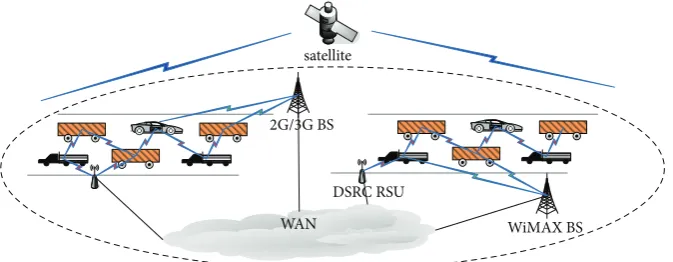
An example of vehicle network built on both direct and
indirect V2V communications is shown inFigure 1, in which
direct V2V communications are enabled with 802.11-like short-range radio for vehicles within a local vicinity. Vehicles equipped with short-range radio can also communicate with a roadside unit (RSU) in range. Alternatively, indirect com-munications can be provided by commercial communication systems, for example, wide area networks (WANs) using satellite or 2 G/3 G cellular base stations (BS) or metropolitan
area networks (MANs) such as WiMAX (IEEE 802.16) [2–4].
satellite
2G/3G BS
WAN
DSRC RSU
[image:3.600.133.470.73.204.2]WiMAX BS
Figure 1: An example of vehicle networks utilizing hybrid vehicle communication technologies.
and potentially excessive delays, which makes indirect V2V communications not the best candidate for real-time safety applications. On the other hand, direct V2V communications will outperform for CSA in terms of both communication performances and cost.
Among direct V2V communication technologies, ded-icated short-range communications (DSRC) have been
regarded as the most promising technology [5,6]. It can
com-plement cellular communications by providing very high data transfer rates, especially important when the applications require low communication latency and relatively small com-munication zones. The technology is expected to be robust
and affordable for large-scale vehicle networks [5–7]. DSRC
has been designed to provide both road safety (e.g., collabora-tive collision warning and collaboracollabora-tive collision avoidance) and commercial services (e.g., navigation, map and Internet
access) [8–11]. The main issues related to the DSRC vehicular
networks have been focused on channel model and mobility
models [10], routing [12], broadcasting [13, 14], security
and privacy, QoS support [15,16], and system performance
evaluation by analytical, simulation, and field test approaches
[17–21]. With regard to collaborative safety applications, more
concerned issues are broadcast schemes, power control and congestion control, and QoS provisioning. Compared to nonsafety applications, road safety applications are known to have strict requirements on reliable and real-time message delivery. Excessive message delay or message loss can cause unexpected negative consequences. The challenge coming from the collaborative safety applications is exaggerated by the fact that the MAC layer of DSRC technology is based on
IEEE 802.11p distributed coordination function (DCF) [22].
With the random channel access specified in the IEEE 802.11 MAC it is hard to achieve deterministic QoS guarantee, even with the enhanced QoS service differentiation mechanisms in
IEEE 802.11e [18,23].
Although a lot of research efforts have been contributed to the individual research problems mentioned above for collaborative safety applications, it is noted that from the system point of view, there are still many research issues to be solved for comprehensive QoS control of vehicle networks before DSRC network based CSA can be assured to be practically useful. These research issues include but are not limited to the following list: (1) What level of QoS can be
realized for DSRC in dynamic vehicle networks? (2) How to adaptively control the QoS of DSRC-based vehicle networks for CSA? (3) How effective are the QoS assurances provided by vehicle networks to CSA services? The first question has been widely studied in the literature by simulations and field tests. Those results show that the QoS assurances in DSRC vehicle networks can be a problem under stressful traffic conditions. The second and the third ones are still open issues. To the best of our knowledge, no effective solution has been reported yet for systematic QoS control of DSRC vehicle networks for CSA. In this paper, we are motivated to pro-pose a QoS control framework for DSRC vehicle networks, aiming to provide some insights into the design of effective QoS support schemes for CSA. Next We briefly overview
CSA applications and DSRC technology in Section 2. The
challenges faced by QoS control in DSRC vehicle networks
are discussed inSection 3.Section 4presents a QoS control
framework which exploits feedback and cross-layer design. A design example of adaptive congestion control is presented
inSection 5. Preliminary results are presented and discussed
inSection 6.
2. Overview of Vehicle Safety
Applications and DSRC
2.1. Typical Vehicle Safety Applications and Communication
Requirements. The QoS provided by DSRC networks should
be viewed within the context of the vehicle safety applications under consideration. It is expected that a wide range of appli-cations including both public safety and private operations will be deployed in order to justify the costs of installing the DSRC hardware. Recently Vehicle Safety Communications Consortium participants identified 34 safety applications that may benefit or be enabled by V2V or V2R communications. These safety applications were ranked according to the estimated benefits, effectiveness, and market penetration. Below are the applications with the highest estimated benefit opportunity for the fifth year after deployment.
(ii) Mid-term: precrash sensing; cooperative forward col-lision warning; left turn assistant; lane change warn-ing; stop sign movement assistant.
(iii) Long-term: cooperative collision warning; intersec-tion collision warning.
In general safety applications have different communi-cation patterns. For example, safety related message trans-missions can be broadcast or unicast. The safety messages may be event-driven (triggered by an event) or periodic (sent automatically at regular intervals). Periodic safety appli-cations (PSA) may transmit safety messages with different frequencies.
The QoS parameters required for safety applications may be varied as well. QoS parameters used widely to evalu-ate wireless communications for vehicle safety applications include maximum required communication ranges, mini-mum throughput, maximini-mum allowable latency, and allowable message failure rate. The maximum required communication range is the effective communication distance for a trans-mission to support a particular application (e.g., 300 m). Maximum allowable latency is an upper bound on the tolerable delay from the instant that a message becomes available for transmission to the instant it is received at the peer safety application layer (e.g., 30 millisecond).
2.2. Multichannel Operation. Next we give a brief overview of
the multichannel operation mechanism specified in the IEEE WAVE system for DSRC. The overall WAVE architecture includes IEEE 802.11p MAC and PHY standards and IEEE 1609.1 to 1609.4 standards (for resource management, security architecture, networking service, and multichannel opera-tion, resp.). IEEE 802.11p uses essentially the same physical layer as 802.11a but operates in a 10 MHz wide channel instead of 20 MHz.
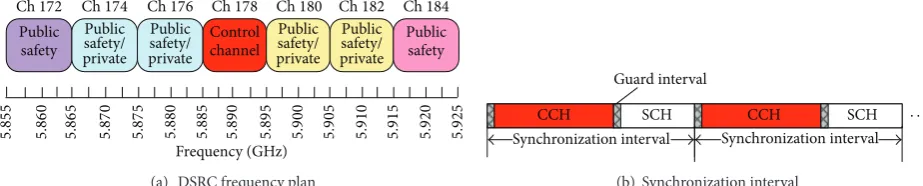
Multichannel operation is a distinctive feature of DSRC technology. In North America, the spectrum allocated to DSRC services in the 5.9 GHz licensed band is divided
into seven channels, as shown inFigure 2(a). Channel 178
is the control channel (CCH) used exclusively for road safety messages and service announcements. The others are service channels (SCH), with Channel 172 dedicated for V2V communications and Channel 184 dedicated for intersections applications. SCH 174 and 176 are shared by medium-range public safety and private services, while SCH 180 and 182 are shared by short-range public safety and private services.
To enable multichannel coordination the IEEE 802.1609 standard for a WAVE system defines functional extensions to the IEEE 802.11 standard. The coexistence of safety and nonsafety applications is achieved through time division multiplexing (TDM). A synchronization procedure has been proposed for TDM channel coordination in the application level, for devices incapable of simultaneously monitoring the CCH and exchanging data on SCHs. In the procedure, a synchronization interval is defined which consists of a CCH interval, a SCH interval, and a guard interval, as shown in
Figure 2(b). All WAVE devices need to monitor the CCH
during the CCH interval. At the beginning of each scheduled channel interval, a guard interval is used to account for
variations in the channel interval and timing inaccuracies. Upon startup a device monitors the CCH until it receives an announcement of service that utilizes an SCH, or it chooses to use the SCH based on received WAVE announcement frames. Clearly, the configuration of CCH interval and SCH interval has a significant impact on the QoS for safety applications as well as on the availability of spectrum resource for nonsafety applications.
3. QoS Control Issues for DSRC Networks
3.1. Research Challenges. The common safety messages for
vehicle safety applications are exchanged mainly in the con-trol channel. Here we focus on the QoS concon-trol for the safety applications over the control channel in DSRC networks. Besides the unreliable wireless channel and multichannel operation, there are many other challenges faced by the QoS control of DSRC networks, which are listed below.
3.1.1. Dynamic Road Traffic. A vehicle may be presented
with different road traffic, urban intersections or highway, at different times. Vehicle traffic is hard to predict and can generate dynamic application traffic. The dynamic safety traffic can overwhelm the control channel in the absence of traffic controls. The DSRC protocols and parameter config-urations should take the worse scenarios into account, but too conservative design and fixed configurations will make overall system performance suboptimal.
3.1.2. Distributed Operation. Most of the safety applications
are based on direct peer-to-peer and broadcast communica-tions. The communication operations are entirely distributed without centralized coordination or control. To prevent broadcast storms, road safety applications are designed to be noninteractive and scalable. The distributed, noninteractive nature of operations increases the difficulties of QoS control in a dynamic environment.
3.1.3. Multiple Safety Applications with Diverse and Strict
QoS Requirements. We mentioned earlier that vehicle safety
applications have diverse and strict QoS requirements. Pro-viding multiple class QoS has been a trouble for wired networks for long time and is not to be easy for dynamic and capacity limited vehicle networks. Network protocols need to be adaptive tuned in order to maximize network throughput while ensuring QoS for safety applications, which further requires efficient feedback on the safety application performances. However, as safety messages are broadcasted, it is unlikely to receive quick feedback on the message deliv-ery. Event-driven safety messages are generated sporadically, which makes the issue of statistic QoS performance feedback worse. Therefore, providing diverse QoS at the MAC layer is very challenging.
3.1.4. Distributed Congestion Control. Critical emergency
Ch172 Ch174 Ch176 Ch178 Ch180 Ch182 Ch184 Public Public safety Public safety safety/ private Public safety/ private Public safety/ private Public safety/ private channel Control Frequency (GHz) 5.85 5 5.86 0 5.86 5 5.87 0 5.87 5
5.880 5.885 5.89
0 5.89 5 5. 90 0 5. 90 5 5. 91 0 5. 91 5 5. 92 0 5. 92 5
(a) DSRC frequency plan
Guard interval
CCH SCH CCH SCH
Synchronization interval Synchronization interval
· · ·
[image:5.600.68.530.74.167.2](b) Synchronization interval Figure 2: DSRC frequency plan and channel synchronization.
Although supported by enhanced MAC QoS mechanisms, emergency safety messages may receive unexpectedly low QoS performances under heavy traffic conditions. Periodic safety messages need to be regulated to prevent from saturat-ing the channel but at the same time should not be controlled too aggressively because they are essential for building mutual awareness. How to fairly and efficiently control congestion in a distributed way is very challenging.
3.1.5. Dynamic Network Topology. Due to high speed
move-ment of vehicles, connectivity of a vehicle with its neighbors can be temporary and very short. The short connectivity makes it very challenging for vehicles to maintain stable relationships and get useful feedback of message delivery performance (e.g., message reception rate and latency).
3.1.6. Random Channel Access. The simple and robust
ran-dom channel access mechanism specified in the IEEE 802.11 standards is one of the reasons for its huge market success. The random channel access mechanism continues to be the foundation of DSRC networks, but it lacks the capability to support QoS guarantees for emergency safety applications. There are many interrelated factors to be considered in the MAC layer for QoS control, for example, how to determine the transmit power to ensure a certain communication range and successful message reception ratio without generating excessive interference.
3.2. Related Work. QoS control has been extensively studied
for cellular networks and general mobile ad hoc networks (MANETs). The most common control mechanisms include call/connection admission control, QoS routing, and message scheduling. However, DSRC network based vehicle safety applications are mainly characterized by broadcast commu-nications, ad hoc networking, and strict QoS requirements. These unique features make the QoS control schemes pro-posed for traditional cellular networks and MANETs not direct solutions to QoS control for vehicle safety applications. QoS control for DSRC based vehicle safety application is still a relatively new research area. It can be achieved through the power control, data rate control, and reliability control. Next we review some initial research efforts towards adaptive power control and congestion control for DSRC networks.
3.2.1. Feedback-Based Power Control. Guan et al. proposed a
feedback-based power control algorithm for vehicular ad hoc
networks [24]. The main idea is that given a target
commu-nication range designated by a vehicle safety application, the power control algorithm should select a transmission power no greater than needed for the target range. The vehicles located beyond the target range of a message selectively send feedback to the message’s sender. The sender counts the num-ber of feedbacks received for that message and compares the number to a predefined threshold. If the number is larger than the threshold, then the transmission power is incremented by a fixed step; otherwise, it is decremented by a fixed step. The idea is simple but the main focus is to reduce power consumption. The algorithm has not considered congestion control and QoS issues. An issue of instability can arise when the channel becomes congested. Under channel congestion, the number of received feedbacks can be small due to message collisions. But the transmit power will be increased according to the power control algorithm, which in turn causes heavier channel congestion.
3.2.2. Collaborative Power Control. Mittag et al. proposed a
distributed power control scheme for vehicle safety
applica-tions [25]. The design aims to ensure strict fairness for the
control of periodic safety messages and leave more space for safety-critical messages. The scheme consists of three main steps.
(i) Each vehicle creates a list for vehicles in the carrier sense range by exchanging periodic messages.
(ii) Each vehicle uses a theoretic model to independently determine the maximal transmit power that can satisfy the minimal channel load requirement for all the vehicles in the list.
(iii) The theoretically determined maximal transmit power is exchanged among vehicles within the transmission range. Each vehicle sets its transmit power to the minimal among the transmit powers determined theoretically by the vehicles in the transmission range.
speed of the proposed congestion control method can be very low in a dynamic network environment.
3.2.3. MAC Layer Blocking. To increase the responsiveness
to channel congestion and provide high channel availabil-ity for safety-critical messages, an optional mechanism for controlling transmission rate has been proposed at the MAC
layer in the IEEE 802.11p specification [22]. A vehicle keeps
monitoring the channel. If the sensed channel occupancy time in a monitoring window is higher than 50%, low priority PSA message transmission attempts are blocked. The drawback of this so-called MAC layer blocking mechanism is that the MAC layer supports either full or zero transmission rate. Also, the conditions to unblock PSA messages at MAC layer are not discussed. The MAC layer blocking mechanism is entirely node-centric, which can not efficiently solve the congestion control problem without vehicle collaboration.
4. A Framework for Cooperative and
Adaptive QoS Control
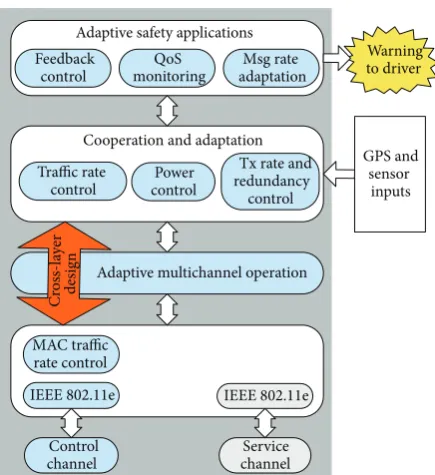
There are many system parameters that have significant impact on the QoS performance provided to vehicle safety applications, for example, transmit power, message rate, CCH interval, and broadcast message redundancy. To date the reported QoS control for DSRC vehicle based safety applica-tions has not been efficient. An effective framework for QoS control of DSRC vehicle networks is highly needed to bring the CSA closer to practice. That framework should allow control of system parameters systematically or individually. It should also effectively cope with dynamic vehicle scenar-ios and maximize the QoS performance for vehicle safety applications. We propose a QoS control framework of DSRC vehicle networks for collaborative road safety applications
over the control channel [26]. It is shown inFigure 3with the
following design goals:
(i) assured high QoS for safety-critical messages; (ii) adaptivity to traffic variations;
(iii) fair channel access; (iv) high spectrum utilization.
The keys in the QoS control framework to achieve the goals are systematic and cross-layer design, vehicle coop-eration, and QoS adaption. As single-layer based QoS control is unlikely to successfully provide QoS for CSA, we exploit systematic and cross-layer design. Vertically the QoS control functions are implemented over three layers, namely, appli-cation layer, transport layer, and MAC layer. Horizontally vehicles cooperate with their neighbors. Feedback and chan-nel/QoS monitoring are used for QoS adaptation in order to provide required QoS and high spectrum utilization. Three main modules are proposed in the QoS control framework with each locating in the three layers to achieve the QoS control functions: adaptive safety applications (ASA) module at the application layer, cooperation and adaptation (CAA) module at transport layer, and MAC layer message rate con-trol (MMRC) module at MAC layer. The detailed functions
Control channel MAC traffic rate control
IEEE 802.11e
Service channel IEEE 802.11e
Warning to driver
GPS and sensor
inputs
Adaptive multichannel operation Feedback
control
QoS monitoring
Msg rate adaptation Adaptive safety applications
Traffic rate control
Power control
Tx rate and redundancy
control Cooperation and adaptation
Cr
oss-la
yer
[image:6.600.319.537.69.307.2]design
Figure 3: QoS control framework.
and interfaces of the modules are explained in the following subsections.
4.1. Adaptive Safety Applications. The ASA module is
respon-sible for three functions: feedback control, QoS monitor-ing, and message rate adaptation. Cooperation among the vehicles and adaptation of system parameters are key design considerations. Adaptivity is highly dependent on availability and accuracy of network and channel condition information. Through feedback and channel monitoring, a vehicle can calculate an approximate estimate of surrounding radio and network conditions. Each vehicle can easily monitor the channel load and the transmission activities of neighboring vehicles. But it still needs feedback from neighboring vehicles to make right adaptation and cooperation decisions. As safety applications are normally broadcast and noninteractive, it is not straightforward to provide feedback at MAC layer without significant modification on the 802.11 MAC layer specification. On the other hand, vehicle safety applications generate safety messages and request QoS from the under-lying networks. The ASA module can easily provide the feedback on the received QoS for safety applications and is the ideal place to implement feedback control function.
The QoS monitoring function in the ASA module is responsible for measuring the actual QoS (such as latency and reception rate) seen by the vehicle safety applications. QoS monitoring should be performed for a relatively long time to make the monitoring results statistically meaningful. If the measured QoS performance is lower than required, the ASA module notifies the CAA module to take necessary actions such as traffic rate control and power control. Additionally the QoS measurement data are sent to neighboring vehicles upon request.
The message rate adaptation function in the ASA module is fairly simple. It informs the CAA module about the range of message rates for different vehicle safety applications. It is a task of the CAA module to determine proper message rates according to safety application requirements and channel congestion levels. The determined message rate is then sent back to the ASA module for use by vehicle safety applications for rate adaptation.
4.2. Cooperation and Adaptation. Among the three modules
in the proposed QoS control framework, the CAA module plays a crucial role because it interacts with both ASA and MMRC modules. The CAA module is responsible for most of the network QoS control functions, for example, message rate control, transmit power control, selection of data rate, and message redundancy mode. Traffic rate, transmit power, data rate, and message redundancy can significantly affect the QoS seen by safety messages. Implementing these functions in the CAA module together can promote intelligent designs. Interactions between the CAA module and the ASA
module have been mentioned inSection 4.1, mainly on the
exchange of feedback, QoS, and message rate information. The CAA module also has interactions with the MMRC
module. As to be introduced in Section 4.3, the MMRC
module is responsible for fast reaction to temporary channel congestion by blocking PSA messages at the MAC layer. Once the percentage of channel occupancy time is monitored to be more than a threshold (e.g., 50%), the MMRC module informs the CAA module about the temporary blocking of PSA messages at the MAC layer. The MMRC module also takes necessary actions if it is requested by the CAA module in case of low QoS being observed at the ASA module.
Message rate control and power control are mainly used to address channel congestion in the CAA module. Unlike the very simple message blocking function in the MMRC mod-ule, Both rate control and power control at the CAA module are much more dynamic and complex with multiple levels. According to the monitored QoS and channel load levels, the CAA module can cooperatively and jointly adjusts the power level, message rate, and other QoS control measures. A design example of cooperative and adaptive rate control will
be presented inSection 5.
4.3. MAC Layer Message Rate Control. The MMRC module
is located at the MAC layer to provide fast congestion mitigation. If a congestion event occurs, low priority PSA messages are blocked immediately at the MAC layer for a certain time. Message rate control at the MAC layer is quite
simple with only two states, unblockedand blocked. In the
unblockedstate, all messages entering the MAC queue will
attempt transmissions. In theblockedstate, low priority PSA
messages are transmitted at a low rate to update statuses (e.g., congestion state, position, speed, direction, etc.).
If a vehicle’s MAC layer isblocked, a closely related issue is
when the MACblockedstate should be returned tounblocked.
Two MAC unblocking algorithms are suggested below.
Fixed Unblock. PSA messages are unblocked if no
conges-tion event happens in the following 𝑇blk,𝑓 synchronization
intervals since the last congestion event happened. As the channel congestion may happen simultaneously for a cluster of vehicles, the unblocking action for those vehicles can be synchronized. For example, in a single hop DSRC vehicle network, all vehicles sense the same channel load. Therefore, MAC blocking and unblocking are fully synchronized for the vehicles, resulting in possible high message collisions and low channel utilization.
Random Unblock. A simple way to solve the synchronization
problem of theFixed Unblockalgorithm is to randomize the
waiting times for unblocking. For example, once a vehicle is blocked due to a congestion event, it chooses to wait
for a random time in the range of [1, 𝑇blk,𝑟] before being
unblocked. Here𝑇blk,𝑟is a configurable parameter.
The MAC unblocking algorithms can be used alone or jointly with the transport layer algorithms for congestion control. Next we will provide a design example to evaluate the congestion control performances.
5. A Design Example
In this section, we present a design example of message rate control function in the CAA module, to illustrate some of the ideas for adaptive and cooperative congestion control described in the previous section. To facilitate the discussion, we define two channel congestion events:
(i) a direct channel congestion event (𝐸dir) happens if
the channel occupancy time sensed by the vehicle is higher than 50% in a synchronization interval.
(ii) an indirect channel congestion event (𝐸ind) happens
if the vehicle receives a message from a neighboring
vehicle indicating an𝐸direvent.
We further define network congestion events for the purpose of rate control. We can design so-called nonco-operative and cononco-operative rate control schemes according to their responses to the channel congestion events. In noncooperative rate control schemes, a network congestion
event is said to happen only if𝐸dir events happen. On the
other hand, in cooperative rate control schemes, a network
congestion event is said to happen if either𝐸diror𝐸indevents
happen at least 𝑁guard synchronization intervals (denoted
SYN-I) after the last MAC blocking action. The configurable
parameter 𝑁guard is used to protect a vehicle from being
20 30 40 50 60 70 0
5 10 15 20 25 30
Number of nodes
T
ime in MA
C b
lo
ckin
g (%)
Noncooperative rate control Cooperative rate control
Fixed rate: 4message/s
[image:8.600.312.544.72.279.2]Fixed rate: 8message/s
Figure 4: Average percentage of time after PSA messages are blocked at MAC layer.
After a network congestion event occurs, congestion can be mitigated by either MAC blocking in the MMRC module or rate control in the CAA module. The CAA module can adaptively control the message rate for low priority PSA. Suppose that the message rate for PSA varies in the
range of [𝑅0, 𝑅𝑀]. Here we use a simple additive-increase
multiplicative-decrease (AIMD) algorithm for message rate
adaptation [27]. When a node joins a vehicle network, it starts
afast start mode for its message rate. The message rate is
initially set to the lowest message rate𝑅0 and increases by
one in every𝑁fast SYN-I. This increase continues until the
rate reaches the upper bound𝑅𝑀or a network congestion
event occurs. After the message rate reaches𝑅𝑀, it remains
at𝑅𝑀as long as no congestion event occurs. Upon a network
congestion event, half of the currently used message rate is saved as the so-called fast start threshold and fast start begins
again from𝑅0after PSA messages are unblocked at the MAC
layer. Once the message rate reaches the fast start threshold,
the rate control enters acongestion avoidance modewhere the
message rate increases by one in every𝑁slowSYN-I. By default
𝑁slowis set to be larger than𝑁fast. In thecongestion avoidance
mode, the message rate for PSA remains at𝑅𝑀after it reaches
𝑅𝑀. If a new network congestion event occurs, the process for
network congestion event is repeated.
In the next section, the above proposed message rate control algorithms will be evaluated and compared to the MAC layer message blocking algorithms.
6. Simulation Results
We implemented a discrete-event driven simulator to eval-uate four DSRC rate control schemes. Two schemes are configured with a fixed message rate of 4 message per second
(mps) and 8 mps andRandom Unblockin the MMRC module,
which are referred to as the FRRU-4 and FRRU-8 schemes,
20 30 40 50 60 70
0 2 4 6 8 10 12
Number of nodes
St
an
da
rd
de
via
tio
n o
f p
er
cen
ta
ge
o
f time
in MA
C b
lo
ckin
g (%)
Noncooperative rate control Cooperative rate control
Fixed rate: 4message/s
[image:8.600.61.283.73.279.2]Fixed rate: 8message/s
Figure 5: Standard deviation of the MAC blocking time for network with 70 nodes.
Noncooperative rate control Cooperative rate control
Fixed rate: 4message/s
Fixed rate: 8message/s
20 30 40 50 60 70
60 80 100 120 140 160 180 200 220 240
Number of nodes
A
verag
e n
u
m
b
er o
f r
ecei
ve
d mes
sag
es
Figure 6: Average number of successfully received messages per second.
respectively. The parameter𝑇blk,𝑟was configured to 10 SYN-I
for theseRandom Unblockschemes. The other two schemes
are adaptive rate control withFixed Unblockin the MMRC
module and either noncooperative or cooperative rate control in the CAA module. The adaptive rate control schemes are denoted by N-CRFU scheme and CRFU scheme, respectively.
The parameter𝑇blk,𝑟was configured to 1 SYN-I for theFixed
Unblockschemes. The range for message rate was set to𝑅0= 1
and𝑅𝑀= 10mps for the𝑁-CRFU and CRFU schemes. Each
PSA message has a fixed length of 300 bytes.
[image:8.600.315.543.332.538.2]20 30 40 50 60 70 0.91
0.92 0.93 0.94 0.95 0.96 0.97 0.98 0.99 1
Number of nodes
M
es
sag
e r
ecep
ti
o
n
ra
tio
Noncooperative rate control Cooperative rate control
Fixed rate: 4message/s
[image:9.600.58.284.72.282.2]Fixed rate: 8message/s
Figure 7: Probability of successful message reception.
distribution over the lanes. IEEE 802.11p was configured with
a backoff window𝑊min = 28for PSA and physical data rate
of 3 Mbps. Both transmission and carrier sensing range were set to 200 m. Synchronization interval parameters were set
to 𝑡syn = 50ms and 𝑡cch = 25ms. Adaptive rate control
parameters were configured to𝑁guard= 20,𝑁fast= 1,𝑁slow=
15, and 𝑝mb = 0.3. We performed 20 simulations runs to
obtain an average overall runs for each point in the following graphs. Each simulation ran for 500 seconds.
For the 𝑁-CRFU and CRFU schemes, the probability
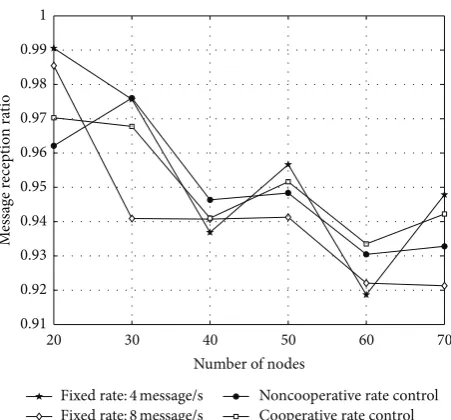
that a new MAC blocking event occurred during the time of MAC blocking was very low (smaller than 1%). Therefore, we can assume that the control channel was highly available for ESA messages. The performance measures of interest include how the vehicles were blocked at the MAC layer, the rate of successfully received messages, and probability of successful
message reception.Figure 4presents the network-wide
aver-age percentaver-age of time of PSA messaver-ages being blocked at the MAC layer. The percentage of MAC blocking time was zero
for FRRU-4 but increased sharply for FRRU-8 for large𝑁due
to a lack of adaptation to increased traffic load. MAC blocking
time was very close for the𝑁-CRFU and CRFU schemes and
increased smoothly with𝑁. Figure 5presents the standard
deviation of percentage of MAC blocking time. The standard deviation of MAC blocking time for the N-CRFU scheme was much larger than that for the CRFU scheme by up to 200%. The results demonstrate that the CRFU scheme can achieve fairer channel access and prevent some vehicles from remaining congested for a long time while at negligible cost for the other performance measures.
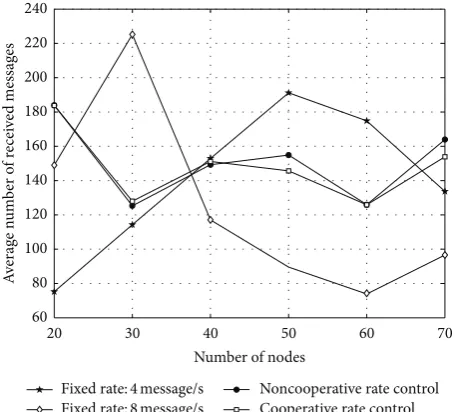
Figure 6 presents the average number of successfully
received messages per second at each node (denoted by𝑁rec).
𝑁recfor the FRRU-4 scheme increases linearly from 75 mps
for network with 20 nodes to 190 mps for 50 nodes and then drops to 132 mps for 70 nodes. Clearly spectrum utilization
for the FRRU-4 scheme is very low with light traffic.𝑁recfor
FRRU-8 is initially 150 mps for 20 nodes but drops quickly
to 96 for 70 nodes. By contrast,𝑁recfor both𝑁-CRFU and
CRFU schemes remains at a high level for all the investigated network scenarios, which demonstrates the effectiveness of the proposed rate control schemes on adapting to dynamic traffic loads. It is noted that intersection of the two curves for schemes FRRU-4 and FRRU-8 is present. The reasons can be explained as follows. When there are a small number of nodes in the network, congestion is not a major problem and the numbers of transmitted and successful messages are both larger for scheme FRRU-8. With increased number of nodes in the network, congestion becomes a serious problem for schemes with high message rate. Scheme FRRU-8 sees severe congestion and has very low number of received messages per second. In this case, the fixed rate scheme with lower message rate will perform better. Theoretically we may say that for static vehicle networks (e.g., with fixed number of nodes and fixed node locations), we could find an optimal message rate to get the highest number of received messages per second and have a centralized entity to determine the optimal mes-sage rate and control the network configuration. However, with a large scale vehicle ad hoc network, it is unlikely to have static vehicles uniformly distributed in the network. It is also difficult and expensive to deploy centralized entities for the rate adaptation purpose. Estimation of the number of nodes in the network is also challenging. Therefore, distributed rate adaptation algorithms are desirable for preventing and mitigating congestions without deployment of centralized controllers.
Figure 7 presents the average probability of successful
message reception (denoted by𝑝suc) over the nodes in the
network. The probability of successful message reception for a node is calculated as the average probability of its messages being successfully received by the neighbors in the node’s transmission range. The overall trend for all the
rate control schemes is that𝑝suc decreases with increasing
number of nodes but is high even with 70 nodes. The achieved
high𝑝succan be explained by either random MAC blocking
function in fixed rate schemes or rate adaptation function
in𝑁-CRFU and CRFU schemes, which successfully prevent
excessive channel congestion. For the results of message success probability, it is worthy of note that there is no direct relationship between the message success probability and the message rate used in the fixed rate scheme, due to the use of MAC layer random blocking mechanism, which can stop transmission of messages once the detected congestion level is higher than a threshold. It is also observed that there is a peak with 50 nodes for scheme FRRU-4. The reason of such a peak can also be explained by the use of the random blocking mechanism in the MAC layer.
7. Conclusions
QoS control in DSRC vehicles and proposed a QoS control framework to provide cooperative and adaptive QoS for road safety applications. The proposed control framework consists of three major modules: ASA module, CAA module, and MMRC module. Vehicle cooperation and cross-layer design were design principles in the modules to achieve effective and robust QoS performance.
We presented a design example on the cooperative and adaptive rate control to illustrate the key ideas proposed in the QoS control framework. Four rate control schemes (two schemes with fixed message rate and MAC layer PSA message blocking, two schemes with rate adaptation at the CAA mod-ule) are proposed and compared by simulations. Simulation results demonstrate the effectiveness of adaptive rate control at the CAA module in terms of adapting to dynamic traffic conditions. It is also observed that cooperative rate control scheme can provide fairer channel access for PSA messages than noncooperative rate control scheme.
Acknowledgments
The work is supported by the UK Engineering and Physical Sciences Research Council (EPSRC) with Grant reference
no. EP/1010157/1 and partially supported by the National
Natural Science Foundation of China (NSFC) under Grant no. 61103177.
References
[1] J. Broch, D. Maltz, D. Johnson, Y. Hu, and J. Jetcheva, “A Performance comparison of multi-hopwireless Ad Hoc nework routing protocols,” inProceedings of the 4th annual ACM/IEEE International Conference on Mobile computing and Networking
(MobiCom ’98), 1998.
[2] G. Jeffrey Andrews, A. Ghosh, and R. Muhamed,Fundamentals
of WiMAX: Understanding Broadband Wireless Networking,
Pearson Education, 2007.
[3] H. Holma and A. Toskala, LTE For UMTS: Evolution To
LTEAdvanced, John Wiley & Sons, New York, NY, USA, 2011.
[4] J. He, K. Guild, K. Yang, and H.-H. Chen, “Modeling contention based bandwidth request scheme for IEEE 802.16 networks,”
IEEE Communications Letters, vol. 11, no. 8, pp. 698–700, 2007.
[5] J. Zhu and S. Roy, “MAC for dedicated short range communi-cations in intelligent transport system,”IEEE Communications
Magazine, vol. 41, no. 12, pp. 60–67, 2003.
[6] D. Jiang, V. Taliwal, A. Meier, W. Holfelder, and R. Herrtwich, “Design of 5.9 GHz DSRC-based vehicular safety communica-tion,”IEEE Wireless Communications, vol. 13, no. 5, pp. 36–43, 2006.
[7] S. Biswas, R. Tatchikou, and F. Dion, “Vehicle-to-vehicle wire-less communication protocols for enhancing highway traffic safety,”IEEE Communications Magazine, vol. 44, no. 1, pp. 74– 82, 2006.
[8] M. Faezipour, M. Nourani, A. Saeed, and S. Addepalli, “Progress and challenges in intelligent vehicle area networks,”
Communi-cations of the ACM, vol. 55, no. 2, pp. 90–100, 2012.
[9] X. Wu and S. Subramanian, “Vehicular communications using DSRC: challenges, enhancements, and evolution,”IEEE Journal
on Selected Areas in Communication, vol. 31, no. 9, 2013.
[10] S. Zeadally, R. Hunt, Y.-S. Chen, A. Irwin, and A. Hassan, “Vehicular ad hoc networks (VANETS): status, results, and challenges,”Telecommunication Systems, vol. 50, pp. 217–241, 2012.
[11] W. Guan, J. He, C. Ma, Z. Tang, and Y. Li, “Adaptive Message Rate Control of Infrastructured DSRC Vehicle Networks for Co-existing Road Safety and Non-safety Applications,”
Interna-tional Journal of Distributed Sensor Networks, vol. 2012, Article
ID 134238, 8 pages, 2012.
[12] M. Eiza and Q. Ni, “An evolving graph-based reliable routing schemefor VANETs,”IEEE Transactions on Vehicular Technol-ogy, vol. 624, pp. 1493–1504, 2013.
[13] F. J. Ros, P. M. Ruiz, and I. Stojmenovic, “Acknowledgment-based broadcast protocol for reliable and efficient data dissem-ination in vehicular ad hoc networks,”IEEE Transactions on
Mobile Computing, vol. 11, no. 1, pp. 33–46, 2012.
[14] X. Ma, J. Zhang, X. Yin, and K. S. Trivedi, “Design and analysis of a robust broadcast scheme for VANET safety-related services,”IEEE Transactions on Vehicular Technology, vol. 61, no. 1, pp. 46–61, 2012.
[15] K. A. Hafeez, L. Zhao, B. Ma, and J. W. Mark, “Performance analysis and enhancement of the DSRC for VANETs safety applications,”IEEE Transactions on Vehicular Technology, vol. 62, no. 7, pp. 358–363, 2013.
[16] M. I. Hassan, H. L. Vu, T. Sakurai, and L. L. H. Andrew, “Effect of retransmissions on the performance of the IEEE 802.11 MAC protocol for DSRC,”IEEE Transactions on Vehicular Technology, vol. 61, no. 1, pp. 22–34, 2012.
[17] S. I. Sou, “Modeling emergency messaging for car accident over dichotomized headway model in vehicular Ad-hoc networks,”
IEEE Transactions on Communications, vol. 61, no. 2, 2013.
[18] J. He, Z. Tang, T. O’Farrell, and T. M. Chen, “Performance anal-ysis of DSRC priority mechanism for road safety applications in vehicular networks,”Wireless Communications and Mobile
Computing, vol. 11, no. 7, pp. 980–990, 2011.
[19] F. Martelli, M. E. Renda, G. Resta, and P. Santi, “A Measurement-based study of beaconing performance in IEEE 802.11p vehicu-lar networks,” inProceedings of the International Conference on
Computer Communications (INFOCOM ’12), 2012.
[20] J. Yin, T. Elbatt, G. Yeung et al., “Performance evaluation of safety applications over DSRC vehicular ad hoc networks,” in
Proceedings of the 1st ACM international workshop on Vehicular
ad hoc networks table of contents (VANET ’04), pp. 1–9, 2004.
[21] N. Nasiriani, Y. P. Fallah, and H. Krishnan, “Stability analysis of congestion control schemes in vehicular Ad-hoc networks,”
in Proceedings of the IEEE Consumer Communications and
Networking Conference (CCNC ’13), 2013.
[22] IEEE 802. 11p/d3. 05, “Draft amendment for wireless access for the vehicular environment (WAVE),” 2008.
[23] IEEE Std.802.11e, “Wireless LAN medium access control (MAC) enhancements for quality of service (QoS),” 2005.
[24] X. Guan, R. Sengupta, H. Krishnan, and F. Bai, “A feedback-based power control algorithm design for VANET,” in Pro-ceedings of the Mobile Networking for Vehicular Environments
(MOVE ’07), pp. 67–72, 2007.
[26] W. Guan,Adaptive QoS control of DSRC vehicle networks for
collaborative vehicle safety applications [Ph.D. thesis], Swansea
University, 2013.
[27] J. He, H.-H. Chen, T. M. Chen, and W. Cheng, “Adaptive conges-tion control for DSRC vehicle networks,”IEEE Communications
Submit your manuscripts at
http://www.hindawi.com
Control Science and Engineering Journal of
Hindawi Publishing Corporation
http://www.hindawi.com Volume 2013
Machinery
Hindawi Publishing Corporation
http://www.hindawi.com Volume 2013Part I
Hindawi Publishing Corporation
http://www.hindawi.com Volume 2013
Distributed
Sensor Networks
International Journal of
ISRN
Signal Processing
Hindawi Publishing Corporation
http://www.hindawi.com Volume 2013
Hindawi Publishing Corporation
http://www.hindawi.com Volume 2013
Mechanical Engineering
Advances in
Modelling & Simulation in Engineering
Hindawi Publishing Corporation
http://www.hindawi.com Volume 2013
Advances in OptoElectronics
Hindawi Publishing Corporation
http://www.hindawi.com Volume 2013
ISRN
Sensor Networks Hindawi Publishing Corporation
http://www.hindawi.com Volume 2013
VLSI Design
Hindawi Publishing Corporation
http://www.hindawi.com Volume 2013
Hindawi Publishing Corporation
http://www.hindawi.com Volume 2013
Hindawi Publishing Corporation
http://www.hindawi.com Volume 2013
The Scientific
World Journal
ISRN Robotics Hindawi Publishing Corporation
http://www.hindawi.com Volume 2013
International Journal of
Antennas and
Propagation
Hindawi Publishing Corporation
http://www.hindawi.com Volume 2013
ISRN Electronics Hindawi Publishing Corporation
http://www.hindawi.com Volume 2013 Hindawi Publishing Corporation
http://www.hindawi.com Volume 2013
Journal of
Sensors
Hindawi Publishing Corporation
http://www.hindawi.com Volume 2013
Electronic Components
Chemical Engineering
International Journal of
Hindawi Publishing Corporation
http://www.hindawi.com Volume 2013 Hindawi Publishing Corporation
http://www.hindawi.com Volume 2013 Electrical and Computer Engineering
Journal of
ISRN
Civil Engineering Hindawi Publishing Corporation
http://www.hindawi.com Volume 2013
Advances in
Acoustics &
Vibration
Hindawi Publishing Corporation