City, University of London Institutional Repository
Citation:
Geilinger, N., Haefliger, S., Von Krogh, G. and Rechsteiner, L. (2016). What makes a social practice? Being, knowing, doing and leading. European Management Journal, 34(4), pp. 319-327. doi: 10.1016/j.emj.2016.04.006This is the accepted version of the paper.
This version of the publication may differ from the final published
version.
Permanent repository link:
http://openaccess.city.ac.uk/15699/Link to published version:
http://dx.doi.org/10.1016/j.emj.2016.04.006Copyright and reuse: City Research Online aims to make research
outputs of City, University of London available to a wider audience.
Copyright and Moral Rights remain with the author(s) and/or copyright
holders. URLs from City Research Online may be freely distributed and
linked to.
What makes a social practice?
Being, knowing, doing and leading
Nina Geilinger (corresponding author) ETH Zurich
Department of Management, Technology and Economics Weinbergstr. 56
8092 Zurich Switzerland
Georg von Krogh ETH Zurich
Department of Management, Technology and Economics Weinbergstr. 56
8092 Zurich Switzerland [email protected]
Stefan Haefliger
City University London Cass Business School 106 Bunhill Row London EC1Y 8TZ United Kingdom
Lise Rechsteiner ETH Zurich
Department of Management, Technology and Economics Weinbergstr. 56
8092 Zurich Switzerland
What makes a social practice?
Being, knowing, doing and leading
Abstract
Despite several decades of work on social practice, many open intriguing questions
remain about their existence and functions within an organizational context. In this article, we
discuss the “inherent logics” of social practice—being, knowing, and doing—to depict the
meaning and mainspring of its conservation within an organizational context. We argue that
the understanding of social practice in organization and management studies has
predominantly focused on the internal workings of social practice, and we propose that a
contextualization of the inherent logics of social practice may be a next step in advancing
theory and empirical research. We propose a contested coexistence of social practices in
organizations and thereby argue that the conservation of social practice protrudes another
element belonging to its inherent logics, i.e., leading. We suggest that leadership in distributed
and adaptive organizations responds to innovation and competitive challenges with wisdom,
care, and fluidity.
Keywords:
• Social practice
• Leadership
• Formal organization
• Informal organization
• Collective action
1. Introduction
Social practices are not possible to think away in contemporary organization theory. They
engulf forms of working and living, provide meaning and direction, afford safety and routine,
engender collective standards and instil ambitions. Without social practices, organizations are
empty shells likened to long abandoned and decaying factories photographed by Timm Suess
(see http://timmsuess.com/). One can only imagine the contrast—what they were like and how
likeable they were back then, when they pulsated with the rhythmic noise of practising
craftsmen working in concert to produce their wares. As organization scholars, we are often
impressed by the vigour and energy of social practices: how much more lively they appear
than the empty shell of the formal organization housing them. It is not surprising, then, that
we are also often prepared to leave our functionalist understanding of organizations behind to
turn to social practices and embrace their unfolding dynamics. However, as we complete our
“practice turn” and redirect investigations, it may also be too easy to oversee that social
practices necessitate organization structure and function, and vice versa (Ben-Menahem, von
Krogh, Erden, & Schneider, 2015; Giddens, 1984; Whittington, 2006). At least, as a function
of producing some form of collective good, social practice inspires quality in work and a
narrative in the individual’s working life (MacIntyre, 1981).
Although many definitions of social practice exist, we draw attention to one by
MacIntyre: “any coherent and complex form of socially established cooperative human
activity through which goods internal to that form of activity are realized in the course of
trying to achieve those standards of excellence which are appropriate to, and partly definitive
of, that form of activity, with the result that human powers to achieve excellence, and human
conceptions of the ends and goods involved, are systematically extended” (MacIntyre, 1981,
stands to reason, then, that social practices may seek various ways to achieve and redefine
standards of excellence.
The “practice turn” in organization studies understands organizational processes and
phenomena as manifestations of underlying practices of work (e.g., Brown & Duguid, 1991;
Schatzki, Cetina, & Savigny, 2001). For example, in organization and management research,
this perspective shaped the important field of “strategy-as-practice” (Golsorkhi, Rouleau,
Seidl, & Vaara, 2010; Jarzabkowski, 2004; Whittington, 2006). Accordingly, organizational
activities are manifested by “strategizing”, i.e., the practising of strategy making in
organizations, examining the underlying organizational activities of the work that is being
accomplished. The practice turn also takes another perspective of organizations (Erden,
Schneider, & von Krogh, 2014). In addition to the distinct types of practising as in
“conducting work”, it offers a renewed view of the social entities that constitute the
organization that is enabling and conducting the work. The focus turns to the type of
practising that is being done, who or what entities are conducting the practising, and how the
interplay of the entities might affect organizational dynamics and work in a broader
organizational context. Although a first glance at social practice directs our attention to its
internal learning and dynamics, a contextualized view of social practice also reveals its
conserving side in an organization’s protection of its ways of doing, being and knowing for
the production of what it defines as its “internal goods” (MacIntyre, 1981).
Innovation across practice boundaries has proven difficult because of the epistemic,
social, and cognitive idiosyncrasy of social practices (Ferlie, Fitzgerald, Wood, & Hawkins,
2005; Swan, Scarbrough, & Robertson, 2002). As an informal organization, a social practice
may produce resistance to change enacted by ingrained work routines (Zietsma & Lawrence,
open to further re-negotiations” (p. 611). Precisely this delicate characteristic of practices may
elevate the efforts by practitioners to conserve the status quo and to protect their identity and
way of conducting work, particularly if and when confronted with external pressure towards
change and re-negotiation. The conserving function of an informal organization is upheld by
the social practices in a formal organization. Practitioners in social practices share a
historically and socially contextualized identity, which enables them as individuals and
collectives to conduct work and thereby to establish a collective meaning-making of that work
(Brown & Duguid, 1991; Lave & Wenger, 1991; Wenger, 1998). The reach of social practices
may go beyond formal boundaries of the organization and occupational jurisdictions; for
instance, the practices of medicine, nursing, and caregiving may cross the boundaries of
hospitals, homes and doctors’ offices, and practitioners may include doctors, informal
caregivers, nurses and other health professionals. A social practice may emerge around the
use of a new technology for medical treatment that includes practitioners from different
occupational groups—i.e., nurses, surgeons, and radiologists—working intensively on the
promotion and defence of its use, which over time percolates into a new shared practice.
Organizations of some size house many coexisting social practices (cf MacIntyre, 1981;
Wenger, 1998) that, on the one hand, depend on each other in the context of organizational
work and, on the other hand, may compete for scarce resources (cf. nursing and medicine in a
hospital). Coexisting practices also need to grapple with the constant pressure for change and
adaptation as exerted on members of a formal organization. The core argument we make is as
follows: The inherent logic of social practices constitutes a key domain in management and
organization studies (Bourdieu, 1990), and has often been examined from an internal
perspective (e.g., practising). Researchers have been somewhat less concerned with how the
influencing the sustainability and conservation of social practice itself1. We know how a
formal organization may influence social practices by providing encouraging support and the
necessary resources and by putting pressure on social practices for adaptation and reform
(Barley & Tolbert, 1997; Thompson, 2005). The dynamic relation between formal
organization and social practices is constitutive for both (Ben-Menahem et al., 2015; Giddens,
1984). We will add here, however, that the interplay of social practices within the same
organizational context may have a similarly important constitutive function. The conserving
disposition of social practices, then, might be explained through its protective measures to
safeguard what it is (being), what it does (doing), and what it knows (knowing) from other
social practices in an organization.
However, we contend that potential goal conflicts—rather than a state of goal congruence
or even harmony between social practices—occur in organizational life (Erden et al., 2014).
Potential goal conflicts tend to surface around the scarcity of resources or the formulation and
development of organization-wide policies and procedures. Note here that rather than
speaking of work-related conflict between people embedded in practices (e.g., a doctor and
nurse in a hospital, a psychologist and an economist in an academic department), we find it
meaningful to argue that the conflicts to some degree originate from inherent conflicts
between distinct social practices. Distinction is constitutive of social practices because it
elicits boundaries. Being in a social practice simultaneously means not being something else
(a practitioner of medicine, not of nursing); knowing something may also mean the rejection
of knowing something different (medical knowledge, not aroma therapy); and doing some
work is also refraining from doing other work (doing surgery but not patient care). A brilliant
analysis that exemplifies this point is Bent Flyvbjerg’s (2001) book on the struggles between
the natural sciences and the social sciences. As members of a social practice, for example,
many social scientists may reject the notion that (natural) scientists can produce any
meaningful knowledge of social phenomena.
The conservation of social practice is about a struggle for relevance and survival against a
multiplicity of social practices within the frames of a changing formal organization. A
contested co-existence reveals the necessity of social practices that possess a capacity for
addressing competing pressure from within an organization to protect their own distinct
practice. The capacity for addressing competing pressure, however, needs not only protection
but also a sense of balance, coexistence, and integration (Beadle & Moore, 2006). The role of
the manager is a difficult one because it often sits between and across social practices (and
associated ways of being, knowing and doing). Here, we hope to contribute an angle for
discussion and future research. Integrating the work and coexistence of social practices is a
leadership challenge: We contribute to building a research agenda for management as a social
practice (owing to Beadle and Moore (2006)) and for the role of individual development to
accept and to cede authority around the leadership in social practice (Laloux, 2014). We argue
that this capacity takes the shape of leadership that differs from traditional formal managerial
roles in organizations.
In moments of conflict between social practices, each practice may bring forth a
distributed and internal capacity of leadership that is a necessary condition for its absorption
of resources and sustainability in the face of change. This capacity for distributed leading in
social practice may partly explain why some social practices survive as others decay and
wither, leaving empty shells behind. We suggest how (distributed) leading in social practices
in a potentially contested organizational context is a complementary part of its inherent logics
discuss the established logics of social practices. Then, we move on to describe the interplay
of social practices in organizations and thereby argue for leading as a complementary inherent
logic of social practice.
2. Inherent logics of social practice
What are the inherent logics of social practices? In other words, what conditions need to
be present before we can meaningfully speak of a social practice? We find it useful to think
about how members of an informal organization become practitioners in a distinct social
practice through what they are, do and know, reflecting the dimensions of “being”, “knowing”
and “doing”2.
Practitioners share a socially and historically contextualized identity, a collective being
that enables meaning-making in and around work. Meaning-making in practice is constantly
(re-)negotiated between practitioners shaped by work and the adaptations in learning and
conduct that changing work requires. The being in social practice is not necessarily consistent
with professional identity, although it might often be an important element of work-related
identity formation (Anteby, Chan, & Dibenigno, 2016). Being in social practices necessarily
creates boundaries (Zietsma & Lawrence, 2010). Ferlie et al. (2005) demonstrate how the
self-sealing aspect of professional communities of practices resist change from other, identical
entities by identifying themselves through social, cognitive, and epistemic boundaries.
The epistemic boundaries making up the knowing of social practice tightly connect to
collective meaning-making. Knowing enables the understanding and interpretation of data
and information within the context of work (Brown & Duguid, 2001; Castellani & Hafferty,
2009; MacIntosh, Beech, Antonacopoulou, & Sims, 2012; Orlikowski, 2002). Knowing is
also the individual and collective potential to act, to solve problems, to make decisions, and to
engage with tasks (Nonaka & von Krogh, 2009). Organizational knowledge resides in and
manifests through the social practices of an organization (Nicolini, 2011), and is a tool used to
accomplish the work of social practice (Sandberg & Pinnington, 2009). Expertise and
interests are considered constitutive parts of social practice (Kellogg et al., 2006).
Doing is the socially contextualized ongoing accomplishment of work. Being and
knowing concurrently (re-)emerge with doing, informing action by collective
meaning-making. Again, the dimension of doing of a social practice goes beyond professionally and
occupationally bounded categories of work (Swan et al., 2002) because the work done may go
beyond and across professional boundaries. Within traditional organizational structures, such
as those found in a hospital, we might also see social practices going beyond professional
boundaries, as in Kellogg’s (2012) study that reveals how reformer alliances emerged across
occupational identities. Doing in social practice entails practitioners’ engagement in work and
their protective efforts to maintain routines (Zietsma & Lawrence, 2010). The boundaries of
social practice function as a stabilizing element in an organization. Doing can be considered
constituted by the distinct types of practising, i.e., the conduct of work—whether that is
strategizing, planning, executing, managing, or other doing-in-practice. The use of artefacts
and tools is another element of doing in social practice (see Kellogg et al., 2006).
The inherent logics of social practices may be thought of as recursive because they
emerge in concert, mutually influencing one another. In other words, none of them exists in
isolation or prior to the others. They also demonstrate the conserving shadow of social
practice—enforcing a singular and distinct social entity of a “constantly disputed terrain”,
inhabited by both “sharing and harmony” and “dissent and conflict” (Gherardi 2015a, p. 15).
being, knowing, and doing are tightly intertwined (Gherardi, 2015b) and whose interactive
“codes” are necessary to follow for the effective functioning of the practice. Although social
practices can reduce individual uncertainty, improve the sharing of tacit knowledge, tighten
routines, improve learning, and increase efficiency, they may by nature also be conserving.
However, within organizations where structural changes may be dramatic or frequent, how do
distinct social practices fare? What factors affect their survival?
Think of different occupational groups such as nurses, surgeons and radiologists meeting
on a daily basis and conducting their work in collaboration. Although their doings clearly
coincide as streams of problems, people, choices, or solutions in a garbage-can-like fashion
(Cohen, March, & Olsen, 1972), the practitioners’ being, knowing, and doing remain distinct
and commonly expressed through a certain collegiality and solidarity, which comes to the fore
particularly in conditions of disagreement between them. For example, in a disagreement
about the appropriate method of treating a patient, radiologists may favour minimally invasive
surgery, and surgeons may favour open surgery, each emphasizing their particular expertise
and role allocation in the procedure to be conducted. Such a disagreement may also be
expressed as a conflict along the being dimension of social practice. Kellogg (2012) brilliantly
shows how surgeons were forced to take a stance between their own practice and the side of
reformers in introducing new working hours. The practitioners themselves forced other
practitioners to remain part of the practice or to be closed off, using the traditional identity
dimension of masculinity to block change and adaption (Kellogg, 2012).
For the second hospital in the same study (Kellogg, 2012), the conflict did not play out as
intensively, possibly blurring the previously clear distinctions between interns and surgeons
and decreasing the persistence of traditional values of masculinity. Although the social
might mean for sustaining the social practice. In other words, how much can being be
changed before the practice has to be redefined? As Kellogg’s study shows, when change
happens in a formal organization, people in social practices may feel threatened. They might
turn inward and away from the social practice or run out to seek alliances elsewhere. One
option for practitioners is to create what Cyert and March (1963) called a “dominant
coalition.” A dominant coalition, however, seems to regard only specific interests of people.
When being, i.e., the practice-based identity, is at stake, an informal organization and its
practitioners might be expected to attempt to conserve their practice.
The conserving role of a social practice may disclose itself by the lack of formal
recognition of its boundaries. Boundaries, as discussed above, result from distinctions in
being, knowing, and doing. In addition, the constant renegotiation of the inherent logics inside
a social practice makes it more susceptible to external pressure (Gherardi & Perrotta, 2010).
The notion of social practices’ boundaries calls attention to the contextualization of social
practices inside organizations. Social practices have often been studied with a focus on their
internal dynamics or boundaries (seminal work includes Carlile, 2002; Lave & Wenger, 1991;
Wenger, 1998). To extend the internal view, it may be beneficial to zoom out onto the larger
organizational context and then to see how distinctions made by other social practices shape
the boundaries of a focal social practice. For example, it may be that medical doctors do not
feed or clean patients because they and others define the activities to be within the social
practice of nursing. Therefore, medical doctors draw the boundaries around the social practice
of nursing by excluding nursing practices from their own social practice.
The literature that examines the coordination of professional groups and entities similar
to social practices as defined here offers insight on how work gets done at the intersection of
between practices (Carlile, 2002). Ferlie et al. (2005), for example, examine the cognitive and
social boundaries between professional groups that hinder knowledge flows between them.
The groups “seal themselves off, even (or perhaps especially) from neighbouring jurisdictions
and group identity” (Ferlie et al., 2005, p. 129). Social practices observe themselves and
others and draw distinctions between themselves—on the one hand as a means of
specializing, and on the other hand as a means of enhancing overall organizational
effectiveness. Carlile (2002) sees the coordination of social practices taking place through
penetrating boundary objects. According to this view, boundary objects must be subject to
negotiation, alteration and manipulation between practices. The boundary objects assist
practitioners in “representing their knowledge, learning about their differences and
dependencies, then jointly transforming current and more novel knowledge to resolve the
negative consequences identified at the boundary” (Carlile, 2002, p. 452f).
The conflict between social practices and their constant striving for making distinctions
drive the being, doing, knowing of social practices. Distinctions made from the outside in all
dimensions of social practice (e.g., being by being different, knowing by not knowing, doing
by not doing) give rise to an ecology of social practices and may explain why an organization,
such as a hospital, may house so many practices simultaneously. They also raise the question
of the paper: Why do some practices thrive, survive, wither and decay? There may be many
reasons to explore in theory and research (Bechky, 2003b; Ben-Menahem et al., 2015,
McLure Wasko & Faraj, 2000). In this paper, we offer one explanation, which involves
distributed leading.
3. An inherent logic of leading
In the following, we discuss how “leading” has been studied from a social practice
leading should be considered not just a form of doing in practice but an inherent logic of
social practice that is equal to being, knowing and doing due to the pressure exerted on social
practices within a changing organizational context.
The discussion on leadership is long established, and it has produced a strain that
investigates leadership beyond formal organizations to cover informal organizations and
social practices. Leading in an informal organization goes beyond formal managerial roles
and responsibilities and takes on a spontaneous, collaborative, and intuitive form of leading
that emerges as a shared role of practitioners (Brown & Hosking, 1986; Pearce & Conger,
2003). In social practice, the activities and responsibilities of leading then arise as a result of
the (re-)accomplishment of work and are distributed among practitioners (Nonaka &
Takeuchi, 2011; von Krogh, Nonaka, & Rechsteiner, 2012). The distribution might take the
form of initiative-taking, negotiations, and soft persuasion and split up intuitively among
practitioners according to their knowledge, expertise, engagement and availability (von Krogh
et al., 2012).
Melucci (1996), for example, notes that leaders emerge to protect the interests of
participants in collective action and to sustain their identity and their engagement.
Furthermore, “leadership is not concentrated but diffuse, restricting itself to specific goals.
Different individuals may, on occasion, become leaders with specific functions to perform”
(Melucci, 1996, p. 114). Melucci (1996) suggests that physical proximity and closeness
between practitioners act as prerequisites for such leadership. It can be expected that
individual practitioners feel morally obliged to take on leadership activities because they care
for their fellow practitioners and the social practice’s standards of excellence and goals.
Leading in social practice rests upon social interactions (Fletcher, 2003) and emerges in the
2010). This approach augments the notion of spontaneous and distributed leadership (e.g.,
Gronn, 2002; Pearce & Conger, 2003) into a collective achievement.
To support this view, Cunliffe and Eriksen (2011) define leading as “a way of
being-in-relation-to-others” (p. 1430). Collective and distributed leading involves relational
engagement and response-ability as a collective achievement of relating with each other as
practitioners within social practices. Wood (2005) shows that it would be correct neither to
pinpoint individual leaders nor to see the “object” of leadership in the relations between
leaders and followers. Leadership involves, according to Wood (2005), a process of
becoming, intertwined in the social context of its practice: “[L]eadership is always enmeshed
in social practice rather than in a clear-cut, definite figure” (p. 1116) and takes the form of “a
process of individuation, rather than as an individual social actor” (p. 1108). In addition,
leadership plays an important role in the distinctiveness of a social practice by drawing
boundaries through externalizing, defining or even answering questions related to being,
knowing, and doing. Who are we? The spontaneous and emergent nature of leadership in
practice answers through initiative-taking, ideas, and role-modelling, similarly to the action of
transformational leadership (Burns, 1978).
The relationalist notions of leadership are apparent as a form of practising. Leadership
occurs as an activity of organizational work—as part of the organizational doing. Building on
this view, we conjecture that leading manifests not purely as a practice of doing but also as a
similar inherent logic of social practices in an organizational context. This point becomes
clear through the absence of leading. Sometimes, leading means not doing—for example,
letting the practice have free reign to explore new things, not influencing relations. By
holding back expectantly, posing questions, or even acting differently from what is expected
practising, and it “glues” the doing, knowing, and being together when a social practice
becomes exposed to a changing context, such as structural or functional change or the
depletion of resources3.
In the following sections, we want to make the point of how leading is essential to the
work conducted at the interplay of social practices within an organization. The relational view
on identity formation defined through the distinction of one practice from others, and thereby
its contextualization, may provide a particular role for leadership when practices are contested
within an organization.
4. Coexistence and conflict
Zooming out on the wider organizational context, we become aware of the boundaries
between social practices as they meet and interact in an organization. Some form of working
consensus and shared meaning-making occurs at the boundaries of social practices in an
organization for organizational work to be accomplished, which demands collaboration across
those boundaries. Bechky (2003a) argues that a reconciliation of local meanings takes place
through transformation—if work is interrupted, a renegotiation of meaning must happen, and
knowledge transforms between practices. Through renegotiation, a consensus can be built,
and work between the practices can commence, such that the practice itself seems not to have
been in danger. Misunderstandings between practices commonly lead to conflict, as suggested
in this work. To transform meaning, a common ground must be found between practitioners.
As in Ospina and Foldy’s (2010) study, leadership may be a trigger of organizational
coordination. The authors state that leadership practices “prompting cognitive shifts; naming
and shaping identity; engaging dialogue about difference; creating equitable governance
mechanisms; and weaving multiple worlds together through interpersonal relationships”
(Ospina & Foldy, 2010, p. 297) enable collaborative work. The acknowledgement of
leadership as a practice (Ospina & Foldy, 2010; Cunliffe & Eriksen, 2011) widens the agency
of leading. Turning the tables, we see leading as an inherent logic of social practices.
So why is this trigger necessary? In a social practice, someone must take on the
formulation, development, and initiative for coordinative mechanisms (such as rules,
schemes, schedules, or routines). Practitioners need to negotiate meaning to accomplish a
consensus at the boundaries of social practices. Such distributed leadership is an outcome of
team processes (Day, Gronn, & Salas, 2004) and focuses on initiative-taking and negotiating
at the boundaries of social practices. An assumed consensus-based leading between practices
may, however, be flawed under certain conditions. As Iedema and Scheres (2003) note,
professional identities and boundaries may be challenged because practitioners need to
develop a “meta-language” to communicate across practices. Although shared meaning is not
always a necessity for a consensus between social practices (Kellogg et al., 2006),
practitioners need to find a working mode that functions for the interactions of social practices
(Ben-Menahem et al., 2015) or, as in Kellogg et al. (2006), find a “provisional settlement.” A
reconciliation of meaning (Kellogg et al., 2006) is not always necessary, and it could even
jeopardize social practices if and when it calls for a far-reaching adaptation of the internal
meaning-making of one social practice.
Bechky (2003a) refers to the dual use of boundary objects: on the one hand for problem
solving across occupational boundaries and on the other hand for defending task areas within
occupational boundaries. Similarly, top management may define boundary objects and other
something they are not ready to do if they perceive such doing as identity-breaking (see
Kellogg, 2012). It follows that a reconciliation of meaning depends on the action of social
practice itself, initiated by its distributed leading.
When a consensus between social practices cannot be reached, the existence of some
social practices might be endangered. Because a consensus does not always call for a
reconciliation of meanings (Kellogg et al., 2006), the potential for conflict persists. Kellogg et
al. (2006) demonstrate such simmering conflicts in organizations over identity, control and
expectations of accessibility. Conflicts may arise because of different understandings of
direction, values and boundaries of action (Lindgren, Packendorff, & Tham, 2011), which
clearly intervene with the being, knowing and doing of a social practice. Lamont and Molnar
(2002) and Zietsma and Lawrence (2010) indicate that boundaries may create resource
distributions and opportunities for redistribution, for example, through a practice that now
defines itself as doing something that another practice was previously doing. One can imagine
many more conditions that make distinct social practices and a formal organization clash:
resource scarcity, relocation and turnover decisions, alliances, breakdown of infrastructure,
and pay and incentive systems.
Social movements address conflicts of interest through negotiations (see O’Mahony &
Bechky, 2008), though from a social practice perspective, resolving conflicts may come to be
an issue about conserving a practice, not just an interest conflict. The discussion again
resembles Melucci’s (1996): Social practices act because what they do conflicts with what
other social practices do, not necessarily what its practitioners hope to gain. Zietsma and
Lawrence (2010) discuss the outcomes of institutional contests with outsiders, which lead to
disruptions of the practice by reframing it and its practitioners as illegitimate, and the
high- and low-level status groups (Bechky, 2003b): “[I]nteroccupational conflicts in the
workplace are an important means for maintaining and justifying occupational jurisdiction”
(p. 747).
We think similar conflicts may take place beyond organizational and occupational
boundaries as a demonstration of the distance and differences between social practices.
Political tools (Kellogg, 2012), resources (Zietsma & Lawrence, 2010), or human capital
(Gimeno, Folta, Cooper, & Woo, 1997) may still remain important for their survival.
However, the spontaneous nature of conserving social practice comes as a natural step before
the enabling resources and capabilities. Furthermore, the selection of tools and resources
constitutes a part of leading in social practice and may affect practice quality, i.e., having and
using the right tools.
The above-mentioned literature argues that social practices cannot rely on rules and
schedules in the case of conflicts because they refer not to the boundaries of social practice
but to the boundaries of a formal organization, such as departments. A two-front conflict may
arise between a formal organization and a social practice or between different social practices.
Social practices cannot fall back on mechanisms internally developed based on their own
demarcation. If a medical practice is scientifically attacked by systems biologists with a
cell-based understanding of illness, doctors may be pressed to refute the argument if it does not
belong to their knowing and methods. We contend that the nature of social practices implies
that they coexist in harmony but that they also sometimes challenge each other’s existence,
such as in the case when the value of knowledge is contested. Social practices may be more
vulnerable than groups and departments, which, through their formal sanction of existence,
are protected through institutionalized mechanisms (Meyer & Rowan, 1977; Deephouse,
repercussions. Although conditions may emerge in which social practices form coalitions and
borrow resources and mechanisms from each other that allow them to increase their
bottom-up ability to negotiate their existence in an organization, the conflict potential still lingers on
with formal expectations and other social practices acting outside of the coalition.
So how can social practices coexist? We think it may happen through leading for the
conservation of practice4. Building on the importance of enabling resources and capabilities,
as suggested by scholars who write on social practices, we propose that leading precedes the
use of tools. Leading functions as an inherent relational capacity of social practices that
ensures its survival. Leading becomes a “glue” between being, knowing, and doing; it
conserves the coherence of the three logics when changes, external pressure or conflict
threaten to tear them apart. In this manner, social practice’s capacity for survival may
increase. Hence, leading should be considered the fourth inherent logic of social practice and
one necessary condition for its existence. In the recursive internal cycle of being, knowing,
and doing in social practice, leading encompasses (re-)establishing, (re-)negotiating and (re-)
transforming meanings between social practices. Thus, we think being, knowing and doing
constitute a prerequisite for leading in social practice.
Leading in social practice entails bottom-up pressure on resource allocations because a
scarcity of resources means fewer resources for some social practices. Leading involves
lobbying for a practice’s own goals and the production of its internal goods, sometimes
against those of other practices. The conserving element of leading might also take the form
of social pressure over the boundaries of a social practice. Other occurrences of leading a
practice are persuading individuals belonging to one social practice to switch their practice
membership (e.g., physicians who take up Eastern medicine), proposing internal candidates
for higher organizational positions (e.g., nurses for the CEO position at a hospital), and
facilitating exclusive social arrangements to strengthen the coherence of a social practice
(e.g., funded team-building events or incentive trips). In addition to resource and tool
selection and internal initiative taking, such elements of leading have great potential to
ameliorate the tensions between social practices.
If leading in a social practice fails to conserve its three inherent logics, the social practice
should struggle to remain cohesive and may be interrupted in its work towards producing its
internal goods, as in MacIntyre’s definition. Practitioners may leave a social practice; the
social practice might merge with another practice and thereby dissolve as a distinct entity; or
it might undergo major changes due to top-down pressure from management, technological
change, and so forth. A social practice may also decouple itself from an organization, seeking
another organizational home or fading away. Regardless of whether the conserving side of a
social practice benefits innovation and an organization’s wellbeing, the conserving element is
an inherent characteristic of social practices. Without this force, a social practice as an
informal organization may not be able to sustain within formal organizations that house
competing social practices.
We argued above that a social practice should be considered part of an organizational
context composed of agency and structure (Giddens, 1984). Because leading is a movement
(Wood, 2005), associated with neither one individual nor a relation, it flows through an
organization and works as a glue between social practices. Leading as a movement is neither
agency nor structure in these terms. Leading enables collaborative meaning-making across
and between social practices in an organization. It is not a movement that is stuck within
organizational layers and enables the flow of meaning-making. To paraphrase Foldy et al.
(2008), leading may emerge at various layers of an organization and thereby needs to move in
concert. Leading is considered a “situated organizational interaction” (Lindgren et al., 2011).
Leading is not about the management of meaning (Smircich & Morgan, 1982) but a collective
engagement in (re-)constructing, (re-)negotiating and (re-)transforming meaning.
5. Implications
Two implications for leadership and social practice research stand out. First, we have
advanced a position that leading constitutes an inherent logic of social practice as its
movement of sustaining and deepening its collective work. Second, leading in a context of
multiple social practices within one organization requires building on bottom-up pressures to
sustain and balance the ways of doing, knowing and being between fragile and shifting
associations within one organization. We see potential in further exploring leadership from an
individual-centred notion to a collective phenomenon and a dimension of a social practice,
which would put leadership theory and research at the forefront of the debate on modern
organizations (Gronn, 2002; 2015; Johnson, Safadi, & Faraj, 2015; Nonaka & Takeuchi,
2011; von Krogh & Geilinger, 2015). Our arguments are but a tiny step in casting leadership
as an inherent logic of social practices and an attempt to inspire more work in this area.
There are new ways through which powerful insights into social practice and leadership
research may be gained. In particular, a fresh perspective on leading practices and leading
across organizational boundaries will broaden our understanding in this field. New ways of
collaborating, relying increasingly on technology and changing business models in most
industries make leading an ever more important topic to investigate and give guidance to
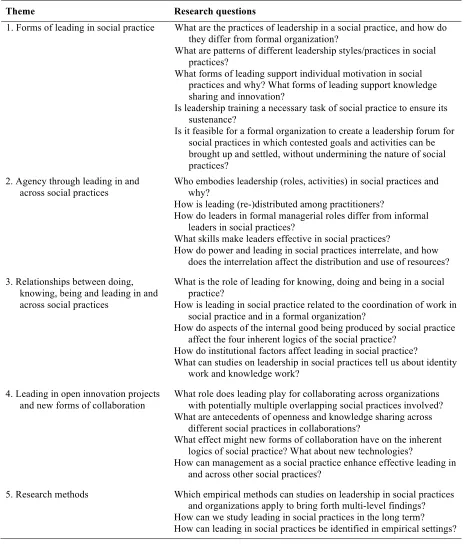
management. Synthesizing our arguments above culminates in five areas for future research
organization theory (see Table 1). This agenda proceeds from the inside out, from the agency
of leadership within a social practice and the patterns of taking the lead and relating to the
core drivers of a social practice to research on leadership across social practices to distributed
leadership that spans organizational boundaries. Work on research methods should follow suit
because it requires updates on how we identify and trace social practices in fast-moving
organizational contexts.
---
INSERT TABLE 1 ABOUT HERE
---
First, leading as an inherent logic of social practice mirrors key tenets of leadership
research (He, Gersdorf, & von Krogh, work in progress; Wood, 2005; von Krogh et al., 2012)
as a movement and a convergence of activities that cannot be permanently attributed to one
individual or one function (Chambers, Drysdale, & Hughes, 2010; Sims, 2010; Leslie &
Canwell, 2010). The actual activities that orchestrate and lead to convergence and agreement
need more research, particularly with the internal and external goods of social practices in
mind. The values and standards of excellence that are definitive of social practice inform the
activities of leadership and may represent an active source of both resistance and support to
organizational goals.
Second, the role and agency of leadership in social practice is a puzzle in the eyes of
management informed in a traditional, formal sense by organizational economics or design
(Erden et al., 2014). The movement that is leadership here undercuts reporting lines, formal
hierarchies, and possibly known sources and alliances of power within an organization
(Fleming & Spicer, 2014). Parallel work on adult development and organizational change
dynamic authority (Laloux, 2014) by demonstrating that different situations require direction
or non-direction, steering or non-steering (Harvey, Cohendet, Simon, & Dubois, 2013).
Individual agency may need to remain flexible, which represents a serious challenge to the
individual’s need for security and stability in working environments.
Third, and focusing beyond any one social practice, the relationship between the defining
elements of social practices implies various positions between social practices when they
enter into conflict or align for an organizational purpose. For example, the hospital represents
an institution that houses multiple social practices within one organization and, to function,
needs to orchestrate the alignment and complementary performances of nursing, medicine,
information systems, hospitality, corporate finance, and many more. Research on leading
multiple practices is relevant because it taps into work that is fundamental to the joint and
convergent decisions of an organization without structures that fully align with a formal
organization.
Fourth, and more specifically, open innovation and forms of open collaboration are in
dire need of a more coherent understanding of leadership because in many settings where this
happens, few or no formal structures are in place (in many instances; e.g., Faraj, Kudaravalli,
& Wasko, 2015). Open source software development is organized in communities that
comprise both individual users and firms, represented by employees (Levine and Prietula,
2013, Rullani and Haefliger, 2013; Lakhani & von Hippel, 2003; Spaeth, von Krogh, & Fang
He, 2014). New forms of collaboration (e.g., Börjeson, 2015; Howison and Crowston, 2014;
Iturrioz, Aragon, & Narvaiza, 2015) can trigger both updates in social practice and conflict in
terms of agenda setting, for the community or for the individual participants in an
organization. Leadership research may need to study how organizations can navigate new
interests of the community (Dahlander and Wallin, 2006; Faraj, Jarvenpaa, & Majchrzak,
2011).
Fifth, we anticipate research challenges when engaging with social practices in
organizations, not least due to the status attributed to social practices by management, and
vice versa (Beadle and Moore, 2006). Who is representing whom, and how do loyalty and
identity run across social practice and the organization? How do the being and the doing
shape the researcher’s ability to empirically distinguish the effect of a social practice on an
organization and identify leading as distinct from formal roles and structures?
Given our suggestions, we zoom in on the level of social practice and believe a practice
perspective could initiate an important discussion on leadership research (Chambers et al.,
2010; McCalman & Paton, 2010; von Krogh et al., 2012). The challenges and opportunities of
managers in practice coincide with novel and distributed forms of organization, still
impervious to researchers (Ahrne, Brunsson & Seidl, 2016; Börjeson, 2015), and they
demonstrate the urgency of revising and further developing leadership research in a direction
that is more sensitive to social practices and informal leading. As highlighted by Ahrne et al.
(2016), we advocate that the orchestration of collective action in organizations needs to be
scrutinized from further angles (in addition to formal organization) to support management
practice accordingly. Indeed, we hope to contribute to fostering the ongoing debate on the
future of leadership and help advance our understanding of leading in and across social
References
Ahrne, G., Brunsson, N., & Seidl, D. (2016). Resurrecting organization by going beyond organizations. European Management Journal, 34(2), 93–101.
http://doi.org/10.1016/j.emj.2016.02.003
Anteby, M., Chan, C. K., & Dibenigno, J. (2016). Three lenses on occupations and professions in organizations. The Academy of Management Annals, 1–62.
http://doi.org/10.1080/19416520.2016.1120962
Barley, S. R., & Tolbert, P. S. (1997). Institutionalization and structuration: studying the links between action and institution. Organization Studies, 18(1), 93–117.
http://doi.org/10.1177/017084069701800106
Beadle, R., & Moore, G. (2006). MacIntyre on virtue and organization. Organization Studies, 27(3), 323–340. http://doi.org/10.1177/0170840606062425
Bechky, B. A. (2003a). Object lessons: workplace artifacts as representations of occupational jurisdiction. American Journal of Sociology, 109(3), 720–752.
Bechky, B. A. (2003b). Sharing meaning across occupational communities: the
transformation of understanding on a production floor. Organization Science, 14(3), 312–330. Ben-Menahem, S., von Krogh, G., Erden, Z., & Schneider, A. (2015). Coordinating
knowledge creation in multidisciplinary teams: evidence from early-stage drug discovery.
Academy of Management Journal, published before print. http://doi.org/10.5465/amj.2013.1214
Börjeson, L. (2015). Interorganizational situations – an explorative typology. European Management Journal, 33(3), 191–200. http://doi.org/10.1016/j.emj.2015.01.001
Bourdieu, P. (1990). The logic of practice. Stanford: Stanford University Press.
Brown, J. S., & Duguid, P. (1991). Organizational learning and Communities-of-Practice: toward a unified view of working, learning, and innovation. Organization Science, 2(1), 40– 57. http://doi.org/10.1287/orsc.2.1.40
Brown, J. S., & Duguid, P. (2001). Knowledge and organization: a social-practice perspective. Organization Science, 12(2), 198–213.
http://doi.org/10.1287/orsc.12.2.198.10116
Brown, M. H., & Hosking, D.M. (1986). Distributed leadership and skilled performance as successful organization in social movements. Human Relations, 39(1), 65–79.
http://doi.org/10.1177/001872678603900104
Burns, J. M. (1978). Leadership. New York: Harper and Row.
Carlile, P. R. (2002). A pragmatic view of knowledge and boundaries: boundary objects in new product development. Organization Science, 13(4), 442–455.
http://doi.org/10.1287/orsc.13.4.442.2953
Castellani, B., & Hafferty, F. W. (2009). Sociology and complexity science. Berlin, Germany: Springer Berlin Heidelberg.
Chambers, L., Drysdale, J., & Hughes, J. (2010). The future of leadership: a practitioner view. European Management Journal, 28(4), 260–268.
http://doi.org/10.1016/j.emj.2010.05.005
Cohen, M. D., March, J. G., & Olsen, J. P. (1972). A garbage can model of organizational choice. Administrative Science Quarterly, 17(1), 1. http://doi.org/10.2307/2392088
Coleman, S., & Simpson, B. (2004). Knowing, doing and being: Pedagogies and
policies and practices in European social anthropology education, EASA Learning Fields, 2
(pp. 18–33). New York: Berghahn Books.
Cunliffe, A. L., & Eriksen, M. (2011). Relational leadership. Human Relations, 64(11), 1425–1449. http://doi.org/10.1177/0018726711418388
Cyert, R. M., & March, J. (1963). A behavioral theory of the firm. Englewood Cliffs, N.J. : Prentice Hall.
Dahlander, L., & Wallin, M. (2006). A man on the inside: unlocking communities as complementary assets. Research Policy, 35(8), 1243–1259.
http://doi.org/10.1016/j.respol.2006.09.011
Day, D. V., Gronn, P., & Salas, E. (2004). Leadership capacity in teams. The Leadership Quarterly, 15(6), 857–880. http://doi.org/10.1016/j.leaqua.2004.09.001
Deephouse, D. L. (1996). Does isomorphism legitimate? Academy of Management Journal, 39(4), 1024–1039. http://doi.org/10.2307/256722
Erden, Z., Schneider, A., & von Krogh, G. (2014). The multifaceted nature of social practices: a review of the perspectives on practice-based theory building about organizations.
European Management Journal, 32(5), 712–722. http://doi.org/10.1016/j.emj.2014.01.005 Faraj, S., Jarvenpaa, S. L., & Majchrzak, A. (2011). Knowledge collaboration in online communities. Organization Science, 22(5), 1224–1239.
Faraj, S., Kudaravalli, S., & Wasko, M. (2015). Leading collaboration in online communities. MIS Quarterly, 39(2), 393–412.
Ferlie, E., Fitzgerald, L., Wood, M., & Hawkins, C. (2005). The nonspread of innovations: the mediating role of professionals. Academy of Management Journal, 48(1), 117–134. http://doi.org/10.5465/AMJ.2005.15993150
Fleming, P., & Spicer, A. (2014). Power in management and organization science. The Academy of Management Annals, 8(1), 237–298.
http://doi.org/10.1080/19416520.2014.875671
Fletcher, J. (2003). The paradox of post heroic leadership: gender matters. Working Paper Nr. 17. Boston, MA: Center for Gender in Organizations. Retrieved from
http://www.alnap.org/resource/9540
Flyvbjerg, B., & Sent, E.-M. (2002). Making social science matter: why social inquiry fails and how it can succeed again. Southern Economic Journal, 68(3), 732.
http://doi.org/10.2307/1061731
Foldy, E. G., Goldman, L., & Ospina, S. (2008). Sensegiving and the role of cognitive shifts in the work of leadership. The Leadership Quarterly, 19(5), 514–529.
http://doi.org/10.1016/j.leaqua.2008.07.004
Gherardi, S., & Perrotta, M. (2011). Egg dates sperm: a tale of a practice change and its stabilization. Organization, 18(5), 595–614. http://doi.org/10.1177/1350508410393057
Giddens, A. (1984). The constitution of society: Outline of the theory of structuration. University of California Press.
Gimeno, J., Folta, T. B., Cooper, A. C., & Woo, C. Y. (1997). Survival of the fittest? Entrepreneurial human capital and the persistence of underperforming firms. Administrative Science Quarterly, 42(4), 750-783. http://doi.org/10.2307/2393656
Golsorkhi, D., Rouleau, L., Seidl, D., & Vaara, E. (2010). Cambridge handbook of strategy as practice. Cambridge University Press.
Gronn, P. (2002). Distributed leadership as a unit of analysis. The Leadership Quarterly,
Gronn, P. (2015). The view from inside leadership configurations. Human Relations,
68(4), 545–560. http://doi.org/10.1177/0018726714563811
Harvey, J-F., Cohendet, P., Simon, L. and Dubois, L-E. (2013). Another cog in the machine: designing communities of practice in professional bureaucracies, European Management Journal, 31(1), 27-40.
He, F., Gersdorf, T. & von Krogh, G. (work in progress). Many conductors, one
symphony: The emergence of shared leadership structure in collaborative knowledge creation. Hosking, D. M. (2000). Ecology in mind, mindful practices. European Journal of Work and Organizational Psychology, 9(2), 147–158. http://doi.org/10.1080/135943200397914
Howison, J., & Crowston, K. (2014). Collaboration through open superposition: a theory of the open source way. MIS Quarterly, 38(1), 29–A9.
Iedema, R. (2003). From doing work to talking work: renegotiating knowing, doing, and identity. Applied Linguistics, 24(3), 316–337. http://doi.org/10.1093/applin/24.3.316
Iturrioz, C., Aragón, C., & Narvaiza, L. (2015). How to foster shared innovation within SMEs’ networks: social capital and the role of intermediaries. European Management Journal, 33(2), 104–115. http://doi.org/10.1016/j.emj.2014.09.003
Jarzabkowski, P. (2004). Strategy as practice: recursiveness, adaptation, and practices-in-use. Organization Studies, 25(4), 529–560. http://doi.org/10.1177/0170840604040675
Johnson, S. L., Safadi, H., & Faraj, S. (2015). The emergence of online community leadership. Information Systems Research, 26(1), 165–187.
http://doi.org/10.1287/isre.2014.0562
Kellogg, K. C. (2012). Making the cut: using status-based countertactics to block social movement Implementation and microinstitutional change in surgery. Organization Science,
23(6), 1546–1570. http://doi.org/10.1287/orsc.1110.0704
Kellogg, K. C., Orlikowski, W. J., & Yates, J. (2006). Life in the trading zone: structuring coordination across boundaries in postbureaucratic organizations. Organization Science,
17(1), 22–44. http://doi.org/10.1287/orsc.1050.0157
Lakhani, K. R., & von Hippel, E. (2003). How open source software works: “free” user-to-user assistance. Research Policy, 32(6), 923–943.
http://doi.org/10.1016/S0048-7333(02)00095-1
Laloux, F. (2014). Reinventing organizations. Brussels : Nelson Parker.
Lamont, M., & Molnár, V. (2002). The study of boundaries in the social sciences. Annual Review of Sociology, 28, 167–195.
Lave, J., & Wenger, E. (1991). Situated learning: Legitimate peripheral participation. Cambridge University Press.
Leslie, K., & Canwell, A. (2010). Leadership at all levels: leading public sector organisations in an age of austerity. European Management Journal, 28(4), 297–305. http://doi.org/10.1016/j.emj.2010.05.006
Lindgren, M., Packendorff, J., & Tham, H. (2011). Relational dysfunctionality: leadership interactions in a Sarbanes-Oxley Act implementation project. European Journal of
International Management, 5(1), 13–29.
MacIntosh, R., Beech, N., Antonacopoulou, E., & Sims, D. (2012). Practising and knowing management: a dialogic perspective. Management Learning, 43(4), 373–383.
http://doi.org/10.1177/1350507612452521
McCalman, J., & Paton, R. A. (2010). The way forward for leadership. European Management Journal, 28(4), 251–252. http://doi.org/10.1016/j.emj.2010.06.003
McLure Wasko, M., & Faraj, S. (2000). “It is what one does”: why people participate and help others in electronic communities of practice. The Journal of Strategic Information Systems, 9(2–3), 155–173. http://doi.org/10.1016/S0963-8687(00)00045-7
Melucci, A. (1996). Challenging codes: Collective action in the information age. Cambridge University Press.
Meyer, J., & Rowan, B. (1977). Institutionalized organizations: formal structure as myth and ceremony. The American Journal of Sociology, 83(2), 340–363.
Nicolini, D. (2011). Practice as the site of knowing: insights from the field of telemedicine.
Organization Science, 22(3), 602–620. http://doi.org/10.1287/orsc.1100.0556
Nicolini, D., Mengis, J., & Swan, J. (2011). Understanding the role of objects in cross-disciplinary collaboration. Organization Science, 23(3), 612–629.
http://doi.org/10.1287/orsc.1110.0664
Nonaka, I., & Takeuchi, H. (2011). The wise leader. Harvard Business Review, 89(5), 58– 67.
Nonaka, I., & von Krogh, G. (2009). Perspective - tacit knowledge and knowledge conversion: controversy and advancement in organizational knowledge creation theory.
Organization Science, 20(3), 635–652. http://doi.org/10.1287/orsc.1080.0412
O’Mahony, S., & Bechky, B. A. (2008). Boundary organizations: enabling collaboration among unexpected allies. Administrative Science Quarterly, 53(3), 422–459.
http://doi.org/10.2189/asqu.53.3.422
Orlikowski, W. J. (2002). Knowing in practice: enacting a collective capability in distributed organizing. Organization Science, 13(3), 249–273.
http://doi.org/10.1287/orsc.13.3.249.2776
Ospina, S., & Foldy, E. (2010). Building bridges from the margins: the work of leadership in social change organizations. The Leadership Quarterly, 21(2), 292–307.
http://doi.org/10.1016/j.leaqua.2010.01.008
Pearce, C. L., & Conger, J. A. (2002). Shared leadership: Reframing the hows and whys of leadership. SAGE Publications.
Rullani, F., & Haefliger, S. (2013). The periphery on stage: the intra-organizational dynamics in online communities of creation. Research Policy, 42(4), 941–953.
http://doi.org/10.1016/j.respol.2012.10.008
Sandberg, J., & Pinnington, A. H. (2009). Professional competence as ways of being: an existential ontological perspective. Journal of Management Studies, 46(7), 1138–1170. http://doi.org/10.1111/j.1467-6486.2009.00845.x
Schatzki, T. R., Cetina, K. K., & von Savigny, E. (2001). The practice turn in contemporary theory. Routledge.
Sims, D. (2010). Looking for the key to leadership under the lamp post. European Management Journal, 28(4), 253–259. http://doi.org/10.1016/j.emj.2010.05.004
Smircich, L., & Morgan, G. (1982). Leadership: the management of meaning. The Journal of Applied Behavioral Science, 18(3), 257–273. http://doi.org/10.1177/002188638201800303
Spaeth, S., von Krogh, G., & He, F. (2014). Perceived firm attributes and intrinsic
Swan, J., Scarbrough, H., & Robertson, M. (2002). The construction of “Communities of Practice” in the management of innovation. Management Learning, 33(4), 477–496.
http://doi.org/10.1177/1350507602334005
Thompson, M. (2005). Structural and epistemic parameters in communities of practice.
Organization Science, 16(2), 151–164. http://doi.org/10.1287/orsc.1050.0120
von Krogh, G., & Geilinger, N. (2015). Valve’s organization: opportunities and open questions. Journal of Organization Design, 4(2), 18-19. http://dx.doi.org/10.7146/jod.20159
von Krogh, G., Nonaka, I., & Rechsteiner, L. (2012). Leadership in organizational knowledge creation: a review and framework. Journal of Management Studies, 49(1), 240– 277. http://doi.org/10.1111/j.1467-6486.2010.00978.x
Wenger, E. (1998). Communities of practice: Learning, meaning, and identity. New York, NY: Cambridge University Press.
Whittington, R. (2006). Completing the practice turn in strategy research. Organization Studies, 27(5), 613–634. http://doi.org/10.1177/0170840606064101
Wood, M. (2005). The fallacy of misplaced leadership. Journal of Management Studies,
42(6), 1101–1121. http://doi.org/10.1111/j.1467-6486.2005.00535.x
Table 1. Future research opportunities
Theme Research questions
1. Forms of leading in social practice What are the practices of leadership in a social practice, and how do they differ from formal organization?
What are patterns of different leadership styles/practices in social practices?
What forms of leading support individual motivation in social practices and why? What forms of leading support knowledge sharing and innovation?
Is leadership training a necessary task of social practice to ensure its sustenance?
Is it feasible for a formal organization to create a leadership forum for social practices in which contested goals and activities can be brought up and settled, without undermining the nature of social practices?
2. Agency through leading in and across social practices
Who embodies leadership (roles, activities) in social practices and why?
How is leading (re-)distributed among practitioners?
How do leaders in formal managerial roles differ from informal leaders in social practices?
What skills make leaders effective in social practices?
How do power and leading in social practices interrelate, and how does the interrelation affect the distribution and use of resources?
3. Relationships between doing, knowing, being and leading in and across social practices
What is the role of leading for knowing, doing and being in a social practice?
How is leading in social practice related to the coordination of work in social practice and in a formal organization?
How do aspects of the internal good being produced by social practice affect the four inherent logics of the social practice?
How do institutional factors affect leading in social practice?
What can studies on leadership in social practices tell us about identity work and knowledge work?
4. Leading in open innovation projects and new forms of collaboration
What role does leading play for collaborating across organizations with potentially multiple overlapping social practices involved? What are antecedents of openness and knowledge sharing across
different social practices in collaborations?
What effect might new forms of collaboration have on the inherent logics of social practice? What about new technologies?
How can management as a social practice enhance effective leading in and across other social practices?
5. Research methods Which empirical methods can studies on leadership in social practices and organizations apply to bring forth multi-level findings? How can we study leading in social practices in the long term? How can leading in social practices be identified in empirical settings?