City, University of London Institutional Repository
Citation
:
Plebani, P., Cappiello, C., Comuzzi, M., Pernici, B. and Yadav, S. (2012). MicroMAIS: executing and orchestrating Web services on constrained mobile devices. Software: Practice and Experience, 42(9), pp. 1075-1094. doi: 10.1002/spe.1106This is the accepted version of the paper.
This version of the publication may differ from the final published
version.
Permanent repository link:
http://openaccess.city.ac.uk/4082/Link to published version
:
http://dx.doi.org/10.1002/spe.1106Copyright and reuse:
City Research Online aims to make research
outputs of City, University of London available to a wider audience.
Copyright and Moral Rights remain with the author(s) and/or copyright
holders. URLs from City Research Online may be freely distributed and
linked to.
City Research Online: http://openaccess.city.ac.uk/ [email protected]
Softw. Pract. Exper.2011;00:1–35
Published online in Wiley InterScience (www.interscience.wiley.com). DOI: 10.1002/spe
MicroMAIS: Executing and Orchestrating Web Services on
Constrained Mobile Devices
C. Cappiello
1, M. Comuzzi
2, B. Pernici
1, P. Plebani
1∗and S. Yadav
31Politecnico di Milano, Piazza Leonardo da Vinci 32 - 20133 Milano, Italy
2Eindhoven University of Technology, P.O. Box 513 - 5600MB Eindhoven, The Netherlands
3Texas A&M University, TAMU 3112, College Station, TX 77843-3112, USA
SUMMARY
Mobile devices with their more and more powerful resources allow the development of Mobile Information
Systems, in which services are not only provided by traditional systems, but they are also autonomously
executed and controlled in the mobile devices themselves. Services distributed on autonomous mobile
devices allow both the development of cooperative applications without a back-end infrastructure and
the development of applications blending distributed and centralized services. In this paper, we propose
MicroMAIS: an integrated platform for supporting the execution of Web service based applications natively
on a mobile device. The MicroMAIS platform is composed ofmASandµ-BPEL. The former allows the execution of a single Web service, whereas the latter permits the orchestration of several Web services
according to the WS-BPEL standard. Copyright c2011 John Wiley & Sons, Ltd.
Received . . .
KEY WORDS: Mobile Information Systems, WS-BPEL, Micro Application Server
∗Correspondence to: Pierluigi Plebani,Dipartimento di Elettronica e Informazione, Politecnico di Milano, Piazza
1. INTRODUCTION
Mobile devices are continuously increasing their capacity and are now able to execute more
sophisticated and complex applications than before. Several solutions based on Service Oriented
Architectures consider mobile devices as the means to provide pervasive solutions to the users
[1]. Nevertheless, mobile devices often hold the role of service consumers instead of service
providers. Due to their limitations in terms of available resources (e.g., power, memory), mobile
devices run applications able to connect to services installed on traditional devices to exploit their
functionalities. In this scenario, the service consumption requires a stable connection with the
service provider. In a mobile environment this might not be guaranteed, due to the nomadic nature
of mobile devices and different contexts of use.
In this paper, we introduce a Web service based platform, i.e., MicroMAIS †, developed as a
means for supporting Mobile Information Systems [2]. MicroMAIS is composed of two modules,
namely mAS (micro Application Server) and µ-BPEL. These modules, designed and developed
according to the most common Web service standards, are capable of supporting the execution of
simple and composite Web services directly on a mobile device. UsingmASandµ-BPEL, we aim at enabling the execution of Web service based applications natively on mobile devices.
More specifically,mASis an application server capable of running on the least capable mobile
device configuration (CLDC). Java-based Web services can be deployed and executed on mAS.
µ-BPEL is a Business Process Execution Language (WS-BPEL) engine designed for supporting
service orchestration in a mobile environment. By allowing the execution of both stateless and
stateful services and the possibility to manage multiple instances, the MicroMAIS platform allows
flexibility of operation in unreliable, nomadic communication environments. Also, while there has
been significant previous work in the areas of mobile Web service execution [1,27,29, 33, 34]
and orchestration [43,44,45], most proposals do not rely on the least capable device configuration
(CLDC), but they rather consider more powerful mobile devices.
†For more information on the MAIS Project (Multichannel Adaptive Information Systems) see
The design of mAS and µ-BPEL preserves as much as possible the interoperability with traditional Web service based applications. Specifically, services running onmAScan be invoked as traditional Web services and processes deployed inµ-BPEL can invoke traditional Web services
as well. As a consequence, MicroMAIS allows the execution of distributed applications involving
different types of devices.
The opportunity to execute standard Web services and Web service compositions natively in a
mobile device is considered relevant in several scenarios, such as, for example, risk management
and logistics [3,4].
Risk management in dangerous good transportation, in particular, requires orchestration of
processes executed on mobile devices [3]. In this scenario, mobile information systems, such as
sensors on the carrier, are able to communicate position and status information via GPRS or UMTS
protocols to the Geographical Information Systems (GISs) in the headquarters of the transportation
company. GISs collect position and status information and mash it up with other information, such
as the presence of water sources, e.g. rivers and basins, or the presence of sites of public interest,
e.g. schools or arenas, to determine the best set of rescue activities to be performed on the ground
in case an accident occurs.
The process enacting rescue activities coordinates different actors on the field, such as private
rescue teams, representatives of the transportation company, and teams from public rescue agencies
(e.g. fire brigades), acting in a disrupted environment with very strict time constraints. Rescue
activities are orchestrated on the field by a manager, who coordinates many teams with different
expertise. In the rescue activities, therefore, mobile information systems can be exploited both as
server and client applications. In particular, the mobile devices of actors on the field act as client
applications of the manager(s) of the rescue activities.
MicroMAIS aims at providing a platform that can be installed on the mobile devices involved
in this kind of scenarios to execute SOAP-based services and orchestrate WS-BPEL processes. In
this way, even though the communication with traditional devices is also supported, MicroMAIS
The rest of the paper is structured as follows. In Section2and Section3we discussmASandµ -BPEL, respectively. Section4introduces an analysis of the performance of our tools when running
a BPEL process. After the Section5where related work is discussed, Section6concludes the paper
and discusses possible future work.
2. MAS: MICRO APPLICATION SERVER
The micro Application Server (mAS) is a J2ME-based application server that supports stateless and stateful Web service execution on cellphones, PDAs, and all least-capable CLDC (Connected
Limited Device Configuration) micro (or mobile) devices. While most of the solutions in the field of
mobile Web service execution considered mobile devices only in the client-side of a client-service
interaction [5], with mAS (similarly to [1,27,29,34]) a mobile device can additionally act as a
service provider to other mobile devices or traditional devices acting as service consumers.
Resource-constrained mobile devices introduce many restrictions that make it difficult to
implement a complete application server on the offered platform. Especially in case of CLDC
Java Virtual Machines (JVMs), the limitations are very strong and, consequently, may affect the
functionalities offered bymAS. For instance, hot deployment is not possible since all the classes required during the execution of a service need to be included in the same MIDlet installed on the
mobile device before the application starts.
Even though various mobile device architectures are augmenting their performance through
technology improvement, the amount of available resources for specific classes of devices, such as
cellphones, remains limited. Cellphones use the CLDC JVM platform, which comprises a smaller
set of classes than other platforms, e.g., CDC JVMs. Therefore, despite running on a CLDC
disconnections. RunningmASon constrained mobile devices ensures addressing a larger consumer market, owing to CLDC JVM’s popular deployment.
mAS design and development are inspired by existing application servers, in particular the J2EE compliant application servers, and aim at achieving complete compatibility with existing
Web service standards and support of Web service interaction based on the Simple Object Access
Protocol (SOAP).mAS design involves two main actors: (i) theapplication provider which uses the application server to ensure availability of its software components and (ii) the application
client, which communicates with server software components, in accordance with the server APIs.
The application server is responsible for deployment and execution of applications designed and
developed using specific programming and deployment models. InmAS, these models are similar to the ones defined for Enterprise Java Beans (EJBs) and specify how the components must be
developed and how they must be described, to make the application server aware of the required
resources, the supported functionalities, and the supported communication protocols.
2.1. mASarchitecture
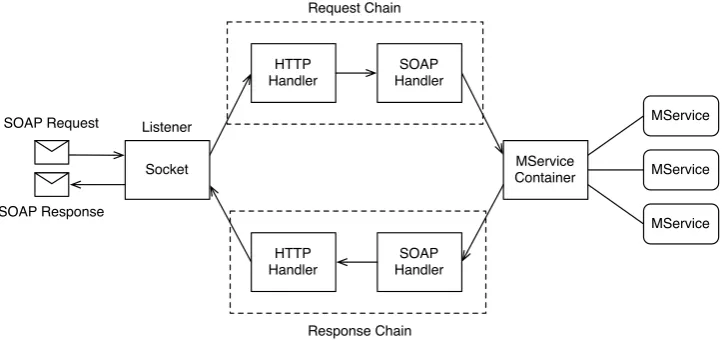
mAS implements a container-based application server that communicates with clients according to an Axis-like [6] architecture implementing theChain of Responsibility[7] design pattern.mAS
architecture relies on three main elements (see Figure1):
• SOAP Request and SOAP Response message: it represents the requests that clients make
towards mAS and also describes how mAS responds to the clients. Depending upon the
supported application protocol,mASprovides aListenerthat receives and marshals incoming messages and, in turn, unmarshals and sends the responses back to the client. After the
Listenerdoes its processing, anymASmodule, regardless of the specific application protocol,
can access the message using the MessageContext object, i.e., the Java memory-model
representation of a message. Note that the CLDC JVM allows connections only through
• Request and Response handlers chain: it allows a step-by-step analysis of the incoming
MessageContextor a step-by-step creation of the outgoingMessageContext. In each step, a
specificHandleranalyzes a part of the message, depending upon its competence. For instance,
theHTTP handlerinterprets protocol parameters, extracts the body, and passes it to the next
handler (SOAP Handler) that realizes the requested service, the action, and the parameters. An
exception is raised if the incoming message does not respect the rules of the communication
protocols.
• MService container: it receives all the information about the service invocation and manages
the required Web service life-cycle. The container is in charge of loading the class
corresponding to the requested service. Moreover, in case of stateful services, the container
needs to identify the client and to manage the resources.
Socket ContainerMService
MService
MService
MService Listener
SOAP Handler HTTP
Handler
Request Chain
SOAP Handler HTTP
Handler
Response Chain SOAP Request
[image:7.595.119.483.359.529.2]SOAP Response
Figure 1.mASarchitecture
Although this structure is now usually adopted by application servers, the CLDC JVMs poses
new challenges in terms of (i) limited available resources (e.g., memory, computational power) and
(ii) limited set of J2ME libraries. Such limitations have a great impact, especially on the design
of the MService container that has to allow service deployment, handle the service execution, and
manage the connections with the clients. In the next section, we discuss the measures adopted by
2.2. Data Persistence
Current solutions for data storage in a mobile environment can be grouped into three main classes:
micro-databases,reusable solutions, andRMS (Record Management Store)-based solutions.
Micro databases are ad-hoc solutions specifically designed for mobile devices. They usually
include GUI-based applications allowing the users to organize and manage small databases. They
can support SQL or SQL-like queries and in some cases they also allow ODBC/JDBC connections.
An example of micro database is eSQL [8].
Reusable solutionsare solutions designed for existing desktop DBMS or superior configurations
that can adapt to the constraints of mobile devices. Some cases require a re-design focused on the
resources limitations that affect the mobile environments: i.e., lack of memory, less computational
power, limited battery life and so on. For instance, SQLite [9] is a DBMS that can be installed
and executed on both a traditional PC and a mobile environment. It implements a self-contained,
serverless, zero-configuration, transactional SQL database engine.
Finally, RMS-based solutionsare based on RMS, which provides a mechanism for MIDlets to
persistently store and retrieve data [10]. RMS defines a set of RecordStores that, in turn, are a
collection of records, which will remain persistent across multiple invocations of the MIDlet. The
device platform is responsible for making its best effort to maintain the integrity of the MIDlet’s
record stores throughout the normal use of the platform, including reboots, battery changes,
etc. [11].
Although the first two classes offer a good variety of solutions, all of them work only with CDC
JVMs, which, as stated earlier, offer more means than CLDC JVMs. For this reason, data persistence
inmASis based on RMS.
J2ME provides a set of instructions to be able to:
• Manage the RecordStore;
• Monitor the RecordStore;
• Search for data in the RecordStore by filtering and comparing the contents of the records;
The contents of the records can only be Strings and this requires a marshalling procedure
to store complex objects. To simplify the use of RMS, our implementation relies on the Floggy
framework [12]. This framework makes use of RMS with usual database management techniques
easier. For instance, if a developer would like to store an entire class, instead of performing
marshalling and unmarshalling procedures, it delegates these tasks to Floggy by implementing the
interfacePersistableand by exploiting the methods offered by thePersistableManager
class.
Floggy’s main limitation, in the context of the mAS platform, is the inability to handle data structures such as aHashTable, which would be useful for storing session based information. In
the next section, we detail our approach to overcome this limitation.
2.3. Session management
When executing stateful services, the MService container needs to uniquely identify the sessions
as the association between a client and the related service instance. As a consequence, the problem
of identification of the client and the definition of links between clients and service instances holds
a central role during the service container design. Here, we consider two possibilities: cookies and
session ids. These two approaches are similar, since they both assign a unique identification code
to every session and put this id in every exchanged message. The difference lies in where each
mechanism puts the id in the message: cookies use a proper HTTP attribute and the session is
defined in terms of the client id; session ids appear in the HTTP body or, sincemAScommunicates through SOAP, in the SOAP body. In this case, the same client can activate more than one session.
Although these two solutions are functionally equivalent, inmASwe adopt the solution based on cookies, that is, to put ids in the HTTP header, for two main reasons. First, using a standard HTTP
attribute makes the solution compatible with all the HTTP clients as long as they enable the use
of cookies; on the contrary, putting the id inside the SOAP body requires to explicitly specify its
HTTP listener). This means that we have the opportunity to customize more activities with respect
to the connected client: e.g., dispatching the request to the most appropriate chain.
Once a client has been identified, the information about the session is stored inmAS. A session is defined in terms of the client id, the instance of the MService related to the client, the state of
the execution, and the session expiration time. Since Floggy does not provide the HashTable data
structure, we cannot rely on this class to link the session id to the related information. For this
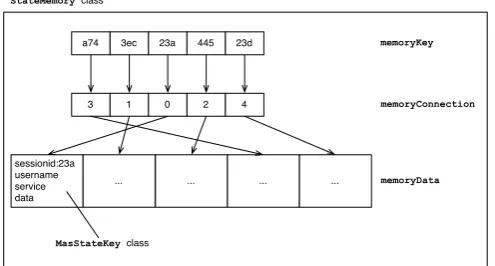
reason, we developed a data structure based on threeVectors organized as shown in Figure2. The
first vector, i.e.,memoryKey, stores the list of active sessionidsand it is used bymASto browse the active sessions. The same position, in the second vector, i.e.,memoryConnectionis used
to index the third vector where the information about the session is finally stored according to the
MasStateKeyclass.
a74 3ec 23a 445 23d
3 1 0 2 4
sessionid:23a username service data
... ... ... ...
memoryKey
memoryConnection
memoryData
MasStateKey class
[image:10.595.174.422.336.469.2]StateMemory class
Figure 2. Structure of theStateMemoryclass for session management.
This structure makes the session management more efficient because of three reasons. First,
using Vectors we can delegate the memory management (when adding and deleting new
sessions) directly to a class that exactly knows when to allocate or deallocate objects in memory.
Second, we exploit the search mechanisms provided by the Vector class, which are already
optimized to minimize memory consumption‡. Finally, when a session expires, the related object in
memoryDatais no longer considered valid and the cell is available to be overridden with a new
‡Indeed, although the session browsing could be done also directly using thememoryData, in our solution only one
value; this ensures that in case the same client tries to connect again, eithermASblocks the access due to session expiration, or the client will not find the previous session id in the memoryKey
vector.
2.4. MService container design
InmAS, aMServiceruns inside a container that manages the entire service life-cycle. We adopt theInversion of Control(IoC) pattern [13], also known asinversion of dependency, to identify and
to properly instruct the class associated with theMServicerequested by the client.
The IoC is a well known design-pattern adopted to extend frameworks. According to this pattern,
all the resources required by a class may not be known at design time. The IoC pattern predicates
dynamic binding of these resources at run-time. As such, this pattern is adopted for developing
container based applications, such asmAS. A container knows about a component invoked by the user only at run-time. As a consequence, all components available to be called by the container
must implement the IoC pattern, implementing a set of pre-defined methods enabling the container
to handle their life-cycles. Depending on the adopted IoC style, the container can be aware of the
available resources in three different ways:
• IoC with injection on constructor: available resources are bound when the object is
instantiated;
• IoC with injection on setters: the container has a group of setters that are invoked to inform
the object of new available resources;
• IoC with injection on interface: all resources need to implement a specific interface that makes
it possible for the object to communicate with them in a homogenous way.
Several Java based frameworks implementing the IoC with different styles are available, but they
all require CDC JVMs. For instance, the Apache Excalibur Fortress [14] project provides a
light-weight embeddable IoC container based on the injection on interface style. PicoContainer [15] and
mASis inspired by these initiatives and assumes that all the deployed services are described by
at least two elements: (i) the class implementing the service features and (ii) an XML descriptor
that describes those features. As a consequence, all the services that will be executed in themAS
container must comply to both the deployment and programming models described in the following
paragraphs. The deployment model is defined by an XML schema, i.e., the descriptor schema,
which includes a set of elements describing the main characteristics of the service. The deployment
information is used by the container to know how to call and manage the service. The programming
model is defined by the interface that all services called inmASMServicemust implement to be invoked by the container.
2.4.1. Deployment model. The deployment model in mAS follows the same approach used in J2EE, attaching a descriptor file to the compiled class implementing the service. Moreover, all
the services must be included in the same jar of mAS, i.e., the MIDlet. This constraint is due to a security policy for J2ME applications that forbids the invocation of classes living outside the jar
file of the invoking class. In our case, themAScontainer needs to invoke, when requested by the user, one of the deployed services. So, these services must be included in the same MIDlet. Such
a security constraint limits the possibility to perform hot deployment that application servers now
usually provide.
To elaborate, each deployed service should include a specific folder under theservicesfolder.
In turn, in each of these Web service specific folders, anINFfolder includes the XML descriptor,
whereas the Java class files of the executable service are stored starting from the service’s root.
The service descriptor includes the service logical name, i.e, display-name, a simple
description, the name to be used to invoke the service by the client, i.e.,service-name,
and the service-type, which can assume the values stateless or stateful. Finally, the
service-class defines the name of the class included in the servicefolder that needs to
+ init()
+ process(in methodName: String, in args: Object[]): Object + destroy()
«interface» MService
+ init()
+ process(in methodName: String, in args: Object[]): Object + destroy()
- dep(in className: String, in bytecode: String): Object Deploy
+ destroy() + init()
+ process(in methodName: String, in args: Object[]): Object - add(in x:int, in y:int): Integer
- div(in x:int, in y:int): Integer - mul(in x:int, in y:int): Integer - sub(in x:int, in y:int): Integer
Calculator
+ Container()
+ execute(in className: String, in methodName: String, in params: Object[]): Object + invoke(in messageContext: MessageContext)
[image:13.595.135.461.63.304.2]- sRespC: ServiceResponseChain Container
Figure 3. MService interface
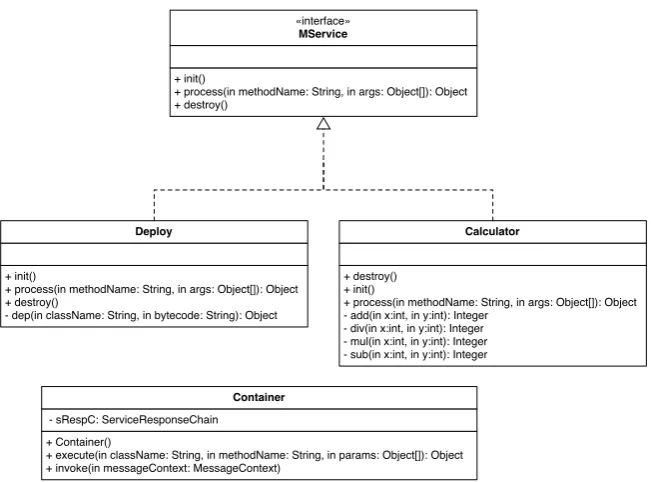
2.4.2. Programming model. Mobile Web services inmASmust comply to a specific programming model specified by theMServiceinterface. This interface (see Figure3, referring to an example
calculator service) reflects a mobile Web service life-cycle composed by three states:init,process,
destroy. As in a servlet life-cycle, init and destroy allocation and deallocation of resources,
respectively, whereasprocessconcerns the mobile Web service application logic.
Due to the limitations of CLDC JVMs, theMServicecontainer is not able to obtain the list of
methods provided by a class since the methodClass.getMethods(), required to accomplish
this, is not supported. As a consequence, themASprogramming model includes in theMService
interface only a standard method, i.e.,process, that will be invoked by the container when any
of the functionalities of a given Web service are required. Thus, the client-side programmer is in
charge of invoking the proper code by specifying an appropriate value for themethodNameinput
2.5. Client side
From a client’s perspective, a Mobile Web service is equal to a traditional Web service. The
Web service is described by a Web Services Description Language (WSDL) interface and can be
invoked through an application protocol such as SOAP. The WSDL interface lists all the supported
operations and also specifies the information about the input and output data of each operation. At
this stage, the WSDL file is not automatically generated bymASand the Web service developer is responsible for creating and including the file in the MIDlet.
3. µ-BPEL: MICRO WS-BPEL ENGINE
Although there exist several proposals enabling workflow execution on mobile devices [43,44,45],
all previous work use configuration of the mobile devices more powerful than the one we consider
in this paper (i.e., CLDC).
With µ-BPEL, we propose a micro-orchestrator that allows orchestrating processes described
using WS-BPEL on mobile devices. As discussed in [16], the design of workflows with mobile
devices needs to consider some peculiar aspects due to their architectural limitations. In this regard,
µ-BPEL supports only a subset of the workflow patterns supported by WS-BPEL. In particular, it
does not support enhanced WS-BPEL constructs, such as links, correlation sets, and event handlers
(see Section3.2for an overview of the WS-BPEL dialect implemented byµ-BPEL).
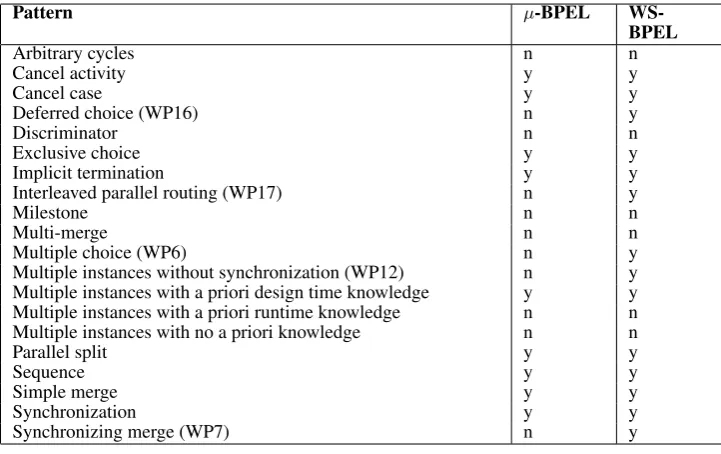
TableI) shows the set of workflow patterns for service composition identified in [17], the ones
supported by WS-BPEL, and the subset supported byµ-BPEL. More in detail, withinµ-BPEL we
do not consider branches with multiple choices (WP6 in [17]) and the related synchronizing merge
(WP7), the possibility of having multiple instances of an activity without synchronization (WP12),
deferred choice (WP16), and interleaved parallel routing (WP17).
WP6 and WP7 are not supported also by other standards such as BPML [18] or WSCI [19] [17].
Moreover, they can be implemented in WS-BPEL only with control links, the semantic of which was
Table I. Supported Workflow patterns.
Pattern µ-BPEL
WS-BPEL
Arbitrary cycles n n
Cancel activity y y
Cancel case y y
Deferred choice (WP16) n y
Discriminator n n
Exclusive choice y y
Implicit termination y y
Interleaved parallel routing (WP17) n y
Milestone n n
Multi-merge n n
Multiple choice (WP6) n y
Multiple instances without synchronization (WP12) n y
Multiple instances with a priori design time knowledge y y Multiple instances with a priori runtime knowledge n n
Multiple instances with no a priori knowledge n n
Parallel split y y
Sequence y y
Simple merge y y
Synchronization y y
Synchronizing merge (WP7) n y
constructs that have remained stable in the WS-BPEL evolution and we leave the implementation
of WP6 and WP7 to future work.
Concerning WP12, due to the scarcity of resources in the mobile scenario, we opted for supporting
multiple instances only in case the number of instances was known a priori at design time.
Concerning WP17, interleaved parallel routing can be captured in WS-BPEL using serializable
scopes. However, the semantic of serializable scopes is not clearly defined in WS-BPEL 1.1 ([17],
p. 209).
WP16 (deferred choice) can be implemented using the pick construct in WS-BPEL. The pick
construct and, consequently WP16, is not supported inµ-BPEL. We plan to address this limitation
as future work. In practice,µ-BPEL does not support dynamic processes in which activities can be
selected on the basis of received messages or temporal alarms.
Concerning communication patterns, at this stageµ-BPEL supports the Request/Reply and
One-Way patterns. This means that the process execution can start only if requested by the client. As
a consequence, all the processes must include at least one<receive>element in the definition,
whereas, the<reply>element is optional.
μ-BPEL Process Design
Process Creator
Recovery Manager Instance
Manager
WS-BPEL WS
Manager
Process instances Web service
partners
<reply> message
WSDL documents
<receive> message
Stored Processes
mAS
[image:16.595.102.500.66.277.2]Process Execution
Figure 4. MicroBPEL Architecture.
• support the execution of a Web service-based process;
• manage multiple activities: the orchestrator is able to manage the parallel execution of
activities belonging to the same workflow;
• manage multiple instances: multiple process instances can be managed. Instances can refer to
the same process or to different processes;
• manage the state of execution: the orchestrator is able to store the execution state (activity
state and variable values) of active processes and restore the instances execution after an
interruption. Interruptions may occur because of the nomadic nature of the mobile scenario.
3.1. µ-BPEL Architecture
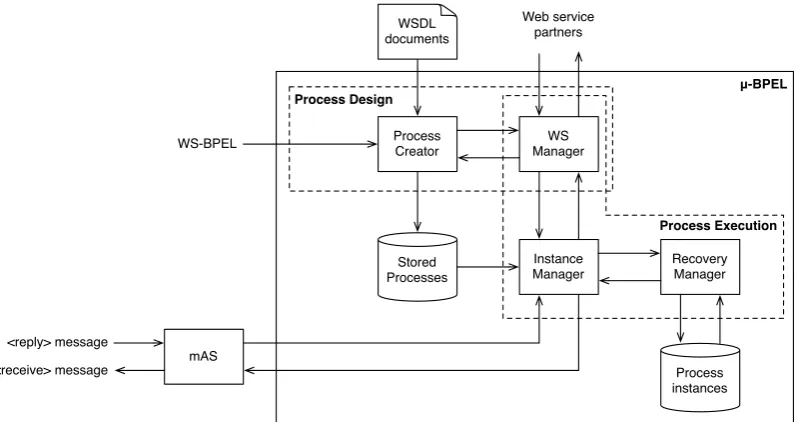
The architecture ofµ-BPEL is shown in figure4. It is possible to identify two overlapping sets of
modules: (i) Process Design and (ii) Process Execution. The former set allows the specification of
the process to be executed according a specific WS-BPEL document and it comprises theProcess
creatorand theWeb Service (WS) managermodules. The latter set includes theInstance manager,
theRecovery manager, and again theWS managermodules. These modules support the execution
of the process. The process starts when, according to the WS-BPEL specification, the process client
In more detail, during the Process Design phase the Process creator receives a WS-BPEL
specification of the service-based process to execute and translates it in the WS-BPEL dialect used
by µ-BPEL (see Section 3.2), in order to build the correct process memory model. If services
provided by external partners are needed, the Process creator module sends the URL of their
WSDL documents to theWS manager module. For each service, theWS manager identifies the
corresponding client stub and sends its specification back to theProcess creator, which stores the
stubs specifications into theStored Processesrepository.
The Process Execution phase starts with the activation of theInstance Manager, which represents
the core of the process engine. The Instance Manager retrieves the process model, generates the
related process instance, and then starts executing the activities. When the execution of a stub is
required, theInstance Managersends a request to theWS managerthat is responsible to invoke and
execute it. TheInstance Managermodule also cooperates with theRecovery Managermodule that
stores and manages all the information about the process state into theProcess instance repository.
This repository contains valuable information especially in case of network disconnection.
3.1.1. Process Design phase. The Process design phase starts with the preparation of the WS-BPEL
document that describes the service-based process to execute.µ-BPEL requires that this document
is sent to the Process creator, which then prepares the process memory model by instantiating
all the classes that correspond to the elements composing the process. To this aim, according to
the WS-BPEL dialect used inµ-BPEL, the process memory model is revised to eliminate all the
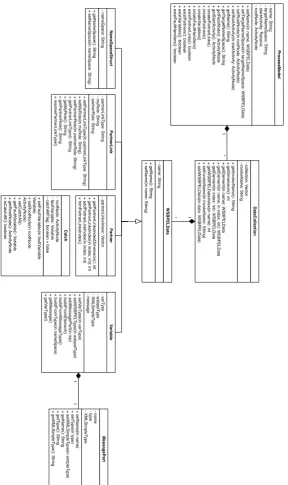
classes and attributes no longer supported and to compact the existing ones. Figure 5shows the
related class diagram (some methods details are omitted to improve readability). At run-time, the
process memory model provides to theInstance managerall the information about the activities to
be executed, the variable to be stored, and all the information about the control flow.
In case the process requires the invocation of services offered by external providers, theProcess
Creator sends the WSDL document containing the service description to the WS Manager. The
+ setName(in name: WSBPELData)
+ setT
argetNameSpace(in targetNameSpace: WSBPELData)
+ setRootNode(in rootNode:
ActivityNode)
+ setStartActivity(in startActivity:
ActivityNode)
+ getName(): String
+ getT argetNameSpace(): String + getRootNode(): ActivitytNode + getStartActivity(): ActivityNode + createPartnerLinks() + createPartners() + createV ariables() + createFaultHandlers()
+ existPartnerLinks(): boolean
+ existPartners(): boolean
+ existV
ariables(): boolean
+ existFaultHandlers(): boolean - rootNode: - startActivity: Receive - targetNameSpace: String - name: String
ActivityNode
ProcessModel
+ getInvokeName(): String
+ getDimension(): int
+ getElement(in name): WSBPELData
+ getElement(in name, in index: int): WSBPELData
+ getElement(in index: int): WSBPELData
+ getWSBPELDataIndex(in name): int
+ setInvokeName(in invokeName: String)
+ addWSBPELData(in data: WSBPELData) - collection: V
ector
- invokeName: String
DataCollection
1
*
+ getName(): String
+ setName(in name: String) - name: String
WSBPELData
1
*
+ getNameSpace(): String
+ setNameSpace(in nameSpace: String) - nameSpace: String
NameSpaceStruct
+ setPartnerLinkT
ype(in partnerLinkT
ype: String)
+ setMyRole(in myRole: String)
+ setPartnerRole(in partnerRole: String)
+ getPartnerLinkT
ype(): String
+ getMyRole(): String
+ getPartnerRole(): String
+ resolvePartnerLinkT
ype()
- partnerLinkT
ype: String
- myRole: String
- partnerRole: String
PartnerLink
+ getPartnerLinksIndexDimension(): int
+ getPartnerLinksIndex(in index: int): int
+ addPartnerLinkIndex(in index: int)
+ trimPartnerLinksIndex() - partnerLinksIndex: V
ector Partner + setFaultV ariable(in faultV ariable: V ariable)
+ setRootNode(in rootNode:
ActivityNode) + setCatchAll() + getFaultV ariable(): V ariable + getRootNode(): ActivityNode
+ isCatchAll(): boolean - rootNode:
ActivityNode
- faultV
ariable: V
ariable
- catchAllFlag: boolean = false
Catch + setV arT ype(in varT ype) + setWSBPEL T ype(in wsbpelT ype)
+ addMessagePart(in mp)
+ buildFromElement() + buildFromMessageT ype() + buildFromT ype(in nameSpace) + getMessage() + getV arT ype() - varT ype - wsbpelT ype - XMLSimpleT ype - message V ariable
+ setName(in name)
+ setT
ype(in type)
+ setXMLSimpleT
ype(in simpleT
ype)
+ getName(): String
[image:18.595.154.443.64.550.2]+ getT ype(): String + getXMLSimpleT ype(): String - name - type - XMLSimpleT ype MessagePart 1 1
Figure 5. Process memory model forµ-BPEL WS-BPEL dialect.
can continue, otherwise an exception is raised. In such a case, by using external tools usually
included in Interactive Development Environment (IDE) for mobile devices, the proper stub is
generated and stored by invoking theWeb Service manager. In the current stage,µ-BPEL assumes
that all the external providers are known and the related stubs are already accessible by the platform.
3.1.2. Process Execution phase. The Process Execution phase starts when a user requests to run the
process previously created. This request can be sent using eitherµ-BPEL’s graphical interface or its
application programming interface (API). The graphical interface allows users to start the process
filling a form that is auto generated on the basis of the variables declared in the receive activity that
starts the process. When the process terminates, the response message reporting the output variables
is directly shown on the device screen to the user. Alternatively, since a process specified in
WS-BPEL can be viewed as a Web service, it is possible to create an API that corresponds to the WSDL
associated with the whole process. The API exposes only the interactions with the client and uses
the functionality discussed in Section2to communicate with Web services inmAS.
Regardless of the selected interface, the process is executed by theInstance Manager module
that is supported by the WS Manager module when an invocation of an external Web service
is needed. The Instance Manager module starts the process execution as a standalone thread to
allow the concurrent execution of multiple process instances. When theInstance Managermodule
receives the execution request, it retrieves the right process model and creates a process instance.
The first receive activity is then executed by initializing the corresponding variables contained in
the instantiation request. The user receives a notification of the beginning of the execution. Each
type of activity matches with a specific thread, created from the relative activity class, which is in
charge of executing the corresponding tasks. In particular, for structured activities, it is necessary
to select which one of the sub-activities has to be executed and to synchronize the activities. In
the µ-BPEL architecture the synchronization is performed by a semaphore mechanism. When a
structured activity (the parent thread) must be executed, the corresponding thread has to execute the
sub-activities (the child threads) in the correct way and in the correct order. The parent thread sets
the semaphore variable to the number of child threads that must be immediately executed and then
falls asleep. When a child thread finishes executing, it decreases the semaphore value. When the
semaphore value is equal to zero, the parent thread awakes and decides what to do. To guarantee
the immediate termination of all the activities when an exception is raised or after the execution of
thread throwing the exception. Each parent thread checks the value of this flag at the time of the
wakening. If the value is true, the parent thread will interrupt its own execution and will propagate
the alert to the child threads.
3.1.3. Process recovery. The data about variables and the state of a process instance are written in a
log by theRecovery Managermodule. This allowsµ-BPEL to recover a process instance abnormally
interrupted, because of disconnection from the network or battery failure.
Since theRecovery Managerlogs also all the possible errors, in case of interruption it is possible
to recover the process by executing the remaining part. The log is implemented through the RMS
as inmASso that the persistence of these data is ensured by the mechanisms implemented by the MIDP. There are three types of RMS-based entities inµ-BPEL:
• RMS for processes: it is a list of all the process instances started, but not yet terminated. In
order to distinguish different instances of the same process, the name of each instance is stored
together with a timestamp. When a process terminates (correctly or for an unmanageable
error), the corresponding record is deleted. All the entries (not deleted) are used to create a
list of the recoverable processes;
• RMS for activities: each process instance in execution has a RMS to store the state of its
activities. The possible states are RUNNING, TERMINATED and ERROR. When the process
terminates, the associated entries are deleted;
• RMS for variables: each process instance in execution has a RMS to store the value of its
variables. When a process starts, the list of all the variables without an associated value is
stored. Once a variable is modified, its value is updated. When a process instance terminates,
the associated entries are deleted.
When users want to recover a process, they select one service from the list of the recoverable
processes. A new instance of the process is created and launched by theInstance Manager, which
is aware of being in recovery mode. The variables are created with the values retrieved from the
Instance Managerstarts executing the process. For each activity, it checks the state of the activity in
the repository. If the state is TERMINATED or ERROR, the corresponding thread does nothing. If
the state is RUNNING or if there is no entry for the activity the thread is normally executed. In case
of abnormal termination during a recovery activity, it will be possible to do the recovery another
time. The name of the process would not change because the timestamp remains the same as in the
first execution.
3.2. WS-BPEL dialect
As previously introduced, µ-BPEL is able to support a subset of the constructs appearing in the
WS-BPEL 2.0 specification [20]. For instance, all the elements about complex activities and the
modeling of control links are ignored. Also, queries, i.e., XPath expressions, are not supported;
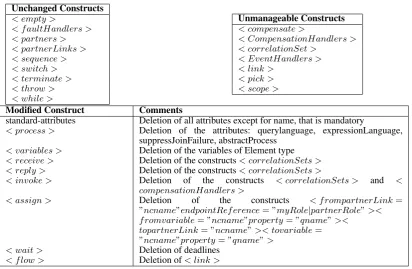
In more detail, Figure 6 lists all the modifications to the WS-BPEL language implemented
in the µ-BPEL dialect. Figure 6 contains three different tables that describe (i) the Unchanged
Constructsthat are considered in the same way as in the original WS-BPEL specification; (ii) the
Unmanageable Constructsthat are all the constructs that have been eliminated in the dialect; (iii)
theModified Constructsthat are all the constructs that have been modified.
4. EVALUATION
Running prototypes of mAS and µ-BPEL are now available and freely
download-able from Sourceforge: http://masproject.cvs.sourceforge.net/ and http://
microbpel.cvs.sourceforge.net/, namely. These implementations rely on kSOAP [21]
as a SOAP pull-parser for mobile devices, developed by Object Web. This parser is based on
kXML [22]: an XML pull parser specifically designed for constrained environments that is suitable
for SOAP messages. Indeed, an XML pull parser [23] can read through large XML files efficiently
Figure 6. Modifications to the WS−BPEL language.
Unchanged Constructs
< empty >
< f aultHandlers > < partners > < partnerLinks > < sequence > < switch > < terminate > < throw > < while >
Unmanageable Constructs
< compensate >
< CompensationHandlers > < correlationSet >
< EventHandlers > < link >
< pick > < scope >
Modified Construct Comments
standard-attributes Deletion of all attributes except for name, that is mandatory
< process > Deletion of the attributes: querylanguage, expressionLanguage, suppressJoinFailure, abstractProcess
< variables > Deletion of the variables of Element type < receive > Deletion of the constructs< correlationSets > < reply > Deletion of the constructs< correlationSets >
< invoke > Deletion of the constructs < correlationSets > and < compensationHandlers >
< assign > Deletion of the constructs < f rompartnerLink=
”ncname”endpointRef erence= ”myRole|partnerRole”><
f romvariable= ”ncname”property= ”qname”>< topartnerLink= ”ncname”>< tovariable=
”ncname”property= ”qname”>
< wait > Deletion of deadlines
< f low > Deletion of< link >
In this evaluation we focus on the response time and the memory occupation during the service
execution. In particular, we measured the trend of these parameters with respect to the number of
clients and the nature of the executing service (i.e., stateless or stateful). About the response time
analysis, to minimize the impact on the total response time given by the execution of the service
business logic, we implemented a simple service calledAddService. This service can run both in
stateless and stateful mode, and starting from0, adds the number received as input. When running
in stateless mode, the service will always return the number sent as input. On the contrary, when
running in stateful mode, the service will keep incrementing the input values.
The AddService is firstly deployed on mAS as a stateless service (by properly setting the service descriptor, see Sect. 2.4). To give the opportunity to measure on-the-fly the memory
occupation, we decide to runmAS on the Sun Java Wireless Toolkit 2.5.2 for CLDC emulation
environment with 2MByte total memory available.
At client-side, we implemented a thread-based Java application able to open parallel connections
have 10 concurrent invocations at most. This client had been executed varying the number of parallel
connection, from1to10. For each case, in order to have reliable results, we repeated the execution
for10times.
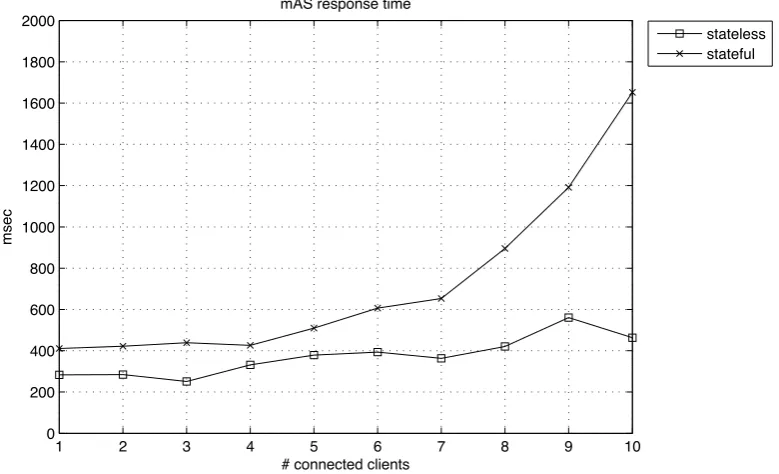
Figure7shows the results of these experiments. The analysis takes into account the execution of
Web services running in both stateless and stateful mode varying the number of connected clients.
For each case, the figure shows the average response time considering all the connected clients.
Focusing on the stateless mode, the average response time varies between250msand560msand the
trend is linear. It is worth noting that with low number of connected clients the response time is lower
than when a single invocation occurs (with 3connected clients, the response time is the lowest).
This trend reflects the computation required bymAS to prepare the system and, in particular, by the container to instantiate the service classes when the first call occurs. As we are considering the
stateless mode, the following calls do not require this initial step and they have a lower response
time. For higher number of clients, the response time tends to increase and, in some case, the gap
is relevant. As discussed in the following, analyzing memory monitor, this situation is due to the
execution of the garbage collector that negatively influences the response time.
Switching to the analysis of the stateful mode, the trend of the average response time is
exponential and it varies between 411ms and 1,65s. Even in this case, with low number of
connected clients, the response time tends to decrease due to the effort required bymASto organize the internal classes after the first call. Unlike the stateless mode, the instantiation of the service
by the container is required for each connected clients and theStateMemorystructure has to be
managed, too. This additional effort results in the increase of the response time that in some cases
is more relevant due to the execution of the garbage collector.
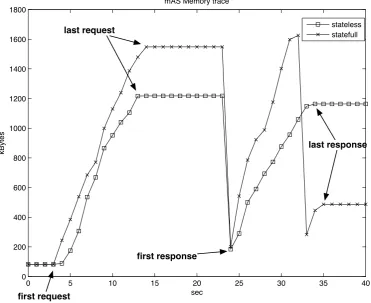
Focusing on the memory occupation for mAS, Figure8shows the trend on both stateless and stateful mode. It is worth noting that, as the execution of the service requires a very short time, to
make the analysis possible the client sends a request every1sand, the service waits for10safter
performing the addition. As shown in Figure8, in stateful mode the occupied memory is generally
1 2 3 4 5 6 7 8 9 10 0
200 400 600 800 1000 1200 1400 1600 1800 2000
# connected clients
msec
mAS response time
[image:24.595.106.496.76.313.2]stateless stateful
Figure 7.mASresponse time varying the number of connected clients.
times. When the first response is sent, since the garbage collector ran, the memory is occupied only
by the objects that are really alive and needed to process the requests. More precisely, at24smAS
occupies188Kbyteon stateless mode and206Kbyteon stateful model.
About the evaluation ofµ-BPEL, we calculated the amount of time required to perform the most
relevant activities in a WS-BPEL process: i.e., receive, reply, assign, and invoke. We decided to
concentrate on these activities as the remaining constructs constituting a WS-BPEL process does not
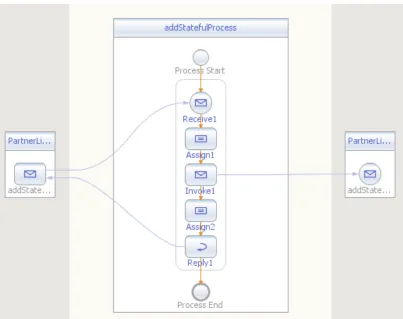
affect the overall execution time. For this reason, we performed our tests using the process shown in
Figure9. This process is deployed into theµ-BPEL environment running on a Sun Wireless Toolkit
emulator, and executed ten times. On another instance of the emulator,mASis running and hosts the services invoked by theµ-BPEL process. In this way, we are able to measure the response time
and the memory occupation forµ-BPEL only. With this configuration, after each execution of the
process, we considered the response time for the relevant activities and the overall response time. As
atmASside, we are able to get information about the time required to execute the invoked service, we excluded this value from the overall response time and the invoke response time. The average of
0 5 10 15 20 25 30 35 40 0
200 400 600 800 1000 1200 1400 1600 1800
mAS Memory trace
sec
kBytes
stateless statefull
first request
last request
last response
[image:25.595.112.484.80.383.2]first response
Figure 8.mASmemory occupation with10connected clients.
Table II. Response time for main WS-BPEL activities.
Activity Execution time
Receive 43 ms
Assign 123 ms
Invoke 156 ms
Reply 212 ms
Focusing on the overall response time, the process required1230mson average§. The overhead required to prepare the execution of the process to control the execution itself is573msobtained as
follows:
overhead= 1130ms−(43 + 123·2 + 156 + 212)ms= 473ms (1)
§This value refers to the time elapsed between the receive execution and the reply execution. Thus, the time required
Figure 9. WS-BPEL process used to evaluateµ-BPEL
It is worth noting that about the same overhead time is also observed when executing a variant of
the process where the external service invocation occurs five times. In that case, the overall process
takes, on the average,1766msso that the overhead is485ms(i.e.,1766−(43 + 123·2 + 156·5 +
212) = 485.
Finally, Figure10shows how the memory occupation varies during the process instantiation and
execution. In this case, we testedµ-BPEL with the process in Figure9and with two variant of it:
in theparallelvariant five parallel ’invoke’ are executed, whereas in thesequencevariant those five
invocations occur sequertially.
As shown, the memory occupation is always under 700Kbytes and at the end of the process
execution is about 170Kbyte. Even if it is not reported in the figure, also in case of parallel
execution, the amount of the memory after the execution remains on that value, but an explicit
0 10 20 30 40 50 60 70 80 0
100 200 300 400 500 600 700
µ BPEL Memory trace
sec
kBytes
single parallel sequence
process parsing and
model instantiation process start of
[image:27.595.112.489.80.412.2]execution
Figure 10.µ-BPEL memory trace.
5. RELATED WORK
As stated in [5], “Mobile Web services are mainly designed so embedded devices can consume
the service provided by the server; in other words, mobile Web services are designed from the
perspective of the Web services consumer, to enable lightweight devices to share the computing
capability and database with the server”. This kind of approach has influenced the research on the
mobile computing. As a consequence, most of the solutions made available so far by pervasive,
ubiquitous, and mobile computing community consider the mobile devices only at the client side of
the application. Among the first relevant contributions in this field, we mention [24] and [25], which
provide descriptions of the methods and components needed to put together mobile networks that
Web services deployed on traditional servers from mobile devices. For instance, Java only provides
the WSA 1.0 (JSR 172) specification that defines an optional package providing standard access
from J2ME devices to web services.
Our paper addresses the problem of orchestrating and executing Web services on a mobile device.
Although these issues have been scarcely addressed in the literature [26], in the remainder of this
section we compare our work with previous contributions addressing the execution, messaging,
andorchestrationof mobile Web services. Eventually, we also briefly discuss current proposals for
mobile Web services execution available in industry.
5.1. Execution of mobile Web services
As regards service execution, Berger et al. in [1] discuss their experience about running Web services
on a mobile device. According to them, there are no fundamental impediments preventing the usage
of Web services technology on mobile devices. Problems, however, may concern the infrastructures
and the mobile device resources. As a confirmation, the authors propose an architecture supporting
the publication and invocation of Web services on mobile devices and they demonstrate its real
effectiveness. In [27], Gehlen and Pham introduce the implementation of an environment executing
Web services on mobile devices. Although the architecture is similar to mAS, it runs on CDC configuration. Moreover, the source code or a downloadable version are not available.
An architecture similar to ours is also proposed in [29], where the authors deploy a Web service
handling infrastructure on a SonyEricsson P800 smartphone. The authors choose to deploy their
application on PersonalJava platform rather than J2ME CLDC/MIDP, owing to the former’s richer
application set. However, our platform achieves the same capability with better response times
using the constrained J2ME CLDC/MIDP platform. Zaplata et al. in [30] propose an architecture
for dynamic adaptation of Web service request based on the resource availability between mobile
service provider and consumer. The adaptation may occur through protocol selection, encoding
format or other means. The approach in [30] has not been evaluated on advanced platforms. Wolff
Initiative) for core management. Kim and Lee in [32] propose the use of Web service migration as
a means to make Web service availability robust to network or communication faults. The migration
policy is driven by the resource availability with respect to target devices capable of hosting Web
services. Innovative service advertisement and discovery protocols are proposed in [33], where the
proposed architecture is deployed only on Java CDC platform. Eventually, Schmidt et al. [34]
present an architecture very similar to ours. Our architecture, however, additionally offers Web
service orchestration, incorporating the WS-BPEL industry standard.
5.2. Mobile Web service messaging
Focusing on the messaging sub-system, Park et al. [35] propose an enhanced SOAP message
processing specifically designed for mobile Web services. Even if the authors assume that mobile
devices still hold the role of the Web service client, the proposed approach performs better than
a SOAP-based message communication, which is often the bottleneck of Web service based
applications. Similarly, Lai et al. [36] propose a SOAP binding based on UDP to obtain a messaging
system 10 times faster than using TCP as a transport protocol.
Deployment of Web services on C++ and Java based platforms have been compared in [37]. In
their study, the authors conclude that C++ Web service deployment provides quicker service times
because of faster processing of SOAP messages via the gSOAP [46] library. The work in [37],
however, exploits the SOAP-based client-server architecture for deployment of their prototype.
Recently proposed alternatives, such as [39], advocate providing REST (Representational State
Transfer) based Web services on mobile devices. This claim is motivated by the need for faster
processing times lower memory consumption and lower amount of resources available for devices
hosting such services. However, REST offers limited flexibility owing to its dependance on HTTP
protocol. Hassan et al. in [40] defers heavy computational tasks involved while executing Web
services to resourceful workstations. The evaluation in [40] demonstrates an improvement of
a factor 2 in response times. However, the authors do not specify the deployment platform.
anywhere. Glombitza et. al. [41] outline a new protocol called LTP (Lean Transport Protocol), for
device-oblivious communication requiring consumption of Web services. LTP employs message
compression without overloading device resources.
5.3. Orchestration of mobile Web services
When considering the execution of a complex application based on the orchestration of several Web
services, the available solutions are even less. Vimoware [43] is a flexible toolkit for developers to
develop Web services and to define and execute collaborative processes with customized scenario.
This work can be compared to ours, sinceµ-BPEL involves a lightweight flow language and allows
mobile devices to exchange messages for collaboration. However, Vimoware allows the mobile
devices to execute Web service, but a mobile device cannot manage the orchestration as inµ-BPEL.
To the best of our knowledge, Sliver [44] and ROME4EU [45] are the only WS-BPEL orchestrators
running on mobile devices. With respect to µ-BPEL, Sliver supports more workflow patterns (13
instead of 9), but it runs on a CDC configuration that has less limitation than CLDC on whichµ
-BPEL can run. ROME4EU is able to support all the -BPEL 2.0 specification, thus it can support
the 14 workflow patterns that also WS-BPEL supports (see TableI). Moreover, Rome4EU is based
on Microsoft .NET Compact Framework that can run only on Windows based mobile platforms,
whereasµ-BPEL is based on a CLDC profile that is supported by all the mobile platforms.
5.4. Industry standards and proposals
The OMA (Open Mobile Alliance) group [28] aims at delivering technical specifications that enable
interoperable solutions when Web services are invoked from or provided by a mobile device. In
particular, while kSOAP2 is a mature library for SOAP based Web service clients running on mobile
devices, we did not find a similarly mature proposal for enabling the provisioning of Web services
on mobile devices.
DPWS (Devices Profile for Web Services) [42] is an industry standard architecture for specifying
hosted and hosting services on resource constrained devices. Currently, Windows Vista and
uDPWS [47] is an extension of DPWS tailored for memory-efficient networked embedded systems
and wireless sensor networks.
The work in [38] compares the performance of Web service deployment on three major operating
systems currently present in the market viz. Symbian OS, Android, and Windows Mobile. Various
platforms (such as J2ME CLDC/MIDP) may be ported over either of these operating systems for
an improved performance. The study measures the tradeoff between performance and scalability of
the mobile operating systems.
6. CONCLUSIONS AND FUTURE WORK
In this paper, we introduced a mobile platform for supporting the execution of Web service based
applications that includes both a single Web service and a composition of Web services. The
two modules composing the MicroMAIS platform, mAS and µ-BPEL, have been developed by
considering all the common Web service standards in order to ensure the interoperability with
existing platforms.
The main rationale behindmASandµ-BPEL is to shift the role of a mobile device from being only the service consumer to being also a service provider. Due to the nature of mobile devices,
the limitation about memory, virtual machines, and connectivity deeply affects the architecture and
the functionalities of MicroMAIS. Nevertheless, we propose a complete framework that is able to
both execute standard Web services and composite Web services orchestrated according to a
WS-BPEL process. All of these functionalities are provided on a J2ME virtual machine that provides a
small subset of classes with respect to the JVM usually installed on traditional devices. Moreover,
we decided to rely on a CLDC JVM (instead of a CDC JVM) to be sure that our platform can be
executed on any kind of mobile device on which a Java Virtual Machine can be installed.
To improve the current release of the two modules, we would like to extend the mAS
functionalities with a management framework allowing the remote deployment of a Mobile Web
service and automatically creating a WSDL file. Finally, we will investigate the porting of
ACKNOWLEDGEMENTS
The authors would like to thank all the students that helped them in developingmASandµ-BPEL. A special thank to Matteo Galli, Giovanni Furnari, Tommaso Codella, Paola Sandrinelli, Matteo Sansalone. This work
has been partially founded by the European Community’s Seventh Framework Programme FP7/2007-2013
REFERENCES
1. Berger S, McFaddin S, Narayanaswami C, Raghunath M. Web Services on Mobile Devices - Implementation and Experience. IEEE Computer Society: Los Alamitos, CA, USA, 2003; 100.
2. Pernici B ( (ed.)).Mobile Information Systems: Infrastructure and Design for Adaptivity and Flexibility. Springer-Verlag New York, Inc.: Secaucus, NJ, USA, 2006.
3. Baresi L, Braga D, Comuzzi M, Pacifici F, Plebani P. A service-based infrastructure for advanced logistics.
Proceedings of the 2nd International Workshop on Service Oriented Software Engineering: in conjunction with
the 6th ESEC/FSE joint meeting, IW-SOSWE 2007, Dubrovnik, Croatia, 2007; 47–53.
4. Brioschi M, Cappiello C, Legnani M, Maurino A, Mussi E, Pernici B, Simeoni N. The MAIS prototype for the risk evaluation of archaelogical heritage. Demo presented in the Developers Track of the 15th International World Wide Web Conference, Edinburgh 2006.
5. Shu Fang R. Designing mobile Web services. http://www.ibm.com/developerworks/wireless/
library/wi-websvc/2006.
6. Apache Software Foundation. Apache Axis 2 User’s Guide. http://ws.apache.org/axis2/1_5_1/ userguide.html2009.
7. Gamma E, Helm R, Johnson RE, Vlissides J.Design Patterns: Elements of Reusable Object-Oriented Software. Addison-Wesley: Reading, MA, 1995.
8. Vieka Technology Inc. eSQL Database Engine.http://vieka.com/esql.htm. 9. SQLite. SQLite Documentation.http://www.sqlite.org/docs.html.
10. Gosh S. J2ME Record Management Store. http://www.ibm.com/developerworks/library/
wi-rms/May 2002.
11. Java Community Process. JSR-000118 Mobile Information Device Profile 2.0. http://jcp.org/aboutJava/communityprocess/final/jsr118/ November 2002.
12. Floggy Open Source Group. Floggy.http://floggy.sourceforge.net.
13. Johnson RE, Foote B. Designing Reusable Classes.Journal of Object-Oriented ProgrammingJune/July 1988;
1(2):22–35.
14. Apache Software Foundation. Excalibur.http://excalibur.apache.org/. 15. PicoContainer Committers. Picocontainer.http://www.picocontainer.org/.
16. Jing J, Huff K, Sinha H, Hurwitz B, Robinson B. Workflow and Application Adaptations in Mobile Environments.
Proceedings of the Second IEEE Workshop on Mobile Computer Systems and Applications, WMCSA ’99, IEEE
Computer Society: Washington, DC, USA, 1999; 62–69.
18. Smith H. Business process management–the third wave: business process modelling language (bpml) and its pi-calculus foundations. Information and Software Technology 2003; 45(15):1065 – 1069, doi:DOI:10.1016/ S0950-5849(03)00135-6. Special Issue on Modelling Organisational Processes.
19. Arkin A, Askary S, Fordin S, Jekeli W, Kawaguchi K, Orchard D, Pogliani S, Riemer K, Struble S, Nagy PT,et al.. Web Service Choreography Interface (WSCI) 1.0.Technical Report2002.
20. OASIS. Web Services Business Process Execution Language (WS-BPEL) version 2.0,. http://docs.
oasis-open.org/wsbpel/2.0/wsbpel-v2.0.html2007. 21. KObjectsorg. Ksoap 2.http://ksoap2.sourceforge.net/. 22. KObjectsorg. kxml.http://kxml.sourceforge.net/.
23. Slominski A. XML Pull Parser (XPP).http://www.extreme.indiana.edu/xgws/xsoap/xpp/. 24. Pashtan A.Mobile Web Services. Cambridge University Press, 2005.
25. Farley P, Capp M. Mobile Web Services.BT Technology Journal2005;23:202–213, doi:http://dx.doi.org/10.1007/ s10550-005-0042-1. 10.1007/s10550-005-0042-1.
26. Tosic V, Lutfiyya H, Tang TY, Sherdil K, Dimitrijevic A. On requirements for management of mobile XML Web services and a corresponding management system. Telecommunications in Modern Satellite, Cable and Broadcasting Services, 2005. 7th International Conference on28-30 Sept 2005; :57–60doi:10.1109/TELSKS.2005. 1572063.
27. Gehlen G, Pham L. Mobile Web services for peer-to-peer applications.Consumer Communications and Networking
Conference, 2005. CCNC. 2005 Second IEEE3-6 Jan 2005; :427–433doi:10.1109/CCNC.2005.1405210.
28. Open Mobile Alliance Web site.http://ksoap2.sourceforge.net/.
29. Srirama SN, Jarke M, Prinz W. Mobile Web Service Provisioning. Advanced International Conference on Telecommunications / Internet and Web Applications and Services, International Conference on2006;0:120, doi: http://doi.ieeecomputersociety.org/10.1109/AICT-ICIW.2006.215.
30. Zaplata S, Dreiling V, Lamersdorf W. Realizing Mobile Web Services for Dynamic Applications.Software Services for e-Business and e-Society,IFIP Advances in Information and Communication Technology, vol. 305, Godart C, Gronau N, Sharma S, Canals G (eds.). Springer Boston, 2009; 240–254, doi:http://dx.doi.org/10.1007/ 978-3-642-04280-5\20. 10.1007/978-3-642-04280-5 20.
31. Wolff A, Michaelis S, Schmutzler J, Wietfeld C. Network-centric Middleware for Service Oriented Architectures across Heterogeneous Embedded Systems.Enterprise Distributed Object Computing Conference Workshops, IEEE International2007;0:105–108, doi:http://doi.ieeecomputersociety.org/10.1109/EDOCW.2007.20.
32. Kim YS, Lee KH. A lightweight framework for mobile web services. Computer Science - Research and Development2009;24:199–209, doi:http://dx.doi.org/10.1007/s00450-009-0091-7. 10.1007/s00450-009-0091-7. 33. Juszczyk L, Dustdar S. A middleware for service-oriented communication in mobile disaster response
environments.Proceedings of the 6th international workshop on Middleware for pervasive and ad-hoc computing, MPAC ’08, ACM: New York, NY, USA, 2008; 37–42, doi:http://doi.acm.org/10.1145/1462789.1462796. URL
34. Schmidt H, K¨ohrer A, Hauck FJ. SoapME: a lightweight Java ME web service container.Proceedings of the 3rd
workshop on Middleware for service oriented computing, MW4SOC ’08, ACM: New York, NY, USA, 2008; 13–18,
doi:http://doi.acm.org/10.1145/1462802.1462805.
35. Park G, Kim S, Bae G, Kim Y, Kang B. An Automated WSDL Generation and Enhanced SOAP Message Processing System for Mobile Web Services.ITNG ’06: Proceedings of the Third International Conference on Information
Technology: New Generations (ITNG’06), IEEE Computer Society: Washington, DC, USA, 2006; 388–387, doi:
http://dx.doi.org/10.1109/ITNG.2006.27.
36. Lai K, Phan TA, Tari Z. Efficient SOAP Binding for Mobile Web Services.LCN ’05: Proceedings of the The IEEE Conference on Local Computer Networks 30th Anniversary, IEEE Computer Society: Washington, DC, USA, 2005; 218–225, doi:http://dx.doi.org/10.1109/LCN.2005.62.
37. Schall D, Aiello M, Dustdar S. Web services on embedded devices. 2006; 45–50, doi:http://dx.doi.org/10.1108/ 17440080680000100.
38. Kikkert S. Performance of Web Services on Mobile Phones.Technical Report, University of Groningen 2010. 39. AlShahwan F, Moessner K. Providing SOAP Web Services and RESTful Web Services from Mobile Hosts.
Internet and Web Applications and Services (ICIW), 2010 Fifth International Conference on, 2010; 174 –179, doi:10.1109/ICIW.2010.33.
40. Hassan M, Zhao W, Yang J. Provisioning Web Services from Resource Constrained Mobile Devices.Cloud Computing, IEEE International Conference on2010;0:490–497, doi:http://doi.ieeecomputersociety.org/10.1109/ CLOUD.2010.30.
41. Glombitza N, Pfisterer D, Fischer S. LTP: An Efficient Web Service Transport Protocol for Resource Constrained Devices.Sensor Mesh and Ad Hoc Communications and Networks (SECON), 2010 7th Annual IEEE Communications Society Conference on, 2010; 1 –9, doi:10.1109/SECON.2010.5508255.
42. WS4D. What is DPWS and uDPWS all about? http://code.google.com/p/udpws/wiki/
IntroductionGeneral#The_InternetOctober 2010.
43. Truong HL, Juszczyk L, Bashir S, Manzoor A, Dustdar S. Vimoware - A Toolkit for Mobile Web Services and Collaborative Computing.Software Engineering and Advanced Applications, 2008. SEAA ’08. 34th Euromicro Conference, 2008; 366 –373.
44. Hackmann G, Gill C, Roman GC. Extending BPEL for Interoperable Pervasive Computing.Pervasive Services, IEEE International Conference on, 2007; 204–213, doi:10.1109/PERSER.2007.4283918.
45. Battista D, de Leoni M, De Gaetanis A, Mecella M, Pezzullo A, Russo A, Saponaro C. ROME4EU: A Web Service-Based Process-Aware System for Smart Devices.Service-Oriented Computing - ICSOC 2008,Lecture Notes in Computer Science, vol. 5364, Bouguettaya A, Krueger I, Margaria T (eds.). Springer Berlin / Heidelberg, 2008; 726–727, doi:http://dx.doi.org/10.1007/978-3-540-89652-4 65.