Theses Thesis/Dissertation Collections
8-2015
Dynamic Optimization of a Rimless Wheel with an
Actuated Pendulum
Benjamin Thomas Mihevc
Follow this and additional works at:http://scholarworks.rit.edu/theses
This Thesis is brought to you for free and open access by the Thesis/Dissertation Collections at RIT Scholar Works. It has been accepted for inclusion in Theses by an authorized administrator of RIT Scholar Works. For more information, please [email protected].
Recommended Citation
Wheel with an Actuated Pendulum
byBenjamin Thomas Mihevc
A Thesis Submitted in Partial Fulfillment of the Requirements for the Degree of Master of Science
in Computer Engineering
Supervised by
Juan C. Cockburn
Department of Computer Engineering Kate Gleason College of Engineering
Rochester Institute of Technology Rochester, New York
August 2015
Approved by:
Juan C. Cockburn, Associate Professor
Thesis Advisor, Department of Computer Engineering
Mario W. Gomes, Assistant Professor
Co-advisor, Department of Mechanical Engineering
Agamemnon L. Crassidis, Associate Professor
Committee Member, Department of Mechanical Engineering
Andres Kwasinski, Associate Professor
Abstract
Dynamic Optimization of a Rimless Wheel with an Actuated Pendulum
Benjamin Thomas Mihevc
As the demand for mobile robots that work alongside humans increases,
the amount of energy that these co-robots consume will become a critical
limiting factor in their deployment. This need is clearly captured in one
of the fifteen main goals of the 2009 Roadmap for US Robotics which is to
create a robot that can walk with half the energy consumption of a human
being. At this point, the most energy-efficient walking robot is about as
energy efficient as a human.
Energy efficient bipedal motion is an active area of research. It has been
proven that it is theoretically possible to design a robot with intermittent
support, one of the most fundamental attributes of legged locomotion, to
have a zero-energy cost collisionless gait.
Optimal control has been used by a number of researchers to study the
generation of periodic gaits for walking robots. However little research
exists demonstrating walkers with energy efficient collisionless motion.
the energy lost to the system when walking is from losses due to step
col-lisions.
In this work energy efficient locomotion of a prototype actuated rimless
wheel on level ground is explored using numerical optimal control. The
actuated rimless wheel has an internal pendulum driven by a DC motor.
The locomotion problem is posed as an optimal control problem.
Dif-ferent cost functions and initial configurations are investigated and the
corresponding gait trajectories analyzed and assessed based on their use
of energy and the potential for collisionless motion.
The results of this work will provide the foundation for the design and
im-plementation of more energy efficient actuated rimless wheel prototype
Contents
Abstract . . . ii
1 Introduction . . . 1
2 Literature Review . . . 5
3 The Actuated Rimless Wheel . . . 9
3.1 Newton-Euler Equations . . . 9
3.2 Lagrangian Dynamics . . . 15
3.3 Actuator Dynamics . . . 21
3.4 Collision Dynamics . . . 24
3.5 Overview of Optimal Control Theory . . . 30
4 Experiments and Results . . . 33
4.1 Overview of Implementation . . . 33
4.2 System Parameters . . . 36
4.4 Experiments . . . 39
4.4.1 Single Colliding Step . . . 40
4.4.2 Single Collisionless Step . . . 45
4.4.3 Two Perfectly Elastic Colliding Steps . . . 50
4.4.4 Three Perfectly Elastic Colliding Steps . . . 67
4.4.5 A Plastic Collision . . . 70
4.4.6 Single Step Extensions . . . 76
4.5 Additional Analysis of Results . . . 82
5 Conclusions . . . 86
5.1 Forward Work . . . 86
5.1.1 Dynamic Model Revision . . . 86
5.1.2 Physical Construction . . . 87
5.1.3 Feedback Control . . . 88
5.2 Concluding Remarks . . . 89
List of Figures
1.1 Diagram of a Rimless Wheel . . . 2
3.1 Diagram of a Pendulum Coupled Rimless Wheel . . . 10
3.2 Free Body Diagrams of the Pendulum Coupled Rimless Wheel 10 3.3 Generalized Circuit of DC Motor . . . 22
3.4 System Before (Left) and After (Right) an Instantaneous Col-lision . . . 24
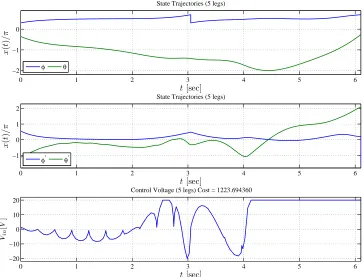
4.1 Single Colliding Step with Voltage Cost . . . 43
4.2 Single Colliding Step with a Multi State Cost . . . 44
4.3 Single Colliding Step Energy . . . 45
4.4 Single Collisionless Step . . . 47
4.5 Single Collisionless Step Simulation Verification . . . 48
4.6 Single Collisionless Step Energy . . . 49
4.7 Two Colliding Steps with Low Wheel Position Cost . . . 54
4.10 Two Colliding Steps with Low Wheel Costs . . . 57
4.11 Two Colliding Steps with Low Wheel Costs Verification . . . . 57
4.12 Two Colliding Steps with Low Wheel Costs Energy . . . 58
4.13 Two Colliding Steps with Low Position Costs . . . 59
4.14 Two Colliding Steps with Low Position Costs Verification . . . 60
4.15 Two Colliding Steps with Low Position Costs Energy . . . 61
4.16 Two Colliding Steps with High Wheel Velocity Cost . . . 62
4.17 Two Colliding Steps with High Wheel Velocity Cost
Verifica-tion . . . 63
4.18 Two Colliding Steps with High Wheel Velocity Cost Energy . . 64
4.19 Two Colliding Steps with High Wheel Velocity Cost . . . 65
4.20 Two Colliding Steps with High Wheel Velocity Cost
Verifica-tion . . . 66
4.21 Two Colliding Steps with High Wheel Velocity Cost Energy . . 66
4.22 Three Colliding Steps GPOPS-II . . . 68
4.23 Two Colliding Steps with High Wheel Velocity Cost
Verifica-tion . . . 69
4.24 Two Colliding Steps with High Wheel Velocity Cost Energy . . 69
4.25 Two Steps Collision Dynamics GPOPS-II . . . 74
4.27 Two Colliding Steps with High Wheel Velocity Cost Energy . . 76
4.28 Single Step Extension to Multi-Step Result, Experiment 1 . . 77
4.29 Single Step Extension to Multi-Step Result, Experiment 1 . . 78
4.30 Single Step Extension to Multi-Step Result, Experiment 1 . . 79
4.31 First Single Step Extension to Multi-Step Result, Experiment 5 80
4.32 Second Single Step Extension to Multi-Step Result,
Experi-ment 5 . . . 81
4.33 Single Step Extension to Multi-Step Verification, Experiment
1 . . . 81
List of Tables
1 List of Variables . . . x
4.1 Nominal Parameter Values . . . 37
4.2 Motor Parameters . . . 37
4.3 Experiment 1 State Constraints . . . 41
4.4 Experiment 2 State Constraints . . . 46
4.5 Experiment 3 State Constraints . . . 51
4.6 Physical Parameter Values . . . 71
List of Variables
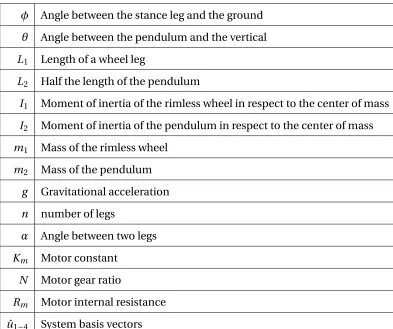
Table 1: List of Variables
φ Angle between the stance leg and the ground
θ Angle between the pendulum and the vertical
L1 Length of a wheel leg
L2 Half the length of the pendulum
I1 Moment of inertia of the rimless wheel in respect to the center of mass
I2 Moment of inertia of the pendulum in respect to the center of mass
m1 Mass of the rimless wheel
m2 Mass of the pendulum
g Gravitational acceleration
n number of legs
α Angle between two legs
Km Motor constant
N Motor gear ratio
Rm Motor internal resistance
ˆ
Chapter 1
Introduction
Numerical optimization is a tool that allows for the determination of an
ideal solution based on a cost criteria. This cost must be minimized to
find this optimal solution. To minimize this cost, function inputs are
al-tered based on the first and second derivatives of the system until an
op-timal solution is found. This is the fundamental idea that opop-timal control
is built upon.
Optimal control is an extension of numerical optimization. With optimal
control, the cost is often a function of functions and the input is a set of
trajectories instead of a constant. The system is then subject to a
num-ber of dynamic constraints. Then, by varying the input trajectories, an
optimal set of state trajectories can be determined.
Optimal control can be, and often is, applied to energy minimization
prob-lems. By using several of the components of the energy in the system as
a cost function, inputs can be found that minimize energy use. However,
it must be noted that optimization is based on a cost function. If the cost
an actual optimal solution may not be found.
Why is energy efficient optimal control important ? The answer to that
question changes constantly. In the 1950s, it was important to enable the
efficient use of rockets for space travel. In the 1960s, it was important
for developing optimal climb trajectories for high performance military
aircraft. Today, it is important for efficient robotic motion.
Historically, robotic walkers started out focused on statically stable
mo-tion. Though practical for early research, maintaining constant stability
is not energy efficient. Proceeding from stable gaits to half stable and
periodic gaits was the focus of much of the early 1990s through the early
2000s. During this research, the rimless wheel was developed. This wheel,
seen in Figure 1.1, can be likened to a wagon wheel with the wheel part removed. This leaves only the spokes.
φ
L1
Figure 1.1: Diagram of a Rimless Wheel
focused on the creation and simulation of an energy efficient walker
ca-pable of level ground transport. The goal was to reduce the energy of
transport by generating collision free motion. For his research, a five
legged walker with an internal inertial device was created. The inertial
device consisted of a torsional spring attached to a rotating mass.
In simulation, frictional losses prevented the passive system from
achiev-ing collisionless motion. Attempts to apply simple actuation and
feed-back control to the system did improve the cost of transport, but did not
reintroduce collisionless motion [1].
In this thesis this problem will be reexamined using optimal control. To
apply optimal control to the system, an understanding of the dynamics of
the rimless wheel must obtained. First studied in detail by McGeer in the
late 1980s and early 1990s, the rimless wheel is considered the simplest
walking system [2]. It has been shown to be a half stable, 1-period system
when walking down an incline. When walking on level ground the system
is asymptotically stable [3].
Rimless wheels with actuation have been proposed and implemented to
further gain insight into collisionless motion. Among the many
actua-tion methods the most common are telescoping legs, spinning inertial
devices, and wobbling pendulums. Most of these methods of actuation
sought a stable gait frequency.
walking rimless wheel. We will consider the minimization of the control
effort as a surrogate to input energy, but we will also seek to determine
the optimal trajectory that leads to a collisionless step.
We will begin by deriving the dynamics of the system and the equations
of motion. From there, a simulation of the system will be developed.
Fol-lowing that, the optimal control problem will be formulated and solved
for various wheel configurations with various costs functions. We will
ex-periment with penalizing state movement and control input. Finally we
will analyze our results and discus physical implementation of the
Chapter 2
Literature Review
In the late 1980s and early 1990s, McGeer pioneered passive dynamic
walking by introducing the rimless wheel [2]. The dynamics of the
less wheel were studied significantly. Since the introduction of the
rim-less wheel it’s passive stability on a gentle incline was determined to be
1-period half stable. With frictional losses, the system is asymptotically
stable [4][5][3][6].
Gamus and Or [6] examined the dynamic legged locomotion of a robotic
walker that undergoes a constant falling motion followed by foot
place-ment. Their work involved a rimless walking wheel without any kind of
secondary oscillation or actuated swinging body besides the wheel itself.
In the paper, they examine the slipping dynamics of the wheel. Though
beyond the scope of my research, the dynamics of their walker are similar
to the simplified dynamics of the walker we are describing.
Passive walking wheels provide a simple way to model stepping motions,
but do not have any inherent methods of actuation. Generating a walking
to these systems are numerous. Some of the more popular methods
in-clude telescoping legs [7], external actuated torsos [5][8], virtual slopes
generated by an actuated heel [9], wobbling pendulums [10], small
phys-ical slopes [1], and many more.
Fumihiko Asano created a passive dynamic walking rimless wheel with a
two degree of freedom wobbling mass on the center of mass of the wheel
[10]. This walker was shown to demonstrate the effect of a passive
wob-bling mass on a walker moving down an incline. The wobwob-bling mass
swings on a pin joint at the center of the wheel’s mass and telescopes
along the pendulum arm’s length. If the telescoping arm’s length is held
constant, the walker is essentially the one in this thesis.
Asano used this walker to demonstrate the asymptotically stable gait of
this type of walker. In addition, the swinging of the inner mass was used
as a controller to achieve a reference frequency. Asano was able to
demon-strate that this type of walker is capable of achieving a controlled gait for
high efficiency movement using simple PID control while walking down
a negative slope [10].
Much of the research involving rimless wheels is foundational work that
leads directly to bipedal walking [6] [3] [7] [5]. These bipedal walkers
al-most exclusively focus on stable periodic walking gaits.
Walkers that can achieve stable periodic bipedal motion need to be
the center of mass of the robot to allow for dynamic motion. In their work,
they model their robot as an inverted double pendulum that has an upper
mass and a swinging foot. By altering the center of mass of their system
they were able to achieve a more efficient method of robotic locomotion.
A Lagrangian approach was used to determine the equations of motion
of the rimless wheel. General background on this approach can be found
in [12] and [13].
Efficient robotic locomotion yields directly to optimal control. Numerous
authors have used optimal control for bipedal and rimless wheel walkers
[14] [15] [16] [17] [18] [19] [20] [21] [22]. Where most of the work involving
optimal control and walking robots differ are the actuation methods. In
general, the cost function of the optimal control problem is either gait
frequency or energy, or both. In some cases, electrical input energy and
storing the systems kinetic energy prior to a step is considered [19], but
the energy lost in the collision with the ground is rarely studied.
As was discovered by Ahlin [1] and previously discussed, a significant
amount of energy is lost in foot collisions. Determining if a trajectory
ex-ists that can yield actuated collisionless motion is of significant interest.
The locomotion problem was formulated as an optimal control problem.
For background on optimal control and dynamic optimization see [23]
[24] [25] [26]. The optimal control problem was then solved numerically
multiple-phase optimal control problems using Gaussian pseudospectral
methods is based on research by Rao et al. [27]. This method discretizes
the problem as approximations of the states and control using high order
polynomials [27] [28] [29]. The coefficients of the polynomials can then
be solved for using traditional optimization methods. This "collocation”
of the system is dynamic in nature and does not require a constant
Chapter 3
The Actuated Rimless Wheel
This section describes the dynamics of a rimless wheel system. In it the
equations of motion, energy equations, and control torque equations will
be presented and explained. Additionally, the derivations will be
pre-sented in detail. The relevant free body diagrams will be prepre-sented and
their significance will be explained.
3.1 Newton-Euler Equations
The rimless wheel dynamics will be described as a double pendulum.
This system is a system with two pin joints, one being the motionless
pivot joint on the ground, and the other being the moving pivot at the
center of gravity of the rimless wheel. This can be seen in Figure3.1where φ is the angle between the spoke and the ground and θ is the angle
be-tween the vertical axes and the inner pendulum’s arm.
This system can be split into two separate free body diagrams. These free
φ
θ
L1
L2
ψ
Figure 3.1: Diagram of a Pendulum Coupled Rimless Wheel
acting on the outer wheel of this system. In the simulation, this system
acts as the first arm of the double pendulum. System 2 is describes the
forces acting on the inner arm of the pendulum. System 1 in Figure 3.2
φ
θ Ry
Rx
m1g τ
m2g Rx
Ry
ˆ
u2
ˆ
u1 ˆ
u4
ˆ
u3
ˆ
ˆı
ˆ
ˆı
System 1 System 2
τ
o
Fy
Fx
Figure 3.2: Free Body Diagrams of the Pendulum Coupled Rimless Wheel
introduces two coordinate axis. The first axis is the standard ˆı, ˆ, and ˆk
coordinate plane. The second coordinate plane is the system consisting
of ˆu3 and ˆu4 system which moves with the outer wheel. System 2 in
the actuated inner pendulum. The coordinate transform from ˆu3 and ˆu4
into ˆı, ˆ, and ˆkis summarized in Equations (3.1) and (3.2). The coordinate transform from ˆu1and ˆu2into ˆı, ˆ, and ˆkis summarized in Equations (3.3)
and (3.4).
ˆ
u3=cos¡φ¢ıˆ−sin¡φ¢ˆ (3.1)
ˆ
u4=sin¡φ¢ıˆ+cos¡φ¢ˆ (3.2)
ˆ
u1=sin(θ) ˆı−cos(θ) ˆ (3.3)
ˆ
u2=cos(θ) ˆı+sin(θ) ˆ (3.4)
For context the following force equations were determined. Though
ulti-mately, unused, they provide an understanding of how the system moves.
To begin, System 1 in Figure3.2was analyzed.
X~
F =m1~α1
Fyˆ+Fxıˆ+Ryˆ+Rxıˆ−g m1ˆ=m1~α1 (3.5)
To determine the acceleration of System 1 , the position of its center of
Figure3.2, where ˙ˆu3= −φ˙uˆ4 and ˙ˆu4=φ˙uˆ3
~rcm1/o = −L1uˆ3
~v1=~r˙cm1/o= −L1u˙ˆ3=L1φ˙uˆ4 ~
α1=~v˙1=L1¡φ¨uˆ4+φ˙u˙ˆ4¢=L1¡φ¨uˆ4+φ˙2uˆ3¢
~
α1=L1¡φ˙2uˆ3+φ¨uˆ4¢ (3.6)
Equations (3.1) and (3.2) were substituted into Equation (3.6).
~
α1=L1¡φ˙2¡cos¡φ¢ıˆ−sin¡φ¢ˆ¢+φ¨¡sin¡φ¢ıˆ+cos¡φ¢ˆ¢¢
Then Equation (3.6) was substituted into Equation (3.5).
Fyˆ+Fxıˆ+Ryˆ+Rxˆı−g m1ˆ=
=m1¡L1¡φ˙2¡cos¡φ¢ıˆ−sin¡φ¢ˆ¢+φ¨¡sin¡φ¢ˆı+cos¡φ¢ˆ¢¢¢
=m1L1φ˙2cos¡φ¢ıˆ−m1L1φ˙2sin¡φ¢ˆ+m1L1φ¨sin¡φ¢ıˆ+m1L1φcos¨ ¡φ¢ˆ
The above vector equation is equivalent to the following two scalar
equa-tions
Fy +Ry =L1m1
µ g
L1+
˙
φ2sin¡φ¢+φ¨cos¡φ¢

(3.7)
Fx+Rx =L1m1¡φ˙2cos¡φ¢−φ¨ sin¡φ¢¢ (3.8)
Next, the rotational dynamics of System 1 were analyzed. This analysis
~
α1=φ¨kˆ
X
Mcm1=I1~α1
I1~α1=rcm1/o×Fyˆ+rcm1/o×Fxıˆ+
rcm1/cm1×Ryˆ+rcm1/cm1×Rxıˆ−rcm1/cm1×g m1ˆ I1~α1=rcm1/o×Fyˆ+rcm1×Fxˆı
I1~α1=L1uˆ3×Fyˆ+L1uˆ3×Fxˆı
I1~α1=L1¡cos¡φ¢ˆı−sin¡φ¢ˆ¢×Fyˆ+L1¡cos¡φ¢ıˆ−sin¡φ¢ˆ¢×Fxˆı
I1φ¨kˆ =L1cos¡φ¢ˆı×Fyˆ−L1sin¡φ¢ˆ×Fxıˆ
I1φ¨kˆ =L1cos¡φ¢Fykˆ+L1sin¡φ¢Fxkˆ
I1φ¨=L1¡Fycos¡φ¢+Fxsin¡φ¢¢ (3.9)
Next, System 2 in Figure3.2was analyzed. To determine the acceleration of System 2’s center of mass, the position of the center of mass must first
˙
θuˆ2, ˙ˆu2= −θ˙uˆ1, ˙ˆu3= −φ˙uˆ4, and ˙ˆu4=φ˙uˆ3.
~rcm2/o=~rcm2/cm1+~rcm1/o
=L2uˆ1−L1uˆ3
~v2=L2u˙ˆ1−L1u˙ˆ3=L2θ˙uˆ2+L1φ˙uˆ4
~α2=L2¡θ˙u˙ˆ2+θ¨uˆ2¢+L1¡φ˙u˙ˆ4+φ¨uˆ4¢
=L2¡θ¨uˆ2−θ˙2uˆ1¢+L1¡φ¨uˆ4+φ˙2uˆ3¢
=L2θ¨uˆ2−L2θ˙2uˆ1+L1φ¨uˆ4+L1φ˙2uˆ3
~α2=L1φ¨¡sin¡φ¢ˆı+cos¡φ¢ˆ¢+L1φ˙2¡cos¡φ¢ıˆ−sin¡φ¢ˆ¢
+L2θ¨¡cos(θ) ˆı+sin(θ) ˆ¢−L2θ˙2¡sin(θ) ˆı−cos(θ) ˆ¢
(3.10)
From Newton’s 2nd law
X~
F =m2~α2
−Ryˆ−Rxıˆ−g m2ˆ=m2~α2
The above vector equation leads to the following two scalar equations
−Rx=m2¡L1φ¨sinφ+L1φ˙2cosφ+L2θ¨cosθ−L2θ˙2sinθ¢ (3.11)
−Ry−g m2=m2¡L1φ¨cosφ−L1φ˙2sinφ+L2θ¨sinθ+L2θ˙2cosθ¢ (3.12)
noting thatrcm1/cm2= −L2uˆ1and~α2=θ¨kˆ,
X~
Hcm2=I2~αcm2 I2~α2=rcm1/cm2×
¡
−Ryˆ¢+rcm1/cm2×(−Rxˆı)+rcm2/cm2×
¡
−g m1ˆ¢
I2~α2=rcm1/cm2×
¡
−Ryˆ¢+rcm1/cm2×(−Rxˆı) I2~α2=L2uˆ1×Ryˆ+L2uˆ1×Rxıˆ
I2~α2=L2¡sin(θ) ˆı−cos(θ) ˆ¢×Ryˆ+L2¡sin(θ) ˆı−cos(θ) ˆ¢×Rxıˆ
I2~α2=L2Rysin(θ) ˆı׈−L2Rxcos(θ) ˆ×ˆı
I2~α2=L2Rysin(θ) ˆk+L2Rxcos(θ) ˆk
I2~α2=L2¡Rysin(θ) ˆk+Rxcos(θ) ˆk¢ (3.13)
These equations were not used for the dynamics of the system. Solving
for the equations of motion directly using the Newtonian equations of
motion proved to become complicated quite quickly. They are included
to provide context and reference for future work. The equations of
mo-tion are determined with the alternative Lagrangian method in the next
section.
3.2 Lagrangian Dynamics
To derive the dynamic equations of the actuated rimless wheel we will use
the Lagrangian approach. Let q = (φ,θ) denote the generalized
the Lagrangian. Then, Lagrange’s equations of motion can be written as
d d t
µ∂(L +D) ∂q˙
¶ −∂L
∂q = f (3.14)
whereDis the dissipation function and f a vector of external generalized
forces. In our model we assume that there is no dissipation, soD=0. To
find the Lagrangian one must first find the kinetic and potential energy of
the system.
The potential energy of the system is
V =g L1(m1+m2)sin¡φ¢−g m2L2cos(θ) (3.15)
The kinetic energy is the sum of the kinetic energies of the wheelTw and
the pendulumTp where
Tw =1
2m1|~v1|
2
+12I1φ˙2 (3.16)
Tp =1
2m2|~v2|
2
+12I2θ˙2 (3.17)
Since the velocities of the center of mass with respect to the point ‘o’ is
~v1=L1φ˙¡sin¡φ¢ıˆ+cos¡φ¢ˆ¢
It follows that
Tw =1 2m1
¯
¯~vcm1/o ¯ ¯
2
+12I1φ˙2
=12m1¯¯L1φ˙ ¡
sin¡
φ¢
ˆ
ı+cos¡
φ¢
ˆ ¢¯
¯
2
+12I1φ˙2
=12m1¯¯L1φ˙sin ¡
φ¢
ˆ
ı+L1φ˙cos¡φ¢ˆ¯¯
2
+12I1φ˙2
=21m1¡L1φ˙sin¡φ¢¢2+1
2m1
¡
L1φ˙cos¡φ¢¢2+1
2I1φ˙
2
Tw = ¡
L21m1+I1¢φ˙2
2 (3.19)
Tp =1 2m2
¯ ¯L2θ˙
¡
cos(θ) ˆı+sin(θ) ˆ¢
+L1φ˙¡sin¡φ¢ıˆ+cos¡φ¢ˆ¢¯¯
2
+12I2θ˙2
=12m2¯¯ ¡
L2θ˙cos(θ)+L1φ˙sin¡φ¢¢ˆı+¡L2θ˙sin(θ)+L1φ˙cos¡φ¢¢ˆ¯¯
2
+12I2θ˙2
=12m2¡L2θ˙cos(θ)¢2+1
2m22L2θ˙cos(θ)L1φ˙sin
¡
φ¢
+12m2¡L1φsin˙ ¡φ¢¢2+1
2m2
¡
L2θ˙sin(θ)¢2
+12m22L2θ˙sin(θ)L1φ˙cos¡φ¢+1
2m2
¡
L1φ˙cos¡φ¢¢2+1
2I2θ˙
2
Tp = ¡
L2
2m2+I2¢θ˙2
2 +
L2 1m2φ˙2
2 +m2L1L2θ˙φ˙sin
¡
θ+φ¢ (3.20)
Finally the total kinetic energy is
T =Tw+Tp
= ¡
L21m1+L21m2+I1¢φ˙2
2 +
¡
L22m2+I2¢θ˙2
To express these equations compactly, define the following variables.
Je0=m1L
2
1+I1 (3.22)
Je1=(m1+m2)L
2
1+I1 (3.23)
Je2=m2L22+I2 (3.24)
Je3=L1L2m2 (3.25)
Substituting in the above equations
V =g L1(m1+m2)sin¡φ¢−gcos(θ)L2m2 (3.26)
T =12Je1φ˙2+
1
2Je2θ˙2+Je3sin
¡
φ+θ¢φ˙θ˙ (3.27)
The Lagrangian of the system is
L =¡
L2m2cosθ−L1(m1+m2)sinφ¢g
+ Je1φ˙2+Je2θ˙2
2 +Je3sin(φ+θ) ˙φθ˙
(3.28)
Remark 1 Note that the kinetic energy has the general form
T (q,q˙)= 12q˙TM(q)q˙, (3.29)
M(q)= "
Je1 Je3sin(φ+θ) Je3sin(φ+θ) Je2
#
(3.30)
SinceV does not depend onq˙, then
∂L
∂L
∂θ = Je3φ˙θ˙cos
¡
φ+θ¢
−gsin(θ)L2m2 (3.32)
∂L ∂θ˙ =
˙
θJe2+Je3φ˙sin
¡
φ+θ¢ (3.33)
∂ ∂t
µ
∂L ∂θ˙

=θ¨Je2+φ¨sin¡φ+θ¢Je3+φ˙cos
¡
φ+θ¢Je3
¡˙
φ+θ˙¢ (3.34)
f1=T (3.35)
∂L
∂φ = Je3φ˙θ˙cos
¡
φ+θ¢−gcos¡φ¢L1(m1+m2) (3.36)
∂L ∂φ˙ =
˙
φJe1+Je3θ˙sin
¡
φ+θ¢ (3.37)
∂ ∂t
µ
∂L ∂φ˙

=φ¨Je1+θ¨sin
¡
φ+θ¢Je3+θ˙cos
¡
φ+θ¢Je3
¡˙
φ+θ˙¢ (3.38)
f2=0 (3.39)
The Euler-Lagrange equations are
Je3sin(φ+θ) ¨θ+Je1φ¨+Je3cos
¡
φ+θ¢ ˙
θ2+L1(m1+m2)cosφg =0
Je2θ¨+Je3 sin(φ+θ)) ¨φ+Je3cos
¡
φ+θ¢ ˙
φ2+L2m2sinθg =T
Remark 2 The Euler-Lagrange equations have the general form
where f =(0;T), M(q)is given by (3.30)and
C(q, ˙q)=
"
0 Je3cos(φ+θ) ˙θ Je3cos(φ+θ) ˙φ 0
#
(3.41)
K(q)= "
L1(m1+m2)cosφ
L2m2sinθ
#
g (3.42)
Solving forq¨
¨
q= −M(q)−1C(q, ˙q) ˙q−M(q)−1K(q)+M(q)−1f (3.43)
where
M(q)−1= 1
γ
"
Je2 −Je3sin(φ+θ)
−Je3sin(φ+θ) Je1
#
(3.44)
γ= Je1Je2−Je32sin(φ+θ)
2 (3.45)
Expanding (3.43) and using the fact thatx =(q; ˙q)=(φ;θ; ˙φ; ˙θ) the
equa-tions of motion of the actuated rimless wheel in state-space form are:
d
d tφ=φ˙ d
d tθ=θ˙
γ d
d tφ˙= −g
¡
cosφJe2L1m1+cosφJe2L1m2−sin
¡
φ+θ¢sinθJe3L2m2
¢
Je32cos
¡
φ+θ¢sin¡φ+θ¢φ˙2−Je2Je3cos
¡
φ+θ¢θ˙2
−sin¡
φ+θ¢Je3T
γ d
d tθ˙=g
¡
sin¡
φ+θ¢
cos¡
φ¢
Je3L1m1−sin(θ)Je1L2m2
¢
+gsin¡
φ+θ¢
cos¡
φ¢
Je3L1m2−Je1Je3 cos
¡
φ+θ¢ ˙
φ2
+Je3
2cos¡
φ+θ¢
sin¡
φ+θ¢ ˙
θ2+Je1T
Note that the dynamic equations are affine in the control input u = T,
that is the torque applied to the internal pendulum.
3.3 Actuator Dynamics
When implementing a prototype of this system, the torque input is
pro-vided by an actuator, in this case a permanent magnet DC motor.
There-fore, the kinematics of the actuator must be taken into account. A linear
model of the actuator can be obtained assuming the motor has negligible
armature inductance and negligible mechanical losses. The motor can
then be represented by the generalized circuit model of Fig. 3.3, where
Vmis the input armature voltage,imis the motor armature current,Rm is
the motor armature resistance,Kmis the motor constant,ωmis the motor
angular velocity, Tm is the electromechanical torque of the motor. The
dependent sources model the electromechanical conversion. The
gear-box with gear ratio N is modeled as an ideal transformer. The inertia of
the rotor Jm
N2 has been reflected to the output of the transformer and
ap-pears in parallel toI2, the pendulum inertia. Finally, the torque delivered
to the pendulum isT and ˙θis the angular velocity of the pendulum.
Since the motor is mounted on the wheel frame (see Fig.3.1) ψ=θ−³π
2 −φ
´
(3.47)
˙
+
Rm
−
im(t)
−→
V(t) + −
Kmωm(t)
Kmim(t)
Tm(t)
−→ +
− ωm(t)
N:1 +
−
˙
ψ(t)
T(t)
−→
Jm
N2 I2
Figure 3.3: Generalized Circuit of DC Motor
The dynamic equations can be obtained applying Kirchhoff’s Laws to the
generalized circuit. Using Kirchhoff’s voltage law
Vm(t)=Rmim(t)+Kmωm(t) (3.49)
The equations for the ideal transformer yield a relation of motor velocity,
ωm, to pendulum angular velocity, ˙θ
ωm(t)=Nψ(˙ t)=N¡φ(˙ t)+θ(˙ t)¢ (3.50)
Substituting equation (3.50) into (3.49) yields
Vm(t)=Rmim(t)+KmN¡φ(˙ t)+θ(˙ t)¢ (3.51)
The current dependent source gives the relation between the
electrome-chanical torque and the armature current which can be related to the
out-put torque via the ideal transformer as
Tm(t)=Kmim(t)=T(t)
Solving equation (3.51) forim(t) and substituting in (3.52) yields
T(t)= −(KmN)
2
Rm
˙
φ(t)−(KmN)
2
Rm
˙
θ(t)+KmN
Rm
V(t) (3.53)
This equation models the actuator. Replacing the torque T in the
equa-tions of motion we obtain a new set of equaequa-tions with statexT =(φ, ˙φ,θ, ˙θ)
and voltage inputu(t)=V(t) given by,
˙
x =p(x)+n(x)u
whereγ=Je1Je2−Je23 sin(φ+θ)
2 as in (3.45) and
p1(x)=φ˙ (3.54)
p2(x)=θ˙ (3.55)
γp3(x)=Je23sin
¡
φ+θ¢cos¡φ+θ¢φ˙2−Je2Je3 cos
¡
φ+θ¢θ˙2
+Je3K
2
mN2sin ¡
φ+θ¢θ˙+Je3K
2
mN2sin ¡
φ+θ¢φ˙
−g Je2L1 (m1 +m2) cos
¡
φ¢
+g Je3L2m2sin
¡
φ+θ¢
sin(θ)
(3.56)
γp4(x)=Je23sin¡φ+θ¢cos¡φ+θ¢θ˙2−Je1Je3cos
¡
φ+θ¢φ˙2
−Je1K
2
mN2θ˙−Je1K
2
mN2φ˙
g ¡
Je3L1m1 sin
¡
φ+θ¢
cos¡
φ¢
−Je1L2,m2 sin(θ)
¢
+g Je3L1m2sin
¡
φ+θ¢
cos¡
φ¢
n(x)= 1
γRm 0 0
−Je3Km2 N2sin
¡
φ+θ¢
Je1Km2N2
(3.58)
In the equations of the system the inertia of the motor reflected to the
load is either assumed to be negligible or lumped into the inertia of the
pendulum.
3.4 Collision Dynamics
θ+ φ+ ˆ u1 ˆ u2 ˆ
u+3
ˆ
u+4
φ− θ− ˆ u1 ˆ u2 ˆ
u−3
ˆ
u−4
‘
a
’
‘
b
’
‘
b
’
‘
o
’
‘
a
’
‘
o
’
Figure 3.4: System Before (Left) and After (Right) an Instantaneous Collision
When a foot of the wheel impacts the ground, a collision occurs. This
collision is the main source of energy losses during locomotion. For
Collisions can occur when
φ=
π−α
2 ,(backward step) π+α
2 ,(forward step)
whereα=2π/n is the angle subtended between legs andnis the number
of legs. Here after we will assume that the wheel takes only forward steps.
Momentum, not energy, is conserved through a collision. This concept
is the basis of the derivation of the collision equations. Let H~+
s and H~s−
denote the system’s angular momentum just after and before collision,
respectively. Similarly H~+
p andH~p−will denote the momentum of the
pen-dulum.
~
H+
p =I2θ˙+kˆ+~rcm+ 2/a×m2~v
+
2 (3.59)
~
Hp−=I2θ˙−kˆ+~rcm− 2/a×m2~v
−
2 (3.60)
~
Hs+= −I1φ˙+kˆ+~rcm+ 1/b×m1~v1++I2θ˙+kˆ+~rcm+ 2/b×m2~v2+ (3.61)
~
where
~r+
cm2/a=L2uˆ
+
1
~v+2 =L1φ˙+uˆ4++L2θ˙+uˆ2+
~rcm− 2/a=L2uˆ−1
~v−2 =L1φ˙−uˆ4−+L2θ˙−uˆ2−
~rcm+ 1/b= −L1uˆ3+
~v+1 =L1φ˙+uˆ4+
~r+
cm2/b= −L1uˆ
+
3 +L2uˆ+1
~rcm− 1/b= −L1uˆ4−
~v−1 =L1φ˙−uˆ4−
~rcm− 2/b= −L1uˆ4−+L2uˆ−1
Substituting the above expressions in the momentum equations leads to
the following scalar equations:
Hp+=L1L2m2 sin(φ++θ+) ˙φ++¡m2L22+I2¢θ˙+ (3.63)
Hs+=¡
L1L2m2sin¡φ++θ+¢−L21(m1+m2)−I1¢φ˙+
+¡
I2+L22m2¡sin¡φ++θ+¢−1¢¢θ˙+
(3.65)
Hs−=¡
L1L2m2sin¡φ−+θ−¢−I1¢φ˙−
+¡
L1L2m2cos¡φ−+θ−¢+I2+L22m2¢θ˙−
(3.66)
Using the variables defined in (3.22)-(3.25) the above equations become
Hp+=Je3sin(φ++θ+) ˙φ++Je2θ˙+ (3.67)
Hp−=Je3sin(φ−+θ−) ˙φ−+Je2θ˙− (3.68)
Hs+=¡
Je3sin
¡
φ++θ+¢
−Je1−I1
¢ ˙
φ+
+¡
I2+L22m2¡sin¡φ++θ+¢−1¢¢θ˙+
(3.69)
Hs−=¡
Je3sin
¡
φ−+θ−¢−I1¢φ˙−+¡Je3cos
¡
φ−+θ−¢+Je2
¢ ˙
θ− (3.70)
The collision equations for forward stepping are given by the following
four algebraic equations:
φ+=φ−−α (3.71)
θ+=θ− (3.72)
Hp+=Hp− (3.73)
Since the first two equations are linear they can be solved first and
substi-tuted in the last two nonlinear equations. To do this first write the
equa-tions in matrix using the fact that x =(φ, ˙φ,θ, ˙θ) is the state vector. Note
thatH+
p =Hp(x+) andHp−=Hp(x−) where
Hp(x)=h1(φ,θ) ˙φ+h2(φ,θ) ˙θ (3.75)
where
h1(φ,θ)= Je3sin(φ+θ) (3.76)
h2(φ,θ)= Je2 (3.77)
Following a similarly approach for H+
s and Hs−define
h3(φ,θ)=Je3 sin(φ+θ)−Je1−I1 (3.78) h4(φ,θ)=I2+L22m2¡sin(φ+θ)−1¢ (3.79)
h5(φ,θ)=Je3 sin(φ+θ)−I1 (3.80) h6(φ,θ)=Je3 cos(φ+θ)+Je2 (3.81)
Therefore, the collision equations are:
h1(φ+,θ+) h2(φ+,θ+)
h3(φ+,θ+) h4(φ+,θ+)
˙ φ+ ˙ θ+ =
h1(φ−,θ−) h2(φ−,θ−)
h5(φ−,θ−) h6(φ−,θ−)
˙ φ− ˙ θ− (3.82)
ML(φ+,θ+) ˙ φ+ ˙ θ+
=MR(φ
−,θ−)
Note that, the left hand side matrix depends on the post-collision
posi-tions. It is easy to see that from (3.71),(3.72)ML(φ+,θ+)=ML(φ−−α,θ−) Solving for the post collision velocities:
˙ φ+ ˙ θ+ = £
ML(φ+,θ+)¤−1 MR(φ−,θ−) ˙ φ− ˙ θ− (3.83)
= h+ 1
1h+4 −h2+h+3
h+
4 −h+2
−h+
3 h+1
h−
1 h−2
h−
5 h−6
˙ φ− ˙ θ− (3.84)
where we have dropped the explicit dependence ofhi(·) onθ and φand
usedh+to denoteh(φ+,θ+)=h(φ−−α,θ−) . A closed form expression for
the above equations can be obtained replacing the expressions in
equa-tions (3.76)-(3.81) forhi and is given below
ηφ˙+=θ˙−¡Je22−J2Je2+cos¡φ−+θ−¢Je2Je3¢
+θ˙−¡
Je2L22m2+sin¡α−φ−−θ−¢Je2L22m2¢
+φ˙−¡
sin¡
φ−+θ−¢
Je2Je3−sin¡φ−+θ−¢J2Je3¢
+φ˙−¡sin¡φ−+θ−¢Je3L22m2−J1Je2¢
+φ˙−¡sin¡α−φ−−θ−¢sin¡φ−+θ−¢Je3L22m2¢
(3.85)
ηθ˙+= −φ˙−¡sin¡α−φ−−θ−¢ J1Je3+sin¡φ−+θ−¢Je1Je3¢
−θ˙−¡
Je1Je2−sin¡α−φ−−θ−¢cos¡φ−+θ−¢Je32¢
where
η=Je1Je2+sin¡α−φ−−θ−¢Je3¡m2L22−J2+Je2¢
+sin¡
α−φ−−θ−¢2Je3L22m2
(3.87)
3.5 Overview of Optimal Control Theory
Optimal control theory is the study of dynamic optimization problems
where the user seeks to obtain a control strategy,u, that minimizes a cost
functional J(u) subject to the dynamics of the system to be controlled
and constraints on the allowable set of control and states. The functional
J captures the "cost of control” and it has the general form of equation
(3.88). It has two distinct components: the integral part, or Lagrangian, component and the scalarM, or Mayer, component. The form of the cost
functional below is know as the Bolza form[26][30][23][24].
J(u)=M¡
x(t0),t0,x¡tf¢,tf¢+ Z tf
t0
L (x(t),u(t),t)d t (3.88)
In its simplest form the objective of an optimal control problem is to find
min
u J(u) (3.89)
subject to the dynamic constraints, (3.90), and the initial conditions, (3.91). ˙
x(t)= f (x(t),u(t),t) (3.90)
The input to the system,u(t) is a time function that must itself satisfy the
dynamics of the system it is affecting. This identifies an optimal control
problem.
Adjoining the dynamic constraints into the cost function yields
J(u)=M¡
x(t0),t0,x¡tf¢,tf¢ +
Z tf
t0
©
L (x(t),u(t),t)+λT(t)£f (x(t),u(t),t)−x˙¤ªd t
(3.92)
whereλ(t) is the co-state vector. Each equality constraint on the system
is integrated into the cost in this manner.
After obtaining the adjoined integrated performance index the critical, or
stationary, points must be determined. Two conditions for a point to be
stationary are a positive or negative definite Hessian matrix and a zero
gradient matrix. The gradient matrix being equal to zero indicates that
the system is not moving when at that point. A positive definite Hessian
indicates a minimum and a negative definite Hessian indicates a
maxi-mum [25].
The necessary conditions for the optimality of a solution of an optimal
control problem can be derived using the calculus of variations. These
conditions for optimality are summarized in "Pontryagin’s Minimum
Prin-ciple”. It is important to note, that these conditions are only necessary.
This implies that a solution satisfying the "Pontryagin’s Minimum
[23].
The determination of a control trajectory that obtains an optimization
re-quires solving a two point boundary value problem (TPBVP). The system
dynamics in equation (3.90) and the co-state dynamics ˙
λ= −HTx ≡ −LTx −fTxλ (3.93)
subject to the boundary conditions at the initial conditions ˙x(t0) and
λ¡
tf¢=MTx (3.94)
where the subscripts denote partial derivatives.
The solution of an optimal control problem does not have, in general, a
closed form. Therefore, most practical problems must be solved
numeri-cally. A number of packages and programs exist for solving optimal
con-trol problems numerically such as ACADO [31], GPOPS-II [32], ICLOCS
[33] and BOCOP [34].
In this thesis we will use GPOPS-II to solve a number of optimal control
problems that arise in the study of efficient locomotion of the
experimen-tal RIT rimless Wheel. GPOPS-II was chosen over other packages because
Chapter 4
Experiments and Results
In this chapter we outline the numerical approach to solution of the
op-timal control problem that generates control trajectories. An overview of
the problem setup used by the GPOP-II toolbox to solve single and
multi-phase optimal control problems is given. Additionally, the methods of
verification are also outlined. All code and design documents are
avail-able upon request.
4.1 Overview of Implementation
Upon determining the equations governing the states of the system, a
working simulation was required. Creating programs that could both
gen-erate optimal trajectories and accurately verify these trajectories was
im-perative to the success of this thesis. GPOPS-II’s results must be verified
independently. For this reason, two separate systems needed to be
cre-ated.
created independently of one another. The only way they are similar is
in that the equations of motion and collision equations are identical.
To begin, the validation simulation for the dynamics of the system was
created. The solver ODE45, which is a MATLAB implementation of
Dor-mand Prince’s explicit Runge-Kutta (4,5) formula, was used to simulate
the system. The simulations were provided with the initial conditions of
an execution of GPOPS-II and a similarly generated control trajectory.
GPOPS-II creates control trajectories with a dynamic time step. To
pro-vide input to the ODE45 simulation, a constant time re-sampled signal
was required. To create this control signal, a linear interpolation was
per-formed on the GPOPS-II control solution. This solution was then
pro-vided to ODE45 as the input trajectory for the system. The sampling rate
of the linear interpolation was set equal to 1 kHz. Unfortunately if the
sig-nal has changes faster than 500 Hz, aliasing will create information loss.
In the event that a multi-step validation is required, ODE45 is provided
with a event detection function. A collision occurs when equation (4.1) is satisfied.
0=sin¡
π−φ¢−sin³π−α 2
´
(4.1)
This event is terminal and will allow the simulation to reinitialize the
in the negative direction however as the system should never be
under-ground.
Upon the completion of the simulation, the energy in the system was
ana-lyzed. This input is compared to expectations and goals. When the motor
losses are removed, the energy in the system is constant. These results
can then be recorded.
After creating the equations of motion and validating them with the
ver-ification model, an optimal control trajectory was required. To do this,
a new folder was created. GPOPS-II requires a minimum of two external
functions to run. These functions are the
rimlessWheelEndpoint.m
andrimlessWheelContinuous.m
functions and must be declared. Inaddi-tion to these two funcaddi-tions, they must be called by a main script that sets
up the system state.
The main files contains a call to
gpops2
. This call can be seen in line 20of Listing 4.1. This call requires a setup structure that contains all of the boundary and initial condition constraints. In addition, the continuous
and endpoint functions must be declared, as in line 3 and 4.
Listing 4.1: GPOPS-II Function Call
1 setup.name = strcat(fileName,stamp,'_'); 2 % Function names dynamics, cost, etc.
3 setup.functions.continuous = @rimlessWheelContinuous; 4 setup.functions.endpoint = @rimlessWheelEndpoint; 5 % Data, bounds and guess
9 % NLP solver selection 10 setup.nlp.solver = 'ipopt'; 11 % Differentiation and scaling
12 setup.derivatives.supplier = 'sparseCD'; 13 setup.derivatives.derivativelevel = 'second'; 14 setup.scales.method = 'automatic-bounds'; 15 % Mesh
16 setup.mesh.method = 'hp';
17 setup.mesh.tolerance = 1e-3; % default 1e-3 18
19 %% Run GPOPS2
20 output = gpops2(setup);
21 solution = output.result.solution;
The
rimlessWheelContinuous.m
function contains the dynamicequa-tions of the system and the cost function. The choice of cost function has
a significant impact on the locomotion trajectories of the system and will
be detailed for each individual situation. The dynamic equations used in
this function were derived in sections3.1through3.3.
The
rimlessWheelEndpoint.m
has the algebraic conditions that linkedthe multi-phase problems together. In the event of a colliding plastic or
elastic step, the equations derived in section 3.4 are used to update the states between phases.
4.2 System Parameters
The walking wheel system has a number of physical parameters. Table4.1
summarized the nominal values for each of the physical parameters of
of the rimless wheel. m2,I2, andL2 are the mass, moment of inertia, and
half length of the pendulum. (e.g., distance from pivot to center of mass.)
Remark 3 The moments of inertia depend on the geometry, material and
axis of rotation of each element in motion, so I1 and m1 are not
indepen-dent and neither are I2 and m2. In general it is not possible to give explicit
closed form expressions for the inertias, however, in the case of the pendu-lum actuator it is easy to show that
I2= 1
3m2L
2
2 (4.2)
Table 4.1: Nominal Parameter Values
Parameter Value Parameter Value
m1[kg] 1 m2[kg] 1
I1[kg2] 1 I2[kgm2] 1
L1[m] 1 L2[m] 0.5
The internal pendulum is driven by a geared DC motor attached to the
rimless wheel. The dynamic equation of the motor driven are derived in
section3.3. The parameters of the motor are given in Table 4.2and were selected from manufacturer specifications data sheets.
Table 4.2: Motor Parameters
Parameter Value
Km£Nm
A ¤
,£ V rad/sec
¤
0.0048
N 505.9
Unless explicitly stated, the parameters outlined above will be used for
each simulation.
4.3 Program Setup
In this thesis, a number of numerical experiments were run. The
numer-ical solution of the optimal control problem requires us to set bounds on
all quantities optimized for each phase. These bounds are critical for the
convergence of the optimization problem to a solution. Listing4.2 sum-marizes the bounds used in the numerical optimization problems. In this
context a phase is a segment of the evolution of the system until a
prede-fined event occurs. In our case a phase is the period between starting and
finishing a step.
Listing 4.2: GPOPS-II Bounds Declaration
1 % GPOPS2 bound structure
2 %% Phase 1 bounds
3 iphase = 1; 4
5 % initial time bounds
6 bounds.phase(iphase).initialtime.lower = t0Min; 7 bounds.phase(iphase).initialtime.upper = t0Max; 8
9 % final time bounds
10 bounds.phase(iphase).finaltime.lower = tfMin;
11 bounds.phase(iphase).finaltime.upper = tfMax/numSteps; 12
13 % initial state bounds
14 bounds.phase(iphase).initialstate.lower = [x10, x20min, x30min, x40min]; 15 bounds.phase(iphase).initialstate.upper = [x10, x20max, x30max, x40max]; 16
17 % Final State bounds
19 bounds.phase(iphase).finalstate.upper = [x1f, x2max, x3max, x4max]; 20
21 % states bounds during phase
22 bounds.phase(iphase).state.lower = [x1min, x2min, x3min, x4min]; 23 bounds.phase(iphase).state.upper = [x1max, x2max, x3max, x4max]; 24
25 % controls bounds during phase
26 bounds.phase(iphase).control.lower = uMin; 27 bounds.phase(iphase).control.upper = uMax; 28
29 % cost bounds during phase
30 bounds.phase(iphase).integral.lower = 0; 31 bounds.phase(iphase).integral.upper = 1000; 32
33 % parameter bounds
34 bounds.parameter.lower = [m2Min]; 35 bounds.parameter.upper = [m2Max];
4.4 Experiments
To gain a better understanding of the motion of a rimless wheel, the
fol-lowing questions needed to be answered.
1. Can we generate a step with no limiting constraints on initial or final
conditions?
2. Can we generate a collisionless step with no limiting constraints on
initial conditions?
3. Can we generate two colliding steps without strict collision
4. Can we generate three colliding steps without strict collision
model-ing?
5. Can we generate two steps while integrating accurate collision
mod-eling?
6. Is there an alternative to multiphase numerical optimization that
can be explored?
These six goals layout the road map to the exploration of the motion
char-acteristics of the rimless wheel and serve to define the different
experi-ments performed. In the next sections the details of these experiexperi-ments
will be presented. The rimless wheel studied in this work has n =5 legs
and the angle between legs is α= n2π. Also it was assumed for the sim-ulations that the motor was attached to a fixed frame. This implies that
˙ ψ=θ.˙
4.4.1 Single Colliding Step
This was the first experiment. The motivation was to determine a set of
initial and final conditions that will provide us with a successful dynamic
step. Table1summarizes the state bounds used in the numerical solution of this experiment.
The first two rows show the constraints on the initial conditions x(to). As
Table 4.3: Experiment 1 State Constraints State φ(t) φ˙(t) θ(t) θ˙(t)
Minimum Initial π−α
2 0 −2π −3π Maximum Initial π−α
2 π 2π 3π Minimum Bound π−α
2 −2π −2π −3π Maximum Bound π+α
2 4π 2π 3π Minimum Final State π+α
2 −2π −2π −3π
Maximum Final State π+α
2 4π 2π 3π
This indicates to the numerical solver thatφ(t0) is fixed. Another
impor-tant constraint is ˙φ(t0). Since we are only interested in forward steps ˙φ(t0)
is constrained to be non-negative. The other constraints on the
remain-ing initial condition are given to prevent the system from deviatremain-ing from
physically safe values.
The third and fourth rows of Table 1 show state trajectory bounds. Any state trajectory produced by the solver must remain between these
val-ues. The bounds forφ(t) were selected to allow free motion in a forward
step. Each of the other state bounds were selected to keep the system in a
physically meaningful state.
Constraints on the final state x(to) are imposed only on the angle φ(tf)
which defines when a step is completed.
In addition to the above state bounds it is also necessary to specify bounds
on the control input and the final time. Recall that if the final time is fixed
timetf was free .
Variable V tf
Minimum −20 0.1
Maximum +20 100
One of the factors that affects more dramatically the trajectories of the
rimless wheel is the choice of cost function. The cost function initially
used to generate an optimal trajectory was the integral of the square of
the input voltage (4.3).
J(tf)= Z tf
to
V(t)2d t (4.3)
Once the cost function was selected, the optimal control problem is
com-pletely defined. The dynamic equations, system bounds, initialization
in-formation, and cost function were encoded in the files requires by
GPOPS-II and after setting additional information about the nonlinear solvers the
optimization problem was executed.
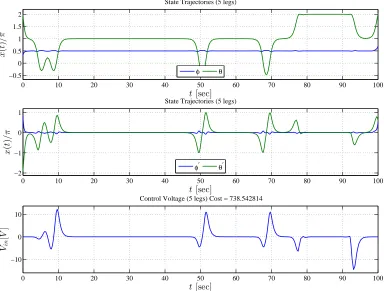
As shown in Figure4.1, we can see that a colliding step was achieved, but the step required significant amount of time. Furthermore the control
action attempted to stabilize the wheel at its unstable equilibrium before
completing the step. This is definitely not an efficient locomotion gait.
The lesson learned from this simple experiment is that the choice of cost
function plays a very important role in the generation of practical
0 10 20 30 40 50 60 70 80 90 100 −0.5 0 0.5 1 1.5 2 t[sec] x ( t ) / π
State Trajectories (5 legs)
0 10 20 30 40 50 60 70 80 90 100
−2 −1 0 1 t[sec] x ( t ) / π
State Trajectories (5 legs)
0 10 20 30 40 50 60 70 80 90 100
−10 0 10
Control Voltage (5 legs) Cost = 738.542814
Vin [ V ] t[sec] φ θ
[image:54.612.119.503.95.386.2]φ′ θ′
Figure 4.1: Single Colliding Step with Voltage Cost
To achieve a better “coordination” a cost penalizing all the states was
used. A revised cost function was created as seen in equation (4.4). This cost function penalized the φ, ˙φ and θ 10000 times less than the input
voltage, and ˙θ1000 times less than the input voltage.
J =
Z tf
to
µ 1
100φ(t)
2
+1001 θ(t)2+ 1 100φ(˙ t)
2
+101 θ(˙ t)2+100V(t)2

d t (4.4)
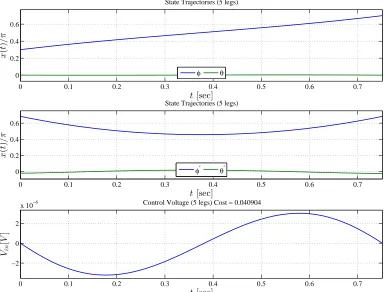
The resulting trajectory is shown in Figure 4.2. Note that now the input voltage is essentially zero (on the order of 10−6) and the step is swift.
The above cost function penalizes excessively the control action and as a
0 0.1 0.2 0.3 0.4 0.5 0.6 0.7 0
0.2 0.4 0.6
t[sec]
x
(
t
)
/
π
State Trajectories (5 legs)
φ θ
0 0.1 0.2 0.3 0.4 0.5 0.6 0.7
0 0.2 0.4 0.6
t[sec]
x
(
t
)
/
π
State Trajectories (5 legs)
φ′ θ′
0 0.1 0.2 0.3 0.4 0.5 0.6 0.7
−2 0 2
x 10−6 Control Voltage (5 legs) Cost = 0.040904
Vin
[
V
]
[image:55.612.118.502.95.387.2]t[sec]
Figure 4.2: Single Colliding Step with a Multi State Cost
The optimal solution provides the initial conditions that give the wheel
just enough velocity for the wheel to lift–off and keeps the internal
pen-dulum close to its stable equilibrium since that does not require much
input voltage.
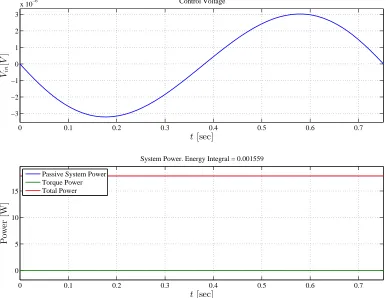
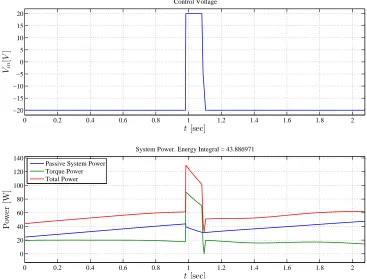
An energy analysis of this input trajectory can be seen in Figure 4.3. In this graph the power output of the motor on the system is plotted. To
de-termine whether the control signal was efficient, the integral of the power
output is calculated. This is done by bypassing the motor and
determin-ing the power of the torque on the system, as produced by the motor. This
0 0.1 0.2 0.3 0.4 0.5 0.6 0.7 −3
−2 −1 0 1 2 3
x 10−6 Control Voltage
Vi
n
[
V
]
t[sec]
0 0.1 0.2 0.3 0.4 0.5 0.6 0.7
0 5 10 15
t[sec]
P
ow
er
[W
]
System Power. Energy Integral = 0.001559
[image:56.612.117.503.96.394.2]Passive System Power Torque Power Total Power
Figure 4.3: Single Colliding Step Energy
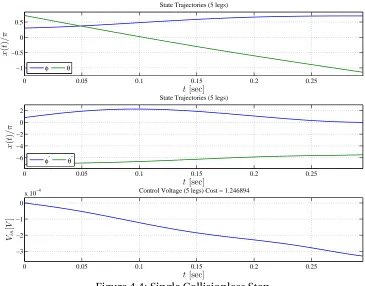
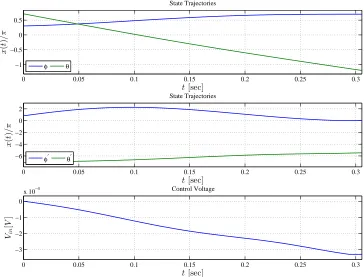
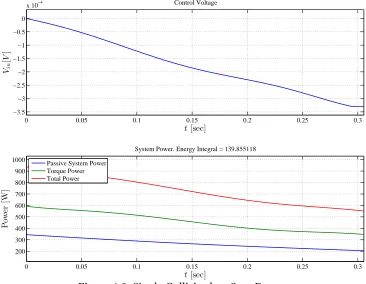
4.4.2 Single Collisionless Step
The second experiment performed focused on creating a collisionless step.
This is a step where the wheel impacts the ground at zero velocity, e.g.,
φ(tf)=0. The goal of this experiment was to determine the type of
mo-tion, initial conditions, and terminal conditions that would be required
to create this collisionless scenario.
The bound for this experiment are given in Table 4.4. As can be seen in the table, φ(t0) is fixed and ˙�