Generation Parallel Programming
Languages
Vivek Kumar
A thesis submitted for the degree of
DOCTOR OF PHILOSOPHY
The Australian National University
4
-
28
a
hv
pr
pr
pr
pr
4
-
29
a
pr
pr
hv
4
-
30
hm
tt
4
-
31
e
hm
4
-
32
dy
4
-
33
dv
pr
pr
u
tt
4
-
34
4
-
35
vara
a
tt
4
-
36
4
-
37
dy
4
-
38
4
-
39
a
dd
4
-
40
nn
a
4
-
41
tt
tt
4
-
42
dg
hm dy
4
13
— Bhagavad Gita, Chapter 4, Verse 38
आचार्यात्
!
पादमादते
!
पादं
!
शिष्यः
!
स्वमेधया
!
।
!!
पादं
!
सब्रह्मचारिभ्यः
!
पादं
!
कालक्रमेण
!
च
!
॥
— The Vedas
A student learns a quarter from teacher, a quarter from own intelligence, a quarter from fellow students, and the rest in course of time.
A decade ago, when I completed my Bachelor degree in Mechanical Engineering, the dream of getting a doctoral degree in Computer Science seemed quite vague. However, with the blessings of the almighty, love from my near and dear ones, and support from the kind people around me, it has become possible to write this doc-toral thesis.
First and foremost I offer my sincerest gratitude to my chair supervisor, Prof. Steve Blackburn. This thesis would not have been possible without his immense support, knowledge, guidance and patience. Thanks Steve for helping me happily sail through this academic journey.
I would also like to thank Dr. Dave Grove and Dr. Daniel Frampton for help-ing me throughout my doctoral study. Their informative discussions, feedback and cooperative nature has always motivated and guided me.
I would also like to thank the Australian Research Council and Australian Na-tional University for helping me financially throughout the duration of my studies and stay in Australia.
Special thanks to Dr. Alistair Rendell for helping me in grabbing the golden opportunity of pursuing a doctorate degree at ANU. He was always very kind in replying to my naive emails while I was in India and looking for such opportunities. And he is still very helpful!
Thanks to Prof. Antony Hosking for allowing me to use his machine to run my experiments. I am also thankful to Dr. Julian Dolby for helping me in formulating one of the contributions in this thesis.
I would also like to express my gratitude to all my fellow students for render-ing their friendliness and support, which made my stay in Australia very pleasant. Thank you Xi Yang and Rifat Shahriyar for the helpful discussions. Thank you Josh
Processor design has turned toward parallelism and heterogeneity cores to achieve performance and energy efficiency. Developers find high-level languages attractive because they use abstraction to offerproductivityandportabilityover hardware com-plexities. To achieve performance, some modern implementations of high-level lan-guages use work-stealing scheduling for load balancing of dynamically created tasks. Work-stealing is a promising approach for effectively exploiting software parallelism on parallel hardware. A programmer who uses work-stealing explicitly identifies potential parallelism and the runtime then schedules work, keeping otherwise idle hardware busy while relieving overloaded hardware of its burden.
However, work-stealing comes with substantial overheads. These overheads arise as a necessary side effect of the implementation and hamper parallel performance. In addition to runtime-imposed overheads, there is a substantial cognitive load as-sociated with ensuring that parallel code is data-race free. This dissertation explores the overheads associated with achieving high performance parallelism in modern high-level languages.
My thesis is that, by exploiting existing underlying mechanisms of managed runtimes; and by extending existing language design, high-level languages will be able to deliver productivity and parallel performance at the levels necessary for widespread uptake.
The key contributions of my thesis are: 1) a detailed analysis of the key sources of overhead associated with a work-stealing runtime, namely sequentialanddynamic overheads; 2) novel techniques to reduce these overheads that use rich features of managed runtimes such as the yieldpoint mechanism, on-stack replacement, dy-namic code-patching, exception handling support, and return barriers; 3) compre-hensive analysis of the resulting benefits, which demonstrate that work-stealing overheads can be significantly reduced, leading to substantial performance improve-ments; and 4) a small set of language extensions that achieve both high performance and high productivity with minimal programmer effort.
A managed runtime forms the backbone of any modern implementation of a high-level language. Managed runtimes enjoy the benefits of a long history of re-search and their implementations are highly optimized. My thesis demonstrates that converging these highly optimized features together with the expressiveness of high-level languages, gives further hope for achieving high performance and high productivity on modern parallel hardware.
Acknowledgments ix
Abstract xi
1 Introduction 1
1.1 Problem Statement . . . 1
1.2 Scope and Contributions . . . 2
1.3 Thesis Outline . . . 3
2 Background 5 2.1 Parallel Programming . . . 5
2.2 Parallel Programming Models . . . 5
2.2.1 The Address Space Model . . . 6
2.2.1.1 X10 . . . 6
2.2.1.2 Habanero-Java . . . 7
2.2.2 Task Parallelism . . . 7
2.2.2.1 Work-Sharing . . . 8
2.2.2.2 Work-Stealing . . . 8
2.2.3 The Concurrent Object-oriented Model . . . 9
2.2.3.1 Atomic Sets for Java (AJ) . . . 10
2.3 An Implementation-Oriented Overview of Work-Stealing . . . 11
2.3.1 Initiation . . . 11
2.3.2 State Management . . . 11
2.3.3 Termination . . . 13
2.3.4 Work-Stealing in X10 . . . 13
2.3.5 Work-Stealing in Habanero-Java . . . 16
2.3.6 Work-Stealing in Java ForkJoin . . . 17
2.4 Managed Runtime Environments . . . 18
2.4.1 The Quest for Productivity . . . 18
2.4.2 Managed Runtime Features . . . 18
2.4.2.1 The Yieldpoint Mechanism . . . 18
2.4.2.2 Dynamic Compilation . . . 19
2.4.2.3 On-Stack Replacement . . . 19
2.4.2.4 Dynamic Code Patching . . . 19
2.4.2.5 Exception Delivery Mechanism . . . 20
2.4.2.6 Return Barriers . . . 20
2.4.3 Jikes RVM . . . 21
2.4.3.1 A Metacircular JVM . . . 21
2.4.3.2 Support for Low-level Programming . . . 21
2.4.3.3 Highly Optimized Compilers . . . 22
2.4.3.4 Light-weight Locking Mechanism . . . 22
2.5 Summary . . . 22
3 Experimental Methodology 23 3.1 Benchmarks . . . 23
3.1.1 Serial Elision . . . 25
3.2 Software Platform . . . 25
3.3 Hardware Platform . . . 26
3.4 Measurements . . . 26
4 Sequential Overheads of Work-Stealing 27 4.1 Introduction . . . 27
4.2 Motivating Analysis . . . 28
4.2.1 Sequential Overheads . . . 28
4.2.2 Steal Ratio . . . 31
4.3 Approach . . . 33
4.3.1 Scalability Concerns . . . 33
4.3.2 Techniques . . . 33
4.4 Implementation . . . 34
4.4.1 Runtime Supported X10OffStackWS . . . 34
4.4.1.1 Initiation . . . 34
4.4.1.2 State Management . . . 35
4.4.1.3 Termination . . . 36
4.4.2 X10TryCatchWS Java implementation . . . 36
4.4.2.1 Leveraging Exception Handling Support . . . 36
4.4.2.2 Initiation . . . 37
4.4.2.3 State Management . . . 39
4.4.2.4 Termination . . . 40
4.4.2.5 Optimizing Runtime Support Calls . . . 40
4.5 Results . . . 40
4.5.1 Sequential Overhead . . . 41
4.5.2 Work Stealing Performance . . . 42
4.5.3 Memory Management Overheads . . . 42
4.5.4 Steal Ratios . . . 53
4.6 Related work . . . 56
4.6.1 Languages versus Libraries . . . 56
4.6.2 Work-stealing Deques . . . 56
4.6.3 Harnessing Rich Features of a Managed Runtime . . . 58
5.1 Introduction . . . 61
5.2 Motivating Analysis . . . 62
5.2.1 Steal Rate . . . 62
5.2.2 Steal Overhead . . . 64
5.3 Design and Implementation . . . 65
5.3.1 Return Barrier Implementation . . . 65
5.3.2 Overview of Conventional Steal Process . . . 65
5.3.3 Installing the First Return Barrier . . . 67
5.3.4 Synchronization Between Thief and Victim During Steal Process 68 5.3.5 Victim Moves the Return Barrier . . . 68
5.3.6 Stealing From a Victim with Return Barrier Pre-installed . . . 69
5.4 Results . . . 69
5.4.1 Dynamic Overhead . . . 69
5.4.2 Overhead of Executing Return Barrier . . . 76
5.4.3 Free Steals From Return Barrier . . . 77
5.4.4 Overall Work-Stealing Performance . . . 79
5.5 Related Work . . . 79
5.5.1 Stealing overheads . . . 79
5.5.2 Return barriers . . . 80
5.6 Summary . . . 80
6 Performance and Productivity via Data-Centric Atomicity and Work-Stealing 81 6.1 Introduction . . . 81
6.2 Motivation and Motivating Analysis . . . 82
6.3 Design and Implementation . . . 84
6.3.1 Annotations in AJWS . . . 85
6.3.2 Translating AJWS to Java . . . 88
6.3.2.1 Translating Concurrency Control Annotations to Java . 88 6.3.2.2 Translating Work-Stealing Annotations to Java . . . 89
6.3.3 Build Integration . . . 89
6.4 Results . . . 90
6.4.1 Programmer Effort . . . 90
6.4.1.1 Expressing Parallelism . . . 90
6.4.1.2 Concurrency Control . . . 91
6.4.2 Performance Evaluation . . . 92
6.4.2.1 Sequential Overhead . . . 92
6.4.2.2 Parallel Performance . . . 94
6.5 Related Work . . . 97
7 Conclusion 99
7.1 Future Work . . . 100
7.1.1 Adaptive work-stealing . . . 100
7.1.2 Utilizing slow path of thief for VM services . . . 100
7.1.3 Steal-Nwork-stealing . . . 101
7.1.4 Task Prioritization . . . 101
A Jikes RVM Modifications for JavaTryCatchWS 103 A.1 Basic Infrastructure . . . 103
A.2 Leveraging Exception Handling Support (Section 4.4.2.1) . . . 103
A.3 Initiation (Section 4.4.2.2) . . . 104
A.4 State Management (Section 4.4.2.3) . . . 104
A.5 Termination (Section 4.4.2.4) . . . 105
A.6 Return Barrier Implementation (Section 5.3.1) . . . 105
A.7 Installing the First Return Barrier (Section 5.3.3) . . . 105
A.8 Synchronization Between Thief and Victim During Steal Process (Sec-tion 5.3.4) . . . 105
A.9 Victim Moves the Return Barrier (Section 5.3.5) . . . 106 A.10 Stealing From a Victim with Return Barrier Pre-installed (Section 5.3.6) 106 A.11 Disabling work-stealing within a synchronized code block (Section 6.3.2.1)106
2.1 C++ and ICC++ variants of the same code. Theconc annotation iden-tifies potential concurrency. . . 9 2.2 Data-centric concurrency control in AJ language from Dolby et al. [2012]. 10 2.3 Using three different work-stealing implementations to write the Fib
micro-benchmark. . . 12 2.4 Execution graph forfib(4). . . 13 2.5 State during evaluation of fib(4). Execution is at the first fib(0)
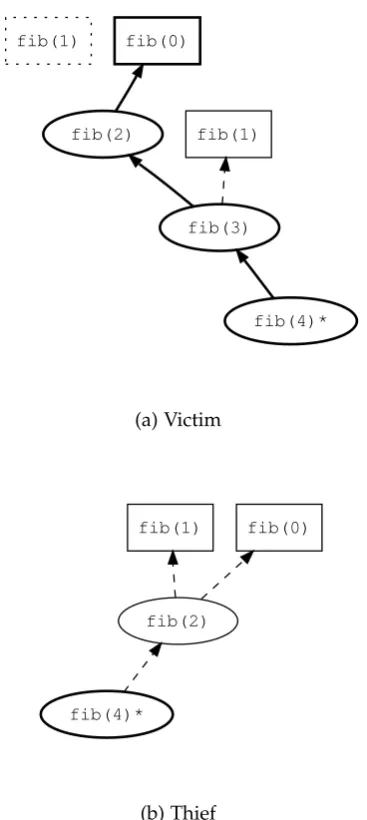
task. Dashed arrows indicate work to be done. Dotted boxes indicate completed work. . . 14 2.6 State for victim and thief after stealing the continuation offib(4). . . . 15
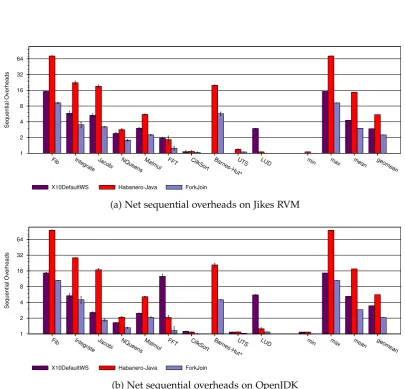
4.1 Sequential overheads in work-stealing runtimes. Y-axis value 1.0 rep-resents the execution of serial elision and anything above that is an overhead. Benchmarks not having any sequential overheads do not appear in the figure. . . 29 4.2 Work-stealing runtime consists of 3 different phase: initiation, state
management and code-restructuring (termination). Initiation overhead in X10DefaultWS is the difference between X10DefaultWS and X10DefaultWS (No Deque), whereas in ForkJoin its the difference between ForkJoin and ForkJoin (No Deque). State management overhead in X10DefaultWS is the difference between X10DefaultWS (No Deque) and X10DefaultWS (No Deque, No Context). In ForkJoin, this is the value of ForkJoin (No Deque). Code-restructuring overhead is encountered only in X10 and this is represented by the value of X10DefaultWS (No Deque, No Con-text). . . 30 4.3 Steals to task ratio for each benchmark on different work-stealing
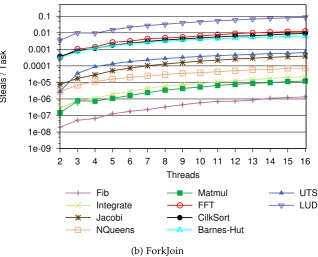
run-times. A low ratio is always preferred to ensure that sufficient tasks are created to keep all processors busy. . . 32 4.4 Pseudocode for the transformation offib(n) from X10 (Figure 2.3(a),
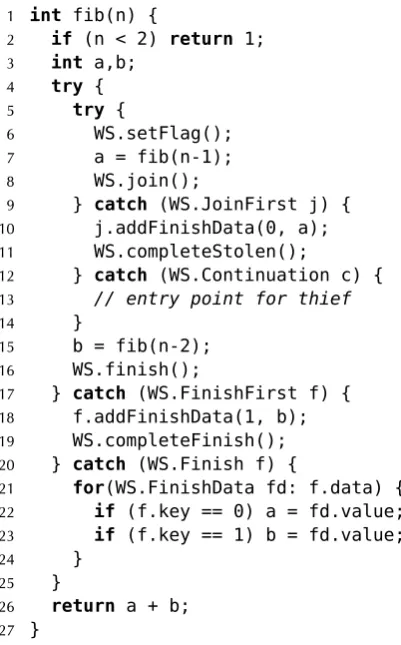
page 12) into X10TryCatchWS. We have modified the default X10 com-piler to automatically generate the code to support X10TryCatchWS. . . 38 4.5 Sequential overheads in work-stealing runtimes. Y-axis value 1.0
rep-resents the execution of serial elision and anything above that is an overhead. Benchmarks not having any sequential overheads do not appear in the figure. . . 41
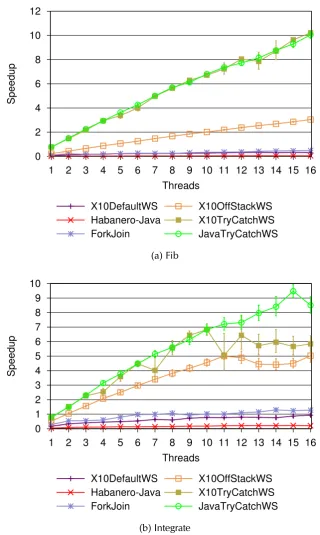
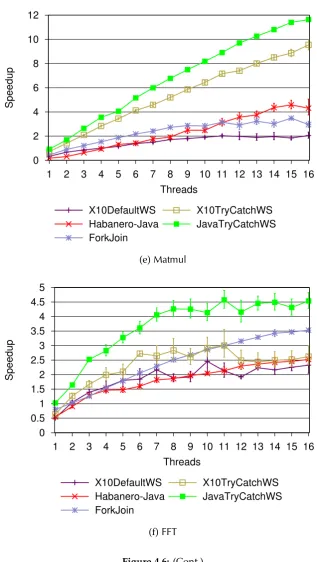
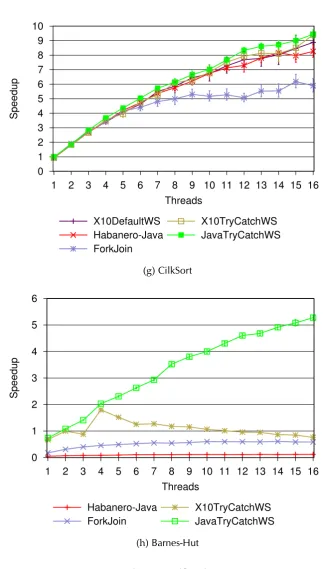
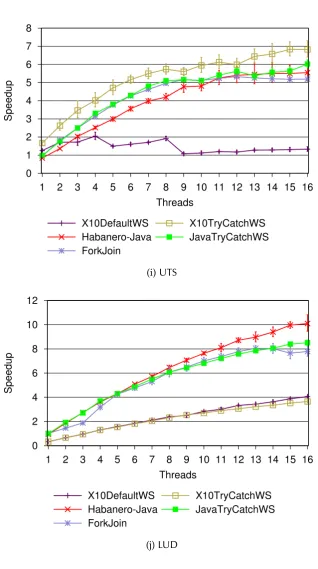
4.6 (Cont.) Speedup relative to serial elision version of each benchmark on Jikes RVM. Y-axis value 1.0 denotes the execution of serial elision. Y-axis values greater than 1.0 represents faster execution than the
cor-responding serial elision version. . . 43
4.6 (Cont.) . . . 44
4.6 (Cont.) . . . 45
4.6 (Cont.) . . . 46
4.6 (Cont.) . . . 47
4.7 (Cont.) Speedup obtained by dividing the execution time of single thread JavaTryCatchWS work-stealing framework with the execution time of different runtimes for threads 1 to 16. Y-axis values greater than 1.0 shows better speedup over single threaded JavaTryCatchWS. JavaTryCatchWS runs over Jikes RVM; X10DefaultWS, Habanero-Java and ForkJoin is executed over OpenJDK; whereas NativeX10WS is the X10 running over it’s C++ backend. . . 48
4.7 (Cont.) . . . 49
4.7 (Cont.) . . . 50
4.7 (Cont.) . . . 51
4.7 (Cont.) . . . 52
4.8 Fraction of time spent performing garbage collection work in different benchmarks. Memory management overhead in JavaTryCatchWS is very similar to that required in serial elision version. X10TryCatchWS and X10OffStackWS operates on X10 arrays rather than Java arrays. This results in relatively extra memory management overhead in these two runtimes as compared to JavaTryCatchWS. . . 53
4.9 Steals to task ratio for X10OffStackWS and X10TryCatchWS. A low ratio is always preferred to ensure that sufficient tasks are created to keep all processors busy. . . 54
4.10 Seal failure rates for X10OffStackWS and X10TryCatchWS. This is the ratio of total failed steal attempts and total successful steals. Steal attempts may fail due to either another thief or the victim winning the race to start that continuation. . . 55
5.1 Steal statistics for DefaultWS show that steal ratio and steal rate can significantly differ across benchmarks. Jacobi and Barnes-Hutexhibit a low steal ratio at 16 threads, but shows a high steal rate with same number of threads. . . 63
5.2 The dynamic overhead of DefaultWS is strongly correlated with the steal rate (Figure 5.1(b)). Jacobihas the highest steal rate and it has the highest dynamic overhead. . . 64
5.3 The victim’s stack, installation, and movement of the return barrier. . . 66
5.4 (Cont.) Dynamic overhead in our old and new system. . . 70
5.4 (Cont.) . . . 71
5.4 (Cont.) . . . 74 5.5 Total Steals . . . 75 5.6 Overhead of executing return barrier in victims. Barnes-Hut has the
highest overhead because of the high number of steals during its exe-cution. . . 76 5.7 Free steals due to the presence of return barrier on stack. Lower
per-centage of free steals tends to reflect a shallow stack and hence, lesser benefit from return barrier. . . 77 5.8 ReturnBarrierWS performance relative to JavaTryCatchWS, where time
with n worker threads in ReturnBarrierWS is normalized to the time for samenworker threads in DefaultWS. Anything above 1.0 is a benefit. 78
6.1 Sample code written in AJWS, showing a simple example offorloop parallelism. . . 86 6.2 AJWS compiles AJWS code to vanilla Java, much like JavaTryCatchWS.
The code above shows the vanilla Java translation of the AJWS example from Figure 6.1. . . 87 6.3 The sequential overheads associated with parallelism. Error bars
indi-cate 95% confidence intervals. Forlusearch-fix, the cost of introducing parallelism is around 7-8% for both the default Java implementation and AJWS. For jMetal, the performance overhead of introducing par-allelism is around 50% for the default implementation and 20% for AJWS. We did not observe any performance overhead associated with parallelism inJTransforms. . . 92 6.4 Pseudocode showing the style of parallelism in default
implementa-tions ofjMetalandJTransforms. . . 93 6.5 (Cont.) Speedup over serial elision version for both the Default and
AJWS implementations. Only lusearch-fix is also evaluated over Java-TryCatchWS to determine whether our concurrency control annota-tions were hampering performance. . . 95 6.5 (Cont.) . . . 96 6.6 A lower steals to task ratio is highly desirable to ensure a proper
6.1 Expressing parallelism in conventional Java has a major impact on how programs are written. For each of our three benchmarks we show, from left to right: a) the total number of class files; b) the total number of
synchronized blocks and methods; c) the total number of files con-taining thesynchronized keyword; d) the number of code fragments that express parallelism; e) the number of files containing explicitly parallel code; and f) the lines-of-code (LOC) overhead due to paral-lelism constructs within this code. . . 83 6.2 The syntactic overhead of using AJWS’s work-stealing annotations to
express parallelism. For both default and work-stealing implementa-tions, we show the number of affected files, the number of affected code blocks and the overhead in lines of code. For all three bench-marks, parallelism can be expressed substantially more succinctly us-ing work-stealus-ing. . . 90 6.3 The syntactic overhead of using AJWS’s data-centric annotations on
our three benchmarks. JTransformsis lock-free, so there is no overhead for either approach. For jMetal there is a very small increase in lines of code, and forlusearch-fix, the overhead in lines of code is about half that of the default which uses thesynchronized keyword. . . 91 6.4 Use of parallel regions that are exercised during execution of each of
the benchmarks. Forlusearch-fixandjMetal, this is substantially lower than the total number of parallel regions in the benchmark code bases (compare to Table 6.2), while for JTransforms, the number is slightly reduced. . . 93
Introduction
This thesis addresses the problem of productively achieving high performance par-allelism in managed languages.
1.1
Problem Statement
Computing hardware is becoming more and more complex. Today and in the fore-seeable future, performance will be delivered principally in terms of increased hard-ware parallelism. This fact is an apparently unavoidable consequence of wire delay and the breakdown of Dennard scaling [Bohr, 2007], which together have put a stop to hardware delivering ever faster sequential performance. Single systems now scale to over one hundred cores.
The software community is facing orthogonal challenges of a similar magnitude with major changes in the way software is deployed, sold, and interacts with hard-ware. Software demands for correctness, complexity management, programmer pro-ductivity, time-to-market, reliability, security, and portability have pushed develop-ers away from low-level programming languages towards high-level ones. These languages offer productivity and portability by building upon a managed runtime.
It is essential that these managed languages be able to efficiently exploit high de-grees of hardware parallelism offered by modern hardware. Unfortunately, software parallelism is often difficult to identify and expose, which means it is often hard to realize the performance potential of modern processors. Common programming models using threads impose significant complexity to organize code into multiple threads of control and to balance work amongst threads to ensure good utilization of multiple cores. This shortcoming has helped work-stealing scheduling [Frigo et al., 1998a; Reinders, 2010] gain popularity. Work-stealing is a framework for allowing programmers to explicitly expose potential parallelism. A work-stealing scheduler within the underlying language runtime schedules work exposed by the program-mer, exploiting idle processors and unburdening those that are overloaded. Work-stealing has been adopted by several high-level languages, such as X10 [Charles et al., 2005], Habanero-Java [Cavé et al., 2011] and Chapel [Chamberlain et al., 2007]. It is also offered as library in some managed languages, such as the Java ForkJoin frame-work [Lea, 2000] in Java 7 and the Task Parallel Library [Leijen et al., 2009] in the
Microsoft .NET framework [Platt, 2002].
Although the details vary among the various implementations of work-stealing schedulers, they all incur some form of overhead as a necessary side effect of enabling dynamic task parallelism. If these overheads are significant, then programmers are forced to carefully tune their applications to expose the ‘right’ amount of potential parallelism for maximum performance on the targeted hardware. Failure to expose enough parallelism results in under-utilization of the cores; exposing too much par-allelism results in increased overheads and lower overall performance. Over-tuning of task size can lead to brittle applications that fail to perform well across a range of hardware systems and may fail to properly exploit future hardware. Therefore, tech-niques that significantly reduce the overheads of work-stealing schedulers simplify the programmer’s task by largely eliminating the need to tune task size.
Achieving load balancing using work-stealing is just one dimension to produc-tively achieving parallelism in managed languages. There is also a substantial cog-nitive load associated with ensuring parallel code is data-race free. This becomes a monolithic exercise in a large code-base. The programmer must ensure the correct-ness in the face of concurrency. Traditionally, managed languages provide object-level consistency by default for all objects. Recent work on Atomic Sets [Vaziri et al., 2006] takes a data-centric approach for consistency requirements. In this model, the programmer simply specifies that sets of object fields share some consistency prop-erty, without specifying what the property may be. The compiler ensures consistency by wrapping all race-prone code blocks with synchronized access. However, Vaziri et al.’s data-centric approach to achieving concurrency correctness is limited to the conventional thread-based parallelism.
The software community is thus facing the significant challenge of harnessing the true performance potential of modern hardware with managed languages.
1.2
Scope and Contributions
The aim of my research is to mitigate the two major challenges for productively exploiting high performance parallelism in managed languages—lowering the over-heads associated with work-stealing scheduling and naively achieving correct paral-lelism by extending the design of high-level languages.
To do this, I chose X10 and Java as the representatives of modern high-level lan-guage and Jikes RVM [Alpern et al., 2000] Java virtual machine as the managed runtime implementation. To evaluate work-stealing, I chose a language-based ap-proach which can execute over Jikes RVM. A language based apap-proach for using work-stealing aims to increase programmer productivity [Charles et al., 2005]. Irre-spective of these choices, the methodology and insights developed here should be applicable beyond this specific context.
transformations that expose parallelism. We introduce two efficient designs which significantly reduce these overheads. The key to our approach is to ex-ploit mechanisms already available within managed runtimes, namely: a) the yieldpoint mechanism; b) on-stack-replacement; c) dynamic code-patching; and d) support for efficient exception delivery. By combining these approaches, we lower the sequential overheads from 195% to 40%.
Dynamic overhead of work-stealing Once parallelism is introduced, additional dy-namic overheads emerge in a work-stealing runtime. This overhead is associ-ated with stealing amongst the threads and is most evident when parallelism is greatest. As core counts rise, dynamic overheads are an increasingly important factor in the performance of work-stealing runtimes. This thesis evaluates the dynamic overhead associated with work-stealing and proposes a new design to lower the cost of stealing. To do this, we apply the same strategy that we used successfully to reduce sequential overheads—reuse existing mechanisms in managed runtimes. Our design exploits a return barrier mechanism to re-duce the dynamic overhead of work-stealing by almost 50%.
Performance and Productivity via Data-Centric Atomicity and Work-Stealing High-level languages should provide an easy to use interface for achieving parallelism-–both in terms of correctness and performance. A parallel program is correct when program execution is free from data races. This thesis provides a small set of extensions to Java for achieving race-free concurrency. The approach is to identify the principal benefits of work-stealing and data-centric concurrency control [Vaziri et al., 2006; Dolby et al., 2012] respectively, and then bring those together into a single, simple framework within Java that combines data-centric concurrency control with a high performance work-stealing implementation. Using our Java extensions, we are able to substantially improve the perfor-mance of a number of realistic Java workloads.
In summary, this thesis addresses the goal of hiding the complexities associated with effectively taming the large-scale parallelism in modern hardware via managed languages. We show the potential of exploiting the rich features of managed runtimes in improving the efficiency of work-stealing implementations.
1.3
Thesis Outline
The body of this thesis is structured around the three key contributions outlined above.
Chapters 4, 5 and 6 comprise the main body of the thesis, covering the three key contributions. Chapter 4 and Chapter 5 identify sequential and dynamic overheads respectively in work-stealing implementations. They use features of managed run-time environments to develop novel techniques for addressing these overheads. Then Chapter 6 designs and implements easy to use annotations for achieving data-race free parallelism in Java.
Background
This thesis takes a well-known idea, work-stealing to exploit parallel hardware, and asks why it doesn’t work as well as it should with managed languages. This chapter provides relevant background information on parallel programming models and key features of managed runtimes.
The chapter starts with a brief discussion on parallel programming in Section 2.1 and parallel programming models in Section 2.2. Section 2.3 provides an implementa-tion-oriented overview of work-stealing scheduling. Section 2.4 discusses managed runtime environments. The chapter concludes by introducing Jikes RVM and fea-tures relevant to this thesis.
2.1
Parallel Programming
Parallel programming is the technique of using two or more computing elements to solve a single problem. Parallel programming is used heavily in various areas in-cluding weather forecasting, astronomy, oceanographics, and data mining. Parallel programming dates back to the late 1950’s with the advent of shared memory mul-tiprocessors. The scale of parallel systems grew until massively parallel processors came to existence. Starting in the late 1980’s, cluster computing came into picture and became the dominant architecture for parallel programming. However, with the advent of multicore processors from 2001 [IBM, 2002], parallel programming is now no longer a niche area and is becoming mainstream. Today, dual and quad core processors are at the heart of most modern computing devices. The need to achieve more and more performance without increasing the power consumption and heat dissipation, promises that today’s multicore processors will be replaced with many-core processors [Jeffers, 2013; Intel Corporation, 2013].
2.2
Parallel Programming Models
Parallel programming models are concerned with different ways of expressing a par-allel program. The ultimate goal is to parpar-allelize a sequential code in such way that is simple and achieves the maximum performance when executed. To serve this goal
of productivity and performance, there has been a plethora of research. Accordingly, there are various ways to classify different parallel programming models existing to-day. For this thesis, we classify it in three broad categories: address space model,task parallelism modelandconcurrent object-oriented model.
2.2.1 The Address Space Model
The address space model defines how data are referred to by the parallel program. The two dominant models are the shared memory and distributed memory models. When using shared memory, a computation is generally divided into threads, which uniformly share the memory. The sharing of a single logical memory may be imple-mented in hardware [Owicki and Agarwal, 1989], or in software [Keleher et al., 1994; Carter et al., 1991]. Contrarily, with distributed memory, the computation is generally divided among processes and each of the processes execute on a separate processor having its own private address space. To communicate, these processes generally send messages over a high speed interconnect. OpenMP [Dagum and Menon, 1998] is a popular standard for shared memory parallel programs, whereas Message Pass-ing Interface (MPI) [Snir et al., 1995] is the de-facto standard for programmPass-ing large distributed memory system. The cost of maintaining coherence (whether in hard-ware or softhard-ware) means that shared memory does not scale as well as distributed memory.
The Partitioned Global Address Space (PGAS) programming model [PGAS, 2011] has recently gained popularity. It strikes a balance between shared and distributed memory models. It provides ease of programming due to its global address memory model and performance due to locality awareness. Here, the threads are mapped to processes and threads, as supported by the language runtime. Languages in this category include, Co-Array Fortran [Numrich and Reid, 1998], Titanium [Yelick et al., 1998] and UPC [El-Ghazawi and Smith, 2006].
Despite the benefits, PGAS model suffers two drawbacks. First, it implicitly as-sumes that all processes run on similar hardware and second, it does not support dynamically spawning multiple activities [Saraswat et al., 2010]. The Asynchronous Partitioned Global Address Space(APGAS) programming model [Saraswat et al., 2010] addresses these drawbacks and can be thought of as being derived from both the MPI and OpenMP models by extending the PGAS model with place and async
(Section 2.2.1.1). Languages that follow this model include, X10 [Charles et al., 2005], Chapel [Chamberlain et al., 2007], Fortress [Allen et al., 2005] and Habanero-Java [Cavé et al., 2011].
We will now briefly discuss X10 and Habanero-Java, which are used in this thesis.
2.2.1.1 X10
built on a C++ backend.
X10 includes specific features to support parallel and distributed programming. In X10 locality is explicitly represented in the form ofplaces. Aplacecan be thought of as a virtual shared memory multiprocessor, where a computational unit has a finite number of threads sharing a bounded amount of shared memory uniformly. Asynchronous activities address the requirements of both thread-based parallelism and asynchronous data transfers in X10. Every X10 activity runs inside a place. While an activity executes at the sameplacethroughout its lifetime, it may dynami-cally spawn activities in remote places. A new activity,S, is created by the statement
async S. To synchronize activities, X10 provides the statement finish S. Control will not return from within a finish until all activities spawned within the scope of the finish have terminated. For achieving concurrency, X10 provides language constructs such aswhen andatomic. This thesis uses only two of the X10 language constructs for achieving work-stealing task parallelism in Managed X10 (async and finish). Sample code written in X10 usingfinish and async is shown in Figure 2.3(a) (ex-plained in detail in Section 2.3.4). X10 restricts the use of a local mutable variables inside async statements. A mutable variable (var) can only be assigned to or read from within theasyncit was declared in. To mitigate this restriction, X10 permits the asynchronous initialization of final variables (val). A final variable may be initialized in a child async of the declaringasync. A definite assignment analysis guarantees statically that only one such initialization will be executed on any code path, so there will never be two conflicting writes to the same variable.
2.2.1.2 Habanero-Java
The Habanero-Java language was developed at Rice University as an extension to the original Java-based definition of the X10 language. Habanero-Java can also be thought of an extension of Java for the APGAS programming model. Parallel pro-gramming constructs in Habanero-Java are similar to that in X10 (place,asyncand
finish). To achieve concurrency, Habanero-Java allows Java concurrent locks [Lea, 2004] and the isolated construct (similar to atomic in X10). As with X10, for Habanero-Java, this thesis only uses finish and async constructs. Figure 2.3(b) shows sample code written in Habanero-Java, explained in detail in Section 2.3.5..
2.2.2 Task Parallelism
Two commonly used task parallelism models are work-sharingand work-stealing, which are explained below.
2.2.2.1 Work-Sharing
Work-sharing task parallelism relies on a centralized shared task queue. Surplus tasks are continuously added to this queue by the runtime. Whenever a worker thread is idle, it will poll this queue and retrieve a task to execute locally. Due to this multi-threaded environment, any addition or removal of tasks to or from the queue always needs to be synchronized. However, as the thread pool size increases, this synchronization can become a scalability bottleneck. Work-stealing addresses this limitation and improves the scalability. OpenMP supports a work-sharing run-time, where the programmer declares the parallel regions in his code using compiler directives (pragmas).
2.2.2.2 Work-Stealing
Work-stealing is a very efficient strategy for distributing work in a parallel system. The ideas behind work-stealing have a long history which includes lazy task cre-ation [Mohr et al., 1990] and the MIT Cilk project [Frigo et al., 1998b], which offered both a theoretical and practical framework. In this model, the runtime maintains a pool ofworker threads, each of which maintains a local set oftasks. When local work runs out, the worker becomes a thief and seeks out a victim thread from which to stealwork.
The elements of a work-stealing runtime are often characterized in terms of the following aspects of the execution of a task-parallel program:
Fork A fork describes the creation of new, potentially parallel, work by a worker thread. The runtime makes new work items available to other worker threads.
Steal A steal occurs when a thief takes work from a victim. The runtime provides the thief with the execution context of the stolen work, including the execution entry point and sufficient program state for execution to proceed. The runtime updates the victim to ensure work is never executed twice.
Join A join is a point in execution where a worker waits for completion of a task. The runtime implements the synchronization semantics and ensures that the state of the program reflects the contribution of all the workers.
2 int x = a.foo(); 3 b.bar();
4 c.baz(x); 5 }
(a) C++
1 conc {
2 int x = a.foo(); 3 b.bar();
4 c.baz(x); 5 }
(b) ICC++
Figure 2.1:C++ and ICC++ variants of the same code. Theconcannotation identifies poten-tial concurrency.
2.2.3 The Concurrent Object-oriented Model
The concurrent object-oriented model goes back at least to Actors [Agha, 1986]. In this model, synchronization is managed at the level of each object, with each object handling messages sent to it in some sequential order. The original model made state changes atomic with a single become operation; subsequent languages such as ABCL [Yonezawa, 1990] and ICC++ [Chien, 1996] present a more conventional imperative semantics in which synchronization is still enforced at the object level, but with some form of lock.
The actor model naturally expresses concurrency in terms of concurrent message sends to objects, and languages like ICC++ carry on this style. A key semantic of languages like ICC++ is that concurrency is elective in the sense that concurrency annotations indicate potential concurrency but the runtime system is left with flexi-bility to determine when to actually create parallel tasks. The other key design goal was to make expressing concurrency as simple as possible. With ICC++, it takes the form of the conc annotation as shown in Figure 2.1, where a standard C++ block (Figure 2.1(a)) is shown in contrast to aconcblock (Figure 2.1(b)).
1 class Counter { 2 atomicset a;
3 atomic(a) int value;
4 int get() { return value; } 5 void dec() { value--; } 6 void inc() { value++; } 7 }
(a) Example ofatomicsetandatomicannotations in AJ.
1 class PairCounter { 2 atomicset b;
3 atomic(b) int diff;
4 Counter|a=this.b| low = new Counter|a=this.b|(); 5 Counter|a=this.b| high = new Counter|a=this.b|(); 6 void incHigh() {
7 high.inc();
8 diff = high.get()-low.get();
9 }
10 ... 11 }
(b) Example ofatomicsetaliasing in AJ.
Figure 2.2:Data-centric concurrency control in AJ language from Dolby et al. [2012].
2.2.3.1 Atomic Sets for Java (AJ)
Traditionally, concurrent object-oriented languages provide object-level consistency by default for all objects. More recently, the Atomic Sets model [Vaziri et al., 2006; Dolby et al., 2012] extended Java with explicit data-centric synchronization in which the programmer specifies that sets of object fields share some consistency property, without specifying what the property may be. This differs from traditional object-oriented models in two key ways: the first is that all consistency is specified by the programmer, and unannotated fields have no synchronization. The second is that the idiom naturally encompasses specifying both subsets of an object’s fields and sets of fields that span multiple objects.
The focus of this thesis is on the implementation of work-stealing scheduling. This section discusses a work-stealing scheduler from an implementation point of view. A work-stealing implementation can be thought of as following basic phases, each of which require special support from the runtime or library:
1. Initiation. (Allow tasks to be created and stolen atomically).
2. State management. (Provide sufficient context for the thief to be able to execute stolen execution, and the ability to return results).
3. Termination. (Join tasks and ensure correct termination).
We now explain each of these and what they require of the runtime, first generally, then concretely in terms of X10, Habanero-Java and Java ForkJoin implementations.
To help illustrate work-stealing, we use a running example of the recursive calcu-lation of Fibonacci (Fib) numbers. Figure 2.3 shows X10, Habanero-Java and ForkJoin code for computing Fib numbers. Figure 2.4 shows the graph of the recursive calls made when executing fib(4) in Figure 2.3. Calls to the non-recursive base case (n < 2) are shown as rectangles.
2.3.1 Initiation
Initiation is concerned with ensuring that: 1) tasks are available to be stolen whenever appropriate, and 2) each task is only executed once. Atask in this thesis is similar to framein the Cilk [Frigo et al., 1998b] implementation. An idle thread may make itself useful by stealing work, so becoming a thief. This begins with the thief identifying a victim from which to steal. For example, the thief may randomly select a potential victim and if they appear to have work available, attempt a steal.
Tasks are typically managed by each worker using a double ended queue (deque), one deque per worker, as illustrated in Figure 2.5. Each worker pushes tasks onto the tail of its deque using an unsynchronized store operation. Both the worker and any potential thieves then use atomic compare-and-swap (CAS) instructions to remove tasks from the worker’s deque, with the worker acquiring from the tail (newest), and thieves attempting to acquire from the head (oldest). Tasks are thus made available and only stolen once, with the deque discipline minimizing contention and increas-ing the probability that long-runnincreas-ing tasks are stolen.
2.3.2 State Management
1 def fib(n:Int):Int {
2 if (n < 2) return 1;
3
4 val a:Int;
5 val b:Int;
6
7 finish {
8 async a = fib(n-1);
9 b = fib(n-2);
10 }
11
12 return a + b; 13 }
(a)Fibin X10.
1 static class IntegerBox {
2 public int v;
3 } 4
5 static void fib (int n, IntegerBox res) { 6 if (n < 2) return 1;
7
8 final IntegerBox x = new IntegerBox();
9 final IntegerBox y = new IntegerBox();
10
11 finish {
12 async fib (n-1,x);
13 fib (n-2,y);
14 }
15
16 res.v = x.v + y.v;
17 }
(b)Fibin Habanero-Java.
1 Integer compute() {
2 if (n < 2) return 1;
3
4 Fib f1 = new Fib(n - 1);
5 Fib f2 = new Fib(n - 2);
6
7 f1.fork();
8 int a = f2.compute();
9 int b = f1.join();
10
11 return a + b;
12 }
[image:34.595.194.444.81.712.2](c)Fibin Java ForkJoin.
fib(4) fib(3) fib(2)
fib(2) fib(1) fib(1) fib(0) fib(1) fib(0)
Figure 2.4:Execution graph forfib(4).
shared across multiple tasks. Requirement 2) is handled differently depending on the execution model, and is discussed in more detail below for specific systems.
2.3.3 Termination
In general, the continued execution of a worker is dependent on completion of some set of tasks, each of which may be executed locally, or by a thief. Such dependencies are made explicit by the programmer and must be respected by the implementation of the work-stealing runtime. The work-stealing runtime must: 1) handle the general case where execution waits, dependent on completion of stolen tasks executing in parallel. However, it is also critical for the scheduler to: 2) efficiently handle the common case where no tasks in a particular context are stolen, and therefore are all executed in sequence by a single worker. Furthermore, work-stealing schedulers also aim to: 3) maintain a particular level of parallelism. To ensure that this occurs, when a worker is waiting on completion of a stolen task, instead of suspending the worker, the scheduler may attempt to have that worker find and execute another task.
2.3.4 Work-Stealing in X10
X10’s work-stealing scheduler is implemented by a combination of an X10-source-to-X10-source program transformation and a runtime library. The program transforma-tion synthesizes code artifacts (continuatransforma-tion methods and frame classes) required by the runtime scheduler. X10 meets the key work-stealing requirements as follows:
fib(4)
fib(3) fib(2)
fib(2) fib(1) fib(1) fib(0) fib(1) fib(0)
(a) Execution state
fib(4) fib(3)
(b) Deque
fib(4)* fib(3)
fib(2) fib(1) fib(1) fib(0)
(a) Victim
fib(4)* fib(2)
fib(1) fib(0)
[image:37.595.229.413.202.613.2](b) Thief
the execution of the async body. For instance, a worker running fib(4) first exe-cutes fib(3) (Figure 2.3(a) line 8), making the fib(2) work item (line 9) available for others to steal. When done withasync fib(3), the worker attempts to pop the tail deque item and if non-null, will execute the continuation (fib(2), line 9).
State management. Each thread’s stack is private, so in order to permit multiple workers to concurrently access and update the program state, the X10 compiler en-capsulates sharable state into frame objects. Consequently, methods are rewritten to operate on fields of frame objects instead of local variables. Frame objects are linked together into trees that shadow the tree structure of the task graph. In other words, Figure 2.4 represents the tree of frame objects assembled during the execu-tion offib(4). When X10 is compiled to Java, frame objects are created on the heap to ensure that they are accessible to both the worker and potential thieves. In the C++ implementation however, an optimization is performed that sees frame objects stack-allocated by default, and only lazily migrated to the heap when a steal oc-curs [Tardieu et al., 2012]. The managed X10 compiler analyzes the source code and indexes all of the points immediately after async statements (‘reentry’ points). It then generates a second copy of the source code in which methods take a pc (pro-gram counter) as an extra argument. The control flow of the generated methods is altered so as to permit starting execution at the specified pc.
Termination. If a worker proceeds from the beginning of a finish block to its end without detecting a steal, then that worker has itself completed every task in the finish context and may return. Termination is more complex when a steal occurs. When a thief steals a work item within the scope of a finish, the scheduler begins maintaining an atomic count of the active tasks within that finish body. When a worker completes a task, or execution reaches the end of thefinishbody, the count is atomically reduced and checked. If the count is non-zero, the worker gives up and searches for other work to process. When the count is zero, then the finish is complete and the worker starts executing the continuation of the finish statement.
2.3.5 Work-Stealing in Habanero-Java
Habanero-Java (Section 2.2.1.2) evolved from early versions of X10 and thefinish
-asyncprogramming in Habanero-Java is very similar to X10. A broader description offinish-asyncwork-stealing in Habanero-Java appears in [Guo, 2010]. Unlike X10, Habanero-Java offers three different work-stealing policies: a) a work-first policy; b) a help-first policy [Guo et al., 2009]; and c) an adaptive policy [Guo et al., 2010].
The implementation ofFibfor Habanero-Java is shown Figure 2.3(b).
on the deque and first executesfib(2)(line 13). In the adaptive policy, the runtime dynamically switches between work-first and help-first policies.
State Management. In order to permit multiple workers to concurrently access and update the program state, Habanero-Java maintains heap allocatedframe objects sim-ilar to X10. For thefibfunction (Figure 2.3(b)), slow and fast clone versions of the method generated by the work-stealing compiler [Raman, 2009]. To mimic val in X10 (Figure 2.3(a), lines 4 and 5), Habanero-Java requires heap allocation of objects to capture results (Figure 2.3(b), lines 8 and 9).
Termination. Thefinishguarded termination in Habanero-Java is very similar to X10.
2.3.6 Work-Stealing in Java ForkJoin
The Java ForkJoin framework [Lea, 2000] is an implementation of the interface java.util.concurrent.ExecutorService that takes advantage of work-stealing scheduling in Java 7 [Oracle Corporation, 2013]. It was originally implemented by Doug Lea [Lea, 1999]. The general design of the ForkJoin framework is a variant of the work-stealing framework devised by Cilk and is explained in detail in [Lea, 2000]. Here we briefly discuss its key components. The ForkJoin implementation of
Fibis shown in Figure 2.3(c).
Initiation. To allowfib(n-1)to be stolen, the user explicitly heap-allocates aFib object (Figure 2.3(c), line 4) and calls fork() on this object (line 7). Like X10, ev-ery worker thread maintains a deque. fork pushes a task to the deque, making it available to be stolen.
State Management. In ForkJoin, tasks are represented as task objects. These ob-jects include: methods for scheduling and synchronizing with the task, any state associated with the task, and an explicit entrypoint for executing the task.
2.4
Managed Runtime Environments
This section provides the background on the managed runtime environments and features that are pertinent to this thesis.
2.4.1 The Quest for Productivity
Processor vendors can no longer deliver performance by increasing single core fre-quency. Instead, they have started manufacturing chips with with multiple processor cores and these are now mainstream. Further, to reduce power, processor architects are now turning to customization and heterogeneity [Borkar and Chien, 2011; Cao et al., 2012; Balakrishnan et al., 2005; ARM Corporation, 2011; Morad et al., 2006; Venkatesh et al., 2010; Suleman et al., 2009; Li et al., 2010; Koufaty et al., 2010]. Tam-ing this new generation of processors is a very dauntTam-ing task and is a first order concern for software deployment. Managed languages aim to enhance the program-mer’s productivity even in the face of complex hardware. They provide abstraction over the hardware by using managed runtime environments, which deliver portabil-ity, reliabilportabil-ity, security and faster time to market.
2.4.2 Managed Runtime Features
The key features of modern managed runtimes were nailed down by Smalltalk-80 [Deutsch and Schiffman, 1984] and Self-91 [Chambers and Ungar, 1991] systems. Managed runtimes came into their own with the advent of the Java programming language [Gosling et al., 1996] and has been a very active research area since. Re-cent examples of widely used virtual machine implementations include Java Virtual Machine [Oracle, 2013] for Java; Common Language Runtime for Microsoft’s .NET framework [Box and Pattison, 2002]; Parrot Virtual Machine [Wall and Schwartz, 1991] for dynamic programming languages like Perl; Dalvik virtual machine [Born-stein, 2008] as a part of Android operating system [Rogers et al., 2009]; PyPy [Rigo and Pedroni, 2006] for Python [Martelli, 2003]; YARV for Ruby [Sasada, 2005]; etc.
Managed runtimes are widely used due to their rich features. Some of the key features, which are exploited in this thesis are as discussed below.
2.4.2.1 The Yieldpoint Mechanism
2000].
2.4.2.2 Dynamic Compilation
Dynamic compilation, also known as Just-In-time compilation (JIT) allows dynami-cally loaded code to be compiled. The alternatives are to interpret the code, or to prohibit dynamic loading. Dynamic compilation is also used to implement adaptive, or feedback directed optimization [Arnold et al., 2002]. Software systems have been using JIT compilation techniques since the 1960s [McCarthy, 1960]. Aycock [2003] describes the history of JIT compilers in detail. Modern virtual machines have very sophisticated JIT compilers. Generally code is first interpreted, or compiled with a baseline non-optimizing compiler. When the virtual machine notices that code is ex-ecuted frequently (i.e. hot), the JIT compiler is invoked to recompile the code with higher optimization levels.
2.4.2.3 On-Stack Replacement
There are many adaptive strategies employed to selectively compile and recompile hot methods [Arnold et al., 2000, 2002; Paleczny et al., 2001; Suganuma et al., 2001]. Transition to the newly compiled version of a method can be done by modifying dispatch structures, so that future method invocations branch to the new compiled version. However, the transition for a method that is currently executing on some thread’s stack presents a formidable engineering challenge. One such example is in-lining of methods inside a long running loop. On-stack replacement (OSR) is a mech-anism employed by virtual machines for replacing the currently executing method and re-initiating the execution in a new version. This mechanism was first deviced by Self programming language [Hölzle and Ungar, 1994; Chambers and Ungar, 1991]. OSR is also exploited to provide enhancements such as debugging optimized code via de-optimization [Hölzle et al., 1992], deferred compilation to improve compiler speed and/or code quality [Chambers, 1992] and optimization and code generation based on speculative program invariants [Paleczny et al., 2001]. In a nutshell, OSR mechanism works as follows [Fink and Qian, 2003]: 1) extract compiler-independent state (program variables, etc.) from a suspended thread; 2) generate new code for the suspended method; and 3) transfer execution in the suspended thread to the new compiled code. OSR is used in several modern virtual machines such as Jikes RVM, HotSpot JVM [Paleczny et al., 2001] and V8 JavaScript engine [Google, 2013].
2.4.2.4 Dynamic Code Patching
as: class resolution; interface method dispatch; method recompilation support; spec-ulative optimization support; and method dispatch in case of static and devirtualized calls [Sundaresan et al., 2006; Ishizaki et al., 2000; Cierniak et al., 2000]. Dynamic code patching is also used to implement return barriers (Section 2.4.2.6).
To understand dynamic code patching, we will refer to the case of dynamic class resolution. According to JVM specifications [Lindholm and Yellin, 1999], class res-olution should be performed lazily. When a method is compiled for the first time, it might contain references to unresolved classes on paths that have not executed prior to this compilation. During the execution, once the unresolved references are resolved, code patching is used to replace the old instructions to point to the resolved references.
2.4.2.5 Exception Delivery Mechanism
An exception is an event which can occur during the execution of the program and disrupts the program’s control flow. Handlers are subroutines where the exceptions are resolved and they may allow resuming the execution from the original loca-tion of the exceploca-tion. Exceploca-tion handling is an old technique [Goodenough, 1975]. Many modern programming languages like C++ [Schilling, 1998], Java [Gupta et al., 2000] and C# [Petzold, 2010] support exception handling mechanisms. There are two commonly used techniques to implement exception handling: stack unwinding and stack cutting [Ramsey and Peyton Jones, 2000]. When an exception is thrown, stack unwinding will unwind the stack frames to search for the corresponding exception handler. On the other hand, stack cutting will search a list of registered exception handlers. Languages like Java and C++ usetryandcatchblocks for exception han-dling. When an exception is thrown, the key steps of Handling the exception are as follows: 1) mapping program context (i.e. program counter), through which an ex-ception is thrown to the correspondingtryblock; 2) filtering the exception as there can be more than one handler (catch block) for thetryblock; and 3) searching for thetryblocks of caller methods if the correctcatchblock is not found.
2.4.2.6 Return Barriers
Jikes RVM is an open source Java virtual machine (JVM), originally known as Jalapeño, and developed at IBM research [Alpern et al., 2000]. It is a high performance JVM, which also provides a flexible open testbed to prototype virtual machine technologies and experiment with a large variety of design alternatives. Some of the key features of Jikes RVM, which influenced our decision to use it in this thesis is are described below.
2.4.3.1 A Metacircular JVM
Most JVMs implement their runtime services in ‘native code’ i.e. a non-Java lan-guage such as C, C++ or assembler. One of the unique characteristics of Jikes RVM is that it is a metacircular JVM — a Java VM written in Java. Other metacircular VM implementations include: Maxine [Wimmer et al., 2013], Squawk [Simon and Cifuentes, 2005], PyPy [Rigo and Pedroni, 2006] and Klein [Ungar et al., 2005]. There are several benefits of writing a JVM in Java. A number of complex processes per-formed by a JVM can be better expressed in Java, which offers features such as type safety, garbage collection and exception handling. Metacircularity also removes the impedance mismatch between application and runtime code, which can pro-vide a significant performance advantages [Alpern et al., 2000]. When the language impedance mismatch is removed, the frequently executed runtime services (such as object allocations) can be inlined and optimized into user code, producing a better optimized code.
2.4.3.2 Support for Low-level Programming
2.4.3.3 Highly Optimized Compilers
Jikes RVM follows a compile-only approach. In the first pass, all the methods are compiled by a fast but non-optimizing compiler, called the baseline compiler. The baseline compiler produces code slightly better than the interpreted code. Next is the JIT compiler (Section 2.4.2.2), which employees an Adaptive Optimization System (AOS) to decidewhen to recompile a method and towhatoptimization level [Arnold et al., 2000]. The AOS drives recompilation decisions based on the estimated cost and benefit of compiling each method. The AOS in Jikes RVM uses the OSR mechanism for transferring execution from one version of compiled code to another. The OSR is high performance and has a relatively simple implementation in Jikes RVM [Fink and Qian, 2003]. The implementation of OSR helped the evolution of novel ideas discussed in further chapters of this thesis.
2.4.3.4 Light-weight Locking Mechanism
High-level languages like Java allow objects to serve as a lock at any time (using thesynchronizedstatement). This can prove disadvantageous to the runtime, since extra space must be allocated by the runtime to hold the lock for each object. The other issue is the overhead of lock and unlock operations which require expensive compare-and-swap operations, especially if they are very frequent. Several tech-niques have been devised in this area to improve locking performance [Bacon et al., 1998; Onodera and Kawachiya, 1999; Kawachiya et al., 2002]. Thin locks is one such technique, where the space overhead of the lock is reduced by using bits in the object header as a lock. Biased locking is another technique, which avoids the need for CAS operations by ‘biasing’ the lock to an ‘owner’ thread. Jikes RVM implements thin locks and a refinement of bias locks called as Fine-Grain Adaptive Bias Locks (FA-BLE) [Pizlo et al., 2011]. This adaptive technique can automatically decide at runtime whether to invoke bias or thin mode locking.
Locks play an integral role in the implementation of any scheduling techniques. The light-weight locking implementation in Jikes RVM supports a low overhead im-plementation of novel ideas developed in this thesis.
2.5
Summary
This chapter introduces key background material. We provide an introduction to work-stealing task parallelism, together with a detailed implementation oriented overview of X10, Habanero-Java and Java ForkJoin. We further discussed the con-current object-oriented programming model, which provides necessary background for Chapter 6. This chapter also discusses managed runtime environments and Jikes RVM. This discussion covers managed runtime features that are extensively used in the following chapters.
Experimental Methodology
This chapter describes the benchmarks, Java Virtual Machines, compilers, work-stealing implementations, operating system, hardware, and performance measure-ment methodologies used in this thesis. To maintain coherency in experimeasure-mental methodology across different chapters, a common set of benchmarks, workloads, measurements and machine is especially chosen for this thesis. For this reason, this methodology differs slightly from that used in the published work [Kumar et al., 2012, 2014b,a].
3.1
Benchmarks
The following methodological choices prescribe the choice of benchmarks. (1) Fine-grained task structures: Coarser granularity of parallel tasks is not an effective ap-proach for achieving load balancing in the face of large scale hardware parallelism. Due to this, the benchmarks used in this thesis are intentionally selected with fairly fine-grained task structures. This also helps analyzing and reducing sequential over-heads of work-stealing. (2) Higher steal frequency: Dynamic overheads of work-stealing are more evident in benchmarks having higher steal frequency. This also governs the choice of some of the benchmarks used in this thesis. (3)Large code base: To evaluate productivity and performance of parallelism in real world problems, three of the benchmarks used in this thesis comprise of large codebases. All of the benchmarks are available athttp://cs.anu.edu.au/~vivek/phd-thesis/.
Fib A simple recursive computation of 40th Fibonacci number. This benchmark is a commonly used micro-benchmark for task scheduling overhead, as the problem is embarrassingly parallel and the amount of computation done within each task is trivial. The version used here is adopted from the X10 distribution [IBM Research, 2012].
Integrate Recursively calculate the area under a curve for the polynomial function x3+x in the range 0 <= x <= 1000. This benchmark is similar in spirit to Fibonacci, but each task contains an order of magnitude more work. Adopted from the X10 distribution [IBM Research, 2012].
Jacobi Iterative mesh relaxation with barriers: 10 steps of nearest neighbor averag-ing on 1024⇥1024 matrices of doubles (based on an algorithm taken from the Java ForkJoin framework [Lea, 2000]).
NQueens The classic N-queens problem where 12 queens are placed on a 12⇥12 board such that no piece could move to take another in a single move (based on an algorithm from the Barcelona OpenMP Tasks Suite [Duran et al., 2009]).
Matmul Matrix multiplication of 1024⇥1024 matrices of doubles (based on an algo-rithm taken from the Java ForkJoin framework [Lea, 2000]).
FFT This is a Cooley-Tukey Fast Fourier Transform algorithm (adopted from Ci-lk [Frigo et al., 1998a]). Input size is 1024⇥1024.
CilkSort A divide and conquer variant of mergesort (adopted from Cilk [Frigo et al., 1998a]) for sorting 10 million integers. It begins by dividing an array of ele-ments in half and sorting each half. It then merges the two sorted halves back together but in a divide-and-conquer approach.
Barnes-Hut A n-body algorithm to calculate gravitational forces acting on a galactic cluster of 100000 bodies (adopted from the lonestar benchmark suite [Kulkarni et al., 2009]).
UTS The unbalanced tree search benchmark designed by Olivier et al. [2007]. Tree type used is T2.
LUD Decomposition of 1024⇥ 1024 matrices of doubles (based on algorithm from Cilk [Frigo et al., 1998a]).
The following set of benchmarks are used in Chapter 6 for evaluating parallelism in real world problems. These benchmarks are adopted from SourceForge projects.
lusearch-fix This is from the Java DaCapo benchmark suite [Blackburn et al., 2006]. It uses Apache lucene [Apache Lucene, 2008] to do a text search of keywords over a corpus of data comprising the works of Shakespeare and the King James Bible. The version of lusearch used here fixes a pathological allocation bug [Yang et al., 2011]. The study oflusearch-fixalso includes the core packages of lucene version 2.4.1, which lusearch-fixdepends upon. Lucene is an open source Java project, which provides Java-based indexing and search technology, as well as spell checking, hit highlighting and advanced analysis/tokenization capabili-ties. Lucene is a very widely used search library. The default implementation oflusearch-fixuses explicit Java threading for parallelism.
tirely multi-threaded and offers parallelism for couple of their algorithms. The default implementation ofjMetal usesjava.util.concurrent.Executerand Java threads for parallelism.
JTransforms This is a multithreaded FFT library written in Java [Wendykier, 2011] and provides several types of FFT transformations. There are a few open source projects which useJTransforms internally. Currently the download counter for
JTransformsis more than 9000. This library offers 8 benchmarks, which is used for the performance comparison. For parallelism the default implementation ofJTransformsusesjava.util.concurrent.Future.
3.1.1 Serial Elision
For each of the benchmarks described above, we also created a serial elision [Frigo, 2007] version. This is a version of the code with all the work-stealing keywords removed. A serial elision in our case is the vanilla Java code, which does not involve any code that expresses parallelism or synchronizations.
3.2
Software Platform
X10 Release 2.2.2.2, svn revision 23688. The latest revision is not used because the work-stealing implementation for the managed X10 (Java backend) is bro-ken. Native X10 (C++ backend) runtime is build with flags -DOPTIMIZE=true -DNO_CHECKS=true -DDISABLE_GC=true. To build the managed X10 run-time, the flag -DDISABLE_GC is not used. Benchmarks are compiled with op-tions -WORK_STEALING -O -NO_CHECKS. With native X10, benchmarks are linked with the thread-caching malloc memory allocator of the Google perfor-mance tools [Ghemawat and Menage, 2009]. This evaluation strategy is similar to that used by Tardieu et al. [2012].
ForkJoin Java ForkJoin work-stealing framework [Lea, 2000]. Version 1.7.0.
Habanero-Java Version 1.3.1. Benchmarks used in this thesis did not compile with the adaptive policy of Habanero-Java [Guo et al., 2010]. Hence, they were built with both work-first and help-first policies [Guo et al., 2009] but the execution time is reported for the policy, which performs best for a particular benchmark.
Jikes RVM Version 3.1.3 with the production build. The command line arguments used are: -Xms1024M -X:gc:variableSizeHeap=false -X:gc:threads=1.
OpenJDK 64-Bit Server VM (build 20.0-b12, mixed mode). The command line ar-gument used is: -Xmx1024M.
modules for Java 1.5 and Java 7. There are several open source projects which use JastAdd internally (for example Soot [Vallée-Rai et al., 1999; Sable McGill, 2012]).
Operating System Ubuntu 12.04.3 LTS.
3.3
Hardware Platform
To maintain coherency across experiments, all the experiments were performed on a dual-socket machine with two Intel Xeon E5-2450 Sandy Bridge processors. Each processor has eight cores running at 2.10 GHz sharing a 20 MB L3 cache. The machine was configured with 47 GB of memory.
To ensure the robustness of the experimental results, we have also verified our findings on several other machines.
3.4
Measurements
Sequential Overheads of
Work-Stealing
Recall from Section 2.2.2.2 (page 8) that work-stealing is a very efficiently strategy for distributing work in a parallel system. However, work-stealing scheduling incurs some form of sequential overheads as a necessary side effect of enabling dynamic task parallelism. This overhead is seen as the increase in single-core execution time due to transformations to expose parallelism. This chapter quantifies and analyzes the sources of the sequential overheads for a work-stealing scheduler. To reduce these overheads, two substantially more efficient designs are proposed and evaluated.
This chapter is structured as follows. Section 4.2 describes the motivation for this work. Section 4.3 discusses the approach taken towards reducing the sequential over-heads of work-stealing. Section 4.4 describes the implementation of two new efficient work-stealing designs developed in this chapter. Section 4.6 provides an overview of various work-stealing implementations, which relates to the contributions in this chapter. Finally, Section 4.5 evaluates our novel work-stealing implementations.
This chapter describes work published as “Work-stealing Without the Baggage” [Ku-mar, Frampton, Blackburn, Grove, and Tardieu, 2012].
4.1
Introduction
This chapter identifies the key sources of sequential overheads in work-stealing sched-ulers and presents two significant refinements to their implementation. The two de-signs proposed in this chapter exploits the runtime mechanisms already available within managed runtimes, namely: a) the yieldpoint mechanism (Section 2.4.2.1, page 18), b) on-stack-replacement (Section 2.4.2.3, page 19), c) dynamic code-patching (Section 2.4.2.4, page 19), and d) support for exception delivery (Section 2.4.2.5, page 20). We use Jikes RVM (Section 2.4.3, page 21) infrastructure to implement our ideas and have empirically assessed them using both a language-based work steal-ing scheduler, X10 (Section 2.2.1.1, page 6), Habanero-Java (Section 2.2.1.2, page 7), and a library-based framework, Java ForkJoin (Section 2.3.6, page 17). The results are also validated with OpenJDK. Compared to serial elision (Section 3.1.1, page 25), the fastest design proposed in this chapter shows a sequential overhead of just 10%.