Srimal Jayawardena
A thesis submitted for the degree of
Doctor of Philosophy at
The Australian National University
person nor material which to a substantial extent has been accepted for the award of any other
degree or diploma of a university or other institute of higher learning, except the following: (1)
I received much advice from my supervisory panel, Marcus Hutter, Stephen Gould, Hongdong
Li and Richard Hartley for the preparation of the thesis as a whole, and technical advice from
Nathan Brewer to implement some of the work presented in Chapter 4; (2) Section 3.3 was
based on work done collaboratively with Di Yang.
. . . .
Srimal Jayawardena
Research Outcomes
The following research outcomes have resulted from the work presented in this thesis.
Publications
• JAYAWARDENA, S.; HUTTER, M.; AND B REWER , N., 2011. A novel illumination-invariant loss for monocular 3D pose estimation. In Digital Image Computing
Tech-niques and Applications (DICTA), 2011 International Conference on, 37–44.
• JAYAWARDENA, S.; Y ANG , D.; AND H UTTER, M., 2011. 3D model assisted image
segmentation. In Digital Image Computing Techniques and Applications (DICTA), 2011
International Conference on, 51–58.
• JAYAWARDENA, S.; GOULD , S.; LI, H.; AND HUTTER , M., 2013. 3D epipolar
ge-ometry recovery from images dominated by highly reflective and largely homogeneous
regions. In Computer Vision and Pattern Recognition (CVPR), 2014 IEEE Conference
on. (Under Review)
• JAYAWARDENA, S.; BREWER, N.; HUTTER, M.; GOULD , S.; LI , H.; AND
HART-LEY , R. 3D CAD model based monocular pose recovery. Machine Vision and
Appli-cations. (Under Review).
Software
Prototype software developed based on this research have been handed over to the industry
partnerControlexpert, which is protected by a non-disclosure agreement.
Invited talks
2011
• CVC Lab, Barcelona, Spain – November 2011
unintentional.
I would like to graciously acknowledge our industry partner Controlexpert, for funding my work and scholarship. I would also like to thank the Australian National University for
providing my tuition fee scholarship.
I am very grateful to my primary supervisor and panel chair, Prof. Marcus Hutter. Thank
you for helping me to see problems in completely new ways and turn impossibilities into
possibilities. I cannot thank you enough for honing my research skills, as well as for your
friendship, guidance and support throughout my PhD candidature.
I had the incredible good fortune to be advised by Prof. Richard Hartley. Thank you for
your clear direction and candid opinion which saved me a lot of valuable time; time which
might have otherwise been used unproductively. Thank you very much for your critical
feed-back which helped shape my research.
I am deeply indebted to Dr. Stephen Gould for his valuable mentoring and guidance.
Thank you for being more than approachable; for always being there. You have helped me
learn much; both from our individual meetings and through the reading group sessions which
not only broadened my research horizons but also my network of colleagues.
I am truly grateful to Dr. Hongdong Li for providing valuable guidance during my
candi-dature. Much have I benefited from your advice, guidance and critical feedback which helped
me focus on important aspects of scientific research. Thank you very much.
Many other academic and technical staff at the ANU have been very helpful during my
PhD candidature. Thank you, Prof. Robert Mahony for allowing me to use the 3D printer and
also thank you Alex Martin for helping me with the 3D printing. Thank you very much Hugh
Fisher for introducing me to OpenGL during my first year and for liberally sharing your copies
of the OpenGL super bibles. Many thanks to everyone who’s critical feedback during my talks
have shaped my research in one way or another.
I have greatly benefited from discussions with my friends and fellow students. Thank you
Di, Nathan, Jan, Phuong, Wen and many others whom I have not mentioned specifically. Many
procedures, processed funds in time and who saw to it that PhD students were lavished with
free food whenever possible.
My research would not have been possible if not for many friends who graciously allowed
me to photograph their damaged vehicles. Thank you Heather, Revantha, Ali and many others
whom I am incapable of enumerating at this moment.
Settling down in Canberra would not have been the same if not for the many friends in
Canberra who welcomed us warmly and helped us settle in. Thank you very much Sean and
Dulamani for your kind friendship, the gentle introduction to Canberra and also for the
de-licious meals which saved me much cooking woes. A special thank you to our two foster
families in Canberra. Thank you very much Indra and Ranjit Gajanayake, for your loving care;
particularly for hosting Dinelie’s birthday party three years in a row, starting from her first
birthday. Thank you very much Kumu and Vasanthe Vithanage for your help; thank you Kumu
Aunty for babysitting Dinelie and practically being a grandmother to her. Many thanks to our
friends at the Church of Christ, Lyons for their supportive fellowship.
I would like to thank my wonderful parents; thank you for all your love, support and
constant encouragement over the past three decades. I am also thankful to my wife’s parents
and sister for their support and hospitality. I owe much gratitude to my loving wife Nirasha;
without your constant support and encouragement I may have never completed my PhD. While
I simply had to do a PhD, you had to run a home with a toddler and a PhD student; a very
demanding and challenging task which you did exceptionally well. Thank you for leaving
our comfortable lives back in Colombo to embark on this wonderful adventure; an adventure
which we will cherish for years to come. To our sweet little daughter Dinelie for providing me
a healthy distraction. As much as your tantrums and late night wakeup calls challenged my
age assessment and insurance claim processing done automatically. However, such a solution
remains a challenging task due to a number of factors. For a start, the scene of the accident is
typically an unknown and uncontrolled outdoor environment with a plethora of factors beyond
our control including scene illumination and the presence of surrounding objects which are not
known a priori. In addition, since vehicles have very reflective metallic bodies the photographs
taken in such an uncontrolled environment can be expected to have a considerable amount
of inter object reflection. Therefore, the application of standard computer vision techniques
in this context is a very challenging task. Moreover, solving this task opens up a fascinating
repertoire of computer vision problems which need to be addressed in the context of a very
challenging scenario. This thesis describes research undertaken to address the problem of
au-tomatic vehicle damage detection using photographs. A pipeline addressing a vertical slice of
the broad problem is considered while focusing on mild vehicle damage detection.
We propose to use 3D CAD models of undamaged vehicles which are used to obtain ground
truth information in order to infer what the vehicle with mild damage in the photograph should
have looked like, if it had not been damaged. To this end, we develop 3D pose estimation
algorithms to register an undamaged 3D CAD model over a photograph of the known
dam-aged vehicle. We present a 3D pose estimation method using image gradient information of
the photograph and the 3D model projection. We show how the 3D model projection at the
recovered 3D pose can be used to identify components of a vehicle in the photograph which
may have mild damage. In addition, we present a more robust 3D pose estimation method by
minimizing a novel illumination invariant distance measure, which is based on a Mahalanobis
distance between attributes of the 3D model projection and the pixels in the photograph.
In principle, image edges which are not present in the 3D CAD model projection can be
considered to be vehicle damage. However, since the vehicle body is very reflective, there is a
large amount of inter object reflection in the photograph which may be misclassified as damage.
In order to detect image edges caused by inter object reflection, we propose to apply multi-view
geometry techniques on two photographs of the vehicle taken from different view points. To
photographs which are dominated by large reflective and mostly homogeneous regions.
The performance of the proposed methods are experimentally evaluated on real photographs
using 3D CAD models of varying accuracy. We expect that the research presented in this thesis
will provide the groundwork for designing an automatic photograph based vehicle damage
de-tection system. Moreover, we hope that our method will provide the foundation for interesting
1 Introduction 1
1.1 Objective . . . 1
1.2 Motivation . . . 1
1.3 Challenges . . . 2
1.4 Contribution . . . 3
1.4.1 Monocular 2D/3D pose estimation . . . 3
1.4.2 3D model assisted segmentation . . . 3
1.4.3 Reflection detection . . . 4
1.4.4 Obtain reliable point correspondences across photographs with largely reflective and homogeneous regions . . . 4
1.5 Thesis outline . . . 4
2 Background and Related Work 7 2.1 Pose estimation . . . 7
2.1.1 Image gradient based methods . . . 9
2.1.2 Feature based methods . . . 9
2.1.3 Distance measures . . . 10
2.1.4 Optimization for pose estimation . . . 10
2.1.4.1 Downhill Simplex . . . 11
2.2 Two-view geometry . . . 13
2.3 Point correspondences between images . . . 16
2.4 Chapter summary . . . 17
3 Pose Estimation and Segmentation 19 3.1 Introduction . . . 19
3.2 3D model registration . . . 20
3.2.1 Gradient based distance measure . . . 20
3.2.3 Gaussian smoothing . . . 22
3.2.4 Choosing the normp . . . 22
3.2.5 Representation of the pose . . . 22
3.2.5.1 Perspective projection . . . 26
3.2.6 Distance measure optimization . . . 27
3.2.6.1 The optimizer . . . 27
3.2.6.2 Normalised pose parameters . . . 27
3.2.6.3 Initialization . . . 29
3.2.6.4 Background removal . . . 29
3.3 Contour detection . . . 30
3.4 Results . . . 31
3.4.1 Sensitivity of the estimated pose to the initial pose . . . 32
3.4.2 Pose and segmentation of real photographs . . . 35
3.4.2.1 Pose estimation . . . 35
3.4.2.2 Segmentation . . . 35
3.4.2.3 Accuracy . . . 38
3.4.2.4 Benchmark tests . . . 38
3.5 Chapter summary . . . 39
4 Robust Pose Estimation 41 4.1 Introduction . . . 41
4.1.1 Motivation . . . 41
4.1.2 Main contribution . . . 43
4.2 Registering a 3D Model over a 2D photograph . . . 44
4.2.1 Problem statement . . . 44
4.2.2 Theoretical formulation . . . 45
4.2.3 Lambertian reflection model . . . 45
4.2.4 Illumination invariant distance measure . . . 46
4.3 Derivation of the illumination invariant distance measure . . . 47
4.3.1 Notation . . . 47
4.3.2 Unknown noisy relationship . . . 47
4.3.3 Linear relationship . . . 48
4.3.4 Linear invariant distance . . . 49
4.3.5 Explicit expression of the distance measure . . . 49
4.6.1 Sensitivity to the initial pose . . . 53
4.6.2 Results on real photographs . . . 55
4.7 Implementation details . . . 57
4.7.1 3D rendering . . . 58
4.7.2 Running times . . . 58
4.8 Chapter summary . . . 59
5 Reliable Point Correspondences 61 5.1 Introduction . . . 61
5.1.1 Motivation . . . 61
5.1.2 Main contribution . . . 62
5.2 Problem formulation and proposed solution . . . 63
5.2.1 Putative point matches . . . 63
5.2.2 Selecting candidate points . . . 63
5.2.3 Edges in the image . . . 65
5.2.4 Sift on edge points . . . 65
5.2.5 Edge feature ambiguities . . . 65
5.2.6 Recovery of the epipolar geometry (EPG) . . . 66
5.2.7 RANSAC . . . 66
5.2.8 Spatial Constraint . . . 67
5.3 Experiments . . . 67
5.3.1 Quantitative results and comparison with baseline methods . . . 67
5.3.2 Compared methods . . . 69
5.3.3 Qualitative results . . . 69
5.3.4 Matching Distance . . . 75
5.3.5 Scale . . . 75
5.4 Chapter summary . . . 75
6 Reflection Edge Detection 81 6.1 Introduction . . . 81
6.1.1 Main contribution . . . 82
6.2.1 Problem formulation . . . 83
6.2.1.1 Image warping via texture mapping . . . 84
6.2.1.2 A simple distance measure . . . 85
6.2.1.3 Offset based distance measure . . . 87
6.2.1.4 A distance measure accounting for local shape information . 89 6.2.1.5 Adjoining pixel color as a feature . . . 90
6.2.2 Experiments . . . 90
6.2.2.1 Statistics used for evaluating the performance . . . 91
6.2.2.2 Evaluating the overall performance . . . 92
6.2.2.3 Qualitative results . . . 93
6.2.3 Limitations . . . 93
6.2.3.1 Point distances . . . 93
6.2.3.2 Fragmented edges . . . 95
6.2.3.3 Image warping . . . 97
6.3 Reflection classification via homography estimation . . . 97
6.3.1 Motivation . . . 97
6.3.2 Problem formulation . . . 98
6.3.3 Proposed solution . . . 99
6.3.4 Symmetric Transfer Error (STE) . . . 99
6.3.5 Estimating the homography transformationHand the STE . . . 99
6.3.6 Experiments and quantitative evaluation of results . . . 101
6.3.6.1 Learned threshold and cross-validation . . . 101
6.3.6.2 Logistic classifier . . . 101
6.3.6.3 Overall performance . . . 103
6.3.7 Qualitative evaluation of results . . . 103
6.3.8 Photographs of complete vehicles . . . 105
6.4 Chapter summary . . . 107
7 Conclusions and Future Directions 109 7.1 Summary and contributions . . . 109
7.1.1 Monocular 2D/3D pose estimation . . . 109
7.1.2 3D model assisted segmentation . . . 110
7.1.3 Reflection detection . . . 110
7.2.4 Other components of the project . . . 112
7.3 Conclusions . . . 112
A Distance Measure Landscapes for a Synthetic and a Real Photograph 113
B Epipolar Geometry Recovery Results 137
2.1 The simplex for a 2D function . . . 11
2.2 Corresponding points and epipolar geometry . . . 14
3.1 Result and benchmark comparison . . . 20
3.2 Visualisations of surface normal components for the Mazda 3 withn=0 . . . 23
3.3 Visualisation of image gradients of car photographs . . . 24
3.4 Overlays ofGN(θ)andGN(θ)for Mazda 3 photographs . . . 25
3.5 1-norm and2-norm gradient based distance measure landscapes . . . 25
3.6 Pose representation . . . 26
3.7 Rendering with perspective projection . . . 28
3.8 Sensitivity analysis plots - 1 . . . 32
3.9 Correct initial pose, background removal and the resulting incorrect final pose . 34 3.10 Pose estimation results . . . 36
3.11 Pose estimation results - close ups . . . 37
3.12 Result and benchmark comparison . . . 37
3.13 Result and benchmark comparison . . . 39
3.14 Results for a semi-profile view . . . 40
4.1 Results using a laser scanned 3D Model . . . 42
4.2 Distance measure landscapes for synthetic and real photographs . . . 52
4.3 Sensitivity analysis plots - 1 . . . 53
4.4 Sensitivity analysis plots - 2 . . . 54
4.5 3D CAD Models . . . 56
4.6 Results using cheap 3D CAD models from the Internet . . . 57
5.1 Limitations in existing point correspondence approaches . . . 62
5.2 Quantitative evaluation on the DAISY dataset . . . 68
5.3 Results of our method on a pair of images from the Middlebury dataset . . . 70
5.5 Results from our method . . . 72
5.6 Results of Daisy on Harris key-points . . . 73
5.7 Results of Daisy on SIFT key-points . . . 73
5.8 Results of SIFT key point detection and matching . . . 74
5.9 Our EPG results for a car door . . . 76
5.10 Recovered EPG and inlier point correspondences from a photograph of a highly reflective building . . . 77
5.11 Our EPG results for an SUV . . . 78
5.12 Our EPG results for the rear of a car . . . 79
6.1 Types of image edges . . . 83
6.2 Motivation based on relative motion . . . 84
6.3 Image warping using a 3D CAD model and texture mapping . . . 86
6.4 Different possible ordering of edge points . . . 87
6.5 Distance measure with an offset . . . 88
6.6 Predicted edge points . . . 94
6.7 Limitations of the distance measure . . . 95
6.8 Area based distance measure . . . 96
6.9 Fragmented edges . . . 96
6.10 Motivation based on apparent depth . . . 98
6.11 Mode ofdSTEvalues . . . 102
6.12 PR curve . . . 104
6.13 Predicted edge points . . . 106
A.1 Photographs used to generate distance measure landscapes . . . 114
A.2 Distance measure landscape with respect toµx andµy . . . 115
A.3 Distance measure landscape with respect toµx andδx . . . 116
A.4 Distance measure landscape with respect toµx andδy . . . 117
A.5 Distance measure landscape with respect toµx andφx . . . 118
A.6 Distance measure landscape with respect toµx andφy. . . 119
A.7 Distance measure landscape with respect toµx and f . . . 120
A.8 Distance measure landscape with respect toµyandδx . . . 121
A.9 Distance measure landscape with respect toµyandδy . . . 122
A.10 Distance measure landscape with respect toµyandφx. . . 123
A.16 Distance measure landscape with respect toδxand f . . . 129
A.17 Distance measure landscape with respect toδyandφx . . . 130
A.18 Distance measure landscape with respect toδyandφy . . . 131
A.19 Distance measure landscape with respect toδyand f . . . 132
A.20 Distance measure landscape with respect toφxandφy. . . 133
A.21 Distance measure landscape with respect toφxand f . . . 134
A.22 Distance measure landscape with respect toφyand f . . . 135
B.1 Results on the car dataset. Subfigures are explained in Table B.1. Color code: cyan lines - epipolar lines, yellow dots - matched points, magenta lines - point correspondences. Best viewed in color. . . 139
B.2 Results on the car dataset. Subfigures are explained in Table B.1. Color code: cyan lines - epipolar lines, yellow dots - matched points, magenta lines - point correspondences. Best viewed in color. . . 140
B.3 Results on the car dataset. Subfigures are explained in Table B.1. Color code: cyan lines - epipolar lines, yellow dots - matched points, magenta lines - point correspondences. Best viewed in color. . . 141
B.4 Results on the car dataset. Subfigures are explained in Table B.1. Color code: cyan lines - epipolar lines, yellow dots - matched points, magenta lines - point correspondences. Best viewed in color. . . 142
B.5 Results on the car dataset. Subfigures are explained in Table B.1. Color code: cyan lines - epipolar lines, yellow dots - matched points, magenta lines - point correspondences. Best viewed in color. . . 143
B.6 Results on the car dataset. Subfigures are explained in Table B.1. Color code: cyan lines - epipolar lines, yellow dots - matched points, magenta lines - point correspondences. Best viewed in color. . . 144
B.7 Results on the car dataset. Subfigures are explained in Table B.1. Color code: cyan lines - epipolar lines, yellow dots - matched points, magenta lines - point correspondences. Best viewed in color. . . 145
cyan lines - epipolar lines, yellow dots - matched points, magenta lines - point
correspondences. Best viewed in color. . . 147
B.10 Results on the car dataset. Subfigures are explained in Table B.1. Color code:
cyan lines - epipolar lines, yellow dots - matched points, magenta lines - point
correspondences. Best viewed in color. . . 148
B.11 Results on the car dataset. Subfigures are explained in Table B.1. Color code:
cyan lines - epipolar lines, yellow dots - matched points, magenta lines - point
correspondences. Best viewed in color. . . 149
B.12 Results on the car dataset. Subfigures are explained in Table B.1. Color code:
cyan lines - epipolar lines, yellow dots - matched points, magenta lines - point
correspondences. Best viewed in color. . . 150
B.13 Results on the car dataset. Subfigures are explained in Table B.1. Color code:
cyan lines - epipolar lines, yellow dots - matched points, magenta lines - point
correspondences. Best viewed in color. . . 151
B.14 Results on the car dataset. Subfigures are explained in Table B.1. Color code:
cyan lines - epipolar lines, yellow dots - matched points, magenta lines - point
correspondences. Best viewed in color. . . 152
B.15 Results on the car dataset. Subfigures are explained in Table B.1. Color code:
cyan lines - epipolar lines, yellow dots - matched points, magenta lines - point
correspondences. Best viewed in color. . . 153
B.16 Results on the car dataset. Subfigures are explained in Table B.1. Color code:
cyan lines - epipolar lines, yellow dots - matched points, magenta lines - point
correspondences. Best viewed in color. . . 154
B.17 Results on the car dataset. Subfigures are explained in Table B.1. Color code:
cyan lines - epipolar lines, yellow dots - matched points, magenta lines - point
correspondences. Best viewed in color. . . 155
B.18 Results on the car dataset. Subfigures are explained in Table B.1. Color code:
cyan lines - epipolar lines, yellow dots - matched points, magenta lines - point
correspondences. Best viewed in color. . . 156
B.19 Results on the car dataset. Subfigures are explained in Table B.1. Color code:
cyan lines - epipolar lines, yellow dots - matched points, magenta lines - point
cyan lines - epipolar lines, yellow dots - matched points, magenta lines - point
correspondences. Best viewed in color. . . 159
B.22 Results on the car dataset. Subfigures are explained in Table B.1. Color code:
cyan lines - epipolar lines, yellow dots - matched points, magenta lines - point
correspondences. Best viewed in color. . . 160
B.23 Results on the car dataset. Subfigures are explained in Table B.1. Color code:
cyan lines - epipolar lines, yellow dots - matched points, magenta lines - point
correspondences. Best viewed in color. . . 161
B.24 Results on the car dataset. Subfigures are explained in Table B.1. Color code:
cyan lines - epipolar lines, yellow dots - matched points, magenta lines - point
correspondences. Best viewed in color. . . 162
6.1 Performance statistics (image warping) . . . 92
6.2 Performance statistics (homography) . . . 103
B.1 Descriptions of subfigures. . . 137
1
.
1
Objective
Automatically detecting vehicle damage after an accident using photographs taken at the
acci-dent scene, is potentially a very useful yet challenging task. Moreover, solving this task opens
up a fascinating repertoire of computer vision problems which need to be addressed in the
con-text of a very challenging scenario. For instance, since vehicles have very reflective metallic
bodies and the photographs are taken in an uncontrolled environment, it is very challenging to
apply standard computer vision techniques in this context.
This research was done forControlexpert, an industry partner company based in Germany. The industry partner is in the business of processing insurance claims and therefore, sees a lot
of potential in automating the process of handling insurance claims for vehicles which suffer
mild damage following an accident.
The overall objective of this research is to be able to automatically detect mild damage in
vehicles using photographs taken at the scene of the accident. The photographs would typically
be taken from a device such as a mobile phone. Anticipated components of this ambitious task
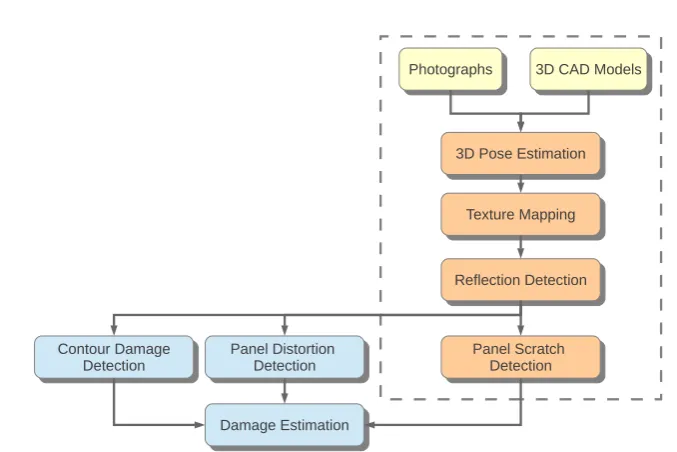
and their interdependencies are illustrated in Figure 1.1. The work presented in this thesis
addresses a vertical slice of the project where the scope is limited to detecting scratch damage
in the vehicle as indicated by the dashed box in Figure 1.1.
1
.
2
Motivation
A vehicle meets with an accident. At the moment what happens next would be as follows.
The vehicle owners/drivers call the relevant insurance companies. They wait till the insurance
agents arrive at the scene of the accident. The agents take photographs of the accident scene
and forms need to be filled out. A lot of time is wasted while all this takes place. More
importantly the insurance companies spend a lot of money in employing staff to drive down to
3D CAD Models
3D CAD Models
Photographs
Photographs
3D Pose Estimation
3D Pose Estimation
Texture Mapping
Texture Mapping
Reflection Detection
Reflection Detection
Panel Scratch Detection
Panel Scratch Detection
Panel Distortion Detection
Panel Distortion Detection
Contour Damage Detection
Contour Damage Detection
Damage Estimation
[image:28.595.99.438.108.334.2]Damage Estimation
Figure 1.1: Components of the overall project with the components within the vertical slice addressed by this research indicated by the dashed box
the scene of the accident. The grand vision of this work therefore, is as follows. In contrast to
the previous scenario, with the proposed technology, the driver would simply take photographs
of the damaged vehicle which will be directly uploaded to the company server via a mobile
phone application and drive away. The photographs will be automatically assessed for damage
using advance computer vision and machine learning techniques, thereby greatly automating
the insurance claims process; saving a lot of time and money. Other benefits which could
also result from such an automatic system include reducing human error, avoiding subjective
decisions by human damage assessors and preventing fraud.
1
.
3
Challenges
The fact that the photographs are taken in an uncontrolled environment makes this task very
challenging. The scene illumination is very complex and hard to predict before hand. To make
things worse, vehicles typically have very reflective metallic bodies which cause a lot of inter
object reflections. These can be easily confused as damage, even by trained human experts. In
addition, since the photographs are taken from a customer’s mobile phone at the scene of the
accident, information about the camera setup is not known a priori. If information about the
1
.
4
Contribution
The motivation behind the proposed solution is to use a library of 3D CAD models of
undam-aged vehicles as ground truth information, in order to detect mild damage in a vehicle using
photographs. The ground truth 3D model needs to be registered over the photograph in order
to know what the vehicle in the photograph should have looked like if it had not been
dam-aged. In principle, image edges which are not present in the 3D CAD model projection can
be considered to be vehicle damage. However, since the vehicle body is very reflective, there
is a large amount of inter object reflection in the photograph which may be misclassified as
damage. Therefore, we use robust image feature detection and matching combined with
multi-view geometry techniques to detect inter object reflections in vehicles using photographs taken
from two views. Based on this rationale, we make the following contributions.
1.4.1 Monocular2D/3D pose estimation
We propose methods to recover the 3D pose of a known object in a given image (in particular
the pose of a known vehicle). In other words, we propose methods to obtain the 3D pose
parameters required to register a 3D CAD model of a known object over a photograph of the
object. To this end we derive distance measures which can be optimized with respect to the
3D pose parameters, in order to obtain the final 3D pose. We present two methods; one in
Chapter 3 and a more robust method in Chapter 4. The work was published in Jayawardena
et al. [37] and Jayawardena et al. [36], respectively. An extended version of the pose estimation
work, Jayawardena et al. [34] is currently under review.
1.4.2 3D model assisted segmentation
We propose a method to use the 3D CAD model projection to help in segmenting and
sepa-rating components of a vehicle body like the doors and fenders which are separated by weak
boundary cues (e.g., parts consisting of the same color and paint). This work which is presented
We propose methods to detect reflections appearing on the vehicle body using photographs of
the vehicle taken from two views. Using this approach, we separate image edges caused by
reflections from edges on the surface of vehicle panels. Since image edges on the surface of
the vehicle can be identified with the aid of the 3D CAD model projection as developed in
Chapter 3, identifying reflection edges helps isolate mild damage to the vehicle in the form of
scratches, peeled off paint, etc,. The reflection detection work which is explained in detail in
Chapter 6.2, relies on the work presented in Chapter 5 which is used to obtain reliable point
correspondences between the two photographs.
1.4.4 Obtain reliable point correspondences across photographs with largely
reflective and homogeneous regions
Photographs of vehicles are dominated by large amounts of inter object reflections as the
metal-lic vehicle body tends to be very reflective. Apart from this, the body of a vehicle tends to have
large homogeneous regions which are relatively feature impoverished. Given photographs
from two views of the vehicle, traditional methods find it challenging to obtain
correspond-ing points across the images that are reliable enough to perform typical structure from motion
tasks like fitting a homography or estimating the epipolar geometry of the scene. We propose
a method which can find point correspondences that are reliable enough for our work using an
approach which compares feature descriptors along image edges in Chapter 5. A publication
based on this work, Jayawardena et al. [35], is currently under review.
1
.
5
Thesis outline
The remainder of this thesis is organized as follows.
In Chapter 2 we present the technical background and a review of related work. This
includes related work done on pose estimation, work related to the recovery of epipolar
ge-ometry and related work on obtaining reliable point matches between photographs of a scene
taken from two views.
We discuss a 3D pose estimation method and our model assisted segmentation method
in Chapter 3. Experiments are conducted to evaluate the sensitivity of the estimated pose to
variations in the initial pose used to seed the optimizer. Results on real car images are compared
with baseline methods.
In Chapter 4 we present our novel illumination invariant distance measure which can be
fol-The reflection detection approach is discussed in Chapter 6.2. Following the theoretical
formulation, we include reflection detection results on a dataset of real vehicle photographs.
The proposed approach utilizes a method to obtain reliable point correspondences across
pho-tographs with largely reflective and homogeneous regions which is presented in Chapter 5.
In this chapter we introduce background material necessary to discuss the work in the chapters
that follow. In doing so we also review related work. As we intend to register a 3D CAD
model of a vehicle over a photograph in our work, we begin this chapter by reviewing
litera-ture on 3D pose estimation. Since we use photographs obtained from two different views to
detect reflections on the vehicle surfaces, we proceed to discuss two view geometry and point
correspondences across two views, in the remainder of this chapter.
2
.
1
Pose estimation
Interest in the use of 3D CAD models has a long history in computer vision. For the sake of
completeness, we include literature spanning at least 50 years from now, when such research
spurred a lot of interest. Although widely used in computer graphics, the use of realistic 3D
CAD models (i.e., 3D models consisting of a large number of polygons) in computer vision
research has been limited by computational constraints. Hence, computer vision researchers
tend to have resorted to other computationally feasible methods over the more recent past. With
the advent of more powerful computing resources, realistic 3D CAD models are becoming
popular [9, 8] once more.
We begin our discussion based on a survey by Chin and Dyer [15] which shows that model
based object recognition algorithms generally fall into three categories based on the type of
object representation used; namely, 2D representations, 2.5D representations and 3D
represen-tations.
2Drepresentations store the information of a particular 2D view of an object (a characteristic
view) as a model and use this information to identify the object from a 2D image. Global
feature methods have been used by Gleason and Algin [25] to identify objects like spanners
and nuts on a conveyor belt. Such methods use features such as the area, perimeter, number of
holes visible and other global features to model the object. Structural features like boundary
graph method has been used by Yachida and Tsuji [90] to match objects to a 2D model using
graph matching techniques. These 2D representation based algorithms require prior training
of the system using a ‘show by example’ method.
2.5Dapproaches are also viewer centered, where the object is known to occur in a particular
view. They differ from the 2D approach as the model stores additional information such as
intrinsic image parameters and surface-orientation maps. The work done by Poje and Delp [70]
explain the use of intrinsic scene parameters in the form of range (depth) maps and needle (local
surface orientation) maps. Shape from shading [31] and photometric stereo [87] are some other
examples of the 2.5D approach used for the recognition of industrial parts.
A range of techniques for such 2D/2.5D representations are described by Forsythe and
Ponce [22], by posing the object recognition problem as a correspondence problem. These
methods obtain a hypothesis based on the correspondences of a few matching points in the
image and the model. The hypothesis is validated against the remaining known points.
3Dapproaches are utilized in situations where the object of interest can appear in a scene from
multiple viewing angles. Common 3D representation approaches can be either an ‘exact
repre-sentation’ or a ‘multi-view feature reprerepre-sentation’. The latter method uses a composite model
consisting of 2D/2.5D models for a limited set of views. Multi-view feature representation is
used along with the concept of generalized cylinders by Brooks and Binford [12] to detect
dif-ferent types of industrial motors in the so called ACRONYM system. The models used in the
exact representation method, on the contrary, contain an exact representation of the complete
3D object. Hence a 2D projection of the object can be created for any desired view.
How-ever, exact representation methods have been typically considered to be too costly in terms of
processing time.
The 2D and 2.5D representations are insufficient for general purpose applications. For
example, in the case of vehicle damage detection, a vehicle may be photographed from an
arbitrary view in order to indicate the damaged parts. Similarly, the 3D multi-view feature
rep-resentation is unsuitable as it restricts the pose of the object to a limited set of views. Therefore,
an exact 3D representation is preferred. Little work has been done to date on identifying the
pose of an exact 3D model from a single 2D image.
Huttenlocher and Ullman [32] use a 3D model that contains the locations of edges. The
edges/contours identified in the 2D image are matched against the edges in the 3D model to
calculate the pose of the object. The method has been implemented for simple 3D objects.
However, it is unclear if this method will work well on objects with rounded surfaces without
hedral models are compared against image gradients in video images. The pose is formulated
using three degrees of freedom; two for position and one for angular orientation. Tan and
Baker [82] use image gradients and a generalized Hough transform [3] based algorithm for
estimating vehicle pose in traffic scenes. The generalized Hough transform is used to collect
votes on possible pose candidates and to select the best pose. They too use a pose
representa-tion consisting of three degrees of freedom. Pose estimarepresenta-tion using three degrees of freedom is
adequate for traffic image sequences, where the camera position remains fixed with respect to
the ground plane. However, this approach does not provide a full 3D pose estimate required
for a general purpose application.
2.1.2 Feature based methods
Work done by Arie-Nachimson and Basri [2] makes use ofImplicit Shape Modelsto recognize 3D objects from 2D images. The model consists of a set of learned features, their 3D locations
and the views in which they are visible. The learning process is further refined using
factor-ization methods. The pose estimation consists of evaluating the transformations of the features
that give the best match. A typical model requires around 65 images to be trained. However,
it is unclear if such a learnedImplicit Shape Modelscan be used as undamaged ground truth information for the purposes of detecting damage in vehicles. We choose to use 3D CAD
models of undamaged vehicles to obtain ground truth information. Possibilities of using other
methods are discussed as future work in Section 7.2.
Other methods like the work by David et al. [17] and the work by Moreno-Noguer et al.
[65] attempt to simultaneously solve the pose and point correspondence problems. The work
by David et al. [17] attempts to simultaneously find the pose and correspondences for simple
3D scenes consisting of straight line segments like imagery of a corridor inside a building.
However, it would be challenging to apply this approach to vehicles which have more complex
and curved shapes. In addition, it is not straightforward to define correspondences between the
vehicle in the 2D photograph and the matching 3D CAD model, unlike with a corridor scene
with clear corners. Moreno-Noguer et al. [65] demonstrate an interesting approach to
incorpo-rate pose priors to simultaneously find the pose and correspondences. However, in their work,
corresponding 2D and 3D feature points are obtained for the real data initially by registering
photo-can be expected to be sensitive to the initial manual registration and in our work we would
prefer to have a fully automatic process. Moreover, the success of these methods are affected
by the quality of the features extracted from the object. Objects like vehicles have large
ho-mogeneous regions which yield very sparse features. Also, the highly reflective surfaces in
vehicles generate a lot of unreliable and noisy features. Our methods discussed in Chapter 3
and Chapter 4 on the contrary, do not depend on feature extraction. In addition, we present a
robust way to generate more reliable 2D point correspondences across photographs from two
views of such highly reflective surfaces in Chapter 5.
2.1.3 Distance measures
Distance measures can be used to represent a distance between two data sets, and hence give
a measure of their similarity. Therefore, a distance measure can be used to measure similarity
between different 2D images, as well as 2D images and 2D projections of a 3D model. A naive
distance measure could be the sum of theEuclidean Distances between corresponding points of the two datasets. However, this has the disadvantage of being dependent on the scale of
measurement. We use theMahalanobis Distance[54] for our work, which is a scale-invariant distance measure. It is used by Xinget al. [89] for clustering. It is also used by Deriche and Faugeras [18] to match line segments in a sequence of time varying images.
2.1.4 Optimization for pose estimation
Optimization refers to finding the minima (or maxima) of a given objective function. We
optimize a distance measure in Chapter 3 and Chapter 4 to obtain the 3D pose of a known
vehicle in a given image. Ifweak perspective projectionorscaled orthography[22] is used (i.e., a parallel projection with constant magnification/scale), the projective transformation that
describes the pose will have six degrees of freedom. With full perspective projection, however,
the 3D pose will have seven degrees of freedom and the objective function to be optimized will
have seven dimensions. In a camera centered coordinate system, there will be three degrees of
freedom for 3D rotation of the object, three degrees of freedom for 3D position of the object
and one degree of freedom for focal length of the camera lens (resulting in the perspective
distortion), resulting in seven degrees of freedom in total. We do not consider intrinsic camera
parameters like radial distortion in the lens which will add more degrees of freedom. We
to use a popular direct search method known as thedownhill simplexmethod [66].
The downhill simplex method [66], also known as the ‘amoeba algorithm’ or the
‘Nelder-Mead simplex algorithm’, is based entirely on function value evaluations. According to Nelder
and Mead [66], the gist of the method is as follows. The algorithm uses a so called simplex
consisting ofn+1points for anndimensional function. This consists of the initial starting point
X0 andnother points obtained by shifting each of thendimensions in the starting point by a
predetermined step size. The points in the simplex are sorted from the best to the worst in terms
of function values (in the case of a minimization, the best point would have the lowest function
value). The worst point is replaced by a new point which is computed from the remaining
points (by applying the so called reflection, expansion and contraction operations) in order to
obtain a new simplex. The process is repeated iteratively until a termination criteria is reached.
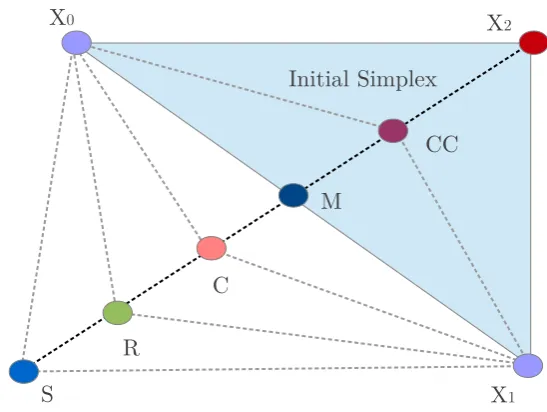
Details of the procedure are shown in Algorithm 1. Possible choices of replacing the worst
point in Algorithm 1 are shown in Figure 2.1 for a two dimensional function.
X0 X2
X1 M
CC
C
R S
[image:37.595.173.447.433.639.2]Initial Simplex
Figure 2.1: The figure shows the simplex for a 2D function. X0 is the initials starting point.
Assuming that the worst point isX2, the diagram shows possible ways of replacingX2as per
Algorithm 1.
There are several candidates when selecting the termination criteria. Nelder and Mead [66]
f X X0 x1,x12, . . . ,xn R Output: Xminwhich minimizes f(X)
fori=1tondo ifxi 6=0then
Xi = [x1,x12, . . . , 1.05xi, . . . ,xn]T else
Xi = [x1,x12, . . . , 0.00025, . . . ,xn]T end if
end for
reorder points such that f(X0)≤ f(X1)≤. . .≤ f(Xn) initial simplex←X0,X1, . . . ,Xn
whiletermination criteria reacheddo
findM =∑Xi/nfori=0, . . . ,(n−1) find reflected pointR=2M−Xn if f(X0)≤ f(R)< f(Xn−1)then
Xn+1←R
terminate iteration // reflect end if
if f(R)< f(X0)then
find expansion pointS← M+2(M−Xn) if f(S)< f(R)then
Xn+1 ←S
terminate iteration // expand else
Xn+1 ←R
terminate iteration // reflect end if
end if
if f(R)≥ f(Xn−1)then
if f(R)< f(Xn)then
findC←M+ (R−M)/2
iff(C) < f(R) then
Xn+1←C
terminate iteration // contract outside end if
end if
if f(R)≥ f(Xn)then
findCC← M+ (Xn−M)/2 if f(CC)< f(Xn)then
Xn+1←CC
terminate iteration // contract inside end if
end if
end if // shrink
findVi =X0+0.5(Xi−X0)fori∈1, . . . ,n
new simplex←X0,V1, . . . ,Vn find f(Vi)fori∈1, . . . ,n
estimate for the number of iterations required for convergence as,
I =3.16(n+1)2.11 (2.1)
whereIis the number of iterations required andnis the number of dimensions in the
indepen-dent variable.
The algorithm is a popular direct search method for unconstrained multidimensional
op-timization. For constrained optimization, Nelder and Mead [66] have suggested two ways of
integrating constraints into the optimization. One methods is to modify the function such that
undesired values of the independent variable result in very large function values. The other
method is to transform the independent variable (e.g., use logarithms to exclude negative
val-ues).
2
.
2
Two-view geometry
Epipolar geometry [28] is commonly used to describe the projective geometry of a 3D scene
observed from two views. It is independent of the scene structure, and only depends on the
in-ternal parameters and relative pose of the cameras. As such it is useful in inferring information
about the cameras.
The epipolar geometry can be conveniently represented algebraically using a three by three
matrix of rank two. This matrix is known as theFundamental MatrixF.
When dealing with multi-view geometry, it is convenient to use projective coordinates in Pnsuch that for the Euclidean pointX
R = (X1,X2, . . . ,Xn)∈Rnthe projective equivalent is
XP =λ(X1,X2, . . . ,Xn, 1)∈Pnwhereλis an arbitrary non-zero scalar. As an aside,
equal-ity in projective coordinates are typically considered only up to a scale factor. For example
(X1,X2, . . . ,Xn, 1) = (2X1, 2X2, . . . , 2Xn, 2) = (λX1,λX2, . . . ,λXn,λ)are all considered
to be projectively equivalent.
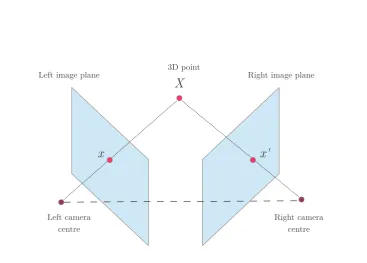
Suppose a point in 3D space X ∈ P3is imaged by the left and right cameras as x ∈ P2
andx0 ∈P2respectively, as illustrated in Figure 2.2.
For noise free measurements of corresponding 2D points x↔ x0, the following condition holds
X
x
x'
Left camera centre
[image:40.595.93.461.110.373.2]Right camera centre Left image plane 3D point Right image plane
Figure 2.2: Corresponding points and epipolar geometry
whereFis the fundamental matrix.
F can be computed using a set of known point correspondences x ↔ x0 such that the condition in Equation 2.2 holds. Extensive work has been done on recovering F using point
correspondences including the works by Longuet-Higgins [52], Zhang [91] and Hartley [27].
In most practical situations, the presence of wrong and noisy correspondences can severely
affect the accuracy of the computed F. Therefore, robust estimation techniques based on the
RANSAC approach [20] are typically employed to rule out noisyoutlierswhich do not agree with the F that describes the given data. The point correspondences that satisfy the F are
termedinliers. The workings of a typical RANSAC algorithm are shown in Algorithm 2. In the context of estimating the fundamental matrix, evaluating the modelM in Algorithm 2 would
mean finding anF using a method like the normalized 8 point algorithm as per Hartley [27].
In this case the sampleswould be obtained by picking eight point correspondences. Amongst
other candidates, the distance threshold t can be evaluated using an algebraic distance or a
geometric distance. We use the Sampson distance [77] in our work, which is of the latter type.
Fis said to be degenerate when it fails to uniquely define the epipolar geometry. There are
several situations when the resultingFmay become degenerate. As per Hartley and Zisserman
Step 2: Find the set of points Si which are within a distance thresholdt of the model; the remaining points inSwill be the set of outliersSo
Step 3:If|Si|>Tthen re-estimateMusing all points inSi and terminate Step 4:If|Si| ≤Tthen repeat from Step 1 up to a maximum ofNtrials
Step 5:Select the largest consensus set obtained so far asSiand re-estimateMwith thisSi
the 3D points are on a ruled quadric or when all the 3D points lie on a plane in 3D. The latter
is of interest to us in Chapter 6 and in such situations it is possible to compute a homography
Hinstead ofF. We may estimate a homographyHsuch that
Hx=x0 (2.3)
Once more it is possible to use robust estimation methods based on the RANSAC approach by
Fischler and Bolles [20] to computeHfrom noisy correspondences. TheSymmetric Transfer Error (STE)[28] is a commonly used distance to measure how much a given point correspon-dence agrees withH. The STE is defined as follows by Hartley and Zisserman [28]. The STE
between point pairsxi ↔ x0i under the homographyHis given as
dSTE(i) =d(xi,H−1xi0)2+d(xi0,Hxi)2 (2.4)
whered(., .)is the Euclidean distance between the inhomogeneous points (inR2) represented
byxi,H−1x0i ∈P2andx0i,Hxi ∈P2. In terms of Algorithm 2, instantiating and re-estimating the model Mwould involve selecting a sets, of four random point correspondences in order
to computeHas per Equation 2.3. In our work, we evaluate the distance thresholdtusing the
STE (Equation 2.4).
However, the degree to which the recovered ForHrepresents the true data when using a
RANSAC based method, is affected by the ratio of inliers to outliers. It is shown by Hartley and
Zisserman [28] that for a given sample size, the number of samples which need to be evaluated
in order to ensure that at least one sample is free from outliers, increases exponentially with
the proportion of outliers (Table 4.3 in Hartley and Zisserman [28]). The requirement, then, is
Structure from Motion (SfM) algorithms, which estimate the 3Dstructureof the scene and the camera motion given photographs from two or more views, typically require the knowledge of corresponding points across the 2D images. Much work has been done on detecting and
identifying correspondences between multiple views of a 3D scene. However, much of this
work is targeted towards images of non-reflective and well textured objects and scenes.
For example, recent work which has received much attention includesPhoto Tourism[78], which employs the SIFT [53] key point detection and matching algorithm to find point
cor-respondences. This work was originally intended for tourist images commonly found on the
Internet which include outdoor landscapes and historic buildings. As such it does not work
well with images of highly reflective objects containing largely homogeneous regions.
It is worth noting at this point that feature detection and description are two separate tasks
although some algorithms like SIFT [53], SURF [4] and BRISK [48] do both. Other
meth-ods like the key point and edge detector by Harris et al. [26] focus only on the detection aspect. Some common feature descriptors include the use of a histogram of oriented gradients
(HoG) [16] and Phog/Phow descriptors [7] which are commonly used in image classification
and recognition. Similarly work done by Kingsbury [39] shows the utility of a rotation
in-variant feature descriptor based on complex wavelets which can be evaluated on Harris corner
points [26].
Detecting regions covariant with a certain class of transformations can be useful in
find-ing correspondences between views and Mikolajczyket al. [63] have compared some common affine region detectors including MSER, IBR, EBR, Hessian-Affine and Harris-Affine.
De-scriptors for finding wide-baseline correspondences also exist [61, 58, 84]. However, these
methods by themselves are not well suited for images of reflective objects with largely
homo-geneous regions like cars.
Recent work by Linet al. [51] finds correspondences and camera pose using motion coher-ence on scenes which were previously regarded as feature impoverished SfM scenes;
contain-ing largely edge cues but few corners. Their work gives good results on scenes consistcontain-ing of
long edges and few corners such as images of buildings and cupboards. Edge based features
have also been used by Mikolajczyket al. [64] for shape recognition. Good results have been reported from their method on simple smooth shapes like bicycles and tennis rackets, where
edges tend to give strong cues in otherwise poorly textured scenes. Our car images on the other
hand, do not guarantee reliable edges that can be matched across images as edges, since the
pixel so that descriptors can be read at the desired edge points in the image. Although, dense
implementations of SIFT [53] and SURF [4] exist, we prefer to use the DAISY [84] descriptor
which is faster and also better suited for wide-baseline images. Faster rotation invariant GPU
implementations of the DAISY also exist [19], although we have not used them in our work.
Reflections are not necessarily harmful for the recovery of the epipolar geometry (EPG)
between two images. Work done by Saminathanet al. [81] shows that the epipolar deviations of specularities on convex surfaces which are not highly undulating are usually quite small.
2
.
4
Chapter summary
In this chapter we discussed some background material related to 3D pose estimation, two view
geometry and obtaining reliable point correspondence across photographs from two views. In
the process, an overview of related work was provided. As described in the chapters to follow,
the 3D pose is used to register a 3D CAD model of the vehicle over the photograph. A 2D
projection of the registered 3D CAD model is used as ground truth information when detecting
vehicle damage using the photograph. Our work on 3D model assisted image segmentation
is presented next in Chapter 3, which is used to detect parts of the car in the photograph. We
present a more robust 3D pose estimation method using a novel illumination invariant distance
measure in Chapter 4. Parts of the vehicle in the photograph which were originally not in
the undamaged 3D CAD model can be expected to be vehicle damage. However, based on
this rationale, reflections of the surroundings appearing on the vehicle body can also be
clas-sified as vehicle damage. Therefore, we explore ways to detect such reflections in Chapter 6,
which is based on the work done in Chapter 5 to obtain reliable point correspondences from
3
.
1
Introduction
In line with our proposition to use a 3D CAD model to identify parts of the vehicle in a
photograph, we present in this chapter a method to register the 3D model over the photograph
using a gradient based distance measure. In order to identify components of the vehicle in the
photograph, we present a method to segment different parts of a vehicle in the photograph with
the help of the 3D model projection. We address challenging segmentation scenarios where
parts of the car have boundary cues which are difficult for existing segmentation methods. The
work presented in this chapter was published in Jayawardena et al. [37].
Image segmentation is a fundamental problem in computer vision. Most standard
unsuper-vised image segmentation techniques rely on exploiting differences between pixel regions such
as color and texture. Hence, segmenting sub-parts of an object which have similar
character-istics with difficult boundary cues (particularly parts car body with the same color and paint)
can be a challenging task. We propose a method that performs such sub-segmentation with
minimal user interaction and without using any prior training. The only form of additional
input required is the make and model of the vehicle. In our target application of analyzing
vehicle photographs for processing insurance claims, this information is already present in the
insurance policy details, so there is no added burden on the end user to provide extra
infor-mation other than identifying themselves. A result from our method is shown in Figure 3.1
with the car sub-segmented into a collection of parts. These parts include the hood of the car,
windshield, fender, front and back doors/windows.
Sub-segmenting parts of an object which share the same color and texture is very hard with
conventional segmentation methods. However, prior knowledge of the shape of the known
object and its components can be exploited to make this task easier. Based on this rationale we
propose a novelModel Assisted Segmentationmethod for image segmentation.
We propose to register a 3D model of the known object over a given photograph/image in
Figure 3.1: The figure shows ‘Model Assisted Segmentation’ results for a semi-profile view of a car.
order to initialize the segmentation process. The segmentation is performed over each part of
the object in order to obtain sub-segments from the image. A major contribution of this chapter
is a novel gradient based distance measure, which is used to estimate the full 3D pose of the
object in the given image. The projected parts of the 3D model may not perfectly match the
corresponding parts in the photograph due to dents in a damaged vehicle or inaccuracies in the
3D model. Therefore, a level-set [50] based segmentation method is initialized using initial
contour information obtained by projecting parts of the 3D model at this 3D pose. We focus
our work on sub-segmentation of known car images. Cars present a difficult segmentation task
due to the highly reflective surfaces in the car body. Our method can be adapted to work on
any other object as well.
The remainder of this chapter is organized as follows. We describe the method used to
estimate the 3D pose of the object in Section 3.2. The contour based image segmentation
approach is described next in Section 3.3. This is followed by results on real photographs
which are benchmarked against state of the art methods in Section 3.4.
3
.
2
3
D model registration
We describe the use of a featureless gradient based distance measure which is used to register
the 3D model over the 2D photo. Our method uses triangulated 3D CAD models with a large
number of polygons (including 3D models obtained from laser scans) and utilizes image
gra-dients of the 3D model surface normals rather than considering simple edge segments as done
by Kollnig and Nagel [42].
3.2.1 Gradient based distance measure
We define a gradient based distance measure that has a minimum at the correct 3D poseθ0 ∈
d=3ifWis an RGB image) having elementsW(u,v)∈ IR . We define thepnorm ‘gradient magnitude’ matrix ofW as
||∇W(u,v)||k
k :=∑di=1
|∂Wi(u,v)
∂u |
k+|∂Wi(u,v)
∂v |
k (3.1)
Based on this we have the gradient magnitude matrixGI for a 2D photo/imageIas
GI(u,v) =||∇I(u,v)||kk (3.2)
Letφ(x,y,z,θ) = φx φyφz
T
∈ IR3be the unit surface normal at the 3D pointp= (x,y,z)
of the 3D model at poseθ. The model is rendered with the surface normal components values
φx,φyandφzused as RGB color values in the OpenGL renderer to obtain the projected surface
normal component matrixΦsuch thatΦ(u,v,θ)∈ IR3has surface normal component values at the 2D point(u,v)in the projected image. Based on this we have the gradient normal matrix for the surface normal components as
GN(θ)(u,v) =||∇Φ(u,v,θ)||kk (3.3)
We define the distance measureLg(θ)for a given poseθas
Lg(θ):=1−(corr(GN(θ),GI))2∈ [0, 1] (3.4)
wherecorr(GN(θ),GI)is the Pearson’s product-moment correlation coefficient [74] between
the matrix elements of GN(θ)and GI. This distance measure has a convenient property of
ranging between0and1. Lower distance measure values imply a better 3D pose.
3.2.2 Visualisation
We illustrate intermediate steps of the distance measure calculation for a 3D model of a Mazda
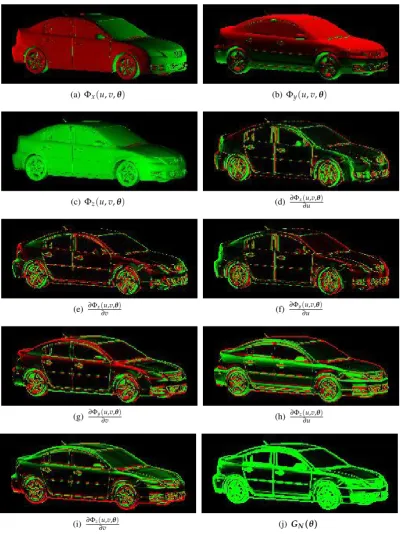
3 car. The surface normal componentsΦx(u,v,θ)Φy(u,v,θ)andΦz(u,v,θ)are shown in Figure 3.2(a-c). Their image gradients are shown in Figure 3.2(d-i) and the resultingGN(θ)
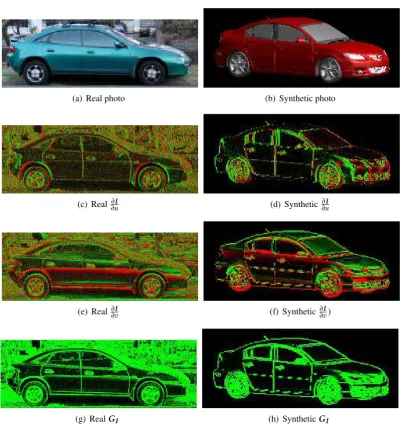
matrix image is shown in Figure 3.2(j). Similarly intermediate steps in the calculation of GI
are show in Figure 3.3 for a real photograph and a synthetic photo. We show overlaid images
real and synthetic photo. The synthetic photograph was made by rendering the Mazda 3 model
at a known poseθ. The real photograph is of a Mazda Astina. An accurate 3D model obtain
from a laser scan is used with this real photograph. The model projections steps for for the
Astina are not included but are similar to what is shown in Figure 3.2(a).
The correlation will be highest in Equation 3.4 when the 3D model is projected with pose
parametersθ0that match the object in the photographF, as this has the best overlap. Therefore
the distance measure will be lowest at the correct pose parametersθ0, for values ofθreasonably
close toθ0. We see this in the distance measure landscapes in Figure 3.5.
3.2.3 Gaussian smoothing
We apply Gaussian smoothing on the photograph and rendered surface normal component
images before calculatingGI(Equation 3.2) and GN(θ)(Equation 3.3). This is done by
con-volving with a 2D Gaussian kernel followed by down-sampling [22]. This makes the distance
measure landscape less steep and noisy, thus making it easier to optimize. However, the global
optimum tends to deviate slightly from the correct pose at high levels of Gaussian smoothing.
Compare the 1D distance measure landscapes shown in Figure 3.5 for different levels of
Gaus-sian smoothingn. Therefore, we hierarchically perform a series of optimizations starting from
the highest level of smoothing, using the optimum found at levelnas the initialization for level
n−1, recursively.
3.2.4 Choosing the norm p
We have a choice when selecting the norm for Equations 3.2 and 3.3. Having tested both1
-norm and2-norm cases we have found the1-norm to be less noisy (as shown in Figure 3.5)
and hence easier to optimize.
3.2.5 Representation of the pose
Careful selection of pose parameters can aid the optimizer when finding the best pose. The pose
of a generic object may be represented by translations along the X,Y and Z axes and a suitable
rotation representation. According to Lepetit and Fua [47], an Euler angle based rotation
representation may give rise to ill-conditioned optimization problems due to a situation known
as the Gimbal Lock, which occurs when two of the three rotations axes align and rotations around the third axis ceases to have any effect. A quaternion or exponential map rotation
representation may be used to avoid this problem. Since we work with vehicles, the following
(a)Φx(u,v,θ) (b)Φy(u,v,θ)
(c)Φz(u,v,θ) (d) ∂Φx(∂uu,v,θ)
(e) ∂Φx(u,v,θ)
∂v (f)
∂Φy(u,v,θ)
∂u
(g) ∂Φy(u,v,θ)
∂v (h)
∂Φz(u,v,θ) ∂u
(i) ∂Φz(u,v,θ)
[image:49.595.119.523.114.649.2]∂v (j) GN(θ)
Figure 3.2: The visualizations showsGN(θ)for a Mazda 3 3D CAD model in (j). The x,y and
z component matrices of the surface normal vector are shown in (a)-(c). Their image gradients are shown in (d)-(i). The resultingGN(θ)matrix is shown in (j). No Gaussian smoothing has
been applied. Color representation: green=positive, black=zero and red=negative. We use a horizontalxaxis pointing left to right, verticalyaxis and pointing top to bottom and anzaxis
(a) Real photo (b) Synthetic photo
(c) Real ∂I
∂u (d) Synthetic
∂I
∂u
(e) Real ∂I
∂v (f) Synthetic∂
I
∂v)
[image:50.595.77.483.177.602.2](g) RealGI (h) SyntheticGI
Figure 3.3: Intermediate steps in calculatingGIfor a real (column 1) and synthetic photograph
(column 2). The synthetic photograph was made by projecting the 3D model. Image gradients (rows 2 and 3) andGI (row 4) are shown. Colour representation: green=positive, black=zero
(a) Real (b) n=0 (c) n=2
(d) Synthetic (e) n=0 (f) n=2
Figure 3.4: Overlaid images of GI andGN(θ)for a real photograph (row 1) and a synthetic photograph (row 2) obtained by rendering a 3D model are shown. The first column shows the photographs I. The overlaid images ofGI andGN(θ)with no Gaussian smoothing (column
2) and 2 levels of Gaussian smoothing (column 3) are shown. The photograph is in the green channel and 3D model is in the red channel, with yellow showing overlapping regions.
0.975 0.98 0.985 0.99 0.995 1
-15 -10 -5 0 5 10 15
Los
s V
al
ue
Percentage shift in x direction from known pose n = 0 n = 1 n = 2
(a) 2-norm
0.75 0.8 0.85 0.9 0.95 1
-15 -10 -5 0 5 10 15
Los
s V
al
ue
Percentage shift in x direction from known pose n = 0 n = 1 n = 2
(b) 1-norm
Figure 3.5: We compare1-norm and2-norm gradient based distance measure landscapes ob-tained by shifting the 3D model along the x direction from a known 3D pose. The horizontal axis shows the percentage deviation along the x axis. This is obtained by varyingµx in the pose representation give in Section 3.2.5. The numbers in the legend show the level of Gaus-sian smoothing napplied on the gradient images before calculating the distance measure in Equation 3.4. We note that the1-norm distance measure is less noisy compared to the2-norm distance measure. The actual distance measure is seven dimensional and graphs of the other
Figure 3.6: The pose representation θortho used for 3D car models. We use the rear wheel centerµ, the vector between the wheel centersδand unit vectorψin the direction of the rear
wheel axle.
representation is consistent with pose representation used in the rough pose estimation method
of Hutter and Brewer [33], which we use for our work.
θortho:= µx,µy,δx,δy,ψx,ψy
(3.5)
In this representation, µ = (µx,µy) is the visible rear wheel center of the car in the 2D projection. δ = (δx,δy)is the vector between corresponding rear and front wheel centers of the car in the 2D projection. The 2D image is a projection of the 3D model on to the XY
plane. ψ = ψx,ψy,ψz
is a unit vector in the direction of the rear wheel axle of the 3D
car model. Therefore,ψz = −
√
1−ψ2x−ψ2yand need not be explicitly included in the pose
representationθ. This representation is illustrated in Figure 3.6. This pose is converted to
OpenGL translation, scale and rotation as per Hutter and Brewer [33] to transform and project
the 3D model. As we directly optimize Equation 4.5 with respect to θ(Section 4.5) explicit
knowledge of intrinsic camera parameters etc,. are not required.
3.2.5.1 Perspective projection
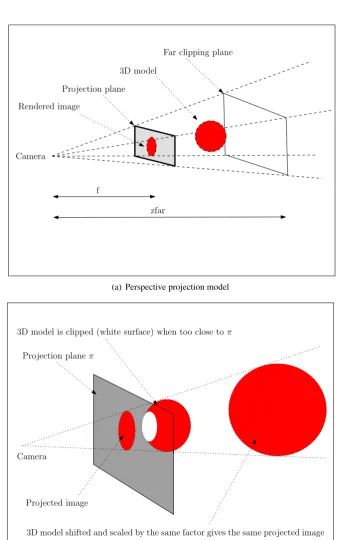
We extend the pose estimation to handle perspective projection as follows. The 3D model is
rendered using the OpenGL perspective projection model. The degree of perspective distortion
can be changed by varying the focal length parameterf (Figure 3.7(a)) in the OpenGL frustum.
Therefore, we include the parameter f as a pose parameter during the optimization. We now
have the following perspective pose representation (with seven degrees of freedom) instead of
the previous representation given in Equation 3.5.
θpersp:= µx,µy,δx,δy,ψx,ψy,f