THESES, SIS/LIBRARY A.G. MENZIES BUILDING N02 Australian National University Canberra ACT 0200 Australia
USE OF THESES
This copy is supplied for purposes
of private study and research only.
Passages from the thesis may not be
copied or closely paraphrased without the
written consent of the author.
Telephone: +61 2 6125 4631 Facsimile: +61 2 6125 4063
PAN'(J IMA Pl!OllOLOGY A!ID l\ORPi!OLOG'(
Alan Charles Donch
A thesis submitted in p>rtlol 3·1tisfaction o.f tho requirements for thfJ degree of Master of Arts of the Australian National University.
!ABLE OF CONTENT$.
i.:ONTENTS:
LIS't Cr TABl ES J,liD HGUfiES
ACKNOWLEDGEMEllTS
,
.
1 • 1 1. 2
, . 3
1. 4 1 • 4 • 1
1.4.2 1. 4. 3
1 • 5
2. 2. 1
2. 1 • l
2.,. 2
2.2
2.3 2.4
3.
2. 4. 1 2.4.2
2.4.3
2. 4 .11 2.4.5
3. 1
3.2
3. 2. 1
TH£ L At;GUAGE AND ITS SPEAKEBS
lfogulstic 1"ypc Dialects
Territory end Hclghbourn
o•ociolinguistic Information The Kinshl? Syotem
The Paathup~thu Avoidoncc Longuap;e Avoidance Relationships
Prc~cnt Situ~tion
PHOl;Q[OGX
Phonemes and their Rcalizoticn Consonants
Vowclo
Phonot2ctics Stress
Morphophonc.mlcs Assimilotion Rules
Word Length CondHicncd Allomorphs Nasal Dissimilaticn
Accusative Eloc~lng
Reduction of Realprocal Dcrivatlonal Affix
MCAPhOLOGY
Parts of Speech
tlom!r.al Morphology
Ca~e Inflections
3,2.2
3. 2 .2. 1 3.2.2.2 3.2.2.3 3.2.2.4 3.2.2.:; 3.2.2.6 3.2.2.7 3.2.2.e 3,2.2.9 :J.2.2. 1G 3.2.2.11 3,3
3, 3. 1 3,3.2 3,3,3 3.4 3.4.1 3.4.2 3.4.3 3.4.4 3,5
3. 5, 1
3,5,2
3,5,3
1.6
3 .6. 1
3.6.2 3,7
3. '/., 3,7,2
3. 'i. 3 3.7.4
3, 7. 4. 1
3, 7 .11.2
3.'/.4.3
3. 7. 4. 4 3,7,4.5
Nomlnal Dcriv2'tional Suffhes 39
?roper .t~oun Clas~ificrs 39
Uur.:bcr 41
'Both' 44
'Eacht 44
'Having' 45
'Privative• 46
1.l\csocietive• 4~/
'Unlfyfog' 47
'AND' h8
'ANO All' 49
'N~ARRA' ~O
K~r.term Duals and Pluralc 51
Reference Kinter~~ 51
!:J.ntc.rn:s of Address 53
,1\nnlpis of Dual Term:: 56
Pronounn 60
First Perr,on Non-Singular Pronouns 60
Second Person !~on-Singular Pronou~1s 63
Analysis of Pronominal Forms 66
Third Person Pronoun 69
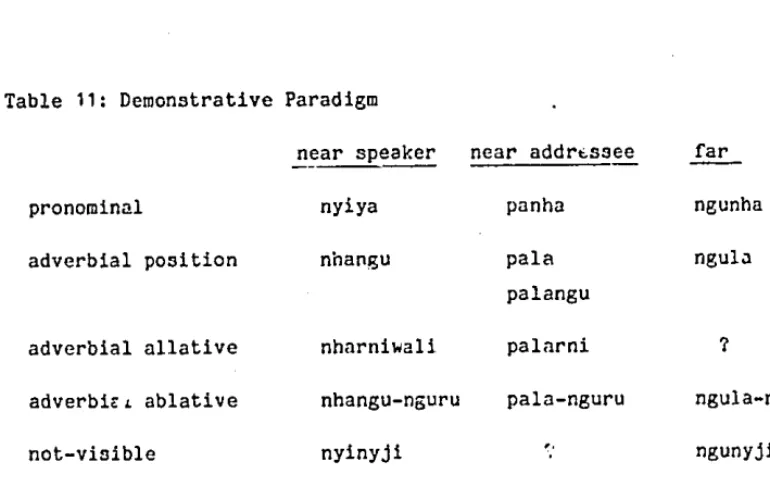
Dcm·on:;trati vcs 73
Ar.apnoric Demonstrative Forms 77
Prcdicntc Demonstrative 81
Directionals 62
Interrogatlvcs/Indcfini tcs 83
Pronominal Interrogatives/Indefinites 83
locative and Temporal Intcrrogat.1ves/Indefinitcs 88
Verbal Morphology 91
Transitivity 91
Conjugation 95
Vcrbol Inflections 58
Verbal Deriv.at1onal t1crphology 112
'Cauzativc' 112
'Inchoatlvc' 114
'Processive' 116
I Pl VC(:fllttlt I 1, 7
3.1.4.5
3.7.4.7 3.7.4.8
3.1.4.9
3. 7 .4.1(•
3.8
3. B. 1 3. 8. 1. 1
3.8.1.2
3. 6. 1. 3
3. 6. 1. 4 3. 8. 1. 5
3. 6.,. 6 3. 8.,. 7 3. 6.,. 8
3
.c.,. s
3.8.1.10
3.:i.1.11 3.b. 1.12
3.8.1.13
3. f;. 2
3.8.3
3 .8. 3. 1
3.8.3.2 FOOTNOTES 'Reciprocal' •r~i~~ctive' 'Consequential' 'Passive'
No~inal Incorporation Pnst Inflectional Clitico Non-Rcstrtictcd Clit!cs
'Only' 'Contra~tivc' 'No'n'' 'Then' 'Inten~ificr' 'Er.iphatiz' 'like• 'Trl..~h~ 'Dubitativc' 'Int~rrogativc'
'R~cogni ti on'
'Foregrounding'
'Tense Axis Shift'
Order of the Non-Restricted Clitics Verb Clitics
Pronominal Clitics
'Reflexive' -iii 120 125 126 129 131 133 133 133 , 34 135 136 138 139 141 142 142 144 145 146 146 151 149 149 151 153
APPENDlX: NClilNATIVE CASE MARKING HI PASSIVE At;D IMPERATlVE CLAUSES 159
Figure 1 · Table 1:
Table 2: Table 3:
Table 4:
Table 5:
Table 6:
Fir;ure 2: Table 7: Table 8: Table 9: Table 10:
Table 11:
Table 12: Table 13: Table 1~: Table 15:
Table 16: Table 17: Teblc 16:
LIST OF TABLES A!JD FIGURr,,;
Kinship System for Male Ello of Panaka Section
Consonant Phonem~z
Vowel Phonemes Cons0nant Clusters
Inter-Morphemic Consonan, Clusters Kin Reference 1'~rms
Kin A-:idres.n Terc3
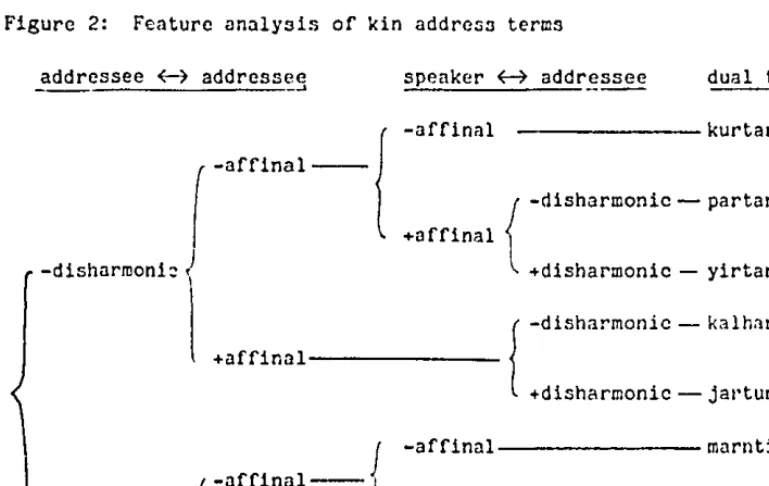
Featur.e Analysis of Kin Address Terms
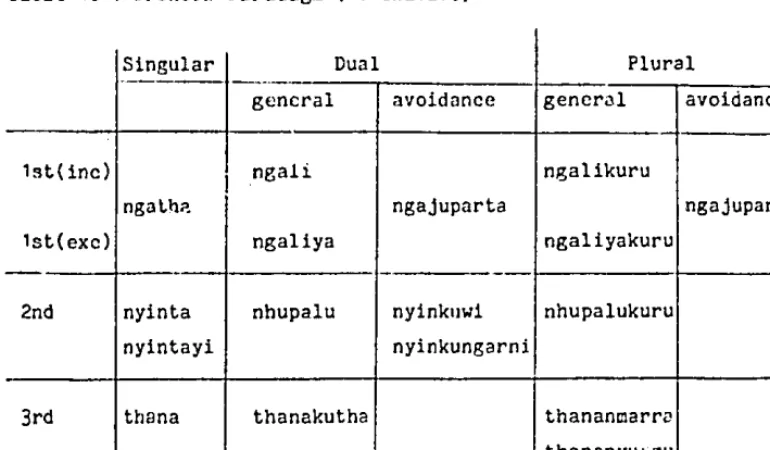
Paradigm for lse, ldl(inc) and 2sg Prono•Jns
First Per~on Dual and Plural Pronouns
Second Pcrcon Dunl end Plural l1ronounn
l'ronoun Paradigm (Ncminat! ve)
DcmonntrD. ti ve Pnra<.l i r,m
Anaphoric Demonstrative~
Directional Paradigm
Compass Points
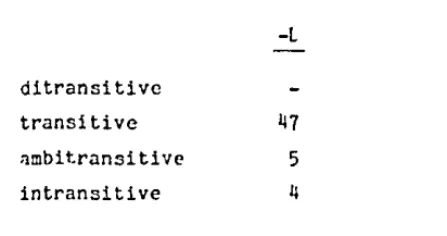
Conjugation Membership and Transitivity
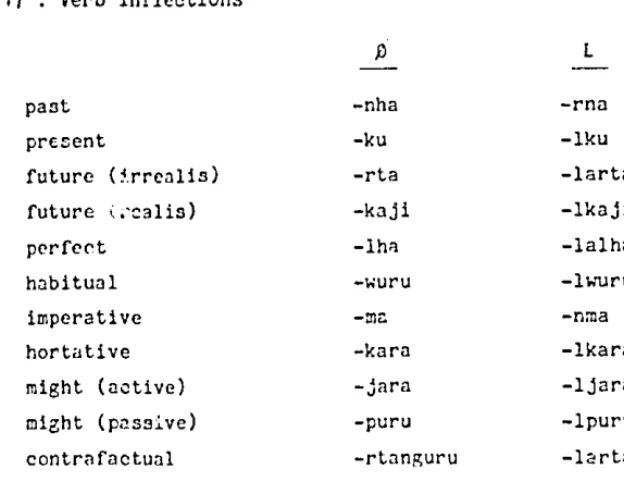
Conjugation Membership and Root-Final Vowel Verb Inflections
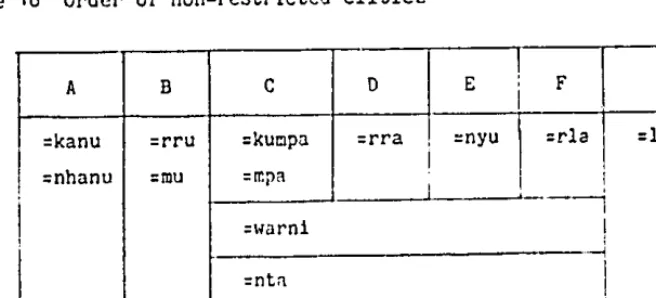
Order of Non-Restricted Clilics
-v
ACKNOWlEDGt:!-:E!JTS
r.y greatest debt is to Percy Tucker and Herbert Parker for their indefatiguable patience and good hu:r.our in teaching their language to Rn, at times, very slow student. without their eagerness tc have their
langua~e recorded this lhc~is cou11: : ~vcr have been \.;r ... tten. :; C'lU3l also
thcnk the 1<holc Onslow com~.uni ty for making my stay an enjoyabl·• and very rcw;irdir.g on'!.
Thanks to Peter Clark and Jul;e Robinson for putting ce up while in
Onslow, and to John and Elisabeth Williams for accomcdation and cuch help in Onslcw arid Carr.arvon. Fi~ld 1<ork in Onslow was supported by the Australian National University.
The thesis 1<as supervised by Bob Dixor. and Harold Koch. For' their
advice c.nd continuEd encouragement I cm very grateful. Special thanks al!:.o to Frnnces Morphy for at~empti11g to r-:c;·.ify rny ignorance of
anlhropological theory. 1 am else grateful to Amee Glass, John Haviland, Ian Green, Bob Tonkinson, Bill Foley and Frank Wordick for sug5estions and fruitful discussion. All errors >hich rc:r.ain in the thesis are all my c1<n work.
The thesis was prodcced using the Univac 1102 computer and I am
grateful to Tony Szeto, Susan Pullan, H. Char.drashakcr and Robyn Cassidy
for all their tuition and help ir. producing t,he draft. T!:anks also to Mrs. Val lyon of the Geography Dopart:r.cnt Ar;u for preparing the map on
1, THE LANGUAGE AllD ITS SPEAKERS
Panyjima is a Pama-Nyungan lansuage of the Ngayarda subgroup (Fn.
1), originally spoken in the tablelands of the Hammersly Range in the ?ilbara rt. .... ~on of lo\~?&t.crn Au!lt.ral ia. Today r.iost of the remainin'5
speakers of the language, ~h0 number approximately sixty, live in the
coastal town of Onslow. Others live in Rocbourne and Witr.oom and on a
number of pastoral leases in the Hammersly arEa.
1.1 linguistic Type
Panyjima is J.n many ways t :pical of the suffixing langueges of
Western Australia.
The phoneme inventory is typically f..ustralian. There arc six points of arttculation for stops and nas~ls with both.·a lamina! t.r.d an apical
contrast. The:-c arc four laterals, corresponding to the non-peripheral
~tops, tv.·o glidi:s and two rho tics. 1hcrt- arc thrr:.e short V0\1cls, and
three loop: vowel!3 of rnrc cccurrcncc.
Ncuns and adjectives car.not be distinguished on ~orpholcgical grounds. Nominals take number and other derivational suffixet, and a
set of inflectional case markers. Verbs take inflectional markers of
tense, aspect, mood nnd voice.
A three •ay number distinction operates in the pronoun paradigm and an 1nclu5ive/€xclusive distinction operates for non-singular first
person, The first and second person non-!31ne;ular pronouns also code
certain kin relationships between the speaker and the address~e(s).
Panyjima ('nd other lan£luages of the llgcyarda subgroup) differ most
~arkcdly fron other Australinn langungcs in having a no~in&tive/
~ccu~ativc case marking system with n productive syntactic passive. It
is clear, ho~cver, that this systEm has evolved out of an earlier
crgativc case mnrking system.
1, 2 Dia lees
-2
was spol<en in lower r'reas. The data on whlch th~.s thesis is !:;dSCd was
collected from people 1<ho identify with the Pantikura dialect.
O'Grady Voegclin and Vcegelin (1966) give two dialect names, Ftukurr and Milyaranpa. Milyaranpa is rnrst l! kely th8 Hijaranypa dialect mentioned by my informants. It is possible tha ·. rtukurr is in reality the word thukurr(pa) (Panyjima docs not permit initial apical consonants) rncaninp, 11straight" or "corrcct11 which is often applied to
language and speech style.
1. 3 Tc."ritory and r;eighbours
Tindale (1974) describes the traditional territory of the Panyjirna as follows:
Upper plntcau of the llar.:mcrsly Range south of the
Fortescue river; east to Weediwolli {sic [ Weeliwolli])
creek nc<'lr ?~.::;.rillon<!j south l<., nti'.'!r Rocklca, on the upper
branches of Tu rec Creek east to the Kundcrong Range. l:i.
later yc3rs under prcs::;urc from the Kurama, they rr:O\'€d
eastward to Yandicoogion an<l the OpthaJ.mia Range forcing the tliaball castw2rd. They ulso shifted south to Turce
and Prai1·ie DO\..'nS 'riving out. the Mandcira tribe, now
virtually extinct.
Tindale (1974:<55)
The map overle.1f gives thio location ond the approximate location of J
number of other lenguage~ m2ntioncd in this thesis .
•
•
3
•
•
1
.
'--....
l
0
II
I !
. . I
I' I
-4
Immediately to the west of Panyjima lie Yinyjiparnti and Kurraroa which are generally . assumed to be dialects of the one language (Hny j iparnti) of the Ngayarda subgroup. Both are no:ninati ve/ acct.sa ti ve and Yinyjiparnti has undergone extensive lenit:ion and deletion of con'sonants which has led to the development of vowel sequences uncommon in this area (see O'Grady 1966, and Wordick 1979). Panyjima is fairly closely related to Yinyjiparnti though the phonological differences are striking.
The Palyku language to the north and ·east of Panyjima has generally been assumed to be a dialect with Panyjima (following O'Grady
1966). While the two have~ very high percentage cognate density (79i by O'Grady) they are structu~ally very diosimilar. While Panyjima is totally nominative/accusative in its case marking system, Palyku is split ergative. Palyku has a full set of cross referencing pronominal clitics to the verb while Panyjima has only t110 which are most likely
•
recent borrowings. ~iy inform&nts clearly did not regard Palyku az a dialect of Panyjima but instead suggested it was related very closely to Nyiyapali. Tindale (1974) describes a history of conflict between the Panyjil'!~ and Palyku involving the kidnapping of women and c!;!ldren. If this was in fact tho case it may help exploin the high degree of lexical similarity between the two languages.
Very little is known about the N,tiya.pali language though some authors regard it as a dialect of Wes~ern Deser·t. It is clear that the Panyjiroa have a long history of contact and cooperation with the groups on the edge of the Western Desert.
The languages to the south (the Mantharta and Kanyara subgroups) do not appear to be closely related to Panyjima.
1.4 Sociolinguistic Information
detail the Panyjima kinship system.
1,ij,1 The Kinship System
The Panyjima kinship system is of the Kariera (Kariyarra) type and kin are divided into four sections. Figure 1, below and overleaf illustrates the Panyjima system from the point of view of a male ego of the panaka ~ection.
Figure 1: Kinship system for male ego of panaka section
I I
L_J
;
sibling Panaka section (A): Ego,B,Z,FF,MM,SS,SD marriage Milhangka section (B): F,FZ(Mo-in-law),S,D
descent Karimarra section (C): MED(wife),DS,DD,FM,
MF,MBS(Bro-in-law) Purungu section (Di: MB( Fa-in-law) ,M
M,ZS,ZD
Note:
- Ego's vie" •lf the kinship universe is th~ same as his brother's.
- Fa = FaBro
6MF/FMB
mapuji
c
6
FM/MFZ L F F /MMB
kaparli mayali
'---~--'
A
_ _ _ _ _ ::::;7<:::::_'-.
---
c-I
DMB
mi[l)i
Zs
D
ZD8
manyka ngarraye lanyka
I
I::::,___
..!;;;:
A
DS/LSS
c
Qoonso
mapuji (kaparli)
I
---C)
f~'1/FFZ
kantharri
I
Qz
thurtuI
Qo
kurntalpa
I
6SD/ZDD
-6
The terms in the diag,•am arc all ego-based kin referen~e and address terms. The grandparent/gr>ndchild terms are to some extent reciprocal. For example, a man and his father's father will call one another, and refer to one another, as mayali, and a woman and her daughter's daughter will call one another and refer to one another as kantharri. These terms are not fully symmetrical. A man will generally call all his son's children, whether male or female, mayali. If "le wants to make a distinction between his male and female grandchildren, he may use the term kantharri for his son's daugtit.er. Similarly, a woman will usually use the term kantharri in addressing or referring to her daughter's children, though she may use mayali for her daughter's son.
Notice that only two of the four sections occur in any generation level, and that generations oltcrnate. Thus for a male ego of the panaka section, all kinsmen of his same genera ti on wl.ll be either pannka or
karimarra. '!'hose kinsmen of his g!"z:-:,1dparents' or grandchildren' s
generation will also be either panaka or karimarra. Ego's parents and his chidren or his siblings' childr~n will, on the other hand, be either milhangka or purungu. I will use the term "harmonfo" to refer to kinsmen of the same set of elternating generations as ego, and the term "disharmonic" to refer to ego's kinsmen of the other set of alternating generations (following Hale 1966).
Notice further t~1at on!y t1<0 of the four sections appear on either side of the dfagr3m. All members of ego's pa trimoiety (to the right of Fig.1) are either panaka or milhangka, while all the members of ego's wife's patrimoiety (to the left of Fig.1) arc either karimarra or purungu. I will use the term "affinal" to refer to male
of ego's wife's patrimoiety. That is, in the terms of person is affinally related to his mother's brother
(Fn.2) kinsmen this thesis, a (MoBro), his mother's brother's son (MoBroSo), his m~ther's father (MoFa), and so on. In later sections I will invoke the distinctive features [+- affinal] and [+- disharmonic) (Fn.3) in describing gr0ups of related individuals. 1.4.2 The Paathupathu Avoidance langu~gc
-9
Paathupathu style is identical with everydsy Panyjima ~ith respect to morphclogical and syntactic processes, that is, the two stlyes have tt.e
same basic grammar. However, the wo~ds used in one style are <liffer·ent
from those uaed in the other style. In particula:-, almost every Ycrb of the everyday languege has an alternative Paathupathu for.1. For the most part the Paathupathu verbs arc generic and arc uocd to re?l ace a nurober of everyday .verbs. The nominals of the Paathupathu style do not exhibit the ~<,me generic properties. The vast majority of Paathupathu nominals are analyzable as the everyday word augmented by some s•1ffix. One s~ch productive suffix is described in section 3.2.2.11 below. Although thP. two speech styles have the same grammatical forms, it is apparent tliat the grammatical forms arc used in slightly different ways. That is, the Paathupathu style is characterized by circumlocution and by a general lack of specificity. For example, rather than using the general locative case inflection for describing the location of a person er object, there i~ a tendency for the indirect allativc inflection to be used instead. Another example is the common use of a verb built on the indefinite, specific pronoun, to avoid making explicit reference to a vo~b event. Thb cannot 1>roperly be described as the use of a generic verb. The Paathupathu s~ecch style is vnly remembered in any detail by a few old ruen and so far I have been able to collect only a few sentences. Certair.ly much more data could, and should, be collected.
1.4.3 Avoidance Rclationsnips
A number of respect and avoidance relativnships were appropriate between certain kin though to a large extent they are not practised today. Firstly, ones in-laws, particularly mother-in-law (FaZi) and father-in-law (MoBro), but also brother-in-law (MoBroSo), Must be largely avoided. Traditionally a man did not talk to his mother-in-law but rather talked through an intermediary and using the Paathupathu avoidance style. Paathupathu 1<as also used when talking to, or within
earshot of one's fa tiler-in-law and sometimes with one 1 s brothern-j n-law.
A certain degree of resrcctful behaviour was observed with all kinsmen classified as FaZi and MoDro sinoe all could potentially be one's in-laws.
m~ther-in-·law. AlM his brothers cu et avoid his mangkaly.i and he must avoid his brothers• mengk21lyis. One connot talk to onc"s '1angkaly1 except thrc,ugh an interm<1iary (ond, tra~!ticnally, usinc P<..athupathu) though the mnngkalyi :nay talk to hiB "~atient", wuntaja, directly (and w1t'1out using P~a<hupatl,u). Despit~ this stro~g avoidance behaviour relaticnshl p, the bond between o rian and hie mangkalyi is very close. A man must rcgul •rly visit his ooangkalyi end ir. rceponsible for him in all tribal matters. If tl•e mangkalyi transgresses tribal law, i t is his wuntaja who carries out the ritual punishment. A man's mangkalyi is one of l'is cla:.sificatory mc,ther's brother'8 r.on", or brothern-in-lDw. There are th~refore many type~ of behaviour .anpropriate to men rL lated as mother's brother's sons. Two kurnpali may be actual mother's
brother' a/fa thcr' s sist<:r':::. nons, they may be brothers-in-law, or they
mof be mangkalyl and wuntaja (fn. ~).
The traditional marriage system rarely operates in the modern comn·mit:. and as a result the kinohip system Is largely in dis•rray. Ho1o1ever, the initiation of young men into the tribe is still practised
and since the ccremonJ.:~l roles are determined on the basis of kin
relationships, parts or the kinship system arc otill verr important. The rules of reopcct and avoidance t•ppror,riate to the initiation ritual arc also still practised.
1,5 Present Situation
The remaining speakers of Panyjima live mair.ly in the coastal town of Onslow. There are perhaps sixty speakers of the language the youngest being in their early twenties. These younger speakers are tending to mix Panyjima with Yinyjiparnti which can in some ways be regarded as an emerging lingua franca of the Pilbara area. It appears that most younger
~peakers arc not aware of this mixing though their elders are.
-10
trad.itior:al culture to the ext~nt that yvun~ me-i a; a ,1ow 1,:~rea!:ingly
encouraged to learn the w•ys ~f their ~:~hers. The purchasing of Pced&mullah station for the C<'~.:nunit;· has helped this revitalization im:ncnsely. The statior ls a pastoral lease o~eratcd entirely by the On•J.ow cocrnunity and give5 the community free access to grounds set aside for ce1·crnonial purposes. Io can only be hopLd that this
revi';.alizat.~011 will. continue a~•d wj.J 1 effect a resurgence of intere!lt iri
th .. language "lhich is otherwise not l~kely tc survive fc:- more than about si::-.tr years.
2. PHONOLOGY
.2. ·1 Phonemes and thcl.r Realization
Th~
Australia.. with both
fonyjitr.a phcneme inventory is typical of languages of Western There are s~x points of ~rticulation for stops and nasals
laminal and an Qpical contrast.
each non-peripheral stop. Panyj!ma hns three corresponding long vowel a of rare occurrence.
2.1.1 Consonants
A lateral corresponds to ,.hart vowels and three
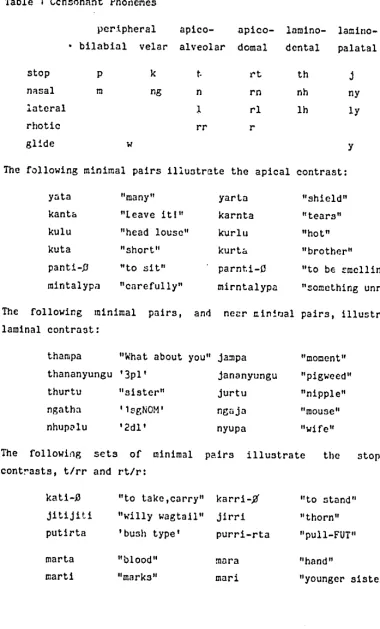
Table 1 Ccnsonant PhoneMes
µer.lpheral apico- apico- lamino- lamino-bilabial velar alveolar domal dental palatal
stop p k t. l't th j
nasal m ng n rn nh ny
lateral 1 rl lh ly
rho tic rr r
glide w y
The following minimal pairs illuntr!?te the apical contrast:
ya ta "many" yarla "shield"
kanta. "Leave it (II karnta 11tears11
kulu "head louse" kurlu "hot" kuta 11short"
kurt.ci "brother"
panti-,0 "to sit" parnti-IJ "to be ~mclling" mintalypa "carefully" mirntalypa "something unre:al"
The following tninimal pairs, and neor 11in!r:ial pairs, illustrate the lamina! contraot:
tharnpa 11What about you" ja:npa
"mocent11
thananyungu '3pl' jananyungu 11pigweed11
thurtu 11sister11 jurtu 11nipple11
ngathn 11sgNOM' ngaja
"mouse"
nhup~lu '2dl' nyupa 11wife"
The followi~g sets of minimal pairs illuotrate the stop/rhotic
cont~asts, t/rr and rt/r:
kati-.0 "to take ,carry" karri-)l" 11to stand"
jitijiti "willy wagtail" jirri 11thorn11
putirta 'bush type' purri-rta "pull-FUT"
mar ta 11blood11 mnra
"hand"
[image:19.513.42.422.88.716.2]-12
yirtiyirti "hanging" yiri "spear point"
Stops are laxly articulated and are generally voiceless and unaspl.rated with a tendency toward voicing in "1Edial position.
The velar consonants arc articulated further back in the mouth thar. is usual for an Austrai.ian language and ro1• some speakers lkl an1 lngl approach [ q] and [ N]. There is al so a tendency for velar consonants to
~e rounded between rounded vowels, or initially preceding the rounded vowel.
As a general characteristic of languages in this part of ~estern
Australia, the apical contrast is often not obvious in free speech. It is often very difficult to distinguish apico-alveolar stops ar.j nasals from apico-domal
apico-dorJals to be high front vowel
stops and nasals. There is a strong tendency for fronted to post-alveolar articulation following the
Iii, and to a slightly lesser extent preceding this
vowel. Further, there is a tendency for the apico-alveolar stops and nasals to be backed to post-alveolar articulation following er preceding the back vowel lul, especially when this vowel is itself in the environment of a preceding or following velar consonant. The fact that velarn are often very bncked suggests some tongue-pull is affecting the
articulation of the consonants. lt is clear in a number of exa~ples that the allophonir variation of apicals has led to the rephonemicization of certain consonants. For example (fo. 6):
1murru-rni
bacV.-HEllCE
>
YnMost of the cases involve apico-alvcolars in the
murrirni behind
>
Pnthe rephoncmicization environment of Iii. It
:nurrini behind
of apico-domalD to
appears that a rule changing retroflex stops and nasals to alveolar stops and nasals has some morphophonemic status ir. YinyJiparnti where i t relates the N- and L- verb conjugations (nee section 3.7.2 below). The same rule operates optionally in PdllY j lma ;rnd thus cannot be called a full morphophonemic rulr. ln l'anyjima lh~ ruk operates nol only for L-conjugalion verbs with stern final Iii, but also for fl-conjugation verbs with stem final
panti-rta sit -FUT
parnti-rta be smelling-FUT
[ pandid/\ ] ([ pandi'l /\ l)
([ P"£1~}d/\ ])
Wordick (1979) notes that in Yinyjiparnti the partial neutralization of the apical contrast is recoEnized as a particular style of speech referred to as "talking light". The status of this speech style and it's sociolinguistic function (if any) is • topic for further research.
The apico-alveolar stop /t/ is generally quite tensely articulated in relation to the other stops (though still lax in comparison with other Australian languages). While the apico-domal stop may occur intervocalically as a retroflex tap, it is not at all common for the apico-alveolar stop to be realized as a tap.
The apico-domal lateral, when following the back vowel /u/ and
precedin~ a vcl~r consonant, is often almost indistinguishable from the rhotic Ir/.
Sequences of lateral plus the bilabial stop /p/ arc characterized by a glottal stop preceding the bilabial stop.
The apico-alveolar rhotic Irr/ is realized as a trill preceding a consonant though never intervocalically. It does not occur in final position. rn the intervocalic position it is often realized as a single tap but perhaps more commonly occurs as an alveolar rhotic continuant. For this reason I treat i t in the same manner class a~• the retroflex rhotic continuant /r/.
There is variation in some words between initial laminal stops. For exampl<:
jartuntarra thartuntarra
Usually, however, when quizzed, the informant would show suprise at the use of the less common variant (for the particular word) and would explain his utterance in terms of interference from ano~hcr language.
-14
yinya-rta ( yinaq,11 ] [ 1na'1f' ] give -FUT
wuntu [ wundu ] [ undu ]
river
2.1.2 Vowels
Tal>le 2: Vowel Phonemes
front back round
high i ,ii u,uu
low a,aa
Panyjima has three short vowels and three long vowels of rare
occurrence. The most common instance of a long vowel is in the 'pa~sive
participle' verb inflection -jangaanu/-rnaanu (sec section 3,7,3 below)
which is C1ost likely borrowed from Yinyjiparnti. In the data collected so far only twenty words with long vow~ls have been found of which only three do not have the long vowel in the initial syllable. The twenty words are listed below.
jaa-ma-l kaarrwanyji-Jl' maatha
ngaa-karta-l paarn-pi-l
paaruma-L
pinpakna-L
thaa-l thaa-karta
thaa-thu-L
thaa-warru
jiiny-ji!ny-ma-l jiirama-l
"to yaw-n"
•to slip (cut of the hand)" "mast.er (Eng) 11
11 tr, buzz (of bees) 11
''to throw down11
"to SEttlc a disagreement"
1'Lo flash rep2atcdly11
11 to send, let go"
"hollow- log"
"to pour"
"carpet snake"
11to make a clicking noisc11
nyiinirri-0 partiikunha pii-karri-ll
juuma-l nguurn-ma-l puulpa thuumaya
"to nir.g"
"Clamina Gorge"
11to make a whistling sound JS
in • ricocheting bullet•
'1to shoe a horse (Eng)"
"to grunt"
"bull (Eng)" "store (Eng)"
Of the twenty words above, five arc borrowings from English. Another ten appear to involve a monosyllabic root. It is also possible that some of the forms are borrowings from Yinyjiparnti, which has undergone drastic lenition resulting in numerous long vowels.
I have found no instances in which the short/long difference distinguishes two words. However, since it is not possible to predict
the occurrence of long vowpls, ~nd since they arc irnportnnt to rules of
stress placement and morphophoner.iic altcrn~tion, I have treatct! r.nem as
phonemes separate from their short \'owel counterparts.
All three short vowels have a range of pronunciations depending on
their consonant environment.
Defore laminal consonants, vowels are characterized by a short high
front vowel off-glide.
There is some tendency toward . nasoil ization of vowels in the
environment of nasals, and Eome ~endcncy towards retroflexion of vowels
in the environment of apico-domal consonant~. IJotice that this is
counter to the tendency, described above, for apico-domals to be fronted in the environment of the vowel /i/. I t appears that there are two contrary tendencies; the first for retroflexion to march throueh a word colouring everything in its path, and th~ second for retroflexion to be largely conditioned by immediate vowel environment. Individual speakers appear to favour one or other tendency and this might be indicative of some dialectal difference (though I h~ve no data on dialect differences as yet). It is still the case, however, that both tendencies can be observed in the speech of any individual.
-16
The rounded vowel /u/ is often fronted befure (and sometimes after/ laminal cor,onants, particul<1•ly /y/, •;ith no loss of rounding. For enmple:
µanu-yu very-A CC
2.2 Phcnotactics
[ panuyil
J
The phonotactics of Panyjirna follow a pattern common among Australfon la"buages. With the exception of a :cw Engi!sh borrowings with initial /a/, no words can have initial vowels. The only consonants permitted in initial position are the non-apical stops ~~~ nasals and the glides. That is:
p k th j m ng nh ny w y
Consonant clusters cannot occur initially, The f1.."'lllowing cons0nants
occur in root final position:
n rn ny l rl ly rr
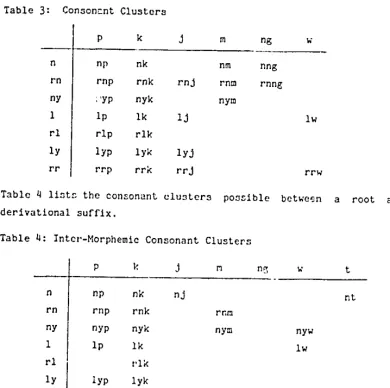
There is a full set of homorganic nasal/stop clusters as followo:
rnp ngk nt rnt nth nyj
Trcre is only one example of a hon .. wganic lateral/stop cluster in the data. This is /lyj/ which occurs in the one word:
tharralyji "bcllbird11
Table 3: Consonc.nt Clusters
p k j m ng
n np nk nm nng
rn rnp rnk rnj rnm rnng
ny : 'YP nyk nym
1 lp lk lj lw
rl rlp rlk
ly lyp lyk lyj
rr rrp rrk rrj rrw
Table 4 list"- the consonunt clu3tcrs possible bctwc';n a root and
a derivational suffix.
Table 4: Inter-Morphemic Consonant Clusters
p k j n n~
"
tn np nk nj nt
rn rnp rnk rr.m
ny nyp nyk nym nyw
1 lp lk lw
rl rlk
ly lyp lyk rr rrp rrk
Panyjima does not permit a consonant cluster bct"een a c.c:: and its final inflection. To avoid in:;tances in "hi ch this "oulc otherwise
occur, a syllable /pa/ is suffixed to the stem creceding the
infltctional suffix. This syllable is also emplo;
.Q prevent
sequences of otcm-final/deri vation-initi al c~ .6vna:it clusters not
permissible by Table lJ, and to prevent co:r.::--.,nant final words. It is common in many pa1·ts of Australia for a syllable /pa/ to be added to words which \JOUld ot~1erwise end in a consonant. It is much less common
for this suffix to be employed to prevent certain inter-morphemic
[image:25.524.58.448.69.457.2] [image:25.524.85.390.300.439.2]-18
2.3 Stress
Stress in Panyjima operates as follows:
1.Primary stress falls on the first long vowel in the word. If there is no long vowel, primary stress falls fn the first syllable 1~ the word. 2. If there is a non-!nitial long \'·:>wel occurring in the word, secondary • stress will fall on the first. syll~ble. I f primary "tress falls on the
,
first syllable then secondary stress will fall on either the penultimate or antcpenultl.,ate syllable depending on the morphological structure of the word.
The placement of primary anti secondary stress un words not having non-initial long vowels can b~ approximated by the follwing rules. Firstly, stress is assigned to the syllables in the ~ord aco:irding to the morphological structure of the word.
a.
b.
CV CV
.I
_cv
CV
~
CVI
CV - CV ·( C may be a cluster)Rule a. states that the first syllable in a word or non-monosyllabic morpheme will be stressed. Rule b. states that where there.is a sequence of three unstres~ed syllables, the middle syllable receives stress.
Secondly, primary stress is assigned to the first stressed syllable in the word, and secondary stress to the last stressed syllable in the word. All other stressed syllables .r~tain som.: slight emphasis which might be called rhythmic stress. Some samplL derivations are given below.
,
.
a. Strc..ss
2. nhantha-lku:pula
a. nh~ntha-lku:pGla
Stress nhanthalkupula J! ,,_
3. nhantha-larta=pula
/
,
/a. nhantha-larta:pula
Stress 1. "' :J..
nhanthalartapula
4.
yur·lu-11arn tura-ku,
/a. yurlu-11arntura-ku
b. yurlu-11arntura-ku , /
,
Stress ' / ~
ylirlu11arnturaku
5. karnalili-pi-lku
a. karnalili-pi-lku
b. k6rnalili-pi-lku
Stress
lc:i
rnalilipilku,
""
6. karnal il i-pi-rnu-la =rru
a. k~rnalili-pi-rnu-la=rru
b. / / ' /
karnalili-p1-rnu-la=rru Stress karnalilipirnularru f. / ,,. ;,
7.
karnalili-pi-rnu-la:layia. karnalili-pi-rnu-la=layi
b. / / ; '
"
karnalil i-pi-rnu-la= layi Stress karnalilipirnulalayi .t. ,, ,, .L
There are a number of exceptions to these rules of stress placement. The exceptions all involve the verbal derivational affix -ma-. For example, we find the word
Ba.
mirli-ma-lnrta _,_,,,
where the rules predict
Also: 9. 10.
idrrara-mi-larta
icl.rrara-m~-lku
uk[rrar~-ma-riirta
*k~rr!;.rt-ma-lku
-20
Notice that not only is -ma- stressed against expectation but other stress doas not occur as expected. Thus we need rules to assign stress to -ma- and to prevent stress on suffixes such as -larta. One possible analysis is to assume that -ma- is inherently stressed. Stress will fall in the right places in Ba, 9, and 10 since stress on -ma- will block the operation of rule b. on 9 and 10. The following rule is then required to erase stress on -larta in Ba, and 9:
c. CV /
->
CVI
CV+_ /However, there is one ::et of counterexamples to this rule. These are cases in which if c. were to operate (after b.), the word would be left with three final unstressed syllables. For example 11 where, by the rules so far constructed, we predict 12.
11 . 12.
> . ,.!,
mirnu-ma-nnguli-nha
1- ,,_
•m~rnu-ma-nngull-nha
Perhaps, then, ~e need a further ruled. which operate~ before o.
d. CV ~ CV/ _+CVCV(+)CVO
Thib i'Ul~ will erase input to c •• The full sequence of rules is then:
/
I
l :]
a. CV ...'.) CV
_cv
b. CV - ) CV
I
CV -·CVI
/_+C~CV
( + )CVOd. CV - ) CV
I
CV
I
,
c. CV
->
cv_
An alternative analysis l.s to have the deriva~ional euffix -ma-attract stress. To start with we can write a rule e. which follows rule
a ..
I
m~CV
/-e. ma CV
->
CV {e
J
(+)CV
This rule copes perfectly well with Ba, 9, and 11 but will not give the
correct form for 10. We a need a further rule f. ordered after b ..
I /
f. CV ma - ) CV ma
The order of the rules will now be:
a. CV -)
cV /
l:)
_cv
/
m~CV
I _
CV! D1
e. ma CV -)
(+)CV
b. CV -)
c6 / cv _ cv
I
CVmh
f. CV ma - )
Stress.
There are just as many rules as in the first formulation but the description is preferable in that we do not need t·.o h3ve -ma-independently stressed in the lexicon. Notice that rule e. collapses rules c. and d. but ~he formulation docs not prevent forms such as 10 from recieving stress by rule b., thus we need the further rule f,,
We can now consider the effects of lC'ng vowels on strczs placement..
Where a long will apply
vowel occurs in the first syllable in the word the rules /
g.
cvv
~cvv
/-22
T.ie rest of the rule sequence wl.ll ; ·;main unchar.ged. Notice that
-ma-will not attract stress from long vowels but by rule f, a sequence of
stress on -ma- followed by long vowel stress is pcssible. For example:
13, karrara-ma-rnaanu 2 /
J-2.~ Morphophonemics
In this section I will discuss the particular morpholo~i,~l processes which produce the VBl'ious allomorphs described in lat•:r sections.
2.~.1 Assimilation Rules
a. Assimilation of lateral/Nasal Clusters
This rule operates to avoid clusters consisting of a lateral followed by a nasal (which are not· attested anywhere in Panyjima). The rule appears to operate in two places though it is not clear whether it should be considered a diachronic or a synchronic rule.
a. 111,crc the anaphoric deri vati '.' ··"' morpheme -1- (see sec ti on 3,5, 1 below) is followed t,y the ablative suffix -nguru.
b. Where the l-conjugatioc marV.cr -1- is followed by a rnc.l"pheme with an initial nasal. For example:
-1-nguli-
->
• nnguli--1-ma - ) -nmaThe rule is simply:
lateral - ) nasal
I
nasalI
some synchronic reality. So~e speakers occaisionally use a different strategy for avoiding the lateral/nasal cluster of the -1-nguli- suffix. Rather than nasali~ing the lateral they transform the nasal into a stop producing -lkuli-. These variants are not very co~mon and though accepted by the spcake:·s who use them, they are often rejected by speakers who always use the more general rule. The existence or the variant form, along with the suprising regularity or the L-conjugation forms with respect to the 0-conjugation forms (see section 3,7,3 below), suggests that the -1- has to some extent been reanalyzed as a productive conjugation marker.
b. Assimilation or the -nha- and -thu- Derivational Affixctl
The two suffixes -nha-, 'proper noun classifier' (see section 3,2.2.1 below), and -thu-, a verbal derivational suffix glossed as 'placement' (see section 3, 7 ,4,4 below), become -na- and -tu-respectively when they follow root final apico-alvcolar stops or nasa•s. The rules ere as follows:
-nha- - } -na-
I
n+_I
-thu-
->
-tu-I
r:t-A rule .:if geminate reduction is then required.
2. 4. 2 Word Length Conditioned Allomorphs
Accusative locative
Instrumental
[
-kuo]
-la -lu
-24
DCV(C}CV_
I
I
The inchootivc verbalizer alno has different forms depending on the length of the root and also on the quality of the root final vowel. There are four forms of the suffix:
-yayi- following disyllabic roots with ·final I i i .
-wayi- following disyllabic roots with final /u/.
-wi- following roots of ruore than two syllables with final vowel /u/.
-yi- ~lsewhere.
I f -yi- is assumed to be the basic form we can write the two rules:
a. -yi- ~ -w.i- / u+_
b. -Ci- ~ -Cayi- / UCV(C}C
v
+_[+high]
c. -Cayi- -> -Ci-
I
rncvca
i
DCV(C)CV(C)CV_)
d. y ~ w
I
U+This pair of rules mighl seema little more plausible in that they delete a syllable rather than adding a syllable, however, they are a little more complex than a. and b •• The optional environment is essentially two rules and is thus more complex than rule b ••
2.4.3 ~asal Dissimilation
The locative and instrumental suffixes -ngka and -ngku become -ka and -ku respectively when they follow another nasal/stop cluster. The
~lltics ;mpa and ;nta do not dissimilate in this environment. This suggest3 that rather than a general rule of nasal dissiruilation for nasal/stop clusters, we need a rule operating only for the velar cluste1·.
[
nasol ]
peripheral
velar
-) %
I
[nasal] [stop][
stop
l
V+ _ peripheral! velar _j
There is some evidence that in Yiny,jiparnti the clitic o·mpa also dissimilates (Wordick 1979). The change to the rule above 1<ould simply involve removing the [velar] feature specification.
-26
2.4.4 Accusative Blocking
A rule is required to prevent the accusative case suffix occurring in certain morphologlcally conditioned environcents. Firstly, the -ku accusative case suffix ~annot follow the accusative suffixes -ku and -yu or the instrui;ental suffixes -ku, -ngku and -lu in ~ub-ordinate clauses. Also the accusative case suffix docs not follow the 'accusative' allomorph of the 'proper noun classifier' (sec section 3. 2. 2. 1 below).
Further, the -ku suffix cannot follow the µ-conjugation participial relative nlause marker, -jangu. It is difficult to sec hew a phonologically conditioned rule could be construoted to avoid the occurrence of -ku in these cases. The best description is probably just
the statement of non-occurrence.
2.4.5 Reduction of the Reciprocal Dcrivational Suffix
The reciprocal derivational suffix -nmayi- is reduced to -yi-following the -ma- causative dcrivation2l "uffix. A rule CM be "ritten as follows:
3,MOHPHOLOGY
The sections below outline the basic morphology of the Panyjima language. To the extent that it is impossible to consider certain morphological processes independently of thc"r syntactic and semantic functions, these are discussed in the appro?riate sections. These
thu~bnail sketches are by no means intended as the last word on Panyjima syntax and semantics. The appendix attempts to tie up the loose ends left by the discussions of the syntax of passive, and imperative and hortative verbs but it too should not be considered a complete analysis. The description of verb morphology, esp,,cially derivational morphology,
the basis
asoumes to a large extent that verbs can be cf their transitivity value. As discusse1\
categorized on in section 3. 7 .1 below, this is a simplification. It appears thnt such a categorization is not only difficult to establish but also docs no•; appear to affect the morphological and syntactic processes of the language to any great degree. For the present purpose of.describing the basic morphology of
the language, the categoriznti~n of verbs on the ba~i~ of trans1tlvity
is retained.
3,1 Parts of Speech
1he following parts of speech are recognised in this thesis:
Nominal•: consiJ.ing of nouns and adjectives. \ihile these may be distinguithed semantically, they cannot bo
distin~uished on morphological or syntactic grounds. Subclasses:
1, a claes of human and kinterms which along with proper nouns take ce1•tain derivational suffixes.
2. a class of dual kinterms Jefincd semantically and on the basis of their plural inflection.
Pronouns: a closed class of items distinguishing singular, dual, and plural number, and three persons. An
non-singular pronouns also code various kin
relationships between the speaker and addressee(s), and t:1mong the addr·essees thcmne:l ves.
-28
Uemo'lstratives: a closed class of iteaw which occur adnomil1ally and indinate the distancr. of the noun phrase referent with respect to the speaker and the addressee.
·\'erbs:
Special forms of these demonstratives operate
anaphorically. That is, they make back reference to a previously mentioned unique referent.
these fall into two conjugations and take a set of verb final inflections.
Particles: a set of uninflectec items whose semantic domain i3 the whole clause,
As well as these parts of speech there ere bound enclitics, so~e of
which may attoch to any part of speech, and some restricted to verb words. These are discussed in section 3.8 below.
3.2 Nominal Morphology
No~inalo arc inflected for case in accordance with their semantic role and syntactic function in the clause. All nominal constituants of the noun phrase, with the exceptions noted in section 2.4.4 above, are inflected for case. Stem-forming affixes may occur between the nominal root and the case inflection. These are discussed in section 3.2.2
below.
3.2.1 Csse lnflections
Case marking in Panyjima is entirely n0minative/accusative, however there are ghost" of a previous split ergative case marking system. In all instances, as a result of the morpho-phonotactic constraints discussed in section 2.2 above, the st~ms to which tt. ! case inflections
are added are vowel final.
---·-Nominative:
-¢
The uninflected form of the stern is used to mark the "agent" or
"experiencer11
of act! ve verbs, and 11goal 11 /"recipient" or "patient" of
passive verbs or of ·1erbs in imperative or hortative mood (see sections 3.7.3, 3.7.4.9, and Appendix 1).
Accusative -yu following disyllabi~ stems
-ku elsewhere
Accusative marks both patier.t and goal/recipient argm>:mts of the
verb. Thus Panyjima makes no morphological distinction between "direct" and "indirect" objects of the verb. The functions of the accusative
case inflection arc discussed in r.ore detail in sectiono 3.7.1, 3.7.4.6, and Appendix 1, Soce simple examples are given below.
14, ngunha-JJ mirlima-lKu kurtanypa-ku.
15,
Instrumental
that-NOi-i sp"ar -PRS bag -ACC
"lle':J spearing a bog.11
ngatha mirta mnna-nh;1
1sg!lOM not get -PST
"I didn't Get any fioh."
ngunha-):i that-!lOM
mirta not
ngaju 1sgACC
kapi-yu.
fish-ACC
kuliya-lku, hear -PRS
mirra -ku ngunha-yu marlpa-yu. sing out-PRS that -ACC man -ACC
.. ~gatha
11
Hc doesn't hear me, I'll sing out tc. . .:.t man."
-ngku follow;.n/J a disyllabic stem
->
-ku where there is a medialnasal/stop cluster.
-lll C 1 !'.lCWtlCl'C
---~----30
The suffix is the old ergatiVP/instrumcntal case marker. In the modern language it marks the &gent or instrument of a verb marked as passive. In addition it :narks Inalienably possessed instruments. Examples 17,
18, 19 and 20 illustrate the use of instrumental with passive verb~. Examples 19 and 20 show different ways of marking the instru:ncnt of the aotion. In 20 the NP is marked with both the Having derivational affix {which is uLJed to mark alienable instruments of active verbs), and the instrumental inflection. By contrast, tht instrument NP in 19 has only the instrumental inflection. If an agent were to appear in 19 the
instrument {if alienable) would have to be marked with the Having affix. Where no agent appears the Having affix need not occur. "'h•"C is some semantic difference between 3cntenccn 19 and 20 a.'.'J : i of the different marking of the instrument though at present it le ~ot clear
exactly what the difference is. The glosses sugg, t that 19 is very like certain English agentless passives.
17.
16.
neatha
lsgNOM
wirnta-nnguli-nhn mnrnta-ku.
cut -PASS -PST stone-INST
''l got cut by a 3~0ne."
ngatha=rla
lsgllOM:FORE
nhantha-rnaant.. warlu-ngku.
bite -PAS~PART snake-INST
''I got bittEn by a snake.11
19. nyiya-!l parnnga-!l ngarra-rnaanu kaju-ngku. this-NOM Jark-l10M chop-PASSPART axe -INST
20.
"This bark was chopped with an axe."
panha-P' yukurru-P kutur.ia-rr.nanu tha t-NOM dog-NOM ki 11-PASSPART
warrkunti-ngarni-lu. boomerang-HAVE-INST
11That dog was killed, ;.iy someone, with a booroerang.11
the instruillental on two nominals which arc semantically closest to
ndje~tives. Though such examples are rare they are well represented in the corpus.
21.
22.
tocati·1e
thala-nma jina-ngku kick -IMP foot-INST
jampurrka-lu.
left one< tlST
"Kick i t •ith your left foot."
mirta paarnpi -larta, panha-P ngurrinypa-.0 not throw down-FUT that-!lOM swag -NOH
yinti -thu -nma
go down-PLACE-IMP
nyarni-ngku. slow -INST
"Don't throw i t down! Lower that swag down slowly, (with slowness)."
ngalikuru wirrpi-yu pathe.-larta ngulanng~1ru-!<u lplNOM wind -ACC blow -FUT there AnABL-ACC
palkapalka-nguru-ku kumpa-rta. panu:mpa! southwind -ABL -ACC wait -FU'f very,EMP
patha-lku kurilarni cirnu-n3ku wayayi-rta-ku blo11 -PRS here from the south know-IllST finish-FUT-ACC
warlpawarlpara-ku. cyclone -ACC
"lie wait for the wind to blow from there, from the south. Okay! with it blowing rro:n the south we know that the cyclone is fiuished."
-ngka follm:ing disyllabic stems
-7 -ka wher~ there is a medial nasal/~top cluater.
-32
This marks location ir. space or time, and also marks some comitatives. Locative also occurs on a very few nominals where it means something like "to be involved in a controlled stative event associated with N". Speakers differ in their intuitions a~ to the acceptability of certain of these sentences: For example, sentence 24a appears to be acc.eptable only for people ><i.,I! sp.end a lot of time fishing, for whom fishing is a pastime as much as a food gathering activity. Non-fishermen correct 24a
to 24b.
24a ngaliyakuru yana-ku kapi-ngka. 1pl(exc)NOM go -PRS fish-LOG
11We're going fishing."
24b ngaliyakuru yana-ku kapi-yu mana-rta. 1pl(exc)NOM go -PRS fish-lCC gtt -FU!
"We're going to get fish."
25. ngaliyn yana-nha wiya-larta ngunha-kut~·a-ku
Ablative
1dl(exc)NOM go -PST see -FUT that -DUAL-ACC
"arlpa-kutha-ku wangka-ka-ku. mon -DUAL-ACC word-LOC-ACC
"\;c went to see those two men talking •11
-nguru
This marks movement away from some point in space or time, and the source from which an artefact is manufactured (sec example 30 below). Notice that in exami;les 27 and 28 the ablati\·J suffix is added to a stem already marked with the locative ouffix. This is the uoual pattern in a number of Australian languages, for example Ngarluma (Simpson 19&0) and
Pitjantjatjara (Glass and Hackct 19'10).
example 28 (below) the NP panha-ngka-nguru-ku "stands in for" the head noun (accusative NP papa-yu in the previous clause). This replacement of the head noun with a location qualifying noun or noun phrase is very
common in Panyjima text. Another example is yurlu-ngka-ngarli in 56 (below). In this latter example the locative suffix is followed by the derivational suffix -ngarti-. As is often the case in Au~tralian
languages, it is very diffi~ult to strictly categorize suffixes as derivational or inflectional.
26. ngunha-)J marlpa-.0 paka-lku yurlu-nguru. that-NOM man -NOM come-PRS camp -ABL
"That man is coming from the camp."
karnta-.P yin ti -ku thurlu-ngka-nguru. tear-NOM go down-ACC eye -L QC -AliL
"TEars falling from their <-yes."
28. nyiya-Jl=rla yanti-0 pili-ngarni-¢, mirta=rru warli-lku this-NOM:FORE dish-NOM hole-HAVE-NOM not :NOW hold -PRS
29.
papa-yu=rla. ngatha wiya-lku panha-ngka-nguru-ku water-ACC:FORE 1sgNOM see -PRS that -l OC -ABL -ACC
panu:warlaru panha-j'l yanti-0 pili-.. garni-P.
very:INTENS th!.!t.--f.t)M dish-NOM hole-HAVE-llOM
"This dish has got a hole, it. won't hold water. I can see (what has come out) from in it (th~ dish). For sure, this dish han got a hole in it."
jilyantharri-¢ children -NOM
panti-lha mirlimirli-ku sit -PERF paper -ACC
karta-lku poke -PRS
warrungkamu-nguru=mu,
r:iornl.ng -ABL:THEN
pir.~i -yayi-nha=rru afterooon-INCH-PST:NOW
karl.inypa-yi-ku=rru return-INCH-PRS:NOW
panha-jirri-~=rru
that-Pl URAl-llOM:NO'rl
witi-ma -yi -ku yurlu-ngka-warntura-~=rru.
play-CAUS-INCH-PRS camp -lOC -EACH -NOM=NOW
"'fhe kids ha\•'! beer. sitting writing on the paper since this morning. Now that it's become afternoon, they're all coming back now. And now the kids in each camp are playing with one another."
30. nyiya-¢ kurrjarta-C warama-rnaanu wirntamarra-nguru.
Allative
this-NOM spear -NOM make-PASSPART mulga -ABl
"This spear is made out of muiga wood. 11
(direct) (indirect)
-karta -wali
-34
l'here are two suffixes in Panyjirna which can be described as
allatives. The first, -karta, mnrks motion to some point, the inference
being that tho point is eventually reached. The second, -wali, marks motion towards some point, th~re being no inference that the point will ever be reached.
In every•Jay speech the -wali allative is the most often used. The -wali allal.ive is used in questions such as in 32 (below) where use of the direct allative would be considered very prying. -wa~i also occurs as a polite locative in Paathupat.hu (th~ avoidance language) and appears frozen in the forms of a number of Paathupathu demonstratives. Examples 31 and 32 illustrate the use of -wali, and 33 and 34 the use of -karta.
31. winya-ma-lalha=layi, minaja-lart~ ngaju=rru, ngaliya full-CAUS-PERf:TAS pick up-r'U'f 1sgACC=llOW 1dl(cxc)NOH
"Once he's filled up, he'll pick me up and we'll go off to
Carna:'von."
32. tharni-wali nyinta yana-ku=rru? where -ALL 2sgNOM go -PRS:llOW
33,
11\-.Ttiere are you going'?"
ngatha 1sgNOM
nyinku 2sgACC
kati-rta take-FUT
maparnpa-ngarni-ku. magic -HAVE -ACC
mama-ngu-karta
Fa -f~C-ALL
"I'll take you to your uncle, (he's) a doctor."
34. ngajupantharri yana-rta ngunha-karta malu-karta 1pl (avoid )tlOM go -FUT that -ALL shade-ALL
kur.purlu -karta. shade tree-ALL
"We'll go over to that shady tree."
Both -wali and -karta are "scd to mark certain purposive notions. For example, consider 35 below.
35, ngali, mayali,
1dl(inc)NOM Soso
yana-rta go -FUT
"We' 11 go for honey, grandson. n
jantaru-wali. honey -All
This is quite compatible with the allativc sense of the morpheme. To go
1 for' something one must presumably go towards i t and, or course, i t
need never be 3ctually attained. The use of the indirect allative seems appropriate. Examples 36 and 37 illustrate the use of -karta with a
36.
37,
ngananha-karta what -ALL
nyinta yana-nha=rla? 2sgNOM go -PST=FORE
"What are you going for?"
ngananha-karta what -ALL
nyinta paka-rna, 2ssNOM come-PST
11What did ycu come for, kid?"
jilya? child
-36
I have only found -karta used with a purposive sense when attached. to the interrogative/indefinite ngananha. In sentences such as those above the speaker assumes the addressee has arrived with a particular purpose in mind and thus the use of the direct allative seems appropri~te.
Behind -puru
This locative marks a NP, behind the referent of which something is shielded from perception. The suffix is probably cognate with a suffix -puru occurring in Pintupi which Hansen and Hannen ( 1975) call "obscured by". Some Panyjima examples are:
25. ngunha-,d marlpa-,o' karri-ku that-NOM ~an -NOM stand-PRS
mungku -puru. ant hi 11-BEH "That man is standing be~ind an ant hill."
26. ngaliya mirta kuliya-lku ngarlarla-puru. 1dl(incl!IOM not hear -PRS noise -BEH "We cnn 1 t hear for the noise."
Example 40 is slightly different.
40. parlkanu-puru=layi clouds -BEil :TAS
yarta-ngarni-P=mu rnany-llAVE-NOM=TH~N
mantu-ngarni-li. mea t-llA VE-llOM
Genitive -tharntu
43
This morpheme marks alienable possession and shows the genitive inflection added to
benefactive. Example the genitive form of a
pronoun. The expression 11yinimarnaanu kamparnaanu" is !lPi>-:ire.r;"ly a fixed
idiom.
41.
42.
43.
Cause
ngi'nha-0 milyula-rna that-NOM steal -PST
ngananha-ku walypala-tharntu-ku. something-ACC whiteman-GEll -ACC
"He stole something of the whitefella's."
thanarta=rru when :NOW
ngatha 1 sgllOM
raana-rta=rla mantu-yu:rla
get -FUT=FORE meat-ACC:FORE
j ilyantharri-t!>arr. tu-ku?
children -GEN -ACC
"!low when am I going to get meat for thoee kids?"
ngatharntu-tharntu mimi-tharntu nyiya jilya. child
1sgGEN -GEN Mo Bro-GEN this
ngaliya 1 dl( exc) NOM
panti-ku sit -PRS
yini-ma -rnaanu kampa-rnaanu. name-CAUS-PASSPART burn -PASSPART
"This kid is m:r cousin brothers
uncle's child. The
...._
(cross cousins) , 11
-mari
two of us arc
This marks the, typl.caliy inanimate, cause of the state experienced by the nominative marked NP in the clause. The only exceptions I have found to the requirement that the cause be inanimate are examples such as 46 below.
·11I'm crook from the grog."
ngatha 1sgNOM
winya-P=rru mantu-mari. full-NOM:NOW meat-er.us
"I'm full of meat.11
46. ngatha ngunha-ngktJ yawarta-lu thala-nnguli-nha. 1sgNOM that -INST horse-INST kick -PASS -PST
ngunha-mari yawarta-mari that -CAUS horse -CAUS
thala-nnguli-lha. kick -PASS -PERF
"I got kicked by a horse. I got a kick fror.1 a horse." -38
Example 46 is particularly interesting. Notice that in the second clause the agent is marked with the -mari suffix rather than with the usual instrur.iental suffix. At present I have no convincing explanation for
this. It appears that when the agent.is marked with -mari the control of the agent over the event is seen as diminished. To some extent the action is unintentional. This would certainly fit the more widespread use of -mari to mark inanimate cauoe.
Indirect Cause -ngarai.;.a
This suffix marks a NP as the indirect cause or reason for the actions of the agent. The suffix is clearly cognate with the Yinyjiparnti indirect causal suffix -ngaala. In fact, articulation of the Panyjima suffix is often very like that of the Yinyjiparnti suffix. The sequence Iara/ is often heard a~ a double articulated vowel and sometimes as a long vowel /aa/. However, this long vowel never attracts primary stress. Two examples of the use of the -ngarala suffix are
given below.
47. pa"'.har·ra-kutha-JJ pir.yarri-ku palya-ng&ralr.. jealous -DUAL-NOH flght-PRS womnn-INCAUS
48. ngananha-ngarala=mpa:rra something-I!ICAUS~EMP:DUB
nhangu-yu here -ACC
panti-jangu alt -REL
paja-yi -ku ngalikuruku wild-INCH-PRS 1pl(inc)ACC
yurlu-ngka-ku. camp -LOC-ACC
"He' a wild with ua sitting here in camp over something, (I don• t know what) • "
3.2.2 Nominal Derivational Suffixes
A number of suffixes can occur between the nominal root and its finDl inflection. In this section I will
suffixes which involve no change in
describe these derivational the syntactic function of the nominal root. That is, these suffixes attach to nominals and produce
nominals. Verbalizing processes will be discussed undee the heading of verbal derivational processes.
There appear to be no productive processes derh ing nominals from verb stems in Panyjima, though future work may well r~veal that such processes existed in an earlier stage of the language. To a large extent, the quite versatile syntax of the language, including a number of participial construct~ons, shoulders the burden of function carried by nominalization in other languages.
3.2.2.1 Proper Noun Classifiers
(Nominative)
-nha-~ -na- following an alveolar nasal
(Accusative)
-ngu-These two suffixes are added to proper names when theso are in
nominative or accusative case frames.