Abstract
Prom the "beginning in the welfare use of national income estimates, national income and expenditure accounts have increasingly come to "be used as an aid to the study of past performance of the economy, short-term economic analysis and forecasting, and long-term economic planning and policy formulation.
The introduction into underdeveloped countries of simple national income estimation or more complicated nat ional accounting technique has met with a number of concep tual and statistical difficulties.
The first conceptual problem is concerned with the meaningfulness of the national income concept in primitive areas where the mobility of conmodities and factors of prod uction is limited, resulting in an imperfect national price system. It can be argued, however, that this imperfection is a matter of degree and does not in most underdeveloped countries invalidate the task of estimating national income.
mainly "by the availability of data. The question of imput ation is a complex one and involves such problems as the propriety of using any market price at all for valuing non- marketed output, and the choice of the appropriate market
price to use.
It has also been contended that Keynesian conceptual distinctions between production, consumption, saving, and
investment do not apply to non-specialised agricultural econ omies. The main answer to this argument is that the validity of conventional concepts depends largely on the extent and effectiveness of the linkage between the monetary sector and the (partly) subsistence sector in each underdeveloped economy.
Statistical problems of national accounting in under developed countries centre on the scarcity of reliable basic data and the shortage of skilled statisticians and national accountants. Some difficulties in obtaining reliable data seem also to be inherent in the nature of underdevelopment itself.
The spread of national accounting practice in under developed areas is due mainly to the efforts of U.N. and a few other international agencies. The usefulness of national accounts in these areas is impaired by the imperfection of estimates available.
the qualification that an integrated national accounts system is always worth aiming at, if only to provide a useful gen eral background for economic analysis and forecasting.
Further, some form of disaggregation of the system seems to he required for purposes of hoth short and long-term planning.
The cost of a national accounts project depends on how much is to he done, which in turn depends on the avail
ability of data and the need for national accounts statistics in the country concerned.
In Thailand, the place of the National Income Office in the government hierarchy is such that its successful operation is dependent upon its ability to maintain a close working relationship, not only among its own three divisions, hut also with other government departments, particular the National Statistical Office.
The work of NIO is at present concentrated on the estim ation, in some details, of gross domestic product, private and government consumption expenditure, and gross domestic capital formation. No attempt has been made to prepare an
integrated national accounts system on a regular basis
reveals a serious weakness in statistics concerning the manufacturing, wholesale and retail trade, and services
sectors. A few other industries e. g. construction, private transport, and fishery also need more reliable benchmark data.
Evidences indicate that the official estimate of gross domestic fixed capital formation is probably overvalued and that of gross domestic product is undervalued, resulting in a high investment ratio. It is also likely that private consumption expenditure is underestimated.
NIO has regularly accompanied its publication of national accounts estimates by an analysis of past performance of the economy. Projections of gross domestic product and capital formation are also made by the National Economic Development Board as part of the six-year economic development plan.
Owing to the fragmentary nature of estimates available, however, these analyses and projections cannot give an inte grated picture of the structure of the economy and its oper ations.
It is considered that at least for two main reasons it is desirable for Thailand to possess a more disaggregative form of national accounts than that presented by the U.N. standard system. The first reason is the increasing import ance and complexity of the secondary and tertiary Sectors which indicate the growing need, for purposes of short-term
the government's long-term development planning.
A sectoral-cum-national accounts system is therefore proposed as a long-term project for Thailand, taking into account the availability of data and the need for national accounts statistics in the country. The proposed system
is then illustrated with a set of figures based as far as possible on actual data. The aim of the illustration is twofold, namely to demonstrate the feasibility of the system and to indicate the extent to which it can be drawn up from data currently available. The illustration appears to con firm the feasibility of the system although limitations of data in certain fields seem to rule out any attempt, at least in the near future, to disaggregate the production sector thoroughly.
An examination of recent budgets of the Thai Government and the National Statistical Office, together with the exist
ing NSO Ten Year Statistical Improvement Programme, suggests that additional costs of statistical enquiries required to fill in the major gaps in information are well within the financial capability of the government.
At some future time when more data are forthcoming to complete the full system proposed, the matrix form of
presentation will be more preferable to the accounting form and will also facilitate analysis with the aid of the
NATIONAL ACCOUNTING IN UNDERDEVELOPED COUNTRIES WITH SPECIAL REFERENCE TO THAILAND
Uy
Prot Panitpakdi
Thesis submitted for the degree of Doctor of Philosophy in the Australian National University.
Acknowl edgements
I wish to record my thanks to the Australian Government for awarding me a Colombo Plan Fellowship, and to the Thai Government, particularly the National Economic Development Board, for giving me a leave of absence with pay. Both
sources of finance enabled me to carry out this study.
During my field work in Thailand, I was greatly indebted to many individuals in various government departments who kindly gave their time to answering my questions, supplied me w ith necessary information, some of which is confidential,
and permitted me to collect data from official records under
their control. These individuals, without whose co-operation
this study would have b e e n based on a less satisfactory stat istical basis, are too numerous for me to mention all by
names. However, I wish in particular to thank H.E. Mr.
Bunchana Attakor, Deputy Minister for National Development, Dr. Bundhit Kantabutra, Secretary General of the National Statistical Office, Mr. Prayad Buranasiri and Dr. Talerng Thamrongnavaswasdi, respectively Secretary General and Deputy Secretary General of the National Economic Development Board, Dr. Puey Ungpakorn, Governor of the Bank of Thailand, and Mrs, Suparb Yossuntorn, Head of the Department of Economic Research, Bank of Thailand.
I am very grateful to Professor H.W. Arndt who has sup
ervised m y work. He has given me many invaluable constructive
criticisms and suggestions which enabled me to improve my
staff of the Research Schools of Pacific Studies and Social Science, Australian National University, have also been very helpful, Various discussions with Dr. W.M. Corden, Mr. E.K. Fisk, Professor T.H, Silcock, Mr. H.P. Brown, and Mr. B.D. Haig have given me useful guidance on some aspects of the work. Mr. H.P. Brown has also generously allowed me access
to his rich and varied collection of national income liter ature. Thanks are also due to Mr. I. Sakura of the Research and Planning Division, ECAFE, Mr. Peter Gajewski, National Accounts Adviser to the Thai Government, Professor William
i Cont ents
Chapter Page
Part I I National Accounting in General
1.1 The Terminology 1
1.2 The Origin of National Accounting 3 1.3 Various Systems of National Accounts 5 1.4 General Purposes of National Account
ing 8
1.5 Shortcomings of National Accounting 11 1.6 Related Systems of Economic Accounts 13
1.7 The Scope of the Thesis 15
II National Accounting Problems in Underdeveloped Countries - Concepts and Statistics
2.1 The Nature of the Problems 22
2.2 The Meaning of the National Income
Concept in Backward Areas 23
2.3 Subsistence Production and the Boundary
of National Output 29
2.4 Subsistence Production and Imputation 36 2.5 Various Concepts of National Income 47 2.6 The Validity of National Accounting
Concepts in Underdeveloped Areas 50 2.7 National Accounts Statistics 56
Chapter Page III The Uses of National Accounts in Underdevel
oped Countries
3.1 The Preparation of National Accounts
in Underdeveloped Countries 73
3.2 Purposes of National Accounting in
Underdeveloped Countries 77
3.3 Practical Uses of National Accounts in
Underdeveloped Countries 83
3.4 The Priority of National Accounts
Project in Underdeveloped Countries 112
Part II IV National Accounting in Thailand
4.1 Principal Characteristics of the Thai
Economy 117
4.2 The Organisation of National Accounts
Work in Thailand 123
4.3 The Structure of the National Accounts
System in Thailand 128
4.4 Methods of Estimation and Sources of
Data in Thailand 133
4.5 Uses of National Accounts Statistics
in Thailand 175
V A Proposed System of National Accounts for Thailand
iii
Chapter Page
VI Availability of Data for and Costs of the Proposed System of National Accounts
6.1 Production Account of Agriculture Sector 204 6.2 Production Account of Non-Agriculture
Sector 218
6.3 Production Account of Finance Sector 226 6.4 The Table of Resources and Uses 229
6.5 The Capital Formation Account 230
6.6 Accounts of the Final Use Sectors 232
6.7 The Flow of Funds Table 236
6.8 Costs of National Accounts 239
6.9 Concluding Observations 245
Bibliography
List of Tables
Table Page
I Availability of National Accounts in Some Coun
tries, 1961-64 75(aJ
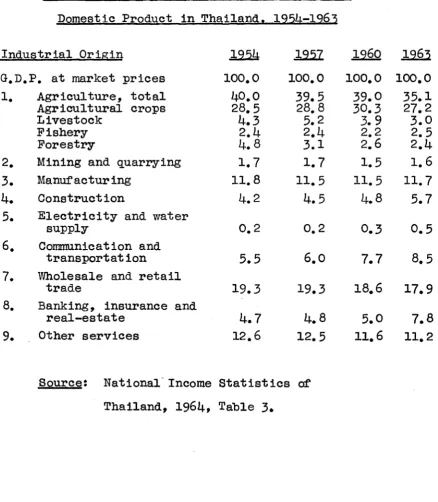
II Percentage Distribution of Gross Domestic Product
in Thailand, 1954-63 117(a]
III Percentage Distribution of Employed Population in
Thailand, Aged 11-r, I960 117(b]
IV Thailand’s Major Exports, 1957, I960, and 19 6 3 118(a]
V Output of Ma3or Crops in Thailand, 1957,1960 and
1963 H8(b;
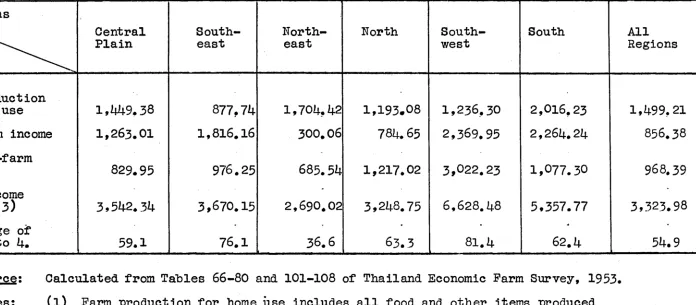
VI Composition of Farm Income in Thailand, 1953 119(a]
VII Average Monthly Family Income and Expenditures in
Thailand, 1962 1 2 0U;
VIII Thai Government Revenue and Expenditure, 1959,
1 9 6 1, and 1963 12l( a'
IX Thailand's Balance of Payments, 1959, 1961, and
List of Tables Table
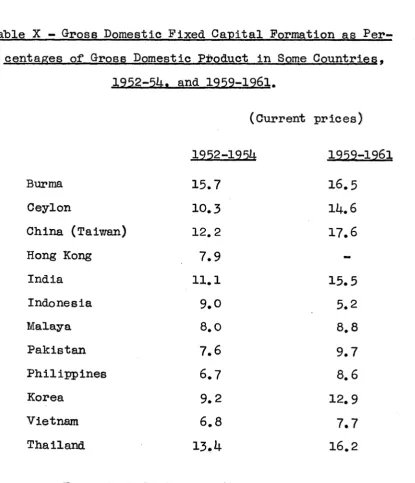
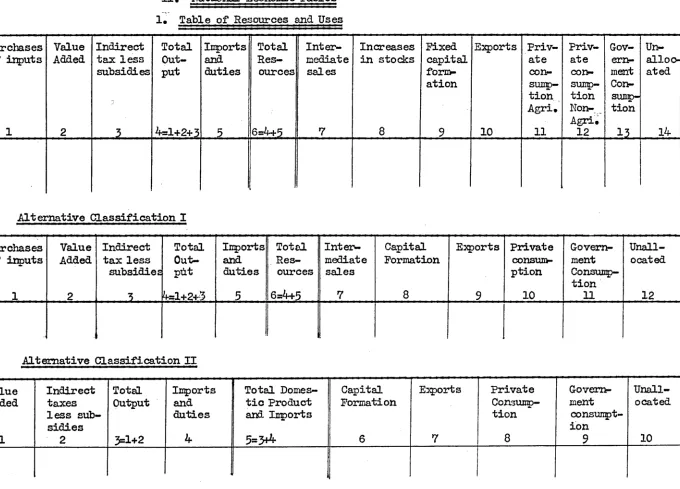
X Gross Domestic Fixed Capital Formation as Percentages of Gross Domestic Product in Some Countries, 1952-54 and 1959-1961. XI An Aggregative National Accounting Matrix XII Budgets of the National Statistical Office,
1962-65.
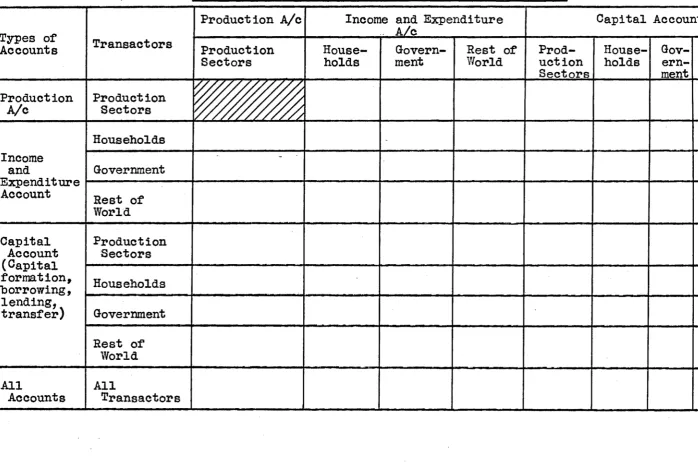
XIII NSO Ten-Year Statistical Programme, 1966-75.
Page
"There is a place for the sceptic who doubts
whether the national accounts can be used for any useful tasks. There is room for the fanatic who by guessing -fills up all the empty ’boxes1 and uses them as well for a variety of purposes".
Ingvar Ohlsson
1
CHAPTER ONE - NATIONAL ACCOUNTING IN GENERAL I. 1 The Terminology
The subject matter of this thesis has been variously described as social accounting, national income (and expen diture) accounting, and national accounting. All these names connote the accounting approach to national income and
I
expenditure studies. Social accounting is perhaps the older name and seems to have been first used in 1942 by Professor J. R. Hicks. ■** It is also used by the United Nations in its first publication on the subject in 1947, a project which it
2
inherited from the League of Nations. When the U.S. Department of Commerce brought out in 1948 a new national
income series in the form of a system of accounts, it was given the name of national income accounting,*^ a name which is still commonly used in many countries. However, when the Organisation for European Economic Co-operation (O.E.E.C.) set up in the stunner of 1949 a research unit to work in this field, the title of National Accounts Research Unit was used.
1. See J.R. Hicks - The Social Framework, An Introduction to Economics, Oxford University Press, first published in 1942, pp. 192-195.
2. Measurement of National Income and the Construction
of Social Accounts - Studies and Reports on Statistical Methods No. 7, U.N. Geneva, 1947.
Under the direction of Mr., now Professor, Richard Stone, the Unit published in 1951 a booklet called "A Simplified System
of National Accounts, designed for use by O.E.E.C. member countries. ^ The name ’national accounts’ or ’national accoun ting’ gained further recognition in 1953 when the U.N. adopted
it in the first edition of A System of National Accounts and Supporting
Tables-It would appear that ’national account* is used in the above publications as a kind of shorthand for ’national income and expenditure accounts’. Properly speaking, the term
’national accounts* or ’national economic accounts* refers to all macroeconomic studies which take the form of inte grated accounts, namely input-output, flow of funds and
national balance sheet. The U.N. use of the term seems approp riate because it is intended to expand the system to include flow of funds and input-output tables, in the first instance,
£
and national balance sheets as a longer term objective.
Following U.N. and international usage and also for the sake of brevity, the term ’national accounting’ will be used
4. A Simplified System of National Accounts - National Accounts Research Unit, O.E.E.C., Paris, 1951.
5. A System of National Accounts and Supporting Tables (SNA) - Studies in Methods No. 2, ST/STAT/Ser. F./No. 2, U.N., New York, 1953*
3
throughout this thesis except where the context requires the use of the full name of ’national income and expenditure account ingf .
1.2 The Origin of National Accounting
The analysis of economic structure using national income and expenditure aggregates is not a new technique* Indeed, it has been traced hack to 1696 when Gregory King compiled estimates of national income of England and Wales*^ Some sixty years later, the French economist Quesnay construc ted his Tableau Eeonoraique which Showed the flows of funds and products between various sectors of the economy in the form of interrelated accounts. It was also said that during the French revolution, the famous scientist L a w i s i e r
advocated the preparation of national accounts to serve as o
’a thermometer of public prosperity**
By the beginning of the twentieth century, the com pilation and publication of national income estimates became
Q
practically universal in Europe and America. However, nat ional accounting in its present form, namely the division of the economy into a number of sectors each with a set of
accounts and transactions arranged under the double-entry 7. Measurement of National Income and the Construction of
Social Accounts, op. cit. , p.26.
8. Harold C# Edey and Alan T. Peacock - National Income and Social Accounting, Hutchinson’s University Library,
London, 1954, p. vii of Preface.
Paul Studenski - The Income of Nations, Washington Square New York University Press, 1958, p. 142,
principle, is barely thirty years old. An early recognition of the accounting approach to national income studies was
contained in a 1935 article by Professor M.A. Copeland.'1'0 The publication in 1936 of Keynesian economic theory supplied the basic equations for a system of national accounts, namely Y = C + I = C + S , and I = S, where Y is national income or
product, C is consumption, I is investment, and S is saving. The earliest form of national accounting consisted mainly of the presentation of the threefold aspect of national income, namely as income produced, income received, and income
expended, either in the form of the familiar flow diagram or of parallel columns.^
The advent of the Second World War gave a strong
impetus to national accounting study in the Ü.K. Following the publication by Keynes of a pamphlet entitled How to Pav for the W a r , in which he outlined the criteria for determin
ing the diversion of national resources from private consump tion and investment to government war expenditure, the British Government invited Mr. James Meade and Mr. Richard Stone, as they were then, to conduct a national income study for this purpose. The technique of double-entry national accounting
10. M.A. Copeland - National Wealth and Income. An Inter
pretation, Journal of the American Statistical Assoc iation, Vol. XXX, No. 190,1935,
pp
.
377-386.5
12 was jointly devised and published "by them in 1941.
Subsequent development of national accounting was closely associated with Professor Richard Stone who, as chairman of the Sub-Committee of Statistical Experts of the League of Nations which produced the 1947 report referred to
above, wrote an important 90 page appendix to the report
which gave an excellent exposition of the subject of national accounting. He was also Director of the 0*E*E*C* National Accounts Research Unit which produced A Simplified System of National Accounts in 1951, and chairman of the U*N. group of
experts which were responsible for the 1953 edition of A System of National Accounts and Supporting Tables, More recently, he has been in charge of the Cambridge Growth
Project, the aim of röiich is to study quantitatively the pres ent structure and future prospects of the British economy, using a computable model of social accounting matrix*
1.3 Various Systems of National Accounts
There are at present four main systems of national accounts that are used by important groups of countries in the world, namely
(l) The Standard U.N* System
J*E* Meade and Richard Stone - The Construction of Tables of National Income, Expenditure, Savings, and Investment, The Economic Journal, Vol. 51, June- September 1941, pp. 216-233*
(2) The O.E.E.C. System (
3
) The French System (4) The Soviet System.The standard U.N. system is, of course, expounded in the publications of the U.N. Statistical Office, particularly "A System of National Accounts and Supporting Tables’*, the third and latest edition of which was issued in 1964. Owing to world-wide organisation of the U.N., the technical assis tance it makes available to various countries in compiling national accounts, and the close association between its system and the O.E.E.C. system, the U.N. design of national accounts is probably the most widely used outside the social
ist bloc.
As previously indicated, the introduction of the O.E.E.C. system of national accounts preceded that of the U.N. system by a few years. The two systems are now practically identical
on matters of flow definitions. However, the O.E.E.C. method of accounting presentation lies somewhere between that of the U.N# and the French system.
The French system is used not only in France but also in a number of African countries, previously under French rule. It differs from the present Ü.N. system in that it covers a wider field of economic activities. Its ma^or aim
13* Peter Ady and Michel Courcier - Systems of National Accounts in Africa, O.E.E.C., Paris, I960, Appendix A. See also A Simplified System of National
7
is to link all economic operations performed in a certain
period with the total material and human resources existing
at a given date. It therefore entails the setting up of a n
inventory account which contains data on population, goods,
and claims and liabilities on the same date, and an operat
ional account which describes all economic activities of the
transactors classified under three sub-accounts, namely the
production, the appropriation, and the capital accounts. It
also lays emphasis on a detailed study of resources and uses
for each product, paying attention not only to transactions
in goods said services but also to the transfers of and changes
in financial assets and liabilities.1** When the present U.N.
system is extended to cover input-output and flow of funds
studies, it will probably move closer to the French system.
The main differences between the Soviet and other
systems of national accounts seem to lie in the f o r m e r ’s
narrower definition of the production boundary and in the
treatments of profits and balance of payments. Theoretically,
only physical commodities are included in national income.
In practice, however, all services connected with the prod
uction and distribution of physical commodities are included
e.g. banking and financial services that serve industry,
transport of industrial products, and services of government
agencies that are engaged in the direction of industry. Profits are treated under the Marxist concept of ’social fund’ and export or import surplus is usually determined in
15
the first place in foreign exchange prices. The adoption of the Soviet concept seems to result in from 4 to 10 per cent reduction in national income estimates as compared to
l6 those prepared under Western concept.
This thesis will concern itself with systems of national accounts on the U.N. and O.E.E.C. lines.
1.4 General Purposes of National Accounting
At the beginning of the century, the main interest in national income estimation was as an approach to measurement of changes in total real income and wealth and in their con centration and distribution by size, with a view to relating these aggregates to the economic welfare of the nation. This may be termed the ’welfare use* of national income estimates
and was pioneered by such economists as Irving Fisher and Pigou.1^
The national accounting technique stimulated the ’analytical use’ of the estimates by focusing attention on 15. U.N. Economic Commission for Europe - A Note on Some
Aspects of National Accounting Methodology in Eastern Europe and the Soviet Union, Economic Bulletin for Europe, Vol. II, No. 3, Geneva 1959» pp. 52-68. 16. Tibor Barna - International Comparison of National
Accounts in Economic Analysis, Income and Wealth Series III, pp. 144-145* See also Morris Bornstein - Soviet National Income Accounts for 1955, Review of Economics
and Statistics, Vol. 44, 1962, pp. 446-457.
9
t h e v a r i o u s c o m p o n e n ts o f n a t i o n a l incom e a n d e x p e n d i t u r e
f l o w s w i t h i n t h e econom y a n d t h e i r r e l a t i o n s h i p t o one
a n o t h e r . A lth o u g h o r i g i n a l l y d e s i g n e d t o p r o v i d e a n e m p ir
i c a l fra m e w o rk f o r K e y n e s ia n c o n c e p ts an d aim ed m a in ly a t
t h e s t u d y o f t h e p r o b le m o f s h o r t - t e r m im b a la n c e b e tw e e n
e x - a n t e s a v in g a n d i n v e s t m e n t , n a t i o n a l a c c o u n tin g h a s come
t o b e u s e d i n t h e d e v e lo p e d c o u n t r i e s f o r a w id e r r a n g e o f
p u r p o s e s . 18
One m a jo r u s e i s i n a n n u a l n a t i o n a l b u d g e t i n g i . e . t o
fo rm a b a s i s f o r t h e p r o j e c t i o n o f t h e eco n o m ic t r e n d s t h r o u g h
t h e co m in g y e a r , b a s e d o n g i v e n m o n e ta ry and f i s c a l p o l i c i e s
o f t h e g o v e rn m e n t an d o n assu m ed r e s p o n s e s o f t h e p r i v a t e
s e c t o r a s r e f l e c t e d i n c h a n g e s i n a g g r e g a t e m a rk e t s u p p l i e s
and d e m a n d s, t h a t i s t o s a y i n s u c h m a g n itu d e s a s p r o d u c t i o n ,
c o n s u m p tio n , s a v i n g , i n v e s t m e n t , a n d i n t h e n e t e x p o r t o r
im p o rt p o s i t i o n o f t h e c o u n t r y .
N a t i o n a l a c c o u n ts a r e a l s o u s e d t o su m m a rise p a s t
p e rf o r m a n c e o f t h e econom y, l e a d i n g i n some c a s e s t o a h i s
t o r i c a l a n a l y s i s o f e co n o m ic g r o w th , t o p r o v i d e d a t a f o r
b u s i n e s s c y c l e a n a l y s i s , a n d t o s u p p ly p a r a m e t e r s f o r a n
e x e r c i s e i n s t r u c t u r a l a n a l y s i s o r m o d e l - b u i l d i n g . T he em
p h a s i s on s h o r t - t e r m a n a l y s i s l e n d s s p e c i a l s i g n i f i c a n c e t o
the preparation of more refined and frequent estimates such as de-seasonalised estimates at constant prices and on a quarterly basis.
The development of the high-speed electronic computer opens up the prospect of building a large computable model of the economic system, based on the social accounting matrix
(SAM). The major purpose of this type of economic model is to indicate possibilities and to maintain consistency among different plans. However, its use is still in an early stage
19 even in the more advanced countries.
The use of national accounts to help in long-term
economic development planning is usually not given a prominent place in developed countries owing to the less urgent need
in this direction. The contrary is true in underdeveloped countries.
Finally, there is the use of national income estimates for an international comparison either of welfare or of
productivity.
It is highly pertinent to ask whether the same national accounts system can satisfactorily be used for all these
various purposes. The answer, in brief, is that if sufficient 19. See A Computable Model of Economic Growth, and A
Social Accounting Matrix for i960 - A Programme for Growth No. 1 and No. 2, The Department of Applied Economics, University of Cambridge, July and October
11
details can be incorporated into a national accounting des ign without unduly encumbering it, these details can be re-arranged in the manner of building blocks so as to suit a number of different purposes* The ’building block* idea of presentation of national accounts data seems to have been
20 first suggested by Stone and Hansen in 1951. 1*5 Shortcomings of National Accounting
One may well begin with Professor Hicks’s analogy that national accounting is to the rest of economics as
21
anatomy is to physiology in medical science* The implic ation is,of course, that national accounts data relate to the past and will not offer much help in predicting the fut ure course of diverse economic variables. However, this is not to deny that the task of making economic projection or forecast is greatly helped by the knowledge of how these var
iables have inter-acted in the immediate past resulting in the movement of the economy in a certain direction and at a certain speed. Moreover, the physiology of an economic sys tem may be represented by a set of econometric relationships describing the various functions of the economy. National accounts can help to supply much of the data for this purpose. 20. Richard Stone and Kurt Hansen - Inter-Country Compar
ison of National Accounts and the Work of the National Accounts Research Unit of the O.E.E.C., Income and Wealth Series III, p.105.
Nevertheless, one would do well to heed Professor Hicks’s warning in this matter.
Professor Benham has made another general point con cerning the use of national accounts, namely that they are essentially a macroeconomic tool and should not he expected to help in microeconomic decisions such as determining the
22
feasibility of a particular development project. This is very relevant in the present day when economic planners,
especially in underdeveloped countries, are strongly tempted to make use of national accounts data for various planning purposes.
An important defect of national accounting is the
unreliability of its estimates, which is always present in a greater or lesser degree, whether in an advanced or under developed country. National accounts draw on a wide area of
statistics ranging from population and employment to product ion and price data. These data may be obtained from diverse sources such as censuses and sample surveys, questionnaires, income tax returns, registered financial accounts, and social security administration. Each of these sources contains its own uncertain margin of error. The result is that in most cases it is impossible to quantify the margin of error of national accounts estimates based, as usual, on mixed sources
13
of basic data, ^ This does not, of course, mean that national accounting is useless since all one can do is to make the
best possible use cf what figures one has. It does mean, however, that weakness of the national accounts estimates must always be frankly admitted and clearly pointed out so
that users can make their own, necessarily subjective, judg ment concerning the suitability of the estimates for various
purposes in hand,
1,6 Related Systems of Economic Accounts
To put the study of national income and expenditure accounting in perspective, it seems desirable to mention its relationship to other systems of economic accounting.
The input-output study which concentrates on inter industry flows of goods and services is directly related to national income and expenditure accounting, through the prod uction account of the individual industries or industrial
groups and also through the accounts of the final use sectors, namely households, government, and rest of world. The analysis of the inter-relationship of transactions in these accounts, arranged in a matrix form, is the subject-matter of an input- output study.
The flow of funds study is related to national income and expenditure accounting through the capital (formation)
23. Milton Gilbert - Statistical Sources and Methods in National Accounts Estimates and the Problem of
account of each sector. The sectoral lending or borrowing position shown in the account reflects in part the changes
in individual financial assets and liabilities of each sector. The analysis of lending and borrowing transactions in the
form of aggregative accounts constitutes the flow of funds approach to economic accounting.
The balance of payments study forms a part of national income and expenditure accounting since most systems of nat ional accounts contain a ’rest of world’ sector which is merely a summary of the balance of payments table.
The national balance sheet study, with its emphasis on stocks of wealth rather than flows of income, is more dis tantly related to national income and expenditure accounting than the three previously mentioned systems of economic
accounts. However, the relationship can be clearly seen in a national accounts system which shows a capital (formation) account for each sector. The capital account, showing on one side capital formation in real assets and on the other the sources of finance of capital formation, represents none other than the accrued changes in two consecutive balance sheets of the sector. The analysis of the capital accounts of all the sectors, therefore, constitutes an important step towards a national balance sheet study.
15
of national accounts to embrace flow of funds and input-output
tables as well as national balance sheets.
1.7 The Scone of the Thesis
The m ain interest of this thesis centres on the process
of adaptation of the national accounting technique,
originally-developed for use in advanced industrial and monetized econ
omies, to underdeveloped economic conditions of the comnon
type that may b e found in any predominantly agricultural
economy with a sizeable partly non-monetized subsistence
sector, with the use of Thailand as a specific case study.
A number of controversial national accounting problems are
therefore regarded as being outside its purview and will not
b e touched upon except when strictly required b y the context.
It must be made clear that the omission is no reflection on
the importance of these problems, many of which are indeed of
fundamental interest to national accounting. The problems
are omitted, not because answers are unimportant, but because
the conventional e. g. U.N. treatments will do for the
present. They are,in the main, problems of refinement which
have no immediate interest to the national accountant in
an underdeveloped country who is struggling to set up a
system of national accounts suitable to the country's needs.
There will b e time later to examine these problems when
national accounting has b e e n firmly established in the
The following aspects of national accounting will generally he omitted from the
discussion:-(1) the question of the suitability of market -price and factor cost concents for various purposes.
Professor Hicks’s view that national income estimates at market prices are suitable for the measurement of economic welfare whereas the estimates at factor cost are appropriate for the measurement of productivity
24 has not received universal and complete acceptance* (2) the criteria that distinguish intermediate from final -products.
Some problems of production boundary will not be discussed. An important example is the services of government. Professor Kuznets would exclude all government expenditures on ’internal peace, external safety, and legal protection* from national product on the ground that they are pre-conditions of
econom-25
ic services and not services in themselves. The conventional treatment is, of course, to include these
services, valued at the total compensation of govern ment employees. Another example is the treatment of expenditure on transport. It could be argued that, 24. See J.R. Hicks - The Valuation of Social Income,
Econoraica, 1940, and J.L. Nicholson - National Income at Factor Cost or Market Prices, Economic Journal, June 1955.
17
contrary to the conventional practice, part of a worker*b personal expenditure on transportation to
26 work might be regarded as a purchase of input.
Other problems which are omitted concern such
questions as whether to include in national income unpaid domestic services of housewives or the flow
of services (satisfaction) from durable consumer goods other than houses.
(3) the measurement of fixed capital consumption or
decreeiation-The debate here is between those who support the net concepts on the logical ground that depreciation
is a cost which must therefore be deducted from total output, and those who, while conceding this, favour the gross concepts in practice
because:-(a) they are more suitable for certain purposes such as the study of the availability of res ources for alternative uses, and
(b) they are on the whole more reliable than the net concepts which have to be arrived at in most cases by deducting a more or less
arb-27 itrary depreciation allowance.
26. H.C. Edey and A.T. Peacock - National Income and Social Accounting, op. cit., p. 67.
27. See L. Goldberg - Concepts of Depreciation, Sydney, Law Book Company of Australasia, I960; E.L. Grant
and P.T. Norton - Depreciation, Ronald Press, New York, 1949, and George Jaszi in Studies in Income
(4) the problem of constant -price or real 'Product estimates.
National accounting data at constant prices are needed for a number of practical purposes, particul arly for the study of economic growth and develop ment. This lends special significance to the prep aration of these series in underdeveloped countries. An analysis of productivity and efficiency also has
to rely on constant price estimates of output of goods and services and of inputs of labour, capital, raw materials etc. Further, a constant price series of private consumption expenditure is required for a study of changes in the standard of living.
A great many conceptual and statistical problems are encountered in the attempt to deflate national accounts estim ates at current prices. Indeed, a whole body of literature
pQ
has been written on this subject. * The following is there fore just a brief glance at some of the major problems
involved.
28. See, for example, Richard Stone - Quantity and Price Indexes in National Accounts, O.E.E.C., Paris, November 1956; A System of Price and Quantity Indexes for National Accounts - U.N.
Statistical Commission, Tenth Session, E/CN.3/231* December, 1957; and A Preliminary Analysis of the Nature of Aggregates at Constant Prices - Ü.N.
19
The deflation of individual national accounts series "by themselves meets with the usual index number and price
problems e.g. what price indexes to construct, what base year and base period to use, how to handle the improvement
in quality, and so on. A method commonly used in deflating a national accounts aggregate involves the separation of the quantity and price aspects of a commodity, technically known as ’factorization’. The aggregates that can satisfactorily be factored seem to be limited to the production, consumption,
and capital formation series. Opinions are conflicting on the 29
possibility of factoring income flows.
A wholly new set of problems, in addition to those already mentioned, arises in balancing a system of double entry national accounts at constant prices. The central
questions are whether revaluation gives a balancing result in each account and, if not, what is the nature of the diff erence, which is known as ’the deflation defect’. The
so-called ’effect of changes in the terms of trade* is a special instance of the deflation defect arising in the rest of world account.
The whole problem of national accounts deflation is therefore very complex and technical. As usual, the avail able amount of data will determine how much can be done in
this direction in the country concerned.
Another point concerning the scope of the thesis is the decision not to attempt to compute firm estimates for
the design of national accounts which is proposed for Thailand in Chapter Five. In the author’s view, a single individual, no matter how much co-operation he may receive from government departments and other sources of basic data, cannot hope to draw up all hy himself a complete set of firm national accounts
estimates for Thailand along the lines proposed. The dis cussion in the text will make clear that this is a project which requires teamwork and all the resources, human and
material, which the government national income agency, namely the National Income Office, can muster. The next hest course of action seems to he to try to demonstrate the feasibility of the proposed design by using an illustrative set of fig ures which is based as far as possible on published official data, data obtained directly from official and private sources, and data collected at first hand. This course is followed
in the thesis.
The contents and arrangement of the thesis will now be briefly described.
21
in Thailand.
The present chapter introduces the subject of national accounting, relates it to other systems of national economic accounts, and discusses in general terms its major purposes and shortcomings. The following chapter examines in detail major conceptual and statistical problems encountered in the
preparation of national accounts in underdeveloped countries. Chapter Three considers the potential and practical benefits
of national accounts and their costs in underdeveloped coun tries in general.
Part II begins with Chapter Pour which discusses
current problems of national accounting in Thailand from the points of view of the organisation of national accounts work, the structure of the national accounts system, methods and sources of estimation, and uses of the estimates. Chapter Five then proposes a system of sector-cum-national accounts for Thailand, designed to suit the need for national accounts
CHAPTER TWO
NATIONAL ACCOUNTING PROBLEMS IN UNDERDEVELOPED COUNTRIES - CONCEPTS AND STATISTICS
2.1 The Nature of the Problems
The characteristics of underdevelopment that are of particular interest to a national accounts study comprise the predominance of agriculture in the economy, the exis tence of a large subsistence or semi-subsistence sector, the relatively unorganised form of production in the secon dary and tertiary sectors, the imperfect national price and transport systems, the scarcity of basic economic stat
istics and the inadequate statistical service. Most under developed countries possess some of these characteristics
in greater or smaller degree . It must be recognised at the outset, however, that there is such a wide diversity of conditions among underdeveloped countries that general
isations, especially from the national accounts viewpoint, can easily be misleading.
National accounting problems in underdeveloped econ omies may be classified into two major categories, namely problems of concepts and problems of statistics.
Conceptual problems arise from the nature of under developed economic conditions and are fundamentally the more important of the two types. They question the
23
applicability of national accounting techniques to under developed countries. Statistical problems arise primarily from the scarcity and unreliability of national accounts data and from the shortage of skilled personnel to process them. Some of these statistical problems can be surmounted by the allocation of more resources, human and material, to the tasks of statistical collection and processing. Still others, like the conceptual problems, will probably persist as long as the economy remains underdeveloped. For example, part of the difficulty of obtaining reliable industrial
production statistics in underdeveloped countries is due to the conmon practice in these countries of carrying out much of the industrial or manufacturing activities in small estab lishments or even in the homes.
The two sets of problems will now be discussed in turn. I. Conceptual Problems
2.2 The Meaning of the National Income Concent in Backward Areas
concept of income* to underdeveloped societies.^ Professor Harry Oshima followed in 1951 "by asking point-blank: "Do
national income and national product exist in the backward areas?"2
As may be inferred from the emphasis in the above rem arks, the physical existence of a collection of goods and services in an underdeveloped area is not called in question but the act of giving a single monetary value to this coll
ection based on the summation of the market values, actual or hypothetical, of individual commodities.
The basis for this doubt may be briefly summarised. It is said that, in the more developed economies, movements of commodities and factors of production tend to equalise their prices in different regions of the country, net of transport costs, whereas in the underdeveloped economies, commodity and factor mobility are restricted with the result that there is not sufficient inter-connection between local markets. Movements of commodities are said to be restricted by subsistence production, lack of transportation, and the
1. S.H. Frankel - Concepts of Income and Welfare and the Intercomparability of National Income Aggregates, in The Economic Impact on Underdeveloped Societies,
Oxford, 1953, P.30
2. Harry Oshima - The Price System and National Income and Product, Review of Economics and Statistics, Vol. 33,
25
disinterestedness of peasants in general in making profits from cash sales. Movements of factors of production are considered only in relation to labour, the mobility of which is alleged to be low owing to the lack of transportation and
3 the attachment to villages.
In the author*s view, this vrtiole question of limitations on commodity and factor movements leading first to an imperf ect national price system and secondly to imperfect national income estimates is, in common with many other national account ing problems in underdeveloped countries, a matter of degree. Certainly, the validity of the above-mentioned argument
cannot be denied in the case of an extremely backward economy such as Papua and New Guinea v/hich consists mainly of a number of disconnected valleys inhabited by primitive tribes speak
ing different languages, having no contact with one another except for an occasional war, and practically none with the outside world. However, there cannot be more than a few pockets of these stone-age societies left in the present-day world. For the great majority of underdeveloped countries, there is a whole range of ‘imperfection’ which will certainly detract from the usefulness of national income estimates
but, it is submitted, not entirely repudiate it.
It may be worth while to examine more closely the res trictions on commodity and factor mobility.
Subsistence production undeniably limits the volume of goods that enters the stream of exchange. However, the pro portion of the peasant’s output that is sold for cash may vary from practically nil, in the case of food crops, in New Guinea to more than 70 per cent in Malaya. A reasonable con clusion seems to be that the smaller the market in a commod ity, relative to the total output of that commodity, the more arbitrary will be the price ruling in that market and
consequently the national income estimate based on this price. The problem of subsistence or non-marketed production and its
valuation will be more exhaustively discussed in the follow ing sections.
The problem of transport costs is a common one in both advanced and underdeveloped economies. It has even been
said that the whole theory of location of industry is based upon it.^ Admittedly, an underdeveloped country cannot match an integrated modern transportation and communication
system of a more developed one. It is submitted, however, that a system of this kind should not be made an indispensable condition of an acceptable national price system. The
importance of waterways i.e. rivers and canals as a means of transportation and communication in many underdeveloped areas should not be too lightly dismissed.
27
The contention that peasants do not sell part of their output for profit but for desperately needed cash and thus do not encourage the movement of goods from regions with low prices to those with high ones, seems to be a dangerous
generalisation, and so is the description of sales by peas ants as "more like forced or bankruptcy sales in the West."^ In the author’s view, these statements certainly do not apply to most sales by peasants in what are often called ’export* economies. The art of commerce or distribution in these economies does not appear to be very far behind that in the more developed areas. For example, a recent study of the rice trade in Thailand disclosed that the Thai rice farmer’s share of the value of rice purchasedlocally was between 70 and 90 per cent compared with the 38 per cent of retail price of potatoes obtained by American farmers. It is submitted, therefore, that where an underdeveloped economy has a sizeable monetary sector, merchants and traders may be trusted to follow their profit-making motive and bring
about a reasonable volume of inter-regional movement of goods.
The alleged immobility of labour in underdeveloped areas is also questionable concerning its general applicat ion. Much has been said about the reluctance of rural
5. Oshima, op. cit. , p.250.
labour to leave villages owing to the strength of tradition, sentiments, rituals etc. But the fact is that the opposite phenomenon is occurring daily in several parts of the world. In Southern Rhodesia, Africans left their homes by tens of thousands to work in the better paid commercialised sector. In Thailand, every year a large number of peasants in the poor and arid Northeast travelled a long way to Bangkok and the Southeast to work in the city or in the sugar-cane or tapioca fields. On the subject of labour mobility in under developed economies, therefore, one should not underestimate both the pull of monetary attraction and the push of popul
ation pressure coupled with the limited capacity of agric ulture, the traditional occupation, to absorb additional labour.
29
short-term policy-making or development planning.^
The foregoing discussion is conveniently summed up by Professor Oshima’s recent statement that: "The larger the
geographical coverage of the national aggregate and the lesserthe extent of transportation the weaker the national
o
element in the aggregate." This indicates, as already
mentioned at the beginning, that the imperfection of national price system, and consequently of national income estimates,
in underdeveloped economies is a matter of degree, In the author* s view, this imperfection may make the task of nat ional income estimators in these countries more difficult and the result of their work less useful than it would otherwise have been, but it does not in most cases invalid ate such undertaking. It may also be added that the trouble
in some cases arises, not from the inapplicability of con ventional national accounting concepts, but from the artific
iality of the national boundary.
2.3 Subsistence Production and the Boundary of National Output
Subsistence production i.e. production for own consumpt ion or use and not for sale, is an important characteristic 7. See National Income Estimates for Papua and New Guinea
I96O/6I - 1962/3, Department of Territories, Canberra, A.C.T., March 1964.
9 of a predominantly agricultural underdeveloped economy. It is "by no means confined to this type of economy since, as pointed out "by Professor Rao, non-marketed services of households are substantial for both industrial and under developed countries.1^ There seems to be little doubt, hov/ever, that as a proportion of total national output, subsistence production poses a more serious problem in the latter than in the former. In various African countries, the percentages of subsistence output to gross domestic product range from 10 per cent to 39 per cent."1"1 It is evident that there is no question of omitting an output of this magnitude, at least in toto, from any meaningful nation al income estimation.
Two major national income problems are raised by sub sistence production, namely
(1) deciding what subsistence goods and services to be included in national output i.e. the problem of production boundary,
(2 ) assigning money value to the collection of goods and services in (l), i.e. the problem of imputation.
9. Barter transactions are usually included in subsistence activities owing to the practical difficulty of disting uishing them from true production for own use or con sumption.
10. V.K.R.V. Rao - Some Reflection on the Comparability of Real Rational Incomes of Industrialised and Underdeveloped Countries, Income and Wealth Series III, Bowes & Bowes, Cambridge, p.I83.
11. P. Ady - Uses of National Accounts in Africa, African Studies in Income and Wealth, Bowes & Bowes, London,
31
The first problem will now he discussed. The second problem will be dealt with in the following section.
The U.N. definition of national output leaves out all non-primary production performed by producers outside their own trade and consumed by themselves. It is explained that the intention is to include only household activities that are closely similar to those usually undertaken by enter-
12 prises.
What is left out in the U.N. definition consists of:-(1) services i.e. mainly activities performed
inside the household,
(2 ) goods i.e. mainly handicraft articles prod uced for own use by rural households.
Some national income statisticians took exception to the U.N. view.
With regard to household services, Prest and Stewart argued in the case of Nigeria that general services such as water-carrying, cooking, cleaning, child-minding and the like should be included in the national output and valued on the basis of sums paid over in bride prices. This argument was based on the alleged commercial relationship between members of a Nigerian family which was said to be much more
extensive than that between members of a Western family. ^ 12. A System of National Accounts and Supporting Tables (SNA), Series F, No. 2, Rev. 2, U.N. , New York, 1964, P. 5.
In the author’s view, if the fact of commercial relat ionship within the family can really he established, there may he a case for including in national output all intra family output of goods and services, providing that reliable data on this form of production are available. The boundary of production will then not stop at the household, as it does in conventional practice, but will extend to the indiv
idual, and only services to oneself will be excluded.
Interesting as this may be as an exercise in national income theory, it does not seem to have much scope, if at all, for actual application. In Nigeria, the official statistician doubts the existence of true commercial relationship within the family and prefers to define production more narrowly.
On a different line of reasoning, G.C. Billington suggested the inclusion in national output of household services in processing, storage, transportation and distrib ution of subsistence output, and the exclusion of other household services such as processing goods purchased,
water-carrying, and so on. The reason for the first part of the suggestion is that as an economy develops activities formerly performed by households will increasingly come to be performed on a commercial basis, and it is necessary to
33
i n c l u d e t h e s e a c t i v i t i e s i n n a t i o n a l o u t p u t a t t h e b e g i n n i n g
t o p r e v e n t a n y u p w ard b i a s i n m e a s u r in g t h e g ro w th r a t e o f
t h e econom y. The r e a s o n f o r t h e s e c o n d p a r t i s t h a t t h e
r e l e v a n t s e r v i c e s a r e s m a ll i n v o lu m e a n d h a v e c o m p a r a b le
a c t i v i t i e s i n u r b a n h o u s e h o l d s w h ic h a r e n o t i n c l u d e d i n 15
n a t i o n a l o u t p u t b y c o n v e n t i o n a l p r a c t i c e .
T he a rg u m e n t t h a t r u r a l h o u s e h o ld a c t i v i t i e s i n c o n n e c t
i o n w i t h s u b s i s t e n c e o u t p u t w i l l b e i n c r e a s i n g l y p e r f o r m e d
o n a c o m m e rc ia l b a s i s m u st b e a c c e p t e d w i t h some q u a l i f i c a t
i o n . P r o b a b l y o n ly some o f t h e s e r v i c e s w i l l b e c o m m e r c ia l
i s e d e . g . t h e m i l l i n g o f r i c e o r o t h e r f o o d g r a i n s . I t i s
u n l i k e l y t h a t t h e s t o r i n g a n d a c t u a l c o o k in g o f s u b s i s t e n c e
f o o d s t u f f s w i l l e v e r becom e c o m m e rc ia l a c t i v i t i e s . I t i s
a l s o d i f f i c u l t t o e n v i s a g e an y d i s t r i b u t i o n f u n c t i o n i n
c o n n e c t i o n w i t h s u b s i s t e n c e o u t p u t . F u r t h e r m o r e , a s a n
econom y d e v e l o p s , tw o t h i n g s u s u a l l y h a p p e n :
-( 1 ) s e r v i c e s a r e c o m m e r c i a l is e d ,
(2) s e r v i c e s i n c r e a s e i n volum e a n d c o m p l e x i t y .
T hus t h e c h a n g e i s n o t m e r e ly one o f c o m m e rc ia l v .
h o u s e h o ld p e r f o r m a n c e .
I t i s , o f c o u r s e , d e s i r a b l e t o a v o i d d i s t o r t i o n on
a c c o u n t o f ( l ) . B u t t h e r e i s a n o b v io u s i n c o n s i s t e n c y i n
t h e s u g g e s t i o n t h a t t h e p r o c e s s i n g o f s u b s i s t e n c e f o o d s t u f f s
b e i n c l u d e d b u t t h e p r o c e s s i n g o f p u r c h a s e d f o o d s t u f f s b e
e x c lu d e d fro m th e n a t i o n a l o u t p u t . I t i s m ore c o n s i s t e n t
t o e x c l u d e a l l p r o c e s s i n g s e r v i c e s , w h e th e r p e r f o r m e d i n
c o n n e c t i o n w i t h s u b s i s t e n c e o u t p u t o r n o t . T h is w i l l a l s o
r e s u l t i n g r e a t e r c o m p a r a b i l i t y w i t h e s t i m a t e s o f m ore
a d v a n c e d m a r k e t e c o n o m ie s . A n o th e r o b j e c t i o n t o t h e i n c l u s
i o n o f r u r a l h o u s e h o ld s e r v i c e s i s fo u n d i n th e d i f f i c u l t i e s
o f o b t a i n i n g r e l i a b l e e s t i m a t e s o f v o lu m e s i n v o l v e d an d o f
v a l u i n g th em i n money t e r m s .
I n t h e a u t h o r ’ s o p i n i o n , t h e r e f o r e , i t i s s a f e r t o
l e a v e t h e s e h o u s e h o l d s e r v i c e s o u t o f n a t i o n a l in co m e e s t i m
a t i o n i n m o st u n d e r d e v e lo p e d a r e a s w h i l e c a u t i o n i n g t h e
i n t e n d e d u s e r s t h a t th e e s t i m a t e s t h e r e b y o b t a i n e d may b e
o n t h e lo w s i d e . The a l t e r n a t i v e m ig h t b e a n o v e r v a l u a t i o n
b a s e d on d o u b t f u l s u b j e c t i v e e s t i m a t e s and i m p u t a t i o n s .
A n o th e r p o i n t i n c o n n e c t i o n w i t h s e r v i c e s may p e r h a p s
b e m e n tio n e d . T h i s r e f e r s to t h e a p p a r e n t l y u n i l a t e r a l p a y
m e n ts w h ic h p e o p l e i n some u n d e r d e v e l o p e d , e s p e c i a l l y r u r a l ,
a r e a s h a v e t o make u n d e r s o c i a l o b l i g a t i o n . The n a t i o n a l
incom e e s t i m a t o r i s n a t u r a l l y i n t e r e s t e d i n f i n d i n g o u t
w h e th e r a n y s e r v i c e s h a v e b e e n r e n d e r e d i n r e t u r n f o r t h e s e
p a y m e n ts . I n some c a s e s e . g. c o n t r i b u t i o n i n c a s h an d i n
k i n d f o r p u r p o s e s o f r e p a i r s t o t h e v i l l a g e te m p le , t h e
s e r v i c e s r e c e i v e d i n r e t u r n may b e s p i r i t u a l . I n o t h e r c a s e s