Rochester Institute of Technology
RIT Scholar Works
Theses
Thesis/Dissertation Collections
9-1-1997
Gender differences in learning styles of 5th, 8th,
and 11th grade students
Leigh Zimmerman
Follow this and additional works at:
http://scholarworks.rit.edu/theses
This Thesis is brought to you for free and open access by the Thesis/Dissertation Collections at RIT Scholar Works. It has been accepted for inclusion
in Theses by an authorized administrator of RIT Scholar Works. For more information, please contact
Recommended Citation
1
Gender Differences
in
Learning Styles of 5th, 8th, and 11th Grade Students
Master's Thesis
Submitted to the Faculty
Of the School Psychology Program
College of Liberal Arts
ROCHESTER INSTITUTE OF TECHNOLOGY
By
Leigh M. Zimmerman
In Partial Fulfillment of the Requirements
for the Degree of
Master of Science
Rochester, New York
September 1, 1997
Approved:
_
(committee chair)
(committee member)
---Permission to Reproduce Thesis
I
\
P
Jrl~
M.
li
M
tlliXVV\
£LY)
hereby grant permission to the
W~emorial
Library of the Rochester Institute of Technology to reproduce my
thesis in whole or in part. Any reproduction will not be for commercial use or profit.
Date:
~
Signature of Author:
---Abstract
Students differ
in
the
way
they
approachlearning
andhow
they
preferto
learn
newmaterial.
Student
learning
characteristics
have been
identified
as astudent7 s
learning
style.This study
examined:1)
differences in
learning
stylebetween
malesand
females,
and2)
consistency
oflearning
style similarities anddifferences
between
males andfemales
atthree
gradelevels.
Males
andfemales
in
grades5,
8,
and11
completedthe
Canfield
Learning
Styles
Inventory
(Canfield
andKnight, 1988),
a30
item
questionnaire which assesses student preferencesfor different
learning
Conditions, Modes,
andAreas
ofInterest.
Student
responsesto
16
scales werecompared
according
to
gender and gradelevel. The
sampleincluded
78,
5th
gradestudents,
74,
8th
gradestudents,
and143,
11th
grade students.Approximately
50%
males and50%
females
comprisedthe
sample at each gradelevel. All
respondents weredrawn from
a suburban public schooldistrict
in Western New York. Findings
indicated
that
males andfemales differed
in
their
preferencesfor
learning
conditions and areas of
interest,
andsomedifferences
were consistent acrossthe
three
gradelevels
sampled.In
addition students werefound
to
differ
according
to
grade
level
in
their
preferencesfor
different
learning
conditions and areas ofinterest.
The
findings
have
implications
for
school personnelin
recognizing
Gender Differences
in
Learning
Styles
of5th, 8th,
and11th
Grade
Students
The
concept of studentlearning
styleshas been gaining
increased
attentionfrom
researchers and educatorsin
recent years.Student
learning
stylesarebeginning
to
be
consideredin
teaching
decisions
as classroomsin
the
United States
become
morediverse,
and as awarenessand acceptance of studentdifferences
increase. To
meetthe
needs ofall studentsin
classrooms, teachers
canbenefit
from
information
about particular groups of students andhow
groupsdiffer
from
oneanother with regard
to their
learning
preferences.Studies
have
investigated
learning
styledifferences between different
groupsaccording
to ethnicity, age,
andgender
(Dunn,
Beaudry,
&
Klavas,
1989). Research
ongroup
learning
styledifferences has been
conductedto
gain a greaterunderstanding
ofhow
studentslearn
andhow
students of particularcultural,
developmental,
gender,
and othergroups
differ from
their
counterparts.The
purpose ofgaining
this
information is
to
develop
methods ofassisting
students,
teachers,
and other school personnelin
improving
students'school experience and academic success.
Theoretical Background
Researchers
have
given avariety
ofdefinitions
for
learning
style.One
definition describes
learning
style as a student's consistentway
ofresponding
to
andusing
stimuliin
the
contextoflearning
(Claxton
&
Ralston,
1978).
Canfield
(1988)
statedthat
learning
styleis "the
affective component ofthe
educationalexperience,
which motivates a studentto
choose,
attendto,
andperform wellin
acourse ortraining
exercise"
(p.
19).
Dunn, Beaudry,
andKlavas
(1989)
defined
learning
styleas
"a
biologically
anddevelopmentally
imposed
set of personalcharacteristics"
(p.
50)
that
predispose studentsto
benefit
from
onetype
ofteaching
method overexperience,
and environmentaldemands
arethe
majorfactors believed
to influence
learning
style and areincluded
in
many definitions.
Accompanying
the
variousdefinitions
oflearning
stylehave
been
avariety
ofdifferent
theories
aboutthe
factors
whichcontributeto
anindividual's
learning
style.
Many
learning
styletheories
have
used a continuum on whichto
chartthe
characteristics ofdifferent
styles.For
example,
Gregorc's
learning
styletheory
centered on
the
idea
that
"the
human
mindhas
channelsthrough
whichit
receives andexpressesinformation
mostefficiently
andeffectively"
(Gregorc, 1982b,
p.5).Gregorc
focused
on perception andordering
asthe
two
mainfactors
involved
in
anindividual's
learning
style.Perception
andordering have
eachbeen
represented oncontinuums
from Abstract
to
Concrete
perceptionstyle,
andSequential
to
Random
ordering
style.Although
this
theory
statedthat
individuals
demonstrate ability
on either end ofboth
continuums,
mostindividuals
demonstrate
a predispositionto
one style ofperceiving
and one style of ordering.Other
theories
are similar with regardto the
conceptualization and use of a continuum.Canfield's
theory
andlearning
styleinstrument
placed students on continuumsfrom
Independent
to
Social
andfrom
Conceptual
to
Applied learners.
For example,
students who aredescribed
asSocial learners
arethose
whoprefer peer contact andcooperativeatmospheres.
Independent
learners
learn best
alone,
dictating
their
ownpace.Conceptual
learners
preferto
learn
from
ideas,
theories,
and concepts whereasApplied learners
wantpractical,
hands-on
experience.Using
21
distinct
scalesdivided into four
categories(Conditions
for
Learning,
Area
ofInterest,
Mode
ofLearning,
andExpectation
for
Course
Grade)
Canfield
andKnight
(1988)
representeddifferent
features
ofa child'slearning
style withtheir
Learning
Style Inventory.
Like the
Gregorc
andCanfield
theories, many
ofthe
learning
styletheories
Students
are classified as global or analyticlearners,
simultaneous or sequential,field-dependent
orfield-independent,
and right-brained orleft-brained. And
there
are
instruments
which canbe
utilizedto
determine
where a childlies
onthese
continuums.Learning
styleis
animportant
conceptin
that
it
provides aframework for
understanding
studentdifferences
andincorporating
them
into
the
educational program.School
personnel can useinformation
aboutthese
factors
to
help
meet allstudents'
educational needs.
The
educationalenvironment,
teaching
methods andmodes, organization, structure,
andsetting
are all areasthat
canbe
modifiedaccording
to
groups ofstudents'
needs.
When
students aretaught
in
methodsthat
correspond
to
their
learning
style,
they
achieve more andhave
more positive attitudestoward
school(Canfield,
1980; DeBello, 1985; Dunn, 1982;
New York
State
Board
ofRegents,
1988).
Teachers,
school psychologists and other school personnelneed
instruments
and methods with whichto
accurately
measurelearning
styles.Measurement
ofLearning
Styles
One
commonand efficientway
ofmeasuring
learning
styleis
to
ask studentstheir
preferencesfor different
teaching
methods and elementsin
learning
environments
(Blakemore, McCray,
&
Coker,
1984).
Dunn
states:"When
studentsdescribe how
they
arebest
ableto
absorb and retain new and
/or
difficult
information,
they
revealtheir
learning
style preferences.When
they
then
aretaught
both in
the
way
they
saidthey
learn best
and alternative ways and performsignificantly better
when matched withtheir
preferences,it
canonly be
concludedthat their
preference istheir
strength."
(Dunn, Beaudry,
&
Evaluating
student preferencesthrough
self-report measuresis
one ofthe
mostefficient ways of
determining
studentlearning
styles.This
approachhas been
usedsuccessfully
in
determining
learning
styles andmaking
educationaldecisions
which resultin
increased
achievementby
students(Dunn,
1989; DeBello,
1985).
As
Dunn
indicates,
students'self-reported preferences are a
logical
and practical method ofgathering
information
abouttheir
learning
style.Gender Differences
Several
studieshave documented differences
in
learning
stylesbetween
malesand
females
(Backman, 1972;
Dunn,
Beaudry,
&
Klavas, 1989;
Fritz,
1992;
Johnson
&
Meade, 1987; Matthews, 1995;
Severiens & Ten
Dam, 1994; Tamaoka, 1987;
Thompson &
O'Brien,
1991).
In
addition,
studieshave
indicated
differing
levels
ofacademic success
between
males andfemales
whichmay
relateto
differences in
learning
styles(American
Association
ofUniversity
Women
[AAUW],
1992;
Sadker
&
Sadker,
1994; Pearson,
1992).
Using
the
Canfield
Learning
Styles
Inventory,
Tamaoka
(1987)
found
malestudents
had
greaterpreferencesfor setting
their
own goals andobjectives,
andmales
indicated
greater negative preferencesfor
classroomdiscipline.
Females
werefound
to
preferto
know
their
instructor
personally,
to
know
specificinformation
onassignments,
andto
demonstrate
negative preferencesfor working
independently.
Matthews
(1995),
alsousing
the
Canfield
Learning
Styles
Inventory,
found
moremales categorized as
Applied
andIndependent
learners
when comparedto
females,
and
females
demonstrated
agreater preferencefor
aConceptual
andSocial
approachto learning.
Pettigrew
andHeikkinen
(1985)
usedthe
Canfield
Learning
Styles
Inventory
withhigh
school students andfound
similardifferences
according
to
gender.
Males demonstrated
stronger preferencesfor setting
their
owngoals,
building,
designing
and creating.Females
showed stronger preferencesfor
working
with
peers,
knowing
their
instructor
personally,
working
withpeople,
andworking
with
language
in
their
learning.
In
addition,
Witkin found
females
to
have
a moreglobal,
orfield-dependent,
learning
style;
and malesto
have
afield-independent,
oranalytic style of
learning
(Witkin
&
Goodenough,
1981).
No
differences between
males andfemales
have
been found
in
preferencesfor
learning
through
listening,
reading,
visual,
or experiential means(Tamaoka,
1987;
Matthews,
1995). Males
andfemales
indicate
similarly strong
preferencesfor direct
experience with materials and moderate preferences
for
learning
through
listening,
reading,
andusing
visualinformation
(Tamaoka,
1987; Matthews,
1995).
Gender
differences
in
learning
stylesmay
relateto
differences in
males'and
females'
achievement
throughout their
educational careers.Studies
indicated
that
at
early
gradelevels,
girls outdistanceboys
in
academic achievement(Sadker
&
Sadker,
1994;
American Association
ofUniversity
Women
[AAUW],
1992).
As
students move
into
their
middle schoolyears,
girls'
relative achievement
has
been
found
to
drop
significantly
(AAUW,
1992).
In high
school,
many
females have been
found
to
feel
less
adequatethan their
male counterpartsacademically
andintellectually
(Sadker &
Sadker,
1994).
Boys,
onthe
otherhand,
are morefrequently
identified
ashaving learning
disabilities,
emotionalhandicaps,
attentionaldifficulties
andbehavioral
problems(Sadker &
Sadker,
1994). In
addition, teachers
have
identified
moreboys
than
girls ashyperactive
and restless(Dunn, Beaudry,
&
Klavas,
1988).
Several factors
may play
into
these
occurrences,
andthe
learning
style characteristics and
differences
of males andfemales
may be
onefactor.
Studies have
alsoinvestigated
differences
according
to
race andSES
andhave
found
significantdifferences.
Few
studiesinvestigating
learning
styleshave focused
few
studieshave
investigated
whetherlearning
styles of males andfemales
areconsistentacross age or grade
levels. This
study includes
age as afactor in
investigating learning
stylesto
determine
what effect age ordevelopment may have
on
students'
learning
needs and preferences.Developmental
Differences
Since
most schools educateboth
males andfemales
ofvarying
ages,
information
pertaining
to
gender anddevelopmental factors
in
learning
stylesmay
help
schoolsin better
meeting
students'learning
needs.Learning
difficulties
impact
schoolexperience and
developmental
trends
may
interact
withgenderfactors
to
createspecific
learning
needsin
certain groups of children.Knowledge
oflearning
stylesby
gender and gradelevel
canprovideteachers
with valuableinformation
abouthow
to
best
structurelearning
groups,
classassignments, test situations,
andlearning
materials sothat
students can maximizetheir
learning
potential and meetwith success
in
school.Price
(1980)
found
that
studentsin
grades9-12
have
a greater needto
learn
andstudy
alonethan
students atany
other gradeinterval.
Young
students require morestructure
in
their
school environment(Price,
1980).
Other
studieshave indicated
that
younger children aregreatly
affectedby
their
learning
preferences,
andtherefore
have
great needsfor
their
preferencesto
be
accommodatedin
their
learning
environment
(New
York
State
Board
ofRegents,
1988).
Dunn,
Beaudry,
andKlavas
(1988)
found
that
studentsin
gradesthree
through
eightlearn better
in
small groupsrather
than
alone or withtheir teacher.
However,
even after grade eight whenmany
studentslearn better
alone, there
are still some students wholearn
best
either withtheir
teacher
orin
teams.
Therefore the
age ordevelopmental
level
of students appearsto
have
anappears
that
young
malesmay have
a great needfor
independence
and structurein
their
environment.And
these two
elements are present more oftenin
middleschooland
high
school grades.In
many elementary
schoolsin
the
United
States,
classroomsincorporate
cooperative and
group learning.
As
students moveinto
middle school andhigh
school,
learning
environmentsgenerally become
less
cooperative(AAUW,
1994).
Expectations
become
more and morefocused
uponindividual
achievement andindependent
work.If it is
true that
males more oftenhave
independent
learning
styles and
females
more oftenhave
cooperativelearning
styles, the trends
in
achievement mentioned earlier
may
be impacted
by
studentlearning
styles andhow
they
are metin
classrooms. Boys' needsfor independence
may
be
metless
frequently
in
their
earlier educationalexperience;
thus
boys
are more oftenidentified
ashyperactive
orlearning
disabled
and girls achieve at greater ratesin
elementary
school. Girls' needsfor
cooperativelearning
conditionsmay
be
metless
frequently
in
their
middle andhigh
schoolyears;
thus their
achievementdeclines
and
they
begin
to
feel
inadequate
academically
asthey
moveup
in
gradelevel.
Students
whoselearning
needs are metearly
onmay
have
a greater chance ofhaving
a successful andrewarding
long-term
educationalexperience.In
addition,
researchers
have
found
that
when students were permittedto
learn
ortake tests
in
seating
arrangementsthat
matchedtheir
learning
stylepreference,
they
achievedsignificantly higher
test
scoresthan
when mismatched(Dunn,
1990).
When
sociologicalpreferences
(ie.
independent
and cooperativepreferences)
were matchedwith
instructional
factors
students achieved at greater rates(Dunn,
etal,
1989). In
other
words,
whenthe
studentdifferences
wereidentified
as styles oflearning,
rather
than
a problem ordisability,
and were recognized aslegitimate
approachesdifferences
to their
benefit.
This
study
seeksto
contributeto the
body
ofknowledge
on genderdifferences
in
learning
stylesby
expanding
that
knowledge
to
include
studentsin elementary
andmiddle
school,
as well ashigh
school.Few
studieshave
comparedthe
learning
styles of males and females'
in
elementary
and middleschool,
andvery
few
studieshave
investigated
patterns orconsistency
in
learning
styles acrossdifferent
gradelevels
and ages.In
this
study
males'and females'
learning
styles were compared ateach of
three
gradelevels; 5th, 8th,
and11th
grades, to
determine
if
learning
stylesare consistent across grade
levels.
Comparisons between
gender and age groupsin
this
study
willaddto the
existing
body
ofknowledge
about studentlearning
styles which educators usein
making decisions
aboutstudents'
needs
in
the
classroom.This information
canhelp
teachers
to
better
meetthe
needs of studentsin
their
classroomsby
identifying
some
typical
characteristicsofdifferent
groups of students.If
this
information
canbe
usedto
help
teachers
better
matchlearning
conditionsto
studentpreferences,
then
studentsmay
be
ableto
learn
more.Method
Hypotheses
Two hypotheses
weretested
in
this
study:1)
The
first
nullhypothesis
wasthat there
were nodifferences between
malesand
females
learning
style preferences.2)
The
second nullhypothesis
wasthat
there
were nodifferences between
andamong
gradelevels in
learning
style preferences.Sample
Subjects
weredrawn
from
asuburban,predominantly
upper middle class publicthese
students,
89%
wereCaucasian,
5.7%
wereAsian,
4.3%
wereAfrican
American,
.88% wereHispanic,
and .26% wereNative American.
Subjects
consisted of78 5th
gradeelementary
school students(41
females
and37
males),
74
8th
grade middleschool students(41 females
and33
males),
and143
11th
grade
high
school students(77 females
and66
males).Instrumentation
An
Identifying
Information Form
was created which required studentsto
checkboxes providing
the
following
information:
grade, age,
date
ofbirth,
gender,
mother's
highest
level
of educationcompleted,
father's highest level
of educationcompleted,
and qualificationfor
special education services.To
identify
learning
stylepreferences,
this
study
usedthe
Canfield
Learning
Styles
Inventory
(Form E) (Canfield
&
Knight, 1988),
abooklet
of30
questions,
written at a
fourth
gradereading
level,
in
which students ranktheir
preferencesfor
different
learning
Conditions,
Modes,
andAreas
ofInterest,
plustheir
Expectations
for
course grades.Canfield's instrument defines Conditions
for
Learning
as"the dynamics
ofthe
situationin
whichlearning
occurs"
(Canfield,
1988,
p.19).
They
areidentified
using
the
following
scales:Peer, Organization,
Goal
Setting,
Competition, Instructor,
Detail,
Independence
andAuthority.
More
specifically
these
categories referto
"the
roles
that
peoplein
the
learning
task assume, the
structure of coursematerials, the
ways
in
which goals areset,
andthe
source of motivationfor
learning"(Canfield,
1988,
p.19).
The Areas
ofInterest
category
refersto
the
"basic
objects ofstudy
orthe
coursesubject matter
dealt
within
worksituations"
(Canfield, 1988,
p.23). The
scaleswhich comprise
this
category
are:Numeric,
Qualitative, Inanimate,
andPeople.
information is
learned
(Canfield,
1988).
This
category
includes the
Listening,
Reading, Iconic,
andDirect
Experience
scales.Descriptions
of each scalein
eachcategory
canbe found
in
Table
1.
Students
ranked answer choicesfor
each questionusing
afour
point scale.For
most
items,
aranking
of1 indicated
the
most-liked choice and aranking
of4
indicated the
least-liked
choice.A
total
ranking
of six questions wereincluded
in
the
scoring
of each scale.Therefore
the
lowest
possibleranking for
each scale was6
(eg.
if
the
student ranked each question a"1")
andthe
highest
possibleranking
was24.
This
instrument
had 21
scalesincluding
eightConditions
for
Learning
scales,
four
Areas
ofInterest
scales,
four Modes
ofLearning
scales,
andfive
Expectations
for Course Grades (see Table
1).
Student
participantsin this
study
were not askedto
rank
Expectations
for Course
Grades,
which were representedby
six questionsonthe
instrument.
Item
analysis ofthe
Canfield
Learning
Styles
Inventory
(Form
A),
whichis
similarto
Form
E
but
written at a9th
gradereading
level,
was conducted and yielded correlations of.87to
.98.Split half
reliabilitiesfor
the
21
scales onForm
A
ranged
from
.96to
.98.Reliability
data
for
Form E
is
notreported,
however
test-retest
reliability
data
between
Form A
andForm
E
indicate
correlationsfrom
.62to
.89
(Canfield,
1988).
Validity
for
the
Canfield
LSI
wasexaminedby
correlating
LSI
results with chosen areas ofstudy
for
agroup
ofcollege students ofvarying
majors.For
example,
Math
majors were examinedto
seeif
their
rankingsfor
Numeric
variables werehigher
than their
rankingsin
other areas.Trade
schoolstudents,
who engagein
hands-on
tasks,
were examinedto
seeif
their
rankingsfor
Direct
Experience
werehigher
than their
rankingsin
other areas(Canfield,
1988). The
focal
career experiences
that
mightbe
expectedfor
that
group"(Canfield,
1988,
p.38).
Also
validity
was examinedby
investigating
whetherteaching
a studentthrough
techniques
congruent withthe
learning
style preferences chosenby
that
studentresulted
in increased
achievement.Pettigrew
andHeikkinen
(1985),
Robertson
(1978),
andIrby
(1977 [as
reportedin
Canfield, 1988])
allindicated that
using
the
Canfield LSI
preferencesin
educationaldecisions did
resultin
increased
academicachievement
(Canfield,
1988).
Procedure
Consent
from
school principals was obtainedto
collectdata
and provide parentsof
participating
students with written notice ofthe
study.Since
allforms
wereanonymous,
informed
parental consent was not requiredby
the
participating
schooldistrict. Parents
of studentsin
the
participating
classes were mailed adescription
and explanation of
the
project,
and aform
to
returnto the
schoolif
they
did
notwish
their
childto
participatein
the
project.Seven forms
werereturned whicheliminated seven students
from
the
sample.In
addition,
students were giventhe
opportunity
to
decline
participationin the
project atthe time
of administration ofthe
forms.
Three
studentsdeclined
participationduring
the
administration ofthe
forms.
Random sampling
of subjects was not possiblebecause
data
was collectedin
regularly
scheduled classes.Participation
in
the
research project was voluntary.Teachers
ofmandatory
classes at each gradelevel
(5th,
8th,
and11th)
weretargeted
for
participationto
ensure an accurate representation ofthe
student populationin
each grade.
For
example,
atthe
high
schoollevel,
all students wererequiredto
take
English
in 11th
grade,
regardless oftheir interest
in
the topic.
At 8th
grade,
in
the
participating
schooldistrict,
it
is
mandatory
that
students attendeda class entitledTeachers
ofthese
mandatory
classes who volunteeredto
participate werethen
included in
the
project.Four
offour
5th
gradeteachers,
one of sixteen8th
gradeteachers,
andthree
oftwelve
11th
gradeteachers
volunteeredto
have
their
classtime
usedto
sample studentsfor
the
study.Since
classes which weremandatory
for
all students were
sampled,
the
sampleincluded
a cross-section of studentsfrom
eachgrade
level.
Students
were provided with a verbal explanation anddescription
ofthe
research project and
directions
for
completing
the
Canfield
LSI.
Students
wereinstructed
notto
writetheir
names ontheir
booklets.
They
wereinstructed
to
complete
the
Identifying
Information
Form,
andthen
the
Canfield
LSI.
The last
item
on each page ofthe
LSI,
pertaining
to
Expectations for Course
Grades,
wascrossed out
to
indicate
to
participants notto
completethose
items.
Preference
ranking
means of each ofthe 16
scales,
groupedby
gender andgrade,
werecompared.
Independent
t-tests
were conductedcomparing ranking
means of malesand
females
at each gradelevel.
One-way
analysis of variance was usedto
comparegrade
levels
withineach gender grouping.Finally,
two-way
analysis of variancewith a
2
by
3 factorial design comparing
grade and gender were conductedto
determine
if
grade,
gender,
or grade and gendertogether
had
any
effect onlearning
style preferences.
Results
Grade
5
No
significantdifferences
werefound between 5th
grade males andfemales
onany
ofthe
Conditions
for
Learning
scales orMode
ofLearning
scales.Differences
were
found among
three
ofthe
four Area
ofInterest
scales.Fifth
gradefemales
indicated
greater preferencesthan
fifth
grade males onthe
Qualitative
(
t
(77)
=-4.39,
p.
=.00) and
People
(t
(77)
=
significantly higher
preferencesthan
females for
the
Inanimate
scale:t
(77)
=3.48,
p
< .01.
These
results at5th
gradeindicate females have
greater preferences
for
using
language
andworking
with peoplein
their
learning
environments while malesprefer
to
work withobjectsin
designing,
creating,
andbuilding.
Grade 8
At
grade8,
females
showed greater preferencesthan
males onthe
Peer
(t
(71)
=-3.37,
p
< .01),Authority
(t
(72)
=-2.69,
p
< .01), andQualitative
(t
(71)
=-2.91,p
<.01)scales.
Males
preferredthe
Goal
Setting
(t
(71)
=3.86,
p.
-.00),
Independence
(t
(72)
=3.82,
p
=.00), and
Inanimate
(t
(71)
=3.47,
p
< .01) scales morethan
females. These
results
indicate
someconsistency between
5th
and8th
grade studentsin that
both
5th
and8th
gradefemales
indicated
greater preferencesfor
the
Qualitative
scale andboth 5th
and8th
grade males preferredthe
Inanimate
scale.Grade
11
At
grade11,
males andfemales
differed
significantly
onfive
scales.Females
showed greater preferences
for
Authority
(t(141)
=-3.25,
p
< .01),Qualitative
(t(141)
=-4.50,
p
= .00), andPeople
(t(141)
=-2.85,
p_
< .01) while malesindicated
greaterpreferences
for
the Independence
(t(141)
=2.90,
p
< .01) andInanimate
(t(141)
=4.64,
P
=.00) scales.Again
these
resultsindicate
consistency
between
5th, 8th,
and11th
graders since males and
females
at allthree
gradelevels differed
significantly
in
their
preferencesfor
the
Qualitative,
andInanimate
scales.Table 2
displays
these
results.
Females
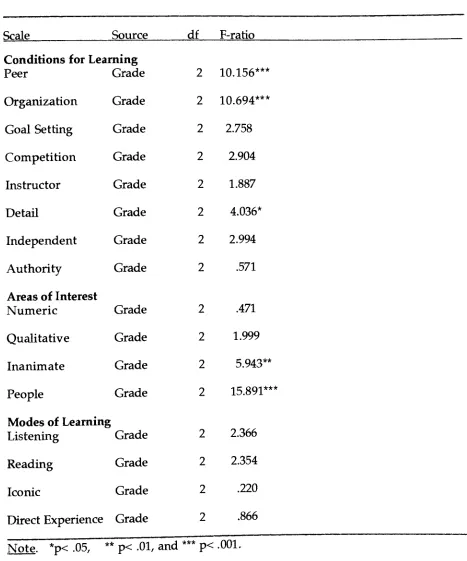
A one-way Analysis
ofVariance
was conducted onfemales
to
determine
if
significant
differences
between
gradelevels
existin
females' preferencesfor
the
different
learning
conditions,
areas ofinterest,
andlearning
modes assessedby
the
Females
atdifferent
gradelevels differed significantly from
each other onthe
following
scales;
Peer
(F=
10.16,
p
< .001),Organization
(F=
10.69,
p
< .001),Detail
(F=
4.04,
p
<.05),
Inanimate
(F=
5.94,
p
< .01),andPeople
(F=
15.89,
p
< .001).This
indicates
that
female
students'grade
level has
an affect ontheir
preferencesfor
these
learning
conditions,
andlearning
modes.On
the
Peer
scale,
5th
gradefemales demonstrated
greater preferencesthan
their
8th
and11th
grade counterparts.As
gradelevel
increases,
the
preferencefor Peer
learning
conditionsdecreases.
The
same effectis
seen onthe
manimate scale.As
subjects'
grade
level
increased,
they
preferredthe
Inanimate
learning
modeless.
Females in 11th
gradeindicated
greater preferencesfor Organization
andworking
with
People
than their
8th
and5th
grade counterparts.As
gradelevel
increased,
preferences
for
these
scalesincreased.
These
results aredisplayed in Table
2.
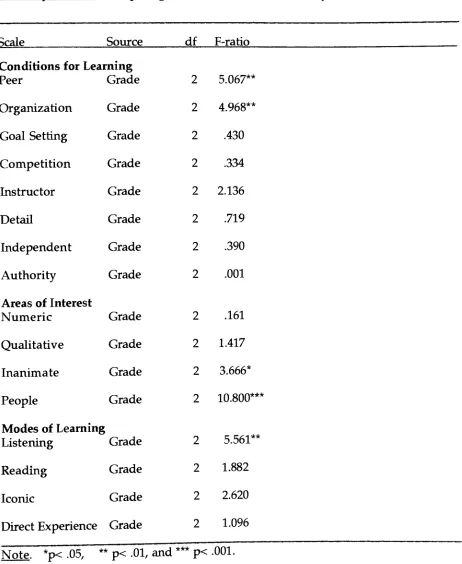
Males
A
one-way
analysis of variance was conducted on malesto
investigate
differences
and similaritiesin
learning
preferencesby
gradelevel
(Table
4).
Males
ofdifferent
gradelevels
differed
significantly
onthe
following
scales:Peer
(F=
5.07,
p
<.01),
Organization
(F=
4.97,
p
< .01),People
(F=
10.80,
p
< .001), andListening
(F=
5.56,
p<.01).Males in
grade5
yieldedthe
lowest
mean scorefor
the
Peer
category,
indicating
agreater preference
for
this
scalethan
both 8th
and11th
grade males.In
the
Organization
scale,
as gradelevel
increased
males'
preferences
for
the
Organization
scale
increased.
The
same effectis
seen withthe
People
scale;
as gradelevel
increased,
males preferencesfor
careersinvolving
working
with peopleincreased.
These
results are shownin
Table
2. This
increasing
preferencefor
the
Organization
listening
(Listen)
morethan
the
8th
and5th
grade males.Gender
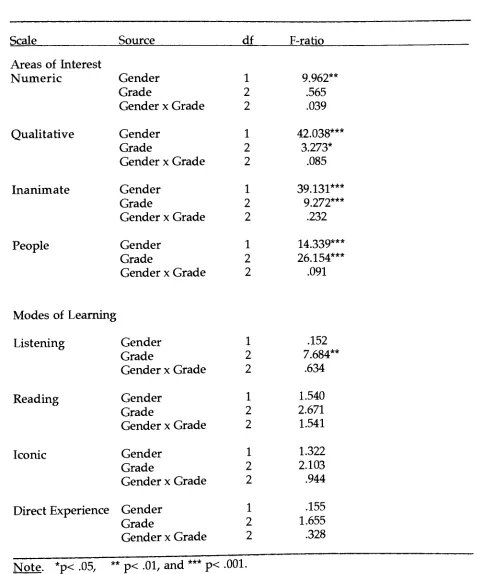
andGrade
A
two-way
analysisofvariance,
with a2
by
3
factorial
design for
gender andgrade,
yieldedsignificant main effectsfor
grade and gender(Table
5). No
significantinteractions
between
grade andgenderwereindicated. The
scales on whichsignificantmain effects ofgender were
found
were:Peer, Organization,
Goal
Setting,
Independence, Authority, Numeric, Qualitative, Inanimate,
andPeople.
This
indicates
that
when all males andfemales
are groupedtogether,
regardless ofgrade,
they
differed
significantly
ontheir
preferencesfor
those
scales.Significant
maineffects
for
grade wereindicated
onthe
following
scales:Peer, Organization,
Instructor, Detail, Qualitative, Inanimate, People,
andListening. This indicates
that
when all subjectswere compared
by
gradelevel,
withoutdifferentiating by
gender,
they
significantly differed
in
their
preferencesfor
those
scalesaccording
to their
grade
level.
Discussion
The
results ofthis
study
rejectedthe
nullhypotheses
andindicate
that
malesand
females
differ in
their
learning
preferences,
and studentsdiffer
according
to
grade
level. Males
andfemales differed in
their
preferencesfor
4
of16
learning
scales at
the
elementary
schoollevel,
6
ofthe
16
learning
preferencesatthe
8th
gradelevel
(middle
school),
and7
of16
learning
scales atthe
11th
grade(high
school)
level.
Males
andfemales
differed
in
their
preferencesfor
learning
Conditions,
Modes,
andAreas
ofInterest
indicating
males andfemales
have
differing
needsin
the
classroom.Students
alsodiffered according
to their
gradelevel,
indicating
student age and grade
level
shouldbe
considered whenstructuring
the
classroomenvironment,
activities,
andteaching
style.Areas
ofInterest.
Males
at allthree
gradelevels
preferredto
work with objectsin
building,
designing
orcreating
(Inanimate
scale).Females
at allthree
gradelevels
prefer
to
work withlanguage
in
writing
and speaking.In
orderto
meet males andfemales'
needs,
schoolpsychologists,
teachers
and other school personnel needto
help
students choose appropriate courses and needto
provideboth language-based
and
hands-on
learning
experiencesin
the
classroom.Also,
at8th
and11th
gradesfemales
preferredauthority
anddiscipline
in
classrooms while males preferredindependence.
Again,
teachers
atthe
middle school andhigh
schoollevels
needto
be
awarethat these
differences
existin
orderto
find
abalance
between both
groups'needs
to
create a classroom atmospherein
whichboth
males andfemales
canlearn.
Females
werefound
to
differ
significantly
when comparedto
each otheraccording
to
grade.As
females
moveup
in
gradelevel,
their
preferencefor working
with peers and
inanimate
objectsdecreases
andtheir
interest in
working
in
people-related
fields
such aspsychology
increases.
Similarly,
as gradelevel
increased
males'
preference
for
the
Peer
scaledecreased
and
their
preferencefor
the
Organization
scaleincreased.
An
increasing
preferenceis
alsoindicated
withthe People
scale.In
addition,
the
higher level
males(11th
grade)
preferredlearning
through
listening
(Listen)
morethan their
8th
and5th
grade counterparts.
These findings
are similarto
previous studies whichindicated
that
males andfemales
differ in
preferencesfor
independence,
authority,
working
withlanguage
and
working
in hands-on
activities(Matthews,
1995; Tamaoka, 1987;
Pettigrew
andHeikkinen,
1985).
These
results are consistent withpreviousfindings.
However,
these
resultsindicate consistency in
preferencesfor
areas ofinterest
that
previousstudies
have
notindicated
because
age was not studied.Also,
this
study indicated
other studies
have
notinvestigated.
Finally
this
study
alsoindicated
agedifferences
in
peer relations and organization whichhas
notbeen
investigated
previously.The
findings from
this
study
suggestthat
school personnel should recognizeand accept
diversity
among
studentlearning
styles.Students
may
develop
greaterself-awareness,
greater enthusiasmfor
school,
andmay be
more successful whentheir
learning
styles are recognized and utilizedby
teachers.
In
addition,
these
results suggest
that
schoolfaculty
have
aresponsibility
to
modify
the
learning
environment and requirements
to
meetthe
differing
strengths and needs ofstudents.
The
samplefor
this
study
waslimited
to
one schooldistrict. Therefore
generalization should
be limited
to
similar schooldistricts.
The
district in
this
study
included
approximately
5500
students enrolledin 5
elementary
schools,
1
middleschool and
2
high
schools.It
waslocated in
a suburbantown
ofapproximately
30,000
residents and containedfamilies
ofpredominantly
upper middle classsocioeconomic status.
In
addition,
randomsampling
of students was notpossible,
although attempts were made
to
ensure accurate representation ofthe
studentpopulation.
Finally,
these
results provide generalinformation
regarding
studentspreferences
according
to
genderand gradelevel.
School
personnelshouldbe
awarethat
studentlearning
styles and preferencesmay vary from
individual
to
individual.
Although
these
results provideinformation
for
structuring
students'
learning,
the
uniquelearning
style characteristics ofindividual
students should alsoReferences
American
Association
ofUniversity
Women.
(1992).
How
schools shortchangegirls.
New York:
Marlowe &
Company.
Backman,
M.
E.
(1972). Patterns
of mental abilities:Ethnic, Socioeconomic,
andsex
differences.
American Educational
Research
Journal,
9,
1-12.
Blakemore,
T., McCray, P.,
&
Coker,
C. (1984). A
guideto
learning
styleassessment:
Research
andtraining
center research report.Menomonie,
WI: Stout
Vocational
Rehabilitation Institute.
(ERIC
Document
Reproduction
Service No.
ED
254
670)
Canfield,
A.
(1988).
Canfield
Learning
Styles
Inventory
Manual.
Los
Angeles,
CA: Western Psychological Services.
Canfield,
A. &
Knight,
W.
(1988).
Canfield
Learning
Styles
Inventory. Los
Angeles,
CA: Western
Psychological
Services.
DeBello,
T.
(1985).
A
critical analysis ofthe
achievement and attitude effects ofadministrative assignments
to
social studieswriting
instruction
based
onidentified,
eighth grade
students'
learning
style preferencesfor
learning
alone,
withpeers,
orwith
teachers.
(Doctoral
dissertation,
St.
John's
University, Jamaica,
New
York,
1985). Dissertation Abstracts International.
47,
68-01A.
DeBello. T. C.
(1990).
Comparison
of eleven majorlearning
styles models:Variables,
appropriate populations,validity
ofinstrumentation,
andthe
researchbehind
them.
Reading. Writing,
andLearning
Disabilities,
6.
203-222.
Dunn,
R.
(1987).
Research
on school environments:Implications
for
studentachievement and attitudes.
Professional
School
Psychology,
11(2),
43-52.
Dunn,
R.
(1990). Rita
Dunn
answers questions onlearning
styles.Educational
Leadership,
48(2),
15-19.
Educational Leadership,
46(7).
Dunn, R, Beaudry, J,
&
Klavas,
A.
(1988). Are
schools responsiblefor
students'failure?:
A
synthesis ofthe
research onlearning
styles.Position Paper
preparedfor
the
New York
State Board
ofRegents.
Albany,
N. Y.: State
University
ofNew
York.
Dunn, R., Giannitti, M.C., Murray, J.B., Rosi,
I.,
Geisert, G., Quinn,
P.
(1989).
Grouping
studentsfor instruction: Effects
oflearning
style on achievement.lournal
of
Social Psychology,
130(4).
485-494.
Fritz,
Robert L.
(1992).
A
study
of genderdifferences
in
cognitive style andconative volition.
Paper
presented atthe
American Vocational
Education Research
Association
Session
atthe
American Vocational
Association Convention.
(ERIC
Document Reproduction Service
No.
ED 331
223).
Gregorc,
A. F.
(1982b).
An
adult's guideto
style.Maynard,
MA: Gabriel
Systems,
Inc.
Johnson,
E.
S.,
&
Meade,
A. C.
(1987).
Developmental
patterns of spatial ability:An
early
sexdifference. Child Development, 58,
725-740.
Lim,
Tock
Keng
(1995).
Perceptions
of classroomenvironment,
schooltypes,
gender,
andlearning
styles ofsecondary
school students.Educational
Psychology:
An International lournal
ofExperimental Educational
Psychology,
15(2). 161-169.
Matthews,
D.
B.
(1995).
An investigation
ofthe
learning
styles of students atselected
postsecondary
andsecondary institutions in South Carolina.
Research
bulletin
#60.
(ERIC
Document Reproduction
Service
No.
ED
386
098)
Pettigrew,
F.E. &
Heikkinen,
M.
(1985).
Increased
psychomotor skillthrough
eclectic
teaching.
Physical
Educator,
43,
140-146.
Pearson,
C. S.
(1992).
Women
aslearners:
Diversity
and educational quality.Journal
ofDevelopmental
Education,
16(2),
2-4, 6,
8,
10,
38-39.
change over
time?
Learning
Styles Network
Newsletter, 1(3), 1.
Report
ofthe
New
York
State
Board
ofRegents
Panel
onLearning
Styles.
(1988).
State
University
ofNew
York: Albany.
Robertson,
P.
(1978).
The
implications
of studentlearning
stylesfor
prescribing
reading
skilldevelopment
strategiesfor community
college students.Unpublished
Doctoral
Dissertation,
Hood
University.
Dissertation Abstracts International.
38,
(7-A),
3919.
Sadker,
D.
&
Sadker,
M.
(1994).
Failing
atfairness:
How
our schools cheat girls.New York:
Simon &
Schuster.
Severiens,
S. E. & Ten
Dam,
G. T.
M.
(1994).
Gender differences in
learning
styles:
A
narrative review and quantitative meta-analysis.Higher
Education, 27,
487-501.
(ERIC Document
Reproduction
Service No.
EJ
494
980)
Tamaoka,
Katsuo. (1987).
Gender differences
in
learning
styles ofCree, Dene,
and
Metis
students,(research/
technical
report).(ERIC
Document
Reproduction
Service
No.
ED
336 229).
Thompson,
M. J. &
O'Brien,
T.P.
(1991).
Learning
styles and achievementin
postsecondary
classrooms.Paper
presented atthe
Annual
Conference
ofthe
American
Educational Research Association.
(ERIC
Document
Reproduction
Service No. ED 331
554).
Witkin,
H.A. &
Goodenough,
D.R.
(1981).
Cognitive Styles: Essence
andTable 1
Description
ofCanfield
Learning
Styles
Inventory
Scales
Conditions
for
Learning
(8
Scales):
Preferred
situation or context ofinstruction.
Peer
Enjoys
teamwork,
maintaining
good relations with otherstudents,
having
studentfriends,
etc.Desires
clearly
organized coursework,
meaningfulassignments,
and a
logical
sequenceof activities.Wants
to
set ownobjectives,
usefeedback
to
modify
goals orprocedures,
and makehis
orher
owndecisions
on objectives.Desires
comparison withothers,
needsto
know
how he
or sheis
doing
in
relationto
others.Wants
to
know
the instructor
personally
andhave
a mutualunderstanding
andliking
for
her
orhim.
Likes
to
know
specificinformation
onassignments, requirements,
rules,
etc.Prefers
working
alone,
determining
his
orher
ownstudy
plan,
and
doing
thingsindependently.
Desires
classroomdiscipline,
maintenance oforder,
andhaving
informed
andknowledgeable instructors.
Area
ofInterest
(4
Scales): Preferred
subject matteror objects ofstudy.Numeric
Prefers working
with numbers andlogic,
solving
mathematicalproblems,
etc.Likes working
withwords orlanguage-writing,
editing, talking.
Enjoys
working
withthings-building,
repairing,
designing,
operating.
Organization
Goal
Setting
Competition
Instructor
Detail
Independence
Authority
Qualitative
24
Table 1
continuedPeople
Prefers
working
withpeopleinterviewing,
counseling, selling,
helping.
Mode
ofLearning
(4 Scales): Preferred
manner ofobtaining
newinformation.
Listening
Prefers
hearing
lectures,
tapes,
speeches,
etc.Reading
Enjoys
examining
writteninformation,
reading texts,
pamphlets,
etc.
Iconic
Likes
interpreting
illustrations,
movies,
slides, graphs,
etc.Direct
Experience Desires
hands-on
or performancesituations,
such asshop,
field
Table 2
Means
andResults
ofT-tests for Males
andFemales
on16
Scales
Scale
Grade
5
Female
Male
(n=41)
(n=37)
Grade
8
Female
Male
(n=41)
(n=33)
Grade
11
Female
Male
(n=77)
(n=66)
(1)
Conditions
Peer
11.61
12.46
Organization
14.83
15.68
Goal
Setting
15.39
14.43
Competition
17.78
17.16
Instructor
11.02
11.25
Detail
14.61
14.69
Independence
16.61
15.53
Authority
17.15
18.53
(2)Area
ofInterest
Numeric
17.16*15.14
Qualitative
13.14
16.94**Inanimate
13.44**10.69
People
15.58
17.17**(3)
Mode
Listening
18.12
17.75
Reading
17.44
18.86
Iconic
12.30
11.03
Direct Experience 11.74
12.36
12.12
13.92
16.90**17.04
12.56
12.41
18.70**16.32
14.78**14.43
13.65
17.12
13.00
13.60
14.88
18.52**16.20
14.60
14.59
17.84** 14.46**11.25
14.76
16.31
18.37
18.91
18.90
18.27
12.17
11.85
10.71
10.97
14.07
12.16
15.33
18.27
11.45
13.90
17.91**16.47
14.53
13.59*14.33
17.56
11.66
14.10
15.73
18.50** 16.88*15.11
14.92
18.30** 16.22**12.68
11.97
13.91**16.90
16.15
18.87
19.80
12.60
12.70
11.64
11.35
Note 1. A
mean of15
pointsindicates
neither ahigh
norlow
preference.The
lower
the mean, the
higher
the
preference,
andthe
higher
the mean, the
lower
the
preference.
Note 2.
* and **indicate that the
designated
meanis
significantly
greater
than
the
otherin
the
independent t-test:
* p< .05 and **Table
3
One-Way
ANOVA
Comparing
Females'Canfield
LSI
Scales
by
Grade
Level
Scale
Source
df
F-ratio
Conditions
for
Learning
Peer
Grade
Organization
Grade
Goal
Setting
Grade
Competition
Grade
Instructor
Grade
Detail
Grade
Independent
Grade
Authority
Grade
Areas
ofInterest
Numeric
Grade
Qualitative
Grade
Inanimate
Grade
People
Grade
Modes
ofLearning
Listening
Grade
Reading
Grade
Iconic
Grade
Direct Experience
Grade
2
10.156***2
10.694***2
2.758
2
2.904
2
1.887
2
4.036*2
2.994
2
.5712
.4712
1.999
2
5.943**2
15.891***2
2.366
2
2.354
2
.2202
.866Note.
*p<.05,
** p< .01, and *** [image:28.531.31.498.88.649.2]Table
4
One-Way
ANOVA
Comparing
Males'Canfield
LSI
Scales
by
Grade Level
Scale
Source
df
F-ratio
Conditions
for
Learning
Peer
Grade
Organization
Grade
Goal
Setting
Grade
Competition
Grade
Instructor
Grade
Detail
Grade
Independent
Grade
Authority
Grade
Areas
ofInterest
Numeric
Grade
Qualitative
Grade
Inanimate
Grade
People
Grade
Modes
ofLearning
Listening
Grade
Reading
Grade
Iconic
Grade
Direct
Experience
Grade
2
5.067**2
4.968**2
.4302
.3342
2.136
2
.7192
.3902
.0012
.1612
1.417
2
3.666*2
10.800***2
5.561**2
1.882
2
2.620
2
1.096
Note.
*p<.05,
** p< .01,and *** [image:29.531.36.498.81.645.2]Table 5
Results
of Two-Way
Analysis
ofVariance
on16
Canfield
LSI Scales
Scale
Source
df
F-ratio
Conditions for
Learning
Peer
Gender
1
10.536**Grade
2
11.760***Gender
xGrade
2
2.715
Organization
Gender
1
5.659*Grade
2
14.594***Gender
xGrade
2
.542Goal
Setting
Gender
1
14.448***Grade
2
.350Gender
xGrade
2
2.488
Competition
Gender
1
1.499
Grade
2
2.220
Gender
xGrade
2
.505Instructor
Gender
1
.410Grade
2
4.014*Gender
xGrade
2
.024Detail
Gender
1
1.182
Grade
2
3.776*Gender
xGrade
2
.544Independent
Gender
1
20.934***Grade
2
.873Gender
xGrade
2
2.013
Authority
Gender
1
17.932***
Grade
2
.316Table
5
continuedResults
ofAnalysis
ofVariance
on16
Canfield
LSI
Scales
Scale
Source
df
F-ratio
Areas
ofInterest
Numeric
Gender
Grade
Gender
xGrade
Qualitative
Inanimate
People
Gender
Grade
Gender
xGrade
Gender
Grade
Gender
xGrade
Gender
Grade
Gender
xGrade
1
2
2
1
2
2
1
2
2
1
2
2
9.962** .565 .039 42.038*** 3.273* .085 39.131***9
272*** .232 14.339*** 26.154*** .091Modes
ofLearning
Listening
Reading
Iconic
Gender
Grade
Gender
xGrade
Gender
Grade
Gender
xGrade
Gender
Grade
Gender
xGrade
Direct
Experience
Gender
Grade
Gender
xGrade
1
2
2
1
2
2
1
2
2
1
2
2
.152 7.684** .6341.540
2.671
1.541
1.322
2.103
.944 .1551.655
.328Note.
*p<.05,
** p< .01, and***
[image:31.531.24.504.84.658.2]