RIT Scholar Works
Theses
Thesis/Dissertation Collections
2007
Language Integrated Query in Java for XML and
Relational Database
Anurag Naidu
Follow this and additional works at:
http://scholarworks.rit.edu/theses
This Thesis is brought to you for free and open access by the Thesis/Dissertation Collections at RIT Scholar Works. It has been accepted for inclusion in Theses by an authorized administrator of RIT Scholar Works. For more information, please [email protected].
Recommended Citation
for XML
andRelational Database
Master's Thesis
Anurag
NaiduOctober 26, 2007
Committee
Dr. Axel T Schreiner, Chair
Dr. Rajendra K Raj, Reader
Title of thesis or dissertation: _ _ _ _ _ _ _ _ _ _ _ _ _ _ _ _ _ _ _ _ _ _ _ LANG.VAG.£ \ t-\l~6 RA.,. \::"1> &VE'R'X )~ :SAvA£Oe
Name of author: AN\JR.A.c. NA II> L)
Degree: \'v\ S
c..p
M.PU 1~ ><::"1 t:=N c:...fProgram: CJ) 1v'I..C>\J 1 \;Y$.
zc:.
1 \=-,... c....c:=College: 6c..c..l S
I understand that I must submit a print copy of my thesis or dissertation to the RIT Archives, per current RIT guidelines for the completion of my degree. I hereby grant to the Rochester Institute of Technology and its agents the non-exclusive license to archive and make accessible my thesis or dissertation in whole or in part in all forms of media in perpetuity. I retain all other ownership rights to the copyright of the thesis or dissertation. I also retain the right to use in future works (such as articles or books) all or part of this thesis or dissertation.
Print Reproduction Permission Granted:
I,
Anurag Naidu
,hereby grant permission to the Rochester Institute Technology to reproduce my print thesis or dissertation in whole or in part. Any reproduction will not be for commercial use or profit.Signature of Author: _ _ _ _ A_n_u_r_a~g'_N_a_id_u
________
Date: _ _ _ _ _Print Reproduction Permission Denied:
I, , hereby deny permission to the RIT Library of the Rochester Institute of Technology to reproduce my print thesis or dissertation in whole or in part.
Signature of Author: _ _ _ _ _ _ _ _ _ _ _ _ _ _ _ _ _ _ Date: _ _ _ _ _ _
Inclusion in the RIT Digital Media Library Electronic Thesis
&Dissertation (ETD) Archive
I,·
Anurag Naidu
,additionally grant to the Rochester Institute of Technology Digital Media Library (RIT DML) the non-exclusive license to archive and provide electronic access to my thesis or dissertation in whole or in part in all forms of media in perpetuity.I understand that my work, in addition to its bibliographic record and abstract, will be available to the world-wide community of scholars and researchers through the RIT DML. I retain all other ownership rights to the copyright of the thesis or dissertation. I also retain the right to use in future works (such as
articles or books) all or part of this thesis or dissertation. I am aware that the Rochester Institute of Technology does not require registration of copyright for ETDs.
I hereby certify that, if appropriate, I have obtained and attached written permission statements from the owners of each third party copyrighted matter to be included in my thesis or dissertation. I certify that the version I submitted is the same as that approved by my committee.
The
Undersigned Computer Faculty Approves the Thesis
Language Integrated
Query
in
Java for XML and Relational
Database
Axel T. Schreiner
Dr. Axel T Schreiner,
Chair
Rajendra
K.
RajDr. Raj endra K Raj,
Reader
James M. Kwon
Dr. James M Kwon,
Observer
Thursday, 25 October 2007
XMLand relationaldatabasesarethemostcommonlyuseddata-sources fornumer ous Java-basedenterprise applications. Theever-growing dependenceofJava-based
applications on these technologies calls for developing a uniform means ofquerying
these data-sourcesin the Java layer such that queries written for anyofthesetech
nologieslooksimilar and areinfactgovernedbya single grammar. This thesisimple
ments a newbackendsystemencapsulatingqueryingcapabilities overXMLand JDBC basedrelationaldatabaseswhich would complementthe translationof queries written
usingQuEL [1],alanguageextensiontotheJava programminglanguage. The QuEL
language extensionto Javais part ofanother thesis developedpreviously and acts as
the querylanguagefortheback-end implemented in thisthesisforXMLand relational
Contents
1 Introduction 5
2 Core concepts 7
2.1 Hierarchical Data Model
/
ExtensibleMarkup Language(XML)
72.2 Relational Data Model
/
Relational Database(SQL)
153 Language Integrated Query
(LINQ)
193.1 XLinqand DLinq 21
3.1.1 XLinq 21
3.1.2 DLinq 21
4 QuEL 22
4.1 QuEL front-end 22
4.2 Object Collections 23
5 QuEL for XML and Relational Database 24
5.1 XML in QuEL 27
5.1.1 Background logic 27
5.1.2 Methodtranslation 28
5.1.3 XML backend design 29
5.2 Database query in QuEL 34
5.2.1 Background logic 34
5.2.2 Method translation 35
5.2.3 SQL backend design 37
6.1 QuEL querytranslation forXML 43
6.2 XQueryfor Java 45
6.3 QuEL query translation for SQL 45
6.3.1 GroupJoin issue 47
7 Conclusion 48
7.1 Timing 49
8 Limitations 50
8.1 Into 50
8.2 Timing 51
1
Introduction
Querylanguages areprogramming languages that are used typicallyto retrievedata from
databasesor otherinformationstorage mediums. The growingdependenceof major appli
cationson avarietyofdatabasesystems and othermediums ofstorage, likeXML [2], now
makes it important thatwe are ableto querysuch data-sources in anefficient andconsis
tent manner. These various data storage technologies haveevolved over along period of
time and originated from separate companies or special interest groups. What this means
isthateachofthesedifferenttechnologies hasitsown distinct languageswhich areusedto
writequeries for retrieving data.
In this thesis we aim to address the problem ofheterogeneity in querying different
data-sources with an aimtointroduceasyntacticallyconsistent querymechanismthat isalmost
independent of the nature ofthe data storage medium that is queried. We demonstrate
the various aspects ofquery preprocessingthat need tobe changedtomake the consistent
query experienceintegrate into Java.
The .NET
community at Microsoft Corporation has made considerable progress in devel
oping Language Integrated Query
(LINQ) [3]
for the C# and VB languagespecificationin .NET 3.0. This thesis work in conjunction with the thesis "Integrating a Universal
Querying Mechanism in Java"
[1]
is targeted towards developing a back-end for such aquerylanguage thatwould provide similarbenefits in Javafor retrievingdataout ofXML
documents and relational databases. One could now write queries using QuEL [1], as a
language extensionofJava,just as one would write SQL
[4]
queries on adatabaseconsoleorXPath
[5]
queriesto operate on aXML document. Apossiblefuture extension ofbothfor a powerful feature in Java that could be used to query XML and relational databases
2
Core
conceptsThis chapter takes a closer look at the design and architecture of the two data-sources
that will be the target for QuEL queries for the purpose ofthis thesis. Simple examples
willbe usedtodemonstrate howwriting queriesin SQL
[4]
and XPath[5]
worksbyusingthe existingAPIs provided in Java and what are the concerns with writing such queries.
This would helpin understanding both the advantages ofwriting queriesusing QuEL
[1]
as well as the backend designed inthis thesis for XML and relational database.
2.1 Hierarchical Data Model
/
ExtensibleMarkup
Language(XML)
XML is a specification for definingmarkup languages designed to separate data from its
representation. This makes it avery usefulformat for data representation anddata inter
change between different systems. Though relativelynew in the computer industry, XML
has become very popular and is widely used as an information storage medium and con
figuration data-source insoftware applications.
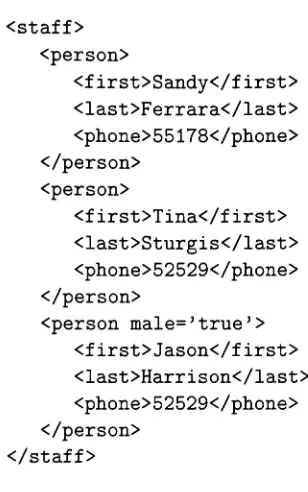
Consider beginning with averysimple XML document that has information for the staff
in an organization, to see how adocument like thislooks and understand the structure of
such adocument. The document hasfirst name, last name and phone numberinformation
of each staff member ofthe department and maintainsthem as anXML document as de
<staff>
<person>
<first>Sandy</first>
<last>Ferrara</last>
<phone>55178</phone>
</person>
<person>
<first>Tina</first>
<last>Sturgis</last>
<phone>52529</phone>
</person>
<person male=,true'>
<first>Jason</first>
<last>Harrison</last>
<phone>52529</phone>
</person>
</staff>
Figure 1: Staff XMLdocument as atree
A quick look at the document shows a striking resemblance to a tree structure which is
rooted at the staff node.
Given this tree-like visualization of the document one could imagine querying this doc
ument being analogous totraversing the tree andpruning out the leavesthat do not pass
the filtering criteria. One would have to write many lines of code in Java using the W3C
DOM
[6]
toreadtheXML document into memoryandthenwrite a visitortocollect nodesthatpassthefilteringcriteria oftheuser queryand constructanewdocumentwith reduced
[image:11.528.135.289.86.332.2]first last phone
Sandy Ferrers 55
Person mete
'true'
first last phone
Jason Harrison 52!
first last phone
[image:12.528.172.344.55.227.2]rina Sti#g* 52!
Figure 2: Staff XMLdocument as atree
scenariointhe programming domainto sievethroughXMLdocuments and collect dataof
interest at particular points.
XPath
[5]
is one suchquerylanguage tailored to operate efficientlyover XMLdocumentsto filter out data. XPath queries are crisp, non-verbose and extremely powerful tools for
working with XML. Since XML has been constantly gaining importance in the software
industry, a marriageofsome sortbetween XPathand Javawas alwaysalogicalnext step.
The growing adoption ofthis technology in the industrywas cemented further when Sun
introduced XPath APIs in Java 5 (JDK 1.5) for querying XML documents, which made
available thepower of efficient XPath querying from within user-levelJavacode. XQuery
[7]
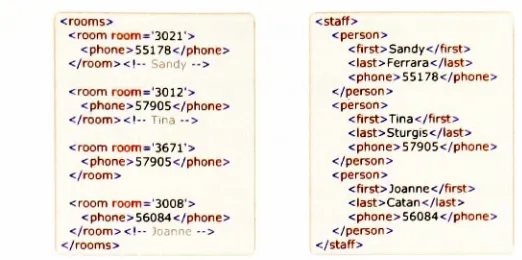
is also one such mechanism that can be used to queryanXML document.UsingfollowingtwosimpleXMLdocuments, RoomsandStaff, howaquerycanbewritten
<rooms>
<room room='3021">
<phone>55178<7phone>
</room><!--Sandy-->
<room room='3012'
>
<phone>57905</phone> </room><!-rina-->
<roomroom='3671'>
< phone >57905</phone> </room>
<room room='3008'>
<phono56084<7phone>
</room><!--Joanne-->
</rooms>
<staff> <person>
<first>Sandy</first> <last>Ferrara</last> <phone>55178</phone> </person> <person> <nrst>Tina</hrst> <last>Sturgis</last> <phone>57905</phono </person>
< person >
<first>Joanne</first> <last>Catan</last> <phone >56084</phone> </person>
[image:13.528.96.357.53.183.2]</staff>
Figure 3: XML document forRooms and Staff
Staff is the same file that we saw above and Rooms is afile that maps the room number
with the phone number associated with that room. A querying scenario from these two
documentscouldbetosearch across thefiles and match records on phone numbers across
the documents and return staff names with the corresponding room they occupy. Fairly
common asthis scenario maybe, it isnot exactlyaprogramming cakewalkto achieve the
desired result.
Assuming that the developer has good knowledge ofXPath, XSLT
[8]
and HTML, thecodeforobtainingthe results ofthe queryacrossthe twoXML fileswould look something
like this in a XSLT file
<?xml version="1.0"
encoding="UTF-8"?>
<xsl:stylesheet version="1.0"
xmlns :xsl="http://www.w3.org/1999/XSL/Transf orm"
>
<xsl:output method="html" indent="yes" />
<! Read in all the room nodes from the Rooms xml file into a temporary variable >
<xsl:variable name="data" select="
document('rooms.xml')/rooms" />
<! Construct the html for the page headers etc. > <html>
<head><title>Occupancy page</title></head>
<body>
<table border="l"
align="center"> <tr><td colspan="3"
align="center">
<b>Name and Room occupancy</bx/td></tr>
<xsl:apply-templates select="/staff" />
</table>
</body>
</html>
</xsl:template>
<! Declare the template for matching the staff and room >
<xsl:template match="
staff">
<! Apply the template over all the staff nodes >
<xsl:for-each select="
./child: :*"> <xsl:variable name="p" select="
./phone/text
()" />
<xsl:variable name="f" select="
./first/text
()" />
<! Get all the rooms to test and iterate >
<xsl:for-each select="$data/child: :*">
<xsl:if test="./phone/text() = $p"> <tr>
<td><xsl:value-of select="$f"/></td>
<td><xsl: value-of select="
. /@room"/x/td> </tr>
</xsl:if>
</xsl:for-each>
</xsl:for-each>
</xsl:template>
</xsl:stylesheet>
Figure 4: XSLTto merge Staff and Rooms
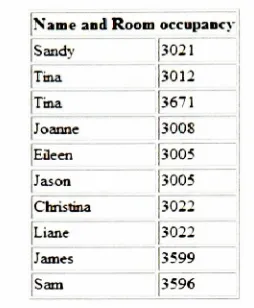
The result of the above XSLT on the two XML documents yields the following HTML
output as can be seenin Figure 5.
Noticethe nested loopsxsl:for-each select with XPath expressionsthat do the trick
along with the presentation HTML code that displays the result. One could debatethe
cumber-NameandRoomoccupancy Sandy 3021 [Tina |3012 |7ma [3671 [Joanne 300S Eileen 3005
,Jason 3005
Christina [3022
Liant [3022
James ;3599
Sam 3596
Figure 5: Result ofXSLT solution
some to write, given howcommon thisscenario is whenworkingwith XML documents.
What we have looked at is a non-Javaimplementation ofthe query. Reconsider how the
same canbe achieved using Javaandthe Java XPath APIs.
public class XmlSample
{
/**
* Oparam args
*/
public static void main(String[] args){
DocumentBuilder documentBuilder = null;
Element staff = null;
Element rooms = null;
XPath xpath = null;
String staffXPathExpr = "/staff/person"
;
String roomXPathExpr =
"/rooms/room";
NodeList outer = null;
NodeList inner = null;
try
{
documentBuilder =DocumentBuilderFactory.newInstance()
.newDocumentBuilderO ;
[image:15.528.196.323.53.207.2]}
try{
staff =
documentBuilder.parse(new File("./linq/staff.xml"))
.getDocumentElementO ;
rooms = documentBuilder.parse(new File("
./linq/rooms.xml"))
.getDocumentElement;
}
catch (SAXException e){
e.printStackTraceO;}
catch (IOException e){
e.printStackTraceO ;}
xpath = XPathFactory.newInstanceO
.newXPathO ;
try
{
outer =(NodeList) xpath.
evaluate (staffXPathExpr, staff, XPathConstants.NODESET);
inner =
(NodeList) xpath.
evaluate(roomXPathExpr, rooms,XPathConstants.NODESET);
}
catch (XPathExpressionException e){
e.printStackTrace;
}
// Match the results in nested loop // THIS IS THE ACTUAL QUERY LOGIC
int staffCount = outer. getLength()
;
int roomCount = inner.getLength()
;
String roomNum = " "
;
Node roomltem =
null;
for (int i =
0; i < staffCount; i++)
{
Node staffItem = outer.item(i);
try
{
roomNum = xpath.evaluate("phone/text()"
, staffItem);
for (int j =
0; j < roomCount; j++)
{
roomltem = inner.
item(j);
if(roomNum. equals(xpath.evaluate("phone/text()
"
, roomltem)) )
System.out.println(xpath.evaluate(
"
first/text( )"
, staffItem) + " "+ xpath. evaluate("Oroom", roomltem));
}
// TODO Auto-generated catch block
e.printStackTrace( );
}
}
}
}
Figure 6: Javacode forXML merging
The first thing that catches the eye is the wordiness of the solution and though it solves
theproblem, maintainabilityof repeatedboilerplatecode,mixed withtheactualfunctional
logic will always remain an issue over time. This problem is especially of concernas such
queryies for XML documents arefairlycommonplace.
Let us elucidate the problems seen so far in writing queries, given the existing infras
tructures and technologies, which would help explain why a change in this area is long
overdue.
Complex codelogic needed for fairlysimple querypatterns.
Proficiencyin many technologies like XPath, XSLT, JDK XPathAPIs etchas tobe
combined.
Repetitive boilerplatecodeto supplement the actual querycode.
The query itselfremainstype unchecked and so potentially unsafe.
Lackof consistent query language for alldata-sources.
Wewillcomeback to theseobservations when wediscuss thedesign for QuEL andexplain
2.2 Relational Data Model
/
Relational Database(SQL)
A relational database is adata-store that is based on a relational modelbetween entities,
a modelthatworkson relational algebra and set theory Such a relational model was first
proposedby Edgar Codd
[9]
wherethe word relation refersto atable in the database.The smallest building block of a relational database is called an attribute, which is a
name/value pair. An unordered set of attributes forms a tuple and an unordered set of
such tuples makes up a relation, which lends its name to a relational database. How
ever when dealing with relational databases we use the words table, row, column and
constraints which are equivalent terms that mapthe mathematicalconcepts on which re
lational databases weredesigned to an actual database implementation.
Someolder databases were also designed on ahierarchical data model like that ofXML.
Mostmoderndatabases havemovedinto a relational model becauseofthegreaterflexibil
ityand advantages thatit provides. Oneofthespecificadvantages with a relational model isamany-to-many relationsbetweenentities. Oneofthe severelylimitingconditionsfor a
hierarchical modelis that therecan at best be aone-to-manyrelational mapping between
entities; however, the model cannot accommodatemany-to-many relations.
A simple example of this could be a super-store where products are classified based on
the various sections like apparel, grocery, sports goods etc. The products in the display
lineare classified under onlyonesection, however if thereareproducts that reallyfallinto
morethanonesection, then thedatabasedoesnot provideanyoptiontolistthesame prod
orderto gather accountinginformationfrom sectionsforsales statistics. This discussionis
merely toprovide aninsightinto whythedatabaseindustryhasmovedtowardsarelational
model for its databaseneeds.
Seclionld Name Aisle 101 Grocery 21 102 Apparel 34 103 Spon 45 101 Foolv/ear 22
Sectionld Produced 101 10 102 12 103IM 14
Productld Name 10 meat 12 flour 14 Nikear
[image:19.528.126.411.162.311.2]SectionToProduct
Figure 7: Hierarchicalmodel anomaly
We discussedtheobvious advantage of relationaldatabasesandhowthe databaseindustry
has moved towards a relational model, focus now on the technologies that one needs to
familiarize oneselfwith in order to be ableto work with relational models. The primary
means ofaccessing relational databases is via the Structured Query Language
(SQL)
[7]
invented byIBM in the 1970s.
In order to see how SQL is used consider the following two relational database tables
Staff and Rooms that contain the same data as shown earlier but this time in relational
data model. In orderto perform the samequery as we didfor theXML sample we would
now writea SQLquerythatjoinsthe two Staff andRoomstables onthe matchingphone
Room F-:-'
302 1 5517* ! 3D'
2 47905
3671 57906 aooe :=
:-Firs Lasl PTvy* Sa-S, =^ 55179
~
= 2-~'Q 5 E>T':*jf toenrae Ga-a~ '*>'**
- 35- 5-*
Room Staff
Figure8: Room andStaff tables
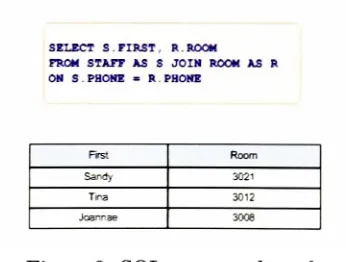
ThefollowingSQLquery returns theresult as listed below. The SQL query itself is very
intuitive and simplein structure and does thejob, however database are always coupled
with some applicationforwhichtheyserve asthedata-storeand thus themeasure ofthe
easeof use of adatabaseinthemannerinwhichit may be accessedbytheapplication it
serves.
SELECT S. FIRST. R ROOM FROMSTAFF AS S JOIH ROOM AS R OH S PHOME R PHONE
First Room
Sandy 3021
Tfa 3012
[image:20.528.140.387.97.167.2]Joarrae 3008
Figure 9: SQLqueryand result
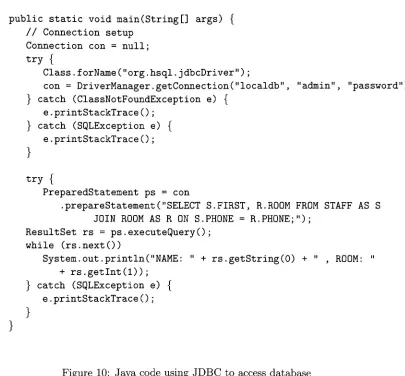
Javahasthe necessary APIs for writing SQL queries inuser level Java application code.
These APIswereintroduced intothelanguagealongtimeago andhaveevolved sincethen
[image:20.528.177.350.369.500.2]Javaprogram again with a large amount ofcode wrapped around the actual query. This
addition setup code, though completely functional and correct, has similar drawbacks as
outlined for theJava XPath APIs.
public static void main(String[] args)
{
// Connection setup Connection con =
null;
try
{
Class.forName(
"
org.hsql.jdbcDriver
"
);
con = DriverManager.getConnectionC'localdb"
, "admin", "password");
}
catch (ClassNotFoundException e){
e.printStackTraceO ;}
catch (SQLException e){
e.printStackTrace();}
try
{
PreparedStatement ps = con
.prepareStatement("SELECT S.FIRST, R.ROOM FROM STAFF AS S JOIN ROOM AS R ON S. PHONE =
R.PHONE;"); ResultSet rs =
ps.executeQueryO ;
while (rs.nextO)
System.out. printIn("NAME: " +
rs.getString(O) + " , ROOM:
"
+ rs.getlnt(l));
}
catch (SQLException e){
e.printStackTrace(); [image:21.528.71.476.148.524.2]}
Figure 10: Javacode using JDBCto accessdatabase
Thepower and speed ofSQL is immense butwith notype-safety andthe requirementfor
3
Language Integrated
Query
(LINQ)
The previous chapter introducedtwo prominent data-storesthat arecommonly used with
enterprise level applications and the existing technologies available to query them. The
areas ofconcern highlighted while using these technologies points a direction towards an
approach aimed at alleviating those concerns and making the entire query experience as
homogeneous as possible with additional safety checks that make it consistent with the
highlevel programming paradigm.
LanguageIntegrated Query
[10]
is a project at Microsoft that is picking up momentuminthe programminglanguage communityfor its attempt at bringingin a queryingsyntax
into mainstream programming languages. The LINQ mechanism provides the program
mer with away toprogrammaticallyorganize and extract specificinformationfrom adata
source. It provides a consistent syntax for writing queries over various data-sources like
object collections, XML, relationaldatabases andeventhirdparty data-sourcesas longas
some ofthe contract requirements are implemented. CurrentlyinLINQ adatasource can
be a hierarchical document, like XML, a database, like mySQL, theobject collection, or
any collection that implementsthe Enumerable interface. Given the type of one ofthese
data sources, the user has the ability to extract information from this source using the
same words in the host language. From this vantage point the programmer is extracting
informationin the same mannerfrom three entirelydifferent sources.
The .NET platform and C# 3.0 language in particular has incorporated useful language
featuresthatmakesseamlesslyincorporatingLINQinto the.NETplatformfeasible. These
include Anonymous Classes, Extension Methods
[11],
Lambdaexpressions etc. Allthesere-served words in the language and maps these words into a series ofmethod calls on the
data-source. These method calls are mapped to certain logical operations. For instance,
the logic ofajoin operation is mapped to a method named join(). This direct mapping
allows for many by products that do not exist in traditional queries performed on data
sources such as databases and hierarchical documents.
Oneofthe biggest resultsofthis technologyistypesafe
queries, ensuringat compiletime
and not runtime, that these queries are valid and will not fail. Ensuring proper typing
reduces the number of potentialbugs in a programin the samewaya strongly typed lan
guagelikeJavaremoveserrorsthatplague a not sostronglytypedlanguage likeCor C++.
Consider the query below in LINQ over an in-memory collection of Employee objects
to find the names ofemployees that areofthe sameage.
var result = from el in Employee from e2 in Employee
where el.ageO ==
e2.age() kk el.nameO != e2.name()
select new {personl =
el.nameO ,person2 =
e2.name()};
Noticehowthequery issimplein itsstructureand no nestedfor loopsare needed as would
berequired in a traditional program. The fromkeywords brings in newdata sources into
the queryenvironment, thewhere keyworddoes the comparison (like in an if statement)
andthe select keywordconstructsthereturntypeoftheresult. Thenewobject withthe
names of employeesis notpreviously defined but it isconstructed at runtime and assigned
to adynamicallytyped result var.
C#, like Anonymous Classes, Extension Methods [11], Lambdaexpressions that are not partofJava, inorder to implement QuEL for XML andrelational databases.
3.1
XLinq
andDLinq
TheruntimeforLINQondifferent data-sources differs inwaysthatarespecifictohandling
the respective data-sources though from a user's perspective LINQ offers the idea of a
consistent queryexperienceacross any data-source backend.
3.1.1 XLinq
Theruntime thatprovidesLinqcapabilitiesfor XML queryingis just an extension ofLinq for dataobjects, with some special extension methods that are relevant in the context of
reading XML documents, like theelements0 methodto readthetext value of nodes and
attribO method used to read the text value of an attribute of a node. The rest ofthe
Linqgrammar staysthe same, AnXLinqquery is thusstructuredexactlythe sameway as a Linqqueryon collections ofdata objects.
3.1.2 DLinq
The Linq grammar by design resembles the syntax of SQL closely. Thus no additional grammar tokens are needed for extending the concept of Linq to databases. The imple mentation for SQL remains the same. Extension methods in the host language backend
corresponding tokeywords inthe querylanguage performthe actions requiredto fulfillthe
4
QuEL
We have lookedat theproblemsidentifiedwith query languagesand their integration into
a host high level programming language. We also discussed how the LINQ project at
Microsoft is bringing together query syntax inside mainstream application programming
languages like VB.NET and C#. In this chapter we will look at the recently offered po
tential solution for querylanguage support withinthe Javaprogramming language, called
QuEL
[1]
. Theofferedsolutionis afront-endthatconstitutesthenewQuELgrammar andthe translation mechanism that is so far implemented for performing queries over object
collections.
The QuEL (QueryEnhancedLanguage)mechanismisafront-endpreprocessor which when
given a Javafilewith an embedded query, written using the QuELgrammar, will convert
that language into syntactically correct Javacode, thereby making queries on Object col
lections less cumbersome and allowing the programmer to ignore the boiler plate coding
normallyneeded whileperformingthesequeries with thesupported JavaAPIssofar avail
able.
4.1 QuEL front-end
The front-end forQuELasdeveloped inthethesis "IntegratingaUniversalQueryingMech
anisminJava"
[1]
consists ofthe completeQuELgrammar andthe translationmechanismthat parses aquery written in QuELandperforms various preprocessingstepsneeded for
it to mapthequeryto the appropriateback-end. The steps inthispreprocessing involves
methodtreerepresentation isanabstractmappingofthequerytoany back-end implemen
tation. The next step is performed by aninterpreter that convertsthis abstract mapping
to a custom mapping in the formof pureJava code.
4.2 Object Collections
So far the interpreterofthe QuEL front-end is configuredto usethe back-endwrittenby
Dr. Axel Schreiner for thepurpose ofqueryingon object collectios
[12]
in Java. The Javacodeemittedbytheinterpretermakes method callsdefined inthisback-endas a successive
method call chain. Thesemethods arethereal operators ontheobject collections on which
theoriginalQuEL query iswritten, therebyreturning theresult as dynamicallycomputed
typedobject collection whichis again usableinuser writtenJavacode. Onecouldimagine
the back-end as the proxy for executingthe actual query andthe query language asjust
syntacticsugar for workdone bythe back-end.
The same LINQ query from the previous chapter is now slightly modified and is now
the QuEL query imbedded in Java code within the @@ markers. This query does the ex
act same function as described earlier but now in the Java enviornment using the QuEL
front-endand object collection back-end that was discussed.
result = from edu.rit
.cs.quel.Person el in Employee
from edu. rit.cs. quel.Person e2 in Employee
where el.ageO ==
e2.age() kk el.nameO != e2.name() select new {personl =
el.nameO ,person2
=
5
QuEL
for XML and Relational DatabaseWediscussed in the previouschapter that the QuEL
[1]
mechanism is afront-endpreprocessor which takes in a Java filewith a QuEL query and translates to pure Java codefor
object collections. The promise ofthis paradigm is however not just to provide a query
mechanism for data collections but a consistent querying experience across varied data
sources. Theworkdonein this thesisis aimed at providing just that experience, forwhich
wehavechosenXML andrelationaldatabaseastheotherdatasourcesforwhichthequery
mechanismcan be extended.
In an earlier chapter on core concepts, it was discussed that writing query over XML
or a relational database inside of Javacode is cumbersome and involves writing a lot of
code that a programmer, for the most part, does not like to be bothered about. It can
be debated that the programmer should not be expected to care about all the wrapper
code and focus around the actual logic of query. This is one ofthe basic reasons behind
developing QuEL and extending it to all data-sources like XML and relational database
so that thefocus ofquerying inside ofJavacomes backto thequery logic.
Asdiscussed inthepreviouschapter, thegrammarforthenewlanguageQuELhas beende
veloped under the thesis "Integrating aUniversal Querying Mechanism in Java"
[1]
whereQuEL will be used to write queries on collections inside a Java program that would be
preprocessed by the QuEL compiler to transform the QuEL part of the code into pure
Javasyntax which could then be compiledby javac.
The current thesis work utilizes the QuEL grammar for writing queries over DOM and
however some constructs specific to the DOM implementation in Java is not part ofthe
grammar. Thus for the purpose ofthis thesis the back-end for XML assumes the
recog-nistion of these constructs in the grammar so that pure Java code could be build from
QuEL queries for XML data-source. Like in the QuEL paper
[1]
the approach taken tointegrate these queries is a preprocessor based approach, so that the extensibility of the
Javaprogramminglanguagecanbe easilyproven. This approach alsogivesusthesoftware
engineering advantageofmaintainabilityandindependencefrom subsequent Sun JDK re
leases. Theprocesses ofincorporatingthenew grammarinto Javawouldthen beto merge
the QuELgrammar and theelements of our new compiler andthequeryback-endsupport
intothe Java compiler.
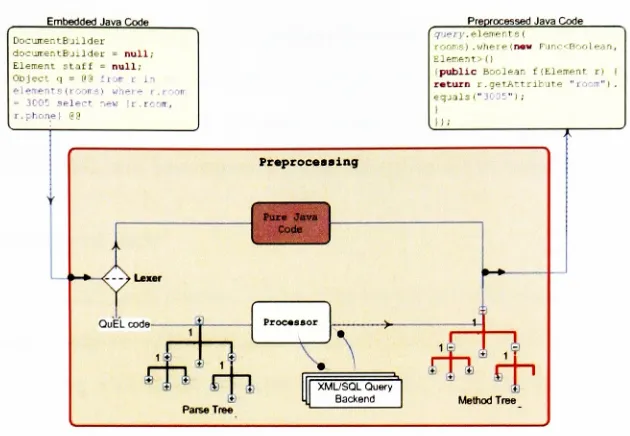
Figure 11 provides a high level understanding of the process that converts the special
Java file with QuEL query through a pre-processing stage into a complete compile able
Javafilewith the right mappings generatedto serve the queryfunctionality.
Theprocess of compilation ofQuELinjected Java code is atwo stageprocess where Java
file is first pre-processed by the QuEL processor that parses only the QuEL codewithin
"@@"
markers. The lexer for the preprocessor convertsthe query intoaparsetree that is
then mappedto a methodtree. Themethods inthis tree arethemethodsthat correspond
to each keywordofthe querygrammarlike from, where, select, join etc. The corre
sponding methods are members ofDocumentFragment or Queryable interface depending
on the datasource. The methods form a closed set of operations overthe resulting type.
Since the operations are closed on the result it makes it very simple to apply just about
Embedded Java Code Preproc&ssedJavaCode DocumentBuilder
docurcentB'jilder=
null; Element staff=
null.-Object q=88fraitr n ]^-ierifg (i -"'nt'< wheie i
-3005 select new Ir.rc
r.phone! <?8
gruery, elements(
rorir.s.).where<ne*r F.u-: rv,nlen, Elements (1
public Booleanf(E.lern&nr.r) I returnt.getAttribute "room"}. equalfl("3i15")) 1 Preprocessing Puce Java Code / . 1 <-+~\-ylow } Processor ,
\
i 1A
J
r
L
-. r4n
? i ?
XML/SOLQuery
[image:29.528.104.419.77.295.2]Backend Method Tree
Figure 11: QuELpreprocessingprocess
Lazy evaluation
The designof anybackend implementing the requiredinterface actions has to be made a closed set in order to achieve a cascaded evaluationflow whichis also a "lazy" evaluation
mechanism reminiscent in the functional programming language Haskell. The evaluation chainis triggeredonlywhenresultofthe query is firstused andnot while each partofthe
queryoperation is constructed. This givesthe flexibilityof "adding on"
anyofthe closed
5.1 XML in QuEL
Now cc jr how we canextend the newquery frameworkto beable towrite queries over
XMLdocuments. Alsokeepinmindthat theQuELgrammarisgenericforauniformquery
syntaxhowever becauseinternallytheback-end usestheorg.w3c.domAPIs inJava, parts
ofthe queryforXML will haveconstructs that are governed bythese APIs.
5.1.1 Background logic
TheJavaprogramin Figure 6 isthebaselinethatwe will usetocomparethe improvements
that we claimto achieve with animplementation ofQuEL for XML. Here is allthat now
needs to be written with QuEL in order to read in the Staffand Rooms document and
mergethem togenerate the occupancylist.
final Element staff = documentBuilder.par
se(
Tester. class.getClassLoader0.getResourceAsStream(
"quel/staff.xml")).getDocumentElementO;
final Element rooms = documentBuilder.parse(
Tester. class.getClassLoader( ).getResourceAsStream(
"quel/rooms.xml")) .getDocumentElementO;
result = from Element s in elements(staff)
join Element r in elements(rooms) on
s.getElementsByTagName
("phone"
) matches
r.getElementsByTagName("phone") into sr select new sr.first, sr.room
Figure 12: QuELqueryfor XML access
before you start the query. The query then is a very compact statement that uses the
fromkeyword tointroduce the Staff source andthe joinkeyword isusedtointroducethe
Rooms source and match on the phone node on both the documents that havethe same
value and merge the results ofthe join filter into a temporary structure referred by the
variablesr. Now theselectkeywordisusedchoosethenodes/attributesfromthemerged
document into afinal result whichis aDOM DocumentFragment structure.
5.1.2 Method translation
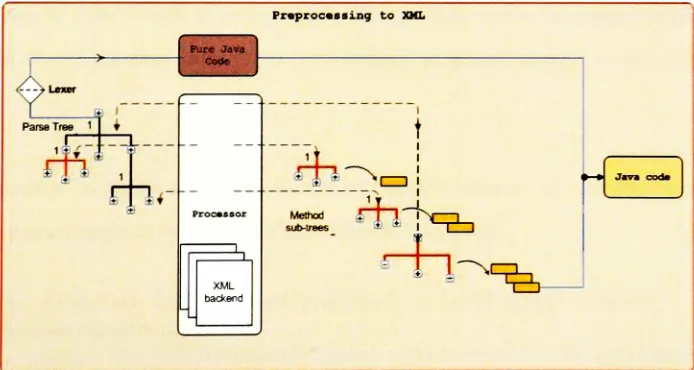
Inorder to understandtheworkingsbehindthe scenethat makes thewhole querylookas
simple, less wordy and yet achievethe same result, we will start by looking at the archi
tectural abstracted view ofthe processing that is part ofthe pre-processing stage of the
compilation.
Puxe Java cote
Tree it I
Processor
XML backend
Preprocessing to XML
rk
Method sub-trees
[image:31.528.90.437.383.568.2]r-r-.-.
From Figure 13 it can be seen that a Java file with QuEL code is parsed by the lexer
and a parsetreeofwith thenodesofthe query is internallygenerated. Note that thepure
Java code part of the file is not scanned in this process and passed though this pipeline
without any modification. After the parsing is done a mapper(not shown in
figure)
walksthe parse tree and converts the tree into something called a Method tree. This tree is
closer representation of the final Java output that will get generated and has all typing
related information alongwith theoriginalquerylambdas andpredicatesthatcan nowbe
worked on by the interpreterthat converts it to thefinal Java code that can be compiled
with javac.
5.1.3 XML backend design
Inthis section we willdescribetheworkings ofthebackend designed for XML andhowthe
Proxy class in Java is used to add on extension methods to the DocumentFragment class
suchthat the allthe keywords in QuEL correspond tomethods addedto this classduring
runtime.
The extension methods are added to the DocumentFragment by defining an interface
QuELDocumentFragment with some ofthe following methods:
public interface QuELDocumentFragment <T extends Node> extends
DocumentFragment
{
public <K> QuELDocumentFragment select(Func<K, T> selector);
public <K> QuELDocumentFragment groupBy (Func<K, T> group);
public <K> QuELDocumentFragment orderBy(Func<K, T> group);
Func<Boolean, Node> predicatel, Func<Boolean, Node> predicate2,
Func2<Node, Node, Node>selector)
}
Thefirststep in the queryinterpretationprocessistocreate aninstanceoftheQueryclass,
which isthe entrypoint forcreatingaproxyoftheDocumentFragment class. This is done
bymakinga callto theelementsQ methoddefined inthisclass withthefollowingsignature:
public <T extends Node> QuELDocumentFragment elements(Node container)
This methodtakes in anXML document read in as aNodeobject and wraps a
QuELDocumentFragment aroundit. Inadditionitalsoperformsthecheckp.getNodeType0
== Node
.ELEMENTJJODE on each node of the input document before it is returned to the
next methodinthe querycomposition chain. This is important becausewhenaXMLdoc
ument isread into the DOM the nodes constitutesthe followingsub interfaces likeAttr,
Comment, Document, Entity, Element, Text etc and for the purpose ofthe query we
will for all practical purposes be concerned only with the Element node. This way the
elements() isnotonlyusedtointroducethe proxywrapperbut alsotoinitializethebasic
filtering for the querybeing constructed.
Oncethe proxy is introducedallthe QuELkeywordcall methoddefinitions are now visible
and can be invoked at any point on the resulting object of each method since the return
typeforeach ofthesemethodsisthe sametypeon which themethod wasinvoked, namely
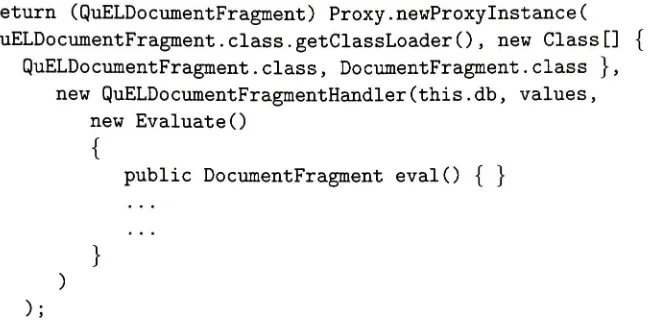
in the XML case a QuELDocumentFragment class. Here is how aproxyobject ofthe same
return (QuELDocumentFragment) Proxy.newProxylnstance(
QuELDocumentFragment.class.getClassLoader(), newClass[]
{
QuELDocumentFragment.class, DocumentFragment.class },
new QuELDocumentFragmentHandler(this.db, values,
new Evaluate()
{
public DocumentFragment evalO
{ }
);
It's thebodyofthe Evaluate interfacethathastheeval0 methodthatisdistinct foreach
ofthe extension methodsthat have logicspecific tothe action thatneedstobeperformed
bythat method.
Consider aquery inQuEL and seethe convertedJavacodeforthe sameusingthebackend
design for XML.
result = from Element s in elements(staff) join Element r in elements(rooms) on
s.getElementsByTagName("phone
"
) matches
r. getElementsByTagName("phone") into sr
where s. getElementsByTagName("last").item(O)
.getTextContent().equals(
" Catan"
)
[image:34.528.77.403.72.236.2]select new sr.first, sr.room
Figure 14: Another QuEL query for XML access
object(s) thatwould havespecial DOM likeextension methods that would beused to ex
tract node elements and attributes from theDOM. The query above in QuEL wouldlook
likethefollowingwhen mapped to the Java backend designed in this thesis.
QuELDocumentFragment 1 = query. elements(staff).join(
query.elements(rooms), new Func<String, Element>()
{
public String f(Element s)
{
return s. getElementsByTagName("phone").item(O)
.getTextContentO;
}
, new FuncjString, Element^)
public String f(Element r)
{
return r. getElementsByTagName("phone").item(O)
.getTextContentO;
}
, newFunc2jDocumentFragment, Node, Node^()
public DocumentFragment f(Node s, Node sr)
{
return query. combine("s", s, "sr", sr) ;
}
).where(new FuncjBoolean, Element^/)
public Boolean f(Element s)
{
return s. getElementsByTagName("last").item(O)
.getTextContentO .equals("Catan");
[image:35.528.65.387.134.430.2]}
});Figure 15: Javatranslation for QuEL queryfor XML
The code generatedusing the XML backend Queryclass can nowbecompiled using javac
would generatethesame result asthe Javacodethatwe wrotein Core Concepts chapter2.
Although the generated Java code is type safe and compiles, the query itself can still
failtogeneratethe expected result. The reasonforthatis, XML isnot schema enforceable
and thus query itselfcannot be type checked for correctness against the XML document
Kayandaims atproviding type checkingon queries writtenusing XPath. This is howwever
an optional facility andJavaat this time doesnot support it, so we ignore this aspect for
the scope ofthis work.
Thus a possible future extension to the QuEL for XML could be to makes the trans
lated queries completely type safe for documents that adhere to some schema definition.
However for all other XML documents it would be a very challenging task to do achieve
5.2 Database query in QuEL
Now considering how same query translation mechanism works for a new data source, in
this case we will lookat themost commonlyuses database medium, Relational databases.
Thebigchallengeand differencewhiletacklingthisproblemis, thatunlike inthe previous
cases for object collections or XML, the data sourceis on disk and should always remain
on disk during the entire query process. This might sound trivial at the moment but it
is animportant situation that needs tobe maintained and whichinfluences the designon
the backend for SQL, i.e. since allthe information cannot be cached we haveto translate
the query into SQL. We shall discuss that later in this chapter after we have built the
foundation for querytranslation.
The other important aspect of query mapping for relational databases is that of type
checking. The database tables over which the QuEL query executes exists on disk and
because the Java compiler has no way prior knowledge of their types, some way needs
to be devised to acquire typing information about such entities so that we can provide a
type-safequeryguaranteed to executesuccessfully.
5.2.1 Background logic
Once again reconsider the Java program inFigure 10 as the baseline to compare with for
theimprovementsthatwe claimto achieve with animplementationofQuELforrelational
database. Here is all that now needs to be written with QuEL in order to read in the
Staffand Rooms tables andmerge thembased onthe phone number fieldto generate the
final edu.rit.cs. quel.StaffBean staff = new
edu.rit.cs.quel.StaffBean(Staff); final edu.rit.cs. quel.RoomBean rooms = new
edu. rit.cs. quel.RoomBean(Rooms); @@
result = from edu.
rit.cs.quel.Staff Bean s in staff
join edu. rit.cs. quel.RoomBean r in rooms on
s.phone matches r.phone
where r.size > 2000
select new s.first, r.size
Figure 16: QuEL queryfor database access
Noticethat thequery isaverycompact statement thatuses thefrom keywordtointroduce
the Staff source and the join keyword is used to introduce the Rooms source and match
on the phone column on both the tables that have the value and on the result apply the
filter condition where the size of the room is greater than 2000. The select keyword is
used to project the columns from the filtered temporary result into a final result which is
a Queryable<T> type, where T is the return typeofthe query which can be an internally
generated typeor anyofthe standardbuilt-intypes.
5.2.2 Method translation
Figure 17 provides an understandingofthe workings of the translation system for QuEL
for SQL and the corresponding SQL backend.
The process of converting QuEL for relational database query is slightly different from
the process discussed earlier for XML. The hook for conversion of the QuEL processor
Preprocessing to SQL
Schemelookup
0-Hb
~
Processor
Collections backend
Si
Method sub-trees
S2*!'
Querymethod composition
"fe-Figure 17: SQLprocessing
whole translation scheme. The reasonfor thisdifference is for thefollowing factors:
QuEL queries for relational databases are converted to their SQL equivalent query
before they get executed on the database. This approach was taken in order to
leverage the performance that SQL provides for querying databases, especially in
cases when the scalability of the query translation mechanism is considered then
executing the appropriate SQL query to extract data becomes a primary concern
for designing thebackend. Another approach that was considered initially, involved
frontloading the data in all the tables into data objects called Beans. Once the all
the data in loaded the query could then be run in-memory on the beans, like in
the object collectionbackend [12]. Thisapproachworks wellforobjects however the
scale ofdatabase tables is far larger and it cannot be assumed that the system has
enough memory resources to store all the datain-memory. Also it would not be a
good design approach that stretches the limitsofthe systemresources.
[image:39.528.85.432.54.259.2]that willhave to beexecuted to retrieve data. The query itself is astring and thus
cannotbecheckedfor syntacticalandtypecorrectness. Thusthe translation process
should not only generate the backend code for writing the query as SQL string, it
should also generate codethat would ensure typesafety ofthe generate query.
5.2.3 SQL backend design
We identified the need for type checking of the QuEL queries when converting to SQL,
which introduces the open-source object relational mapping tool SQL2JAVA [14]. The
tool is used to generate classes that will ensure type checking for the queries, and the
query translation mechanism generates code which when complied and run will generate
SQLquery and executethe same onthe concerned databaseand wrapsthe results appro
priately in so that it could be iterated upon conveniently in the user code.
SQL2JAVA
Thetoolisfreelyavailablefor downloadand comes withtheexecutablefortheopen source
HSQLDB
[15]
database. The tool can be configuredto run ant[16]
scripts that generateJavaclassesthatmapto tablesintheunderlyingrelationaldatabaseschema. The database
schema file should be provided to the tool for it to generate these classes, called Beans.
The beans themselves provide additional functionality like persistence and transactional
capabilities, the capability to execute simple queries such that from a programmer's per
spective the beanscan be treatedas in-memoryrepresentation oftherealdatabasetables.
However for the purpose of this thesis we shall not use the latter mentioned capabilities
for limitations explainedin the 5.2.3 section.
the beans for mappingthe tables into Javaclasses aregenerated before the preprocessing
step and made available to the translation engine. Only the attributes of the beans will
be used asthey map tothe columns ofthe tableand in that regardany other
relational-mappingtool could also be used topregenerate thesebeans. Another alternative to using
atool could be tohand-writethese beansbyexamining thedatabase schema.
The design for the backend involves the following Queryable<X> and Evaluate<X> in
terface that serve as the contractfor translation to SQL.
The Evaluate<X> interface is used to hide the bodyof methodthat chainsthe evaluation
process once itstrigerred.
public interface Evaluate<X>
{
/**
* The method to that computes the resulting intermediate query
* and determines if the query is complete and executes the same * on the database.
*
* return An Iterable result of the query */
public Iterable<X> evalO throws SQLException;
}
The Queryable<X>interface declaresthepubliclyavailable extension methods ofthe
back-end. The translationmechanism calls on thesemethods to build the Java code equivalent
ofa QuEL query.
/**
* type
* and maintains the logic to convert this Expression into
* the SQL string appropriate time comes, i.e. when the call to * evaluate the result occurs.
* author Anurag Naidu
*
* param <X>
*/
public interface Queryable<X> extends Iterable<X>
{
/*** The select contains the columns to project and triggers the * evalution process and this is seen as logical termination of * complete QuEL query.
*
* param select
* return An object of itself so that its a closed operation
*/
public Queryable<X> select(Expression<SqlQuery> select); /**
* The where contains the labmda condition that needs to * be checked as a query result filter.
*
* param where * return
*/
public Queryable<X> where(Expression<SqlQuery> where); /**
* The where contains the sources that are introduced into a
* QuEL query, namely the database table names. *
* param from * return
*/
public Queryable<X> from(Expression<SqlQuery> from);
}
The hook intheQuellnterpreterisa subclassthattranslates theQuELquerytowards the
public interface Expression<T>
{
/*** Function to generate the
query string. The string generated * so far is passed as input and the result is the same type
* the parts of the query computer from the extension method
* that defines this Expression class
*
* param Parameter to the function (same as return type)
* return
*/
T f (T param) ;
}
We can now look at the earlier QuEL query on relationaldatabase and compare with the
translated code. The simple query that brings together the Staff and Rooms tables and
returns all staff member who occupyrooms with size greater than 200 sq.ft.
final edu. rit.cs. quel.Staff Bean staff = new
edu.rit.cs.quel.Staff Bean(Staff);
final edu. rit.cs.quel.RoomBean rooms = new
edu. rit.cs.quel.RoomBean(Rooms);
@
result = from edu. rit
.cs.quel.Staff Bean s in staff
join edu. rit.cs. quel.RoomBean r in rooms on
s. phone matches r. phone
where r.size > 2000
select new s.first, r.size
Figure 18: QuELqueryfor database access
The queryaftertranslationismappedto theedu.rit. cs. sql.backend.Querybackend is
Queryable<AN0N1548173586> resultl = new
edu.rit.cs. sql.backend.Query<AN0N1548173586>(
AN0N1548173586.class, this, null).from(
new Expression<SqlQuery>()
{
public SqlQuery f(final SqlQuery current)
{
current.fromClause.append("staff s, ");
return current;
}
}).from(new Expression<SqlQuery>()
{
public SqlQuery f(final SqlQuery current)
{
current.fromClause.append("rooms r, "); return current;
}
}).where(new Expression<SqlQuery>()
{
public SqlQuery f(final SqlQuery current)
{
current.partialQueryClause.append("where ");current.partialQueryClause.appendC'r.size");
current.partialQueryClause.append(">");
current.partialQueryClause.append("200");
return current;
}
}).select(new Expression<SqlQuery>()
{
public SqlQuery f(final SqlQuery current)
{
current.selectClause.append("select ");current. selectClause. append("s.name, r.size,") ; return current;
}
[image:44.528.76.385.58.480.2]});
Figure 19: Javatranslation for QuEL query for database
Notice in the convertedquery how themethod definitionfor the Expression<T> interface
has thecode to writeout itspart ofthe SQL querystring. When invoked theycontribute
their part ofthe query to the SqlQueryobject.
joinetc ofEvaluate<X> interfacetriggersthe T f (T param) methodpassedtoitasthe
first stepwhich cases the chain to first construct the correct SQL string equivalent ofthe
QuEL query. The methods select or groupBy carry special meaning as they execute
the query on the database using the internal connection object, in Figure 19 above the
code generatedfortype-safetychecksisomittedfrom output nowforbrevity, howeverthe
Java code generated also has the type-safety check code that does not ever get executed
but is merely there as a proof, that ifthe generated Java file compiles then the query is
6
Comparison
andResults
This chapter considers a few QuEL queries over XML and relational databases and com
pare the results from the respective backend against the results from a native language
translation ofthesame query. As discussed in the backend design for relational database,
the QuEL query is converted to the SQL equivalent and one ofthe measureof success for
the backend is the comparison between the backend generated query and original QuEL
queryhand-written as SQL.
6.1 QuEL query translation for XML
Assume that we have the same Staff and Rooms XML documents from Figure 3 and we
wanttomerge thetwo documentsonthematchingphonenumbers andcreate a new
docu-ument using the name and room values after groupingthem based on room numbers and
alphabetically reverse sorting the names within each group. The QuEL query to do the
same would likethe following:
result = from s in elements(staff) join r in elements(rooms) on
s.getElementsByTagName(phone) .item(O).getTextContent() matches
r.getElementsByTagName(phone) .item(O).getTextContent0 into sr
select new
{
s.getElementsByTagName(f irst).item(O),room = r.getAttribute(foom)
group by r.getAttribute(foom)
Figure 20: Quel queryforXML
Thetranslated queryreturns the
following
resultwhichmatcheswiththesamequerywrittenusingJava APIs for XML processing
involvingmanymorelinesofcodethan the QuEL
query.
Group groupedBy='3012'
first room='3012'
'Tina'
Group groupedBy='3599'
first room=3599
'James'
Group groupedBy= '3005'
first room='3005'
'Eileen'
first room='3005'
'Jason'
Group groupedBy='3022'
first room='3022'
'Christina'
first room='3022' 'Liane'
Figure 21: XML queryresult
Wewill skip the translated Java codeusing XML backend fromthistext dueto the shere
size ofthe code, however it isinterestingto notehow thisconciseQuELquerytogenerate
thisresults expands almost ten times itssize when convertedto pureJava using theXML
backend and when compared with code written using only the available Java APIs for
XML is roughlytwentytimesthelengthoftheactual QuELquery. Thisonlygoestoshow
interactingwith XML documents.
6.2
XQuery
for JavaThere are a some XQuery
[7]
implementations that are available for use in Java as APIcalls. Oneofthem isOJXQI
[17]
proposedbyOracle[4]
designedonthelinesofJDBC[18]
with similar APIs. OJXQI could be used to query XML documents by preparing a
PreparedXQueryobject and constructingan XQueryqueries with it.
OJXQI being similar to JDBC in Java, has some advantages and similar disadvantages
discussed in chapter 2 on XML which this thesis attempts to alleviate. However OJXQI
also allows support for SQL queries on documents through a sqlquery function. These
features bring it close the syntax of QuEL, however using OJXQI still involves writing
boilerplate setup codejust like in JDBC.
6.3 QuEL query translation for SQL
ConsideraQuELquerytoretrievedata froma relationaldatabase,inthiscaseHSQLDB [15],
that has the tables that we will query. Assume that we have the Staff and Rooms tables
fromFigure 8in our database and wejoinon thephone column andthen filterout rooms
on the condition that they are greater than 2020 sq.ft. and numbered above 2000 with
theresults groupedbyromms with same size. A SQL querytodothesame wouldlooklike,
select s.*, r.size from rooms r
inner join staff s on s.phone = r.phone
and r.size > 2020
order by r.size
The same querywritten in QuEL would then look like,
result = from
sql2java.linq.database. RoomsBean r in rooms
join sql2Java.linq. database.Staff Bean s in staff on r.phone matches s. phone
where r.size > 2020
where r.number > 2000
orderby sr.size
select new sr.name, sr.number, r.size
@@ . . .
The SQL backend converts this query into the following SQL,
select s.name, s.phone, r.size from rooms r
join staff s on s. phone = r. phone
where r. number > 2000 and r.size > 2020
order by r.size
The result ofexecutingthe QuEL query is the same as executingour first SQL query,
name=JasonMorrison phone=4010 size=2030
6.3.1 GroupJoin issue
OneofthelimitationsoftheQuELtranslationmechanism for SQL iswiththe into clause
withthe joinandgroupbyclauses. ThefollowingQuELqueryconvertsto theappropriate
SQL howeverwrapping the ResultSet into the correct return typeclass fails.
result = from
sql2Java.linq.database. RoomsBean r in rooms
join sql2java. linq.database. Staff Bean s in staff
on r.phone matches s. phone into sr
select new sr, r.number
The translated SQL appears likethe
following
select sr.*, r. number
from (
select s.name, r.*
from rooms r
inner join staff s on s. phone =
r. phone
) sr,
rooms r
This query executes on the database however the because the select clause specifies the
variable sr as one ofthe return types the QuEL mapper
[1]
creates the return type classfor the whole query with an instance of Staf fBean wrapped in a Iterablelmpl. This is
however insufficientforthe purpose ofSQLsince use of srin theselect clauseisequivalent
to selecting all the columns of the table Staff and Rooms. This makes the return type
7
Conclusion
Reconsidering
the problem areasthat we identifiedearlier with writingaqueryover XMLusing XPathandDOMAPIs orover a relational databaseusing SQL in Javaandcompar
ing how the QuEL wayofquerying onXML andSQL backend solves theseproblems.
Complex codelogic neededforfairlysimple querypatterns
A queryforperforming the same operation is simpler, cleaner and more intuitive.
Proficiency in many technologies likeXPath, XSLT, JDK XPath APIsis needed. Theprogrammer onlyneeds to learn QuELforthe most partfor writing queries over
any of the supported data sources.
Repetitiveboilerplate codeto supplement the actualquerycode.
No boilerplate code is written by the programmer. The backendfor the respective
data source technologywill auto generate all boilerplate code andkeep the query logic clean.
The query itselfremainstype unchecked and so potentially unsafe.
The query is not checkedfor type safety by the backend. Since the backendgenerates pure Java code that is compiles, thus the queries are themselves are assured ofbeing
type checked otherwise the code generated by the backendwould not have compiled.
Lack of consistent query language for all data-sources.
QuEL grammardoes not change significantlywith the data-source itoperates on and
7.1
Timing
T