Rochester Institute of Technology
RIT Scholar Works
Theses
Thesis/Dissertation Collections
5-1-1998
Analysis of heterogeneity of variance using anome
on ln S^2
Casey Volino
Follow this and additional works at:
http://scholarworks.rit.edu/theses
This Thesis is brought to you for free and open access by the Thesis/Dissertation Collections at RIT Scholar Works. It has been accepted for inclusion
in Theses by an authorized administrator of RIT Scholar Works. For more information, please contact
Recommended Citation
Approved by:
ANALYSIS OF HETEROGENEITY OF VARIANCE
USING ANOME ON
In
S2
by
Casey A. Volino
A Thesis Submitted
111
Partial Fulfillment
of the
Requirements for the Degree of
MASTER OF SCIENCE
111
Applied and Mathematical Statistics
Prof.
Edward G. Schilling
(Thesis Advisor)
Prof.
David
R.
Lawrence
Prof.
Donald D. Baker
(Department Head)
GRADUATE STATISTICS
COLLEGE OF ENGINEERING
ROCHESTER INSTITUTE OF TECHNOLOGY
ROCHESTER, NEW YORK
Title
ofThes~:
ANALYSIS OF HETEROGENEITY OF VARlANCE USING ANOME
ON
In
Sj2I
hereby grant permission to the Walhcc Memorial
Library
of
RlT
tel
reproduce my thesis
in whole or in pan. Any reproducaon
will
not be for
commercial use or profit.
Forward
While
working
atCorning,
Incorporated,
I
had
the
goodfortune
ofbeing
ableto
work with several
highly
skilled senior statisticalengineers,
from
whomI learned
a greatdeal
about various statistical
techniques.
One
suchstatistician,
Charles
Comer,
introduced
meto
an article
by
L.
S.
Nelson1which
succinctly detailed
the technique
ofusing
ananalysis-of-variance-type approach
to
detect
varianceheterogeneity. Sometime
later,
whenI
learned
about
the
analysis ofmeans(ANOME)
technique, I
thoughtit
wouldbe
interesting
to
useANOME
to
analyze varianceheterogeneity
andthen
comparethe
resultsto the
ANOVA
Abstract
When
nreplicatesare availablefrom
afactorial
experiment,
several methods existfor
testing
the
validity
ofthe
assumption of equal variances withinthe
"cells"ortreatmentcombinations of
the
experiment.A
newtest
is
proposedfor
variances of random samplesbelieved
to
be from
normal populations.This
newtest
combinesboth
the
familiar
graphicalanalysis ofmeans
for
treatment
effects(ANOME)
andthe
analysis of thelogarithms
ofthe
within-group
variancesto
produce a graphicaldisplay
ofthe test
for
variancehomogeneity.
To
determine
robustness ofthe
proposedtest
againstdepartures from
the
underlying
normality
assumption,
this
newtest
is
also evaluatedfor
non-normalpopulations.Another
analysis-of-means-typetest
wasdeveloped
by
Wludyka
andNelson
whichutilizes
Dirichlet
distributions
andspecially
constructedtables.
The
newtest,
proposedherein,
has
an advantagein
that
it
reliessolely
on critical valuesdeveloped
for
the
analysis-of-means procedure.
As
an addedsimplification,
only
those
critical valuescorresponding
to
infinite degrees
offreedom
arerequired.A
In
ANOME
analysisofNelson's
data (used
to
demonstrate
the
In
AN
OVA
procedure)
yieldedthe
same conclusion.Also,
simulationresultsindicate
that
whentheunderlying
assumption ofnormality is
notfeasible,
the
In
ANOME
proceduredemonstrated
equivalentor superior
Type-I
error-ratestability
and poweramong
tests
whichrely
onthat
assumption.
However,
whenthe
underlying
assumption ofnormality is tenable, Bartlett's
test
performsthe
best
of allhomogeneity-of-variance
tests
studiedin
maintaining
stableType-I
errors and power.Table
of
Contents
Page
I.
Introduction
1
II.
ANOME
ofIn
S23
Decision Limits
for ANOME
3
Procedure for ANOME
onIn
S24
Example
ofANOME
onIn
S27
III.
Bartlett
&
Kendall's In ANOVA Test
ofHomogeneity
ofVariance
14
IV.
Bartlett's Test
ofHomogeneity
ofVariance
15
V.
Levene's Test
withBrown
andForsythe's Modification
16
VI.
Monte Carlo Simulations
18
VII.
Simulation Results
22
VIII.
Summary
andConclusions
29
IX.
Future Work
30
X.
References
32
XI.
Appendix
A-l
34
Exact Factors
for
One-Way
Analysis
ofMeans,
Ha
34
XII.
Appendix
A-2
35
Sidak Factors
for
Analysis
ofMeans
for
Treatment
Effects,
ha
35
XIII.
Appendix
A-3
36
Example
ofGenerating
Random Numbers
(Two-Parameter
Weibull)
36
XIV.
Appendix
A-4
38
Visual
Basic
Subroutines
for Simulations in
Excel
38
XV.
Appendix
A-5
43
Type-I Error Rates
for ANOVA
43
List
of
Tables
Page
Table
1.
Cases
Used For Monte
Carlo
Simulation
18
Table 2.
Results for
Case
1,
Normal Distribution
with|i
50,
anda
=15
22
Table 3.
Results
for
Case
2,
Weibull Distribution
withCO
=1,
and<|)
=1.5
24
Table 4.
Results for Case
3,
Gamma Distribution
with\\f
=2.5,
andX
2
25
Table 5.
Results
for
Case
4,
Normal Distribution
with|I
=50,
andc,
=a,
=... =
ak.,
=15,
ak
=20
25
Table 6.
Results
for Case
5,
Normal Distribution
with|1
=50,
anda,
=a,
=... =
ak_,
=15,
ak
=30
26
Table 7.
Results for
Case
6,
Weibull Distribution
with(0=1,
andCp)=1.5
(First k-1
groups),
CO
=2
(k*subgroup)
27
Table 8.
Results
for
Case
7,
Gamma Distribution
with\|/
=2.5,
andA.
=2
(First k-1
groups),
\\f
-5.0
(kIhsubgroup)
28
Table A-l. Exact Factors for
One-Way
Analysis
ofMeans, Ha
34
List
of
Figures
Page
Figure
1. Example
ofANOME
onIn
S214
Figure 2. Normal
Distributions
Used for Simulations
19
Figure 3. Weibull
Distributions
Used
for
Simulations
20
Figure 4.
Gamma
Distributions Used for Simulations
20
Figure 5. Types
ofError
in
Hypothesis
Testing
21
Introduction
In
many
statisticalanalyses,
the
statisticianis
interested in
testing
the
hypothesis
ofhomogeneity
of variances oftwo
ormore populations.Often
these
populations representthe
"groups"in
an analysis ofvariance,
andit
is
desirable
to test the
validity
ofthe
assumption of equal
"wi
thin-group"
variances.
However,
attimes,
we areinterested
in
only
adirect
comparison ofthe
variability,
orspread,
among
several candidatepopulations(i.e.
suppliers,
measurementdevices,
etc.).In
the
latter
situation,
the
variancescanbe
thought
ofasthose of random samples
from
populationsrepresentedby
the"groups"
or cells
in
a oneway
orhigher
analysis ofvariance.Hence,
ourdiscussion
willfocus
onthe
general case ofvariances of random samples
from
populationsconstituting
the
"groups"or "cells"in
the
analysis ofvariance.
Suppose
wehave
a sampleof n observationsfrom
each ofk
populations.We
shalldenote
the
random samplefrom
populationi
by
{Y;i,
Y,,,
...,
Yin}
with samplemeann
Y,
=-(1)
and sample variance
(Y3-Yi)S
s.2=^-Then
the
hypothesis
we would wishto test
wouldbe
ofthe
form
H0:
a2=a22=-=
al,
where
C^
representsthe
variance ofthe
ithpopulation.We
wouldthen test this
againstthe
alternate
hypothesis
HA: Not
Hn
for
atleast
oneO?
.(4)
xoWhen
these
populationsarethought to
be
normally
distributed,
there
exist severalwell-established
techniques
commonly
accepted as appropriatetests
ofthis
hypothesis.
Among
these
arethe
commonF-test
(for
two
variances),
andBartlett's
test.
An
approximatetest,
presentedby
Bartiett
andKendall3,
involves
performing
the
usual analysis of variance on
the
logarithms
ofthe
"within-group" sample variances.Bartiett
and
Kendall
point outthat the
variance ofIn
S2is independent
ofG2,
andthat
aknown
theoretical
errorterm
is
available whichdepends
ononly
the number ofreplicates, n,
for
each
treatment
combination.An
approximationto this
theoretical errorterm
givenby
L. S.
Nelson1
is
ofthe
following
form:
Var(lnS2),-^
(5)
A
more precise approximation ofthis
errorterm
is
givenby
Wludyka
andNelson2 as
2
2
4
16
Var(lnS2)=
+
-+
r
(6)
v
n-1
(n-1)2 3(n-l)3 15(n-l)5
w
For
n>
5
replicates persubgroup,
the
logarithms
ofthe
subgroup
variances areapproximately normally
distributed. Thus
the test
ofthenullhypothesis
in
(3)
aboveis
essentially
transformedinto
atest
on means.This
test
reliesonthe
fact
, asScheffe4
indicates,
that
"the
analysis of variance[procedure]
is
fairly
insensitive
to
the shape ofthe
distributions
ofthe
estimatedmeans."
if
we useloge
(natural
logarithm)
orlog1(l
for
this
test,
sinceboth
log
functions
are scalerelatedand
ANOVA is
scaleinvariant.
For
dealing
with variancesfrom
non-normalbut
continuousdistributions,
Levene's
test
was modifiedby
Brown
andForsyfhe7
from
it's
originalform
to
serve as anon-parametric
test
of variances.The
proposed procedure(that does
analysisof means onthe
natural
logarithms
ofthe
subgroup
variances)
willbe
comparedto
Bartiett
andKendall's
approximate
ANOVA
test,
Bartlett's8
test,
and amodified version ofLevene's
test
due
to
Brown
andForsythe. The
comparison willbe
made undervarying
conditions.ANOME
of
In
S2
Decision Limits
for
ANOME
In
the
usualanalysis of meansfor
treatment
effects(ANOME)
from
afactorial
experiment,
E. G.
Schilling9
gives
the
following
formula for
the
upper andlower
decision
limits,
0deha^>
(7)
where
N
=total
number of observationsin
the
experiment,
k
=numberofpoints plotted
(number
ofmeansto
compare).The
valuesfor
ha
differ
depending
on whetherthe
effectofinterest is
a main effect or aninteraction
effect.For
maineffects,
the
decision
limits
canbe exactly
specifiedash=H-Vrh'
(8)
since
in
the case oftesting
maineffects,
Ha
is
exact.For interaction
effects,
ha
=ha
,wherethe
ha*
are
Sidak
factors
tabulated
in Table A.9 in E. R. Ott
andE.
G.
Schilling10,
assuggested
by
L. S.
Nelson11Ha
critical valuesfor
a
=0.10, 0.05, 0.01,
and0.001
andinfinite
degrees
offreedom
are givenin Appendix A-l
.E. G.
Schilling9
justifies
the
useofSidak
factors
withthe
statement,
"For interactions
and nestedfactors,
ha*is
usedbecause
ofthenatureofthecorrelationamong
pointsplotted."
For one-way
layouts,
it
may
by
desirable
for ANOME
onlog-variances
to
be
constructedso that
"effects"
are centered about
their
averagelog-variance instead
of aboutzero.
One
wouldthen
be
ableto
easily
retrievethe
originalsubgroup
variancesfrom
the"main
effects"as
S;
=e n'
.
Procedure
for
ANOME
on
In
S2To
adaptthe
ANOME
procedureto the
analysis ofthe
logarithms
ofvariances,
wetake the
following
steps:Step
2.
Calculate
the treatment
effectsfor
the
main effects asthe
Main Effects for Factor A:
A,=
lnS2 InS2Main
Effects for Factor B:
B,= lnS2 InS2
(9)
(10)
Repeat
this
for
eachfactor in
the
experiment.Step
3. Calculate
the treatment
effectsfor
the
interactions
asthe
difference between
the
averagelog-variance for
eachtreatment
combination ofthe
factors
andthe
grand average of allthe
log-variances,
less any
previously
estimatedlower-order
effects.(See below for
two-factor
example.)
Interaction Effects for
theAB Interaction:
AB
= InS2 InS2A,
B,
(11)
Repeat
this
for
eachinteraction in
the
experiment.Step
4.
Calculate
the theoretical
errorvariance,
andtake
it's
square rootfor
usein
computing
the
decision
limits. Regard
this
estimate ashaving
infinite
degrees
of
freedom.
Approximation
to theTheoretical Error Variance.
d>=_2_ +
_2_+
_!16_
(12)
e
n-1 (n-1)2
3(n-l)3 15(n-l)5
(!,,
=Joe
withdegrees
offreedom
Step
5.
Compute
the
decision limits for
main effects:Note
thatby
adding
the
average overall meanback into
the
treatmenteffect,
we could
essentially
centerthe
effects aboutthe
overallaverage.However,
the
decision limits for
the
main effects centered about zero wouldbe
computed as
follows:
oWirw'
(,3)
whichreduces
to
o.hJ.
(14)
For
aone-way
analysis,
N
k,
sothe
limits
are givenby
06eHa.
(15)
(N
k
for
aone-way
analysis,
since aftertaking
the
naturallogarithm
ofthesubgroup
variances,
thereis effectively only
onereplicate percell.)
Step
6. Compute
thedecision limits for
interaction
effectsDecision
Limits for Interaction Effects:
The decision limits
for
interaction
effects centered aboutzero are computedas
follows:
0dXi^'
(16)
where
N
=total
number oftreatmentcombinationsin
the
experiment,
q
=degrees
offreedom
for
the
interaction
effecttested,
andThe
nextsectionpresentsa worked exampleto
further illustrate
the
technique.Example
of
ANOME
on
In
S2An
example oftheANOME
onIn
S,2
(henceforth
calledIn
ANOME)
procedureis
nowpresented
using
the
samedata
givenby
L.
S.
Nelson1to
illustrate ANOVA
onIn S
2.
The
experimentaldesign involved
three
factors
(A, B,
andC),
withk
=3, 2,
and4
levels,
respectively.
The
entire experiment was replicated sixtimes. The
originaldata
is
shownbelow.
Al
A2
A3
CI
C2
C3
C4
Bl
B2
Bl
B2
Bl
B2
53.0
49.8
53.0
51.7
51.3
53.2
52.1
53.2
52.5
50.1
48.9
51.9
55.9
51.3
50.4
52.9
51.7
53.1
53.0
52.6
51.5
49.8
53.4
49.6
55.0
51.7
52.6
52.3
52.6
54.1
52.0
53.7
53.5
51.9
50.1
53.1
59.3
52.3
55.0
54.1
51.5
57.5
51.4
56.4
57.0
54.7
56.4
55.0
58.0
53.5
55.6
54.7
51.3
52.3
54.1
54.2
50.3
56.7
49.4
54.1
58.3
53.7
51.4
54.4
55.4
50.8
56.1
51.8
57.5
53.2
53.1
53.1
55.7
55.3
58.9
48.2
57.7
54.3
53.5
55.9
57.0
56.5
61.9
54.6
55.4
54.7
58.0
59.0
49.6
54.7
54.5
54.1
57.7
52.9
57.0
56.7
53.5
55.2
57.3
54.5
56.6
57.6
59.4
59.3
52.2
56.8
56.8
58.1
54.0
59.3
62.0
57.5
57.2
56.8
54.7
59.5
58.5
58.1
62.4
60.3
57.9
55.7
57.9
56.3
63.1
60.9
58.8
56.9
59.7
63.4
56.5
52.3
59.1
58.4
60.8
54.6
60.7
61.0
Step
1.
Compute
the
subgroup
variances,
andtake their
naturallogarithms.
Var(Y)
ln(Var(Y))
Al
Bl
CI
2.544
0.934
Al
Bl
C2
8.944
2.191
Al
Bl
C3
4.819
1.572
Al
Bl
C4
14.942
2.704
Al
B2
CI
2.019
0.703
Al
B2
C2
2.627
0.966
Al
B2
C3
3.391
1.221
Al
B2
C4
2.695
0.991
A2
Bl
CI
1.259
0.230
A2
Bl
C2
8.791
2.174
A2
Bl
C3
5.619
1.726
A2
Bl
C4
3.255
1.180
A2
B2
CI
1.527
0.423
A2
B2
C2
1.335
0.289
A2
B2
C3
14.331
2.662
A2
B2
C4
8.968
2.194
A3
Bl
CI
2.691
0.990
A3
Bl
C2
7.059
1.954
A3
Bl
C3
15.700
2.754
A3
Bl
C4
11.159
2.412
A3
B2
CI
2.508
0.919
A3
B2
C2
5.392
1.685
A3
B2
C3
2.800
1.030
A3
B2
C4
12.603
2.534
Average:
1.518
Step
2.
Calculate
the
treatment effectsfor
the
main effects asthe
difference
between
theaverage
log-variance
for
eachlevel
ofthe
factor
andthegrand average of allthelog-variances.
Main Effects
for Factor
A:
A,
=InS,
InS2Ai
=(0.934
+2.191
+1.572
+2.704
+0.703
+0.966
+1.221
+0.991)/8
-1.518
=-0.108
A2
=(0.230
+2.174
+1.726
+1.180
+0.423
+0.289
+2.662
+2.194)/8
-1.518
= -0.158Main Effects
for
Factor B:
B,=
lnSj
InS2Bi
-(0.934
+2.191
+1.572
+2.704
+0.230
+2.174
+1.726
+1.180
+0.990
+1.954
+2.754
+2.412)/12
-1.518
=0.217
B2
=(0.703
+0.966
+1.221
+0.991
+0.423
+0.289
+2.662
+2.194
+0.919
+1.685
+1.030
+2.534)/12
-1.518
=-0.217Main Effects
for
Factor C:
Cm=lnS^
InS2C,
=(0.934
+0.703
+0.230
+0.423
+0.990
+0.919)/6
-1.518
= -0.818C2
=(2.191
+0.966
+2.174
+0.289
+1.954
+1.685)/6
-1.518
=0.025
C3
=(1.572
+1.221
+1.726
+2.662
+2.754
+1.030)/6
-1.518
=0.309
C,
=(2.704
+0.991
+1.180
+2.194
+2.412
+2.534)/6
-1.518
=0.484
Step
3. Calculate
thetreatmenteffectsfor
the
interactions
asthe
difference
between
the
average
log-variance for
each combination ofthe
factors
andthe
grand average of allthe
log-variances,
less
any
previously
estimatedlower-order
effects.Interaction Effects for
theAB Interaction:
AB
= InS2 InS2A,
Bf
ABn
=(0.934
+2.191
+1.572
+2.704)/4-1.518
-(-0.108)
-(0.217)
=0.223
AB12
=(0.703
+0.966
+1.221
+0.991)/4
-1.518
-(-0.108)
-(-0.217)
= -0.223AB2i
=(0.230
+ 2.174+ 1.726+ 1.180)/4-1.518
-(-0.158)
-(0.217)
= -0.249AB22
=(0.423
+0.289
+2.662
+2.194)/4
-1.518
-(-0.158)
-(-0.217)
=0.249
AB3!
=(0.990
+1.954
+2.754
+2.412)/4
-1.518
-( 0.266)
-( 0.217)
=0.026
AB32
=(0.919
+1.685
+1.030
+2.534)/4
-1.518
-( 0.266)
Interaction Effects for
the
AC Interaction:
AC,m=lnS2m
InS2A,
-Cm
ACn
=(0.934
+0.703)/2
-1.518
-(-0.108)
-(-0.818)
=0.226
AC,
2=(2.191
+0.966)/2
-1.518
-(-0.108)
-( 0.025)
=0.143
ACB
=(1.572
+1.221)/2
-1.518
-(-0.108)
-(
0.309)
=-0.323ACu
=(2.704
+0.991)/2
-1.518
-(-0.108)
-(
0.484)
=-0.047
AC2i
-(0.230
+0.423)/2
-1.518
-(-0.158)
-(-0.818)
=-0.215
AC22
=(2.174
+0.289)/2
-1.518
-(-0.158)
-( 0.025)
=-0.153AC23
=(1.726
+2.662)/2
-1.518
-(-0.158)
-( 0.309)
=0.525
AC2-1
=(1.180
+2.194)/2
-1.518
-(-0.158)
-(
0.484)
=-0.157AC,
=(0.990
+0.919)/2
-1.518
-( 0.266)
-(-0.818)
=-0.012AC32
=(1.954
+ 1.685)/2-1.518
-(0.266) -(0.025) =0.010
AC33
=(2.754
+1.030)/2
-1.518
-( 0.266)
-( 0.309)
=-0.202AC34
=(2.412
+2.534)/2
-1.518
-(
0.266)
-(
0.484)
=0.204
Interaction
Effects
for
theBC
Interaction:
BC,m=lnS2m
InS2B,
Cm
BCi,
=(0.934
+0.230
+ 0.990)/3-1.518
-(0.217) -(-0.818)=-0.199BC12
=(2.191
+2.174
+1.954)/3
-1.518
-( 0.217)
-( 0.025)
=0.346
BC13
=(1-572
+1.726
+2.754)/3
-1.518
-( 0.217)
-( 0.309)
=-0.027
BC14
-(2.704
+1.180
+2.412)/3
-1.518
-( 0.217)
-( 0.484)
=-0.121
BC21
-(0.703
+0.423
+0.919)/3
-1.518
-(-0.217)
-(-0.818)
=0.199
BC22
=(0.966
+0.289
+1.685)/3
-1.518
-(-0.217)
-( 0.025)
=-0.346
BC23
=(1.221
+2.662
+1.030)/3
-1.518
-(-0.217)
-(
0.309)
=0.027
BC24
=(0.991
+2.194
+2.534)/3
-1.518
-(-0.217)
-( 0.484)
=0.121
Interaction Effects for
theABC Interaction:
ABC
=lnS2m
-InS2-A,
B,-Cm-AB-AC,m-BC,m
ABCm
=ABCii2
=ABC3
=ABCi,4
=ABC21
=ABC122
=ABC,
23 =ABC124
=ABC211
ABC212
=ABC2,3
=ABC214
=ABC221
=ABC222
ABC223
=ABC224
=ABC311
=ABC3i2
=ABC3i3
=ABC3,4
=ABC321
=ABC322
-ABC323
=ABC324
=(0.934)
-1.518-(2.191)
-1.518-(1.572)
-1.518-(2.704)
-1.518-(0.703)
-1.518-(0.966)
-1.518-(1.221)
-1.518-(0.991)
-1.518-(0.230)
-1.518-(2.174)
-1.518-(1.726)
-1.518-(1.180)
-1.518-(0.423)
-1.518-(0.289)
-1.518-(2.662)
-1.518-(2.194)
-1.518-(0.990)
-1.518-(1.954)
-1.518-(2.754)
-1.518-(2.412)
-1.518-(0.919)
-1.518-(1.685)
-1.518-(1.030)
-1.518-(2.534)
-1.518-(-0.108)
-(
(-0.108)
-((-0.108)
-((-0.108)
-((-0.108)-(-(-0.108)
-(-(-0.108)
-(-(-0.108)
-(-(-0.158)
-(
(-0.158)
-(
(-0.158)
-(
(-0.158)
-((-0.158)
-(-(-0.158)
-(-(-0.158)
-(-(-0.158)
-(-(
0.266)
-(
(
0.266)
-(
(
0.266)
-(
( 0.266)
-(
( 0.266)
-(-( 0.266)
-(-(
0.266)
-(-( 0.266)
- (- (0.217)- (-0.217)- (0.217)-(-0.217)-(-0.217)
-(0.217)-(-0.217)
-(-0.217)
-(-0.217)
-(-0.217)-(-0.818)
-(
0.025)
-( 0.309)
-(
0.484)
-
(-0.818)-(
0.025)
-(
0.309)
-(
0.484)
-
(-0.818)-(
0.025)
-(
0.309)
-(
0.484)
-
(-0.818)-(
0.025)
-(
0.309)
-(
0.484)
-
(-0.818)-( 0.025)
-( 0.309)
-( 0.484)
-
(-0.818)-( 0.025)
-(
0.309)
-( 0.484)
-(
0.223)
-(
0.223)
-(
0.223)
-(
0.223)
-(-0.223)
(-0.223)
-(-0.223)
-(-0.223)
-(-0.249)
-(-0.249)
-(-0.249)
-(-0.249)
-( 0.249)
-( 0.249)
-(
0.249)
-(
0.249)
-(
0.026)
-( 0.026)
-( 0.026)
-( 0.026)
-(-0.026)
-(-0.026)
-(-0.026)
-(-0.026)
-0.226)
0.143)-0.323) 0.047)0.226)
0.143)
0.323)
0.047) -0.215) -0.153)0.525)
-0.157) -0.215) -0.153)0.525)
-0.157) -0.012)0.010)
-0.202)-0.204)
--0.012)0.010)
0.202)
0.204)
-(-0.199)
=(
0.346)
=
-(-0.027)
= -(-0.121) = -(0.199) :-(-0.346)
=-(
0.027)
:-(0.121)
-(-0.199)
:
-(
0.346)
=
-(-0.027)
= -(-0.121) = -(0.199) =-(-0.346)
=-(
0.027)
=-(0.121)=
-(-0.199)=
(
0.346)
=-
(-0.
027)
(-0.121)
= -(0.199) :-(-0.346)
=-( 0.027)
=Step
4.
Calculate
the
theoreticalerrorvariance,
andtake
it's
square rootfor
usein computing
the
decision limits.
Regard
this estimate ashaving
infinite degrees
offreedom.
61=
i-+
-lT
+
_L^-">
0.4903
6-1
(6-1)2 3(6-l)3 15(6-1)56e
=y[&l =
V0.4903
=0.70021
Step
5. Compute
the
decision
limits for
main effects(shown
for
a
0.05).
(k~
Decision
Limits for Main Effects:
0
daH.|
e
aVN
A:
k
=3
levels,
H
=Ho.os,
3,~=1.91,
N
=24.
Hence,
fk"
I 3
0
a
H
J
=>0
0.70021*1.91*
J
=>0
0.4728
VN
V24
B:
k
=2
levels,
Ha
=Ho.os,
2,
~ =1
.386,
N
=24.
Hence,
fk"
[Y
0
a
=>0+0.70021* 1.386*
J
=>010.2801
aVN
V24
C:
k
=4
levels,
K^
=Ho.os,
4,~=2.14,
N
=24.
Hence,
nr
/
4
0
a
HJ=>00.70021*
2.
14*
J
=>00.6116e
aVN
V24
Step
6. Compute
the
decision
limits
for
interaction
effects(shown for
OC
=0.05).
AB:
k
=3
*2
=6
levels,
q
= ab-a-b+
l
=6-3-2+l=2,
hlns
c=2.631,
N
=
24.
Hence,
thedecision limits
arefa"
HT
0
a
h\
=>00.70021*2.631*
J
=>00.5317e
aVN
V24
AC: k
=3
*4
=12
levels,
q
= ac-a-c+l =12-3-4+l
=6,
h005
12M=
2.858,
N
24.
Hence,
thedecision limits
areI
n \f\0
+
ah*
p-
=>0
0.70021
*2.858
*J
=>0
1.0003
VN
V24
BC: k
=2
*4
=8
levels,
q
=bc-b-c
+
l
=8-2-4+l
=3,
h005
8,=
2.727,
N
=24.
Hence,
thedecision
limits
are0
6h"
-=>
0
0.70021
*2.727
*J
=>0
+
0.6749
VN
V24
ABC:
k=3*2*4
=24
levels,
q
= abc- ab-ac-
be
+
a
+
b
+
c-1
=6,
h005
24oo3.071,
N
=
24.
Hence,
thedecision limits
are0
ah' =>0+0.70021*3.071*
=>01.0749
e a^
N
V24
Step
7.
Construct
the
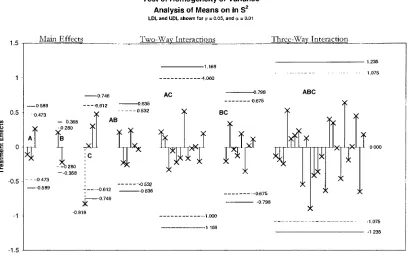
chart.Note
thatthe
chart(next page)
displays
decision limits
atthe
a
=0.01
level,
as well as atthe
OC
0.05
level
as calculated above.As
canbe
seenfrom
the
In ANOME
chart,
thevariability
differed for
the
different
levels
offactor C. In
particular,
weseethat the
variability for
thefirst level
offactor C is
significantly
less
thanthe
variability for
the
otherthree
levels
offactor
C.
Figure 1: Example
ofANOME
onIn
S2.
1.5 Main
Effects
0.5
c o
v
E
-1.5
Testof
Homogeneity
ofVariance AnalysisofMeansonInS2LDLandUDLshownfora=0.05,and a=0.01
Two-Way
Interactions^
Three-Way
Interaction-1.235 1.075
0 589 0.473
0.746
-fl.612
AC ABC
-0280
Tb
0 280
--0.368
-0473
0.589
BC
A
ft
X
-0.818
-+ 0.612
0.746
^0532 0 635
-0.675
--0.798
>^
I
l-L00
-1.075
-1.235
A, B,andC
Bartiett &
Kendall's
In ANOVA Test
of
Homogeneity
of
Variance
Bartiett
andKendall's3
ANOVA-type
test
ofhomogeneity
of varianceinvolves first
computing
the
subgroup
variancesandthen
computing
their
naturallogarithms,
as wasshown
previously
for
the
ANOME
onIn
S
.Next,
the theoretical
error varianceis
computedbased
onthe
number of replications as shownin
equation(12). Then
the
usual sum ofsquares,
degrees
offreedom,
and meansquares are computedfor
every
term
in
the
originalmodel.
Usually,
we would nothave
an errorterm
for
this
situation,
sincethere
is
noweffectively only
onereplicate ofthe
entire experiment andthe
model wouldthereforebe
completely
specified.However,
we make use ofthe theoretical
error variance withinfinite
degrees
offreedom
to
compute valuesfor
the
F-statistics
andperformtests
ofhypothesis.
The
analysis ofthe
exampledata from L. S. Nelson
is
shownbelow.
In
ANOVA
on
L. Nelson's Data
Source
DF
Adj
SS
Adj
MS
F
p
0.86224
0.43112
0.87925
0.4151
1.12867
1.12867
2.30188
0.1292
6.00366
2.00122
4.08141
0.0066
**0.90023
0.45012
0.91800
0.3993
1.26216
0.21036
0.42902
0.8601
1.04869
0.34956
0.71291
0.5441
3.50764
0.58461
1.19229
0.3069
0.49033
Again
wearrive atthe
conclusionthat the
variability differed for
the
different levels
offactor
C. This
time, however,
further investigation is
requiredto
determine
the
nature ofthis
difference.
Bartlett's Test
of
Homogeneity
of
Variance
Bartlett's8
test
ofhomogeneity
of varianceis
amodification ofNeyman
andPearson's12
generalized
likelihood-ratio
test
(LI test, 1931). This
modificationinvolved
replacing
the
biased
maximum-likelihoodestimators ofthe
variances with unbiasedA
2
B
1
C
3
A*B
2
A*C
6
B*C
3
A*B*C
6
Error
ooestimators and
substituting
n,-lfor n,
in
the
weights.Bartlett's
test
is
known
to
rely
heavily
on
the
assumptionofnormality
ofthe
underlying distributions.
The
value ofthe test
statisticis determined
from
the
data
by
first
computing
the
sample variances of each of
the
k
subgroups andthen
computing
the
subsequent pooledsample variance as
IK-Ds,2
pooled '='
N-k
(17)
Then
base-10
logarithms
aretaken
of each ofthe
k
sample variancesand ofthe
pooledvariance.
Ultimately,
the test
statisticis
givenby
(N-k)log10s^oled-X(ni-l)log10s12
ll
=2.3026-1
+
-1
(
k3(k-l)
1
1
trX-i
N-k
(18)
The
valueof%0
is
then
comparedto the
critical chi-square value withk-1
degrees
offreedom.
Levene's Test
with
Brown
and
Forsythe's Modification
Levene's6
test
withBrown
andForsythe's
modificationis essentially
anon-parametric
test
ofhomogeneity
of variance.The
test
statisticis
constructedasfollows:
Let
Vii
=Y
-Y
y
(19)
where
Y-
the
jthobservationin
the
ithgroup
andYj
=the
median ofthe
i' group.Then form
the
one-way ANOVA
statisticZni(V,-y.)2
i=l
F(calc)
=k
k~l
,
(20)
si^-v,.)2
N-k
where
%
v.
=^-(21)
V=J1
,
(22)
j='
N
and
N
=In,
i=l
(23)
is
the total
number of observationsin
the
experiment.The
value ofthe test
statistic,
F(calc),
is
comparedto
a critical value ofthe
F-distribution,
withk-1
numeratordegrees
offreedom
and
N-k denominator
degrees
offreedom.
Monte
Carlo
Simulations
Simulations
providedthemeansfor
assessing,
undercontrolledconditions,
the
ability
ofthese
individual
tests to
rejectcorrectly
orincorrectly
the
nullhypothesis. All
simulationsinvolved
abalanced,
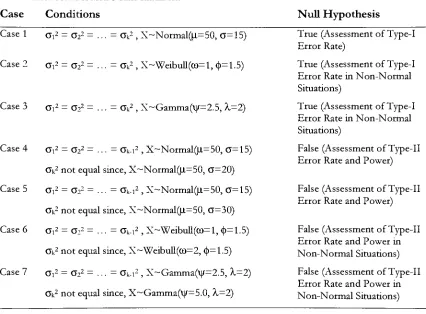
one-way layout. Seven
cases wereconsidered,
asindicated in Table 1
.Table
1Cases Used For Monte Carlo Simulation
Case
Conditions
Null
Hypothesis
Case
1
o"i2= 0"22Case
2
cm2=<j2
Ck2
,
X~Normal(p=50,
<7=15)
OV2
,
X~Weibull(CO=l,
<t>=1.5)
Case 3
oV
= a,2= = ak2^
X~Gamma(\|/=2.5,
A.=2)
Case 4
d2= Q22- - Ok-i2,
X~Normal(U=50,
0=15)
Ok2notequal
since,
X~Normal(U=50,
O"=20)
Case 5
<ji2= C22= ...= Ck-i2
,
X~Normal(Lt=50, C=15)
Ok2notequal
since,
X~Normal(U=50, O=30)
Case 6
oV
= G22= .. . =ak-i2
,
X~WeibuU(CO=
1
,
(|)=1.5)
CTk2
notequal
since,
X~Weibull(C0=2,
<p=1.5)
Case 7
oV
=a22 = .=OVi2
,
X~Gamma(\|/=2.5,
X-2)
<Jk2not equal
since,
X~Gamma(l|/=5.0,
X.=2)
True
(Assessment
ofType-I
Error
Rate)
True
(Assessment
ofType-I
Error Rate
in
Non-Normal
Situations)
True
(Assessment
ofType-I
Error Rate in Non-Normal
Situations)
False (Assessment
ofType-II
Error Rate
andPower)
False (Assessment
ofType-II
Error Rate
andPower)
False
(Assessment
ofType-II
Error Rate
andPower in
Non-Normal
Situations)
False (Assessment
ofType-II
Error
Rate
andPower in
Non-Normal
Situations)
To
assessthe
Type-I
errorratein
Cases
1, 2,
and3,
k
=2, 4,
6, 8,
and10
subgroupsweregeneratedand
compared,
withn=2,
3,
...,
10
replicateseach.The
otherfour
casesassessedthe power of
the
homogeneity
of variancetests
using
comparisons ofk
=2, 4, 6, 8,
and
10
subgroups with n =2, 3,
. . [image:26.561.68.494.221.535.2]One
thousand
simulations per condition(case,
subgroup,
and replicatecombination)
were conducted
in
accordancewithrandom-number-generating
procedures outlinedby
Dodson
andNolan13
These
procedures make use ofthe
fact
that
allBASIC-type
programming
languages
are capable ofproducing
uniformly-distributed pseudo-randomnumberson
the
[0,
1]
interval. These
uniformly-distributedrandom numbers canbe
usedto
generate other random numbers
for
almostany distribution. In
the
simplestform
ofrandom-number
generation,
this
is done
by
setting
the
cumulativedistribution function
ofthe
desired
density
function
equalto the
uniformly-distributed random number andthensolving
for
the random variable ofthe
newdistribution.
An
example ofthis
procedurefor
the
two-parameterWeibull
distribution is
shownin
Appendix A-3. When
a closedform does
not exist
for
the
cumulativedistribution
function,
special algorithms mustbe
employed.Two
such algorithms wereused
to
generateNormal-distributed
andGamma-distributed
randomnumbers.
The
codefor
all random numbers generatedis
availablein Appendix A-4.
[image:27.561.144.421.475.657.2]The
three
Normal distributions
chosenfor
this
study
areshownin Figure 2.
Figure 2: Normal Distributions Used for Simulations
Normal Distributions
90 100
The
two
forms
ofthe
Weibull distribution
usedfor
simulations are shownin
Figure 3.
Figure 3: Weibull
Distributions
Used for Simulations
Weibull Distributions
*=Shape Parameti
01=ScaleParamete
0)=1 *=1.5
/
v*=15
fix)
= -^x-'e B\
1.5 2 0 2.5 3.0 3.5
X
The
two
forms
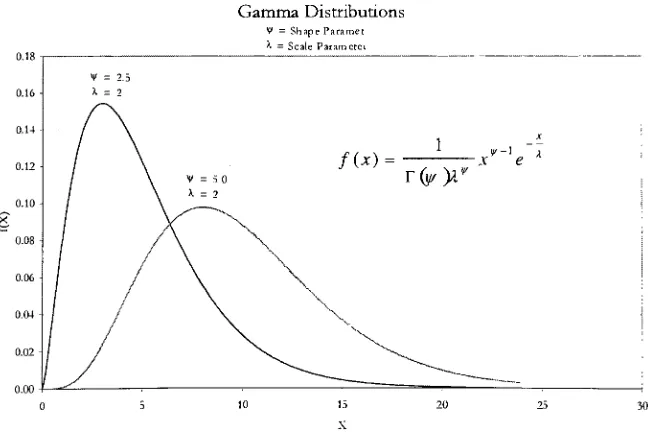
ofthe
Gamma
distribution (both
Chi-Square,
in
this
case,
sinceA,
2)
areshown
in Figure 4.
Figure 4:
Gamma Distributions Used for Simulations
Gamma
Distributions
V=ShapeParamec ^=ScaleParanacrei
[image:28.561.120.444.445.663.2]Once
randomnumbers ofthe
appropriatetype
weregenerated, the
number ofrejections of
the
nullhypothesis
(out
of one-thousandsimulations)
was recordedfor
eachsetof conditions.
This
wasdone concurrently
onthe
data
for
each ofthe
following
statisticaltests:
1
.the
standardANOVA for
testing
means,
2.
the
ANOVA
onIn
S,2
(In
ANOVA)
to test
for
homogeneity
ofvariance,
3.
the
proposedANOME
onIn S
2(In
ANOME)
to
testfor
homogeneity
ofvariance.
4.
Bartlett's Test
ofhomogeneity
ofvariance,
5.
the
standardF-test
(for k
=2
variancesonly),
and6.
Levene's
test
withBrown
andForsythe's
modification.In
situations werethe
nullhypothesis
of equal variances wastrue,
the tests
werecomparedon
the
basis
oftheirability
to
maintain,
over allconditions,
the expectedType-I
error rate.
When
the
nullhypothesis
wasfalse (that
is,
whenthe
last
ofk
variances wasnotequal
to the
otherk-1
variances),
the tests
were compared onthe
basis
of power.This
is
more
easily
understoodconsidering
the
following
familiar
diagram:
Figure
5: Types
ofError
In Hypothesis
Testing
Types
ofError:
Reject 1 1:
Simulation Conditions
Accept H:
Type-I
Error
a
Correct
Decision
Power
(1-P)
Correct
Decision
Type-II
Error
P
H0
True
H0
False
Casel
Case5
Case6
Case7
Simulation
Results
The
behavior
ofthe tests
ofhomogeneity
of variancein conforming
to the
Type-I
error rate at
the
five
percentlevel
arepresentedin Tables
2,
3,
and4. Each
ofthe tables that
follow
display
the
number of rejections(at
the
a
=0.05
significancelevel)
ofthe
nullhypothesis
of equal variances out of one-thousand simulations.Table 2: Results for Case
1,
Normal Distribution
with u=50,
andO=15
(Number of
rejectionsofthenullhypothesis
outof
1000)
n
HOVTest k 2 3 4 5 6 7 8 9 10
InANOVA 2 68 35 37 40 53 44 44 50 35
(Bartiettand
Kendall)
4 108 63 47 48 45 46 50 69 716 113 65 56 58 45 51 42 47 38
8 120 69 56 46 44 53 57 55 41
10 116 50 55 56 48 51 69 51 69
InANOME 2 68 35 37 40 53 44 44 50 35
(Volino)
4 119 70 50 49 46 52 53 70 666 142 82 66 77 54 53 46 65 47
8 172 98 85 66 75 77 67 62 50
10 177 92 93 88 70 72 94 64 76
Bartlett'sTest 2 34 28 35 36 51 40 43 48 35
4 31 39 27 33 38 41 39 54 63
6 36 32 31 41 40 34 33 38 38
8 19 30 26 20 34 34 50 40 33
10 16 21 25 32 28 39 50 39 47
F-Test(Two
Variances)
2 45 30 35 37 51 41 43 48 35Levene's Test 2 0 49 7 46 9 32 18 33
1 0 59 1 30 9 31 15 40
6 0 55 0 25 10 31 12 23
8 0 50 0 27 6 53 15 17
10 0 58 0 27 6 42 14 36
Even
though the
assumption of approximatenormality
ofIn
S2
is
statedin many
references as
holding
for k
>
5,
the
number of replicates within each cell was examinedfor k
<
5,
as well ask
=5, 6,
...,
10.
In
fact,
"real
world"
experiments
frequendy
have fewer
than
five
replicates.It
is
ofinterest,
therefore,
to
study
the
behavior
ofthese
statistics underless-than-idealconditions.
Both
the
In ANOVA
andIn
ANOME
techniques
are more aptto
rejectthe
hypothesis
of equal variancesthan
is
the
F-test,
Bartlett's
test,
orLevene's
test.Between
In ANOME
andIn
ANOVA,
ask
increases,
In
ANOME
rejectsslightly
more oftenthan
In
ANOVA.
This
makesIn ANOME
in its
presentform less
attractivethan
otherhomogeneity-of-variance
tests
for k
>6
or7.
Bartlett's test,
giventhe
conditionofnormality,
performed closest
to the
expected nominal rejection rate of50
out of1000,
or5%.
Curiously,
in Levene's test,
there
is
akind
of"odd-even"
effect
that
couldbe due
to
the
modification ofLevene's6
original
test
by
Brown
andForsyfhe7
(Brief
mention ofthis
"odd-even"
effect was made
in
Conover, Johnson,
andJohnson.14)
For
oddnumbers ofreplicates,
the
medianis
the value ofthe
"middle"observationin
terms
ofmagnitude.Considering
deviations
from
the
median,
based
on an odd number ofreplicates,
one termin
equation
(19)
is
always zero.Hence,
averages ofthe
Vtj
are smallermaking
the test
overly
conservative relative
to the
nominalType-I
rejection rate.In
fact,
for
n =3
replicatespercell,
the
nullhypothesis
was never rejected!(Calculations
from
the
simulation programswerecross-checked
frequently
withthe results obtainedfrom
both SAS
andMINITAB,
and alltest-statistics
andp-valuesagreed.) For
an evennumber ofreplicates,
the
resultsfrom
Levene's
test
wereless
conservativethan
resultsfor
oddnumbers ofreplicates,
but
were stillbelow
the
nominal rejection rate offive
percent.The
resultsfor
the
Weibull
andGamma
distributions
showthe
dependence
of all ofthese
tests,
exceptLevene's,
onthe
underlying
assumption of normality.Type-I
errorratesfor
allbut Levene's test,
whichagain gives evidence of an"odd-even"
effect,
are attimes
more
than triple
or quadruplethe
norninalfive
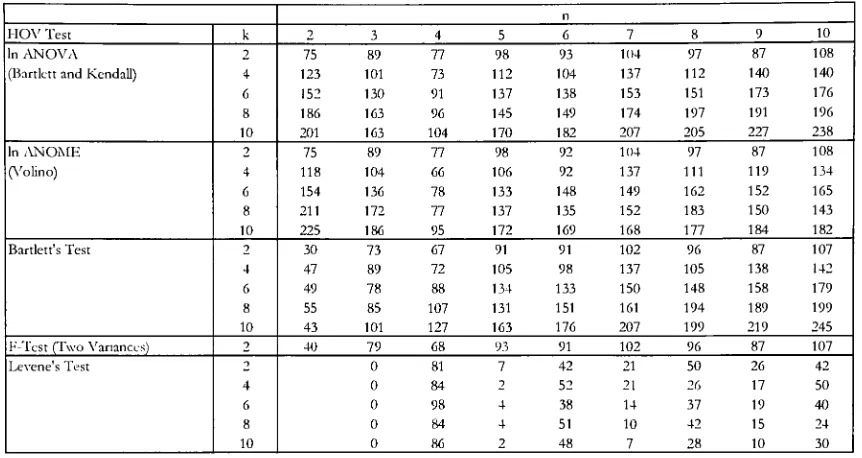
percent rejection rateone would expect.Table 3: Results for Case
2,
Weibull Distribution
with(0=1,
and ((Number of
rejectionsof
thenullhypothesis
outof 1
000)
1.5
n
ITOVTest k 0 3 4 5 6 7 8 9 10
In ANOVA 2 75 89 77 98 93 104 97 87 108
(Bartiettand
Kendall)
4 123 101 73 112 104 137 112 140 1406 152 130 91 137 138 153 151 173 176
8 186 163 96 145 149 174 197 191 196
10 201 163 104 170 182 207 205 227 238
InANOME 2 75 89 77 98 92 104 97 87 108
(Volino)
4 118 104 66 106 92 137 111 119 1346 154 136 78 133 148 149 162 152 165
8 211 172 77 137 135 152 183 150 143
10 225 186 95 172 169 168 177 184 182
Bartlett's Test 2 30 73 67 91 91 102 96 87 107
4 47 89 72 105 98 137 105 138 142
6 49 78 88 134 133 150 148 158 179
8 55 85 107 131 151 161 194 189 199
10 43 101 127 163 176 207 199 219 245
F-Tcst (Two
Variances)
2 40 79 68 93 91 102 96 87 107Levene'sTest n 0 81 7 42 21 50 26 42
4 0 84 ? 52 21 26 17 50
6 0 98 4 38 14 37 19 40
8 0 84 4 51 10 42 15 24
10 0 86 2 48 7 28 10 30
For
tests
of equal variancesin
non-normalsituations,
only Levene's test, for
evennumbers of
replicates,
yieldedaType-I
rejection rate comparableto the
nominal5%
rate.All
other
tests
resultedin greatly inflated Type-I
errorrates relativeto the
nominal.In
the
caseof an
underlying Weibull
distribution,
In
ANOME
was comparableto
orbetter
than
In
ANOVA
andBartlett's
Test for
n>
4
replicatesper subgroup.Also,
asthe
number ofvariances,
k, increased,
In ANOME
showedslightly better Type-I
error ratestability
than
did
either
In ANOVA
orBartlett's Test.
Table 4: Results for Case
3,
Gamma Distribution
with\(/=2.5,
andX
=2
(Number of
rejectionsof
thenullhypothesis
outof
1000)
n
HOVTcst k 2 3 4 5 6 7 8 9 10
InANOVA 2 88 75 89 105 109 116 117 139 127
(Bartiettand
Kendall)
4 114 98 122 134 139 154 165 181 1856 160 130 125 177 186 217 233 207 228
8 170 135 163 188 210 223 253 262 278
10 184 134 162 199 224 263 289 306 312
In ANOME 2 88 75 88 105 109 116 117 139 127
(Volino)
4 129 95 124 122 129 132 157 165 1786 184 125 139 157 154 203 202 188 210
8 186 153 158 182 178 205 9->a 222 254
10 220 164 162 176 172 224 233 233 254
Bartlett's Test 2 49 61 83 99 103 111 112 134 122
4 58 84 110 124 139 156 165 180 187
6 63 103 115 176 197 231 232 225 234
8 68 111 170 204 217 246 277 292 286
10 67 124 195 232 242 283 315 329 329
F-Test(Two
Variances)
2 59 67 84 99 104 111 112 134 122I.cvcnc'sTest n 0 82 5 46 24 38 29 49
4 0 109 5 44 15 43 19 43
6 0 98 7 43 16 48 12 40
8 0 83 2 47 9 41 20 22
10 0 93 4 37 12 33 18 30
The
performance ofthe
tests
ofhomogeneity
of variancein
maintaining
power(l-(3)
atthe
five-percent level
are presentedin Tables
5,
6, 7,
and8.
Tables 5
and6
showthe
resultsunder
normality
assumptions,
whileTables 7
and8
showthe
results under non-normality.Table 5: Results for
Case
4,
Normal Distribution
with(I=50,
andCm= C-2:(Number of
rejectionsof
thenullhypothesis
outof
1000)
= fJk-i=
15,
Ok=20
n
IIOVTest k 2 3 4 5 6 7 8 9 10
In ANOVA 2 77 45 41 55 86 95 135 114 117
(Bartiettand
Kendall)
4 99 75 51 58 68 91 106 98 1036 115 65 56 76 73 71 107 82 111
8 105 68 46 56 77 63 72 99 100
10 133 57 51 50 72 63 79 67 108
In ANOME 2 77 45 41 55 86 95 135 114 116
(Vohno)
4 111 75 54 66 73 100 102 100 1046 132 75 79 83 77 88 104 89 113
8 150 95 80 76 99 81 93 111 122
10 188 88 84 79 79 83 97 79 115
Bartlett's Test 2 37 30 37 51 81 87 133 110 116
4 31 47 37 58 76 93 98 101 109
6 27 30 29 61 71 78 99 94 125
8 27 36 32 44 73 71 67 102 106
10 40 23 27 47 63 61 83 76 110
F-Test (Two
Variances)
2 47 35 38 51 81 88 133 110 116Levene's Test 2 0 70 10 67 35 62 61 84
4 0 66 5 80 22 68 37 71
6 0 54 4 76 26 56 39 83
8 0 68 5 52 19 50 33 58
10 0 60 1 39 12 63 23 76
[image:33.561.71.480.444.674.2]From
Tables
5
and6,
it is
clearthat
alltests
respondto the
increase from 20
to
30 in
the
k'(J.
In
Table
5,
alltests that
rely
onthe
normality
assumption performed aboutequally
wellin
terms
ofpower.However,
the
In ANOME
test
seemedto
detect
the
difference in variability
of
the
kthgroup
morereadily
than
eitherIn
ANOVA
orBartlett's Test. The F-test
results aregenerally
so closeto those
ofBartlett's
test that there
is little
valuein
mentioning
both.
Judging
from
Table
6,
Bartlett's
test
seemsto
be
the
best
atdetecting
truedifferences in
variability,
followed
by
In ANOME.
Hence,
the
faith
ofmany
authorsin Bartlett's
testwhen [image:34.561.67.501.319.547.2]a
normality
assumptionis
tenable
seemsjustified.
Table 6: Results for Case
5,
Normal
Distribution
with u50,
and0i=O2:
(Number of
rejectionsof
thenullhypothesis
outof
1000)
Ok.i=
15,
ok=30
n
HOVTest k 0 3
4 5 6 7 8 9 10
InANOVA 2 80 95 114 197 264 318 419 436 504
(Bartiettand
Kendafl)
4 108 88 121 183 257 314 392 436 504 6 129 95 114 161 226 308 364 404 4518 145 95 94 131 210 226 366 365 417
10 151 95 102 133 167 219 305 333 398
InANOME 2 80 95 114 197 264 318 419 436 504
(Volino)
4 122 72 132 179 286 343 402 457 512 6 142 104 140 177 272 334 406 451 5168 184 110 115 170 254 295 439 471 509
10 194 134 122 184 241 293 397 456 519
Bartlett's Test 2 45 84 101 185 257 310 412 427 499
4 61 90 166 227 328 386 463 500 566
6 55 78 155 216 299 387 474 479 568
8 43 116 129 205 328 348 503 501 545
10 34 93 135 215 276 335 442 479 550
F-Test(Two
Variances)
1 57 84 104 185 258 311 412 427 499Levene'sTest 2 0 102 25 151 106 268 192 308
4 0 158 55 237 165 326 282 389
6 0 140 48 198 180 305 299 407 8 0 134 43 191 142 351 310 407
10 0 146 41 198 125 302 278 398
For Cases 6
and7,
it
wasnot possiblein
simulationsto
alterthe
variance of agroup
withoutalso
changing
the
group's mean.This
is due
to
thefact
that
for
the
Weibull
andGamma
distributions,
both
the
mean andthe
variance ofthe
populationaredirect functions
of
the
parametersthat
describe
these
distributions.
Nonetheless,
the
results are shownin
Tables
7
and8
for k-1
groupsfrom
thesame population andthe
kc
[image:35.561.69.493.156.407.2]group
different.
Table 7: Results for Case
6,
Weibull Distributions
withCO=1,
and<|>=1.5
(Firstk-1
groups), CO=2
(kIhgroup)
(Number of
rejectionsof
thenullhypothesis
outof
1000)
n
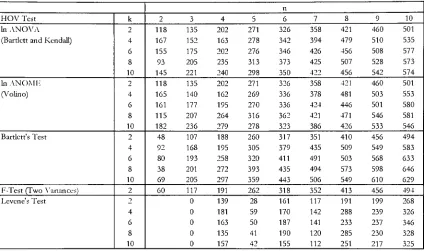
HOV
Test
k 2 3 4 5 6 7 8 9 10In ANOVA 2 118 135 202 271 326 358 421 460 501
(Bartiett
andKendall)
4 167 152 163 278 342 394 479 510 535 6 155 175 202 276 346 426 456 508 577 8 93 205 235 313 373 425 507 528 573 10 145 221 240 298 350 422 456 542 574 In ANOMK 2 118 135 202 271 326 358 421 460 501(Volino)
4 165 140 162 269 336 378 481 503 5536 161 177 195 270 336 424 446 501 580 8 115 207 264 316 362 421 471 546 581 10 182 236 279 278 323 386 426 533 546 Bartlett's Test 2 48 107 188 260 317 351 410 456 494
4 92 168 195 305 379 435 509 549 583 6 80 193 258 320 411 491 503 568 633 8 38 201 272 393 435 494 573 598 646 10 69 205 297 359 443 506 549 610 629 F-Test (Two
Variances)
2 60 117 191 262 318 352 413 456 494Levene'sTest 2 0 139 28 161 117 191 199 268 4 0 181 59 170 142 288 239 326 6 0 163 50 187 141 233 237 346 8 0 135 41 190 120 285 230 328 10 0 157 42 155 112 251 217 325
For
the
simulations ofCase
6,
involving
Weibull-distributed data
withthe kthgroup
having
mean and variancedifferent from
the
otherk-1
groups,
the
number ofrejectionsofthe null
hypothesis
was on averagedouble
the
rejection ratein
the
homogenous
case(see
Table 2:
allk
groupsthe
same).This
was afairly
commonphenomenonacross alltests.Bartlett's
test
wasthe
most sensitiveto the
difference in
the
kth
group,
followed
by
Bartiett
and
Kendall's In ANOVA. The
results ofLevene's
test
once again revealedthe
"odd-even"effect mentioned earlier
and,
asusual,
wasthe mostconservativein
declaring
differences
among
the
within-group
variances.Note
that the
actual variancefor
the
first
k-1
Weibull-distributed
groups was0.376,
as opposed
to
a variancein
the
k*
group
of1.503,
detenriined
by
the
formula for Weibull
variance,
namely
=GJU
r
rL
0_
-ri+i
[image:36.561.67.494.241.493.2]1
L
*
(24)
Table 8: Results for Case
7,
Gamma Distributions
with\|/=2.5,
andX
-2
(1stk-1
groups),\|/=
5.0
(klhgroup)
(Number of
rejectionsof
thenullhypothesis
outof1000)
n
IIOYTest k 2 3 4 5 6 7 8 9 10
In ANOVA -) 82 84 103 130 167 185 216 204 248
(Bartiettand
Kendall)
4 124 113 145 175 190 240 234 267 3056 136 105 183 181 249 265 282 302 335
8 152 134 166 219 253 303 300 349 364
10 189 174 199 245 274 301 389 397 409
In ANOME -> 82 84 103 130 167 185 216 204 248
(Volino)
4 132 111 129 162 166 218 232 264 2876 152 116 176 179 211 245 261 280 300
8 171 137 165 204 226 254 270 299 305
10 217 185 197 206 232 238 309 311 317
Bartlett's Test 2 46 68 94 118 162 181 214 201 240
4 49 104 142 177 187 236 251 265 314
6 45 103 192 214 257 284 302 324 346
8 46 134 187 246 274 324 357 377 378
10 68 160 216 283 280 316 425 408 456
F-Test (Two
Variances)
2 62 74 97 118 163 181 214 202 241Levene'sTest 2 0 86 13 70 44 93 81 110
4 0 107 19 80 34 103 65 112
6 0 99 10 72 33 74 55 99
8 0 113 10 51 24 81 48 84
10 0 95 9 69 33 73 50 73
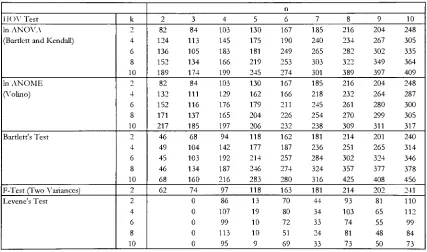
In
an examination of power(l-f3)
ofthetests
performedon variancesfrom
Gamma
distributions,
oftests that
rely
onnormality
(mcluding
In
ANOVA,
In
ANOME,
andBartlett's test), Bardett's
test
againprovidedthe
most power whenk
>4
andn>
3.
In
ANOVA
andIn ANOME
werenearly
as powerful.Levene's
test
wasconservativeto the
extent
that
it
was almost worthless as atest
ofequality
of variances.Not surprisingly,
this
same
test
was muchless
powerfulfor
an oddnumber of replicatesthan
for
an even numberofreplicates.
Summary
and
Conclusions
An
analysis-of-means-typetest
(In
ANOME)
for
determining
differences in
variability
between
subgroupsfrom
normalpopulations was presented.Its
merits parallelthose
ofthe
usual analysis ofmeansin
that the
result ofthe test
is
agraphical representationof
the
differences due
to the
various combinations ofthe
variables.In ANOME has
the
advantage of
providing
its
own estimate ofthe
error variances and ofrelying
onthe
sametables that
arecommonly
availablefor
thestandardANOME
procedure.In
cases ofnormality,
the
In
ANOME
test, in its
presentform,
is
less
ableto
maintain stable
Type-I
errorratesthan
is
the
commonly
acceptedBardett's
test.In
cases ofnon-normality,
in
terms
ofboth Type-I
error rate andpower,
In ANOME is
comparableto
andsometimes
better
thanothertests
like Bartlett's
test
andIn ANOVA.
Moreover,
theresults
from
this
study
suggest thatthe
In ANOME
procedure would allowfor fewer
than
the
"n
=5
replicates"
cutoff
that
Bartiett
andKendall
recommendedfor
approximatenormality
ofIn
S2
The
expectedType-I
andType-II
errorrates weremaintainedfor
n =4
replicates,
andsometimes evenfor
n=3
replicates.Bartlett's
test
is
usually
preferredin
the
literature for comparing
variancesfrom
normal
distributions.
Results
obtainedin
this
investigation
confirmthat
Bardett's
test
provides good power when
the
assumptionofnormality is
tenable.
When
that
assumptionis
in
doubt,
In ANOME
orIn ANOVA may
provideslighdy
more stable error rates ofboth
types.
Levene's test,
withBrown
andForsythe's
modification,
is
plaguedby
an"odd-even"
effect
in its
ability
to
maintainboth
the
Type-I
errorrate and power.For
n=3replicates,
the
test
never