Int. J. Electrochem. Sci., 14 (2019) 8121 – 8130, doi: 10.20964/2019.08.86
International Journal of
ELECTROCHEMICAL
SCIENCE
www.electrochemsci.orgNovel Nanofibrous Dy
2Ce
2O
7as an Electrocatalyst for Methanol
Oxidation
Aijuan Zhao1, Haijie Sun1,*, Lingxia Chen1, Yufang Huang1, Mubing1, Xingjie Lu2,*, Hairong Gao1, Yaping Wang1, Xiuli Chen1
1 Institute of Environmental and Catalytic Engineering, College of chemistry and chemical
engineering, Zhengzhou Normal University, Zhengzhou 450044, Henan, China 2 Henan Istitute of Metrology, Zhengzhou 450000, Henan, China
*E-mail: [email protected], [email protected]
Received: 28 March 2019/ Accepted: 21 May 2019 / Published: 30 June 2019
The present paper has utilized nanoparticles of fibrous Dy2Ce2O7. The catalytic strength of fibrous Dy2Ce2O7 was used as an electrocatalystin the case of methanol oxidation reaction. The fibrous Dy2Ce2O7 NPs are completely in vestigated by taking advantages of AFM, XRD, EDS, BET, TEM, FESEM and FT-IR analyses. The fibrous Dy2Ce2O7 indicated high stability forreaction without considerable loss of some property like activity.
Keywords: Electrocatalyst, Nano catalyst, Dy2Ce2O7, Green chemistry, Nanoparticle
1. INTRODUCTION
Bimetallic nanoparticles are promising materialsdue to their porous, large surface zones, abundant active sites, and open structures subjected on the branched surfaces [1-10] Assessment of Re2Ce2O7 as a rare earth cerate are gaining importance because of its wide applications in diverse fields [11-18]. Diverse methods have been presented to synthesis the rare earth create [19-22]. This technique is not cost impressive and not eco-friendly viable because of the usage of harmful chemical material, or complex casesduring preparation. Therefore, there is main need to drop the harmful chemical materials as well as to present clean and alsoeffective tanique to fabricate the nano-scale rare earth cerate.
employment of DMFC to a large extent [26-33]. Thus, increase the activity and stability of Pt catalysts as well as reducing the cost of Pt catalysts will be more practical for the development of DMFC.
Due to high-index forms have a high density of low-coordinated compared to other similar materials step atoms by high reactivity. In the present paper, a new fibrous Dy2Ce2O7 nanostructures with having noteworthy properties are produced and selected as electrocatalyst for the oxidation reactionof methanol in an aqueous medium. The system of Microemulsion caused toform a novel morphology of mesoporous Dy2Ce2O7 with having dendrimeric fibers developed outward producing a high surface area as well as high availability of the reactant to the functional compounds. The production of fibrous Dy2Ce2O7 nanoparticles has been realized by reduction of a ceric ammonium nitrate as well as dysprosium nitrate on the templates of sacrificial polymeric micelle. Dy2Ce2O7 nanostructure is unique with this kind of fibrous morphology.
2. EXPERIMENTAL
High purity chemicals were procured from Fluka and Merck. Electrothermal 9100 apparatus were utilized for the determination of uncorrected melting points in open capillaries. VERTEC 70 spectrometer (Bruker) in transmission mode were used for the determination of FTIR spectra. Samples were pulverized and pelletized with spectroscopic grade KBr. Determination of size and structure of nano particles were done via transmission electron microscope (TEM) (Phillips CM10) operated at 100 kV. The crystallographic structures of nano particles are characteristicsby utilizing powder X-ray diffraction (Bruker D8 Advance model) with Cu ka radiation. Thermal gravimetry analysis (TGA) (NETZSCH STA449F3) is used with a heating rate of 10°C/min(under nitrogen atmosphere). NMR spectra of 1H and 13C were determined with BRUKER DRX-300 AVANCE spectrometer and BRUKER DRX-400 AVANCE spectrometer. The NMR spectra recorded for both elecments were at 300.13 and 75.46 MHz; 400.22 and 100.63 MHz, respectively. Heraeus CHN-O-Rapid analyzer were used to perform elemental analyses for carbon, hydrogen and nitrogen. Thin later chromatography (TLC) done on silica gel polygramSILG/UV 254 plates were used for the determination of product purity and monitoring of reaction. Shimadzu GCMS-QP5050 Mass Spectrometer were used to map the mass spectra.
2.2. General procedure for the preparation of fibrous Dy2Ce2O7 NPs
2.3. Preparation of working electrode
A glassy carbon electrode (GCE) with having a diameter around 3 mm and active surface zone of 0.071 cm2 is burnished by slurry of alumina powder and then cleaned by deionized water. A certain amount of catalyst was evenly scattered in around 1000 μL deionized water by ultrasonication. After that, 8 μL of the catalyst suspension was dropped onto the GCE. After the catalyst suspension was dried, 6 μL of 0.5% Nafionisreleased onto the GCE. The GCE is dried in air before use. The mass loading of Pt on GCE is about 8 μg for wholeconsidered catalysts.
2.4. Electrochemical tests
The electrochemical performances are tested by using a three-electrode cell on a CHI-660D model electrochemical workstation at room temperature. The base electrode was a saturated calomel electrode (SCE). Then the auxiliary electrode was a platinum electrode (2cm×2cm). In the cyclic voltammetry (CV) tests, the scanning rate was 50 mV/s, and the potential window was -0.2 ~ 1.0 V. The electrolytes were N2 saturated 0.5 M H2SO4 solution or N2 saturated 0.5 M H2SO4 + 0.5 M CH3OH solution. The data were recorded after the figure tend stable. The chronoamperometry experiments were performed at 0.6 V for 3600 s in 0.5 M H2SO4 + 0.5 M CH3OH.
3. RESULTS AND DISCUSSION
Figure 1. FESEM images ofDy2Ce2O7 NPs (a); TEM images ofDy2Ce2O7 NPs (b).
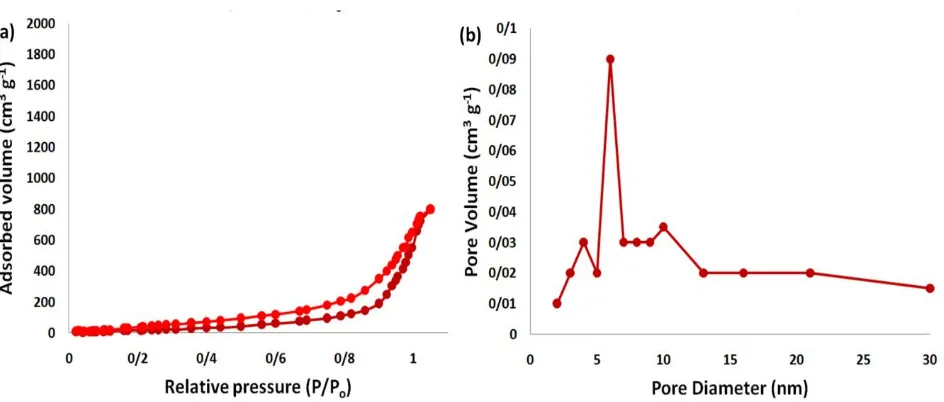
The analysis of nitrogen physisorption indicated that the BET specific surface area of the dendritic fibrous nano Dy2Ce2O7 were around 209 m2/g. As can be observed in Figure 2, the nitrogen adsorption-desorption isotherms of the dendritic fibrous nano Dy2Ce2O7 based catalysts. The dendritic fibrous nano Dy2Ce2O7 indicated a kind IV isotherm, by a H1-type hysteresis loop, proposing the attendance of mesopores. The corresponding pore size dispensation predicted from the desorption series of the nitrogen isotherm using the BJH procedure displayed a narrowpore size distribution peaked at about 6 nm (as can be seen Table 1).
[image:4.596.68.540.494.695.2]Table1. Structural parameters of Dy2Ce2O7 NPs.
Catalysts SBET (m2 g-1) Va (cm3 g-1) DBJH (nm)
Fibrous nano Dy2Ce2O7 209 1.4 6
[image:5.596.104.494.104.135.2]The analysis of XRD that is highly useful method todetermine crystalline structure as well as average crystallite size, isused to test the as-obtained nanostructured Dy2Ce2O7. Total the diffraction peaks showed in Figure 3 are properly matched with pure fluorite Dy2Ce2O7. As seen no impurities existed in this schema. The surface roughness of Dy2Ce2O7 NPs in its fibrous shape is too characterized using atomic force microscopy (AFM) as well as the images of topographic that are shown in Figure 4. As seen, the more height region determined using the brighter yellowish white color enhanced by reducing T/W, proposing the roughness increase in the surface of catalyst. Figure 5 demonstrated which FT-IR spectrum which analyzed to obtain more details concerning surface of the created nanostructured Dy2Ce2O7 in its fibrousshape. The peaks around 3440 and 1632 cm-1 of the spectrum explain the attendance of physically adsorbed water molecule. In addition, the peaks related to Dy2Ce2O7 are placed at 1462, 1104 and 454 cm-1.
Figure 4. Three-dimensional of AFM images of fibrous Dy2Ce2O7 NPs.
Figure 5. FT-IR spectrum of the produced fibrous Dy2Ce2O7 NPs.
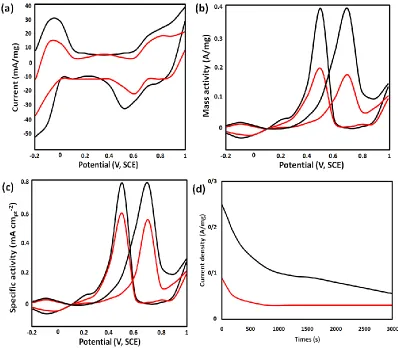
[image:6.596.64.530.360.610.2]6b, a peak current was obtained by fibrous nano Dy2Ce2O7 yolk-shell nanoalloy (0.39 A/mg) than that of simple nano Dy2Ce2O7 (0.18 A/mg) at ~0.69 V. As compared in Figure 6c, the fibrous nano Dy2Ce2O7 had a higher activity in term of specific area. Finally, Chronoamperometry is employed to study the electrochemical activity and stability of the catalyst. As can be seen from Figure 6d, the fibrous nano Dy2Ce2O7 had a much better stability compared with the simple nano Dy2Ce2O7. After 5 min, the current density of the fibrous nano Dy2Ce2O7 is higher (0.08 A/mg) by factor of 5 times than simple nano Dy2Ce2O7 (0.03 A/mg), further demonstrating the better electrocatalytic durability.
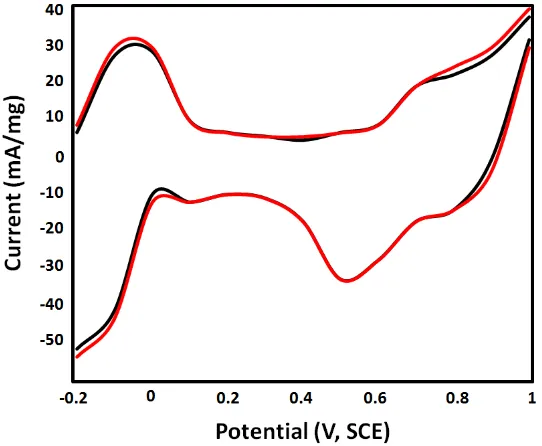
[image:7.596.100.498.345.693.2]The durability of fibrous nano Dy2Ce2O7was further verified by cyclic voltammetry in N2 -purged 0.5 M H2SO4, where the electrochemically active surface area (determined from the hydrogen adsorption region) is almost kept constant with a small loss of 0.9% within 200 cycles. The improved electrocatalytic ability, strong tolerance, and better stability of fibrous nano Dy2Ce2O7are attributed to two factors. (i) The dandelion-like structures contribute to a larger electrochemically active surface area and the abundant atomic steps, edges, and corner atoms in the Dy2Ce2O7 fibers would act as highly active sites for methanol oxidation. (ii) Better dispersion of the fibrous Dy2Ce2O7 nanoparticles on the enlarges the surface area and facilitates electron transport (Figure 7).
Figure 7. The cyclic voltammograms of the fibrous nano Dy2Ce2O7 electrode before and after 200 cycles in N2-saturated 0.5 M H2SO4.
According to the above results of our prepared electrocatalyst, an improved performance was achieved when compared with other electrocatalysts in the literature [34-39] as shown in Table 2 as follows: The potential value of the first oxidation peak at Pd-Ni/C electrocatalyst precedes that at both Ni-Pd/Si and Ni-Pd/Si-microchannel plates, prepared by electroless plating followed by annealing at 300 oC [34] by 42 and 32 mV, respectively and that at Pd-1 wt.% MWCNTs-5 wt.% Ni electrocatalyst by 37 mV [37]. An increased current density value by 4.6 times was shown at the first oxidation peak of our Pd-Ni/C electrocatalyst, in relation to that of ethanol oxidation reaction at Pd2Ni3/C, prepared by solution phase-based nanocapsule method [35]. It is comparable to that obtained at Pd1Ni3/C electrocatalyst, prepared by impregnation method using NaBH4 as a reducing agent, during allyl alcohol oxidation [36]. As shown in Table 2, the yolk-shell structure of our catalyst was more active than other catalyst, indicating a promising application for methanol oxidation. The activity and selectivity of nano-catalyst can be manipulated by tailoring chemical and physical properties like size, shape, composition and morphology. Besides, the large space between fibers can significantly increase the accessibility of the active sites of the nanofibrous Dy2Ce2O7. That is why, the nanofibrous Dy2Ce2O7 was more effective than other nano catalysts. As a result, nanofibrous Dy2Ce2O7 were used in the subsequent investigations because of its high reactivity, high selectivity and easy separation.
Table 2. Comparison of nano catalysts for methanol electrooxidation. Entry Catalyst Preparation
method
Organic substrate
Oxidation solution
I Refs.
1 Ni-Pd/Si Electroless plating followed by annealing at 300
oC
Methanol (2 M KOH + 1 M methanol)
3.28 mA 34
2
Ni-Pd/Simicrochannel plates
Electroless plating followed by annealing at 300
Methanol (2 M KOH + 1 M methanol)
[image:8.596.147.418.88.311.2]oC
3 Pd2Ni3/C Solution
phase-based nanocapsule method
Ethanol (1 M KOH + 1 M methanol)
1.66 mA cm-2
35
4 Pd1Ni3/C Impregnation
method using NaBH4
Allyl alcohol
(0.5 M NaOH + 0.1 M allyl
alcohol)
9 mA cm-2 36
5 Pd-1 wt.% MWCNTs-5 wt.%
Ni
Impregnation method using
NaBH4
Methanol (1 M KOH + 1 M methanol)
341.68 mA cm-2
mg-1 (Pd)
37
6 Pd-Ni/MWCNTs Impregnation method using
NaBH4
Methanol (0.5 M KOH + 1 M methanol)
482.2 mA mg-1 (Pd)
38
7 Ni@Pd/MWCNTs Core and shell method
Methanol (0.5 M KOH + 1 M methanol)
770.7 mA mg-1 (Pd)
38
8 Pd-Ni/C Impregnation method using formic acid
Methanol (1 M KOH + 1 M methanol)
530 mA mg-1 (Pd)
39
9 Nanofibrous Dy2Ce2O7
Core and shell method
Methanol (0.5 M H2SO4
+ 0.5 M methanol)
390 mA mg-1 (Pd)
Our work
4. CONCLUSIONS
In conclusion, fibrous Dy2Ce2O7 nanoparticles was synthesized successfully by a simple method. The obtained nanoalloy was well characterized by a series of methods and used as catalyst for the electrooxidation of methanol. The fibrous nano Dy2Ce2O7 showed welldefned dandelion-like structures as well asproperdissemination that exhibited enhancedelectrocatalyticcharacteristics. Besides, fibrous nano Dy2Ce2O7denoted an improved catalytic activity and also stability for methanol oxidation. The asdevelopedsystem presents a promising approach for the design of highly effective electrocatalysts for oxidation of methanol.
ACKNOWLEDGEMENTS
This work was supported.by the Key Scientific and Technological Project of Henan Province (192102210139), the Key Scientific Research Project of Henan Province (18A180018), the Environmental Catalysis Innovative Research Team of Zhengzhou Normal University (702010), and the Student Innovative Program of Zhengzhou Normal University (DCZ2017014).
References
1. B. Lim, M. Jiang, P. H. C. Camargo, E. C. Cho, J. Tao, X. Lu, Y. Zhu, Y. Xia, Science, 324 (2009) 1302–1305.
2. L.M. Yang, Z.L. Chen, D. Cui, X. B. Luo, B. Liang, L.X. Yang, T. Liu, A. J. Wang and S. L. Luo. Chem. Eng. J., 359(2019)894.
3. S. Guo, S. Dong, E. Wang, ACS Nano, 4 (2009) 547–555.
4. P. H. Shao, J. Y. Tian, F. Yang, X. G. Duan, S. S. Gao, W. X. Shi, X. B. Luo, F. Y. Cui, S. L. Luo and S. B. Wang, Adv. Funct. Mater., 28 (2018) 1705295.
5. Q. Sun, Y. Yang, Z. Zhao, Q. Zhang, X. Zhao, G. Nie, T. Jiao and Q. Peng, Environ. Sci: Nano, 5 (2018) 2440.
7. L. Shi, A. Wang, T. Zhang, B. Zhang, D. Su, H. Li, Y. Song, J. Phys. Chem. C, 117 (2013) 12526– 12536.
8. S. F. Tang, D. L. Yuan, Y. D. Rao, M. H. Li, G. M. Shi, J. M. Gu and T. H. Zhang. J. Hazard. Mater., 366 (2019) 669.
9. X. Cao, N. Wang, S. Jia, L. Guo, K. Li, Biosens. Bioelectron., 39 (2013) 226–230.
10.H. Ataee-Esfahani, L. Wang, Y. Nemoto and Y. Yamauchi, Chem. Mater., 22 (2010) 6310–6318. 11.R. Mezzenga, Q. R. Zhang, S. Bolisetty, Y. P. Cao, S. Handschin, J. Adamcik and Q. M. Peng,
Angew. Chem. Int. Edit., 2019, Doi: 10.1002/anie.201901596.
12.G. Meng, G. Ma, Q. Ma, R. Peng, X. Liu, Solid State Ionics, 178 (2007) 697-703. 13.Z.G. Liu, J.H. Ouyang, K.N. Sun, Fuel Cell., 11 (2011) 153-157.
14.X. Cao, R. Vassen, W. Fischer, F. Tietz, W. Jungen, D. Stover, Adv. Mater,. 15 (2003) 1438-1442. 15.X. Y. Min, X. Wu, P. H. Shao, Z. Ren, L. Ding, X. B. Luo, Chem. Eng. J., 358 (2019) 321. 16.Z. Salehi, S. Zinatloo-Ajabshir, M. Salavati-Niasari, RSC Adv., 6 (2016) 26895-26901.
17.Y. Ling, J. Chen, Z. Wang, C. Xia, R. Peng, Y. Lu, Int. J. Hydrogen Energy, 38 (2013) 7430-7437. 18.S. Zinatloo-Ajabshir, Z. Salehi, M. Salavati-Niasari, Journal of Alloys and Compounds, 763 (2018)
314-321.
19.C. Wang, Y. Wang, A. Zhang, Y. Cheng, F. Chi, Z. Yu, J. Mater. Sci., 48 (2013) 8133-8139. 20.C. Wang, W. Huang, Y. Wang, Y. Cheng, B. Zou, X. Fan, J. Yang, X. Cao, Int. J. Refract. Metals
Hard Mater., 31 (2012) 242-246.
21.F.W. Bezerra Lopes, C.P. de Souza, A.M. Vieira de Morais, J.-P. Dallas, J.-R. Gavarri, Hydrometallurgy, 97 (2009) 167-172.
22.C. Sanchez-Bautista, A.J. Dos santos-García, J. Pe~na-Martínez, J. Canales-V_azquez, Solid State Ionics, 181 (2010) 1665-1673.
23.E. Antolini, J. Power, Sources, 170 (2007)1.
24.E. Antolini, E. R. Gonzalez, Appl. Catal. B-Environ., 63 (2006) 137. 25.U. B. Demirci, J. Power Sources, 173 (2007) 11.
26.N. Kakati, J. Maiti, S. H. Lee, S. H. Jee, B. Viswanathan, Y. S. Yoon, Chem. Rev., 114 (2014) 12397.
27.H. S. Liu, C. J. Song, L. Zhang, J. J. Zhang, H. J. Wang, D. P. Wilkinson, J. Power Sources, 155 (2006) 95.
28.N. S. Porter, H. Wu, Z. W. Quan, J. Y. Fang, Acc. Chem. Res., 46 (2013) 1867.
29.Y. K. Zhou, K. Neyerlin, T. S. Olson, S. Pylypenko, J. Bult, H. N. Dinh, T. Gennett, Z. P. Shao, Energ. Environ. Sci., 10 (2010) 1437.
30.X. Q. Huang, S. H. Tang, X. L. Mu, Y. Dai, G. X. Chen, Z. Y. Zhou, F. X. Ruan, Z. L. Yang, N. F. Zheng, Nat. Nanotechnol., 6 (2011) 28.
31.S. J. Guo, E. K. Wang, Acc. Chem. Res., 44 (2011) 491. 32.S. Sakong, A. Gross, Acs Catal., 6 (2016) 5575.
33.C. Li, R. Dai, R. Qi, X. Wu, J. Ma, Int. J. Electrochem. Sci., 12 (2017) 2485.
34.F. Miao, B. Tao, L. Sun, T. Liu, J. You, L. Wang, P.K. Chu, J Power Sources, 195 (2010) 146. 35.Z. Zhang, L. Xin, K. Sun, W. Li, Int J Hydrogen Energy, 36 (2011) 12686.
36.C. Jin, X. Sun, Z. Chen, R. Dong, Mater Chem Phys., 135 (2012) 433. 37.R.N. Singh, A. Singh, Int J Hydrogen Energy, 34 (2009) 2052.
38.Y. Zhao, X. Yang, J. Tian, F. Wang, L. Zhan, Int J Hydrogen Energy, 35 (2010) 3249. 39.Z. Liu, X. Zhang, L. Hong, Electrochem Commun., 11 (2009) 925.