4109 EN
– TI-AG-12-001-EN-C
Europe 123, 570 01 Thessaloniki (Pylea), GREECE PO Box 22427, 551 02 Thessaloniki, GREECE
Tel. +30 2310490111, Fax +30 2310490020, E-mail: [email protected] European Centre for the Development
of Vocational Training
work
2012
programme
work
2012
programme
Luxembourg: Publications Office of the European Union, 2012
A great deal of additional information on the European Union
is available on the Internet.
It can be accessed through the Europa server (http://europa.eu).
Cataloguing data can be found at the end of this publication.
Luxembourg:
Publications Office of the European Union, 2012
ISBN 978-92-896-0884-8 doi:10.2801/3001
© European Centre for the Development of Vocational Training, 2012
All rights reserved.
The European Centre for the Development of Vocational Training(Cedefop) is the European Union's reference centre for vocational education and training. We provide information on and analyses of vocational education and training systems, policies, research and practice.
Cedefop was established in 1975 by Council Regulation (EEC) No 337/75.
Europe 123, 570 01 Thessaloniki (Pylea), GREECE PO Box 22427, 551 02 Thessaloniki, GREECE Tel. +30 2310490111, Fax +30 2310490020 E-mail: [email protected]
www.cedefop.europa.eu
Christian F. Lettmayr, Acting Director
Contents
1. Introduction 2
2. Policy background 4
3. MTP 1 –Supporting modernisation of VET systems 9
Monitoring, analysing and reporting on policy developments 9
Common European tools and principles, learning outcomes and qualifications 11
Study visits 13
4. MTP 2 –Career and transitions – CVET, adult and work-based learning 14
Adult and work-based learning 14
Individualsʼ learning and work trajectories, careers and transitions 16
5. MTP 3 –Analysing skills and competence needs to inform VET provision 17
6. Communication, information and dissemination 19
External communication 19
Documentation and information 21
Publications and content management 21
7. Management, risk management, resources and internal control 22
8. Activity fiches by medium-term priority, activity and project 29
ANNEXES I Activity-based budget (ABB) 60
II Cedefop organisation chart 61
III Human resources 62
IV Cedefop networks 63
V Cooperation between Cedefop and the European Training Foundation 64
VI Planned publications 2012 65
Cedefopʼs 2012 work programme has been established under new medium-term priorities 2012-14 adopted in June 2011 (1). They are aligned to objectives of the European Union strategy, ʻEurope 2020ʼ (2) and its flagship initiatives, the Education and training 2020 framework (3) and the Bruges communiqué (4) with its long-term objectives and short-term deliverables for Member Statesʼ, the European Commissionʼs and European social partnersʼ continued joint work on vocational education and training (VET) within the Copenhagen process (5). This policy framework reinforces the pivotal role of vocational education and training. Neither in the EU nor in the USA has the economic crisis yet been overcome. While some countries have shown promising signs of recovery the overall economic situation has remained volatile and several members of the
Eurozone are struggling with fundamental financial problems, recession and high levels of unemployment.
Cedefop, founded in 1975 (6) and based in Greece since 1995, is the EUʼs agency for European VET policy. Cedefopʼs work is based on policy and actions agreed at European level. Cedefopʼs activities cover skills and competences (7), initial and continuing VET and their roles in lifelong learning. Cedefopʼs work integrates the interests, priorities and needs of policy-makers in the European Commission, Member States, and social partners who are actors at all levels of VET policy and practice: European, national, regional, sectoral and enterprise.
Cedefopʼs added value is the high quality of its comparative analyses and expertise. Cedefop cooperates closely with European
1.
Introduction
(1) Cedefop. Medium-term priorities 2012-14. Luxembourg: Publications Office of the European Union, 2011. Available from Internet: http://www.cedefop.europa.eu/EN/Files/4104_en.pdf [cited 15.9.2011].
(2) European Commission. Europe 2020: a European strategy for smart, sustainable and inclusive growth. Available from Internet: http://ec.europa.eu/eu2020/index_en.htm[cited 15.9.2011] and Europe 2020: a new European strategy for jobs and growth. European Council Presidency conclusions 25-26 March 2010. Available from Internet: http://register.consilium.europa.eu/pdf/ en/10/st00/st00007.en10.pdf [cited 15.9.2011].
(3) Council of the European Union. Conclusions on a strategic framework for European cooperation in education and training (ET 2020)
of 12 May 2009. Official Journal of the European Union, C 119, 28.5.2009, p. 2-10. Available from Internet: http://eur-lex.europa.eu/ LexUriServ/LexUriServ.do?uri= OJ:C: 2009:119:0002:0010:en:PDF[cited 15.9.2011].
(4) Bruges communiqué on enhanced European cooperation in vocational education and training for the period 2011-20. Communiqué
Introduction 3
institutions, especially the Commission and Parliament, as well as the Economic and Social Committee and the Committee of the Regions, the European Training Foundation (ETF), other European organisations and international organisations such as OECD, ILO and Unesco to reinforce its added value and secure synergy of common efforts. By combining its research and networking capabilities, Cedefop uses its expertise to strengthen (European) cooperation in VET and increase awareness of VETʼs role and importance. By way of conferences and workshops or presentations it promotes discussion and experience exchange between policy-makers, social partners, researchers and practitioners to share ideas to find the best ways to tackle challenges.
The following sections comprise:
• a narrative part reviewing the policy
background and outlining how Cedefop will pursue its medium-term priorities in 2012, including a risk assessment;
• detailed activity and project fiches. They show the expected outcomes of Cedefopʼs activities and output of each activityʼs projects that will help achieve them;
• an activity-based budget (ABB) that shows the human and financial resources allocated to each activity and several other annexes.
(5) The term Copenhagen process refers to cooperation in VET officially endorsed in the Copenhagen declaration of November 2002.
Available from Internet: http://ec.europa.eu/education/pdf/doc125_en.pdf [cited 15.9.2011].
(6) Council of the European Union. Council Regulation EEC No 337/75 of 10 February 1975 establishing a European Centre for the
Development of Vocational Training (Cedefop) , Official Journal of the European Communities, L39, 13.2.1975 as last amended by Council Regulation EC No 2051/2004. Available from Internet: http://www.cedefop.europa.eu/EN/Files/Consolidated_version_ Founding_Regulation_EN_01975R0337-20041221-en.pdf
(7) For definitions see the Council recommendation of 23 April 2008 establishing a European qualifications framework for lifelong
learning. Official Journal of the European Union, C 111, 6.5.2008. For ease of reference the term ʻskillsʼ may be used elsewhere in the text.
Assessment of Member Statesʼ national reform programmes in the first ʻEuropean semesterʼ (2011) concluded that Member States need to do more to protect investment in education (8). The European Parliament is concerned that failure to invest in education and lifelong learning in the short term could compound and prolong the crisis (9). While Europeʼs strategy for 2020 advocates giving priority to investment in education and training, austerity measures have affected many countriesʼ educational budgets.
High unemployment, particularly among the most vulnerable, call for reinforced efforts as economic recovery so far has been uneven and volatile. In 2009, governments of EU Member States invested about EUR 27.6 billion, or 27% more than in 2007, in training individuals with difficulties on the labour market (unemployed, employed at risk of job loss and inactive who would like to enter the labour market but are disadvantaged in some way). Among all labour market policy measures, the share of public expenditure devoted to training was highest
(about 43% of the 2009 EU total and, compared to 2007, an increase of 4.6 percentage points). First-time entry into the labour market has become more difficult for young Europeans, despite shrinking younger age cohorts and an ageing workforce. In the short term, employment in Europe is affected by the crisis and a recovery with weak job growth in the private sector, coupled with declining employment in the public sector. Even in a medium-term perspective, growth is expected to remain modest (10).
Youth unemployment and increasing risks of skills bottlenecks, as for instance in science, technology and engineering, require improved guidance and counselling and a better match between educational and training outcomes and labour market needs. The skills base that young people acquire should also empower them to manage future transitions and take up learning at later stages in their lives. Education performance and access to continuing training need to improve in several countries to empower more people to participate in the
2.
Policy background
(8) European Commission. Communication on concluding the first European semester of economic policy coordination: guidance for
national policies in 2011-12. COM(2011) 400 final, 7.6.2011. Available from Internet:
http://ec.europa.eu/europe2020/pdf/communication_en.pdf
(9) European Parliament. Resolution on investing in the future: a new multiannual financial framework (MFF) for a competitive,
sustainable and inclusive Europe. 8 June 2011. Available from Internet:
http://www.europarl.europa.eu/sides/getDoc.do?type=TA&reference=P7-TA-2011-0266&language=EN&ring=A7-2011-0193. (10) Cedefop. What next for skills on the European labour market? Briefing note Thessaloniki 2011. Available from Internet
labour market and secure jobs. Europeʼs 2020 employment rate target has been set at 75% for women and men.
In 2010 already at about 18 %, the share of Europeʼs over 65 year-olds, is expected to rise soon to 20 %. As Europeʼs societies are ageing, the need for care and household services and relevant skills in these areas will increase. Other major trends that will influence skill needs are reflected in Europeʼs environmental objectives, use of new technologies, and new forms of work organisation. A flagship initiative ʻinnovation unionʼ therefore also promotes excellence in education and skills development (11).
Increasing life expectancy and longer working lives will lead to a higher average age of the labour force. Both changes in labour demand and supply require older workers to engage more regularly in continuing education and training.
The European year for active ageing and solidarity between generations is 2012.
Among its key objectives are better conditions for older age groups to participate in the labour market. The European Commissionʼs Education and training 2020 framework (ET 2020) sets a benchmark of 15% for adults to participate in learning. Currently, however, lifelong learning decreases with age. Although they need it most, older low-qualified workers are especially difficult to engage in lifelong learning. Almost 60 % of Europeʼs 74 million low qualified in the EU are over 45 years old. As the ʻAgenda for new skills and jobsʼ (12) states, upskilling and reskilling of these vulnerable groups should therefore also be one of Member Statesʼ priorities. To do so, its lifelong learning component needs reinforcing and better targeting.
To remove barriers to learning for adults and to support them, regardless of gender and circumstances, through guidance and validation schemes is a major aim of the renewed agenda for adult learning (13). Still the ʻweakest link in developing national lifelong learning systemsʼ,
Policy background 5
(11) European Commission. Communication on Europe 2020 flagship initiative innovation union. COM(2010) 546 final, 6.10.2010.
Available from Internet: http://eur-lex.europa.eu/LexUriServ/LexUriServ.do?uri=COM:2010:0546:FIN:EN:PDF[cited 17.11.2011]. (12) European Commission. Communication on an agenda for new skills and jobs: a European contribution towards full employment.
COM(2010) 682 final, 23.11.2010. Available from Internet:
http://eur-lex.europa.eu/LexUriServ/LexUriServ.do?uri=COM:2010:0682:FIN:EN:PDF[cited 22.06.2011].
(13) Council of the European Union. Council resolution on a renewed European agenda for adult learning, Official Journal of the
adult learning (14) can contribute substantially to economic development and to achieving Europeʼs 2020 headline targets for education and training.
Young peopleʼs educational attainment is in general higher than that of older age groups, nevertheless tackling early school-leaving remains crucial. In the EU, 14.1 % of 18 to 24 year-olds had less than upper secondary education and were not in further education and training in 2010 (15). Only a few countries have reached the target of less than 10%, which has now become one of Europe 2020ʼs headline targets.
Poorly-qualified people face a higher unemployment risk and are less likely to participate in training. They risk getting trapped in a vicious circle, as they have a higher risk of poverty which, in turn, may affect their access to education and training or employment (16). The more so, as demand for skills at a higher level is increasing even in elementary jobs. The flagship initiative ʻA European platform against
poverty and social exclusionʼ (17) aims at preventive actions to break the cycle of disadvantage.
Youth unemployment remains most frequent for early school-leavers who have not acquired any qualification. Among Europeʼs 25 to 34 year-olds, for instance, 21.5% of those with low qualification levels (ISCED 0-2) were jobless in 2010, compared to about 10% with medium-level (ISCED 3-4). Evidence (18) indicates that medium-level qualified graduates from vocational streams are less likely to be unemployed than those from general education. However, as a Eurobarometer carried out in 2011 (19) suggests, those who leave education and training early with low qualifications are the least convinced about VETʼs benefits.
One objective is to ease young peopleʼs access to employment. This is reflected in the envisaged benchmark for employability and focus on key competences (20) and (quality of) guidance services for young people in the Council recommendation on policies to reduce Work programme 2012
6
(14) The renewed agenda understands adult learning as follows: a vital component of the lifelong learning continuum, covering
the entire range of formal, non-formal and informal learning activities, general and vocational, undertaken by adults after leaving initial education and training. Lifelong learning covers learning from pre-school age to post-retirement.
(15) Eurostat. Labour force survey, date of extraction 15.7.2011.
(16) Eurobarometer. Special Eurobarometer 321 on poverty and social exclusion. February 2010. http://ec.europa.eu/public_opinion/archives/ebs/ebs_321_en.pdf[cited 15.7.2011].
(17) The European platform against poverty and social exclusion: A European framework for social and territorial cohesion. Brussels,
16.12.2010. COM(2010) 758 final. Available from Internet: http://eur-lex.europa.eu/LexUriServ/ LexUriServ.do? uri= COM:2010: 0758:FIN:EN:DOC [cited 1.8.2011].
(18) Forthcoming Cedefop analysis of the 2009 ad hoc module of the EU labour force survey.
(19) European Commission, Attitudes towards vocational education and training. Special Eurobarometer 369 EB75.4. (Fieldwork, June
early school-leaving (21). Acknowledging VETʼs potential as an alternative option for learners, it advocates raising VETʼs status and quality and ensuring pathways to higher education. Reinforced language learning (22), a mobility benchmark and programmes to help achieve it should give VET learners more opportunities to gather working or learning experience abroad. By 2020, at least 6 % of 18 to 34 year-olds should have had such an opportunity during their initial VET (23).
The ʻEuropean semesterʼ guidelines refer to VET and specifically apprenticeship to help retain and reintegrate more young people into education and training. Preparing for a wide range of occupations, apprenticeship-type schemes offer training opportunities for different talents and contribute substantially to a competitive labour force. The European Commission has set a target of at least five million young people in Europe to be enrolled in apprenticeship training by the end of 2012 (24).
ʻYouth on the moveʼ aims to improve attainment levels not only by promoting workplace learning opportunities but also by recognising skills and competences acquired by various forms of training, such as volunteer work, for example. Skills that are not recognised are often not used. This is not only a missed opportunity for businesses but also affects employability or job quality of individuals. Validation of non-formally and informally acquired skills can motivate people to engage in further learning and help them improve their employability and career prospects, as the (forthcoming) Council recommendation on validation of non-formal and informal learning will point out.
The Bruges communiqué also stresses the need to promote excellence in VET. Developing VET at high qualification levels aims to make enterprises more productive and competitive, but also fosters employability and helps people to shape their careers.
With its seven flagship initiatives, Europe 2020 sets the framework for detailed policies
Policy background 7
(20) European Parliament; Council of the European Union (2006). Recommendation of the European Parliament and of the Council of
18 December 2006 on key competences for lifelong learning. Official Journal of the European Union, L 394, 30.12.2006. Available from Internet: http://eur-lex.europa.eu/LexUriServ/LexUriServ.do?uri=OJ:L:2006:394:0010:0018:en:PDF [cited 22.06.2011]. (21) Council of the European Union . Recommendation on policies to reduce early school-leaving.Brussels, 7 June 2011 (OR. en)
10544/11 EDUC 100 SOC 424. Available from Internet:http://ec.europa.eu/education/school-education/doc/earlyrec_en.pdf[cited 22.06.2011].
(22) Council of the European Union. Conclusions on language competences to enhance mobility. Available from Internet: http://www.consilium.europa.eu/uedocs/cms_data/docs/pressdata/en/educ/126373.pdf[cited 19.12.2011].
(23) Council of the European Union. Conclusions on a benchmark for learning mobility. Available from Internet: http://www.consilium.europa.eu/uedocs/cms_data/docs/pressdata/en/educ/126380.pdf[cited 19.12.2011].
(24) The estimated baseline was 4.2 million based on 2008 data. European Commission. Communication on Youth on the Move. An
and initiatives. Integrating different policy areas, annual growth surveys inform ex-ante policy coordination (European semesters) and guide national reform programmes to promote economic recovery and successful responses to todayʼs challenges. Education and training, including VET, is a central issue in this process. Medium-term targets combined with short-term commitments will help to assess national policy agendas and actual progress against these EU goals. In addition, country-specific
recommendations on economic and employ
-ment issues also require consideration of national policies and targets. The recommend -ations form the basis for assessing national programmes in the following year and are supplemented by complementary EU actions.
ʻEuropean semesterʼ recommendations on lifelong learning issues draw on results of education and training monitoring, including
follow-up to the Bruges communiqué. Member States are also encouraged to link closely education and training, employment and related policy areas and implement integrated (employment) guidelines for lifelong learning (25). Employment and education committees of the Council have agreed to cooperate closely to discuss progress and ensure education and trainingʼs key role (26).
Effective coordination of Member Statesʼ economic and employment policies is key to Europeʼs efforts to stabilise and reinforce its labour markets. Policy actions and guidelines in 2012, will be influenced by crisis-related measures. However, in the context of budgetary constraints growth-enhancing investment in areas such as education should be given priority, as the European Council stressed in its conclusions of 4 February 2011 (27).
Work programme 2012
8
(25) Integrated employment guidelines:
No 8: Developing a skilled workforce responding to labour market needs and promoting lifelong learning.
No 9: Improving performance of education and training systems at all levels and increasing participation in tertiary or equivalent education.
(26) Council of the European Union. Conclusions on the role of education and training in the implementation of the ʻEurope 2020ʼ
strategy. Official Journal of the European Union, C 70, 4.3.2011, p. 1-3. Available from Internet: http://eur-lex.europa.eu/ LexUriServ/LexUriServ.do ?uri=OJ:C:2011:070:0001:0003:EN:PDF[cited 20.5.2011].
Following Cedefopʼs mandate in the Copenhagen process to support policy development and provide evidence for policy-making in VET, confirmed in the Bruges communiqué (28), the Centre will continue to: (a) monitor, assess and report on progress
towards the 2020 strategic objectives for European cooperation in VET and short-term deliverables; and
(b) support the European Commission, Member States and social partners in further developing and implementing common European tools and principles. Cedefop will also assist the Commission and Member States in preparation of European semesters of economic policy coordination, namely by supporting country-specific analyses of national VET reforms.
Monitoring, analysing and reporting
on policy developments
Under the Cypriot Presidency, Cedefop will deliver a first intermediary review of progress achieved by countries participating in the Copenhagen process in implementing 22 national short-term deliverables defined in the 2010 Bruges communiqué. Relying on Cedefop research and systematic comparative analyses, this review of VET policy developments in Europe will use qualitative and quantitative data as well as information collected from ReferNet. Stocktaking of progress in meeting the short-term deliverables will include a country by country review as well as overall analysis by Cedefop to inform further policy developments. The review will be presented to Directors-General for Vocational Training (DGVTs) and will feed into Council conclusions on VET in November.
(10) ʻ... support policy development and implementation, to report on progress towards the strategic objectives and the short-term
deliverables, and to provide evidence for policy-making in VET ...ʼ; Bruges communiqué, December 2010.
3.
MEDIUM-TERM PRIORITY 1
Work programme 2012
10
In addition, and to contribute to continuous follow-up of VET developments at European level, selected content input (ʻthematic snapshotsʼ) will be provided for DGVT meetings and the Advisory Committee on Vocational Training (ACVT). Cedefopʼs thematic snapshots will be aligned with the ʻsemester themesʼ agreed between the DGVTs, European social partners and the European Commission for 2012, namely: ʻVET-business cooperationʼ (first semester) and ʻPermeability, higher level VET and mobilityʼ (second semester).
To support analysis of policy developments with quantitative data and through better exploitation of available statistics and indicators on VET, new statistical reviews and indicators, suitable for policy reporting, will be developed. Cedefop will, in parallel, continue improving availability, relevance and quality of data as well as methods and tools for data collection at European and international levels. Prioritised areas for (statistical) data development and analysis are learning and labour market transitions, adult learning and continuing vocational training in enterprises. Using respective Eurostat surveys (labour force, adult education and continuing vocational training), Cedefop will carry out an in-depth data assessment and statistical analysis to provide insights into European and national trends. The Centre will also continue to contribute to the implementation of the new ISCED nomenclature in education and training statistics.
Cedefopʼs comparative analyses of selected policies and initiatives in countries participating in the Copenhagen process will feed into policy
reporting and informing on VET developments. In 2012, the Centre will provide information on national strategies, policies, measures and institutional setups to promote international -isation and geographical mobility for learning purposes in VET. In particular, it is necessary to identify factors that boost or inhibit learnersʼ participation in mobility measures in European countries. In addition, results of a pan-European study on policies to make initial VET an attractive learning option will be validated by stakeholders. This study pays particular attention to factors and determinants of attractiveness in different countries considering their socioeconomic and institutional contexts as well as needs and perceptions of different stakeholders. Examples of effective policy initiatives raising attractiveness of VET will be reviewed.
Common European tools and
principles, learning outcomes and
qualifications
In 2012, Cedefopʼs work will focus on supporting implementation at national and sectoral levels and initiatives to increase synergies and coherence between tools. This coherence is critical for their relevance and practical usefulness to citizens, and should help them to make full use of their knowledge, skills and competence on the labour market or in further learning.
Cedefop will continue to coordinate - jointly with the European Commission - the EQF advisory group. A key activity will be further development of annual mapping and analysis of national qualifications frameworks (NQFs) in Europe. Outcomes will feed directly into the referencing process, in which countries relate their national qualifications levels to the EQF and which will be concluded in 2012 by the majority of countries. To deepen analysis of NQF developments and to provide evidence on reliability of learning outcomes-based levels, a study will be initiated focusing on a selection of qualifications related to EQF level 5. Another focus will be examination of potential benefits of qualifications frameworks for certificates and diploma awarded at international level, for example by sectors and branches. Additional emphasis will be given to dissemination of Cedefopʼs work on NQFs, in particular by improving web services and establishing links to the new EQF platform as well as the ETF platform addressing international qualifications
frameworksʼ developments. In cooperation with the ETF and Unesco institute for lifelong learning, a ʻglobalʼ review of NQF developments will be published.
Cedefop, with the European Commission and EQAVET network, will endeavour to strengthen the link between EQF and quality assurance arrangements at European and national levels to support recognition of qualifications. Building on outcomes of the study on quality culture in training institutions (through implementation of internal quality management systems), Cedefop will continue to explore training and learning needs in various sectors and their relation to quality. Cedefop will also analyse quality approaches to informal training/learning in SMEs to identify barriers and positive factors for effective training practices and policies.
Cedefop will support ESCO – European taxonomy on skills, competence and occupations – in development of a qualifications pillar, thus, ensuring a direct link to EQF and NQF developments. Cedefop participates in the ESCO Board and provides advice on non-occupation specific skills as well as links between the occupation, skills-competence and qualification pillars of the initiative. Two studies will be finalised and disseminated in 2012: (a) The role of qualifications in governing
professions and occupationswill provide a better understanding of how and to which extent qualifications are used to regulate access to and practice in occupations and professions and how this relationship (between qualifications and occupations) is changing; and
(b) Cooperation between education and training and the labour market in renewing VET will analyse the different forms this dialogue takes in different countries and increase understanding of political and social commitment levels underpinning national systems.
To support the 2012 deadline set by the
Euro-pean ECVET recommendation (29), Cedefopʼs
annual ECVET monitoring will focus on imple-mentation strategies and conditions and measures necessary for gradual implementation of ECVET. Monitoring will reflect ECVET devel-opments in Member States, also relating them to the status quo of NQF developments. Its out-comes will provide input to the ECVET forum that the European Commission will organise jointly with Cedefop in the first half of 2012. To prepare for the large-scale evaluation of ECVET in 2014, Cedefop will launch a study to identify possible methodologies for assessing ECVET implementation in a comparative research per-spective. Work will also extend to experience exchange groups (communities of practice) for supporting ECVET in Europe and on learning outcomes and unitisation in VET, which is highly relevant to credit transfer systems. Continued support for European ECVET governance will be provided.
In close cooperation with the European Commission, Europass development will continue on redesigning the Europass website, including the CV and language passport online tool, and on improving interoperability of the Europass CV with employment services. A specific new project is development of the European skills passport (ESP) and its integration into the Europass portfolio which comprises conceptual work as well as adaptation of the technical platform (IT application).
Cedefop will continue providing analytical and practical support to stakeholders introducing and/or using the learning-outcomes approach in implementation of common tools and principles. Related actions include coordinating – jointly with the European Commission – the learning outcomes group (LOG). Building on Cedefopʼs previous work, an analysis will be carried out on how the learning-outcomes approach affects teaching and learning practices.
A study on learning-outcomes-based curricula in VET will analyse developments in 32 countries and provide a solid base for how to define and describe curricula. Results of the study on assessment of learning outcomes in VET will provide a better understanding of current assessment methodologies and practices used in initial VET in 32 countries and Work programme 2012
12
how they respond to challenges posed by the shift to learning outcomes. Findings of the two complementary studies on curriculum and assessment policies and practices will be disseminated. The aim is to bring together developments in different components of VET in relation to learning-outcome approaches and to discuss typologies of key competences and learning outcomes in different countries, sectors and professions. Building directly on the above outcomes, a new study will be launched in 2012 to explore emerging evidence on the benefits of outcome-oriented curricula for learners and to analyse the correlation between learning processes and learning outcomes.
In 2012, Cedefop will disseminate results of its study on permeability in VET. The study includes a typology of permeability mechanisms in education and training, their rationales, strengths and weaknesses. Specific attention will be paid to the role of credit arrangements (including ECVET and ECTS). Building on the outcomes of this study, Cedefop will analyse governance patterns and partnerships for permeability in education and training. Analysis will focus on systems and institutional settings supportive of permeability, with specific focus on the links between VET and HE. Results of Cedefopʼs activities in permeability will inform directly the semester theme of the Cypriot Presidency (Permeability, higher-level VET and mobility).
Cedefop will support the European Commission in follow-up to the recommendation on validation of non-formal and informal learning. Priority is given to disseminating the European inventory on validation (updated 2011) and linking it (electronically) to the updated European validation guidelines to present both initiatives as one, interoperable, instrument.
Study visits
In 2012, work will focus on capturing outcomes and impact of study visits and disseminating them to the programmeʼs target groups and to EU education and training stakeholders. This includes targeted dissemination of results on selected topics, such as quality assurance in education training, acquisition of key competences for employability, and transition of young people from education to employment. Cedefop will assess impact of the programme on participants and host institutions and identify common issues and trends over the past three (academic) years. It will also continue to identify and disseminate good examples of policies and practice and ensure that the content and outcomes of study visits are relevant to the European education and training policy agenda as well as to policy- and decision-makers, including social partners.
Adult and work-based learning
Cedefopʼs work and studies on adult learning contribute directly to implementation of the priorities set at EU level, including the Bruges communiqué and renewed European agenda for adult learning (30). Cedefop will support the European Commission by providing expertise and advice to the relevant working groups. Results will also feed into the planned Commissionʼs policy handbook on access to and participation in CVET. In the field of work-based learning in initial VET including apprenticeship systems, content and expertise will be provided to the European Commission for development of a policy handbook. Cedefop also contributes to the steering of a Commission study on work-based learning models. Work-based learning, and in particular apprenticeships, are increasingly recognised as an efficient way to acquire occupational skills and key competences. It is a specific objective of EU policy to increase the number of apprenticeships in 2012.
For lifelong and lifewide learning, work-based learning also becomes increasingly important for adults. Cedefop will intensify its work in this field. Final outcomes of the study on how skills development can support innovation in enterprises will be available and disseminated in 2012. The study looks at work organisation processes that stimulate business performance and innovation, while enabling employees to
develop their skills on-the-job. The studyʼs outcomes will provide background information for the VET-business forum (2012) of the
Commission. Another study –Return to work:
work-based learning and the reintegration of unemployed adults into the labour market– will analyse the design and effectiveness of work-based learning programmes and provide key messages for policy- and decision-makers and for those who design and implement such programmes. Final results of the study are expected by the end of 2012 and will provide input for the Commissionʼs forthcoming Vademecum of best practices on inclusion of at-risk groups through a combination of work-based learning and key competences.
Validation of non-formal and informal learning has a key role to play to identify and value skills and competences of adults in the workplace. In 2012, Cedefop will publish results of its study on use of validation for recruitment and career management in European enterprises. The study will give new insights into challenges and opportunities in this field, in particular on how competences and learning outcomes are identified, assessed and valued. It will also give a first indication of the relevance of validation to the labour market. Results will provide a basis for intensified dialogue with social partners and governments on how to promote further cost-efficient and high-quality approaches. It is planned to disseminate the studyʼs outcomes at
(30) http://register.consilium.europa.eu/pdf/en/11/st16/st16743.en11.pdf.
4.
MEDIUM-TERM PRIORITY 2
Career and transitions –
a conference on validation to be jointly organised with the European Commission.
To contribute to the European year for active ageing and solidarity between generations 2012, raise awareness on the role of learning and capitalise on Cedefopʼs research and analysis, a conference will be organised to share evidence on the relationship between ageing, learning and working and improve effectiveness of active ageing policies. Based on outcomes of the 2011 conference Learning later in life: uncovering the potential of investing in an ageing workforce (jointly organised with the European Commission), a publication will be
released in Cedefopʼs series Working and
ageing. The study on how guidance can support active age management in working life – to be finalised in 2013 – will support these activities.
Cedefop will continue to support the Commissionʼs activities on entrepreneurship education and examine the role of lifelong guidance and counselling. Entrepreneurship education has not yet become a standard part of VET curricula or in secondary or tertiary education and needs to be reinforced to close existing gaps. In 2012, Cedefop will also analyse how national policies and strategies address guidance needs of adult immigrants as well as how they support labour market integration of migrant workers.
Trainers in VET are at the front line of a broad range of policy initiatives related to lifelong learning, employment and VET reforms. There is increased interest at policy level in trainers, reflected in several European, national and sector-based initiatives. In 2012, Cedefop will
coordinate – jointly with the European Commission – the thematic working group on trainers in VET set up under the open method of coordination (OMC). Building on the groupʼs feedback and Cedefopʼs previous work in this field, a study on competence requirements and certification processes of in-company trainers will be published.
Promoting adult learning and CVET also depends on capacity to identify adequate and effective incentives to motivate individuals. In September 2012, building on research carried out by Cedefop since 2007, a comprehensive comparative analysis of financing CVET will be published, covering all EU Member States and bringing together evidence on effectiveness, efficiency and equity of different cost-sharing instruments (training funds, tax incentives, vouchers/individual learning accounts, saving schemes, loans, training leave and payback clauses). Findings will also feed into the policy handbook to be prepared by the Commission. In 2012, Cedefop will expand its analysis to effective strategies combining financial and non-financial incentives to reach individuals and groups usually underrepresented in CVET, such as low-skilled, migrants or long-term unemployed. Cedefop will aim to identify effective and new ways to pool incentives and resources for CVET. Finally, Cedefop will organise in September – with DG EAC - a conference on financing strategies and benefits of investing in adult learning. The conference will share the evidence emerging from four year of Cedefopʼs research on financing VET as well as the economic and social benefits of learning.
Individualsʼ learning and work
trajectories, careers and transitions
Throughout 2012, Cedefop will disseminate findings of its analysis on labour market outcomes of VET, investigating aspects and outcomes of transitions from education to work. The analysis is based on data from the labour force survey ad hoc module on entry of young people to the labour market where, for the first time in an international household survey, information on VET has been collected for all EU countries. The study will show features of labour market transition of young people graduating from different education and training pathways, including VET. This will shed light on
comparative advantages of various qualifi
-cations at the stage of entering the labour market.
In parallel, research on how lifelong learning supports career transitions of adult workers will be carried out based on individual biographies. Such a qualitative approach should provide insights into the role of VET and various forms of skills development in successful careers and working life transitions.
In 2012, Cedefop will put together results of its extensive research on economic and social benefits of VET to provide an integrated and, as much as possible, comprehensive view of the benefits of training. Cedefop has investigated how individuals benefit in terms of employment opportunities and higher wages, as well as improved satisfaction with life and health benefits. The research also explores the
benefits for enterprises and economic sectors in terms of improved productivity, innovation capacity, job satisfaction and employeesʼ commitment to the firm. Finally, this work extends to the benefits for economies and society in terms of faster economic growth and improved social cohesion. Results and their implications for policy will be debated at a conference organised in cooperation with DG EAC (see above) and will provide input for the Council conclusions on ʻequity and excellence in VETʼ foreseen for the second half of 2012.
Supporting DG RTD, Cedefop will contribute to steering and monitoring a Euro 2.7 million
research programme Lifelong learning,
innovation, growth and human capital – Tracks in Europe. Cedefop contributed to the thematic definition of this strand of the seventh framework programme on socioeconomic research on
Lifelong learning in Europe: appropriate skills for sustaining better jobs. Results of various projects under this strand of the seventh framework programme will provide further evidence.
Work programme 2012
As in 2011, Cedefop will continue to support development of the EUʼs ʻSkills panoramaʼ to be released in autumn 2012. The panorama, available online, will improve transparency of skills and labour market intelligence in Europe. Various strands of Cedefopʼs work on analysing skill needs will feed into the panorama. To accompany and support launch of the European skills panorama, Cedefop will publish in October 2012 a first skills report entitled Skills for all – Enabling job-rich growth in Europe (working title). The report will analyse evidence and combine key findings of various data sets and strands of research on skills needs in Europe, using the wealth of data available in the panorama. The publication will articulate evidence around the three pillars of Europe 2020 strategy demonstrating how skills contribute to smart, sustainable and inclusive growth.
In March 2012, with the European Commission, Cedefop will release its new skills forecasts until 2020. These forecasts will assess impact of the recession on skills demand and supply in Europe. Results will be based on a refined methodology and will explore the impact of various policy scenarios on skill needs. The forecast results for Europe, by country, sector, occupation and qualification will be accessible online through a user-friendly tool, while Cedefopʼs publication will analyse and interpret trends in demand and supply for skills and qualifications, potential imbalances and their implications. The new forecast will be important input to the skills panorama of the European Commission.
During the first semester of 2012, the methodology developed for a first international employer survey on emerging skill needs in enterprises will be piloted in several European countries. The pilot will focus on testing the measurement concept and statistical methodology, including availability of relevant data in enterprises. Cedefop will then analyse and release the pilot results, finalise the survey instruments and make recommendations to the European Commission for scaling up of the survey to the whole European Union.
Research investigating causes and consequences of mismatch between individualsʼ skills and their jobsʼ requirements will continue to focus on vulnerable groups, paying attention in 2012 to the unemployed reintegrating the labour market and people experiencing other forms of labour market transitions. In parallel, a new strand of research on skill mismatch in enterprises, exploring their dynamics and consequences will be initiated. The relationship between human resource practices in enterprises and incidence and consequences of skill mismatch will be explored, in particular recruitment and training and career development strategies. The European and national data infrastructure for addressing issues of skill mismatch in enterprises will be further evaluated and potential synergies with Cedefopʼs international employer survey on emerging skill needs in enterprises explored.
Supporting the shift towards a resource-efficient and sustainable economy, through adaptation of skills and training systems will remain a focal point. In 2012, Cedefop will
5.
MEDIUM-TERM PRIORITY 3
release results of a study on green skills and environmental awareness in VET, where challenges and priorities for green skills will be identified to ensure that education and training systems can respond to needs of businesses and contribute to sustainable growth. Skills necessary for developing and implementing technologies for renewable energies will be reviewed in another study. Due to the urgency of transforming the ways in which Europe uses energy from different sources, it is important to gain better insight into implications of sustainable energy scenarios for employment and skill needs. Further mapping of the nature and demand for evolving skills across key sectors and occupations shall support VET policies and provision to respond effectively to the challenges and opportunities of a greener Europe. The first international green skills forum will be organised in cooperation with the OECD early in 2012. The forum will draw lessons from international work on implications of the green economy for skills development and training policies.
Timely and sector-based short-term information allowing institutions and stake -holders to react quickly to labour market developments helps to avoid shortages or mismatch. As part of a comprehensive approach to analysis of skill needs, Cedefop will explore how to complement existing tools, methods and data with short-term sector-based information on labour market trends and skill needs. In 2012, Cedefop will review and analyse methods which have been successfully applied nationally and feasibility of transferring them to European level.
Work programme 2011
External communication
Cedefop will support the European year of active ageing and intergenerational solidarity. Cedefopʼs key messages will raise awareness of how VET can help older workers to update their skills and how continuing VET contributes to avoiding mismatches, secures employability and opens up career chances for adults.
More generally, Cedefopʼs communications policy aims to raise the profile of VET by disseminating clear, reliable, and timely information. This includes disseminating results of VET research effectively to various target groups.
Cedefop cooperates closely with European institutions in its communication policy. It provides information, by way of background documents and contributions (such as presentations) for events and initiatives, position papers, etc. of the European Commission, European Parliament, and the Council, as well as the Economic and Social Committee and the Committee of the Regions. In 2012, Cedefop will, for example, continue to coorganise events with members of the European Parliament on VET issues.
Further refinements of the Centreʼs communication to key ʻclientsʼ (stakeholders) and provision of VET information targeted at the wider public are foreseen. Efforts will continue to exploit better possibilities of reaching national audiences through cooperation with ReferNet and Governing Board members which already started in 2011. Cedefop will continue to support social partners and Member States, particularly EU Presidency countries (Denmark and Cyprus), in preparing VET-related events and disseminating information at national and EU levels.
Responding to needs of policy-makers, including social partners and other stakeholders such as researchers and practitioners, Cedefop aspires to be an open and authoritative source of information on VET. About 10 editions of Cedefopʼs electronic newsletter provide information on recent developments in VET and at Cedefop.
More specific needs of policy-makers are addressed through briefing notes (policy briefs) which communicate concisely the main results of important and policy-relevant VET issues. The wider public is mainly addressed through
6.
Communication, information
press releases which have been further developed. In 2012, the media (national and European newspapers, radio and TV) will also receive regular press releases.
Cedefop will continue to concentrate its dissemination activities on electronic media. Cedefopʼs web portal (www.cedefop.europa.eu) is at the centre of Cedefopʼs information dissemination. It gives access to Cedefopʼs publications and provides continuously updated information structured by VET themes. Specific tools such as VET in Europe provide updated information on specific issues, for example, national VET systems. Cedefop will further improve accessibility and usability, focusing on key pages (homepage, themes and publications section). The Centre will implement a new search mechanism and introduce user segmentation techniques into its web statistics measurements.
Cedefopʼs social media activities (Facebook and Twitter) will be refined to increase information exchange and encourage feedback from stakeholders and EU citizens. The target is to expand Cedefopʼs social media audience and increase the number of Facebook and Twitter followers by 20 % in 2012.
As in previous years the Centre will engage in local activities to raise awareness of Cedefopʼs contribution to European VET policy and increase Cedefopʼs visibility in its host
country. Several activities are organised in cooperation with the agency network and other European organisations and representations in Greece. This includes Cedefopʼs visitors service which welcomes every year delegations and individuals from Greece, other European countries and overseas who visit the Centre to learn about the organisation and its work on VET issues. Besides a regular information session for VET stakeholders in the north of Greece, Cedefop cooperates with the city of Thessaloniki, the Perifereia of Northern Greece and the Greek Ministry of Education in implementation and practical application of European tools and skill needs anticipation by providing conceptual and consulting services and by participating in working groups.
In 2012, Cedefop in cooperation with the Thessaloniki Museum of Photography, will award for the fourth time an international prize for portfolios visualising training in a work context. Besides PR effects and increased visibility by contributing to cultural activities in Thessaloniki, the prize also gives Cedefop the possibility to use subject-related photographic images in its publications at no additional cost. Work programme 2012
Documentation and information
Continuous update of Cedefopʼs bibliographical database (VET-Bib), the most comprehensive and up-to-date collection of VET literature in Europe, guarantees that Cedefop can also satisfy future (outside) requests from policy-makers, experts and citizens. It is also an important resource for Cedefopʼs own researchers. Following a decision to streamline activities of ReferNet members, the library services at Cedefop will explore and incorporate alternative ways to ensure that updates of the bibliography on VET in Europe cover all major European and national VET publications.
The library maintains close contacts with libraries of other European institutions which serve as multipliers for disseminating Cedefopʼs information. Cooperation with other databanks and web-based services duplicating Cedefop information, either in full or in excerpts, such as cooperation with Eurydice, also serve as multipliers for VET information. So are links on websites of other organisations directing users to Cedefopʼs web portal.
The library and documentation service is also responsible for Cedefopʼs record management and archive. In 2012, the records registration system, currently used to register incoming documents, will be extended to allow for registration of internal and outgoing documents.
Publications and content
management
Cedefopʼs communication strategy makes electronic publication the standard format for disseminating our work. In 2012, publishing activities will continue to focus on a limited number of flagship publications (supporting flyers, brochures and announcements) and briefing notes, newsletters and press releases. Most reports are however published as online research and working papers and are printed in limited numbers only on demand.
Print and online information are presented in user-friendly formats, whenever possible edited and designed according to needs of the target audience and in accordance with Cedefopʼs corporate identity.
2012, Cedefopʼs performance management system will be in its third year of application. After concentrating on establishing indicators in the implementation process, further developments will focus on streamlining data collection and presentation of results. This includes efforts to enrich interpretation of results with qualitative information, also requested by Cedefopʼs Bureau members.
These efforts complement actions to develop further planning and reporting procedures and improvement of relevant statistics. In particular, estimating costs and expenditure and monitoring budget implementation will be further refined.
Attempts by the Court of Auditors to implement benchmarking between agencies may also have an effect on Cedefopʼs performance measurement system (PMS) and quality and impact indicators in the PMS will be further developed.
Cedefop will conduct an internal staff survey to analyse the working climate and “hygiene” to improve HR management and ensure that working conditions at the Centre support an efficient working climate, ensure fair treatment, and allow staff to develop their potential.
According to plan, repairs to the building should be completed by summer 2012. On completion of the repairs, Cedefop will implement maintenance works and renovations such as painting the façade, revamping the conference technology, and other works postponed because of the repair works. Completion of the works will allow Cedefop to regain full use of its internal conference facilities. Cedefop will continue to work on a comprehensive long-term ICT strategy towards e-government/administration at Cedefop, although no major IT developments are foreseen in 2012. Projects will focus on ICT support with smaller applications and upgrading available IT tools to improve their efficiency, and more substantial IT applications for operational activities such as the European skills passport or web tools.
Improvements of the internal control system will be put in place based on recommendations from audits, evaluations and internal ex-post controls of earlier actions.
In 2012, the (regular) external evaluation of Cedefop will be conducted by the European Commission. It will require support and input from Cedefopʼs services. Depending on availability of results, follow-up actions may also be required.
7.
Management, risk management,
Likewise, Cedefop will follow up the findings and recommendations of the interinstitutional working group on agencies.
Cedefop updated itsrisk assessment and
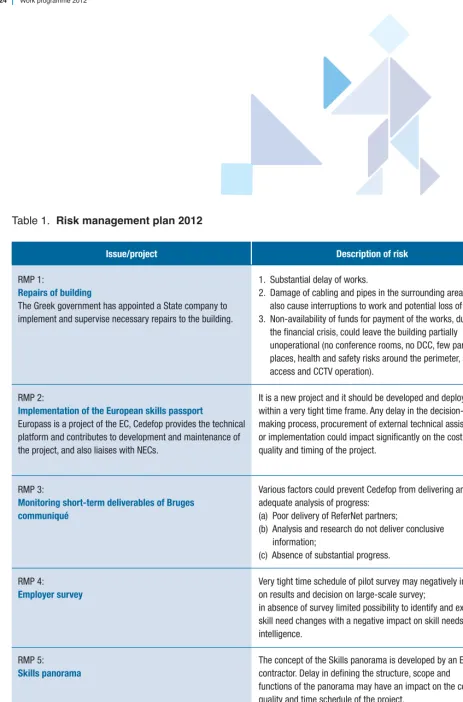
management policyin autumn 2011 to reflect recent developments. The risk assessment which is a form of ex ante evaluation anticipates probabilities of failures to achieve planned objectives (at the level of Cedefopʼs planning of next yearʼs work programme). In a two-pronged approach – one, concerning generic issues from a management perspective, the other focussing on specific projects from project managersʼ and heads of areasʼ perspectives – risks are assessed. Their probability combined with the importance of the issue or project for Cedefop (impact) results in a risk indicator. Standard procedures and instruments which are generally applied already mitigate some of the risks and are considered in the risk assessment.
In the risk assessment for the work
programme 2012,Cedefop has identified five higher risk issues which require additional measures to mitigate or control risks. These issues are included in the following risk management plan. The plan also includes actions which have been identified and will be centrally monitored to ensure that risks are controlled to the extent possible. Actions in the plan are implemented by responsible services and management, with implementation also monitored by the internal control coordinator.
Risks included in the RMP reflect that Cedefop, in compliance with its mandate to report on the Copenhagen process and support the Commission in activities designed to implement flagship initiatives, is taking up new activities. Required development work carries its own risks. In addition, some activities are higher risk simply because they are not yet fully defined regarding their scope and the actual contribution of Cedefop. Risks are further elevated, especially for Cedefopʼs reputation, as tight deadlines must be kept. Consequently, envisaged actions to mitigate risk levels focus on clarifying content and expectations, securing necessary resources, and close monitoring.
Work programme 2012
24
Issue/project
RMP 1:
Repairs of building
The Greek government has appointed a State company to implement and supervise necessary repairs to the building.
RMP 2:
Implementation of the European skills passport
Europass is a project of the EC, Cedefop provides the technical platform and contributes to development and maintenance of the project, and also liaises with NECs.
RMP 3:
Monitoring short-term deliverables of Bruges communiqué
RMP 4:
Employer survey
RMP 5:
Skills panorama
Description of risk
1. Substantial delay of works.
2. Damage of cabling and pipes in the surrounding area could also cause interruptions to work and potential loss of data. 3. Non-availability of funds for payment of the works, due to
the financial crisis, could leave the building partially unoperational (no conference rooms, no DCC, few parking places, health and safety risks around the perimeter, semi-access and CCTV operation).
It is a new project and it should be developed and deployed within a very tight time frame. Any delay in the decision-making process, procurement of external technical assistance or implementation could impact significantly on the cost, quality and timing of the project.
Various factors could prevent Cedefop from delivering an adequate analysis of progress:
(a) Poor delivery of ReferNet partners;
(b) Analysis and research do not deliver conclusive information;
(c) Absence of substantial progress.
Very tight time schedule of pilot survey may negatively impact on results and decision on large-scale survey;
in absence of survey limited possibility to identify and explain skill need changes with a negative impact on skill needs intelligence.
The concept of the Skills panorama is developed by an EC contractor. Delay in defining the structure, scope and functions of the panorama may have an impact on the cost, quality and time schedule of the project.
[image:31.652.97.561.70.773.2]High expectations upon Cedefop, lack of clear definition of Cedefop’s role and lack of adequate funding to support Cedefop’s extra effort may impede Cedefop’s ability to focus on its core tasks.
Management, risk management, resources and internal control 25
Planned action (comment)
External contractor paid by third party. No direct control.
Actions:Close monitoring of the works to be put in place. Information on problematic developments to supervising company and Greek government. Regular information to staff.
(This risk had also been included in the RMP 2009 and 2010.)
Close cooperation with DG EAC. Specifications and time-plans are agreed to clarify expectations and establish realistic work plans.
Use of negotiated procedure, justified by the circumstances to accelerate procurement. Tight control of technical implementation to secure tight time plan.
Quality control.
Close monitoring – information and reflection – of ReferNet contributions. Standardisation of input (streamlined questionnaire) and flexible approach to methodological problems.
Agreements on communication of developments (EC, Cedefop, Member States).
Close monitoring and information of contractor, involvement of project team in data analysis and information and involvement of EC partners.
Close cooperation with DG Empl and DG EAC in steering the contractor. Clarification of expectations, specifications and time-plans to establish realistic work plans.
Adequate funding is secured to support Cedefop’s input and role in the panorama so its expertise can continue be concentrated on data analysis and production of skills intelligence.
Responsible
Head of Resources, Facility manager
(Deadline envisaged end June 2012)
Heads of Areas ECVL, Resources and Directorate
(deadline: end 2012)
ECVL/project manager ICT/project manager
ECVL and RPA/ project managers ReferNet coordinator
Monitoring: Heads of Areas, Directorate
RPA/ Skill needs team
Work programme 2012
26
MTP
ABB
Projects
ABB
Projects
ABB
ABB
[image:33.652.96.540.284.746.2]ABB
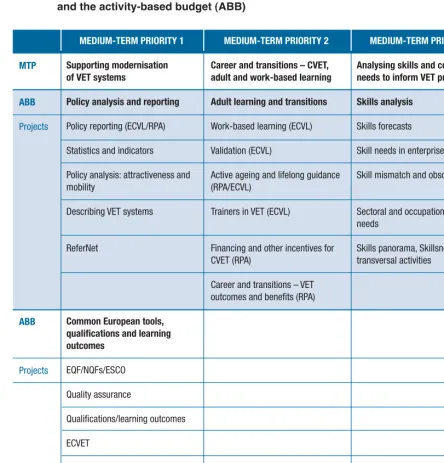
Table 2. Relation of activities and projects to Cedefopʼs medium-term priorities 2012-14 and the activity-based budget (ABB)
MEDIUM-TERM PRIORITY 1
Supporting modernisation of VET systems
Policy analysis and reporting
Policy reporting (ECVL/RPA)
Statistics and indicators
Policy analysis: attractiveness and mobility
Describing VET systems
ReferNet
Common European tools, qualifications and learning outcomes
EQF/NQFs/ESCO
Quality assurance
Qualifications/learning outcomes
ECVET
Europass
Study visits
MEDIUM-TERM PRIORITY 2
Career and transitions – CVET, adult and work-based learning
Adult learning and transitions
Work-based learning (ECVL)
Validation (ECVL)
Active ageing and lifelong guidance (RPA/ECVL)
Trainers in VET (ECVL)
Financing and other incentives for CVET (RPA)
Career and transitions – VET outcomes and benefits (RPA)
MEDIUM-TERM PRIORITY 3
Analysing skills and competence needs to inform VET provision
Skills analysis
Skills forecasts
Skill needs in enterprises
Skill mismatch and obsolescence
Sectoral and occupational skill needs
Skills panorama, Skillsnet and other transversal activities
Communication, information and dissemination
(External communication, documentation and information, publications and content management)
Resources, Directorate
8.
Activity fiches by medium-term
priority, activity and project
MEDIUM-TERM PRIORITY
SUPPORTING MODERNISATION OF VET SYSTEMS
Activity: Policy analysis and reporting
Cedefop has been entrusted with reporting on Member Statesʼ progress in implementing the joint priorities for VET within the Copenhagen process. To fulfil this mandate, Cedefop prepares and disseminates VET policy analyses and reports assessing achievements in European VET cooperation and informing future VET policy developments. The Bruges communiqué combines a long-term strategic vision for 2020 (11 strategic objectives) and a commitment to implement a series of actions at national level by 2014 (22 short -term deliverables) to modernise and further develop VET. Cedefopʼs analysis of and reporting on VET policies relies on yearly input of ReferNet - Cedefopʼs European network for VET - without losing sight of assessing whether the strategic objectives set for VET are met. Starting in 2012, Cedefop will produce policy-aligned VET statistical reviews and indicators to compile further evidence of progress on VETʼs contribution to reaching the targets of Europe 2020. In addition, Cedefop will intensify investigation of selected key VET policies and prepares thematic snapshots to support the European Commission and Presidency countries. For instance, Cedefop will investigate factors and determinants of VET attractiveness in European countries and efficient policies to increase participation in VET. Cedefop will also review measures, programmes and institutional set-ups promoting learnersʼ mobility in VET. Providing the context for policy analysis, descriptions of national VET systems and developments are updated annually by ReferNet and published by Cedefop in electronic and hard copy formats.
Desired impact
Cedefop aims to support an evidence-based European VET policy agenda and stronger European cooperation between countries who share common policy priorities. Cedefop also aims to be acknowledged as an authoritative source of expertise on European VET policies, with a capacity to monitor progress in modernising European VET.
Corresponding ABB activity: Policy analysis
Principal activity outcomes
New knowledge and insights generated and raised awareness among European and national policy-makers, including social partners, in particular stakeholders of the Copenhagen process European cooperation in VET on:
• Evidence of progress in implementing the 2011-14 short-term deliverables of the Bruges communiqué and related strategic policies objectives
Outcome indicators
(with reference to Cedefopʼs performance measurement system)
Policy advice
• Citations in EU policy documents
• Mandates given to Cedefop in policy documents • EU policy documents to preparation of which
Cedefop contributed
Activity fiches 29
Project 1:
Policy reporting
In close consultation with the European Commission and other stakeholders, Cedefopʼs 2012 VET policy reporting will focus on assessing progress in the 22 short-term deliverables agreed in Bruges in December 2010 by ministers responsible for VET. To measure achievements for each of the short-term deliverables, Cedefop will collect, analyse and synthesise quantitative and qualitative information and compile all relevant information in country-specific fiches. As appropriate, the Centre will adjust its approach to gathering evidence from various sources within and outside Cedefop (mostly through the ReferNet network). It will provide selected input to meetings of Directors General for VET (ʻthematic snapshotsʼ) depending on theme and data availability.
Principal outputs 2012 Timing/frequency
Questionnaire to ReferNet on progress with the 22 short-term deliverables January 2012
Publication: Stocktaking - A first review of progress on the short-term October 2012
deliverables (booklet)
Publication: Country fiches (online publication, dedicated web interface) Ongoing as new information becomes available
Advice and expertise provided to key stakeholders for various meetings Ongoing
and events (DGVTs, ACVTs, Copenhagen working group, etc.) • Trends in ʻVET-business cooperationʼ
and ʻPermeability, higher level VET and mobilityʼ in line with the 2012 semester themes
• Factors and determinants of IVET attractiveness, innovative and effective policies to raise participation in IVET • Barriers to VET learnerʼs mobility and
countriesʼ strategies and initiatives to overcome them
• Key features of national VET systems
stakeholders, Presidency events and
conferences that steer or support implementation of policies
New knowledge
• Downloads of publications/working and research papers/briefing notes
• Citations of publications/studies in the literature
Raising awareness
• Website traffic
• Participation in conferences and events • Usefulness/satisfaction with Cedefopʼs
conferences and events
Project 2:
Statistics and indicators
The statistics and indicators project supports improvements in quality and methods of European data collection and provides sound statistical evidence on VET issues. In 2012, Cedefop will continue to improve dissemination of available statistics and indicators on VET, in particular through development of a policy-aligned VET statistical review and by launching detailed analysis of the latest continuing vocational training survey and adult education survey data. In parallel, improvements to availability, relevance and quality of data will be sought as well as methods and tools for data collection at European and international levels.
Principal outputs 2012 Timing/frequency
Advice and expertise provided on statistical and indicator developments Ongoing
key stakeholders (Eurostat, Commission, OECD, etc.)
Publication: Cedefop statistics and indicators web pages: Ongoing
statistics of the month, tables and graphs (electronic publication -regular update and development)
Project 3:
Policy analysis – attractiveness and mobility
In 2012, thematic policy analyses will be conducted on IVET attractiveness and learnersʼ mobility. Cedefop will map and critically review factors and policy efforts to raise IVET attractiveness across Europe and will identify innovative, efficient and transferable policies. A solid evidence base, also relying on further analysis of relevant Eurobarometer surveys, will be created to support short-term deliverables related to improving IVET attractiveness. Validity and policy relevance of findings will be debated in a workshop to be held in September.
Putting together knowledge on learnersʼ mobility in VET, Cedefop will take stock of barriers to mobility and analyse countriesʼ strategies and initiatives to overcome them. A working paper based on information from ReferNet as well as other studies will be prepared. A workshop will draw on mobility experiences in higher education to identify promising paths for VET and provide food for thought for the next stage of the project.
Principal outputs 2012 Timing/frequency
Publication: IVET attractiveness – State-of-the-art and promising Autumn 2012
avenues (briefing note)
Workshop: IVET attractiveness: Validity and policy relevance of findings September 2012
Workshop: Learnersʼ mobility (expert workshop) October 2012
Work programme 2012