Contents lists available atScienceDirect
Evaluation and Program Planning
journal homepage:www.elsevier.com/locate/evalprogplan
Dealing with context in logic model development: Re
fl
ections from a realist
evaluation of a community health worker programme in Nigeria
Bassey Ebenso
a,⁎, Ana Manzano
c, Benjamin Uzochukwu
b, Enyi Etiaba
b, Reinhard Huss
a,
Tim Ensor
a, James Newell
a, Obinna Onwujekwe
b, Nkoli Ezumah
b, Joe Hicks
a, Tolib Mirzoev
aaNuffield Centre for International Health and Development, University of Leeds, Worsley Building, Clarendon Way, Leeds, UK
bHealth Policy Research Group & the Department of Health Administration and Management, College of Medicine, University of Nigeria Enugu-Campus, 400001, Nigeria
cSchool of Sociology and Social Policy, Social Sciences Building, University of Leeds, Leeds, UK
A R T I C L E I N F O
Keywords: Programme theory Realist evaluation Logic model
Community health workers programme Maternal and child health
Nigeria Context
A B S T R A C T
Logic models (LMs) have been used in programme evaluation for over four decades. Current debate questions the ability of logic modelling techniques to incorporate contextual factors into logic models. We share experience of developing a logic model within an ongoing realist evaluation which assesses the extent to which, and under what circumstances a community health workers (CHW) programme promotes access to maternity services in Nigeria. The article contributes to logic modelling debate by: i) reflecting on how other scholars captured context during LM development in theory-driven evaluations; and ii) explaining how we explored context during logic model development for realist evaluation of the CHW programme in Nigeria. Data collection methods that informed our logic model development included documents review, email discussions and teleconferences with programme stakeholders and a technical workshop with researchers to clarify programme goals and untangle relationships among programme elements. One of the most importantfindings is that, rather than being an end in itself, logic model development is an essential step for identifying initial hypotheses for tentative relevant contexts, mechanisms and outcomes (CMOs) and CMO configurations of how programmes produce change. The logic model also informed development of a methodology handbook that is guiding verification and con-solidation of underlying programme theories.
1. Background
There have been growing calls, in the past four decades, for pro-gramme planners and service providers to describe the intervention models and underlying theories of their programmes to demonstrate how programmes will facilitate change (Davies, Walker, & Grimshaw, 2010;Powell et al., 2017;Sundra et al., 2006;Yampolskaya, Nesman, Hernandez, & Koch, 2004). Hitherto, many funders require logic models (LMs) to demonstrate that programme strategy and outcomes are grounded in theory, and to facilitate monitoring and evaluation (Helitzer, Willging, Hathorn, & Benally, 2009; Judge & Bauld, 2001; Kaplan & Garette, 2005). Consequently, researchers and evaluators increasingly use LMs for understanding the linkages among programme objectives, inputs, activities and outcomes. Theory-driven evaluation is “any evaluation strategy or approach that explicitly integrates and uses stakeholder, social science, some combination of, or other types of
theories in conceptualizing, designing, conducting, interpreting, and applying an evaluation” (Coryn, Noakes, Westine, & Schröter, 2010). According toRogers (2006), theory-driven evaluation approaches have two essential elements: an explicit model of the programme depicting the assumptions and ideas (i.e.‘theories’) that inform the making of a programme, followed by an empirical investigation to gauge the extent to which those theories are met within complex contextual circum-stances of implementation practices (Manzano & Pawson, 2014). Theory-driven evaluators use several methods with varied levels of detail and complexity for eliciting, “constructing or reconstructing” programme theory, including logic modelling, logical frameworks, outcomes hierarchies and Antecedent Target Measurement (Astbury & Leeuw, 2010;Blamey & Mackenzie, 2007;Renger, Foltysova, Becker, & Souvannasacd, 2015;Rogers, 2008).
Nevertheless, current debates in the LM literature criticise scholars for overlooking the role of context in logic model design, construction
https://doi.org/10.1016/j.evalprogplan.2018.12.002
Received 20 February 2018; Received in revised form 7 September 2018; Accepted 5 December 2018 ⁎Corresponding author.
E-mail addresses:[email protected](B. Ebenso),[email protected](A. Manzano),[email protected](B. Uzochukwu), [email protected](E. Etiaba),[email protected](R. Huss),[email protected](T. Ensor),[email protected](J. Newell),
[email protected](O. Onwujekwe),[email protected](N. Ezumah),[email protected](J. Hicks),[email protected](T. Mirzoev).
Available online 07 December 2018
0149-7189/ © 2018 The Authors. Published by Elsevier Ltd. This is an open access article under the CC BY license (http://creativecommons.org/licenses/BY/4.0/).
and usage (Morell, 2014;Renger et al., 2015) This article contributes to addressing this shortcoming by: i) reflecting on how theory-driven evaluation approaches account for context during LM development; and ii) presenting how we explored context during LM development for realist evaluation of a community health workers’(CHW1) programme in Nigeria.
In the realist evaluation (RE) approach, which is a form of theory-driven evaluation, evaluators do not ask ‘what works?’, ‘does this work?’or‘did this work this time (Pawson & Tilley, 1997)?’Rather, they seek to establish “how and why programmes work (or do not work), for whom they work, to what extent, in which settings and for how long?’(Westhorp, 2014, Pg4). In recognition of the influence of context on programme implementation and its outcomes,Pawson and Sridharan (2010)urged scholars to model, in diagrammatic form, the process through which programmes achieve their ends. In response to Pawson and Sridharan’s call (2010), this paper shares how we devel-oped our LM within an ongoing RE of a community health workers programme in Nigeria, including how we incorporated context into the LM. An overall aim of the RE is to assess the extent to which and under what circumstances, the CHW programme promotes equitable access to quality maternity services in Nigeria and improves maternal and child health (MCH). A secondary aim is to assess the sustainability of achieved outcomes and the effects of ongoing advocacy efforts to en-trench MCH in the national political agenda.
The paper begins by explaining the concept of logic modelling and its usefulness to programme stakeholders while reflecting on categories of context to consider when developing or using LMs. After that, we examine how scholars have used logic models to develop programme theories in theory-driven evaluation, including in realist evaluation. We then describe the background to the CHW programme and how we created a LM for our evaluation. The process used to incorporate con-text into the LM and develop initial working theories are also discussed. We conclude with lessons for those who wish to develop and use LMs in future programme evaluations.
2. Literature review
2.1. Logic models and their purpose
Logic models are tools for planning, describing, managing, com-municating, and evaluating a programme or intervention (CDC, 2013; Millar, Simeone, & Carnevale, 2001;Naimoli, Frymus, Wuliji, Franco, & Newsome, 2014). The LM offers a simplified visual representation of the relationship between various components of a programme (Kaplan & Garette, 2005; Renger et al., 2015), and may include assumptions that underlie expectations that the programme will work under certain environmental conditions to solve a particular social problem (Knowlton & Phillips, 2012;McLaughlin & Jordan, 2015). Logic models vary in their complexity and take many different forms, including flowcharts, tables, pictures, and diagrams, and can include different components (Funnell & Rogers, 2011;Newton, Poon, Nunes, & Stone, 2013;Petersen, Taylor, & Peikes, 2013). The literature reveals at least five ways in which scholars use LMs:
a)Assessing feasibility of a programme at the inception stage:A clear and brief presentation of the programme theory at the pro-gramme conception stage is vital (Clapham, Manning, Williams, O’Brien, & Sutherland, 2017) for deciding whether the programme: i) has a good chance of being implemented with planned resources, ii) has a reasonable chance of achieving its intended outcomes, and
iii) is presented in a manner that can aid planning of its evaluation (McLaughlin & Jordan, 1999;Savaya & Waysman, 2005).
b) Clarifying goals and conceptual gaps:A coherent LM can help implementers and evaluators reach consensus about their goals and uncover gaps in programme logic. A collaborative approach to considering goals and conceptual gaps at the programme develop-ment stage (Newton et al., 2013) enables stakeholders to clarify, specify or modify resources and activities before full-scale im-plementation commences (Petersen et al., 2013)
c)Monitoring progress of implementation and changing needs:A LM can provide implementers and evaluators with a framework for monitoring how the programme and/or its components evolve over its life span. For example, a LM can help determine whether inputs are sufficient or activities are implemented according to plan, in order to identify areas for modification or provide technical support for ongoing implementation (Petersen et al., 2013).
d) Developing measures of evaluation:By outlining the important components and inner workings of a programme, proverbial“black box”, (Petersen et al., 2013), a LM can serve as a focal point for discussions about data collection by informing decisions about key aspects of a programme that should be evaluated and ensuring that evaluators identify indicators of all elements that are critical to programme theory (Conrad, Randolph, Kirby, & Bebout, 1999; Sherman, 2016). Designing data collection based on a LM can aid examination and testing the programme logic and provide a plau-sible explanation for the hypothesized causal mechanisms if in-tended outcomes are attained. LMs can also help evaluators identify critical questions that can/should be answered and guide priorities and allocation of resources (Petersen et al., 2013).
e) Dissemination and knowledge building:LMs can offer an effi -cient way of assessing the applicability and generalizability of pro-grammes to other settings or populations, especially as stakeholders often want to see their investments (of time, money and energy) yield benefits beyond the immediate setting of programme im-plementation (Savaya & Waysman, 2005). Scholars therefore urge evaluators to use LMs to facilitate knowledge transfer from some programmes or sites to others, by explaining the processes that cause or prevent the achievement of intended outcomes (Cronbach et al., 1980;Shadish, Cook, & Leviton, 1991).
2.2. Synopsis of debate regarding incorporating context into logic models
Most approaches to creating logic models have focused on simple, linear models, but some have explored how non-linear models might be used (e.g.Funnell, 2000) to better represent programmes and guide their evaluation (Rogers, 2008). While there is broad agreement that LMs are useful for summarizing the “logical’’ process of linking un-derlying programmatic assumptions, inputs, activities, outcomes and impact, nonetheless, the ability of logic modelling techniques to in-corporate contextual factors into simple LMs is contested. While some authors have praised the incorporation of contextual factors in LMs as a strength of logic modelling (McLaughlin & Jordan, 1999; Owen & Rogers, 1999), others criticize LMs for their failure to capture the ex-ternal context in which programmes operate (Cullen et al., 2016;Hill & Thies, 2010; Rogers, 2008). Moreover, scholars have highlighted an unintended consequence of some simple formats of LMs. For example, Morell (2014)andRenger et al. (2015)noted that the limitation of the table-format of LM is that it only depicts the subset of contextual con-ditions directly targeted by a programme while ignoring the broader context of the other underlying conditions that contributed to the problem the programme aimed to change.Rogers (2008)argues that, by leaving out the other factors that contribute to observed outcomes, including the implementation context, concurrent programmes and the characteristics of clients, simple logic models risk overstating the causal contribution of the intervention, and providing less useful information for replication. Interestingly, the heterogeneity of LMs (whether simple 1List of Abbreviations: CHW = Community Health Worker; GON =
or complex in format) derives from the different purposes and related contexts in which they may be used. In this sense, two inter-related contexts can be differentiated: the contextual circumstances in which a programme is implemented; and the context within which the evaluation of the programme is conducted. A brief description of these contexts is provided next.
a)Programme context: This relates to the programme’s contextual factors e.g. policies, institutional, cultural and socio-economic fac-tors that affect users or deliverers of the programme. Although context is traditionally understood as”factors that are external to and operate outside of a programme’s control but may influence the implementation of the programme” (Cullen et al., 2016), context also permeates across the individual, organisational and system le-vels (Ebenso et al., 2017;Mirzoev et al., 2016). According to the RAMESES II project (2017), realist evaluation considers the settings into which programmes are introduced as social systems with meanings, rules and sets of relationships that interact with/infl u-ence: i) responses of stakeholders to programme resources and ii) intended programme outcomes. This is important as a detailed un-derstanding of contextual factors assists in identifying the challenges and assumptions that affect implementation and, eventually, pro-gramme successes and failures. It also increases understanding of how unforeseen and unplanned contingencies can affect programme mechanisms, resources and expected outcomes (Cullen et al., 2016). b)Evaluation context:Over the past four decades of praxis, LMs have been used in many evaluation contexts (Park, Welch, & Sriraj, 2016). Evaluation contexts relate mainly but not exclusively to programme size and type; evaluation purpose; budget and time-frames; stakeholders involved in the evaluation and their interests and values; the evaluation approach (e.g. summative/formative, theory-driven etc.). These components of context all impact the objectives of the selected LM. For example, while some argue that LMs can be applied to all kinds and sizes of programmes (Porteous, Sheldrick, & Stewart, 2002), the application of LMs in large scien-tific research programmes is often debated (O’Keefe & Head, 2011) with evaluators reporting challenges when using logic models in multi-site community-based programmes (Cullen et al., 2016; Kaplan & Garrett, 2005).Newton et al. (2013) also differentiate between LMs used in evaluations, from those used in social science research studies explaining that the latter tend to isolate variables while professional evaluators acknowledge the complex interactions among program activities and outcomes.
Closely linked to both programme and evaluation contexts are de-cisions concerning the purpose for developing a LM, the people who develop it and circumstances in which the LM is developed as these are likely to impact the process of and the end results of the LM’s devel-opment. These contextual and methodological decisions ultimately in-fluence the format of LM selected, the components of the programme represented in the LM and the language used for describing features of LMs (Moss, 2012). Both types of contexts were taken into consideration and explored during LM development for realist evaluation of the CHW programme in Nigeria. While we differentiate between the programme and evaluation contexts, we acknowledge the apparent overlaps be-tween the two and a possible argument that the distinction bebe-tween the two contexts may be somewhat less clear. Next, we examine how theory-driven evaluations (including realist evaluation) use LMs to explore context. This is followed by a description of the realist eva-luation of the CHW programme in Nigeria and methods we used to develop the LM within the RE of the programme.
2.3. Using LMs in theory-driven evaluations
Theory-driven evaluation is a collection of evaluation methods that highlight the significance of understanding the theories underlying a
programme approach, before evaluating it (Breuer, Lee, De Silva, & Lund, 2016). As mentioned in the background section, the programme theories arefirst made explicit and thereafter used to assess how pro-gramme activities lead to intended outcomes.Breuer et al. (2016), Pg 2) contend that there are a number of interrelated theory-driven evalua-tion approaches in existence including: logic models, logical frame-works, outcomes hierarchies and Theory of Change (ToC). Conversely, other evaluators do not see these as distinct evaluation approaches but rather as methods used within theory-driven evaluation for eliciting, (re)constructing programme theory (Astbury & Leeuw, 2010;Blamey & Mackenzie, 2007;Renger et al., 2015;Rogers, 2008). ToC was devel-oped byWeiss (1997)within the tradition of theory-driven evaluation, as an approach for explaining how a programme brings about specific long-term outcomes through a logical sequence of intermediate out-comes (Breuer et al., 2016). Regardless of its similarity to other theory-driven evaluation approaches, ToC has significant differences. For ex-ample, whilst LMs are useful for depicting a simplified and linear model of the components (i.e. input, activities and outcomes) of a programme, nevertheless, LMs do not explicitly articulate the causal links through which the programme produces change in the way that ToC does (Breuer et al., 2016). Similarly, although logical frameworks (log-frames) have utility in summarising programme resources, inputs, outputs, outcomes, indicators of success and the assumptions/risks to the programme, unfortunately, the inflexibility of funder-driven for-mats has turned logframes into a results-based management tool, that does not facilitate the articulation of causal pathways through which components of the logframe work together. On the other hand, realist evaluation, focuses on articulating the underlying generative mechan-isms that link a programme's processes and inputs to outcomes and contexts (Pawson & Tilley, 1997).
Evidence shows that simple LMs were favoured in earlier ap-proaches of theory-driven evaluations to enhance implementation and adoption of evaluation findings (W.K.-Kellogg-Foundation, 2004). However, in the last decade, more comprehensive or ecological models have been advocated to help account for multiple and interacting contextual factors that may impact on programme processes and out-comes (Coryn, Noakes, Westine, & Schröter, 2011). These more recent evaluation models tend to start by: i) identifying the detailed specifi -cation of underlying processes, to assess whether they have been met and: ii) identifying contextual factors at macro, meso and micro levels that influence their achievement. For example, to address the limitation of the table-formation of LM highlighted earlier,Renger et al. (2015) employed a two-step strategy to adapt the Antecedent Target Mea-surement (ATM) approach for logic modelling, to facilitate exploration and incorporation of context into their development of LM. Firstly, to generate an understanding of programme context,Renger et al. (2015) engaged programme stakeholders (e.g. programme staff, expert scho-lars and business executives) in a root cause analysis (RCA) interviews, to identify and visually represent the relationship between the problem of obesity and the underlying conditions that contributed to the pro-blem. RCA interviews entailed delving deeper, by asking stakeholders a succession of“why”questions about underlying conditions related to obesity. The results of Renger et al.’s RCA interviews were then in-corporated into a single diagram called the context map. Renger et al. used the context map (seeFig. 1for example) to systematically and visually depict context by identifying as many of the conditions as possible that contributed to obesity and the relationships between them.
Secondly, following identification of myriads of contexts, Renger et al. engaged key programme stakeholders in a prioritization process (aided by a matrix shown inTable 1), tofilter through, and rank the numerous conditions in the context map, to arrive at a manageable number of contextual factors to include in their evaluation.
by considering the premises of realist evaluation), which underlines the importance of context in interpreting programme outcomes.
However, realist evaluators use LMs in a different way. Rather than gathering as much evidence as is feasible on each component of the LM, to answer the question “Did this happen?’’ about each programme component’, like many evaluation approaches would do, realist eva-luations are also interested in “why this did or did not happen? and what circumstances contributed to their happening/or not happening?” (Rogers, 2008). In this sense, LMs are tools for understanding thefirst evaluation step (i.e.figuring out what is the plan? and the programme theories supporting it) and then presuming that every single link in all the possible series of inputs, outputs and outcomes is (or produces) a possible Context, Mechanism, Outcome (CMO) configuration and that there are an infinite number of such CMOs. This is more than con-sidering the specific contextual factors in which the programme is im-plemented; it is about elucidating the“social rules, values, sets of in-terrelationships” that either constrain or support the activation of programme mechanisms and eventually of outcomes (Pawson & Tilley, 1997, p70).
Prioritising which CMOs to evaluate is potentially an endless task, in which anomalies and contradictions are pursued in the hope that ten-tative causality hypotheses will emerge about how the programme brings about change. Data collection methods are also designed to
identify how this ideal model is operationalised locally when con-fronted with the inevitable implementation challenges and the infinite complexity of open systems and to ascertain where and why pro-grammefidelity succeeded or failed. Besides the ideal model, a second model of intentional or unintentional programme adaptations will emerge in the form of deletions, alterations and/or additions of those initial hypotheses (Pawson & Tilley, 1997).
3. A realist evaluation of the CHW programme in Nigeria
Documentation of national Maternal, Newborn, and Child Health (MNCH) statistics in Nigeria started in early 1990s (ICF-International & NPC, 2014). Despite significantly reducing maternal and neonatal mortality by 60% and 50% respectively since 1990, these indices re-main high at 814/100,000 and 37/1,000 births respectively, particu-larly in rural areas of the country, where vulnerable groups reside (FMoH, 2011,2013;WHO, 2015).
[image:4.595.82.516.56.394.2]In 2012, the Government of Nigeria (GoN) launched a Subsidy Reinvestment and Empowerment Programme (SURE-P), to invest rev-enues from fuel subsidy reduction into a social protection scheme for the benefit vulnerable populations, especially in rural areas of Nigeria. The SURE-P scheme had an MCH component (i.e. SURE-P/MCH) geared to improve the lives of mothers and their infants (NPHCDA, 2012). The Fig. 1.Example of a context map (Source:Renger et al., 2015, pg121).
Table 1
Matrix for prioritizing antecedent conditions for outcome evaluation (Source:Renger et al., 2015, pg122).
High coverage (Two or more targeted underlying conditions) Low coverage (one activity targeting an underlying condition) No coverage
High (immediate) control High prioritye.g., Healthy food not carried by local retailer Medium prioritye.g., Limited school curriculum Do not evaluate Low (intermediate) control Medium–high prioritye.g., Limited healthy food choices Low prioritye.g., People make unhealthy food choices Do not evaluate
[image:4.595.32.569.694.744.2]SURE-P/MCH scheme comprised both supply and demand components. The supply component aimed to broaden access to quality maternity services and improve MCH outcomes through recruiting, deploying and training CHWs, infrastructural development and increasing availability of supplies and medicines. The demand component aimed to increase utilization of health services during pregnancy and at birth using a conditional cash transfer (CCT) programme. CCTs were given to preg-nant women who register at a primary health care(PHC) centre, where they get health check-ups, deliver at a health facility and take their baby for thefirst series of vaccinations (Ebenso et al., 2015).
Since June 2015, a team of researchers from the University of Leeds, UK and the University of Nigeria have been using realist evaluation to assess the extent to which and under what circumstances, the SURE-P/ MCH scheme (or CHW programme) promotes equitable access to quality services and improves MCH outcomes (Mirzoev et al., 2016). Methodology for the realist evaluation consisted of three inter-related steps: i) initial programme theory development, ii) theory validation and iii) theory consolidation. Thefirst step aimed to develop the pro-gramme’s theory and the other two steps, to test it using empirical observations. Details of the three steps have been reported elsewhere (Mirzoev et al., 2016). Four months after commencing the evaluation (i.e. October 2015), the newly elected President of Nigeria reversed the policy on fuel subsidy reduction in order to catalyse the economic growth, thereby stopping government funding to SURE-P programme. Following discussions with our funders and Nigerian health authorities, it was decided that the best course of action was to implement the original methodology for the study, while also assessing the sustain-ability of achieved changes and the effects of ongoing advocacy efforts to entrench MCH in the national political agenda.
Subsequent sections of this paper reports the processes for and re-flections on using logic modelling for thefirst evaluation step and how we explored context during the LM development.
4. Methods
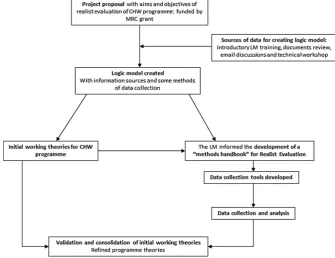
We now explain how we created the LM through a multi-stage process, using data from diverse sources. Fig. 2depicts how the LM development for the CHW programme fits into the RE of the
programme.
Thefigure shows that the sources of data used to develop the LM consisted of: i) an introductory LM training session, ii) documents re-view, iii) email discussions, and iv) technical workshop for researchers. The LM in turn informed development of initial working theories and a first version of the methodology handbook for the evaluation which was designed to be a living document that is updated as the evaluation progressed. At the time of writing this paper, the methodology hand-book is guiding data collection and analysis of the RE exercise. The process of developing the LM is summarized next.
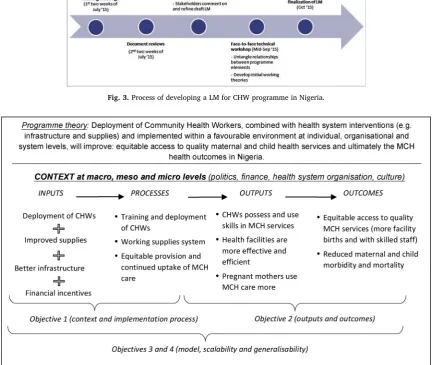
Linking back to purposes of LMs described in the background sec-tion, our LM served two purposes. First, to clarify the goals and con-ceptual gaps in programme stakeholders’(i.e. researchers, policymakers and implementers) expectations of how the programme should work; and second, to inform measures of programme evaluation. Regarding thefirst purpose, logic modelling served to graphically represent sta-keholders’thinking of how the programme should work, by showing interrelationships between inputs, activities, outputs, outcomes and context. As no previous LMs were developed at inception and im-plementation stages of the CHW programme, the LM for this evaluation was used inductively as a tool for documenting the activities and out-comes the CHW programme hoped to achieve, and so retrospectively constructing the programme theory.Fig. 3shows the process of creating the logic model took about three months from the training meetings in July 2015 through tofinalization of LM in October 2015. This process is discussed next.
[image:5.595.127.463.472.730.2]i)Logic model training meetings: Research teams from the University of Leeds and the University of Nigeria met in thefirst two weeks of July 2015 for a logic modelling training. The training used published literature on theory-driven, realist evaluation prin-ciples and logic modelling; and focused on how mapping pro-gramme inputs, activities and outcomes can help establish initial hypotheses for tentative relevant Contexts, Mechanisms, Outcomes and CMO configurations. Whilst different formats of logic models were considered as part of the training, a columnar and a multilayer format was chosen to facilitate the identification of inputs, activ-ities, outputs and outcomes (Ziviani, Darlington, Feeney, & Head,
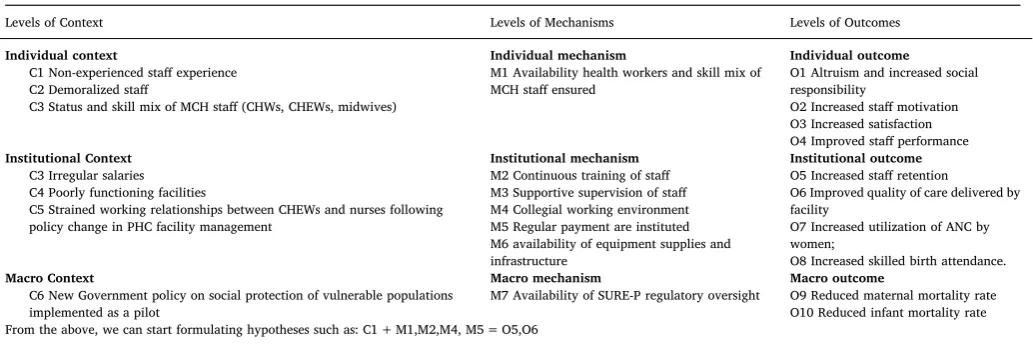
2011). Potential contextual factors that can influence the pro-gramme outputs and outcomes were identified and made more explicit by the participants. The process of identifying contextual factors started with eliciting a broad list of potential contextual factors that could influence the processes necessary to achieve in-puts, outputs and outcomes in the CHW programme. Team con-sensus was achieved in line with the relevance of the evaluation questions, academic rigour and the presumed role in potential outcome patterns. Contextual factors were then organised at micro, meso and macro levels, using insight from the conceptual frame-work (seeFig. 4) for the realist evaluation (Mirzoev et al., 2016). Given this layered nature of context, we explored: a) the individual values and perceptions held by pregnant women and health workers i.e. micro context; b) the cultural norms that can influence the programme i.e. meso context; c) the institutional/health systems environment i.e. meso context; and d) policy and general societal factors i.e. macro context. Further explanation of how the above data was processed is provided below in section iv) Technical Workshop”.
ii)Documentary review:Training meetings were followed by review of key documents, to extract relevant information about programme components from the documents. Documents were reviewed colla-boratively by researchers in both institutions, who then shared their summaries with programme implementers and policymakers in Nigeria. The documents reviewed included health policies, the
CHW programme implementation manual; and the national health management information system (NHMIS) policy, to identify the long-term vision and impact of the programme, and identify the inputs, activities, outputs and outcomes that were necessary for achieving these results (The-Presidency, 2012). Tentative con-textual factors that can prevent/facilitate these results from hap-pening were further refined.
[image:6.595.144.451.57.172.2]iii)Email discussions and teleconferences: The draft LM created during steps i and ii was shared with policy makers and im-plementers to establish their understanding of the model. Programme implementers that contributed to the LM were: a) the national SURE-P programme manager; and b) oversight and vali-dation (O&V) officers charged with monitoring SURE-P MCH ac-tivities at health facility level. The O&V officers produced monthly NHMIS reports on human resources; drugs and supplies; facilities upgrade; and expenditure by health facilities. As huge geographical distances prevented regular face-to-face meetings with policy-makers and programme implementers, we used different informa-tion and communicainforma-tion technologies (M. S. Househ, Kushniruk, Maclure, Carleton, & Cloutier-Fisher, 2011) to support the inter-actions between researchers and programme stakeholders. Specifi -cally, regular email discussions and monthly teleconferences with policy makers and implementers facilitated the iterative refinement of the draft model to ensure that it reflected stakeholders’shared thinking of how the CHW programme should work in the context of Fig. 3.Process of developing a LM for CHW programme in Nigeria.
[image:6.595.81.514.80.445.2]Nigeria. Refining the LM involved clarifying and agreeing re-lationships among programme components. Consulting and enga-ging with local stakeholders ensured that only essential components of the multi-intervention CHW programme were represented in the LM. In other words, harnessing the tacit, formal and professional knowledge of stakeholders to identify essential components asso-ciated with how the CHW programme was intended to produce change, helped to narrow down the possible range of CMOs, so that a manageable number of mechanisms will be considered in the evaluation (Ling et al., 2012). The process of choosing the formation to include in the LM was dynamic and iterative, and in-volved the addition of emerging/relevant components while si-multaneously removing those deemed unnecessary for answering our evaluation questions. See sections5.1(Results) and 6.7 (Dis-cussion and lessons learned) for more information on stakeholder consultation.
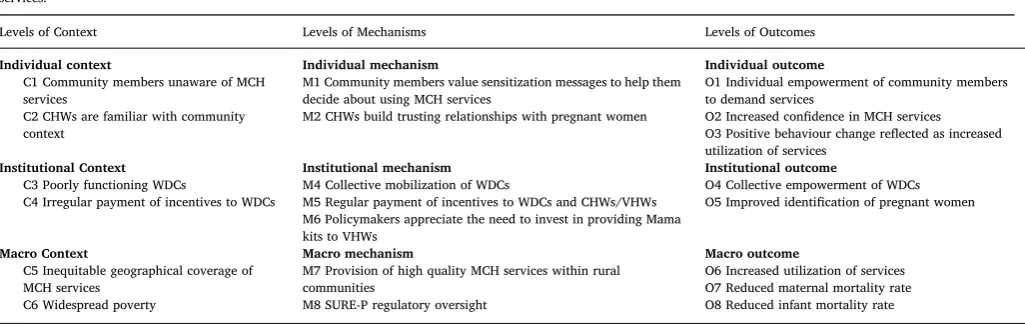
[image:7.595.41.558.570.743.2]iv) Technical workshop:Building on the feedback from stakeholder consultations, we conducted a 3-day face to face technical work-shop in September 2015, involving 10 researchers from universities of Leeds and Nigeria. The workshop was used to untangle re-lationships between programme elements, clarify contextual factors that affected the implementation and results of CHW programme, and subsequently develop initial working theories (IWTs) about how, why and in what circumstances the theories may work. The IWTs are summarized in the Results section. In the meantime, clarifying contextual factors that influenced the CHW programme entailed developing a number of matrixes to elicit tentative con-textual factors. Data included in the matrixes were candidate the-ories of how the CHW programme should produce change; and a range of CMOs at micro, meso and macro levels that are related to the candidate theories. The matrixes facilitated systematic data extraction, critique and presentation of the CMOs.Tables 2 and 3 show examples of matrixes developed at the workshop, with Table 2focusing on the supply andTable 3on demand components of the programme. Content analysis of the matrixes aided prior-itization of contextual factors for inclusion in the LM namely: po-litical economy; policies; concurrent programmes; health system organisation; culture; and the values and perceptions of patients and health staff.
The purpose of prioritization was to narrow down the numerous ranges of CMOs to a manageable number to be considered for the
evaluation.
5. Results
5.1. The resulting logic model and its components
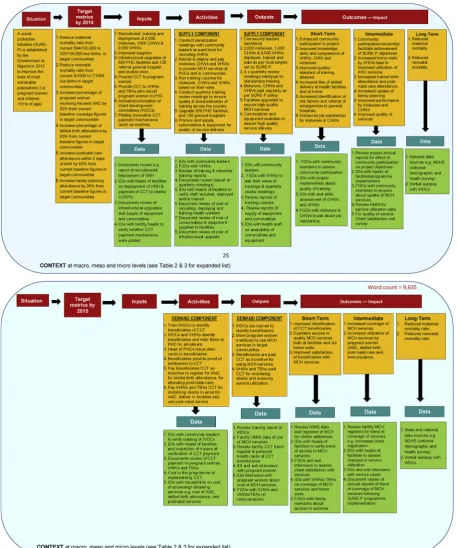
The stakeholders of the CHW programme selected a modified W.K. Kellogg Foundation approach to logic modelling, hitherto used by the RUSH project for a bicycle helmet public information campaign (Moss, 2012;Williams, 2006;W.K.-Kellogg-Foundation, 2004). This LM format consists of columns stretching across the page from left to right, linked via connecting one-way arrows (seeFig. 5). The multi-level format in-cludes three sections: an upper section portraying the target-input-process-output-outcome continuum; a middle section depicting various columns with information describing planned inputs, activities, out-puts, and outcomes; and a lower section (i.e. data boxes) showing data collection methods and sources of information required for programme evaluation. This outcomes-based format was selected to facilitate a focus on each section of the LM to ensure that details of each column were systematically and easily summarised. However, as the process of elaborating programme components progressed, the difficulty of re-presenting all relationships among the components of the CHW pro-gramme in a single, two-dimensional LM became apparent. Therefore, a series of inter-linked LMs were required to comprehensively unpack each intervention of the programme and capture interrelations among the supply and demand components of the CHW programme. The series of LMs required afive-page diagram (included as a supplementaryfile) to sequentially depict the interrelations among the supply and demand components of the CHW programme. However, due to the limitation of space, only a 2-page abridged version of our LM is presented inFig. 5. The resulting LM comprised of six columns.
Thefirst column (the situation that led to creation of the CHW programme) suggests the GON launched the SURE-P scheme following countrywide outcry to invest savings from Nigeria’s oil wealth into initiatives such as MCH that benefited vulnerable sections of the po-pulation. The column captures key programme contextual features: programme funder, programme aim, programme users and programme start date.
The second column shows specific programme objectives that re-flect key target metrics. These relate to improvements in selected health and service delivery indicators such as maternal and neonatal mortality rates and utilisation of health services.
Table 2
Matrix of tentative CMOs for supply component of the CHW programme.
Candidate theory 1:If different incentives (e.g. regular payments, training and improved working environment) are available in a timely manner, this will lead to improved and sustained health worker motivation, job satisfaction, performance and improved retention of staffin the context of Anambra State that is characterised by irregular salaries and poorly functioning facilities.
Levels of Context Levels of Mechanisms Levels of Outcomes
Individual context
C1 Non-experienced staffexperience C2 Demoralized staff
C3 Status and skill mix of MCH staff(CHWs, CHEWs, midwives)
Individual mechanism
M1 Availability health workers and skill mix of MCH staffensured
Individual outcome
O1 Altruism and increased social responsibility
O2 Increased staffmotivation O3 Increased satisfaction O4 Improved staffperformance
Institutional Context
C3 Irregular salaries C4 Poorly functioning facilities
C5 Strained working relationships between CHEWs and nurses following policy change in PHC facility management
Institutional mechanism
M2 Continuous training of staff M3 Supportive supervision of staff M4 Collegial working environment M5 Regular payment are instituted M6 availability of equipment supplies and infrastructure
Institutional outcome
O5 Increased staffretention
O6 Improved quality of care delivered by facility
O7 Increased utilization of ANC by women;
O8 Increased skilled birth attendance.
Macro Context
C6 New Government policy on social protection of vulnerable populations implemented as a pilot
Macro mechanism
M7 Availability of SURE-P regulatory oversight
Macro outcome
The third column relates to inputs invested in the programme to increase access to MCH services and improve MCH outcomes. The in-puts in the figure can be further grouped into supply-related compo-nents (e.g. increased capacity of human resources and supplies) and demand-related components (e.g. community participation and provi-sion offinancial incentives to pregnant women to increase service up-take).
Column four captures groups of supply- and demand-side activities prioritized by the GON to facilitate delivery of quality MCH services in the context-specific implementation of the programme: i) sensitization meetings with community leaders to establish/ reactivate ward devel-opment committees (WDCs) to work with the health system to achieve planned outcomes; ii) deploying health staff to the programme; iii) running training workshops for WDCs and health workers; iv) re-novating facilities and procuring necessary equipment and tools; v) paying CCTs to pregnant women and CHWs.
Thefifth column (outputs), shows that the direct products of the activities implemented by the programme were measured in terms of the volume of work achieved (e.g., numbers of workshops conducted, health workers trained, and facilities renovated) and the number of customers reached (e.g., pregnant women who attended antenatal clinics, and who delivered in health facilities).
The last column (outcomes-impact), summarises the intended ben-efits or changes in the programme’s target population, further cate-gorized as short-term, intermediate and long-term outcomes, with short-term outcomes leading to intermediate outcomes that, in turn, lead to long term-outcomes. Short-term outcomes of the programme included: increased individual knowledge, capacity and confidence of pregnant women to make decisions about their health; improved quality of training of health workers; and enhanced job satisfaction of workers. Intermediate outcomes included: making healthy choices and behaviours (e.g. uptake of family planning), and increased service user satisfaction and confidence in MCH services. Long-term outcomes cluded: lower maternal and neonatal mortality achieved through in-creased utilization of services in health facilities, and equitable access to health services.
The LM served as a focal point for discussions about developing evaluation measures by displaying where (i.e. data sources) and how (i.e. collection methods) to obtain information needed to determine the achievement (or not) of programme results. Data requirements were identified for all steps in the inputs-outcomes continuum and linked to the specific demand- or supply-side activities, outputs and outcomes by
adding an extra row (see green boxes in Fig. 5) below each of the components. Data sources for assessing the programme included e.g., reports of trainings, NHMIS data and reports of national demographic and health surveys, while data collection methods included documents review, in-depth interviews, focus group discussions and verbal au-topsies. We have listed data sources and data collection methods to-gether inFig. 5, due to the limitation of space in the data boxes.
Once the different features and sections of the LM were identified, the assumptions and contextual factors that can prevent the achieve-ment of programme results were made explicit. Programme assump-tions comprised of stakeholders’beliefs about the programme and its inputs, including their perceptions of how the CHW programme will produce change (CDC, 2013). Although these are not explicitly shown inFig. 5, the key assumptions about the CHW programme, extracted from the documents review, and stakeholder experiences were that:
i) GON’sfinancial support will be secure throughout the course of the programme
ii) Payment offinancial incentives to pregnant women will stimulate positive behaviour change
iii) Health workers with the necessary capabilities will be recruited and deployed
iv) Knowledge and skills gained from training courses will be used to improve quality of care
v) Financial and non-financial incentives to health workers will sti-mulate staffmotivation and retention.
[image:8.595.44.557.105.268.2]In realist evaluation, contextual factors describe both the internal environment in which the programme operates and external factors that interact with and influence implementation, participation, and the achievement of outcomes of the programme (CDC, 2013). The exchange between researchers and programme stakeholders in creating the LM facilitated the identification of contextual factors that can potentially affect the production of intended programme outcomes or unintended outcomes. As mentioned in the Methods section, CMO matrixes were then developed at a technical workshop in September 2015, to further clarify and systematically elicit contextual factors that arose from en-gagement with policymakers and programme implementers. Finally, content analysis of the matrixes led to the prioritization of following 6 groups of contextual factors at macro level (policy and societal), meso level (health facilities, communities) and micro levels (individual staff and patients) for inclusion in the LM namely:
Table 3
Matrix of tentative CMOs for demand component of the CHW programme.
Candidate theory 2:If communities in Anambra State (with poorly-functioning WDCs and irregular payment of incentives to women who are unaware of what MCH services are available), are mobilized andfinancially incentivized in a timely manner, this can lead to improved identification of women, increased coverage and improved utilization of MCH services.
Levels of Context Levels of Mechanisms Levels of Outcomes
Individual context
C1 Community members unaware of MCH services
C2 CHWs are familiar with community context
Individual mechanism
M1 Community members value sensitization messages to help them decide about using MCH services
M2 CHWs build trusting relationships with pregnant women
Individual outcome
O1 Individual empowerment of community members to demand services
O2 Increased confidence in MCH services O3 Positive behaviour change reflected as increased utilization of services
Institutional Context
C3 Poorly functioning WDCs
C4 Irregular payment of incentives to WDCs
Institutional mechanism
M4 Collective mobilization of WDCs
M5 Regular payment of incentives to WDCs and CHWs/VHWs M6 Policymakers appreciate the need to invest in providing Mama kits to VHWs
Institutional outcome
O4 Collective empowerment of WDCs O5 Improved identification of pregnant women
Macro Context
C5 Inequitable geographical coverage of MCH services
C6 Widespread poverty
Macro mechanism
M7 Provision of high quality MCH services within rural communities
M8 SURE-P regulatory oversight
Macro outcome
O6 Increased utilization of services O7 Reduced maternal mortality rate O8 Reduced infant mortality rate
i) Political events that influenced policy and programme activities (macro context).
ii) Other MCH initiatives implemented by non-governmental organi-zations (macro context).
iii) Organization of the Nigerian health system and health services (meso context)
iv) Cultural norms that influence programme outcomes in reaching pregnant women (meso context)
v) Socioeconomic factors of pregnant women which affect their ability to pay for and/or utilize MCH services (micro context)
vi) Individual values and perceptions which affect health-seeking be-haviour and service provision (micro context)
InFig. 5, the context is depicted as a blue background around the LM, with a statement of factors that interact with/influence the CHW programme. Used in this way, the CMO matrixes: a) were effective tools for eliciting and incorporating context into the LM, and b) enhanced the LM development process and thefinal LM.
[image:9.595.70.528.54.603.2]programme operates influence the ways in which a particular policy instrument evolves and operates (Manzano-Santaella, 2011). Context was further taken into consideration for developing initial working theories as part of CMO configurations that emerged from using the LM to map the components for this large-scale programme.
5.2. How the LM informed development of initial working theories
Initial working theories (IWTs) or candidate programme theories can be used to accomplish two objectives. First, to identify components of a programme needed to solve a problem and achieve expected out-comes (Davidoff, Dixon-Woods, Leviton, & Michie, 2015). Second, to identify a programme's theory of change i.e. assumptions about me-chanisms that link a programme's processes and inputs to outcomes (Weiss, 1995). Our LM helped to accomplish thefirst objective, and the IWTs addressed the second. As mentioned earlier, we used the technical workshop in September 2015 to untangle relationships between ele-ments/components of the CHW programme, to develop matrixes for eliciting contextual factors and for developing IWTs. The matrixes de-veloped during that workshop (refer Tables 2 and 3) served as the dataset for developing and refining IWTs. Specifically, some‘if…then’ statements of change were developed and subsequently converted into IWTs. One example of an‘if…then’statement of change identified at the workshop is:“If local communities are mobilized and supported to parti-cipate in the CHW programme, then participating communities will have increased capacity to identify and refer more pregnant women to hospitals that provide quality maternity care”. The‘if…then’statements had a key implicit contextual purpose: i.e. to clarify what will happen if the as-sumptions/theories were not implemented in this way for all pro-gramme users in all institutional contexts.
Similarly, we present two examples of IWTs that emerged from converting ‘if…then’ statements into programme theories. The first example is drawn from the supply component of the CHW programme to illustrate contextual factors that can influence health worker moti-vation, performance and retention. The second example, from the de-mand component, illustrates contextual factors that can influence ser-vice utilization by local communities:
i) Providing timely financial and non-financial incentives (such as regular salaries, training and improved working environment) (Cs) to health workers, will make stafffeel valued (M), leading to im-proved staffmotivation (O), job satisfaction (O), performance and retention (O) in the context of Anambra state that is otherwise characterised by irregular salaries and poorly-functioning facilities (Cs).
ii) Mobilizing the ward development committees (WDCs) and pro-vidingfinancial incentives to local communities (Cs) will stimulate WDCs to search for pregnant women who require referral (M), thus leading to improved identification and referral of pregnant women (O), increased coverage (O) and utilization of MCH services (O) in the context of Anambra State, which is otherwise characterized by inactive WDCs and poor uptake of available MCH services (Cs). From the foregoing, IWTs enabled us to infuse the‘if…then’ state-ments with implied contexts (Cs), that may enable/disable assumed programme mechanisms (Ms) and consequently result in planned/un-planned outcomes (Os) that could be empirically verified during the evaluation. The list of ITWs identified at the workshop were later re-viewed and endorsed by programme implementers and policymakers in Nigeria. The endorsed working theories (available as supplemental material) will be refined and validated as part of data collection in ongoing realist evaluation of the programme.
6. Discussion and lessons learned
In this paper, we reflected on how other scholars explored and
incorporated context into their LM during theory-driven evaluation. We also shared how we developed a LM within an ongoing realist evalua-tion of a CHW programme in Nigeria, which aimed to assess the extent which and under what circumstances the CHW programme promoted equitable access to maternity services and improved health outcomes. As no previous LMs were developed at the inception stage of the CHW programme, we used the LM to clarify programme goals, map inter-relations among programme elements and develop evaluation measures to verify how (i.e. intervention processes), in what circumstances (i.e. contextual factors), for whom and why the CHW programme achieved or did not achieve its outcomes (Westhorp, 2014).
After using an adapted ATM approach and context map to depict their programmatic assumptions (i.e. mechanisms of change) in con-text,Renger et al. (2015)posited that the utility of context maps (refer Fig. 1) can be augmented by applying context maps from a realist evaluation perspective to enhance the ability of evaluators to explore and interpret how different contextual factors may influence a pro-gramme’s mechanism(s) of change, and how different mechanisms of change can in turn, alter programme outcomes. In line with their pro-posal, we developed our logic model from a realist evaluation per-spective by elaborating different programmatic assumptions and con-texts (at macro, meso and micro levels) that can affect outcomes of the CHW programme. Moreover, we used CMO matrixes as a tool to sys-tematically elicit, analyse and prioritize contextual factors that were incorporated into the LM. Finally, the CMO matrixes helped us to infuse context into initial working theories (see previous section) as part of CMO configurations that emerged from using the LM to map the com-ponents for the multi-intervention CHW programme.
We share and briefly discuss the following eight lessons learned from the process of creating a LM within our realist evaluation, to in-form future similar efforts:
6.1. Logic model format, features and process should be approached with flexibility
Our experience of creating a LM for the CHW programme showed that different versions of logic models may be needed during the de-velopment process, at different evaluation stages and across projects. Creating a LM is not an end in itself. By displaying inter-relations among programme components, creating a LM is an essential step in the task of developing an empirically-based and theoretically-grounded modelof complex relations between a programme, its outcomes and its broader context. Involving policy makers and implementers in creating the LM facilitated better understanding of the logic that connected the CHW programme to its outcomes (Ling et al., 2012), thus minimizing the risk that external researchers will have only a limited knowledge of the local context.
6.2. The purpose of logic model should be made explicit
We acknowledge that programme stakeholders come to the LM development process with their own, often different, expectations of aims, objectives and approaches. Whilst the flexibility of the logic modelling process allows for a variety of perspectives and approaches to be taken within a programme’s context, nevertheless, stakeholders should understand the purpose for which they are developing their LM. In our case, the LM helped to clarify the goals of the CHW programme, map interrelations among various elements of the programme and de-velop measures of evaluation.Petersen et al. (2013)argue that, in the absence of LMs, evaluators may be tempted to design data collection systems that focus exclusively on programme outcomes, neglecting implementation analyses that measure the processes needed to achieve identified outcomes or partially account for the context in which in-terventions take place. It should be expected that in the majority of programmes, at the outset, a programme’s theory will very likely be “under-developed, in conflict with real conditions, and unclear” (Chatterji, 2016). From our experience, a clear and agreed purpose for logic modelling is an important premise to start the process of eluci-dating and developing those theories.
6.3. Documentation and stakeholder involvement facilitate development of LMs
Developing a coherent LM requires in-depth understanding of a programme and its components—information that can often be found in programme manuals and plans. This is especially so for programmes such as the CHW programme, for which no prior LMs were created at the programme inception stage. In our experience, the availability of a well-designed programme manual (NPHCDA, 2012) and a compre-hensive national NHMIS policy (FMOH, 2006) facilitated our under-standing of the vision, goals and objectives of the CHW programme. The absence of such documents would make it partly difficult to articulate and represent underlying theories of how the programme should work, or to discuss them with stakeholders. However, in situations where programme documents are sketchy or unavailable, scholars may use relevant information from initial primary data collection e.g., stake-holder meetings, individual interviews and focus group discussions to create LMs.Leeuw (2003)argued that an evaluator-guided, empirical-analytical approach to modelling and testing assumptions may not be enough to construct programme theory models and that a number of other methods should be used by evaluators to adequately grasp pro-blems. This may include the elicitation of mental models to predict behaviours of decision makers and action-takers in organizations to postulate theories of action and change.
6.4. LM development is an iterative, ongoing and time-consuming process
It took our research group approximately 12 weeks, i.e. from the training meetings in July through tofinalizing the model in October 2015, to create the LM for the CHW programme. It is fair to emphasize that while programme documentation are important, they are not en-ough by themselves. Additional to document reviews mentioned above, data for creating our LM were derived from face-to-face meetings of researchers, monthly teleconferences and email discussions with sta-keholders, and technical workshop with researchers. This supports the arguments ofKaplan and Garrett (2005), that developing robust LMs for complex intervention programmes is not a quick and easy process. Helitzer et al. (2009)also argue that poorly-designed LMs that are often based on a rushed process, characterized by a lack of attention to local context and stakeholder views, or have overly simplistic assumptions which are superficial and unhelpful for monitoring and evaluating programmes.
6.5. LMs may fail to capture programme complexity and contextual nuances
LMs typically depict linear and simplified relationships (depicted by sequential arrows at the upper section ofFig. 5) between inputs, ac-tivities and outputs, or between outputs and outcomes. However, in reality, interrelationships between and among inputs, activities, out-puts, and outcomes are more complex (Renger et al., 2015; Rogers, 2008) due to micro, meso and macro contextual factors. We observed that as the process of refining the draft LM for the CHW programme progressed, it was difficult to represent all relationships among pro-gramme elements in a single, A4-sized, two-dimensional LM format. A five-page series of LMs were subsequently required to unpack each in-tervention of the CHW programme and capture complex interrelations among the various components of the multi-intervention programme. However, due to constraints of space, we can only share an abridged (two-page) version of the LM for the CHW (seeFig. 5). The full version of the LM has been uploaded as a supplementaryfile.Petersen et al. (2013) maintain that although it may seem overwhelming to fully specify all relevant linkages within complex programmes, nevertheless, articulating a LM or a series of LMs can help evaluators distil pro-gramme interventions to their core elements. If researchers will go down this route, it would be important to identify any possible points of connection of different LMs to ensure that the overall big picture is in sight. This echoes Chatterji’s (2016) views that although, the logic underlying comprehensive programmes in the minds of some key sta-keholders is linear, mimicking that of RCT designs, the real conditions defy linearity because the causal pathways to outcomes are vague, disconnected and unstable.
6.6. In realist evaluation, LM can be used a tool for identifying tentative contexts, mechanisms and outcomes
Although scholars have identified that a limitation of simple logic models (e.g. table-format LM), is their failure to capture the context in which a programme operates (Morell, 2014; Renger et al., 2015; Rogers, 2008), evaluators can address this limitation by either adopting more complex LM formats or applying a realist evaluation perspective to logic modelling. LM development can be used as a tool for identifying initial hypotheses for relevant tentative contexts, mechanisms and outcomes and CMO configurations of how the programme will produce change. Taking a collaborative approach to elaborating the components of a programme on a LM and refining the LM might imply that several variations in and versions of the LM are produced before stakeholders eventually validate and approve for the LM for realist evaluation of the programme.
6.7. The process of developing LM itself can facilitate closer links with stakeholders
enhanced the level of interaction and facilitated partnership building among policymakers, implementers and researchers. Furthermore, the availability of voice and video conferencing technologies increased the level of social presence of stakeholders during LM discussions. These range of ICTs ensured continuity of communication at a distance and facilitated closer links among stakeholders. Besides ICT, we found that embedding our research within the policy and practices of the Ministry of Health (MOH) Nigeria (COMDIS-HSD, 2012) facilitated collaboration of researchers with policymakers and with programme implementers. As part of the embedding process, policymakers and implementers in Nigeria were involved as collaborators at every stage of the study. For example, the national programme manager of the CHW programme contributed to research design as well as to identification and prior-itization of context-specific research questions during the research conception phase (from October 2013 to January 2014). Similarly, policymakers and implementers contributed to development of the LM, which informed data collection phase of the evaluation; and will con-tribute to data analysis and help to refine and validate programme theories. The primary objective of involving stakeholders at all stages of the study was to increase trust in the research-policy partnership (WHO, 2012) and enhance ownership of the research (Ghaffar et al., 2017). WhereasWong (2009), regards mutually trusting relationships as a key facilitator of collaborative research,Kothari, Hovanec, Hastie, and Sibbald (2011)maintain that having a“champion”within an or-ganization who supports co-development of research is essential for embeddedness. In our experience, a combination of factors that pro-moted embeddedness were: i) a national programme manager that championed the embedding process, ii) a pre-existing relationship with the programme manager, as a number of our co-authors (BSC, EE, NE, OO) had worked with the manager on a previous project; iii) the use of different ICTs to bridge geographical distances between researchers in the UK and collaborators in Nigeria (Kothari et al., 2011).
6.8. Logic mapping provided a shared language for understanding the programme and strengthening stakeholder learning
Logic mapping provided an opportunity and a shared language for understanding programme nuances, contextual constraints and facil-itators and strengthening stakeholder learning.Knowlton and Phillips (2012)argue that, because LMs enhance learning through the iterative exchange of information and experience, they offer important features to organizations that value evidence, diversity, dialogue, feedback and systematic planning. In our experience, two key factors enhanced the shared language among stakeholders dispersed across continents. First, the LM training meetings (of July 2015) facilitated by an expert in realist methodology (AM) fostered shared understanding among re-searchers, of the concept of logic modelling and how to develop a LM for the CHW programme. We built on the shared understanding among researchers, by using the technical workshop in September 2015, to co-produce CMO matrixes and prioritize contextual factors for inclusion in the LM. As outlined in Section 5.2, the CMO matrixes subsequently served as the dataset for IWT development. Secondly, the regular use of ICTs (email discussions and monthly teleconferences) made it easier to coordinate the process of elaborating programme components for the LM development. Furthermore, the collaborative approach adopted for developing and refining the draft LM also provided our stakeholders (policymakers, implementers and researchers) with a shared language and an approach for understanding the programme nuances. Stake-holders reported that using the LM to explicitly depict programme in-puts, activities, outputs and outcomes helped them to better appreciate the range of resources needed by the programme and potential con-textual constraints to clarify previously implicit assumptions of how the CHW programme was perceived to work. Ourfindings supportHouseh et al.’s research (2011)that reported that a range of strategies including face-to-face meetings and different ICTs such as audio and web con-ferencing may be required to facilitate knowledge exchange processes
and indirectly promote a shared language of among collaborating partners.
7. Conclusion
Multi-intervention health programmes such as the CHW programme in Nigeria are complex, dynamic and always evolve in response to local contexts, service user preferences and other events that can affect the implementation and impact of the interventions. As complex inter-vention programmes are difficult to evaluate by traditional experi-mental designs, we applied a programme logic model as part of an ongoing realist evaluation project, to help depict the relationships among the inputs, activities, outputs and outcomes of the CHW pro-gramme. We also used logic model development as a tool for identifying initial hypotheses for relevant tentative contexts, mechanisms and outcomes and CMO configurations of how the programme will promote equitable access to quality maternity services and improved health outcomes. In our experience, adopting a realist evaluation perspective to logic modelling helped us explore different programmatic assump-tions (i.e. mechanisms of change) and contexts (at macro, meso and macro levels) that could affect outcomes of the CHW programme. In this sense, logic models can be adequate tools for addressing complexity but they need to be understood as iterative tools to accumulate learning that are always imperfect, never linear and should be constructed with multiple-methods andflexible formats.
Authors' contributions
BE, AM, TM and RH jointly conceived the study; BE led data col-lection and the writing of this paper with contributions from TM, EE, AM, BU, AM, OO, RH, NE, JH, JN, TE. All authors read and approved thefinal version of the manuscript.
Funding
This work was supported as part of the Joint MRC/ESRC/DFID/ Wellcome Trust health systems research initiative (grant ref: MR/ M01472X/1). None of the funders had any role in the design of this study.
Ethics approval and consent to participate
Ethical approval for the wider study were obtained from the School of Medicine Research Ethics Committee at the Faculty of Medicine and Health at the University of Leeds (ref: SoMREC/14/097) and the Health Research Ethics Committee at the University of Nigeria Teaching Hospital (ref: NHREC/05/02/2008B-FWA00002458-1RB00002323).
Competing interests
The authors declare that they have no competing interests
Acknowledgements
The authors acknowledge the contributions from Dr Lawrence Ezenwa in developing the original study proposal. We thank health authorities at the Ministry of Health of the Anambra State in engaging with discussions on the study design, and staff at the College of Medicine, University of Nigeria Enugu campus for contributing towards the development of the methodology used in this paper. This study was funded by the Medical Research Council, UK (Grant ID:MR/M01472X/ 1).
Appendix A. Supplementary data