C
2010. The American Astronomical Society. All rights reserved. Printed in the U.S.A.
IMPACT REGIMES AND POST-FORMATION SEQUESTRATION PROCESSES: IMPLICATIONS FOR THE
ORIGIN OF HEAVY NOBLE GASES IN TERRESTRIAL PLANETS
Olivier Mousis1, Jonathan I. Lunine2, Jean-Marc Petit1, Sylvain Picaud1, Bernard Schmitt3, Didier Marquer4, Jonathan Horner5,6, and Caroline Thomas1
1Universit´e de Franche-Comt´e, Institut UTINAM, CNRS/INSU, UMR 6213, 25030 Besan¸con Cedex, France;[email protected] 2Dipartimento di Fisica, Universit`a degli Studi di Roma “Tor Vergata,” Rome, Italy
3Universit´e Joseph Fourier, Laboratoire de Plan´etologie de Grenoble, CNRS/INSU, UMR 5109, Observatoire de Sciences de l’Univers de Grenoble, France 4Universit´e de Franche-Comt´e, Chrono-Environnement, CNRS/INSU, UMR 6249, 25030 Besan¸con Cedex, France
5Department of Physics, Science Laboratories, University of Durham, South Road, Durham, DH1 3LE, UK 6Astronomy Group, Physics & Astronomy, The Open University, Milton Keynes, MK7 6AA, UK
Received 2009 December 21; accepted 2010 February 24; published 2010 April 20
ABSTRACT
The difference between the measured atmospheric abundances of neon, argon, krypton, and xenon for Venus, Earth, and Mars is striking. Because these abundances drop by at least 2 orders of magnitude as one moves outward from Venus to Mars, the study of the origin of this discrepancy is a key issue that must be explained if we are to fully understand the different delivery mechanisms of the volatiles accreted by the terrestrial planets. In this work, we aim to investigate whether it is possible to quantitatively explain the variation of the heavy noble gas abundances measured on Venus, Earth, and Mars, assuming that cometary bombardment was the main delivery mechanism of these noble gases to the terrestrial planets. To do so, we use recent dynamical simulations that allow the study of the impact fluxes of comets upon the terrestrial planets during the course of their formation and evolution. Assuming that the mass of noble gases delivered by comets is proportional to the rate at which they collide with the terrestrial planets, we show that the krypton and xenon abundances in Venus and Earth can be explained in a manner consistent with the hypothesis of cometary bombardment. In order to explain the krypton and xenon abundance differences between Earth and Mars, we need to invoke the presence of large amounts of CO2-dominated
clathrates in the Martian soil that would have efficiently sequestered these noble gases. Two different scenarios based on our model can also be used to explain the differences between the neon and argon abundances of the terrestrial planets. In the first scenario, cometary bombardment of these planets would have occurred at epochs contemporary with the existence of their primary atmospheres. Comets would have been the carriers of argon, krypton, and xenon, while neon would have been gravitationally captured by the terrestrial planets. In the second scenario, we consider impacting comets that contained significantly smaller amounts of argon, an idea supported by predictions of noble gas abundances in these bodies, provided that they formed from clathrates in the solar nebula. In this scenario, neon and argon would have been supplied to the terrestrial planets via the gravitational capture of their primary atmospheres whereas the bulk of their krypton and xenon would have been delivered by comets.
Key words: astrobiology – comets: general – Earth – planets and satellites: formation – planets and satellites: general
1. INTRODUCTION
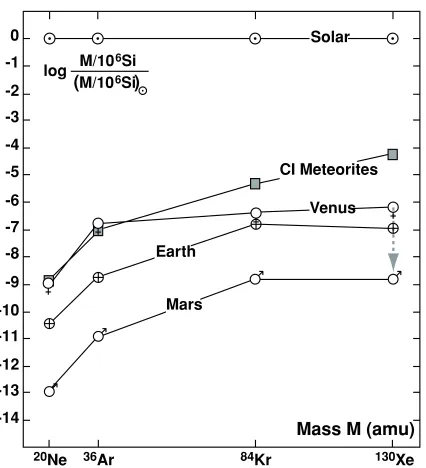
The difference between the measured atmospheric abun-dances of non-radiogenic noble gases in Venus, Earth, and Mars is striking. It is well known that these abundances decline dra-matically as one moves outward from Venus to Mars within the inner solar system, with these two planets differing in abun-dance by up to 2 orders of magnitude (see Figure1and Tables1
and2). Therefore, understanding this variation is a key issue in understanding how the primordial atmospheres of the terres-trial planets evolved to their current composition, and requires us to study the different delivery mechanisms of the volatiles accreted by these planets (Pepin1991,2006; Owen et al.1992, 1995; Dauphas2003; Marty & Meibom2007). Another striking feature of the atmospheric noble gas abundances in terrestrial planets is that they all exhibit significant depletion relative to solar composition (see Figure1 and Pepin 1991, 2006). This depletion depends, at a first approximation, on the mass of the element in question, with the light gases being more depleted and isotopically fractionated than the heavy ones. Moreover, the nature of the main source of noble gases remains contro-versial. Indeed, only a relatively small fraction was supplied to the atmospheres of terrestrial planets via the outgassing of their
mantles (Marty & Meibom 2007). On the other hand, it has been proposed that noble gases could have been acquired by the terrestrial planets through the gravitational capture of their pri-mary atmospheres (Pepin1991,2006). These gases would have initially been captured in approximately solar-like abundances, then experienced ongoing fractionation as a result of gravita-tional escape, driven on Earth by a giant Moon-forming impact and on Mars by sputtering at high altitudes (and also, potentially, the putative giant impact which formed the observed Martian crustal dichotomy; Andrews-Hanna et al.2008). In addition, the fractionation process will also have been driven by the absorp-tion of intense ultraviolet radiaabsorp-tion from the young Sun (Pepin
2006) on each of the terrestrial planets. Other scenarios suggest that bombardment by icy planetesimals or comets could be the main delivery mechanism of argon, krypton, and xenon to the terrestrial planets (Owen et al.1992; Owen & Bar-Nun1995). In these scenarios, the idea that an asteroidal bombardment could be the main contributor of noble gases to the terrestrial plan-ets is not favored because the trend described by the chondritic noble gas abundances as a function of their atomic mass does not reflect those observed in Venus, Earth, and Mars (Owen & Bar-Nun1995). In order to account for the differences between the noble gas abundances observed today among these planets,
Table 1
Abundances of Heavy Noble Gases in Terrestrial Planet Atmospheres in g/g-Planet
Planets 20Ne 36Ar 84Kr 130Xe
Venus 2.9±1.3×10⁻¹⁰ 2.51±0.97×10⁻⁹ 4.7+0.6−3.4×10⁻¹² 8.9+2.5−6.8×10⁻¹⁴
Earth 1.00±0.01×10⁻¹¹ 3.45±0.01×10⁻¹¹ 1.66±0.02×10⁻¹² 1.40±0.02×10⁻¹⁴
Mars 4.38±0.74×10⁻¹⁴ 2.16±0.55×10⁻¹³ 1.76±0.28×10⁻¹⁴ 2.08±0.41×10⁻¹⁶
Note.From Pepin (1991) and references therein.
-14
Mass M (amu)
-13 -12 -11 -10 -9 -8 -7 -6 -5 -4 -3 -2 -1 0
20Ne 36Ar 84Kr 130Xe
log M/106Si
(M/106Si)
Solar
CI Meteorites
Venus
Earth
Mars
Figure 1.Measured abundances of Ne, Ar, Kr, and Xe in the atmospheres of the terrestrial planets and primitive CI meteorites. The values shown for these gases are presented relative to their solar abundances, in units of atoms per 106Si
atoms (adapted from Figure 2 of Pepin1991). The vertical arrow pointing down indicates that the Venus atmospheric abundance of Xenon is only an upper limit (see the text and Donahue et al.1981).
Owen et al. (1992) argued that giant impacts would have eroded their atmospheres without inducing any fractionation. In their model, gravitational escape would have played a role restricted to the fractionation of atmospheric neon. The idea that two separate sources (i.e., fractionated nebular gases and accreted cometary volatiles) contributed to the current noble gas budget on Earth has also been developed by Dauphas (2003). In this case, hydrothermal escape would have fractionated the heavy noble gases acquired from the solar nebula and the resulting transient atmosphere would have mixed with cometary material in order to reproduce Earth’s noble gas abundances.
[image:2.612.64.277.151.385.2]In this work, we investigate whether it is possible to quan-titatively explain the differences between the heavy noble gas abundances measured in the atmospheres of Venus, Earth, and Mars, assuming that cometary bombardment was the main de-livery mechanism of these noble gases to the terrestrial planets. To do so, we use the recent dynamical simulations performed by Horner et al. (2009) that allowed the calculation of the im-pact fluxes of small bodies suffered by the terrestrial planets during the course of their formation and evolution. Assuming that the mass of noble gases delivered by comets is proportional to the rate at which they impact upon the terrestrial planets, we show that the krypton and xenon abundances in Venus and the Earth can be explained in a manner consistent with the hypothesis of cometary bombardment. In order to explain the differences between the krypton and xenon abundances of Earth and Mars, we need to invoke the presence of large amounts of
Table 2
Ratio of Observed Noble Gas Abundances Between the Terrestrial Planets
Noble Gas XVenus/XEarth XEarth/XMars
20Ne 15.8–42.4 193.3–277.5
36Ar 44.5–101.2 126.9–214.9
84Kr 0.8–3.2 80.4–113.5
130Xe 1.5–8.3 55.4–85.0
CO2-dominated clathrates in the Martian soil that would have
efficiently sequestered these noble gases. On the other hand, our calculations show that it is impossible for the variation of the argon abundance between the terrestrial planets to be explained if the sole source of volatile material is cometary in nature. In order to account for this variation, a loss of argon due to gravita-tional escape needs to be invoked from the primary atmospheres of the terrestrial planets.
2. THE IMPACT REGIMES OF THE TERRESTRIAL PLANETS
Recentn-body simulations performed by Horner et al. (2009) studied the impact rates experienced by the terrestrial planets as a result of diverse populations of potential impactors. They considered a wide range of plausible planetary formation sce-narios for the terrestrial planets, and found that the different impact regimes experienced by Venus, Earth, and Mars could have resulted in significant differences between their individual hydration states over the course of their formation and evolu-tion. These authors created different test populations of mass-less particles representing asteroidal and cometary material, and followed their dynamical evolution for a period of 10 Myr un-der the gravitational influence of the planets (see Horner et al.
2009for further details). For the sake of comparison, Table3
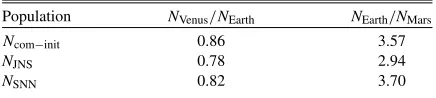
shows the results of two of the simulations conducted by Horner et al. (2009), investigating the impact flux of cometary bodies on the terrestrial planets. Simulation 1 describes the evolution of a population of 100,000 objects (Ncom−init) analogous to the Centaurs in the modern outer solar system (5 AU< q <10 AU, 5 AU< Q < 30 AU, and 0◦ < i <30◦; see, e.g., Levison & Duncan 1997; Horner et al. 2003, 2004; Bailey & Malhotra
2009; Jewitt2009for a variety of papers on the nature of the Centaurs). Simulation 2 describes the simultaneous evolution of two different populations of 50,000 comets each. The first group of objects (NJNS) was created with semimajor axes between 6 and 10 AU, eccentricities less than 0.2, and inclinations less than 10◦. The second group (NSNN) was created with the same spread
of eccentricities and inclinations, but with semimajor axes be-tween 10 and 30 AU. Table 3 shows that the results of both simulations are very similar. On average, the Earth received a flux of impacting comets which is∼3.4 times higher than that experienced by Mars. On the other hand, Venus experiences an impact flux of comets that is only∼0.8 times that for Earth.
[image:2.612.336.554.176.236.2]Table 3
Ratio of the Number of Objects Impacting on Venus and Earth as a Function of the Number Hitting Earth and Mars, Respectively, for Each of the Populations
of Comets Used (from Horner et al.2009)
Population NVenus/NEarth NEarth/NMars
Ncom−init 0.86 3.57
NJNS 0.78 2.94
NSNN 0.82 3.70
which they impacted upon them. It is then possible to derive
Xp/Xp (the ratio of the noble gas abundances (as a fraction of
the total mass of the planet) between planetspandp) from the ratio of the number of comets impacting upon those two planets (Np/Np; see Table4) through the following relation:
Xp
Xp
= Np
Np
Mp
Mp
, (1)
where Mp and Mp are the masses of planets p and p,
respectively. Table 4 displays the values of Xp/Xp for the
terrestrial planets and shows that the amount of noble gases delivered to Earth and Venus, as a fraction of their total mass, is almost identical. Assuming that comets were the only source of the heavier noble gases to the terrestrial planets, this result falls within the range of values obtained through observation (Table2) of the84Kr abundance in Venus and Earth.
Because of the large uncertainties involved in the measure-ment of the abundance of noble gases in the atmosphere of Venus, we also consider that the ratio of the130Xe abundances
of the two planets is in agreement with our model. Indeed, the
130Xe abundance used in Table1and derived from Pepin (1991)
corresponds to the value determined by Donahue (1986) from the data collected by the U.S. Pioneer Venus probe. On the other hand, the same data and others collected by Soviet spacecraft have been comprehensively reviewed by von Zahn et al. (1983) who suggested that xenon might not have been detected at all. Moreover, other determinations by Donahue et al. (1981), still from the same Pioneer Venus data set, also suggest that the measured130Xe abundance is an upper limit and could be as
low as zero. In other words, all these studies suggest that the Venusian data are not in a state to permit a robust determination of the Xe isotope abundances.
On the other hand, our model cannot reproduce the high ratio (up to 2 orders of magnitude) between the observed36Ar
abundances in Venus and Earth. Moreover, Table4shows that the average noble gas abundance on Earth should be∼0.37 times the Martian noble gas abundances if these volatiles were solely delivered by comets. This result differs significantly from that inferred from measurements of noble gas abundances, which are observed to be approximately 2 orders of magnitude larger for the Earth compared to Mars. From these considerations, it appears that the different impact regimes undergone by the terrestrial planets are not sufficient to explain all the variations between their noble gas abundances.
In the following section, we discuss the potential influence that multiple guest clathrates located in the Martian subsurface could have on its atmospheric noble gas budget.
3. THE TRAPPING OF NOBLE GASES BY CLATHRATES IN THE MARTIAN SOIL
Theories supporting the presence of clathrates on Mars initially focused on CO2 as the sequestered gas, but have been
Table 4
Mass Fraction Noble Gas Abundances of Venus and Earth as a Function of those for Earth and Mars, as Derived from Equation (1)
Population XVenus/XEarth XEarth/XMars
Ncom−init 1.05 0.38
NJNS 0.95 0.32
NSNN 1 0.40
extended to the investigation of the trapping of other gases. It was shown in 1970 that CO2 clathrate was thermodynamically
stable at the Martian poles (Miller & Smythe 1970). Since then, many studies have postulated the existence of large CO2
clathrate deposits both at the poles and in the subsurface at lower latitudes, and discussed their possible influence on the Martian climate or atmospheric composition (Milton1974; Dobrovolskis & Ingersoll1975; Jakosky et al.1995; Musselwhite & Lunine
1995; Kargel & Lunine 1998; Komatsu et al. 2000; Max & Clifford 2001; Longhi 2006; Prieto-Ballesteros et al. 2006; Chastain & Chevrier2007; Thomas et al.2009; Swindle et al.
2009).
The presence of CO2-dominated clathrates in the perennial
Martian polar caps or in the permafrost is important for our study because it could imply that the36Ar,84Kr, and130Xe abundances
measured in the planet’s atmosphere are not representative of its global noble gas budget. Indeed, depending on the amount of existing clathrates, the volume of noble gases trapped in these crystalline structures could be much larger than those measured in the atmosphere. This was shown by Musselwhite & Lunine (1995) and Swindle et al. (2009) who exploited a statistical mechanical model (van der Waals & Platteeuw1959; Lunine & Stevenson 1985) to determine the composition of CO2-dominated clathrates formed on the Martian surface. In
this model, the relative abundance fG of a guest speciesGin
a clathrate (of structure I because CO2 is the primary guest
species) is defined as the ratio of the average number of guest molecules of species Gin the clathrate over the average total number of incorporated molecules as
fG=
bLyG,L+bSyG,S
bL
JyJ,L+bS
JyJ,S
, (2)
where the sums in the denominator run over all species present in the system, andbS andbLare the number of small and large
cages per unit cell, respectively. The occupancy fractionsyGof
the guest species Gfor a given type of cage and for a given type of clathrate are determined from the Langmuir constants which are related to the strength of the interaction between each guest species and each type of cage (van der Waals & Platteeuw
[image:3.612.60.278.95.144.2]and clathrate hydrate determined by experimental data. Extrap-olated down to low temperatures, small differences in the fits at higher temperature would become magnified between the two approaches. Furthermore, while Lunine & Stevenson (1985) assumed a constant value with temperature for the chemical potential difference between water ice and the empty clathrate hydrate cage, Parrish and Prausnitz derived a temperature de-pendence from the experimental data. Although this would not affect the predictions of clathrate formation in the pure noble gases, CO2 has such a large, rod-like core that as a primary
guest species it could lead to large differences in noble gas trapping efficiencies depending on the two approaches. Indeed, there are significant differences in trapping efficiency between the Kihara parameters derived by the two sets of authors. For ex-ample, from a set of Kihara parameters determined by Lunine & Stevenson (1985), Musselwhite & Lunine (1995) found that the mole fractions of Xe, Kr, and Ar in CO2-dominated clathrates
are∼700, 6, and 0.1 times those measured in the Martian atmo-sphere, for a soil temperature of 150 K and a CO2gas pressure
of 0.007 bar, i.e., the atmospheric pressure at the ground level. On the other hand, from another set of Kihara parameters self-consistently determined by Parrish & Prausnitz (1972a,1972b) on some experimentally measured dissociation pressures, Swindle et al. (2009) found that the mole fractions of Xe, Kr, and Ar in CO2-dominated clathrates are ∼34, 0.6, and 0.02
times those measured in the Martian atmosphere, in the same clathration conditions. Despite the discrepancies, these calcula-tions confirm that at least large amounts of xenon and krypton can be trapped in the CO2-dominated Martian clathrates.
The amount of noble gases potentially sequestered in the Martian soil will depend on the postulated mass of existing clathrates. Using Mariner 9andViking Orbiter observations, Jakosky et al. (1995) assumed a total volume of the north-polar layered deposits (NPLD) of ∼2×10⁶ km3 and inferred that
up to the equivalent of∼0.2 bar of CO2 could be contained
in the NPLD if it consists primarily of clathrates. However, recent observations by the sounding radar SHARAD on the
Mars Reconnaissance Orbiter have shown that the NPLD should be somewhat smaller, with an estimated volume of
∼1.1 ×10⁶ km3 (Grima et al. 2009). On the other hand,
observations of the south-polar layered deposits (SPLD) by the sounding radar MARSIS aboard theMars Express Orbiter
indicated the plausible presence of ∼1.6×10⁶ km3 of ice
(Plaut et al.2007). From these recent estimates and following the approach of Jakosky et al. (1995), if all the polar deposits consist essentially of clathrates, then the equivalent pressure of CO2trapped in clathrates could reach∼0.27 bar, provided that
all the clathrate cages are occupied. Note that these estimates do not take into account the possible existence of clathrates in the Martian permafrost whose thickness is expected to vary between 3–5 km at the equator and 8–13 km at the poles (Max & Clifford2000,2004; Chastain & Chevrier2007). Assuming that only 10% of this layer is made of ice would add between
∼30 and 50×106km3of ice and thus more than 3 bar of CO 2if
all this permafrost is made of CO2clathrate. However, as of yet,
there is no observation of such a deep and extended permafrost layer. Recent MARSIS analysis demonstrated that an ice-rich permafrost layer exists close to the surface with a depth of at least 50 m at all latitudes poleward of±50◦in both hemispheres, adding ∼1 ×10⁶ km3 to the known ice budget (Mouginot et al. 2009). However, the dielectric constants of water ice and clathrates are too similar to allow to them to be easily distinguished at these radar wavelengths. If we assume this ice
layer is also clathrates, this adds an atmospheric equivalent of 0.1 bar of CO2. The total CO2content of all known ice on Mars
could be up to 0.37 bar. However, because the efficiency of clathration is never total, we will assume here that the trapping of 0.3 bar of CO2in Martian clathrates is plausible. It is an upper
limit for the known Martian ice but also a lower limit given all the still-unknown but probably deep underground ice reservoirs. This value implies that, if the mixing ratios of guest species trapped in clathrates were similar to the atmospheric ones, about 0.3/0.007,∼43 times more noble gases would be present in the Martian subsurface than in the atmosphere. Taking into account the fractionation of the noble gas abundances induced by their clathration, the amount of noble gases stored in the Martian subsurface could be much larger. In this case, if one considers the Kihara parameters derived by Lunine & Stevenson (1985), the equivalent abundances of Xe, Kr, and Ar permanently stored in the Martian subsurface could be up to∼30,000, 260, and 4 times higher than their observed atmospheric abundances for 0.3 bar of CO2trapped in clathrates.
Calculations detailing the impact regimes of the terrestrial planets predict that, if comets were the main suppliers of noble gases to the terrestrial planets, then the average noble gas abundance (scaled to the mass of the planet) on Earth should be approximately 0.37 times the noble gas abundance on Mars. In this case, the equivalent of ∼216–307 times the Martian84Kr atmospheric abundance is required to be trapped in
clathrates in order to match the observed Earth/Mars∼80–113 range of84Kr abundance ratios. This value remains below the maximum predicted from the assumption that 0.3 bar of CO2is
stored in the Martian clathrates and that all the clathrate cages are filled by guest molecules. Similarly, if the equivalent of
∼150–230 times the Martian atmospheric abundance of130Xe is
trapped in clathrates, a range of values well below the maximum predicted, then the resulting terrestrial 130Xe abundance is
in agreement with the observed Earth/Mars ∼55–85 range of 130Xe abundance ratios. However, the Earth/Mars 36Ar
observed range of ratios of 127–215 cannot be explained by our model because the trapping of this species is very poor in Martian clathrates, at least∼86 times less than that would be required to reduce the Martian atmospheric argon to its current level.
In order to match the observations, the amounts of krypton and xenon trapped in CO2-dominated clathrates must be enhanced
by a similar factor compared to their atmospheric abundances. This conclusion could appear to contradict the present results that show that the maximum trapping efficiencies of krypton and xenon calculated here are very different. However, it should be noted that these differences could be strongly reduced by consid-ering the variation of the cage size with temperature. Indeed, it has been recently shown that a small contraction of the cage size strongly increases the trapping efficiency of Kr without chang-ing noticeably the one of Xe, at least for CH4-rich clathrates
4. DISCUSSION AND CONCLUSIONS
Our model only accounts for the differences between the krypton and xenon abundances in terrestrial planets. However, in addition, two different scenarios based on our model can be used to explain the differences between the neon and argon abundances of these planets. In the first scenario, cometary bombardment of the terrestrial planets would have occurred at epochs contemporary to the existence of their primary atmospheres. Comets would have been the carriers of argon, krypton, and xenon, while neon would have been gravitationally captured by the terrestrial planets (Owen et al.1992). Only neon and argon would have been fractionated due to gravitational escape, while the abundances of the heavier noble gases would have been poorly affected by such losses. In this scenario, the combination of processes, such as escape of neon and argon, cometary bombardment at the epochs of existence of primary planetary atmospheres, and the sequestration of krypton and xenon in the Martian clathrates, would then explain the observed noble gas abundance differences between the terrestrial planets. However, this scenario leads to an important chronological issue because the primordial atmospheres of terrestrial planets are expected to exist during the first few million years or so of their lifetime (Pepin 2006), while recent work suggests that heavy noble gases could have been supplied by the late heavy bombardment (Marty & Meibom2007) which is thought to have marked the end of accretion of terrestrial planets 3.8 billion years ago (Gomes et al.2005).
In the second scenario, impacting comets would be signifi-cantly depleted in argon, compared to the other noble gases. This idea is supported by predictions of the noble gas abundance in these bodies, provided that they formed from clathrates in the so-lar nebula (Iro et al.2003). In this model, neon and argon would have been supplied to the terrestrial planets via the gravitational capture of their primary atmospheres, whereas the bulk of their krypton and xenon would have been delivered by comets. In this case, the cometary bombardment of the terrestrial planets could have occurred after the formation of their primary atmo-spheres because only the neon and argon abundances observed today would have been engendered by the escape-fractionation processes in these atmospheres. Here, we favor this scenario be-cause it is consistent with the hypothesis that the heavier noble gases could have been supplied by the late heavy bombardment to the terrestrial planets.
Whatever the scenario envisaged, our work does not preclude the possibility that a fraction of the heavy noble gases could have been captured by terrestrial planets during the acquisition of their primary atmospheres. In the first scenario, the fraction of krypton and xenon accreted in this way should be low compared to the amount supplied by comets since these noble gases are not expected to have been strongly fractionated by gravitational escape. In the second scenario, the fraction of krypton and xenon captured gravitationally by the terrestrial planets could be large if the escape was efficient.
The hypothesis of atmospheric escape is supported by both Mars (SNC meteorites) and Earth, which show substantial fractionation of the xenon isotopes compared to the plausible primitive sources of noble gases, i.e., solar wind (SW–Xe), meteorites (Q–Xe), or the hypothetical U–Xe source7 (Pepin
2006). This fractionation then suggests important losses of Xe and other noble gases from the atmospheres of the Earth and
7 The U–Xe source is presumably a nebular composition inferred to be
present on early Earth but so far not seen directly elsewhere (Pepin2000).
Mars. These loss processes might have been more important for the Earth and Mars than Venus because the latter planet would have escaped impacts of the magnitude that formed the Moon (Canup & Asphaug 2001) or created the largest basins on Mars (Andrews-Hanna et al. 2008). In the case of the Earth, the noble gas fractionation episode could have been driven by impacts (Pepin 1997; Dauphas 2003) or by extreme-ultraviolet (EUV) radiation (Pepin1991). In the case of Mars, the combination of impacts, hydrodynamic escape due to EUV radiation, planetary degassing, and fractionation by sputtering losses (Jakosky et al. 1994; Luhmann et al. 1992; Carr 1999; Chassefi`ere & Leblanc 2004) might have played an important role in sculpting the pattern of the noble gas abundances observed today. On the other hand, EUV from the young Sun that powered Ne-only loss from the Earth (Pepin
2006) could have driven escape of Kr and lighter species—but not Xe—from the closer Venus (Pepin 1997). Therefore, the present distribution of noble gas abundances in terrestrial planets might result from a combination between the different cometary input fluxes, volatiles sequestration into Martian clathrates, and subsequent vigorous atmospheric escapes that occurred during the evolution of these planets.
Several ongoing space missions could provide an opportunity to test the different scenarios proposed in this work. Indeed, the ESA Rosetta spacecraft should provide precise measurements of the noble gas content in Comet 67P/Churyumov–Gerasimenko. These measurements should allow us to determine whether argon is depleted in comets (Iro et al.2003). The NASAMars Science Laboratory Missionmay help evaluate the possibility that large amounts of xenon and krypton are trapped in Martian clathrates (Swindle et al.2009). Indeed, seasonal variations in the Kr/CO2 and Xe/CO2 ratios should reveal the extent to
which clathrates participate in the exchange of these noble gases between the Martian surface and atmosphere (Swindle et al.
2009).
We acknowledge Fran¸cois Forget for fruitful discussions about the evolution of the Martian climate. This work was supported in part by the French Centre National d’Etudes Spatiales, and the program “Incentivazione alla mobilita” di studiosi straineri e italiani residenti all’estero. We acknowledge the anonymous referee whose comments have helped us to improve our manuscript.
REFERENCES
Andrews-Hanna, J. C., Zuber, M. T., & Banerdt, W. B. 2008,Nature,453, 1212 Bailey, B. L., & Malhotra, R. 2009,Icarus,203, 155
Canup, R. M., & Asphaug, E. 2001,Nature,412, 708 Carr, M. H. 1999,J. Geophys. Res.,104, 21897
Chassefi`ere, E., & Leblanc, F. 2004,Planet. Space Sci.,52, 1039 Chastain, B. K., & Chevrier, V. 2007,Planet. Space Sci.,55, 1246 Dauphas, N. 2003,Icarus,165, 326
Dobrovolskis, A., & Ingersoll, A. P. 1975,Icarus,26, 353 Donahue, T. M. 1986,Icarus,66, 195
Donahue, T. M., Hoffman, J. H., & Hodges, R. R. 1981,Geophys. Res. Lett.,8, 513
Gomes, R., Levison, H. F., Tsiganis, K., & Morbidelli, A. 2005,Nature,435, 466
Grima, C., Kofman, W., Mouginot, J., Phillips, R. J., H´erique, A., Biccari, D., Seu, R., & Cutigni, M. 2009,Geophys. Res. Lett.,36, 3203
Horner, J., Evans, N. W., & Bailey, M. E. 2004,MNRAS,354, 798
Horner, J., Evans, N. W., Bailey, M. E., & Asher, D. J. 2003,MNRAS,343, 1057
Iro, N., Gautier, D., Hersant, F., Bockel´ee-Morvan, D., & Lunine, J. I. 2003,Icarus,161, 511
Jakosky, B. M., Henderson, B. G., & Mellon, M. T. 1995,J. Geophys. Res.,100, 1579
Jakosky, B. M., Pepin, R. O., Johnson, R. E., & Fox, J. L. 1994,Icarus,111, 271 Jewitt, D. 2009,AJ,137, 4296
Kargel, J. S., & Lunine, J. I. 1998, Astrophys. Space Sci. Lib. 227, Solar System Ices (Dordrecht: Kluwer),97
Komatsu, G., Kargel, J. S., Baker, V. R., Strom, R. G., Ori, G. G., Mosangini, C., & Tanaka, K. L. 2000, Lunar Planet. Inst. Sci. Conf. Abstr.,31, 1434 Levison, H. F., & Duncan, M. J. 1997,Icarus,127, 13
Longhi, J. 2006,J. Geophys. Res., 111, E06011
Luhmann, J. G., Johnson, R. E., & Zhang, M. H. G. 1992,Geophys. Res. Lett., 19, 2151
Lunine, J. I., & Stevenson, D. J. 1985,ApJS,58, 493 Marty, B., & Meibom, A. 2007, eEarth,2, 43
Max, M. D., & Clifford, S. M. 2000,J. Geophys. Res.,105, 4165 Max, M. D., & Clifford, S. M. 2001,Geophys. Res. Lett.,28, 1787
Max, M. D., & Clifford, S. 2004, Second Conference on Early Mars: Geologic, Hydrologic, and Climatic Evolution and the Implications for Life,8083 Miller, S. L., & Smythe, W. D. 1970,Science,170, 531
Milton, D. J. 1974,Science,183, 654
Mouginot, J., Kofman, W., Pommerol, A., Beck, P., Schmitt, B., Herique, A., Safaeinili, A., & Plaut, J. J. 2009, Icarus, submitted
Musselwhite, D., & Lunine, J. I. 1995,J. Geophys. Res.,100, 23301 Owen, T., & Bar-Nun, A. 1995,Icarus,116, 215
Owen, T., Bar-Nun, A., & Kleinfeld, I. 1992,Nature,358, 43
Papadimitriou, N. I., Tsimpanogiannis, I. N., Yiotis, A. G., Steriotis, T. A., & Stubos, A. K. 2007, in Proc. 11th Int. Conf. on Physics and Chemistry of Ice 311, On the Use of the Kihara Potential for Hydrate Equilibrium Calculations, ed. W. Kuhs (Cambridge: The Royal Society of Chemistry), 475
Parrish, W. R., & Prausnitz, J. M. 1972a,Ind. Eng. Chem. Process Des. Dev., 11, 26
Parrish, W. R., & Prausnitz, J. M. 1972b,Ind. Eng. Chem. Process Des. Dev., 11, 462
Pepin, R. O. 1991,Icarus,92, 2 Pepin, R. O. 1997,Icarus,126, 148 Pepin, R. O. 2000,Space Sci. Rev.,92, 371 Pepin, R. O. 2006,Earth Planet. Sci. Lett.,252, 1 Plaut, J. J., et al. 2007,Science,316, 92
Prieto-Ballesteros, O., Kargel, J. S., Fair´en, A. G., Fern´andez-Remolar, D. C., Dohm, J. M., & Amils, R. 2006,Geology,34, 149
Swindle, T. D., Thomas, C., Mousis, O., Lunine, J. I., & Picaud, S. 2009,Icarus, 203, 66
Thomas, C., Mousis, O., Picaud, S., & Ballenegger, V. 2009,Planet. Space Sci., 57, 42
Thomas, C., Picaud, S., Mousis, O., & Ballenegger, V. 2008,Planet. Space Sci., 56, 1607
van der Waals, J. H., & Platteeuw, J. C. 1959, in Advances in Chemical Physics 2, Clathrate Solutions, ed. I. Prigogine (New York: Interscience), 1 von Zahn, U., Kumar, S., Niemann, H., & Prinn, R. 1983, in Venus, ed. D. M.