in Asia (CAADRIA), Hong Kong
CONSTRUCTIVE INTERPRETATION WITH EXAM-PLES FROM INTERPRETING FLOOR PLANS
Abstract. This paper describes the role that interpretation plays in fa-cilitating situated design and presents an implementation that demon-strates a system interpreting floor plans. Designers often see more in what they produce than they intentionally put there. Cognitive studies suggest that this helps develop design ideas. Interpretation is de-scribed as the use of expectations to construct an internal representa-tion of an external representarepresenta-tion (such as a sketch). An implementa-tion of this noimplementa-tion of interpretaimplementa-tion is described. As an example of its capability the system, primed on floor plans, looks at a randomly gen-erated image and can find a floor plan within it. The system produces different results with the same image if it has different expectations. This is used to discuss the notions of a space of possible designs and the two-way relationship between expectations informing interpreta-tion and interpretainterpreta-tion changing the expectainterpreta-tions (design ideas) of a designer. Further work is suggested and the ideas are discussed.
Keywords. constructive interpretation, situation, floor plan, reinter-pretation, push-pull
1. Introduction
Whenever designers bring something from the external world into their in-ternal world, interpretation is occurring, such as when designers read a de-sign brief, consider their own work whilst sketching or observe the behav-iours of a model. In each of these cases, designers interpret by constructing from their expectations. Their interpretation is affected by their past experi-ences (the limits of their knowledge) as well as their current cognitive state (how their knowledge is being used).
infor-mation’ (Bruner 1990). This work looks towards an understanding of the re-lationship between experience, expectation and interpretation in which: (i) interpretation is driven by expectations; (ii) expectations come from experi-ence; and (iii) experiences occur through a sequence of interpretative acts.
1.1 INTERPRETATION IN DESIGN
It has been well recognised that the construction of interpretations is a part of design activity (Schön and Wiggins 1992, Suwa and Tversky 1997). The im-portance of these two studies on ‘kinds of seeing’ and ‘what do architects and students perceive in their design sketches’ is underscored by the fact that they are the two most cited papers within the Design Studies journal since 19901. In sketching, designers work with elements and the relationships
be-tween them. When they look at what they have sketched, they are able to see things in the representation that they did not intentionally place there. Inter-pretation becomes a way in which designers change their own idea of what they are doing (Suwa et al 2000, Oxman 2002). This can be observed in the “seeing-moving-seeing” of the design conversation, where discoveries with-in a sketch from the basis for future design actions (Schön and Wiggwith-ins 1992). This work is based upon a perceived need to explain this conversation of design at a deeper, cognitive level, in the language of concept formation and use. It is grounded in three cognitive frameworks: (i) Perceptual Symbol Systems (Barsalou 1999, 2008); (ii) Conceptual Spaces (Gardenfors 2000) and (iii) Hierarchical Temporal Memories (Hawkins 2005).
An interpretation arises not just from the representation and the designer's knowledge about the world, but also from ‘whereabouts’ within this knowledge the designer is at when interpreting; their current cognitive state or the situation they are in when interpreting (Clancey 1997, Gero 2007). In the implementation described here a situation can be considered as the world view resulting from the use of a number of concepts where concepts affect the use of each other (after Gero 2007). There is a bi-directional relationship between interpretation and situation: the situation that the designer is in changes their interpretation, and the act of interpreting can change the situa-tion. The contribution made by the work is to posit a possible method for modelling this bi-directional relationship that is observed in designers.
1.2 INTERPRETATIONS ARE CONSTRUCTED
the scribble ‘as’ something. For the scribble in Figure 1, as with any repre-sentation, there are many possible interpretations. In Figure 1, a drawing could be made using the lines of the scribble in which the circle becomes the wheel of a car, the eye of a bison or a hole in a cliff face – in each case the player has seen the drawing in such a way that an action is suggested. There are no limits to possible interpretations within the representation, only within the mind of the viewer. The example demonstrates that the meaning lies not in the representation itself but rather is constructed by the player looking at the scribble – and a different player will likely construct something different from the lines. In doing this the player is making use of their knowledge from experience in the world to construct an interpretation. In other words, “it's not what you look at that matters, it's what you see” (Thoreau 1851).
Figure 1. Lines on a page from which an interpretation can be constructed.
2. A computational example of construction
The same effect has been implemented in a constructive interpretation sys-tem. The system demonstrates that: (i) a randomly constructed representation is given meaning by a system through construction from expectations found-ed on experience; and (ii) the same system with the same source and the same knowledge produces different interpretations depending upon the situa-tion it is in when interpreting.
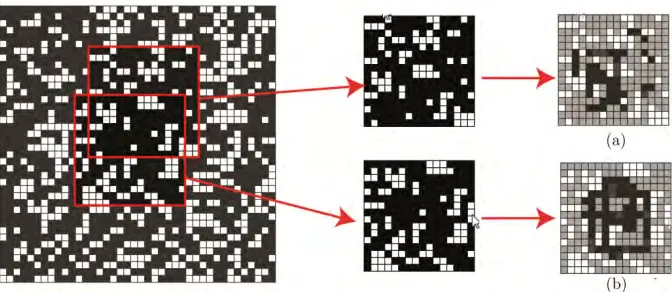
map (Kohonen 1989) to learn the different representations. It then scans the external representation, which is this case is a randomly generated set of marks upon a page, such as that seen in Figure 3(a), and constructs an pretation using its expectations. In doing this the system constructs an inter-pretation that is both relevant to where it is at cognitively, its situation, and the source that is interacting with visually.
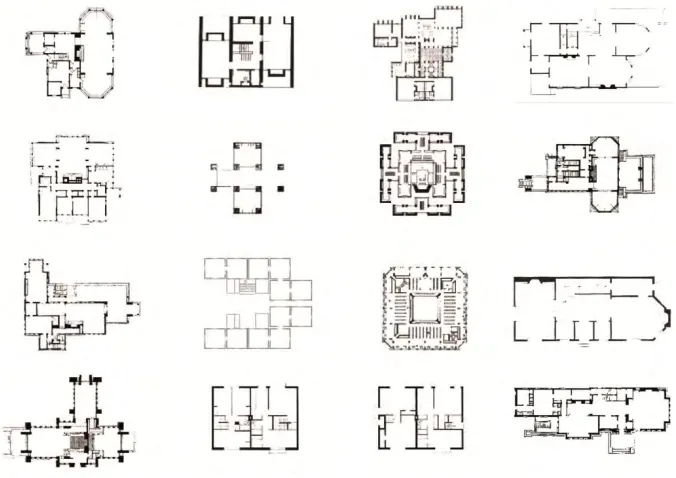
[image:4.595.130.468.321.560.2]The development of situations is supervised in that floor plans are la-belled with the architect responsible for them. Prior to interpreting the source, the system holds expectations from the situation. For example, if it is expecting a Palladio floor plan then it holds conceptual expectations related to this.
Figure 2. Samples from the set of floor plans used in the example.
Figure 3. (a) A randomly generated source, (b) is perceived by saccading across the image in a pattern from left to right, with the system only ever perceiving 16x16 squares at a time.
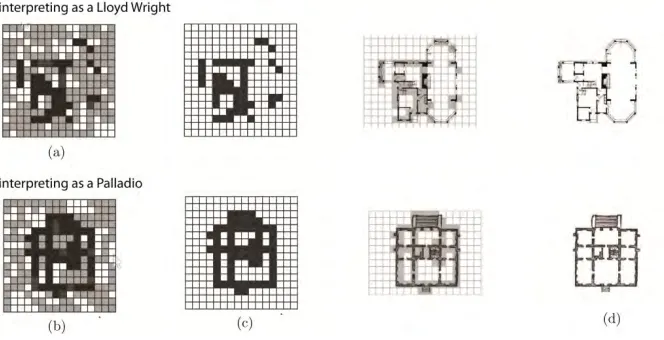
[image:5.595.125.470.163.311.2]The system attempts to construct from the available source data as it sac-cades, using its expectations. Figure 4 shows two examples of where a con-struction has occurred in two different runs of the experiment. In Figure 4(a) the system is expecting to find a Frank Lloyd Wright floor plan and in Fig-ure 4(b) it is expecting to find an Andrea Palladio floor plan. The two runs have the same source and the same knowledge, but the situation that the sys-tem is in is different in the two runs. As a result, the constructed interpreta-tion is very different - not only is the system constructing something differ-ent, but it is using a different part of the representation for construction.
Figure 4 Two different constructions from the same source have resulted from two runs of the system with different expectations: (a) expecting a Frank Lloyd Wright; and (b) expecting an
[image:5.595.129.465.494.640.2]The constructed representations are canonical representations of the ini-tial floor plans that the agent was primed with through its experience. Figure 5(a) and Figure 5(b) show what the system has ‘seen’ within a randomly generated source when expecting a Lloyd Wright and a Palladio floor plan respectively. In each case it has constructed as interpretation of something in the source as a floor plan from what is available. It has made this construc-tion because of the expectaconstruc-tions that it held. At this point in the saccade there was sufficient similarity for the system to be able to construct an interpreta-tion from what it was expecting.
Figure 5 The two constructed representations are compared to the original representations that were part of the training set from: (a) a Frank Lloyd Wright; and (b) an Andrea Palladio. The images labelled (c) are representations of the concepts within the system that have been
con-structed. The images labelled (d) are the original representations used in the training set that goes to make up the viewer’s knowledge about plans.
Two different interpretations are produced by runs in the system, but nei-ther the knowledge held by the system nor the source has changed. The rea-son why the interpretation is different is that the system is within a different situation. This demonstrates that the expectations that the system holds are important in constructing an interpretation.
3.2 A SPACE OF POSSIBLE INTERPRETATIONS
One way to describe what is occurring in the model is to introduce the notion of a space of possible interpretations. We can describe three spaces of possi-ble interpretation based upon how they expectations are used referring to no-tions of push and pull (Gero and Kannengeisser 2004):
• Push-only interpretation. In push-only interpretation, expectations
are not utilised in producing an interpretation. The system uses every-thing that it knows about producing a representation from a source in the interpretation. In push-only interpretation the same knowledge (in the system) with the same source will produce the same interpretation. For example, a CAD system will represent the same file in the same way. Figure 6(a) shows this as a single space of possible interpreta-tions bounded by the knowledge that the agent holds.
• Pull-only interpretation. In pull-only interpretation the expectations
of a system are the basis for producing an internal representation. In pull-only interpretation every source is constructed from the expecta-tions held by the system, regardless of how good a fit for the source these expectations are. Figure 6(b) shows this as a reduced space of possible interpretations. This space will be located in a different place in a different situation, meaning that the same source can produce a different representation.
• Push-pull interpretation. In push-pull interpretation an internal
[image:7.595.127.470.566.633.2]rep-resentation is constructed from expectations (as with pull-only) but push can occur where the expectations are not a good fit with the source. Figure 6(c) shows this as a reduced space of possible interpre-tations that can shift to another reduced space during interpretation.
3. Interpretation in the design conversation
In this first implementation the system was finding within a representation what it expected to find – an example of pull-only interpretation. In the de-sign conversation, cognitive studies suggest that dede-signers see using their expectations but also have their expectations changed by what they see (Su-wa et al 2000).
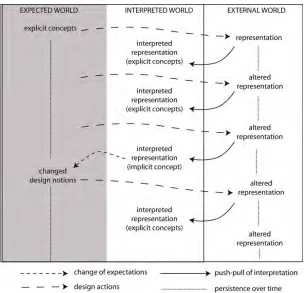
[image:8.595.146.450.336.629.2]A second implementation was developed in a similar environment to model a design conversation in which the design agent begins with one no-tion of what it is doing which changes over time as it plays with ideas and interprets the external representation. Figure 7 shows a script typical of this implementation as the interaction between three worlds (Gero and Kannen-giesser 2004).
Figure 7 A design conversation as the interaction between three worlds, the internal, expected and external.
of shapes from Louis Khan floor plans. When it looks at the resulting layout it constructs an interpretation, which can lead it to bring concepts outside the situation into the situation. An example of this is a shape from a Frank Lloyd Wright floor plan being seen suggesting other similar shapes that could be useful for the design.
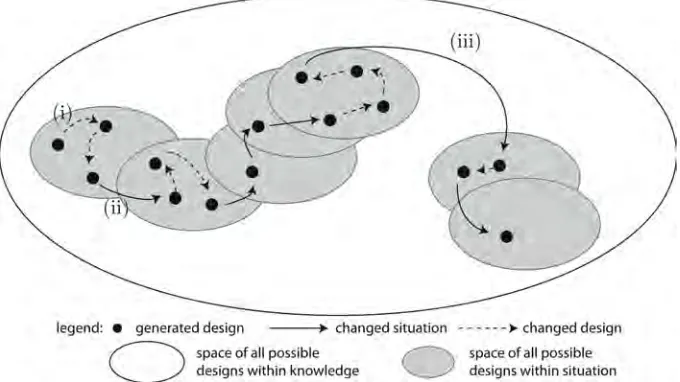
[image:9.595.128.468.297.488.2]Implementing a design conversation with push-pull interpretation pro-duces some phenomena observed in conceptual design activity. This can be described using the notions of situations and a changing space of possible designs (Coyne et al 1990). Within a situation a limited number of designs are possible, Figure 8.
Figure 8 The changing space of possible designs in which interpretation can lead to: (i) new designs within the existing space; (ii) a shift to a changed space; and (iii) a shift to a new space of designs
Discussion
Interpretation pertains to the way that designers see things within their own work. The situation that a designer is in when they look at a representation affects the interpretation that they produce. The meaning of a representation is constructed by the viewer. Designers engaged in a design task see things within their work and the world around them that help them develop ideas. For example, a designer looks at a sketch, points to an element and makes a judgement about it. Where did this judgement come from?
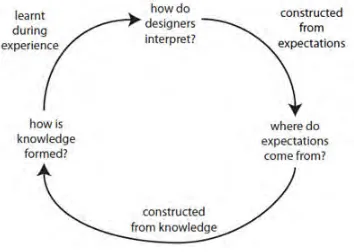
[image:10.595.195.372.510.636.2]This work suggests a model of interpretation through pull from expecta-tions and push to a new situation when pull does not work. In this way a de-signer maintains a balance between a stable world (seeing what they expect to see) and a changing world (bringing concepts from outside the situation into the design conversation). In this paper two implementations have been discussed. In one a randomly generated representation is interpreted ‘as’ something. Different expectations of the system led to different interpreta-tions. In the second system the initial design ideas are developed by using the ideas in creating an external representation and then interpreting the re-sult. This leads to concepts being brought into the design task that were not previously being considered by the designer, providing a possible explana-tion for the observaexplana-tion of this phenomena in designers. The work starts with the observation that designers construct an interpretation from their expecta-tions and considers the way that this affects the design conversation. This can be seen as a contribution towards understanding the relationships in the loop seen in Figure 9, trying to get at this overarching question: how do de-signers see?
Figure 9 Research into constructive interpretation is a part of understanding how designers see, a loop involving the formation of knowledge through experience and development of
Endnotes
1. Google Scholar as at 11/09/2010
References
Barsalou LW: 1999, Perceptual symbol systems, Behavioral and Brain Sciences 22: 577-660 Barsalou LW: 2008, Grounded cognition, Annual Review of Psychology 59: 617-645 Bruner J: 1990, Acts of Meaning, Harvard University Press, Cambridge, MA
Clancey WJ: 1997, Situated Cognition: On Human Knowledge and Computer Representa-tions, Cambridge University Press, Cambridge
Coyne RD; Rosenman MA; Radford AD; Balachandran M and Gero JS: 1990, Knowledge- Based Design Systems, Addison-Wesley, Reading MA
Gärdenfors P: 2000, Conceptual Spaces: The Geometry of Thought, MIT Press, Cambridge, MA
Gero JS: 2007, Situated design computing: Principles, in BHV Topping (ed), Civil Engineer-ing Computations: Tools and Techniques, Saxe-Coburg Publications, Stirlingshire, pp. 25-35
Gero JS and Kannengiesser U: 2004, The situated function-behaviour-structure framework,
Design Studies 25(4): 373-391
Hawkins J: 2005, On Intelligence, Holt Paperbacks, New York
Schön D and Wiggins G: 1992, Kinds of seeing and their functions in designing, Design Stud-ies 13(2): 135-156