Final year projects Australia
Final year engineering projects in Australia and Europe
Faculty of Engineering and Surveying, University of Southern Queensland, West Street, Toowoomba, 4350, Australia
H Ku and S Goh, Final year engineering projects in Australia and Europe, European Journal of Engineering education, 2010, Vol. 35, No. 2, May, pp.161–173.
Title : Dr.
Name : Harry Siu-lung Ku
Affiliation : Faculty of Engineering and Surveying,
University of Southern Queensland. Tel. No. : (07) 46 31-2919
Fax. No. : (07) 4631-2526
Abstract
The paper starts by emphasising that final year engineering projects are regarded important in the training and education of professional engineers in Australia and Europe. The sources of projects available to students were also mentioned. Some Australian universities insist individual projects but some not, each with their own reasons. However, it can be argued that all European universities run individual projects. In most cases, whether it is in Australia or Europe, the total load for final year engineering project is about 6.25 % of the load of the engineering programs. Assessment methods were also described. They were all different whether it is in Australia or Europe but not very significant. It was discovered that literature review, oral presentation and written report or dissertations were important elements in the assessment schemes. Many university staff, in both continents, encouraged students to publish their work in international conferences and journals if the originality of the projects was high. It can be argued that individual project is most effective in learning outcome; however, the cost involved is also very high and its sustainability in smaller universities in Australia is in doubt.
Keywords: Final year engineering projects, individual project, assessments, oral presentation, dissertation, conferences, journals, Europe and Australia.
Introduction
categories of core, major and elective subjects. Other universities may call them core subjects for specialised degree, elective subjects for specialised degree and elective subjects from outside the School/Faculty (Zayegh, 2007).
The objective of this study is to compare and contrast the delivery and management methods of final year engineering projects by different universities in Australia and Europe so that engineering educators can learn how each of the universities in the two continents delivers and manages their undergraduate final year engineering projects.
Capstone projects in Australia
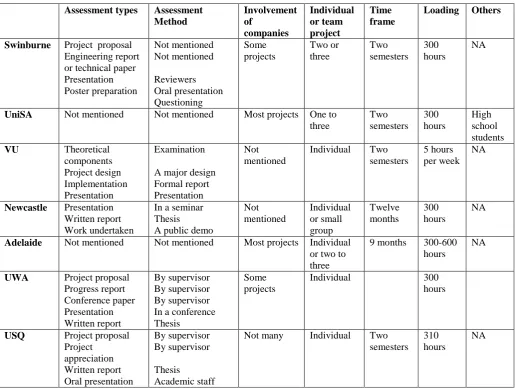
The final year engineering research projects of seven universities in Australia were selected for discussion; the seven universities were Swinburne University of Technology (Swinburne), University of South Australia (UniSA), Victoria University (VU), University of Newcastle (Newcastle), University of Adelaide (Adelaide), University of Western Australia (UWA) and University of Southern Queensland (USQ). The characteristics of their final year engineering research projects were summarised in Table 1 and more details of them will be mentioned in the coming paragraphs.
Swinburne
project is also completed. The process takes approximately 10 weeks before any “project work” can commence. Students work in groups of two or three, depending on the project theme or topic. Students are given the choice of submitting either a formal engineering report (of approximately 35 pages) or preparing a technical paper in accordance with guidelines of the American Society of Mechanical Engineers (ASME)or Society of Automotive Engineers (SAE) at the end of the second semester. Very few average students chose the “paper” writing path. In most cases, “papers” were prepared at the suggestion of the supervisors after the submission of final reports. For those students who choose the “paper” writing path, the goal of the project is very oriented towards manuscript preparation for conference submission and follows different guideline from those preparing a report. These students must now ensure that their results are experimentally accurate, can be statistically validated and the literature review is comprehensive. Often the students who contemplate postgraduate studies undertake this path (Blicblau, 2007).
guidelines, 20 minutes is allocated for each presentation. At the end of each presentation, two minutes is allowed for questions. At the same time as the presentations are being given, the posters are displayed in a specially prepared room. At the end of the presentation session, the students are required to attend their posters and answer any questions. On account of the requirements for accreditation by Engineers Australia, Swinburne has developed generic attributes appropriate to final year projects of all of engineering programs, which are depicted in Table 3. Anecdotal reports by students indicated a high level of satisfaction with the management and outcomes of the work in the form of conference participation, presentation and publications (Blicblau, 2007).
University of South Australia
In the final year of undergraduate degree programs in the School of Electrical and Information Engineering at the University of South Australia (UniSA), students accomplish hands-on design projects that account for a quarter of the year’s academic credit load. The majority of the projects, depending on each year, there are between 60% and 80% of the projects are industry sponsored. Recently, high school students have also been involved in these projects. The program has been successfully running for the past 3 years and proved to bring benefits to high school students, university students and also to companies that participate in the program (Nafalski and Nedic, 2008).
With industry sponsorship and high school students’ involvements in the final year engineering projects, UniSA is actually providing service-learning, which is a teaching and learning pedagogical approach that combines active student learning with a meaningful community service (Nafalski and Nedic, 2008).
Victoria University
Zayegh (2007) claimed that the final year projects of undergraduate electrical engineering program in Victoria University, Melbourne would provide the students with the knowledge and the techniques to investigate and solve an engineering problem based on the knowledge acquired over the years of the program. It also provides them with method of scientific enquiries, including the “tricks of trade”.
The final year engineering design and project subject consists of two semesters, which could be one or two projects. It has five contact hours per week. The students cannot enrol in the subject until they have completed all the subjects of their first three years. The subject has theoretical components in parallel with project design in first semester and ends with written examination and a major project design and implementation with formal project report and presentation at the end of the second semester (Zayegh, 2007).
time requirement, including hardware and software components. The coordinator will list all the approved projects with their provider names and give the students the opportunity to select the projects of interest. All projects are individual project and supervised by one academic staff. Project provided by industries may be supervised by academic and industry supervisor. All marked work over the year will be added to generate the final mark of the subject as shown in Table 4 (Zayegh, 2007).
From Table 4, it can be found that the assessment panel will be responsible for only 30% of the total assessment marks due to limited contact with the students except during presentation sessions (Chan, 2001). On the other hand, the principal supervisor will be responsible for 65 % of the total assessment marks which includes the final report mark. The principal supervisor will follow a set of criteria for his/her assessment (Zayegh, 2007).
University of Newcastle
This course consists of a combination of Part A and Part B. Students must complete Part A before completing Part B. Students must complete the sequence within a twelve month period. The course is conducted under the direct supervision of an academic staff (University of Newcastle, 2009b):
University of Adelaide
The final year project is considered to be an important part of the engineering education process and projects sponsored by local industry are very welcomed. In the past many companies have benefited considerably from technology developed as part of a final year project. Although the projects normally require a minimum of 300 hours of student time, many students spend up to 600 hours. Students work in groups of two to three but sometimes, one student carries out a project by himself or herself. Many of the final year mechanical engineering student projects in the University of Adelaide are industry-sponsored.
students progress to ensure that the project remains on schedule. The total cost to industry for this program is $10,000. The student commences the project from the beginning of March to end of October on the project, including vacation time in June/July (University of Adelaide, 2009).
The second way that companies may be involved is less structured than the first in terms of project management. Students work in groups of 2 or 3 from the beginning of March until the end of October and may be expected to spend 300 to 400 hours on the project. The project is supervised by a member of academic staff and the students are not paid a stipend. An upfront fee of $500 to cover incidental expenses is charged. If both the company and the academic supervisor agree that the project has met specified goals, a further payment to the School of Mechanical Engineering of $2000 is required at the completion of the project (University of Adelaide, 2009).
University of Western Australia
significant changes in the operations of individual companies, novel designs, and even the formation of a new company (University of Western Australia, 2009).
All projects must be undertaken as individual projects – group or team projects are not permitted for final year projects in the School of Mechanical Engineering. Project topics may be drawn from the list of projects provided on the course website, or individuals may suggest their own topics (provided that they can find a member of the academic staff to supervise the project). Students may undertake projects with supervisors outside the School of Mechanical Engineering, though in such cases students are required to have a co-supervisor in the School of Mechanical Engineering and the approval of the Head of School (this requirement is waived for Mechatronics students undertaking projects in the School of Electrical, Electronic and Computer Engineering or the School of Computer Science and Software Engineering) (University of Western Australia, 2009).
During the course of the project, students will be required to submit a (University of Western Australia, 2009):
• project proposal (draft and final versions)
• progress report
• conference paper and abstract • draft thesis
The assessments of the projects are given in Table 6 (University of Western Australia, 2009).
University of Southern Queensland
In University of Southern Queensland (USQ), research project is an individual activity; USQ students will have had some experience in undertaking small and sometimes quite large group projects as part of a team in their four problem-based courses. It is likely that much of one’s professional life will be spent in effective team work which is usually critical to the success of an enterprise. Ultimately, however, the management of the enterprise is not a collective responsibility – an individual is ‘in-charge’ and responsible. Recognising and carrying this responsibility is an essential feature which ENG4111 Research Project Part 1 and ENG4112 Research Project Part 2 do not normally permit ‘joint projects’. However, related (or group) projects may be pursued in parallel by two or more students, but only when there is a clear individual responsibility for separate tasks (Hancock et al., 2009).
to ENG4112 Research Project Part 2 in the second semester. For equality and fairness, whether one is an on-campus or off-campus student, in addition to enrolling in ENG4111 and ENG4112, students are required to complete the course complete the course to project work has their own assessment items (FOES, 2009a). Four courses are required to ensure that all off-campus students can satisfy the research project and other requirements of Engineers Australia. To ensure fairness and flexibility to transfer from on-campus to campus, on-campus students are also required to enrol in the same four courses as their off-campus counterparts (Goh et al., 2009).
Capstone projects in Europe
The final year engineering research projects of three universities in Europe were selected for discussion; the three universities were University of Granada (Granada) in Spain, De Montfort University (De Montfort) in the, United Kingdom and Høgskolen i Østfold (Høgskolen) in Norway. The characteristics of their final year engineering research projects were summarised in Table 2 and more details of them will be mentioned in the coming paragraphs.
University of Granada, Spain
(Sorbonne Joint Declaration, 1998; Bologna Joint Declaration, 1999; Montes et al., 2004).
The Engineering Projects Department has designed the Final Degree Course project (“Proyecto Fin de Carrera”) with two clearly differentiated stages: a study of alternatives and the construction project. Both stages end with a public defence of the work that has been carried out. This obligates the student not only to display a knowledge and command of technical concepts but also to communicate those aspects that have been analysed in the project and that have determined the decisions that have been taken throughout the process. In short, the student is forced to act as an engineer and as a communicator (Montes et al., 2007).
Among the tasks demanded of students when writing up the Final Degree Course project, the elaboration of the environmental impact study is given great importance, and students are informed that the result of this study may determine whether or not the planned work is carried out (Montes et al., 2007).
De Montfort University, United Kingdom
literature reviews, determine solutions, evaluate information, develop hardware & software as appropriate, process data, critically appraise and present their finding using a variety of media. The project topic will be assessed for suitability to ensure sufficient academic challenge and can be satisfactorily supervised by an academic member of staff (De Montfort University, 2009).
The assessment will normally include the presentation of a written report and an oral presentation. As a result of the Final Year Engineering Project, students will be able to develop a range of practical skills including project management, data information collection, practical problem solving, theoretical analysis, focussed research and communication skills to the solution of an identified problem within a relevant discipline. On occasions final year engineering students also have opportunities to publish their work if it is deemed sufficiently original (De Montfort University, 2009).
Høgskolen i Østfold,Norway
have completed projects in Aachen and students from Aachen have spent their compulsory industrial practice periods in Norway. Cooperation with Wismar has been active in many fields, inclusive Wismar student traineeships in Norway and annual staff exchanges (Høgskolen i Østfold, 2009).
Results and discussions
With the approaches used by Swinburne University of Technology in delivering and assessing the final year engineering projects, it was found that the capstone project have provided students with skills in project proposal, project execution, experimental work and communication skills. The outcomes of some of the capstone projects have seen undergraduate student work accepted and presented at local and international conference, as well as a number of international journal articles (Blicblau, 2007).
.
Nafalski and Nedic (2008) claimed that there were a lot of merits for running the final year engineering projects in the form carried out in the past three years by UniSA. However, UniSA pointed that that the program required significant resources, particularly extensive effort and time of university and industry supervisors and therefore has only been running on a small scale only. The program appears to be the first in Australia
The University of Western Australia claimed that the final year engineering project provides students with an opportunity to undertake an extensive independent exploration of a particular topic. In addition to applying the skills that students have developed in their undergraduate courses, they will develop their research skills, project management skills, and technical communication skills (University of Western Australia, 2009).
In University of Southern Queensland, it was discovered in a recent study that most students have difficulty to start with their projects, particularly in the area of literature review. The study will recommend some suggestions to improve the situations and attain the goals of the final year engineering projects.
In University of Granada, the final year project allows the student to use skills that can be applied to specific cases, ensuring that a perfect approach to the problem is made, that the project to be carried out is clearly defined, and that possible alternatives are taken into consideration, from technical, economic, and environmental perspectives, and selected using several criteria. The technical documents that make up the project are written and presented (Montes et al., 2007).
2009). On the other hand, some universities have one to three students in their final year engineering projects such as University of Adelaide and University of South Australia, which have a lot of large industry-based projects and believe that only team work can handle these large projects smoothly (University of Adelaide, 2009; Nafalski and Nedic 2008). De Montford University mentioned that the final year engineering projects in that university is an individual project (De Montford University, 2009). The other two European universities chosen did not mention about whether their projects were an individual projects or a team projects but it appeared to the authors that they were individually based.
The time spent by these students on their projects for the two semesters or over 12 months is around 300 hours, i.e. around 6.25 % of the total workload in their engineering degree programs. However, the Norway students of Høgskolen i Østfold spent 8.33% of the load of their programs (Goh et al., 2009).
On the other hand, some universities like Victoria University and University of Western Australia have fixed weights to each assessment but they are different in details. In Victoria University, the supervisor would give 65% of the total marks, while in the University of Western Australia, the supervisor could give at most 35% of the total marks (Zayegh, 2007; University of Western Australia, 2009). There were no assessment details and criteria from the chosen European universities but it can be argued that they do exist in one way or the other. Victoria University in Melbourne, Australia seems to be the only institution that has formal examinations in the final year engineering projects.
The final year engineering projects of the UniSA involved high school students and this was innovative as it would bring about the interest and sense of importance of engineering to high school students. The involvement of high school students had been inspired by a major shortage of engineering graduates that needed to be addressed at the high school level if not earlier (Nafalski and Nedic 2008).
academics in smaller and newer universities tend to believe that publications in international journals require “rocket-science” projects; this is not true and they should try their best to publish to lift the publication profile of their universities.
The planned lectures carried out by University of Western Australia are excellent in guiding students through the difficult tasks of their research projects and it can be argued that other universities have to consider doing the same thing.
In both continents, final year engineering projects lead students to pay attention to the impact of technology on environment and society, health and safety issues as well as professional ethics.
Conclusion
References
Blicblau, A S, Promotion of Final Year Capstone Projects, Proceedings of the 2004 American Society for Engineering Education Annual Conference & Exposition, American Society for Engineering Education.
Central Queensland University, Final Year Engineering Project, 2009,
Chan, K L, Statistical Analysis of Final Year Project Marks in the Computer Engineering Undergraduate Program, IEEE Transaction on Education, August 2001 Vol. 44, No. 3, pp. 258-261.
De Montfort University, Final Year Projects, 2009,
25 May 2009>.
Deakin University, SEJ441 Engineering Project 1 (G, X) and SEJ442 Engineering Project 2
(G, X)
20 May 2009>.
Høgskolen i Østfold, Faculty of Engineering, 2009,
Hancock, N, Young, F and Apan, A, ENG4111/4112 Research Project, Project Reference Book, University of Southern Queensland, 2009.
Hurst, K S, The progressive use of projects in an engineering degree course, International Journal of Mechanical Engineering Education, 1993, Vol. 21, p. 373.
Montes, G, M, Gámez, M C R, Escobar, B M, García, J O, Final Project Teaching in Higher Education within Civil Engineering: New Perspective, Journal of professional issues in engineering education and practice © ASCE / April 2007, pp. 94- 98.
Nafalski, A and Nedic Z, Final Year Projects with Involvement of Industry and High Schools, 38th ASEE/IEEE Frontiers in Education Conference, October 22 – 25, 2008, Saratoga Springs, NY.
University of Adelaide, Final Year Undergraduate Projects, 2009,
University of Newcastle, Final Year Engineering Project, 2009a,
University of Newcastle, Final Year Engineering Project, 2009b,
2009>
USQ, ENG4111/4112 Research Project Parts 1 and 2, 2009a,
<viewed
on 14 may 2009>
USQ, ENG3902/4903 Professional Practices 1 and 2, 2009b,
<viewed on 15
May 09>.
University of Western Australia, Unit Outline, School of Mechanical Engineering, Chemical&Process/Materials/Mechatronics/Mechanical/Oil & Gas Engineering Project,
2009,
2009>.
Table 1: Summary of the characteristics of final year engineering research projects of seven Australian universities.
Assessment types Assessment Method Involvement of companies Individual or team project Time frame
Loading Others
Swinburne Project proposal Engineering report or technical paper Presentation Poster preparation Not mentioned Not mentioned Reviewers Oral presentation Questioning Some projects Two or three Two semesters 300 hours NA
UniSA Not mentioned Not mentioned Most projects One to
three Two semesters 300 hours High school students
VU Theoretical components Project design Implementation Presentation
Examination
A major design Formal report Presentation Not mentioned Individual Two semesters 5 hours per week NA
Newcastle Presentation Written report Work undertaken
In a seminar Thesis A public demo
Not mentioned Individual or small group Twelve months 300 hours NA
Adelaide Not mentioned Not mentioned Most projects Individual
or two to three
9 months 300-600 hours
NA
UWA Project proposal Progress report Conference paper Presentation Written report By supervisor By supervisor By supervisor In a conference Thesis
Some projects
Individual 300
hours
USQ Project proposal Project appreciation Written report Oral presentation By supervisor By supervisor Thesis Academic staff
Not many Individual Two semesters
310 hours
NA
Table 2: Summary of the characteristics of final year engineering research projects of three European universities. Assessment types Assessment Method Involvement of companies Individua l or team project
Time frame
Loading Others
Gr anada A study of alternatives Construction project Writing up Public defence Public defence Not mentioned
Not mentioned Not mentioned Not mentioned Not mentioned NA De Montfor t Presentation Written report Publication Oral presentation Not specified Not specified
Some projects Individual Not mentioned
Not mentioned
NA
Høgskolen Presentation
Written report
Oral presentation at EXPO Not specified
Most projects Individual Not mentioned
[image:24.595.57.566.535.703.2]Table 3: Swinburne attributes for capstone project
To develop collaborative and team work skills. To develop project management skills.
To develop skills in planning and executing an innovative project.
To undertake a major project and complete the task satisfactorily within time and budget To develop an understanding of the processes of research
To demonstrate the ability to integrate knowledge and skills acquired during the course. To develop advanced skills in literature review, report writing and oral presentation. To develop skills in writing and presenting a major project report.
[image:25.595.77.344.377.560.2]To demonstrate the ability to communicate by presenting a professional seminar
Table 4: Formal Assessment of Final year Projects of Victoria University
Project contract Weighting (%)
Feasibility Study 5
Mid of First semester presentation 10 End of first semester presentation 10 Mid of second semester presentation 10 End of second semester presentation and demonstration 40
Final project report 25
Total Marks 100
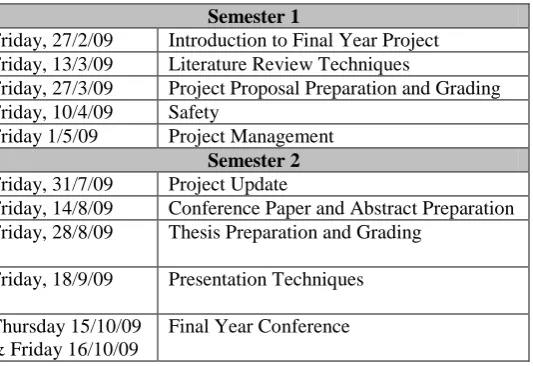
Table 5: Lecture Schedule for Final Year Engineering Project for students commencing semester 1, 2009 in the University of Western Australia
Semester 1
Friday, 27/2/09 Introduction to Final Year Project Friday, 13/3/09 Literature Review Techniques
Friday, 27/3/09 Project Proposal Preparation and Grading Friday, 10/4/09 Safety
Friday 1/5/09 Project Management
Semester 2
Friday, 31/7/09 Project Update
Friday, 14/8/09 Conference Paper and Abstract Preparation Friday, 28/8/09 Thesis Preparation and Grading
Friday, 18/9/09 Presentation Techniques
Thursday 15/10/09 & Friday 16/10/09
Final Year Conference
Semester 2
Table 6: Formal Assessment of Final year Projects of University of Western Australia
Element Assessed by Weighting (%)
Project Proposal Supervisor 10
Progress Report Supervisor 5
Conference Paper Supervisor 10
Conference Presentation 2 Staff members but not supervisor 10 Thesis At least 1 Panel member* but not supervisor 65
[image:25.595.69.454.592.667.2]Table 7: Project Workload for students
Activity Hours
Private study 30
Project work 170
Dissertation writing 80
Supervisor consultation 30
[image:26.595.68.393.287.454.2]Total hours 310
Table 8: Assessment details of ENG4111/ENG4112
Description Mark out of Weighting (%)
Assessment 1, Topic allocation 1.00 1.00
Assessment 2, Project specification 1.00 1.00
Assessment 3, Project appreciation 1.00 1.00
Assessment 4, Progress assessment 100.00 100.00
Partial draft dissertation 1.00 1.00