JOURNAL
of
LEARNING
Volume 16, Number 6
Mere Mortals Creating Worlds: Low Threshold 3D
Virtual Environments for Learning
THE INTERNATIONAL JOURNAL OF LEARNING http://www.Learning-Journal.com
First published in 2009 in Champaign, Illinois, USA by Common Ground Publishing LLC www.CommonGroundPublishing.com.
© 2009 (individual papers), the author(s)
© 2009 (selection and editorial matter) Common Ground
Authors are responsible for the accuracy of citations, quotations, diagrams, tables and maps.
All rights reserved. Apart from fair use for the purposes of study, research, criticism or review as permitted under the Copyright Act (Australia), no part of this work may be reproduced without written permission from the publisher. For permissions and other inquiries, please contact
ISSN: 1447-9494
Publisher Site: http://www.Learning-Journal.com
THE INTERNATIONAL JOURNAL OF LEARNING is peer-reviewed, supported by rigorous processes of criterion-referenced article ranking and qualitative commentary, ensuring that only intellectual work of the greatest substance and highest significance is published.
Typeset in Common Ground Markup Language using CGCreator multichannel typesetting system
Peter Robert Albion, University of Southern Queensland, Queensland,
Australia
Abstract: The prevalence of computer games in popular culture and their demonstrable success at engaging players in complex activity requiring learning of new skills has generated wide interest in the potential of games and related 3D virtual environments for education. The process of design, de-veloping, and deploying tailored virtual environments is typically expensive in terms of time and money, both of which are usually scarce in education. What educators need, especially in the initial period during which the educational affordances of virtual environments are being explored, is an approach that can support experimentation by educators with ideas for the application of virtual environments in support of pedagogy. Ideally such an approach would enable educators to test designs by rapidly developing and deploying virtual environments without requiring substantial technical support. Uptake of other technologies by educators has been encouraged by identifying tools that present relatively low barriers to use, ‘low threshold applications’ (LTA) (Gilbert, 2004). This paper will describe a project that has sought to develop tools and processes that support educators in working with 3D vir-tual environments in ways that encourage experimentation by facilitating easy development and adapt-ation of environments for particular pedagogical purposes. Examples of tools and environments that have been developed are described together with lessons learned in the course of the project.
Keywords: 3D Virtual Environment, Low Threshold Application, Educational Design
Introduction
R
ECENT DECADES HAVE seen changes in the characteristics of Australian higher education students. Between 1989 and 2002 the proportion of Australians aged between 20 and 24 enrolled in higher education increased from 10% to 19% (DEEWR, 2005) indicating participation by a wider segment of the population than previously. Many of those students have commitments, to family or work, that affect their ability to participate in conventional classes on campus.A study published by Universities Australia (James, Bexley, Devlin, & Marginson, 2007) found that in 2006 the typical Australian university student was undertaking considerable paid employment during the semester. Among full-time undergraduate students, 70% were working an average of almost 15 hours per week, 15% were working more than 20 hours per week, and almost 5% reported working full-time. It is hardly surprising that many of these students do not attend all of their scheduled classes on campus. They need flexible educational opportunities that allow them to balance study, family and work commitments in ways that meet their individual needs.
One response by universities has been to adopt technologies, such as placing recorded lectures on the web, that offer on-campus students some of the flexibility more commonly
The International Journal of Learning
Volume 16, Number 6, 2009, http://www.Learning-Journal.com, ISSN 1447-9494
associated with distance education models. A recent Australian study (Woo, et al., 2008) reported that recorded lectures appear to provide clear benefits for distance education students because they provide study support that is not otherwise available and an increased sense of belonging to the class. The data suggested that distance and on campus students used the recorded lectures in similar ways, listening to entire recordings more than once, but with some significant difference in purpose. Internal students reported using recordings to catch things they had missed in class, a use not generally applicable to external students who were more likely to use the recordings to set their own pace for working, compared to internal students for whom the pace is set by scheduled classes. Both groups used the recordings for revision. Access to recordings provided both groups with additional opportunities to interact with course content, and some students from both groups reported increased interaction with the lecturer and peers. However, there was concern among at least some lecturers that the availability of recordings had the potential to discourage attendance by internal students with a consequent reduction in interaction that promotes and supports learning.
Interaction and Distance Learning
The effects of initiatives, such as providing recorded lectures, on interactions of students with content, instructors and each other are of interest because of the widely held view that interaction is fundamental to the process of learning (Ertmer & Newby, 1993). Traditionally interaction in education has been managed by the teacher who was responsible for presenting the learner with an appropriate sequence of resources and experiences to support learning. Distance education, although available in various forms for a century or more, has often been considered as “second rate” because of its limitations in providing for pedagogic inter-action (Koul, 2006). However, both the busy lifestyles of increasingly mobile learners in advanced economies and the requirement for mass higher education in emerging economies are adding to the attraction of moving education from a 20th century industrial model to a more flexible and cost effective 21st century information network model (Daniel, 2007).
Despite distance education having been historically disdained as inferior to conventional formats (Koul, 2006), research demonstrating “no significant difference” between distance education and regular classrooms (Russell, 1999; WCET, 2007) has encouraged its wider acceptance. A large meta-analytical study (Zhao, Lei, Yan, Lai, & Tan, 2005) found that, although overall there is no significant difference in outcomes achieved by students in face-to-face and distance education, there is considerable variability among comparative studies with some demonstrating significant differences in outcomes and some not. The study found several factors that may result in significant differences, not always in favour of face-to-face instruction, with the importance of interaction for learning being a central theme.
This is consistent with a socio-cognitive understanding, which is based on the work of researchers such as Vygotsky, Piaget and Bandura, and in which learning and teaching are social activities (Kim & Baylor, 2006). In this view social interaction is central to learning and development, and is an important influence on the design of systems to promote learning. “Interaction is an essential ingredient of any learning environment” (Woo & Reeves, 2007, p. 15).
desirable because of the contribution a skilled instructor can make to facilitating learning. Moore noted that interaction between learners had been used in face-to-face classes for reasons that often had little to do with learners’ needs but was a recent addition in distance education, where it was facilitated by new technologies, especially the Internet. He advised that distance educators should plan carefully for an appropriate mix of interaction to facilitate learning. Anderson (2003) has argued that it is not necessary, and may even be detrimental, for learning experiences to include high interaction in all three forms. The most appropriate mix in any circumstance may be affected by characteristics of the learner, what is to be learned, and material constraints on design.
Although the “distance” in distance education was originally understood as a matter of geography, the need to provide for more flexible access to education makes it increasingly important to understand distance more broadly. As early as 1972 the theory of transactional distance identified the “distance” in distance education as a pedagogical concept addressing the psychological and communications space that separates learner and teacher rather than merely geographic separation (Moore, 1993). Even within the face-to-face classroom such separation exists and has been explored through concepts such as teacher immediacy, defined by Christophel (1990) as the “perceived physical and/or psychological closeness between people” (p. 325). It affects learning by influencing motivation through behaviours such as smiling, disclosure, and humour.
Moore (1993) described transactional distance as a function of dialogue (purposeful inter-action toward understanding), structure (course design with more or less flexibility for indi-vidual learners), and learner autonomy (extent to which learner, rather than instructor, de-termines goals and activities). Autonomous learners can manage with low dialogue and little structure. Less autonomous learners tend to prefer more dialogue with variable preferences for structure. Moore argued that new technologies permit learner-learner interaction that can reduce transactional distance while simultaneously increasing learner autonomy. If this does occur then it should enhance interaction that supports learning at the same time as providing learners with flexibility that is necessary for balancing study with other commitments.
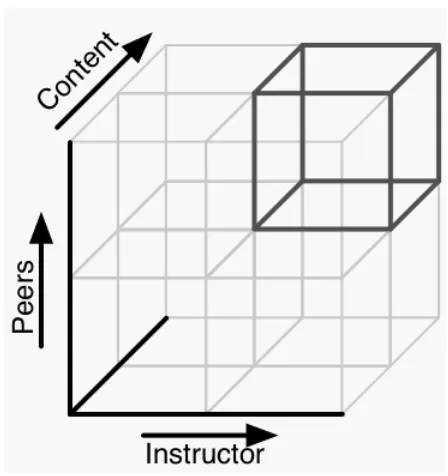
Figure 1: Instructional Interaction Space (Albion, 2008)
Shin (2002) proposed transactional presence as a way of viewing the issue of transactional distance from an alternative perspective, drawing on concepts such as social presence (Gunawardena & Zittle, 1997). Transactional presence is “the degree to which a distance student perceives the availability of, and connectedness with, other parties involved in a given distance education setting” (Shin, 2002, p. 121) and both encourages and is derived from interaction in the learning environment. Tu (2000) found that optimum levels of social presence, fostered by appropriate course design and instructor behaviour, led to increased online interaction. Similarly, another study (Weaver & Albion, 2005) reported a significant relationship between levels of perceived social presence and motivation to participate in online course discussions, a common form of interaction in distance education.
These findings point to ways in which facilitators of distance education courses might use computer-mediated communication to increase transactional presence and/or decrease transactional distance as a means of promoting the interaction required for learning. However, the benefits will depend upon the specific communications tools used. The most common forms of online communication depend upon written dialogue, which works well for some learners (Lin, Cranton, & Bridglall, 2005) but lacks many of the cues associated with face-to-face communication. Some learners find the reliance on text limiting and experience online courses as “a form of disembodied presence” (Mason, 1995, as cited in Shin, 2002). Because learning is holistic, and involves emotional and physical interactions as well as the cognitive, the lack of contextual clues and opportunity for informal interaction is a significant loss for some learners (Lin, et al., 2005).
and video content using recorded material (Woo, et al., 2008) or applications that support direct interaction among learners and instructors may enhance the sense of presence and re-duce transactional distance (Little, Passmore, & Schullo, 2006).
Games and MUVEs in Education
Enhancing online learning environments by expanding the options for communication beyond text seems logical as an approach to reducing transactional distance and increasing the inter-action that supports learning. To be effective, such adaptations need to meet the needs of both teachers and learners. Given the popularity of computer games among the generation currently leaving school and entering higher education, it seems reasonable to suppose that environments that share some characteristics of such games might be more appealing to learners than more traditional approaches (Prensky, 2001b). Even where such environments are not explicitly designed for learning, there is evidence that players are learning sophisticated skills through their deep engagement (Brown, 2006).
Multi-user virtual environments (MUVEs) or 3D virtual worlds have characteristics sim-ilar to popular games but without the explicit goals of games. Because they represent users with avatars, they have the potential to reduce the sense of disembodiment experienced by some learners in text-based environments. Communication in early versions of such systems was limited to text but current versions support voice conversations and the presentation of media streams from outside the MUVE. Studies have found that such 3D spaces can enhance social presence (Hauber, Regenbrecht, Hills, Cockburn, & Billinghurst, 2005; Salinäs, 2005) in ways that would be expected to reduce transactional distance and promote learning.
MUVEs possess qualities that offer potential to address some of the challenges posed by the growing demand for distance education or at least some features of distance education in regular higher education. These qualities include appeal to learners familiar with computer games, learning through engagement in authentic activities, and enhanced presence promoting interaction. The challenge is how to realise that potential by discovering approaches to the application of MUVEs that work well for learning and disseminating those practices as widely as possible.
Design of educational games and simulations typically requires knowledge and skills across the domains of both educational design and games design (Agostinho, Meek, & Herrington, 2005; Chambers & Stacey, 2005). It seems likely that design and implementation of 3D virtual worlds for educational use will require a comparable combination of capabilities. Because it is rare to find individuals capable of both educational design and the technical tasks required to implement their designs, teams that bring together the necessary skills commonly undertake such development but often increase the complexity, time and resources required. Traditional software development processes typically begin by specifying the design and include periodic pilot testing during development but with limited opportunities for changes to the design once it is specified. More recent approaches, such asagile program-ming(Hunt, 2006), adopt a cycle of frequent testing that provides opportunities for designs to be adjusted during development and are better suited for the exploration of new educational technologies.
with the aims of teachers and data from several schools suggested that the process was one that entailed co-evolution of teacher practices with the application of the technology.
The evolutionary metaphor suggests a way forward with the application of 3D virtual worlds in education. There are numerous different software systems on which MUVEs may be built. They offer different possibilities and restrictions, which are changing rapidly as the systems develop. Although there seems to be good reason to expect that MUVEs might be used productively for learning and teaching, it is not clear what the most productive uses might be. Hence, rather than a unitary development effort directed toward a single planned outcome there might be value in promoting an experimental approach with numerous altern-atives being tried to see what works best under given conditions. In effect, this would be an evolutionary approach to development in which the most successful of numerous variations would emerge as the preferred solutions for particular educational niches, much as species evolve through mutation to occupy ecological niches. For such a process to work it would be necessary to develop a mechanism that would provide for the generation of small variations (mutations) in educational MUVEs at low cost.
Gilbert (2004) identified two threshold factors likely to limit the uptake of new technologies in education. The first was the lack of development resources to tailor applications for spe-cific purposes. The second was anticipated reluctance of faculty members to make what they perceived as major changes to their instructional practices. He argued that they would be more receptive to smaller changes that would also require fewer resources for implementation. Out of this thinking grew the idea of a Low-Threshold Application (LTA) which is a “teaching-learning application of information technology that is reliable, accessible, easy to learn, non-intimidating, and incrementally, inexpensive” (Gilbert, 2004, p. 49). Compared to more complex technological innovations, the likelihood that an LTA will be adopted is increased because it is seen as non-challenging and requiring minimal extra work and carries little or no additional cost.
The Web3D Project
The threshold factors identified by Gilbert (2004) apply to the development and application of 3D virtual worlds for educational use. Hence, a route to generating the experimental variations needed as a base for evolution of successful 3D virtual worlds for education would be to develop LTAs that would empower content experts to incrementally adapt and imple-ment learning experiences in virtual spaces. The project described in this paper was funded by the Australian Learning and Teaching Council (ALTC) to explore the development of tools, equivalent to LTAs, that could support content experts in the development of 3D vir-tual environments demonstrating good design in both educational and technical domains. Aspects of the project and the earlier ALIVE project with which it has been associated have been described elsewhere (de Byl, 2009). In the context of this project, Web3D is used to describe techniques that embed 3D content within web pages, a process that has potential to simplify access to the material and improve the presentation of certain elements as com-pared to more specialised 3D virtual environments such as Second Life™.
early adopters on exemplars and use their experience and the tools developed in the first phase to support a second round of adopters. Development of the first group of exemplars proved to be more challenging than anticipated and the project did not progress as rapidly as originally planned. Nevertheless, some of the goals have been achieved and more will be accomplished before the project is completed late in 2009.
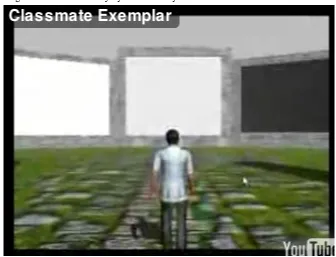
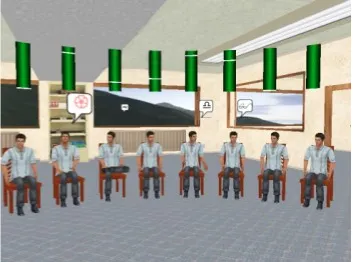
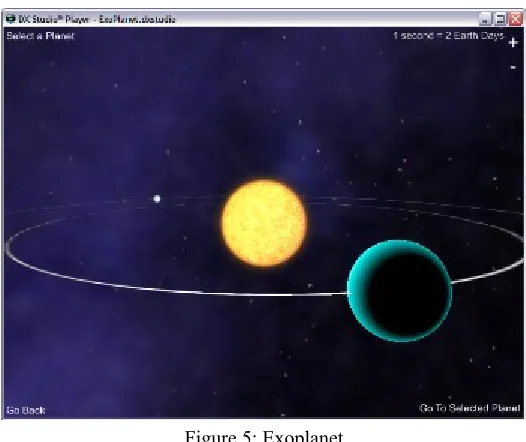
Exemplars developed to date vary from 3D models of objects such as a skeleton or the solar system presented in a web page, through ALIVE Classmate, which provides an online space that a teacher can use for presentation and discussion with distant students, to 3D in-teractive games. The learning designs are diverse but the underlying technology used in the exemplars is the same and the development tools and building blocks can be re-used in dif-ferent contexts.
Figure 2: Interactive 3D Skeleton
pedagogies such as lectures, the environment can be configured to support a variety of learning activities limited only by the creativity of the users.
Figure 3: ALIVE Classmate
Figure 4: Behavioural Management Simulation
Figure 5: Exoplanet
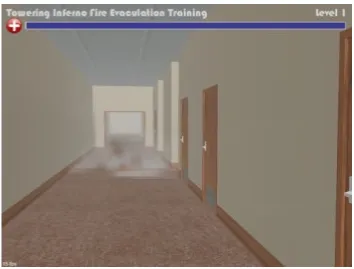
Figure 6: Escape Alive
Project Outcomes to Date
The exemplars described above represent progress toward achieving the primary project goal of developing a suite of Web3D exemplars for education. The development process resulted in the creation of a variety of 3D elements, such as building parts, furniture, and common objects, which are reusable, with or without some cosmetic changes, in other 3D virtual spaces. These objects provide the foundation for a library of objects that may be used by academics to build their own environments, thus reducing both the effort and technical capability required for developing customised 3D spaces for use in teaching. The programmers working on the project also developed a simplified editor for shaping a 3D virtual space and placing and adjusting objects within it. Although the editor and other tools are not yet at the stage where they can be easily used by non-technical academics, the combination of the ed-itor and the growing library of objects lend hope that the project goal of making it possible for non-technical academics to design and develop their own 3D spaces may be achievable, at least to the degree permitted by technology that is still immature and in rapid flux.
ped-agogies as the obvious, but not necessary, default. There is work remaining to explore the remaining sectors of the possible interaction space.
Lessons Learned
The process of developing and testing the exemplars has produced lessons that are guiding work in the remainder of the project and may be of wider relevance to others seeking to take advantage of these emerging technologies.
The technical challenges faced by the project were more significant than had been anticip-ated. Although there are many software tools available for creating 3D objects, they require technical skills beyond those possessed by most teaching academics. Such tools require considerable time for practice to develop the relevant skills, especially for high quality objects that require the use of professional tools such as Maya or 3D Studio. Fortunately, several of the exemplars had common elements required in the virtual environments and it was possible to reuse elements, with or without minor customisation. If academics without specialised technical skills are to be able to arrange their own 3D spaces for learning and teaching they will need to have ready access to collections of ‘building blocks’ from which the spaces can be assembled. Fundamental to achieving this will be adherence to standards that permit easy sharing and reuse of objects and the establishment of libraries of such objects that can be made available through a broad community of practice. The project has made a start by es-tablishing the Web3D Exchange (http://web3dexchange.org/) but much work remains to be done on developing standards and the community of users.
Relatively few academics have much experience of playing computer games. Consequently they find it challenging to conceptualise the design of games to support learning even in discipline areas where they are acknowledged experts (Prensky, 2001a). This is likely to be true, even when they have well deserved reputations as effective educators. Moreover, one of the major challenges of designing educational games is that “whenever you add an instruc-tional designer, they suck the fun out” (Prensky, 2004, p. 1). From the opposite perspective, game developers are generally not well versed in formal understanding of learning design although well-designed games support players in learning how to succeed by successive approximations. Successful development of educational games requires bringing together varied expertise across at least the domains of content, learning design, game design, graphics and programming. Recruiting team members with one or more of the necessary skill sets and facilitating communication among them is essential for success and represented a significant challenge to the progress of the Web3D project. The original project leader had strong background in games design and programming and assembled a small team of pro-grammers. The content experts lacked background in games design and mostly had little formal background in learning design. The team members with background in education had limited experience of games and the specific content to be included. Working together on the project initially presented challenges in communication across the different fields of expertise but offered each group the opportunity to learn from the other perspectives.
Conclusion
parts of their courses by distance education, the fundamental importance of interaction for learning, and the widely observed power of games and game-like 3D virtual environments to engage users, especially young people, in interactive experiences. If any benefits are to be made available as widely as possible, it will be important to develop processes that em-power non-technical users (mere mortals) to create virtual worlds tailored to the needs of their own classes. Such are the influences that contributed to the genesis of the Web3D project described in this paper and led to the adoption of an approach based on the notion of low-threshold applications (Gilbert, 2004).
To date the project has encountered more challenges than anticipated in making the creation of virtual worlds easily achievable by non-technical users. At least in part these challenges have been related to the relative immaturity of the technologies being explored. Some progress has been made toward creating exemplars, resources and tools that can be applied by non-technical users and it is anticipated that, as the technologies mature, hardware and software with the necessary power and ease of use will become more widely available. As that happens we expect that the lessons learned by pioneering users will be applied by many more mere mortals as they create virtual worlds to support learning and teaching.
Acknowledgement
Support for the production of the materials described in this paper has been provided from the Australian Learning and Teaching Council, an initiative of the Australian Government Department of Education, Employment and Workplace Relations.
The views expressed in this paper do not necessarily reflect the views of the Australian Learning and Teaching Council.
References
Agostinho, S., Meek, J., & Herrington, J. (2005). Design Methodology for the Implementation and Evaluation of a Scenario-Based Online Learning Environment.Journal of Interactive Learning Research, 16(3), 229-242.
Albion, P. R. (2008). Virtual Spaces for Teaching and Learning. In D. Gibson & Y. K. Baek (Eds.), Digital Simulations for Improving Education: Learning Through Artificial Teaching Envir-onments(pp. 52-67). Hershey, PA: IGI Publishing.
Albion, P. R., & Ertmer, P. A. (2004).Online courses: Models and strategies for increasing interaction. Paper presented at the Tenth Australian World Wide Web Conference. Retrieved October 22, 2007, from http://ausweb.scu.edu.au/aw04/papers/refereed/albion/index.html
Anderson, T. (2003). Getting the Mix Right Again: An Updated and Theoretical Rationale for Interac-tion.The International Review of Research in Open and Distance Learning, 4(2).
Brown, J. S. (2006). New Learning Environments for the 21st Century: Exploring the edge.Change, 38(5), 18-24.
Chambers, D. P., & Stacey, K. (2005). Developing and using multimedia effectively for undergraduate teacher education.Australian Journal of Educational Technology, 21(2), 211-221. Christophel, D. (1990). The relationship among teacher immediacy behaviours, student motivation,
and learning.Communication Education, 39, 292-306.
Daniel, J. (2007).New Providers, New Approaches: Towards a World of Mass Higher Education. Paper presented at the Third Global Forum on International Quality Assurance, Accreditation and the Recognition of Qualifications. Retrieved December 18, 2007, from
de Byl, P. (2009). Making Web3D Less Scary: Toward Easy-to-Use Web3D e-Learning Content De-velopment Tools for Educators.Innovate, 5(5), Retrieved June 16, 2009, from http://www.in-novateonline.info/index.php?view=article&id=2554.
DEEWR. (2005).Education participation rates by sector, 1989 to 2002 - Higher Education. Australian Government Department of Education, employment and Workplace Relations. Retrieved August 19, 2009 from http://www.dest.gov.au/sectors/higher_education/publications_re-sources/profiles/highered_participation_rates.htm
Ertmer, P. A., & Newby, T. J. (1993). Behaviorism, cognitivism, constructivism: Comparing critical features from an instructional design perspective.Performance Improvement Quarterly, 6(4), 50-72.
Gilbert, S. W. (2004). If it ain’t broke, improve it: Thoughts on engaging education for us all.Journal of Asynchronous Learning Networks, 8(1), 39-53.
Gunawardena, C. N., & Zittle, F. (1997). Social presence as a predictor of satisfaction within a computer mediated conferencing environment.American Journal of Distance Education, 11(3), 8-25. Hauber, J., Regenbrecht, H., Hills, A., Cockburn, A., & Billinghurst, M. (2005).Social Presence in
Two- and Three-dimensional Videoconferencing.Paper presented at the 8th Annual Interna-tional Workshop on Presence, London, UK.
Hunt, J. (2006).Agile software construction. London: Springer.
James, R., Bexley, E., Devlin, M., & Marginson, S. (2007).Australian University Student Finances 2006: Final report of a national survey of students in public universities. Canberra: Univer-sities Australia.
Kim, Y., & Baylor, A. (2006). A Social-Cognitive Framework for Pedagogical Agents as Learning Companions.Educational Technology Research and Development, 54(6), 569-596. Koul, B. N. (2006). Towards a culture of quality in open distance learning: Current practices. In B. N.
Koul & A. Kanwar (Eds.),Perspectives on Distance Education: Towards a Culture of Quality(pp. 1-15). Vancouver: Commonwealth of Learning.
Land, R., & Bayne, S. (2006). Issues in cyberspace education. In M. Savin-Baden & K. Wilkie (Eds.), Problem-based learning online(pp. 14-23). Maidenhead, Berkshire: Open University Press. Lin, L., Cranton, P., & Bridglall, B. (2005). Psychological Type and Asynchronous Written Dialogue
in Adult Learning.Teachers College Record, 107(8), 1788-1813.
Little, B. B., Passmore, D., & Schullo, S. (2006). Using Synchronous Software in Web-based Nursing Courses.Computers, Informatics, Nursing, 24(6), 317-325.
Moore, M. G. (1989). Three types of interaction.American Journal of Distance Education, 3(2), 1-6. Moore, M. G. (1993). Theory of transactional distance. In D. Keegan (Ed.),Theoretical Principles of
Distance Education(pp. 22-38). London: Routledge.
Prensky, M. (2001a). Digital natives, digital immigrants Part 1.On the Horizon, 9(5), 1, 3-6. Prensky, M. (2001b). Digital natives, digital immigrants Part 2: Do they really think differently?On
the Horizon, 9(6), 1-6.
Prensky, M. (2004). Use their tools! Speak their language! Retrieved from http://www.marcpren-sky.com/writing/Prensky-Use_Their_Tools_Speak_Their_Language.pdf
Russell, T. L. (1999).The No Significant Difference Phenomenon. Chapel Hill, NC: Office of Instruc-tional Telecommunications.
Salinäs, E.-L. (2005). Effects of Communication Mode on Social Presence, Virtual Presence, and Performance in Collaborative Virtual Environments.Presence: Teleoperators & Virtual Environments, 14(4), 434-449.
Shin, N. (2002). Beyond Interaction: the relational construct of “Transactional Presence”.Open Learning: The Journal of Open and Distance Learning, 17(2), 121 - 137.
Tu, C.-H. (2000).An examination of social presence to increase interaction in online classrooms. Unpublished PhD, Arizona State University, Tempe, AZ.
Weaver, C. M., & Albion, P. R. (2005). Momentum in online discussions: the effect of social presence on motivation for participation. In H. Goss (Ed.),Balance, fidelity, mobility: Maintaining the momentum? proceedings of the 22nd Annual conference of the Australasian Society for Computers in Learning in Tertiary Education(pp. 703-706). Brisbane: Teaching and Learning Support Services, Queensland University of Technology.
Woo, K., Gosper, M., McNeill, M., Preston, G., Green, D., & Phillips, R. (2008). Web-based lecture technologies: blurring the boundaries between face-to-face and distance learning.ALT-J, 16(2), 81 - 93.
Woo, Y., & Reeves, T. C. (2007). Meaningful interaction in web-based learning: A social constructivist interpretation.Internet and Higher Education, 10(1), 15–25.
Zhao, Y., & Frank, K. A. (2003). Factors affecting technology uses in schools: an ecological perspective. American Educational Research Journal, 40(4), 807-840.
Zhao, Y., Lei, J., Yan, B., Lai, C., & Tan, H. S. (2005). What Makes the Difference? A Practical Analysis of Research on the Effectiveness of Distance Education.Teachers College Record, 107(8), 1836-1884.
About the Author
Dr. Peter Robert Albion
Mary Kalantzis, University of Illinois, Urbana-Champaign, USA.
Bill Cope, University of Illinois, Urbana-Champaign, USA.
EDITORIALADVISORYBOARD
Michael Apple, University of Wisconsin, Madison, USA.
David Barton, Lancaster University, Milton Keynes, UK.
Mario Bello, University of Science, Cuba.
Manuela du Bois-Reymond, Universiteit Leiden, Leiden, The Netherlands.
Robert Devillar, Kennesaw State University, Kennesaw, USA.
Daniel Madrid Fernandez, University of Granada, Spain.
Ruth Finnegan, Open University, Milton Keynes, UK.
James Paul Gee, University of Wisconsin, Madison, USA.
Juana M. Sancho Gil, University of Barcelona, Barcelona, Spain.
Kris Gutierrez, University of California, Los Angeles, USA.
Anne Hickling-Hudson, Queensland University of Technology, Kelvin Grove, Australia.
Roz Ivanic, Lancaster University, Lancaster, UK.
Paul James, RMIT University, Melbourne, Australia.
Carey Jewitt, Institute of Education, University of London, London, UK.
Andeas Kazamias, University of Wisconsin, Madison, USA.
Peter Kell, University of Wollongong, Wollongong, Australia.
Michele Knobel, Montclair State University, Montclair, USA.
Gunther Kress, Institute of Education, University of London, London, UK.
Colin Lankshear, James Cook University, Cairns, Australia.
Kimberly Lawless, University of Illinois, Chicago, USA.
Sarah Michaels, Clark University, Worcester, USA.
Jeffrey Mok, Miyazaki International College, Miyazaki, Japan.
Denise Newfield, University of Witwatersrand, Johannesburg, South Africa.
Ernest O’Neil, Ministry of Education, Addis Ababa, Ethiopia.
José-Luis Ortega, University of Granada, Granada, Spain.
Francisco Fernandez Palomares, University of Granada, Granada, Spain.
Ambigapathy Pandian, Universiti Sains Malaysia, Penang, Malaysia.
Miguel A. Pereyra, University of Granada, Granada, Spain.
Scott Poynting, Manchester Metropolitan University, Manchester, UK.
Angela Samuels, Montego Bay Community College, Montego Bay, Jamaica.
Michel Singh, University of Western Sydney, Sydney, Australia.
Helen Smith, RMIT University, Melbourne, Australia.
Richard Sohmer, Clark University, Worcester, USA.
Brian Street, University of London, London, UK.
Giorgos Tsiakalos, Aristotle University of Thessaloniki, Thessaloniki, Greece.
Salim Vally, University of Witwatersrand, Johannesburg, South Africa
Gella Varnava-Skoura, National and Kapodistrian University of Athens, Greece.
Cecile Walden, Sam Sharpe Teachers College, Montego Bay, Jamaica.
Nicola Yelland, Victoria University, Melbourne, Australia.
Wang Yingjie, Beijing Normal University, Beijing, China.
Creates a space for dialogue on innovative theories and practices in the arts, and their inter-relationships
with society. ISSN: 1833-1866
http://www.Arts-Journal.com
Explores the past, present and future of books, publishing, libraries, information, literacy and learning
in the information society. ISSN: 1447-9567
http://www.Book-Journal.com
Examines the meaning and purpose of ‘design’ while also speaking in grounded ways about the task of
design and the use of designed artefacts and processes.
ISSN: 1833-1874
http://www.Design-Journal.com
Provides a forum for discussion and builds a body of knowledge on the forms and dynamics of difference
and diversity. ISSN: 1447-9583
http://www.Diversity-Journal.com
Maps and interprets new trends and patterns in globalisation.
ISSN 1835-4432
http://www.GlobalStudiesJournal.com
Discusses the role of the humanities in contemplating the future and the human, in an era otherwise dominated by scientific, technical and economic
rationalisms. ISSN: 1447-9559
http://www.Humanities-Journal.com
Sets out to foster inquiry, invite dialogue and build a body of knowledge on the nature and future of
learning. ISSN: 1447-9540
http://www.Learning-Journal.com
Creates a space for discussion of the nature and future of organisations, in all their forms and
manifestations. ISSN: 1447-9575
http://www.Management-Journal.com
Addresses the key question: How can the institution of the museum become more inclusive?
ISSN 1835-2014
http://www.Museum-Journal.com
Discusses disciplinary and interdisciplinary approaches to knowledge creation within and across
the various social sciences and between the social, natural and applied sciences.
ISSN: 1833-1882
http://www.Socialsciences-Journal.com
Draws from the various fields and perspectives through which we can address fundamental
questions of sustainability. ISSN: 1832-2077
http://www.Sustainability-Journal.com
Focuses on a range of critically important themes in the various fields that address the complex and subtle relationships between technology, knowledge
and society. ISSN: 1832-3669
http://www.Technology-Journal.com
Investigates the affordances for learning in the digital media, in school and throughout everyday life.
ISSN 1835-2030
http://www.ULJournal.com
Explores the meaning and purpose of the academy in times of striking social transformation.
ISSN 1835-2030