This information is provided to Members of Parliament in support of their parliamentary duties and is not intended to address the specific circumstances of any particular individual. It should not be relied upon as being up to date; the law or policies may have changed since it was last updated; and it should not be relied upon as legal or professional advice or as a substitute for it. A suitably qualified professional should be consulted if specific advice or information is required. This information is provided subject to our general terms and conditions which are available online or may be provided on request in hard copy. Authors are available to discuss the content of this briefing with Members and their staff, but not
Student Loan statistics
Standard Note: SN/SG/1079 Last updated: 13 February 2015
Author: Paul Bolton
Section Social & General Statistics
Student loans are the main method of direct government support for higher education students. Money is loaned to students at a subsidised rate to help towards their maintenance costs and to cover the cost of tuition fees. Currently more than £10 billion is loaned to students each year. This is expected to grow rapidly over the new few years and the Government expects the value of outstanding loans to reach over £100 billion (2014-15 prices) in 2018 and continue to increase in real terms to around £330 billion (2014-15 prices) by the middle of this century.
Graduates repay these loans to the government after their earnings exceed the threshold level. These loans are therefore private contributions towards the costs of higher education. The student loans system aims to ensure that upfront costs do not deter potential students.
Graduates repay student loans and they generally have above average incomes. In the past
the loans system has been criticised on a number of different grounds including not covering living costs, excluding part-time students, being too expensive, targeting its interest rate subsidy at higher earning graduates and putting off those who are concerned about graduating with large debts.
This note gives a background to student loans, statistics on their take-up, total value owed, repayment, public expenditure, arguments for reform and factors that affect take-up. It does not look in detail at the repayment system in England for new students from 2012/13 which is included in the note Changes to higher education funding and student support from 2012/13.1
Student Loans Company data used to cover the UK as a whole, but devolution of student support arrangements caused a change in their geographical coverage. The figures from 2006-07 in this note are for England only. The following Library publications give related information about changes in this sector:
Changes to higher education funding and student support from 2012/13
HE in England from 2012: Funding and finance
Value of student maintenance support
Tuition fee statistics
Entrants to higher education
The Sale of Student Loans Bill [Bill 6 of 2007-08]
The Scottish Parliament Information Centre’s Student Loans and Repayments compares Scotland and England. Data from the HStudent Loans CompanyH may also be helpful.
Contents
1 Background 2
1.1 Recent loan interest rates, the ‘low interest cap’ and the zero interest rate 3
1.2 Student loan sell offs 4
2 Changes in loan amounts and repayment terms from 2012/13 7
3 Take-up of student loans 9
3.1 Aggregate data 9
3.2 Who takes out loans? 11
4 Student loans: Financial transactions 12
4.1 Individuals’ loan repayment 13
Repayment by cohort 14
4.2 Student loan interest subsidies –who benefits? 14
5 International comparisons 15
Annex -Student loans and public spending to 2010 17
6 Reference tables 18
1
Background
Student loans first became part of the student support package in 1990/91. In that year students could take out a maximum2 of £420 or around one sixth of the maximum amount of public support. Over the following years their value was increased at the expense of grants and stood at just under 50% of the maximum support level in 1996/97.3 Student loan interest rates are currently set in line with inflation and hence have a zero real interest rate. Repayments of loans taken out before the late 1990s were made on a ‘mortgage-style’ system. They became repayable from the April after the student finished higher education when their gross income exceeded the threshold of 85% of national average earnings. If their income stayed above the threshold then repayments were made over 5 years in 60 equal monthly instalments;4 hence ‘mortgage-style’.
The Government gradually introduced new arrangements for students starting in autumn 1998 (academic year 1998/99). In the first year new entrants received support through loans and grants. The maximum maintenance grant available was £1,000 less than that for existing students. This was compensated for by a matching increase in loan entitlement. Most new entrants were also expected make an income-assessed contribution of up to £1,000 a year to the cost of their tuition. From 1999 new entrants and those who started in 1998 received all maintenance support as loans which were partly income-assessed. A different repayment system operates for loans for new students from 1998. These are income contingent repayments where graduates repay 9% of gross income annual above £10,000.5 This
2 Maximum for a full year student living away from home and outside London.
3 DfEE statistical first release 48/2000 Student support: statistics of student loans for higher education in United Kingdom -financial year 1999-00 and academic year 1999/00
threshold was raised to £15,000 in April 2000. The last Government planned to receive this level in 2010, but did not alter its level. The current Government has announced that the repayment thresholds for students with income contingent loans who started higher education before 2012/13 will be increased in line with inflation until 2016.6
Further changes in the student finance system were introduced in 2006/07 when new students attending institutions in England and Northern Ireland could be charged variable fees of up to £3,000. New students could take out a Tuition Fee Loan to cover the cost of these fees. This means that upfront payment of tuition fees would effectively be abolished for new students. This option was also available to cover the (fixed) fees of students who started before 2006/07. New lending from 2006/07 was subject to a 25-year maximum term after which they are written off. Previously the age related write-off was at 65.
New students in 2006/07 in England were also eligible for a new income-assessed Maintenance Grant of up to £2,700. Unlike some earlier support this reduced the amount of Maintenance Loan someone was eligible for. In summer 2007 the Government announced changes to a number of the income thresholds for new students from 2008/09. These should mean that more students receive some Maintenance Grant. They also announced student loan ‘repayment holidays’ of up to five years for these students.7
In 2009/10, 2010/11 and 2011/12 the maximum Maintenance Loan for a student living away from home outside London was £4,950 (assuming they were not eligible for any maintenance grant). With a maximum Tuition Fee Loan this gives a theoretical maximum in 2011/12 of £8,325, or £10,303 in London. In practice the actual maximum that most students could take out was less as around one quarter of the Maintenance Loan is income assessed and those in receipt of the Maintenance Grant will have their loan eligibility reduced by between £1,300 and £1,450 depending on the year they started. This maximum was increased to £5,500 for new students in 2012/13, kept at this level in 2013/14 and increased to £5,555 in 2014/15.
1.1 Recent loan interest rates, the ‘low interest cap’ and the zero interest rate
Variations in the interest rates on income contingent loans are illustrated opposite. Plan 1 are loans taken out by pre-2012 starters. Plan 2 are for those who started from 2012.
Pre-2012
The rate in 2007/08 was 4.8%, the level of all-items RPI inflation in financial year 2006-07. This was the highest annual rate since
1991/92.8 The rate for 2008/09 was initially set at 3.8% reflecting the fall in inflation in
2007-08. However, the legislation also required that interest rates for income contingent loans should not exceed one percentage point above the highest base rate of a specified group of major banks. The so-called ‘low interest cap’. The large falls in Bank of England base rates meant that this cap was used for the first time. The interest rate on income contingent loans
6 ibid.
7 DIUS press release 5 July 2007 Increased support for students in higher education 8 Facts & Figures, Student Loans Company
Hhttp://www.slc.co.uk/statistics/facts_figures.html H
Plan 1
Plan 2
98/99 00/01 02/03 04/05 06/07 08/09 10/11 12/13 14/15
0% 1% 2% 3% 4% 5% 6% 7%
was reduced to 3.0% on 4 December 2008, to 2.5% on 9 January 2009, to 2.0% on 6 February 2009 and to 1.5% on 5 March 2009. Interest rates were lower in 1993/94 and 2002/03.91011
The all-items RPI was -0.4% in the year to March 2009. The (then) current regulations stated that if an interest rate is to apply to these loans then this will be the rate for the year from 1 September 2009.12 In the past the then Government stated that it had ‘no plans to abandon the consistent use of RPI in calculating interest on student loans’.13 It subsequently decided that no interest rate (0%) was to apply to income contingent student loans in 2009/10. The small numbers of remaining mortgage-style loans are solely linked to RPI and hence their interest rate was -0.4%.14 Having no interest on student loans does not affect monthly repayments of those with outstanding income contingent loans. Repayments are based on income, not the interest rate. The cut to 0% would slightly reduce the loan period/total repayments for those who completely paid off their loans in year, but this applies to any cut in interest payments. The impact on other borrowers will depend on how interest rates on student loans and hence RPI vary in future years. If inflation jumps up to above the long-term trend then any advantage they might have gained would be lost.15 This effect could be reduced by the continued operation of the low interest cap.
The all-items RPI increased by 4.4% in the year to March 2010. This means that the interest rate on the relatively small number of mortgage style loans was 4.4% in academic year 2010/11. RPI inflation was 5.3% in the year to March 2011, 3.6% in the year to March 2012 and 3.3% to March 2013.16 The interest rate on these loans therefore increased to 5.3% in 2011/12 and fell 3.3% in 2013/14. The rate for income contingent loans depends on whether the low interest cap still applies and hence on decisions by the Monetary Policy Committee of the Bank of England. No further changes in base rates would imply loan interest rates remain at the level seen from March 2010 (1.5%). Any increases in base rates during 2014/15 or later would normally mean immediate increases in the student loan interest rate. Such variations potentially change the duration of the loan, not the monthly repayments which depend on income.
Post 2012 loans
With no ‘low interest rate cap’ and rates set at RPI +3% the plan 2 interest rates have been much higher: 6.6% in 2012/13, 6.3% in 2013/14 and 5.5% in 2014/15.
1.2 Student loan sell offs
Mortgage-style loans
Two sales of the student loan portfolio of around £1 billion each were made in 1998 and 1999. Both consisted of mortgage-style loans only. Borrowers faced exactly the same repayment conditions. As the interest rate of student loans is below market level the DfES
9 ibid.
10 HC Deb 26 January 2009 c268W
11 Income Contingent Loans (ICL) - Maximum Loan Rates, SLC
12 The Education (Student Loans) (Repayment) Regulations 2009, (SI 470 2009) : http://www.opsi.gov.uk/si/si2009/uksi_20090470_en_3#pt2-l1g21
13 HC Deb 9 July 2008 c1716W
14 Student Loans Company Repayment site, Interest rate for Income Contingent Loans,
http://www.studentloanrepayment.co.uk/portal/page?_pageid=93,3866911&_dad=portal&_schema=PORTAL
15 If the current negative inflation rate is simply a blip then any gain in 2009/10 will be lost for those who repay in
later years. If there is no steep upward increase in prices after the period of deflation, but a direct return to long term levels of inflation, then all who eventually repay their loans would gain compared to steady trend inflation/interest rates.
agreed to pay a subsidy to the purchaser to reflect this and make the purchase attractive to the private sector. The difference between this and the cost that the DfES would have incurred is the net cost of the sell off. At the time of the 1998 and 1999 sales the estimated net present values of these payments over the lifetime of the loans were £50 million and £85-100 million respectively.17
The subsequent cut in the Treasury discount rate from 6.0% to 2.2% since the time these calculations were made would increase these net present value figures (the public sector comparator becomes cheaper). A written answer gave an updated estimated cost for both portfolios combined for England and Wales. This revised the original estimates using a more up-to-date discount rate of 3.5%, the actual performance of loans since they were sold and new projections of performance. This concluded that the net cost in 1998-99 net present value terms was £125 million.18
A plan to sell off the last remaining mortgage-style loans was announced in March 2013.19 On 25 November 2013 the Government announced that the last £890 million of outstanding mortgage-style loans had been sold for £160 million.20
Income contingent loans
Plans for loan sell offs totaling £6 billion over the period 2008-11 were announced in Budget 2007.21More detail is given in the Library Research Paper
HSale of Student Loans Bill. The Government said in late June 2009 that (current) market conditions did not allow sales to make a good return for the taxpayer and they would look for sale opportunities when market conditions improved.22 The current Government announced in the Higher Education White Paper that:23
We want to find a solution that will manage all current and future ICR [income contingent repayment] loans on an ongoing basis (unlike the one-off sales of the late 1990s).
The intention to sell off income-contingent loans was re-iterated in the 2013 Spending Round. More detail was given in the Autumn Statement 2013. Sales of pre-2012 income-contingent loans are expected to start before the end of financial year 2015-16. Sales will be in a number of tranches and the estimated that gross proceeds are expected to be in the range of £10-15 billion, with a central estimate of £12 billion. The proceeds are said to more than cover the costs of removing the cap on student numbers from 2015-16 which was also announced in the Autumn Statement. The central estimates of the cash proceeds from the loan sales over five years are above the Government’s estimate of the cash cost of this policy over the whole period 2013 to 2018.24 However, sales of pre-2012 loans cannot go on indefinitely and even if it were assumed that pre-2012 loan sales continued (as far as possible) it is highly likely that the cumulative proceeds would be less than the cumulative
17 HC Deb 5 March 1998 c 749-5W; HL Deb 9 March 1999 cc20-21WA 18 HC Deb 12 July 2007 c1609-10W
19 BIS press notice 26 March 2013, The government launches process to sell off the last remaining
publicly-owned mortgage-style student loans
20 BIS press notice 25 November 2013 Sale of mortgage style student loan book completed 21 Budget 2007, HM Treasury
22 HC Deb 30 June 2009 c147W
cost of the policy within a decade.25 If these costs still had to be met through loan sales at that point then sell offs would need to move to the post-2012 loan book.
The Institute for Fiscal Studies made the following comments after the Autumn Statement:26 …in his speech the Chancellor claimed that the additional cost of student loans arising from lifting the cap on the number of students in higher education would be “financed by selling the old student loan book”. This may work in the near-term fiscal numbers, but economically it makes little sense. Selling the loan book will be broadly fiscally neutral in the long run, bringing in more money now at the expense of less money later on. Lifting the cap on numbers will cost money every year.
A report by the Business, Innovation and Skills Select Committee expressed concern about the amount which the loan sales might raise and the link between these proceeds and the expansion of student numbers:27
The Government appears to have committed itself to the sale of the income contingent loans before it has fully assessed the financial viability of such a move. Demand for these assets is untested and without the introduction of a synthetic hedge would only realise around £2 billion of the £12 billion return expected by Government. While demand would increase with the introduction of a synthetic hedge, this would come with an additional long-term cost to Government, which has yet to be quantified.
[…]
Given that the Chancellor of the Exchequer has linked the removal of the student numbers cap to the sale of the income-contingent loan-book, we seek clarification from the Department whether the removal of the cap is dependent on the sale of the loan book.
If the policy is not dependent on the sale, the Government must set out in its response where it will raise the £5.55 billion between now and 2018–19 required to remove the cap without putting an additional burden on the taxpayer
In July 2014 the Secretary of State is reported to have ruled out any sale of these loans (in this Parliament) because recent evidence suggested there was “…no longer any public benefit…” to the sales.28
The Government have subsequently said that the expansion of student numbers has been agreed with the Treasury and “Student numbers are not contingent on the sale…”29 The Government’s response to the Business, Innovation and Skills Committee report on student loans reiterated this. It also added that the £5.5 billion additional loan outlays (up to 2018-19) needed for the expansion was “fully funded”.30
25 The cost of the policies is the sum of the cash value of new loans and direct spending on additional students,
plus the value of lost repayments from loans which are sold. This calculation assumes that the gross proceeds estimates in the Autumn Statement are met and further tranches are sold with gross proceeds of £2.5 billion per year after 2019-20. Cumulative gross costs are larger than cumulative gross proceeds by 2023-24 with an assumed 40% write down on all loan sales. Changes in the write-down rate have a large impact on the total proceeds.
26 Autumn Statement 2013: Introductory Remarks, IFS
27 Student Loans, Business, Innovation and Skills Select Committee, third report of 2014/15 28 Student loans sell-off abandonment raises tension in cabinet, The Guardian 20 July 2014 29 PQ HL1512 [on Higher and further education: Admissions], 11 August 2014
30 Student Loans: Government Response to the Committee’s Third Report of Session 2014-15, BIS Select
In their long-term fiscal projections the Office for Budget Responsibility (OBR) has said that so long as these loans are sold at a ‘fair’ value the expected return (on these assets) to the Government at the point of sale would be zero. In other words the sale price is equal to the present value of the lost future repayments. Selling loans at a fair price would only affect the
flow of receipts not their present value.31
2
Changes in loan amounts and repayment terms from 2012/13
The Government set out its proposals for higher education funding and student finance on 3 November 2010. This will affect new students starting in England from 2012/13. Alongside an increase in the fee cap to £9,000 and a related cut in direct public funding for tuition there were a the following proposed changes to student loans:32
An increase in the earnings threshold to £21,000
A real interest rate of will start to be charged when income is above the earnings threshold reaching a maximum of 3.0% above inflation when earnings reach a new higher earnings threshold of £41,000.
The interest rate will be inflation plus 3.0% for students while they are studying and up to the repayment date (April following graduation)
Both earnings thresholds will be increased annually in line with earnings
The length of time before all debts are written off is extended from 25 to 30 years
Extension of fee loans to part-time students
Repayments will remain at 9% of income above the threshold.33
The impact of these changes on graduates is expected to be larger average loans, lower
monthly repayments, an large increase in the average duration of a loan, increased average
repayments across the lifetime of the loan (with the largest increases coming from the highest earners) and an increase in the proportion of graduates who have some of their loan written off from around 15% for pre-2012 borrowers to around 60%.34
The Education Act 2011 made provision for above inflation interest rates. It also meant that there would be no low interest cap linked to bank base rates for new students from 2012/13. The Government has said:35
The Education (Student Loans) (Repayment) Regulations state that for the current income contingent repayment (ICR) scheme (loans taken out prior to September 2012), the rate of interest will be the lower of the retail prices index (RPI) or the bank base rate (for a specified group of banks) plus 1 per cent. As the current bank base rate (0.5 per cent) plus 1 per cent is lower than the March 2011 RPI (5.3 per cent), the interest cap has taken effect.
[...]
Under the new repayment scheme (post-September 2012 ICR loans), the interest rate will vary with the borrowers income, starting at RPI for those earning £21,000 or less,
31 Fiscal Sustainability Report – July 2014, OBR 32 Reform for higher education and student finance
, BIS (3 November 2010)
33 More detail and analysis is included in the note Changes to higher education funding and student support from
2012/13
up to a maximum of RPI + 3 per cent for those earning £41,000 and above. There are no plans to limit either the additional 3 per cent rate of interest, where it applies, or the retail prices index-based level of interest.
The legislation also requires that interest rates for new students do not exceed those commercially available.36
Regulations setting out provisions for student loan repayments for post-2012 student loans were laid before Parliament in May 2012.37 These confirmed the earlier announcements about loan interest rates, thresholds, timing of repayments etc. and gave more detail about certain exceptions and repayments from non-UK residents. They introduced the terms ‘standard interest rate’ for the element linked to RPI and ‘additional interest rate’ for the variable element paid on top of this for those earning between the lower and higher interest thresholds. Borrowers earning above the higher interest threshold pay the standard rate plus 3%, as do those still studying or who have not reached their Repayment Due Date (April after the end of their course).
This means that as the low interest cap no longer applies students who started in 2012/13 they are charged an interest rate that is three percentage points higher than RPI. As the all-items RPI increased by 3.6% in the year to March 2012 new students were charged 6.6% compared to 1.5% (under the low interest cap) for students who started before 2012. This gap will fall if base rates increase, but this is not expected to happen in the near future. As the RPI increased by 3.3% in the year to March 2013 post-2012 students will be charged an interest rate of 6.3% (RPI+3%) in 2013/14 and 5.5% in 2014/15. The interest rates for pre-2012 (plan 1) and post-pre-2012 (plan 2) borrowers are illustrated in the chart in section 1.1. Average loans are considerably larger for new students so the absolute amount of interest added to their outstanding debt will be larger still.
The Government has also said that the repayment threshold for existing borrowers with income contingent loans and students who enter before 2012 will be retained at £15,000 until 2012, after which it will be increased in line with inflation until 2016.38
36 Education Bill 2011 –Explanatory Notes
3
Take-up of student loans
3.1 Aggregate data
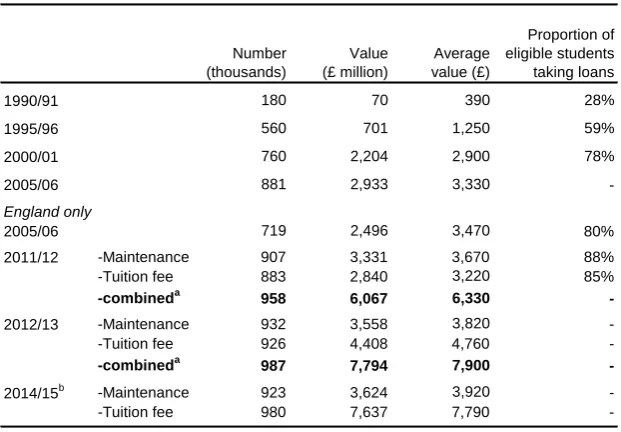
Details of the growth in student loans, in terms of the number and value of loans and take-up are shown in Table 1 at the end of this note and summarised in the table below. Their annual value is illustrated opposite. Note the change in geographical coverage in 2006/07. Each of these indicators has increased in every year to 2013/14 other than the proportion of students taking out loans which fell slightly in 2004/05. Growth in maintenance loans has generally been slower since 2006/07, this
partially reflects the increases in the value of and eligibility for maintenance grants.
Between 1990/91 and 2005/06 the annual number of loans taken out went from 180,000 to 881,000, their average value from £390 to £3,330 and their total annual value from £70 million to nearly £3 billion. 2006/07 data for England give an average value of £3,590; 3% above the equivalent figure from 2005/06. Subsequent increases in the value of maintenance loans have been more modest, in part because of the increase in maintenance grant in 2006/07. The 2013/14 data is provisional up to the middle of November while the earlier figures are for the full year. The 2013/14 figures are also based on the amount awarded, rather the amount paid which is used for the figures from 2008/09 onwards. This has an impact on the tuition fee loan data only. The 2014/15 figures, when compared to
Student loans: value and take-up in the UK, academic years
Number (thousands) Value (£ million) Average value (£) Proportion of eligible students taking loans
1990/91 180 70 390 28%
1995/96 560 701 1,250 59%
2000/01 760 2,204 2,900 78%
2005/06 881 2,933 3,330
-England only
2005/06 719 2,496 3,470 80%
2011/12 -Maintenance 907 3,331 3,670 88%
-Tuition fee 883 2,840 3,220 85%
-combineda 958 6,067 6,330
-2012/13 -Maintenance 932 3,558 3,820
--Tuition fee 926 4,408 4,760
--combineda 987 7,794 7,900
-2014/15b -Maintenance 923 3,624 3,920
--Tuition fee 980 7,637 7,790
-Notes: Latest data are provisional
(a) Values are for students from England only. Other figures included EU domiciled students (fee loans only)
Source: DfES statistical first release 32/2003 Student support: statistics of student loans for higher education in the UK; Student Support for Higher Education in England: Academic Year 2014/15 (Provisional) and earlier editions, SLC; Student Support Scheme Facts and Figures, www.slc.co.uk
Loan data for 2008/09 to 2013/14 are the amount paid. Earlier figures and 2014/15 data are the amount awarded.
(b) Amount awarded up to mid-November 2014
England only England only England only England only England only England only England only England only England only 0 500 1,000 1,500 2,000 2,500 3,000 3,500
1990/91 1992/93 1994/95 1996/97 1998/99 2000/01 2002/03 2004/05 2006/07 2008/09 2010/11 2012/13 2014/15 Annual value of student maintenance loans, UK
[image:9.595.143.454.342.558.2]equivalent data for 2013/14 show a 2% increase in the number of maintenance loans taken out and a 6% increase in the total value of maintenance loans. The equivalent figures for fee loans show a 1% rise in the number taken out and a 23% increase in their total value as the average value of loans to new students was £8,170 compared to just under £3,310 for existing students.39 The total value of loan made is expected to continue to grow rapidly as more students come under the new funding regime in England. The Office of Budget responsibility has forecast that the face value of loans made in 2018-19 across the UK will be £17.4 billion.40
Tuition Fee Loans are excluded from the chart above. In 2006/07 234,000 new students were awarded Tuition Fee Loans with an average value of £2,740 and a total value of £639 million. A further 153,000 existing students were awarded Tuition Fee Loans for regulated fees, these totalled £156 million at an average of £1,010. The number awarded and their total value has increased in subsequent years as each year brings a new cohort liable to pay them. The first year of new students under the post-2012 funding regime with its higher fees (and fee loans) caused the total value of Tuition Fee loans to exceed that of Maintenance Loans for the first time. This gap has since grown and the value of Fee loans was provisionally more than double Maintenance Loans in 2014/15. This gap will continue to grow over the next year or two as more students become liable for higher fees.
The 2011 data was the first to include and analysis of the combination of loans individual students from England took out. The latest figures are for 2013/14 when 11% of students who received a loan had only maintenance, 5% fee loan only and the remainder took out both. The average combined loan for those who took out both was £10,020; the average across all who took out any type of loan was £9,130.41
The 2011 data also included the first estimates of maintenance loan take-up for some years. These showed the rate continuing at its earlier level of 80% up to 2008/09 then increasing to 82% in 2009/10 and 89% in 2012/13. The 2014 publication included estimates of fee loan take up which were 92% for students in England and 64% for EU students in 2012/13.42 The Government estimated that for students starting after 2006/07 the average Student Loan debt on graduation (maintenance and tuition fee loans) would be around £15,00043 and take an average of 11 years to repay for men and 16 year for women.44 In the past the Department for Business, Innovation and Skills has forecast that the average student loan debt on graduation would increase to £17,000 for 2010 graduates, £19,000 for 2012 and £21,500 for 2014 graduates.45 The 2014 figure is inflated to an extent by the inclusion of some students who start under the new regime in 2012/13 are eligible for much higher fee loans and who either graduate from a short course or who drop out. Fee levels from 2012/13 imply that for students starting in England in 2012/13, who take out average maintenance and fee loans, the typical debt on graduation could be almost £40,000.46 The Institute for Fiscal Studies has estimated the average debt on graduation among the 2012 cohort at £44,000 (2014 prices) compared to just under £25,000 if the pre-2012 system had still been
39 Student Support for Higher Education in England: Academic Year 2014/15 (Provisional), SLC. Tables 4A(iii)
and 4B(iii)
40 Economic and Fiscal Outlook March 2014, OBR
41 Student Support for Higher Education in England: Academic Year 2014/15 (Provisional), SLC. Table 4D 42 ibid. Table 4B(ii)
43 HC Deb 19 March 2007 c703W 44 HC Deb 26 November 2007 c166W 45 HC Deb 25 January 2011 c251-2W
46 Average fee and maintenance awards awarded to students from England in 2013/14. Interest rate calculated
in place. They also estimated that just under three quarters of these graduates would not repay their loans in full, more than double their projected rate under the old system. However, the total real value of repayments will be around 75% more because more graduates will repay their loans for a longer period (mainly high and middle earners).47
3.2 Who takes out loans?
The latest Student Income and Expenditure Survey48gives more detailed information on loan
take-up among different groups in England in 2011/12. The results reported here are for full-time English domiciled students only. 79% of students had taken out a Tuition Fee Loan and the average (mean) value was £3,330 and 74% a Maintenance Loan with an average value of £3,730. The chart on page 97 of the report shows the distribution of Maintenance Loan amounts. Around one-quarter of full-time students received no support from this source, almost half received £2,500 to £4,000 and there was a fairly long ‘tail’ of students who received amounts above this.
Some of the report’s main findings were:
Across all students, (Fee and Maintenance) loans made up 50% of their total income, well above mean income from paid work (16%), family (14%) or maintenance grants (8%)
The following groups were significantly less likely to have taken out a Maintenance Loan:
o students from a managerial, professional or intermediate (family) background
o non-first degree undergraduates
o students living at home
o London-based students
o students studying medicine or dentistry and subjects allied to health (where other funding is available)
Those significantly more likely to take out a Maintenance Loans were:
o students from routine and manual (family) backgrounds.
o those on arts based courses
There were observed differences in take-up propensity by age, ethnicity and some other characteristics, but there were not significant once other factors (especially those listed above) were taken into account. In the previous study (2007/08) family type was found to be a significant factor with higher take-up among those from lone parent families. This result was not found to be significant in the 2011/12 study.
There was much less variation in Fee Loan take-up as nearly all of the students in the survey were under the ‘variable’ fees regime introduced in 2006/07. Total mean outstanding student loan debt for those at the end of their third year or on single year courses was £10,600 per student. The median was much lower at £7,400.
47 Payback time? Student debt and loan repayments: what will the 2012 reforms mean for graduates?, IFS April
2014
4
Student loans: Financial transactions
The appended Table 2 shows total student loan outlay and repayments for financial years to 2013-14. Again the later data for is for England only. There is a further discontinuity in the data from 2001-02 as later
figures exclude the privately owned debt from 2002. Trends in public debt only are illustrated opposite.
At the end of 2013-14 total publicly owned debt for English students and EU students studying in England was £54.4 billion. The growth in the total amount owed by students/ graduates is illustrated opposite. It stood at £1.9 billion at the end
of 1995-96, £3.6 billion at the end of 1998-99 and £8.4 billion at the end of 2001-02. The sale of the final tranche of mortgage style loans in November 2013 means that all publicly owned debt at the end of 2013-14 was in income-contingent loans. These are financial year data so only include part of academic year 2012/13 when new students could take out much larger fee loans. Despite this just over one-third of tuition fee loans made in 2012-13 were to post-2012 students. The Government has projected that the outstanding cash value of publicly owned student debt in England will increase to around £100 billion in 2016-17, £500 billion in the mid 2030s and £1,000 billion (£1 trillion) in the late 2040s. The real (2014-15) value is expected to exceed £100 billion around 2018, £200 billion in the late 2020s and stabilize around £300 billion by the middle of this century. These figures assume that fee increase in line with inflation from 2016 and take no account of loan sell offs.49
The Office for Budget Responsibility (OBR) does not project the size of the student loan book
per se, but the additions to net debt from student loans. This represents the cumulative cash
flows (spending less repayments) on loans as a proportion of GDP. It is not affected by write offs, loan sales, repayments and interest charges in the same way as the loan book, especially in the longer term. It is, however, another indication of the scale of lending. Their latest projection is that across the UK student loans added 3.4% of GDP to net debt in 2013-14 (around £55 billion). This is all loans, repayments and sales up to 2013-14, not just net lending in that year. This rate is expected to increase rapidly over the next two decades (even with planned loan sales) before peaking at 9.8% of GDP in the mid-2030s and declining to 8.3% in the early 2060s. This peak rate would be equivalent to around £450 billion in 2013-14 prices. This increase is driven by English loans made to new students from 2012 onwards. These projections take account of the announcement made in Autumn Statement 2013 to lift the cap on student numbers in England from 2015-16. This element on its own is expected to increase net debt by around 1% of GDP by the late 2030s. These projections are highly sensitive to their underlying assumptions, for instance, assuming fees increase in line with inflation rather than earnings cuts the peak rate by around 1% of GDP and the early 2060s figure by 3.3% of GDP.50
49 HC Deb 18 June 2014 c655-7W
50 Fiscal Sustainability Report – July 2014, OBR. Annex B
E ngl and onl y E ngl and onl y E ngl and onl y E ngl and onl y Eng lan d on ly Eng lan d on ly Eng lan d on ly Eng lan d on ly Inc ome c ont in gen t onl y 0 10 20 30 40 50
1990-91 1992-93 1994-95 1996-97 1998-99 2000-01 2002-03 2004-05 2006-07 2008-09 2010-11 2012-13 Student loans: amount of public debt outstanding at
financial year end, UK/England £ billion cash
Loan repayments have been steadily increasing, but were clearly affected by the exclusion of privately owned debt where most accounts were in repayment status. The gap between repayments and interest generally fell between 2002-03 and 2007-08 due to the rising total value of outstanding loans, longer repayment profiles of income contingent loans and higher interest rates. It widened in 2008-09 and grew much more rapidly from 2009-10 as the lower interest rates cut the amount of interest added. Readers should note that the interest added to loans for students who started before 2012 is intended to ensure that the outstanding value of loans retains its real value.
The table opposite shows the split between Maintenance and Tuition Fee loans since 2006-07. Maintenance Loans fell in 2008-09 in part due to increases in grants. This was reversed in later years due to increases in numbers and less generous grants for new students. As these figures are financial year totals they do not accurately match academic year tuition fee liability, but the growth of lending for fees is very clear. In 2012-13 Tuition Fee Loans made up 51% of the
total loaned. This increased to 59% in 2013-14. Fee loans were made available to part-time students for the first time in 2012. The value of loans to part-time students in financial year 2013-14 was £124 million or just over 2% of fee loans to all post-2012 students.51
4.1 Individuals’ loan repayment
The following table gives summary data on income contingent borrower activity in 2013-14. It is based on all those who still have student loans accounts outstanding. At the end of 2013-14 2.5 million borrowers, 58% of the total, were liable for repayments. Unlike in previous years the Student Loans Company has not published a breakdown of these people specifying who were actually repaying and who were not earning enough to repay.
51 SLC statistical first release 1/2014 Student loans for higher education in England -financial year 2013-14
Student Loan borrower activity, financial year 2013-14, England
Number Percentage (000s) of all borrowers
All borrowers at end of financial year 4,258 ..
-Borrowers with accounts in repayment or being closed at year end 2,458 58 -Borrowers with accounts not liable for repayment 1,525 36
-Accounts closed: Repaid in full 404 9
-Accounts closed: Loan cancelled 3 0
Constituent parts may not sum to totals because individual borrowers may be counted in more than one category if they have loan accounts in more than one status
Source: SLC statistical first release 1/2014 Student loans for higher education in England -financial year 2013-14
(a) The large majority of these accounts have been paid off, but the account cannot be closed until the final HMRC return is received and/or any refund is paid
Breakdown of new lending by type since 2006-07
£ million
Tuition Fee Loans Maintenance
Loans
English students
EU
Students Total
2006-07 2,568 377 10 2,952
2007-08 2,836 1,038 32 3,905
2008-09 2,497 1,653 54 4,204
2009-10 2,875 2,105 69 5,049
2010-11 3,116 2,377 85 5,578
2011-12 3,229 2,637 100 5,966
2012-13 3,471 3,536 137 7,144
2013-14 3,696 5,126 200 9,021
Some limited data are available on bankruptcies and Individual Voluntary Arrangements (IVAs). These only cover students who notified the Student Loans Company of this while they were studying and hence exclude anyone with a student loan who became bankrupt or had an IVA after they graduated. The total number bankrupt or with IVAs in England increased from 10-20 a year in the late 1990s to 110 in 2004. The Higher Education Act 2004
included provisions to prevent student loans being written off by bankruptcy. There were 30 IVAs amongst this group in 2005 and 20 in 2006. Over this period there were large increases in the number of bankruptcies and IVAs across the whole population.52 Regulations were changed in 2010 to exclude Student Loans debt from IVAs.
Repayment by cohort
The Student Loans Company has started to publish data on repayments of income contingent loans by the year in which they became liable to repay their loans (the April after graduation or leaving their course). The latest data look at repayment cohorts up to 2012 and give limited information for the 2013 and 2014 cohorts who have no full tax year processed yet.53 41% of students in the first large repayment cohort54 (2002) had repaid their loan; this fell off to 22% of the 2006 cohort and 6% of the 2010 cohort. The likelihood that a borrower was working, but earning below the threshold was clearly higher for more recent graduates; 29% for the 2012 cohort falling to 13-15% for the 2007 and earlier cohorts. The proportion who were in the UK tax system but not working was 8-9% for the more recent and 6-8% for earlier cohorts. A further 5-6% were known to be in the UK but with a status not requiring repayment.
There was a large jump in the average amount owed by those who first became liable to repay from 2010. These cohorts were the first to mainly consist of students who had taken out fee loans for variable fees. The average amount owed by the 2009 cohort (when first liable to repay) was £12,300, £15,600 for the 2010 cohort, £17,100 for the 2011 cohort, rising to a provisional figure of £20,100 for the 2014 cohort. The first large cohort of borrowers who took out loans under the post-2012 system will be in the 2016 cohort.
There is a shift over time from those repaying to those who have repaid as we might expect. The cohort data shows, a relatively rapid increase in the number repaying within a cohort over the first few years of potential repayment followed by much less variation and a gradual decline in numbers as more repay their loans in full. The average value of repayments continues to increase in each year and hence totals also increase. This suggests that it is only in the first few years after leaving higher education that large numbers of borrowers start repaying. Relatively few only start earning above the repayment threshold three, four, or more years later and even then their numbers are balanced by those who stop repaying for one reason or another. It may be some time before any longer term patterns become clear, particularly shifts from non-payment to payment.
4.2 Student loan interest subsidies –who benefits?
Broadly speaking the terms of student loans are favourable to borrowers in two ways. First the interest rate is subsidised. Second the loan is currently written off after 25 years.55 From the perspective of the state there are analogous costs because the interest rate is below the
52 HC Deb 7 March 2008 c2900W
53 SLC statistical first release 1/2014 Student loans for higher education in England -financial year 2013-14 54 The year refers to when the first become liable to repay. This is the April after the completion of their course.
Hence the 2002 cohort will have completed in 2001.
government’s cost of borrowing and because not all loans will be repaid.56 Both would require higher interest rates if the system were to break even.
Professor Nicholas Barr has argued for some time that the interest rate subsidy is both inefficient and unfair. The operation of income contingent loans means that graduates with low income in any one year are ‘protected’ from high repayments because they only repay 9% of their income over £15,000 per year. These are normally graduates at the start of their career. Where graduates have a low income for their entire career –either through low annual earnings or periods out of the labour market- they make little or no repayments. Their ‘protection’ comes from the 25 year write off. If they make any repayments they are small and unlikely to cover more than interest payments, so it does not matter what the interest rate is. It is their income that determines repayments, not the interest rate. The interest rate is completely irrelevant for the lowest paid graduates. It could be set at commercial levels, zero, or even a negative rate. It would have no impact on the amount they repay. The interest rate affects the duration of repayments for those who do repay. If it were higher then it would take longer to repay and total repayments would increase. By definition it is the higher paid graduates who benefit from this shorter repayment period and lower total repayments.
Professor Barr has calculated that the 20% of graduates with the lowest lifetime earnings (a group dominated by women) gain most of their benefit from the 25 year write off and very few gain anything from the interest rate subsidy. This situation shifts until by the middle income group all the benefit comes from the interest subsidy. The same applies to the top two income groups. The subsidy element on its own becomes regressive overall as most of the benefit goes to the better off. The loan write-off aspect is strongly progressive and makes the overall loan terms progressive. He argues that the subsidy is a poor use of public funding, it is poorly targeted expensive to government and ‘crowds out’ spending on other areas which would improve the efficiency of the system. Interest subsidies on student loans: A better class of drain57 sets out various options for reforming loans terms, most of which involve
setting the interest rate on loans at the same level as the Government’s cost of borrowing. These options remove some or all of the benefit to more highly paid graduates while protecting some or all of the benefit for the less well paid. He argues that this cut in public spending could improve the economic efficiency of higher education more generally by taking the financial pressure off direct support for institutions, allowing maintenance loans to be expanded to cover the full cost of going to university, increasing fee loans to cover the potentially higher fee cap, extending loans to part-time students and postgraduates and/or loans to students in other tertiary education and training more generally.
5
International comparisons
The OECD has made some comparisons of different aspects of student loans. The most compete were made some years ago and are mainly for 2010/11. The complexity of loan systems in many countries means that direct comparisons are not straightforward. Full detail can be found here (indicator B5). In general UK interest rates on loans were lower than typical rates, although some countries charged no interest on loans while the student is in higher education. Annual income repayment thresholds (where they exist) are generally lower elsewhere than the income contingent threshold for the UK and a relatively high proportion of UK students leave higher education with student loan debt. A much greater share of higher education expenditure goes on loan subsidies in the UK than average. The
56 The 25 year write-off is one way that loans can be cancelled. The others are due to death or permanent
illness/disability.
57 N Barr and A Johnson, Interest subsidies on student loans: A better class of drain, (CEE DP 114) LSE Centre
2011 figure of 33% was well above the OECD average of 9%. Only New Zealand (33%) had a higher rate.58 The 2012 changes will substantially increase this figure for the UK.
A more qualitative analysis carried out for BIS includes some more up to date information on student support arrangements in a group of developed countries.59
58 Education at a Glance 2014, OECD. Table B5.4
Annex -Student loans and public spending to 2010
Under resource accounting public expenditure on student loans is not the cash value of loans paid out in the year. The resource cost is based on the difference between the value of the loan and the estimated (discounted) value of future repayments. Commercial loans are made at rates to ensure that in aggregate future repayments at least cover the costs of capital and bad debt and hence the loans are profitable. Student loans represent a public expenditure cost as interest rates are subsidised (they do not cover the cost of capital) and the cost of loan write offs falls on the lender (the Government) rather than on borrowers through higher interest rates. The public cost is allocated to the year in which the loans are made.
In the past the resource cost is calculated as 21% (of the cash value) for maintenance loans and 33% for tuition fee loans.60 For instance in 2006-07 a total of £2,954 million was paid out in maintenance and tuition fee loans to English domiciled and EU students studying in England, 61 but the resource accounting cost was £710 million,62 or 24% of the face value of the loans. The percentage figure for maintenance loans has varied due to changes in the forecast model used by the Government and reductions in the Treasury discount rate (cost of capital charge). The lower discount rate has the effect of reducing the resource cost because the subsidy element (difference between the interest rate and the cost of capital) is reduced. The discount rate was reduced from 6.0% to 3.5% in 2003 and to 2.2% from 2005-06.
Currently there is no distinction between the resource costs of fee or maintenance loans. Borrowers do not pay them off sequentially –a justification for different explicit resource cost percentages. The overall resource cost is currently around 27% of the face value of loans issued.63 It is expected to increase to 32% for new loans from 2012/13.64 Trends in the resource costs of loans are given below. These take account of changes in discount rates and estimation methods as well as the underlying growth in the value of loans made each year. More recent public spending figures have not broken down the resource costs of the two types of loans. The Government expects the 2011-12 total to be £1.6 billion.65 The Office of Budget Responsibility forecasts that the total will reach £3.3 billion in 2015-16 (around 3 billion in 2010-11 prices).66
60 HC Deb 19 October 2006 c1369W
61 Student loans for higher education in England, financial year 2006-07 (provisional), SLC 62 Resource Accounts 2006-07, DfES
63 Resource accounts 2009-10, BIS
64 Impact Assessment Higher Education: Student at the Heart of the System, BIS (June 2011) 65 Business Plan 2011-2015, BIS
66 March 2011 Economic and fiscal outlook, OBR. Supplementary table 2.9 Student loans resource accounting charge, England
£ milllion
2003-04 2004-05 2005-06 2006-07 2007-08 2008-09 2009-10 2010-11 Maintenance
loans 769 511 599 605 619 640 610 639
Tuition Fee
loans - - - - 310 552 722 782
Total
Outturn prices 769 511 599 605 929 1,192 1,332 1,421 2010-11 prices 920 595 685 669 999 1,247 1,371 1,421 Notes: 2008-09 data are estimated, 2009-10 and thereafter are planned
Prices adjusted to 2008-09 values using March 2011 GDP deflators
Source: DCSF Departmental Report 2007, Table 8.2. DIUS Departmental Report 2009, Table 11
6
Reference tables
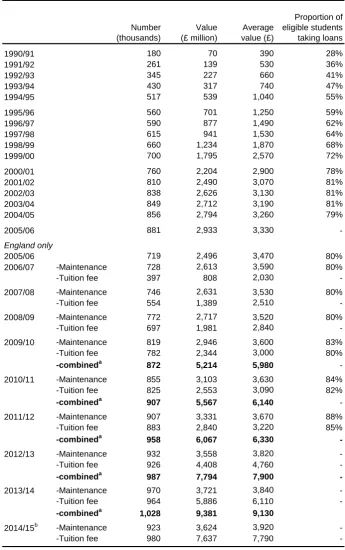
Table 1
Student loans: value and take-up in the UK, academic years
Number (thousands)
Value (£ million)
Average value (£)
Proportion of eligible students taking loans
1990/91 180 70 390 28%
1991/92 261 139 530 36%
1992/93 345 227 660 41%
1993/94 430 317 740 47%
1994/95 517 539 1,040 55%
1995/96 560 701 1,250 59%
1996/97 590 877 1,490 62%
1997/98 615 941 1,530 64%
1998/99 660 1,234 1,870 68%
1999/00 700 1,795 2,570 72%
2000/01 760 2,204 2,900 78%
2001/02 810 2,490 3,070 81%
2002/03 838 2,626 3,130 81%
2003/04 849 2,712 3,190 81%
2004/05 856 2,794 3,260 79%
2005/06 881 2,933 3,330
-England only
2005/06 719 2,496 3,470 80%
2006/07 -Maintenance 728 2,613 3,590 80%
-Tuition fee 397 808 2,030
-2007/08 -Maintenance 746 2,631 3,530 80%
-Tuition fee 554 1,389 2,510
-2008/09 -Maintenance 772 2,717 3,520 80%
-Tuition fee 697 1,981 2,840
-2009/10 -Maintenance 819 2,946 3,600 83%
-Tuition fee 782 2,344 3,000 80%
-combineda 872 5,214 5,980
-2010/11 -Maintenance 855 3,103 3,630 84%
-Tuition fee 825 2,553 3,090 82%
-combineda 907 5,567 6,140
-2011/12 -Maintenance 907 3,331 3,670 88%
-Tuition fee 883 2,840 3,220 85%
-combineda 958 6,067 6,330
-2012/13 -Maintenance 932 3,558 3,820
--Tuition fee 926 4,408 4,760
--combineda 987 7,794 7,900
-2013/14 -Maintenance 970 3,721 3,840
--Tuition fee 964 5,886 6,110
--combineda 1,028 9,381 9,130
2014/15b -Maintenance 923 3,624 3,920
--Tuition fee 980 7,637 7,790
-Notes: Latest data are provisional
(a) Values are for students from England only. Other figures included EU domiciled students (fee loans only)
Source: DfES statistical first release 32/2003 Student support: statistics of student loans for higher education in the UK; Student Support for Higher Education in England: Academic Year 2014/15 (Provisional) and earlier editions, SLC; Student Support Scheme Facts and Figures, www.slc.co.uk
Loan data for 2008/09 to 2013/14 are the amount paid. Earlier figures and 2014/15 data are the amount awarded.
Table 2
Student loan outlay and repayment, financial years, UK or England
£ million
Public student loan debt in the UK
1995-96 1996-97 1997-98 1998-99 1999-00 2000-01 2001-02 2002-03 2003-04 2004-05 2005-06 2005-06 2006-07 2007-08 2008-09 2009-10 2010-11 2011-12 2012-13 2013-14
Total outstanding at end of
previous financial year 1,178 1,859 2,691 3,574 4,582 5,917 7,838 8,390 10,821 13,364 15,948 13,033 15,322 18,116 21,944 25,963 30,489 35,186 40,272 45,903 of which public 1,178 1,859 2,691 3,574 3,592 4,022 6,048 8,390 10,821 13,364 15,948 13,033 15,322 18,116 21,944 25,963 30,489 35,186 40,272 45,903
Lending during financial year 688 855 939 1,082 1,480 2,115 2,440 2,618 2,722 2,780 2,914 2,465 2,954 3,905 4,204 5,049 5,578 5,966 7,144 9,021
% income contingent loans .. .. .. 33% 78% 89% 97% 99% 100% 100% 100% 100% 100% 100% 100% 100% 100% 100% 100% 100%
Repayments 51 86 134 196 278 357 476 333 413 497 578 482 530 634 900 1,010 1,143 1,306 1,407 1,461
Interest added 44 64 79 123 134 161 207 147 239 312 404 331 394 586 760 524 291 463 620 921
Amount written off/cancelleda 1 1 1 1 2 2 3 3 8 15 23 20 24 29 45 42 29 37 38 29
Administration charges .. .. .. 0 1 4 5 3 3 2 0 0 0 0 0 0 0 0 0 0
Total outstanding at end of
financial year 1,859 2,691 3,574 4,582 5,917 7,838 10,011 10,821 13,364 15,948 18,657 15,322 18,116 21,944 25,963 30,489 35,186 40,272 46,590 54,355
% income contingent loans .. .. .. 8% 26% 44% 59% 70% 85% 89% 92% 92% 94% 96% 97% 97% 98% 98% 99% 100%
Note: Excludes privately owned debt from 2002-03 onwards.
2013-14 totals exclude the final tranche of mortgage style loans which were sold off in November 2013. All remaining public loans are income contingent
(a) From 2002-03 includes amount cancelled in respect of Repayment of Teachers' Loan scheme. In 2008-09 a new data system was introduced and the increase shown is in part due to a backlog of cancellations being included in this year. Source: SLC statistical first release 1/2014 Student loans for higher education in England -financial year 2013-14 (and earlier)