Evolutionary Patterns of Eastern Equine Encephalitis Virus in North
versus South America Suggest Ecological Differences and
Taxonomic Revision
䌤
†
Nicole C. Arrigo, A. Paige Adams, and Scott C. Weaver*
Department of Pathology and WHO Collaborating Center for Tropical Diseases, University of Texas Medical Branch, Galveston, Texas 77555-0609
Received 30 July 2009/Accepted 28 October 2009
The eastern equine encephalitis (EEE) complex consists of four distinct genetic lineages: one that circulates in North America (NA EEEV) and the Caribbean and three that circulate in Central and South America (SA EEEV). Differences in their geographic, pathogenic, and epidemiologic profiles prompted evaluation of their genetic diversity and evolutionary histories. The structural polyprotein open reading frames of all available SA EEEV and recent NA EEEV isolates were sequenced and used in evolutionary and phylogenetic analyses. The nucleotide substitution rate per year for SA EEEV (1.2ⴛ10ⴚ4) was lower and more consistent than that for NA EEEV (2.7ⴛ10ⴚ4), which exhibited considerable rate variation among constituent clades. Estimates of time since divergence varied widely depending upon the sequences used, with NA and SA EEEV diverging ca. 922 to 4,856 years ago and the two main SA EEEV lineages diverging ca. 577 to 2,927 years ago. The single, monophyletic NA EEEV lineage exhibited mainly temporally associated relationships and was highly conserved throughout its geographic range. In contrast, SA EEEV comprised three divergent lineages, two consisting of highly conserved geographic groupings that completely lacked temporal associations. A phylogenetic compar-ison of SA EEEV and Venezuelan equine encephalitis viruses (VEEV) demonstrated similar genetic and evolutionary patterns, consistent with the well-documented use of mammalian reservoir hosts by VEEV. Our results emphasize the evolutionary and genetic divergences between members of the NA and SA EEEV lineages, consistent with major differences in pathogenicity and ecology, and propose that NA and SA EEEV be reclassified as distinct species in the EEE complex.
Eastern equine encephalitis virus (EEEV) is an important veterinary and human pathogen belonging to one of seven antigenic complexes in theAlphavirusgenus, family Togaviri-dae(32). Isolated throughout the Americas, EEEV is classified as the only species in the eastern equine encephalitis (EEE) complex (9, 10), which was originally divided into North and South American varieties based on antigenic properties (11). However, additional antigenic and phylogenetic analyses have refined its classification to include four subtypes that corre-spond to four major genetic lineages (I to IV) (7, 55). North American EEEV (NA EEEV) strains and most strains from the Caribbean comprise subtype/lineage I, while subtypes/lin-eages II to IV include South and Central American EEEV (SA EEEV) strains. The EEEV genome consists of a nonseg-mented, single-stranded, positive-sense RNA of approximately 11.7 kb, which includes a 5⬘cap and a 3⬘poly(A) tail. The 5⬘ end of the genome encodes four nonstructural proteins (nsP1 to -4), while a subgenomic RNA (26S) is encoded by the 3⬘end and ultimately produces three main structural proteins: capsid and envelope glycoproteins E1 and E2 (46).
Despite considerable nucleotide sequence divergence be-tween NA and SA EEEV lineages, NA EEEV is highly
con-served throughout its geographic and temporal spectra. Mul-tiple robust analyses have demonstrated less than 2% nucleotide sequence divergence among NA EEEV strains isolated between 1933 and 2007 (5, 7, 64, 68, 69). An overall temporal trend of genetic conservation is also maintained, with newer isolates differing most from ancestral strains at the base of the North American clade (7, 64). In contrast, SA EEEV is highly divergent both between and among the three lineages/subtypes. Although less robust than previous NA EEEV phylogenetic analyses, those of SA EEEV show a tendency for geographic clustering of isolates rather than temporal relationships (7). Differing patterns of genetic conser-vation between NA and SA EEEV may be the result of differ-ences in their ecology and adaptation to different mosquito and vertebrate hosts (65).
Transmission of NA EEEV occurs in an enzootic cycle in-volving the ornithophilic mosquito vector Culiseta melanura
and passerine birds in hardwood swamp habitats (32, 43). The broad geographic distribution and distinctly ornithophagic be-havior ofCs. melanuraresult in a close relationship between NA EEEV and avian vertebrate hosts, which is one proposed mechanism for its highly conserved genetic nature. Infected birds provide for efficient geographic dispersal and the mixing of strains with distant origins. While genetic drift tends to have less impact on large, panmictic populations, competition and natural selection may periodically constrain genetic diversity in the NA EEEV population, resulting in the antigenic and ge-netic conservation observed (64, 66). Transmission of NA EEEV by bridge vectors probably does not impact viral
evo-* Corresponding author. Mailing address: 301 University Blvd., De-partment of Pathology, University of Texas Medical Branch, Galveston, TX 77555-0609. Phone: (409) 0758. Fax: (409) 747-2415. E-mail: [email protected].
† Supplemental material for this article may be found at http://jvi .asm.org/.
䌤Published ahead of print on 4 November 2009.
1014
on November 8, 2019 by guest
http://jvi.asm.org/
lution; however, it does result in sporadic outbreaks of severe disease in humans, equids, and other domestic animals, includ-ing game birds, swine, and dogs that are considered dead-end hosts (22, 23, 43, 50).
Although they are associated with equine disease, SA strains of EEEV are not clearly associated with human disease (4, 17, 18, 40). This lack of human pathogenicity has limited research to expand our epidemiologic and ecologic understanding of SA strains. EEEV isolations fromCulex (Melanoconion) spp. in the Spissipes section (Culex pedroiin South America andCulex
taeniopus in Central America) suggest that they are the
pri-mary enzootic, and potentially epizootic, vectors (28, 33, 53, 58). Movement of these vectors beyond their tropical forest habitat is typically limited (29), which may influence the focal-ity of transmission. However, these species are relatively cath-olic in their feeding behavior, which broadens the potential transmission cycles used by SA EEEV. Greater vector diversity in tropical regions may also contribute to genetic diversity among the SA EEEV lineages, although vector competence data are limited.
The vertebrate ecology of SA EEEV is not well described, with serological associations including wild birds, ground-dwelling rodents, marsupials, and reptiles (12, 17, 31, 45, 56, 57, 58). The observed genetic divergence and geographic clustering of the SA EEEV phylogeny could reflect the use of ground-dwelling mammals as primary hosts for enzootic transmission (43, 65). With limited mobility, these vector and vertebrate species may restrict the distribution of SA EEEV to geograph-ically defined regions, thus limiting competition among distant strains and allowing for the independent evolution of genetic lineages (65). Geographically delineated transmission foci may also be more susceptible to the impacts of genetic drift, thus constraining genetic diversity locally. Venezuelan equine en-cephalitis viruses (VEEV), which also utilizeCulex(
Melano-conion) sp. vectors and small mammals as primary vertebrate
hosts (15, 42, 51, 52, 59, 67), exhibit a similar genetic pattern of independent evolution and multiple, cocirculating subtypes in Central and South America (60). However, a robust compar-ison of the evolutionary patterns between SA EEEV and VEEV has not been conducted.
Elucidation of patterns of enzootic transmission and dis-persal of zoonotic, arboviral pathogens is critical for under-standing and predicting the risk to human health. Therefore, we studied the evolutionary progression of the EEE complex to clarify the extent of divergence between NA and SA EEEV. Because previous analyses of SA EEEV were either limited in their geographic scope or utilized only partial, concatenated sequences, conclusions regarding the genetic relationships of members within and among EEEV lineages were limited. In addition, previous analyses utilized linear regression and were based on few representatives of a single SA EEEV lineage. Here we exploited contemporary techniques to sequence and analyze the structural protein open reading frames (ORFs) of all available SA EEEV and additional NA EEEV isolates and phylogenetically compared SA EEEV and VEEV. Our results support evolutionary and ecological diversity between NA and SA EEEV and suggest that NA and SA lineages be considered independent species in the EEE complex.
MATERIALS AND METHODS
Virus preparation, RNA extraction, and reverse transcription-PCR (RT-PCR).Table 1 includes a list of all EEEV strains included in this study, which were either from our collection or kindly provided by Robert Tesh (UTMB) from the World Reference Center for Emerging Viruses and Arboviruses. RNA was extracted using a QIAamp viral RNA extraction kit (Qiagen Inc., Valencia, CA), according to the manufacturer’s protocol. The cDNA synthesis and PCR ampli-fication reactions were conducted simultaneously using a Titan one-tube RT-PCR kit (Roche Diagnostics Corp., Indianapolis, IN), according to the manu-facturer’s protocol. The complete structural polyprotein ORFs of all EEEV strains were amplified by producing three overlapping fragments (primer se-quences available upon request). SA EEEV strain GU68 required the use of additional strain-specific primers to fill gaps, and random hexamer primers were used to produce cDNA, followed by PCR in two-step RT-PCRs for strains BR75, BR76, BR77, PE75, and GU68. The PCR amplifications included 35 cycles, with annealing temperatures set to 3 to 5°C below the lowest melting temperature of each primer pair, and a 1-min extension step per kb of genome amplified.
DNA extraction, purification, and sequencing.PCR amplicons were extracted using agarose gel electrophoresis and purified using the QIAquick PCR purifi-cation kit (Qiagen). DNA sequencing was performed using the BigDye Termi-nator version 3.1 cycle sequencing kit (Roche) and an Applied Biosystems 3100 genetic analyzer (Foster City, CA). Independent sequencing reactions used both the forward and reverse amplification primers (3.2 pmol) and multiple internal sequencing primers.
Genetic and phylogenetic analysis.Nucleotide sequences were aligned using ClustalW (48) in the MacVector 9.0 software package (MacVector, Inc.). The final sequence alignments were manually adjusted according to the translated ORF alignment. Pairwise comparisons were performed using MacVector; phy-logenetic analyses were performed with multiple methods using the PAUP* version 4.0b10 (47) and BEAST version 1.4.7 (20) software packages, and boot-strap resampling was performed with 1,000 replicates (25). The heuristic search algorithm was used in maximum parsimony (MP) analyses, and the neighbor-joining (NJ) distance matrix algorithm was used with Hasegawa-Kishono-Yano, 85, Kimura 3, and general time-reversible (GTR) substitution models. Maximum likelihood (ML) analyses were performed with the heuristic search method using the GTR plus gamma distribution plus a proportion of invariant sites (GTR⫹G⫹I) model, as recommended by Modeltest 3.7 (35), and refined with multiple iterations of parameter estimates. The resultant ML substitution model parameters were also applied to NJ analyses for additional validation and boot-strapping. BEAST was used to implement a Bayesian Markov chain Monte Carlo (MCMC) method using the codon-based SRD06 nucleotide substitution model (44). Further details of the Bayesian analysis are provided below. As the most closely related alphavirus, VEEV was used as an outgroup to root some EEEV trees.
Coalescent analysis. The BEAST software package was used to conduct Bayesian evolutionary analyses, including phylogenetic and coalescent analyses, from data sets compiled using the BEAUti interface. BEAST analyses produce rooted phylogenetic trees that incorporate a time scale based on rates of evolu-tion estimated for each tree branch or group of related sequences. Rates of evolution were independently estimated as substitutions per nucleotide site per year (s/n/y), assuming both the relaxed and strict molecular clock models. Ap-propriate single or variable rates were then used to estimate divergence times (i.e., time since most recent common ancestor [TMRCA]) of the EEEV complex and of individual lineages. When available, dates of isolation for each strain were provided to the month; otherwise, they were designated as midway through the calendar year. All analyses were initially run with the relaxed molecular clock model using the uncorrelated lognormal distribution (UCLD) (19) to account for rate heterogeneity among lineages and indicate the degree to which the data fits a clock-like model of evolution. If unable to reject a clock-like evolution (as measured by the UCLD standard deviation [UCLD.STDEV] and coefficient of variation parameters), the analyses were then conducted under the strict molec-ular clock model to further refine the rate of evolution and divergence dates.
The Bayesian skyline coalescent model (21) was used in all strict and relaxed molecular clock analyses. The SRD06 model parameters were applied because they have been shown to impose a reasonable balance of prior information to fit coding nucleotide data (44). This model links first and second codon positions but allows the third position to differ in the rate of nucleotide substitution, the transition/transversion (Ti/Tv) ratio, and gamma-distributed rate heterogeneity. Convergence was monitored using the Tracer version 1.4 (http://beast.bio.ed.ac .uk/Tracer) software program, and the MCMC algorithm was run for a number of generations sufficient to obtain estimated sample size (ESS) values of at least 200 for each parameter in the model. At least two independent runs were
on November 8, 2019 by guest
http://jvi.asm.org/
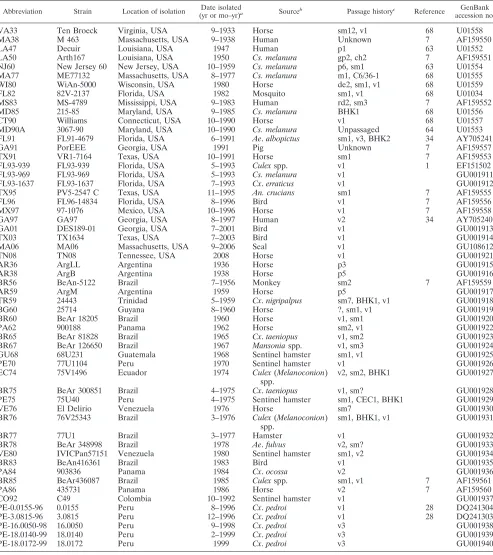
TABLE 1. EEEV strains used in phylogenetic and coalescent analyses
Abbreviation Strain Location of isolation Date isolated
(yr or mo–yr)a Sourceb Passage historyc Reference
GenBank accession no.
VA33 Ten Broeck Virginia, USA 9–1933 Horse sm12, v1 68 U01558
MA38 M 463 Massachusetts, USA 9–1938 Human Unknown 7 AF159550
LA47 Decuir Louisiana, USA 1947 Human p1 63 U01552
LA50 Arth167 Louisiana, USA 1950 Cs. melanura gp2, ch2 7 AF159551
NJ60 New Jersey 60 New Jersey, USA 10–1959 Cs. melanura p6, sm1 63 U01554
MA77 ME77132 Massachusetts, USA 8–1977 Cs. melanura m1, C6/36-1 68 U01555
WI80 WiAn-5000 Wisconsin, USA 1980 Horse de2, sm1, v1 68 U01559
FL82 82V-2137 Florida, USA 1982 Mosquito sm1, v1 68 U01034
MS83 MS-4789 Mississippi, USA 9–1983 Human rd2, sm3 7 AF159552
MD85 215-85 Maryland, USA 9–1985 Cs. melanura BHK1 68 U01556
CT90 Williams Connecticut, USA 10–1990 Horse v1 68 U01557
MD90A 3067-90 Maryland, USA 10–1990 Cs. melanura Unpassaged 64 U01553
FL91 FL91-4679 Florida, USA 6–1991 Ae.albopictus sm1, v3, BHK2 34 AY705241
GA91 PorEEE Georgia, USA 1991 Pig Unknown 7 AF159557
TX91 VR1-7164 Texas, USA 10–1991 Horse sm1 7 AF159553
FL93-939 FL93-939 Florida, USA 5–1993 Culexspp. v1 1 EF151502
FL93-969 FL93-969 Florida, USA 5–1993 Cs. melanura v1 GU001911
FL93-1637 FL93-1637 Florida, USA 7–1993 Cx.erraticus v1 GU001912
TX95 PV5-2547 C Texas, USA 11–1995 An. crucians sm1 7 AF159555
FL96 FL96-14834 Florida, USA 8–1996 Bird v1 7 AF159556
MX97 97-1076 Mexico, USA 10–1996 Horse v1 7 AF159558
GA97 GA97 Georgia, USA 8–1997 Human v2 34 AY705240
GA01 DES189-01 Georgia, USA 7–2001 Bird v1 GU001913
TX03 TX1634 Texas, USA 7–2003 Bird v1 GU001914
MA06 MA06 Massachusetts, USA 9–2006 Seal v1 GU108612
TN08 TN08 Tennessee, USA 2008 Horse v1 GU001921
AR36 ArgLL Argentina 1936 Horse p3 GU001915
AR38 ArgB Argentina 1938 Horse p5 GU001916
BR56 BeAn-5122 Brazil 7–1956 Monkey sm2 7 AF159559
AR59 ArgM Argentina 1959 Horse p5 GU001917
TR59 24443 Trinidad 5–1959 Cx.nigripalpus sm7, BHK1, v1 GU001918
BG60 25714 Guyana 8–1960 Horse ?, sm1, v1 GU001919
BR60 BeAr 18205 Brazil 1960 Horse v1, sm1 GU001920
PA62 900188 Panama 1962 Horse sm2, v1 GU001922
BR65 BeAr 81828 Brazil 1965 Cx.taeniopus v1, sm2 GU001923
BR67 BeAr 126650 Brazil 1967 Mansoniaspp. v1, sm3 GU001924
GU68 68U231 Guatemala 1968 Sentinel hamster sm1, v1 GU001925
PE70 77U1104 Peru 1970 Sentinel hamster v1 GU001926
EC74 75V1496 Ecuador 1974 Culex(Melanoconion)
spp.
v2, sm2, BHK1 GU001927
BR75 BeAr 300851 Brazil 4–1975 Cx.taeniopus v1, sm? GU001928
PE75 75U40 Peru 4–1975 Sentinel hamster sm1, CEC1, BHK1 GU001929
VE76 El Delirio Venezuela 1976 Horse sm7 GU001930
BR76 76V25343 Brazil 3–1976 Culex(Melanoconion)
spp.
sm1, BHK1, v1 GU001931
BR77 77U1 Brazil 3–1977 Hamster v1 GU001932
BR78 BeAr 348998 Brazil 1978 Ae.fulvus v2, sm? GU001933
VE80 IVICPan57151 Venezuela 1980 Sentinel hamster sm1, v2 GU001934
BR83 BeAn416361 Brazil 1983 Bird v1 GU001935
PA84 903836 Panama 1984 Cx.ocossa v2 GU001936
BR85 BeAr436087 Brazil 1985 Culexspp. sm1, v1 7 AF159561
PA86 435731 Panama 1986 Horse v2 7 AF159560
CO92 C49 Colombia 10–1992 Sentinel hamster v1 GU001937
PE-0.0155-96 0.0155 Peru 8–1996 Cx.pedroi v1 28 DQ241304
PE-3.0815-96 3.0815 Peru 12–1996 Cx.pedroi v1 28 DQ241303
PE-16.0050-98 16.0050 Peru 9–1998 Cx.pedroi v3 GU001938
PE-18.0140-99 18.0140 Peru 2–1999 Cx.pedroi v3 GU001939
PE-18.0172-99 18.0172 Peru 1999 Cx.pedroi v3 GU001940
aMonth of isolation provided if available.
bMosquito species listed in italics.Ae.,Aedes;An.,Anopheles;Cs.,Culiseta;Cx.,Culex.
csm, suckling mouse; v, Vero cell culture; p, unknown passage source; gp, guinea pig; ch, chicken embryo; m, mosquito; C6/36, C6/36Aedes albopictuscell culture;
dec, duck embryo cell culture; rd, human embryonal rhabdomyosarcoma cell culture; BHK, baby hamster kidney cell culture; CEC, chick embryo cell culture; ?, unknown passage source or number.
on November 8, 2019 by guest
http://jvi.asm.org/
performed for each data set. While chain length varied for each analysis con-ducted, they generally consisted of 10,000,000 to 50,000,000 generations, with parameters sampled and logged every 1,000 generations. Maximum clade cred-ibility trees were generated (with 10% burn-in) to display median node heights using TreeAnnotator version 1.4.7 and visualized using FigTree version 1.2.2 (http://tree.bio.ed.ac.uk/software/figtree).
RESULTS
Genetic and phylogenetic analyses of the EEE complex.The complete structural polyprotein ORF of approximately 3.7 kb was sequenced for 25 SA EEEV strains and 4 NA EEEV strains. These new sequences were combined with all homol-ogous EEEV sequences available from GenBank for a data set comprising 29 SA EEEV and 22 NA EEEV strains (Table 1; Fig. 1). The monophyletic nature of the EEE complex within
the Alphavirusgenus and the presence of four major EEEV
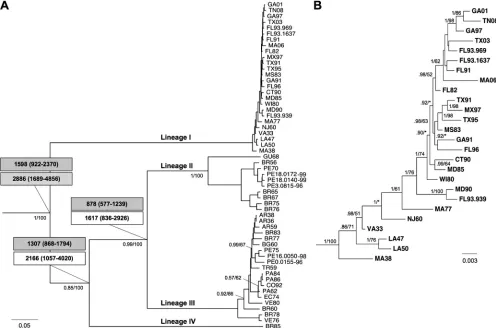
lineages were validated using all phylogenetic methods (Fig. 2A). Consistent with previous findings (7), lineage I included isolates from North America, lineages II and III included iso-lates from Central and South America, and lineage IV con-tained a single strain from Brazil. The inclusion of longer and additional sequences in our analysis further supported the sis-ter grouping of SA EEEV lineages II and III and the polyphy-letic nature of all three Central/South American clades.
Pairwise comparisons of both nucleotide and amino acid sequences were used to determine the genetic relatedness among members of the EEE complex as well as their
related-ness to VEEV (Table 2). The NA and SA EEEV lineages consistently showed 23 to 24% nucleotide and 9 to 11% amino acid sequence divergence. The SA EEEV were only slightly more conserved than the overall EEE complex, with 17 to 21% nucleotide divergence between the two main lineages (II and III) but only 3 to 5% amino acid divergence, indicating a high proportion of synonymous nucleotide changes. Greater diver-gence was observed between SA EEEV lineage IV and the other two SA lineages, particularly at the amino acid sequence level.
The degree of genetic divergence within each EEEV lineage varied greatly. NA EEEV lineage I was highly conserved, with less than 3% nucleotide divergence throughout its temporal and geographic range. The independent clades comprising SA EEEV lineage II differed from one another by approximately 5% and from the basal isolate (GU68) by 11 to 12%. SA EEEV lineage III was more highly conserved, with only 4 to 5% sequence divergence among strains. Consistent with previous alphavirus intercomplex comparisons (37), all EEEV lineages, and each of their members, differed from subtype I VEEV by 41 to 43% in both nucleotides and amino acids.
NA EEEV.The temporally dominated evolution and mono-phyletic nature of the NA EEEV lineage were robustly sup-ported by MP and Bayesian analyses, which placed the older isolates (1933 to 1977) at the base of clade, followed by sub-sequent divergence into 2 distinct, cocirculating groups in the 1970s (Fig. 2B). However, the use of some NJ and ML models resulted in either the placement of MD90/FL93-939 isolates basal to the NA lineage or the paraphyletic codivergence of those isolates from the older isolates. While this arrangement supports the early cocirculation of two monophyletic groups in North America prior to 1970, low bootstrap values and the lack of basal resolution (polytomies) with these methods limited confidence in this theory. Similar inconsistencies in NA EEEV topology were encountered in earlier analyses (64). However, the limited sequence data and lack of early sequences led to the conclusion that NA EEEV evolves as a single lineage. Our robust MP and Bayesian phylogenies validated these previous assumptions. The basal inconsistencies we observed may re-flect the inherent limitations of various phylogenetic methods to resolve relationships among very highly conserved sequences. Although the placement of the MD90/FL93-939 group was inconsistent, the divergence of the NA EEEV lineage into additional monophyletic groups after 1970 was robustly sup-ported in all analyses (Fig. 2B). Previously termed group A and group B by Weaver et al. in 1994 (64), the sympatric cocircu-lation of these two groups was further validated by our distinct phylogenetic placement of two newly sequenced group A Flor-ida 1993 strains, FL93-969 and FL93-1637, from the group B FL93-939 strain. FL93-969 and FL93-939 were isolated from two different mosquito species that were collected simulta-neously from the same county (30).
A temporally dominated pattern of NA EEEV evolution was also evident in the terminal groupings of our most recent isolates, GA01, TX03, MA06, and TN08 (Fig. 2B). The group-ing of all recent isolates from Georgia, Tennessee, and Florida supported regional EEEV evolution, with only occasional geo-graphic dispersal (5, 7, 64, 69). While other regional clusters (TX91/MX97/TX95, GL91/FL96, and MD85/CT90) also sup-ported regionally confined transmission, their persistence
ap-FIG. 1. Map showing the geographic distribution of EEEV lineages I to IV. Symbols represent locations of isolation for virus strains used
in this study.
on November 8, 2019 by guest
http://jvi.asm.org/
[image:4.585.47.282.70.369.2]peared to be limited, and their topological placement generally followed a temporal trend. However, the basal relationship of a Massachusetts isolate (MA06) to the most terminal Southern grouping also emphasized the wide geographic dispersal and temporal conservation of NA EEEV.
[image:5.585.43.539.70.398.2]SA EEEV.The phylogeny of SA EEEV was stable regardless of the methods and models used and demonstrated an evolu-tionary pattern very different from that of NA EEEV. Multiple highly divergent lineages of SA EEEV have coevolved and continue to cocirculate in overlapping geographic regions (Fig.
FIG. 2. Phylogenetic and coalescent analyses of EEEV isolates using Bayesian methods, with the complete structural polyprotein open reading frames. (A) Phylogenetic tree of NA and SA EEEV. Bayesian posterior probability (PP) values and maximum parsimony (MP) bootstrap values are noted for all major nodes of lineage divergence (PP/MP values). Within each SA EEEV lineage, values for PP/MP are shown only if either value is less than or equal to 0.90 (PP) or 90 (MP) for the adjacent node. Boxes represent the time since most recent common ancestor (TMRCA) in years for respective nodes, estimated using BEAST analysis. TMRCAs within the gray and white boxes were estimated with data sets including all EEEV and all SA EEEV lineages, respectively. TMRCAs within the lined box adjacent to the basal node were estimated with a data set including all SA EEEV lineages and a single representative of the NA EEEV lineage (TX03). Scale bar shows a genetic distance of 5% nucleotide sequence divergence. (B) Magnified version of NA EEEV phylogeny. Values for PP/MP are shown only if either value is greater than or equal to 0.90 (PP) or 90 (MP) for the adjacent node. Asterisks indicate a polytomy in MP bootstrap analysis. Scale bar shows a genetic distance of 0.3% nucleotide sequence divergence.
TABLE 2. Nucleotide and amino acid sequence divergence among EEEV and VEEVa
Data set
% Sequence divergence fromb:
NA EEEV lineage I SA EEEV lineage II SA EEEV lineage III SA EEEV lineage IV VEEVc
NA EEEV lineage I 22.8–23.9 22.5–23.5 22.7–23.0 41.1–42.2
SA EEEV lineage II 8.9–10.5 16.5–18.0 20.7–21.2 41.6–42.5
SA EEEV lineage III 8.2–9.7 3.3–4.6 19.3–19.9 41.6–43.2
SA EEEV lineage IV 10.2–11.2 7.8–8.9 6.9–7.6 41.3–42.4
VEEVc 42.1–43.0 41.6–42.8 41.3–42.2 41.3–42.2
a
Values in the upper diagonal indicate nucleotide sequence divergence; values in the lower diagonal indicate amino acid sequence divergence. b
All members of each EEEV lineage were compared and are represented by ranges of percent sequence divergence. c
VEEV includes representatives of subtypes IAB, IC, ID, and IE.
on November 8, 2019 by guest
http://jvi.asm.org/
[image:5.585.43.541.620.699.2]1). A temporal trend of evolution was lacking, and multiple geographic clusters were evident within both of the main SA EEEV lineages (Fig. 2A). The inclusion of longer, contiguous genomic sequences provided the robust support that had been lacking for previously recognized clades (7, 28), and the addi-tion of more recent isolates revealed newly recognized geo-graphic groupings that also lacked a temporal association.
Despite its limited representation, lineage II consisted of mul-tiple genetically divergent SA clades. Brazilian (BR65/BR67) and Peruvian (PE70/PE3.0815-96/PE18.0172-99/PE18.0140-99) groups exhibited a high degree of localized genetic conserva-tion, particularly exemplified by the isolates collected in the Amazon basin of Peru over a span of 30 years. Although lineage III was more highly conserved overall, it was more extensive in its geographic scope and contained numerous geo-graphically based groupings. One such northern South/Central American cluster included isolates from Panama, Colombia, and Ecuador, with a collection time span from 1962 to 1992. Argentinean isolates collected from 1936 to 1959 also formed a robust grouping on the most terminal branches of the lin-eage, further emphasizing the lack of widespread EEEV dis-persal in SA. Finally, a Peruvian clade (PE75/PE16.0050-98/ PE0.0155-96) similar to that in lineage II further supported the genetic conservation among isolates from the same geographic area over the same period of time. Most interesting was the apparent cocirculation and persistence of subtypes II and III for multiple decades.
Interestingly, some of the highly conserved geographic SA EEEV clades were closely related to geographically distant isolates. For example, the Peruvian isolates of lineage II grouped with a distant Brazilian isolate (BR56), and those from Argen-tina consistently grouped with BR83 in lineage III. While long-term geographic groupings could indicate maintenance by ver-tebrate hosts with limited mobility, these distant relationships could represent historical introductions, perhaps via alterna-tive vector or vertebrate hosts. Sampling bias is also inherent in these analyses, as the majority of SA EEEV isolates originated from equine epizootics, structured arbovirus surveillance, or focused scientific research studies. EEEV circulation in sparsely inhabited tropical regions may go undetected, resulting in an incomplete representation of the SA EEEV phylogeny.
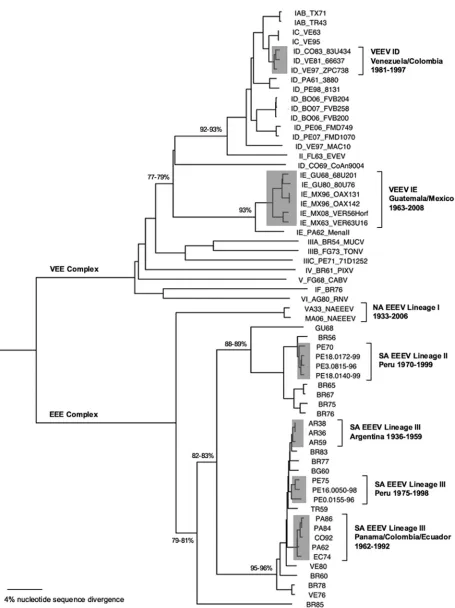
VEEV phylogenetic comparison. Because VEEV ecology, and especially reservoir host use, is better understood in SA, the phylogenetic patterns of enzootic VEEV subtypes ID and IE were compared to those of SA EEEV. VEEV subtypes IAB and IC utilize fundamentally different epizootic cycles of lim-ited duration and were therefore not considered. To provide an accurate comparison of the topologies and scales of divergence, the phylogeny in Fig. 3 was generated using the structural polyprotein ORFs of both VEE and EEE complex viruses (see Table S1 in the supplemental material). Representative mem-bers of all VEE subtypes and two NA EEEV representatives (VA33 and MA06) were included in the tree for context and to provide an accurate topology of the VEE and EEE complexes. Similar evolutionary patterns were observed between SA EEEV and VEEV subtypes ID and IE, which overlap both geographically and temporally. Many geographic clusters of SA EEEV and VEEV subtype ID/IE isolates were analogous in their spatial and temporal scales and their degree of genetic conservation (Fig. 3). For example, the SA EEEV lineage III
grouping that included Panama/Colombia/Ecuador isolates and the Mexican/Guatemala VEEV IE grouping were compa-rable in their geographic dimensions, their collection times spanned 30 to 40 years, and they maintained similar levels of genetic conservation at approximately 98 to 99%. The lineage II and III Peruvian and lineage III Argentinean EEEV clusters were spatially more focal but equally conserved, which corre-sponded in geographic and collection time span to the VEEV subtype ID Venezuelan and VEEV subtype IE Mexican (MX63/ MX08) and Guatemalan clusters. Although isolated decades apart, the viruses within each group differed in nucleotide sequences by less than 2%.
Despite the well-established role of rodent hosts with limited mobility in the transmission of enzootic VEEV (2, 62), exam-ples of closely related viruses with distant geographic origin were also observed in the VEEV phylogeny (e.g., VEEV sub-type ID PA61/PE98). Although fewer sequences are available for other subtypes of the VEE complex, the recent phylogeny (6) of VEE complex subtype IIIA (Mucambo virus) generally agreed with those observed with SA EEEV and VEEV sub-types ID and IE.
Rates of EEEV evolution.The rates of evolution of the EEE complex, NA EEEV lineage I, and SA EEEV lineages II to IV were independently analyzed under the relaxed molecular clock model of evolution (Table 3). We observed a high degree of rate heterogeneity in all 3 data sets, which signified that these data sets were best modeled with the relaxed molecular clock; therefore, the use of a strict molecular clock model of evolution was rejected. Mean substitution rates (UCLD.mean) were 2.1⫻10⫺4s/n/y for the entire EEE complex, 2.7⫻10⫺4
s/n/y for the NA EEEV lineage, and 1.2⫻10⫺4s/n/y for SA
EEEV lineages II to IV.
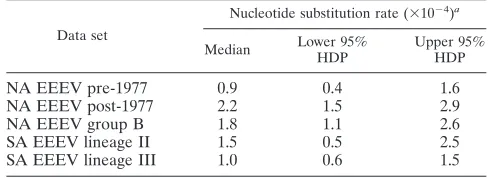
Branch rate variation within the SA EEEV data set was not surprising because it included diverse SA EEEV lineages. Therefore, lineages II and III were individually analyzed using the relaxed clock model to determine the degree of intraclade variation. UCLD.STDEV parameter estimates abutting zero indicated that a strict molecular clock could not be rejected for SA EEEV lineages II and III. A strict clock model applied to the analysis of each lineage (Table 4) yielded a median substi-tution rate (clock rate) of lineage II (1.5⫻10⫺4s/n/y) that was
approximately 1.5 times higher than that of lineage III (1.0⫻ 10⫺4s/n/y). Both the strict and relaxed clock models yielded
similar rates of nucleotide substitution for each SA EEEV lineage, further supporting the robustness of the groupings within these lineages and their clock-like evolution (20).
There was considerable rate variation estimated with the relaxed molecular clock model analysis of NA EEEV; there-fore, clades were analyzed individually via the relaxed and strict clock models. Based on NA EEEV phylogenetic analyses conducted in this study and those of previous studies (64), the individual groups analyzed consisted of the following: (i) all strains isolated prior to 1977, designated “pre-1977”; (ii) all strains isolated after 1977, designated “post-1977”; and (iii) post-1977 strains minus MD90 and FL93-939, termed “group B,” which corresponds with that of Weaver et al. in 1994 (64). Because only 2 isolates from group A were included in the present study, substitution rates were not estimated for these isolates.
The pre-1977 group was unable to efficiently reach
on November 8, 2019 by guest
http://jvi.asm.org/
FIG. 3. Phylogenetic tree including SA EEEV and VEEV generated with Bayesian methods using the complete structural polyprotein open reading frames. Geographic clusters with less than 2% nucleotide sequence divergence are shaded in gray for comparison between SA EEEV and VEEV. The brackets and captions refer to the strains included in each geographic cluster and their collection time span. NA EEEV is represented by two isolates to denote the phylogenetic placement and temporal span of lineage I. Representatives of all VEE subtypes are included to provide an accurate topology of the VEE complex. Numbers refer to percent nucleotide identity among members of clades defined by the adjacent node.
on November 8, 2019 by guest
http://jvi.asm.org/
gence for all parameters using the relaxed clock model, sug-gesting a poor fit of this model to the data. Alternatively, convergence was quickly reached using the strict clock model, with a median substitution rate estimate of 9.4⫻10⫺5 s/n/y.
The post-1977 and group B data sets ultimately reached con-vergence using the relaxed clock model; however, the strict clock model resulted in more efficient convergence and substi-tution rates similar to those with the relaxed model. The evo-lutionary rate estimate of 2.2 ⫻ 10⫺4 s/n/y in the post-1977
isolates was more than twice that of the pre-1977 group, sup-porting previous observations of an increase in evolutionary rate following the divergence of NA EEEV into two distinct, cocirculating clades in the 1970s (64). Differentially higher passage histories in these two groups may have slightly im-pacted these estimated evolutionary rates. However, many of the oldest EEEV isolates had very low passage histories (e.g., 1 to 4 for LA47 and LA50), and extensive passage of EEEV is accompanied by relatively few mutations (61), suggesting that any effect on evolutionary rate estimates was minimal. Inter-estingly, the rate for group B isolates (1.8⫻10⫺4 s/n/y) was
lower than that of the post-1977 group, i.e., when MD90 and FL93-939 (group A) were removed, which implies that MD90 and FL93-939 evolved at a higher rate than those isolates in group B.
Times of divergence.The times since most recent common ancestor (TMRCAs) were estimated using the model that best fit the corresponding data (Fig. 2A). Using the relaxed model and the entire EEE complex, NA and SA EEEV last shared a common ancestor 1,598 (922 to 2,370) years ago, or around the year 410 AD of the Gregorian calendar. The same analysis estimated a divergence of lineage IV (BR85) from the other
SA EEEV lineages 1,307 (868 to 1,794) years ago (701 AD), followed by the divergence of lineages II and III 878 (577 to 1,239) years ago (1129 AD). However, the relaxed model anal-ysis that included only SA EEEV lineages produced much earlier TMRCA estimates of 2,166 (1,057 to 4,020) years since the divergence of lineage IV (158 BC) and 1,617 (836 to 2,926) years since the divergence of lineages II and III (391 AD). An additional analysis including all SA EEEV lineages and a sin-gle representative of the predominate NA EEEV clade (TX03) was performed in order to generate a TMRCA for the basal divergence of NA and SA EEEV that corresponded to those of the SA EEEV analysis. This analysis resulted in TMRCAs for all internal nodes that were similar to those generated by the SA EEEV strains only. In addition, the estimate for NA and SA EEEV divergence was much earlier, 2,866 years (1,689 to 4,856 years; ca. 878 BC), than that generated from the entire EEE complex data set. Although the confidence intervals broadly overlapped, these wide differences in TMRCAs and the cor-responding dates of divergence highlight the variation ob-tained with the different models and data sets used for coales-cent analyses and the imprecision of the estimates based on rate variation among virus lineages.
DISCUSSION
Geographic, pathogenic, and epidemiologic differences be-tween NA and SA EEEV have prompted exploration of their genetic diversity and evolutionary history. However, a lack of corresponding sequence data had previously limited a robust comparison. By expanding the length and number of available EEEV sequences, we produced an equal platform upon which to compare and contrast the evolutionary patterns of NA and SA EEEV and to compare SA EEEV to the closely related VEEV. Our results emphasized the differences between NA and SA EEEV and provided insights into the extent that this divergence likely reflects extant transmission dynamics.
[image:8.585.44.540.81.161.2]EEEV evolution.To explore the evolutionary history of the EEE complex, a Bayesian coalescent analysis was performed. Depending upon the data set used, median estimates of when NA and SA EEEV last shared a common ancestor were ap-proximately 1,600 and 2,300 years ago, with ranges stretching much earlier than previously estimated. Data dominated by SA EEEV produced an earlier range of TMRCAs (1,689 to 4,856 years ago) due to the slower evolutionary rate estimated for these lineages (1.2⫻10⫺4s/n/y), while those dominated by the
TABLE 3. Summary of coalescent analysis parameters estimated using the relaxed molecular clock modela
Data set
Nucleotide substitution rateb(⫻10⫺4) Intraclade rate variationc
Molecular clock model fit Median Lower 95% HDP Upper 95% HDP Median Lower 95% HDPd
Upper 95% HDP
EEE complex 2.1 1.7 2.6 0.4 0.3 0.5 Relaxed
NA EEEV lineage I 2.7 1.9 3.7 0.6 0.3 0.8 Relaxed
SA EEEV lineages II-IV 1.2 0.6 1.8 0.2 0.1 0.4 Relaxed
SA EEEV lineage II 1.8 0.2 4.6 0.2 0.0 0.6 Cannot reject strict
SA EEEV lineage III 1.1 0.5 1.8 0.2 0.0 0.4 Cannot reject strict
aParameters estimated using the uncorrelated lognormal relaxed molecular clock (UCLD) model in BEAST. HPD, highest posterior density intervals. bNucleotide substitution rate is measured by the UCLD.mean parameter and is the mean result of the branch substitution rates, with units of substitution/nucleotide
site/year.
cMeasured by the UCLD.STDEV parameter, which is used to determine if the data set rejects or cannot reject a strict molecular clock.
dLower 95% HPD values for UCLD.STDEV parameter abutting zero indicate that data cannot reject a strict molecular clock; if not abutting zero, a relaxed clock
model is most appropriate. Values of zero reflect rounding to the nearest tenth.
TABLE 4. Rates of nucleotide substitution estimated using the strict molecular clock model
Data set
Nucleotide substitution rate (⫻10⫺4)a
Median Lower 95% HDP
Upper 95% HDP
NA EEEV pre-1977 0.9 0.4 1.6
NA EEEV post-1977 2.2 1.5 2.9
NA EEEV group B 1.8 1.1 2.6
SA EEEV lineage II 1.5 0.5 2.5
SA EEEV lineage III 1.0 0.6 1.5
a
Measured by the clock rate parameter, with units of substitutions/nucleotide site/year.
on November 8, 2019 by guest
http://jvi.asm.org/
[image:8.585.40.284.619.708.2]TMRCAs (922 to 2,370 years ago) based on their higher evo-lutionary rate estimates (2.1 ⫻ 10⫺4 and 2.7 ⫻ 10⫺4 s/n/y,
respectively). While it is unclear why analysis of the entire EEE complex was influenced more by NA EEEV than by SA EEEV, the variation in evolutionary rates among EEEV lin-eages limits the precision of estimates for divergence events. The stability and uniformity of the slower evolutionary rates of the SA EEEV lineages, as well as their concordance with estimates of other alphaviruses (66), support the earlier esti-mates of key divergence events.
The consistency observed in SA EEEV evolutionary rates suggests long-term adaptation to its ecology and stability in its environment. Nonsynonymous (dN)-to-synonymous (dS) mu-tation ratios (data not shown) in SA EEEV lineages II and III suggested similar degrees of purifying selection. This may in-dicate that EEEV has reached a high level of fitness for cir-culation in South and Central America, thus stabilizing its evolutionary rates. Although still dominated by purifying se-lection, higherdN/dSratios were observed for NA EEEV, with that of the pre-1977 group exceeding that of the post-1977 group. This pattern is consistent with progressive adaption of EEEV to its transmission cycle in North America, possibly reflecting its relatively recent introduction or anthropogenic changes in it habitat. However, a decline in thedN/dSratios was also associated with increasing evolutionary rates, suggest-ing that positive selection is an unlikely drivsuggest-ing force behind this rate change.
An alternative explanation for the apparent increase in the EEEV evolutionary rate in North America is genetic drift. Recent studies have focused on NA EEEV transmission in the northeastern United States and provide evidence for episodic overwintering, regionally independent evolution, and epizootic clustering (5, 69). While the precise mechanisms are unclear, viral overwintering in temperate regions could impose focal bottlenecks, and surviving populations may be more subject to rapid genetic drift and seasonal competition with southern strains reintroduced from areas of continuous transmission. In addition, recent work suggests that, in some areas, NA EEEV transmission may deviate from the typical avian-mos-quito enzootic cycle to involve ectothermic hosts, such as rep-tiles and amphibians, and herpetophilic mosquito vectors (14, 16). Changes in vector and host ecology in these southeastern foci could impact the spatial and temporal transmission pat-terns by affecting virus dispersal and reducing virus popula-tions, thereby providing additional opportunities for founder effects and genetic drift. Because these dynamics could con-tribute to variability in EEEV evolutionary rates, it may be important to monitor the evolutionary progression of NA EEEV when considering predictive factors of epizootic/epi-demic emergence and adaptation to new environments.
Implications for understanding EEEV ecology.The dichot-omy between NA and SA EEEV was further underscored by their distinct genetic and phylogenetic patterns. The highly con-served, monophyletic, and temporally dominated relationships among strains of NA EEEV starkly contrast with the highly divergent, polyphyletic, cocirculating, and geographically asso-ciated relationships among SA EEEV strains. The mainte-nance of NA EEEV by highly mobile avian hosts, with their ability to widely disperse the virus, is hypothesized to
deter-observed with other New World alphaviruses, e.g., western equine encephalitis virus (WEEV), which also uses avian ver-tebrate hosts throughout its North and South American trans-mission range (27, 38, 45), and Highlands J virus that circulates in eastern North America in a manner indistinguishable from EEEV (13). Alternatively, arboviruses that utilize less mobile mammalian hosts tend to share a molecular epidemiologic pat-tern more similar to that observed for SA EEEV. Ground-dwell-ing mammals, such as rodents and marsupials, lack the ability to physically disperse acutely infecting viruses. Theoretically, this limited host and virus mobility leads to geographically defined transmission foci with independent evolution.
As the closest relative to EEEV, VEEV circulates sympat-rically with SA EEEV and provides a prototypical example of the evolutionary pattern generated by an arbovirus that relies primarily on terrestrial mammalian vertebrate hosts for its enzootic maintenance. A comparison between SA EEEV and VEEV subtypes ID and IE revealed similar patterns of genetic divergence characterized by the evolution of multiple subtypes and lineages and highly conserved geographic groupings that lack temporal clustering. Comparable to those observed with VEEV subtypes ID/IE, the geographic scales defining SA EEEV clusters are highly focal, on the order of a few hundred miles or less. This pattern suggests a mode of transmission that limits dispersal of EEEV in SA and is consistent with the use of mammalian vertebrate hosts as reservoirs and amplifiers. In contrast, NA EEEV demonstrates a similar degree of genetic conservation over its entire geographic range, up to thousands of miles, which is consistent with wide dispersal of the virus by avian hosts.
Although VEEV and SA EEEV overlap in their range of transmission and share similar evolutionary profiles, their de-gree of ecological similarity is unknown. Members of theCulex
(Melanoconion) subgenus have been implicated as the primary
vectors of both enzootic VEEV (15, 42, 51, 52, 59, 67) and SA EEEV (28, 33, 53, 58) in Central and South America. While these mosquitoes are known to feed on a variety of vertebrates, a primary vertebrate host(s) for SA EEEV has not yet been identified. Field isolations, seroprevalence among wild birds, rodents, marsupials, and reptiles, and experimental data (N. C. Arrigo, unpublished data) indicate that both mammalian and avian species are susceptible to infection (12, 17, 31, 45, 56, 57, 58); however, their involvement in maintaining enzootic trans-mission of SA EEEV is unclear. Additional ecological and experimental data are needed to implicate a particular type of vertebrate host responsible for the maintenance of SA EEEV.
Systematics of EEEV.In the early 1980s, the classifications of numerous arboviruses, including EEEV, were proposed based solely on their antigenic properties (10). Different vi-ruses were delineated by a fourfold or greater difference in antibody cross-reactivity in both directions, i.e., the heterolo-gous versus homoloheterolo-gous antibody titers of sera from 2 viruses. A fourfold or greater difference in only one direction desig-nated a subtype, while antigenic varieties were distinguishable only with special serological tests (e.g., kinetic hemagglutina-tion inhibihemagglutina-tion). According to this definihemagglutina-tion, all EEEV strains were originally classified as a single virus consisting of two anti-genic varieties, NA and SA (11). Later, cross-neutralization testing with representatives from each phylogenetically
on November 8, 2019 by guest
http://jvi.asm.org/
fied EEEV lineage divided EEEV into 4 antigenic subtypes, de-spite some relationships with greater than fourfold differences in cross-reactivity in both directions (7).
The International Committee on Taxonomy of Viruses (ICTV) has more recently revised the definition of a virus species to be a “polythetic class of viruses that constitute a replicating lin-eage and occupy a particular ecological niche” (24, 54). This definition incorporates the notion of multiple characteristics defining a virus species, including but not limited to genetic and phylogenetic relationships, geographic distribution, differ-ences in ecology and transmission cycles, pathogenicity, mor-phology, replication patterns, and antigenicity. Genetic diver-sity resulting in distinct phylogenetic lineages can often reflect differences in ecological niche and evolutionary history; there-fore, they often dominate the current classification of novel virus species. For example, the newly discovered Lujo virus
(family Arenaviridae) (8) and Bundibugyo ebolavirus (family
Filoviridae) (49) were designated novel species primarily based
on their nucleotide sequence divergence of at least 21.5% and 32%, respectively, which also corresponded to unique geo-graphic isolation and pathogenic properties.
The ability to analyze genetic relationships has also led to the reconsideration of establishedAlphavirustaxonomy, result-ing in recommendations that have subsequently been accepted by the ICTV. Tonate virus was designated a species unique
fromMucambo viruswithin subtype III of the VEE complex
based on 16% nucleotide and 7% amino acid sequence diver-gence as well as antigenic differences and the use of different reservoir hosts (37). The distinction of theMayaro virusand
Una virusspecies was also supported by recent molecular
ep-idemiological studies, despite their previous conspecific desig-nations based on antigenic relationships (36). These viruses exhibit 55% nucleotide sequence divergence, and their phylo-genetic patterns also suggest differences in the use of reservoir hosts and the occupation of distinct ecological niches. With up to 24% nucleotide and 11% amino acid sequence divergence between lineages of NA and SA EEEV, the genetic and phy-logenetic diversities observed in our study were consistent with the examples described above and with the 21% nucleotide and 8% amino acid sequence divergence generally observed among differentAlphavirusspecies of the same antigenic com-plex (37).
The current ICTV species definition encompasses several characteristics that are applicable to public health programs aimed at prevention and intervention. Perceptions of EEEV often focus on NA strain characteristics, namely, the avian-mosquito transmission cycle, geographic range, highly patho-genic nature resulting in severe human and equine encephali-tis, and highly conserved genetic nature. However, the distinct characteristics of SA EEEV are not reflected by this depiction. Importantly, unlike NA EEEV, SA EEEV has little to no association with human disease, despite evidence of human exposure in areas of endemic and epizootic activity (4, 17, 18, 40). Differential replication in lymphoid tissues of mice and differences in interferon induction and sensitivity (3, 26) may contribute to the observed attenuation of SA EEEV, further distinguishing it pathogenically from NA EEEV.
Considering the goal of classification as a means to facilitate the understanding of a virus taxon from multiple perspectives, we recommend designating NA and SA EEEV as separate
virus species, given their distinct geographic, epidemiologic, ecologic, pathogenic, genetic, phylogenetic, and evolutionary characteristics. This revision, based on polythetic criteria, would provide a more medically and scientifically accurate represen-tation of the viruses comprising the EEE complex. Reclassifi-cation of individual SA EEEV subtypes is not warranted based solely on genetic differences, as the lack of information on potential ecologic differences within South America precludes the evaluation of polythetic criteria. Because NA EEEV strains are considered the prototypes, we propose a revision of all SA EEEV strains to a new species called Madariaga virus
(MADV), based on the location of the earliest strain isolated in 1930 from General Madariaga Partido, Buenos Aires Prov-ince, Argentina (39, 41).
ACKNOWLEDGMENTS
We thank Robert Tesh and Hilda Guzman of the World Reference Center for Emerging Viruses and Arboviruses (UTMB) for providing many of the EEEV isolates used in this study and Sara M. Volk for valuable theoretical and technical expertise in the evolutionary analysis.
N.C.A. was supported by the TO1/CCT622892 Fellowship Training Grant in Vector-Borne Infectious Diseases from the Centers for Dis-ease Control and Prevention and by Biodefense Training Program NIH T32 training grant AI-060549. A.P.A. was supported by the James W. McLaughlin Fellowship Fund. This work was supported by the John S. Dunn Research Foundation and NIH grant U54 AI-057156 from the National Institute of Allergy and Infectious Diseases to S.C.W. through the Western Regional Center of Excellence for Bio-defense and Emerging Infectious Diseases Research.
REFERENCES
1.Aguilar, P. V., A. P. Adams, E. Wang, W. Kang, A. Carrara, M. Anishchenko, I. Frolov, and S. C. Weaver. 2008. Structural and nonstructural protein genome regions of eastern equine encephalitis virus are determinants of interferon sensitivity and murine virulence. J. Virol.82:4920–4930. 2.Aguilar, P. V., I. P. Greene, L. L. Coffey, G. Medina, A. C. Moncayo, M.
Anishchenko, G. V. Ludwig, M. J. Turell, M. L. O’Guinn, J. Lee, R. B. Tesh, D. M. Watts, K. L. Russell, C. Hice, S. Yanoviak, A. C. Morrison, T. A. Klein, D. J. Dohm, H. Guzman, A. P. Travassos da Rosa, C. Guevara, T. Kochel, J. Olson, C. Cabezas, and S. C. Weaver.2004. Endemic Venezuelan equine encephalitis in northern Peru. Emerg. Infect. Dis.10:880–888.
3.Aguilar, P. V., S. Paessler, A. S. Carrara, S. Baron, J. Poast, E. Wang, A. C. Moncayo, M. Anishchenko, D. Watts, R. B. Tesh, and S. C. Weaver.2005. Variation in interferon sensitivity and induction among strains of eastern equine encephalitis virus. J. Virol.79:11300–11310.
4.Aguilar, P. V., R. M. Robich, M. J. Turell, M. L. O’Guinn, T. A. Klein, A. Huaman, C. Guevara, Z. Rios, R. B. Tesh, D. M. Watts, J. Olson, and S. C. Weaver.2007. Endemic eastern equine encephalitis in the Amazon region of Peru. Am. J. Trop. Med. Hyg.76:293–298.
5.Armstrong, P. M., T. G. Andreadis, J. F. Anderson, J. W. Stull, and C. N. Mores.2008. Tracking eastern equine encephalitis virus perpetuation in the northeastern United States by phylogenetic analysis. Am. J. Trop. Med. Hyg.
79:291–296.
6.Auguste, A. J., S. M. Volk, N. C. Arrigo, R. Martinez, V. Ramkissoon, A. P. Adams, N. N. Thompson, A. A. Adesiyun, D. D. Chadee, J. E. Foster, A. P. A. Travassos da Rosa, R. B. Tesh, S. C. Weaver, and C. V. F. Carrington.2009. Isolation and phylogenetic analysis of Mucambo virus (Venezuelan equine encephalitis complex subtype IIIA) in Trinidad. Virology392:123–130. 7.Brault, A. C., A. M. Powers, C. L. Chavez, R. N. Lopez, M. F. Cachon, L. F.
Gutierrez, W. Kang, R. B. Tesh, R. E. Shope, and S. C. Weaver.1999. Genetic and antigenic diversity among eastern equine encephalitis viruses from North, Central, and South America. Am. J. Trop. Med. Hyg.61:579– 586.
8.Briese, T., J. T. Paweska, L. K. McMullan, S. K. Hutchison, C. Street, G. Palacios, M. L. Khristova, J. Weyer, R. Swanepoel, M. Egholm, S. T. Nichol, and W. I. Lipkin.2009. Genetic detection and characterization of Lujo virus, a new hemorrhagic fever-associated arenavirus from southern Africa. PLoS Pathog.5:e1000455.
9.Calisher, C. H., and N. Karabatsos.1988. Arbovirus serogroups: definition and geographic distribution, p. 19–57.InT. P. Monath (ed.), The arbovi-ruses: epidemiology and ecology, vol. I. CRC Press, Boca Raton, FL. 10.Calisher, C. H., R. E. Shope, W. Brandt, J. Casals, N. Karabatsos, F. A.
on November 8, 2019 by guest
http://jvi.asm.org/
tion of registered arboviruses I. Togaviridae,Alphavirus. Intervirology14:
229–232.
11.Casals, J.1964. Antigenic variants of eastern equine encephalitis virus. J. Exp. Med.119:547–565.
12.Causey, O. R., R. E. Shope, P. Sutmoller, and H. Laemmert.1962. Epizootic eastern equine encephalitis in the Bratanca region of Para, Brazil. Rev. Servicio Especial Saude Publica12:39–45.
13.Cilnis, M. J., W. Kang, and S. C. Weaver.1996. Genetic conservation of Highlands J. viruses. Virology218:343–351.
14.Cupp, E. W., K. Klingler, H. K. Hassan, L. M. Viguers, and T. R. Unnasch.
2003. Transmission of eastern equine encephalomyelitis virus in central Alabama. Am. J. Trop. Med. Hyg.68:495–500.
15.Cupp, E. W., W. F. Scherer, and J. V. Ordonez. 1979. Transmission of Venezuelan encephalitis virus by naturally infectedCulex(Melanoconion) opisthopus. Am. J. Trop. Med. Hyg.28:1060–1063.
16.Cupp, E. W., D. Zhang, X. Yue, M. S. Cupp, C. Guyer, T. R. Sprenger, and T. R. Unnasch.2004. Identification of reptilian and amphibian blood meals from mosquitoes in an eastern equine encephalomyelitis virus focus in cen-tral Alabama. Am. J. Trop. Med. Hyg.71:272–276.
17.de Souza Lopes, O., and L. de Abreu Sacchetta. 1974. Epidemiological studies on Eastern equine encephalitis virus in Sao Paulo, Brazil. Rev. Inst. Med. Trop. Sao Paulo16:253–258.
18.Dietz, W. H., Jr., P. Galindo, and K. M. Johnson.1980. Eastern equine encephalomyelitis in Panama: the epidemiology of the 1973 epizootic. Am. J. Trop. Med. Hyg.29:133–140.
19.Drummond, A. J., S. Y. Ho, M. J. Phillips, and A. Rambaut.2006. Relaxed phylogenetics and dating with confidence. PLoS Biol.4:e88.
20.Drummond, A. J., and A. Rambaut.2007. BEAST: Bayesian evolutionary analysis by sampling trees. BMC Evol. Biol.7:214.
21.Drummond, A. J., A. Rambaut, B. Shapiro, and O. G. Pybus.2005. Bayesian coalescent inference of past population dynamics from molecular sequences. Mol. Biol. Evol.22:1185–1192.
22.Elvinger, F., A. D. Liggett, K. N. Tang, L. R. Harrison, J. R. Cole, Jr., C. A. Baldwin, and W. B. Nessmith.1994. Eastern equine encephalomyelitis virus infection in swine. J. Am. Vet. Med. Assoc.205:1014–1016.
23.Farrar, M. D., D. L. Miller, C. A. Baldwin, S. L. Stiver, and C. L. Hall.2005. Eastern equine encephalitis in dogs. J. Vet. Diagn. Invest.17:614–617. 24.Fauquet, C. M., M. A. Mayo, J. Maniloff, U. Desselberger, and L. A. Ball
(ed.).2005. Virus taxonomy: eighth report of the International Committee on Taxonomy of Viruses. Elsevier Academic Press, San Diego, CA. 25.Felsenstein, J.1985. Confidence limits on phylogenies: an approach using
the bootstrap. Evolution39:783–791.
26.Gardner, C. L., J. Yin, C. W. Burke, W. B. Klimstra, and K. D. Ryman.2009. Type I interferon induction is correlated with attenuation of a South Amer-ican eastern equine encephalitis virus strain in mice. Virology390:338–347. 27.Hayes, C. G., and R. C. Wallis.1977. Ecology of Western equine
encepha-lomyelitis in the eastern United States. Adv. Virus Res.21:37–83. 28.Kondig, J. P., M. J. Turell, J. S. Lee, M. L. O’Guinn, and L. P. Wasieloski,
Jr.2007. Genetic analysis of South American eastern equine encephalomy-elitis viruses isolated from mosquitoes collected in the Amazon Basin region of Peru. Am. J. Trop. Med. Hyg.76:408–416.
29.Mendez, W., J. Liria, J. C. Navarro, C. Z. Garcia, J. E. Freier, R. Salas, S. C. Weaver, and R. Barrera. 2001. Spatial dispersion of adult mosquitoes (Diptera: Culicidae) in a sylvatic focus of Venezuelan equine encephalitis virus. J. Med. Entomol.38:813–821.
30.Mitchell, C. J., C. D. Morris, G. C. Smith, N. Karabatsos, D. Vanlanding-ham, and E. Cody.1996. Arboviruses associated with mosquitoes from nine Florida counties during 1993. J. Am. Mosq. Control Assoc.12:255–262. 31.Monath, T. P., M. S. Sabattini, R. Pauli, J. F. Daffner, C. J. Mitchell, G. S.
Bowen, and C. B. Cropp.1985. Arbovirus investigations in Argentina, 1977– 1980. IV. Serologic surveys and sentinel equine program. Am. J. Trop. Med. Hyg.34:966–975.
32.Morris, C. D.1988. Eastern equine encephalomyelitis, p. 1–36.InT. P. Monath (ed.), The arboviruses: epidemiology and ecology, vol. III. CRC Press, Boca Raton, FL.
33.O’Guinn, M. L., J. S. Lee, J. P. Kondig, R. Fernandez, and F. Carbajal.2004. Field detection of eastern equine encephalitis virus in the Amazon Basin region of Peru using reverse transcription-polymerase chain reaction adapted for field identification of arthropod-borne pathogens. Am. J. Trop. Med. Hyg.70:164–171.
34.Platteborze, P. L., J. P. Kondig, R. J. Schoepp, and L. P. Wasieloski.2005. Comparative sequence analysis of the eastern equine encephalitis virus pathogenic strains FL91-4679 and GA97 to other North American strains. DNA Seq.16:308–320.
35.Posada, D., and K. A. Crandall.1998. MODELTEST: testing the model of DNA substitution. Bioinformatics14:817–818.
36.Powers, A. M., P. V. Aguilar, L. J. Chandler, A. C. Brault, T. A. Meakins, D. Watts, K. L. Russell, J. Olson, P. F. Vasconcelos, A. T. Da Rosa, S. C. Weaver, and R. B. Tesh.2006. Genetic relationships among Mayaro and Una viruses suggest distinct patterns of transmission. Am. J. Trop. Med. Hyg.
75:461–469.
Strauss, and S. C. Weaver.2001. Evolutionary relationships and systematics of the alphaviruses. J. Virol.75:10118–10131.
38.Reisen, W. K., and T. P. Monath.1988. Western equine encephalomyelitis, p. 89–137.InT. P. Monath (ed.), The arboviruses: epidemiology and ecology, vol. V. CRC Press, Boca Raton, FL.
39.Sabattini, M. S., G. Aviles, and T. P. Monath.1998. Historical, epidemio-logical, and ecological aspects of arboviruses in Argentina: Togaviridae, Alphavirus, p. 140.InA. P. A. Travassos da Rosa, P. F. C. Vasconcelos, and J. F. S. Travassos da Rosa (ed.), An overview of arbovirology in Brazil and neighbouring countries. Instituto Evandro Chagas, Belem, Brazil. 40.Sabattini, M. S., J. F. Daffner, T. P. Monath, T. I. Bianchi, C. B. Cropp, C. J.
Mitchell, and G. Aviles.1991. Localized eastern equine encephalitis in San-tiago del Estero Province, Argentina, without human infection. Medicina
51:3–8.
41.Sabattini, M. S., T. P. Monath, C. J. Mitchell, J. F. Daffner, G. S. Bowen, R. Pauli, and M. S. Contigiani.1985. Arbovirus investigations in Argentina, 1977–1980. I. Historical aspects and description of study sites. Am. J. Trop. Med. Hyg.34:937–944.
42.Scherer, W. F., S. C. Weaver, C. A. Taylor, E. W. Cupp, R. W. Dickerman, and H. H. Rubino.1987. Vector competence of Culex (Melanoconion) taeniopus for allopatric and epizootic Venezuelan equine encephalomyelitis viruses. Am. J. Trop. Med. Hyg.36:194–197.
43.Scott, T. W., and S. C. Weaver.1989. Eastern equine encephalomyelitis virus: epidemiology and evolution of mosquito transmission. Adv. Virus Res.37:
277–328.
44.Shapiro, B., A. Rambaut, and A. J. Drummond.2006. Choosing appropriate substitution models for the phylogenetic analysis of protein-coding se-quences. Mol. Biol. Evol.23:7–9.
45.Shope, R. E., A. H. D. Andrade, G. Bensabath, O. R. Causey, and P. S. Humphrey.1966. The epidemiology of EEE WEE, SLE and Turlock viruses, with special reference to birds, in a tropical rain forest near Belem, Brazil. Am. J. Epidemiol.84:467–477.
46.Strauss, E. G., and J. H. Strauss.1986. Structure and replication of the alphavirus genome, p. 35–90.InS. Schlesinger and M. Schlesinger (ed.), The togaviruses and flaviviruses. Plenum Press, New York, NY.
47.Swofford, D. L.1998. PAUP*. Phylogenetic Analysis Using Parsimony (*and other methods), version 4. Sinauer Associates, Sunderland, MA. 48.Thompson, J. D., D. G. Higgins, and T. J. Gibson.1994. CLUSTAL W:
improving the sensitivity of progressive multiple sequence alignment through sequence weighting, position-specific gap penalties and weight matrix choice. Nucleic Acids Res.22:4673–4680.
49.Towner, J. S., T. K. Sealy, M. L. Khristova, C. G. Albarino, S. Conlan, S. A. Reeder, P. L. Quan, W. I. Lipkin, R. Downing, J. W. Tappero, S. Okware, J. Lutwama, B. Bakamutumaho, J. Kayiwa, J. A. Comer, P. E. Rollin, T. G. Ksiazek, and S. T. Nichol.2008. Newly discovered Ebola virus associated with hemorrhagic fever outbreak in Uganda. PLoS Pathog.4:e1000212. 50.Tully, T. N., Jr., S. M. Shane, R. P. Poston, J. J. England, C. C. Vice, D. Y.
Cho, and B. Panigrahy.1992. Eastern equine encephalitis in a flock of emus (Dromaius novaehollandiae). Avian Dis.36:808–812.
51.Turell, M. J., J. Barth, and R. E. Coleman.1999. Potential for Central American mosquitoes to transmit epizootic and enzootic strains of Venezuelan equine encephalitis virus. J. Am. Mosq. Control Assoc.15:295–298.
52.Turell, M. J., J. W. Jones, M. R. Sardelis, D. J. Dohm, R. E. Coleman, D. M. Watts, R. Fernandez, C. Calampa, and T. A. Klein.2000. Vector competence of Peruvian mosquitoes (Diptera: Culicidae) for epizootic and enzootic strains of Venezuelan equine encephalomyelitis virus. J. Med. Entomol.
37:835–839.
53.Turell, M. J., M. L. O’Guinn, D. Dohm, M. Zyzak, D. Watts, R. Fernandez, C. Calampa, T. A. Klein, and J. W. Jones.2008. Susceptibility of Peruvian mosquitoes to eastern equine encephalitis virus. J. Med. Entomol.45:720– 725.
54.van Regenmortel, M. H. V.2000. Introduction to the species concept in virus taxonomy, p. 3–16.InM. H. V. van Regenmortel, C. M. Fauquet, D. H. L. Bishop, E. B. Carstens, M. K. Estes, S. M. Lemon, J. Maniloff, M. A. Mayo, D. J. McGeogh, C. R. Pringle, and R. B. Wickner (ed.), Virus taxonomy. Classification and nomenclature of viruses, seventh report of the Interna-tional Committee on Taxonomy of Viruses. Academic Press, San Diego, CA. 55.van Regenmortel, M. H. V., C. M. Fauquet, D. H. L. Bishop, E. B. Carstens, M. K. Estes, S. M. Lemon, J. Maniloff, M. A. Mayo, D. J. McGeogh, C. R. Pringle, and R. B. Wickner (ed.).2000. Virus taxonomy. Classification and nomenclature of viruses, seventh report of the International Committee on Taxonomy of Viruses. Academic Press, San Diego, CA.
56.Walder, R., and O. M. Suarez.1976. Studies of arboviruses in southwestern Venezuela. I. Isolations of Venezuelan and eastern equine encephalitis vi-ruses from sentinel hamsters in the Catatumbo region. Int. J. Epidemiol.
5:375–384.
57.Walder, R., O. M. Suarez, and C. H. Calisher.1984. Arbovirus studies in southwestern Venezuela during 1973-1981. II. Isolations and further studies of Venezuelan and eastern equine encephalitis, Una, Itaqui, and Moju vi-ruses. Am. J. Trop. Med. Hyg.33:483–491.
58.Walder, R., O. M. Suarez, and C. H. Calisher.1984. Arbovirus studies in the
on November 8, 2019 by guest
http://jvi.asm.org/
Guajira region of Venezuela: activities of eastern equine encephalitis and Venezuelan equine encephalitis viruses during an interepizootic period. Am. J. Trop. Med. Hyg.33:699–707.
59.Weaver, S. C.2001. Venezuelan equine encephalitis, p. 539–548.InM. W. Service (ed.), The encyclopedia of arthropod-transmitted infections. CAB International, Wallingford, United Kingdom.
60.Weaver, S. C., L. A. Bellew, and R. Rico-Hesse.1992. Phylogenetic analysis of alphaviruses in the Venezuelan equine encephalitis complex and identi-fication of the source of epizootic viruses. Virology191:282–290. 61.Weaver, S. C., A. C. Brault, W. Kang, and J. J. Holland.1999. Genetic and
fitness changes accompanying adaptation of an arbovirus to vertebrate and invertebrate cells. J. Virol.73:4316–4326.
62.Weaver, S. C., C. Ferro, R. Barrera, J. Boshell, and J. C. Navarro.2004. Venezuelan equine encephalitis. Annu. Rev. Entomol.49:141–174. 63.Weaver, S. C., A. Hagenbaugh, L. Bellew, and C. H. Calisher.1992. Genetic
characterization of an antigenic subtype of eastern equine encephalomyelitis virus. Arch. Virol.127:305–314.
64.Weaver, S. C., A. Hagenbaugh, L. A. Bellew, L. Gousset, V. Mallampalli, J. J.
Holland, and T. W. Scott.1994. Evolution of alphaviruses in the eastern equine encephalomyelitis complex. J. Virol.68:158–169.
65.Weaver, S. C., A. M. Powers, A. C. Brault, and A. D. Barrett.1999. Molecular epidemiological studies of veterinary arboviral encephalitides. Vet. J.157:
123–138.
66.Weaver, S. C., R. Rico-Hesse, and T. W. Scott.1992. Genetic diversity and slow rates of evolution in New World alphaviruses. Curr. Top. Microbiol. Immunol.176:99–117.
67.Weaver, S. C., W. F. Scherer, C. A. Taylor, D. A. Castello, and E. W. Cupp.
1986. Laboratory vector competence ofCulex(Melanoconion)cedeceifor sympatric and allopatric Venezuelan equine encephalomyelitis viruses. Am. J. Trop. Med. Hyg.35:619–623.
68.Weaver, S. C., T. W. Scott, and R. Rico-Hesse.1991. Molecular evolution of eastern equine encephalomyelitis virus in North America. Virology182:774– 784.
69.Young, D. S., L. D. Kramer, J. G. Maffei, R. J. Dusek, P. B. Backenson, C. N. Mores, K. A. Bernard, and G. D. Ebel.2008. Molecular epidemiology of eastern equine encephalitis virus, New York. Emerg. Infect. Dis.14:454–460.