13
Supplement to the 2013 Annual Statistical Report
on United Nations Procurement
Procurement and innovation
/ A collection of articles from academia, the public
UNOPS would like to acknowledge the contribution of the various authors to this supplement to the 2013 Annual Statistical Report on United Nations Procurement. The views expressed in this publication are those of the authors and do not necessarily reflect those of the United Nations. Furthermore, the views expressed in this publication are not necessarily shared by each of the authors.
Copyright © 2014
All rights reserved. The use of data from this publication must be accompanied by a reference to the title and a website location of this report. This publication may be reproduced for personal use but may not otherwise be reproduced or, stored in a retrieval system or transmitted, in any form or by any means, electronic, photocopying, recording or otherwise, without prior written permission of UNOPS.
This document is available online at www.ungm.org and www.unops.org.
Cover photo: Innovative procurement can include investment in new technology, the promotion of domestic manufacturing and support for small and medium-sized enterprises, helping to develop national capacity and attain sustainable development goals. Photo: Luis Acosta/AFP for UNDP
Photos, table of contents (from left to right): Albert Gonzalez Farran/UNAMID, Dominic Sansoni/World Bank, Steve Harris/World Bank
Creative Commons
Information on the use of Creative Commons images in this publication can be found here: http://creativecommons.org/licenses/by-nc-nd/2.0/deed.en
This publication is printed by Phoenix Design Aid A/S, a CO2 neutral company accredited in the fields of quality (ISO 9001), environment (ISO14001) and CSR (DS49001) www.phoenixdesignaid.com
Foreword
The United Nations and its partners are working hard to achieve the Millennium Development Goals (MDGs) while shaping a vision for a sustainable development agenda beyond 2015. In the midst of these efforts, it is becoming increasingly evident that innovative solutions must be found in order to tackle humanity’s greatest challenges.
Each year, an average of 15 percent of global gross domestic product is spent through public procurement systems, amounting to over $10 trillion. These systems yield tremendous benefits in terms of delivering public goods and services, but they can also reap secondary benefits, such as increased standards of living and social equality, and more resilient economies.
Innovative procurement offers tremendous opportunities to use government buying power to shape the world around us for a better tomorrow. Through investment in new technology and research, the promotion of domestic manufacturing, increased transparency and accountability in public fund management, and support for small and medium-sized enterprises, procurement systems can help develop national capacity and attain sustainable development goals.
As this report shows, innovation and procurement are viable, tested and proven policy options to achieve sustainable growth in the developed world and, increasingly, in the developing world as well. I commend the work and research presented in this report, and I encourage Member States to adopt more innovative public procurement practices as we strive to build a better world for all.
Ban Ki-moon
Secretary-General of the United Nations July 2014
Secretary-General Ban Ki-moon addresses participants at the MDG Innovation Forum. The forum, led by the Secretary-General’s MDG Advocacy Group, gathered leaders from the private and public sectors to discuss innovative ways to accelerate progress on the MDGs.
20 /
Procurement policies and training: Two powerful tools to foster innovation in the procurement practiceBy Rolando M. Tomasini
13 /
The Procurement InnovationChallenge By Norma Garza
17 /
A European platform for the procurement of innovationBy Marlene Grauer
8 /
Innovation in local procurement in least developed countriesBy Jill Engen / Julian Abrams
1 /
ForewordBy Ban Ki-moon
4 /
Lead article:To unlock innovation, procurement is key
By Raj Kumar
36 /
Public procurement of innovation: an option for South Africa?By Phoebe Bolton
27 /
Using public procurement to support industrial innovation: International policy experienceBy Veiko Lember
/ Rainer Kattel
/ Tarmo Kalvet
32 /
Development-based public procurement policies: a selective survey of policy experienceBy Murat Yülek
/ Murad Tiryakioğlu
23 /
Public procurement and innovation: some initial assertionsBy Max Rolfstam
53 /
Reducing corruption through e-procurementBy Arjun Neupane
/ Jeffrey Soar
/ Kishor Vaidya
/ Jianming Yong
44 /
Public procurement to drive innovation in ChinaBy Yanchao Li
49 /
Innovation and public procurement in BrazilBy Victor Mourão
/ Rodrigo Cantu
40 /
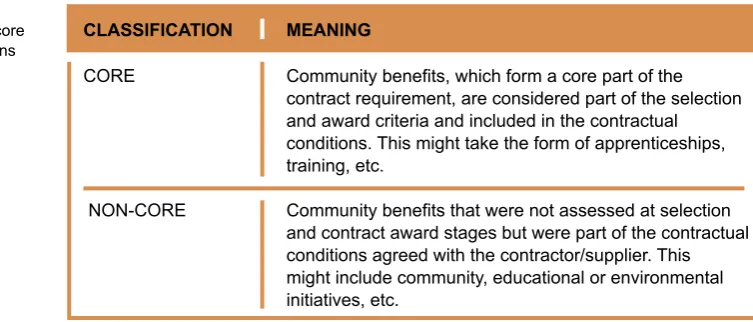
Utilizing a communitybenefits tool in support
of the local multiplier effect for sustainable procurement innovation
By Jane Lynch
/ Helen Walker
Engaging procurement stakeholders in the development and humanitarian sectors is critical to unlocking innovation for development.
Photo: Albert Gonzalez Farran, UNAMID
Raj Kumar is the founding President and Editor-in-Chief of Devex, a social enterprise that connects and informs 500,000 aid workers and development professionals on Devex.com. Mr Kumar has been profiled in the Financial Times, Foreign Policy, Forbes and The Washington Post, where Devex was called the “Bloomberg of foreign aid.” He has been a part of nine presidential campaigns on four continents as political director of the political strategy firm Penn Schoen Berland and got his start as a member of the national advance team for former United States President Bill Clinton. Kumar speaks English and Spanish, has worked, studied, and traveled in over 50 countries, and is a member of the Council on Foreign Relations and the Clinton Global Initiative.
Lead article
To unlock
innovation,
procurement
is key
There are few topics in global
development that generate the excitement and optimism of innovation. After decades of effort and trillions of dollars in development aid, enormous challenges remain. So innovation— the idea that a new idea can go around, cut through, or hop over traditional barriers to development—is enchanting. We all want a short-cut to improving lives, and, when we can see so much innovation around us in our daily lives, we rightly begin to demand it for global development too.
Further fueling this demand, there are many successful illustrations of innovation in global development, from whiz-bang gadgetry like
cell-phones that can conduct blood tests to less buzz-worthy process innovations that cut down on paperwork and make, for example, tax collection more effective.
It is in the area of procurement that real scale resides; the nuts-and-bolts of procurement— both that of aid agencies and of national and local governments—is where the enormous opportunity for innovation remains constrained. And the challenge comes down to the basics of procurement: Is innovation required from bidders? Is it encouraged and rewarded? Is it measured and is success shared?
And this is where things get difficult. Procurement in the development context is tough. It is often conducted in fragile situations where there is limited capacity among both government and private sector actors and where the focus tends to be on avoiding the negative financial leakage or unsuccessful projects, rather than on doing something more like fostering innovation. So to request governments and implementing agencies to add an additional step to their procurement process is asking a lot.
But it can be done, particularly if the development community works together to change the mindset around innovation from novel ideas to better results achieved faster and cheaper. That’s the kind of language that procurement officials understand and it is, after all, the real goal of innovation in global development. With limited budgets, can you educate more children, reduce malaria infections, increase yields for more farmers, and the like? If you can, and particularly if you can do it with a step change rather than incrementally, your bid should be considered innovative. It shouldn’t matter if you educate those children with a tablet computer or a chalkboard—what we ought to incentivize now, as always when it comes to procurement, is results.
Doing so may require some tangible steps. One is using the procurement process to
Innovation in procurement can include finding ways to support local suppliers, such as this embroiderer in Cyprus. Photo: UNDP/Kerim Belet
focus on broad goals rather that prescribing a specific approach to a project. This is particularly important when it comes to technology procurement where the market often moves faster than procurement officials can keep up. By not buying a specific
product but rather a solution, we can create an opportunity for new ideas to be put forward successfully that aid agencies and governments may not have been aware of at all just months earlier.
And we need to be clearer about what we mean by innovation. As a buzzword, it can encourage procurement that includes exciting new technology or gadgets at the expense of proved approaches. That should not be our goal. Instead, most innovation in the development sector should be focused on process improvements that make development interventions cheaper and more efficient, such as building more modern and effective government systems. During a recent Devex initiative focused on innovation in global health, a key takeaway was that development agencies would do more good by focusing on strengthening health systems rather than trying to introduce new health technologies to the market.
That leads to another tangible step: using procurement to foster a market for the commercial introduction of new products and technologies. An approach that lets demand—particularly local demand—take precedence is much more likely to succeed in the long-run than designing innovative solutions in Washington, DC, Paris, or Tokyo and then seeking to export them to developing countries. So, innovative procurement
should entail setting high standards for cost-effectiveness and allowing the local market to respond with their own solutions, some of which may be decidedly low-tech.
Finally, for procurement to foster innovation we must consider how best to incentivize innovation. Often innovative solutions may require investment and risk, hence the many challenge grants and pilot programmes that aid agencies have launched to help support innovators and entrepreneurs with early-stage ideas. Social finance can help with the other side of the coin—not just reducing risk but incentivizing innovators to be a part of the procurement process in the development sector at scale. If a project can achieve its results faster and cheaper than ever before, allowing the implementers to share financially in that success is one important way to foster a market that incentivizes innovation. There are many challenges in doing so, but that shouldn’t cause us to walk away from these opportunities.
At Devex, our reporters, editors, and analysts focus a lot on innovation. Much of our reporting on innovation in global development does take the form of the latest technology—after all, we are all excited by new tools to address poverty, as we should be. But we also understand that the old adage of ‘follow the money’ applies here as elsewhere: of the approximately $200 billion spent annually by agencies, NGOs, and corporations on global development, most is funneled through procurement systems. Pilot projects, grants, and contests are important and have their place, but it’s time for the billions of dollars that flow through procurement systems to be used to help bring innovative approaches to ending global poverty to scale.
Lead article
Why does good procurement
practice matter?
Good procurement practices are directly linked to efficiency, effectiveness, transparency and accountability, which are all good governance indicators. Good governance in procurement brings immediate benefits in terms of money savings or improved quality of the goods, works or services procured. Unfortunately, procurement at all levels is often prone to errors and to deliberate abuse by officials, contractors, and suppliers for personal gain. In addition, problems in procurement can lead to delays in implementation and poor results, and can ultimately undermine the trust of the local community in
government processes. In turn, establishing and demonstrating the benefits of good
procurement practices improves administrative capacities and the understanding of the
essential building blocks of good governance.
The United Nations Capital Development Fund (UNCDF) Local Development Finance Practice (LDFP) supports programmes in least developed countries aimed at reducing poverty through sustainable, inclusive and equitable local
development. LDFP does this through innovation and testing of various aspects within public and private financial systems that mobilize, allocate and invest additional resources and promote transparency and accountability in their use. To this end, the promotion of good procurement practices is essential, in order to address corruption by increasing stakeholders’ capacities and awareness, and in embedding best practices in daily operations.
In 2013, UNCDF published a best practice guide for local government procurement in least developed countries. The guide is not specific to UNCDF, nor are its recommendations mandatory for UNCDF-supported or financed programmes.
Rather, the guide is intended to pass on the experience gained from UNCDF involvement in local procurement in least developed countries and to assist officials and advisers engaged in designing procurement procedures for local administrations to identify the most appropriate procedures according to the local circumstances. This article highlights a number of best practices and innovative activities used in our programmes.
Establishing appropriate local
procurement regulations
Local officials and local development programme staff commonly regard
procurement as problematic. Its rules are seen as complex and obscure, and even where staff, officials, contractors and suppliers are familiar with the steps of the procurement process, they may not understand the purpose of some important steps. Procurement rules exist for a reason—most generally, to ensure best value in return for expenditure of public money. When programme staff, officials, and contractors understand how a rule increases value for money, they are less likely to see the rule as complicated or burdensome.
Experience shows that complaints from government officials, contractors and communities in relation to public
Innovation in local procurement
in least developed countries
procurement processes often is the result of misunderstanding the purpose of procurement rules or a failure to correctly follow procedures that can be easily mitigated. However, the real problems arise from the use of procurement rules that are inappropriate to the situation.
Local development programmes supported by UNCDF may apply national regulations if suited, but more often than not our programmes provide technical support to develop and test local procurement regulations, based on international best practices and an adaptation of national procurement frameworks to local contexts and needs. The starting point for these types of interventions is that the rigor and complexity of a procurement process should be in proportion to the size and complexity of the investment. It also assumes that with targeted capacity development support and an appropriate
regulatory framework for local level procurement, the results will include improved value for money and better local governance outcomes.
Procuring the right item
Although appropriate regulatory frameworks for local procurement are in place, these
do not automatically translate into good procurement results in terms of deliverables. Good procurement practice starts with a clear definition of the desired product.
One of the largest challenges identified at the local level is the lack of sufficient technical expertise to develop the much needed specifications, design and costing of infrastructure projects, in addition to preparing clearly formulated bids. This often becomes a bottleneck in the overall process of infrastructure development and one of the key causes of poor results.
With this background, UNCDF LDFP has developed innovative capacity development initiatives and provided technical support to local administration staff in procurement preparations and processes, including technical design and costing. This has included the design of generic templates for specifications and costing in accordance with overall government standards, market surveys of material costs, capacity development modules for local engineers and training modules in overall local level procurement preparations and processes.
Our programmes have not only supported more effective and efficient procurement processes, but have also contributed to overall improved efficiency in local government
spending of local and central government funds and/or direct aid contributions from our development partners.
Community contracting and
community participation in local
procurement
Community contracting is a term used to refer to different modes of community involvement in scheme implementation. It may be used in the sense that the community group acts as a contractor, or engages local contractors to implement works, even in such situations where no defined ‘contract’ is involved.
Community contracting, in the context
supported by UNCDF, is defined as a mode of local government procurement within a local procurement process. Therefore, the scheme is implemented under an official government contract between the local government as buyer and an organization or committee (the community contractor) representing the beneficiary. The community contractor is not selected through competitive procurement, as there should only be one organization or committee that can represent the beneficiary community, and is directly involved in
implementing (not just monitoring) the scheme. Under this contract modality, the community
contractor receives funds from the buyer and implements the scheme via a mixture of voluntary labour contributions, paid labour, sub-contracting to local tradesmen and petty contractors, and purchase of materials.
Community contracting arrangements increase community ownership and capacity. However, quality of implementation of community contracting can vary, and competitive bidding should often be the preferred modality. If the beneficiary community is clearly identified, technical skills can be found locally, it is a small scale intervention that is not technically complex and the ruling procurement
regulations allow for such type of contracting, community contracting may be the right
choice. In these cases, UNCDF has supported the development of an official community contracting modality as part of the official procurement regime.
Learning from our programmes, support to local administrations to improve their capacities in terms of technical support and oversight of community-led implementation of infrastructure contracts is imperative for a successful result. This is needed in order to make up for the lack of financial, administrative or technical capacity on the part of the community contractor, and to ensure that the project gets implemented as per the specifications. Depending on the circumstances, effective support may be very challenging, however, long-term investments in
developing the capacity of local administrations to manage community contracting modalities have been shown to be more sustainable than direct support to the community groups themselves during the implementation of individual contracts.
Developing private sector capacities
One of the major difficulties faced by local governments in implementing development projects is a lack of capacity within the local small- and medium-scale contracting sector. In other words, a lack of technical capacity, skilled staff and appropriate equipment can be a problem. Local contractors often lack formal education and have a limited understanding of procurement, contract administration procedures and health, safety and environmental regulations that may be required in order to undertake public sector work. The resulting problems for the local government include:
• a high proportion of bids are found to be ineligible because of errors in bid preparation (see box)
• bidders submit unrealistically low bid prices or otherwise take on obligations that they will be unable to fulfill
• competition is restricted to a few higher capacity firms, resulting in high prices
• local contractors are shut out in favour of large, city-based firms
• the quality of completed work is low because of errors or misunderstandings by the contractor
Hence, even if small local firms have the technical capacity to implement the required types of investments, they often lack the administrative capacity and are unfamiliar with the lengthy formal bidding procedures. These firms may be deterred from bidding due to the complexity of the system, may be unable to meet stringent registration and qualification requirements, or may find the cost of submitting a bid too high.
For a local procurement process and overall outsourcing of government services to be successful, the supply from the private sector needs to match the offer. If a procurement
process, no matter how well prepared and procedurally correct, fails to attract technically and financially sound bid submissions from local firms, the overall procurement process will not be successful.
Thus, not only does the capacity of local administrations to manage local procurement processes need to be improved, but technical support should also be provided to contractors to improve their responsiveness to government bids and contracts. Through capacity
development of the local private sector, the local government aims to achieve better value-for-money and lower risk in procurement, as well as create wider benefits for the local economy.
Our experience has shown that support of both local administration and private sector suppliers in parallel, with the view to develop the overall capacity of both sides, results in more satisfactory procurement processes and outcomes. In addition, a good relationship between the local administrations and contractors can lead to innovative local solutions to problems that may occur along the way. If the relationship is good and the local firm feels fully involved in the process, it may also take on greater responsibility during contract implementation. The pressure from the community is higher on local contractors to do a good job, or at least do the job they were hired for, compared to nationally procured contractors for infrastructure development, since these will seldom feel the same sense of social responsibility.
A standard model for good local
procurement practice?
This paper has highlighted a few areas of innovative activities that UNCDF has focused on in our programmes to address the issues related to locally procured and implemented infrastructure schemes: technical support to improve the regulatory framework for local procurement; capacity development support to the local administration in areas of technical design and costing; bid preparations and management of local procurement
processes; support to local administrations in implementing community contracting modalities; and capacity development support
to local contractors and suppliers to improve their responsiveness to public bids.
Our 2013 best practice guide describes these areas and many others in more detail, proposing a set of principles as a foundation for developing procurement guidelines for local administrations in least developed countries. Procurement based on these principles should achieve the value-for-money objective while also enhancing local governance, local economic development and the capacity of local communities.
Julian Abrams is an independent consultant to UNCDF and other agencies. Mr Abrams has worked on local planning, procurement and infrastructure development in countries throughout the Asia-Pacific region and in Africa. He has been based in Cambodia since 1992, initially working on rural infrastructure development. From 1997 to 2006 he helped develop the implementation framework for the Commune Fund system of grants to local administrations in the country.
Find out more at: http://bit.ly/engenabrams
Jill Engen joined the United Nations system in 2000 and is currently a regional technical advisor with the UNCDF Asia-Pacific office. She has held various positions ranging from local development officer in UN Peacekeeping, government advisor on decentralization and local government and regional technical advisor on local development finance. She is an inter-disciplinary specialist with more than 15 years of field and policy experience in the Asia-Pacific region.
The Procurement
Innovation Challenge
By Norma Garza
A farmer speaks on his mobile telephone while at work in Bihar, India. Poor availability of and access to information contributes to inefficient procurement and supply chain systems. The Procurement Innovation Challenge looked at ways in which ICT can improve performance of procurement systems. Photo: M. DeFreese/CIMMYT
The World Bank Institute Open Government Practice (WBIOG) provides cutting-edge knowledge and capacity development opportunities to practitioners in the public and private sectors and civil society in developing countries. This work focuses on some of the most challenging areas of governance reform, including procurement—areas where success could have transformational impacts on the lives of the poor.
Public procurement is an essential government function that can provide a means for socio-economic development and some measure of social equity, particularly in fragile situations. In developing countries, service delivery is important in alleviating poverty, enhancing
the government’s credibility, and acting as the primary means by which goods and services are provided to constituents. High-performing and transparent procurement systems are fundamental to guaranteeing cost-effective delivery of goods and services, particularly for the poor, and for helping ensure equitable and sustainable development.
A common challenge for many organizations is promoting the documentation and sharing of experiences for further learning. Efforts offering powerful insights into the drivers of reform are frequently not documented because practitioners lack the tools, incentives,
opportunity for peer-to-peer connections around that knowledge is limited. To address this and similar challenges, the WBIOG procurement programme seeks to adopt novel approaches to identify experiences, knowledge and good practices. With this in mind, the Procurement Innovation Challenge, also known as the Challenge, was designed.
An innovative crowdsourcing
mechanism
The Challenge was designed as a mechanism to identify and present evidence of innovative approaches, processes, initiatives, policies or tools that have led to effective procurement reforms or better performing procurement systems. At the same time, this innovative crowdsourcing mechanism successfully helped build and strengthen a nascent community of practice on procurement and open contracting.
The Challenge was a collaborative process from design to implementation, involving partners such as the United Nations
Procurement Capacity Development Centre, the University of Nottingham, the German development agency GIZ and Integrity Action. Investing in the design phase of this knowledge competition was critical for its success.
Practitioners from around the world and across various sectors shared their experiences of innovation in procurement reform processes undertaken in diverse settings, including fragile and conflict-affected countries and small states. This helped build a knowledge platform for innovative approaches. Between 1 February and 31 March 2012, institutions, organizations, companies and individuals from the public and private sectors and civil society around the world were invited to submit a short case story. Stories were submitted using an online form that had a set of questions, each to be answered with a word limit. Within
the broader theme of innovative approaches to procurement reform, case stories were submitted under at least one of the four priority thematic areas:
• Contract monitoring to enhance accountability and effectiveness of public contracts
• Use of ICT to improve performance of procurement systems
• Procurement reform in fragile and conflict-affected countries and small states
• Managing procurement systems for enhanced performance
After the two-month submission period, more than 60 case stories representing experiences from 72 countries were shared. All eligible case stories were reviewed by a group of evaluators who helped identify the Challenge’s top 15 stories. From these stories, the top five participated in the Open Contracting Conference in Johannesburg in October 2012, where they presented their experiences to the broader open contracting community. The case stories allowed participants to share practical experiences and exchange knowledge on best practices, lessons learned and efforts to overcome challenges to procurement reform. The Challenge process helped bring many creative and effective experiences in procurement innovation from around the world to light on a global scale.
The final stage of the Challenge process involved the development of its publication. The Challenge showcased the top 15 stories, informing readers in practical way and serving as a tool to bring visibility and recognition to the authors’ work, while promoting further knowledge-sharing and learning around findings. The development of the publication itself was also collaborative, as case story authors were supported to further develop their
Challenge launch Feb 1, 2012
Deadline for case stories Mar 31, 2012
Evaluation begins Apr 3, 2012
Evaluation ends Apr 13, 2012
initial submissions, while maintaining a format that was engaging and accessible to a broad audience. The publication is available in print and online and has been distributed broadly. It is used as a tool for learning and continued discussion on how increased openness and transparency can contribute to effectiveness in procurement.
The Challenge process sparked further collaboration and contributed towards strengthening a community of practitioners working around these issues. It specifically helped build the Open Contracting
Community of Practice (http://bit.ly/ OpenContractingCommunity).
Lessons from the Challenge
approach
The Challenge helped enhance the
understanding of its partners, procurement professionals and reformers to develop or improve public procurement systems. Serving
as an opportunity to initiate a deeper dialogue and process of shared learning, it also became a catalyst for peer-to-peer networking around this issue and helped identify future activities and opportunities for collaboration. It proved to be a useful tool for promoting further knowledge-sharing and learning. Overall, competitions and challenges are effective crowdsourcing mechanisms and do contribute to building a community, as was the case with the open contracting community.
For knowledge competitions such as the Challenge, submissions of no more than 1,000 words provide the optimal amount of information required for delving into a topic. The key is to invest time in thinking of the right questions to guide the case story’s development. Incentives to participate are important to the success of such
competitions. Even when prizes are limited, providing opportunities for greater visibility and recognition of the authors and their
experiences, both during and after knowledge competitions, is essential to encouraging participation.
Ongoing engagement throughout the different stages of the Challenge was very important. This required the use of traditional and more modern communication methods such as social media. It was important to consider that language could be a barrier for participation during the design of the competition, the outreach strategy and the measurement of its success.
Partnerships and rich collaborative processes were just as important for the Challenge process. These elements proved to be crucial for greater buy in, championing of the initiative, helping with outreach and generating enthusiasm to participate. They enabled partners and networks to not only shape the issues the Challenge would explore, but also to help with the review process, the identification of top stories, and the
engagement of practitioners to participate and share their stories. This collaborative effort made it easier to disseminate the findings, not only around the experiences, but also about the Challenge process itself. The success
of the original Challenge approach led to a second competition in 2013, which focused on procurement for complex situations. A new publication is currently on its way and will also feature the 2013 Challenge’s top stories.
Transparency: the foundation-
stone of strong procurement
Transparency underpins all the stories and lessons from the Challenge. If systems are transparent, corruption or inefficiency cannot hide within them, meaning innovation in procurement should always be made with increased transparency. Other findings from the case stories included the importance of: embracing ICT; securing stakeholder buy in from the start; good procurement as a ripple effect; and innovation. As the winning entry from Nigeria shows, if you can challenge a culture of secrecy around procurement, train people in open contract monitoring and make their findings widely accessible, you can introduce transparency to situations where it has never previously existed. If greater transparency is achieved, social justice and value for money will follow, both for
organizations and the people and communities they serve.
Norma Garzaleads knowledge and learning for the Open Contracting and Governance for Extractive Industries programmes at the World Bank’s Governance Global Practice, formerly the World Bank Institute Open Government Practice. Since 2011, she has provided knowledge management and strategic support, including managing two communities of practice: GOXI and Open Contracting. Norma specializes in designing innovative mechanisms that facilitate knowledge exchange, such as online competitions, apprenticeship programmes to build civil
society’s capacity to use social media, and online tools to collaborate, communicate and advocate more effectively. Before joining the World Bank, she served as Member Services Coordinator at Impact Alliance, managing the network for five years. She has worked for non-profits such as Pact and as advisor to Mexican Congressman Diódoro Carrasco. Norma is a certified knowledge manager and majored in international relations from Universidad Iberoamericana in her home city of Mexico City.
Why create a European platform for
the procurement of innovation?
Public procurement has the power to foster innovation and use it to better address the needs and challenges of public services. Public procurement of goods and services accounts for 19 percent of Europe’s GDP, which is more than €2.3 trillion per year—this is major potential to be harnessed.
Innovation is a key driver for business competitiveness and job creation in Europe, and the procurement of innovative goods and services is growing in importance.
However, ambiguity exists among public sector procurers on how to incorporate innovation in procurement practice and how to successfully
connect it to sustainability goals. Many procurers are disconcerted by the unknown elements surrounding the process, such as managing risk, dealing with intellectual property and measuring success.
A tool was needed to reduce this knowledge gap by providing information and exchange on the subject. To address these challenges, Local Governments for Sustainability, the European branch of ICLEI, developed the Procurement of Innovation Platform funded by the European Commission, in partnership with the Dutch Public Procurement Expertise Centre (PIANOo), the Regional Environmental Center for Central and Eastern Europe (REC) and the Flemish agency for Innovation by Science and Technology (IWT).
A European platform for the
procurement of innovation
By Marlene Grauer
(on behalf of the Procurement of Innovation Platform Consortium)
What is the Procurement of
Innovation Platform?
The Procurement of Innovation Platform is a new online hub that helps public authorities, procurers, policy makers, researchers and other stakeholders harness the power of public procurement of innovation (PPI) and pre-commercial procurement (PCP). Custom-made to meet users’ needs, the platform is comprised of three elements: a website, Procurement Forum, and Resource Centre.
The website
(https://www.innovation-procurement.org/) is the first port of call for all things PPI- and PCP-related. It contains the latest news on PPI and PCP developments and events, as well as background information on the European legal framework, policy support, and more.
The Procurement Forum is a specially designed networking tool with currently over 1,600 members. It is a space for procurers and related stakeholders from around Europe to discuss, share and connect, allowing them to post comments and upload documents, images or videos. Users can also create private groups, which are ideal for developing and coordinating projects involving numerous partners.
When it comes to knowledge, the Resource Centre provides a centralized database for PPI guidance, gathering useful documents in one place. The Resource Centre makes over 600 resources available, including national and European policy and strategy documents, tools, good practice case studies, details of projects and initiatives, as well as reports and valuable links on innovation and procurement. Members of the Procurement Forum can also upload their documents and promote their work.
Which products does the
Procurement of Innovation Platform
offer?
Guidance
In an effort to boost knowledge on the topic, the Procurement of Innovation Platform project has developed ‘Guidance for Public Authorities on Public Procurement Innovation’, providing practical advice for procurers.
Authored by Abby Semple, a leading expert in procurement law, the guide is ideal for both beginners and those looking to improve their innovation procurement activities. It offers detailed information, such as explanations of procedures, definitions and answers to common questions, a selection of real-life examples and useful resources for further reading. It is written for policy makers, consultants, private companies and others who have a stake in successful innovation procurement. The guide also examines the challenges and barriers that hamper innovation procurement in Europe, as well as the new European Union procurement directives, with a particular emphasis on how the legislation will be used to better facilitate innovation procurement. Procedures and policies are outlined in a digestible manner.
Furthermore, the guide contains a series of case studies, such as the City of Ghent's procurement of probiotic cleaning products, which possess a level of ‘good’ bacteria for human health, or Rawicz County Hospital in western Poland's purchasing of innovative bio-based fibre uniforms for staff.
In addition, the Procurement of Innovation Platform Consortium aims to produce two additional guidelines on intellectual property rights and risk management.
All documents are generated with input from international procurement experts. The publications provide specific guidance for public authorities and facilitate the preparation and implementation of public procurement of innovative goods and services. The PPI guide and draft versions of the other publications can already be found online.
Innovation procurement in action:
case studies
infrastructure. Another highlights the joint procurement of four boats capable of fighting fire outbreaks along the Rhine river by German administrations in Baden-Württemberg,
Rhineland-Pfalz and Hesse.
Exchange, training and the PPI
award
Going beyond online resources, a number of activities within the Procurement of Innovation Platform aim to help members move from acquiring the theory behind innovation procurement to practice, thus contributing to raising awareness of the topic amongst public authorities.
The Experience Exchange Programme has the goal of spreading knowledge and know-how on innovation procurement between advanced public procurers and public authorities trying to expand their horizon on this issue.
It allows procurers from different public authorities to travel to a number of host
organizations leading the way in procurement of innovation and learn from their experiences. Host organizations that are currently available are:
• Réseau des acheteurs hospitaliers d’Ile de France, Paris, France
• City of Torino, Italy
• City of Birmingham, United Kingdom
• Sucha Beskidzka Hospital, Poland
The Procurement of Innovation Platform team also organizes a number of one-day training seminars on the topic. The training takes place across Europe, free of charge, and provides participants with both a theoretical framework and more practical knowledge for implementing innovation procurement. The training package is specifically tailored to meet
different needs, and is suitable for practitioners both in the beginner and advanced levels. The latest innovation procurement support tools are introduced and discussed, and specific aspects of innovation and procurement, such as criteria setting or pre-procurement aspects, are explored. Specially developed materials are also provided and experts are on hand to give advice.
The biennial Public Procurement of Innovation Award recognizes successful public
procurement practices that have been used to purchase innovative, more effective and efficient products or services. Winners receive widespread promotion. The award is open to applicants from national, regional and local public authorities within Europe.
Join the platform and the movement
The Procurement of Innovation Platform is a stepping stone for public authorities to engage in innovation procurement. Its hub function allows public authorities to create the necessary network with other experienced and interested authorities, share best practices, learn from one another and gather the expertise to put innovation procurement into practice. With more than 1,500 members and over 600 resources, the platform is a crucial factor in advancing innovation procurement at the European level.
The Procurement of Innovation Platform project is supported by the European
Commission through the CIP-EIP programme. CIP-EIP is the part of the European
Commission's Competitiveness and Innovation Framework Programme (CIP) dedicated to the Entrepreneurship and Innovation Programme (EIP).
Marlene Grauer is a Sustainable Economy and Procurement Officer at ICLEI—Local Governments for Sustainability. She currently supports several European projects on sustainable public procurement, public procurement of innovation and pre-commercial procurement as well as the development of the monthly European Commission Green Public Procurement News Alert. She also carries out training activities on sustainable public procurement for local authorities. Before joining ICLEI, Marlene worked with local authorities in Latin America as a consultant for the German Agency for International Development (GIZ).
Procurement innovation has largely focused on fostering market competitiveness and sustainability, for the most part reserved to a select few organizations whose buying power is sufficient to cause sector-wide changes. However, procurement innovation exists in many other areas starting at the policy level, going through to internal processes and capabilities, and ending at the supplier interface. Innovating at the different levels can help to advance sustainability from within, while strengthening the organization’s in-house capabilities—a principle we have chosen to adopt at the United Nations Office of Project Services (UNOPS) with our revised Procurement Manual and training strategy.
The performance of the procurement function is and will continue to be an important topic for both public and private organizations. While there are no magic formulas to decipher efficiency, risk management, or return on investment, a few points remain consistent both in practice and in the academic literature: individual capabilities and organizational design are critical factors in assessing and enhancing procurement team performance. However, performance is not about results-based compliance to rules and procedures, but rather the output from using those processes as tools for making the best decisions in each context. This explains our investment in developing the individual capabilities of our procurement community and empowering these individuals to innovate.
Capabilities can be defined as the skills and know-how that reside within the organization’s
members and routines. These are brought into organizations through individuals’ respective educational backgrounds and professional experiences. These capabilities live in the processes and routines of organizations, and grow and expand informally through the interaction of individuals in daily life, and formally through training and education.
Organizational design refers not only to the allocation of resources and capabilities, but also to the types of processes and policies that regulate the procurement process. As such, capabilities and policies are tightly embedded in the question of how we set up structures so that our procurement officers can contribute innovatively to the organization’s performance.
At UNOPS we have recently launched a revised version of the Procurement Manual, a document borne from an extensive
collaborative process with our field
personnel and the exchange of best practice with other international agencies for the harmonization of the content. The result of this consultative exercise is a manual that serves as a repository of procurement policies at UNOPS, formalizing the organization’s agreed procurement procedures. In itself, it is the foundation of the capabilities of the procurement community within the organization.
Policy goes beyond a set of rules and principles, and is rather the description of a standardized set of processes and routines that have embedded in them the organization’s know-how, expertise and skill set. In light
Procurement policies
and training
Two powerful tools to foster innovation
in the procurement practice
of this, the Procurement Manual is to be used as a companion to assist procurement officials in fulfilling UNOPS mandate. For this purpose, the new policy has been designed with a degree of flexibility that
empowers procurement officials to rely on their experience and knowledge of the market, and to apply discretion during different steps of the procurement process.
On the policy level, complemented by practical enablers, sustainability comprises the DNA of the new manual. While not yet mandatory in every step of the procurement process, sustainable procurement is promoted as UNOPS first choice wherever feasible. This
is complemented with a set of sustainable procurement training modules to empower procurement officials to integrate sustainability as they see fit in their own environments and market conditions.
On a more operational level, the minimum bidding time has been reduced and a more detailed division of duties has been put in place to enable more decisions to be taken in the field, without compromising transparency and fairness in the process. We have
revised and increased the threshold of the shopping procedure for greater efficiency and autonomy. For long-term agreements, the price adjustment threshold and contract
As a central procurement resource in the UN system, UNOPS provides training that helps partners advance innovation in procurement. In Honduras, UNOPS provided in-depth procurement training as part of support to water, sanitation and hygiene projects in small cities and schools, funded by the Swiss Agency for Development and Cooperation.
requirements have been revised to make it easier for procurement officials to use discretion while meeting the policies.
To complement the revised policies of the Procurement Manual, our training aims to strengthen the capabilities within the procurement function and to enhance and harmonize the understanding of the manual’s contents among the members of our procurement community. Reaching out to all of our widespread procurement officials is a challenge, as UNOPS is an organization that operates internationally, often rendering its services to its partners in remote locations.
This geographic spread brings with it a large diversity of procurement profiles and responsibilities. Keep in mind that we procure globally for very specific needs in political contexts that are frequently changing and rapidly evolving. This work is done on behalf of partners or for ourselves. Often the procurement exercises we conduct may only ever occur once in the history of UNOPS. Therefore the capabilities of our procurement officials must reflect the astute implementation of our policies and adherence to our procurement principles (i.e. fairness and integrity, best value for money, effective competition, and best interest for UNOPS and its partners) in fast changing environments, catering to a large and ever growing spectrum of needs.
The benefits and impact of training on procurement teams is well documented as a contributing factor to world-class procurement practices and the establishment of an adaptive and learning organization. This results often in innovation, not just in terms of products and services, but largely in internal processes that optimize the way in which we research the market, select suppliers, negotiate, finance purchases, develop supplier relations, deal with issues, and improve our planning and contracting cycles. Therefore, promoting the capabilities required for operating in the organizational context of UNOPS provides a great opportunity to innovate and instil international best practice procurement standards into the way procurement is practiced at UNOPS.
Ultimately, the combination of having a robust policy in place and developing capability
through training enables procurement officials to be the drivers of all the steps in the procurement process. As such, they are the stewards of quality in the organization: quality of the goods, services and works procured; quality in terms of the results obtained; but also the quality of the needs assessments and the sourcing and bidding processes. This ensures that we, as an organization, get the best from the market so we can satisfy the needs of our partners and fulfil our mandate.
Rolando Tomasini is currently a Training Specialist at UNOPS Sustainable Procurement Practice Group. Prior to joining UNOPS, he held different procurement positions in the private sector, including as a supplier relationship manager and consultant for the design and implementation of global corporate procurement academies for several leading multinationals. He is the author of several award-winning case studies, articles, chapters and books on humanitarian logistics and corporate social responsibility, based on numerous secondments and consulting projects with different United Nations agencies during his PhD studies. Over the past decade, he has lectured at INSEAD, Copenhagen Business School, Hanken, and various corporate universities around the world, attaining the Skinner Award for Teaching Innovation from the Production and Operations Management Society.
Public procurement is the main sourcing instrument used by public agencies to
secure the delivery of public services. Public procurement can also be perceived as a secondary policy instrument rendering different kinds of innovation. One generic notion
capturing such effects is public procurement of innovation understood as purchasing activities carried out by public agencies that lead to innovation.
This definition includes not only the technical process of tendering but also preparation activities taking place in the pre-procurement process as well as activities leading to the uptake and diffusion of the procured item. It also acknowledges that innovation can occur unintended, and can lead to different innovation effects: initiation, escalation,
consolidation and destruction. It may also take place with the aim of satisfying an intrinsic need, in cooperation with others, rendering catalytic effects on behalf of other actors, and sometimes in more distributed forms where the role of the procurer is mainly to expose a public opportunity for innovative suppliers.
The idea that public procurement can be used as a means to stimulate innovation is currently discussed in many parts of the world. Evidence also suggests that public procurement can play a significant role in stimulating innovation. In the past, public agencies in the United States promoted the initial development of the computer, civilian aircraft and semiconductor industries. Drawing on innovation surveys and patent data from Canada, the importance of the public sector as a first user of
Public procurement and
innovation: some initial assertions
By Max Rolfstam
innovation has been established. More recent quantitative studies drawing on German data have compared different innovation effects, suggesting public procurement and university spillovers can be more important than other measures such as regulation and public funding of innovation projects. Similar results have been found by drawing on data collected from European Union (EU) member states as well as Norway and Switzerland. Leading experts have found that the biggest impact is achieved with policies considering the simultaneous application of research and development subsidies and public procurement. There is also a range of case studies reporting on how public procurement has helped to stimulate innovation.
The idea of using public procurement as a way of implementing secondary policies is not new. The underlying driver for the current interest in public procurement of innovation stems from the perceived bias towards supply-side instruments, seen for instance in the European context. Supply-side measures such as research and development subsidies or tax exemptions have historically been the central
policy tools applied by governments, while demand-side innovation policy instruments, such as public procurement have been relatively neglected. The EU has concluded that the main area of neglect in recent years in research and development and innovation policy spheres has been demand-side policies. It has been argued that within the EU, policy makers should take into account both blades of the scissors of demand and supply.
The need for increased attention on the demand side has also been emphasized by the Organisation for Economic Co-operation and Development (OECD). A recent study of the development of public procurement of innovation policy by Lember, Kattel and Kalvet, which analyzed 11 countries around the world, further corroborates this general picture. The researchers state: “The prevailing supply-sidedness in innovation policy-making (instruments such as R&D grants or tax reductions) has simply left the demand-side unnoticed in many countries for a long time.”1
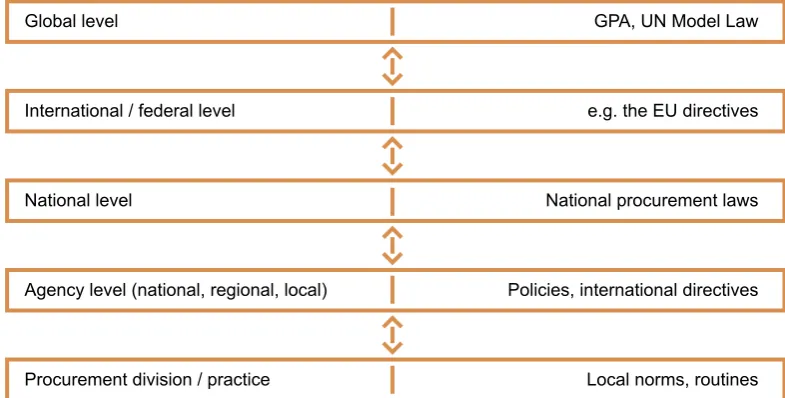
From a global perspective, one must however keep in mind that there is a variation among Global level
International / federal level
National level
Agency level (national, regional, local)
Procurement division / practice
GPA, UN Model Law
e.g. the EU directives
National procurement laws
Policies, international directives
[image:26.595.108.501.64.263.2]Local norms, routines Figure 1. Different institutional levels useful for understanding public procurement of innovation
1Lember V., Kattel, R. and Kalvet, T. (2014). How Governments Support Innovation Through Public Procurement: Comparing
Evidence from 11 Countries. In Lember V., Kattel, R. and Kalvet, T. (Eds). Public procurement for innovation policy: International perspectives. Springer Heidelberg, New York, Dordrecht, London, p. 298
2Mourão, V. and Cantu, R. (2014). Public Procurement and Innovation in Brazil: A Changing Course of Public Procurement
Policy? In Lember V., Kattel, R. and Kalvet, T. (Eds). Public procurement for innovation policy: International perspectives. Springer Heidelberg, New York, Dordrecht, London.
3Li, Y. (2013). Public procurement as a demand-side innovation policy in China. PhD thesis. University of Manchester, UK. Article
the specific circumstances in which public procurement of innovation might occur. Developments and challenges encountered in Brazil2
are not the same as in Denmark or China3
. To fully understand a specific circumstance requires a multilevel institutional analysis, taking into account laws, policies, traditions, norms and routines ranging from global to local in the specific context. The global level includes institutional elements such as the Agreement on Government Procurement (GPA) of the World Trade Organization (WTO) and the United Nations Commission on International Trade Law (UNCITRAL) model law.
On the international/federal level, we find economic regions, such as the EU, that may affect underlying levels through policies and/ or regulation. On the state/country level, country-specific laws and policies evolve where public procurement may or may not be regulated and/or is targeted by innovation policy. Within a country, particular agencies may to develop policies, practices and routines which to varying degrees affect the likelihood of public procurement of innovation. At the local level, within procurement departments
and/or among practitioners, executing public procurement also reveals the norms, attitudes and conditions which affect the extent to which public procurement of innovation occurs (see Table 1).
An interest in public procurement of innovation policy implementation may render debates that concern different levels and perspectives. The fundamental idea that the public sector can act as an important market player may be perceived as contrasting to perspectives based on neo-liberal ideas, which makes the current policy interest somewhat of a paradigm shift as compared to policy thinking in the past.
To adapt to these new policies may require institutional change in local contexts, which for a long time have evolved according to efficiency rationalities. It may also induce a discussion regarding the tension between discrimination and competition, and the extent to which public procurement of innovation policies should promote innovation among domestic and/or local firms or promote the sourcing of the most universally innovative solutions. Another concern is the extent to which exogenous demand-side policies can Expertise on public procurement procedures
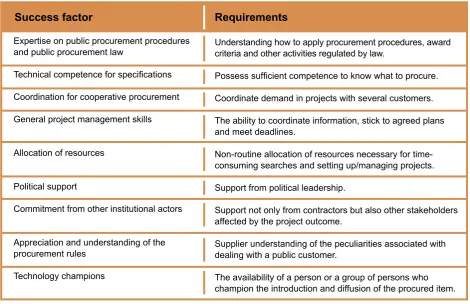
and public procurement law
Technical competence for specifications
Coordination for cooperative procurement
General project management skills
Allocation of resources
Political support
Commitment from other institutional actors
Appreciation and understanding of the procurement rules
Technology champions Success factor
Understanding how to apply procurement procedures, award criteria and other activities regulated by law.
Possess sufficient competence to know what to procure.
Coordinate demand in projects with several customers.
The ability to coordinate information, stick to agreed plans and meet deadlines.
Non-routine allocation of resources necessary for time-consuming searches and setting up/managing projects.
Support from political leadership.
Support not only from contractors but also other stakeholders affected by the project outcome.
Supplier understanding of the peculiarities associated with dealing with a public customer.
[image:27.595.56.527.71.375.2]The availability of a person or a group of persons who champion the introduction and diffusion of the procured item. Requirements
or should affect public procurement decisions made locally. Such perspectives tend to downplay some of the claims made and suggest policy should settle with promoting innovation-friendly procurement practices rather than build up too bold expectations of public procurement as a means expected to render radical innovation. It also brings about a discussion that relates to procurement law and global agreements.
Although competition appears to enable public procurement of innovation in developed markets, initial protection of domestic markets may be important for developing countries; a need that conflicts with the efficiency and competition rationales embedded in most global trade agreements. Also, for some countries, problems related to corruption and a general lack of competencies and resources may make a discussion regarding the extent to which public procurement could be used to stimulate innovation a somewhat peripheral discussion.
Success factors driving public
procurement of innovation
A closer scrutiny of cases of public procurement of innovation suggests however that many determinants rendering success prevail on lower institutional levels (Table 1). Public procurers need to possess skills related to procurement procedures and laws, particularly the ability to produce technical specifications, and general management skills. It usually requires a significant level of tacit knowledge and experience to apply the procurement rules to the specific context. Technical competence for specifications refers to the ability to know and formulate what is to be procured, preferably in such a way that solutions the procurer
was not initially aware of are allowed to be submitted. Cooperative public procurement
of innovation in turn raises a need for skills in coordinating and negotiating demands stemming from different forms of collaboration. Specification production and management skills are, while requiring a great amount of tacit knowledge, controllable, in the sense that they can either be developed by individuals or allocated to a project through appropriate recruitment.
Some success factors are external to the actual procurement context. One example is consistent and predictable regulation by the authorities monitoring public procurement behaviour, which reduces uncertainty for public procurers. Sometimes, success in public procurement of innovation depends on additional actors rather than those formally included in the contract. To achieve such commitment is partly controllable, if the procurer manages the project well. In the end, however, the decision to commit to public procurement of innovation prevails with the external stakeholder.
Other success factors are political support and the allocation of resources, which underline that other categories of staff within the public sector should be considered as targets for skill upgrading in public procurement of innovation. Two final and sometimes neglected success factors are the appreciation of the procurement rules in general and the role of technology champions. The former stresses that not only does the procurer need to appreciate the peculiarities of public procurement, but suppliers need to as well, by possessing the knowledge and skills required to do business with a public client and understanding relevant rules and procedures. The latter stresses that uptake and actual use of a procured innovation may require, for example, user training and promotional initiatives carried out by technology champions.
Max Rolfstam is an innovation researcher with a broad interest in how institutions and institutional change affect possibilities for innovation. For more than a decade he has worked together with public agencies at the European, regional and national levels on issues related to how public procurement can drive innovation. Dr Rolfstam has teaching experience from universities in Sweden, Denmark, Germany and China in topics such as public procurement of innovation, innovation policy and innovation management.
Introduction
The recent decade has witnessed a growing interest in using public procurement to spur innovation and development. An increasing number of governments are claiming that public procurement—usually worth 10 to 30 percent of a country’s gross domestic product—should be used more extensively and explicitly to promote innovation, technology, and economic development. Indeed, diverse countries from Asia to North America and from Europe to South America have started to develop new and explicit policies that place public procurement into service for innovation and development.
Compared with earlier programmes, what seems to differ now is that recent policy rhetoric has broader innovation impacts as a primary goal of public procurement, often seen as a horizontal policy measure.
Public procurement and innovation
There are two main ways that public procurement can be associated with innovation. First, it
is understood as a tool for stimulating the development of new products (goods, services, systems); second, it can refer to public
procurement that attempts to open up innovation possibilities without necessarily targeting new products. The former is often referred to as public procurement for innovation (or sometimes as
Using public procurement to
support industrial innovation
International policy experience
By Veiko Lember / Rainer Kattel / Tarmo Kalvet
public technology procurement), which happens when a public organization places an order for a new product that fulfils certain functions in a limited time span. This can refer either to radical, new-to-the-world breakthrough technologies or, more frequently, incremental innovations where existing products are adapted to the local context.
The second approach ascribes public procurement a broader role in inducing innovation and stresses that innovation is not limited to only new products, but is also about new capabilities (organizational and technological). This can be defined as public procurement of innovation, which refers to purchasing-related activities performed by public agencies that result in innovation. This wider approach stresses the importance of giving the market the possibility to come up with innovative solutions by deliberately using innovation criteria in tender documents (e.g. functional specifications).
Policy modes in innovation-oriented
public procurement
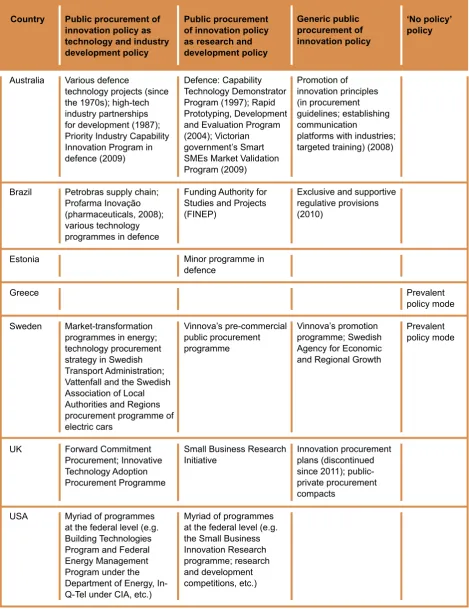
By distilling from international policy practices, past and present, as well as theoretical debates, innovation-oriented public procurement can be identified in four different policy modes: technology and industry development policy; research and development policy; generic policy; and ‘no policy’ policy (Table 1).
Historically, perhaps the most influential and most frequently exploited innovation-oriented public-procurement instrument has been government technology procurement. It is not only radical research and development-intensive innovations or new technology platforms (e.g. military, telecommunications, and pharmaceuticals) that are the focus. Adaptive innovations should also be
considered, for example, by using standard-setting and technology-transfer as part of public-procurement initiatives. Public technology procurement can as often be technology-driven (i.e. based on social needs, such as low-carbon solutions for environmental protection or defence systems) as industry-driven (i.e. where national industry has a potential advantage to grow).
Second, innovation-oriented public
procurement often takes place in the form
of public procurement of research and development—public procurement is often used as a tool to fund industrial research and development. Thus, in this case public procurement directly serves the goals of science, technology and innovation policy, but is at the same time directly oriented towards production and not only knowledge creation. Here governments usually establish separate horizontal or field-specific programmes (e.g. in defence, security, health and energy) that focus on early phases of product and technology life cycles (pre-commercial solutions) and which assume high-level
research and development work from providers in order to meet (sometimes loosely) specified public demand.
Third, governments can also opt for more generic policy solutions to promote and foster innovation. The innovation dimension is made a central and explicit part of
government procurement strategies and decisions across the public sector. The generic policies aim at exploiting government consumption expenditure in general as a vehicle for inducing innovation. In these cases, emphasis is given not only to dedicated public-procurement programmes, but to the maximum use of specific, allegedly innovation-friendly procurement practices and methods such as performance specifications, competitive dialogue, variant bids and idea competition.
Fourth, many governments have never pursued massive technology, research and development or generic procurement policies to spur innovation. Much of today’s government spending on goods, works and services is still done according to routine by employing regular public procurement practices (e.g. simple price auctions targeting off-the-shelf solutions) without secondary intentions—such as innovation—in mind. This perspective assumes that it is price-driven competition that should drive innovation.
Public procurement of innovation
policy: a comparative overview
Table 1. Selected examples of innovation-relevant public procurement policy approaches and instruments
Country ‘No policy’
policy Public procurement of
innovation policy as technology and industry development policy
Public procurement of innovation policy as research and development policy Australia Brazil Estonia Greece Sweden UK USA Prevalent policy mode Prevalent policy mode Various defence
technology projects (since the 1970s); high-tech industry partnerships for development (1987); Priority Industry Capability Innovation Program in defence (2009)
Petrobras supply chain; Profarma Inovação (pharmaceuticals, 2008); various technology programmes in defence
Market-transformation programmes in energy; technology procurement strategy in Swedish Transport Administration; Vattenfall and the Swedish Association of Local Authorities and Regions procurement programme of electric cars
Forw