Abstract: The emerging applications of IoT require that Wireless Sensor Network should be energy proficient. To build the Wireless Sensor Network more energy proficient, many challenging issues like routing, localization and sensor fusion must be properly addressed. Although many routing protocols are in existence, there is a lack of research papers that contain an in depth analysis which can give an overview to the current researchers. In order to provide a big picture outlook, we have put an effort to analyze the comparative performance of various leading routing protocols available in WSN. Although many routing protocols are available in the literature under flat routing, SPIN is selected under flat routing protocol as it’s a leading protocol. Similarly, LEACH, LEACH-C and PEGASIS is considered under hierarchical routing protocol. Simulations have been carried out by using the NS-2 simulator. The Performance metrics like energy utilization, delay, throughput and network lifetime are some of them which has been explored
Index Terms: LEACH, LEACH-C, NS-2, PEGASIS, SPIN
I. INTRODUCTION
A wireless sensor network is composed of a compilation of sensor nodes and they have been deployed in a field in order to examine the specific environment and to gather the data about the environment. Sensor nodes are usually small in size, resource constrained, less memory, limited battery power etc [1]. In spite of the above-mentioned drawbacks, sensors are capable of providing a real picture of the environment which is being sensed. Due to various resource constraints, WSN need to face many challenges in routing, communication, topology, efficient hardware components and algorithms etc [2]. Routing protocol takes part in packet delivery which includes routing of packets between various networks. The major goal is to deliver the data efficiently to the destination. Routing is a big difficult task in wireless sensor networks and has to to be focused more because of the densely populated sensor nodes and they have very minimal energy resource and a small memory. Generally, the routing protocols are classified into two major groups namely based on network architecture and application. On the basis of
network architecture, it is further classified into three types namely location ,flat and hierarchical based routing. The
Revised Manuscript Received on May 28, 2019.
First Author name, His Department Name, University/ College/ Organization Name, City Name, Country Name.
Second Author name, His Department Name, University/ College/ Organization Name, City Name, Country Name.
Third Author name, His Department Name, University/ College/ Organization Name, City Name, Country Name.
[image:1.595.317.559.257.374.2]routing protocols can also be further divided on the basis of establishment of path, operations of the protocols and initiator of operation.
Figure 1: General Architecture of WSN
We are considering various routing protocol in this paper. Even though the concept is not new, but the performance parameters are presented in the literature is isolation to each other. The intention of this research paper is to make available the performance parameters in a single domain and give a sharp vision of most important protocols under flat and hierarchical routing protocol. Out of that, we have considered SPIN under flat routing protocol and LEACH, LEACH-C, PEGASIS under hierarchical routing protocol to verify the simulation results. The paper is structured as follows. Section 2 describes the existing works available in the literature and in Section 3, we have discussed the simulation results obtained from NS-2 Simulator. Section 4 provides the conclusion of the paper.
II. RELATED WORK
In this section, some of the famous protocols available in the current literature are discussed in detail. These protocols are designed with the intention of improving some factors like utilization of energy, network lifetime. WSN is basically classified into three types hierarchical, location and flat based routing [3, 14].Various techniques have been put-forward for the improvement of routing protocols. Categorization of routing protocols is depicted in Figure 2.
A. Flat Based Routing
In this type of routing, all the nodes are having the identical
FLAT Vs Hierarchical Routing Protocols in Wireless
Sensor Networks: An In-depth Analysis
functionality and they work along together to sense the data. Since the numbers of nodes are more there is no way to allocate an identifier to the nodes. Because of this data centric routing concept is introduced in which the base station is responsible for sending the queries to a selected portion and waiting for the sensor nodes to respond from the located in the particular area. Two protocols classified on basis of data centric routing involves SPIN, Directed Diffusion (DD) which eliminates the repeated data as well as it saves energy through data negotiation. Above Fig 1. Shows the example of flat routing protocol.
Figure 2: Classification of Routing Protocols in WSN
1) Directed Diffusion [15]: Directed diffusion is a flat based routing protocol came into existence after SPIN. The data in the sensor nodes are diffused by using a naming scheme. Attribute-value pairs are being used for the sensed data and also the data is queried from the sensor nodes based on the demand. A node which requires the data, generates an interest using the attribute value pair and sends it through the sink to the neighbor. DD is more energy efficient due to the on-demand processing and global network is not required.
2) SPIN [10] is an example of flat based routing protocol. Each and every node in the network is considered as equal capability and each one passes the information to each other until it has been passed to the base station. So, the information is present in all the nodes and the user can query any of the nodes to get the information. All the nodes which are present in the nearby area will have similar data so only few data to be transmitted to the other nodes. This protocol mainly uses two concepts negotiation of data and algorithms for resource adaption. Drawback is that advertisement mechanism used is not reliable.
A. Hierarchical Based Routing
Hierarchical routing otherwise called as cluster-based routing is utilized basically to advance the efficient communication, scalability, energy proficiency of the network. In this kind of routing, processing of data is carried out by high energy nodes and sensing of data in the deployed environment is carried out by low energy nodes. Energy efficiency, scalability and communication are greatly increased by the clusters and the
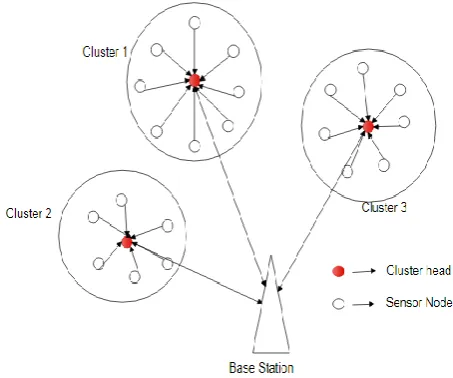
[image:2.595.314.541.144.333.2]cluster head concept. The advantages of hierarchical routing involve the reduction of energy consumption and it reduces the packets that are delivered to the base station by means of using data aggregation and fusion technique. Figure 3 shows the example of hierarchical routing.
Figure 3: Clustering in WSN
1) In [4,5], the author discusses about LEACH that is the first clustering based protocols which form the cluster in a distributed fashion. The key intention of this protocol is to lessen the energy utilization and to uniformly allocate the energy efficiently amongst the nodes present in the network. Load balancing is achieved through the re-clustering i.e. the CH is changed during given intervals with an intention to dissipate the energy evenly in the sensor network. LEACH is having n rounds. Each and every round is composed of two phases namely setup and steady state. During the setup phase, the formation of clusters is carried out and among the cluster one of the node is being selected as the head. In the set up phase, the data collected from the cluster head is transferred to the base station. Usually the 2nd phase, called the steady phase
is made longer to reduce the consumption of energy.
3) PEGASIS [7] is an improvement over the LEACH protocol. This mainly depends on the concept of chain, in which the nodes which are close by need to communicate each other and thereafter the data is communicated to the BS, base station. The nearby nodes are being located depending on the strength of the signals of the nodes. A path has been formed to the base station based on the nodes in the chain. Each and every node present in the chain take alternate turns in order to push the aggregated data to the BS, base station thereby it reduces the required energy since the energy is spread uniformly between the nodes present in the network.
4) TEEN [8] is a hierarchical routing protocol and proposed to meet the abrupt changes in the sensed attributes. It reduces energy consumption and nodes available in the network collect the information regularly but the transmission of data is not done frequently. In TEEN, two kinds of threshold values are used such as Hard (HT) and Soft (ST) Thresholds are distributed by the CH to the nodes. By adjusting the thresholds values, the energy efficiency and accuracy of data is maintained.
5) APTEEN [9] [13] is an improvement over TEEN capable of collecting regular periodic data along with the critical events. The characteristics of both networks i.e proactive, reactive are mingled there by the transmission of data are carried out at adaptable time intervals. Four parameters are transmitted by the CH to the nodes like attributes, count time, thresholds and schedule. The CH selection is mainly based on the LEACH-C protocol. The threshold as well as the CT values can be adjusted which results in energy consumption, it allows a lot flexibility to the users.
6) HEED [10, 12] is a distributed clustering technique which uses multi-hop technique. Two factors are considered during the cluster head formation i.e., residual energy and communication cost unlike LEACH protocol. Residual energy present in the cluster head is usually greater than the other nodes.
III.
S
IMULATIONR
ESULTS ANDD
ISCUSSIONS A) Experimental Setup:The experiments are carried out by NS-2 Simulator for evaluating the performance of SPIN, LEACH, LEACH-C, and PEGASIS Protocol.
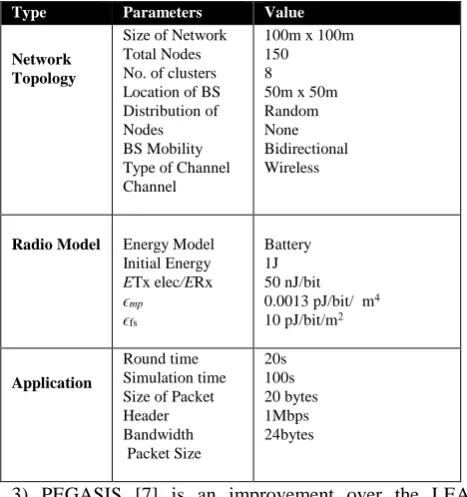
[image:3.595.41.275.61.310.2]Table 1 gives the parameters considered for simulation for carrying out the experiments
Table 1: SIMULATION PARAMETERS
For experimental set up, a sensor field that contains 150 nodes is considered. the nodes are allocated randomly with the given co-ordinates as x=0, y=0 and value of x=100, y=100. The BS is situated at (x=50, y=50). The field size is 100m * 100m. Bandwidth of the channel is considered as 1Mb/s. 24 bytes is taken as packet size. We have considered 20 bytes for header length. Each node is assumed an initial energy of 1 joule. The maximum number of clusters which have been used in simulation is 8. Duration of each round is considered as 20s. Simulations have been run for 100s.
B. Results and Analysis
In order to analyze and clearly understand the advantages of flat Vs. hierarchical techniques, we have compared SPIN under flat routing and LEACH, LEACH-C, PEGASIS under hierarchical routing protocol with different clustering principles. In this paper, we have considered various metrics for measuring the performance such as consumption of energy, delivery of packets ratio, average throughput, delay, and network life time. Firstly, we tried to find out the consumption of energy of the four protocols. Secondly, we tried to find out the throughput i.e. the entire number of packets delivered successfully at the base station. Thirdly, we emphasize on the entire quantity of packets that are send out to the base station over a period of time. Lastly, the delay of the packets from the beginning to the target node is calculated. Simulations results have been plotted in the figure 4 to figure 7.
C. Performance Metrics
Various performance metrics such as consumption of energy, throughput, delivery of packets ratio and delay are discussed in this section to give an overview of efficiency of the protocol.
Type Parameters Value
Network Topology
Size of Network Total Nodes No. of clusters Location of BS Distribution of Nodes BS Mobility Type of Channel Channel
100m x 100m 150 8 50m x 50m Random None Bidirectional Wireless
Radio Model Energy Model Initial Energy ETx elec/ERx ϵmp
ϵfs
Battery 1J 50 nJ/bit 0.0013 pJ/bit/ m4 10 pJ/bit/m2
Application
1. Energy Consumption:
Figure 4: Energy Consumption Vs Number of Rounds
Fig.4. represents the comparison results of energy consumption in SPIN, LEACH, LEACH-C and PEGASIS. In this, LEACH and PEGASIS consumes lower energy compared to SPIN. So, it is having high remaining energy after transmission. But SPIN and LEACH-C are consumed more energy compared to LEACH. Energy Consumption of the protocol LEACH and PEGASIS is comparatively more when compared to the other protocols.
2. Packet Delivery Ratio:
Figure 5: Packet Delivery Ratio Vs Number of Rounds
In Figure 5 we have tried to represent the PDR-packet delivery ratio. PDR is defined as the ratio of packets carried to the destination with respect to the count of packets
transmitted. Fig.5. conveys that PEGASIS is having more packets delivered compared to others. LEACH shows that the packets delivery ratio is more when evaluated to the other two protocols LEACH-C and SPIN.
3. Average Throughput:
Figure 6: Average Throughput Vs Number of Rounds
Throughput is one of the major performance metrics that justifies the efficiency of the protocol. It can be defined as
………..(1)
The result of the experiment is shown in Fig.6, shows the comparison of throughput for SPIN, LEACH, LEACH-C, and PEGASIS. In this, PEGASIS provides higher throughput compared to SPIN and LEACH-C. When number of round increases, PEGASIS and LEACH drops down to lower throughput.
4. End to End delay:
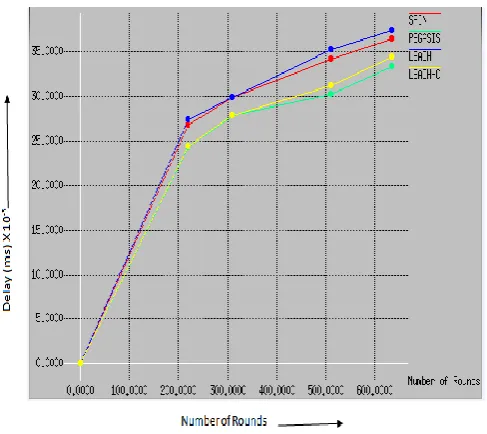
Figure 7: End to End Delay Vs Number of Rounds
Table 2: Comparison of Performance Metrics
IV. CONCLUSION
This paper provides an in-depth reading of Routing Protocols in Wireless Sensor Network to provide an outlook to the current researchers in this vast area. Routing is one of the main challenging issue in WSN and consumes major part of the energy while transmitting the data. Although many routing protocols are present in the current literature, Flat and hierarchical routing protocols are the key building blocks for developing any other category of routing protocols. We have selected SPIN under Flat routing and LEACH, LEACH-C, PEGASIS under hierarchical routing protocols as these are the leading protocols to proof the efficiency of the protocol. The simulation results obtained from NS-2 simulator conveys that PEGASIS provides better performance in terms of
consumption of energy, packet delivery ratio, throughput, end to end delay. PEGASIS minimizes energy consumption compared to other three protocols.
V. FUTURE WORK
The basic routing protocols provide many more opportunities on top of which many more routing protocols can be designed to optimize the network performance. Our future work includes to develop few new routing protocols utilizing the machine
learning algorithms that can optimize the routing technique as well as enhance the network lifetime.
REFERENCES
1. I.F. Akyildiz, W. Su, Y. Sankarasubramaniam, E. Cayirci, “Wireless Sensor Networks: A Survey,” Computer Networks, 2002, Vol. 38, Issue 4, pp. 399-422.
2. Al-Karaki, A. Kamal, “Routing Techniques in Wireless Sensor networks:A Survey,” Security and Networks, 2004, Vol. 11, Issue 6, pp.6-28
3. Nikolaos A. Pantazis, Stefanos A. Nikolidakis,Dimitrios D. Vergados. "Energy-Efficient Routing Protocols in Wireless Sensor Networks:A Survey", IEEE Communications Surveys & Tutorials, 2013.
4. A.P. Chandrakasan, H. Balakrishnan and W. R.Heinzelman, "Energy efficient communication protocol for wireless microsensor networks," 33rd Hawaii Int. Conf. Sys.Sci., Jan. 2000.
5. A.P.Chandrakasan, H. Balakrishnan and W. B.Heinzelman, "An application-specific protocol architecture for wireless microsensor networks," IEEE Trans. Wireless Commun. vol. 1, no. 4, October 2002. 6. Wu Xinhua, Wang Sheng, Performance Comparison of LEACH and
LEACH-C Protocols by NS2, 2010 Ninth International Symposium on Distributed Computing and Applications to Business, Engineering and Science.
7. S. Lindsey, C. Raghavendra, "PEGASIS: Power-Efficient Gathering in Sensor Information Systems," in IEEE Aerospace Conf., Big Sky, Montana, March 2002.Smith, T.F., Waterman, M.S.: Identification of Common Molecular Subsequences. J. Mol. Biol. 147, 195--197 (1981) 8. A. Manjeshwar and D. P. Agarwal, “TEEN: a Routing Protocol for Enhanced Efficiency in Wireless Sensor Networks,”1st Int’l. Wksp. on Parallel and Distrib. Comp. Issues in Wireless Networks and Mobile Comp., April 2001.
9. A. Manjeshwar and D. P. Agarwal, “APTEEN: A Hybrid Protocol for Efficient Routing and Comprehensive Information Retrieval in Wireless Sensor Networks,” Proc.Int’l. Parallel and Distrib. Proc. Symp., pp. 195–202.
10. F. Wu, and L. Li. "Research on SPIN of wireless sensor network," Computer and Modernization, vol. 3, pp. 93-96, 2007M. Young, The Techincal Writers Handbook. Mill Valley, CA: University Science, 1989.
11 S. Sahu, N. Kumar, V. Jain, “Survey on Recent Clustering Algorithms in Wireless Sensor Network”, International Journal of Scientific and Research Publications, vol. 3, 2013.
12. Ishu Sharma Rajvir Singh Meenu Khurana "Comparative study of LEACH LEACH-C and PEGASIS routing protocols for wireless sensor network [C]" Computer Engineering and Applications (ICACEA) pp. 842-846 2015.
Routing Protocols” in International . Journal of Sensors, pp. 10506-10523,2010.
14. Kulik, J.; Rabiner, W.; Balakrishnan, H. “Adaptive protocols for information dissemination in wireless sensor networks”. In Proceedings of the 5th Annual ACM/IEEE International Conference on Mobile Computing and Networking (MobiCom_99), Seattle, WA, USA, August 1999.
15. O. Younis, S. Fahmy, “HEED: A Hybrid, Energy-Efficient, Distributed clustering approach for Ad Hoc sensor networks”, IEEE Transactions on Mobile Computing 3 (4) (2004) 366–379.
AUTHORS PROFILE
Dr.S.Shanthi received her Ph.D. degree from University Of Mysore, Mysore, India, in 2016, and M.E Degree from Sathyabama University, India in 2008. She is currently working as a Research Professor with Malla Reddy College of Engineering and Technology, Hyderabad, Telangana, India, an autonomous Institution under the affiliation of Jawaharlal Nehru Technological University, Hyderabad. She is an author and co-author of more than 20 papers in Technical Journals and Conference Proceedings, and she has contributed to Book Chapters in her areas of interest and to her credit she has 2 patents. Her research interests include image processing, wireless Adhoc and sensor networks, machine learning, Network Security.
Dr.Padmalaya Nayak received her Ph.D. degree in Computer Science and Engineering from the National Institute of
Engineering Technology,
Tiruchirappalli, India, in 2010 , M.E. (Hons.) degree in
Computer Science and
Engineering from the University of Madras, in 2002, and
Engineering degree in
electronics and
telecommunication engineering from the Institution of Electronics and Telecommunication Engineers (IETE), New
Delhi, in 1997. She is currently a Professor with the Gokaraju Rangaraju Institute of Engineering Technology under Jawaharlal Nehru Technological University, Hyderabad. She has authored over 32 international conference/journal papers in Ad Hoc and Sensor Networks and two book chapters to her credit. Her current research interest includes ad hoc and sensor networks, cellular communication, and network security. She is the member of IEEE, IAENG, IETE Professional bodies.
Dr. A kundi Sai Hanuman, Professor of Computer Science and Engineering, completed his Ph.D.
from Acharya Nagarjuna
University, Guntur in 2012. He has over 22 years of experience in Academic, Industry and Research. Dr. Akundi Sai Hanumans Research interests include Data Clustering,