International Journal of Innovative Technology and Exploring Engineering (IJITEE) ISSN: 2278-3075, Volume-8 Issue-5S March, 2019
Abstract: The sophisticated improvement of Information and Communication Technology (ICT) has sparked new inventions in teaching and learning approach. These positive technological advantages therefore inspired the Malaysian Ministry of Education (MOE) to invest in digitalizing the Malaysian schools, including the implementation of Frog Virtual Learning Environments (VLE). Despite this huge investment, the ratio of usage is relatively low, especially among the teachers. This evidence indicates that there is an urgent requirement to conduct a post-implementation evaluation to investigate the factors behind the issue. Therefore, this study is conducted to develop a conceptual model based on the updated DeLone and McLean IS Success Model to evaluate the Frog VLE success among Malaysian teachers. As the study is still in the early stage, this paper will present the initial investigation that leads to the development of the conceptual model, including background of the study, the objectives, literature review and research methodology that the study wishes to employ. Based on this conceptual model, 14 hypotheses have been proposed.
Keywords: DeLone and McLean IS Success Model, Evaluation of IS Success, Frog VLE, Learning Management System
Jel classification: A29, O33
I. INTRODUCTION
The sophisticated improvement of Information and Communication Technology (ICT) has sparked new inventions in teaching and learning approach. Currently, most educational institutions have implemented various forms of teaching style such as blended and online learning. Blended learning combines face-to-face teaching with an unusually high percentage of autonomous learning and online tutoring. These new teaching styles are made possible through Virtual Learning Environments (VLEs) (Berns et al., 2013).
VLE is defined a decade ago as computer-based environments that are relatively open systems, allowing interactions with other participants and access to a wide range of resources (Wilson, 1996).
Revised Manuscript Received on March 08, 2019.
Hapini Awang, School of Computing, College of Arts & Sciences, Universiti
Utara Malaysia, Malaysia.
Wan Rozaini Sheik Osman, School of Computing, College of Arts &
Sciences, Universiti Utara Malaysia, Malaysia,
Zahurin Mat Aji, School of Computing, College of Arts & Sciences,
Universiti Utara Malaysia, Malaysia.
The virtual environments offer various benefits compared to the traditional approach by promoting
the “any time/any place” learning model (Ahmad et al., 1998). The introduction of VLE technology in education has significantly shifted the nature of traditional learning in six aspects; time, place, space, technology, interaction, and control(Piccoli et al., 2001). VLE is commonly recognized as an Internet-based platform that supports various educational activities including online courses, quizzes, and tutorials (Abdelhag et al., 2014). The introduction of VLE technology into education has produced positive impact to the parent, students, and teachers (Nor Fadzleen and Halina 2013) by promoting the dynamicity in learning particularly in conditions of opposing the barriers of time and location (Uzunboylu, H., Bicen & Cavus, 2011). The technology also enables users to mutually interact with each other, both synchronously and asynchronously (Halonen et al., 2012).
II. LITERATURE REVIEW
The VLE technology implementation in Malaysia was initiated by Ministry of Education (MOE) through the 1BestariNet project to improve the previous version of SchoolNet service (Kementerian Pendidikan Malaysia, 2014). Through the initiative, MOE aims to connect approximately over 10,000 schools across the nation via cloud-based virtual learning environment, supported by high-speed 4G internet connections by the end of 2013 (Kementerian Pendidikan Malaysia, 2013). As a long term investment, the 1BestariNet (including Frog VLE) executions is expected to run for at least thirteen years and MOE believed that it will transform Malaysian education sector by promoting sustainable use of ICT in both areas of pedagogy (teaching and learning) as well as education management (Abdullah et al., 2013; Cheok & Wong, 2014).
Frog VLE, adopted from the United Kingdom (UK), is the
most recent Learning Management System (LMS)
implemented in Malaysian schools. One of the ultimate objectives of this initiative is to connect the educational separate among rural and urban schools by providing equal digital education for every student, regardless of their locations. It is hoped that over 10,000 public schools, 5
million students, 500,000 teachers, and 4.5 million parents will be connected together in the virtual learning community, and therefore boost the quality of Malaysian education up to the highest level. However, the current report indicates low usage of Frog VLE, which is between 19.5% to 33.5%, with only 0.57% to 4.69% of teachers’ usage (Kementerian Kewangan Malaysia, 2014).
The low utilization of Frog VLE in schools is associated with at least two issues. First, a recent evidence has demonstrated that some teachers refuse to continue using the system, although they agreed on the benefits offered by Frog VLE (Cheok & Wong, 2016) Second, some studies also suggest an association between user satisfaction and the actual usage of LMS (Eom et al., 2012). This notion implies that the teachers who are not satisfied with the Frog VLE will most likely refuse to continue using it and henceforth contribute to the overall statistic of low usage. Nevertheless, the current literature on Frog VLE is found to be widespread with the lack of empirical evidence on its continuous usage and user satisfaction. Therefore, there is a need to empirically examine the factors behind both of these issues, particularly among the teachers.
Regarding the trend of recent studies in Frog VLE, it is becoming extremely difficult to ignore the existence of teachers’ excessive workload as a major hindrance of its utilization (Abdullah et al., 2013). While the body of research in the area suggests that excessive workload may also have some impact on the use of Frog VLE (Abuhmaid, 2011) empirical evidence on this is still lacking. Moreover, the literature is yet to reveal any attempt to structurally map out the relationship between workload and usage in the context of IS success.
Equally important, the Personal Characteristics like Age, Gender and Experience are found to be influential in IS adoption especially in determining the strength of usage (Venkatesh et al., 2012). However, the plausible effect of these Personal Characteristics in evaluating Frog VLE success has not yet been clarified, so it is not obvious whether these characteristics are influential or the otherwise. This implies that the existing literature on IS evaluation lies on insufficient research in determining its predictors and thus requires further empirical investigations.
The Updated DeLone and McLean IS Success Model
Various theories and designs related to IS usage have been introduced including Theory of Reasoned Action (TRA), Theory of Planned Behavior (TPB), Technology Acceptance Model (TAM) and Unified Theory of Acceptance and Use of Technology (UTAUT). Nevertheless, IS usage is not representing the overall IS success, however it is one amognst IS success is that the interconnected (Delone & McLean, 2003; DeLone & McLean, 1992). In step with Delone & McLean, (2003), IS success is the interrelated dimensions, so it mustn't be measured supported solely single dimension. This stance implies that many studies that examine sure dimension, for instance, IS usage (AlAwadhi & Morris, 2008; Jurisch, 2015) and user satisfaction (Chang et al., 2009; Dai et al.,
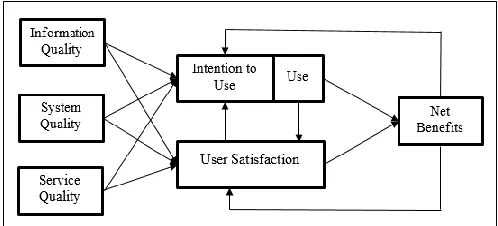
[image:2.612.316.565.479.592.2]2011) failed to represent the full construct of IS success. In addition, the continuous usage during the post-implementation stage is more significant in determining the IS success compared to initial use during pre-implementation (Bhattacherjee, 2001). As for this study, the continuous usage is identified as a prominent issue, illustrated by the low usage of ICT and Frog VLE (Hassan & Kamisah 2010). Even though majority of the teachers have the initial Frog VLE experience, the current finding shows that they refused to continue using the system (Nor Azlah et al., (2014) that replicate that the system isn't on the correct track of success. From the literature, this study found that these problems can be engaged utilizing the updated DeLone and McLean IS Success Model (D&M) (Delone & McLean, 2003). Previous research have proven that this model suits all the dimension for IS success assessment (Mohammadi, 2015; Al-Debei et al., 2013). Therefore, this study uses the D&M IS Success Model as the theoretical basis, with the inclusion of Workload and Personal Characteristics as the external moderating variable to measure the Frog VLE Success among Malaysian teachers. Although the updated D&M IS Success Model was developed for measuring e-commerce, its applicability in other IS streams has been proven by many studies. This model was introduced on 2003 as the response to the criticisms on the original version of IS Success Model by (DeLone & McLean, 1992). As an enhancement model, several adjustments have been made including the inclusion of Service Quality (SeQ) and the combination of Individual Impact and Organizational Impact into the single dimension known as Net Benefits (NB). Furthermore, the updated D&M purpose to supply a complete know-how of IS success with the aid of describing the inter-dating between six recognized dimensions, namely Information Quality (IQ), System Quality (SyQ), Service Quality (SeQ), Intention to Use (ITU) or Use (U), User Satisfaction (US) and Net Benefits (NB), is proven in Fig. 1.
Fig. 1The Updated DeLone and McLean IS Success Model
International Journal of Innovative Technology and Exploring Engineering (IJITEE) ISSN: 2278-3075, Volume-8 Issue-5S March, 2019
updated D&M remains the foundation model of these IS success evaluation studies. For example, a major study by (Mohammadi, 2015) that investigate the factors that influence E-Learning outcomes has included a number of external variables into D&M including Educational Quality, Perceived Ease of Use, Perceived Usefulness, and Learning Assistance. In another study by (Al Zoubib & Jali, (2014), the relationships in D&M have been modified along with the inclusion of Relative Advantage, Compatibility, and Complexity to measure E-Learning adoption among adults workers. Also, some researchers choose to hybridize D&M by integrating it with other models or theories such as TAM and VLE Effectiveness Model (Eom et al., 2012). Despite the variability in adapting the D&M model (to suit the objectives and context of studies), the majority of researchers still believed that most of the constructs in the model are relevant for the evaluation of IS Success across different context and should be retained (Alshibly, 2014).
Based on the preceding discussion, this learning terminates that the entire constructs in D&M are relevant to model the Frog VLE success among Malaysian teachers. More importantly, the preservation all IS Success dimensions is congruent to the suggestion of [20] to produce a comprehensive understanding the IS achievement whereas at a similar time retaining the nature of interdependency between these dimensions. However, to analyze the issue of non-stop usage (why the teacher refuse to continue using Frog VLE?); this study will use both ITU and U while also adding the new relationship from U to ITU. Although the ITU was introduced by [20] as an alternative measurement for U, the separation of these two constructs will enhance the explanation power of D&M (Agarwal & Prasad, 1997); Mardiana, 2015). In addition, this study will also incorporate the WL as the moderator since it has identified as a major issue that affects the ICT integration in education including Frog VLE, (Wu et al., 2010). Finally, the Personal Characteristics, which consist of Age, Gender and Frog VLE Experience, will be added to the D&M as another moderating variable, which is expected to influence the relationship between the Quality Dimensions (IQ, SeQ and SeQ) and ITU.
III. RESEARCH OBJECTIVES AND QUESTIONS
This learning seeks to provide some understandings on how the new Conceptual Model that’s developed supported the D&M IS Success Model (Delone & McLean, 2003). Will predict the success of Frog VLE among Malaysian teachers. Additionally, this study also wishes to address the following main questions:
a) Is the modified D&M suitable for the post-implementation evaluation of Frog VLE?
b) Why are the teachers not using the Frog VLE?
Research Conceptual Model
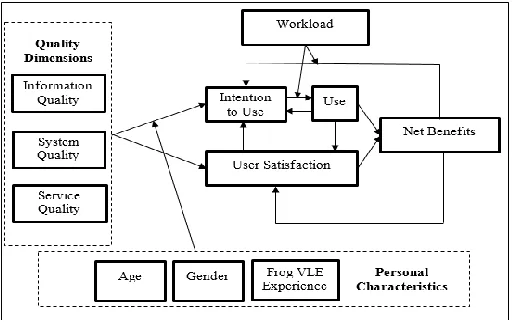
The Conceptual Model for the projected learning, as shown below (
Fig. 2), relies on the renewed DeLone and McLean IS Success Model (Delone & McLean, 2003). Comprises of
eight interdependent determinants of success, this model suggests that the Quality Dimensions (Information Quality, System Quality, and Service Quality) will significantly influence the Aim to Use and User Satisfaction. Furthermore, the Personal Characteristics (Age, Gender and Frog VLE Experience) may moderate the relationship between the Quality Dimensions and Intention to Use. At the second level, the increasing Intention to Use should lead to more usage (Use) of the Frog VLE. By the same manner, the initial Use may also affect future Intention to Use, with the mediating effect of User Satisfaction. As a result of these Use and User Satisfaction, certain Net Benefits will occur, that will further lead to improvement of Intention to Use (moderated by
[image:3.612.315.571.268.432.2]Workload of the teachers) and User Satisfaction. At the same time, the teachers’ employment is additionally expected to moderate the link between Intention to Use and Use of Frog VLE.
Fig. 2 Research Conceptual Model Hypotheses
This study postulates that the Quality Dimensions will influence the ITU of Frog VLE among Malaysian teachers, in the positive relationship. This assumption was supported by several previous research which proved a significant connection among IQ, SyQ and SeQ to the ITU (Al-Debei et al., 2013; Ramayah et al., 2010). Hence, the subsequent main hypothesis is planned, and therefore the elaborate discussion of the sub-hypotheses is provided within the next paragraphs.
H1: The Quality Dimensions have the significance influence on the Intention to Use of Frog VLE among the teachers.
IS researchers. As a result, data from these studies have identified both significant (Chen et al., 2009; Iivari, 2005) and insignificant (Halawi et al., 2008) of this relationship. Second, SyQ should have directly affected the ITU; even though the density of the relationship may vary across different IS atmosphere (Teo et al., 2008). In this sense, it can be assumed that the Frog VLE that always available, easy to use and convenient to access will lead to greater aim to utilize within the future by teachers. Nevertheless, the previous studies have demonstrated the mix supported relationship between theses variables. Some studies have found that SyQ is not related to ITU (Agarwal & Prasad, 1997; Klein, 2007), while many other studies found it significant (Al-Debei et al., 2013).
Third, on the practical basis, good support services by Frog VLE and 1BestariNet should motivate the teachers to continue utilizing the system within the future. However, empirical examinations by a number of previous studies have shown that SeQ only had a mixed support for its ability to explain ITU (Al-Debei et al., 2013). Building on the previous arguments and the inconsistency on the findings, this study believed that it the further exploration of the above-mentioned relationships are urgently needed. Therefore, the following sub-hypotheses are proposed:
H1a: Information Quality has a significance influence on the Intention to Use of Frog VLE among the teachers.
H1b: System Quality has a significance influence on the Intention to Use of Frog VLE among the teachers.
H1c: Service Quality has a significance influence on the Intention to Use of Frog VLE among the teachers.
This study postulates that if the teachers satisfied with the Frog VLE in term initial use, information quality, system quality and service quality, they will be inspired to use it again in the future. This notion is further supported by [30] who suggest that the individual who satisfied with the technology may have higher intention to use it in the future due to the positive reinforcement of attitude toward the technology. Moreover, the relationship between US and ITU has been supported in a number of empirical studies ((Al-Debei et al., 2013; Wixom, 2005; Halawi et al., 2008). In light of this, this study proposes the following hypothesis:
H2: User Satisfaction has a significance influence on the Intention to Use of Frog VLE among the teachers.
According to the updated D&M IS Success Model [20], the initial use and the intention to use in the future can be different under certain circumstances. By referring to two important studies by Agarwal & Prasad (1997) and Karahanna et al., (1999), the model described that the positive experience with the initial use should lead to user satisfaction and thus increase the attitude toward usage in the future. Comparatively, this study (post-implementation) assumed that all the teachers are continuance users as all the teachers are provided with personal IDs by 1BestariNet and required to create Frog VLE account (1BestariNet, 2012). Therefore, the positive initial use of Frog VLE is expected to increase their intention to continue using it in the future. Considering the preceding discussion, this study proposes the following hypothesis:
H3: Use has a significance influence on the Intention to Use of Frog VLE among the teachers.
The positive NB is expected to lead to future ITU [20]. In other words, the teachers will intent to continue using Frog VLE if they perceived that the system is beneficial to them. Moreover, the relationship between NB and ITU also has been supported by the number empirical studies (Al-Debei et al., 2013; Fang et al., 2011; Zheng et al., 2013). Therefore, this study proposes the following hypothesis:
H4: Net Benefits has a significance influence on the Intention to Use of Frog VLE among the teachers.
This study postulates that the Quality Dimensions will influence the US of Frog VLE among Malaysian teachers, in the positive relationship. This assumption was supported by the previous studies that proved the significant relationship between IQ, SyQ and SeQ to the US (Al-Debei et al., 2013). Therefore, the following main hypothesis is proposed, and the detailed discussions of the sub-hypotheses are provided in the next paragraphs.
H5: The Quality Dimensions have the significance influence on User Satisfaction of Frog VLE among the teachers.
IQ will positively influence US on the direct relationship [20]. In other words, the user will be satisfied if the IS produced precise, updated, relevant, and appropriate information. Thus far, a growing body of empirical research that examined the correlation between these two IS success dimensions can be found (Al-Debei et al., 2013). Hence, in the context of this study, the good quality of information provided by Frog VLE should increase the teachers’ satisfaction. Furthermore, SyQ was also found to have a strong positive relationship to US by a number of studies conducted to date (Urbach & Müller, 2012). For example, both empirical studies conducted by Al-Debei et al., (2013) and Aggelidis et al., (2012) have found a strong relationship between SyQ and US. Hence, this study assumed that the good quality of Frog VLE that is always available, easy to use and learn, convenient to access and reliable will lead to positive teachers’ satisfaction. On the other hand, higher service quality is expected to lead to higher user satisfaction as well at the individual level of analysis [[20]. Thus, this study postulates that if the teachers received the good services by Frog VLE and 1BestariNet, they will likely to feel satisfied and intend to continue using the system. However, empirical examinations by a number of previous studies have shown that SeQ only had a mixed support for its ability to explain US (Urbach & Müller, 2012). Nevertheless, the literature in the discipline of LMS evaluation, particularly in the Malaysian context, is yet to reveal any attempt to empirically test this relationship. Therefore, considering the preceding discussion, the study proposes the following sub-hypotheses:
H5a: Information Quality has a significance influence on the User Satisfaction of Frog VLE among the teachers.
International Journal of Innovative Technology and Exploring Engineering (IJITEE) ISSN: 2278-3075, Volume-8 Issue-5S March, 2019
Satisfaction of Frog VLE among the teachers.
H5c: Service Quality has a significance influence on the User Satisfaction of Frog VLE among the teachers.
The updated D&M posits that the positive experience with the initial U of IS will lead to higher US [20]. In light of this, the teachers are expected to feel satisfied if they have experienced the positive use of Frog VLE. Empirically, the literature has demonstrated the moderately supported relationship between U and US (Urbach & Müller, 2012), which requires further investigation. Therefore, based on this argument, this learning projected the subsequent theory: H6: Use has a significance influence on the User Satisfaction of Frog VLE among the teachers.
In addition, the updated D&M also suggest that the NB will have the correlation to the US [20]. The positive NB supposed to trigger the positive US and the other way around. In addition, the reversed back effect from NB to US has shown to be very robust (Urbach & Müller, (2012). Build on the preceding arguments; this study postulates that the positive net benefits provided by Frog VLE will increase the teachers’ satisfaction toward the system itself. Therefore, the following hypothesis is proposed:
H7: Net Benefits has a significance influence on the User Satisfaction of Frog VLE among the teachers.
The ITU is a measure of the likelihood a person will employ an application (Al-Debei, 2013). The concept of people’s intention to use certain technology was introduced by Davis, 1989) in TAM. This model uses the ‘Behavioral Intention to Use’ construct as an antecedent to predict the actual Use of the specific technology. This positive use will later cause satisfaction and intention for future use and so on. Based on this premises, Mardianaet al., 2015) also suggest that the ITU should be the predictor of U in D&M. In addition, this relationship between ITU and U has also been supported by a number of empirical studies (Mohammadi, 2015). Based on the preceding discussion, the study hypothesized that the teachers’ intention to use Frog VLE in the future will positively influence its actual usage. Therefore, the subsequent theory is projected:
H8: Intention to Use has a significance influence on the Use of Frog VLE among the teachers.
Delone (2003) suggested that certain net benefits would occur when the user used the particular IS. Hence, this study hypothesizes that the teachers will capture some benefits in term of time-saving, improved productivity and personal valuation when they use the Frog VLE. Empirically, the relationship between these two IS Success dimensions was found to be moderately supported (Petter, 2008). Considering the inconsistency in the previous findings, this study believed that the further investigation is required. Therefore, the subsequent theory is projected:
H9: Use has a significance influence on the Net Benefits of Frog VLE among the teachers.
Meanwhile, certain NB will occur as a result of U and US [20]. On the practical basis, the teachers who are satisfied with the Frog VLE should believe that they would save time,
improve productivity and increase their personal value when using it. A review of the current state of research on D&M by [53] has shown that the relationship of US and NB were strongly supported by the previous empirical studies including those conducted by prominent researchers such as (Iivari, 2005). Considering these findings, this study will also expect the similar outcome, and hence projected the subsequent theory:H10: User Satisfaction has a significance influence on the Net Benefits of Frog VLE among the teachers.
As discussed earlier, Delone (2003) suggested that the good experience with the initial U of Frog VLE is expected to cause the positive US, and further lead to increase in ITU. In this sense, the positive relationship between U and ITU should only exist with the mediating effect of US. In other words, the teachers (who have already experienced the initial use) are assumed to have an intention for future use, only if they were satisfied with the initial use of Frog VLE. Therefore, this learning projected the subsequent theory:
H11: User Satisfaction mediates the relationship between Use and Intention to Use of Frog VLE among the teachers.
In this study, the Personal Characteristics, which consist of Age, Gender and Frog VLE Experience, were posited to play the moderating role in the connection among Quality Dimensions (IQ, SyQ and SeQ) and Intention to Use (ITU). Therefore, the following main theory is projected. The next paragraphs will thoroughly discuss the antecedents of this main hypothesis.
H12: Personal Characteristics moderates the relationship between Quality Dimensions and Intention to Use of Frog VLE among the teachers.
During the past 50 years, much more evidence has become available on the effect of age toward IS adoption, especially in the context of intention to use the technology (Lin et al., 2013; Taylor, 1975; Venkatesh et al., 2003). Some researchers suggest that the age reflects the variation of human capability in processing information that further interfere their reaction toward the IS (Venkatesh et al., 2012). Compared to the younger people, the older people are found to rely more on automatic information processing (Jennings & Jacoby, 1993), and therefore require the better quality of information. Moreover, the increased age will usually cause the difficulty in processing complex information and to stay focus on the job, which both are necessary in IS adoption (Venkatesh et al., 2003). Hence, the older teacher is expected to feel less interested in using Frog VLE if they found that the information and system quality is low.
the older IS user is believed to face greater obstacles in processing the new and complex information that will further affect their ability to learn the recent technologies (Morris et al., 2005).
As a result, they tend to rely more on the greater support and service quality to perform certain task (Venkatesh, et al., (2012). This study posits that the older teachers will require better information, system and service quality from Frog VLE in order to integrate it into their teaching activities. This assumption is supported by a number of empirical studies that demonstrated the effect of teachers’ age toward the ICT usage in schools (Hindman, 2000). Based on the preceding discussion, this study postulates that the older teachers will demand higher information, system and service quality by Frog VLE and 1BestariNet. Therefore, the following sub-hypotheses are proposed:
H12a: Age moderates the relationship between Information Quality and Intention to Use of Frog VLE among the teachers. H12b: Age moderates the relationship between System Quality and Intention to Use of Frog VLE among the teachers.
H12c: Age moderates the relationship between Service Quality and Intention to Use of Frog VLE among the teachers.
Meanwhile, the empirical evidence shows that perceived usefulness (one of the measurements for information quality) was more salient for men compared to the women (Venkatesh et al., 2003; Venkatesh, & Morris, 2000). Men are commonly task oriented, and thus the desired quality of information is important to perform a certain task at hand (Venkatesh et al., 2003), such as in this case, for teaching. On the other hand, women are found to be more sensitive and detailed especially in making decisions (Meyers-Levy & Tybout, 1989). This is primarily attributed by the reality that they often tend to process every element of information in a structured manner, while men are most likely to ignore some relevant details and process the information from broader perspective (Meyers-Levy& Maheswaran, 1991). In light of this Venkatesh et al., (2012) suggested that the women will be more sensitive to changes in the environment that will further affect their intention. This notion was also supported by a number of empirical IS studies that uncover the greater effect of perceive ease of use (one of the measurements for system quality) among the women (Venkatesh, et al., 2003). This evidence suggested that women will expect better system quality that is not difficult to utilize (Venkatesh, et al., 2003), and henceforth if they perceived that the particular system is difficult to use, they will most likely demand the greater service quality. Indeed, the factor of age and gender are closely related to each other and should be examined together (Levy, 1988). Gender differences and the dependence on service quality will become more salient with the increasing age (Morris, et al., 2005). As the human being getting older, the distinction in the gender roles will become more compelling and women are generally will place more reliance on better external support or service quality (Venkatesh et al., 2012). In summary, the previous discussion on the gender roles has demonstrated that the intention to use Frog VLE among the teachers will most likely
be influenced by the gender differences. Male teachers are expected to demand better information quality, while female teachers will mostly be influenced by the system and service quality. Based on the preceding consideration, this study therefore proposes the following sub-hypotheses:
H12d: Gender moderates the relationship between Information Quality and Intention to Use of Frog VLE among the teachers. H12e: Gender moderates the relationship between System Quality and Intention to Use of Frog VLE among the teachers. H12f: Gender moderates the relationship between Service Quality and Intention to Use of Frog VLE among the teachers.
Experience as suggested in UTAUT and UTAUT 2 refers to “an opportunity to use a target technology and is typically operationalized as the passage of time from the initial use of a technology by an individual” [19]. Hence, in this study, it is referred to the teachers’ experience with the Frog VLE. Frog VLE experience can also moderate the relationship between SeQ and ITU, as suggested by [19]. By referring to the groundbreaking studies conducted by (Hutchinson, 1987), the greater experience is expected to lead to greater familiarity with the specific system and thus reducing the reliance to the external supports.
Even though the factors of age and gender are found to be influential in the previous studies, the effect of these factors were also expected to decrease with the increasing of experience (Venkatesh et al., 2003). To elaborate, gender differences in learning new technologies will usually increase in parallel with age and the aging process will cause the declining in information processing ability. As the men are most likely will process information based on their preceding experience, the older women tend to process the information in more detailed and cautious manner (Venkatesh et al., 2012). In this sense, the older women are expected to be less influenced by their heuristic experience. In one of the prominent study to determine the role of prior experience, perceived usefulness is found to be more pronounced with increasing experience, that is the IS user will psychologically believe that the information provided by the particular IS is useful to them as they are getting familiar with it (Taylor, & Todd, 1995). This finding proved that the role of prior experience is crucial in the context of IS usage, particularly to determine the strength of the relationship between information quality and intention to use.
International Journal of Innovative Technology and Exploring Engineering (IJITEE) ISSN: 2278-3075, Volume-8 Issue-5S March, 2019
support or services (Hutchinson, 1987). Besides, the dependency on the service quality is more noticeable to the older woman in the early stage of technology adoption (less experience) since they are most of the time put to the effort of learning the new technology [19]. In the context of this study, the effect of quality dimensions is expected to be moderated by Frog VLE experience. Likewise, the effect of these personal quality dimensions will gradually
become lesser as the teachers getting familiar with the system. The greater Frog VLE experience by the teachers should positively increase the familiarity and finally should lead to decreasing dependency on external support, particularly from 1BestariNet helpdesk services. Therefore, the following sub-hypotheses are proposed:
H12g: Frog VLE Experience moderates the relationship between Information Quality and Intention to Use of Frog VLE among the teachers.
H12h: Frog VLE Experience moderates the relationship between System Quality and Intention to Use of Frog VLE among the teachers.
H12i: Frog VLE Experience moderates the relationship between Service Quality and Intention to Use of Frog VLE among the teachers.
A report produced by Association of School and College Leaders, (2014) has defined Workload (WL) as “Work done for perceived and/or unnecessary compliance processes which take teachers away from the complex process of teaching and learning”. In addition, it is also related to the teachers’ professional duties and responsibilities such as teaching, community services, professional development and interaction with students (Yuker, H. E. (1984). In the context of LMS implementation, it is considered as one of the factors that possibly influence the utilization of the particular system. The issue of excessive Workload has been acknowledged by many previous researchers, particularly in the field of ICT in education (Wu et al., (2010). Unfortunately, the empirical evidence is still rare to be found regarding the issue, especially in Malaysia.
For instance, Hu et al., (2003) suggested that WL can severely hinder the teachers from adopting technology. Accordingly, the case study by Cheok & Wong (2016) found that WL is one of the major influence that interferes their predetermination to use of Frog VLE, even though they are aware of those particular benefits. Since the last century, the task of teachers has rapidly grown and the complaints of heavy Workload has become common among them (Ballet & Kelchtermans (2009). In light of this, Inan & Lowther (2010) suggested that the future research on ICT integration in education should include the factor of Workload, as they believed that it will extend the explanations from the existing literature. Also, the similar issue (Workload) has also become the concerns for several other IS researchers in Malaysia, which requires further explanations and more empirical evidence Anuar and Mohd Nordin (2015).
Based on the preceding discussion, this study postulates that WL will negatively moderate two relationships, namely; NB
to ITU and ITU to U of Frog VLE among the teachers. The teachers with the higher WL are expected to have lower intention to use Frog VLE even though they are agreed that Frog VLE provides benefits to them, while at the same time should negatively influence the usage. Thus, the following hypothesis is presented:
H13: Workload moderates the relationship between Net Benefits and Intention to Use of Frog VLE among the teachers.
H14: Workload moderates the relationship between Intention to Use and Use of Frog VLE among the teachers.
IV. RESEARCH METHODOLOGY
A cross-sectional survey field study will be employed in this study, as the data will be collected at a single point in time. Applying a survey method is believed to be the most appropriate to choose because it is an accurate mean to gather information as well as enable the researchers to generalize the findings, from the sample to a population (Creswell, J. W. (2013). This method is also suitable for a research with the large sample size, as the survey is quick, cheap and efficient to administer (Sekaran & Bougie (2016). Finally, a survey is also suitable when asking the respondents about their thought, opinions, and feelings (Shaughnessy et al., (2012).
Sampling
This study will use the probability sampling method to reduce the bias and increase the generalizability of the findings. Table.1 summarizes the sampling design of this study. The simple random sampling will be used. Based on the predetermined sample size required for this study, 45 the schools will be selected from sampling frame using the random calculator. From each selected school, 10 teachers will be chosen as respondents, using ‘fishbowl draw sampling’ technique. This will total up to approximately 450 of sample size (45*10 = 450).
Instrument Design
This study will systematically develop the inquiry that meets the research objectives based on the proposed Conceptual Model. The inquiry is divided into three sections; A, B, and C. Section An aims to gather the demographic data of the respondents.
For every construct, the measurement scale is a seven-point Likert Scale, which ranges from 1 to 7 [‘1’ Extremely Disagree to ‘7’ Extremely Agree]. This study applies the seven-point Likert Scale because it provides more widely spread scale values compared to five-point Likert Scale and thus reduces the possibility of respondent’s bias - by just selecting a neutral value (Dwivedi et al., (2010). In fact, the seven-point Likert Scale has also been applied by many prominent researchers in the IS discipline (Seddon & Kiew, 1996).
Table.1 Sampling Design of the Study.
Concept / Terminology
The Current Study
The Theoretical Population
The teachers throughout the Malaysia.
The Study Population The teachers in the Northern Region of Malaysia.
Sampling Frame List of schools in the Northern Region of Malaysia.
The Sample 450 teachers
Data Analysis
The data analysis process will be conducted in two phases. In the first phase, IBM SPSS Statistics (SPSS) will be used for data entry, screening, and preparation, for the purpose of identifying missing and non-compliance data before starting the main analysis. Finally, in the second phase, Structural Equation Modelling (SEM) will be used for hypotheses and model testing. In addition, the CFA will be conducted at this stage to confirm the factor structure extracted previously during EFA. According to Hair et al., (2011), SEM is an appropriate multivariate method to test the complete theories and concepts. Moreover, it enables the researcher to conduct systematic and comprehensive testing of the interlinked variables and their items in just a single run (Gefen et al., (2000).
IV. CONCLUSION
This paper has presented the initial stage of the study which comprises of introduction, objectives, literature review, conceptual framework and research methodology that will be employed. From the literature analysis, the research issues and the gaps have been identified. Building on this, a research conceptual framework is developed to evaluate the Frog VLE success among Malaysian teachers. Furthermore, this study will be beneficial to the researchers in both domains, IS, and education by contributing in the following ways.
First, this study will examine the applicability of D&M Model to evaluate the success of Frog VLE implementation. Second, this study will extend the D&M Model, by testing the role of Workload as the moderating variable between two relationships namely, Net Benefits and Intention to Use (IV) to the Use (DV) of the Frog VLE. By examining these
moderating effects, the study aims to improve the explanation power D&M in the context of LMS implementation. Third, this study will also examine three Personal Characteristics as moderating variables, namely Age, Gender and Frog VLE Experience to the updated D&M. The body of literature thus far only calibrated to the assessment of the existing constructs or with the inclusion of certain external independent variables to fits the issues at hand. Nevertheless, the studies that examine the moderating effects of these personal characteristics are surprisingly scarce in D&M based literature, even though it have been empirically proved in other models like UTAUT and UTAUT 2. Finally, this study will use both constructs of Intention to Use and Use. Although Intention to Use is introduced as an alternative for Use, this study posits that both of these constructs are significant, especially to capture the issue of continuous usage.
In conclusion, this study aims to fill the gap as none of the existing studies to the knowledge of the researcher provides the determinants of Frog VLE success. The successful implementation of LMS relies on its ability to meet the users’ requirement and expectation, while at the same time provide the net benefits for its users, regardless of the location, urban and rural. Thus, the outcome of the study will provide the guidelines and evidence for Malaysian policy makers especially the MOE to spot the weaknesses in the current practice of Frog VLE, for future improvement, as well as to justify their investment.
REFERENCES
1. Berns, A., Gonzalez-Pardo, A., & Camacho, D. (2013). Game-like language learning in 3-D virtual environments. Computers & Education, 60(1), 210-220.
2. Wilson, B. G. (1996). Constructivist learning environments: Case studies in instructional design. Educational Technology.
3. Ahmad, R., Piccoli, G., & Ives, B. (1998, December). Effectiveness of virtual learning environments in basic skills business education: A field study in progress. In Proceedings of the international conference on Information systems (pp. 352-357). Association for Information Systems. 4. Piccoli, G., Ahmad, R., & Ives, B. (2001). Web-based virtual learning
environments: A research framework and a preliminary assessment of effectiveness in basic IT skills training. MIS quarterly, 401-426. 5. Abdelhag, M. E., & Osman, S. E. F. (2014). SOA for Effective Data
Integration of Virtual Learning Environment Systems. International Journal, 4(6).
6. Nor Fadzleen, S. and Halina, M. D. (2013). “Knowledge Management Enhancement in Virtual Learning Environment (VLE) in Malaysian Schools,” in International Conference on Virtual Learning Environment (ICVLE). pp. 1–9.
7. Uzunboylu, H., Bicen, H., & Cavus, N. (2011). The efficient virtual learning environment: A case study of web 2.0 tools and Windows live spaces. Computers & Education, 56(3), 720-726.
8. Halonen, R., Thomander, H., & Laukkanen, E. (2012). DeLone & McLean IS success model in evaluating knowledge transfer in a virtual learning environment. In Societal Impacts on Information Systems Development and Applications (pp. 100-113). IGI Global.
International Journal of Innovative Technology and Exploring Engineering (IJITEE) ISSN: 2278-3075, Volume-8 Issue-5S March, 2019
9. Kementerian Pendidikan Malaysia, “Perancangan Pelaksanaan Peluasan Sistem Pengurusan Sekolah sebagai Penyelesaian kepada Menangani Isu Beban Tugas Guru dan Pengintegrasian Satu Data Pendidikan KPM,” 2013.
10.Abdullah, N., Mohamed Noh, N., Yusuff, N., Azmah, N., & Mansor, R. (2013). Aplikasi Persekitaran Pengajaran Maya (FROG VLE) Dalam Kalangan Guru Sains. Jurnal Pendidikan Sains & Matematik Malaysia, 3(2), 63-76.
11.Cheok, M. L., & Wong, S. L. (2014). Predictors Of E-Learning Satisfaction Among The Malaysian Secondary School Teachers. Icce 2014, 33.
12.Kementerian Kewangan Malaysia, “Maklum Balas Ke Atas Laporan Ketua Audit Negara 2013 Siri 3,” Putrajaya, Malaysia, 2014.
13.Cheok, M. L., & Wong, S. L. (2016). Frog Virtual Learning Environment for Malaysian Schools: Exploring Teachers’ Experience. In ICT in Education in Global Context (pp. 201-209). Springer Singapore. 14.Eom, S., Ashill, N. J., Arbaugh, J. B., & Stapleton, J. L. (2012). The role
of information technology in e-learning systems success. Human Systems Management, 31(3-4), 147-163.
15.Mohammadi, H. (2015). Factors affecting the e-learning outcomes: An integration of TAM and IS success model. Telematics and Informatics, 32(4), 701-719.
16.Abuhmaid, A. (2011). ICT training courses for teacher professional development in Jordan. TOJET: The Turkish Online Journal of Educational Technology, 10(4).
17.Raman, K., & Yamat, H. (2014). Barriers Teachers Face in Integrating ICT during English Lessons: A Case Study. Malaysian Online Journal of Educational Technology, 2(3), 11-19.
18.Venkatesh, V., Thong, J. Y., & Xu, X. (2012). Consumer acceptance and use of information technology: extending the unified theory of acceptance and use of technology.
19.Delone, W. H., & McLean, E. R. (2003). The DeLone and McLean model of information systems success: a ten-year update. Journal of management information systems, 19(4), 9-30.
20.DeLone, W. H., & McLean, E. R. (1992). Information systems success: The quest for the dependent variable. Information systems research, 3(1), 60-95.
21.AlAwadhi, S., & Morris, A. (2008, January). The Use of the UTAUT Model in the Adoption of E-government Services in Kuwait. In Hawaii International Conference on System Sciences, Proceedings of the 41st Annual (pp. 219-219). Ieee.
22.Jurisch, M. C., Kautz, M., Wolf, P., & Krcmar, H. (2015, January). An international survey of the factors influencing the intention to use open government. In System Sciences (HICSS), 2015 48th Hawaii International Conference on (pp. 2188-2198). IEEE.
Chang, H. H., Wang, Y. H., & Yang, W. Y. (2009). The impact of e-service quality, customer satisfaction and loyalty on e-marketing: Moderating effect of perceived value. Total Quality Management, 20(4), 423-443.
23.Dai, C. Y., Kao, M. T., Harn, C. T., Yuan, Y. H., & Chen, W. F. (2011, August). The research on user satisfaction of easy teaching Web of Taipei assessed via information quality, system quality, and Technology Acceptance Model. In Computer Science & Education (ICCSE), 2011 6th International Conference on (pp. 758-762). IEEE.
24.Bhattacherjee, A. (2001). Understanding information systems continuance: an expectation-confirmation model. MIS quarterly, 351-370. 25.Hassan, J., & Kamisah, S. N. (2010). Halangan terhadap penggunaan komputer dan ICT di dalam pengajaran dan pembelajaran (P&P) di kalangan guru di sekolah menengah kebangsaan luar Bandar di daerah Kulai Jaya Johor.
26.M. J. Nor Azlah, K. Fariza, N. A. Mohd Jaafar, F. Khalid, M. J. Nor Azlah, K. Fariza, N. A. Mohd Jaafar, and F. Khalid,(2014). “Keberkesanan Kemahiran Komunikasi Di Kalangan Guru Dalam Penggunaan Persekitaran Pembelajaran Maya (Frog VLE),” Pengajaran Sumber Dan Teknol. Mklm. Impaknya ke atas Penyelid. Dalam Pendidik. 2014, vol. 11, pp. 63–69.
27.M. Ummu Salma and K. Fariza. (2014). “Tahap Pengetahuan Guru Sekolah Rendah dalam Penggunaan VLE-Frog untuk Pengajaran & Pembelajaran,” in The 4th International Conference on Learner Diversity (ICELD 2014), 2014, pp. 780–788.
28.Al-Debei, M. M., Jalal, D., & Al-Lozi, E. (2013). Measuring web portals success: a respecification and validation of the DeLone and McLean information systems success model. International Journal of Business Information Systems, 14(1), 96-133.
29.Al Zoubib, A. I. S., & Jali, M. Z. (2014, June). An integrated success adoption model for examining E-learning among adult workers in Jordan. In Computer and Information Sciences (ICCOINS), 2014 International Conference on (pp. 1-4). IEEE.
30.Hosnavi, R., & Ramezan, M. (2010). Measuring the effectiveness of a human resource information system in National Iranian Oil Company: An empirical assessment. Education, Business and Society: Contemporary Middle Eastern Issues, 3(1), 28-39.
31.Alshibly, H. H. (2014). Evaluating E-HRM success: A Validation of the Information Systems Success Model. International Journal of Human Resource Studies, 4(3), 107.
32.Chen, J. V., Jubilado, R. J. M., Capistrano, E. P. S., & Yen, D. C. (2015). Factors affecting online tax filing–An application of the IS Success Model and trust theory. Computers in Human Behavior, 43, 251-262.
33.Wixom, B. H., & Todd, P. A. (2005). A theoretical integration of user satisfaction and technology acceptance. Information systems research, 16(1), 85-102.
34.Agarwal, R., & Prasad, J. (1997). The role of innovation characteristics and perceived voluntariness in the acceptance of information technologies. Decision sciences, 28(3), 557-582.
35.Mardiana, S., Tjakraatmadja, J. H., & Aprianingsih, A. (2015). DeLone-McLean information system success model revisited: The separation of intention to use-use and the integration of technology acceptance models. International Journal of Economics and Financial Issues, 5(1S).
36.Wu, D., Hiltz, S. R., & Bieber, M. (2010). Acceptance of educational technology: field studies of asynchronous participatory examinations. Communications of the Association for Information Systems, 26(1), 21. 37.Ramayah, T., Ahmad, N. H., & Lo, M. C. (2010). The role of quality
factors in intention to continue using an e-learning system in Malaysia. Procedia-Social and Behavioral Sciences, 2(2), 5422-5426.
38.Chen, C. W. D., & Cheng, C. Y. J. (2009). Understanding consumer intention in online shopping: a respecification and validation of the DeLone and McLean model. Behaviour & Information Technology, 28(4), 335-345.
39.Iivari, J. (2005). An empirical test of the DeLone-McLean model of information system success. ACM Sigmis Database, 36(2), 8-27. 40.Halawi, L. A., McCarthy, R. V., & Aronson, J. E. (2008). An empirical
investigation of knowledge management systems' success. Journal of Computer Information Systems, 48(2), 121-135.
41.Teo, T. S., Srivastava, S. C., & Jiang, L. (2008). Trust and electronic government success: An empirical study. Journal of management information systems, 25(3), 99-132.
42.Klein, R. (2007). An empirical examination of patient-physician portal acceptance. European Journal of Information Systems, 16(6), 751-760. 43.Choe, J. M. (1996). The relationships among performance of accounting
information systems, influence factors, and evolution level of information systems. Journal of Management Information Systems, 12(4), 215-239. 44.Karahanna, E., Straub, D. W., & Chervany, N. L. (1999). Information
technology adoption across time: a cross-sectional comparison of pre-adoption and post-pre-adoption beliefs. MIS quarterly, 183-213.
45.1BestariNet, (2012). “1BestariNet - Kementerian Pendidikan Malaysia: Soalan Lazim,” 2012. [Online].
Available: http://1bestarinet.net/?page_id=21. [Accessed: 24-Sep-2016]. 46.Fang, Y. H., Chiu, C. M., & Wang, E. T. (2011). Understanding
customers' satisfaction and repurchase intentions: An integration of IS success model, trust, and justice. Internet Research, 21(4), 479-503. 47.Zheng, Y., Zhao, K., & Stylianou, A. (2013). The impacts of information
quality and system quality on users' continuance intention in information-exchange virtual communities: An empirical investigation. Decision Support Systems, 56, 513-524.
49.Ainin, S., Bahri, S., & Ahmad, A. (2012). Evaluating portal performance: A study of the National Higher Education Fund Corporation (PTPTN) portal. Telematics and Informatics, 29(3), 314-323.
50.Bossen, C., Jensen, L. G., & Udsen, F. W. (2013). Evaluation of a comprehensive EHR based on the DeLone and McLean model for IS success: approach, results, and success factors. International journal of medical informatics, 82(10), 940-953.
51.Urbach, N., & Müller, B. (2012). The updated DeLone and McLean model of information systems success. In Information systems theory (pp. 1-18). Springer New York.
52.Aggelidis, V. P., & Chatzoglou, P. D. (2012). Hospital information systems: Measuring end user computing satisfaction (EUCS). Journal of biomedical informatics, 45(3), 566-579.
53.Davis, F. D. (1989). Perceived usefulness, perceived ease of use, and user acceptance of information technology. MIS quarterly, 319-340.
54.Petter, S., DeLone, W., & McLean, E. (2008). Measuring information systems success: models, dimensions, measures, and interrelationships. European journal of information systems, 17(3), 236-263.
55.Lin, P. C., Lu, H. K., & Liu, C. H. I. A. (2013). Towards an education behavioral intention model for e-learning systems: An extension of UTAUT. Journal of Theoretical and Applied Information Technology, 47(3), 1120-1127.
56.Taylor, R. N. (1975). Age and experience as determinants of managerial information processing and decision making performance. Academy of Management Journal, 18(1), 74-81.
57.Venkatesh, V., Morris, M. G., Davis, G. B., & Davis, F. D. (2003). User acceptance of information technology: Toward a unified view. MIS quarterly, 425-478.
58.Jennings, J. M., & Jacoby, L. L. (1993). Automatic versus intentional uses of memory: aging, attention, and control. Psychology and aging, 8(2), 283.
59.Morris, M. G., Venkatesh, V., & Ackerman, P. L. (2005). Gender and age differences in employee decisions about new technology: An extension to the theory of planned behavior. IEEE transactions on engineering management, 52(1), 69-84.
60.Hindman, D. B. (2000). The rural-urban digital divide. Journalism & Mass Communication Quarterly, 77(3), 549-560.
61.Venkatesh, V., & Morris, M. G. (2000). Why don't men ever stop to ask for directions? Gender, social influence, and their role in technology acceptance and usage behavior. MIS quarterly, 115-139.
62.Meyers-Levy, J., & Tybout, A. M. (1989). Schema congruity as a basis for product evaluation. Journal of consumer research, 16(1), 39-54. 63.Meyers-Levy, J., & Maheswaran, D. (1991). Exploring differences in
males' and females' processing strategies. Journal of Consumer Research, 18(1), 63-70.
64.Levy, J. A. (1988). Intersections of gender and aging. The Sociological Quarterly, 29(4), 479-486.
65.Hutchinson, J. W. (1987). Dimensions of Consumer Expertise," Journal of Consumer Research, 13 (March), 411-454., J. Wesley Hutchinson, and John G. Lynch (1990). Memory and Decision Making,” in Handbook 66.0fC0n-sumer Theory and Research, ed. Harold H. Kassarjian and Thomas
S. Robertson, Englewood Clifi" s, NJ: Prentice-Hall, 1-49.
67.Taylor, S., & Todd, P. (1995). Assessing IT usage: The role of prior eSzajna, B. (1996). Empirical evaluation of the revised technology acceptance model. Management science, 42(1), 85-92.
68.Thompson, R. L., Higgins, C. A., & Howell, J. M. (1994). Influence of experience on personal computer utilization: testing a conceptual model. Journal of management information systems, 11(1), 167-187.
69.Yuker, H. E. (1984). Faculty Workload: Research, Theory, and Interpretation. ASHE-ERIC Higher Education Research Report No. 10, 1984. Association for the Study of Higher Education, Department PR-10, One Dupont Circle, Suite 630, Washington, DC.
70.Hu, P. J. H., Clark, T. H., & Ma, W. W. (2003). Examining technology acceptance by school teachers: a longitudinal study. Information & management, 41(2), 227-241.
71.Ballet, K., & Kelchtermans, G. (2009). Struggling with workload: Primary teachers’ experience of intensification. Teaching and teacher education, 25(8), 1150-1157.
72.Inan, F. A., & Lowther, D. L. (2010). Factors affecting technology integration in K-12 classrooms: A path model. Educational Technology Research and Development, 58(2), 137-154.
73.Anuar and Mohd Nordin,(2015). “Amalan Kaizen Dalam Sistem Pengurusan Sekolah di Malaysia,” Res. Publ., no. September, 2015. 74.Creswell, J. W. (2013). Research design: Qualitative, quantitative, and
mixed methods approaches. Sage publications.
75.Sekaran, U., & Bougie, R. (2016). Research methods for business: A skill building approach. John Wiley & Sons.
76.J. J. Shaughnessy, E. B. Zechmeister, and J. S. Zechmeister. (2012). Research Methods in Psychology, 9th ed. New York: McGraw-Hill, 2012. 77.Dwivedi, Y. K., Papazafeiropoulou, A., Brinkman, W. P., & Lal, B. (2010). Examining the influence of service quality and secondary influence on the behavioural intention to change internet service provider. Information Systems Frontiers, 12(2), 207-217.
78.Armstrong, D. J., Brooks, N. G., & Riemenschneider, C. K. (2015). Exhaustion from Information System Career Experience: Implications for Turn-Away Intention. MIS Quarterly, 39(3).
79.Seddon, P., & Kiew, M. Y. (1996). A partial test and development of DeLone and McLean's model of IS success. Australasian Journal of Information Systems, 4(1).
80.Hair, J. F., Ringle, C. M., & Sarstedt, M. (2011). PLS-SEM: Indeed a silver bullet. Journal of Marketing theory and Practice, 19(2), 139-152. 81.Gefen, D., Straub, D., & Boudreau, M. C. (2000). Structural equation
modeling and regression: Guidelines for research practice. Communications of the association for information systems, 4(1), 7. 82.Aliza Sarlan, “To Propose Prediction Analysis Algorithm based on