Response of the Southern Ocean circulation to
changes in global climate
Adele K. Morrison
Research School of Earth Sciences
7The Australian National University
;
Canberra
7Australia
March 2014
A thesis submitted for the degree of Doctor of Philosophy of
..
11Except where otherwise indicated, this thesis is my own original work.
fl
i L'.
1vl
__...
A/\/
I
lu
L . (7 V' ' -Adele K. MorrisonMarch, 2014
Acknowledgements
Andy Hogg was an amazing supervisor. He vvas forever patient when progress was slovv
and never failed to make time for a question or chat. I am extremely grateful for his
encouragement to continue vvith academia; despite my protest. I donjt believe I could
have found a better supervisor.
It
vvas a pleasure to collaborate with l\!Iatt England and Oleg Saenko on the final tvvochapters of my thesis. Their enthusiasm for the research and attention to detail helped
the projects progress smoothly and simply.
I a1n grateful to Ross Griffiths for nurturing and sustaining the friendly and welcoming
GFD group; it has been a thoroughly enjoyable place to work over the last fours years,
and no doubt I will miss the lunch; coffee and Friday beer routines. Thanks to everyone
in the GFD group: with special n1ention to Kial; l\!Iarshall: Isa; Kate and Chris for all the
fun, beer and adventures.
Abstract
The Southern Ocean circulation plays a central role in the dyna1nics of past and future
global clin1ate change. However, due to a scarcity of observations and the difficulty of accuratel} n1odelling the Southern Ocean: we lack a con1prehensive understanding of how the circulation responds to change. The energetic eddy field directly impacts the response
of the circulation: but the sn1all scale of the eddies has generally been below the resolution
of nun1erical ocean 111odels. This thesis 111akes use of two high resolution idealised ocean
111odels to investigate the role of eddies in 1nodifying the response of the Southern Ocean
circulation to changing ,vind stress and surface buoyancy forcing.
The si1nulations den1onstrate that the eddy field is significant 111 the dynamical re -sponse. but that the in1pact on different aspects of the circulation is complex and subtle.
The Antarctic Circun1polar Current (A.CC) transport increases only weakly in response
to enhanced Southern Ocean wind stress: due to the enhanced eddy field: v1.1hich efficiently eliniinates n1on1entun1 input. In contrast: the eddy field only partially co1npensates \'i1
ind-driven increases in the upper overturning circulation: resulting in a n1oderate overturning
increase in response to enhanced westerly ,vinds. Southern Ocean heat uptake is also shown to be dependent on changes in the eddy field. ldid-depth v1.rarnling occurs prin1arily
due to a decrease in the upward eddy heat fillX: associated -with reduced isopycnal tem
-perature gradients in a warn1er cli1nate. HoVi-eveL increased wind stress n1ay reduce the
111.id-depth heat uptake: a transient cooling trend arises fron1 the wind-driven enhancen1ent
of the vertical eddy heat filL"'<.
The uncoupled idealised n1odels also pernlit an in-depth analysis of the response of the
Southern Ocean overturning to changes in Sluface buoyancy forcing. _;~_ suite of buoyancy
forcing pertlubations show that 111.id-latitude heat and freshVi-ater filL-xes n1ay be as sig
nifi-cant as wind stress in altering the strength of the upper overturning circulation. Analysis
of the transient n1odel response to a range of Sluface buoyancy forcing perturbations also
indicates that recent obserYations are consistent Vi'ith a slowdown of the lower overturning
cell.
In su111111arY. this thesis has refined our understanding of hoVi- the large scale
South-ern Ocean circulation responds to atn1ospheric change and the role of the eddy field in
n1odifying that response. This work pro,-ides a basis to interpret the 1nore con1plicated
response of coupled and coarse resolution 111odels .
Contents
Acknowledgements
Abstract
Preface
1 Introduction
1.1 Southern Ocean circulation
1.1.1 I\Iean state . . . . .
1.1. 2 S ensi ti -i ty to surf ace forcing
1.2 Glacial-interglacial c, cles and the Southern Ocean
1.3 Anthropogenic cli1nate change and the Southern Ocean 1.4 Research orientation . . . .
2 Sensitivity of the Southern Ocean overturning circulation to surface
V
..
Vll
.
XI
1 1
1
4 6 7
8
buoyancy forcing 11
2.1 Introduction . 2. 2 ).Iodel .
2. 3 Results . 2.4 Discussion
3 On the relationship between Southern Ocean overturning and ACC transport
3.1 Introduction.
3.2 :\°un1erical n1odel and experin1ents
3.3 Results . . . . 3.3.1
3.3.2 3.3.3
).Iean state and eddy kinetic energy
O"\-erturning response
ACC response . . . .
3.4 Discussion and conclusions .
4 The role of vertical eddy flux in Southern Ocean heat uptake
--±.1 Introduction . . .
-±.
2 :\° umerical ).Iodel--±.3 ).Iean \1ertical Heat Transport .
-±
.-±
Response to Idealised Clin1ate Change Scenarios--:1:A. l Surface "\Yanning . . . .
.
lX11
12
15
17
21 21 23
2.s
2.S
26
27
29
33 33 3.5
36
37
X Contents
4.4.2 Enhanced Southern \!Vind Stress . . . .
4.4.3 Con1bined vVarming and Enhanced Wind Stress .
4.5 Discussion and Conclusions . . . .
39
40
40
5 Southern Ocean surface cooling in response to a warming perturbation
6
in an eddy permitting ocean model 43
5.1 Introduction . . . 43
5. 2 N u1nerical model
5.3 Surface response to buoyancy forcing perturbations
5.3.1 Freshwater perturbations 5.3.2 Warming perturbations
5.4 Heat and salt budgets
5.4.1 l\!Iethods . . . .
5.4.2 Freshwater perturbations
5.4.3 Warming perturbations . 5.5 Response of the lower overturning cell
5.5.1 Overturning transport . . . 5.5.2 Abyssal temperature and salinity 5.6 Comparison to observations
5. 7 Discussion and summary .
Conclusions 6.1 Summary
6.2 Future directions
6.2.1 Ocean-atn1osphere coupling
6.2.2 Detecting change in the Southern Ocean overturning
6.2.3 How eddy saturated is the ocean?
6.2.4 Iinproved observations . . . .
45
48
48
49
50
50 53 55
57
57 59
60 62
67 67
68
68
68
Preface
The main body of this thesis is co1nprised of four chapters (2-5), each of which is a manuscript written for journal publication. These manuscripts have reached various stages in the review process, as outlined below. Except where referenced, the 1naterial presented in this thesis is entirely based on my own ·work, with the coauthors involved in interpretation of results and editing.
Chapter 2: Niorrison, A. K., A. NicC. Hogg, and NI. L. vVard, 2011: Sensitivity of the Southern Ocean overturning circulation to surface buoyancy forcing. Geophysical Research Letters, 38, 114602.
Chapter 3: Niorrison, A. K., and A. NicC. Hogg, 2013: On the relationship between Southern Ocean overturning and ACC transport. Journal of Physical Oceanography, 43,
140-148.
Chapter 4: Niorrison, A. K., 0. A. Saenko, A. NicC. Hogg, and P. Spence, 2013: The
role of vertical eddy flux in Southern Ocean heat uptake. Geophysical Research Letters, 40, 5445-5450.
Chapter 5: Niorrison, A. K., NI. H. England, and A. NicC. Hogg, 2014: Southern Ocean surface cooling in response to a warming perturbation in an eddy permitting ocean model.
Journal of Climate, Submitted.
.
Chapter 1
Introduction
The Southern Ocean overturning circulation provides a unique pathway for the deep water rnasses of the global ocean to return to the surface, creating a 1nechanism for the transfer of carbon and heat between the deep ocean and the atn1osphere (Tvlarshall and Speer, 2012). The strength of upwelling in the Southern Ocean controls the release of CO2 from the ocean and is therefore central to the dynamics of past (Sigman et al., 2010) and future (Takahashi et al., 2012) global cli1nate change. Evidence suggests that the atinospheric CO2 changes at the heart of the cyclic glacial-interglacial transitions over the last n1illion years vvere driven by physical changes in the rate of Southern Ocean upvvelling (Skinner et al., 2010). ldeanwhile, present-day absorption of carbon and heat by the Southern Ocean is a significant n1itigating influence on the rate of anthropogenic atn1ospheric warming (Sabine et al., 2004; Levitus et al., 2012). Yets the pathways, volu1ne transport and controlling forcing of the Southern Ocean circulation re1nain poorly understood con1pared with other regions of the world:s oceans. The ren1oteness and-severity of the environn1ent has led to a paucity of observations, both spatially and ten1porally, ·while the computational burden of resolving the s1nall scale eddy field has slowed nun1erical n1odelling progress.
This introductory chapter revieVirs our current understanding (prior to the results of this thesis) of the large scale circulation in the Southern Ocean and the role it plays in global clin1ate. Section 1.1 introduces the Southern Ocean circulation: the different con1ponents and their sensitivity to changing atn1ospheric forcing, and so1ne of the open questions and challenges in the field. Sections 1.2 and 1.3 provide n1otivational background for the research in this thesis, addressing the dynan1ical role of the Southern Ocean ove r-turning circulation in glacial-interglacial cycles and anthropogenic clin1ate change.
1.1
Southern Ocean circulation
1.1.1
Mean
state
The unblocked circun1pola.r passage around _Antarctica pern1its tv10 unique features of the
global ocean circulation, shown sche1natically in Figure 1.1. One is the world:s largest ocean current - the eastward fioViring Antarctic Circun1polar Current (ACC) - with a vo l-un1e transport of rv 140 Sv (1 Sv
=
106 1n3s- 1; Cunninghan1 et al., 2003). The other is the upwelling li1nb of the 111eridional (north-south) overturning circulation, which transports deep waters forn1ed around Antarctica and in the North Atlantic back to the surface.2
0
1000
E :5 2000
0.
(lJ 0
3000
4000
-75 -70
Intro cl uction
-65 -60 -55 -so -45 -40 -35
Latitude
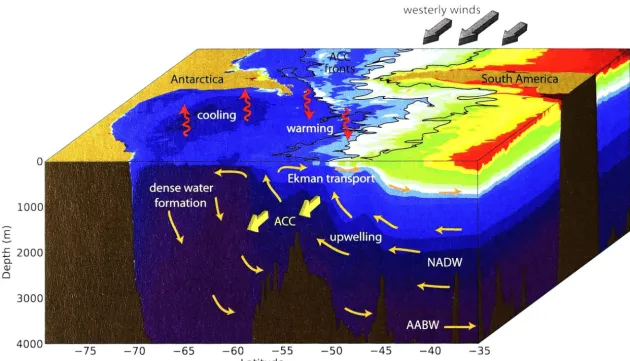
Figure 1.1: Schematic of the large scale Southern Ocean circulation. Isopycnal layers ( colour shows ocean density) tilt up towards Antarctica on the left, linked to the zonal Antarctic Cir
cu111-polar Current (ACC; yellow arrows and black streainlines) through a thern1al wind balance.
Up-welling 111odified North Atlantic Deep \Nater (NADW) splits at the surface into the two branches
of the n1eridional overturning circulation. vVarming and freshening permits northward Ekinan transport in the surface layer to close the upper cell, while dense water forn1ation near the coast of
Antarctica replenishes the lower cell with Antarctic Bott0111 vVater (AABW). [Figure constructed
from data sourced fr0111 a global 1VI01VI4 si111ulation run by Paul Spence.]
The strongly tilted density layers (isopycnals) in the Southern Ocean are central to both the ACC and the overturning circulation. A co1nbination of strong westerly winds and surface heat and freshwater fluxes set the mean stratification. The winds drive a thin Ekn1an layer, which, due to the rotation of the Earth, transports water northward in the upper few hundred rnetres of the ocean. The northward n1ove1nent of the surface waters tilts up the isopycnals in the south; so that modified North Atlantic Deep Water (NADvV) outcrops at the surface. The available potential energy stored in the tilted isopycnals is re lPased into 111esoscale eddies - coherent vortices roughly 10 -50 kin in size - through a process known as baroclinic instability. The eddy field acts to oppose the wind-driven strepening of the isopycnals and the resulting isopycnal slopes are pri1narily a balance between the con1peting effects of the Ekn1an and eddy-driven contributions. Latitudinally \rcu-)·ing heat and freshwater fluxes at the surface also contribute to setting the 1nean stratification in the Southern Ocean.
[image:14.834.65.695.129.490.2]§1.1 Southern Ocean circulation 3
level of the shallowest topography in the unblocked passage ( occurring at Drake Passage - the gap between Antarctica and South America), the southward flow may be sustained
by zonal (east-west) pressure gradients across the topography. Above the Drake Passage
sill, upwelling is only possible through the mass flux induced by the eddy field, which
occurs via zonal variations in the thickness of isopycnal layers, giving rise to the necessary
pressure gradients to drive the meridional flow (Speer et al., 2000b). If the meridional
transports are integrated along lines of latitude (known as a zonally averaged framework),
two separate Southern Ocean overturning cells are clear, with the upwelling waters
divid-ing into two branches at the surface (Figure 1.1). The upper cell returns lighter water
masses, after warming and freshening at the surface, northward towards the equator in
the upper Ekman layer. Sea ice forming polynyas around Antarctica modify the upwelled
waters entering the abyssal cell, returning cold, dense Antarctic Bottom Water (AABW)
northward along the bottom topography.
Viewed in three dimensional space, observations suggest that the global overturning
circulation is rather more complicated and interconnected than what is implied by the
simplified zonally averaged picture (Lumpkin and Speer, 2007; Marshall and Speer, 2012;
Talley, 2013). In this framework, the two overturning cells are intrinsically connected.
After up\iVelling in the Southern Ocean, modified NADW flows primarily southward (not
northward) at the surface to form bottom water around Antarctica and fill the abyss of the Indian and Pacific basins as AABW. The deep water formation regions in the North
Atlantic are fed primarily from water masses most recently upwelled in the Southern
Ocean from the AABW pathway via the Indian and Pacific basins, instead of the direct
NADW pathway. Rather than the two nearly independent overturning cells that appear in
the zonal-average framework, the new global conceptual picture more closely resembles a
single loop, linking all ocean basins and deep water formation regions. However, while our
understanding of the dynamical controls on the overturning remains far from complete, progress can be made through attempts to first understand the overturning in a simplified
framework.
The upwelling is distributed around the Southern Ocean and, despite its importance for
global climate, has a transport of roughly one fifth the 1nagnitude of the ACC transport.
Assuming evenly distributed circumpolar upwelling and a net transport of 30 Sv, the
1nean vertical velocity is only rv50 m/ yr. v\Tith present measurement techniques, it is impossible to directly measure such small velocities against the large background noise of
the eddy field, which may induce transient vertical velocities of up to 200 n1/ day (Rivas
et al., 2008). Knowledge of the pathways and transport of the overturning circulation has
therefore been inferred from indirect methods, such as tracing of water 1nass properties
( e.g. temperature, salinity, oxygen) in hydrographic sections. However, the scarcity of
measurements results in large uncertainties in the observational transport estimates of
rv30-60% (Talley, 2008). The necessity of resolving eddies, due to their central role in
the upwelling above topography, has also slnwed progress in numerical 1nodelling of the
4 Intro cl uction
The Antarctic Circun1polar Current arises through a thennal wind balance with the
1neridional density gradient. That is, the strength of the ACC transport is directly related
to the slope of the isopycnals in the Southern Ocean (Rintoul et al., 2001). Satellite
observations and high resolution idealised nu1nerical models have illustrated the co1nplex
structure of the ACC ( e.g. surface streamlines in Figure 1.1). The energetic Southern Ocean eddy field splits the current into multiple jets that divide and 1nerge along the circumpolar path.
1.1.2
Sensitivity to surface forcing
The significance of the Southern Ocean for global climate arises largely due to the capacity
of the ocean circulation to respond to changes in external forcing. However, the dyna1nics of how the circulation responds to forcing perturbations is uncertain. The sensitivity of the Southern Ocean overturning to changing wind stress and buoyancy fluxes is one of the largest unknowns in solving the puzzle of glacial-interglacial transitions, as well as in
predicting the extent of future climate change.
The upper overturning circulation in the Southern Ocean is commonly considered to be wind-driven, due to the central role of the divergent surface Ekman transport in driving upwelling (Toggweiler and Samuels, 1993; Marshall and Speer, 2012). In this simple view, unifonn increases in wind stress enhance the divergence and therefore the rate of upwelling.
Coarse resolution 1nodelling studies support this theory, showing overturning increasing
in proportion to westerly wind stress (Saenko et al., 2005). However, over the last decade,
models that partially resolve the eddy field, known as eddy pennitting models, have shown that the response of the eddy field to changing wind stress co1nplicates the simple wind-driven theory (Hallberg and Gnanadesikan, 2006; Farneti et al., 2010). Eddies act to relax
the isopycnal tilt, effectively providing a southward 1nass transport in the surface layers of the Southern Ocean. As the wind stress increases, the eddy field increases approximately linearly (Hallberg and Gnanadesikan, 2006; Abernathey et al., 2011; Meredith et al., 2012) 1
causing an increase in the southward transport, which opposes the wind-driven increase
in the northward Ek1nan transport. Therefore in the presence of eddies, the overturning sensitivity to wind stress is decreased. This pheno1nenon is tenned eddy compensation. Extrapolating from the results of coarse resolution and eddy pennitting studies, it has been hypothesised that. in eddy resolving n1odels or the real ocean, wind-driven increases in the southward eddy transport 1nay exactly counteract increases in the northward Ekn1an
transport (Hallberg and Gnanaclesikan. 2006: Farneti et al.. 2010). Such perfect eddy
con1pensation would yield the upper overturning cell co1npletely insensitive to changes in
wind stress.
l early all sensitivity studies of the upper overturning circulation have focused on the response to ,,-incl stress changes. clue to the wind-driven overturning hypothesis of Togg-,n:'iler and Sann1els ( 1995). However. air-sea fluxes of heat and precipitation in the n1icl-latitucles abo pla~- a critical role in the overturning clyna1nics by allowing the conversion
§
1.1 Southern Ocean circulation 5et al., 2000b). While it has been proposed that changing mid-latitude buoyancy fluxes may have played a significant role in driving the enhanced overturning and outgassing
following the Last Glacial Maximum (Watson and Naveira Garabato, 2006), the idea has not been extensively tested.
There is some confusion over the influence of wind stress on the lower overturning
cell. The proposed theory of Toggweiler et al. (2006) for the Southern Ocean control on
the glacial-interglacial atmospheric CO 2 variability relied on an enhancement of the lower overturning cell with increased or southerly shifted westerly winds. Several numerical
modelling studies have demonstrated an increase in the lower overturning cell in response
to enhanced westerly winds, but have failed to produce the required control on
atmo-spheric CO 2 (Menviel et al., 2008; Tschumi et al., 2008; D'Orgeville et al., 2010). Recent theoretical scaling arguments predict the opposite: that the strength of the lower cell
de-creases as wind stress inde-creases (Nikurashin and Vallis, 2012). An analysis of the third Coupled Model Intercomparison Project ( CJVIIP3) models also suggests that stronger wind
stress would weaken the abyssal overturning in the Southern Ocean (Saenko et al., 2012).
JVIeanwhile Stewart and Thompson (2012) find that, although the abyssal overturning is relatively insensitive to the midlatitude westerlies, there may be a strong dependence on the weaker polar easterlies. In their model, increases in the easterly wind stress near the
coast of Antarctica reduce eddy activity over the continental slope, thereby increasing the
dominance of the mean wind-driven component of the overturning. While the sensitivity
of the lower overturning circulation to changing wind stress remains unclear, a solution for the Southern Ocean control on the atmospheric CO 2 concentration could lie with the dynamics of the upper overturning cell. Lauderdale et al. (2013) ran a series of
South-ern Ocean simulations with varying wind stress and buoyancy forcing and found a linear
relationship between the strength of the upper overturning cell and atmospheric CO2.
Furthermore, buoyancy forcing is a more prominent controlling factor on the sensitivity
of the abyssal overturning circulation. Sea ice formation on Antarctic shelves creates cold,
salty shelf waters, which descend the continental slope to form Antarctic Bottom Water. JVIodelling studies with increases in either atmospheric CO 2 or melting of Antarctic ice
sheets respond with a reduction in the volume and density of dense water production ( e.g.
Stouffer et al., 2007; Swingedouw et al., 2008; JVIenviel et al., 2010). In many models this reduction in deep water formation leads to a dramatic shut down of the lower
overturn-ing cell. However, the air-sea heat and freshwater flux thresholds which may result in a shutdown of the lower overturning cell in the real ocean are unknown, due to the inacces-sibility of the Antarctic dense water formation regions and the difficulty of modelling the
small-scale convective structures.
Finally, the transport of the ACC may be influenced by any factor that can change the
tilt of the Southern Ocean isopycnals. Local surface heat and freshwater flux perturbations
may change the density structure of the water column and therefore the ACC transport
6 Introduction
and Vallis. 2007). However, n1odels and observations indicate that ACC transport is
only weakly sensitive to changes in wind stress (Nieredith and Hogg, 2006; Hallberg and
Gnanadesikan, 2006; Farneti et al., 2010; Jones et al., 2011). The limited sensitivity
of the ACC transport is thought to be a result of the near linear response of the eddy
kinetic energy to increasing wind stress. As the enhanced wind stress acts to steepen
isopycnals, a 111ore active eddy field opposes by flattening the isopycnals. This 111echanisrn
is known as eddy saturation ( distinct from eddy compensation, which refers to lirniting of
the overturning sensitivity).
1.2
Glacial-interglacial
cycles and
the
Southern Ocean
Pockets of gas trapped in Antarctic and Greenland ice cores reveal a striking pattern in
the history of atmospheric CO2 (Figure 1.2; Petit et al., 1997). Cold glacial periods with
low at1nospheric CO2 are terminated by rapid warming and enhanced atmospheric CO 2,
with a cyclic period of roughly 100,000 years. The regularity of the glacial-interglacial transitions, without an obvious trigger or dynamical sequence, has confounded scientists
for decades ( e.g. Siegenthaler and Wenk, 1984; Sig1nan and Boyle, 2000; Broecker, 2009;
Fischer et al., 2010).
4 ,- - - ,
,.-...
~o
::J O 0
+-' ..__..
m C I.... 0 (l) · -0.. +-'
E -~ -4 ~ ~
-8
300
Q
-,
IT
0
260 ::J 0.. 0 ><
220 ?5"
,.-...
"'O
-0
' - - - -_ _ _ _ _ , _ _ _ _ _ J _ _ _ _ _ L _ _ _ _ _ _____,_ _ _ _ ____J.__ _ _ _ _ _ J L _ _ _ _ _ - - - - ' - - - ' - - - ' 180 3
0 100 200 300 400 ..__.. <
Thousands of years ago
Figure 1.2: Data from the Vostok ice core in Antarctica, showing the last four glacial cycles
(from Petit et al., 1997). a) Variation in Antarctic temperature relative to preindustrial climate.
b) Atmospheric CO2 concentration. Note that the tin1e axis is reversed.
A n1ajor breakthrough can1e fro1n the record of atn1ospheric radiocarbon. J.4C: over
the last glacial c::cle (Hughen et al.. 2006). l-tc is fonned in the atrnosphere through
the interaction of cosn1ic rays with nitrogen and decays with a half-life of ""'6000 years.
As the Earth "·arn1ed o\·er the last 20.000 years (since the Last Glacial 1'Iaxin1u1n) and
atn1ospheric CO2 increased. the at111ospheric 1"1C concentration sin1ultaneously decreased.
The drop i11 l-1 C in1plicates glacial carbon storage in the deep ocean. resulting in an isolated
[image:18.831.64.691.591.850.2]§1.3 Anthropogenic climate change and the Southern Ocean 7
with a corresponding glacial-interglacial history of 14C, providing observational evidence
that the interglacial rise in atmospheric CO2 is closely linked to Southern Ocean upwelling
rates.
Debate is ongoing about the relative roles of upwelling from the upper or lower
over-turning cells and whether the changes in upwelling were primarily wind or buoyancy driven.
As outlined in Section 1.1.2, Toggweiler et al. (2006) proposed that atmospheric CO2
in-creased as a result of enhanced upwelling and outgassing from the lower cell, driven by
increased or southerly shifted westerly winds. They argue that only changes in the lower
overturning cell can be important, because the upwelled carbon is drawn from depths
>2000 m. Yet paleoceanographic models have failed to demonstrate a link between the
strength of the lower overturning cell and atmospheric CO2 concentration (Menviel et al.,
2008; Tschumi et al., 2008; D'Orgeville et al., 2010). Furthermore, recent theory and
cou-pled model analyses suggest that the lower overturning cell actually scales inversely with
westerly wind stress (Nikurashin and Vallis, 2012; Saenko et al., 2012). An alternative
hypothesis is that carbon outgassing increased following the Last Glacial Maximum due
to an enhancement of the upper overturning cell, driven either by increased wind stress or
increased heat and freshwater fluxes in the midlatitudes (Watson and N aveira Garabato,
2006). The question of how the abyssal carbon (at depths >2000 m) enters the upwelling
limb of the upper overturning cell (usually <2000 m) may be solved by either increased
interior vertical mixing (Watson and Naveira Garabato, 2006) or a wind-driven deepening
of the upper cell (Barker et al., 2010; Nikurashin and Vallis, 2012). Further support for
outgassing driven by changes in the upper cell, rather than the lower cell, is provided by
the recent modelling study of Lauderdale et al. (2013), which found a linear relationship
between the strength of the upper overturning cell and atmospheric CO 2.
1.3
Anthropogenic climate change and the Southern Ocean
There is a strong signature of human-induced climate change in the Southern Ocean.
The warming trend is more intense and deep-reaching compared with the global average,
due to the connection between the surface and deep ocean provided by the overturning
circulation (Gille, 2008; Purkey and Johnson, 2010). Freshening also extends through
the water column to the abyssal water masses (Durack and Wijffels, 2010; Purkey and
Johnson, 2013).
The fast timescale of the Southern Ocean changes indicate that they have likely been
driven by changes in the local forcing. Due to changes in both atmospheric ozone and
CO2 forcing, the westerly winds have strengthened and shifted southward (Thompson and
Solomon, 2002; Marshall, 2003). Climate models predict that this trend will likely continue
in the future, despite ozone recovery (Bracegirdle et al., 2013). Surface air temperatures
have increased ( Chapman and Walsh, 2007).
It
is likely that precipitation over far southernlatitudes has also increased due to an amplified hydrological cycle (Durack et al., 2012)
8 Introduction
the Southern Ocean fro1n Antarctic ice sheet 111elt is also accelerating (Rignot et al.. 2011).
Due to the uncertainty in the sensitivity of the Southern Ocean circulation. it ren1ains
unclecu- ,,·hat effect these forcing changes ,vill have on the ACC and overturning circulation.
An obserYational a.nal:vsis of recent changes in the zonally averaged isopycnal slopes in
the Southern Ocean concluded that there have been no detectable changes in the ACC
transport to date (Boning et al. 2008). Several studies have suggested that the upper
OYerturning circulation 111a.y have increased in response to enhanced \\resterly ,vinds. using
indirect observations including an inverse calculation of atn1ospheric CO2 history (Le
Quere et al.. 2007). trends in ship-based pC0 2 111easuren1ents (Takahashi et al.: 2012)
a.nd spatial patterns of change in ocean chlorofluorocarbon concentrations (vVaugh et al.: 2013). \:Vhile the indi·vidual uncertainty in each of these 111ethods prohibits a conclusive
result. the agreen1ent between then1 adds plausibility to the hypothesis that the upper
OYerturning cell 111a.y be strengthening due to clin1ate change. Changes in the upper
overturning circulation 111ay have severe in1plica.tions for the rate of global \Varn1ing. The
oceans have absorbed 30% of the additional CO2 that hun1ans have released into the
atn1osphere uver the period 1960-2008 (Le Quere et al.: 2009). Around half of that CO2
has been absorbed south of 30°S (Takahashi et a.l.: 2012). due to the overturning of ·water
111asses b:· the Southern Ocean circulation. Enhanced upv.relling would likely increase the
outgassing of natural carbon fron1 the deep ocean. offsetting the uptake of anthropogenic
carbon in the short tern1 (Le Quere et a.l.. 2007: Takahashi et al.. 2012). The resultant
increase in atn1ospheric CO2 and ten1perature could lead to a positive feedback. driving
further increases in the strength of upwelling and outgassing in the Southern Ocean.
ObserYations of the ab:·ssal Southern Ocean indicate that Antarctic Botton1 vVater is
y\·anning (Purke:· and Johnson. 2010: I(ouket u et al.. 2011) and freshening (Purkey and
Johnson. 2013). I(a,Yano et al. (2010) inferred that the warn1ing n1a:· be linked to a change
in the transport of the lo,Yer o,·erturning circulation. since the obserYed warn1ing pattern
is concentrated on _--L..\B\Y pat h,,·a:·s and depth le,·els. I(ouketsu et al. (2011) also h:vpot
h-esised a reduction in transport of the lo,,·er o,·erturning cell. based on the correlation in
their ocean reanal:·sis data bet,Yeen the a b:·ssal ,,·anning and AAB\\-- transport. Ho,,·e,·er.
actual transport obse1Tations are too scarce and uncertain to conclu ·i\·el:· sho,,· a change
in thl' lcm·er oYerturning cell (Shi1nada et al.. 2012). It ren1ains possible that the re1note
changes in AAB\\-- properties n1a:· be caused b:· ten1perature and salinity changes at the
forn1c1 t ion regions. or enhanced deep 1nixing. rat her than reel uced \·ol un1e fluxes.
1.4
Research orientation
The research prE'sentecl in this t llE'sis hc1s been able to contribute to long-standing ques
-t il)llS in the DC' lcl through the use of an idealised. high resolution ocean 1nodelling approach.
\\-hilr 111c111:· pre,·ious stucli 'S ha,·e used 111ore con1prehensiYe n1odels. such as the global
n)uplt'd 111odcb used for the I11tergo,·ern111ental Panel on Clin1ate Change (IPCC) reports.
-§
1.4 Research orientation 9stricts the resolution of such models and thereby introduces the need for parameterisation
of the eddy field. Smaller domain, high resolution uncoupled ocean models have the advan-tage of explicitly resolving the eddy field, which has an order one effect on the response of the Southern Ocean circulation. Although the exact quantitative response of the Southern
Ocean circulation can not be determined using idealised models, the dynamical insights
gained through these methods have significantly advanced progress in understanding the
Southern Ocean circulation and its role in global climate.
The first two chapters are a sensitivity analysis of the upper overturning circulation in
the Southern Ocean in response to changing atmospheric forcing. Chapter 2 investigates
the influence of midlatitude buoyancy forcing on the strength of the upper overturning
cell. In Chapter 3, the extent of eddy compensation and eddy saturation are examined
under a range of wind stress perturbations and model resolutions.
The final two chapters seek to explain elements of the temperature changes that have
been observed in the Southern Ocean in recent decades, through an improved
understand-ing of the changes in ocean circulation. Chapter 4 presents an investigation of possible
mechanisms affecting the accelerated depth heat uptake in the Southern Ocean
mid-latitudes. The role of eddies and changes in the upper overturning circulation in modifying
both wind and surface warming driven changes in heat content are assessed. Chapter 5
brings attention to observations of recent sea surface temperature cooling south of 50°S in
the Southern Ocean. The observations are compared to the transient response of an
ide-alised model to surface warming and freshwater perturbations and a possible ocean-driven
Chapter 2
Sensitivity of the Southern Ocean overturning
circulation to surface buoyancy forcing
Abstract
The sensitivity of the Southern Ocean overturning to altered surface
buoy-ancy forcing is investigated in a series of eddy-permitting, idealised simula-tions. The modelled response indicates that heat and freshwater fluxes in the
Southern Hemisphere mid-latitudes may play a significant role in setting the
strength of the overturning circulation. Enhanced buoyancy fluxes act to
in-crease the meridional overturning up to a limit approaching the wind-driven
Ekman transport. The sensitivity of the overturning to surface buoyancy
forc-ing is strongly dependent on the relative locations of the wind stress profile,
buoyancy forcing and upwelling region. The numerical simulations provide
support for the hypothesis that changes in upwelling during deglaciations may
have been driven by changes in heat and freshwater fluxes, instead of, or in
addition to, changes in wind stress.
2.1
Introduction
The southern limb of the oceanic meridional overturning circulation plays a key role in the
Earth's response to climate change. The rise in atmospheric CO 2 at glacial-interglacial transitions has been attributed to outgassing of enhanced upwelling water masses in the
Southern Ocean (Skinner et al., 2010), while subducting water masses currently represent a significant fraction of the global anthropogenic CO2 sink ( Gruber et al., 2009). Despite
the significance of the Southern Ocean overturning to past and future climate change, the
dynamics and sensitivity to forcing changes are poorly understood.
The upper cell of the Southern Ocean meridional overturning is commonly considered
to be a wind-driven circulation, with dense waters upwelling along steeply tilted isopyc-nals, driven by divergent Ekman transport at the surface (Toggweiler and Samuels, 1993).
Coarse resolution modelling studies support this theory, showing overturning increasing in proportion to westerly wind stress (Saenko et al., 2005). JVIore recently, investigations into the response of the overturning to changing wind stress in eddy-permitting models
have revealed the significance of the eddy field to the overturning dynamics; increases in
12 Southern Ocean overturning sensiti·vity to surface buo,,-ancy forcing
Ekn1an transport are at least partially con1pensatecl by increases in opposing eddy-induced
transport. in1plying only a ·weak sensitivity of the net residual overturning transport to \\-ind stress (Hallberg and Gnanadesikan. 2006: \/iebahn and Eden: 2010: Farneti et al.. 2010). The focus of these n1odelling studies has been on the effect of wind stress forcing
on the overturning; while very little n1odelling work has exa1nined the response of the oYerturning to changes in surface buoyancy forcing.
Air-sea fluxes of heat and precipitation over the Antarctic Circu1npolar Current (ACC) region are necessary for the conversion of dense up·welled water n1asses into lighter waters at the surface (Speer et al.: 2000b). Theoretical fran1evvorks, based on zonally averaged re
p-resentations of the 1neridional overturning circulation (lv'Iarshall and Radko, 2003; Radko and I(an1enkovich, 2011), shoviT the 1nagnitude of the overturning increasing linearly with
the net buoyancy flux supplied to the surface n1ixed layer. \i\Thile the effect of mid-latitude
buoyancy fluxes on the overturning has not been extensively tested in an eddy-permitting nun1erical n1odel, coarse resolution si1nulations have highlighted the link between southern hen1isphere 1nid-latitude freshwater forcing and the formation of deep water in the North
Atlantic (Saenko et al., 2003).
It
has also been proposed that the increase in atn1osphericCO2. observed at the end of the last glacial 1naxin1u1n, ,vas a result of increased upwelling
in the Southern Ocean, driven by an increased surface buoyancy flux (\i\Tatson and _ J aveira
Garabato. 2006). In addition, observational studies have shown that heat and freshwater fluxes into the Southern Ocean have increased over the past few decades (Boning et al.,
2008) and n1odelling studies sugge t that this trend ,vill continue with future cli1nate
change (Bracegirdle et al., 2008). However: due to the sparse coverage of flux data in the
Southern Ocean and the difficulties of investigating buoyancy forcing in coupled clin1ate
1nodels. the dependence of the 1neridional overturning on surface buoyancy forcing has not been fully explored.
In this paper we investigate the dependence of the overturning on surface buoyancy forcing in the n1id-latitudes through a series of ecldy-pen11itting. idealised si1nulations of
the Southern Ocean.
2.2
Model
\Ye use GOLD. the pri1niti,-e equation. isop~-cnal layered ocean n1oclel of Hallberg and Gnanaclesikan (2006). ,,-hich is a recent adaptation of the Hallberg Isop~-cnal :).Iodel (Ha
ll-berg. 199.S). The icleali eel clo1nain i a zonally reentrant. --10° ,Yide sector of the Southern Ocean ,Yith a sin1ple Drake Passage-like sill (Figure 2.la). A :).Iercator grid. with grid
~ize decrec1.sing to11·arcls the southern boundar~-. is e1nployecl at t11·0 different horizontal re:-;olutions ( l/_1::: and
1
/
~
2) . resultinrr in square grid cells of site 1--1 kn1 (1/.1°) and 7 kn1 ( l/s2
) at 60:::S. The latitucli.nal e:;.;:tent is fro1n 70°S to the equator. A sponge of "·idth
·12 at the equator rela:;.;:es the clensit~· stratification to obsen ·ational data (Le,-itus. 2010)
at the northern boundary ,Yi th a decay tin1escale of 1 cla~-. This allo"-s an effectiYe
§2.2 Model
a) Buoyancy forcing (1
o-
8 m2s-3)-8 -6 -4 -2 0
-
(f)0
10
20
~30
CD "O
::J E 40
Cd
_J
50
60
10~· --...-iililo..;;.!;~ --...._ ...
0 10 20 30
Longitude ( 0)
Upwelling per grid cell (x 1
o
-
3Sv)40
4000
3000
-
E2000£
1000
0
0..
CD
0
b) 0o 5 1 0 1 5
C)
,,,...
-(f)10
20
~30
CD "O ::J
E 40
Cd
_J
50
60
70=----~_.d_~___L~__J
0 0.05 0.1 0.15
Wind stress (Nm-2)
-8 -4 0 4 8 12 1 6
Buoyancy forcing (1
o-
9 m2s-3)13
Figure 2.1: (a) Bathymetry, with spatial distribution of buoyancy forcing shown in contours. (b) Zonally averaged wind stress (black) and theoretical zonally integrated Ekman-induced
up-welling in each meridional grid cell (red). ( c) Zonally averaged buoyancy forcing ( control in black,
perturbations in colour).
incoming velocities. Bathymetry consists of an Antarctic shelf and Drake Passage-like sill,
providing an unblocked circumpolar passage down to 2500 m below the surface, with a
maximum ocean depth of 4000 m. A three layer bulk mixed layer is used, in addition to
nine interior constant density layers (shown in Figure 2.2a). Biharmonic viscosity with an
additional Smagorinsky component provides numerical closure. Biharmonic coefficients
are set to 2x10
11
m4
s-1 (1/4
°
)
and 2x10¹⁰
m4
s-1 (1/s
0) . A weak diapycnal diffusivity of
10-5 m2 s-1 in the interior ensures a largely adiabatic circulation. The control cases are
spun up for rvl20 years (Figure 2.2c). Perturbations from the end of the control spin-up
are allowed to reach equilibrium ( rv30 years), and 25 year averages after these spin-up
[image:25.783.253.620.123.725.2]14 Southern Ocean o,·erturnjng sensjtjvjty to surface buo:vancy forcjng
a
0 b -40 1028
--C'J
-45 1027.5 E en
~ 1000
-- -50 E
(j)
0 .__.
1027 .c (/)
C
Cl)
-5 2000 -o Q) -55
a. ::::,
(1) -~
0
-
ell-0
1026.5 ell
-.:; C
Cl)
_J -60 1026
-
03000 a. (1)
0
-65 1025.5 ell
't: ::::,
4000
-70
-70 -60 -50 -40 -30 10 20 30
(j)
1025
Latitude (0S) Longitude (0)
C 4 d 2.5
--
>(j)
1025
(j) 3
--0 '?
0 E
(".) 0)
2
-->(j)
1.5 en
-
2 ~ell
.c -~ 1026
-
O') (/)C 1 C
Cl) Q)
.... -a
en ell
en ·.;:;
C 0 C 1027
C (1)
....
-::::, 0
-
.... CLCl) -1 >
C
·c
1 .2 ....
....
Q) 0.5 > 0 ell ::::, 0 -0 . ii5
Q) -0.5 a:
0
1028 -1
40 80 120 160 -60 -40 -20 0
Time (years) Latitude (0 S)
Figure 2.2: (a) Zonally and ten1porally averaged isopycnal layers for the
1/
0control si1nulation.
(b) Snapshot of surface potential density for the
1
/
s
0control simulation. ( c) Timeseries of 1/8°
m·erturning spinup. The n1axin1un1 of the upper (lower) cell in the control run at 30°S is shown in
black (blue). \Yith the buoyancy forcing perturbation 16 x 10- 9 m2 . - 3 shown in red. The \·ertical line indicates the point after \Yhich the 2.S year aYerages \\·ere calculated. ( d) Residual overturning
streamfunction in den ity space for the
1
/
0control sin1ulation. Positive values (red) indicate cloc
k-\\·i ·e transport . \\·hile negati\·e \·alues (blue) indicate anti-clock\\·ise transports. The \·ertical black
lines shmY the extent of the unblocked circun1polar pas. age ( abm·e the sill). Horizontal sections
of the stream function imply adiabatic transport along isopycnal la\·ers. Since the isopycnals are
strongl~· tilted in the south. this also indicates up\Yelling.
The 111odellecl residual o\·erturning 1s forced by zonally and te111porall>· invariant. s1
-nu. ·oida.l \\·incls. \\·ith a n1axi111u111 of 0.12 ~ 111- 2 at .S0°S (Figure 2.lb). The idealised
buo>·anc>· forcing used in the 111odel (Figure 2. la.c) is based on net heat and fresh\vater
surface fiuxe--; cleri\·ecl fro111 se\·eral observational and reanab·sis products. Sparse data
co\·erage ( and loose l_\· constrained reanal_\·ses) over the Southern Ocean is no in1peclin1ent
to this stucb·. as our fra.n1e\\·ork tests the sensiti\·it>· of the overturning to forcing changes.
rat her than sinnda. ting the exact structure a.nd n1agnitude of t lie overturning. The region
of 111id-latititude positi\·e buo>·anc>· forcing (ie. acting to decrease the density of surface
\\·1:-1.ters) in the control run has a 1nagnitucle of -l x 10- 9 1112 s-:3. incorpora.ting both heat and
frC'sll\vater fluxes. The region of negati\·p buo>·ancy forcing has a zonal average peaking
§2.3 Results 15
an Antarctic Bottom Water cell in this model). We use a fixed, non-interactive buoyancy
flux, to allow precise control of surface buoyancy forcing and an increased ability to isolate
dynamical processes.
2.3
Results
The surface forcing generates a Southern Ocean-like state (Figure 2.2) with tilted
isopy-cnals, an energetic eddy field with associated fronts and jets and two overturning cells
which broadly resemble observations (Speer et al., 2000b). The lower Antarctic Bottom
Water cell is driven principally by the negative buoyancy forcing near the southern
bound-ary. The ACC transport in the model is 108 Sv in the 1/4° runs and 91 Sv in the 1/s0
runs. The upper meridional overturning cell simulates the upwelling of NADW in the
latitudes unblocked by bathymetry. Scaled up to the full width of the Southern Ocean,
the transports of the upper and lower cells in Figure 2.2d would be 23 Sv and 9 Sv
re-spectively. The meridional overturning in the model is largely adiabatic in the interior,
with diapycnal transport occurring predominantly in the mixed layers, as allowed by the
surface buoyancy forcing and diapycnal eddy transports.
As the mid-latitude surface buoyancy forcing is increased, so does the overturning in
the upper cell (Figure 2.3), while the lower overturning cell is unaffected. Due to the
adiabatic nature of the overturning, the changes in a single profile of the streamfunction
( as shown in Figure 2.3a) are representative of the changes in the structure of the entire
overturning cell. When surface buoyancy forcing is weak, the modelled overturning is
substantially less than the magnitude of the wind-driven Ekman transport (Figure 2.3b).
At progressively larger values of buoyancy forcing, the overturning approaches a limit close
to the value of the Ekman transport ( offset by the opposing eddy-induced transport). The
simulated 1/s0
overturning is less sensitive to buoyancy forcing than the overturning in
the 1/4° model. Though it may appear that the reduced sensitivity in the 1/s0
model is
a result of eddy compensation, this is not the case; the eddy kinetic energy (EKE) is
nearly insensitive to buoyancy forcing. In the 1/s0
model, a doubling of buoyancy forcing
increases EKE by less than 5%, whereas a doubling of wind stress increases EKE by more
than 100%.
Increased buoyancy forcing results in an expected lightening of surface waters and an
associated southward shift in the location of isopycnal layer outcropping (Figure 2.4a). The
structure of the overturning in the interior remains largely unchanged and therefore the
upwelling region also shifts southward, following the movement of the outcropping. Note
that the data shown in Figure 2.4a indicates roughly the latitude of the northern edge of
the upwelling, which is spread over a 5° - 8° latitude band. The limiting behaviour seen in
Figure 2.4a arises due to the restricted range of the mid-latitude buoyancy forcing. There is
nearly no change in the latitude of outcropping south of 50° - 55°S (Figure 2.4b). Therefore
the upwelling shifts southward only so far as the mid-latitude buoyancy perturbations
extend. The reduced surface density at high latitudes in the 1/s0
16 Southern Ocean overturning sensitivi(y to surfr1ce buoyancy forcing
Figure 2.4 and the 25% reduction in ACC transport con1pared with the 1(1° 111odel) 111ay
be linked to an enhancen1ent of the eddy field at higher resolution. EKE is around 40%
higher in the
1/s
0rnodel and the increased eddy field acts to reduce the tilt of isopycnal layers near the surface, resulting in more southerly outcropping in the higher resolution
case. a)
----Cf) I E 0) .:::.::.- -2 x10⁻⁹ m2s-3
- - 4 x10⁻⁹ m2s-3
1024 - -8 x10⁻⁹ m2s-3
- -12 x10-9 m2s-3
- - 16 x10-9 m2s-3 ;:: 1025 _ _ _ _ _ _ _ _ ___,
...
(/) C
Q)
-a
ro 1026
·.;:::; C Q) ... 0 0... b) 1027 1028 -2
3.5
----
> (f) (f) 0 3 0 C') ... ro E :J E·x 2.5 ro E 0) C C ' -:J 2 t Q) > 0
-1 0 1
Overturning streamfunction (Sv)
2 3
• 1 /4°
--- 1 /8°
1 . 5 .___ _ ___,,_ _ _ ____.__ _ _ ..,__ _ _..._ _ _ _J... _ _ _ . _ _ _ _ , . _ _ _ _ _ _ , _ _ _ ,
0 2 4 6 8 10 12 14 16
Buoyancy forcing (1
o
-
9 m2s-3)Figure 2.3: (a) Transects of the overturning streamfunction (such as shown in Figure 2.2d) at
30°S for a range of buo\anc.v forcing perturbations. run at
1/s
0resolution. The upper (lower)
m·erturning cell is represented b~: positive (negative) streamfunction values. (b) l'viaxi1num of the
m·crturning ::;tre:::unfunction at 30°S for \·aried surface buoyancy forcing and resolution. The error
bars ::;hm\· the standard clevia t ion of 1 vear m·erturning averages from the 25 year mean. The
a) 44 46
---CJ) 0 ._ 48 (l) "'O :::i +-'~ 50
0.. 0 ,._
.8 52
:::i 0 54 56 0 ..- 1023 C') I E
~ 1024
--
>, +-' ·u5 1025 C (l) "'O (l) 1026 () C1:S-
,._ :::i CJ) 1027 2§2.4 Discussion
---- 1/4°
---- 1/8°
4 6 8 10 12 14 16
Buoyancy forcing (1
o-
9 m2s-3) ---.,...,,., .,,.._;,.' .,,;, . / / / / / / ./ / / . , / 1028L--~-'-~~...I.-~---'-~~-'-~---'~~---'-~~.,__~___,-70 -65 -60 -55 -50 -45 -40 -35 -30
Latitude (0S)
17
Figure 2.4: (a) The variation, with applied buoyancy forcing, of the latitude at which the 1 Sv overturning streamfunction outcrops into the upper isopycnal layer. (b) Mixed layer density for a range of simulations with varied resolution and buoyancy forcing. All values in this figure are zonal and temporal (25 year) averages.
2.4
Discussion
These idealised model results indicate that the overturning circulation is sensitive to
mid-latitude buoyancy forcing. Increases in buoyancy forcing act to shift the location of
up-welling southward, while enhancing the overturning circulation. The enhanced upup-welling
is qualitatively consistent with theoretical predictions (JVIarshall and Radko, 2003; Radko
and Kamenkovich, 2011) which indicate the need for water mass transformation to occur
if upwelled water masses are to travel northwards in the surface layers without being
im-mediately subducted. The change in upwelling location helps to control the sensitivity of
the overturning to buoyancy forcing.
The upwelling region in the model is determined by a number of factors, including
bathymetry, the eddy field, wind and buoyancy forcing. The modelled upwelling therefore
does not necessarily coincide with the location of the maximum potential Ekman-induced
upwelling (profile shown in Figure 2.1 b). As the upwelling location is forced southward by
[image:29.783.244.632.128.623.2]re-18 Southern Ocean o,·erturning sensitivi(Y to surface buqvancy forcing
gion of low Ek111an-induced upwelling: southward to a region of higher Ekn1an-induced
up-1\·elling. The Ekn1an-induced upwelling transport (v x (7/(paf)) 6.x6.y) increases rapidly
fro1n zero at -J:5°S to a 1naxin1un1 at 56°S. The n1ore northerly location of the upwelling in
the 1/ -1° runs with low buoyancy forcing (Figure 2.4a) results in a strong sensitivity of the
overturning to buoyancy forcing perturbationsi as the upwelling 1noves through a region
with rapidly increasing Ek1nan-induced upwelling. The reduced sensitivity observed in
the 1/s0
sin1ulations n1ay be traced to the increased stratification and the location of the upwelling region on the boundary of the applied 1nid-latitude buoyancy forcing. However:
the profile of the Ek1nan-induced upwelling, which is nearly constant (
<
10% variation) over the range 52° - 61 °S, adds a further limit to the increase of the overturning circula -tion. Buoyancy forcing perturbations extending further south would not significantly alterthe overturning sensitivity.
In our 1nodel, the sensitivity depends on the relative locations of the wind stressi buoy -ancy forcing and upwelling. The greatest sensitivity occurred for low buoyancy forcing at 1/4° resolution, as the upwelling region ·was located furthest from the latitude of maximu1n Ek1nan-induced upwelling. The sensitivity for other models and the real ocean may vary widely from our results, depending on the stratification and the exact location and details of topography, wind stress and buoyancy forcing. However: we have highlighted that the
Southern Ocean overturning n1ay be strongly dependent on mid-latitude buoyancy forcing
under certain conditions. Given the importance of the meridional overturning strength for the future of the oceanic CO2 sink, our results indicate an urgent need to improve monitoring of Southern Ocean buoyancy forcing and overturning.
The sensitivity of the overturning to changes in buoyancy forcing presented here may
play a role in solving the 1nystery of glacial-interglacial transitions. Radiocarbon evidence supports the hypothesis that the increased at1nospheric CO 2 observed in Antarctic ice cores following the Last Glacial 1Iaximu1n was released fron1 deep water n1asses upwelling
in the Southern Ocean (Skinner et al.. 2010). though the trigger and n1echanis1n for the increased upwelling ren1ains unclear. Current theories rely predominantly on strengthening
and southward shifting ,vinds as the driving force for increased upwelling (Toggweiler et al..
2006). Ho,vever. both obserYations and 1nodels have cast doubt on this wind driven theory.
Paleoreconstructions of \\·incl using pollen and dust sources are sparse and inconsistent
(Fischer et al.. 2010). ,1·hile global coarse resolution n1odelling studies have shown that
eYen a doubling in ,\·incl stress produces onlv r-v35 ppm increase in atrnospheric CO2
(D.Orge,·ille et al.. 2010). Higher resolution n1odels are likely to show even less sensitivity
to \Yincl stress changes as a result of eddy compensation. On the contrary. it is plausible
that large changes in buoyancy forcing occurred at the encl of glacial periods. clue to sudden
changes in air te1nperature and sea ice extent. The dependence \Ve ha1·e found of the
o,·ertnrning on surface buo>·ancy forcing supports the h:vpothesis that buoyancy forcing
( in addition to changes in ,\·ind stress) n1a>· haYe played a n1ajor role in the enhanced
up11·elli11g and snbsequent outgassing of CO2 froIY1 the Southern Ocean during glacia
§2.4 Discussion 19
We have shown, using an idealised, but high resolution, 1nodel of the Southern Ocean,
that surface buoyancy forcing, in addition to wind stress, may also be significant in setting
the strength of the meridional overturning and that it may play an important role in past
and future climate change. Increased mid-latitude buoyancy forcing may have led to
enhanced Southern Ocean upwelling and therefore the rise in deglacial atmospheric CO2
at glacial-interglacial transitions. Given the significance of the Southern Ocean CO2 sink
to future climate change, we have outlined the need for improved observations and an
increased understanding of the dynamics of the meridional overturning circulation.
Acknowledgments
This work was supported by an ARC Discovery Project (DP0877824). Numerical
com-putations were conducted using the National Facility of the Australian National
Compu-tational Infrastructure. We wish to thank Steve Rintoul for useful comments and Robert
Chapter 3
On the relationship between Southern Ocean
overturning and ACC transport
Abstract
The eddy field in the Southern Ocean offsets the impact of strengthening winds on the meridional overturning circulation and Antarctic Circumpolar
Current (ACC) transport. There is widespread belief that the sensitivities of the overturning and ACC transport are dynamically linked, with limitation of the ACC transport response implying limitation of the overturning response. Here, an idealised numerical model is employed to investigate the response of the large-scale circulation in the Southern Ocean to wind stress perturba-tions at eddy-permitting to eddy-resolving scales. Significant differences are
observed between the sensitivities and the resolution dependence of the over-turning and ACC transport, indicating that they are controlled by distinct dynamical mechanisms. The modelled overturning is significantly more sensi-tive to change than the ACC transport, with the possible implication that the Southern Ocean overturning may increase in response to future wind stress changes without measurable changes in the ACC transport.
It
is hypothesised that the dynamical distinction between the zonal and meridional transport sensitivities is derived from the depth dependence of the extent of cancellationbetween the Ekman and eddy-induced transports.
3.1
Introduction
The overturning of deep, carbon rich water masses in the Southern Ocean is closely linked to the outgassing rate of natural CO2, and hence future changes in upwelling rnay signif-icantly impact the present-day global oceanic sink of atmospheric CO2 . The strong link between outgassing and overturning (Toggweiler et al., 2006) has led to the suggestion that the Southern Ocean sink has weakened in response to increased westerly winds, due to an inferred enhancement of the overturning circulation (Le Quere et al., 2007; Lovenduski et al., 2008). However, a number of recent eddy-permitting and eddy-resolving numerical studies ( e.g. 1\/Ieredith and Hogg, 2006; Hallberg and Gnanadesikan, 2006; Farneti et al., 2010) have shown that the sensitivity of the large-scale circulations in the Southern Ocean
22 Eclclv < c01noeJ. nsation ,,·ersw, eclclv saturation
111ay be reduced by eddy effects. This has led to the suggestion that the overturning cir-culation 111ay be less sensitive to changes in wind stress than previously thought. Despite the heightened focus on these questions, there remains significant uncertainty regarding the degree of sensitivity of the Southern Ocean circulation to wind stress and the potential interplay between the dynarnical responses of the overturning and Antarctic Circun1polar Current (ACC) transport.
Numerical 1nodels and observations reveal the dominant role of the 111esoscale eddy field in controlling the response of the ACC transport to changes in wind stress. Eddy
-pern1itting and eddy-resolving 111odels (lVIeredith and Hogg, 2006; Hallberg and Gnanade
-sikan, 2006; Farneti et al., 2010; Jones et al., 2011) show a decreased sensitivity of the zonal ACC transport relative to coarse resolution 111odels that use a te111porally invariant Gent and l'vicvVilliams (1990) eddy parameterisation. Limited response of the Southern Ocean isopycnal slopes over decadal timescales has also been observed, despite significant intensification of the westerlies (Boning et al., 2008). The li111ited sensitivity of the ACC transport is thought to be a result of the near linear response of the eddy kinetic energy to increasing wind stress; increased momentum input by surface wind stress is transferred to the botto111 via enhanced interfacial fonn stress, rather than providing an acceleration of the zonal transport (lVIeredith and Hogg, 2006). This phenomenon is termed eddy sat
-uration. lviost eddy permitting models show a weak, non-zero ACC transport sensitivity
(,-vl0- 20% ACC increase for doubled wind stress).
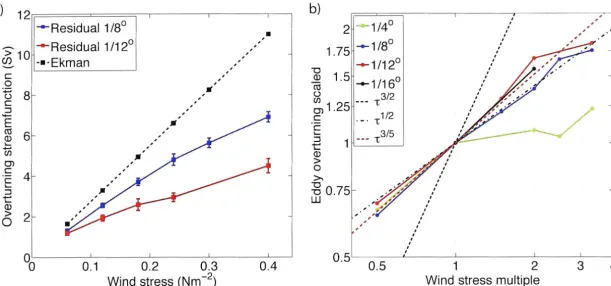
A si1nilar phenon1enon, termed eddy compensation, has been observed in edd y-permitting and eddy-resolving nu1nerical models of the upper 111eridional overturning circulation (Hallberg and Gnanadesikan, 2006; Viebahn and Eden, 2010: Farneti et al.. 2010: Abernathey et al., 2011). Increased wind stress over the Southern Ocean results in a one-to-one increase in the northward surface Ek111an transport ( 7/J = vh = T
/
pf
)
.
,vhich is at least partially co111pensated by an opposing increase in the southward edd y-induced transport ( 7/J*
=
v'h')
(
detailed in the theory of 1viarshall and Radko. 2003). Thus the residual overturning. which is the sun1 of the Ekn1an and eddy-induced transports( u,ires
=
zL,+
,
w*)
.
increases substantially less than the Ekn1an transport. Perfect eddy con1-pensation. whereby increases in the Ekn1an transport are exactly balanced by increases in the edd:v-induced transport. has been hypothesised to occur at sufficiently high reso lu-tion and wind stress (Hallberg and Gnanadesikan. 2006: Farneti et al.. 2010). However. t,Yo edd_,·-resolving nl1111erical experi1nents (Viebahn and Eden. 2010: Abernathey et al.. 2011). albeit with flat-botton1 bathy111etry. still show 111oderate increases in the residual O\·erturning \Yith \Yind stre. s.
The eddy con1pensation and saturation seen 111 these nun1erical studies has led to