Abstract: The social interaction of human beings is many times influenced by non-verbal communication, especially facial expressions. In societal life face of a human being is mostly observed by surrounding people to know the inner feelings. Thus, face forms a significant source of expressing human emotions, typically categorized into surprise, anger, fear, disgust, sad and happy. In the variety of behavioral science fields, emotion recognition has a significant role to play. The present paper describes a system in which preprocessing is performed by median filtering. Before extracting features, the watershed segmentation is applied to get the required characteristics of an image. In this paper, the Gamma based Feature Extraction (GFE), Local Binary Pattern (LBP) and Histogram of Oriented Gradients (HOG) technique have been used for feature extraction. The LBP algorithm is additionally tested with and without application of gamma correction using GFE. Two classifiers, namely kNN and SVM, have been employed, and their performance is compared. kNN and SVM, being supervised classifiers, can aid in better accuracy with proper training.
Keywords : Median filtering, Watershed Segmentation, GFE, LBP, HOG, kNN and SVM
I. INTRODUCTION
The feelings of human being are typically understood through his facial expressions. The analysis of facial expressions provides a measure of the sentiments of a human being. Thus the emotions of a human being can be recognized using facial expressions and hence provide the mechanism of non-verbal communication in the social life of human being. In interpersonal communication, the contribution of facial expression is much higher than text and voice communication. As per a classic study, this contribution is as high as 55% [1, 2]. Various applications of day to day life can be enhanced by effective recognition of facial expressions. These applications involve systems like automated machines, robotics, and security.
Thus recognition of emotion based on facial expressions
Revised Manuscript Received on October 05, 2019.
Vishal D. Bharate, Department of Electronics and Telecommunication, Government College of Engineering, Amravati/ Sinhgad Academy of Engineering, Pune, India. Email: [email protected]
Devendra S. Chaudhari, Department of Electronics and Telecommunication, Government College of Engineering, Jalgaon, Jalgaon, India. Email:[email protected]
Mayur D. Chaudhari, Data Architect, Parkar Labs, Pune, India. Email: [email protected]
contributes towards the automation of various applications in industrial and domestic sectors.
The facial expressions are classified typically into seven different categories, namely surprise, anger, fear, disgust, sad, happy and neutral. Last few decades have seen prominent growth in the research area of facial expression recognition. The researchers are continually pursuing facial expression recognition as a vital field of research for improving various system automation applications.
The facial expression recognition typically involves various steps. The first step is image preprocessing in which the inherent low-frequency noise in the image is eliminated. In the second step, the facial action units are explored to choose a specific action unit for further investigation. The third step involves segmenting the facial image into various logical portions that form input to the feature extraction phase. Feature extraction forms the next step, in which feature vectors are generated. A crucial phase as the output of this phase provides a logical database for classification. The final phase in facial expression recognition involves classifying the feature vectors into physical categories for emotion recognition.
The present paper focuses on feature extraction and classification phases of the facial expression recognition system. There are various techniques employed in the feature extraction phase. These include Speeded-Up Robust Features (SURF), Scale Invariant Feature Transform (SIFT), Gabor wavelets, Principal Component Analysis (PCA), Linear Discriminator Analysis (LDA), Gray Level Co-occurrence Matrix, moments. These techniques, even though popular in literature, used in isolation, may contribute some drawbacks to the developed system. A combination of feature extraction techniques provides some advantages to the developed system [2]. Hence, the system described in this paper employs a combination of GFE, LBP and HOG techniques. The literature describes various classification algorithms to be used after the feature extraction phase in various applications. These include Artificial Neural Networks (ANN) [4], AdaBoost classification [7], Support Vector Machine (SVM) [6], [8-9], k-Nearest neighbor (kNN) [3], random forests (RF) [6], Extreme Learning Machine (ELM) [5].
Emotion Recognition from Facial Expressions
using GFE, LBP And Hog
Feature Extraction Techniques
As with feature extraction techniques, the classification algorithms also have individual shortcomings when used in facial expression recognition systems. kNN has challenges like memory usage, choice of the number of neighbors. Training time for ANN is more. Also, it requires many training samples. ELM faces the overfitting issue along with optimization in the choice of hidden layer nodes. Noisy data and outliers are challenging for AdaBoost classifier.
The paper is organized into the following parts: Section 2 gives insights into the implemented method. Section 3 describes the performance analysis of the implemented. Section 4 concludes the presented work.
II. PROPOSED METHOD
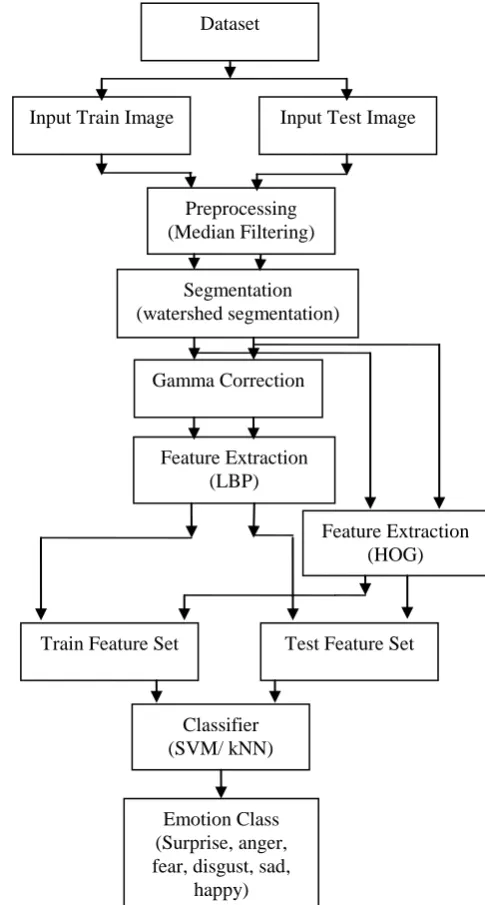
This section describes the approach used for human emotion recognition using facial expressions. The block diagram of the proposed system is, as shown in Fig. 1. Preprocessing is the first step of implementation. Median filtering is applied in this step for smoothing out the input image. Segmentation has been used in this step to extract the required characteristics from the input image. Using Gamma based Feature Extraction (GFE) technique; the gamma values of various segments of the image obtained from the first step are adjusted. Gamma correction is useful to enhance the overall efficiency of the system. The features of output image after gamma adjustment are extracted using Local Binary Pattern (LBP) as one part of the system. Another feature extraction technique employed in the current system is the Histogram of Oriented Gradients (HOG). For this purpose, the input image after segmentation is processed for feature extraction using HOG technique.
The classification of feature vectors, either from LBP or HOG, is performed using kNN and SVM separately. Results of the classification are compared for performance analysis of the system.
A. Preprocessing
The initial step in a typical digital image processing is preprocessing. Image quality, in terms of visual attributes, is enhanced with the aid of preprocessing. It also helps in enhancing the processing dataset. The random noise in the image is removed. The homogeneity and contract features of the image are improved. There is also an enhancement of boundary areas and the illumination of low-frequency features. The noise is typically removed from an image using some filtering techniques.
The median filter has been applied for preprocessing the input image as it eliminates impulse noise and bridges the corner and edge gaps.
Variable size matrix has been used to mask the pixels for which the median value is computed. Ascending sorting of the pixel value gives the central pixel. Central pixel is replaced by the median value. Every pixel is compared with the neighbor pixel to remove the noise.
Segmentation
The image is divided into various regions by means of segmentation. We employ watershed segmentation to conquer over-segmentation issue arises due to segmentation. This process removes the background noise in the image. The
segmentation improves the performance of the system due to the removal of background noise.
B. Feature Extraction
[image:2.595.324.567.218.671.2]The next step, followed by preprocessing and segmentation is feature extraction. The feature plays a vital role since it carries significant and meaningful information about an image. Features give rise to dimensional reduction, thus saves the memory requirement and processing time for classification in pattern recognition. The extracted features are stored to form a set of feature vectors. In this paper for emotion recognition from facial expression, we have used three feature extraction techniques, namely GFE, LBP and HOG.
Fig. 1.Block Diagram of the Proposed System. Local Binary Pattern (LBP)
A non-parametric operator used for texture information retrieval is LBP [7].
Feature Extraction (HOG) Dataset
Input Train Image Input Test Image
Preprocessing (Median Filtering)
Segmentation (watershedsegmentation)
Gamma Correction
Feature Extraction (LBP)
Train Feature Set Test Feature Set
Classifier (SVM/ kNN)
Emotion Class (Surprise, anger, fear, disgust, sad,
In pattern recognition texture information plays a vital role, and LBP is one of the feature extractors to retrieve the texture information from an image. In LBP, the mask of 3x3 is applied to the image. Out of a total of nine pixels, the central pixel value takes the threshold value by considering eight neighbor pixels. The neighboring pixel values are compared with a central pixel value. The pixel value is less than threshold value pixel is rejected or otherwise, it is accepted. The decimal form of the resulting vector is given by (1).
7
0) ,
(
)
(
2
,
k
q p k k
m
m
g
q
p
LBP
(1) where,
) , (pq
m
- Central pixel grey value,k
m
-neighbor pixel grey value,g p
( ) 1,
if
p
0
( )
0,
g p
otherwise
Here grayscale transformation affects significantly less on LBP operator. Hence pixel intensities are preserved in order with neighborhood pixels.
Gamma based Feature Extraction (GFE)
Gamma correction is a part of preprocessing. The grey level intensity I is replaced by gamma correction with Iᵞ. Here ᵞ is parameter under control of the user. The darker portion is enhanced while the bright region is compressed, utilizing gamma correction.
[image:3.595.67.275.493.698.2]Fig. 2. shows the phenomena of the gamma correction. ᵞ value may range in between 0.00 to 10.00, which is user-controllable. It can be seen that gamma correction adjusts the linear performance for the image under consideration. It improves the performance of classification accuracy. In this paper, we apply gamma correction along with LBP for performance analysis.
Fig. 2. Gamma Curves[11] Histogram of Oriented Gradients (HOG)
Image processing and computer vision applications use HOG [3] as a robust feature descriptor. In HOG, the occurrence of gradient orientation is computed in the localized region. The localized intensity distribution is computed in the HOG feature.
The HOG feature extraction block gets input as the preprocessed image. The image is further divided by this HOG feature into a small number of cells. Histogram gradient is computed further for the pixels of every cell. The concatenation operation is performed on the computed histograms gradients to form HOG feature descriptor. HOG feature descriptor is invariant to geometric and photometric transformations. After gradient computation and orientation binning, the descriptor blocks are formed. Concatenation and normalization of these descriptors blocks give HOG features. The condition for the normalization process is given in (2).
e
v
v
f
Lnorm
nn/
nn
(2)where, nn
v
is the non-normalized vector and e is the error vector.C. Classification
After the feature extraction, one of the essential steps is classification. Classification step involves a comparison of features of stored image in the dataset with those of the image under consideration. The class label associated with the trained image feature dataset is assigned where the appropriate match is found. Various classes, namely, surprise, anger, fear, disgust, sad and happy, are used for categorization of facial expressions into emotions; thus forming a multiclass problem. We use two classifiers for performance check of the implemented method, namely k-Nearest Neighbor (kNN) and Support Vector Machine (SVM).
k-Nearest Neighbor (kNN) Classification
k-Nearest Neighbor [1, 5] classifier is applied on pattern recognition problems using non-parametric method for classification of various classes. The numeric distance between the test pattern and training pattern is computed by the classifier. k nearest set of training patterns forms the classifier input. The odd numbers of training patterns forming the nearest neighbours are the basis for the classification algorithm. The class of the maximum number of training patterns that forms the nearest neighborhood is the basis computing the output of the classifier. The classification of feature vector into a particular class is hence performed by comparing it with an odd number of nearest neighboring training feature vectors. For example, for k=1, it is a single nearest neighbor, while for k=3, the classifier compares test vector with three training feature vectors and finds a maximum match of testing feature vector with other three training feature vectors, and for k=5,7,9 and so on. The entire classification algorithm has been depicted in Fig. 3.
Fig. 3. kNN classification[12]
The circular pattern is classified into triangle class, according to the kNN classification algorithm, as two out of the three nearest neighbors are triangles. The methodology presented applies to all the real-time classes.
Support Vector Machine (SVM)
SVM [2] is one of the supervised learning classifiers and also has non-linear features. SVM gives a generalized performance since it uses statistical learning theory. SVM gives optimum performance for limited size dataset. Different kernel functions can be tried to get the optimum performance of SVM classifier. It provides an interactive and dynamic approach. To get high-performance efficiency, selection of kernel function plays an important role.
Support vector machines have previously been successfully employed in a variety of classification applications, including identity and text recognition as well as DNA microarray data analysis.
III. PERFORMANCE ANALYSIS
This section gives the performance analysis of three features, namely GFE, LBP and HOG. Initially, the database used for experimentation followed by system specifications on which experimentation is carried out is explained. The later part of the section describes the performance parameters considered along with discussions on results presented. A. Database and Experimental setup
The standard JAFEE [9] database comprising of 213 static images has been used for experimentation purpose. The database comprises of images in TIFF format having dimensions 256×256 pixels and storage size in the range between 60 to 70 KB. The use of standard database facilitates a platform for accuracy measurement, more specific results and comparison of results in terms of a common platform. The employed database is classified into testing and training datasets. Training dataset contains 120 images, whereas the testing dataset uses the remaining 63 images. The experimental setup consists of Matlab version 2014a software installed on a laptop having Windows 7 OS, i3 processor and 3 GB RAM. The purpose of Matlab software is to run the simulation of the proposed algorithm on the said dataset. B. Results and Confusion Matrix
In this work, kNN and SVM classifiers have been applied to training and testing datasets. In the training phase, the HOG feature vectors of training dataset are computed. The testing phase involves computation of the HOG features of the image under test and comparing with the HOG features of all the images in the training dataset. The best match is based on the closest distance of the testing feature from that of training dataset feature. Using a similar methodology, LBP features are computed and applied to training and testing datasets.
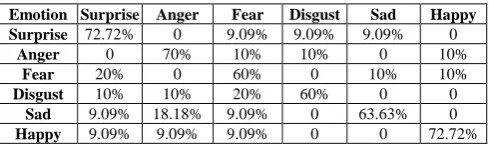
Table I represents, the confusion matrix for SVM classifier
[image:4.595.305.550.135.208.2]applied to the HOG feature. From Table I, it can be seen that for happy and surprise class recognition rate is maximum. Another finding from Table I, is that anger and fear expressions are not distinguished accurately due to the high level of similarity in the feature vectors.
Table- I: Confusion matrix for SVM applied to HOG features
Emotion Surprise Anger Fear Disgust Sad Happy
Surprise 72.72% 0 9.09% 9.09% 9.09% 0
Anger 0 70% 10% 10% 0 10%
Fear 20% 0 60% 0 10% 10%
Disgust 10% 10% 20% 60% 0 0
Sad 9.09% 18.18% 9.09% 0 63.63% 0
Happy 9.09% 9.09% 9.09% 0 0 72.72%
Table II represents the confusion matrix for kNN classifier applied to the HOG feature. From Table I, it can be seen that the surprise class has maximum recognition accuracy. Another finding from Table I is that fear expression has a minimum recognition accuracy.
Table- II: Confusion matrix for kNN applied to HOG features
Emotion Surprise Anger Fear Disgust Sad Happy
Surprise 81.81% 0 9.09% 9.09% 0 0
Anger 0 70% 20% 0 10% 0
Fear 20% 0 60% 20% 0 0
Disgust 10% 10% 0 70% 0 10%
Sad 0 9.09% 9.09% 9.09% 72.72% 0
Happy 9.09% 9.09% 0 0 0 81.81%
Similarly, kNN and SVM classifiers are applied on LBP feature vectors without gamma correction. Table III depicts the confusion matrix for kNN applied to LBP features without Gamma correction. It can be seen from Table III, that the recognition accuracy of surprise and happy class is maximum. Also, from Table III, it is observed that a sad class has a minimum recognition accuracy.
Table- III: Confusion matrix for kNN applied to LBP features without Gamma correction
Emotion Surprise Anger Fear Disgust Sad Happy
Surprise 72.72% 0 9.09% 9.09% 9.09% 0
Anger 0 60% 10% 10% 10% 10%
Fear 10% 10% 60% 0 10% 10%
Disgust 10% 10% 10% 60% 10% 0
Sad 9.09% 18.18% 9.09% 9.09% 54.54% 0
Happy 9.09% 9.09% 9.09% 0 0 72.72%
Table IV depicts the confusion matrix for kNN applied to LBP features with Gamma correction. It can be seen from Table IV, that the recognition accuracy of surprise and happy class is maximum. Also, from Table IV, it is observed that a sad, fear and disgust class have minimum recognition accuracy.
Table- IV: Confusion matrix for kNN applied to LBP features with Gamma correction
Emotion Surprise Anger Fear Disgust Sad Happy
Surprise 90.90% 0 0 9.09% 0 0
Anger 0 70% 10% 10% 10% 0
Fear 10% 10% 70% 0 0 10%
Disgust 10% 0 10% 70% 10% 0
Sad 9.09% 9.09% 9.09% 9.09% 63.63% 0
Similarly, the SVM classifier is applied to LBP feature vectors without gamma correction. Table V depicts the confusion matrix for SVM applied to LBP features without Gamma correction. It can be seen from Table V, that the recognition accuracy of surprise and happy class is maximum. Also, from Table V, it is observed that fear and disgust class have minimum recognition accuracy.
Table- V: Confusion matrix for SVM applied to LBP features without Gamma correction
Emotion Surprise Anger Fear Disgust Sad Happy
Surprise 81.81% 0 0 9.09% 9.09% 0
Anger 0 70% 10% 10% 10% 0
Fear 10% 10% 60% 0 10% 10%
Disgust 10% 10% 10% 60% 10% 0
Sad 9.09% 18.18% 0 9.09% 63.63% 0
Happy 9.09% 9.09% 9.09% 0 0 72.72%
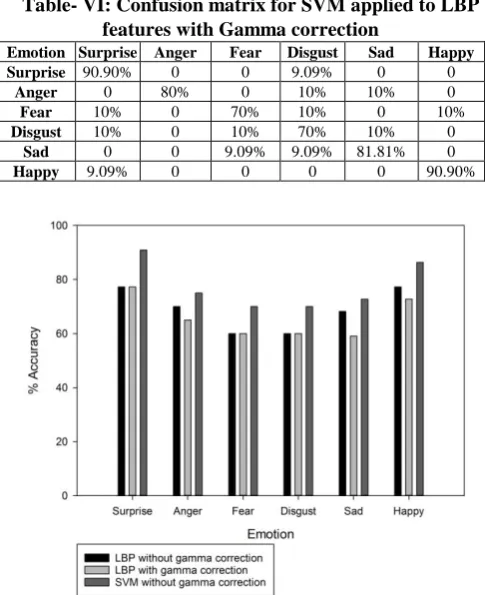
[image:5.595.48.291.322.620.2]Table VI depicts the confusion matrix for SVM applied to LBP features with Gamma correction. It can be seen from Table VI, that the recognition accuracy of surprise and happy class is maximum. Also, from Table V, it is observed that fear and disgust class have minimum recognition accuracy.
Table- VI: Confusion matrix for SVM applied to LBP features with Gamma correction
Emotion Surprise Anger Fear Disgust Sad Happy
Surprise 90.90% 0 0 9.09% 0 0
Anger 0 80% 0 10% 10% 0
Fear 10% 0 70% 10% 0 10%
Disgust 10% 0 10% 70% 10% 0
Sad 0 0 9.09% 9.09% 81.81% 0
Happy 9.09% 0 0 0 0 90.90%
Fig. 4.Performance of kNN and SVM with and without Gamma correction for LBP and HOG Feature Fig. 4. shows the comparison of LBP with gamma correction, LBP without gamma correction and HOG without gamma correction. The performance accuracy is presented in terms of percentage. From results, it can be seen that performance accuracy for all classes is giving best results for LBP with gamma correction. The most promising results are obtained for surprise and happy class. Whereas there is still scope of improvement for the performance accuracy of the fear and disgust class.
IV. CONCLUSION
This paper described the use of facial expressions for emotion recognition. This objective is achieved with the use of GFE, LBP and HOG features, and kNN and SVM classifiers. Images of the face are preprocessed with the aid of median filtering and watershed segmentation algorithm. The results reveal that without gamma correction, the performance accuracy for the HOG using kNN and SVM is better than that using LBP for surprise and happy class. The performance accuracy of LBP with gamma correction is more compared to that of LBP without gamma correction, excepting sad class. The recognition rate of Happy and Surprise class is better as compared to all other classes for all implemented methods; whereas Fear and Disgust class have exhibited lowest performance accuracy.
REFERENCES
1. J. Vaibhavkumar, M. Mistry and M. Goyani, “A literature survey on Facial Expression Recognition using Global Features” International Journal of Engineering and Advanced Technology (IJEAT), vol. 2, no. 4, Apr. 2013.
2. S. Pande and S. Shinde, “A Survey on Emotion Recognition with respect to Database and Various Recognition Techniques”, International Journal of Computer Applications, vol. 58, no. 3, 2012.
3. S. Agrawal and S. Yadav, “Approach Based on HOG Descriptor and K nearest Neighbour for Facial Expressions Recognition”, InternationalJournal of Innovations & Advancement in Computer Science, Vol. 7, No. 5, pp. 239-249, 2018.
4. N. Kauser and J. Sharma, "Facial expression recognition using LBP template of facial parts and multilayer neural network", 2017International Conference on I-SMAC (IoT in Social, Mobile, Analytics and Cloud) (I-SMAC), Palladam, pp. 445-449, 2017. 5. Z. Liu et al., "A facial expression emotion recognition based
human-robot interaction system", in IEEE/CAA Journal of Automatica Sinica, Vol. 4, No. 4, pp. 668-676, 2017.
6. J. Jayalekshmi and T. Mathew, "Facial expression recognition and emotion classification system for sentiment analysis", 2017International Conference on Networks & Advances in Computational Technologies (NetACT), Thiruvanthapuram, pp. 1-8, 2017.
7. R. Verma and M. Y. Dabbagh, "Fast facial expression recognition based on local binary patterns", 2013 26th IEEE Canadian Conference on Electrical and Computer Engineering (CCECE), Regina, SK, pp. 1-4, 2013.
8. O. Dniz, G. Bueno, J. Salido and F. Torre, “Face recognition using Histograms of Oriented Gradients,” Pattern Recognition Letters, vol. 32, no. 12, pp. 1598-1603, Sep. 2011.
9. M. Kamachi, M. Lyons and J. Gyoba, “The Japanese female facial expression (JAFEE) database,” International Conference on Automatic Face and Gesture Recognition, 1997.
10. A. Smeulders, M. Worring, S. Santini, A. Gupta and R. Jain, “Content-based image retrieval at the end of the early years,” IEEE Transactions on Pattern Analysis and Machine Intelligence, vol. 22, no. 12, pp. 1349-1380, Dec. 2000.
11. D. M. Blackburn, M. Bone, and P. J. Phillips, “Facial recognition ven- dor test 2000 evaluation report,” Dec. 2000 [Online].
12. Srivastava, T. (2018, March 26). Introduction to k-Nearest Neighbors: A powerful Machine Learning Algorithm (with implementation in Python & R). Retrieved August 10, 2019, from analyticsvidhya.com:
oto
AUTHORS PROFILE
Vishal D. Bharate obtained BE, from Shivaji University, Kolhapur and M.Tech. from Dr Babasaheb Ambedkar University, Lonere. He is pursuing Ph. D. from Government College of Engineering, Amravati. He has been engaged in teaching, research for about 12 years. Presently he is working as Assistant Professor, Department of Electronics and Telecommunication Engineering at Sinhgad Academy of Engineering, Pune, Maharashtra, India. He has published research papers and presented papers in international conferences at Chennai, Kanyakumari. He has published 3 Journal and 5 Conference papers. His present research and teaching interests are in the field of Digital Image Processing, Digital Signal Processing, Computer Vision and Machine Learning.
Devendra S. Chaudhari obtained BE, ME, from Marathwada University, Aurangabad and PhD from Indian Institute of Technology, Bombay, Powai, Mumbai. He has been engaged in teaching, research for about 30 years. He has worked as Head Electronics and Telecommunication, Instrumentation, Electrical, Research and incharge Principal at Government Engineering Colleges. Presently he is working as Head, Department of Electronics and Telecommunication Engineering at Government College of Engineering, Jalgaon. Dr Chaudhari published research papers and presented papers in international conferences abroad at Seattle, USA and Austria, Europe. He is fellow of IE, IETE and life member of ISTE, BMESI and member of IEEE (2007). He is the recipient of Best Engineering College Teacher Award of ISTE, New Delhi, Gold Medal Award of IETE, New Delhi, Engineering Achievement Award of IE (I), Nashik. He has organized various Continuing Education Programmes and delivered Expert Lectures on research at different places. He has also worked as ISTE Visiting Professor and visiting faculty member at Asian Institute of Technology, Bangkok, Thailand. His present research and teaching interests are in the field of Biomedical Engineering, Digital Signal Processing and Analogue Integrated Circuits.
![Fig. 2. Gamma Curves[11]](https://thumb-us.123doks.com/thumbv2/123dok_us/8166647.251133/3.595.67.275.493.698/fig-gamma-curves.webp)