International Journal of Innovative Technology and Exploring Engineering (IJITEE) ISSN: 2278-3075, Volume-8 Issue-11, September 2019
Abstract: In modern years, there is substantially technical progression in research area pertaining to image retrieval, in specific Query By Image Content (QBIC) system. It has turned out to be essential to deliver adept and effective method to retrieve images from the gigantic collections of images utilized in heterogeneous applications. In this paper, a hybrid QBIC retrieval system known to be PSO optimized Log Gabor QBIC system that retrieves color features, texture features and shape features of the images in three consecutive stages has been developed. In the proposed system, color features are retrieved by means of color histogram in the first stage. In subsequent stage, the texture features are extracted by tuning Log Gabor filters using Particle Swarm Optimization(PSO). Lastly, shape features are retrieved by polygonal fitting algorithm. The recommended method displays enhanced retrieval rate in terms of mean recall and mean precision when compared to the prevailing standard systems.
Keywords: Particle Swarm Optimization, mean recall and mean precision.
I. INTRODUCTION
Research on image retrieval has evolved to be considerably significant during the preceding years and has become dictating propensity in the area of information retrieval [1, 2]. Retrieval of images is a very exciting area of research in numerous applications like databases related to multimedia, Google retrieval and digital libraries. Abundant techniques, many algorithms and different systems have been proposed to resolve the hitches that publicized indexing and retrieval perceptions, which gave rise to evolution of Query by Image Content retrieval. QBIC retrieval system conceivably can derive traceable features of images and retrieve anticipated image from the repository of numerous images. The main principle of QBIC retrieval is organizing digital picture archives by making use of their visual content. This can be achieved using image processing and feature extraction. The key features chosen for extraction are color, texture and shape which dictate meaningful image retrieval. Wang et al.[3] has accentuated an image retrieval scheme by the integration of color features, texture features and shape features and comparison among these features is taken for retrieval.
Shrivastava et al. [5] epitomized the extraction order at each stage to be color, texture and shape so that competence of the retrieval system can be improved after conducting numerous simulation experiments. Even though most of the real life textures are colored, substantial research has been focused on grayscale texture analysis [13] for the reason that even for grayscale textures, existing descriptors are still not
Revised Manuscript Received on September2, 2019.
N.Jyothi*, Department of EIE,GITAM Deemed to be University, Visakhapatnam, Andhra Pradesh,India,E.Mail:[email protected]
D. Madhavi, Department of ECE,GITAM Deemed to be University, Visakhapatnam, Andhra Pradesh,India,E.Mail:[email protected]
dominant to represent textural properties of an image. Haridas et al. [11] grasped Gray Gabor wavelet in texture analysis and their classification for extracting texture information in given orientation and scale. Gabor wavelet has been shown to be very effective in image retrieval systems by Madhavi et al. [6]. The technique where a different orientation, frequency and scale of Gabor wavelet are preferred to obtain the feature of every image is triggered by Tsai et al. [8] since it has separable property and texture invariance to extract texture features from repository for retrieval of images. Chisti et al. [7] expounded an optimized Gabor filter by means of PSO in addition to GA for minimizing the Gabor energy by changing scale, frequency as well as orientation parameters. Arrspide et al. [4] highlighted Log Gabor filter descriptor for image centered vehicle authentication that has been considered as a supervised classification problem. The image retrieval scheme exemplified by Agarwal and Maheswari [9] using Log Gabor wavelet transform has shown better performance than using Gabor wavelet transform. Kumar et al. [10] authenticated use of Log Gabor filter for vehicle authentication and obtained a better retrieval performance. Ashraf et al. [12] prompted a retrieval method employing bandelet transform and artificial neural networks.
Chaorong et al. [16] postulated a proficient color texture extraction method based on copula model that utilize Gabor wavelets. The foremost concern regarding the usage of color histograms for image retrieval includes selection of color space, color space quantization into number of color bins as well as similarity metric [17].There exist even more complex methods [18] to measure similarity between color histograms. Casti et al. [19] devised an unusual technique for the assessment of breast skin-line centered on multi directional Gabor filtering. Madhavi et al. [15] recommended a tuned color Gabor wavelet employing genetic algorithm to obtain the texture features. The Gabor wavelet constraints in the quantified range are tuned to obtain minimum energy. Gu et al. [20] conceptualized vocal emotion recognition using Log Gabor filters. The approaches for shape depiction can be classified into boundary based or region based methods [21]. The boundary based methods comprise rectilinear shapes, finite element prototypes [22] besides Fourier based shape descriptors .
II. PROPOSEDMETHOD
A hybrid PSO optimized QBIC retrieval method utilizing Log Gabor filter is proposed by combining three descriptors namely color, texture and shape of an image. The recommended hybrid Log Gabor based retrieval system has chronological process of three stages.
PSO Optimized Log Gabor QBIC System
The block diagram illustrating the structural design of recommended system is shown in Fig.1. Retrieval is implemented in three successive stages in this system. The best matched retrieved imageries of every single stage are
[image:2.595.130.468.109.238.2]considered as input imageries to the subsequent phase to derive ‘N’ best retrieved imageries out of ‘R’ repository imageries. Features are obtained based on the three descriptors of an image namely color, texture and shape.
Fig. 1. Proposed PSO optimized Log Gabor QBIC system
Considering ‘R’ repository images as input, the color based feature extraction process is done by choosing appropriate ‘C’ images for certain query image in stage1. The color feature extraction is done by means of HSV color space through color histogram. The ‘C’ images are considered as input repository set for stage 2. The Log Gabor filter energy is minimized in three different orientations using particle swarm optimization algorithm by maintaining the remaining two parameters scale and frequency constant to reduce the number of convolutions. This tuning suits well to the texture structure present in the query image and assists in retrieving texture features to identify suitable matched ‘T’ images through calculation of minimum energy in second stage. These ‘T’ repository images are chosen as repository for stage 3. In stage 3, retrieval depends on extraction of shape features employing polygonal curve fitting algorithm. The retrieved ‘N’ images from last stage are the utmost possible pertinent images to particular query image.
The relationship among number of images obtained in each and every stage of the recommended retrieval system and initial total repository database is given by R > C >T> N.
III. RESULTANDDISCUSSION
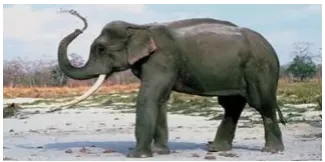
This section demonstrates investigational estimation of recommended PSO optimized Log Gabor QBIC system. The accomplishment of the model is completed by means of COREL repository [14] in MATLAB. The repository encompasses 100 natural imageries incorporated in each of 10 categories creating it a whole of 1000 consistent images. It includes 1000 images that are classified into ten different categories of images that include Buses, Foods, Horses, Buildings, Elephants, Beaches, African people, Flowers, Dinosaurs and Mountains respectively. The query image is displayed in Fig. 2.
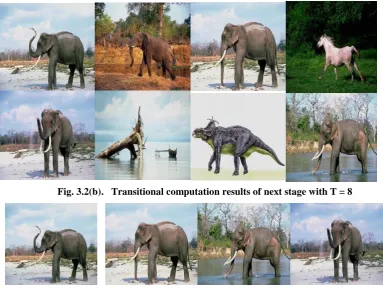
The rightness of proposed PSO optimized Log Gabor QBIC system is limited to considered assumptions of C, T and N and therefore appropriate concern is necessary in taking these factors. The value of R is considered as number of total imageries in the repository. The factors C, T and N are preferred as 10, 8 and 4 respectively. The factors C, T and N are fixed substantially by user. The method can be enhanced by choosing factors C, T and N through changing values and considering outcomes in terms of mean precision and mean recall. The obtained results at each phase are portrayed in Fig. 3, by taking factors C, T and N to be 10, 8 and 4 respectively. The inappropriate imageries are filtered markedly at each stage thereby thinning down the exploration. This results in creating the elementary level characteristics to portray the purpose of user. The enactment of the proposed PSO optimized Log Gabor QBIC system is assessed specifically in terms of mean precision and mean recall for each category by means of the retrieval outcomes.
Table I and Table II demonstrate the experimental results obtained using proposed PSO optimized Log Gabor QBIC system and other prevailing models namely Ashraf model [12], Shrivastava model [5], Youssef model [13].
The recommended PSO optimized Log Gabor QBIC system is measured by treating every image in each set as query image and thereby the extracted results of every query image can be used to measure the retrieval outcomes. The performance metrics is assessed for every set in the repository by considering 20 as the numerical value of output images. It is witnessed that the recommended system has shown enhanced precision and recall than other existing standard models for all sets. Fig. 4 depicts the comparison of precision and recall of the recommended PSO optimized Log Gabor QBIC system.
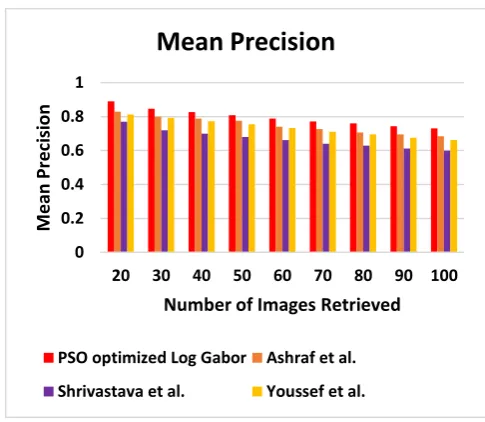
The performance metrics for retrieval performance specifically mean precision and mean recall of recommended PSO optimized Log Gabor QBIC system and other prevailing models under identical conditions by changing the values of L from 20 to 100 are shown in Fig. 5 and Fig. 6.
[image:2.595.73.236.681.762.2]International Journal of Innovative Technology and Exploring Engineering (IJITEE) ISSN: 2278-3075, Volume-8 Issue-11, September 2019
Fig. 3.1(a). Transitional computation results of initial stage with C = 10
Fig. 3.2(b). Transitional computation results of next stage with T = 8
[image:3.595.98.470.52.198.2]Fig. 3.3(c). Transitional computation results of final stage with N = 4
Table I: Evaluation of Mean precision of the recommended PSO optimized Log Gabor QBIC system with prevailing standard systems
Table II: Evaluation of Mean recall of the recommended PSO optimized Log Gabor
Group ID Group
PSO optimized Log Gabor QBIC
Ashraf Exemplary
[12]
Shrivastava Exemplary
[5]
Youssef Exemplary
[13]
1 Buildings 0.82 0.75 0.60 0.70
2 Food 0.85 0.80 0.80 0.81
3 African people 0.85 0.80 0.75 0.64
4 Beaches 0.82 0.75 0.60 0.64
5 Elephants 0.92 0.90 0.75 0.78
6 Horses 0.96 0.90 0.90 0.95
7 Buses 0.94 0.90 0.80 0.92
8 Flowers 0.95 0.80 0.92 0.95
9 Dinosaurs 1.00 1.00 1.00 0.99
10 Mountains 0.79 0.70 0.58 0.74
[image:3.595.96.480.229.518.2] [image:3.595.97.499.578.725.2]QBIC system with prevailing standard systems
Group ID Group PSO optimized Log Gabor
QBIC
Ashraf Exemplary
[12]
Shrivastava Exemplary
[5]
Youssef Exemplary
[13]
1 Buildings 0.160 0.150 0.120 0.140
2 Food 0.166 0.160 0.160 0.160
3 African people 0.166 0.160 0.150 0.130
4 Beaches 0.16 0.150 0.120 0.130
5 Elephants 0.184 0.180 0.150 0.160
6 Horses 0.184 0.180 0.180 0.190
7 Buses 0.184 0.180 0.160 0.180
8 Flowers 0.182 0.160 0.180 0.190
9 Dinosaurs 0.200 0.200 0.200 0.200
10 Mountains 0.154 0.140 0.120 0.150
Mean 0.174 0.166 0.154 0.163
0 0.2 0.4 0.6 0.8 1 1.2
[image:4.595.214.545.91.527.2]Precision Recall
Fig. 4. Comparison of Precision and Recall of the recommended PSO optimized Log Gabor QBIC system
0 0.2 0.4 0.6 0.8 1
20 30 40 50 60 70 80 90 100
M
ean
P
rec
isi
on
Number of Images Retrieved
Mean Precision
PSO optimized Log Gabor Ashraf et al.
Shrivastava et al. Youssef et al.
Fig.5. Evaluation of Mean precision of the recommended PSO optimized Log Gabor QBIC system
with
prevailing standard systems
0 0.1 0.2 0.3 0.4 0.5 0.6
20 30 40 50 60 70 80 90 100
M
e
an
R
e
cal
l
Number of Images Retrieved
Mean Recall
PSO optimized Log Gabor Ashraf et al.
Shrivastava et al. Youssef et al.
Fig.6. Evaluation of Mean recall of the recommended PSO optimized Log Gabor QBIC system with
prevailing standard systems
IV. CONCLUSION
[image:4.595.48.291.473.684.2]International Journal of Innovative Technology and Exploring Engineering (IJITEE) ISSN: 2278-3075, Volume-8 Issue-11, September 2019
REFERENCES
1. K.Juneja,, A. Verma, S. Goel and S.Goel, “A Survey on Recent Image
Indexing and Retrieval Techniques for Low-Level Feature Extraction in
CBIR Systems,” Proc. 2015 IEEE International Conference on
Computational Intelligence & Communication Technology, Feb. 2015, pp. 67-72.
2. Y.Yang, F. Nie, D. Xu, J. Luo, Y. Zhuang and Y. Pan, “A Multimedia
Retrieval Framework Based on Semi-Supervised Ranking and
Relevance Feedback,” IEEE Trans. Pattern Analysis and Machine
Intelligence, vol. 34, Issue 4, April 2012, pp. 723-742.
3. X.Y.Wang, , Y.J. Yu and H.Y. Yang, “An effective image retrieval
scheme using color, texture and shape features,” Computer Standards &
Interfaces, vol. 33, Issue. 1, Jan. 2011, pp. 59-68.
4. J.Arrspide, and L. Salgado, “Log-Gabor Filters for Image-Based
Vehicle Verification,” IEEE Trans. on Image Processing, vol. 22, no. 6,
June 2013, pp. 2286-2295.
5. N.Shrivastava, and V. Tyagi, “An efficient technique for retrieval of
color images in large databases,” Computers and Electrical
Engineering, vol. 46, Issue C, Aug. 2015, , pp. 314-327.
6. D.Madhavi, and M.R. Patnaik, “Image Retrieval using GA Optimized
Gabor Filter,” Indian Journal of Science and Technology, vol. 9, no. 44,
Nov. 2016, pp. 1-11.
7. K.M.Chisti, , S.S. Kumar and G. Prasad, “2D Gabor filter for surface
defect detection using GA and PSO optimization techniques,” AMSE
Journals, vol. 58, 2015, pp. 67-83.
8. D.M.Tsai, C.P. Lin and K.T. Huang, “Defect detection in colored
texture surfaces using Gabor Filters,” The Imaging Science Journal, vol.
53, 2005, pp. 27-37.
9. M.Agarwal, and R.P. Maheshwari, "Content Based Image Retrieval
Based on Log Gabor Wavelet Transform,” Advanced Materials
Research, vols. 403-408, 2012, pp. 871-878.
10. P.P.Kumar, and I.K. Rao, “Log Gabor Filter Based Feature Detection in
Image Verification Application,” International Journal of Science and
Research, vol. 3, Issue 12, Dec. 2014, pp. 703-707.
11. K.Haridas, and T.A. Selvadoss, “Well-organized content based Image
retrieval system in RGB color histogram, Tamura texture and Gabor
feature,” Int. Journal of Advanced Research in Computer and
Communication Engineering, vol. 3, Issue. 10, 2014.
12. R.Ashraf, , K. Bashir, A. Irtaza and M. T. Mahmood, “Content Based
Image Retrieval Using Embedded Neural Networks with Bandletized
Regions,” Entropy, vol. 17, 2015, pp. 3552-3580.
13. S.M.Youssef, “ICTEDCT-CBIR: Integrating curvelet transform with
enhanced dominant colors extraction and texture analysis for efficient
content-based image retrieval,” Computers and Electrical Engineering,
vol. 38, 2012, pp. 1358-1376.
14. Wang database from: http:wang.ist.psu.edu.
15. Madhavi, D. and M.R. Patnaik, “Image Retrieval Based on Tuned Color
Gabor Filter Using Genetic Algorithm,” International Journal of
Applied Engineering Research, vol. 12, no. 15, 2017, pp. 5031-5039.
16. Li, Ch., Y. Huang and L. Zhu, “Color texture image retrieval based on
Gaussian copula models of Gabor wavelets,” Pattern Recognition,
vol. 64, April 2017, pp. 118-129.
17. V.Prasad, . and J. Domke, “Gabor Filter Visualization,” Technical
Report, Dept. Comp. Science, University of Maryland, Maryland, March 2005.
18. M.S.Meharban, and S. Priya, “A Review on Image Retrieval
Techniques,” Bonfring International Journal of Advances in Image
Processing, vol. 6, no. 2, April 2016, pp. 7-10.
19. P.Casti, A. Mencattini, M. Salmeri, A. Ancona and R. M. Rangayyan,
“Estimation of the breast skin-line in mammograms using
multidirectional Gabor filters,” Computers in Biology and Medicine,
vol. 43, Issue 11,Nov. 2013, pp. 1870-1881.
20. Y.Gu, , E. Postma and H.X. Lin,“Vocal Emotion Recognition with
Log-Gabor filters,” proc. 5th International Workshop on Audio/Visual
Emotion Challenge, Australia Oct. 2015, pp. 25-31.
21. J.Yue, Z. Li,L. Liu and Z. Fu, “Content-based image retrieval using
color and texture fused features,” Mathematical and Computer
Modelling, vol. 54, Issues 3-4, Aug. 2011, pp. 1121-1127.
22. U.Suhyuk, J. Kim and D. Min, “Fast 2-D Complex Gabor Filter with
Kernel Decomposition,” IEEE Trans. Image Processing, vol. 27, no. 4 ,
April 2018, pp. 1713-1722.
AUTHORSPROFILE
N.Jyothi has done M.E from Andhra University in 2003, B.Tech from Nagarjuna University in 2001. She is having 17 years of teaching and research experience. She is an Associate Professor in GITAM Deemed to be University, Visakhapatnam. Her areas of interest include signal processing, VLSI and image processing.