Abstract: Current demands of the healthcare industry require the use of information systems (IS) and information technologies (IT) to deliver care that is safe, patient centered, timely, efficient, and equitable. Successful development, implementation, and use of IT applications requires proper consideration of the hierarchy as well as synergy of each industry. In this work, a reliable secure and administrative cloud platform OncologyQuest has been developed to enhance the clinical service in radiation oncology. A case study used was automation of information data entry, reviewing, auditing and clinical approval cycles in radiation oncology intraoperative procedure of Prostate radioactive permanent seeds implant. Secure login and proper authorization using administration function for authenticating end users and granting them access to authorized services on the platform. Automation of data entry, reviewing, auditing and clinical approval cycles in radiation oncology intraoperative procedure has been achieved. That automation provides proper clinical approvals control to clinical multidisciplinary practitioners. OncologyQuest eased the dissemination of information during the procedure, enhanced information integration between oncology practitioners. Reliability and effectiveness of chartless documentation, successfully allowed appropriate communication regardless of geographic vicinity before, during and after the procedure.
Index Terms: cloud, engineering, informatics, healthcare, radiation oncology, LDR seed implant, OncologyQuest
I. INTRODUCTION
A. Cloud based platforms
Cloud based platforms differs from traditional software deployment as follows; it successfully uses Software as a Service (SaaS) architecture model to design software for to deliver a typical business service regardless of business industry type, also data resides on internet and can be accessed easily by authenticated and authorized logins, end
Revised Manuscript Received on September2, 2019.
Hamed S. El-Ghety*, Electrical Engineering dept., Faculty of Engineering, Aswan University, Aswan, Egypt. Email:[email protected]
Ismail Emam, Oncology department, Faculty of Medicine, Ain Shams University, Cairo, Egypt. Email:[email protected]
Nawal El-Fishawy, Computer Science and Engineering, Faculty of Electronic Engineering, Menoufia University, Menouf, Egypt. Email:[email protected]
AbdelMagid M. Ali, Electrical Engineering Dept., Faculty of Engineering, Aswan University, Aswan, Egypt. Email: [email protected]
user can use cloud based platform software directly through internet browser without the need to install any prerequisite software on their machines (e.g Desktop Computers, Laptops, Tablets, smart phone, etc). End users are not limited by geographic boundaries, they don’t have to pay any fees to start using (i.e. no up-front fees) because in cloud platform, “as end user you pay as you use” without any up-front fees (e.g. the more storage you’re consuming the additional fees pay you for extra storage consumed). There are many types of cloud deployment examples. The most commonly used type whilst discussion of cloud computing is the public cloud, in this type the applications and infrastructure are controlled and owned by the selling organization for the cloud-based implemented services. Due to some security and data privacy concerns, the cloud-based service tiers are replicated within private environment, behind the firewall, on-premises and maintained by hosting organization.[1] Many believe that the effective spot for cost optimization in an organization will be found in a good balance of public and private clouds, the engineered platform addressed in this paper is hosted in public cloud and the platform is called “OncologyQuest”.
B.Informatics in Radiation oncology
The field of biomedical informatics broadly encompasses the use of information in medical decision-making. Applied informatics are involved with the specific uses of healthcare information technology (IT) to transform clinical practice. The expansion in knowledge about biomedical informatics has paralleled the exponential growth in the IT market.[2] Radiation Oncology (and other medical specialties) needs a software that helps in efficiently manage all aspects of clinical procedures. All patient information is gathered and become accessible, from diagnosis through treatment and follow-up, so that, the best care can be delivered for every patient.
The ideal information system shall enhance the management of complex treatments and techniques with automation and easily customized workflows. Also it shall impersonate treatments with online decision support for more informed clinical decision making. That would result less errors and patient waits by eliminating errors in data entry and avoiding unneeded procedures. Software
Platforms enables a unified and consolidated database for radiation therapy patient records, a single point of access for Patient data and that's important for patients pursuing treatments of different types. [3]
With such information integrity, information systems integration, the radiation therapy work can flow smoothly. Clinical teams can make fully informed decisions. And staff can manage daily operations
in an effective and reliable way.[3]
Engineering Cloud Based Platform to Enhance
Radiation Oncology Services
C.Aim of the work
To provide a secure informed-decisions clinical platform. This robust and collaborative public cloud system is designed to serve radiation oncology professionals. It will enforce chartless auditing and approval cycles by minimizing physical communication within the clinic.
Moreover, it provides advice, data, education and training for the technical staff. Also, it encourages oncology society members to play a constructive role to patient awareness and in enforcing & increasing appropriate compliance measures.
II. METHODOLOGY
A.CloudPlatform
“OncologyQuest” is the cloud platform addressed in this work. This platform is designed and developed to provide reliable security for the content via secure login and proper authorization using administration function. One of the most
important functions used in OncologyQuest is administration function. This function is responsible for authenticating end users and granting them access to authorized services of the platform. The case study used was automation of information data entry, reviewing, auditing and clinical approval cycles in radiation oncology intraoperative procedure of Prostate radioactive permanent seeds implant using process flow diagram as design input for the implemented cloud service as shown in Fig.1.
.
Figure 1. Process flow diagram for LDR seeds implant processes and decision-based authorization per each system actor/end-used
B.Prostate radioactive seeds implant
[image:2.595.50.520.275.521.2]Prostate seed implant is a promising and well-tolerant method for treatment of prostate cancer. Small radioactive iodine-125 radiation sources (i.e. seeds), are injected inside the prostate by an oncology specialist or under his supervision. By placing tiny rice-similar sized seeds evenly throughout organ as shown in Fig. 2, the prostate is injected with the assigned dose through radiation seeds required to kill the cancerous cells. Owing to irradiation is mostly local to the radioactive seed, tissues that are neighbor to the tumor are saved from unnecessary harm. The seeds stay in the tumor and give a low rate continuous dose of radiation (LDR) over a few months. After months, the radioactive level of implanted seeds eventually becomes nothing. The non-active seeds then remains in patient body, without any harm effect on the patient.
Figure 2 x-ray and ultrasound images of typical patient under Prostate LDR seed implant showing seed
distribution in prostate [4]
These procedures are being performed in the operation theaters with a live treatment plan during patient on a general anesthesia, the referral physician usually cannot attend the procedures, and instead he rely on the experience and skills of the oncologist.[5] Our platform enables the referral to get the opportunity to be contacted during the live planning, and get his approval for the treatment before commencing into implant. That shall raise the effectiveness of the treatment output and patient’s quality of
In addition to that, the whole process becomes chartless and electronic. That means the oncologist can evaluate suitability of patients online, and then ordering the radioactive seeds accordingly by the physicist.
Also, this platform is robust and collaborative by prohibiting access and modification according to authorized roles (i.e. urologist user can’t modify oncologist or physicist users and vice versa) and their process flow continues according to accumulation of data each one provides. Also platform enforces informed-decisions via not allowing the completion of any stage unless approved by all parties involved (i.e. now referral urologist user can follow up and check all updated LDR procedure data during implant’s planning stage and he can approve or disapprove to continue the procedure) as shown in Fig. 3. So OncologyQuest platform is helping radiation oncology stakeholders to deliver better quality of medical service for oncology patients.
C. Technologies
OncologyQuest is implemented as SaaS model using MS SQL Server Database and C# .Net in order to easily deal with MS Windows Azure Cloud Deployment. In addition to that UML tools like MS Visio and Axure are used in business analysis and design of all OncologyQuest Cloud services.
III. IMPLEMENTATION
In developing service across OncologyQuest cloud platform Microsoft Visio was used to develop UML diagrams like Process flow diagram in Fig. 1 and state diagram in Fig. 3. Example service used in OncologyQuest is Prostate LDR seeds implant Fig. 3 Shows screenshot from system featuring how the oncologist can now approve /reject the request of Urologist online rather than offline at the same time can easily download all support evidences to the patient under procedure
new case
under assessment
case accepted pre-implant
Referal ask for LDR
case planning during implant
case completed post-implant
Pass to physicist
LDR completed
oncologist accept Oncologist rejects
Referal Approve to proceed Referral Disapprove to proceed
[image:3.595.307.541.156.444.2]Oncologist :needs update
Figure 3 state diagram for LDR seeds implant service showing different states across patient case lifecycle As shown in Fig.3 the administration function authorize authenticated users to move through the system from one state to another (i.e. new case, case accepted, case planning and case completed) according to triggers and conditions. Also Microsoft SQL Server Database is used to design relational database for each business service (e.g. information service for Prostate seeds implant. And C# .net was used as programming language to code data access layer, business
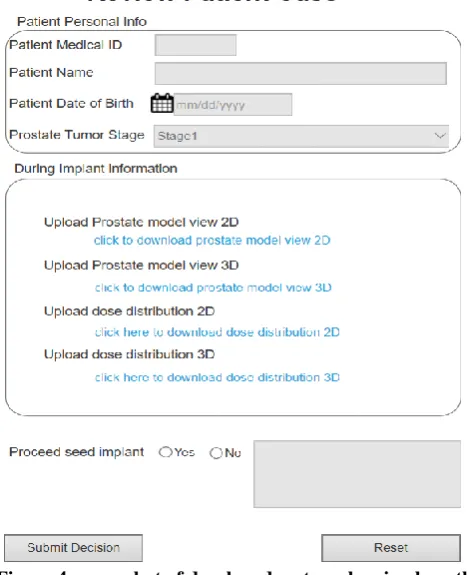
[image:3.595.60.272.475.661.2]rules layer and application layer producing light web form output as Fig. 4 Shows screenshot from system featuring how the referral doctor can Intervene during implant procedure by approving /rejecting online rather than offline at the same time can easily download all support evidences to the patient under procedure. A scenario for auditing and approval/rejection online, but this time from oncologist side as shown in Fig. 5.
Figure 4 screenshot of developed system showing how the referral doctor can intervene during implant procedure
Figure 5 screenshot of developed system showing oncologist reviewing new patient case for assessment to
have LDR seed implant or not
And Fig. 6 shows a screenshot of developed system featuring how oncologist team (physicists) updating patient case with computed technical parameter values for new Seed LDR implant patient case.
Figure 6 screenshot of developed system showing oncologist team (physicists) updating patient case with technical parameter values for new Seed LDR implant Understanding the components of the new radiation oncology practices, the underlying processes, and the social infrastructure of a specific organization or clinical environment is essential for the successful development, evaluation, and implementation of IT/IS applications that will support safe, effective, and efficient information flow and workflow. The introduction of computer-based systems
into the practice of radiation oncology has simplified and streamlined some tasks that in the past had been time-consuming, difficult, or unsafe and provided new capabilities that a few decades ago were practically impossible. [7]
IV. CONCLUSION
OncologyQuest cloud platform provided a unique and pioneer solution for successfully automating and providing an online chartless Prostate radioactive seeds implant procedure covering pre-implant, during-implant and after-implant scenarios. Thus achieving distribution of authenticated data as well as informed decisions across the whole LDR seed implant procedure. The design and implementation way of the platform allows other oncology services to be automated and added to the platform.
REFERENCES
1. Lasse Berntzen: Enhanced e-Services through Partnerships, IEEE Proceedings of the First International Conference on the Digital Society (ICDS'07), 2007
2. DeShazo, J. P. et al. (2009). Publication trends in the medical informatics literature: 20 years of “Medical Informatics” in MeSH. BMC Medical Informatics and Decision Making, 9, 7.
3. Crane, J. & Crane, F. G. (2006). Preventing medication errors in hospitals through a systems approach and technological innovation: A prescription for 2010. Hospital Topics, 84, 3–8.
4. Variseed user manual, varian medical systems, Palo-Alto, California, 2010
5. Liu, B. J. et al. (2007). Image-assisted knowledge discovery and decision support in radiation therapy planning. Computerized Medical Imaging and Graphics, 31, 311–321.
6. Law, M. Y. Y., & Liu, B. (2009). Informatics in radiology DICOM-RT and its utilization in radiation therapy.
7. Huq, M. S. et al. (2008). A method for evaluating quality assurance needs in radiation therapy. International Journal of Radiation Oncology Biology Physics, 71, S170–S173.
8. Jha, A. K. et al. (2009). Use of electronic health records in U.S. hos¬pitals. New England Journal of Medicine, 360, 1628–1638. Radiographics, 29, 655–667.
9. Law, M. Y. Y. et al. (2009). DICOM-RT-based electronic patient record information system for radiation therapy. Radiographics, 29, 961–U3. 10. Kagadis, G. C. et al., Overview of medical imaging informatics, in
Advances in Medical Physics, 3rd edition, Hendee, W. R. et al., Eds., Madison, Wisconsin, Medical Physics Publishing, 2010.
11. Barton, H. I., Health informatics, in Encyclopedia of Library and Information Science, 2nd edition, Drake, M., Ed., Taylor & Francis, Boca Raton, Florida, 2008, 1179.
12. Bernstam, E. V. et al. (2009). Synergies and distinctions between computational disciplines in biomedical research: Perspective from the Clinical and Translational Science Award pro¬grams. Academic Medicine, 84, 964–970.
13. Butte, A. J. (2008). Translational bioinformatics: Coming of age. Journal of the American Medical Informatics Association, 15, 709–714. 14. Friedman, C. P. (2009). A “fundamental theorem” of biomedical
informatics. Journal of the American Medical Informatics Association, 16, 169–170.
15. Herskovic, J. R. et al. (2007). A day in the life of PubMed: Analysis of a typical day’s query log. Journal of the American Medical Informatics Association, 14, 212–220.
16. Hersh, W. (2009). A stimulus to define informatics and health information technology. BMC Medical Informatics and Decision Making, 9, 24.
[image:4.595.47.289.398.685.2]Author-2 Photo
AUTHORS PROFILE
Eng. Hamed S. El-Ghety currently PhD student at Electrical Engineering Department, Faculty of Engineering, Aswan University, Aswan-Egypt. And he had been awarded Bachelor and Master Degrees in Electronic Engineering - Computer Science and Engineering, from Computer Science and Engineering Department, Faculty of Electronic Engineering, Menoufia University, Menouf- Egypt in 1997 and 2013 respectively.
Dr. Ismail Emam, Awarded the PhD degree in Medical Physics from Ain-Shams University, Cairo, Egypt in 2011. He is Medical Physics lecturer at Oncology Department, Faculty of Medicine, Ain-Shams University, Cairo-Egypt. Currently He is a Senior Medical Physicist at the Hermitage Medical Clinic in Dublin, Ireland. His Research interest includes Medical Physics Quality improvement with emphasis of clinical protocols, Medical informatics in radiation oncology including knowledge based platforms, and machine performance studies. Adaptive radiation therapy and its application in hypofractionated treatment.
Prof. Nawal El-Fishawy, Awarded the Ph.D degree in mobile communications from faculty of Electronic Engineering, Menoufia University, Menouf, Egypt, in collaboration with Southampton University in 1991. Now she is Professor at Computer Science and Engineering Dept., Faculty of Electronic Engineering, Menoufia University, Menouf-Egypt. Her research interest includes computer communication networks with emphasis on protocol design, traffic modeling and performance evaluation of broadband networks and multiple access control protocols for wireless communications systems and networks. Now she directed her research interests to the developments of security over wireless communications networks (mobile communications, WLAN, Bluetooth), VOIP, and encryption algorithms. She has served as a reviewer for many national and international journals and conferences.