International Journal of Innovative Technology and Exploring Engineering (IJITEE) ISSN: 2278-3075, Volume-8 Issue-11, September 2019
Role of It among Multi-Generational
Workforce in Banking Sector
By Ipseeta Satpathy, B.C.M Patnaik & Debajani Palai
Abstract: Today organizations recruit & retain Multi-Generational Workforce (Age Diversified Workforce) which consists of employees from five different generations having diversified competency. It is always a great challenge for organizations to retain & motivate a Multi-Generational Workforce to achieve their goals & objectives in a competitive era. The growth and development of an age diversified organization depends upon the performance (PFM) level of personnel working in the organization and their PFM level depends upon both ability & adaptability. As banking sector is automated & every activity is done with the help of computers (IT) it is very tough for banks to deal with multi-generational workforce effectively. The banking sector consists of multi-generational workforce who are different in thought, ideology, attitude & perception & they adapt technology differently. Traditionalist, the silent generation is completely resist to accept technology whereas Baby boomers are little bit sound in technology. Similarly Gen-X is technology friendly & uses technology to make work life balance whereas Gen-Y, the tech savvy generation is completely attached with technology & finally Gen-Z the 5G who is more advanced in technology & cannot walk a single step without the help of IT. In India with the introduction of New Economic Policy (NEP), there was enormous change in banking sector. There was enough scope for private sector banks (LPG, policy) which came to be known as “Tech savvy Banks of New Generation”. The introduction of IT paved new wave of automation in banking sector which enhanced performance & at the same time faced challenges regarding adaptability. It is an attempt to study the importance of IT in banking sector & the challenges faced by banks regarding the adaptability of IT as banks lead a multi-generational workforce. The remedial measures are suggested to bring the compatibility of workforce with IT & strategies with the help of which the workforce will attain its goals & objectives & gain competitive advantage. To test hypotheses “Independent t test” have been conducted.
Keywords: Multi-Generational Workforce , Silent Generation, Baby Boomers, Gen-X, Y & 5G, Challenges, competitive advantage.
I. INTRODUCTION
In early 1991, with the introduction of New Economic Policy (NEP) more emphasis has been given on Liberalization, Privatization & Globalization (LPG) which made India developing & competitive with rest of the world. In this era like other service sectors there was enough scope for private sector banks as banks were going to be automated with introduction of IT. The first bank of India “Bank of Hindustan” was established in 1770. The oldest & largest bank “SBI” was originated in 1806 (Mid-June) & RBI has the sole authority to control & regulate the entire banking functions.
Revised Manuscript Received on September 03, 2019
Dr. Ipseeta Satpathy (D.Litt), Professor in OB and HRM, School of Management, KIIT University. Odisha, India
Dr. B.C.M Patnaik, Associate Professor, School of Management, KIIT University. Odisha, India
Debajani Palai, doctoral scholar in KIIT School of Management, KIIT University. Odisha, India
But during NEP “Tech Savvy Banks of New Generation” came to focus & the introduction of IT has made new banking system automated & more progressive. Along with other functions banks give more stress on Core Banking Solution (CBS) & Customer Relationship Management (CRM) which are the advents of IT. In 2008, RBI has introduced Cheque Truncation which is the digital conversion of cheque from physical form to electronic form. It is just like the blessing for banking sector as banks put broad outlook by focusing on both physical & virtual transactions through internet banking, mobile banking, tele banking, ATM, Paytm, credit card transaction etc. But at the same time banks face challenges regarding adaptability of technology across multi-generational workforce.
II. OBJECTIVES OF THE STUDY To focus on importance of IT in banking sector.
To identify basic challenges faced by banking sector while dealing multi-generational workforce regarding the compatibility with IT.
To suggest measures to curb the challenges & gain competitive advantage.
III. HYPOTHESES
H1: There is no difference in the level of adaptability with technology (IT) for old generation & new generation.
H2: There is no difference in the adaptability with technology (IT) for old generation in public sector & private sector banks.
H3: There is no difference in the adaptability with technology (IT) for new generation in public sector & private sector banks.
To test the hypotheses “independent t test” has been conducted which is explained in the analysis part later.
IV. METHODOLOGY
The study is conducted with the help of both primary & secondary sources of data collection. The secondary sources are being used for this purpose are journals, magazines & articles from national & international level. At the same time primary data is collected directly from the respondents. The present study is the very important piece collected from the thesis “A Comparative Study on Multi-Generational Workforce in Public & Private Sector Banks”. With the help of exploratory research (review of literature) 25 variables are identified & they are clubbed with 6 basic factors on the basis of factor rotation. Adaptability with technology (IT) is a very dominant factor which strongly influences multi-generational workforce in banking sector. The pilot study is conducted with 67 respondents to identify the reliability & validity of questionnaire & justification of variables. The Cronbach alpha for 25 variables is 0.823 which is greater than 0.70 & it paved way for reliability of questionnaire. KMO test (to identify adequacy of sampling for factor analysis & the KMO measures with values greater than 0.5) & Bartlett’s Sphericity test (to identify whether variables are suitable for categorization into factors) have been done. The variables are closely related to each other & for significance correlation measure, r is 0.3taken as cut off. The study is done with 310 respondents out of which 189 from public sector & 121 from private sector banks (Twin-City, Odisha). As the study is conducted in Indian context the respondent employees are regarded as Socialists, Liberals, Gen-X, & Gen-Y. For the current study, Socialists & Liberals are categorized as “Old Generation” & Gen-X & Gen-Y are categorized as “New Generation”. The 310 respondents include 162 old generation employees & 148 new generation employees; 181male employees & 129 female employees. In the present study Stratified Random Sampling technique is used to collect data as the target population is heterogeneous on the basis of age group & the questionnaire is developed by using Likert’s five point scale (1= strongly agree to 5= strongly disagree). The questionnaire consists of two basic sections: one provides
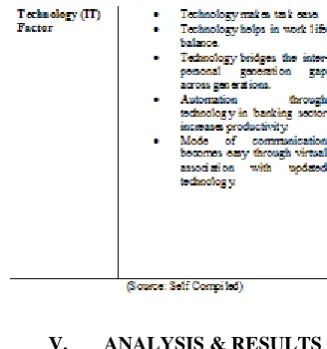
demographic details & another segment reflects on factor analysis. The basic variables come under technology (Factor) can be presented through the following table
V. ANALYSIS & RESULTS
(i) Demographic Analysis
The demographic analysis states that out of total 310 respondents, 162 respondents i.e. 52.26% from old generation & 148 respondents i.e. 47.74% from new generation & 60.97% from public sector & 39.03% from private sector. From 189 respondents of public sector the old generation is 102 (53.97%) & the new generation is 87 (46.03%). Similarly, out of 121 respondents of private sector the old generation is 60 (49.59%) & new generation is 61 (50.41%). Similarly, out of 162 respondents of old generation 90 (55.56%) respondents are male & 72 (44.44%) are female. Similarly, 148 respondents of new generation 91 (61.49%) are male & 57 (38.53%) are female respondents. (ii) Test of hypothesis
Hypothesis 1:
[image:2.595.338.502.106.281.2]H1 a: There is no difference in “technological adaptability” (factor) between “old generation”& “new generation”. H1 b: There is difference in “technological adaptability” (factor) between “old generation”& “new generation”.
Table a:Group Statistics of mean score of Technology Factor – Old Generation & New generation
Generation of
Workforce N Mean
Std. Deviation
Std. Error Mean
Technology Factor Mean
Score
Old
Generation 162 3.2191 0.81464 0.064 New
International Journal of Innovative Technology and Exploring Engineering (IJITEE) ISSN: 2278-3075, Volume-8 Issue-11, September 2019
Table b: Independent Samples t Test for equality of mean score of technology factor between Old Generation & New Generation
Levene's
Test for Equality of
Variances t-test for Equality of Means
F Sig. T Df
Sig. (2-
Mean Difference
Std. Error Difference
95%
tailed)
Confidence Interval of the
Difference
Lower Upper
E qual
variances assumed
Technology 0.052 0.82 -2.107
308 0.036 -0.18796 0.08919
-0.36346 -0.01246 Factor
Mean
Score
Equal
v ariances
n
ot assumed
-2.115
307.981 0.035 -0.18796 0.08886
-0.36281 -0.01311
Interpretation:
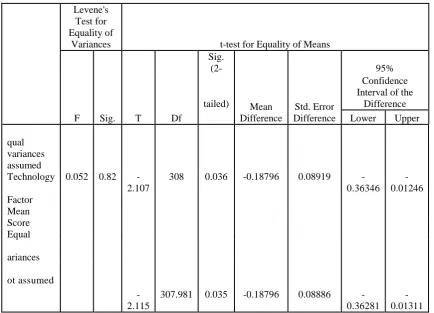
The descriptive statistics shows the mean factor score of technology is higher for new generation work force at 3.41 compared to that of old generations at 3.22. The variation in score is low for new generation which is evidenced by the lower standard deviation i.e. 0.75 compared to the standard deviation for old generation of 0.81.
The result of Levene’s test for equality of variances is looked into to know whether there is statistically equality of variances or not. The p value of Levene’s test is 0.82 which is greater than 0.05 & so there is equality in variances in the mean score for technology factor between old generation & new generation.
The p value of the‘t’ test for equality of means is 0.036 which is lower than 0.05. It suggests rejecting the null hypothesis of equality in mean scores of adaptability of technology factor & thus there is statistically significant difference in the mean scores of both the groups.
Implication:
There is difference in the opinion between old generation & new generation in the use of technology.
Hypothesis 2:
H2a: There is no difference in “technological adaptability” (factor) of old generation in “public sector” & “private sector” banks.
H2b: There is difference in “technological adaptability” (factor) of old generation in “public sector” & “private sector” banks.
Table a: Group Statistics mean score of Technology Factor among Old Generation among Public Sector &
Private Sector Banks
Generation of
Workforce N Mean
Std. Deviation
Std. Error Mean
Public Sector Bank
Technology Old Gen 102 3.2181 0.76565 0.7581
Private Sector Bank
Table b: Independent Samples t Test for equality of mean score of Technology factor among Old Generation working in Public Sector & Private Sector Banks
Levene's Test
for Equality of
t-test for Equality of Means Variances
F Sig. T Df
Sig. (2-
Mean Difference
Std. Error Difference
95% Confidence Interval of the
tailed) Difference
Lower Upper
E qual variances
Technology assumed Factor Mean
1.385 0.241 -0.02 160 0.984 -0.0027 0.13295
-0.26527
0.25987
Score Old Gen
Equal
variances
n
ot assumed
-0.019 108.589 0.985 -0.0027 0.13858
-0.27737
0.27197
Interpretation:
The mean score of technology factor for old generation in public sector banks is 3.218, whereas the same in private sector bank is 3.220. The standard deviation for the mean score in public sector banks is 0.77 & in private sector banks is 0.90. But the Levene’s test suggested for equality in variances as p value for the test is greater than 0.05.
The p value of the‘t’ test for equality of means is 0.984 which is greater than 0.05. It suggests accepting the null hypothesis of equality in mean scores of technology factor & thus there is statistically no significant difference in the mean scores in public sector banks & private sector banks for old generation.
Implication:
The old generation people, whether they work in the public sector banks or private sector banks, do not have change in the view on technology.
Hypothesis 3:
H3a: There is no difference in “technological adaptability” (factor) of new generation in “public sector” & “private sector” banks.
H3b: There is difference in “technological adaptability” (factor) of new generation in “public sector” & “private sector”
banks.
Table a: Group Statistics of mean score of Technology Factor among New Generation working in Public Sector
& Private Sector Banks
Sector of
bank N Mean Std. Deviation
Std. Error Mean
Technology New Gen Public Sector Private Sector Bank 87
61 3.42
3,39 0.778
0.714
0.083
[image:4.595.53.286.641.702.2]International Journal of Innovative Technology and Exploring Engineering (IJITEE) ISSN: 2278-3075, Volume-8 Issue-11, September 2019
Table b: Independent Samples t Test for equality of mean score of Technology Factor among New Generation working in Public Sector & Private Sector Banks
Levene's
Test for Equality of
Variances t-test for Equality of Means
F Sig. T Df
Sig. (2 tailed)
Mean Difference
Std. Error Difference
95% Confidence Interval of the
Difference Lower Upper E
qual
v ariances
assumed
Technology New Gen
0.435 0.51 -0.02 146 0.81 0.03 0.126
-0.218 0.278
Equal
v ariances
not
a
ssumed
-0.019
135.843 0.808 0.03 0.124
-0.214 0.275
Interpretation:
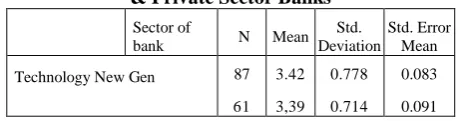
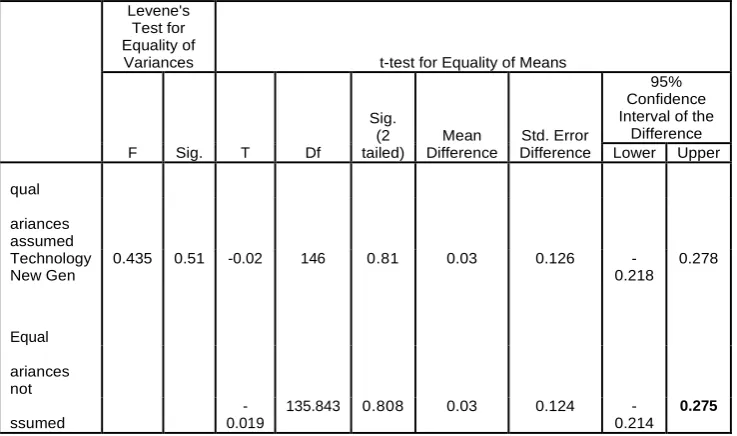
The mean score of technology for new generation workforce in public sector banks & private sector bank are 3.42 & 3.39 respectively. Levene’s test suggested for equality in variances as p value for the test is greater than 0.05 though the standard deviation for the mean score in public sector banks is 0.78 & in private sector banks is 0.71.
The p value of the‘t’ test for equality of means is 0.81 which is greater than 0.05. It suggests accepting the null hypothesis of equality in mean scores of dominant work values factor & thus there is statistically no significant difference in the mean scores in public sector banks & private sector banks for new generation.
Implication:
There is no difference among new generation people working in the public sector banks & the same generation people working in the private sector banks for technology as they have to work with updated technology.
Importance of IT & Challenges while Dealing with Multi-Generational Workforce in Banking Sector: IT sector has been developed on the basis of generation. The First Generation (0G) computer was developed in 1940-56. Today’s trend is 5G as IT shifted itself from an entire room to one figure to be run. From the evolution till date IT sector faced so many changes & challenges. From the typical process of collection, store, circulation & retrieve information IT now runs the entire world in a single palm. From 0G-5G IT shifted itself from unified objective of enhancing PFM & Efficiency to Research & Development (R&D). At present conference, research, video, audio, chats etc. are done in an easy & swift process which is the gift of IT. The modern world heavily depends on IT. It is always stated that each generation is identified on the basis of the dependence on technology. Traditionalists were not technology friendly, but they use first generation’s heavy Vacuum Tubes. Baby Boomers were rocked by electronic calculator & later the personal computer. For Gen-X, it was email & online services. For Millennials who are completely tech-savvy & occupy the one third portion in workforce depend on technology like anything. They use laptops,
palmtops, smart phones & mobile apps which quickly access information & feedback. Their world is digital which is based on creativity & innovation. Artificial Intelligence & Smart Machines make problem solving & decision making tasks easy & swift (Trends in Information technology for 2019-Vista College).
In India with the introduction of NEP IT plays very significant role in banking sector. Both public & private sector banks heavily dependent on IT for Core Banking Solution (CBS), Customer Relationship Management (CRM), Cheque Truncation, other virtual transactions like internet banking, ATM, Paytm etc. But at the same time banks face heavy challenges regarding the adaptability of technology across multi-Generational workforce. The old generation is less adaptive with technology whereas the young generation is more compatible. For example; while the old generation prefers face-to-face meetings the young generation opt for virtual association with skype, tele conference or video conference etc. Similarly, conflicts occur on the basis of dominant values like importance of work. The old generation is more dedicated & come to workplace regularly whereas the young generation prefers work from home & flexible working hours to make work-life balance with the help of technology. As they are multi-task oriented technology makes their life swift & easy. Measures to Curb Challenges & Gain Competitive advantage
On the basis of analysis it is clear that there is difference in adaptability with technology factor in between old generation & new generation in banking sector. The new generation is more adaptive with IT as compared to old generation. Similarly whether the bank is public sector under taking or private both the generations do not change their views regarding technology. The new generation is known as tech savvy or digital generations. The employees belong to new generation are born & brought up in technological era & they are highly updated in the use of technology. They are more adaptive as compared to old generations. Old generation
should provide scope for both generations to work together by reducing the resistance of old generation& providing them training to be adaptive with technology. The old generation is less technically sound& less user of technology. The employees belong to this group have resistance to accept new technologies. They feel insecurity fear towards updated technology. So the banking sector whether it is public or private should provide refresher trainings & knowledge sharing platform for old generation to be adaptive. The new generation is tech savvy & adaptive with automation system. They believe in that technology makes their task ease, increases productivity & provides work-life- balance. For them technology makes their lives soft, swift & comfortable as it is time effective & cost effective. Banking sector whether it is public or private should provide a common platform in which the young generations share their technical knowledge through reverse mentoring with old generation which will help to reduce generational gap & strengthen their relations.
VI. CONCLUSION
The technology used by different generations are not standardized or same for all. There is the shift in technology from first generation computer (heavy vacuum tubes) to palm top, from wireless to smart phones & from manual system of work to automation. The use of technology increases productivity, makes task ease, bridges generational gap & helpful for work-life-balance in banking sector. The employees belonging to old generation are technically sound, but they mostly do not depend on technology. Normally, they resist to adapt updated technology due to insecurity &fear. Similarly, the new generation is known as tech savvy or digital generations. So, banks should provide scope for both generations to work together as the young generation can easily share technical knowledge with the old generation. As a result, banks gain strong inter-personal relation & bridge the gap across generations. At the same time, banks should provide refresher training programs & development programs like sharing knowledge on technical knowhow & its positivity to retain experienced employees & digital employees. Banks should also focus on reverse mentoring & establishment of leadership institutes that would help in sharing of knowledge among employees of all generations.
REFERENCE
1. 1. Brusch, D. & Kelly, K.(2014), “Managing Multigenerational Workplace”, UNC Executive Development, UNC Kenan – Flagler Business School.
2. Kane, S. (2017), “Managing & Motivating an Age Diverse Workforce”.
3. https://en.m.wikipedia.org/wiki/Banking_in_India
4. Haeger, DL., Lingham, T. (2014), “A trend toward Work-Life Fusion: A multi-generational shift in technology use at work” 5. Cekada, TL. (2012), “Training a multigenerational workforce:
Understanding key needs & learning styles”
6. Njenga, A. (2018), “Technology & the Multigenerational Workforce”.
7. https://www.entrepreneur.com, (2017), “3 ways Technology Influences Generational Divides at work”.
8. https://www.peoplematters.com, (2018), “Can Technology Integrate multi-generational workforce”.
9. Coulter, J.S. & Faulkner, D.C. (2014), “The Multigenerational Workforce”.
10. Admin, W. (2018), “An article on information technology” 11. Rouse, M. (2016, “Information Technology (IT), Tech Target,
Retrieved”
12. Wilkinson, M. (2014), “How Internet has Made the world a smaller place”, Digital Rise, Retrieved.
13. Chen, W. & Srinivasan, S. (2019,) “Going Digital: Implications for Firm Value & Performance”.
14. Wesolowski, P. (2014), “Melding a multi-generational workforce: Communication technology is part of the problem – & the solution”, Human Resource Management International Digest” 15. Tiwari, T. (2016), “India’s New HR Challenge: Managing a
multi-generational Workforce”, Journal of Business & Human Resource Management.
16. Stewart,A. et.al.(2017), “Leading A multi-generational Staff”. 17. Savino, E. M.(2017), “Quick! How do I deal with a multigenerational
workforce?”, Strategic HR Review, Vol. 16, Issue: 4, pp.192-193. 18. Sean,J., Britton et al. (2018), “Understanding & Embracing the
Multigenerational Workforce”.
19. https://www.Vistacollege.edu> careers, (2019), “Trends in Information Technology for 2019- Vista College”.
AUTHORS PROFILE
Dr. Ipseeta Satpathy (D.Litt) is a Professor in OB and HRM, School of Management, KIIT University. She has over 15 years of experience in teaching and administration in KIIT University. Prof. Satpathy is a visiting professor to Lynchburg College, Virginia, USA. She has authored six books published by Excel books, New Delhi, Transnational Marketing Strategy, published by New Age International Publishers.12 of her scholars have been awarded Ph.D degree also she has published more than 100 research papers in various referred national & international journals and conference proceedings. Dr Satpathy was invited by University of Massachusetts, Dartmouth, USA to address the faculties & the students.
Dr. B.C.M Patnaik Associate Professor, School of Management, KIIT University. He has 6 years of corporate and 16 years of academic experience. To his credit he has published more than 70 research papers in various reputed International and National Journals and presented more than 10 research papers in various International and National Conferences. He has been awarded Best Faculty award three times once by GIMT, New Delhi and twice in Wilsonia Group.