Performance Evaluation of Compressive Sensing
Based Compression of Multi-Resolution Ppg
Signals Under Wban Environment.
Kiran Kumar G H
, Manjunatha P
, Mallikarjun S. Holi , Rajashekar Kunabeva
Abstract—Wireless Body Area Network (WBAN) is a collection of wireless biosensors worn on the body, in which each sensor node is capable of computing and communicating with other nodes or devices like smart phones, Personal Digital Assistant (PDA), hand held devices etc,. The wearable nodes are powered by battery and need to be always functional for continuous remote monitoring of patients which demands that node life time has to be prolonged to the maximum extent. One of the best solutions for this issue is to go for data compression at the node. In this context, Compressive sensing (CS) based energy efficient compression algorithms have been developed and tested for 8 -bit and 10-bit resolution Photoplethesmogram (PPG) signal. Test data have been acquired from normal subjects using Arduino Uno R3. Validation of the algorithm has been carried out by applying on MIMIC-II database and acquired signals. It is found that the CS algorithm reconstruction quality diminishes for low resolution PPG data.
Keywords—WBAN, PPG, Compression, Compressive sensing, ADC Resolution.
I. INTRODUCTION
For the aging population and busy life style, the non-invasive monitoring technology is highly desirable as it permits us to do routine activities without any constraints. Biomedical sensors worn on the body with communication capabilities will be very helpful in patient monitoring and has led to the development of wireless body area network (WBAN). The WBAN [1] is a small wireless sensor network comprising of tiny, intelligent sensor nodes worn on, in or placed near the vicinity of the human body. The medical emergencies demand that the window time available for saving the life of the person suffering from Cardiovascular Diseases (CVD) is very less and this may further escalate due to deployment of technology which cannot produce quicker response. As per World Health Organization (WHO), in India, most of the elderly people [2] are prone to death due to Cardiac related issues.
Revised Manuscript Received on September 2, 2019.
Kiran Kumar G H.Research Scholar, Dept of ECE, JNNCE, Shivamogga, VTU, India.
Manjunatha P
.
Professor & Head, Dept. of ECE, JNNCE, Shivamogga, VTU, India.Mallikarjun S. Holi.Professor & Chairman, Department of E&IE, UBDTCE, Davangere, VTU,India
Rajashekar Kunabeva
.
Research Scholar, Dept of ECE, JNNCE, Shivamogga, VTU, India. [image:1.595.306.557.357.479.2]So it is evident that PPG [3] along with ECG monitoring is a life-critical e-health application for observing the cardiac status of a person. Physiological parameters like heart rate, cardiac output, blood pressure, blood oxygen saturation, vascular assessment and respiration can be assessed by PPG. The implementation of such a monitoring system requires a WBAN. End-to-end architecture for WBAN based communication is shown in fig.1 consists of intra, inter and beyond Body Area Network (BAN) data transfer. WBAN technology is useful in early detection of myocardial infarction (MI) [1] and other heart ailments leading to prevention of deaths.
Fig. 1 WBAN Communications architecture for e-health applications [2]
The major problem in WBAN being that, continuous acquisition of evolving PPG produces enormous volume of data in the order of giga bytes and needs to be reduced before communicating to remote places or other devices to prolong the PPG node life span while efficiently utilizing the available bandwidth. Therefore WBAN node should employ efficient PPG data compression technique for increasing its life span.
The PPG can be used to determine the blood volume changes in the microvascular bed of tissue. Fig. 2 depicts the characteristics of the PPG signal, which is a low-frequency (around 1 Hz) waveform.
Fig 2. PPG signal [3]
From the PPG signals, parameters like pulse rate (PR), average pulse rate (APR), pulse rate variability (PRV) can be determined which are of diagnostic importance [5]. The objective of this paper is to develop CS based energy efficient compression algorithm which is applied on multiresolution PPG signal (8 bit and 10 bit data) and to check the reconstruction quality of the signal, and to evaluate the performance of CS algorithm with respect to compression ratio (CR), PRD and signal to noise ratio (SNR).
II. LITERATUREREVIEW
The redundancy removal techniques play significant role in saving energy of the battery, and hence energy efficient compression techniques are to be designed for extension of WBAN node life time. Recent Study shows that compression of bio-signals boosts the battery life of wearables [6] for health monitoring up to 100 times and reconstruction error limited to 4% of the peak-to-peak signal amplitude can be achieved. It was pointed that designer is helped with the power efficient signal processing techniques [7] to keep power depletion linked to the acquisition and analysis of the biological signals under control.
Compressive sampling/sensing (CS) is an emerging paradigm for low cost encoder design which is based on transform coding technique. Each transform is a tool for signal representation in different domain so that sparse version is obtained before applying CS on the signal. Today CS [8] has emerged as the most promising data acquisition technique for extending the life time of WBAN node and longevity of the WBAN also. CS involves design of low complexity algorithms for intelligent choice of the samples from the sensors so that clinical content of the signal is captured without loss of any significant data and rebuild the signal at the end with almost same quality as that present at the patient end.
Many CS algorithms have been designed for single and multiple channel ECG signals, but for other bio-signals of interest like PPG, limited attempts have been made to perform on node compression using CS theory. Recently some of the papers have experimentally verified that accurate extraction of HR and HRV parameters [9] using PPG sensor node is possible. Some of the papers relate the application of PPG signal [10, 11] for CVD detection.
The greatest challenging concern of PPG acquisition is the high power consumption [11] in LED. This needs further investigation as to how energy efficient sensor design has to be done.
With every signal there are different types of noises which have to be eliminated before processing phase to prevent energy drain and compromise in the accuracy. An algorithm was designed to reduce the effect of motion artefacts [12] to obtain accurate heart rate estimation.
Hardware implementation of low power PPG was realized which exploited duty cycle based non-uniform CS algorithm [9]. Around 30 times reduction in power consumption was achieved with no loss of information. The total system power consumption was 172µw when extracting HR and HRV parameters from compressed PPG signal.
Hence, it can be concluded that on-node PPG signal CS algorithms need to be designed to prevent energy drain in WBAN node. Most of the previous papers have been published on acquisition and compression of 10-bit resolution PPG data at a sampling rate of 125 HZ.
III. METHODOLOGY
The CS based compression algorithm shown in Fig. 3 has been implemented and tested using PPG signal from MIT-BIH arrhythmia database and MIMIC-II database which was recorded using 10-bit ADC resolution at a sampling rate of 125 Hz. Even most of the previous papers have been published on acquisition and compression of 10-bit resolution PPG data. But in practice all the medical devices capturing PPG do not record the signal at same bit-resolution as they deploy different ADC variants. Hence there is need for testing the performance of the compression algorithms for multi-resolution PPG data for effective reconstruction quality.
Test records have been taken from and MIMIC-II database for 10-bit resolution data whereas 8-bit resolution data and 10-bit resolution data is recorded from normal subjects using simulink and aurdino uno board with sampling rate of 50Hz as representative cases of multi resolution signals. In this paper, CS algorithm shown in Fig. 3 compresses PPG data in discrete wavelet domain. Mathematical models are illustrated in section IV.
Hence CS acquires and represents the original signal using small number of measurements which can be transmitted and used for recovery of the signal at the doctor’s mobile or medical server end.
Fig 3. CS algorithm
In digital CS theory, any compressible or sparse signal xRn can be given as
x = (1)
where s is the n column vector of weighting coefficients s = x and T denotes the transpose operation. Ψ is the basis matrix of size n×n. Therefore, the compressed signal y is found as
[y]m×1= [φ]m×n [x]n×1 (2)
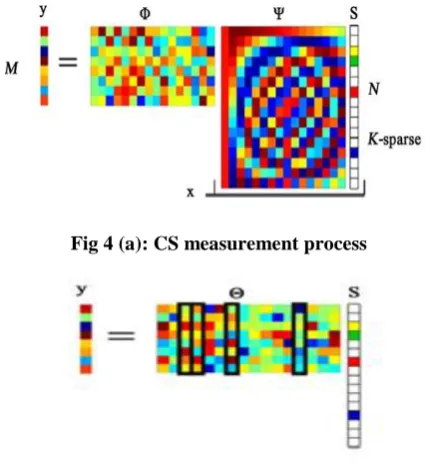
[y]m×1 = [φ]m×n [ψ]n×n [s]n×1 = [Θ]m×n [s]n×1 (3) Pictorial depiction of (3) is shown in Fig 4(a) and 4(b). [Φ] and [Θ] have two interesting properties, i.e. they are incoherent with the basis [Ψ] and they have the Restricted Isometry Property (RIP) with accurate level for detection probability of the compressed signals at the receiver side that is suitable for recovering the actual signal from compressed signal. CS scenario has two important steps.
A stable measurement matrix [φ]m×n should confirm
that the significant data in any compressible data is not dented by the dimensionality drop from x∈RN
down to y∈RM.
The CS theory offers a restoration algorithm under certain conditions with adequate exactness to get back actual data x from the compressed data. Therefore, CS theory mainly focus on M random linear measurements instead of N samples such that M N. The compressive sensing theory also offers a reconstruction algorithm to recover original signal x from the compressed signal y only with M random linear measurements. The number of random linear measurements M, number of samples/coefficients N, and non-zero significant coefficients K must satisfy the following equation
M ≥ cKlog(N/K) (4) where c is constant. The CS theory consists of the following steps :
1. Design a stable measurements matrix Φ.
2. Develop a rebuilding algorithm to get back the actual signal from the compressed signal in the receiver side.
3. Test the number of M measurement to ensure that reduction from N to M is not damaged to collect the original signal.
Fig 4 (a): CS measurement process
Fig 4 (b): Measurement process interms of product Φ
A. Reconstruction Algorithm
CS theory offers a way to reconstruct the compressible or sparse signal from the M linear measurements. There reconstruction algorithm needs only random matrix Φ and Ψ to recover the original signal. lp norm is used to recover the
sparse solution of the signal in order to reconstruct the signal, where p is a norm parameter. With p = 1 is the l1
norm, by minimizing this norm one can reconstruct the sparse solution of the signal with enough accuracy by solving the basis pursuit denoise problem.
[image:3.595.83.256.106.205.2]V. EXPERIMENTAL DATA COLLECTION The PPG signals are recorded from the subjects with normal medical profile with 8-bit and 10-bit resolution at a sampling rate of 50Hz by arduino uno acquisition module board as shown in Fig. 5. The recorded signals were saved as text files in the computer.
[image:3.595.307.550.537.701.2]VI. RESULTS AND DISCUSSIONS
Evaluation of CS algorithm was done using the following metrics.
A. Performance Metrics
Evaluation of algorithms is measured using the metrics namely CR, SNR and PRD. The expressions for the metrics are as below:
CR =
(5)
where - number of bits required for the original signal. - number of bits required to represent compressed signal.
PRD =
(6)
where, is the original signal and is the reconstructed signal and
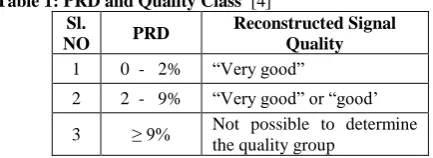
[image:4.595.49.266.334.413.2]SNR = (7) Reconstruction with PRD quality of “Very good” [6] is desirable after reconstruction by CS algorithm. Table 1 shows different PRD range and the reconstruction quality.
Table 1: PRD and Quality Class [4] Sl.
NO PRD
Reconstructed Signal Quality 1 0 - 2% “Very good”
2 2 - 9% “Very good” or “good’
3 ≥ 9% Not possible to determine the quality group
PPG compression algorithms were tested by conducting an experiment as below.
Experiment: To study the impact of data resolution on the performance parameters of CS the algorithm is implemented using db1 mother wavelet.
[image:4.595.309.549.356.415.2]CS algorithm were tested by simulation using MATLAB 2017b over Intel i-5 CPU and Window 10 platform. 10-bit PPG data from MIMIC-II database, and 10-bit and 8-bit acquired PPG signals were segmented into window/block size of N=512 samples. The performance parameters of the compression algorithm are given in Tables 2 to 6.
Table 2 and 3 shows CR, PRD and SNR of CS algorithm for four different subjects for 8 bit and 10 bit recorded PPG data.
Table 2: CS algorithm for 8-bit recorded PPG data PPG
Record CR PRD % SNR (dB)
Execution time (secs)
Sub 1 58.62 15.41 16.24 0.4190
Sub 2 59.48 16.19 15.81 0.2467
Sub 3 58.68 15.27 16.17 0.3044
Sub 4 71.20 20.48 13.77 0.1684
Average 61.99 16.83 15.50 0.2846
Table 3: CS algorithm for 10-bit recorded PPG data PPG
Record CR PRD % SNR (dB)
Execution time (secs)
Sub 1 55.57 3.94 28.07 0.2148
Sub 2 55.57 3.96 28.04 0.2021
Sub 3 55.36 4.68 26.59 0.1912
Sub 4 72.37 7.83 22.12 0.1862
Average 59.71 5.10 26.20 0.1985
Observation 1: For 10 bit PPG data, CS algorithm achieves least PRD and higher SNR compared to 8 bit PPG data, where as CR is virtually same. Execution time for both 8-bit and 10-8-bit data is almost same except for 8-8-bit of sub 1 and sub 3.
Table 4: CS algorithm for 10-bit PPG data from MIMIC-II database
PPG Record CR PRD % SNR (dB) Execution time (secs)
a45503m 57.38 4.92 26.15 0.2310
a44115bm 56.49 6.04 24.37 0.2957
a44115am 56.32 6.44 23.81 0.3229
a45449bm 62.05 6.95 23.15 0.2437
Average 58.06 6.09 24.37 0.2733
Table 5: Validation of CS algorithm for 10-bit recorded and 10-bit downloaded data
Sl.
NO Performance metric
CS_10-bit recorded
CS_10-bit downloaded
1 Avg CR 59.71 58.06
2 Avg PRD % 5.10 6.09
3 Avg SNR (dB) 26.20 24.37
4 Avg Exec time (s) 0.1985 0.27334 Observation 2: For 10 bit recorded PPG data and 10 bit downloaded PPG data from MIMIC-II data base, CS algorithms achieves almost same PRD, SNR and CR.
Table 6: Comparitive performance study of CS algorithm for 8-bit recorded and 10-bit recorded data
Sl.
No. Performance metric
8-bit recorded signal
10-bit recorded signal
1 Avg CR 61.99 59.71
2 Avg PRD % 16.838 5.10
3 Avg SNR (dB) 15.50 26.2085
4 Avg Exec time (s) 0.2846 0.1985
As shown in table 6, avg PRD for 10 bit PPG data is very much less than 8 bit PPG data with almost same CR, which is highly desirable from the point of signal reconstruction quality.
VII. CONCLUSIONS
[image:4.595.46.292.578.764.2]Hence, there is a further improvement in the CS algorithm is needed, so that recovered signal is useful for diagnostic purpose with less PRD (< 2%) and higher CR, irrespective of the underlying ADC deployed in the medical devices.
REFERENCES
1. Rim Negra, Imen Jemili and Abdelfettah Belghith, “Wireless Body Area Networks: Applications and technologies”, Second International Workshop on Recent Advances on Machine-to-Machine Communications, Procedia Computer Science, Vol. 83, pp1274 – 1281,2016.DOI:10.1016/j.procs.2016.04.266
2. CVD factsheet. Available:
http://www.who.int/mediacentre/factsheets/fs317/en/index.html.[ accessed 2014].
3. Rajarshi Gupta “Lossless Compression Technique for Real-Time Photoplethysmographic Measurements”, IEEE transactions on instrumentation and measurement,Vol.64,Issue:4, pp975 – 983. APRIL 2015.DOI: 10.1109/TIM.2014.2362837.
4. Hossein Mamaghanian, Nadia Khaled, David Atienza and Pierre Vandergheynst, “ Compressed Sensing for Real-Time Energy-Efficient ECG Compression on Wireless Body Sensor Nodes”, IEEE transactions on biomedical engineering, Vol. 58, Issue: 9,pp 2456 – 2466, September 2011.DOI: 10.1109/TBME.2011.2156795.
5. Jayadevappa B.M, Kiran Kumar G.H , Anjaneya L.H, Mallikarjun S. Holi, “ Design and Development of electro-optical system for acquisition of PPG signals for the assessment Of cardiovascular system”, IJRET, Vol. 03, No. 06, pp520-525, June-2014.
6. Darren Craven, Brian McGinley, Liam Kilmartin, Martin Glavin and Edward Jones, “Adaptive Dictionary Reconstruction for Compressed Sensing of ECG Signals”, IEEE journal of biomedical and health informatics,Vol.21,Issue:3,pp645–
654,May2017.DOI: 10.1109/JBHI.2016.2531182.
7. Riccardo Cavallari, “A Survey on Wireless Body Area Networks: Technologies and Design Challenges”, IEEE communications surveys & tutorials,Vol.16,Issue:3, pp 1635-1657, Third quarter 2014.DOI: 10.1109/SURV.2014.012214.00007
8. Emmanuel J. Candès and Michael B. Wakin, “An Introduction to Compressive Sampling”, IEEE signal processing magazine, Vol.25, Issue:2, pp 21-30, MARCH 2008.DOI: 10.1109/MSP.2007.914731
9. Pamula Venkata Rajesh and Marian Verhelst, “A 172μW Compressive Sampling Photoplethysmographic Readout with Embedded Direct Heart-Rate and Variability Extraction from Compressively Sampled Data”, IEEE International Solid-State Circuits Conference, Electronic ISSN: 2376-8606,2016.DOI: 10.1109/ISSCC.2016.7418069
10. S. Hwang, JoonOh Seo, Houtan Jebelli and SangHyun Lee, “Fesibility analysis of heart rate monitoring of construction workers using a photoplethysmography (PPG) sensor embedded in a wristband-type activity tracker”, Automation in Construction, Vol.71, Part 2, pp372– 381, Elsevier 2016.
11. B. Furht and A. Agarwal (eds.), “Chapter 22: Wearable and Implantable Technologies for Cardiovascular Health Informatics”, Handbook of Medical and Healthcare Technologies, pp481-501, Springer Science &Business Media New York, 2013.
12. Yo-Ping Huan, Chao-Ying Huang, Shen-Ing Liu, “Hybrid intelligent methods for arrhythmia detection and geriatric depression diagnosis”,Applied Soft Computing, Vol. 14 , pp 38–46, Elsevier 2014.
AUTHORS PROFILE
Kiran Kumar G H received the M.Tech degree in Digital Electronics form BVBCET, Hubli, Karnataka, India, in the year 2003. He has 15 years of teaching and 05 years of research experience. His research interests are Biomedical Signal Processing and Wireless Sensor Network. He is pursuing research work towards obtaining Ph.D. Currently, he is Assistant Professor in the Department of Electronics and Communication Engineering, Bapuji Institute of Engineering and Technology, Davangere, Karnataka, India.
Manjunatha P has completed his BE degree from kuvempu University in 1994, ME from Karnataka University in 1999, and Ph.D. from IIT Bombay, Mumbai in the area of wireless sensor networks in 2012. He is presently working as Professor in the department of ECE, JNNCE Shivamogga. He has an experience of around 18 years in Academics. His areas of interest are communication, signal processing, wireless sensor networks, Image Processing, , Pattern Recognition and Natural Language Processing. He has to his credits, 01- chapter Edited Text Book, 03- International Journals, and 12- Conferences papers. He is a Fellow of the Institution of Electronics and Telecommunication Engineers (IETE), a Life Member of Indian Society for Technical Education (ISTE. He is the reviewer of International Journal of Systems Assurance Engineering and Management (IJSA).
Mallikarjun S. Holi received Bachelor of Engineering
degree in Instrumentation Technology in 1993, Master of Technologyand Ph.D. degree in Biomedical Engineeringfrom Indian Institute Technology, Madras in 1997 and 2004 respectively. He has received Institute Merit Award for the Best Academic Record in M.Tech. (Biomedical Engineering) program for the academic year 1995-1996 from IIT-Madras. He has 25 years of teaching experience and 15 years of research experience. His research interests are in the field of Biomechanics, Rehabilitation Engineering, Biomedical Signal and Image Processing, Biomedical Instrumentation & Process Control. He has published 99 research papers in National and International journals and conference proceedings. He has 185 citations. Six scholars have received the Ph.D. degree, and 4 scholars are pursuing their Ph.D. programme under his guidance. He has carried out several Sponsored Research Projects, and organized Faculty Development Programs and Seminars funded by AICTE, VTU and VGST.
![Fig. 1 WBAN Communications architecture for e-health applications [2]](https://thumb-us.123doks.com/thumbv2/123dok_us/8176099.253484/1.595.306.557.357.479/fig-wban-communications-architecture-e-health-applications.webp)
![Fig 2. PPG signal [3] From the PPG signals, parameters like pulse rate (PR),](https://thumb-us.123doks.com/thumbv2/123dok_us/8176099.253484/2.595.46.294.119.247/fig-ppg-signal-ppg-signals-parameters-like-pulse.webp)