Abstract: This article analyzes the existing terminological and methodological personnel management apparatus and as a result, it turned out that the application of the project-oriented management approach leads to the conclusion and indicates that the employment agreement (contract) for the voyage, the ship's crew are all signs of the project, and the project team. It should be noted that shipping companies are management oriented organizations through projects. Despite the absolutely correct conclusion that the minimum crew should be determined on the basis of the conditions for ensuring the safe operation of all ship systems and mechanisms. Specific techniques and methods for calculating the required number of crew not previously represented. The project-oriented context of modern project management in a turbulent environment and the need for appropriate transformations of infrastructure and industry, including the sea. The management activities take into account the individual characteristics of the project team members, due to socio-cultural influences. The project management methodology and team format of the project activity considers human resource management processes in conjunction with other areas of knowledge that should be integrated into processes such as content management, timing, cost, quality, risk, supply, communications. Therefore, it seems quite logical for the authors to refer to “the processes of formation and management of human resources in project teams” on the example of the ship’s crew.
Index Terms: Forming teams, methodology, personnel management, project management, ship’s crew.
I. INTRODUCTION
The focus of special attention should be not only the unique contextual features of the enterprise, but also the question of creating a high-quality organizational and social space. Thus, in the knowledge P2M system highlights the importance of creating the intellectual (or mental) environment "ba", capable of forming an additional value of the project. Concepts of creative management also apply to the development of special methods aimed at developing the
Revised Manuscript Received on August 05, 2019.
Sergiy O. Kramskyі, Department of Management and Economics, Odessa Institute Private Joint-Stock Company "Higher Educational Institution "Interregional Academy of Personnel Management"", Odessa, Ukraine.
Oleg V. Zakharchenko, Department of Management and Marketing, Odessa State Academy of Civil Engineering and Architecture, Odessa, Ukraine.
Aleksandr V. Darushin, Department of Management and Marketing, Odessa State Academy of Civil Engineering and Architecture, Odessa, Ukraine.
Olena V. Bileha, Department of Management and Marketing, Odessa State Academy of Civil Engineering and Architecture, Odessa, Ukraine.
Tetiana P. Riepnova, General Scientific, Social and Behavioral Disciplines Department, Odessa Institute Private Joint-Stock Company "Higher Educational Institution "Interregional Academy of Personnel Management"", Odessa, Ukraine.
group potential of the workforce. Project management format, focusing on compliance with the precise parameters of time, financial, material and human resources, provides for the mandatory establishment of a project team. The basis for modeling team competencies are the international standards NCB, P2M, PRINCE2, PMBOK6 [1]-[4], each of which contains a personal component (behavioral competences). The management activities are taken into account the individual characteristics of the psyche of the project team members, caused by social and cultural influences. The project management methodology and team format of the project activity considers human resource management processes in conjunction with other areas of knowledge that should be integrated into processes such as content management, timing, cost, quality, risk, supply, communications. Therefore, it is quite logical that the authors appeal to “the processes of formation and management of human resources in project teams”. In recent years, the global maritime community formed the opinion that the security operations at sea can be significantly improved by forming on ships in ports and other businesses catering to cargo transportation process, and passengers of production and social conditions that represent the concept of "safety culture" [5].
II. LITERATUREREVIEWANDPROBLEM
STATEMENT
Modern international trends indicate the importance of development of a new methodology for sustainable project management. Statistics of major accidents to ships have occurred in recent decades, it shows that none of the elements of navigation systems is not in the side. Thus, ship crews, shipowners, charterers, consignees, classification societies and other organizations associated with maritime transport form a “chain” of risk. Deficiencies in identifying, managing, and reducing risks in any part of this “chain” will undoubtedly appear elsewhere. Therefore, all those involved in the marine enterprise, from personnel on board the ship to the director of the shipping company and the management of the national maritime administration, are responsible for the safety of navigation and must take the necessary measures to minimize the risks of existing threats [6].
On the number of management functions, including project-oriented innovative organization there is a disagree among scientists. A. Fayolle singled out five key management functions (foresight,
planning, organization,
regulation, control
(coordination)), S.
The method of Project Team Formation on the
Example of the Ship’s Crew
O'Donnell – six (planning, organization, management, leadership, work with staff and control), C. Crane – ten (definition of objectives, organization, coordination, management decision, planning, management, control, work with personnel, leadership and administration), M. Meskon – four (planning, organization, motivation and control) and the decision – both continuous and connective function [7].
Despite such collective responsibility for ensuring the safety of navigation, the main cause of most incidents at sea is the human factor - a multi-valued term describing the possibility of a person making erroneous or illogical decisions in specific situations. The correct combination of human abilities and capabilities of a machine significantly increases the efficiency of the “human-machine” systems and conditions the use of technical equipment by a person for their intended purpose. The second problem lies in the development of a system of international division of labor, which has led the navy to create a growing number of international crews. Different levels of training, coupled with the language barrier, mental and physical features, unique national customs and traditions drastically reduce the handling of the team, especially in extreme situations. Crew selection is made by crewing companies, which do not always put the quality of their work at the forefront, that is, the total level of training and crew coordination.
Analysis of the theory of project management allowed to prove the possibility of applying a project-oriented approach and the general methodology of project management to solve the problem of formation the optimal vessel crew depending on its type, technical condition, age, features of scheduled cruises, etc.
One of the main concepts in project management is the concept of “team in a project”, and in project management it is the human resources management of a project, which includes the processes of planning, forming and creating a team, its development and supporting activities, transforming or disbanding the team [8].
It should be noted that the word "crew" is derived from the maritime practice, where people on the ships, perform various functions integrated into the team for the joint steering the vessel, namely personnel vehicles, commercial vessels called "team" (led by the master (captain) [9]. Despite the great attention paid to the formation of project management teams, existing research does not take into account the specifics and features in the working conditions of the ship's crew. Summarizing, we can say that project management is closely related to the social sciences. But nowadays, there is also a connection, a trend of management with technical sciences, and specialties, including project and program management. This can be explained by the fact that a person is a “soft component”, a participant in technological and production processes.
III. THEAIMANDOBJECTIVESOFTHESTUDY In connection with the foregoing, the purpose of this study is to develop mechanisms for the formation of project teams that will take into account both product features and the project environment on the example of the project team’s work - the crew of a vessel.
This necessitated the following tasks:
- determine the method of forming the project team taking into account the behavioral characteristics of individuals and functional groups;
- development of a simulation model that allows you to estimate the load of individual human resources of the project in conditions of uncertainty scope of work;
- implementation of study results into practice the formation of crewing companies of ships crews, as well as students, in the learning process and cadets of sea specialties in the educational system.
IV. MATERIALSANDMETHODSFOR
DETERMININGTHEMANAGEMENT
CHARACTERISTICSOFTHEPROJECTTEAM
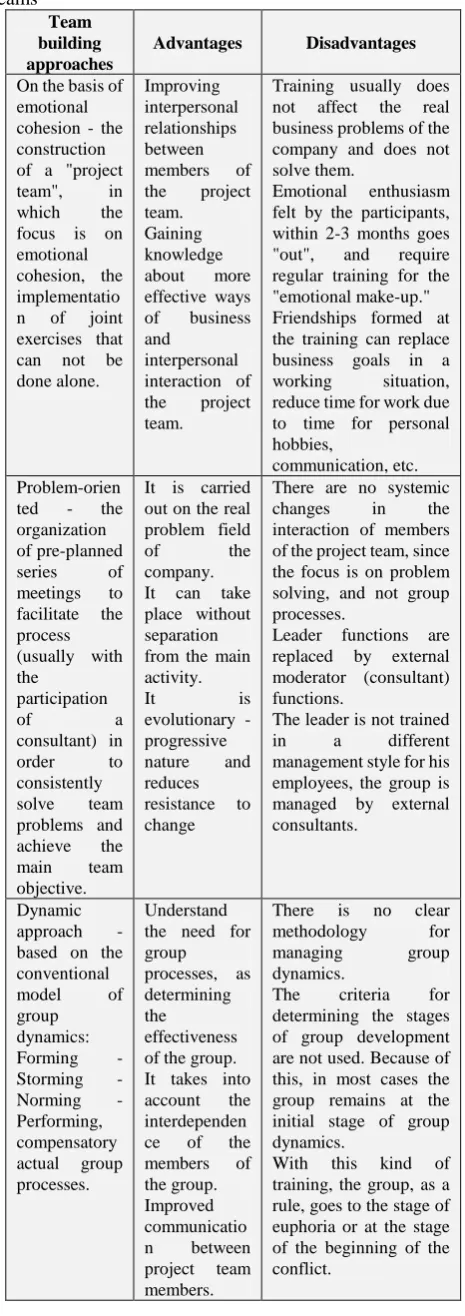
Based on the established dependencies of psychophysical stress on the characteristics of the content and elementary operations of the professional activity of the functional group of the project team, it is proposed to predict the approach of the workload of its members depending on the incomplete definiteness of the scope of work during the implementation of a specific project (Table 1).
Within the framework of the proposed approach, the formation of a project team that makes it possible to identify its composition is the most suitable and sustainable (balanced) for managing a specific project in terms of its competence, complementarity of crew members on the ship (synergy) and management features of such a crew [6]. The methodology of management of such projects allows you to control:
the time of the completion of each event; duration of each work;
number of detected shortages in work;
the length of work performed repeatedly in connection with the detection of defective parts;
the total length of completion of the repair process of the technical system;
the total amount of labor costs, taking into account some works in parallel with the use of independent resources.
Projects are carried out by people (human resources - specialists, professionals) who are improved in the process of joint activities. The essence of project management is the process of making competent decisions by the project management team regarding the result and effective coordination of project activities in order to obtain a project product with unique features of harmonious value, quality, time, cost.
After all, human resources can be represented as a “soft component” of the project. At present, there is a tendency to an increase in the number of projects where the product is a person, they can be considered as soft projects. Accordingly, soft projects are projects in which product a rather large part is occupied by a soft component [10]. Meanwhile, today there is a growth of projects, where the soft component is a person, as a member of the ship’s crew. This defines the requirements for creating ship crews as a project team. Crewing companies are usually responsible for this aspect. The selection is carried out by a crewing company of
necessary personality traits, professional competence and the ability to work in the newly created (ship crew).
Table 1. Analysis of approaches to the formation of project teams
Team building approaches
Advantages Disadvantages
On the basis of emotional cohesion - the construction of a "project team", in which the focus is on emotional cohesion, the implementatio n of joint exercises that can not be done alone.
Improving interpersonal relationships between members of the project team. Gaining knowledge about more effective ways of business and
interpersonal interaction of the project team.
Training usually does not affect the real business problems of the company and does not solve them.
Emotional enthusiasm felt by the participants, within 2-3 months goes "out", and require regular training for the "emotional make-up." Friendships formed at the training can replace business goals in a working situation, reduce time for work due to time for personal hobbies,
communication, etc. Problem-orien
ted - the organization of pre-planned series of meetings to facilitate the process (usually with the
participation
of a
consultant) in order to consistently solve team problems and achieve the main team objective.
It is carried out on the real problem field
of the
company. It can take place without separation from the main activity.
It is
evolutionary - progressive nature and reduces resistance to change
There are no systemic changes in the interaction of members of the project team, since the focus is on problem solving, and not group processes.
Leader functions are replaced by external moderator (consultant) functions.
The leader is not trained in a different management style for his employees, the group is managed by external consultants.
Dynamic approach - based on the conventional model of group dynamics: Forming - Storming - Norming - Performing, compensatory actual group processes.
Understand the need for group processes, as determining the
effectiveness of the group. It takes into account the interdependen ce of the members of the group. Improved communicatio n between project team members.
There is no clear methodology for managing group dynamics.
The criteria for determining the stages of group development are not used. Because of this, in most cases the group remains at the initial stage of group dynamics.
With this kind of training, the group, as a rule, goes to the stage of euphoria or at the stage of the beginning of the conflict.
The methodology and problem of psychological compatibility of the project team members is the main task of
the formation of crews of ships in connection with the peculiarities of the implementation of such projects, including:
- enclosed space, lack of communication with the outside world and relatives, partial limitation of the motor activity of the project team members;
- language barrier between international crews of ships, different mentality, cultural environment, moral values, religion, etc.;
- specific food ration on the vessel, etc.
A team is a complex mechanism that will directly affect the effectiveness, efficiency and success of a project. The project team (ship's crew) is the basis of the component of the final product or service in the project and depends on the following:
- the balance and correctness of the selection of project participants;
- rationality and adequacy of the arrangement of team members who occupy positions in the project team.
It is known that when specialists carrying out a project are united in a team, the quality of decision-making improves. The distribution of powers should be guided not so much by the place of the team member in its composition as by motivation, features of the type of activity and expected remuneration (profit) [10].
Each person must have a certain degree of aggressiveness. Lack of it leads to passivity, statements, conformity, etc. Its excessive development begins to determine the personality, which may become conflicting due to the human factor [11].
Crews work on ships — people who are capable of making rash acts and actions, making mistakes and mistakes, are not always competent enough and disciplined. The expression "human factor" is often used as an explanation of the causes of catastrophes and accidents that led to various losses or human casualties. The human factor is crucial if focusing only on the management of “human resources” and “staff” without taking into account organizational and professional cultures, individual characteristics of team members and other poorly identifiable and measurable characteristics of project teams, often leads to conflicts, difficulties “on an equal footing” place "and failure of the entire project. In projects, the role of the human factor, the presence of a person, as a component of the project product is increasing [12]. The stage of formation of the project team provides for “lapping” its members with each other in a professional manner, creating a collection within the project team itself. At the stage of development of a project team in its environment, disagreements and conflict situations often arise, it lacks unity, solidarity and responsibility in the orientation of the mission, goals and objectives of the project.
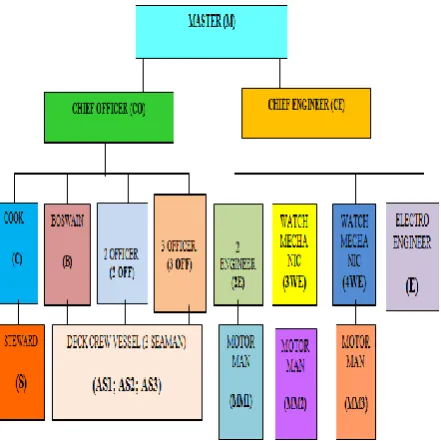
The formation of functional groups of the project team is determined on the basis of the following list: an analysis of the type of vessel, the conditions of the voyage task, the characteristics of the cargo being carried, the specifics of the region in which the flight will take place (both political and geographical). As an example, [13] presents the division into functional groups of the bulk
(see Fig. 1).
Fig. 1. The standard crew of a bulk carrier with deadweight of 10000 tones.
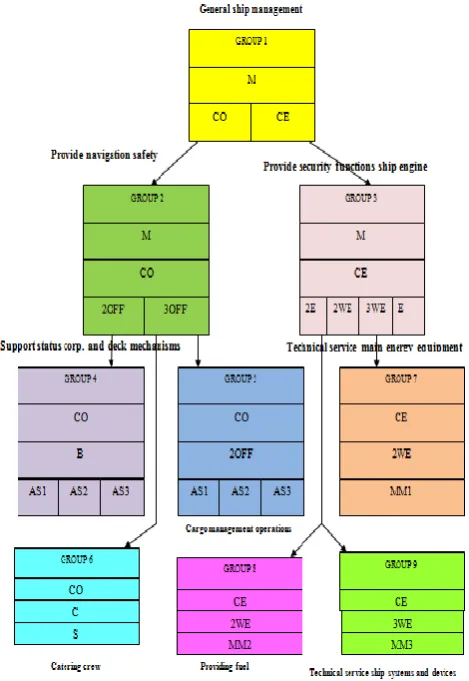
In accordance with the functions performed, the crew of such a vessel can be divided into nine functional groups of the project team:
- general ship management (M - CO - CE);
- ensuring navigation safety (M - CO – 2OFF – 3OFF); - ensuring the safe operation of ship machinery and mechanisms (M - CE – 2E – WE3 – WE4 - E);
- maintaining the state of hull structures and deck mechanisms (M - CO - B - AS1 - AS2 - AS3);
- management of cargo operations (CO–2OFF-AS1 - AS2 - AS3);
- catering crew (CO - C - S);
- maintenance of the main power equipment (CE – 2E - MM1);
- provision of fuel and lubricants (CE – WE3 - MM2); - maintenance of ship systems and devices (CE – WE3 - MM3).
Thus, the entire crew can be represented as nine project teams, each of which performs its own scope of work. The number of each such project team is from 3 to 6 people. Such a number of people is considered optimal [13]. Please note that the presented list of functional groups of the project team is not exhaustive [14].
So, in this list there are no management functions such as ship security management, financial and logistical support management, communications organization, management of interaction with port authorities, quarantine, border and customs services at ports of call, etc. Obviously, the more accurate all compositions of the functional groups of the project team are defined; the less risk of being in a critical situation during the voyage. Note that the same member of the ship’s crew can be included in several functional groups of the project team at once, which indicates the formation of the ship’s crew at this stage.
V. RESULTSOFIMPLEMENTATIONOFTHE
METHODFORDETERMININGABALANCEDCREW
The ship’s crew as a project team has a number of features compared to the teams of other types of projects, which is due to the specifics of the objectives, implementation conditions and products of sea transportation projects. The main features that lead to difficulties in the formation of an optimal crew include:
- high uncertainty in the nomenclature of the planned elementary operations, the performance of most of the work in conditions of increased danger;
- non-deterministic nature of most of the source data, and the laws of the distribution of random variables often have a large variance due to the lack of sufficient statistical information; - almost complete lack of duplication of functions among the individual members of the crew;
- the inability to make a replacement in the crew during the project, including in the case of illness;
- mismatch of goals and interests of the project team with the project management team (shipping company);
- the lack of information support, the complexity of the organization of communications between the crew and other project stakeholders.
At the same time, when forming the crew of a specific vessel, it is necessary to take into account a number of additional factors indicating the level of readiness to perform the planned functions, namely:
- experience in this position, role;
- the presence of positive characteristics from previous jobs. Testing of seamen is made by a crewing company during the submission of documents. At the same time, some features have a positive effect on the formation of the ship’s crew. This is the need for documents confirming one or another competency of a specialist, which protects unqualified seafarers from joining the project team. Mandatory medical professional selection of candidates reduces the likelihood of chronic illness of seafarers during a voyage on board a ship. Filling vacancies is as follows. A hierarchical “tree” of functional groups is constructed, as shown in Fig. 2. At the first stage, the master (captain) of the vessel is selected. A person with the most appropriate technical competences for the project conditions is assigned to this role. The technical competencies include ship control systems, control of mechanisms and components of the ship’s power plant, control of lifting mechanisms of the ship, control of the availability of certificates and working diplomas of competence among seafarers. The further formation of group 1 (one) is carried out on the basis of the analysis of the predispositions and competence of the chief officer and chief engineer so that the tension between them and the master (captain) both in terms of ship management, professional, and in communication, skills is minimal, that is, insignificant and did not lead to conflicts in the voyage vessel process. If it is not possible to select persons from the entire base of the chief officer and chief engineer, predispositions of team members who would satisfy the condition of insignificant tension, then we choose another master
Fig. 2. The composition of the functional groups of the crew
For each functional group, the project team selects the work assigned to it for execution. Evaluation of the complexity of each of the works is made on the basis of regulatory information. The total time budget of the functional group of the project team is determined of members of the watch group.
Such an approach will help to avoid conflicts as much as possible among senior commanders in the period of the vessel’s voyage [15].
Thus, from the base of the ordinary composition, possessing the necessary technical competencies, we choose the one whose temperament parameters are closest to the optimal values. After the formation of all the functional groups of the project team, you can determine the overall cohesive, non-conflicting crew of the vessel. Thus, it is intended to achieve an increase in the efficiency of the work of the project team members, as well as an improvement in the psychological climate inside the ship’s crew. Of interest is another study - it is effective to change the entire crew of the project (crew) at the same time or with separate functional groups of the project team, while maintaining continuity and experience on board the ship. When forming the rank-and-file composition of the functional groups of the project team, individual predispositions of the individual should be evaluated. A member of each functional group of the project team is selected with such personality characteristics as close as possible to the senior officers of the vessel. The proposed method allows planning the achievement of a synergistic effect by complementing the capabilities of different
members of the project team, which is not possible with a separate selection of project team members. Effective management of the crew allows the shipping company - the project management team to intelligently plan and successfully implement projects, optimize time, financial and human resources. At the same time, in general, do not deviate from the planned quality of the final product of a specific project and increase the effectiveness of its activities. The main result of the study can be considered as evidence of the feasibility of using the project management methodology at the stage of the formation of project teams on the example of ship’s crew.
VI. CONCLUSION
In project management methodology there is a reorientation towards soft components such as: project team, project, and stakeholders, at the base of which the personality is located.
1. It is shown that the problem of the occurrence of unrecorded and poorly predictable effects in managing the project team, stakeholders and maintaining barriers to create a project team most suitable for working in a particular project is the result of ignoring the uniqueness of the project in managing the team. It is proved that the factors for the uniqueness of a project for managing a team are the project implementation environment, the mission, the identity of each member, the professional activity in the human factor team, and the project product configuration.
2. Despite the close attention of project management specialists to the formation of project teams based on the compatibility analysis of participants, a single model has not yet been created that allows the selection of seafarers based on the compatibility factor, which is important for the crew due to the particular conditions of the project approaches to the processes of formation and management of heterogeneous project teams to determine the size of the crew, depending on the deadweight on modern ships.
3. Since the modern understanding of the “team” is considered not so much as a structural, but a quality education characterizing the level of interaction, the organization aims to develop mechanisms for the formation of project teams that take into account both product features and project implementation environments based on the crew of vessel. At the same time, an essential problem solved is a long-lasting counter-tension, non-conflict performance in the team and the project team.
4. Accordingly, the purpose of such projects is the profit related to the carriage of goods by sea vessels, as well as the efficiency and effectiveness of the project team.
REFERENCES
1. D. T Baumann, Swiss National Competence Baseline (Swiss NCB). Glattbrugg Swiss Project Management Association, 2010.
2. O. Shigenobu, P2M - A Guidebook of project and program management for enterprise innovation. PMAJ, 2017.
4. C. Bentley, РRINCE2 for Beginners: From introduction to passing your foundation exam. London: Routledge Ltd, 2015.
5. S. A. Kramskoy, “Use of the competency approach in determining the minimum crew of the vessel,” Bulletin of National Technical University "KhPI", 1 (1110), 2015, pp. 134–139.
6. S. О. Kramskyi, Models and methods of forming project teams on the example of the crew of a ship. PhD thesis. ONMU, 2014.
7. V. M. Pіterska, and S. O. Kramskiy, “Methodological basis of innovative project-oriented organizations’ management,” Management of the development of complex systems, 30, 2017, pp. 11-20.
8. V. Mikheev, Modern project management team. Open systems, 2011. 9. A. S. Maltsev, and S. O. Kramskiy, “Management project team and
mathematical models of collective behavior of small groups,” Management of development of complex systems, 36, 2018, pp. 27-34. 10. N. Ya. Azarov, F. A. Yaroshenko, and S. D. Bushuev, Innovative
mechanisms for managing development programs. Kyiv: Summit book, 2011.
11. S. A. Kramskoy, and D. P. Matolikov, “Determination of duration and complexity of technical systems repair by simulation,” Bulletin of National Technical University "KhPI", 3 (1046), 2014, pp. 84-91. 12. T. Demarco, and Т. Liste, The human factor: successful projects and
teams. St-Peterburg: Symbol-Plus, 2005.
13. A.V. Shakhov, “Formation of the crew on the basis of simulation,” Eastern-European Journal of Enterprise Technologies, 1/5(49), 2011, pp. 69-70.
14. S. O. Kramskiy, “Project management of joint project teams,” Bulletin of communal services of cities, 95, 2010, pp. 328-336.