International Journal of Innovative Technology and Exploring Engineering (IJITEE) ISSN: 2278-3075,Volume-8, Issue-8S, June 2019
Abstract: The innovations within the small and medium-sized (SME) companies in Malaysia are inspired by the utilization of e-business. Since this industry relies on online business, a good and effective platform should be used in order to gain customers’ trust. Information sharing plays a main role in this business platform. Slow response time, information availability, and security attacks on users’ information are the factors that bring weakness to the system. Hence, a good information sharing practice in implementing an online purchasing system amid the SMEs should be adopted in order to encourage innovation among SMEs. The primary aim of this research is to propose an information sharing model to support the implementation of an online purchasing system in the SME industry in Malaysia. A theoretical study is conducted to analyse several prominent information sharing models to identify the appropriate information sharing practices in delivering the online purchasing system. The case study of SMEs in Malaysia has been applied to explore the current practices of information sharing models in the online purchasing system. Data has been collected from online surveys from 300 active users of an online purchasing system. The data was analysed using Structural Equation Modeling (SEM) and Partial Least Square (PLS) techniques to examine the relationships between the identified factors which were grounded on the IS Success Model. Result indicates that System Quality (SQ), Information Quality (IQ), Service Quality (SVQ), Intention of Use (IU), and Perceived Net Benefits (NB) are the important factors in a successful purchasing system. The findings suggested that, IQ, and SVQ positively correlate with IU, while IU positively correlates with NB. These outputs are also expected to formulate guidelines and procedures to best guide the information sharing framework to support the implementation of online purchasing system in the SME industry in Malaysia. It is very crucial for business organisations in order to obtain maximum profit and expand businesses in the future.
Keywords: Information sharing, Online purchasing system, SME companies, D&M IS success model
I. INTRODUCTION
These days, shoppers are getting more active in online purchasing rather than offline. The rapid development of electronic devices, e-commerce applications, online payment gateways, and the stability of Internet connection causes online purchasing to become the main business activity that can generate income for businesses and for the development of the country. Indirectly, these factors lead to the increasing number of people that shop online. Information nowadays is recognised as a catalyst for business growth and survival [1].
Revised Manuscript Received on May 22, 2019.
Mazidah Binti Ahmad, University Utara Malaysia, 06010
In the business field, information sharing plays the main role in communication between companies and customers and communication between members in a company. Information sharing and communication spotlight on the achievement in company goals and strategies [2].
This research focuses on the information that available to public in terms of the details how SME industry in Malaysia practices information sharing in their online purchasing system between organisations and the public in the context of information sharing through the lens of DeLone and McLean IS Success Model [3].
The research aims to identify information sharing requirements, practices and stages of IS among the SMEs in implementing online purchasing systems. A model is proposed to support the online purchasing system implementation among SMEs in encouraging innovation.
II. RESEARCHCONTEXTANDCONCEPTUAL
MODEL Online Purchasing System
Online purchasing system is a form of electronic business where people can buy everything through the Internet via a wide range of electronic devices such as personal computer, laptops, tablets, e-kiosks, and smartphones. Generally, it consists of a virtual store and customer terminal that are connected to the server. Yamada (2003) claimed that online shopping systems have become increasingly popular with the development of the Internet [4]. A purchasing system involves three main phases, namely shopping phase, payment phase, and delivery, where goods are delivered to shoppers via delivery services provided in each country. Accurate information is very important to ensure the smooth running of the purchasing process. Thus, a model should be introduced to arrange the information systematically. According to the D&M IS Success Model, system quality and information quality will ensure the satisfaction of users and will give positive impact to organisations. Since the online purchasing system does not involve face-to-face communication between people, users only have to access business platforms (e.g., website), social media platforms (e.g., Facebook and Instagram), and mobile applications to make a purchase. This causes information sharing through business platforms to become the most important part in making people understand about the business, offers, product benefits, and terms and conditions of purchasing. Moreover, a quality business platform can guarantee
customer satisfaction.
Information Sharing Requirement Model in
Online Purchasing System among Small
Medium Enterprises (SMEs)
The invention of e-commerce platform contributes to numerous advantages that provide complete information on the selling products.
SME Innovation
The transformation from traditional business into online-based business is one of the innovation processes encountered by SMEs. Nowadays, business model innovation has become the effective way to gain competitive advantages; hence, it is a necessary choice for enterprises [5]. The implementation of new Internet-based information systems and technology (IT/IS) and business attitude have been recognised as an important process for transforming a business into an electronic business [6].
Previous studies showed that small businesses are an important driving force for innovation and that they can be as innovative as larger enterprises [7]. E-business technologies allow small and medium enterprises (SMEs) to gain capabilities that were once the preserve of their larger competitors [8]. SMEs would benefit immensely from adopting different technological e-commerce solutions in order to bridge the technological gap between them and large enterprises [9].
According to Zhang and Tao (2012), there are four main factors that affect technology innovation, which are SMEs' own economic level and development scale, status of SMEs in the industry, SMEs' different stages of life cycle, and SMEs' technological innovation capability [10]. While, Rogers (2003) found five variables in determining the rate of adoption of innovation, namely attributes of innovations, type of innovation-decision, communication channels, nature of the social system, and extent of change agents' promotion efforts [11]. In this research, online purchasing system is used as the main electronic business platform in order to support innovation among SMEs. There are various innovation benefits found by the implementation of online-based business.
Information Sharing
Information sharing is defined as a way of communication between sender and receiver [12]. There are many models of information sharing that have been developed by previous researchers. Abdelhadi et al. (2015) proposed an information sharing model in order to develop business management using cloud technology [13]. The model offers two variants in the cloud technology, which are managed private cloud and unmanaged private cloud. Managed private cloud is flexible and secures cloud hosting services, which is also compelling for all businesses alike. Meanwhile, unmanaged private cloud provides users with similar features as managed cloud, with the only exclusion being managed services.
Bijon, Haque, and Hasan (2014) proposed a mobile ad hoc network (MANET) based on the implementation of an information sharing model [14]. This model has the capability to analyse the circulation situation for approval flows and minimise it using the ‘buffering on-the-fly’ technique. The information model upgrades a specific model known as the behavioural model that identifies various valuable properties influencing trust calculations in
a universal environment and delivers supple device by which a node can compute trust in prioritising the properties based on its requirements.
Wang and Lei (2013) implemented an information sharing model on geo-hazard spatial based on service-oriented architecture (SOA) for geological disaster data services [12]. The data for the application of SOA assisted in reusable application service or utility of distinct development of integration and was expected through the network admission to these services or functions. The service framework was modified to the Wenchuan zone by using dataset rules and the geo-shared service model by geo-hazard spatial information. The information sharing service model is an evaluation and application as well as an effective system that was tested based on the Wenchuan geo-disaster evaluation and application system and shared service stage design. Yingzhao and Jing (2009) developed an information sharing approach for supply chain management in order to intensify market competition [15]. Supply chain partnership entails intensive but selective information sharing and joint improvement activities. Information sharing is prominent between purchasing information sharing and tactical information sharing.
SME Industry in Malaysia
The SME industry is defined as a micro, small, and medium enterprise industry in every country. Zhang and Tao (2012) defined SMEs as medium or small-scale enterprises with simple internal organisational structures, independent production and operation, non-monopoly of relevant product markets, corresponding social responsibility, and different kinds of ownerships and organisation patterns [10]. Compared to other developing countries, Malaysia defines the SME industry into two categories, which are manufacturing and services, depending on the turnover and the number of employees.
According to the Department of Statistics Malaysia (2016), the number of SME companies established in 2017 is 907,065. The industry provides the largest economic contribution in Malaysia. There are 23,525 establishments in the medium size industry, 192,013 in the small size industry, and 691,527 in the microenterprise industry. Saleh and Ndubisi (2006) claimed that small and medium enterprises (SMEs) play a vital role in the Malaysian economy. They agreed that this industry is considered to be the backbone of industrial development in the country [16]. This is supported by Zhang and Tao (2012) who stated that SMEs could drive the high-speed development of municipal economy and play a unique role in creating jobs, invigorating markets, improving people's lives, and maintaining social stability [10].
In Malaysia, the digital economy is acknowledged as a key element in determining the country’s future economic growth. ICT development has given a new look to the SME industry. Today, most of the businesses are running digitally through the development of Internet accessibility. The Malaysian Digital Economy Corporation or MDEC has introduced the Digital Malaysia programme that aims to drive technology adoption amongst Malaysian
International Journal of Innovative Technology and Exploring Engineering (IJITEE) ISSN: 2278-3075,Volume-8, Issue-8S, June 2019
Customers of the SME industry are more well-informed about their everyday needs via the Internet and they have begun relying on ICT to make purchases of products and services. Thus, the SME industry has to provide the best online business platform in order to improve their business performance.
Conceptual Model
This research is grounded on the D&M IS Success Model to measure the information sharing from IS success perspectives of the e-Government services as suggested by Jafari et al. (2011) [17]. DeLone and McLane information system is a framework for conceptualizing and operationalizing IS success. Most of researchers referred the framework as guidance in implementation of information system particularly in relation to the area of information sharing [17] [18] [19] [20] [21].
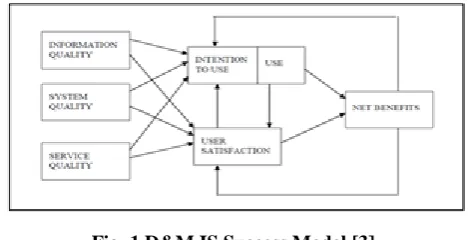
D&M IS Success Model suggesting success measures which consists of three quality constructs (IQ, SQ and SQ), IU, User Satisfaction and NB as depicted in Figure 1.
Fig. 1 D&M IS Success Model [3]
[image:3.595.49.286.320.440.2]According to DeLone and McLean, NB is the most crucial IS success measure which is determined by carefully defined context and stakeholders [3]. The results of intention to use and user satisfaction lead to the occurrences of net benefits whether the benefits have positive or negative overall impacts on users. Positive benefits most likely will lead to the continuation of the services and negative benefits most likely will lead to the discontinuation of the services. Figure 3 depicts the conceptual model based on the D&M IS Success Model.
Fig. 2 Conceptual Model
IQ generally refers to the quality of the content of the e-services. A website or service is considered good if the content is well-organized, relevant, customized to cater the targeted users, easy to understand and offers high security especially during purchasing or business transactions. SQ
is to measure the usability, reliability, adaptability, availability and response time of this e-Government service. SVQ usually refers to the service providers which could be from the IS department, other departments or third-party organizations to deliver the support to the users. An excellent service provider will likely to increase the users’ experience, satisfaction and prevent sale losses. IU is an essential factor to measure users’ viewpoints of this e-Government service. This measure covers the whole process of the users’ experience of using the system. NB are the most key success measures of an electronic system and dictate the successfulness of an IS system. It may have positive or negative impact on individual users, organizations or societies which determined by specific context and objectives for this system.
This model postulates four propositions: (i) IQ positively correlates with IU (ii) SVQ positively correlates with IU (iii) SQ positively correlates with IU, and (iv) IU positively correlates with NB.
III. RESEARCHMETHODOLOGY
The research first identified the list of all criteria of the IS Success Model that was involved in the online purchasing system for the SME industry in Malaysia. This research stresses on the review of the DeLone and McLean IS Success Model. From the review, five important criteria have been identified that support online purchasing system. The criteria are SQ, IQ, SVQ, IU, and NB. As the case study approach was chosen, HR Marketing Sdn Bhd was selected to run the survey based on the qualification of small and medium size industry and the usage of website as the main platform of their business. Questionnaires were designed and distributed to all customers of HR Marketing Sdn Bhd that have made online purchasing via their website.
A discussion was made with HR Marketing Sdn Bhd to collect data by rewarding a token of appreciation to all respondents who answered the questionnaire. Since all the respondents are the distributors of the company, they actively use the online marketing system to make product purchases. The reward was credited to their distributor account. The questionnaires were attached as a pop-up in the purchasing system in order to make the users answer the survey before they start the purchasing process. From the pop-up, 300 respondents answered the survey completely.
From the questionnaires, the data was then analysed using the SPSS programme and the information sharing model was created using the Smart PLS programme to analyse the reliability of each information sharing requirement.
IV. RESEARCHFINDING Research finding is discussed into five subtopics. Measurement Model Results
There are two steps in PLS analysis, which are Measurement Model and Structural Model. Measurement model is analysed to determine the indicators load on the theoretically defined constructs. It is also to ensure that the survey items are measuring the constructs they were designed to measure, thus ensuring that
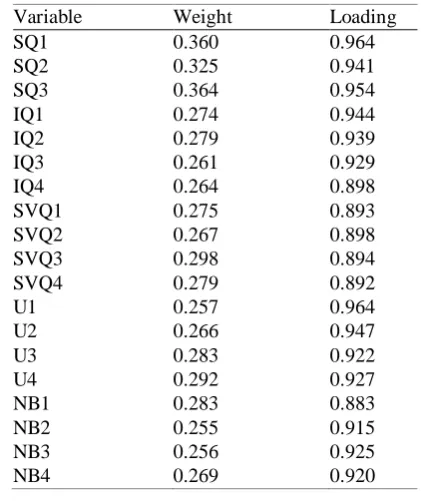
[image:3.595.53.280.580.714.2]The item loadings show the reliabilities of the items. Table 1 presents the item loadings and weights obtained from the model. The weights and loadings for all five constructs were examined, and all 19 items had loadings of 0.60 or higher.
Variable Weight Loading
SQ1 0.360 0.964
SQ2 0.325 0.941
SQ3 0.364 0.954
IQ1 0.274 0.944
IQ2 0.279 0.939
IQ3 0.261 0.929
IQ4 0.264 0.898
SVQ1 0.275 0.893
SVQ2 0.267 0.898
SVQ3 0.298 0.894
SVQ4 0.279 0.892
U1 0.257 0.964
U2 0.266 0.947
U3 0.283 0.922
U4 0.292 0.927
NB1 0.283 0.883
NB2 0.255 0.915
NB3 0.256 0.925
NB4 0.269 0.920
Convergent validity
Convergent validity was carried out based on factor loadings, composite reliability, and average variance extracted (AVE) [22]. The loadings for all items exceeded the recommended value of 0.5 [22]. All constructs ranged from 0.824 to 0.930, which exceeded the recommended value of 0.8. The AVE ranged from 0.541 to 0.801. Table 2 depicts the results of the measurement model.
Construct No of Items CR AVE
SQ 3 0.968 0.909
IQ 4 0.961 0.861
SVQ 4 0.941 0.799
U 4 0.951 0.830
NB 4 0.968 0.833
Discriminant Validity
[image:4.595.58.269.139.390.2]Discriminant validity test guarantees a construct is independent and distinguished among other constructs by assessing the correlations between the constructs [22]. The values of discriminant validity of all constructs are shown in Table 3 the values in bold represent the AVE while the other values represent the squared correlations.
Table. 3 Discriminant validity for model
Constructs IQ NB SQ SVQ U
IQ 0.928
NB 0.820 0.940
SQ 0.882 0.758 0.953
SVQ 0.876 0.850 0.780 0.894
U 0.883 0.871 0.809 0.894 0.911 Hypothesis Testing
The proposed model postulates four hypotheses – (H1) Information Quality positively correlates with IU, (H2) SVQ positively correlates with IU, (H3) SQ positively correlates with IU, and (H4) IU positively correlates with NB.
[image:4.595.309.538.174.298.2]Path analysis was conducted to test the significance of the hypotheses by analysing the inner model of the proposed model and the results are presented in Figure 3. The R2 value was 0.845 for the IU and 0.759 for the NB, suggesting that IQ, SQ, and SVQ explained 85% of the variance in IU and IU explained 76% of the variance in NB.
Fig. 3 Results of the path analysis Structural Model Results
The Structural Model was generated after analysing the Measurement Model in PLS and by analysing the inner model to test the significance of the hypotheses of the proposed model by using the computed statistics. The value of T-statistics should be at least 1.96 for the hypotheses to be considered significant. The results of path coefficients (β) and T-statistics are shown in Table 4, and therefore identify the significance of the hypotheses of the model.
Table. 4 Path Coefficients for Structural Model Hypothesis Path (β) T Significant Result H1 IQ U 0.329* 4.079 Yes Supported H2: SQ U 0.118
1.790 No Not
Supported H3: SV U 0.513* 8.278 Yes Supported H4: U NB 0.871* 53.566 Yes Supported *p <.05
Based on Table 4, the significant path suggests that a system with excellent information quality and offers outstanding service quality encourage users to have a higher intention to use the system. However, H2: SQ U is found to be insignificant towards the IU towards the system.
V. CONCLUSION
This paper investigates the information sharing requirements among the SMEs in implementing online purchasing system in Malaysia. Through the lens of D&M IS Success Model, a conceptual model is proposed. The results indicated that IQ and SVQ positively correlate with IU, whereas IU positively correlates with NB.
The research produced a number of key findings. First, the research found that IQ positively correlates with IU. Secondly, SVQ positively
[image:4.595.306.544.452.536.2]International Journal of Innovative Technology and Exploring Engineering (IJITEE) ISSN: 2278-3075,Volume-8, Issue-8S, June 2019
Furthermore, the outputs are expected to formulate guidelines and procedures to best guide the information sharing framework to support the implementation of online purchasing system in the SME industry in Malaysia. It is very crucial for business organisations in order to obtain maximum profit and expand the business in the future.
REFERENCES
1. Chalotra, V. (2015). Information sharing: A key survival platform for marketers. International Journal of Business Ethics in Developing Economies, 4(1).
2. Medori, D., & Steeple, D. (2000). A framework for auditing and enhancing performance measurement systems. International Journal of Operations and Production Management, 20, 520-533.
3. Delone, W. H., & McLean, E. R. (2003). The DeLone and McLean model of information systems success: a ten-year update. Journal of management information systems, 19(4), 9-30.
4. Yamada, K. (2002). U.S. Patent No. 6,336,100. Washington, DC: U.S. Patent and Trademark Office.
5. Wu, X. J. (2009). A study on the evolution of business model based on complex adaptive system (Order No. 10319184). Available from ProQuest Dissertations & Theses Global. (1868800595).
6. Yu, C., & Tao, Y. (2009). Understanding business-level innovation technology adoption. Technovation, 29(2), 92.
7. Brown, X.H.A. (1998), "Innovation management and contemporary small enterprise research", available at:
www.sbaer.uca.edu/research/icsb/r006.htm (accessed 27 April 2005). 8. Xu, M., Duan, Y., & Ravni Rohatgi (2007). E-business adoption in SMEs: Some preliminary findings from electronic components industry. International Journal of E-Business Research, 3.
9. Nabeel Al-qirim (2007). A research trilogy into e-commerce adoption in small business in New Zealand, Electronic Markets, 17(4). 10.Zhang, B., & Qiuyan, T. (2012). Research of SMEs' technology
innovation model from multiple perspectives. Chinese Management Studies, 6(1), 124-136.
11.Rogers, E. M. (2003). Diffusion of innovation (5th ed.): The Free Press.
12.Wang, Z., & Lei, J. (2013). A Study of Spatial Information Sharing Model Based on Geological Hazard Domain Ontology. In Proceedings of Fifth International Conference on Computational and Information Sciences (ICCIS), 268-270.
13.Abdelhadi, A. M., Abdu, K., Awada, A., & Monem, A. A. (2015). An Information Sharing Model for Construction Business Using Cloud Technology. In Developments of E- Systems Engineering (DeSE), 2015 International Conference, 239-244.
14.Bijon, K. Z., Haque, M. M., & Hasan, R. (2014). A trust based Information sharing model (TRUISM) in MANET in the presence of uncertainty. In Proceedings of Privacy, Security and Trust (PST), 2014 Twelfth Annual International Conference, 347-354.
15.Yingzhao, S., & Jing, L. (2009). Information Sharing Model of Supply Chain Based on Third Party Logistics Providers. In Proceedings of International Colloquium on Computing, Communication, Control, and Management, 139-143.
16.Saleh, A.S., & Ndubisi, N.O. (2006). An Evaluation of SME Development in Malaysia. International Review of Business Research Papers, 2(1), August 1-14.
17.Jafari, S. M., Ali, N. A., Sambasivan, M., & Said, M. F. (2011) A respecification and extension of DeLone and McLean model of IS success in the citizen-centric e-governance. In Proceedings of Information Reuse and Integration (IRI), 2011 IEEE International Conference on, 342-346.
18.Williams, M.D., Rana, N.P., & Dwivedi, Y.K. (2012). A Bibliometric Analysis of Articles Citing the Unified Theory of Acceptance and Use of Technology, Information System Theory – Explaining and Predicting Our Digital Society, Vol. 1: Springer, 37–62.
19.Ramantoko, G., & Irawan, H. (2017). Information Sharing Model in Supporting Implementation of e-Procurement Service: Case of Bandung City. International Journal of Supply Chain Management, 6(3), 252–257.
20. Rashid, A.H., Abdulaziz, S.G., & Yasin, N.B.M. (2018). Technology Acceptance Models to Improve Adoption of Health Information Systems. Journal of Advanced Sciences and Engineering Technologies, 1, 17–29
21. Wu, I.-L., & Chiu, M.-L. (2018). Examining supply chain collaboration with determinants and performance impact: Social capital, justice, and technology use perspectives. International Journal of Information Management, 39, 5–19.