ISSN: 2278-3075, Volume-8 Issue-8S2, June 2019
Abstract: In recent years, as the advanced window system, vacuum glazing with a low thermal transmittance (U-value) of under 1.0 W/m2∙K are actively being developed worldwide. Vacuum glazing comprises only two panes of glass with a vacuum space between them, and do not include the use of insulating gas. Thus, unlike existing multi-pane windows, heat transfer occurs only by radiation from the glass surfaces. In addition, to reduce the U-value of a vacuum glazing by a considerable amount, it is necessary to minimize the emissivity of the glass surfaces. The application of a low emissivity coating to the glass surfaces that are in contact with the vacuum layer has recently been introduced. In this study, a computer simulation was conducted to analyze the effects of reducing the surface emissivity on the U-value for vacuum glazing, as well as for double-pane glazing filled with air, argon, and krypton. The results showed that, for double-pane glazing filled with air, Ar, and Kr, when the emissivity of the glass surfaces, #2 and #3 was reduced gradually from 0.8 to 0.1 in steps, the U-value decreased from 13.41% to 50.65%. Meanwhile, for vacuum glazing, when the emissivity of the glass surfaces in contact with the vacuum cavity was reduced from 0.8 to 0.1, from 18.07% to 67.04%. Therefore, to reduce the U-value of the vacuum glazing, glass with a low-e coating is effective, especially. This research suggested to applying #3 or #4 coating of its glass surface to reach a lower U-value than the double-pane glazing with Kr and the glass with emissivity, 0.1.
Index Terms: Double-pane glazing, emissivity, Low-emission coating, U-value, Vacuum glazing.
I. INTRODUCTION
A vacuum has the property of a thermal insulator, which decreases the heat transfer process between two objects. In particular, because a fluid cannot theoretically exist in a vacuum, no heat transfer by conduction and convection can occur. Thus, only heat transfer by radiation occurs. Therefore, a vacuum has the advantage of dramatically reducing the amount of heat transfer. The studies and technology development regarding a vacuum have mostly been conducted in non-architectural areas, with cases involving the use of a vacuum in architecture being extremely rare [1]. Recently, however, the cases in which a vacuum is utilized in window systems applied to buildings are increasing overseas. In particular, vigorous studies are being
Revised Manuscript Received on May 22, 2019.
Sanghoon Baek, Industry Academic Cooperation Foundation, HanKyong National University, 327, Jungang-ro, Anseong-si, Gyeonggi-do, 17579, South Korea.
Sangchul Kim, School of Architecture, HanKyong National University, 327, Jungang-ro, Anseong-si, Gyeonggi-do, 17579, South Korea
conducted on vacuum glazing in which, after forming a vacuum layer using double-pane glazing, the U-value is reduced to improve the insulating performance of the overall window system [2].In contrast, in Korea, studies on the necessity of introducing vacuum glazing in the architectural field and its insulating performance have been conducted, but the theoretical and numerical studies on vacuum glazing are still inadequate. In particular, there is a still a need for studies that compare and analyze the insulating performances of double-pane glazing filled with insulating gases and vacuum glazing, along with those that consider the elements affecting the gas layer or vacuum layer. Therefore, this study theoretically compared and analyzed the heat transfer processes of double-pane glazing containing insulating gases and vacuum glazing using a mathematical model. In addition, in order to prove the thermal excellence of vacuum glazing, changes were made to the surface emissivity of the glass, which has the greatest effect on the insulating performance of double-pane glazing and vacuum glazing, using a computer simulation. The U-values of the double-pane glazing filled with insulating gases and the vacuum glazing were calculated to compare their results. Based on the above results, this paper suggests the necessity of disseminating vacuum glazing as an alternative system to improve the insulating performance of the window systems applied to the envelopes of buildings, and provides advanced research data for other studies on vacuum glazing in the future.
II. LITERATURE REVIEWS
Both thermal problems and structural problems must be solved simultaneously in order to apply vacuum glazing to a window system and overcome the pressure difference caused by a vacuum. A variety of studies related to this topic are being conducted in Korea and overseas.First, in overseas studies, it has been found that a pillar must be inserted in the vacuum space to prevent damage to the glass caused by the difference between the inside and outside pressures from the formation of the vacuum. However, when this thermal conductor is inserted, it not only generates additional heat transfer in the vacuum space, but also reduces the overall thermal performance of the vacuum glazing. Therefore, studies on the development of a pillar that can maintain the structural stability while simultaneously minimizing the thermal loss is being performed [3]. In addition, studies are being conducted on a
methodology for applying a
low-emission (low-e)
coating to the surface of the
Application and Effect of Low-Emission Coating
for Reducing U-Value of Vacuum Glazing
Application and Effect of Low-Emission Coating for Reducing U-Value of Vacuum Glazing
glass in order to suppress the radiant heat transfer of vacuum glazing, and to the change in the thermal performance of the vacuum glazing from the performance of the low-e coating applied to the glass [4,5,6]. In addition, studies on the thermal performance of double-pane glazing applied to vacuum tubes, studies on the development of spacer and sealing technologies for vacuum glazing, and studies to develop a high-intensity vacuum glazing that can maintain a vacuum under high pressure are being conducted from various perspectives [7,8].On the other hand, in Korea, the necessity of introducing vacuum glazing as a method to reduce the heat loss from the envelope of a building has been raised, and studies on the basic heat transfer of such vacuum glazing and its insulating performance have been conducted. In particular, studies have been conducted to develop a sealing technology to maintain a vacuum and on the change in the U-value caused by a pillar array in the vacuum space [9].However, in comparison to overseas studies, the studies on vacuum glazing in Korea have mostly considered the simple thermal performance of vacuum glazing or have been numerical studies on the energy-saving performance and so on. In particular, no studies have yet been conducted on a theoretical methodology to introduce vacuum glass in the architectural field or on the vacuum glazing conditions to provide the optimal insulating performance after selecting elements that affect the thermal performance of a vacuum glazing. Therefore, this study attempted to analyze vacuum glazing theoretically from a thermal perspective, and then suggest the vacuum glazing conditions with the optimal insulating performance through a computer simulation, compared to double-pane glazing containing insulating gases.
III. THEORY A. Heat Transfer of Double-Pane Glazing
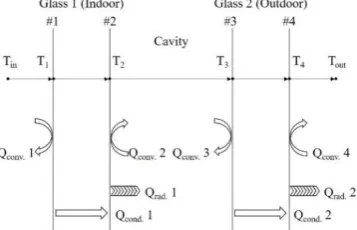
During a heating period, heat transfer by double-pane glazing containing an insulating gas such as air, Ar, or Kr is induced from the interior to exterior by conduction, convection, and radiation. The heat transfer concept and its mathematical model are described in Figure. 1 [10,11,12].
Figure 1. Heat Transfer Process of Double-Pane Glazing Filled with Insulating Gas During Heat Period.
The overall thermal quantity moving from inside to outside can be expressed as the sum of the conduction (𝑄𝑐𝑜𝑛𝑑 .) by the
pane 1 and 2; convection (𝑄𝑐𝑜𝑛𝑣 .) between the fluid in the
atmosphere, cavity and glass surface; and radiation (𝑄𝑟𝑎𝑑 .).
The calculations of each heat transfer are shown below in Eqs. (1), (2), and (3), respectively.
𝑄𝑐𝑜𝑛𝑑 .= 𝑘 ∙ 𝐴 ∙ ∆𝑇 (1)
𝑄𝑐𝑜𝑛𝑣 .= ℎ ∙ 𝐴 ∙ ∆𝑇 (2)
𝑄𝑟𝑎𝑑 .= 𝜀 ∙ 𝜎 ∙ 𝐴(𝑇𝑠− 𝑇𝑠𝑢𝑟𝑟) (3)
Here, k is the conductivity of the glass, and A and ∆𝑇indicate the heat transfer area and temperature difference between the high and low temperatures, respectively. In addition, ε and σ are the emissivity of the glass surface and the Stefan–Boltzmann coefficient, and 𝑇𝑠and 𝑇𝑠𝑢𝑟𝑟are the
surface temperature of the glass and around fluid temperature, respectively. In particular, the convection heat transfer coefficient, h is calculated as heat transfer by natural convection, and its basic equation can be described as shown in Eq. (4).In addition, Nusselt number (Nu), which is a dimensionless number required for the calculation of the convective heat transfer coefficient, and the Rayleigh number (Ra) can be calculated using Eqs. (5) and (6), respectively.
ℎ =𝐻
𝛿𝑁𝑢 (4)
𝑁𝑢 =ℎ𝛿
𝑘 = 𝐶 𝐺𝑟 ⋅ 𝑃𝑟 = 𝐶 ⋅ 𝑅𝑎 (5)
𝑅𝑎 = 𝐺𝑟 ⋅ 𝑃𝑟 =𝑔⋅𝛽 ⋅(𝑇𝑠−𝑇∞)⋅𝛿3
𝜈2 ⋅ 𝑃𝑟 (6)
Here, H refers to the vertical height of the glass, and δ refers to the characteristic length of the fluid. In addition, C is a constant estimated by experiment after considering the roughness coefficient of the solid surface, shape factor, and velocity of the fluid, and Gr and Pr refer to the Grashof number and Prandtl number, respectively. Moreover,𝑔, 𝛽, and 𝜈 represent the gravitational acceleration, cubical expansion coefficient of a fluid, and coefficient of the kinematic viscosity of a fluid, respectively. Therefore, during a heating period for double-pane glazing filled with an insulating gas, the total heat (𝑄𝑡𝑜𝑡𝑎𝑙) can be calculated by
adding the quantities of heat transferred by conduction, convection, and radiation, which can be expressed in Eq. (7) below (See the Figure. 2).
𝑄𝑡𝑜𝑡𝑎𝑙 = 𝑄𝑐𝑜𝑛𝑣 .#1+ 𝑄𝑐𝑜𝑛𝑑 .𝑔𝑙𝑎𝑠𝑠 1+ 𝑄𝑐𝑜𝑛𝑣 .#2+ 𝑄𝑟𝑎𝑑 .#2+
𝑄𝑐𝑜𝑛𝑣 .#3+ 𝑄𝑐𝑜𝑛𝑑 .𝑔𝑙𝑎𝑠𝑠 2+ 𝑄𝑐𝑜𝑛𝑣 .#4+ 𝑄𝑟𝑎𝑑 .#4 (7)
B. Heat Transfer of Vacuum Glazing
[image:2.595.82.261.555.670.2]ISSN: 2278-3075, Volume-8 Issue-8S2, June 2019
Figure 2. Heat Transfer Process of Vacuum Glazing During Heat Period.
𝑃𝑣𝑎𝑐 = 𝑃𝑎𝑡𝑚 − 𝑃𝑔 (8)
First, the vacuum pressure (𝑃𝑣𝑎𝑐), as in Eq. (8), can be
described as the difference between standard atmospheric pressure (𝑃𝑎𝑡𝑚) and the gauge pressure (𝑃𝑔). This pressure
can be divided into five stages, including low vacuum, medium vacuum, high vacuum, ultra-high vacuum, and extremely high vacuum. Among these vacuum pressures, because the pressure applied to the vacuum glazing is a medium vacuum with a normal pressure of 1–10-3 (torr), a slight amount of air is included. Therefore, when estimating the heat transfer through a vacuum, a very small amount of heat transfer by this air and the conduction of the pillar should be included in the calculation. However, because the convection by the molecular motion of the small amount of air included in the vacuum has a very small value that can be ignored in a large enough volume, the convection by air in vacuum glazing is generally ignored in the calculation. Therefore, the total heat transfer moving from inside to outside through the vacuum glazing can be calculated using Eq. (9) [10]. In the equation, cond. glass 1: conduction by glass 1 and cond. glass 2: conduction by glass 2.
𝑄𝑡𝑜𝑡𝑎𝑙 = 𝑄𝑐𝑜𝑛𝑣 .#1+ 𝑄𝑐𝑜𝑛𝑑 .𝑔𝑙𝑎𝑠𝑠 1+ 𝑄𝑟𝑎𝑑 .#2+
𝑄𝑐𝑜𝑛𝑑 .𝑝𝑖𝑙𝑙𝑎𝑟 + 𝑄𝑐𝑜𝑛𝑑 .𝑔𝑙𝑎𝑠𝑠 2+ 𝑄𝑐𝑜𝑛𝑣 .#4+ 𝑄𝑟𝑎𝑑 .#4 (9)
IV. SIMULATION CONDITIONS
To calculate the U-value of double-pane glazing and vacuum glazing, this study used the Window 7.3 program provided by the Lawrence Berkeley National Laboratory (LBNL) in the U.S., which is a representative window research institute. To model the double-pane glazing and vacuum glazing and calculate U-values, „Glass Library‟, „Gap Library‟, and „Glazing System Library‟ provided by Window 7.3, and an algorithm included in the „Environmental Conditions Library‟ were used. The U-values of the double-pane glazing and vacuum glazing were calculated based on the inside and outside temperature difference using this algorithm, and to consider the heat transfer using only the temperature difference, direct radiation, defused radiation, and reflected radiation were excluded from the early condition [14, 15, 16, 17].
A. 4.1 Single Pane
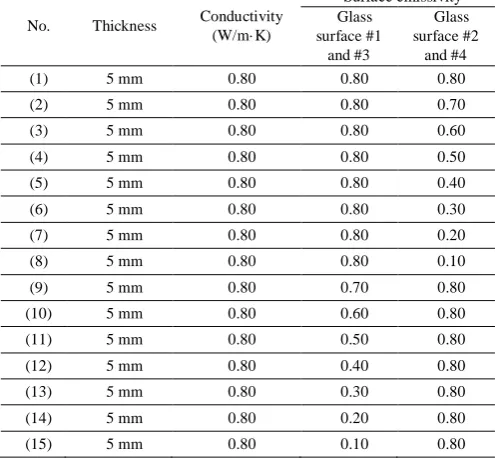
[image:3.595.299.547.229.458.2]To simulate a single-pane, the types of glasses provided by the Window 7.3 program were referenced, and the thickness of the pane was set at 5 mm, which is the size generally used by domestic window companies. In addition, the surface emissivity of glass was used as a variable for the glasses (#2 and #3 in Figure. 2) in the simulation, while the thickness was 5 mm, the conductivity was 0.80 W/m·K, and the surface emissivity of standard glass was 0.80. By reducing the surface emissivity of the glass in stage, different glasses were compared. The types and thermal properties of these glasses used in the simulation are listed in Table 1.
Table 1: Thickness and Thermal Properties of Single Panes
No. Thickness Conductivity (W/m·K)
Surface emissivity Glass
surface #1 and #3
Glass surface #2
and #4 (1) 5 mm 0.80 0.80 0.80 (2) 5 mm 0.80 0.80 0.70 (3) 5 mm 0.80 0.80 0.60 (4) 5 mm 0.80 0.80 0.50 (5) 5 mm 0.80 0.80 0.40 (6) 5 mm 0.80 0.80 0.30 (7) 5 mm 0.80 0.80 0.20 (8) 5 mm 0.80 0.80 0.10 (9) 5 mm 0.80 0.70 0.80 (10) 5 mm 0.80 0.60 0.80 (11) 5 mm 0.80 0.50 0.80 (12) 5 mm 0.80 0.40 0.80 (13) 5 mm 0.80 0.30 0.80 (14) 5 mm 0.80 0.20 0.80 (15) 5 mm 0.80 0.10 0.80
B. Insulating Gas
[image:3.595.300.545.581.672.2]Among the gases provided by Window 7.3, air, Ar, and Kr were selected as the insulating gases for the general double-pane glazing in this simulation. The physical and thermal properties of these insulating gases are listed in Table 2 [18].
Table 2: Physical Properties of Insulating Gases
Gas Type
k 𝜈 Cp ρ
Pr (W/m·
K) (m/s2)
(W/kg·
K) (kg/m3) Air
0.026 0.00007
1 0.240 1.2
0.715 Argo
n 0.017
0.00016
8 0.125 1.7
0.669 Krypt
on 0.009
0.00039
0 0.059 3.5
0.672
C. Vacuum
Compared to double-pane glazing filled with an insulating gas, which has a cavity of 10 mm or more, a vacuum has a smaller thickness, but is characterized by high thermal performance [7]. In addition,
Application and Effect of Low-Emission Coating for Reducing U-Value of Vacuum Glazing
[image:4.595.302.555.52.299.2]emitted radiation can be added to the calculation. Therefore, the thickness of the vacuum layer applied to the double-pane glazing and the thermal properties of the vacuum in this simulation are listed in Table 3 [18].
Table 3: Physical Properties of Vacuum Cavity
Thicknes s (mm) Pvac (Pa) Pvac (torr) Pillar K (W/m·K ) Radiu s (mm) Spacin g (mm) 0.2 0.13
3
0.00
1 11.5 30.0 0.107
D. 4.4 Double-Pane and Vacuum Glazing
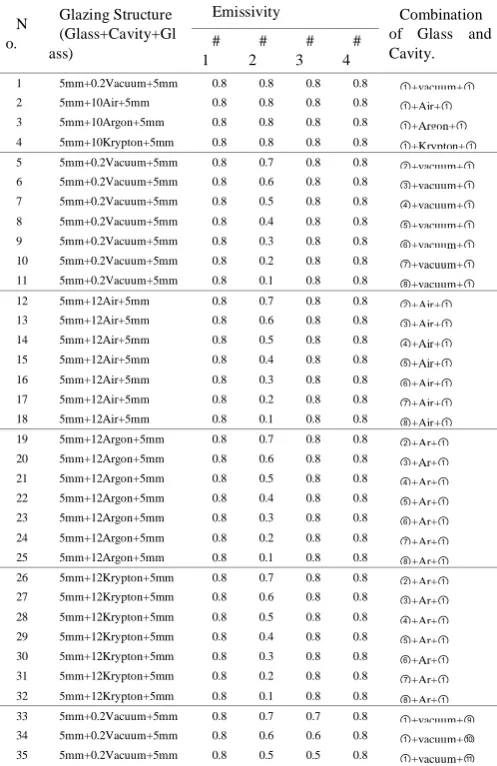
A total of 60 types of double-pane glazing and vacuum glazing were designed and applied to the simulation using single-pane, insulating gas, and vacuum. Their types and thermal properties are listed in Table 4 [18].First, nos. 1–4 are the cases used to compare the U-values of the vacuum glazing and double-pane glazing containing air, Ar, and Kr, respectively, which are typical insulating gases. In addition, to calculate and compare the U-values in relation to the surface emissivity of the glass, nos. 5-32 are the cases where the emissivity of the glass surface, #2 was reduced by stages, and nos. 33-60 are the cases where the emissivity of the glass surface, #3 was reduced by stages.
Table 4: Types of Structures of Double-Pane and Vacuum Windows N o. Glazing Structure (Glass+Cavity+Gl ass)
Emissivity Combination of Glass and Cavity. # 1 # 2 # 3 # 4
1 5mm+0.2Vacuum+5mm 0.8
0 0.8 0 0.8 0 0.8 0 ①+vacuum+①
2 5mm+10Air+5mm 0.8
0 0.8 0 0.8 0 0.8
0 ①+Air+①
3 5mm+10Argon+5mm 0.8
0 0.8 0 0.8 0 0.8 0 ①+Argon+①
4 5mm+10Krypton+5mm 0.8
0 0.8 0 0.8 0 0.8
0 ①+Krypton+①
5 5mm+0.2Vacuum+5mm 0.8
0 0.7 0 0.8 0 0.8
0 ②+vacuum+①
6 5mm+0.2Vacuum+5mm 0.8
0 0.6 0 0.8 0 0.8
0 ③+vacuum+①
7 5mm+0.2Vacuum+5mm 0.8
0 0.5 0 0.8 0 0.8 0 ④+vacuum+①
8 5mm+0.2Vacuum+5mm 0.8
0 0.4 0 0.8 0 0.8
0 ⑤+vacuum+①
9 5mm+0.2Vacuum+5mm 0.8
0 0.3 0 0.8 0 0.8
0 ⑥+vacuum+①
10 5mm+0.2Vacuum+5mm 0.8
0 0.2 0 0.8 0 0.8
0 ⑦+vacuum+①
11 5mm+0.2Vacuum+5mm 0.8
0 0.1 0 0.8 0 0.8 0 ⑧+vacuum+①
12 5mm+12Air+5mm 0.8
0 0.7 0 0.8 0 0.8
0 ②+Air+①
13 5mm+12Air+5mm 0.8
0 0.6 0 0.8 0 0.8
0 ③+Air+①
14 5mm+12Air+5mm 0.8
0 0.5 0 0.8 0 0.8
0 ④+Air+①
15 5mm+12Air+5mm 0.8
0 0.4 0 0.8 0 0.8
0 ⑤+Air+①
16 5mm+12Air+5mm 0.8
0 0.3 0 0.8 0 0.8
0 ⑥+Air+①
17 5mm+12Air+5mm 0.8
0 0.2 0 0.8 0 0.8
0 ⑦+Air+①
18 5mm+12Air+5mm 0.8
0 0.1 0 0.8 0 0.8 0 ⑧+Air+①
19 5mm+12Argon+5mm 0.8
0 0.7 0 0.8 0 0.8
0 ②+Ar+①
20 5mm+12Argon+5mm 0.8
0 0.6 0 0.8 0 0.8 0 ③+Ar+①
21 5mm+12Argon+5mm 0.8
0 0.5 0 0.8 0 0.8
0 ④+Ar+①
22 5mm+12Argon+5mm 0.8
0 0.4 0 0.8 0 0.8
0 ⑤+Ar+①
23 5mm+12Argon+5mm 0.8
0 0.3 0 0.8 0 0.8
0 ⑥+Ar+①
24 5mm+12Argon+5mm 0.8
0 0.2 0 0.8 0 0.8
0 ⑦+Ar+①
25 5mm+12Argon+5mm 0.8
0 0.1 0 0.8 0 0.8 0 ⑧+Ar+①
26 5mm+12Krypton+5mm 0.8
0 0.7 0 0.8 0 0.8
0 ②+Ar+①
27 5mm+12Krypton+5mm 0.8
0 0.6 0 0.8 0 0.8 0 ③+Ar+①
28 5mm+12Krypton+5mm 0.8
0 0.5 0 0.8 0 0.8
0 ④+Ar+①
29 5mm+12Krypton+5mm 0.8
0 0.4 0 0.8 0 0.8
0 ⑤+Ar+①
30 5mm+12Krypton+5mm 0.8
0 0.3 0 0.8 0 0.8
0 ⑥+Ar+①
31 5mm+12Krypton+5mm 0.8
0 0.2 0 0.8 0 0.8 0 ⑦+Ar+①
32 5mm+12Krypton+5mm 0.8
0 0.1 0 0.8 0 0.8
0 ⑧+Ar+①
33 5mm+0.2Vacuum+5mm 0.8
0 0.7 0 0.7 0 0.8
0 ①+vacuum+⑨
34 5mm+0.2Vacuum+5mm 0.8
0 0.6 0 0.6 0 0.8
0 ①+vacuum+⑩
35 5mm+0.2Vacuum+5mm 0.8
0 0.5 0 0.5 0 0.8
0 ①+vacuum+⑪
36 5mm+0.2Vacuum+5mm 0.8
0 0.4 0 0.4 0 0.8 0 ①+vacuum+⑫
37 5mm+0.2Vacuum+5mm 0.8
0 0.3 0 0.3 0 0.8
0 ①+vacuum+⑬
38 5mm+0.2Vacuum+5mm 0.8
0 0.2 0 0.2 0 0.8 0 ①+vacuum+⑭
39 5mm+0.2Vacuum+5mm 0.8
0 0.1 0 0.1 0 0.8
0 ①+vacuum+⑮
40 5mm+12Air+5mm 0.8
0 0.7 0 0.7 0 0.8
0 ①+Air+⑨
41 5mm+12Air+5mm 0.8
0 0.6 0 0.6 0 0.8
0 ①+Air+⑩
42 5mm+12Air+5mm 0.8
0 0.5 0 0.5 0 0.8 0 ①+Air+⑪
43 5mm+12Air+5mm 0.8
0 0.4 0 0.4 0 0.8
0 ①+Air+⑫
44 5mm+12Air+5mm 0.8
0 0.3 0 0.3 0 0.8 0 ①+Air+⑬
45 5mm+12Air+5mm 0.8
0 0.2 0 0.2 0 0.8
0 ①+Air+⑭
46 5mm+12Air+5mm 0.8
0 0.1 0 0.1 0 0.8
0 ①+Air+⑮
47 5mm+12Argon+5mm 0.8
0 0.8 0 0.7 0 0.8 0 ①+Argon+⑨
48 5mm+12Argon+5mm 0.8
0 0.8 0 0.6 0 0.8
0 ①+Argon+⑩
49 5mm+12Argon+5mm 0.8
0 0.8 0 0.5 0 0.8
0 ①+Argon+⑪
50 5mm+12Argon+5mm 0.8
0 0.8 0 0.4 0 0.8 0 ①+Argon+⑫
51 5mm+12Argon+5mm 0.8
0 0.8 0 0.3 0 0.8 0 ①+Argon+⑬
52 5mm+12Argon+5mm 0.8
0 0.8 0 0.2 0 0.8
0 ①+Argon+⑭
53 5mm+10Air+5mm 0.8
0 0.8 0 0.1 0 0.8
0 ①+Argon+⑮
54 5mm+12Krypton+5mm 0.8
0 0.8 0 0.7 0 0.8 0 ①+Krypton+⑨
55 5mm+12Krypton+5mm 0.8
0 0.8 0 0.6 0 0.8
0 ①+Krypton+⑩
56 5mm+12Krypton+5mm 0.8
0 0.8 0 0.5 0 0.8
0 ①+Krypton+⑪
57 5mm+12Krypton+5mm 0.8
0 0.8 0 0.4 0 0.8 0 ①+Krypton+⑫
58 5mm+12Krypton+5mm 0.8
0 0.8 0 0.3 0 0.8 0 ①+Krypton+⑬
59 5mm+12Krypton+5mm 0.8
0 0.8 0 0.2 0 0.8
0 ①+Krypton+⑭
60 5mm+12Krypton+5mm 0.8
0 0.8 0 0.1 0 0.8
0 ①+Krypton+⑮
E. Boundary Conditions
[image:4.595.300.554.53.301.2]The inside and outside boundary conditions of the simulation were applied based on the „KS F 2278‟ (KS: Korea Standard; F: Construction sector) condition regulated in the architectural field, and these are listed in Table 5. The inside and outside temperatures were set at 20.0 ℃ and 0.0 ℃, respectively, and the convective heat transfer coefficients based on the velocity of the fluid generated at the inside and outside surfaces of the glasses were set at 9.0 W/m2·K and 20.0 W/m2·K, respectively [19].
Table 5: Indoor and Outdoor Boundary Conditions
Locati on Temperatu re (℃) Veloci ty (m/s) Convection Heat Transfer Resistance (m2∙K/W) Convection Heat Transfer Coefficient (W/m2·K) Indoor 20.0 1.25 0.11 9.0 Outdo
or
0.00 4.00 0.05 20.0
V. RESULT AND DISCUSSION
A. U-value by Type of Gas
Figure 3 shows the results analyzing the U-values of the double-pane glazing filled with air, Ar, and Kr gases and the vacuum glazing. First, the U-values when air, Ar, and Kr were injected in the double-pane glazing were found to be 2.300, 2.418, and 2.610 W/m2·K, respectively. However, when the insulating gases were changed to a vacuum layer of 2 mm, the U-value was found to be 2.048 W/m2·K. Therefore, it was determined that the vacuum glazing provided an insulating performance 11 %, 15 %, and 21 % higher than those of the double-pane glazing containing Kr, Ar, and air. In particular, it showed the highest insulating performance despite having a thickness that was 1/50 that of a cavity filled with an
[image:4.595.41.283.123.186.2] [image:4.595.44.293.401.784.2]ISSN: 2278-3075, Volume-8 Issue-8S2, June 2019
Figure 3. Changes in U-value by Types of Gases
B. U-value by Types of Double-Pane and Vacuum glazing
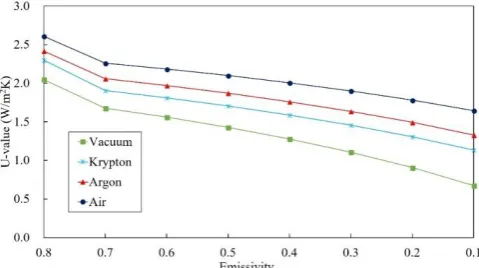
The double-pane glazing consisting of two single-pane had a total of four sides. Among these, the emissivity of the #2 and #3 (See the Figure. 1) was decreased from 0.80 to 0.10 by 0.10 stages. The U-values of the double-pane glazing and vacuum glazing of each stage were analyzed as follows:
[image:5.595.313.554.110.245.2]1) U-value by decreasing emissivity of glass surface#2 In the double-pane glazing and vacuum glazing with the same glass thickness (5 mm) and conductivity (0.80 W/m·K), U-values by the emissivity changes of glass surface, #2 are as shown in Figure. 4. First, when the emissivity was 0.80, the U-values of the double-pane glazing with Kr, Ar, and air were calculated to be 2.300, 2.418, and 2.610 W/m2·K, respectively, whereas the U-value of the vacuum glazing was found to be 2.048 W/m2·K. In addition, when the emissivity was reduced to 0.10, the U-values of the double-pane glazing filled with Kr, Ar, and air were found to be 1.135 W/m2·K, 1.330 W/m2·K, and 1.646 W/m2·K, respectively, but the U-value of the vacuum glazing was 0.675 W/m2·K, which was the lowest.
Figure 4. Changes in U-value by decrease in the emissivity of glass surface, #2
2) U-value by decreasing emissivity of glass surface #3 Just as with the analysis process for the glass surface, #2, in the double-pane and vacuum glazing with the same glass thickness and conductivity, U-values by the emissivity changes of glass surface, #3 are as shown in Figure. 5.When the emissivity of glass surface, #3 was 0.80, the U-values of the double-pane glazing filled with Kr, Ar, and air were 2.300, 2.418, and 2.610 W/m2·K, respectively, whereas the U-value of the vacuum glazing was found to be 2.048 W/m2·K. In addition, when the emissivity was reduced to
0.10, the U-values of the double-pane glazing filled with Kr, Ar, and air were found to be 1.341, 1.505, and 1.838 W/m2·K, respectively, but the U-value of the vacuum glazing was found to be 0.769 W/m2·K, the lowest value.
Figure 5. Changes in U-value by decrease in the emissivity of glass surface, #3.
C. Overall Analysis
Table 6 presents the overall analysis results for the U-values of the double-pane glazing and the vacuum glazing by the changes of emissivity in glass surfaces, #2 and #3.
After reviewing the insulating performances of the double-pane glazing and the vacuum glazing through simulations, the U-value of the vacuum glazing was found to display an insulating performance 11–21% higher than those of the double-pane glazing filled with Kr, Ar, and air. Moreover, as a result analyzing the U-values of the double-pane glazing and vacuum glazing by changing the emissivity of the glass surfaces, it was found that reducing the emissivity of glass surface, #2 could reduce the U-value more than doing so for glass surface, #3. In addition, when the emissivity of the glass surface, #2 was reduced from 0.80 to 0.10, the U-values of the double-pane glazing filled with Kr, Ar, and air were calculated to be 2.300–1.135 W/m2·K, 2.418–1.330 W/m2·K, and 2.610–1.646 W/m2·K, respectively. In contrast, for the vacuum glazing, when the emissivity was 0.80–0.10, the U-values of the vacuum glazing were found to be 2.048–0.675 W/m2·K.Therefore, it was found that the U-value was reduced to a greater extent when the emissivity of the vacuum glazing was reduced, compared to the reductions when the emissivity of the double-pane glazing filled with insulating gas was reduced.
Table 6: Comparison of U-values and decrease ratio by glazing types
N o.
Glazing Structure (Glass+Cavity+Glas
s)
Emissivity U-valu e (W/m2·
K)
Decre ase Ratio (%) #
1 # 2
# 3
# 4 2 5mm+10Air+5mm 0
.8 0 .8
0 .8
0
.8 2.610
Stand ard 4
0 5mm+12Air+5mm 0 .8
0 .8
0 .7
0
.8 2.534 2.9 4
1 5mm+12Air+5mm 0 .8
0 .8
0 .6
0
.8 2.450 6.1 3 5mm+10Argon+5m
m
0 .8
0 .8
0 .8
0
[image:5.595.55.295.488.622.2] [image:5.595.300.553.642.837.2]Application and Effect of Low-Emission Coating for Reducing U-Value of Vacuum Glazing
4
2 5mm+12Air+5mm 0 .8 0 .8 0 .5 0
.8 2.356 9.7 4 7 5mm+12Argon+5m m 0 .8 0 .8 0 .7 0
.8 2.331 10.7 4 5mm+10Krypton+5
mm 0 .8 0 .8 0 .8 0
.8 2.300 11.9 1
2 5mm+12Air+5mm 0 .8 0 .7 0 .8 0
.8 2.260 13.4 4
3 5mm+12Air+5mm 0 .8 0 .8 0 .4 0
.8 2.251 13.8 4 8 5mm+12Argon+5m m 0 .8 0 .8 0 .6 0
.8 2.233 14.4 5 4 5mm+12Krypton+5 mm 0 .8 0 .8 0 .7 0
.8 2.208 15.4 1
3 5mm+12Air+5mm 0 .8 0 .6 0 .8 0
.8 2.184 16.3 4
4 5mm+12Air+5mm 0 .8 0 .8 0 .3 0
.8 2.132 18.3 4 9 5mm+12Argon+5m m 0 .8 0 .8 0 .5 0
.8 2.124 18.6 5 5 5mm+12Krypton+5 mm 0 .8 0 .8 0 .6 0
.8 2.105 19.3 1
4 5mm+12Air+5mm 0 .8 0 .5 0 .8 0
.8 2.100 19.5 1 9 5mm+12Argon+5m m 0 .8 0 .7 0 .8 0
.8 2.060 21.1 1 5mm+0.2Vacuum+
5mm 0 .8 0 .8 0 .8 0
.8 2.048 21.5 1
5 5mm+12Air+5mm 0 .8 0 .4 0 .8 0
.8 2.006 23.1 5 0 5mm+12Argon+5m m 0 .8 0 .8 0 .4 0
.8 2.000 23.4 4
5 5mm+12Air+5mm 0 .8 0 .8 0 .2 0
.8 1.995 23.6 5 6 5mm+12Krypton+5 mm 0 .8 0 .8 0 .5 0
.8 1.990 23.8 2 0 5mm+12Argon+5m m 0 .8 0 .6 0 .8 0
.8 1.971 24.5 3 3 5mm+0.2Vacuum+ 5mm 0 .8 0 .8 0 .7 0
.8 1.933 25.9 2 6 5mm+12Krypton+5 mm 0 .8 0 .7 0 .8 0
.8 1.906 27.0 1
6 5mm+12Air+5mm 0 .8 0 .3 0 .8 0
.8 1.901 27.2 2 1 5mm+12Argon+5m m 0 .8 0 .5 0 .8 0
.8 1.872 28.3 5 7 5mm+12Krypton+5 mm 0 .8 0 .8 0 .4 0
.8 1.860 28.7 5 1 5mm+12Argon+5m m 0 .8 0 .8 0 .3 0
.8 1.858 28.8 4
6 5mm+12Air+5mm 0 .8 0 .8 0 .1 0
.8 1.838 29.6 2 7 5mm+12Krypton+5 mm 0 .8 0 .6 0 .8 0
.8 1.812 30.6 3 4 5mm+0.2Vacuum+ 5mm 0 .8 0 .8 0 .6 0
.8 1.803 30.9 1
7 5mm+12Air+5mm 0 .8 0 .2 0 .8 0
.8 1.782 31.7 2 2 5mm+12Argon+5m m 0 .8 0 .4 0 .8 0
.8 1.761 32.5 5 8 5mm+12Krypton+5 mm 0 .8 0 .8 0 .3 0
.8 1.711 34.4 2 8 5mm+12Krypton+5 mm 0 .8 0 .5 0 .8 0
.8 1.707 34.6 5 2 5mm+12Argon+5m m 0 .8 0 .8 0 .2 0
.8 1.695 35.1 5 5mm+0.2Vacuum+
5mm 0 .8 0 .7 0 .8 0
.8 1.678 35.7 3 5 5mm+0.2Vacuum+ 5mm 0 .8 0 .8 0 .5 0
.8 1.655 36.6 1
8 5mm+12Air+5mm 0 .8 0 .1 0 .8 0
.8 1.646 36.9 2 3 5mm+12Argon+5m m 0 .8 0 .3 0 .8 0
.8 1.636 37.3 2 9 5mm+12Krypton+5 mm 0 .8 0 .4 0 .8 0
.8 1.589 39.1
6 5mm+0.2Vacuum+ 5mm 0 .8 0 .6 0 .8 0
.8 1.561 40.2 5 9 5mm+12Krypton+5 mm 0 .8 0 .8 0 .2 0
.8 1.540 41.0 5 3 5mm+12Argon+5m m 0 .8 0 .8 0 .1 0
.8 1.505 42.3 2 4 5mm+12Argon+5m m 0 .8 0 .2 0 .8 0
.8 1.494 42.8 3 6 5mm+0.2Vacuum+ 5mm 0 .8 0 .8 0 .4 0
.8 1.484 43.1 3 0 5mm+12Krypton+5 mm 0 .8 0 .3 0 .8 0
.8 1.457 44.2 7 5mm+0.2Vacuum+
5mm 0 .8 0 .5 0 .8 0
.8 1.429 45.2 6 0 5mm+12Krypton+5 mm 0 .8 0 .8 0 .1 0
.8 1.341 48.6 2 5 5mm+12Argon+5m m 0 .8 0 .1 0 .8 0
.8 1.330 49.0 3 1 5mm+12Krypton+5 mm 0 .8 0 .2 0 .8 0
.8 1.307 49.9 3 7 5mm+0.2Vacuum+ 5mm 0 .8 0 .8 0 .3 0
.8 1.286 50.7 8 5mm+0.2Vacuum+
5mm 0 .8 0 .4 0 .8 0
.8 1.279 51.0 3 2 5mm+12Krypton+5 mm 0 .8 0 .1 0 .8 0
.8 1.135 56.5 9 5mm+0.2Vacuum+
5mm 0 .8 0 .3 0 .8 0
.8 1.107 57.6 3 8 5mm+0.2Vacuum+ 5mm 0 .8 0 .8 0 .2 0
.8 1.051 59.7 1 0 5mm+0.2Vacuum+ 5mm 0 .8 0 .2 0 .8 0
.8 0.908 56.2 3 9 5mm+0.2Vacuum+ 5mm 0 .8 0 .8 0 .1 0
.8 0.769 70.5 1 1 5mm+0.2Vacuum+ 5mm 0 .8 0 .1 0 .8 0
.8 0.675 74.1
VI. CONCLUSIONS
This study theoretically analyzed the changes of U-value by emissivity of glass surfaces for double-pane glazing filled with insulating gases, air, Ar, and Kr, and vacuum glazing, and the results are as following:
1) The heat transfer of the double-pane glazing filled with insulating gases, Kr, Ar, and air and vacuum glazing were theoretically analyzed, and the excellent insulating performance of vacuum glazing was proved.
2) To compare the insulating performances of the double-pane glazing filled with Kr, Ar, and air to that of the vacuum glazing, each U-value was estimated. As a result, whereas the U-values of the double-pane glazing filled with Kr, Ar, and air were found to be 2.300, 2.418, and 2.610 W/m2·K, respectively, the U-value of the vacuum glazing was found to be 2.048 W/m2·K. Therefore, it was found that the insulating performance of the vacuum glazing was superior to those of the double-pane glazing filled with the insulating gases. 3) Among the glass surfaces (#1, #2, #3, and #4) of the
double-pane and vacuum glazing, as a result of analyzing the U-values in relation to changes of emissivity for the glass surfaces, #2 and #3, a decrease in the emissivity of the surface of the glass surface, #2 produced a greater U-value decrease than a decrease in the emissivity glass surface, #3.
ISSN: 2278-3075, Volume-8 Issue-8S2, June 2019
decreased from 0.80 to 0.10, the insulating performances of the double-pane glazing filled with Kr, Ar, and air were improved by 17.13–50.65, 14.81–45.00, and 13.41–36.93 %, respectively, whereas the insulating performance of the vacuum glazing was improved by 18.07–67.04 %. Therefore, when the emissivity of the glass surface was reduced, the insulating performance of the vacuum glass was improved to a greater extent than those of the double-pane glazing filled with insulating gases.
ACKNOWLEDGMENT
This work was supported by the National Research Foundation of Korea (NRF) grant funded by the Korea government (MSIP) (2018R1D1A1B07048848).
REFERENCES
1. G. Kim, K. Kim, G. Yeom. “The study of improvement in the characteristics of oxide thin film transistor by using atmospheric pressure plasma,” J. Kor. Ins. Surf. Eng. 2015 Feb; 48(1): 7-10. DOI: http://dx.doi.org/10.5695/JKISE.2015.48.1.007.
2. J. Garrison, R. Collins. “Manufacture and cost of vacuum glazing,” Sol. Energy. 1995 Sep; 55(3): 151-61. DOI: https://doi.org/10.1016/0038-092X(95)00046-T.
3. Y. Fang, T. Hyde, F. Arya, N. Hewitt, P. Eames, B. Norton, S. Miller. “Indium alloy-sealed vacuum glazing development and context,” Renew. Sust. Energ. Rev. 2014 Sep; 37: 480-501. DOI: https://doi.org/10.1016/j.rser.2014.05.029.
4. P. Fang, B. Eames, T. Norton, J. Hyde, J. Zhao, J. Wang, Y. Huang. “Low emittance coatings and the thermal performance of vacuum glazing,” Sol. Energy. 2007 Jan; 81(1): 8-12. DOI: https://doi.org/10.1016/j.solener.2006.06.011.
5. Y. Fang, P. Eames. “The effect of glass coating emittance and frame rebate on heat transfer through vacuum and electrochromic vacuum glazed windows,” Sol. Energy Mater. Sol. Cells. 2006 Oct; 90(16): 2683-95. DOI: https://doi.org/10.1016/j.solmat.2006.04.006.
6. Y. Fang, P. Eames, T. Norton, Y. Hyde, Y. Huang, N. Hewitt. “The thermal performance of an electrochromic vacuum glazing with selected low-emittance coatings,” Thin Solid Films. 2008 Jan; 516(6): 1074-81. DOI: https://doi.org/10.1016/j.tsf.2007.07.210.
7. J. Zhao, P. Eames, T. Hyde, Y. Fang, J. Wang. “A modified pump-out technique used for fabrication of low temperature metal sealed vacuum glazing,” Sol. Energy. 2007 Sep; 81(9): 1072-77. DOI: https://doi.org/10.1016/j.solener.2007.03.006.
8. S. Bergh, R. Hart, B. Jelle, A Gustavsen. “Window spacers and edge seals in insulating glass units: A state-of-the-art review and future perspectives,” Energy Build. 2013 Mar; 58: 263-80. DOI: https://doi.org/10.1016/j.enbuild.2012.10.006.
9. S. Cho, S. Kim, T. Eom. “The evaluation of thermal performance of vacuum glazing by composition and the pillar arrangement through test method of thermal resistance,” Journal of The Korean Solar Energy Society. 2015 Feb; 35(1): 61–8. DOI: http://dx.doi.org/10.7836/kses.2015.35.1.061.
10.J. Xaman, C. Nucamendi, J. Arce, J. Hinojosa, G. Alvarez, I. Huillen. “Thermal analysis for a double pane window with a solar control film for using in cold and warm climates,” Energy Build. 2014 Jun; 76: 429-39. DOI: https://doi.org/10.1016/j.enbuild.2014.03.015.
11.M. Arici, M. Kan. “An investigation of flow and conjugate heat transfer in multiple pane windows with respect to gap width, emissivity and gas filling,” Renew. Energy. 2015 Mar; 75: 249-56. DOI: https://doi.org/10.1016/j.renene.2014.10.004.
12.M. Arici, H. Karabay, M. Kan.“Flow and heat transfer in double, triple and quadruple pane windows,” Energy Build. 2015 Jan; 86: 394-402. DOI: https://doi.org/10.1016/j.enbuild.2014.10.043.
13.H. Kim, Y. Hwang, D. Park, K. Lim.“Translators. Introduction to basic vacuum engineering for semiconductor and display processing,”Seoul (South Korea): NaeHa Publishing Ltd.: 2007. ISBN: 978-89-5717-171-4.
14.Window.ibl.gov. Conrad 5 & View 5 technical and programming documentation [Internet]. [place unknown]: Carli, Inc; 2006 [cited 2019 Mar 4]. Available from:
https://windows.lbl.gov/sites/all/files/Downloads/conrad-and-viewer-0 6-20-06.pdf
15. Iso.org. Thermal performance of window, doors and shading devices-Detailed calculations [Internet]. [place unknown]: International Organization for Standardization; 2016 [cited 2019 Mar 4]. Available from: https://www.iso.org/obp/ui/#iso:std:iso:15099:ed-1:v1:en. 16. Window.lbl.gov. TARCOG: Mathematical models for calculation of
thermal performance of glazing systems with or without shading devices [Internet]. [place unknown]: Carli, Inc.; 2006 [cited 2019 Mar 3]. Available from: https://windows.lbl.gov/sites/all/files/Downloads/tarcog-mathematical-model.pdf.
17. Window.lbl.gov. Window 6 verification results [Internet]. [place unknown]: National Fenestration Rating Council; 2006 [cited 2019 Mar 4]. Available from: https://windows.lbl.gov/sites/all/files/Downloads/window6-verification -results.pdf.
18. Window.lbl.gov. Therm 7 / window 7 NFRC simulation manual [Internet]. [place unknown]: National Fenestration Rating Council; 2017 [cited 2019 Mar 4]. Available from: https://windows.lbl.gov/sites/default/files/Downloads/NFRCSim7-July 2017.pdf.
19. Infostore.saiglobal.com. KS F 2278:2014 Standard test method for thermal resistance for windows and doors [Internet]. [place unknown]: Sai Global; 2014 [cited 2019 Mar 4]. Available from: http://infostore.saiglobal.com/store/details.aspx?ProductID=1782035.
AUTHORS PROFILE
Sanghoon Baekis a research fellow in Hankyong National University in South Korea. His main concern is architectural environment and energy saving. He has focused on analyzing energy consumption and greenhouse gas emission emitted from commercial and residential buildings by using fossil fuels for heating, cooling, domestic hot water, and ventilation etc.