0022-538X/95/$04.0010
Copyrightq1995, American Society for Microbiology
Determination of Adeno-Associated Virus Rep68 and Rep78
Binding Sites by Random Sequence Oligonucleotide Selection
JOHN A. CHIORINI, LINDA YANG, BRIAN SAFER,ANDROBERT M. KOTIN*
Molecular Hematology Branch, National Heart, Lung, and Blood Institute, Bethesda, Maryland 20892
Received 26 May 1995/Accepted 4 August 1995
To further define the canonical binding site for the P5-promoted Rep proteins of the adeno-associated virus,
a modified random oligonucleotide selection procedure was performed, using purified recombinant Rep protein. These results may explain the effects of Rep on cellular gene expression.
The P5-promoted Rep proteins of adeno-associated virus (AAV), Rep68 and Rep78, have been shown to regulate AAV replication (3–5, 14), transcription (13), and integra-tion (11, 12, 18). Each of these diverse activities requires binding of these Rep proteins to tandem repeats of a GAGC motif. Although binding of Rep to the inverted terminal repeat (ITR) structure was previously thought to be absolutely de-pendent on the presence of a hairpin conformation (1, 10), we have recently shown that Rep can bind to a number of linear DNA substrates with an affinity similar to that of the wild-type (wt) ITR fragment (7). This finding may explain the effect of Rep on expression of heterologous promoters and its cytostatic effects when overexpressed. It is, therefore, impor-tant to define a consensus binding site and to determine the contribution of the individual bases at the sites of Rep-DNA interaction.
To define the Rep-DNA interactions, a modified random oligonucleotide selection procedure was performed, using pu-rified MBP-Rep68Dand MBP-Rep78. Electrophoretic mobil-ity shift assays (EMSA) were used to isolate oligonucleotide probes containing Rep binding sites from a pool of randomly generated oligonucleotides containing over 1012 sequence combinations. With this technique, a canonical binding site was identified.
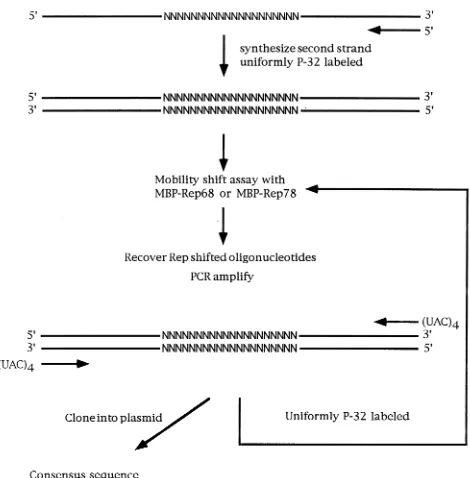
The technique of random selection has many advantages compared with base-by-base mutagenesis studies of wt ele-ments for defining binding sequence requireele-ments (17). The sequence combinations generated allow the determination of a statistically significant canonical binding site. The short oligo-nucleotides are easily cloned into bacterial vectors and se-quenced. Iteration of the selection procedure yields oligonu-cleotides with higher-affinity binding sites (17). The procedure used for the random selection is similar to one previously described (9) and is outlined in Fig. 1.
The random probes were chemically synthesized and consist of a core of 20 random bases flanked by two constant regions (Fig. 2C). A double-stranded probe was generated by anneal-ing a primer to one of the constant regions and extendanneal-ing it with the Klenow fragment of DNA polymerase and radiola-beled nucleotides. MBP-Rep68Dis incubated with the pool of oligonucleotide probes under conditions which favor binding of Rep to its specific substrate (6, 7). Probes containing the
Rep binding site were separated from nonbinding oligonucle-otides by EMSA (7). The random probes were recovered and purified from the shift complex and amplified by using Taq polymerase and PCR (cycling conditions [35 cycles]: 958C for 30 s, 508C for 30 s, 728C for 30 s). Aliquots were either selected again to enrich for higher-affinity fragments or cloned into plasmid vectors and sequenced. The band produced by incu-bating MBP-Rep68Dwith the random oligonucleotide probes (Fig. 3, lane 3) was only present in reaction mixtures containing MBP-Rep68D(Fig. 3, lane 1). Furthermore, the addition of wt ITR (Fig. 2A) could inhibit the formation of the shift band, demonstrating the specificity of the complex (Fig. 3, lane 2). Similar results were obtained with MBP-Rep78.
[image:1.612.320.555.412.651.2]* Corresponding author. Mailing address: NIH/NHLBI/MHB, Bldg. 10/7D18, 10 Center Dr., MSC 1654, Bethesda, MD 20892-1654. Phone: (301) 496-1594. Fax: (301) 496-9985.
FIG. 1. Random selection procedure. The random probe was chemically synthesized and made double stranded by annealing and extending an oligonu-cleotide primer. The purified probe was then incubated with recombinant MBP-Rep68Dor MBP-Rep78, and the complexed DNA was separated from the free DNA by EMSA. The complexed DNA was then isolated from the gel and purified. For cloning, the selected random probes were amplified with Taq polymerase by using PCR and oligonucleotide primers which were complemen-tary to the constant regions and which contain (UAC)4tails complementary to the CloneAmp vector.
7334
on November 9, 2019 by guest
http://jvi.asm.org/
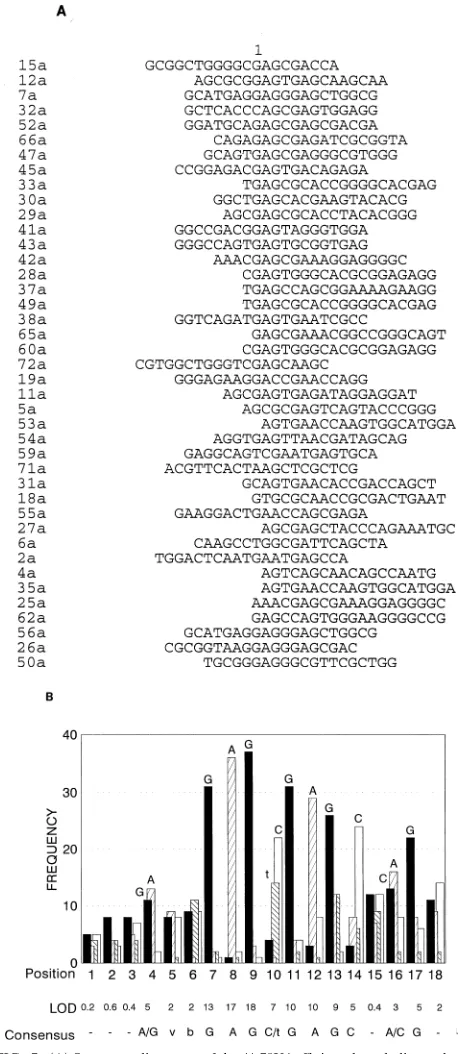
Of the 1.43108cpm of probe (43 107 cpm/pmol) incu-bated with 4 pmol of MBP-Rep78 and separated in the first round of EMSA, less than 1% of the probe was bound by Rep and recovered from the gel. These fragments were then incubated a second time with 1 pmol of Rep and EMSA fractionated a second time to enrich for the fragments con-taining higher-affinity Rep binding sites. Approximately 5% of this material was bound by Rep and recovered from the gel. The fragments isolated from the second round of selection were amplified by PCR. The amplified probes were either relabeled and reselected as described above or cloned, using the CloneAmp system (Bethesda Research Laborato-ries), and sequenced. This pool of clones is referred to as 78X2. Thirty-two fragments were sequenced, and their random bases were aligned by using a common GAGC motif present in each fragment (Fig. 4A). The position of this element within the probes varied, indicating that the conserved flanking sequence played a less critical role than the random region in the for-mation of the shift complex.
Log probability ratios, or LOD scores, were calculated for the aligned fragments. Using chi-square analysis, a nucleotide(s) was assigned to each position in the consensus sequence if
P was ,0.05 and the LOD score at that position was 3 or greater. Alignment of all 32 clones gave a consensus of GAGC
Ga(g/c)gGgg(g/c), with bases in uppercase boldface type indi-cating statistically significant events (Fig. 4B). While this se-quence is similar to the AAV ITR or AAVS1 sese-quences which contain multiple tandem repeats of GAGC, the consensus de-veloped with random probes after two rounds of selection contained only one full repeat followed by a number of
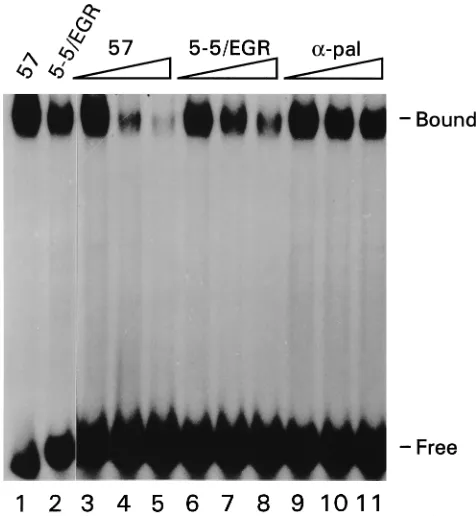
gua-nine (G) residues. To test the ability of runs of G residues to stabilize the binding of Rep78 to DNA, a probe which con-tained GAGC GGGGGCG in place of the block of 20 random bases was constructed (Fig. 2D). This sequence was identified in clone 5-5 and resembles the consensus binding site of the early growth response gene, EGR-1 [GCG(G/T)GGGCG] (8). The probe is therefore referred to as 5-5/EGR. The EMSA results indicate that MBP-Rep78 could form a stable interac-tion with this sequence (Fig. 5, lane 2). However, competiinterac-tion experiments using labeled D57 ITR (Fig. 2B) and unlabeled
D57 ITR or 5-5/EGR (Fig. 2D) indicate that the affinity was approximately 5- to 10-fold lower for 5-5/EGR than for wtD57 ITR (Fig. 5, lanes 6 to 8 and 3 to 5, respectively). No compe-tition was observed with a GC-rich probe for thea-pal binding site (9) (Fig. 5, lanes 9 to 11), demonstrating the specificity of the competition.
To identify the higher-affinity sites contained in the pool of selected fragments, a third round of selection was performed with PCR-amplified fragments from the second selection. Ap-proximately 20% of this material was recovered and selected again in the fourth and final round. Nearly 50% of this input material was in the shift complex. The final pool of probes was then amplified by Taq polymerase, cloned, and sequenced and is referred to as 78X4. To compare the consensus binding sites for MBP-Rep68Dand MBP-Rep78, the random selection pro-cedure was performed with MBP-Rep68D instead of MBP-Rep78 as described above, and this resulting pool of fragments is referred to as 68X4.
Using either Rep68 or Rep78, the four rounds of selection FIG. 2. Sequence of probes. (A) wt ITR was made as previously described
(7). (B)D57 ITR is an annealed oligonucleotide pair, 57 bases in length, corre-sponding to all of the A/A9region and part of the D/D9region of wt ITR with a GATC 59 overhang. (C) The random probe was chemically synthesized and consists of a core of 20 random bases (N) flanked on one side by a 20-bp region and on the other by a 21-bp conserved region, both of which are used for annealing primers for amplification and cloning. (D) Probe 5-5/EGR contains the core Rep binding site identified in clone 5-5 flanked by the conserved regions of the random probe. Sequences of the wt ITR andD57 ITR are aligned to the GAGC repeat motifs (horizontal arrows).
FIG. 3. EMSA of random oligonucleotide probe. A tight cluster of bands was produced by incubating 1 pmol of MBP-Rep68Dwith the random oligonucleo-tide probes (lane 3). No shift bands were detected in the absence of protein (lane 1). Formation of the lower-mobility complex could be reduced by the addition of wt ITR (lane 2), demonstrating the specificity of the complex.
on November 9, 2019 by guest
http://jvi.asm.org/
resulted in a number of clones containing multiple GAGC repeats. A thymidine-to-cytosine (T-to-C) transition was very common in the 59-most GAGC repeat motif for both 68X4 and 78X4 but was not as frequently observed in the adjacent re-peats. As was seen in the consensus sequence developed for the 78X2 fragments, a number of clones contained repeats of G residues after the tandem GAGC repeats. Sequences of
41 clones from the 78X4 pool (Fig. 6) and those of 46 clones from the 68X4 pool (Fig. 7) were aligned, and consensus se-quences of (A/G)vbGAGCGAGC n(A/C)G and (G/A)nn(T/C)G AG(C/T)GAGCGAG(c/a)(g/a)V, respectively, were identified. These consensus sequences more closely resemble the binding sites identified in the AAV ITR and the AAVS1 sequence (7, 16, 19).
The data presented in this paper suggest that while a pre-ferred site for Rep binding contains tandem repeats of GAGC, stable binding with a lower affinity can be detected with one GAGC motif, provided it is followed by a run of G residues. In addition, a common substitution within the repeats was a T-to-C transition. In the 68X4 pool of fragments, T was as com-mon as C in the first repeat and almost as comcom-mon as C in the 59GAGC element of the 78X4 pool. This T-to-C substitution is also present in the first repeat in the P5promoter of AAV, which has been shown to bind Rep (15). The binding of Rep to a fragment containing an EGR-1 consensus sequence is in-triguing and warrants further investigation to determine if Rep can effect the expression of EGR-1-responsive genes. The GAGC repeat motif is also similar to the binding site of the
Drosophila transcription factor Zeste [(C/T)GAG(C/T)G] (2),
suggesting that Rep may affect expression of genes regulated by the human homolog of this protein. The identification of a consensus binding site for Rep68 and Rep78, as well as accept-able substitutions within the binding sequence, will help to facilitate the understanding of the effects of Rep68 and Rep78 on the expression of heterologous promoters and their re-ported cytostatic effects.
FIG. 4. (A) Sequence alignments of all 32 78X2 affinity-selected oligonucle-otides. (B) Consensus sequence and LOD score. Positions of the aligned frag-ments from panel A are shown, with the frequency of the occurrences of the four bases at each position and the LOD scores for each position. Statistically signif-icant bases are shown above the bars. An LOD score of 3 indicates that the probability of the distribution of the bases at that position occurring by chance is 1 in 1,000. A consensus binding site is also shown.■, G;o, A;p, C;u, T.
FIG. 5. The binding affinities of recombinant MBP-Rep78 were compared for three probes,D57 ITR, 5-5/EGR, anda-pal. Approximately 50,000 cpm of 59-end-labeledD57 ITR was incubated with 100 ng of MBP-Rep78 in the pres-ence of a 5-, 10-, or 15-fold excess of cold competitors:D57 ITR (lanes 3 to 5), 5-5/EGR (lanes 6 to 8), ora-pal (lanes 9 to 11). The binding affinities of MBP-Rep78 forD57 ITR and 5-5/EGR were also directly compared by incubat-ing MBP-Rep78 with eitherD57 ITR or 5-5/EGR, which had been 59-end labeled to the same specific activity (lanes 1 and 2, respectively).
on November 9, 2019 by guest
http://jvi.asm.org/
[image:3.612.317.555.71.329.2]FIG. 6. (A) Sequence alignments of the 46 68X4 affinity-selected oligonucle-otides are shown. (B) 68X4 consensus sequence and LOD scores for the aligned fragments in panel 6A are shown, with the sum of the number of occurrences of the four bases at each position and the LOD scores for each position.■, G;o, A;p, C;u, T.
FIG. 7. (A) Sequence alignments of the 41 78X4 affinity-selected oligonucle-otides are shown. (B) 78X4 consensus sequence and LOD scores for the aligned fragments in panel A are shown, with the sum of the number of occurrences of the four bases at each position and the LOD scores for each position.■, G;o, A;p, C;u, T.
on November 9, 2019 by guest
http://jvi.asm.org/
[image:4.612.65.288.85.683.2] [image:4.612.326.556.117.644.2]We thank Cathy Ciatto for her outstanding administrative skills. J.A.C. is a Pharmacology Research Associate funded by the NIGMS.
REFERENCES
1. Ashktorab, H., and A. Srivastava. 1989. Identification of nuclear proteins that specifically interact with adeno-associated virus type 2 inverted terminal repeat hairpin DNA. J. Virol. 63:3034–3039.
2. Biggin, M. D., and R. Tijan. 1988. Transcription factors that activate the ultrabithorax promoter in developmentally staged extracts. Cell 53:699–722. 3. Bohenzky, R. A., and K. I. Berns. 1989. Interactions between the termini of
adeno-associated virus DNA. J. Mol. Biol. 206:91–100.
4. Bohenzky, R. A., R. B. LeFebvre, and K. I. Berns. 1988. Sequence and symmetry requirements within the internal palindromic sequences of the adeno-associated virus terminal repeat. Virology 166:316–327.
5. Chejanovsky, N., and B. J. Carter. 1989. Replication of a human parvovirus nonsense mutant in mammalian cells containing an inducible amber sup-pressor. Virology 171:239–247.
6. Chiorini, J. A., M. D. Weitzman, R. A. Owens, E. Urcelay, B. Safer, and R. M. Kotin.1994. Biologically active Rep proteins of adeno-associated virus type 2 produced as fusion proteins in Escherichia coli. J. Virol. 68:797–804. 7. Chiorini, J. A., S. M. Wiener, R. A. Owens, S. R. M. Kyo¨stio¨, R. M. Kotin,
and B. Safer.1994. Sequence requirements for stable binding and function of Rep68 on the adeno-associated virus type 2 inverted terminal repeats. J. Virol. 68:7448–7457.
8. Christy, B., and D. Nathans. 1989. DNA binding site of the growth factor-inducible protein Zif268. Proc. Natl. Acad. Sci. USA 86:8737–8741. 9. Efiok, B. J. S., J. A. Chiorini, and B. Safer. 1994. A key transcription factor
for eukaryotic initiation factor-2a is strongly homologous to developmental transcription factor and may link metabolic genes to cellular growth and development. J. Biol. Chem. 269:18921–18930.
10. Im, D. S., and N. Muzyczka. 1989. Factors that bind to adeno-associated
virus terminal repeats. J. Virol. 63:3095–3104.
11. Kotin, R. M., R. M. Linden, and K. I. Berns. 1992. Characterization of a preferred site on human chromosome 19q for integration of adeno-associ-ated virus DNA by non-homologous recombination. EMBO J. 11:5071–5078. 12. Kotin, R. M., M. Siniscalco, R. J. Samulski, X. Zhu, L. Hunter, C. A. Laughlin, S. McLaughlin, N. Muzyczka, M. Rocchi, and K. I. Berns.1990. Site-specific integration by adeno-associated virus. Proc. Natl. Acad. Sci. USA 87:2211–2215.
13. Labow, M. A., P. L. Hermonat, and K. I. Berns. 1986. Positive and negative autoregulation of the adeno-associated virus type 2 genome. J. Virol. 60: 251–258.
14. LeFebvre, R. B., S. Riva, and K. I. Berns. 1984. Conformation takes prece-dence over sequence in adeno-associated virus DNA replication. Mol. Cell. Biol. 4:1416–1419.
15. McCarty, D. M., D. J. Pereira, I. Zolotukhin, X. Zhou, J. H. Ryan, and N. Muzyczka.1994. Identification of linear DNA sequences that specifically bind the adeno-associated virus Rep protein. J. Virol. 68:4988–4997. 16. McCarty, D. M., J. H. Ryan, S. Zolotukhin, X. Zhou, and N. Muzyczka. 1994.
Interaction of the adeno-associated virus Rep protein with a sequence within the A palindrome of the viral terminal repeat. J. Virol. 68:4998–5006. 17. Oliphant, A. R., C. J. Brandl, and K. Struhl. 1989. Defining the sequence
specificity of DNA-binding proteins by selecting binding sites from random-sequence oligonucleotides: analysis of yeast GCN4 protein. Mol. Cell. Biol. 9:2944–2949.
18. Shelling, A. N., and M. G. Smith. 1994. Targeted integration of transfected and infected adeno-associated virus vectors containing the neomycin resis-tance gene. Gene Ther. 2:1–5.
19. Weitzman, M. D., S. R. M. Kyo¨stio¨, R. M. Kotin, and R. A. Owens.1994. Adeno-associated virus (AAV) Rep proteins mediate complex formation between AAV DNA and its integration site in human DNA. Proc. Natl. Acad. Sci. USA 91:5808–5812.