0022-538X/96/$04.0010
Copyrightq1996, American Society for Microbiology
A Replication Function Associated with the Activation Domain
of the Epstein-Barr Virus Zta Transactivator
ROBERT T. SARISKY,1ZHIGANG GAO,1PAUL M. LIEBERMAN,2ELIZABETH D. FIXMAN,1†
GARY S. HAYWARD,1,3ANDS. DIANE HAYWARD1,3*
Molecular Virology Laboratories, Department of Pharmacology and Molecular Sciences1
and Department of Oncology,3Johns Hopkins School of Medicine,
Baltimore, Maryland 21205-2185, and Wistar Institute,
Philadelphia, Pennsylvania 191042
Received 26 June 1996/Accepted 23 August 1996
The Zta transactivator is crucial for both Epstein-Barr virus (EBV) lytic gene expression and lytic DNA replication. We have used a cotransfection-replication assay to examine the effect of mutations in the Zta activation domain (amino acids [aa] 1 to 167) on Zta replication activity. Deletion of Zta aa 25 to 86, which are critical for transcriptional activation of ori-Lyt, or aa 93 to 141 did not adversely affect replication of an ori-Lyt-containing target plasmid. However, removal of aa 2 to 25 (D2-25) abolished replication activity. Within this subdomain, deletion of aa 2 to 10 (D2-10) or mutation of codons 18 and 19 (m18/19) or 22 and 26 (m22/26) did not affect replication competency, while deletion of codons 13 to 19 (D13-19) or mutation at codons 12 and 13 (m12/13) impaired Zta replication function. Each of the replication-negative Zta variants was capable of transactivating expression from both BHLF1 promoter-chloramphenicol acetyltransferase constructions and the BMRF1 promoter on endogenous EBV genomes in Raji cells with efficiency comparable to that of the wild-type polypeptide. Thus, a replication contribution of Zta was functionally separable from its transacti-vation activity and was supplied by the N-terminal region encompassing aa 11 to 25. Replication by a subset of the impaired Zta mutants was partially rescued upon the addition of Rta to the replication assay. The contribution of Rta mapped to domain II of the Rta activation domain and was specific for this region. A chimeric Rta–EBNA-2 transactivation domain fusion, which retains the DNA-binding and transactivation properties associated with wild-type Rta, failed to rescue replication-deficient Zta. Our data suggest that Rta may act as an ancillary replication factor in EBV ori-Lyt DNA synthesis by stabilizing Zta-replisome inter-actions.
Maintenance of both a latent state and a lytic replicative cycle by the human gammaherpesvirus Epstein-Barr virus (EBV) requires distinct genetic elements, ori-P and ori-Lyt, respectively (25, 30, 71). In latently infected, immortalized B lymphocytes, multiple copies of the viral genome are main-tained as extrachromosomal episomes. The latent state is char-acterized by a lack of virus production, limited viral gene ex-pression, and replication of the episome in a manner synchronous with cell division (72). The absolute dependence on a multitude of host cell proteins yet only a single virus-encoded polypeptide, EBNA-1 (56, 71), for amplification es-tablishes an intimate association of replication of the episomal EBV genome with the latently infected cell. Lytic replication differs from the latent amplification state in that multiple rounds of replication are initiated within ori-Lyt, and the rep-lication process has a greater dependence on EBV-encoded proteins. Moreover, lytic DNA replication results in the gen-eration of high-molecular-weight concatemeric molecules which are subsequently cleaved into unit-length genomes and packaged into virions (16, 59, 73). The lytic replication cycle, which occurs in the oropharynx (65), can be induced in latently
infected B cells by treatment with phorbol esters, by cross-linking of surface immunoglobulin, or by introduction of the EBV BZLF1-encoded transactivator, Zta (13, 66, 74). The first genes expressed on induction are those for the immediate-early Zta (BZLF1) and Rta (BRLF1) transactivators (23, 53). The initial transcription of these genes is further up-regulated by Zta, which binds to sequences in both promoters (22, 45, 64). Zta and Rta then activate expression of the third transac-tivator, Mta (BMLF1) (12, 27, 34, 42). The concerted action of these three viral regulatory proteins culminates in the sequen-tial activation of early gene expression followed by the lytic cascade of replication and late gene expression (20, 23, 60, 64, 66).
The EBV genome possesses two copies of ori-Lyt, although one is sufficient for lytic-cycle replication. The 695-bp origin consists of two essential or core elements and one auxiliary domain (30, 61). The first core element encompasses the pro-moter and leader region of the BHLF1 gene, which contains four binding sites for Zta (Zta response elements [ZREs]) and is Zta responsive in transient expression assays (40, 44). Dele-tion of the TATA box, ZRE1, ZRE2, and the CAAT box abolishes replication, while mutation of the ZRE1 and ZRE2 sites reduces replication efficiency (61). The second essential domain is delineated by a central 225-bp region including two adenine-thymidine (AT)-rich palindromes and an adjacent polypurine-polypyrimidine tract (28, 57). Such elements are vital to facilitate the localized unwinding and helical destabi-lization essential for initiation of replication (38, 63). The third domain, a nonessential auxiliary element, is a powerful
en-* Corresponding author. Mailing address: Department of Phar-macology and Molecular Sciences, John Hopkins School of Medicine, 725 N. Wolfe St., Baltimore, MD 21205-2185. Phone: (410) 955-2548. Fax: (410) 955-8685. Electronic mail address: diane_hayward@qmail .bs.jhu.edu.
† Present address: Department of Medicine, Royal Victoria Hospi-tal, McGill University, Montreal, Quebec, Canada.
8340
on November 9, 2019 by guest
http://jvi.asm.org/
hancer region which contains DNA-binding sites for Rta and Zta and responds synergistically to the presence of these trans-activators (14, 27). Hammerschmidt and Sugden (30) function-ally replaced this domain with the human cytomegalovirus (HCMV) major immediate-early gene enhancer, thus implicat-ing the enhancer function of the third domain, and not a specific sequence element, as indispensable for lytic replica-tion.
Previously, our laboratory used a transient replication assay in Vero cells to determine which EBV-encoded proteins are required to replicate an ori-Lyt target (19, 20). This method has also proven invaluable for identifying the replication genes for herpes simplex virus type 1 (HSV-1) (5, 69) and human cytomegalovirus (HCMV) (54). In this assay, six essential core EBV replication genes were identified for ori-Lyt DNA repli-cation as well as the Zta and Mta lytic-cycle transactivators (20). Rta, encoded by BRLF1, is a transcriptional activator that binds DNA as a dimer (26, 31, 48) and acts in combination with Zta to produce a synergistic response in targets containing binding sites for both factors (14, 55). Rta augments DNA replication but is not absolutely required (20). Mta, encoded by BSLF2/BMLF1 (41), primarily serves a posttranscriptional function (3, 12, 35) and contributes to replication in an indirect manner (20). In contrast, an absolute dependence was dem-onstrated for Zta, the single virus-encoded protein which serves an essential origin-binding function (20). Moreover, mu-tation of all ZRE sites in the target origin abrogates replication function, further implicating Zta as an obligatory participant in lytic replication (60).
Zta is a bZIP transcriptional activator with a basic DNA recognition domain that is closely related to that of Jun, Fos, and other bZIP proteins (18, 44, 68). However, unlike the rest of this family, the Zta dimerization domain does not consist of a heptad repeat of leucines (7, 21). One consequence of this structural difference is that Zta does not undergo heterodimer-ization interactions with other family members. Zta binds as a homodimer to AP-1 sites and to the related ZREs (4, 7, 18, 44, 68), and its binding to DNA is modified by phosphorylation (37). Activation of transcription occurs primarily through di-rect interaction between the amino-terminal activation domain of Zta and TATA-binding protein (45) and TATA-binding-protein-associated factors (43) to stimulate formation of a sta-ble TFIID-TFIIA complex (11, 43). However, the mechanism by which Zta functions to fulfill its essential role in the repli-cation process is not currently understood. Chimeric Zta polypeptides in which the Zta activation domain, extending from amino acids (aa) 1 to 168, was replaced by the potent transcriptional activation domain from the HSV-1 VP16 pro-tein failed to support ori-Lyt replication (60). This finding implies that a property intrinsic to the Zta activation domain, other than the transcriptional activation features common to VP16, may be essential for replication.
This report represents an initial examination of the effects of Zta variants carrying deletions or mutations within the activa-tion domain on ori-Lyt replicaactiva-tion in a transient cotransfec-tion-replication assay. We have identified a region within the N terminus of Zta that genetically separates transcriptional ac-tivity from replication function within the polypeptide. These results represent the first evidence that the replication function associated with Zta may be dispensed with while maintaining the integrity of transcriptional activation activity. Furthermore, we demonstrate the ability of Rta to contribute to ori-Lyt replication by partially complementing a replication-impaired Zta protein. The property of Rta-mediated compensation of Zta function maps to the acidic activation domain. These
find-ings underscore the importance of protein interactions with Zta and Rta for functional replication complex assembly.
MATERIALS AND METHODS
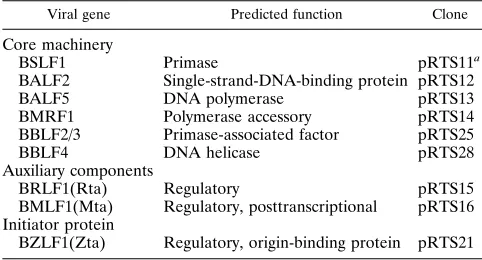
Plasmid constructions.Plasmid pRTS2, a modified pSG5 vector (Stratagene), was constructed by destroying theXbaI site and placing the polylinker from pGH57 between theEcoRI andBglII sites. Oligonucleotide primers were syn-thesized to amplify the viral replication open reading frames extending from the ATG start site to the translation stop codon as indicated in Table 1. After PCR amplification, the DNA product was cleaved with the appropriate restriction endonucleases and subcloned into pRTS2 as follows: pRTS11, -12, -13, -14, -15, -16, -25, and -28 as XbaI-HindIII fragments and pRTS21 as aBamHI-BglII fragment. These plasmid constructions have been described previously (58), as has the origin-containing plasmid, pSL77 (19).
The Zta deletionsD2-141,D25-86, andD93-141 have been described elsewhere (45). Zta (D2-167) was constructed by PCR amplification using a 59 oligonucle-otide, AATGAATTCATATGGAGGAATGCGATTCTGAA, and a 39 oligonu-cleotide specific for pBSKII vector sequences. The product was cleaved with EcoRI and ligated into theEcoRI site of pcDL-SRa-296. The open reading frame was checked by DNA sequencing, and expression was confirmed by West-ern blotting (immunoblotting). pRTS68 [Zta (D2-25)] was generated by using oligonucleotide-directed mutagenesis to delete nucleotides 103072 to 103143 from the Zta open reading frame. The parental construction was SVZwt (nls) (24), a gift from S. Speck (Harvard Medical School). The variants Zta (m12/13), Zta (m18/19), and Zta (m22/26) were generated by PCR mutagenesis (33) and cloned into the expression plasmid pcDL-SRa296 (67). Zta (D2-10) (pDH284) and Zta (D13-19) (pDH285) were originally cloned as cDNAs into the bacterial expression plasmid pQE8 (Qiagen, Chatsworth, Calif.). The coding sequences were then moved as anEcoRI fragment into the eukaryotic expression vector pcDL-SRa296. All Zta derivatives tested were controlled by the simian virus 40 (SV40) early promoter. The Rta activation domain mutants pLT24, pLT27, and pLT29 were obtained from J. M. Hardwick (Johns Hopkins School of Hygiene and Public Health). Plasmids pLT24 and pLT27 have been described elsewhere (32). The Rta protein encoded by pLT29 is truncated at codon 519, and activa-tion domain II is replaced with the activaactiva-tion domain (codons 437 to 477) of EBV EBNA-2.
Transient expression and DNA replication assays.DNA transfections, the transfection-replication assay, and chloramphenicol acetyltransferase (CAT) as-says were performed as previously described (20, 46). Vero cells were maintained in Dulbecco modified Eagle medium plus 5% fetal calf serum at 378C in 5% CO2 and were transfected by calcium phosphate precipitation. Briefly, for replication assays 1.53106Vero cells per 100-mm-diameter dish were transfected with 3.5 to 5.0mg of pSL77(ori-Lyt) DNA, 1.5mg of Zta expression plasmid, and 700 ng of expression plasmids for each of the six core replication proteins as well as Mta and Rta. Cells were harvested 80 h after transfection. Autoradiograms of South-ern blot analyses were quantified with a Kontes fiber optic scanner. For transient expression assays, 33105Vero cells were transfected with 2mg of plasmid DNA in six-well dishes, and cells were harvested 48 h after transfection. Cell extracts were incubated with 0.2mCi of [14C]chloramphenicol (60 mCi/mmol) for 1 h at 378C. The acetylated forms were separated by chromatography in chloroform-methanol (95:5) solvent. CAT activity was quantitated by phosphorimager anal-ysis.
[image:2.612.315.556.82.212.2]Raji lymphoblastoid cells were maintained at 53105cells per ml in RPMI 1640 medium supplemented with 10% fetal calf serum at 378C in 5% CO2and were transfected by the DEAE-dextran method. Induction of BMRF1 was as-sayed with 23106Raji cells per sample and 3mg of each Zta expression plasmid. Cells were resuspended at 107/ml in Ca–Tris-buffered saline (CaTBS; 0.1 g of
TABLE 1. EBV replication proteins and expression plasmids
Viral gene Predicted function Clone
Core machinery
BSLF1 Primase pRTS11a
BALF2 Single-strand-DNA-binding protein pRTS12
BALF5 DNA polymerase pRTS13
BMRF1 Polymerase accessory pRTS14
BBLF2/3 Primase-associated factor pRTS25
BBLF4 DNA helicase pRTS28
Auxiliary components
BRLF1(Rta) Regulatory pRTS15
BMLF1(Mta) Regulatory, posttranscriptional pRTS16 Initiator protein
BZLF1(Zta) Regulatory, origin-binding protein pRTS21
a
The open reading frames of the EBV replication loci were subcloned into an expression vector (pRTS2) containing the SV40 enhancer,b-globin intron, and SV40 polyadenylation signals as described previously (58).
on November 9, 2019 by guest
http://jvi.asm.org/
MgCl2z6H2O, 0.1 g of CaCl2, 8.0 g of NaCl, 0.38 g of KCl, 0.1 g of Na2HPO4z12H2O, and 3.0 g of Tris hydrochloride per liter [pH 7.5]). DNA was mixed with 300ml of CaTBS and 300ml of CaTBS-DEAE-dextran (1.0 mg/ml). Approximately 106
cells in 100ml of CaTBS were added to the DNA-containing mixture, inverted several times, and placed at 378C for 1 h with occasional rocking. Cells were then pelleted at 3,000 rpm for 3 min, washed twice with Tris-buffered saline (minus CaCl2), and then resuspended in 2.0 ml of RPMI 1640 medium containing 10% fetal calf serum. Cells were harvested 48 h after transfection.
Western analysis.Immunoblot assays were performed as previously described (51). Cell extracts were boiled in lysis buffer (4% sodium dodecyl sulfate [SDS], 160 mM Tris [pH 6.8], 200 mM dithiothreitol, 20% sucrose, 0.02% bromophenol blue, 10%b-mercaptoethanol), and the proteins were separated by SDS-poly-acrylamide gel electrophoresis on 10% (BMRF1) or 12% (Zta) gels. Proteins were transferred to a nitrocellulose membrane (Schleicher & Schuell, Keene, N.H.) and incubated with either Zta-specific monoclonal antibody (MAb) (BZ1; Dako, Carpinteria, Calif.) at 1:1,500 or BMRF1-specific monoclonal antibody (p52/50; Advanced Biotechnologies, Inc., Columbia, Md.) at 1:2,000. Proteins were visualized by chemiluminescence (Dupont NEN, Boston, Mass.).
Immunofluorescence assay.Vero cells were plated at approximately 0.83105 cells per well onto glass tissue culture chamber slides (Nunc). DNA transfections were done as described above, with a total of 1.5mg of DNA transfected per well. After a change of medium, the slides were harvested for immunofluorescence assay as described previously (58) except that a MAb to Zta (BZ1; Dako) was used at a dilution of 1:2,000.
RESULTS
Identification of a replication function within the Zta trans-activation domain. We initially evaluated four Zta variants possessing deletions in the Zta activation domain for their effects on ori-Lyt replication in the transient cotransfection-replication assay. Such an assay measures DNA amplification
by exploiting the ability of the DpnI restriction enzyme to
discriminate between methylated and unmethylated DNA se-quences. Basically, only target origins which undergo amplifi-cation upon transfection into eukaryotic cells will lose the bacterially imposed methylation pattern and become resistant
to cleavage byDpnI. All input molecules unable to replicate in
transfected tissue culture cells will remain methylated and be
digested by DpnI. The replication gene expression plasmids
listed in Table 1 were cotransfected into Vero cells along with
pSL77, the EBVBamHI-H origin-bearing plasmid (Fig. 1A),
and one of the Zta expression derivatives presented in Fig. 1B.
Transfected cell DNA was isolated, digested with
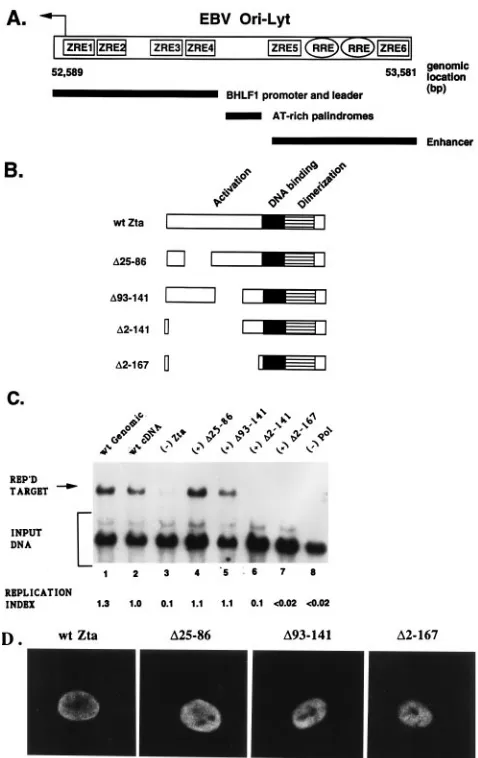
BamHI-DpnI, and examined by Southern blot analysis for DNA am-plification. In this transient assay, Zta variants lacking aa 2 to 141 or 2 to 167 were impaired for replication function (Fig. 1C, lanes 6 and 7). Amino acids from 25 to 86 have been shown to be important for transcriptional activation (45), leading to speculation that this region of Zta may affect replication effi-ciency. Surprisingly, however, Zta carrying a deletion
encom-passing this region,D25-86, mediated ori-Lyt DNA replication
(lane 4). Additionally, a Zta variant deleted for aa 96 to 141 was also replication competent (lane 5). All Zta derivatives were tested for the ability to localize to the nucleus upon transfection as determined by indirect immunofluorescence with a MAb to Zta. Indeed, all Zta expression plasmids de-scribed in Fig. 1B localize to the nucleus, and a subset of these derivatives are shown in Fig. 1D.
Since a Zta polypeptide deleted for aa 2 to 141 lost replica-tion activity but delereplica-tion of aa 25 to 86 and 96 to 141 did not affect replication function, we set out to determine whether aa 2 to 25 might represent a specific subdomain through which replication function is mediated. The transient repli-cation assay system was used to examine the replirepli-cation
prop-erty of a Zta (D2-25) derivative, encoded by pRTS68. This
analysis revealed that deletion of the first 25 aa culminated in the abrogation of replication function, thus potentially de-lineating a replication-indispensable Zta domain (Fig. 2, lane 3).
Functional dissection of the replication domain within aa 2 to 25 of Zta.In an attempt to further narrow the replication-specific region of Zta, we used two smaller deletions of
pRTS68, Zta (D2-10) and Zta (D13-19), along with three Zta
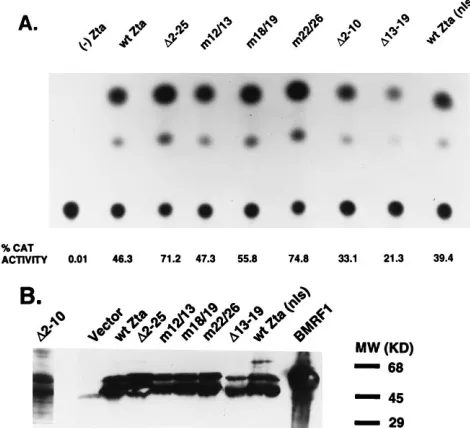
variants containing double-point mutations within the first 26 aa (Fig. 3A). Western analysis with an anti-Zta MAb demon-strated that all of the Zta variants were expressed in trans-fected cells and expressed at comparable levels (Fig. 3B).
The Zta mutant derivatives were first tested for transcrip-tional activity in a transient transfection assay. Both the
BHLF1 promoter controlling the NotI repeat transcript and
the upstream enhancer region of ori-Lyt contain Zta-binding sites, and the BHLF1 promoter is activated by Zta in transient expression assays (40, 44). The ability of the Zta variants to activate CAT expression in a transient expression assay was examined by using the target plasmid pDH123, which contains sequences extending from the BHLF1 promoter through the enhancer region. All Zta expression derivatives were compe-tent to activate CAT expression from pDH123 (Fig. 4A). Zta
(D2-25) induced a response comparable to and slightly greater
than that of the wild-type (wt) polypeptide. Similarly, Zta (D
2-10), Zta (m12/13), Zta (m18/19), and Zta (m22/26) showed
wild-type transactivation activity, while Zta (D13-19) activated
to levels within twofold of that observed with wt Zta. Transcription factors essential to the replication process may possess a multiplicity of functional roles. One key factor in the enhancement of origin activation may reside in the ability to displace template-tethered nucleosomes (9, 39). The removal of such proteins can serve to allow access of key regulatory or initiator polypeptides to the DNA origin. Introduction of Zta reactivates EBV lytic gene expression from endogenous, nu-cleosoassociated EBV genomes, presumably in part by me-diating removal of such template-bound nucleosomes (62). The ability of Zta variants to activate targets in transient assays does not always correlate with the ability to activate expression from an endogenous template (36). We therefore examined the histone displacement potential of the Zta derivatives. Raji cells were transfected with the Zta expression plasmids and assayed for activation of the endogenous early BMRF1 gene and subsequent expression of the BMRF1 gene product, the polymerase processivity factor. Raji cells transfected with only pSG5 (vector) failed to express BMRF1 as assayed by immu-noblot analysis. All Zta derivatives tested were functional for induction of BMRF1 protein expression (Fig. 4B).
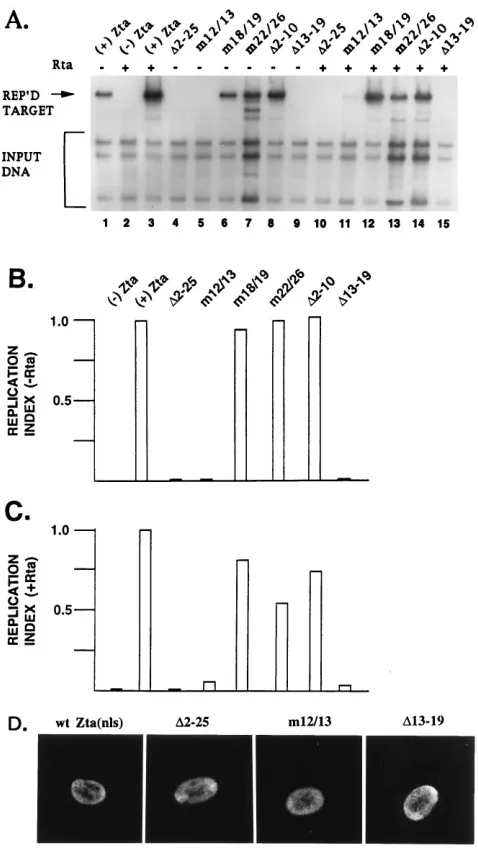
The ability of the Zta mutants to promote replication of EBV ori-Lyt was examined in the presence and absence of Rta in a cotransfection transient assay. In the absence of Rta, wt Zta, the double mutants Zta (m18/19) and Zta (m22/26), and the
dele-tion Zta (D2-10) were found to possess significant replication
ability (Fig. 5A, lanes 1, 6, 7, and 8, respectively). The Zta (D
2-25) and Zta (D13-19) deletions as well as the Zta (m12/13)
mu-tant were defective for replication (lanes 4, 5, and 9). In the presence of Rta, a replication signal became detectable for Zta
(m12/13) and weakly detectable for Zta (D13-19) (lanes 11 and
15). Relative levels of replication, expressed as the replication index, are shown in Fig. 5B and C. Moreover, we have determined that the Zta derivatives tested in Fig. 5A are capable of local-izing to the nucleus upon transfection. The immunofluorescence assay data for a subset of the Zta deletions are shown in Fig. 5D.
Rta rescue of the replication-impaired Zta (m12/13) mutant requires activation domain II.Rta acts as an ancillary factor to boost replication efficiency but is not essential (20). To further explore the contribution of Rta to ori-Lyt replication, Rta variants with altered activator domains were tested for the ability to complement the Zta (m12/13) mutant. The Rta ac-tivation domain can be divided into two subdomains. Domain
on November 9, 2019 by guest
http://jvi.asm.org/
II is an acidic, potent activation domain. Domain I is a proline-rich domain which possesses weak activity when assayed inde-pendently and synergizes with domain II in B cells but not in epithelial cells (32, 49). Deletion of domain I resulted in Rta complementation of Zta (m12/13) that was as efficient or bet-ter than that observed with wt Rta (Fig. 6, lane 3). Deletion of domain II abrogated the ability of Rta to complement this Zta mutant (lane 4). Further, replacement of domain II with the
activation domain from EBNA-2 resulted in a chimeric protein that was unable to complement the Zta (m12/13) mutant (lane 5) in the replication assay. This Rta–EBNA-2 chimeric protein, however, functioned in a transactivation assay in Vero cells with 80% of the activity of wt Rta (data not shown). Each of the Rta variants retains DNA-binding ability, and hence bind-ing of Rta to ori-Lyt is itself insufficient to rescue Zta function.
DISCUSSION
cis-acting elements which function as origins of DNA repli-cation frequently comprise an essential core component and a dispensable auxiliary component, often composed of promoter and enhancer elements (17, 29). Initiation typically begins within the central core region adjacent to an AT-rich motif capable of being easily unwound, while the auxiliary elements determine replication efficiency. Well-characterized viral ori-gins include those of HSV-1 and SV40. Alphaherpesvirus rep-lication origins such as those from HSV-1 possess a compara-tively simple structure containing a palindrome with a central AT-rich region plus recognition sites for a viral origin-binding protein UL9 (6, 47, 52). Replication in SV40 requires a single
multifunctional trans-acting viral factor, the large T antigen,
and utilizes a multicomponentcis-acting origin domain which
harbors several specific binding sites for T antigen as well as containing an AT-rich palindrome (1). The EBV lytic origin consists of three genetically separate domains: an enhancer, and a pair of AT-rich palindromes alongside a polypyridimine tract and the BHLF1 promoter (30, 61). Recently our labora-tory demonstrated that EBV lacks an equivalent of the HSV-1 UL9 protein. Instead, the lytic cycle transactivator Zta serves an essential origin-binding function in transient ori-Lyt repli-cation assays (20). Zta binds to six sites within ori-Lyt, and the integrity of such ZRE sequences must be maintained in order to retain replication activity (60).
[image:4.612.57.296.67.446.2]Interaction of origin-binding proteins such as HSV-1 UL9, SV40 T antigen, and papillomavirus E1 with the DNA tem-plate initiates the replication process by facilitating distortion of the origin DNA and localized melting. Moreover, such viral polypeptides possess intrinsic helicase activities to begin the initial unwinding prior to the assembly of the remaining rep-lication machinery (2, 15, 70). The mechanism by which Zta contributes an essential function to lytic replication remains poorly characterized. Transcription initiation complexes adja-cent to, or within, origins of replication can stimulate origin
FIG. 1. Effects of deletions within the Zta activation domain on transient replication of EBV ori-Lyt. (A) Organization of ori-Lyt. The relative positions of Zta-binding sites (ZRE1 to -5), Rta-binding sites (RRE), the BHLF1 promoter and leader region, and AT-rich palindromes with adjacent polypurine-polypyri-midine tract and enhancer domain are shown. (B) Locations of deletions intro-duced into the Zta transactivation domain. (C) Transient replication assay. Vero cells were cotransfected with theBamHI-H target and the expression plasmids for the replication genes listed in Table 1. The wt Zta expression plasmid was replaced with plasmids expressing Zta deletion variants as indicated. Isolated cell DNA was digested withBamHI andDpnI, and a Southern blot of the separated DNA fragments was probed with32
P-labeled ori-Lyt DNA. ReplicatedDpn I-resistantBamHI-H target and unreplicated input DNA are indicated. Lane 1, wt genomic-expressed Zta supplied by pPL17; lane 2, wt cDNA-expressed Zta supplied by pPL220; lane 3, minus Zta; lane 4, Zta (D25-86); lane 5, Zta (D 93-141); lane 6, Zta (D2-141); lane 7, Zta (D2-167); lane 8, minus DNA polymerase, BALF5. The replication index corresponds to a densitometric analysis of the ratio of theDpnI-resistant band relative to the firstDpnI-sensitive (input DNA) band. This value was set at 1.0 for the positive control (lane 1). (D) Immuno-fluorescence assay. Zta expression constructs were transfected into Vero cells to verify nuclear localization by using a fluorescein isothiocyanate-labeled mouse MAb to Zta.
FIG. 2. A Zta mutant deleted for aa 2 to 25 lacks replication competency. (A) Schematic of theD2-25 protein. (B) Southern blot analysis of a transient replication assay performed as described for Fig. 1, usingD2-25. Lane 4 contains a wt Zta polypeptide with a second nuclear localization signal (24).
on November 9, 2019 by guest
http://jvi.asm.org/
function. These schemes have been proposed for these com-plexes: (i) they may prevent nucleosome formation and hence increase access of DNA replication proteins to the origin; (ii) a transcription factor or competent transcription assembly complex may either facilitate unwinding of the DNA duplex or result in the generation of a secondary structure critical for initiation of replication; and (iii) polypeptides indispensable for transcriptional activation may directly recruit, stabilize, or serve as core replication machinery within the replisome com-plex. A goal of this study was to begin to evaluate which of these roles Zta plays in lytic-cycle replication.
One of the first observations made when the Zta transacti-vation domain deletions were tested for replication function in the transient transfection replication assay in Vero cells was
thatD25-86 retained replication competency comparable to wt
Zta replication levels. The amino acids removed by this dele-tion have previously been shown to be critical for transcrip-tional activation of the BHLF1 promoter in a transient expres-sion assay (45). Therefore, the transactivation function of this Zta variant did not directly correlate with replication activity.
Conversely, Zta (D2-25) and Zta (D13-19) were
transcription-ally active on the BHLF1 promoter in transient CAT assays and on the BMRF1 promoter located on the endogenous EBV genomes in Raji cells but were inactive in the replication assay. Thus, as measured by the cotransfection-replication assay, the replication activity of Zta is not solely a reflection of its tran-scriptional activation function. The contribution of certain other transcription factors to replication has been demon-strated to be independent of transactivation function. For ex-ample, in vitro replication of the SV40 origin of replication
remains insensitive toa-amanitin (9). Moreover, the
interac-tion of NF1 with adenovirus DNA polymerase to mediate formation of a preinitiation complex does not require the pro-line-rich activation domain for function (8, 50).
Examination of the replication ability possessed by the Zta deletion variants suggested that the N terminus may contain a subdomain through which replication function is mediated. Efficient ori-Lyt replication, but not transactivation function, was dependent on the presence of the first 25 aa of Zta. Previous studies have also reported that deletion of the N-terminal 25 aa of Zta has minimal effects on Zta transactiva-tion activity in cotransfectransactiva-tion and in vitro transcriptransactiva-tion assays (10, 24). Our finding represents the first demonstration of a genetic separation of transactivation function from replication activity within the transactivation domain. The replication-spe-cific region within the transactivation domain was further nar-rowed by mutagenesis. Zta polypeptides deleted for aa 13 to 19 or mutated at aa 12 or 13 failed to replicate the ori-Lyt target in transfected Vero cells yet were able to mediate activation of both the BHLF1 promoter and the BMRF1 promoter. More-over, such transactivation activity indicates that the mutant Zta polypeptides were able to interact normally with their cognate DNA-binding sites. This would be expected since the muta-tions are not within the DNA-binding domain of Zta.
[image:5.612.98.253.70.304.2]T-antigen-directed SV40 DNA replication and E1-mediated replication of bovine papillomavirus in vitro are repressed by nucleosome assembly (9, 39). In EBV latency within B cells, early promoters are normally quiescent and nucleosome-asso-ciated prior to Zta expression and can be activated by Zta. Wild-type Zta, when bound to the BHLF1 promoter and en-hancer, could also activate replication by functionally displac-ing nucleosomes present on the ori-Lyt template. We demon-strated that the entire set of Zta variants and wt Zta were competent to activate expression of the polymerase accessory protein (BMRF1) from the endogenous EBV genomes in Raji cells. Therefore, the inability to displace ori-Lyt-associated nu-cleosome complexes from the DNA template most likely does
FIG. 3. Structures and expression of Zta variants carrying alterations in the aa 2 to 26 region of the activation domain. (A) Schematic representation of the Zta double-point mutants and small deletions tested. (B) Demonstration of protein expression by the panel of Zta derivatives in a Western blot analysis using an anti-Zta MAb. The positions of molecular mass markers are indicated on the right.
FIG. 4. The Zta derivatives are functional transactivators in transient assays. (A) Transient transactivation assay. The reporter plasmid, pDH123, contains the BHLF1 promoter and leader region driving the CAT gene. The reporter DNA (800 ng) was cotransfected with 1.5mg of the Zta derivatives indicated at the top. Shown below is the percent acetylation as determined by quantitation with a phosphor imager. (B) Immunoblot showing induction of endogenous EBV BMRF1 gene expression in Raji cells upon transfection of the set of Zta deriv-atives. The membrane was probed with an anti-BMRF1 MAb. The last lane contains BMRF1-transfected cell extract as a positive control. Vector corre-sponds to pSG5-transfected Raji cell extract.
on November 9, 2019 by guest
http://jvi.asm.org/
[image:5.612.317.552.429.643.2]not account for the replication-negative phenotype of Zta (D
2-25) and Zta (D13-19). Zta apparently possesses a replication
activity distinct from nucleosome disruption.
One interesting finding is the ability of Rta to compensate for the replication deficient Zta (m12/13) mutant protein. Zta and Rta both interact with DNA sequences within ori-Lyt. Rta is not essential for replication; it serves to augment replication activity in the presence of Zta (20). This function of Rta maps to the potent transactivation domain, domain II. DNA binding by Rta, in the absence of transactivation domain II, did not complement mutant Zta replication function, nor did transac-tivation mediated by a chimeric Rta protein in which domain II was replaced by the activation domain of EBNA-2. The
impli-cation is that domain II possesses amino acid sequences spe-cific for the mutant Zta replication compensation function. Our data suggest that the amino terminus of Zta may interact with a cellular or viral polypeptide which is essential for effi-cient replication. The Zta (m12/13) mutant may have reduced affinity for this factor. Stabilization of the Zta-replication fac-tor interaction by Rta contacting the replication complex could be sufficient to allow replication to ensue. The potential ability of Rta domain II to interact with such a replication factor as part of a replisome complex is not incompatible with Rta’s inability to directly mediate ori-Lyt replication. [Rta was
un-able to aid the replication-deficient Zta (D2-25) polypeptide.]
However, the ability of Rta to partially compensate for Zta function may be a complicating factor in analysis of Zta activity in other replication systems in which the endogenous EBV genomes are induced and also express Rta.
The lack of a truly dedicated virus-encoded origin-binding protein common to most viral systems, the absolute depen-dence on the Zta transcription factor, and the partial restora-tion of inefficient replicarestora-tion by a second transcriprestora-tion factor, Rta, encourage speculation that initiation of replication at EBV ori-Lyt may have more in common with a cellular origin of replication than most other viral counterparts.
ACKNOWLEDGMENTS
We thank Sam Speck, Loretta Tse, and Marie Hardwick for gifts of plasmids, Ron Schnaar for help with densitometry measurements, and Feng Chang for manuscript preparation.
This work was supported by grants from the National Institutes of Health to S.D.H. (R01 CA30356) and G.S.H. (R01 AI31454). R.T.S. was supported by training grant T32 CA09243. S.D.H. is the recipient of an American Cancer Society award (FRA429).
REFERENCES
1.Borowiec, J. A., F. B. Dean, P. A. Bullock, and J. Hurwitz.1990. Binding and unwinding—how T antigen engages the SV40 origin of DNA replication. Cell60:181–184.
2.Bruckner, R. C., J. J. Crute, M. S. Dodson, and I. R. Lehman.1991. The herpes simplex virus 1 origin binding protein: a DNA helicase. J. Biol. Chem.
266:2669–2674.
[image:6.612.57.296.68.493.2]3.Buisson, M., E. Manet, M.-C. Trescol-Biemont, H. Gruffat, B. Durand, and A. Sergeant.1989. The Epstein-Barr virus (EBV) early protein EB2 is a posttranscriptional activator expressed under the control of EBV transcrip-tion factors EB1 and R. J. Virol.63:5276–5284.
FIG. 5. Effects of mutations within the aa 2 to 26 region of Zta on replication function. (A) Southern blot analysis of a transient replication assay examining mutant Zta function in the presence and absence of Rta. Quantitation of the assay is shown in (B and C). All replication index values for lanes containing Rta are relative to that for the1Zta1Rta lane, which was set to 1.0. All replication index values for lanes lacking Rta are relative to that for the1Zta2Rta lane, which was set to 1.0. (D) Immunofluorescence assay. Zta expression constructs were transfected into Vero cells to verify nuclear localization by using a fluores-cein isothiocyanate-labeled mouse MAb to Zta.
FIG. 6. Complementation of the Zta (m12/13) replication-deficient mutant by Rta maps to acidic activation domain II. Shown is Southern blot analysis of a transient replication assay examining the ability of Rta activation domain mu-tants to complement the replication deficit of Zta (m12/13). The replication index was calculated as described for Fig. 1.
on November 9, 2019 by guest
http://jvi.asm.org/
[image:6.612.350.520.70.240.2]4.Carey, M., J. Kolman, D. A. Katz, L. Gradoville, L. Barberis, and G. Miller.
1992. Transcriptional synergy by the Epstein-Barr virus transactivator ZE-BRA. J. Virol.66:4803–4813.
5.Challberg, M. D.1986. A method for identifying the viral genes required for herpesvirus DNA replication. Proc. Natl. Acad. Sci. USA83:9094–9098. 6.Challberg, M. D., and T. J. Kelly.1989. Animal virus DNA replication.
Annu. Rev. Biochem.58:671–717.
7. Chang, Y.-N., D. L.-Y. Dong, G. S. Hayward, and S. D. Hayward.1990. The Epstein-Barr virus Zta transactivator: a member of the bZIP family with unique DNA-binding specificity and a dimerization domain that lacks the characteristic heptad leucine zipper motif. J. Virol.64:3358–3369. 8. Chen, M., N. Mermod, and M. Horwitz.1990. Protein-protein interactions
between adenovirus DNA polymerase and nuclear factor 1 mediate forma-tion of the DNA replicaforma-tion preinitiaforma-tion complex. J. Biol. Chem.265:18634– 18642.
9. Cheng, L., J. L. Workman, R. E. Kingston, and T. J. Kelly.1992. Regulation of DNA replicationin vitro by the transcriptional activation domain of GAL4-VP16. Proc. Natl. Acad. Sci. USA89:589–593.
10. Chi, T., and M. Carey.1993. The ZEBRA activation domain: modular organization and mechanism of action. Mol. Cell. Biol.13:7045–7055. 11. Chi, T., P. Lieberman, K. Ellwood, and M. Carey.1995. A general
mecha-nism for transcriptional synergy by eukaryotic activators. Nature (London)
377:254–257.
12. Cook, I. D., F. Shanahan, and P. J. Farrell.1994. Epstein-Barr virus SM protein. Virology205:217–227.
13. Countryman, J., and G. Miller.1985. Activation of expression of latent Epstein-Barr herpesvirus after gene transfer with a small cloned subfragment of heterogeneous viral DNA. Proc. Natl. Acad. Sci. USA81:7632–7636. 14. Cox, M. A., J. Leahy, and J. M. Hardwick.1990. An enhancer within the
divergent promoter of Epstein-Barr virus responds synergistically to the R and Z transactivators. J. Virol.64:313–321.
15. Dean, F. B., P. Bullock, Y. Murakami, C. R. Wobbe, L. Weissbach, and J. Hurwitz.1987. Simian virus 40 (SV40) DNA replication: SV40 large T antigen unwinds DNA containing the SV40 origin of replication. Proc. Natl. Acad. Sci. USA84:16–20.
16. Delius, H., and G. W. Bornkamm.1978. Heterogeneity of Epstein-Barr virus III: comparison of a transforming and a nontransforming virus by partial denaturation mapping of their DNAs. J. Virol.27:81–89.
17. DePamphilis, M. L.1993. Eukaryotic DNA replication: anatomy of an ori-gin. Annu. Rev. Biochem.62:29–63.
18. Farrell, P., D. Rowe, C. Rooney, and J. Kouzarides.1989. EBV BZLF-1 transactivator specifically binds to consensus AP-1 sites and is related to c-fos. EMBO J.8:127–132.
19. Fixman, E. D., G. S. Hayward, and S. D. Hayward.1992.trans-acting re-quirements for replication of Epstein-Barr virus ori-Lyt. J. Virol.66:5030– 5039.
20. Fixman, E. D., G. S. Hayward, and S. D. Hayward.1995. Replication of Epstein-Barr virusoriLyt: lack of a dedicated virally encoded origin-binding protein and dependence on Zta in cotransfection assays. J. Virol.69:2998– 3006.
21. Flemington, E., and S. H. Speck.1990. Autoregulation of Epstein-Barr virus putative lytic switch gene BZLF1. J. Virol.64:1227–1232.
22. Flemington, E., and S. H. Speck.1990. Evidence for coiled-coil dimer for-mation by an Epstein-Barr virus transactivator that lacks a heptad repeat of leucine residues. Proc. Natl. Acad. Sci. USA87:9459–9463.
23. Flemington, E. K., A. M. Borras, J. P. Lytle, and S. H. Speck.1992. Char-acterization of the Epstein-Barr virus BZLF1 protein transactivation do-main. J. Virol.66:922–929.
24. Flemington, E. K., A. E. Goldfeld, and S. H. Speck.1991. Efficient transcrip-tion of the Epstein-Barr virus immediate-early BZLF1 and BRLF1 genes requires protein synthesis. J. Virol.65:7073–7077.
25. Gahn, T. A., and C. L. Schildkraut.1989. The Epstein-Barr virus origin of plasmid replication, oriP, contains both the initiation and termination sites of DNA replication. Cell58:527–535.
26. Gruffat, H., N. Duran, M. Buisson, F. Wild, R. Buckland, and A. Sergeant.
1992. Characterization of an R-binding site mediating the R-induced acti-vation of the Epstein-Barr virus BMLF1 promoter. J. Virol.66:46–52. 27. Gruffat, H., E. Manet, A. Rigolet, and A. Sergeant.1990. The enhancer factor
R of Epstein-Barr virus (EBV) is a sequence-specific DNA binding protein. Nucleic Acids Res.18:6835–6843.
28. Gruffat, H., O. Renner, D. Pich, and W. Hammerschmidt.1995. Cellular proteins bind to the downstream component of the lytic origin of DNA replication of Epstein-Barr virus. J. Virol.69:1878–1886.
29. Guo, Z.-S., and M. L. DePamphilis.1992. Specific transcription factors stimulate simian virus 40 and polyomavirus origins of DNA replication. Mol. Cell. Biol.12:2514–2524.
30. Hammerschmidt, W., and B. Sugden.1988. Identification and characteriza-tion of oriLyt, a lytic origin of DNA replicacharacteriza-tion of Epstein-Barr virus. Cell
55:427–433.
31. Hardwick, J. M., P. M. Lieberman, and S. D. Hayward.1988. A new Epstein-Barr virus transactivator, R, induces expression of a cytoplasmic early anti-gen. J. Virol.62:2274–2284.
32. Hardwick, J. M., L. Tse, N. Applegren, J. Nicholas, and M. A. Veliuona.
1992. The Epstein-Barr virus R transactivator (Rta) contains a complex, potent activation domain with properties different from those of VP16. J. Virol.66:5500–5508.
33. Ho, S. N., H. D. Hunt, R. M. Horton, J. K. Pullen, and L. R. Pease.1989. Site-directed mutagenesis by overlap using the polymerase chain reaction. Gene77:51–59.
34. Holley-Guthrie, E. A., E. B. Quinlivan, E.-C. Mar, and S. Kenney.1990. The Epstein-Barr virus (EBV) BMRF1 promoter for early antigen (EA-D) is regulated by the EBV transactivators, BRLF1 and BZLF1, in a cell-specific manner. J. Virol.64:3753–3759.
35. Kenney, S., J. Kamine, E. Holley-Guthrie, E. C. Mar, J. C. Lin, D. Marko-vitz, and J. Pagano.1989. The Epstein-Barr virus immediate-early gene product, BMLF1, acts intransby a posttranscriptional mechanism which is reporter gene dependent. J. Virol.63:3870–3877.
36. Kolman, J. L., N. Taylor, L. Gradoville, J. Countryman, and G. Miller.1996. Comparing transcriptional activation and autostimulation by ZEBRA and ZEBRA/c-Fos chimeras. J. Virol.70:1493–1504.
37. Kolman, J. L., N. Taylor, D. R. Marshak, and G. Miller.1993. Serine-173 of the Epstein-Barr virus ZEBRA protein is required for DNA binding and is a target for casein kinase II phosphorylation. Proc. Natl. Acad. Sci. USA
90:10115–10119.
38. Kowalski, D., and M. J. Eddy.1989. The DNA unwinding element: a novel, cis-acting component that facilitates opening of theEscherichia coli replica-tion origin. EMBO J.8:4335–4344.
39. Li, R., and M. R. Botchan.1994. Acidic transcription factors alleviate nu-cleosome-mediated repression of DNA replication of bovine papillomavirus type 1. Proc. Natl. Acad. Sci. USA91:7051–7055.
40. Lieberman, P. M., and A. J. Berk.1990. In vitro transcriptional activation, dimerization, and DNA-binding specificity of the Epstein-Barr virus Zta protein. J. Virol.64:2560–2568.
41. Lieberman, P. M., and A. J. Berk.1991. The Ztatrans-activator protein stabilizes TFIID association with promoter DNA by direct protein-protein interaction. Gene Dev.5:2441–2454.
42. Lieberman, P. M., and A. J. Berk.1994. A mechanism for TAFs in tran-scriptional activation: activation domain enhancement of TFIID-TFIIA-pro-moter DNA complex formation. Genes Dev.8:995–1006.
43. Lieberman, P. M., J. M. Hardwick, and S. D. Hayward.1989. Responsive-ness of the Epstein-Barr virusNotI repeat promoter to the Z transactivator is mediated in a cell-type-specific manner by two independent signal regions. J. Virol.63:3040–3050.
44. Lieberman, P. M., J. M. Hardwick, J. Sample, G. S. Hayward, and S. D. Hayward.1990. The Zta transactivator involved in induction of lytic cycle gene expression in Epstein-Barr virus-infected lymphocytes binds to both AP-1 and ZRE sites in target promoter and enhancer regions. J. Virol.
64:1143–1155.
45. Lieberman, P. M., P. O’Hare, G. S. Hayward, and S. D. Hayward.1986. Promiscuoustrans-activation of gene expression by an Epstein-Barr virus-encoded early nuclear protein. J. Virol.60:140–148.
46. Ling, P. D., J. J. Ryon, and S. D. Hayward.1993. EBNA-2 of herpesvirus papio diverges significantly from the type A and type B EBNA-2 proteins of Epstein-Barr virus but retains an efficient transactivation domain with a conserved hydrophobic motif. J. Virol.67:2990–3003.
47. Lockshon, D., and D. A. Galloway.1988. Sequence and structural require-ments of a herpes simplex viral DNA replication origin. Mol. Cell. Biol.
8:4018–4027.
48. Manet, E., C. Allera, H. Gruffat, I. Mikaelian, A. Rigolet, and A. Sergeant.
1993. The acidic activation domain of the Epstein-Barr virus transcription factor R interacts in vitro with both TBP and TFIIB and is cell-specifically potentiated by a proline-rich region. Gene Expr.3:49–59.
49. Manet, E., A. Rigolet, H. Gruffat, J. F. Giot, and A. Sergeant.1991. Domains of the Epstein-Barr virus (EBV) transcription factor R required for dimer-ization, DNA binding and activation. Nucleic Acids Res.19:2661–2667. 50. Mermod, N., E. A. O’Neill, T. J. Kelly, and R. Tjian.1989. The proline-rich
transcriptional activator of CTF/NF-1 is distinct from the replication and DNA binding domain. Cell58:741–753.
51. Mullen, M.-A., D. M. Ciufo, and G. S. Hayward.1994. Mapping of intracel-lular localization domains and evidence for colocalization interactions be-tween the IE110 and IE175 nuclear transactivator proteins of herpes simplex virus. J. Virol.68:3250–3266.
52. Olivo, P. D., N. J. Nelson, and M. D. Challberg.1988. Herpes simplex virus DNA replication: the UL9 gene encodes an origin-binding protein. Proc. Natl. Acad. Sci. USA85:5414–5418.
53. Packham, G., M. Brimmell, D. Cook, A. J. Sinclair, and P. J. Farrell.1993. Strain variation in Epstein-Barr virus immediate early genes. Virology192:
541–550.
54. Pari, G. S., and D. G. Anders.1993. Eleven loci encodingtrans-acting factors are required for transient complementation of human cytomegalovirus ori-Lyt-dependent DNA replication. J. Virol.67:6979–6988.
55. Quinlivan, E. B., E. A. Holley-Guthrie, M. Norris, D. Gutsch, S. L. Bachen-heimer, and S. C. Kenney.1993. Direct BRLF1 binding is required for cooperative BZLF1/BRLF1 activation of the Epstein-Barr virus early
on November 9, 2019 by guest
http://jvi.asm.org/
moter, BMRF1. Nucleic Acids Res.21:1999–2007.
56. Rawlins, D. R., G. Milman, S. D. Hayward, and G. S. Hayward.1985. Sequence-specific DNA binding of the Epstein-Barr virus nuclear antigen (EBNA-1) to clustered sites in the plasmid maintenance region. Cell42:859– 868.
57. Ryon, J. J., E. D. Fixman, C. Houchens, J. Zong, P. M. Lieberman, Y.-N. Chang, G. S. Hayward, and S. D. Hayward.1993. The lytic origin of herpes-virus papio is highly homologous to Epstein-Barr herpes-virus ori-Lyt: evolutionary conservation of transcriptional activation and replication signals. J. Virol.
67:4006–4016.
58. Sarisky, R. T., and G. S. Hayward.1996. Evidence that the UL84 gene product of human cytomegalovirus is essential for promotingori Lyt-depen-dent DNA replication and formation of replication compartments in cotrans-fection assays. J. Virol.70:7398–7413.
59. Sato, H., T. Takimoto, S. Tanaka, J. Tanaka, and N. Raab-Traub.1990. Concatameric replication of Epstein-Barr virus: structure of the termini in virus-producer and newly transformed cell lines. J. Virol.64:5295–5300. 60. Schepers, A., D. Pich, and W. Hammerschmidt.1993. A transcription factor
with homology to the AP-1 family links RNA transcription and DNA repli-cation in the lytic cycle of Epstein-Barr virus. EMBO J.12:3921–3929. 61. Schepers, A., D. Pich, J. Mankertz, and W. Hammerschmidt.1993.cis-acting
elements in the lytic origin of DNA replication of Epstein-Barr virus. J. Vi-rol.67:4237–4245.
62. Shaw, J., L. Levinger, and J. C. Carter.1979. Nucleosomal structure of Epstein-Barr virus DNA in transformed cell lines. J. Virol.29:657–665. 63. Shimizu, M., J. C. Hanvey, and R. D. Wells.1990. Multiple non-B-DNA
conformations of polypurinezpolypyrimidine sequences in plasmids. Bio-chemistry29:4704–4713.
64. Sinclair, A. J., M. Brimmel, F. Shanahan, and P. J. Farrell.1991. Pathways of activation of the Epstein-Barr virus productive cycle. J. Virol.65:2237– 2244.
65. Sixbey, J. W.1989. Epstein-Barr virus and epithelial cells. Adv. Viral Oncol.
8:187–202.
66. Takada, K., and Y. Ono.1989. Synchronous and sequential activation of latently infected Epstein-Barr virus genomes. J. Virol.63:445–449. 67. Takebe, Y., M. Seiki, J.-I. Fujisawa, P. Hoy, K. Yokota, K.-I. Arai, M.
Yoshida, and N. Arai.1988. SRapromoter: an efficient and versatile mam-malian cDNA expression system composed of tahe simian virus 40 early promoter and the R-U5 segment of human T-cell leukemia virus type 1 long terminal repeat. Mol. Cell. Biol.8:466–472.
68. Taylor, N., E. Flemington, J. L. Kolman, R. P. Baumann, S. H. Speck, and G. Miller.1991. ZEBRA and a Fos-GCN4 chimeric protein differ in their DNA-binding specificities for sites in the Epstein-Barr virus BZLF1 pro-moter. J. Virol.65:4033–4041.
69. Wu, C. A., N. J. Nelson, D. J. McGeoch, and M. D. Challberg.1988. Iden-tification of herpes simplex virus type 1 genes required for origin-dependent DNA synthesis. J. Virol.62:435–443.
70. Yang, L., I. Mohr, E. Fouts, D. A. Lim, M. Nohaile, and M. Botchan.1993. The E1 protein of the papillomavirus BPV-1 is an ATP dependent DNA helicase. Proc. Natl. Acad. Sci. USA90:5086–5090.
71. Yates, J., N. Warren, D. Reisman, and B. Sugden.1984. A cis-acting element from the Epstein-Barr viral genome that permits stable replication of re-combinant plasmids in latently infected cells. Proc. Natl. Acad. Sci. USA
81:3806–3810.
72. Yates, J. L., and N. Guan.1991. Epstein-Barr virus-derived plasmids repli-cate only once per cell cycle and are not amplified after entry into cells. J. Virol.65:483–488.
73. Zimmermann, J., and W. Hammerschmidt.1995. Structure and role of the terminal repeats of Epstein-Barr virus in processing and packaging of virion DNA. J. Virol.69:3147–3155.
74. zur Hausen, H., F. O’Neill, and U. Freese.1978. Persisting oncogenic her-pesvirus induced by the tumor promoter TPA. Nature (London)272:373– 375.