The
NFIII/OCT-1 Binding Site Stimulates Adenovirus
DNA
Replication
In
Vivo and Is
Functionally Redundant
with
Adjacent
Sequences
LIANNAHATFIELDtANDPATRICK HEARING*
DepartmentofMicrobiology, Health Sciences Center, State University ofNew
York,
StonyBrook, New York 11794-7621Received 14December1992/Accepted 2 April 1993
Theinverted terminalrepeat(ITR)of adenovirustype5(AdS) is 103 bp in length and contains the origin of
DNAreplication. Cellular transcription factors NFI/CTFand
NFHVI/OCT-1
bindtositeswithin theITR andparticipate in the initiation ofviralDNA replicationinvitro. The ITR also contains multiple copies oftwo conservedsequencemotifs thatbindthecellular transcription factors SP1 and ATF. We have analyzedaseries
of virusesthatcarrydeletionsattheleftterminus of AdS.A viruscarryingadeletion oftheNFIIHOCT-1, SP1,
and ATF siteswithin the ITR (mutantd1309-44/107)waswildtypeforvirusgrowth.However, the deletion of
these elements in additiontosequencesimmediatelyflanking theITR(mutantd1309-44/195) resultedinavirus
that grew poorly. The analysis of growth parameters of these and other mutants demonstrate that the NFII/OCT-1 and adjacent SP1 sitesaugmenttheaccumulation of viral DNA following infection.Thefunction
of these elementswasmostevident incoinfectionswithawild-type virus,suggesting that these sites enhancethe
abilityofalimitingtrans-acting factor(s), that stimulates viral DNAreplication,tointeractwith theITR.The
results of these analyses indicate functional redundancy between different transcription elements atthe left
terminus of theAd5 genomeand demonstrate that the NFII/OCT-1 siteand adjacent SP1 site, previously thoughttobenonessential foradenovirus growth, playa roleinviralDNAreplicationinvivo.
Adenovirus DNA replication requires three viral gene products: the adenovirusDNApolymerase(Ad Pol), preter-minal protein (pTP), and the single-stranded-DNA-binding protein (DBP) (reviewed in references 4, 42, and47).
Ter-minal sequenceintegrity ofthelineargenomeismaintained
by usingpTP as aprotein primerfor DNAreplication. pTP
remainscovalently attachedtothe 5' endsof the replicated
DNA and is proteolytically processed to the mature form late in infection. Adenovirus replication origins are located at the ends of the genome within the inverted terminal repeats(ITRs).The adenovirustype5(AdS)ITR is103bpin
length (Fig. 1); the ITR is 102 bp in Ad2 and is nearly identical insequence tothe AdS ITR. Invitro studies using
AdS and Ad2 have assigned the replication origin to
se-quenceswithinthe terminal 50bp(reviewedin references4, 42). The terminal 18bp include conserved core sequences
between nucleotides (nt) 9 and 18 that direct low levels of initiation in vitro. This minimaloriginbinds thepTP-AdPol
complex (31, 46)and the cellular factor ORP-A (38). Maxi-maloriginfunction in vitrorequiresthebindingsites for the cellular factorsNFIand NFIII located betweennt19 and50
(Fig. 1) (reviewedinreferences4,42,and47).These factors bindnoncooperativelytotheircorrespondingsitesand stim-ulate the initiation of replication by different mechanisms
(32). NFIDNA bindingis stimulated by DBP (7, 45). NFI attractsthepTP-AdPolreplication complextotheoriginand stabilizes its interaction withthis regionvia direct protein-proteininteractions betweenNFIand Ad Pol (2, 5, 31, 32).
The mechanism of enhancement by NFIII is not clear, although a rolefor thebending ofDNA inducedby NFIII bindinghas beenpostulated (48). Inadditiontotheirroles in
*Correspondingauthor.
tPresentaddress:DepartmentofMolecular and CellularBiology, UniversityofArizona, Tucson,AZ85721.
adenovirus DNAreplication,cellularfactorsNFI andNFIII
are also known to regulate the transcription of viral and cellular genes; NFI is related to transcription factor CIT (25), andNFIII isrelatedtothetranscription factor OCT-1 (33, 36).
InadditiontoDNAreplication, cis-actingsequencesatthe left end of the adenovirus genome direct other events important for viral growth. The ElA enhancer region, lo-cated between nt 195 and 355, is required to stimulate immediate early transcription of region ElA and is com-posedoftwodistinctenhancer elements(21, 22).Thisregion
also contains sequencesthat are required forpackaging of
viral DNA late in infection (12, 13, 20). The ITRs of all human and simian adenoviruses contain two conserved
sequences: aGC-richmotifand thesequence5'-TGACGT-3' (40, 43). While differentDNA-binding activities that
recog-nize these sequence motifs have been identified, these ele-mentsinAdS have beenshowntobind the cellular
transcrip-tion factors SP1andATF(26, 30),respectively, and willbe referredtohereastheSP1 andATF motifs.Theadenovirus
ITRpossesses promoter andenhancer activities dependent ontheseconserved elements(18, 30, 34). Similarsequences
arefound between the ITR and theElA enhancer(nt 104to
194; Fig. 1). This region also containsbindingsites for the cellular enhancer factors EF-1A (3) and EBP-1 (1) and has beenshowntoconfer enhanceractivity(23).Itislikelythat thetranscriptional activityof the terminal 195bp alongwith the ElA enhancer is involved in the ElAtranscriptionalstart sites observed late in infection which initiateasfarupstream
asnt 125 (35, 39).
Inthisreport,weexamine thephenotypeof viralmutants
carrying deletions within and flanking the AdS ITR. Our resultsdemonstrate that theNFIII/OCI-1 siteandadjacent SP1 site, previously thought to be nonessential for virus growth, play a role in viral DNAreplication in vivo. The
3931
on November 9, 2019 by guest
http://jvi.asm.org/
ITR
r30 60 90
CATCATCAATAATATACCTTATTTTGGATTGAAGCCAATATGATAATGAGGGGGTGGAGTTTGTGACGTGGCGC GGGAACGGGGCGGGTGACGTAG
ORP-A NFI/CTF NFIII/OCT-1 SPI ATF SPI SPI ATF
EFlA 120
> ,>
150 EF A 180
TAGTGTGGCGGAAGTGTGATGTTGCAAGTGTGGCGGAACACATGTAAGCGACGGATGTGGCAAAGTGACGTTTTTGGTGTGCGCCGGTGT
SPI? ATF? SPI? EBP-1 ATF?
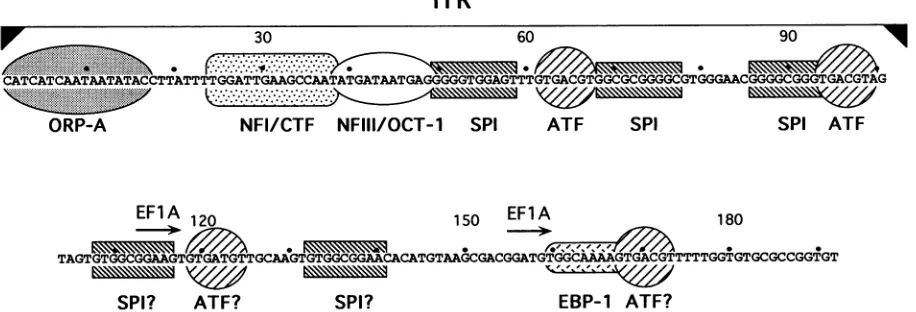
FIG. 1. The left-terminal 194 bp ofAd5. The nucleotide sequence of theAd5 ITR (terminal 103 bp, indicated by abracket above the sequence)and the left-end flanking sequences are shown. Numbers above the sequence represent nucleotide positions relative to the genomic terminusat nt1.Thestippled oval designates the region protected from DNase I by ORP-A (38). Recognition sequences for cellular factors NFI/CTF, NFIII/OCT-1, SP1, ATF, EF-1A, and EBP-1 (1, 3, 25, 26, 30, 33, 36) are indicated. Question marks indicate that binding of SP1
orATF to thesebinding site homologies has not been determined.
functionalrole of the NFIII/OCT-1 site could be replaced by sequencesimmediately flanking the ITR, suggesting a func-tional redundancy of these distinct sequences. The pheno-type of viruses carrying mutations in the ITR was most evidentin coinfections with awild-type virus, indicating that the NFIII site, SP1 site, and elements flanking the ITR enhance the ability of a limiting trans-acting factor(s), re-quiredtoaugmentviral DNAreplication,tointeract with the adenovirus terminal repeat. These results suggest that dif-ferent transcription factors may stimulate the interaction of suchacomponentwith the replication machinery.
MATERLILSANDMETHODS
Plasmids and virus constructions. Plasmids used for virus constructionswerederived frompElA-WT,which contains the left-terminal 1,339 bp of the Ad5 genome cloned into pBR322 (21). A unique 8-bp BglII linker was inserted in plasmid pElA-WT at either the RsaI site at nt 194 or the HphI site at nt 106, generating plasmids pEBL194 and pEBL106, respectively, which served as parental plasmids for deletionmutagenesis. Unidirectional deletions that orig-inated at the BglII linker sites and progressed leftward toward theITR were constructed by standard cloning pro-cedures using exonuclease III and nuclease
Si.
An 8-bp BglII linker was inserted at each deletion endpoint. Theextent of the deletion in each mutant plasmid was deter-minedby nucleotidesequenceanalysis. The nomenclature of theplasmids reflects the last nucleotide position remaining at either side of the deletionjunctions; e.g., deletion mutant pEB44/195 retains nt 44 and 195. Plasmids used to rebuild viruses
d1309-44/195+27
and d1309-44/195+90 were con-structedby inserting DNA fragments from different sources into the BglII linker site of pEB44/195. pEB44/195+27 contains an insertion of a 27-bp synthetic oligonucleotide carrying the bacteriophage T7 promoter (5'-GATCTCGCCCTATAGTGAGTCGTATrA-3').
pEB44/195+90 carriesan insertion ofa 90-bp fragment that contains five 17-mer GAL4 binding sites [PstI-XbaI fragment from plasmid
p(GAL4)5/ElBCAT
(27)].Allmutations constructed in plas-midswererebuilt into intact viruses by the method of Stow(44).
Virus isolateswerescreenedby restrictionendonucle-ase analysis of viral DNA, and the mutations of the final virus particle stocks were confirmed by 32P-labeling BglII restriction fragments with Klenow polymerase and sizing the left-end fragments in comparison with the parental plasmid fragment by electrophoresis on a 12% sequencing gel as
previously described (19). Purified virus particleswere pre-pared by CsCl equilibrium gradientsedimentation, titered by optical density (1 optical density unit at A260 equals 1012 particles), and used for all infections.
Cells, infections,and determinationof virusyields. 293 (14) and HeLa cell lines were maintained as monolayers in Dulbecco modified Eagle medium containing 10% supple-mented calf serum (HyClone). HeLa cells were also propa-gated in suspension in minimal essential medium containing 5% supplemented calf serum. Virus infections were per-formedwithpurifiedvirionsat amultiplicity of 200particles percell, exceptwhere otherwise indicated, at 37°C for 1 h. After infection ofmonolayers,cellswerewashed twice with phosphate-buffered saline (PBS) before the addition of fresh medium. Infected cell lysates were generated by three freeze-thaw cycles, and infectious virus yields were deter-minedby plaque assayson 293 cells.
Viral DNAaccumulation, replication rates, andpackaging efficiency determination. For experiments involving mixed virusinfections,HeLasuspension cellswerecoinfected with bothmutantandwild-typed1309 virusesasdescribed above. To assaytheaccumulation of viral DNA, total nuclear DNA wasisolated at 3, 8, 16, and 24 h postinfection (p.i.). Total nuclear DNA was isolated by lysing infected cells by the addition of Nonidet P-40to 0.4%, harvesting the nuclei by centrifugation, and isolating DNA as described previously (28).The isolated DNAwasdigested with ClaI andBglII,to distinguish mutant fromwild-type DNA, and analyzed by Southernhybridization (28)using pElA-WT,32P-labeledby the random primer method (11), as a probe. Ratios of wild-typeto mutantDNAs weredetermined by densitomet-ric scanning of autoradiographs generated by using pre-flashed film. Viral DNA accumulation in the nucleus of single-virus-infected HeLamonolayer cells was determined by isolating total nuclearDNAat3, 8, 12, and 16 hp.i. Viral DNAinsamples of equal amounts of total nuclear DNA was quantitated by slot blot analysis (49) using a
32P-labeled
on November 9, 2019 by guest
http://jvi.asm.org/
[image:2.612.78.536.80.236.2]pElA-WT probe as described above. To confirm that equal amounts of total DNA were represented in all samples, aliquots were also analyzed with an actin-specific probe (data not shown). Two different dilutions of samples from a typical experiment were quantitated by liquid scintillation spectroscopy of the hybridized filter pieces, and values of virus-specific counts per minute were normalized to the input (3-h) value for each virus.
Viral DNA replication rates were determined by [3H]thy-midine incorporation into newly synthesized viral DNA. Infected cells were labeled at 8, 12, and 16 h p.i. for 1 h with 100,LzCiof[3H]thymidine per ml. Following the pulse, the cells were washed twice with PBS, and total nuclear DNA wasisolated, digested with restriction endonucleaseHindIII, fractionated on a 1% agarose gel, and fluorographed. Repli-cationrates at 12 and 16 h p.i. were quantitated by densito-metric scanning of virus-specific bands on autoradiograms from threeindependent experiments.
Todetermine the packaging efficiencies of mutant viruses, HeLa cells coinfected with wild-type and mutant viruses wereharvested at 24 or 48 h p.i., as indicated. Total nuclear DNA wasisolated from one half of the cells, and virion DNA wasisolated from the other half. Virion DNA was isolated as described previously (12). Briefly, virions were isolated from cleared lysates of infected cells lysed in 0.2% deoxycholate and10% ethanol at pH 9 and then treated with RNase A and DNase I. Virus particles were lysed in 0.5% sarcosyl, and the viral DNA was digested with proteinase K, extracted extensively with phenol-chloroform, and precipitated with ethanol. Total nuclear and virion DNAs were analyzed by Southern hybridization as described above.
Detection of viral DBP protein levels. The levels of the E2a geneproduct DBP in virus-infected cells were determined by Westernimmunoblotanalysis (17). Aliquots of infected cells used for viral DNA replication rate determination were harvested at 8, 12, and 16 h p.i., and whole cell extracts were prepared by radioimmunoprecipitation assay lysis as de-scribed previously (9). Protein concentrations were deter-mined by using theBio-Rad protein assay reagent (Bio-Rad Laboratories). A
50-Rg
amount of each sample was sepa-rated by sodium dodecylsulfate-polyacrylamide gel electro-phoresis and assayed for relative amounts of DBP by using clone B6 anti-DBP monoclonal antibody (37), detected by chemiluminescence with use of ECL Western blotting de-tection reagents (Amersham).RESULTS
Viruses with mutations in the NFIII site are defective for growth. A series ofrecombinant viruses carrying deletions which originated at the border of the ElA enhancer and packagingregion at nt 194 and extended leftward toward the ITR wasconstructed (Fig. 2A). The growth of these mutant viruses relative to that ofwild-typed1309was determined by
a one-step growth curve on HeLa and 293 cells (Fig. 2B). These results showed that functionally redundant elements important for virus growth are present beyond the terminal
44bp. Insertion of a BglII linker at nt 194 (d1309-EBL194) produced aphenotypically wild-type virus. Deletion of se-quences between nt 76 and 195 (d1309-76/195) produced a slightly defective virus which grew to levels within twofold ofthewild-type level. This virus, d1309-76/195, retains one copy each of the binding sites for cellular transcription factorsNFI/CTF,NFIII/OCT-1, SP1, and ATF. Removal of the remaining ATF(d1309-60/195) and ATF and SP1 (d1309-53/195) elements produced viruses that also were slightly
defective for growth (levels three- to fivefold below the wild-type level). Mutant virusd1309-44/195carries a deletion of sequences between nt 44 and 195 and retains only the
NFI
binding site and core origin of replication. This virus grew very poorly and produced a high percentage of small plaques in both cell lines. Yields ofd1309-44/195were typically 30- to 50-fold below the wild-type level and varied within this range among experiments. We attribute this variability in yields to the inability to detect all of the very small plaques. An independent mutant isolate, d1309-44/195B, gave similar re-sults. The defect observed withd1309-44/195in comparison withdl309-53/195
defines a functional role forNFIII/OCT-1
in vivo. Deletion to nt 36 disrupted the remainingNFI/CTF
site and was lethal in repeated reconstruction experiments. Insertion of aBglII
linker at nt 106, or deletion of the NFIII/OCT-1, SP1, and ATF motifs within the ITR (se-quences between nt 44 and 107) but with maintenance of the sequences flanking the ITR, produced a virus(dl309-EBL106
ord1309-44/107, respectively) which grew like the wild type (Table 1) (18, 19).Viruses carrying insertions of variable size and sequence in the
dl309-44/195
deletion background were constructed to confirm that the defect observed withdl309-44/195
was sequence specific and not due to a spacing effect (e.g., with respect to the packaging sequences). DNA fragments carry-ing either five bindcarry-ing sites for the yeast transcription factor GAL4 (90 bp) or the bacteriophageT7promoter (27 bp) were inserted into theBglII restriction site ofd1309-44/195. The resulting insertion virus (d1309-44/195+90 or d1309-44/ 195+27, respectively) retained the defective growth pheno-type of the parental virus (Table 1).The loss of sequences from the left end of the viral genome may affect growth of mutant virusd1309-44/195by perturbing a number of viral processes; ElA gene expression, viral DNA replication, and viral DNA packaging are processes that are directed by left-end sequences. The adenovirus ITR contains intrinsic promoter and enhancer activities mediated primarily by the conserved SP1 and ATF motifs (18, 30, 34). Therefore, expression of ElA in the deletion viruses was examined. Both the steady-state levels ofElA transcripts and the utilization of upstream start sites late in infection (35, 39) were unaffected with mutant viruses d1309-76/195, -53/ 195, -44/195, and -44/106 (data not shown). In addition, the growth curves of the mutant viruses were the same in HeLa and 293 cells (Fig. 2B), which provide the ElA gene prod-ucts in trans, suggesting that the defects observed were not at the level ofElAexpression.
TheNFIII/OCT-1 binding site augments viral DNA replica-tion in vivo. DNA replicareplica-tion of the mutant viruses was examined in a coinfection assay. In this assay, HeLa cells were coinfected at equal multiplicities of infection with a mutant virus and wild-typed1309, which served as a com-plementing virus for any defect in trans and as an
internal
control. Total nuclear DNA was harvested 3 h p.i., before the onset of viral DNA replication, to determine the input ratio of mutant to wild-type DNA, and at various time points after the onset of replication. Ratios of viral DNAs were determined bySouthernhybridization in which mutant DNA was distinguished fromd1309DNA by restriction endonucle-ase analysis. The accumulation of mutant relative to wild-type DNA was determined by comparing the ratios at various time points after replication to the input ratio. Equivalent amounts of mutant andd1309DNAs were present in the nucleus of coinfected cells before the onset of viral DNA replication, as illustrated by the 3-h time point (Fig. 3). These input ratios indicated that the virus particle titers wereon November 9, 2019 by guest
http://jvi.asm.org/
A.
[TR
w /
195\
194
76
60 EZJ1
53
44
106
L-44
F--dl 309 dl 309-EBL1 94 dl 309-76/195 dl 309-60/195 dl 309-53/195 dl 309-44/195 dl 309-EBL106 dl 309-44/107
293
1ol0
io'O
-:1091
108
-107
I I
1 2 3
DAYS POST-INFECTION
o d1309
dl309-EBL194 -*-dl309-76/1 95 * dl309-60/195
--*d309-53/195
-& d1309-44/195 o dl309-44/195B
1 2 3
DAYS POST-INFECTION
FIG. 2. (A)Schematicdiagram ofmutantviruses. The left-terminal 195bp ofwild-typevirusd1309is shownschematicallyat thetop. Binding sites within theITRfor cellulartranscription factorsareindicatedasdescribed in thelegendtoFig.1. Thick lines represent deleted sequencesthat have beenreplacedwithBglIIlinkers(white rectangles).EBL194 andEBL106signifythataBglII linker has been inserted after nt194 and106,respectively;thenomenclature for deletion viruses indicates nucleotidepositions remainingatdeletionjunctions. (B) One-step growthcurves onHeLa and 293cells.HeLaand 293cellswereinfectedat amultiplicity of 200 particlespercell.Lysateswereharvestedat 1,2, and 3 days p.i.,andPFUtitersweredeterminedon293 cells. Titersweredetermined twiceineach oftwoindependent experiments, and theaveragedvaluesareplotted. Theone-stepgrowthcurves aredistinguished bysymbols indicatedontheright.
correct and that all deletion viruses were able to enter the
cells and deliver their DNA to the nucleus. Virus d1309-EBL194(aswell as
d1309-44/107;
datanotshown) produced thesameratio ofwild-typeto mutantDNAastheinputratio during the entire course ofinfection, thus exhibitingwild-EBL194 76/195 53/195 44/195
It t tOUe
mC N ff)"I CO N I C0D O- N CD - N
*
*
_
-dl309
_~~~~~~__
-MUTANT
TABLE 1. Virusyieldswithspacingmutants
Virus Yield(%ofWIT
valuer
d1309-44/195... 2.1 d1309-44/195+90"... 1.9
dl309-44/195+27b... 1.6
d1309-EBL106... 100
d1309-44/107... 45
FIG. 3. AccumulationofmutantDNAsin cells coinfected witha wild-type virus. HeLa cellswere coinfected withwild-typed1309 and the indicatedmutantviruses eachatequalmultiplicities.Total nuclear DNAwasprepared at3, 8, 16,and 24 hp.i.and digested with ClaI plus BglII. Various dilutions ofthe digested fragments werefractionated on a1%agarosegel, andviral left-end fragments weredetectedbySouthern hybridization usingaprobe containing left-end adenovirus DNA sequences. The migration positions of
mutant andwild-type internal controld1309 fragments are distin-guishedasindicated. More total DNAwasloaded inthe3-hinput samplesinordertodetect the viralDNA,causingthesesamplesto runaberrantly.
B.
HELA
1011.
101
108
-a Determined forlysatestaken 2days p.i.in twoindependentexperiments andexpressedas apercentage of thewild-typed1309-EBL194titer.
bRecombinant virus constructed bythe insertion of different-size DNA
fragments into theBgIIIlinker siteofd1309-44/195 asdescribed in the text.
00qm4wo
4w4ft4w
-0on November 9, 2019 by guest
http://jvi.asm.org/
[image:4.612.120.497.82.449.2] [image:4.612.332.544.531.609.2]A.
N N
_ _n
\ \
-Q4 -. ... _w - 4m . d1309
- e.LTA\fr
B. t
d1309
404**M-LTANT
FIG. 4. Packaging efficiencies of mutant virus genomes. (A)
Total nuclear (N) and virion (V) DNAs were isolated 48 h after
coinfection of HeLa cells with wild-type d1309 and the indicated
mutantviruses. The sampleswere analyzed by Southern
hybridiza-tionasdescribed for Fig.3.(B)HeLacellswereinfected witheither
d1309-EBL194 ord1309-44/195 at amultiplicity fivefold higher than
that usedfor the coinfectedwild-typed1309, harvestedat24h p.i.,
and analyzed for packaging efficiencies as described for panel A.
The input (I) high-molecular-weight nuclear DNA samples
har-vestedat3 h p.i. are includedfor comparison.
type kinetics ofDNA replication. Nuclear DNA
accumula-tion with mutantd1309-76/195 and -60/195 (data not shown)
waswithintwofoldof that of the coinfected wild-typed1309.
Mutantd1309-53/195was clearly reduced for DNA
accumu-lation relative to the wild-type virus. Mutant d1309-44/195
wasseverely defectivefor DNA accumulation (greaterthan 20-fold less efficient than d1309) in the coinfection assay.
Theseresults correlate the inability ofa given mutant virus togrowwell,asdeterminedbyaone-stepgrowthcurvewith
adefectin viral DNA replication, and show that the defect is
cis acting, since essential gene products required for
repli-cation should be provided in trans by the coinfecting wild-typevirus.
Theleft-terminal 380 bp of AdSareinvolved in viralDNA packaging (12, 13, 20). This observation prompted us touse
a coinfection assay to test the efficiency with which the deletion mutant viruses packaged their DNA into virus particles (Fig. 4). Total nuclear DNA was harvested 48 h
after coinfection of HeLa cells with wild-type and mutant
viruses to determine the nuclear pool of mutant and wild-type DNAavailable for packaging. This determination was
compared with the ratio of mutant towild-type DNA that
was productively packaged by analyzing virion DNA from
virus particles isolated at thesame time point (Fig. 4). The ratio ofmutant tod1309 DNA available in the nucleuswas
correctly reflected in the ratio of DNAs thatwere actually
packaged into stable virions for all of the deletion mutant
viruses, demonstrating that these viruses packaged their DNAwithwild-type efficiencies. Because themutant virus
d1309-44/195 replicated so poorly, a fivefold-higher input
ratio ofmutant DNArelativetod1309 wasused in orderto
detect the mutant DNA after 24 h of infection (Fig. 4B).
Unequal ratios ofmutant relative to wild-type DNAin the
nucleus at the time of packaging did not bias the packaging efficiency of one DNA over the other
(d1309-EBL194).
These results showed that mutant d1309-44/195 packaged the low level of viral DNA that was available in the nuclear pool, demonstrating the absence of a cis-acting defect inpackag-ing.
The NFIII/OCT-1 binding site stimulates the rate of viral DNA replication in vivo. The coinfection experiments dem-onstrated that for the mutant viruses which grew poorly
(d1309-76/195, -60/195, -53/195, and -44/195), the kinetics of viral DNA accumulation were reduced relative to that of the coinfected wild-type virus. We next investigated whether this defect reflected a decrease in the initiation of viral DNA replication by analyzing DNA replication rates. Singly in-fected HeLa cells were pulse-labeled for 1 h with
[3H]thy-midine at 8, 12, and 16 h p.i., and total nuclear DNA was harvested. Viral DNA was detected by fractionation of restriction endonuclease digests on an agarose gel and fluorography. The results of a typical DNA replication rate experiment are shown in Fig.SA. At the onset of viral DNA replication (8 h p.i.), no or marginally detectable viral DNA was evident relative to the smear of labeled cellular DNA. At 12 h p.i., viral DNA as well as partial host DNA replication shutoff (reduction in background smearing) were evident. The relative DNA replication rates of d1309-53/195 and d1309-44/195 were approximately 2.5- and 4-fold below wild-typed1309-EBL194levels. By 16 h p.i., the shutoff of cellular DNA replication was complete. The DNA replication of d1309-53/195 and d1309-44/195 had increased to rates equiv-alent to and twofold below that of the wild-type virusd1309, respectively. These data indicate that the mutant viruses were reduced for the initiation of replication and displayed a lag in the onset of DNA replication.Figure5B shows the results of a Western blot to analyze the amounts of viral DBP present in the same samples assayed for DNA replication rates in Fig. SA. The results indicate that the relative amounts of early gene products required for viral DNA replication, as measured by DBP, were equivalent at the onset of viral DNA replication and were similar during the course of infection for each of the
viruses.
To quantitate the overall DNA replication defect, viral
DNA accumulation in the nucleus of cells infected with single mutant viruses was determined (Fig. 6). Viral DNA accumulation in HeLa cells was assayed by slot blot analysis of total nuclear DNA harvested at 3, 8, 12, or 16 h after infection with the wild-type and mutant viruses. Viral DNA accumulation was quantitated by liquid scintillation spec-troscopy. The data are plotted in Fig. 6A; the results of a typical experiment are shown in Fig. 6B. Input levels of DNA (3 h) were similar in thed1309-53/195 andd1309-44/195 samples relative to the wild-type d1309-EBL194. Over the time course of the experiment,d1309-53/195 and d1309-44/195 DNA consistently accumulated to levels 1.5 and 2-fold, respectively, below that of wild-type
d1309-EBL194
DNA. The reduction in mutant d1309-44/195 DNA accumulation was not due to DNA instability in the nucleus, since mutant viral DNA was found to be as stable as wild-type DNA as determined by pulse-chase experiments (data not shown). These results are consistent with the DNA replication rate results for these two viruses. The more severe extent of the cis-acting DNA replication defect observed withd1309-44/ 195 in the coinfection assays (Fig. 3 and 4) was likely exaggerated as a result of competition with the coinfected wild-type d1309 DNA for a limiting factor(s) required for DNAreplication.-M n
IM a, a)
7 71
5R _n I-r
I 11
-, , . I
on November 9, 2019 by guest
http://jvi.asm.org/
[image:5.612.118.256.80.274.2]A.
a).
z
0
D
0)
3000
2000
-1000
-0 4 8 12 16 HRSPOST INFECTION
B.
U (AEBL1 94 -._ _
53/195 -
-44/1 95 - - ,
-B.
8 hrs 12 hrs 16hrs
_r 1,
sr m uz' U.J LOIi,~
an
c-
cL~ ur'
'j Ln Lr) an a) 0)
CO
d-LUJ Lfl Id
FIG. 5. Viral DNAreplication rates. (A) Autoradiograph of the
fluorographed gel from a typical experiment inwhich HeLa cells
wereinfected with theindicatedmutantviruses andpulse-labeled
for 1 h with[3H]thymidineat8, 12,and 16 hp.i.Total nuclear DNA
washarvested, and equal amounts ofHindIII-digested total DNA
weresubjected toelectrophoresis on a 1% agarose gel. (B) Viral
DBPprotein levels.Whole cellproteinlysateswerepreparedat8, 12, and 16hp.i. from aliquotsof the infected cells used forpanelA. ViralDBP-specific bandsweredetected insamplesofequalamounts
of total protein by Western blotting using anti-DBP antiserum.
Mock- andd1309-infectedsampleswereincludedascontrols.
DISCUSSION
Theanalysisofaseries of viralmutantscarrying deletions
whichimpingeontheAd5ITRdemonstrated thatsequences previously believed to be nonessential for virus viability
contributed inasignificant manner toviralgrowth. Specifi-cally, mutant virus d1309-44/195, which lacks the NFIII/ OCT-1 binding site in the ITR and a series of adjacent, repeated SP1 andATFbinding motifs and the binding sites
for othertranscription factors (Fig. 1), was reduced 30- to 50-fold in yield, as assayed in a single-step growth curve (Fig. 2B). A second, independently constructed isolate, d1309-44/195B, displayed the same growth characteristics, making it unlikely that the defect was due to a fortuitous
second-site mutation. Mutant viruseswhich maintained the
NFIII/OCT-1sitebut lacked theadjacentSP1and ATFsites (d1309-53/195, -60/195 and-76/195) also displayeda discern-ible, although less defective, reduction in virus yield. The defect in growth in infections withd1309-44/195 wasnot at
FIG. 6. Viral DNAaccumulation in thenucleus of single-virus-infected cells. HeLa cellswereinfectedwith the indicatedmutant
viruses,and total nuclear DNAwasprepared3, 8, 12,and 16 hp.i. Samplescontaining equal amountsof total DNAweredenatured,
andadifferentdilutionforeach timepointwasslot blottedontoa
nitrocellulose membrane. Theamountofviral DNA in eachsample
was quantitated after Southern hybridization usingaleft-end ade-novirus DNAprobe by liquid scintillationspectroscopyof the filter sections. (A)Results for theexperimentshown inpanel B, plotted againstthe timep.i.that thesamplewasprepared.Afteradjustment
for dilution factors, the amount of steady-state viral DNA was
determined as virus-specific counts per minute in the original sample. (B)AutoradiographofatypicalDNA accumulation
exper-iment, showing total DNA isolatedat3, 8, 12, and 16 h p.i. Controls included 1.5 ,ug ofamock-infected sample and 125 and 500pgof
d1309 DNA.
thelevel ofappearance of viral DNA in the nucleus imme-diatelyafterinfection, representingtheentryanduncoating
process, since viral DNA accumulation in the nucleusprior
totheonsetof viral DNAreplicationwasequivalentto the
wild-type level in coinfection experiments (Fig. 3). The defect also didnotreflect reduced ElAexpression (Fig.2B,
HeLaversus293,and datanotshown)or alack ofanyother
virus-encodedtrans-actingcomponent,since the defect with mutantd1309-44/195wasmostevident inacoinfection witha wild-type virus, inwhich caseallnecessaryproductswould
beprovidedintrans(Fig. 3). Thepackagingofd1309-44/195
DNA into virions was not deficient in coinfection assays (Fig. 4),indicating that thismutantretained sufficient pack-aginginformation in cis. Finally,the reduction inyieldwith
d1309-44/195 did not reflect a spacing effect due to the removal of DNA sequences; the insertion of 27or 90bp of heterologous DNAatthedeletionjunctionwith thismutant did not restorewild-type viability (Table 1).
Themajordefect withd1309-44/195wasfoundtobeatthe level of therateof viral DNAreplication.Thisrepresentsthe firstdemonstration that theNFIII/OCT-1siteaugmentsviral DNAreplicationinvivo,ashasbeen describedinreportsof
studiesusinginvitroreplication assays. Coinfection
exper-iments showed adramaticreduction in the kinetics of viral DNA accumulation for d1309-44/195 relative to the coin-fected wild-type virus d1309 (Fig. 3 and 4). These results A.
8 hrs
Ir tn Ln
a) am aw
m cl) s
X ur Ir
12 hrs
a, cr
J
..ml
toIe
16 hrs
a, LO to
m cU
u; uz Ie
-J/
/
,4{
d1309-EBL194
* d1309-53/195
A 1309-44/195
MOCK
125pg dj309
500pg d309
-,.,..
-Y
,Ak im ;L.
a
i-6-1-1. op. .,j
't
on November 9, 2019 by guest
http://jvi.asm.org/
[image:6.612.333.539.72.294.2] [image:6.612.88.266.75.418.2]showed that the DNA replication defect observed was cis acting. When viral DNA accumulation and replication rates were determined in single infections (Fig. 5 and 6), the results showed that both the DNA accumulation and repli-cation rates ofd1309-44/195were reduced but reached levels within two- to threefold of wild-type levels. The exaggerated magnitude of the DNA replication defect observed with d1309-44/195 in the coinfection assay (greater than 20-fold) waslikely due to competition with the coinfected wild-type virus for a limiting trans-acting factor(s) required to stimu-late viral DNAreplication.
The growth ofd1309-44/195 was rescued by functionally redundant sequences located in the ITR flanking region between nt 106 and 195; mutant virus d1309-44/107 and a similar virus (deletion of Ad2 sequences between nt 45 and 107) described by Hay and McDougall (19) each grew like the wild type. Redundancy was also evident between the terminus-distal half of the ITR and the ITR flanking region; deletion of sequences between either nt 44 and 106 or nt 106 and 195 produced viruses dl309-44/107 and d1309-6 (21), respectively, which grew like the wild type; however, re-moval of both blocks of sequences (nt 44 to 195) was detrimental for the resulting virus d1309-44/195. Sequences that are similar to the SP1 and ATF motifs, conserved in multiple copies in the terminus-distal half of the ITR, are evident in multiple copies in the ITR flanking region (Fig. 1).
We cannot distinguish from these analyses whether these sites or other regulatory elements in this region contribute to virus growth. The data strongly indicate that different tran-scription elements contribute to the level of viral DNA replication. This functional redundancy may reflect a com-mon mechanism of action.
Howdoes a dramatic 30- to 50-fold decrease ind1309-44/ 195 yields come about from a 2- to 3-fold decrease in viral DNA accumulation? Several points are worth considering. First, virus yields were determined by plaque assays, and it is possible that the variability in observed yields for dl309-44/195 was due to the inability to detect the unusually high number of small plaques formed by this mutant. Although thegrowth ofd1309-44/195 wasclearly defective, the yields maybeartificially low because of small plaque size. Consis-tentwith this idea is the fact that mutant dl309-44/195 was reduced only 5-fold in virus yield in A549 cells (data not shown), compared with the -50-fold reduction observed in 293 cells (Fig. 2B and Table 1). Larger viral plaques are produced with A549 cells than with 293 cells, allowing for
more accurate quantitation of virus titers with this mutant virus. Additionally, the particle-to-PFU ratio for the wild-type virus was -20 on 293 and A549 cells, while that of mutantd1309-44/195was -200 on 293 cells and -60 on A549 cells. Second, while postreplication steps in d1309-44/195 virion production appeared normal (late viral protein synthe-siswasnearly at the wild-type level [data not shown], and no cis-actingpackaging defect was observed when this mutant wascoinfected with wild-type virus [Fig. 4]), the possibility ofatrans-acting defect in viral DNA packaging still remains.
Asmall RNA has been identified as an essential component in thepackaging of bacteriophage 429 (15, 16). This bacte-riophage is similar to adenovirus in genetic structure and organization. The catalytic packaging sRNA of +29 is en-coded by sequences at the left end of the linear double-stranded DNA genome(16) which, as in adenovirus, directs packaging.Thus, because of thetranscriptional competence ofAd5 left-end sequences (18, 30, 34, 35), expression of such
a putative packaging RNA may have been perturbed with mutant
d1309-44/195,
resulting in inefficient packaging insingly infected cells. Third, although the levels of mutant virus DNA in infected cells approached that of the wild type (Fig. 5), a lag in the onset of replication or a reduction in the levels of viral DNA accumulation may disrupt the efficient progression of the virus life cycle. By analogy, adenoviruses with certain mutations in early region 4 display a lag in viral DNA accumulation, although wild-type levels are eventually reached, that results in small plaque size and lower virus yield (24, 50).
The NFI/CTF and NFIII/OCT-1 binding sites, as well as the regions which rescue the DNA replication defect of d1309-44/195 (23, 39), function also as transcription elements. The use of transcription elements to augment or regulate origin function is not unprecedented (reviewed in reference 10), and a variety of mechanisms have been described. For instance, transcription elements can regulate origin function byforming a promoter. Active transcription in the vicinity of the Eschenchia coli chromosomal origin (oriC) is required for initiation of DNA replication in vivo (reviewed in refer-ence 51). In purified replication systems, such transcrip-tional activation is observed only when oriC melting by DnaA protein is inhibited by agents which stabilize duplex formation, e.g., high concentrations of the E. coli histone-like protein HU or low temperatures. Transcriptional acti-vationin this case is mediated by an R loop, formed between the persistent RNA transcript and the template strand of DNA, which helps DnaA overcome topological constraints inunwinding (41). Similarly, transcriptional activation of the bacteriophage lambda origin is required in vivo and acts to overcome inhibition by HU in vitro (29). Alternatively, the site-specific DNA-binding activity of transcription factors can influence DNA replication initiation. Experiments sug-gesting thatspecific binding of
NFI/ClF
to sites engineered near the simian virus 40 replication origin stimulated repli-cation by affecting the phasing of nucleosomes such that the origin remained nucleosome free have been performed (6). Transcription factors may also influence DNA replication initiation in a manner similar to the way they are believed to influencetranscription, that is, by interacting with the repli-cation machinery via direct or indirect protein-protein inter-actions. This is the case for NFI/CTF in adenovirus DNA replication; direct interactions between NFI/CTF and Ad Pol are believed to correctly position the viral replication machinery at the origin (2, 5, 31, 32). Results recently described byVerrijzer et al. (48) suggest thatNFIIIIOCT-1 maystimulate adenovirus DNA replication by the induction ofDNA bendinginduced by binding at the site. Coenjaerts et al. have also shown that thespacing of the NFIII/OCT-1 site relative to the viral terminus is important for activity (8). It isdifficult tounderstand how sequences outside the ITR are functionally redundant with the NFIII/OCT-1 site in our studies, since a linker replaces the NFIII/OCT-1 site in mutantdl309-44/195 that would be expected to position the redundant, flanking elements at a distance where NFIII/ OCT-1 does not function in vitro. The observation that the SP1 site adjacent to theNFIII/OCT-1 site also contributes to theefficiency of viral DNA replication(d1309-53/195; Fig. 3) supports the idea thatNFIII/OCT-1,SP1, and the redundant elements between nt 106 and 194 may function similarly to theNFI/CTF sites when introduced adjacent to the simian virus 40 origin of replication (6); that is, by blocking the assembly of chromatin or the binding of other DNA-binding proteins at the adenovirus terminus, these binding activities may allow the adenovirus replication complex more ready access to the viral origin.on November 9, 2019 by guest
http://jvi.asm.org/
ACKNOWLEDGMENTS
Wethankourcolleagues, especiallyMariaGrable,Nick Muzyc-zka, Bruce Stillman, and Peter Tegtmeyer,formanyhelpful com-ments anddiscussions, andwethank TinaPhilipsbergforexcellent technicalhelp.
L.H. was supported by Public Health Service training grant CA09176 from the National Cancer Institute. This research was
supported by Public Health Service grant CA28146 to P.H.from the National Cancer Institute.
REFERENCES
1. Barrett, P., L.Clark, and R. T. Hay. 1987.Acellularprotein binds to a conserved sequence in the adenovirus type 2 en-hancer. NucleicAcids Res.15:2719-2735.
2. Bosher, J., E. C. Robinson, and R. T.Hay. 1990. Interactions betweenthe adenovirustype 2 DNApolymerase and theDNA binding domain of nuclear factorI. NewBiol. 2:1083-1090. 3. Bruder, J. T., and P.Hearing.1989.Nuclear factorEF-1Abinds
to the adenovirus ElA core enhancer element and to other transcriptionalcontrolregions. Mol. Cell. Biol. 9:5143-5153. 4. Challberg, M. D., andJ. K. Kelly. 1989. Animalvirus DNA
replication. Annu. Rev.Biochem. 58:671-717.
5. Chen, M.,N.Mermod,and M.S.Horwitz.1990.Protein-protein interactions between adenovirus DNApolymeraseandnuclear factor-I mediate formationoftheDNAreplication preinitiation complex.J. Biol. Chem. 265:18634-18642.
6. Cheng, L., and T. J. Kelly. 1989. Transcriptional activator nuclearfactor I stimulates thereplicationofSV40 minichromo-somes invivoand in vitro. Cell59:541-551.
7. Cleat, P. H., and R. T. Hay. 1989. Co-operative interactions between NFIand the adenovirus DNAbinding protein atthe adenovirusorigin of replication. EMBOJ. 8:1841-1848. 8. Coenjaerts,F. E.J., E. D.Vries, G. J. M.Pruin,W. V.Driel,
S. M.Bloemers, N. M. T. van derLigt,and P.C.vanderVliet. 1991. Enhancement of DNAreplication by transcriptionfactors NFI andNFIII/Oct-1depends criticallyonthepositions of their binding sites in the adenovirus originofreplication. Biochim. Biophys.Acta1090:61-69.
9. Cutt, J. R., T. Shenk, and P. Hearing. 1987. Analysis of adenovirusearly region 4-encodedpolypeptides synthesizedin productively infected cells.J.Virol. 61:543-552.
10. DePamphillis, M. L. 1988. Transcription elements as compo-nentsofeukaryotic originsof DNAreplication. Cell 52:635-638. 11. Feinberg, A. P., and B. Vogelstein. 1983. A technique for radiolabelingDNA restriction endonucleasefragments tohigh specific activity. Anal. Biochem. 132:6-13.
12. Grable, M.,and P.Hearing. 1990. Adenovirustype5packaging domainiscomposed ofarepeatedelement that isfunctionally redundant. J.Virol. 64:2047-2056.
13. Grable,M., and P.Hearing.1992. cis andtransrequirements for selectivepackagingofadenovirustype 5 DNA. J. Virol. 66:723-731.
14. Graham,F.L., J. Smiley, W. C. Russell, and R. Nairn. 1977. Characteristicsofahuman cell linetransformedbyDNAfrom human adenovirus type 5. J. Gen.Virol.36:59-72.
15. Guo, P., S. Bailey, J. W. Bodley, and D. Anderson. 1987. Characterization of the small RNA ofbacteriophage +29DNA packagingmachine. Nucleic Acids Res. 15:7081-7090. 16. Guo, P., S. Erickson, andD.Anderson.1987. A small viral RNA
isrequired forinvitropackagingofbacteriophage 429 DNA. Science 236:690-694.
17. Harlow, E., and D. Lane. 1988. Antibodies: alaboratory man-ual. ColdSpringHarborLaboratory,ColdSpring Harbor,N.Y. 18. Hatfield, L., and P. Hearing. 1991. Redundant elements in the adenovirus type 5 inverted terminal repeat promote bidirec-tionaltranscriptionin vitroand areimportantfor virusgrowthin vivo.Virology 184:265-276.
19. Hay, R. T., and I. M. McDougall. 1986. Viable viruses with deletions in the left inverted terminal repeat define the adeno-virusorigin ofDNAreplication. J. Gen. Virol. 67:321-332. 20. Hearing, P., R. J. Samulski, W. L. Wishart, and T. Shenk. 1987.
Identification of a repeated sequence element required for efficientencapsidationof the adenovirus type 5 chromosome. J. Virol. 61:2555-2558.
21. Hearing, P.,and T. Shenk. 1983. The adenovirus type 5 ElA transcriptional control region contains a duplicated enhancer element.Cell 33:695-703.
22. Hearing, P., and T. Shenk. 1986. The adenovirus type 5 ElA enhancer contains two functionally distinct domains: one is
specificforElAand the other modulates allearlyunits in cis. Cell 45:229-236.
23. Hen, R., E. Borreli, P.Sassone-Corsi,and P.Chambon.1983. An enhancer element is located 340 basepairs upstreamfromthe adenovirus-2ElAcapsite.Nucleic Acids Res. 11:8784-8760. 24. Huang, M. M., and P.Hearing.1989.Adenovirusearly region4
encodes two gene products with redundant effects in lytic infection.J. Virol. 63:2605-2615.
25. Jones,K.A., J.T.Kadonaga,P.J.Rosenfeld,T.J. Kelly,and R. Tjian. 1987. A cellular DNA-binding protein that activates eukaryotictranscriptionand DNAreplication.Cell 48:79-89. 26. Leza, M.A.,and P.Hearing. 1988. Cellulartranscriptionfactor
bindstoadenovirusearly regionpromotersandtoacyclicAMP responseelement. J. Virol. 62:3003-3013.
27. Lillie, J. W.,andM. R.Green.1989.Transcriptionactivationby theadenovirusElAprotein.Nature(London)338:39-44. 28. Maniatis, T., E. F.Fritsch,andJ. Sambrook. 1982. Molecular
cloning:alaboratorymanual. ColdSpringHarborLaboratory, ColdSpring Harbor,N.Y.
29. Mensa-Wilmont, K.,K.Carroll,and R.McMacken. 1989. Tran-scriptional activation of bacteriophage X DNA replication in vitro:regulatoryrole ofhistone-likeproteinHU ofEscherichia coli.EMBO J.8:2393-2402.
30. Miralles,V.J.,P.Cortes,N.Stone,and D.Reinberg. 1989.The adenovirus inverted terminalrepeatfunctionsas anenhancerin acell-freesystem.J. Biol.Chem. 264:10763-10772.
31. Mul, Y. M.,and P. C. van der Vliet. 1992. Nuclearfactor I enhances adenovirus DNAreplication by increasingthe stabil-ity ofapreinitiation complex. EMBO J. 11:751-760.
32. Mul, Y. M., C. P.VerriJzer, and P. C. van derVliet. 1990. Transcription factors NFI and NFIII/Oct-1 function
indepen-dently, employingdifferentmechanismstoenhance adenovirus DNAreplication.J. Virol. 64:5510-5518.
33. O'Neill, E. A., C. Fletcher, C. R. Burrow, N. Heintz, R. G. Roeder, and T. J. Kelly. 1988. Transcriptionfactor OTF-1 is
functionally identical to the DNA replication factor NF-III. Science241:1210-1213.
34. Ooyama, S., T. Imai, S. Hanaka, and H. Handa. 1989. Tran-scription in the reverse orientation at either terminus of the adenovirus type 5 genome. EMBOJ.8:863-868.
35. Osborne,T. F.,and A. J. BerL 1983. Far upstreaminitiation sites for adenovirus early region 1A transcription areutilized after theonsetof viral DNAreplication.J. Virol.45:594-599. 36. Pruin, G. J. M., P. van derVleit, N.A. Dathan, and I. W.
Mattaj. 1989. Anti-OTF-1 antibodiesinhibit NFIIIstimulation ofin vitro adenovirus DNA replication. Nucleic Acids Res. 17:1845-1863.
37. Reich, N. C., P. Sarnow, E. Duprey, andA. J. Levine. 1983. Monoclonal antibodieswhich recognize native anddenatured forms of the adenovirus DNA-binding protein. Virology 128: 480-484.
38. Rosenfeld,P.J.,E.O'Neill,R.J. Wides,and T.J.Kelly.1987. Sequence-specific interactions between cellular DNA-binding proteins and the adenovirus origin of DNA replication. Mol. Cell.Biol. 7:875-886.
39. Sassone-Corsi, P.,R.Hen,E.Borrelli,T.Leff,and P.Chambon. 1983. Far upstream sequences arerequired for efficient
tran-scriptionfrom the adenovirus-2ElAtranscriptionunit. Nucleic Acids Res. 11:8735-8745.
40. Shinagawa, M., and R. Padmanabhan. 1980. Comparative
se-quenceanalysisof the inverted terminalrepetitions from differ-entadenovirusserotypes. Proc.Natl.Acad.Sci.USA 77:3831-3835.
41. Skarstad, K., T. A. Baker, and A. Kornberg. 1990. Strand separation requiredfor initiationofreplication atthe
on November 9, 2019 by guest
http://jvi.asm.org/
somal origin of E. coli is facilitated by a distant RNA-DNA
hybrid. EMBO J. 9:2341-2348.
42. Stillman, B. 1989. Initiation of eukaryotic DNA replication in vitro. Annu. Rev. Cell Biol. 5:197-245.
43. Stillman, B. W., W. C. Topp, and J. A. Engler. 1982. Conserved
sequencesatthe origin of adenovirus DNA replication. J. Virol. 44:530-537.
44. Stow, N. D. 1981. Cloning ofaDNAfragment from the left-hand terminus of the adenovirus type 2 genome and its use in
site-directed mutagenesis. J. Virol. 37:171-181.
45. Stuiver, M. H., and P. C.vandeVliet. 1990. The adenovirus
DNAbinding protein formsamultimeric protein complex with
double-stranded DNA and enhances binding of nuclear factor
I.J. Virol. 64:379-386.
46. Temperley, S. M., and R. T. Hay. 1992. Recognition of the adenovirus type 2 origin of DNA replication by the virally
encoded DNApolymerase and preterminal proteins. EMBO J.
11:761-768.
47. van der Vliet, P. C. 1991. The role of cellular transcription
factors in the enhancement of adenovirus DNA replication. Semin. Virol. 2:271-280.
48. Verrijzer, C. P., J. A. W. M. van Oosterhout, W. W. van
Weperen, and P. C. van derVliet. 1991. POU proteinsbend
DNA via thePOU-specific domain. EMBO J. 10:3007-3014. 49. Wahl, G. 1983. Rapid detection of RNA and DNAusingslot
blotting. Schleicher & Schuell, Inc. Keene, N.H.
50. Weinberg, D. H., and G. Ketner.1986. Adenoviralearly region 4 isrequired for efficient viral DNA replication and for lategene
expression. J. Virol. 57:833-838.
51. Zyskind, J. W., and D. W. Smith. 1992. DNA replication, the
bacterial cellcycle, and cell growth. Cell 69:5-8.