A STUDY ON
PITHA KAASAM
Dissertation Submitted To
THE TAMIL NADU DR.M.G.R Medical University
Chennai – 32
In Partial fulfillment for The Award of Degree of
DOCTOR OF MEDICINE (SIDDHA)
(Branch V - Noi Naadal)
DEPARTMENT OF NOI NAADAL
GOVERNMENT SIDDHA MEDICAL COLLEGE
PALAYAMKOTTAI – 627 002
ACKNOWLEDGEMENT
First and foremost. The author very much grateful to the Lord
almighty who gave her the will power to complete her dissertation
work. The author wish to express her gratitude to her parents for
their sincere prayers and best wishes.
The author takes opportunity to express her gratitude to the
Vice chancellor, Tamil Nadu Dr.M.G.R. Medical University
and the Commissioner and Directorate of Indian Medicine and
Homeopathy, Chennai for giving permission to undertake this
dissertation work.
The author sincerely thanks our Principal Dr.R.Devarajan
M.D.(s).
,
I/C and Head of the Department of Noi Naadal Postgraduate, Government Siddha Medical College, Palayamkottai, for
granting permission to take this dissertation topic.
The author expresses to thanks to our Vice Principal
Dr.Soundararajan M.D. (s).,Government Siddha medical College
Palayamkottai.
The author expresses her gratitude to Dr.A.VasukiDevi
The author expresses her deep sense for gratitude to
Dr.S.K.Sasi M.D.(s)., Lecturer Post graduate department of Noi
Naadal, Government Siddha Medical College, Palayamkottai, for the
continuous valuable guidance, suggestions to evaluate the
pathological view, encouragement and timely help in the completion
of this dissertation.
The author expresses her thanks to Dr.R.Rajasekar
M.D.(s), Dr.S.Sundararajan M.D.(s).,and Dr. Thanga Moni
M.D.(s)., for the valuable guidance to take this dissertation topic.
The author expresses her sincere thanks to Dr.Padma
M.B.B.S., DMRD. Radiologist Government Siddha Medical College,
Palayamkottai, for her guidance to arrive clinical diagnosis.
The author also expresses her warmful thanks to
Dr.Chokalingam M.B.B.S., for providing permission to undergo
her dissertation work in Parvathy Nursing Home, Kalakad.
The author should not forget to express her gratefulness to
Librarian and Technical staffs, Government Siddha Medical
College, Palayamkottai, for their invaluable help.
Last but not the least, as a most important factor, the author
would like to thanks St. Jude’s Computer Research Institute,
Palayamkottai, for the co-operation and commitment to shape this
INTRODUCTION
“vd;Dil kdJ Gj;jp ape;jphpa rhPu nky;yhk;
vd;Dil awptp dhNy aputpKd; dpkNk ahf;fp vd;Dil ePA ehD Nkfnkd; iwf;fpaQ; nra;a
vd;Dil FUtha;j; Njhd;W kPrid apiwQ;rp NdNd” - ifty;a etePj trdk;
Life is a divine. It’s our duty to achieve the goal of life by
healthy way to living. The siddha system of medicine well known for its simplicity and credibility speaks much of healthy life style by promoting physical and mental well being.
“mz;lj;jp Ys;sNj gpz;lk;
gpz;lj;jp Ys;sNj mz;lk; mz;lKk; gpz;lKk; xd;Nw mwpe;Jjhd; ghh;f;Fk; NghNj”
- rl;lKdp Qhdk;
“ghug;gh G+jike;J kz;ePH NjA
ghp thA thfhak; Ie;jpdhNyNa Nrug;gh rlkhr;Nr”
- rjf ehb E}y;
The fundamental principle of the siddha science involves the five elements namely Mann, Neer, Thee, Kattru and Aagayam. Which are present in both beings -the microcosm and universe - the macrocosm. Therefore all created or evolved in this world fall with in the five elemental categories. Of these, the constituents of air, fire and water in the body from the three humours viz. Vaatham, Pitham and Kabam. The three fuindamental principles on which the constitution of the human being is based.
The three humors are supposed to be in proporation of in healthy
Vaatham 1 Pitham ½ Kabam ¼
individual, and then they are known as ‘Muthathus’ But when this equilibrium is altered or their proportion are deranged, these are known as ‘Mukkutram’, which ultimately causes illness or disease.
“nka;asT thj nkhd;W
Thus for the maintenance of these three humours in a state of equilibrium a reasonable knowledge in the physiology of the body is essential.
But in the given circumstances the high level of environmental degradation, westernised life styles and scant regard for social and moral values, it is highly impossible to maintain a healthy life. Hence to revert the deranged three humors to its state of equilibrium, material medica plays on important role. In the siddha science, the material medica consists of herbs, minerals and animal products, which are used in 64 types of medicines, of which 32 varieties are internal and 32 varieties, are external forms. There are lakhs of formulation siddha medicines in literatures and the siddhars are considered to be the pioneers in the use of metal and minerals in the treatment of disease.
Noi Naadal means approach to the disease and Noi Mudhal Naadal denotes the determination of the etiology of the disease. The basic pathology of a disease lies in the alteration of the quality and quantity of the thathus, and the assessment of their various dimension forms the essential part of diagnosing a disease. An effect line of treatment can be formulated, only when the uniqueness of the individual and exact nature of the illness, to the level of their sub classification are understood.
The siddhar’s deviced and utilised a special, effective and cost efficient techniques of diagnosis known as “Envagai thervugal”. They are Naadi, Sparism, Naa, Niram, Mozhi, Vizhi, Malam and Moothiram. These eight features play a vital role in finding out the disease and the imblanced life factors.
The author doing her post graduate in the Dept of “NOI NAADAL” attempts a dissertation on the various aspects of Pitha Kaasam with special emphasis on the changes undergone by the Mukkutram and method of diagnosing this disease by using Envagai thervugal.
SIDDHA PHYSIOLOGY
Physiology means the science of the functions of the living organisms and its components and the physical and chemical factors and processes involved.
Udal Thathuvam (physiology) of Siddha aspect
Composed of
96 basic elements – Thathuvas
7 Somatic compounds – Udal Kattukal
14 reflexial functions – Vegams
6 Tastes – Suvaigal
4 body fires – Udal thee
3 immunities – Udal Vanmai etc.
These basic elements are responsible for the creation, protection of life which is mediated through the Panchapootha and Mukkuttra theory.
96 Thathuvas are,
The five elements - Ik;G+jk;
The ten naadai - jr ehb.
The five states of the soul - gQ;r mtj;ij
The three principles of moral evil - Kk;kyk;
The three cosmic qualities - Kf;Fzk;
The three regions - %d;W kz;lyk;
The three humours - Kg;gpzp
The eight predominant passions - vz; tpfhuk;
The six stations of the soul - MW Mjhuk;
The seven constituted elements of the body - VO tif jhJ
The ten vital airs - jr thA
The five cases of sheaths of the soul - gQ;r Nfhrk;
The wisdom - mwpT
The three physical bindings - <liz
The two deeds - tpidfs;
MUKKUTRAM
(I) Vaatham : -
Vaatham is the kinetic energy that effects all movements.
Location of Vaatham : -
Types of Vaatham:-
1) Piranan : This controls knowledge mind and five objects of sense which are helpful for
breathing and digestion.
2) Abanan : This is responsible for all downward movements such as passing of urine, stools, sperms, mensutral flow, ova,
foetus etc.
3) Viyanan : This responsible for movements of all parts of body.
4) Uthanan : This is responsible for all upward visceral movements such as vomiting, eructation and nausea.
5) Samanan : This is the neutralizing force for the above four vayus, this aid for proper
digestion.
6) Naagan : Responsible for opening and closing of eyes and also responsible for yawning and vision.
8) Kirukaran : Responsible for Salivation, nasal secretion and appetite.
9) Thevathathan : Responsible for laziness, sleeping and anger.
10) Dhananjeyan : Responsible for swelling of body after death, it escapse on the third day after death by bursting of cranium.
(II) Pitham : -
Pitham does not essentially mean bile but signifies the function of the thermogenesis of heat production and metabolism. Comprehensing in its scope the process of digestion, colouration of blood and formation of various secretion and excretion which are either the mean or the ends of tissue combustion.
Location of Pitham in body: -
Pitham is located in pranan, bladder, molakini, heart, umbilical region, abdomen, stomach, sweat, eyes, saliva, blood etc.
Types of Pitham : -
1) Anarpitham : It gives appetite and helps digestion. 2) Prasagam : It gives complexion to skin.
4) Alosagam : It brightens the eyes. 5) Sathagam : It controls the whole body.
It has the property of fullfillment (III) Kabam :-
Kabam stabilizes, maintains and lubricate all movements.
Location of Kabam : -
Kabam is located in Samanan, Semen, head, tongue, bone marrow, blood, nose, chest, nerves, brain, bones, large intestine, eyes, stomach and pancreas.
Types of Kabam : -
1) Avalambagam : Present in lungs, it controls the functions of lungs and heart and other kabas.
2) Kilethagam : Lives in stomach, it gives moisture and softness to the ingested food. 3) Pothagam : Tongue is the centre of pothagam,
and responsible for identifying taste. 4) Tharpagam : Present in the head and responsible
for coolness of the both eyes. 5) Santhigam : Responsible for the lubrication and
UDAL KATTUGAL (SEVEN SOMATIC COMPONENTS)
The seven Physical constituents
They are as follows.
1) Saaram – Chyle : -
It is responsible for the growth and development. It keeps the individual in good spirit and it nourishes the blood. 2) Senneer – Blood: -
Blood imparts colour to the body and nourishes the muscles responsible for the ability intellect of the individual. 3) Oon – Muscle :-
It gives shape of the body according to the requirements for the physical activity,
4) Kozhuppu – Fat: -
It helps in lubricating the different organs and maintains oily matter of the body.
5) Enbu – Bone: -
Support the skeletal system and responsible for the posture and movements of the body.
6) Moolai – Bone marrow: -
It is responsible for the reproduction.
VEGAMS
In our body, the normal physiology includes 14 urges. They are called Vegangal and it should not be disturbed in any way.
1) Vaatham - Flatus 2) Thummal - Sneezing 3) Siruneer - Urine 4) Malam - Stool 5) Kotavi - Yawning 6) Pasi - Hunger 7) Neer vetkai - Thirst 8) Kaasam - Erumal 9) Elaippu - Fatigue 10) Nithirai - Sleep 11) Vaanthi - Vomit 12) Kanneer - Tear 13) Sukkilam or Suronitham 14) Suvaasam - Respiration
5) Karppu - Pungent 6) Thuvarppu - Astrigent
UDAL THEE
That is body fire, it helps in digestion.
1) Samakini - To maintain the normal complete digestion
2) Mandhakini - Delayed digestion
3) Deekshanakini - Quick fast digestion in an earlier Period.
4) Vishamakini - Incomplete digestion leading to toxicity
UDAL VANMAI
It means strength and vitality of the body.
1) Eyarkai Vanmai - Inherited immunity 2) Kala Vanmai - Age, Season and time 3) Cheyarkai vanmai - Improvements of 3 vitality
SIDDHA PATHOLOGY
Pathology = Pathos + logos Patho = Suffering
Logos = Study
Pathology is the study of disease, that is study of structure and function of the body in disease, it deals with causes, effects, mechanisms and nature of disease.
Disease is opposite of health, but the terms health and disease are difficult to define. Health is a condition when the individual is in complete accord with the surrounding, while disease is loss of ease to the body(dis-ease).
“kjpj;jplw; fUik tha;e;j
khz;ghp fhu nky;yhe; Jjpj;jpl TzHe;jh NdDe;
Jfswg; gpzpapd; wd;ik gjpj;jpl Tzuh dhfpw;
gaDwh dhf yhNd tpjpj;jpL gpzpj; jpwj;ij
tpsk;GJ Kjw;fz; kd;Ndh”
- rpfpr;rh uj;d jPgk;
UYIR THATHUKAL
I.Vaatham
Abnormal functions of Vaatham :-
Pain all over the body, piercing pain, inflammation and redness of complex, also roughness of the skin, hardness of the limbs, astringent taste in the mouth, tastelessness, sweating, sleep, contraction and numbness or paralysis of the limb, tremors, muscular wasting, decreased excretion of stools and urine, thirst, blackish discolouration of skin, stool and urine.
In Increased condition: -
Distended abdomen
Constipation
Weakness
Insomnia
Tremors
Breathlessness
Blackish discolouration of skin
In Decreased condition:-
Body pain
Feeble voice
Syncope
II.Pitham
Abnormal functions of Pitham:-
Indigestion, acidity, burning sensation in the heart, throat and stomach.
In Increased condition:-
Yellowish discolouration of eyes, skin, urine and motion.
Polyphagia.
Burning sensation all over the body.
Sleeplessness
In Decreased condition :- Cold
Pallor
Decreased appetite
Symptoms associated with growth of kabam.
III. Kabam
Abnormal functions of Kabam : -
Whiteness of complexion, cold, itching, dullness, heaviness, oilyness, loss of sensation, a sense of sweetness in the mouth.
In Increased condition : - Loss of appetite
Excessive salivation
Heaviness
Dyspnoea
In decreased condition: -
Prominence of bony edges
Dry cough
Lightness
Profuse sweating
Palpitation
Giddiness
Dryness of the joints
UDAL KATTUGAL
1) Saaram
Increased conditions - Leads to disease identical to the increase in kaba like loss of appetite, excessive salivation.
Decreased condition - Loss of weight, tiredness, dryness of skin, laziness, diminished activity of the sense organs.
2) Senneer
Increased condition - Boils and tumours in the different parts of the body, splenomegaly, colic pain, increased blood pressure, reddish eye and skin, jaundice,
3) Oon
Increased condition - Tumours or extra growth around the neck, face, abdomen, thigh, genitalia etc.
Decreased condition - Muscle wasting
4) Kozhuppu
Increased condition - Identical to that of increased oon associated with dyspnoea and loss of acivity.
Decreased condition - Pain
5) Enbu
Increased condition - Strong bones and teeth.
Decreased condition - Weak bones, teeth, nails and hairs.
6) Moolai
Increased condition - Heaviness, swollen eyes, swollen phalanges, oliguria and non- healing ulcers.
Decreased condition - Osteoporosis and Shunken eyes.
7) Sukkilam or Suronitham
AIM AND OBJECTIVES
Siddha system is considered to be the most ancient therapeutic science in the world. Siddhars have identified four thousand four hundred and forty eight disease and Scientifically arranged eighty type of Vaatha diseases, forty types of Pitha diseases and twenty types of Kaba diseases and so on.
Among all the forms of treatment Noi Naadal (or) Identification of disease and Noi muthal naadal (or) the determination of the aetiology of the disease are the most important aspects. Once the diagnosis is accurate the treatment may be easily fulfilled.
In “Chikicharathna deepam” “kjpj;jplw; fUik tha;e;j
khz; ghpfhu nky;yhQ; Jjpj;jpl czHe;jh NdZe;
Jfswg; gpzpapd; wd;ik gjpj;jpl Tzuh dhfpw;
gad whdh fhyhNd tpjpj;jpL gpzpj;jpwj;ij
tpsk;GJ Kjw;fz; kd;Ndh”
The following specific objectives have been drawn to achieve the above aim,
To collect the ancient Siddha literatures about Kaasa disease
in general and Pitha Kaasam in particularly.
To study the clinical course of the disease Pitha Kaasam with
clean observation on the actiology, clinical fetures and diagnosis.
To evaluate the siddha basic physiology and Pathology.
To make a thorough physical examination of the patient.
To find out the changes that occur in Uyirthadukkal,
Udalthadukkal and in Naadi.
To support the study of Pitha Kaasam by using envagai
thervugal, mentioned in siddha literatures with modern parameters.
To discuss the clinical features and complications associated
ELUCIDATION ABOUT PITHA KAASAM
According to the literature Yugi Vaithiya Sinthamani, Pitha Kaasam has been mentioned as
“rPuhd ,Uky;kpfg; Gul;l yhfpj;
jpj;jpj;J cg;Giuf;FQ; rHj;jp Az;lhk; jhuhfj; jiyAlk;G jhd;t ypf;Fk;
jhfpj;Jf; Fuy;fk; Kk;uj;jk; tPOk; Muhf tq;fe;jhd; kpftp isf;Fk;
md;de;jhd; nry;yhkw; Gspj;Njf; fhFk; khuhkapH $r;Rr; RuKz; lhk;
kjpkaq;Fk; gpj;jfh rj;jpd; tz;ik”
ghly; vz; - 697 – Yugi Vaithiya Sinthamani
Meaning of the words : -
,Uky; : -
* fhrk; - Cough
** ff;fy;
Gul;ly; :-
*Fkl;Ljy;
*fPo; Nkyhfj; jpUg;Gjy;> jpUk;Gjy; - Repeat
**tapW Gul;ly; - A sensation felt in the abdomen as in
vomiting
jpj;jpj;J : -
cg;G :-
*ytzk; - Salt
**Nrhw;Wg;G> ctHf; fly;> cUrp
rHj;jp:-
*the;jpnaLj;jy; - Vomiting
**ff;fy;> neUg;G> ff;Fjy
jiy :-
*rpuk; - Head
*jiykapH – Hair
**Mfhak;> clk;gpd; Nkw;ghfk;.
clk;G : -
*rhPuk; - Body
**nghd; - Gold
typf;Fk; : -
*NehTz;lhjy;> tw;Wjy;> gyte;jg;gLj;jy;
**NehT – Pain
jhfpj;J :-
*ePH Ntl;if cz;lhjy; - To be thirsty
Fuy;fk;Kk; :-
*Fuyilg;G – Sore throat, Hoarseness
*Ngr Kbahky; Nghjy; - Loss of speech
** A disease of the larynx due to dryness and the consequent
inability to talk except with hoarse voice – hoarseness.
uj;jk; tPOk; :-
*,uj;j the;jp – Haemoptysis
[uj;jk; - Blood] [tPOk; - To come out]
**tPOk; - To descend, to fall.
mq;fk; : -
*cWg;G> milahsk;> vYk;G.
**clk;gpd; ghfk; - A part of body
**miuapd; NkYs;s clk;gpd; gFjp – The portion of the main
body without the limibs.
**clk;G> kdk;> %is> vYk;Gf;NfhHit
,isf;Fk; : -
*fpNyrk; - Distress, dyspnoea, nkypjy;
**NrhHT – Lassitude, Loss of Power, To be fatigued
md;dk; :-
*NrhW – Food, boiled rice
Gspj;Njf;fhFk; : -
*Gspj;Jg; Nghjy; - To turn sour, to ferment
**kh Kjypad Gspj;Jg; Nghjy;
**jd;ik jphpjy;> ntWj;Jg; Nghjy;
kapHf;$r;R : -
*kapHrpypHj;jy; - Rising of the hairs of the body.
**Gsfk; - Horripillation.
Ruk; : -
*fha;r;ry; - Fever
**ghiy epyk;> fs;> fhL> ,ir.
kjpkaq;Fk; : -
*Gj;jp khwhl;lk; - Confusion **Gj;jp kaf;fk;
fhrk; : -
*Nfhio - Phlegm
**,iug;Gk;> ,UkNyhLk; $ba fbd %r;R.
[* Denote – Tamil lexicon Dictinoray
Meaning of the lines
“rPuhd ,Uky;kpfg; Gul;l yhfpj;”
- ,Uky; jpUk;g> jpUk;g mjpfkhf tUjy; - Repeated cough or persistent cough
“jpj;jpj;J cg;Giuf;FQ; rHj;jp Az;lhk;”
- ,dpg;G kw;Wk; cg;G Rit Njhd;wy;> the;jp Az;lhjy;.
- Sensation of sweet and salt taste in the tongue and vomiting.
“jhuhfj; jiyAlk;G jhd;t ypf;Fk;”
- rpuR kw;Wk; clk;G typ cz;lhjy;
- Headache and body pain
“jhfpj;Jf; Fuy;fk; Kk;uj;jk; tPOk;”
- vhpAe;jd;ik> Fuy; fk;ky; kw;Wk; uj;jk; ntsptuy;
- Burning sore throat and Haemoptysis.
“Muhf tq;fe;jhd; kpftp isf;Fk;”
- %r;R jpzwy;
- Dyspnoea
“md;de;jhd; nry;yhkw; Gspj;Njf; fhFk;”
“khuhkapH $r;Rr; RuKz; lhk;”
- kapHrpypHj;jy; kw;Wk; Ruk; cz;lhjy;
- Horripillation and Fever
“kjpkaq;Fk; gpj;jfh rj;jpd; tz;ik” - Gj;jp kaf;fk;
- State of Confusion.
The poem clearly depicts,
Presistent Cough
Sensation of sweet and salt taste in the tongue.
Vomiting.
Headache
Body pain
Burning sore throat
Haemoptysis
Dyspnoea
Anorexia with sour taste regurgitation
Horripillation
Fever and
REVIEW OF LITERATURES
According to many literatures, kaasa noi has calssified in to different types, Pitha kaasam has come under this classification. But in some literatures, the pitha kaasam has not been described.
The literatures that describes the pitha kaasam are,
Yugi Vaithiya Sinthamani
Agathiyar – 2000
Thanvanthri Vaithiyam – Part I
Pararasasekarn – Part IV
Sarabainthra Vaithya Muraigal.
Noi Naadal Noi mudal Naadal Thiratu – Part II
Anubava Vaithya deva Ragasiyam.
Roga Nirnaya Sarum.
T.V.Sambasivam pillai Dictionary.
Description about this concept 1) According to Agathiyar - 2000
Inspite of the types of kaasam, only the symptoms of the pitha kaasam have been described.
Vaatha Kaasam
Pitha Kaasam
Kaba Manthara Kaasam
Pakka Manthara Kaasam
Suthika Kaasam
Symptoms of Pitha Kaasam
“gpj;jfhr kpUky; kpfg;Gul;b KWf;fpAg;G iuf;FQ;
rj;jp naLf;F kpUkYz;lhe; jiyAKlk;Ge; jhd;typf;Fe; Fj;jp apUKk; Fuy;fk;Kk; FyTrhPu kpftpisf;Fe;
jpj;jpj;jpUf;Fk; thAwy; rpte;jePNuh jhdhWk;”
- Persistent cough
- Sensation of salt taste in the tongue
- Vomiting
- Headache and body pain
- Sore throat
- Weight loss
- Sensation of Sweet taste in Saliva
- Haemoptysis
2) According to Thanvanthiri Vaithiyam – Part I
Under the heading of Kaasa nithanam5 types of Kaasam are described.
1) Vaatha Kaasam 2) Pitha Kaasam 3) Kaba Kaasam 4) Shatha Kaasam 5) Shaya Kaasam
Symptoms of Pitha Kaasam
“gpj;jfh rj;jpd; nra;if nga;tis kapNy Nfsha;
xj;jTl;bz kpFe;j jhFk; thAyHjy; ehT ifj;jy;rj; jpj;jy; gpj;jq; ff;fp;lYlk;G fha;j
ypj;jidf; FzK Kz;lhe; NjfKk; ntSf;Fnkd;Nw”. - Dryness of the mouth
- Sensation of bitter taste in the tongue - Vomiting
- Fever - Anaemia
3) According to Therayar Vaakadam
“mjpahd mjPjk; khHgpy; tpOe;njOe;J mQ;Rtiff; fhrkJ
mDrhpf;Fk;”
He described the nature of kuruthi kaasam along with the medicine for pitha kaasam. Such as ennai and chooranam
4) According to Pararasasekaram – Part I (Silarpana Roga Nithanum)
Kaasam - 10
1) Vatha Kaasam 6) Ratha Kaasam 2) Pitha Kaasam 7) Athisara Kaasam 3) Silarpana Kaasam 8) Soga Kaasam 4) Sura Kaasam 9) Manthara Kaasam
Symptoms of Pitha Kaasam
“kj;jKW NtfhAq; fpWfp nwd;Dk;
tha;ePUk; tOtOf;Fk; tuz;L ehTk; rpj;jKw kaf;fKz;lh kpUkpr; rPwpr;
rpWePHfz; kQ;rzpj;Jr; rPap uj;jk; Jj;jptpOe; Jug;gpiug;Gj; njhz;il fl;Le;
Njhs;GwK eLf;FneQ;R Jbj;jp bf;Fk; rj;jpnrAq; fz;FopAe; jhfe; jhge;
jhd;gpj;j fhrnkdr; rhw;w yhNk”.
- Fever
- Dryness of the tongue
- Confusion
- Cough
- Yellowish discolouration of urine and eyes
- Haemoptysis
- Sore throat
- Shoulder & chest pain
- Vomiting
- Thirsty
Kaasam - 5
Symptoms of Pitha Kaasam
“kpQ;rNt Al;lzkha;j; jhf kha;tha;
kpff;fre;J kpfTye;J RuK kPwp mQ;rNt Aly;ntspwpr; rj;jp Njhd;wp
yLj;jgpj;j fhrnkd tiwA E}Ny”.
- Thirsty
- Sensation of bitter taste in the mouth - Dryness of the mouth
- Fever - Anaemia - Vomiting
5) According to Sarabainthira Vaithiya Muraigal (Kaasa, Suvasa Sikichai)
Kaasam 5
1) Vaatha Kaasam 2) Pitha Kaasam 3) Kaba Kaasam 4) Shatha Kaasam 5) Shaya Kaasam
Symptoms of Pitha Kaasam
“gpj;jfhr kpUky; kpfg;
Gwl;b KWf;F Kg;Giwf;FQ; rj;jpnaLf;F kpUkY z;lhe;
jiyA Klk;Ge; jhd;typf;Fk; Fj;jpapUKk; Fuy; fk;Kk;
FyT rPhPukpf tpisf;Fe; jpj;jpj; jpUf;Fk; thA+wy;
- Persistent cough
- Sensation of salt taste in the tongue - Vomiting
- Headache & body pain - Sore throat
- Weight loss
- Sensation of sweet taste in the saliva - Haemoptysis
6) According to Noi Naadal Noi Muthal Naadal Thiratu – Part 2
12 types of kaasam under the heading “Erumal”, according to yugi vaithiya sinthamani and 12 types of kaasam under the heading “Kai Ezhuthu Pirathi” are described
Symptoms of Pitha Kaasam
“Fj;jp apUkpf; Fuy; fk;kpf;
Nfhio fre;J kQ;rspj;Jf; Flk;ig ,isj;J tha;ifg;gha;f; NfhL efq;fs; kQ;rspj;J nkj;jf; fk;kpa ghHitAkha;
nka;apw;wiyapy; typ Az;lha; NkTQ; Ritf spdpg;Gg;gha;
njhj;jp kpfNt tUj;jp tUe; Njhfha;g; gpj;j fhr nkdr;
nrhy;yha;g; GtpNah uwpe;jpleP rpfpr;ir nra;aj; JzpthNa”.
- Cough with Haemoptysis
- Yellow colour sputum
- Weight loss
- Sensation of bitter taste in the mouth
- Yellowish discolouration of nail
- Decreased eye vision
- Body pain
- Sensation of sweet and salt taste in the
tongue.
- Increased thrist
- Horripillation
- Haemoptysis
- Anorexia with regurgitation
- Fever
- Frequent burning micturation
7) According to Anubava Vaithiya Deva Ragasiyam – Part IV - J. Seetharam Prasath
5 Kaasam
1) Vaatha Kaasam 2) Pitha Kaasam 3) Kaba Kaasam 4) Ratha Kaasam
5) Shaya Kaasam Symptoms of Pitha Kaasam
Yellowish eyes, Yellow colour sputum, Haemoptysis, Confusion, Thirsty, Sore throat and Persistent cough.
8. According to Roga Nithana Saram
- T.R.Mahadeva Pandither Kaasam 5
2) Vaatha Kaasam 2) Pitha Kaasam 3) Kaba Kaasam 4) Ratha Kaasam
5) Shaya Kaasam
Symptoms of Pitha Kaasam
9. According to T.V. Sambasiva Pillai Dictionary
Kaasam 20
1) Suvasa Kaasam 11) Kolai Kaasam 2) Manthara Kaasam 12) Thontha Kaasam 3) Ratha Kaasam 13) Pakka Kaasam
4) Neela Kaasam 14) Pakka Manthara Kaasam 5) Silathuma Kaasam 15) Sudar Kaasam
6) Pitha Kaasam 16) Peenisa Kaasam 7) Vaatha Kaasam 17) Naatha Kaasam 8) Bala Kaasam 18) Vali Kaasam 9) Virana Kaasam 19) Adaipu Kaasam 10) Karba Kaasam 20) Gunma Kaasam
Pitha Kaasam is given as one of the type among the 20 types of Kaasam. But the symptoms are not given.
10) According to Segarasa Sekara Vaithiyam Under Kaasa disease,
Vala Manthara Kaasam
Pakka Manthara Kaasam
Manthara Kaasam
Ushana Kaasam
Elai Kaasam
DETAILED PATHOLOGICAL VIEW OF
PITHA KAASAM
INTRODUCTION ABOUT DISSERTATION TOPIC
Pitha Kaasam
It is one of the type of Kaasa disease under kaba noigal. Types of Kaasam
According to yugi vaithya cinthamani, types of kaasm is 12.
“jhdhd fhrkJ gd;dpuz; lhFe;
jhf;fhd ke;jhu fhrj; NjhL ghdhd gf;fke; jhu fhrk;
ghq;fhd Rlh; fhrk;thj fhrk; Ngdhd gpj;jkhq; fhrj; NjhL
Ngh;nghpa Rthrfh rj;Njh nlhf;f Qdhd ,uj;jkhq; fhrj; NjhL
,iug;ghd rpNyj;kfh re;jh dNk Mfpd;w gPdprj;jpd; Rthr fhrk;
mopthj gpj;jj; jpd;fhr khFk; Nghfpd;w gpj;j rpNyl;k fhre; jhNd
Gfo;nghpa nrhe;jkhq; fhrj;NjhL Njfpd;w fhrkJ gd;uz; lhFe;
njspthf ,jDila nraiyf; Nfs;”
- Yugi Vaithiya Chinthamani The types are
4. Vatha Kaasam 5. Pitha Kaasam 6. Suvasa Kaasam 7. Ratha Kaasam 8. Kaba Kaasam 9. Peenisa Kaasam 10.Valiazhal Kaasam 11.Azhaliya Kaasam 12.Mukkutra Kaasam
In above, pitha kaasam is one of the fifth type of kaasam.
CAUSES FOR PITHA KAASAM
According to Yugi vaithiya Sinthamani “Ntfpd;w tjpfkhFk; Gifap dhYk;
kPWfpd;w ghzj;jhy; kpFf;Fe; jhNd”
“ghzj;jy; gukhf;fpdp kpFf;if ahYk;
ghukh khkprq;fs; Grpf;if ahYk; jhzj;jhw; rQ;rhue; jtph;f;if ahYk;
rhpg;glhg; gjhh;j;jq;fs; Grpj;j yhYk; jPzj;jhw; nghrpahk ypUf;if ahYk;
Nrapioahh; Nkypd;gQ; rpijt jhYk; khzj;jhy; khJf;f kilj yhYk;
“fhzNt Njtijf;Fg; gphpj;j gz;lk;
fsthb jpd;whYk; fztd; wd;idj; NjhzNt epe;jul;ir nrhd;d jhYk;
Urpahd gjhh;j;jnkr;rpy; gz;zp dhYk; NtzNt xUth;nra;j ed;wp jd;id
kpf kwe;J nfhLikflhd; tpsk;G Nthh;f;Fk; NgzNt rigjdpNy nrhd;d Ngr;R
gpuz;Nlhh;f;Fq; fhrk; te;J gpwf;Fe; jhNd”
-Yugi vaithiya Sinthamani 1) Environmental Causes
2) Food Habits
3) Suppression of 14 reflexes 4) Activities
5) Mental and Social causes In details,
1) Environmental causes
Inhalation of smoke
2) Food habits
Intake of cool drinks
Excess intake of non-vegetarian food
Intake of allergic food
3) Suppression of 14 reflexes
Less activity
Excess sexual desire
5) Mental and social causes
Sorrow
Stealing prasatham from God.
Psychological factors
Forgetting good things done by others
The author consider, the causes for the kaasam given in the literature yugi as the causes for pitha kaasam
Introduction about Kabam: -
“fgj;jpidad;wpf; fhrRthrq; fhzhJ”
- Njiuah;
Kaba disease also denotes “Silathuma Noi”
“jhdD kPNuo; E}W jd;dpnyz;gj;J %d;W
CDaph; rPjsj;jp D}o;aPtpid ajpfQ; nra;Nj aPdkh KlYk; tw;wp naKe;jgpd; Nehahnjy;yhQ;
Njdkh nkhopaha; tz;zQ; Nrj;jkQ; nrg;gYw;Nwd;”
- mfj;jpah; 2000
Types of kabam produced diseases are 1483. These are occur due to cooling and poorva kanmam and it produce emaciation of the body.
“Nrj;Jke; jz;zPh;” So Kabam is “Neer Bootha” amsam.
¾ Uppu = Thee + Neer
In 6 tastes, Enippu and Uppu are “Neer Bootha” amsam. Vatham = Aakayam + Kaatru
Pitham = Thee
Kabam = Mann + Neer
Mann and Neer are combined to produce “kaba Thathu”. If any one or two bootha increase, it produces diseases of kaba.
At the same time, increased intake of Enippu or Uppu, it also altered kaba thathu and produce kaba diseases.
In our body. Place of Kabam is neck to head.
Kabam stabilizes, maintains and lubricates all movements. Locations of Kabam:
Kabam is located in
Samanan Blood Bones
Semen Nose large intestine Head Chest Eyes
Tongue Nerves Stomach Bone Marrow Brain Pancreas Character of Kabam:
4) It fixes the joints
5) It gives ability to cope with hunger, thirst and heat, etc. Functions of Kabam:
Itching, dullness, cold, heaviness, oiliness, loss of
sensation.
White complexion.
Indigestion
Excess sleep
Sweetness in mouth
Whitish discolouration of skin, eyes, urine and motion.
Classification of kabam:
1) Avalambagam : Present in lungs, it controls the
functions of lungs and heart and other kabas.
2) Kilethagam : Lives in stomach, it gives moisture and softness to the ingested food.
3) Pothagam : Tongue is the centre of pothagam, and responsible for identifying taste.
4) Tharpagam : Present in the head and responsible for coolness of the both eyes.
In Increased condition
Loss of appetite
Excessive salivation
Heaviness
Dyspnoea
Excessive sleeping
Whiteness of complexion
Diminished activity
In decreased condition
Prominence of bony edges
Dry cough
Lightness
Profuse sweating
Palpitation
Giddiness
Dryness of the joints
Six qualities of Kabam
1) Cold – Fsph;r;rp
5) Unctuous – <uk;
6) Viscid – totog;G
Seven Udal Kattugal – Kabam (Relation) Saaram : -
This is the extract of digested food. It keeps the individual is good sprit and it nourishes the body. It is responsible for growth and developments.
Saaram increase condition:
Features identical to those encounted in increased kabam occurs.
(eg) Loss of appetite Thinai – Kabam (Relation)
In kurunji nilam, Kaba diseases occur. Kaalam (month) – Kabam (Relation)
Kabam
Accumulation - Pinpani Kaalam - Maasi, Pankuni Aggrevation - Elavenir Kaalam - Chithirai, Vaikasi. Normal - Muthuvenir Kaalam - Aani, Aadi
In Maasi to vaikasi month, kabam is increased in nature. Fourteen vagam – Kasam (Relation)
“fhrj;ij alf;fp dhNyh
The person who is trying to control the kaasam, increased cough, bad breathe, heart disease will occur.
Pathogenesis of Pitha Kaasam
rpj;j kUj;Jtj;jpd;gb clypy; gpzp Vw;gLtjw;F Mjp fhuzk; tsp-moy; - Iak; vd;Dk; %d;W caph;jhJf;fspy; Vw;gLk; khw;wNk (kpFjy;> Fiwjy;) MFk;.
mWRit Ngjk; jfhj elj;ij
Iak; mjpfhpj;jy;
,iug;ig
,sfpg; ngUj;j Ia milia cUthf;Fk;
czT nrhpahik (Indigestion)
,urj;ij nrYj;Jfpdw Jisia milj;jy;
kaph;f;fhy;fspd;; fz;fis kiwf;Fk;
cly; typ
(Body pain) kaph; rpyph;j;jy; (Horripillation)
Iak; gf;Fthrak; nry;yy;
“Flw; jd;dpy; rPjkyhJ Ruk; tuhJ”
“Nrj;Jk nkOe;jpLfpw; jpj;jpg;G ehtp NyWk;”
“tsh;gpj;jj; jPjyhJ rj;jpalhJ”
It means increased pitham produce vomiting.
mwpT kq;Fjy;
(Confusion State)
jho;e;j Fuy; (Fuy; fk;ky;) thjk; Fiwjy;
gpj;jk; mjpfhpj;jy;
“RukNj fgkhFk” “RukNj twl;rpahFk;”
EiuaPuy; ntg;gkilAk; VO clw;fl;Lfspy; guTk;
FUjp twSk; jd;ikAk;> nraYk; nfLk;
Iaj;ij ntspg;gLj;jhky; <isiaj; jq;fr; nra;Ak;
vt;topapNyDk; FUjpia ntspg;gLj;Jk;
(Haemoptysis)
Ia Nehia cz;lhf;Fk;
Any alteration in the food habits (or) seasonal variations (or) changes in the activities affected kaba thathu that produce increased kabam (Thannilai Valarchi), then the kaba kutram affect pitha thathu and produce increased pitham (vetrunilai valarchi), these two kutrams also affect vaatham to decreased in condition respectively, to produce pitha kaasam.
In this disease pitha kaasam following alterations are takes place.
I. Alterations in Mukkutra Nilaigal Iyam
1.Avalambagam – Cough with expectoration. 2.Kilethagam - Anorexia.
3.Bothagam - Sensation of sweet and salt taste in the tongue.
4. Tharpagam – Headache
5.Santhigam - Pain in the knee joint. Azhal
1. Anar pitham - Anorexia
2.Ranjaga Pitham - Pallor of the conjunctiva and tongue. 3.Sadhaga Pitham - Difficulty in doing routine works. 4. Aalosa Pitham – Decreased vision.
Vali
4. Udhanan - Cough with expectoration, vomiting. 5. Samanan – Anorexia.
6. Nagan - Horripillation. 7. Koorman – Decreased vision. 8. Kirukaran – Cough, anorexia. 9. Devathathan - Irritability. Inference
Iyam (Increased) – Avalambagam, Kilethagam, Bothagam and santhigam are affected.
Azhal (Increased) – Anar pitham, Ranjaga pitham, Sadhaga pitham and Aalosaga pitham are affected. Vali (Decreased) – Pranan, Abanan, Viyanan, Udhanan,
Samanan, Nagan, Kooraman, Kirukaran and Devathathan are affected.
II.Alterations in Udal Thathugal 1. Saaram - Tiredness.
2. Senneer -Pallor in the conjunctiva and tongue. 3. Oon –Swelling around the knee joints.
4. Kozhuppu - Restricted knee joint movements. 5. Enbu - Excess falling of hair in the scalp.
6. Moolai –Decreased vision. Inference
rhj;jpa> mrhj;jpa epiy
“fhzNt rhj;jpaj;ijf; fUjf; Nfsha;
fdj;jNjhh; ke;jhu fhrj; NjhL G+zNt gf;fke; jhu fhrk;
nghypthd Rlh;fhrk; gpj;j fhre; NjhzNt Rthrfh rj;jp NdhL
Ropapuj;jf; fhrkhk; gPdpr fhrk; jhzNt ,JNtOe; rhj;jpa khFQ;
rhjfkha;g; ghpfhuk; ghh;j;Jr; rhw;Nw”
Curable types of kaasam are seven, these are 1. Manthara Kaasam
2. Pakka Manthara Kaasam 3. Sudar Kaasam
4. Pitha Kaasam 5. Suvasa Kaasam 6. Ratha Kaasam 7. Peenisa Kaasam
THEORETICAL VEIW OF DISSERTATION TOPIC
ANATOMY
Respiratory system
The interchange of gases between an organism and the medium in which it lives called respiration.
In human the organs of respiration consists of the respiratory passage and lungs.
Anatomy of the Respiratory System :
For the descriptive purpose, the organs of respiration divided into the upper and lower respiratory tracts. The cricoid cartilage is at the level of the lower border of the 6th cervical vertebra is the
dividing line of the upper and lower respiratory passage.
The respiratory system is made up of the nose, pharynx, larynx, trachea, bronchi, lungs and pleura.
The upper Respiratory tract includes Æ the nose, Pharynx and larynx.
The lower Respiratory tract contains Æ Trachea, bronchi, lungs and Pleura.
LUNG:
The right lung weight about 700g, it is about 50 -100g heavier than the left lung.
Features: -
Each lung is conical in shape, it has (1) An apex at the upper end.
(2) A base resting on the diaphragm.
(3) Three borders ie. Anterior, posterior and inferior (4) Two surfaces ie. Costal and medial.
The medial surface is divided in to vertebral and mediastinal parts.
Apex:
Is blunt and lies above the level of the anterior end of the first rib.
Base :
Is semilunar and concave. It rests on the diaphragm. Anterior border:
Is very thin, is shorter than the posterior border. The anterior border of the left lung shows a wide cardiac notch.
Posterior border:
Costal surfaces:
Is large and convex. It is in contact with the costal pleura and the overlying thoracic wall.
Medial surfaces:
Is divided into a posterior or vercebral part, and an anterior or mediastinal part.
Fissures and lobes of the lungs:
The right lung is divided into 3 lobes (upper, middle and
lower) by two fissures (oblique and horizontal).
The left lung is divided into 2 lobes (upper and lower) by
the oblique fissure.
The oblique fissure cuts into the whole thickness of the
lung, except at the hilum.
In the right lung, the horizontal fissure passes from the
anterior border up to the oblique fissure and separates a wedge-shaped middle lobe from the upper lobe.
The tongue – shaped projection of the left lung below the
cardiac notch is called “Lingula” Root of the lung:
Is short, broad pedicle which connects the medial surface
of the lung to the mediastinum.
It is formed by structures which either enter or come out of
The roots of the lungs lie opposite the bodies of the T5, T6
and T7 vertebrae.
Arterial supply of the lung:
The bronchial arteries supply nutrition to the bronchial tree and to the pulmonary tissue.
Venous drainage of the lung:
The venous blood from the first one or two division of the
bronchi is carried by bronchial veins. The right bronchial veins drain into the azygos vein. The left bronchial veins drain into the left superior intercostal vein or into the hemiazygos vein.
The greater part of the venous blood from the lung is drained
by the pulmonary veins. Lymphatic drainage of the lungs:
There are two sets of lymphatics, both superficial and deep lymphatics of which drain into the broncho pulmonary nodes.
Nerve supply:
(1)Para symphathetic nerves are derived from the vagus.
(2)Sympathetic nerves are derived from second to fifth spinal
segments.
The right principal bronchus is 2.5 cm The left principal bronchus is 5 cm.
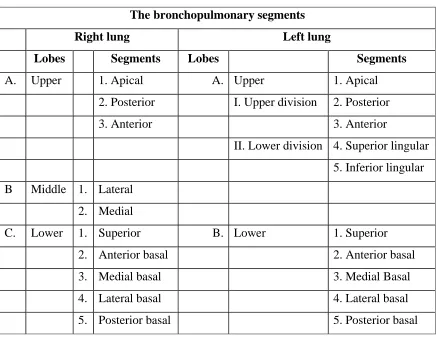
Each principal bronchus enters the lung through the hilum and divides into secondary lobar bronchi, one for each lobe of the lungs. Thus there are three lobar bronchi on right side and only two on the left side. Each lobar bronchus divides into tertiary or segmental bronchi, one for each broncho pulmonary segment, which are 10 on the right side and 10 on the left side. The segmental bronchi divide repeatedly to form very small bronches called terminal bronchioles. Still smaller branches are called respiratory bronchioles.
Each respiratory bronchiole aerates a small part of the lung known as pulmonary unit. The respiratory bronchiole ends in microscopic passages which are termed.
(1)Alveolar ducts (2)Atria
(3)Air Sacules
(4)Pulmonary alveoli
Gaseous exchanges take place in the alveoli.
Table No : 1
The bronchopulmonary segments
Right lung Left lung
Lobes Segments Lobes Segments
A. Upper 1. Apical A. Upper 1. Apical
2. Posterior I. Upper division 2. Posterior
3. Anterior 3. Anterior
II. Lower division 4. Superior lingular
5. Inferior lingular
B Middle 1. Lateral
2. Medial
C. Lower 1. Superior B. Lower 1. Superior
2. Anterior basal 2. Anterior basal
3. Medial basal 3. Medial Basal
4. Lateral basal 4. Lateral basal
5. Posterior basal 5. Posterior basal
Histology of Trachea and lung:
Trachea and extra pulmonary bronchi:
Have pseudo stratified ciliated columnar epithelium with
goblet cells. Lamina propria contains connective tissue and ducts of glands present in sub mucosa.
No muscularis mucosa is present.
Submucosa contains mucous and serous acini, outer most is
Intra pulmonary bronchus:
Epithelium is same as in trachea. The epithelium is thrown in to folds. Lamina propria is surrounded on all sides by thin sheet of smooth muscle fibres. Outside the muscle layer are small pieces of cartilage with glands in between these pieces outermost is the connective tissue.
Terminal bronchiole:
Is lined by columnar epithelium with no cilia or goblet cells. Smooth muscles surround it all around. No cartilage or glands are seen. Connective tissue is seen out side.
Respiratory bronchiole:
PHYSIOLOGY
MECHANISM OF RESPIRATION:
During normal quiet breathing, inspiration is the active process and expiration is the passive process. During inspiration, thoracic cage enlarges and lung expand. During expiration, the thoracic cage and lungs decrease in size and attain the preinspiratory position.
Movements of the thoracic cage:
Inspiration causes enlargements of thoracic cage. The size of the thoracic cage is increased in all diameters. Increase in anteroposterior and transverse diameters occurs due to the elevation of ribs. The vertical diameter of thoracic cage is increased by the descent of diaphragm.
In general, the change in the size of thoracic cavity occurs because of the movement of four units of structures.
(1)Thoracic lid
Movements of the lungs:
During inspiration, due to the enlargement of thoracic cage, the negative pressure is increased in the thoracic cavity. This causes expansion of the lungs.
During expiration, the thoracic cavity decreases in size to the preinspiratory position. The pressure in the thoracic cage also comes back to the preinspiratory level. This compresses the lung tissue. So that, the air is expelled out of lungs.
The lungs also have some tendency of recoiling still, the lungs do not collapse.
EXCHANGE OF RESPIRATORY GASES:
The exchange of gases between blood and alveoli occurs only in the respiratory unit. It includes respiratory bronchioles, alveolar ducts, atria, alveolar sacs and alveoli. The membrane through which the exchange occur is called the respiratory membrane.
DIFFUSION OF OXYGEN:
•
From atmosphere to the alveoli:gradient of 55 mm Hg, Oxygen easily enters the alveoli from atmospheric air.
• From alveoli in to the blood:
The partial pressure of Oxygen in the pulmonary capillary is 40 mm Hg and in the alveoli, it is 104 mm Hg. The pressure gradient is 64 mm Hg. This facilities the diffusion of Oxygen from alveoli in to blood.
In the venous blood, the volume of Oxygen is 14ml%. The content of Oxygen in arterial blood is 19ml%. Thus diffusion of Oxygen from alveoli to blood is 5ml /100 ml of blood.
DIFFUSION OF CARBON DIOXIDE:
• From blood in to alveoli
The partial pressure of carbon dioxide in alveoli is 40mm Hg where as in the blood, it is 45mm Hg. The pressure gradient of 5mm Hg is responsible for the diffusion of carbon dioxide from blood into the alveoli.
The carbon dioxide content in the venous blood in 52ml% and in arterial blood, it is 48ml%. So, the diffusion of carbon dioxide from blood to alveoli is 4ml/100ml of blood.
In the atmospheric air, the pressure gradient of carbon dioxide is very insignificant and is only about 0.3mm Hg whereas, in the alveoli, it is 40mm Hg. So carbon dioxide leaves alveoli easily.
LUNG DEFENSE MECHANISM:
The normal lung is free from bacteria. A number of potent defense mechanism clear or destroy any bacteria inhaled with air or fortuitously deposited in the airway passages as follows.
(1) Nasal clearance:
Particles, including aerosolized droplets carrying microorganisms deposited near the front of the airway on the non ciliated epithelium, are normally removed by sneezing and blowing, whereas those deposited posteriorly are swept over the mucus-lined ciliated epithelium to the nasopharynx, where they are swallowed.
(2)Tracheobronchial clearance:
PNEUMONIA
Synonym
Pneumonitis Definition
An acute inflammation of the lung parenchyma, distal to terminal bronchioles which consist of the respiratory bronchiole, alveolar ducts, alveolar sacs and alveoli.
Causes
I) Bacteria
Streptococcus Pneumoniae.
Staphylococcus Pyogenes.
Mycobacterium tuberculosis
II) Mycoplasma
Mycoplasma Pneumoniae
III)Viruses
Myxo Virus Æ Influenza
Para – Influenza
Respiratory syncytial virus
Etiological Classification
A) Bacterial Pneumonia 1) Lobar Pneumonia.
2) Lobular Pneumonia (Broncho Pneumonia). B) Viral and Mycoplasmal Pneumonia
(Primary Atypical Pneumonia) C) Other types of Pneumonias
1) Legionella Pneumonia
2) Aspiration Pneumonia (Inhalation Pneumonia) 3) Hypostatic Pneumonia
4) Lipid Pneumonia
Pathogenesis
The microorganisms gain entry in to the lungs by one of the following four routes
1) Inhalation of the microbes present in the air.
2) Aspiration of organisms from the nasopharynx or oropharynx.
3) Haematogenous spread from a distant focus to infection. 4) Direct Spread from an adjoing site of infection.
Nasopharyngeal filtering action,
Mucociliary action of the lower respiratory airways and,
Immunoglobulins.
Failure of these defense mechanisms and presence of certain predisposing factors result in pneumonias. These conditions are as under
1. Altered consciousness
The oropharyngeal contents may be aspirated in states unconsciousness.
E.g In coma, cranial trauma, seizures, cerebrovascular accidents, drug overdose, alcoholism etc.
2. Depressed cough and glottic reflexes
Depression of effective cough may fallow aspiration of gastric contents.
E.g. In old age, pain from trauma or thoraco abdominal surgery, neuromuscular disease, Weakness due to malnutrition, kyphoscolosis, severe obstructive pulmonary disease and tracheostomy.
3. Imparied Mucociliary transport
bronchioles is impaired or destroyed in many conditions favouring passage of bacteria in to the lung parenchyma.
E.g. Cigarette smoking, Viral respiratory infections, immotile cilia syndrome, inhalation of hot or corrosive gases and old age.
4. Impaired alveolar macrophage function
Pneumonias may occur when alveolar macrophage function is impaired.
E.g. Cigarette smoking, hypoxia, starvation, Anaemia, pulmonary oedema and viral respiratory infections.
5. Endobronchial obstruction
The effective clearance mechanism is interfered with in endobronchial obstruction.
E.g. Tumour, foreign body, cystic fibrosis and chronic bronchitis.
6. Leucocyte dysfunctions
Disorders of lymphocytes including congenital and acquired immuno deficiencies.
Pathology
Organism
Upper Respiratory Tract
Lower Respiratory Tract
Exudation of fluid in to the alveoli
Adjacent acini and segment
Stage of Congestion
Red Hepatization (or)
Early consolidation
Grey Hepatization (or)
Late consolidation
Resolution 1 – 3 weeks
Spread to Pericardium (Less)
1 -2 days
2 - 4 days
(The fluid is invaded by neutrophils and red cells)
(alveoli are filled with red cells and fibrin)
The pneumonic process may be confined to a segment or lobe or may be patchy. The distribution is not characteristic of any particular micro-organism. The initial acute inflammatory process may be associated with bacteraemia which is more common with pneumococal pneumonias than with others.
Pneumonia causes a restrictive defect of ventilation with a reduction in vital capacity and lung compliance. The work of breathing is diminished by a small tidal volume and rapid rate of breathing. This pattern of breathing is encouraged by pleuritic pain if it is present. Ventilation of the alveoli is also grossly impaired by inflammatory oedema. On the other hand, the blood flow is maintained. Physiological shunting ensues and is the cause of the reduction in arterial PO2. If this is considerable then the arterial
oxygen saturation is reduced with development of cyanosis. The arterial PCo2 usually remain normal unless the pneumonia
complicates a disorder associated with severe airways obstruction.
Clinical features
Symptoms
¾ Fever with rigor.
¾ Cough at first is usually dry and irritating and may cause
distress because it aggravates the pain.
¾ Sputum is scanty and tenacious (or) may appear rusty.
¾ Sleeplessness.
¾ Headache.
¾ Delirium. are manifestations of toxaemia.
¾ Confusion.
¾ Pleuritic chest pain – dyspnoea.
¾ Body pain.
¾ Vomiting.
¾ Anorexia.
Signs
¾ Temperature as high as 1020 – 1050 F (38.90 – 40.60 c)
¾ The skin tends to be hot and moist and may be pale due to
peripheral
vasoconstriction with systemic hypotension.
¾ Central cyanosis. (Due to hypoxaemia)
¾ Tachycardio and tachypnoea.
¾ Herpes simplex and jaundice may appear in younger people.
¾ Diminished chest movement on the affected side.
¾ Localised crepitaions appear on the affected side.
¾ An impaired percussion note.
¾ Bronchial breathing
Complications
1) Pulmonary
• Spread to other lobe.
• Lung abscess
• Delayed resolution.
2) Pleural
• Sterile pleural effusion
• Empyema
3) Cardiovascular
• Peripheral circulatory failure
• Acute pneumococcal endocarditis
• Acute pneumococcal pericarditis.
• Venous thrombosis in the lower limbs.
4) Neurological
• Pneunmococcal meningitis.
• Brain abscess.
• Meningism.
5) Others
• Otitis media.
• Mastoiditis.
Investigation
¾ Neutrophilic leucocytosis.
¾ Blood culture
¾ Sputum to be examined by microscopy and culture.
¾ Chest radiograph may reveal consolidation.
Differential diagnosis
¾ Pulmonary infarction
¾ Pulmonary tuberculosis
EVALUATION OF DISSERTATION TOPIC
MATERIALS AND METHODS
The clinical study on Pitha Kaasam has been taken in the post graduate department of Noi Naadal.
The clinical study was done in 30 cases, of them 21 cases were selected. In which I had selected 21 cases to evaluate typical picture by siddha parameters along with modern parameters.
The detailed history of the present and past illness and family history were observed.
EVALUATION OF CLINICAL PARAMETERS
The detailed history and clinical features of the patients
were taken carefully.
The clinical history.
Detail history of present and past illness.
Personal and family history.
Diet habits.
Exposure to cold weather.
Clinical features for Pitha Kaasam are
Presistent Cough
Sensation of sweet and salt taste in the tongue.
Vomiting
Headache
Burning sore throat
Haemoptysis
Dyspnoea
Anorexia with sour taste regurgitation
Horripillation
Fever and
State of Confusion
STUDY ON SIDDHA CLINICAL DIAGNOSIS
Siddha diagnosis was also made by the following methods. 1. Poriyal arithal
2. Pulanal arithal 3. Vinathal
4. Mukkutra nilaigal 5. Udal Kattugal
6. Envagai thervugal (Including Neerkuri, Neikuri) 7. Nilam
8. Kaalam
THE CLINICAL INVESTIGATION
For further detailed study about the disease the following laboratory investigation was done in all cases.
Haemoglobin
Erythrocyte Sedimentation Rate Blood sugar
Blood urea Urine
Albumin Sugar Deposit Motion
Ova Cyst Other test
OBSERVATION AND RESULTS
Results were observed with respect to the following aspects.
1. Age and Sex reference 2. Nilam
3. Seasonal variations 4. Socio-economic status 5. Mukkuttram
6. Udal Kattugal
7. Signs and Symptoms 8. Envagai thervugal
[image:76.612.192.437.483.637.2]9. Laboratory Investigation 10.Chest X-ray
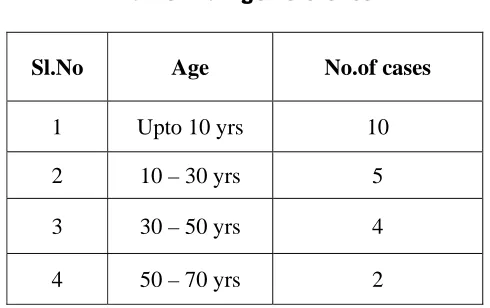
Table 2 : Age reference
Sl.No Age No.of cases
1 Upto 10 yrs 10
2 10 – 30 yrs 5
3 30 – 50 yrs 4
4 50 – 70 yrs 2
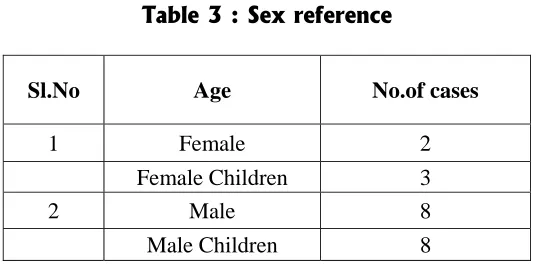
Table 3 : Sex reference
Sl.No Age No.of cases
1 Female 2
Female Children 3
2 Male 8
Male Children 8
[image:77.612.181.451.96.228.2]Out of 21 cases, males are more affected.
Table 4: Lung affected
Sl.No Lung Lobe No.of cases
1 Right Lung
Upper 7
Middle 1 Lower 5
2 Left Lung Lower Upper -
8
[image:77.612.182.448.454.546.2]Left lower lobe lung is more affected (38%). Table 5 : Nilam
Sl.No Nilam No.of cases
1 Kurunji 13
2 Marutham 8
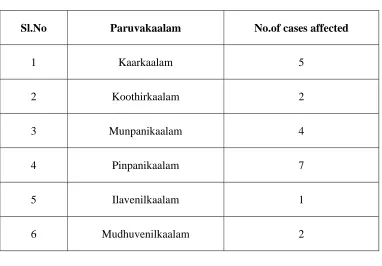
Table 6: Seasonal variation
Sl.No Paruvakaalam No.of cases affected
1 Kaarkaalam 5
2 Koothirkaalam 2
3 Munpanikaalam 4
4 Pinpanikaalam 7
5 Ilavenilkaalam 1
6 Mudhuvenilkaalam 2
Out of 21 cases, 7 cases were affected under pinpani kaalam (33%).
Table 7: Socio-economic status
Sl.No Class No. of cases
1 Middle 9
2 Poor 12
[image:78.612.124.504.446.560.2]Mukkutra Nilai
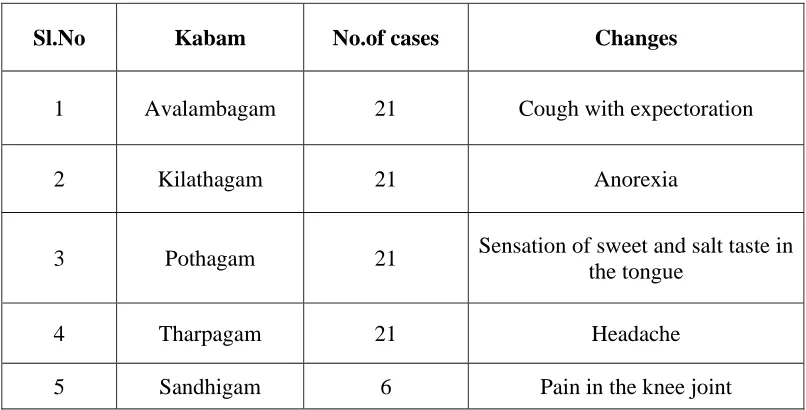
Table 8: Derangement of Iyam
Sl.No Kabam No.of cases Changes
1 Avalambagam 21 Cough with expectoration
2 Kilathagam 21 Anorexia
3 Pothagam 21 Sensation of sweet and salt taste in
the tongue
4 Tharpagam 21 Headache
5 Sandhigam 6 Pain in the knee joint
100% of cases are affected in increased Iyam.
Table 9:Derangement of Azhal
Sl.No Pitham No.of cases Changes
1 Anilam 21 Anorexia
2 Ranjagam 10 Pallor in conjunctiva and tongue
3 Saadhagam 21 Difficulty in doing routine work
4 Aalosagam 5 Diminished vision
[image:79.612.103.512.407.566.2]Table 10: Derangement of Vali
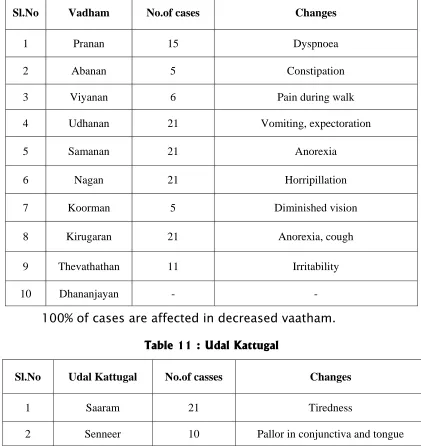
[image:80.612.104.529.444.678.2]100% of cases are affected in decreased vaatham. Table 11 : Udal Kattugal
Sl.No Udal Kattugal No.of casses Changes
1 Saaram 21 Tiredness
2 Senneer 10 Pallor in conjunctiva and tongue
3 Oon 6 Pain in the knee joints
4 Kozhuppu 6 Restricted movements
5 Enbu 6 Excess falling of hair in the scalp
6 Moolai 5 Dimnished vision
Sl.No Vadham No.of cases Changes
1 Pranan 15 Dyspnoea
2 Abanan 5 Constipation
3 Viyanan 6 Pain during walk
4 Udhanan 21 Vomiting, expectoration
5 Samanan 21 Anorexia
6 Nagan 21 Horripillation
7 Koorman 5 Diminished vision
8 Kirugaran 21 Anorexia, cough
9 Thevathathan 11 Irritability
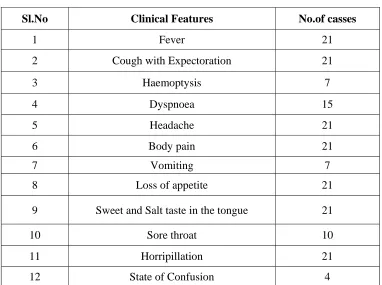
Table 12: Clinical Features
Sl.No Clinical Features No.of casses
1 Fever 21
2 Cough with Expectoration 21
3 Haemoptysis 7
4 Dyspnoea 15
5 Headache 21
6 Body pain 21
7 Vomiting 7
8 Loss of appetite 21
9 Sweet and Salt taste in the tongue 21
10 Sore throat 10
11 Horripillation 21
[image:81.612.122.506.85.687.2]12 State of Confusion 4
Table13 : Envagai thervu
Sl.No Envagai thervu No.of casses affected
1 Naa 10
2 Niram -
3 Mozhi 10
4 Vizhi 5
5 Sparisam 21
6 Malam 5
7 Naadi
Kaba pitham 21
8 Neerkuri
Enjal 20
Neikuri
Table 14: Envagai Thervugal
A – Affected RP – Rapid pulsation
NA – Not affected KP – Kabapitham
Case
No Naa Niram Mozhi Vizhi Sparisam Malam Moothiram Neikuri Naadi
Niram Manam Nurai Edai Enjal
1 A NA NA NA A NA NA NA NA NA A Pearl KP, RP
2 A NA A NA A A NA NA NA NA A Pearl KP, RP
3 NA NA NA NA A NA NA NA NA NA NA Pearl KP, RP
4 NA NA A A A NA NA NA NA NA A Pearl KP, RP
5 NA NA NA NA A NA NA NA NA NA A Pearl KP, RP
6 NA NA NA NA A NA NA NA NA NA A Pearl KP, RP
7 NA NA NA NA A NA NA NA NA NA A Pearl KP, RP
8 A NA A NA A NA NA NA NA NA A Pearl KP, RP
9 A NA NA NA A NA NA NA NA NA A Pearl KP, RP
10 A NA A A A A NA NA NA NA A Pearl KP, RP
11 NA NA NA NA A NA NA NA NA NA A Pearl KP, RP
12 NA NA A NA A NA NA NA NA NA A Pearl KP, RP
13 A NA A A A A NA NA NA NA A Pearl KP, RP
14 A NA A NA A A NA NA NA NA A Pearl KP, RP
15 A NA A NA A NA NA NA NA NA A Pearl KP, RP
16 NA NA NA NA A NA NA NA NA NA A Pearl KP, RP
17 NA NA A A A A NA NA NA NA A Pearl KP, RP
18 NA NA NA NA A NA NA NA NA NA A Pearl KP, RP
19 A NA A A A NA NA NA NA NA A Pearl KP, RP
20 NA NA NA NA A NA NA NA NA NA A Pearl KP, RP
Table 15: Laboratory investigation Case No TC Cells/ Cu.mm DC % ESR mm Hb g % B. Sugar mg% B.Urea
mg% Urine
Motion Mantoux
Test Sputum for AFB Chest X-ray
P L E ½
hr 1
hr Alb Sug Dep Ova Cyst
1 26800 80 20 - 30 75 6.6 - - Nil Nil 5-7 puscells Nil Nil - ve - RULP
2 15200 72 25 3 15 40 8 93(R) 23 Nil Nil 2-3 puscells Nil Nil - ve - ve LLLP
3 21000 77 23 - 80 120 12.7 - - Nil Nil NAD Nil Nil - - RLLC
4 23700 77 23 - 40 95 12.3 120(PP) 22 Nil Nil 2-3 puscells Nil Nil - ve - ve RLLC
5 13600 73 24 3 25 65 12.2 - - Nil Nil 0-2 puscells Nil Nil - ve - LLLC
6 14300 60 39 1 50 105 12.9 - - Nil Nil 1-3 puscells Nil Nil - - RLLC
7 19400 77 23 - 80 120 13.3 - - Nil Nil 3-10 puscells Nil Nil - ve - RULC
8 16400 71 24 5 10 30 11.8 - - Nil Nil 0-3 puscells Nil Nil - ve - ve RMLC
9 20500 85 15 - 110 135 5.7 - - Nil Nil 5-15 puscells Nil Nil - ve - RLLC
10 18800 74 23 3 5 20 7.6 100(R) 32 Nil Nil 1-3 puscells Nil Nil - ve - ve RULC
11 14000 61 39 - 80 120 12.3 - - Nil Nil 2-5 puscells Nil Nil - ve - RULC
12 23400 95 5 - 20 80 13.9 85(R) 20 Nil Nil 1-3 puscells Nil Nil - ve - RULP
13 20400 81 19 - 15 30 8.9 98(R) 30 Nil Nil Occasionally
seen Nil Nil - ve - ve RULP
14 18300 86 14 - 25 85 11.7 86(R) 23 Nil Nil 2-4 puscells Nil Nil - ve - RLLP
15 25800 68 30 2 25 50 9.6 90(R) 32 Nil Nil 0-2 puscells Nil Nil - ve - LLLC
16 26600 72 26 2 50 115 13 - - Nil Nil Occasionally
seen Nil Nil - ve - LLLC
17 16100 60 35 5 20 55 12 85(R) 35 Nil Nil 2-3 puscells Nil Nil - ve - ve LLLP
18 21000 69 30 1 50 110 12.6 - - Nil Nil Occasionally
seen Nil Nil - - RULP
19 24800 92 8 - 30 60 7.3 97(R) 32 Nil Nil 1-5 puscells Nil Nil - ve - ve LLLC
20 19700 67 31 2 40 80 13.2 - - Nil Nil Occasionally
seen Nil Nil - ve - LLLC
21 27300 88 12 - 7 15 8.2 - - Nil Nil 0-3 puscells Nil Nil - ve - LLLP
RLL – Right lower Lobe RML – Right middle lobe P – Pneumonitis
DIFFERENTIAL DIAGNOSIS
ke;jhufhrk;
“jhdhd J}aNjhh; ehrp jd;dpy;
ryNeha; ePh; jhd;tpOe;J Jk;k Yz;lhk; khdhd khh;GneQ; rilj;J %r;R
tYthfg; ghk;GNghy; rPw yhFk; fhdhd fz;lnkhL KfKq; fhJk;
fhakJq; frpthfp tpaHit ahFk; Vdhd ,UknyhL Nfhio fk;ky;
,iug;ghF ke;jhuf; fhr khNk”
- Yugi Vaithiya Chintamani In manthara kaasam, even though rhinitis, sneezing, discomfort in the chest, added sounds, body pain, cough with expectoration, associated with sweating are present, but the special symptoms of pitha kaasam such as fever and haemoptysis are not present.
Rthrfhrk;
“tz;ikaha;f; Nfhiofl;b ,Ukp tP*k;
khehfk; NghyNt thq;FQ; Rthrk; jpz;ikaha;r; nrUkYz;lh kbf;f bf;Fr;
rpuzkpy;yh kNy tapW CJk; ez;ikaha; ehrpaJ jzy;Ngh yhFk;