MGA TRAJECTORY PLANNING WITH AN ACO-INSPIRED ALGORITHM
Matteo Ceriotti
Advanced Space Concepts Laboratory
Department of Mechanical Engineering, University of Strathclyde 75 Montrose Street, James Weir Building
Glasgow G1 1XJ, United Kingdom Phone: +44 (0)141 548 5726
(Corresponding author)
Massimiliano Vasile
Space Advanced Research Team
Department of Aerospace Engineering, University of Glasgow James Watt South Building
Glasgow G12 8QQ, United Kingdom Phone: +44 (0)141 330 6465
ABSTRACT
1
INTRODUCTION
The complete automatic design of multiple gravity assist trajectories (MGA), that is the definition of an optimal sequence of planetary encounters and the definition of one or more locally optimal trajectories for each sequence, has been approached with several different techniques. All of them can be classified in two main categories: two level approaches and integrated approaches.
Two-level approaches split the problem into two sub-problems which lay at two different levels: one sub-problem is to find the optimal sequence of planetary encounters; the other is to find an optimal trajectory for that sequence. Two-level approaches define the planetary sequence independently of the trajectory itself. Once the sequence (or a set of promising sequences) has been selected, then the optimal trajectory can be searched for within the set of selected sequences only [1]. Simplified, low fidelity, models for representing the trajectory [2] are used at the first level: this allows for a quick
assessment of many sequences, if not all. At the second level, a full model is used to optimize the trajectory. Each sequence is represented by a string of integer numbers, while the associated trajectory is represented with a string of real and integer numbers defining the time and the characteristics of the events occurring along the trajectory (e.g. launch, deep space manoeuvre, arrival at a celestial body, number of revolutions around the Sun, etc.). Therefore, for each sequence, there is an infinite variety of possible trajectories.
The issue with two-level approaches is that it is difficult to assess the optimality of a given planetary sequence without an exhaustive search for all possible trajectories associated with that sequence. Unfortunately, finding an optimal trajectory is a very difficult global optimisation problem in itself. This, combined with the fact that usually there exist a very high number of sequences for a given transfer problem, requires a considerable computational effort. The computational cost can be reduced by discarding non-promising sequences. However, if the low-fidelity model is not accurate enough, either some good sequences are discarded, or many of the retained ones can result to be actually not interesting.
As opposed to the two-level approaches, integrated approaches define a mixed integer-continuous optimization problem, which tackles both the search of the sequence and the optimization of the trajectory by using a single model, at the same time [3]. This kind of problem is known in literature as a hybrid optimization problem [4]. The main difficulty with integrated approaches is that a variation of even a single celestial body in the sequence corresponds to a substantially different set of trajectories. In addition, a variation of the length of the sequence implies varying the number of legs of the trajectory, and thus the total length of the solution vector.
The automatic design of a trajectory with discrete events was recently formulated as a hybrid optimal control problem [5], and a solution was proposed by Conway et al. [6] with a two level approach based on genetic algorithms.
Here we propose to formulate the complete automated design of a multiple gravity assist trajectory as an autonomous planning and scheduling problem. The resulting scheduled plan will provide the planetary sequence for a multiple gravity assist trajectory and a good estimation of the optimality of the associated trajectories.
problem associated to the design of MGA trajectories. The basic ACO paradigm is hybridized with a taboo strategy based on an external archive on infeasible solutions. In the literature, some ACO-derived meta-heuristics exist for the specific solution of different scheduling problems. In particular, Merkle et al. [9] proposed to apply ACO to the solution of the Resource-Constrained Project Scheduling Problem, while Blum, in his work [10], suggested the hybridization of Ant Colony Optimization with a probabilistic version of Beam Search for the solution of the Open Shop Scheduling problem. In this paper, at first we will present the trajectory model and the integrated scheduling of the events, then the novel ACO-based algorithm and how the plan is constructed. Finally, two case studies will demonstrate the effectiveness of the proposed approach at solving known space trajectory design problems.
2
TRAJECTORY MODEL
The trajectory model is based on a two-dimensional linked-conic approximation of the trajectory and of the orbits of the planets. The trajectory is composed of a sequence of planar conic arcs linked together through discrete, instantaneous events. In particular, the sequence is continuous in position and piecewise continuous in velocity, i.e. each event introduces a discontinuity in the velocity of the spacecraft but not in its position. The discrete events can be: launch, deep space manoeuvre (DSM), swing-by, and brake.
A final assumption of the present implementation is that all the orbits of both spacecraft and celestial bodies are direct, thus no retrograde orbits are allowed.
In summary, the proposed trajectory model is composed of: a launch from the departure celestial body; a series of deep space flight legs connected through gravity assist manoeuvres (modelled through a linked-conic approximation); an arrival at a target celestial body. Each one of these basic components will be explained in the following sections.
2.1 Launch
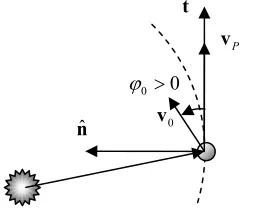
The launch event is modelled as an instantaneous change of the velocity of the spacecraft with respect to the departure planet. The velocity change is given in terms of modulus v0 (which depends on the capabilities of the launcher) and in-plane direction, specified through the angle 0, measured counter clockwise with respect to the planet’s orbital velocity vector vP at time of launch t0.
0
[image:3.612.64.194.581.685.2]t and 0 are free parameters of the model, while launch velocity modulus v0 will be used to target the next planetary encounter and solve the phasing problem, as explained later.
Fig. 1: Geometry of the launch, and convention for launch angle. P
v
0
v
0 0
ˆ
t
ˆ
2.2 Swing-by
Gravity assist manoeuvres, or swing-bys, are modelled as instantaneous changes of the velocity vector of the spacecraft due solely to the gravity field of the planet.
Given the relative velocity vector
v before the swing-by, the physical properties of unperturbed hyperbolic orbital motion prescribe that v v v
, which means that the modulus of the outgoing velocity v at infinity is known. Its direction
can be computed considering the anomaly of the outgoing asymptote (see Fig. 2):
2
arccos P p P p
r
v r
. (1)
Here, P is the gravity constant of the planet, and rp is the radius of the pericentre of the hyperbola. The value of rp can be used to control the magnitude of the deflection angle
2
of the incoming velocity and is limited to be above the radius of the planet, RP, to avoid a collision, or to be above the atmosphere to avoid a re-entry. The direction of deflection is determined using a signed radius of pericentre rps, such that rp rps and sgn
rps
2
.Once is computed, the relative outgoing velocity is calculated by rotating
[image:4.612.61.213.387.594.2]v in the plane of an angle . As for the launch velocity magnitude, the radius of pericentre rps is tuned to meet the terminal conditions of the transfer leg following the swing-by.
Fig. 2: Geometry of the swing-by.
2.3 Deep space flight leg
Each deep space flight leg starts at a departure planet Pi and ends at an arrival planet Pi1, and is made of two conic arcs linked at a point Mi. If the leg contains a deep space manoeuvre, this is applied in this point, and it produces an
instantaneous change in the heliocentric velocity vector of the spacecraft, due to an ignition of the engines. In this model, we assume that the DSM is performed either at the apocentre or pericentre of the conic arc preceding the manoeuvre. In
v
v
For clarity, in the remainder of this section, we neglect the subscript index i of the leg in all the variables. 2.3.1 First arc
Let us assume that the spacecraft is at a given planet P1 at time t1. Its position coincides with that of the planet, which is
known from the 2D ephemeris. The heliocentric velocity of the spacecraft, instead, depends on the preceding launch or swing-by event.
If the transfer leg contains a DSM, the first step is to find the position M and time tDSM of the deep space manoeuvre. The position can either be the pericentre or the apocentre, according to a binary parameter fp a/ . The true anomaly of the DSM is
given by
/
0 0
1
DSM p a
DSM
f
.
The time of the DSM tDSM is found by using the Kepler’s time law [11]. The parameter nrev,1 is used to count the number of full revolutions before the deep space manoeuvre.
At M, the DSM is applied tangentially, being the free parameter mDSM the magnitude and direction of the DSM: if mDSM is positive, the thrust is along the velocity of the spacecraft, otherwise it is against the velocity of the spacecraft. The complete state of the spacecraft at the beginning of the second arc is thus fully determined.
Note that the use of a tangential DSM at apsidal points is one of the simplifying assumptions of the trajectory model, which allows reducing the number of free parameters. This type of DSM is particularly effective for perigee/apogee
raising/decreasing, or period change.
If the leg does not contain any DSM, i.e. mDSM 0, the first arc is propagated up to a fictitious point M, defined by adding an angle to the initial true anomaly of the spacecraft. The reason for using this forced propagation is twofold: first, we
want to force the spacecraft to move away from the planet, before computing the second leg. This is done to prevent that, if no full revolutions are considered, the first intersection could happen after a null time. Second, it prevents any event (swing-by or DSM) to happen immediately after the swing-(swing-by, which would be unfeasible due to spacecraft operation constraints. Therefore, the quantity has to be larger than the machine numerical precision but small enough to allow for the
modelling of short transfer legs. It is important to underline the value of is not a design parameter of the model and does
not affect the efficiency of the optimization process. For this work, a value of 0.3 rad (about 17 deg) was chosen. For this work, 0.3 rad was chosen. The time tM at M is found by solving again the Kepler’s time law. In this case, parameters fp a/ and nrev,1 are not used.
2.3.2 Second arc
The second arc starts at point M and is propagated until the intersection of the orbit of planet P2. Given the orbital
parameters of the spacecraft at M, and the orbital parameters of planet P2, the task is to find the intersection between the
two coplanar orbits. If there are no intersections, the leg is unfeasible, and the initial conditions of the leg, or its parameters, have to be changed. Otherwise, one of the two possible intersections is selected according to the binary parameter f1/ 2: let
integer parameter nrev,2 counting the number of full revolutions between the point M and the orbital intersection. Figure 3
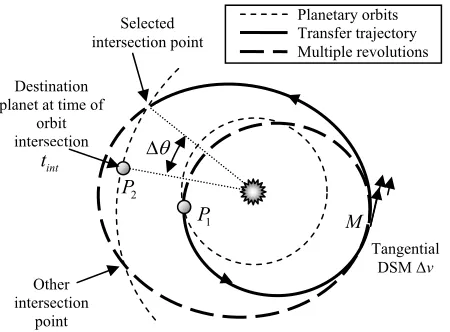
[image:6.612.64.289.128.294.2]illustrates a complete leg, including a DSM. The figure highlights that the orbital intersection does not imply, in general, that the planet is at the intersection point at the correct time. This issue will be addressed in the following paragraph.
Fig. 3: Representation of a complete leg, starting from P1 with either a swing-by or launch, with a DSM and possibly multiple revolutions. The phasing problem at P2 is not solved, as P2 at the time of intersection is not at the intersection point.
2.4 Solution of the Phasing Problem
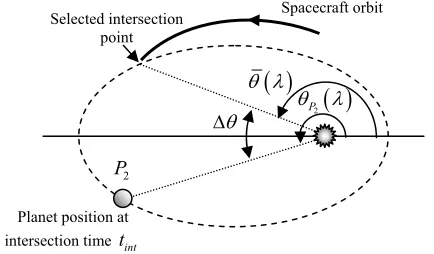
In order to perform a gravity assist manoeuvre or a planetary capture, the terminal position of the spacecraft has to match that of the planet. However, at intersection time tint, planet P2 is at true anomaly P2, which is generally different from .
The time of intersection is a function of the states at the beginning of the leg, which ultimately depend on v0 or rps depending on the starting event. Therefore, if we introduce the symbol , such that rps if swing-by, or v0 if
launch.
The true anomalies of the intersection point and of the planet can be expressed as
and
2
P
. Matching the position of the planet with that of the intersection point at time tint (also known as the phasing problem), then, translates into finding a value = * that satisfies the equation (see Fig. 4):
2
* * * 0
P
(2)
Selected intersection point
Destination planet at time of
orbit intersection
Other intersection
point
Tangential DSM Δv
1 P 2
P
M Planetary orbits Transfer trajectory Multiple revolutions
int
Fig. 4: The phasing problem consists of finding λ such that the target planet P2 is at the orbital intersection point at the correct time. This is done by finding the zero of the difference in true anomalies Δθ.
Fig. 5 (a) and (b) represent the function
for different transfer cases. The non-resonant case depicted in Fig. 5 (a) shows that the function
is continuous, smooth and monotonic over the range of interest of . Hence, the phasing problem has only one solution. This solution can be found with a simple Newton-Raphson method in one dimension. However, when a resonant transfer is considered, as in Fig. 5 (b),
is discontinuous and multiple zeros exist. Each zero corresponds to a different resonance with the planet (and of course a different transfer time). Since there is no easy way, at a given transfer, to prefer one value of over another, all the solutions need to be retained for the evaluation of thefollowing transfers.
In ACO-MGA, the search for the zeros of the function
is performed with the Brent method. A set of starting points, defining multiple intervals for the bisection method, needs to be provided to initialize the Brent method and are specified case by case.Note that in the examples in Fig. 5, the parameter is the launch excess velocity v0. It is possible to show that the same behaviour of
holds for a leg starting with a swing-by (i.e. rps).Planet position at intersection time tint
Selected intersection point
Spacecraft orbit
2
P
a)
0 1 2 3 4 5 6 7
0 0.5 1 1.5
v
0, km/s
, r
ad
b)
2 3 4 5 6 7 8
-4 -3 -2 -1 0 1 2 3 4
v
0, km/s
, r
[image:8.612.59.306.63.438.2]ad
Fig. 5: Δθ(v0) for: (a) Earth to Venus leg following launch from Earth. (b) Earth to Earth leg following launch from Earth.
2.5 Complete trajectory
A complete trajectory is made of a sequence of transfer legs connecting nP1 celestial bodies P P0, ,1PnP. The
trajectory starts from P0 at time t0 with a launch event characterized by a departure angle 0. The first leg goes from P0 to
1
P, then a number of swing-bys and interplanetary legs follow, until the final planet PnP. Thus, a complete trajectory with
1
P
n planets has nP legs, and nP1 swing-bys.
The solution of Eq. (2) provides a complete scheduling of the trajectory given the initial time t0 and the five parameters
,1 ,2 / 1/ 2
, , , ,
DSM rev rev p a i
m n n f f
for every leg i0,...,nP1.
Since these five parameters fully characterize all possible legs from a planet Pi to a planet Pi1, they are said to define a
Hence, assigning a value to t0, 0, Pi, PnP, mDSM,nrev,1,nrev,2,fp a/ ,f1/ 2i for i0,...,nP1 creates a plan, or solution, which is a tree structure in which every branch, from root to leaves, is a trajectory. Each trajectory is characterised by a different combination of *
0 v and *
p
r for each leg.
The entire tree is a complete set of trajectories from P0 to PnP and represents a solution of the MGA trajectory planning problem. Thus, a plan is fully defined by assigning a value to the parameters in Table 1 for all legs i0,...,nP1. Algorithm 1 keeps track of all the trajectories in the tree, and yields a list L containing all the possible conditions of arrival at the last reachable planet. If no trajectory in the set associated to leg i satisfies the phasing problem, then planet i1
cannot be reached and the algorithm terminates. A partial or incomplete solution is the set of parameters sufficient to describe a solution up to leg i. Furthermore, if no solution to the phasing problem exists at leg i, the plan is broken and the solution is said to be infeasible at leg i. Furthermore, an upper bound on the time of flight of the entire trajectory, or of some legs, is introduced. Trajectories that exceed the total or partial time of flight constraint are discarded from the list. The information of infeasibility at a given transfer will be used to fill in a taboo list of broken or incomplete solutions. For each of the trajectories found, the model computes: the sum of all the deep space manoeuvres, or total v and the launch excess velocity, v0; the relative velocity at the last planet, v; the total time of flight of the trajectory, T. The
objective value fobj of the trajectory depends on the problem and it is usually a function of these values. The whole model was implemented in ANSI C and compiled as a MEX-file for interfacing with MATLAB.
Table 1: Description of the free design variables defining a solution according to the proposed 2D model. Description Variables
Planetary sequence P P0, ,1 PnP
Departure time t0
Departure angle 0
Types of transfer
Algorithm 1: Generation of a list L containing the arrival conditions for all the feasible trajectories of the transfer problem.
1: On the first leg, find all possible *
*0 0 0
v v
2: For each * 0
v find the final conditions of the leg at planet P1
3: Add all the possible final conditions to list L 4: End For
5: For each leg i0,...,nP1
6: Ltemp
7: For each element in list L
8: Find all possible rps
rps 09: For each rps
10: Find the final conditions at planet Pi1 and add to list Ltemp 11: End For
12: End For
13: If Ltemp , Then All trajectories infeasible at leg i, Terminate 14: LLtemp
15: End For
3
THE ACO-MGA ALGORITHM
The model described in the previous section yields a set of scheduled trajectories provided that a complete or partial plan is available. In this section, we present an optimization procedure, based on the ant colony optimization paradigm, to explore the space of possible plans.
At first, the continuous space of the real parameters t0, 0 and mDSM i is reduced to a finite set of states. Then, the optimization algorithm, called ACO-MGA in the following, operates a search in the finite space of possible values for the design parameters. A complete description of the algorithm ACO-MGA follows.
3.1 Solution coding
In ACO-MGA, a solution is coded through a string of discrete values assigned to the parameters. However, the set of parameters discussed before is inhomogeneous, as it is made of real, integer and binary variables. In particular, t0, 0 and
DSM i
m are real continuous variables and need to be properly discretised. In the present implementation of ACO-MGA, the values of the departure date t0 and the departure angle 0, are assumed to be pre-assigned and therefore the two parameters are removed from the list of the variables. The rationale behind this choice is that, although the launch date has a great impact on the resulting trajectory, if an algorithm exists that is able to efficiently generate a complete plan for a given launch date, a systematic search can be performed along the launch window, with a given time step (as will be shown in one of the test cases). The angle 0, on the other hand, is often dictated by the launch capabilities and the first planetary encounter [1]. mDSM is a design parameter in the optimisation: the discretisation is chosen a priori and it can be, for
Using the additional assumptions on t0, 0, and fixing P0, each solution can be coded using a vector s of positive integers.
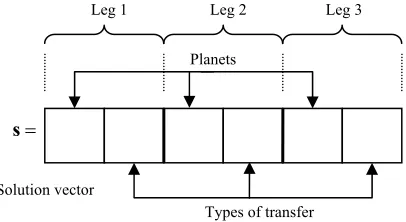
The vector has 2nlegs components. Each pair of consecutive components encodes all the parameters necessary to
characterise one leg of the solution (Fig. 6). The first element of the pair is encoding the identification number of the target planet for the corresponding leg according to the following procedure: an ordered list qP i, containing all the planets available as a target for each leg i is predefined (and fixed); then, let ks2 i 1 1, the target planet is the kth entry in the list
,
P i
q , i.e. qP i k,( , ).
The second element of the pair is the row index of a matrix Gi containing all possible combinations of indexes identifying the elements of the five sets: q q1,i, 2,i,q3,i,q4,i,q5,i. These sets contain the possible values for each one of the five
parameters identifying the type of transfer at leg i. Thus, each row of Gi is a vector representing a different type of transfer. The matrix Gi has q1,i q2,i q3,i q4,i q5,i rows and 5 columns ( is the cardinality of a set). The parameters for the
jth type of transfer for the ith leg can be obtained as follows:
1 2 3 4 5 1, ,
,1 2, ,
,2 3, ,
/ 4, ,
1/ 2 5, ,
DSMi i k rev i i k rev i i k
p ai i k i k i m q n q n q f q f q
where kl Gi j l, , ,l1,...,5. If q4,i q5,i
0,1 , then the matrix Gi is:1, 2, 3,
1 1 1 1 1
1 1 1 1 2
1 1 1 2 1
1 1 1 2 2
1 1 2 2 1
1 1 2 2 2
2 2 i
i i i
G
q q q
[image:11.612.64.267.563.674.2]
Fig. 6: Solution vector s for coding a three-leg solution.
Leg 1 Leg 2
Types of transfer Planets
Leg 3
3.2 The taboo and feasible lists
A transfer from planet Pi to planet Pi1 can be feasible or unfeasible, for the same set of parameters, depending on all the
preceding legs from 0 to
i1
. For this reason, when an infeasible leg is generated, it is necessary to store the path that led to that infeasible leg. Thus, all the parameters characterising the partial solution up to Pi1 are stored in a taboo list.In particular, if the problem involves nP legs, then the same number of taboo lists are used. The taboo list Ltaboo i, of leg i
contains all the partial solutions which are unfeasible at leg i (but feasible for legs 1i1). Each taboo list consists of a matrix, which has an arbitrary number of rows and 2i columns.
Dual to the list of taboo partial solutions, the feasible list Lfeas stores all the solutions, which are completely feasible, i.e. reach PnP. This is once more a matrix with an arbitrary number of rows and 2nP columns.
Since each solution contained in the feasible list is complete, then it is possible to associate an objective value (or cost) to each one of them. In the following test cases, we will use, as objective value, the v and a combination of v and T. Note
that, since, in general, there is more than one trajectory for a given solution (i.e. for a given set of free design variables), the objective value of a solution is given by the best trajectory value.
3.3 Search engine
The search space is organised as an acyclic oriented tree. Each branch of the tree represents a leg of the problem, while each node (or leave) represents a different destination planet and type of transfer. A population of virtual ants are dispatched to explore the tree, searching for an optimal solution.
The search runs for a given number of iterations niter max, , or until a maximum number of objective function evaluations
,
eval max
n has been reached. An evaluation is a call to the model, in order to compute the objective value associated to a given solution.
Algorithm 2: Main ACO-MGA search engine. 1 : While niter niter max, neval neval max, , Do
2 : For each ant k1m
3 : sGenerate planetary sequence 4 : sGenerate types of transfers 5 : If s is not discarded, S S
s 6 : End For7 : Evaluate all solutions in S 8 : Update Lfeas and Ltaboo i,
9 : Update ,niter neval 10 : End Do
11 : Sort Lfeas according to fobj.
3.4 Solution generation
The tree is simultaneously explored, from root to leaves, by m ants. At each iteration, each one of the m ants explores the tree independently of the others, but taking into account the information collected by all the ants, at previous iterations, and stored in the feasible and taboo lists. As an ant moves along a branch, it progressively composes a complete solution. At first, each ant assigns a value to the odd entries of the solution vector, i.e. composes the sequence of planetary encounters, then it assigns a value to the even entries of the solution vector, i.e. the parameters defining the type of transfer for each legs.
3.4.1 Planetary sequence generation
The process is described in pseudo-code in Algorithm 3. Each ant composes a solution adding one planet at the time. As the departure planet is given, the ant has only to choose the destination planet for each leg. The choice is made probabilistically by picking from the list qP i, . The selection depends on the discrete pheromone distribution vector τP i, (one for every leg)
which contains the pheromone level associated to each body in qP i, . Note that we use the same notion of pheromone as in
standard ACO [7], however there are some differences. Here, the pheromone level of each possible choice at each leg depends on the previous legs, and therefore it is computed at every step. Furthermore, due to the different pheromone update rule, here the amount of pheromone is not upper limited to 1. Every time an ant is at leg i, the pheromone
distribution vector is reset to τP i,
1 1 1
T. As it will be explained, this is equivalent to state that all the planets have equal probability to be chosen. The ant sweeps the entire list qP i, substituting the identification number of each element in,
P i
q into the ith odd component of the partial solution vector s. Then, the feasible list is searched, for all the solutions which have a (partial) planetary sequence which matches the one in s. Say that the jth element of
,
P i
q is added to s, and the resulting partial sequence in s matches the partial sequence of the lth solution in the feasible lists, then the pheromone level
, ,
P i j
associated to the jth element of
,
P i
q is increased as follows:
, , , ,
,
1 planet P i j P i j
obj l w f
The amount of pheromone which is deposited depends on the objective value fobj l, of the matching solution in the feasible
list, and on the weight wplanet. Once the pheromone update has been done for all the possible choices, the probability of selecting one of them is given by P i j, , P i j, , P i j, ,
j
p
, and a random selection is performed according to thisprobability distribution. Thus, the probability of choosing the jth planet increases according to how many times it generates a promising sequence (leading to a feasible solution), to the value of the feasible solution itself, and to the parameter wplanet. This mechanism is analogous to the pheromone deposition of standard ACO and aims at driving the search of the ants toward planetary sequences, which previously led to good solutions. In fact, those planets which generate (partial)
sequences that appear either frequently in the feasible list, or rarely, but with low objective function are selected with higher probability. On the other hand, the probability of selecting other planets remains positive, such that one or more ants can probabilistically choose a planet that generates an undiscovered sequence. Note that, if the feasible list is empty, then all the planets have the same probability to be selected.
The parameter wplanet controls the learning rate of the ants. A low value of wplanet will make the term wplanet fobj l, small, and thus the probability distribution will not change much, even if the solution appears repeatedly in the feasible list, or with low values of fobj. Thus, a relatively low value of wplanet will favour a global exploration of the search space, while a high value of wplanet will greatly increase the probability of choosing a planet which led to a feasible sequence. If the value of
planet
w is high enough with respect to a reference objective value, then the ant will preferably choose a feasible sequence, rather than trying a new one, which has not proven to be feasible. For these reasons, we can say that low values of wplanet will favour local exploration of planetary sequences.
The procedure iterates for all the legs of the problem, and for all the ants. At the end, all the odd entries of the temporary solution s contain a target planet and the planetary sequence is complete. The next step is to find the type of transfers for each leg, thus filling the even entries of s and complete the solution.
Algorithm 3: Generation of the planetary sequence of the temporary solution probabilistically. 1: For each leg i1, , nP
2: τP i,
1 1 1
3: For each target body j available at leg i
4: stemp
1 2
i1
j5: For each solution l in Lfeas that matches stemp 6: , , , ,
,
1 planet P i j P i j
obj l w f
7: End For 8: End For
9: stemp
1 2
i1
RandomSelection
τP i,10: End For
3.4.2 Type of transfer generation
one at the time, to the solution s. A vector s for which a value is assigned to both the odd and even components up to leg i
represents a partial solution. Similarly to before, a vector τt i, contains the pheromone associated to the rows of the matrix i
G (i.e. to each type of transfer).
For each new partial solution, the taboo list is first checked. If the partial solution appears in the taboo list, then it means that this solution will be infeasible, regardless of the way it is completed. The pheromone of the type of transfer associated to that sequence is set to zero, to avoid future selection of that type of transfer. If the partial solution does not appear in the taboo list, the feasible list is searched for any matching partial solution. For every match found, the pheromone of that type of transfer is modified as follows:
, , , ,
,
1 type t i j t i j
obj l w f
(4)
where the weight wtype is introduced with analogous meaning to wplanet. In fact, the higher the coefficient, the higher the chances that solutions similar to the feasible ones are generated. Conversely, a low value of wtype will favour the selection of sequences with a different type of transfer, thus increasing the random exploration of the whole solution space. The selection of the type of transfer happens probabilistically, in the same way as for the planet before.
If, at a given leg i, all possible transfer types correspond to partial solutions in the taboo list, the vector of pheromone distribution τt i, will be full of zeros. As a consequence, the solution s (which can be partial or complete) is discarded, and
the ant can stop its exploration of that branch of the tree. At the end of the solution generation step, the solution s is either discarded or completed. Once all the ants have completed their exploration, the result is a number of solutions (less than or equal to the number of ants m) to be evaluated.
Algorithm 4: Generation of the types of transfer of the temporary solution probabilistically. 1: For each leg i0, , nP1
2: τt i,
1 1 1
3: For each type of transfer j available for leg i
4: stemp
2 2
i1
j5: If stempLtaboo i, taboo list of leg i Then 6: t i,
j 07: Else
8: For each solution l in Lfeas that matches with stemp
9: ,
,
,
1
t i t i type
obj l
j j w
f
10: End For 11: End If 12: End For 13: If t i,
0j
j
τ Then14: Discard this solution, Terminate 15: Else
16: stemp
2 2
i1
RandomSelection
τt i, 17: End If3.5 Solution evaluation
Once a set of solutions S has been generated by the ants, each solution has to be evaluated to assess its feasibility and its objective value. This is done by calling the trajectory model.
Solutions in S are evaluated one by one, by means of the model presented before. The trajectory model can be seen as a function which takes a solution vector s as an input, together with t0, ,0 P0, and gives as an output either an objective
value fobj (if the solution is feasible) or the leg lu at which the solution becomes unfeasible. If the solution is feasible, it is stored in the feasible list and lu 0, otherwise it is stored in the luth taboo list.
3.6 Differences with standard ACO algorithm
Although the proposed approach takes its inspiration from ACO, and substantially applies the same principle, there is a fundamental difference that prevents the use of the standard ACO for the MGA problem. In the MGA problem, as opposed to the TSP tackled with ACO, the pheromone cannot be assigned to single legs of the trajectory: this is due to the fact that each leg (identified by its couple of integers) has no intrinsic value in the trajectory, if disconnected from the previous legs. In other words, the only two parameters (planet and type of transfer) are not sufficient to fully characterise one leg: the actual value of the leg depends also on its initial conditions, which are in turn determined by the parameters of the previous legs. As a comparison, in the TSP, the distance between pair of cities, that is summed up to build the tour cost, is constant and fixed a-priori, for a given instance of the problem. For this reason, it is not possible to assign pheromone to single legs, independently from the rest of the solution.
4
CASE STUDIES
The proposed optimisation method was applied to two case studies inspired by the Laplace [12] and Cassini [13] missions, the former of which currently under preliminary study by ESA, NASA and JAXA.
ACO-MGA was tested against genetic algorithms, which are known to perform well on problems with discrete variables. In particular, it was chosen to use the genetic algorithm implemented in MATLAB® within the Genetic Algorithm and Direct Search Toolbox™ (GATBX), and the Non-dominated Sorting Genetic Algorithm (NSGA-II) [14]. Settings for all the optimisers will be specified for each test case. While NSGA-II can deal with discrete variables, GATBX only uses real variables: a wrapper of the objective function was coded to round the continuous solution vector to the closest integer. Due to the stochastic nature of the methods involved in the comparative tests, all the algorithms were run 100 times. The performance index used to compare the ACO-MGA against the other global optimisers is the success rate for a given number of function evaluations: according to the theory developed in [15], 100 repetitions give an error in the determination for the exact success rate of less than 6%, with 92% confidence.
Some preliminary tests showed that the best performances of ACO-MGA are achieved if the algorithm is run in 2 steps, using different sets of parameters. In particular, in the first step, the weights wplanet,wtype are set to null: remembering Eq. (3) this choice translates into an initial pure random search. In the second step, weights are set to non-null values, to explore around the feasible solutions found.
The values of wplanet,wtype are set such that:
,
where fobj is the expected value for the objective function. In this way, choosing for example w1, a 1 is added to the pheromone of a given element every time a matching solution with objective fobj appears in the feasible list. The value of pheromone is higher if the objective value of the matching feasible solution is lower.
This two-step procedure can be explained in the following way. The first step allows a random sampling of the solution space, with the aim of finding a good number of feasible solutions. This is done to prevent the algorithm to stagnate around the first feasible solution found. The second step intensifies the search around the feasible solutions which were found at step one. Because of Eqs. (3) and (4), feasible solutions with low objective value are likely to be investigated further. In addition, the random component in the process does not forbid to keep exploring the rest of the search space.
The test cases were run on an Intel® Pentium® 4 3 GHz machine running Microsoft® Windows® XP.
4.1 Laplace case study
In this mission, the spacecraft reaches the sphere of influence of Jupiter after an interplanetary flight, and exploits a swing-by of Ganymede to get captured into the Jovian system. At this point, multiple swing-swing-bys of Ganymede and Callisto are used to reduce the relative velocity to Callisto v, in order to be captured by the moon and start the scientific phase of the mission.
The problem under consideration relates to the second part of the transfer: it is assumed that the interplanetary trajectory has been already optimised, including the first Ganymede gravity assist. The resulting orbit has a 3:1 resonance
(spacecraft:planet) with Ganymede. The problem is to find the sequence of additional swing-bys, starting from the second one of Ganymede, to reach Callisto with low v.
For tackling this problem with ACO-MGA, a launch is simulated from Ganymede, and the initial conditions and type of transfer for the first leg (GG) are kept fixed. The subsequent legs, instead, need to be optimised.
The date of the first Ganymede swing-by is t0 9309.8 d, MJD2000, corresponding to 28th June 2025, where the spacecraft leaves the planet with an angle 0 1.2471rad. As the first leg is fixed, the associated sets of parameters is:
1 ,1
1,1 1
,11 2,1
,21 3,1
/ 1 4,1
1/ 21 5,1
Ganymede 0
0
1 P DSM
rev rev p a
P m
n n
f f
q q q q q q
Since there is no DSM, the parameters nrev,11q2,1 and fp a/ 1q4,1 are not relevant. These settings lead to a departure
velocity from Ganymede of v0 5.1 km/s, as required.
, 1, ,1 2, ,2 3, / 4,1/ 2 5,
Ganymede, Callisto 10,0,10 m/s 0 2,3 0,1, 2,3 0,1 0,1 i P i DSM i i
rev i i rev i i p ai i i i P m n i n f f q q q q q q
4 ,4 1,4 4,14 2,4
,24 3,4
/ 4 4,4
1/ 24 5,4
Callisto 10,0,10 m/s 0 0,1, 2,3 0,1 0,1 P DSM rev rev p a P m n n f f q q q q q q
Small corrective DSM manoeuvres of 10 m/s can be used, and up to 3 complete revolutions can be performed. The number of revolutions is entirely controlled by the parameter rev,2 3,i
i
n q . In general, there is no easy way to identify whether the first or the second orbital intersection is the best one, so the binary parameter f1/ 2i was left as a free design variable.
The radius of pericentre of the swing-bys is bounded between 1 and 3 radii RP of the body. Here a comment is needed: it is usual practice, in preliminary mission design, to consider a safety margin in the closest approach of a planet during a swing-by manoeuvre. Usually this translates in considering a radius of pericentre not smaller than 1.1 RP. The main reason for using a slightly lower minimum altitude is that the number of feasible solutions in the solution space increases, since each swing-by can provide a higher deflection of the velocity vector, and thus the search for the optimal solution results more favourable for all the optimisers, but in particular for the population-based ones. We can also assume that the safety margin can be added when the solution is re-optimised with a more complete model, and assume that a DSM can compensate for the lack of swing-by deflection. Note that this trick will not be adopted in the next, more realistic case study.
The total time of flight was limited to a maximum of 100 days and the objective function for a complete solution is the v
at the final encounter with Callisto.
The average time for evaluating one solution (finding all possible trajectories) is 30.34 ms, and there are 9216 distinct solutions. Thus, a systematic approach, scanning all the solutions, would require 4.66 min.
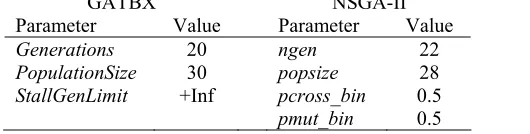
GATBX and NSGA-II were run for 600 function evaluations with the settings shown in Table 2. The mutation and crossover parameters pcross_bin and pmut_bin were tuned through several preliminary runs although very little difference in the quality of the results was registered.
converging with only 600 function evaluations. For GATBX, instead, results were changing significantly, and the settings leading to the best solutions were used.
The parameters for ACO-MGA were tuned by running the same test case for different values of the weights, the number of ants and the number of iterations. The maximum number of function evaluations was set to 600 as for the other algorithms although ACO-MGA requires, on average, 545 function evaluations. The best results were obtained with the following settings. 10 ants were used, with a first optimisation step with 30 iterations and wplanet,wtype 0, followed by a second step of 30 more iterations with wplanet,wtype 20 3 km/s . Because of the normalisation shown in Eq. (5), the non-dimensional weight w does not depend on the dimensions and value of the objective function of the specific problem: therefore, we will use the same value also for other transfer problems, as will be shown in the next case study. Note that the two weights
, planet type
w w are tuning parameters of the optimiser. It was found that the performance of ACO-MGA is not very sensitive to the value of the weight (within reasonable variations). Furthermore, it should be easy, for a given problem, to get a value for
obj
f , either by experience or simply by random sampling the solution space. In the case fobj cannot be determined, then the values of wplanet,wtype shall be selected by tuning the optimiser on the specific problem.
Results in the form of statistical parameters over the 100 runs are presented in Table 3. All the algorithms found at least one feasible solution in every run. The value of 2 km/s as a target value for the v has been chosen to compute the success rate
according to the procedure proposed in [16].
The results in Table 3 point out that, while all the algorithms find feasible solutions in all the runs, the quality of the solution is much better for ACO-MGA. Moreover, GATBX found a good solution only in 31% of the runs, and NSGA-II in 39%. ACO-MGA, instead, found a good solution in 62% of the runs.
[image:19.612.49.314.499.566.2]The time for one MGA run is about 8 min. The simplicity of the test case, together with the implementation of ACO-MGA in a high-level language like MATLAB, makes the use of an optimisation method slower than the systematic scan of the whole solution space. Note that this will not happen in the more complex Cassini test case.
Table 2: Parameters of GATBX and NSGA-II for the Laplace test case.
GATBX NSGA-II
Parameter Value Parameter Value
Generations 20 ngen 22
PopulationSize 30 popsize 28
StallGenLimit +Inf pcross_bin 0.5
pmut_bin 0.5
Table 3: Comparison of the performances of ACO-MGA, GATBX, NSGA-II over 100 runs for the Laplace problem.
Average best
value, km/s < 2 km/s % runs % feasible runs ACO-MGA 2.0141 62% 100%
GATBX 2.34 31% 100%
NSGA-II 2.1074 39% 100%
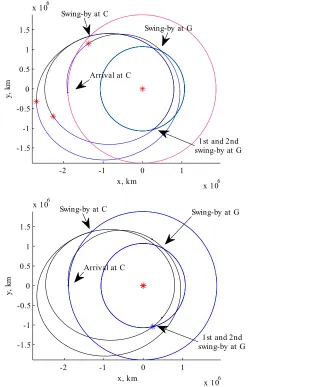
Fig. 7 (a), starting from the second swing-by of Ganymede. The sequence for this solution is GGCGC, and the objective value, i.e. the final relative velocity, is v 1.96 km/s. The solution is practically ballistic.
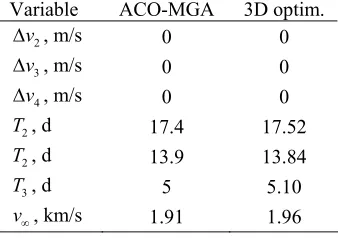
ACO-MGA identified a solution, with an objective value of v 1.91 km/s, equal flyby sequence and comparable transfer times per leg (see Fig. 7 (b)). Table 4 compares some parameters of the 2D solution with the re-optimised 3D solution. Slight differences are due to the different models, and mainly to the changes of inclination that are needed in the 3D solution. When re-optimized with the full 3D model, the 2D solution identified by ACO-MGA yields the reference solution in Fig. 7 (a). This demonstrates that the assumptions underneath the 2D model are consistent and allow for identifying first guess solutions that converge locally to higher fidelity solutions with comparable cost and mission characteristics.
Note that the solution chosen by ESA, and used here as a comparison, is not the best from the point of view of the arrival velocity. In fact, this solution was chosen by ESA following a trade off, taking into account not only the v, but also the presence of DSMs, the total time of flight, the radiation dose, and the arrival velocity vector at Callisto.
ACO-MGA found also solutions with lower v. The best one has v 1.709 km/s, and corresponds to the trajectory plotted
in Fig. 8. The swing-by sequence is the same, GGCGC, but the total time of flight is much longer (92 days), since the first GC leg performs 1 full revolution and the CG leg 2 full revolutions, and a 10 m/s DSM is added to the second leg.
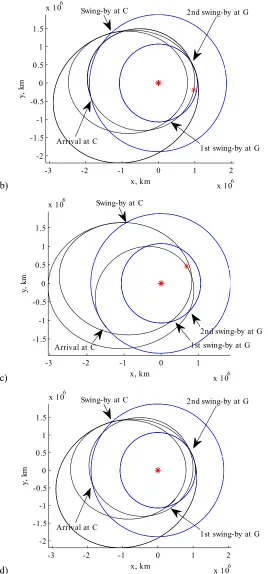
The 100 runs returned a number of feasible solutions. Four different solutions with a low value of v are described in Table
5, and respectively plotted in Fig. 9. Note that we deliberately decided not to pick the best four solutions according to lowest
v, but rather to show the variety of different good solutions that were found through this approach, and demonstrate that
this tool could be useful for finding valid alternative options. In the same way, Table 6 and Fig. 10 describe four different solutions among those with short total time of flight. Note that all the solutions with low v follow the same planetary
sequence GGCGC, while the short solutions use also the sequence GGGCC, but at the cost of a higher v.
a)
-2 -1 0 1
x 106 -1.5
-1 -0.5 0 0.5 1 1.5
x 106
x, km
y,
km
Swing-by at G
1st and 2nd swing-by at G Arrival at C
Swing-by at C
b)
-2 -1 0 1
x 106 -1.5
-1 -0.5 0 0.5 1 1.5
x 106
x, km
y,
km
Swing-by at C
Arrival at C
1st and 2nd swing-by at G Swing-by at G
Fig. 7: (a) Reference solution (sequence GGCGC) optimised with a full 3D model. (b) Same solution as found by ACO-MGA. The first leg is not plotted.
-2 -1 0 1
x 106 -1.5
-1 -0.5 0 0.5 1 1.5
x 106
x, km
y,
km
Swing-by at C
10 m/s DSM Arrival at C
[image:21.612.70.397.57.444.2]1st and 2nd swing-by at G Swing-by at G
[image:21.612.66.309.495.677.2]Table 4: Characteristics of the ACO-MGA solution and the optimised 3D solution. The first leg is not considered. Variable ACO-MGA 3D optim.
2 v
, m/s 0 0
3 v
, m/s 0 0
4 v
, m/s 0 0
2
T , d 17.4 17.52
2
T , d 13.9 13.84
3
T , d 5 5.10
v, km/s 1.91 1.96
Table 5: Four solutions with low final relative velocity. Sol. (a) Sol. (b) Sol. (c) Sol. (d) Sequence GGCGC GGCGC GGCGC GGCGC
2 v
, m/s 0 0 0 0
3 v
, m/s -10 0 0 0
4 v
, m/s 0 -10 -10 0
2
T , d 17.492 17.492 50.226 17.492
2
T , d 47.957 34.766 14.812 34.766
3
T , d 5.711 17.985 6.502 18.007
v, km/s 1.7097 1.7945 1.7972 1.8199
a)
-2 -1 0 1
x 106 -1.5
-1 -0.5 0 0.5 1 1.5
x 106
x, km
y,
km
[image:22.612.52.315.213.557.2]b)
-3 -2 -1 0 1 2
x 106 -2
-1.5 -1 -0.5 0 0.5 1 1.5
x 106
x, km
y,
km
1st swing-by at G Swing-by at C 2nd swing-by at G
Arrival at C
c)
-3 -2 -1 0 1
x 106 -1.5
-1 -0.5 0 0.5 1 1.5
x 106
x, km
y,
km
Swing-by at C
Arrival at C 1st swing-by at G 2nd swing-by at G
d)
-3 -2 -1 0 1 2
x 106 -2
-1.5 -1 -0.5 0 0.5 1 1.5
x 106
x, km
y,
km
1st swing-by at G Swing-by at C 2nd swing-by at G
[image:23.612.57.325.57.631.2]Arrival at C
Table 6: Four solutions with short total time of flight. Sol. (a) Sol. (b) Sol. (c) Sol. (d) Sequence GGCGC GGGCC GGGCC GGCGC
2 v
, m/s 0 -10 -10 -10
3 v
, m/s -10 -10 -10 -10
4 v
, m/s 0 -10 -10 0
2
T , d 17.482 14.318 14.318 33.697
2
T , d 13.864 6.6194 6.6194 18.482
3
T , d 5.0154 30.889 46.362 15.339
v, km/s 1.9047 2.2068 2.2003 2.1437
a)
-2 -1 0 1
x 106 -1.5
-1 -0.5 0 0.5 1 1.5
x 106
x, km
y,
km
Swing-by at C
Arrival at C
1st swing-by at G 2nd swing-by at G
b)
-2 -1 0 1 2
x 106 -1.5
-1 -0.5 0 0.5 1 1.5
x 106
x, km
y,
km
1st and 2nd swing-by at G Swing-by at C
c)
-2 -1 0 1 2
x 106 -1.5
-1 -0.5 0 0.5 1 1.5
x 106
x, km
y,
km
1st and 2nd swing-by at G Arrival at C
Swing-by at C
d)
-3 -2 -1 0 1
x 106 -2
-1.5 -1 -0.5 0 0.5 1 1.5
x 106
x, km
y,
km
Swing-by at C
Arrival at C
[image:25.612.58.327.54.443.2]1st swing-by at G 2nd swing-by at G
Fig. 10: Four solutions with short total time of flight (see Table 6). The first leg is not plotted.
Table 7: Best solution for each feasible sequence: objective value, final relative velocity, total DSM cost and total time of flight (considering only the three legs under design).
Sequence fobj v, km/s v, m/s T, y
GGCGC 1.7097 10 71.1606
GGGCC 2.1940 10 70.0352
GGGGC 2.2354 30 67.9405
GGCCC 3.4084 30 68.3365
4.2 Cassini case study
Cassini is the ESA-NASA mission to Saturn. The planetary sequence designed for the mission, EVVEJS is particularly long, allowing a substantial saving of propellant.
[image:25.612.51.279.500.563.2]For testing ACO-MGA we will make use of a 5-leg trajectory, with starting date t0 779 d, MJD2000, corresponding to
13 November 1997. The following sets of parameters were used, to allow DSMs in the first 3 legs only:
1, ,1 2, ,2 3, / 4,1/ 2 5,
600, 350, 200, 0 m/s 0
0 1, 2,3
0,1 0,1
DSMi i rev i i rev i i p ai i i i m n n i f f q q q q q
1, ,1 2, ,2 3, / 4,1/ 2 5,
0
0 4,5
0,1
DSM i i rev i i rev i i p ai i i i m n n i f f q q q q q
The planets available for swing-bys are qP i,
Venus, Earth, Jupiter ,
i1,.., 4, while the target planet is obviously fixed to Saturn. The number of maximum full revolutions is fixed to 0, as it can be seen from the choice of parameters nrev,1 and,2
rev
n . This is done to limit the total time of flight of the mission. Since the trajectory is going outwards of the orbit of the Earth, every full revolution implies more than one additional year in the transfer time. The main aim of this case study, then, is to assess the ability of finding promising planetary sequences, using deep space manoeuvres. The total number of distinct solutions for this test is 7,112,448, and the average time to evaluate a solution is 1.26 ms. This translates in 8961.7 s (or about 2.5 hours) to systematically evaluate all the solutions.
The launch excess velocity module was bounded between 2 and 4 km/s. For the swing-bys of Earth and Venus, the radii of pericentre span from 1.1 to 5 RP. A different choice is adopted for Jupiter. In fact, the mass of this planet is considerably bigger than the masses of Venus and Earth, so higher radii of pericentre are enough to achieve considerable deviations. It was decided to consider the range 5 to 100 RP.
Regarding the choice of the objective function, it has to be noted that for all the missions to outer planets, the time of flight becomes very important, as very long missions are needed to reach farther destinations. Even limiting the number of complete revolutions to zero, is not enough to guarantee a mission with reasonable duration. Therefore, it is important to include the total time of flight T in the objective function, in addition to the total v. Since the current algorithm cannot deal with multi-objective optimisation, the total time of flight and the v are weighed inside the objective function, such that fobj vT: for this test case the weight on T was chosen to be 1 1000 km/s/d.
The total time of flight has been limited to a maximum of 100 years: limiting the time of flight to lower values would over-constrain the search for optimal solutions. Instead, better results are obtained by allowing long solutions to be returned as feasible, and introducing their duration into the objective function.
first bunch of runs and 6000 for the second bunch of runs. In particular, for 4000 function evaluations, the number of iterations allocated to the first step was 200 and the number of iterations allocated to the second step was 300. For 6000 function evaluations, instead, the number of iterations allocated to the first step was increased to 600 and the number of iterations allocated to the second step was left equal to 300. With these settings, a run of ACO-MGA requires, on average, 1900 function evaluations and 161 s, if the upper limit is 4000, and 3300 function evaluations and 273 s, if the upper limit is 6000 evaluations. This is considerably faster than the exhaustive scan of the solution space and the number of function evaluations is lower than in the case of GATBX and NSGA-II, however the computational time for each single run of GATBX, which is fully coded in MATLAB®, is, on average, half of the one required to ACO-MGA as the access to the taboo and feasible lists is currently not optimal and coded in MATLAB®. Current developments have addressed this bottleneck and the results of the new implementation will be presented in future papers. NSGA-II is even faster as the code is fully in C. Therefore, a fair comparison would allow GATBX and NSGA-II to perform a higher number of function evaluations.
The parameters used for GATBX and NSGA-II are reported in Table 8. The comparative results for the two sets of runs are shown in Table 10. It can be seen that, for 1900 function evaluations, ACO-MGA found feasible solutions in 91% of the runs, compared to 25% of GATBX and 26% of NSGA-II. The average ACO-MGA solution is also slightly better than GATBX, and considerably better than NSGA-II. The performances of ACO-MGA increase significantly by using 3300 evaluations: all the runs produce a feasible solution, and in 80% of the cases, the best solution found is below 16 km/s. The average value of the solution also decreases to 15.434 km/s. It is interesting to note that, for GATBX, the average best solution found with 6000 evaluations is higher than for 4000: this is partly balanced by the fact that it finds feasible solutions in 28% of the runs. Another thing worth noticing is that NSGA-II finds more often feasible solutions than GATBX, but their quality is in average worse.
The best solution found by ACO-MGA (sequence EVVEJS) has an objective value of 6.9686 km/s: The characteristics of this solution can be found in Table 9, compared to the best solution found for the Earth-Saturn transfer problem (see http:// www.esa.int/gsp/ACT/inf/op/globopt/edvdvdedjds.htm). The trajectory of the ACO-MGA solution is shown in Fig. 11 (a), while the 3D reference solution is in Fig. 11 (b).
[image:27.612.53.289.587.716.2]It is worth to underline that the superior computing time of ACO-MGA is also due to the fact that for all runs, including the few that are not feasible, the algorithm finds partial solutions that are feasible up to the last transfer. As a consequence, the taboo lists of the last planetary encounter tend to grow significantly. A possible solution, on top of optimising the access to the list, would be to plan backward from the target planet in the case of transfers to the outer part of the solar system.
Table 8. Parameters of GATBX and NSGA-II for the Cassini test case.
GATBX NSGA-II
Parameter Value Parameter Value
Common parameters
StallGenLimit +Inf pcross_bin 0.5
pmut_bin 0.5 4000 function evaluations
Generations 20 ngen 200
PopulationSize 200 popsize 20
6000 function evaluations
Generations 30 ngen 300
Table 9. Characteristics of the ACO-MGA solution and the reference solutions.
Variable ACO-MGA Reference
0
v , km/s 3.14 3.259
1
v
, m/s 600 480
2
v
, m/s 350 398
3
v
, v4, v5, m/s 0 0
v, km/s 4.21 4.246
1
T, d 168 167
2
T , d 423 424
3
T , d 53 53
4
T , d 596 589
5
T , d 2290 2200
Table 10. Comparison of the performances of ACO-MGA, GATBX, NSGA-II over 100 runs for the Cassini problem. Optimiser Average best value, km/s < 16 km/s % runs % feasible runs
Max 4000 function evaluations
ACO-MGA 16.24 44% 91% GATBX 16.349 14% 25% NSGA-II 20.426 5% 26% Max 6000 function evaluations
ACO-MGA 15.434 80% 100%
[image:28.612.56.285.264.377.2]a)
-10 -5 0
x 108 -2
0 2 4 6 8 10 12x 10
8
x, km
y,
km
Arrival at S
Swing-by at J
DSM
DSM 2nd swing-by
at V
Swing-by at E
1st swing-by at V
b)
-1.5 -1 -0.5 0 0.5 1 1.5
x 109 -1
-0.5 0 0.5 1 1.5x 10
9
x, km
y,
km
DSM
Swing-by at J
DSMDSM
DSM
2nd swing-by
at V 1st swing-by at V
Swing-by at E Arrival at S
Fig. 11: (a) ACO-MGA solution; (b) Cassini reference solution.
It is interesting to sort the feasible sequences found by ACO-MGA according to the best objective value that they can achieve. Table 11 shows the objective value, the relative velocity at arrival, the total DSM cost and the time of flight of the best solution found for each sequence. Note that every solution has a trajectory associated to it, modelled as shown before, and thus taking into account the phasing problem. This means that these solutions could be re-optimised with a more detailed model (in particular including the third dimension), leading to actual transfer solutions.
[image:29.612.56.311.60.440.2]Table 11: Best solution for each sequence: objective value, velocity at infinity, DSM cost and total time of flight. Sequence fobj, km/s v, km/s v, km/s T, y
EVVEJS 7.5832 4.1112 1.4 11.639 EVVEES 10.762 6.6954 1.4 27.978 EVEEJS 14.230 8.2067 1.15 18.624 EVEEES 16.135 10.283 1.4 32.188 EVVVES 21.261 10.437 1.2 33.038 EVVVVS 21.725 6.5036 1.55 13.791
4.3 Launch date analysis
As mentioned before, the algorithm, at the current state, does not perform any kind of search on the launch date t0. In fact,
this variable is not even included in the solution vector s. Rather, if the launch date is not fixed, but a launch window is available, a systematic scan can be performed to find the best launch date, and the corresponding solutions. This procedure is not always applicable: in fact, if re-running the algorithm for a small change in the launch date, the solutions that ACO-MGA finds are substantially different, then the systematic scan along t0 is not feasible, and this variable must be included in the optimization process. If, on the other hand, a small displacement along t0 causes a small change in the best solution
found (e.g. same planetary sequence, possibly different types of transfers, similar objective value), then the systematic scan over t0 is applicable to the identification of promising launch dates.
In order to verify this assertion, a test was run using the BepiColombo mission as a reference case [16]. BepiColombo is a multiple gravity assist mission to Mercury, currently under study at ESA and JAXA. In Ref. [16] an optimal transfer solution is provided, using two swing-bys of Venus to reach Mercury (sequence EVVMe). The optimal launch date is the 15 August 2013, i.e. t0 4974.5 d, MJD2000.
ACO-MGA was run, leaving the choice of the swing-by sequence and the other transfer parameters, like the number of revolutions, free. The objective was to minimise the relative velocity v at Mercury.
Five different launch dates, in a window of 10 days around the one chosen by ESA, were considered, and for each one of them, 100 runs of ACO-MGA were performed. The best solutions for each launch date can be found in Table 12. Note that, the optimal launch date occurs 1 day before t0, while earlier or later launch dates appear to be less convenient. In addition,
all the solutions have the same planetary sequence.
The discrepancy between the value of v found by MGA and the one in [16] has two reasons: the first is that ACO-MGA does not take into account the inclination of the planets, and the orbit of Mercury is highly inclined. The second is that the ESA solution was found as a part of a longer trajectory, and thus with a different objective.
The same reasons explain why, according to ACO-MGA, the ideal launch date is 1 day earlier. As a matter of fact, this is not a problem, and a subsequent local optimisation of the ACO-MGA solutions with a full model would tune the launch date.