
Dongari, Nishanth and Zhang, Yonghao and Reese, Jason (2011)
Behaviour of microscale gas flows based on a power-law free path
distribution function. In: Rarefied Gas Dynamics. AIP Conference
Proceedings, 1333 (1st). Springer, pp. 724-729. ISBN 978-0-7354-0889-0 ,
http://dx.doi.org/10.1063/1.3562732
This version is available at
https://strathprints.strath.ac.uk/32101/
Strathprints is designed to allow users to access the research output of the University of Strathclyde. Unless otherwise explicitly stated on the manuscript, Copyright © and Moral Rights for the papers on this site are retained by the individual authors and/or other copyright owners. Please check the manuscript for details of any other licences that may have been applied. You may not engage in further distribution of the material for any profitmaking activities or any commercial gain. You may freely distribute both the url (https://strathprints.strath.ac.uk/) and the content of this paper for research or private study, educational, or not-for-profit purposes without prior permission or charge.
Any correspondence concerning this service should be sent to the Strathprints administrator:
The Strathprints institutional repository (https://strathprints.strath.ac.uk) is a digital archive of University of Strathclyde research outputs. It has been developed to disseminate open access research outputs, expose data about those outputs, and enable the
Behaviour of microscale gas flows based on a power-law free
path distribution function
Nishanth Dongari, Yonghao Zhang and Jason M Reese
Department of Mechanical Engineering, University of Strathclyde, Glasgow G1 1XJ, Scotland, United Kingdom [email protected]
Abstract. We investigate a power-law form for the probability distribution function of free paths of dilute gas molecules in a confined region. A geometry-dependent effective molecular mean free path (MFP) model is then derived for a planar wall confinement, by taking into account the boundary limiting effects on the molecular paths. The power-law based effective MFP is validated against molecular dynamics simulation data and compared with exponential effective MFP models. The Navier-Stokes constitutive relations are then modified according to the kinetic theory of gases i.e. transport properties can be described in terms of the free paths which the molecules describe between collisions. Results for isothermal pressure-driven Poiseuille gas flows in micro-channels are reported, and we compare results with conventional hydrodynamic models, solutions of the Boltzmann equation and experimental data.
Keywords: Microchannel gas flow; Kndesn layer; Molecular mean free path; slip flows
PACS: 47.61.-k, 47.61.Cb, 47.61.Fg
INTRODUCTION
In microscale gas flows the small system dimensions mean that the non-dimensional Knudsen number,Kn, defined as the ratio of the molecular mean free path (MFP) of the gas,λ, to a characteristic flow field dimension (H), indicates the flows are often rarefied. AsKnincreases, the behaviour of a gas flow near a solid bounding surface is dominated by the effect of gas molecule-surface interactions. This leads to the formation of a Knudsen layer (KL): a local thermodynamically non-equilibrium region extending∼ O(λ) from the surface. Although the Navier-Stokes (NS) equations with classical velocity-slip and temperature-jump boundary conditions [1] can often adequately predict the flow field outside the KL, they fail to capture the non-linear form of the KL [2].
In the KL, gas molecule-surface collisions are more frequent than gas molecule-molecule collisions, i.e. the gas MFP will effectively be reduced in the KL. It is well-known from the kinetic theory of gases that viscosity and thermal conductivity can be interpreted in terms of the collisions of gas molecules, and of the free paths of the molecules between collisions [3]. Linear constitutive relations for shear stress and heat flux, with constant thermophysical transport coefficients such as viscosity and thermal conductivity, are not necessarily valid in the KL.
Stops [4] derived an effective MFP,λeff(S), which is geometry-dependent, by investigating the classical probability
distribution function,ψ(r) =λ−1exp (−r/λ). If the gas is not bounded, the MFP of the gas molecule ensemble is
simplyR0∞rψ(r)dr=λ. If a solid bounding surface is included in the system, however, some molecules will hit the
surface and their free flight paths will be terminated. The MFP of all the gas molecules in the system will therefore be smaller thanλ, due to this boundary limiting effect. Guoet al.[6] implemented the effective MFP expression derived by Stops [4] in conjunction with a second-order slip boundary condition and obtained good results for pressure-driven rarefied gas flows.
However, comparison of these effective MFP profiles with molecular dynamics (MD) simulation data [7] shows that the model is accurate only up to Knudsen numbers of about 0.2, as exponential distribution function can only provide an accurate description of a gas under thermodynamic equilibrium [4]. Non-equilibrium transport is often better described using Lévy and power-law (PL) probability distributions [8, 9].
AN EFFECTIVE MOLECULAR MEAN FREE PATH
Let us consider a group of similar gas molecules moving at a speedvwith a collision rate of ˙θv, where molecular mean
free pathλ =v/θ˙v. The number in the group at timet=0 isN0, and by timetletNof them still be travelling without
having had a collision. During the intervaldt,Nθ˙vdtmolecules will collide and drop out of the group;N is thereby
changed by the amount:
dN=−Nθ˙vdt. (1)
We can easily integrate this equation under thermodynamic equilibrium conditions, as the probability of a certain microscopic state averaged over the details of the interactions, does not change in time or space [3]. So, with ˙θv
constant,dN/N=−θ˙vdt, thus lnN=−θ˙vt+const.Choosing the constant of integration so as to makeN=N0att=
0, we find
N=N0exp
¡
−θ˙vt
¢
=N0exp
µ
−θ˙v|vr|

, (2)
where|r|is the lengthvtof free path that has been travelled at timetby each molecule. Letψ(r)drbe the fraction of all the free paths that have a length betweenrandr+dr. Thenψ(r)dr=dN/N0, hence fromλ =θ˙vv
ψ(r) = 1
λexp
µ
−|λr|

. (3)
Soψ(r), the probability distribution of free paths, is only exponential in form under thermodynamic equilibrium conditions and when the gas is unbounded.
Although it is certainly difficult to evaluate the probability distribution functionψ(r)in Knudsen layer, introducing non-equilibrium into Eq. (1) by means of physical arguments could allow us to propose a distribution function that may be more appropriate for non-equilibrium conditions than the exponential one [3]. Montroll & Scher [9] pointed out that a finite moment of the probability distribution function implies an exponential character of the randomness. A distribution function with diverging higher-order moments, such as the standard deviation, is essential to non-equilibrium transport.
We hypothesize a PL form for the probability distribution function for non-equilibrium MFP, with diverging higher-order moments, instead of the classical exponential form of distribution function. Here we propose for investigation the following form of molecular free path distribution function:
ψ(r) =C(a+r)−n, (4)
whereaandCare constants with positive values determined through the zero and first moments. The range of values for the exponentncan be obtained by making one of the higher-order moments divergent. Zero and first moments are given as follows:
1=
Z
0
∞
C(a+r)−ndr, (5)
λ =
Z
0
∞
Cr(a+r)−ndr. (6)
Equation (5) requires the probability to range only from zero to one. Equation (6) defines the unconfined, conventional MFP value,λ. It then follows that,C= (n−1)an−1anda=λ(n−2).Ifn>2, a>0, otherwise the distribution function is negative. The standard deviation (second moment) of the distribution function given by Eq. (4) diverges only forn≤3; so 2<n≤3. If one wishes to make theith moment diverging, then max(n) =i+1. Asn→∞, the distribution function will have finite moments, which is the condition required of an equilibrium distribution function. For a finite n, the distribution function describes a system deviating from equilibrium. Thus,n acts as a decisive parameter to define the extent of deviation from equilibrium. Here, we testn=3, unless otherwise explicitly stated.
We follow the approach based on an integrated form of the probability distribution function [5], i.e.
p(r) =
Z
r
∞
ψ(r)dr=
·
1−³1+r
a
´1−n¸
, (7)
andr+if the molecule is travelling in the positivey-direction. We also use the notationsθ−andθ+for the equally
probable zenith angle travelling direction of the molecule. These quantities are related throughr−= (H/2+y)/cosθ−
andr+= (H/2−y)/cosθ+, whereHis the distance between the two parallel plates.
The MFP based on the PL form of distribution function,λeff(PL), is expressed by weighting the unconfined MFP, λ, withp(r)as follows:
λeff(PL)=λ
2
£
p(r−) +p(r+)¤=λ
(
1−1
2
"µ
1+r−
a
¶1−n
+
µ
1+r
+
a
¶1−n#)
. (8)
A 3-dimensional MFP depending on the gas molecule’s distance to a surface is then obtained by averaging the free path with respect toθ−andθ+in the range [0,π/2] using the mean integral theorem,
<λeff(PL)(θ)>=2 π
Z
0
π/2
λeff(PL)(θ)dθ. (9)
Averaging over the free path in Eq. (9), using Simpson’s numerical integration involving 16 subintervals, results in
λeff(PL)=λ βPL, where
βPL=1− 1
94
" ³
1+H/2a−y´1−n+³1+H/2a+y´1−n+4∑8i=1
³
1+acos[(H2/2i−−1)yπ/32]´1−n+4∑8i=1
³
1+acos[(H2/2i−+y1)π/32]´1−n
+2∑7i=1
³
1+acosH/2[iπ−/16y ]´1−n+2∑7i=1
³
1+acosH/2[iπ+y/16]´1−n
#
, (10)
which is the normalized effective MFP based on the power-law distribution function, and is evaluated using the rarefaction parameterKn(asais dependent on mean free path).
Comparison with Molecular Dynamics simulations
Theβ-function of Eq. (10) is now compared with MD simulation results [7] and the classical exponential probability function models of Stops [4] and Arlemarket al.[5], for both single- and parallel-wall cases. Single-wall results are deduced by assuming that the second wall is located an infinite distance from the first.
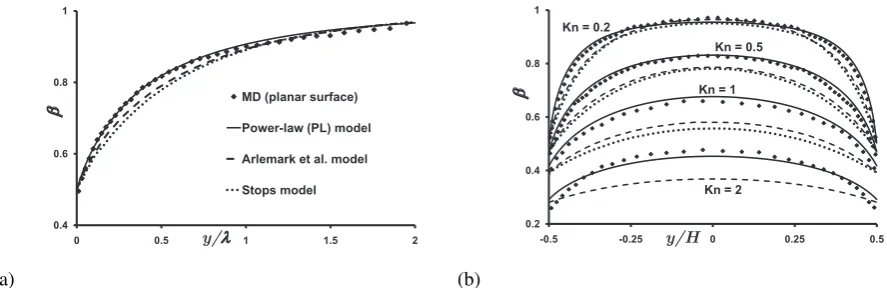
Figure 1(a) shows the variation of normalized effective MFP profiles (i.e.β). Our PL model predictions are in close agreement with MD simulations, although minor overpredictions are noticed in the bulk region. The PL model has a sharp gradient close to the wall, while both of the previous exponential-based models have shallower gradients and underpredict the MFP values in the wall vicinity. All three theoretical models converge to a similar value in the bulk region as expected.
Results for the normalized MFP between two parallel surfaces are presented in Fig. 1(b). AtKn=0.2, the PL model is in fair agreement with the MD data in the near-wall region and the two exponential based models underpredict in the KL. As the value ofKnincreases, the classical models fail to predict the effective MFP in the wall region, as well as in the bulk. Both classical models underpredict the effective MFP values, although the Arlemarket al.[5] results are slightly above Stops’. PL model MFP values compare very well to the MD data for bothKn=0.5 and 1, although it overpredicts forKn=1 in the bulk. ByKn=2, the PL model shows significant deviations from the simulation data and overpredicts in the near-wall region, although there is fair agreement in the bulk region. The MD data shows a relatively sharp gradient of effective MFP in the near-wall region, compared to the theoretical predictions.
ISOTHERMAL PRESSURE-DRIVEN RAREFIED GAS FLOWS
We consider isothermal pressure-driven gas flow along a planar-wall channel with walls a distanceH apart as a test case. The flow is assumed to be hydrodynamically developed and two-dimensional, isothermal, laminar and steady. With these assumptions, the governing equation is:
0=−∂P
∂x−
∂ τ
[image:4.595.71.566.283.341.2](a)
0.4 0.6 0.8 1
0 0.5 1 1.5 2
b
y/l
MD (planar surface)
Power-law (PL) model
Arlemark et al. model
Stops model
(b)
0.2 0.4 0.6 0.8 1
-0.5 -0.25 0 0.25 0.5
b
y/H Kn = 0.2
Kn = 0.5
Kn = 1
[image:5.595.78.522.91.235.2]Kn = 2
FIGURE 1. Variation of normalized mean free path,β, with normalized distance from a surface; (a) single-wall case and (b) parallel-wall case. Comparison of power-law (PL) model with molecular dynamics (MD) simulation data [7], and Arlemarket al.
[5] and Stops [4] exponential models, for various Knudsen numbers.
wherexis the streamwise coordinate,ythe wall-normal coordinate,Pthe pressure andτthe stress, which is given as:
τ=−µ£∇U+ (∇U)tr¤+
µ
2 3µ−κ

(∇.U)I, (12)
whereµis the fluid dynamic viscosity,κthe bulk viscosity,Ithe identity tensor andtrthe transpose operator. The unconfined MFP is related to the shear viscosity [3]:
µ=ρp λ
π/2RT, (13)
whereRis the specific gas constant andT the gas temperature. Equation (13) is assumed to be valid only for flows that are quasi-equilibrium. If we wish to use Eq. (13), we need to take into account the MFP affected by gas molecular collisions with surfaces. If the unconfined expression for the MFP, λ, is replaced by our effective and geometry-dependent mean free path,λeff(PL), we obtain a non-constant, geometry-dependent, effective viscosity,µeff(PL), that
can then be used to postulate a non-linear stress/strain-rate relation:
τ=− µβPL
| {z } µ
eff(PL)
∂Ux
∂y , (14)
Using Eq. (14) in Eq. (11) results in the modified governing equation:
µ ∂
∂y
µ
βPL∂Ux ∂y

=∂P
∂x. (15)
whereUxis the fluid velocity in the axial direction. This needs to be solved in conjunction with an appropriate slip
boundary condition. Guoet al.[6] proposed the following heuristic slip boundary condition to take into account the KL correction:
Uslip=−C1
µ
λeff∂Ux ∂y

w −C2
·
λeff ∂ ∂y
µ
λeff∂Ux ∂y
¶¸
w
. (16)
This simply reduces to the conventional second-order slip boundary condition [11] if there is no KL, i.e. ifλeff=const. Values ofC1andC2are chosen as 1 and 0.31 [12] respectively for the results presented here.
The wall-normal coordinateyis normalized byH, and the axial velocityUxby the free-molecular velocityU0=
0.25 0.75 1.25 1.75
0 0.1 0.2 0.3 0.4 0.5
U
*
y* Boltzmann Eq.
NSF, PL, 2nd order slip BCs
R26
NSF, 2nd order slip BCs
NSF, 1st order slip BCs
Kn = 0.113
R26 equations
0.25 0.5 0.75 1
0 0.1 0.2 0.3 0.4 0.5
U
*
y*
[image:6.595.106.506.79.220.2]Kn = 0.677
FIGURE 2. Normalized half-channel velocity profiles for various Knudsen numbers. Comparison of power-law (PL) model results with the solution of the Boltzmann equation [13], R26 moment equations (– –) [14] and conventional NS equations with first- and second-order slip (–.–).
1 1.5 2 2.5 3
0.01 0.1 1 10
G
δm
NS, PL, 2nd order slip BCs
NS, Stops, 2nd order slip BCs
BGK
Exp. data
(a)
1 1.5 2 2.5 3
0.01 0.1 1 10
G
δm
NS, PL, 2nd order slip BCs
NS, PL, 1st order slip BCs
NS, 2nd order slip BCs
NS, 1st order slip BCs
Boltzmann Eq.
R26
(b)
R26 Equations NS, 2nd order slip BCs
FIGURE 3. Normalized volume flow rate (G) variation with inverse Knudsen number (δm). Comparison of power-law (PL) model results with: (a) experimental data [10] and BGK simulation results (– –) [15]; (b) the solution of the Boltzmann equation [13], R26 equations (–.–) [14] and the conventional NS equations with first- and second-order slip.
RESULTS AND DISCUSSION
The cross-sectional velocity profiles of pressure-driven Poiseuille flow at a range of Knudsen numbers are presented in Fig. 2. Our PL model is validated with a Boltzmann solution [13] and compared with three hydrodynamic models: conventional first- and second-order slip models, and the R26 equations [14]. AtKn=0.113, the PL model and R-26 equations predict similar values of slip velocity at the wall and are close to the solution obtained from the Boltzmann equation [13]. The conventional NS equations with both first- and second-order slip boundary conditions significantly underpredict the velocity in the bulk region and show minor deviations in the KL. The PL model is in fair agreement with the Boltzmann solution in the bulk region, although the R26 equations slightly overpredict the maximum velocity. At higherKn, the flow enters the transition regime and the non-equilibrium regions from both parallel walls start to overlap each other. AtKn=0.677, the slip model shows significant discrepancy in the Knudsen layer and both the PL model and R26 equations compare reasonably well with the Boltzmann solutions, although the R26 equations overpredict the wall-slip velocity.
[image:6.595.106.508.280.422.2]Figure 3 shows the variation of normalized flow rateGwith inverse Knudsen number,δm=√π/(2Kn). In Fig. 3(a),
the PL model results are compared with experimental data [10], BGK results [15] and the NS equations with Stops’ MFP model and second-order slip condition. In the slip flow regime, both the PL model and Stops’ MFP based slip model agree reasonably well with the experimental data and BGK simulation results. Aroundδm∼1, Stops’ MFP
based slip model starts to significantly underpredict the flow rate, whilst the PL model follows the BGK simulation data reasonably well untilKnreaches about 10. Flow rate results of our PL model withn=3 are shown in Fig. 3(b) to compare with the exact Boltzmann solution [13], R26 results [14], NS equations with first- and second-order slip and the PL model with first-order slip. Here the first-order slip for the PL based MFP NS equations results are obtained simply by settingC2=0. ForKn>0.1, NS equations with first-order slip underpredict the flow rate, although the
other hydrodynamic models are in good agreement with the Boltzmann solution up toKn∼0.2. The NS results with second-order slip are good up toKn∼0.5, but significantly overpredict beyond that. The R26 equations show good agreement untilKn∼2, and our PL model with second-order slip follows the Boltzmann results up toKn∼10.
CONCLUSIONS
The key physics of the rarefied gas flow in the Knudsen layer has been outlined, and we have proposed an analysis based on a power-law (PL) probability distribution function for free-paths of molecules in a confined gas. Theoretical comparisons with the MD simulation data illustrates that exponential distribution functions are inaccurate in the transition regime and the PL model can predict non linear phenomenon in the Knudsen layer. A constitutive scaling approach to model the Knudsen layer within a continuum fluid dynamics framework has also been described. This has been tested for the case of isothermal pressure-driven gas flow through a microchannel. An advantage of the PL MFP constitutive scaling technique is that it is based on simple physical arguments, which can successfully be implemented in conventional CFD codes, and is still able to capture some of the essential trends associated with the complex non-equilibrium physics of the Knudsen layer.
While it is important not to draw strong conclusions based on these simple test cases alone, the present results may motivate future work into understanding the origin of non-equilibrium physics in rarefied gases, incluing:
1. validation of the power-law probability distribution function for a range of flow systems geometries through molecular dynamics simulations;
2. classical constitutive relationships and velocity slip boundary conditions are derived under the assumption of constant MFP in Knudsen layers — derivations of these boundary conditions should be revisited based on geometry-dependent effective MFP models through an appropriate kinetic equation.
ACKNOWLEDGMENTS
The research leading to these results has received funding from the European Community’s Seventh Framework Programme FP7/2007-2013 under grant agreement ITN GASMEMS no. 215504.
REFERENCES
1. J. C. Maxwell, Philosophical Transactions of Royal Society, Part 1, 170, 231-256 (1879). 2. D. A. Lockerby, J. M. Reese, and Gallis, M. A., Physics of Fluids, 17, 100609 (2005). 3. C. Cercignani, Mathematical Methods in Kinetic Theory, Plenum Press, New York, 1990. 4. D. W. Stops, Journal of Physics D: Applied Physics, 3, 685-696 (1970).
5. E. J. Arlemark, S. K. Dadzie, and J. M. Reese, Journal of Heat Transfer, 132, 041006 (2010). 6. Z. L. Guo, B. C. Shi, and C. G. Zheng, Europhysics Letter, 80 (2), 24001-24006 (2007). 7. E. J. Arlemark, and J. M. Reese, ASME ICNMM2009-82080, Pohang, South Korea (2009). 8. K. S. Fa, and E. K. Lenzi, Physical Review E, 67, 061105 (2003).
9. E. W. Montroll, and H. Scher, Journal of Statistical Physics, 9 (2), 101-135 (1973).
10. T. Ewart, P. Perrier, I. A. Graur and J. B. Meolans, Journal of Fluid Mechanics, 584, 337-356 (2007). 11. N. Dongari, A. Agrawal and A. Agrawal, International Journal of Heat Mass Transfer, 50, 3411-3421 (2007). 12. N. G. Hadjiconstantinou, Physics of Fluids, 15(8), 2352-2355 (2003).

![FIGURE 2.Normalized half-channel velocity profiles for various Knudsen numbers. Comparison of power-law (PL) modelresults with the solution of the Boltzmann equation [13], R26 moment equations (– –) [14] and conventional NS equations withfirst- and second-order slip (–.–).](https://thumb-us.123doks.com/thumbv2/123dok_us/1682825.121679/6.595.106.508.280.422/normalized-proles-comparison-modelresults-boltzmann-conventional-equations-withrst.webp)
