Online Catalogue and Repository Interoperability Study (OCRIS)
Final Report
Duncan Birrell, Gordon Dunsire and Kathleen Menzies
Centre for Digital Library Research, University of Strathclyde
Table of Contents
Acknowledgements ... 4
1. Background ... 10
2. Aims and Objectives ... 11
3. Methodology ... 11
4. Implementation ... 12
4.1. Questionnaires ... 12
4.2. Sampling and in-depth analysis ... 15
4.3. Case Studies ... 16
5. Outputs and Results ... 16
5.1. LMS and IR systems and software ... 17
5.2. Interoperability ... 19
5.2.1. Administrative Systems ... 19
5.2.2. LMSs and IRs ... 21
5.3. Services currently supported ... 24
5.3.1. Institutional Repositories ... 25
5.3.2. Library Management Systems ... 28
5.3.3. Key findings regarding services offered by LMSs and IRs ... 30
5.4. Integration services and tools ... 30
5.5. Scope Overlap ... 32
5.6. Authority Control ... 33
6. Summary of analysis of in-depth studies... 34
6.1. Introduction ... 34
6.2. Main findings ... 34
6.3. Descriptions of scope ... 35
6.4. Overlap ... 38
6.5. Journal articles ... 39
6.7. Subject headings ... 42
6.8. Name Authority Control and finding publications by specific authors, research groups and departments ... 43
7. Summary of main findings of case studies ... 47
7.1. Rationale ... 47
7.2. Introduction ... 47
7.3. Systems and Scopes ... 47
7.4. Key points of comparison ... 48
7.4.1. The Impact of Research Assessment ... 48
7.4.2. Systems Issues ... 50
7.4.3. Authority Control and Standards ... 50
7.4.4. External sourcing of bibliographic records ... 51
7.4.5. Links between LMSs/OPACs and IRs ... 52
7.4.6. Links with other institutional systems ... 52
7.4.7. Re-imagining the role of IRs and the LMS ... 53
7.4.8. Resource Discovery Platforms ... 53
7.4.9. Development of Identity Management Systems within Institutions ... 54
8. Outcomes ... 55
9. Conclusions ... 56
10. Implications ... 59
10.1. Duplication and scholarly needs ... 59
10.2. Creating links between systems and records ... 60
11. Recommendations ... 62
16. References ... 65
Technical Glossary ... 67
Key terms used by the project ... 67
Technologies and systems referred to in the Final Report ... 69
Appendices ... 74
Appendix 1 - OCRIS Questionnaires and Guidance ... 74
Appendix 2 - Case Studies in 2 Higher Education Institution Libraries ... 74
Table of Figures
Figure 1 - Questions about item types and scope. ... 14
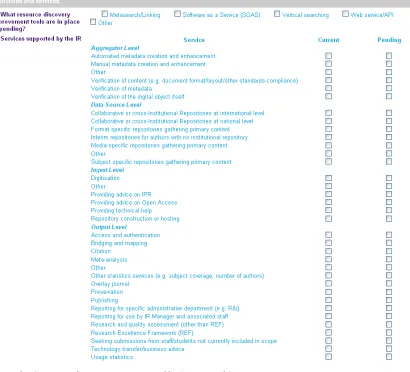
Figure 2 - Questions about services supported by Institutional Repositories. ... 14
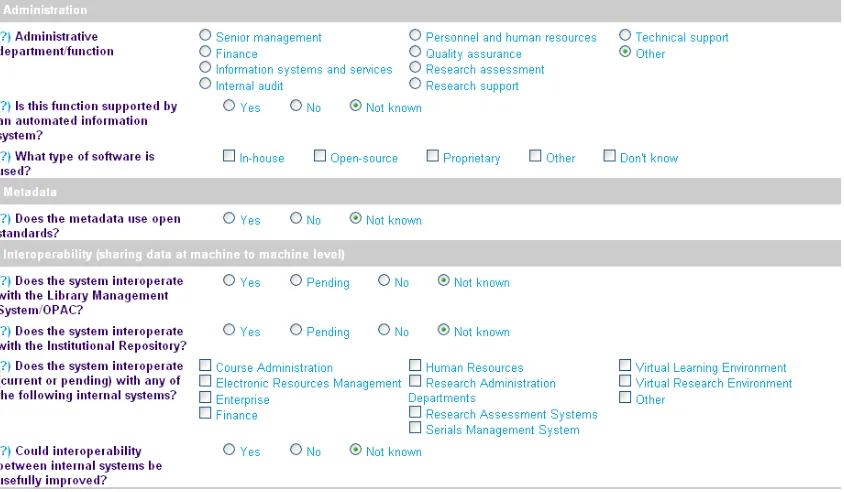
Figure 3 - The OCRIS administrative systems questionnaire. ... 15
Figure 4 - The various software packages used by UK HEI Institutional Repositories. ... 18
Figure 5 - Answers given to OCRIS' questions about interoperability of admin and library systems. . 20
Figure 6 - Responses to the question, "Does the LMS interoperate with the IR?" ... 21
Figure 7 - Responses to the question, "Does the IR interoperate with the LMS/OPAC?" ... 21
Figure 8 - Interoperability between IRs and LMSs. ... 23
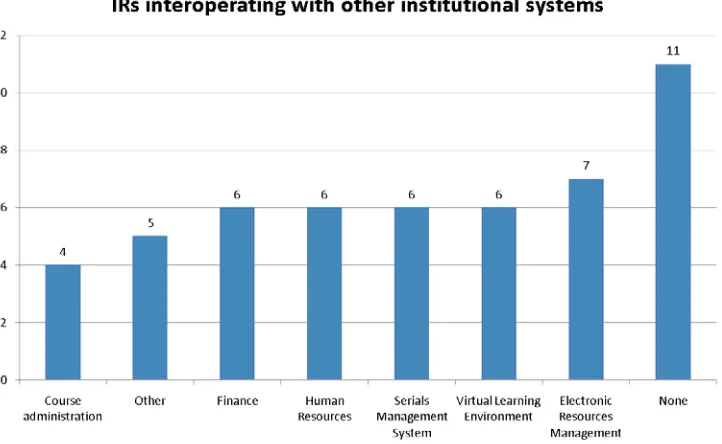
Figure 9 - Various institutional systems with which IRs interoperate. ... 24
Figure 10 - Various institutional systems with which LMSs interoperate. ... 24
Figure 11 - Services currently supported by IRs. ... 26
Figure 12 - Services which will be supported by IRs. ... 27
Figure 13 - Services offered by LMSs. ... 29
Figure 14 - Use or planned use of what OCRIS terms "integration services" within LMSs and IRs. .. 31
Figure 15 - Venn diagram showing scope overlap between IRs and LMSs in HEIs. ... 32
Figure 16 - Classification and subject schemes being used within IRs and LMSs. ... 33
Figure 17 - Name authority schemes being used within IRs and LMSs. ... 33
Figure 18 - A pre-print held in Glasgow's DSpace Service. ... 39
Figure 19 - Partial record for the post-print version held in Enlighten. ... 40
Figure 20 - UCCA bibliographic records for the magazine Design, published from 1949 - 1999. ... 41
Figure 21 - The Search by Year interface of Design Online. ... 41
Figure 22 - Doctoral Thesis defended at the TFTS department at Glasgow, with embargo period imposed. ... 42
Figure 23 - Extract from the CogPrints repository's "Browse by Subject" menu. ... 43
Figure 24 - An edited version of results retrieved from e-Prints Soton, showing duplication of bibliographic records between e-Prints and ECS e-Prints (fig.25). ... 44
Figure 25 – The corresponding records in ECS e-Prints. ... 44
Figure 26 - Extract from the University Structure hierarchy used in e-Prints Soton. ... 45
Figure 27 - Extract from CogPrints with Research Group structures implemented as a menu. ... 45
Table of Tables Table 1 - Interoperability and integration enabling features of LMSs used by in scope HEIs. ... 17
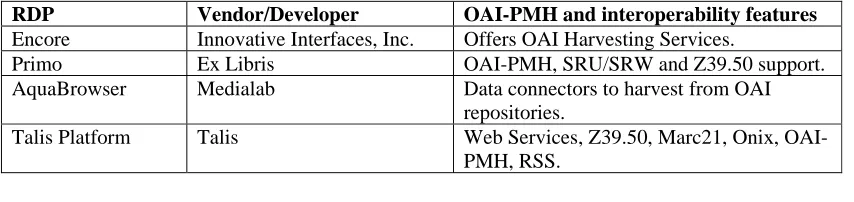
Table 2 - OAI-PMH and interoperability focussed features of RDPs used by in scope HEIs. ... 18
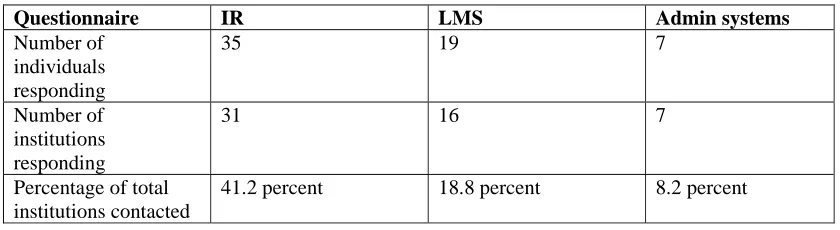
Table 3 - Number of responses received to the OCRIS questionnaires, by group. ... 19
Table 4 - Number of responses received to the OCRIS admin systems questionnaire, by department.19 Table 5 - Conflicting questionnaire responses. ... 22
Table 6 - Interoperability of LMSs and IRs across the group of HEIs - both before and after the introduction of a new category to resolve conflicting data. ... 23
Table 7 - Services currently supported by IRs. ... 25
Table 8 - Services currently supported by LMSs. ... 28
Table 9 - Integration services in place or pending in IRs. ... 30
Acknowledgements
The OCRIS Project was funded by the JISC Scholarly Communications Working Group (SCG) as part of the JISC's Information Environment Programme and their contributions are gratefully acknowledged.
The participation of Cambridge University Library and the University of Glasgow Library were essential to Workpackage 3 of OCRIS and invaluable to our research in more general terms. The Project Team would therefore like to thank the following individuals:
Barbara Bültmann: DSpace@Cambridge Support and Liaison Officer, Cambridge University. Marie Cairney: Principal Library Assistant, University of Glasgow.
Ed Chamberlain: Systems Librarian, Cambridge University.
Patricia Killiard: Head of Electronic Services and Systems, Cambridge University. William Nixon: Deputy Head of Library Information Systems, University of Glasgow. Elin Stangeland: DSpace@Cambridge Repository Manager, Cambridge University. Karen Stevenson: Library Systems Administrator, University of Glasgow.
Rosemary Stenson: Head of Cataloguing, University of Glasgow.
Hugh Taylor: Head, Collection Development and Description, Cambridge University.
Individuals who pilot tested the three online OCRIS questionnaires, devised and administered under Workpackage 1, provided us with much useful feedback and advice. They are:
Chris Awre: Head of Information Management at the University of Hull.
Alan Dawson: Programmer at the Centre for Digital Library Research, University of Strathclyde. Emma McCulloch: Research Co-ordinator at the Centre for Digital Library Research, University of Strathclyde.
Alan Slevin: Institutional Repository Manager, University of Strathclyde. Judith Smart: Systems Librarian, University of Strathclyde.
Hugh Taylor: Head, Collection Development and Description, Cambridge University. April Woods: Directorate Administrator, Information Resources Directorate, University of Strathclyde.
Ben Wynne: Programme Manager (Information Environment), JISC Executive.
Chris Awre and Alma Swan (External Consultant and Director, Key Perspectives Ltd.) are also thanked for granting us permission to use their ontology of Institutional Repository Services within the OCRIS questionnaire.
Others who contributed informally to the project via email should also be thanked for their contributions:
Jenny Delasalle: E-Repositories Manager, Research & Innovation Unit, University of Warwick Library.
Stuart Hunt: Data Services Manager, the Library, University of Warwick.
Dr. Heather V Haskins: Project Officer, MERIT (Making Excellent Research Influential and Transferable).
Stuart Halliday: Technical Services Manager, Information Services, University of Sunderland. Simon Kerridge: Head of Graduate Research Support & Assistant Director (Research), Academic Services, University of Sunderland.
Linda Noble: Head of Library and Information Services, National Marine Biological Library, Marine Biological Association.
Executive Summary
Context
What is an Institutional Repository (IR) and what should be its role? Library Management Systems (LMSs) and their Online Public Access Catalogues (OPACs) have traditionally been used by HE institutions to provide information about the publications and other bibliographic output of the organisation. Although this role is well-established, the development of IRs potentially conflicts and overlaps with these functions.
Library and repository systems are undergoing intensive development to adapt to the demands of a digital, networked environment, taking into account changing technologies, user behaviours, and research and service agendas of institutions - yet links between these and other HEI systems are often non-existent or inadequate.
There is little evidence that the range of institutional, departmental, subject or format specific IRs and OPACs used in UK HEIs are being developed with shared workflows, re-use of data, or other considerations of efficiency. This inhibits the development of services such as the production of management reports or publications lists for research assessment and planning. It also inhibits internal and external end users wishing to easily access the institution’s rich range of documentary output.
Interoperability between systems is a key mechanism for improving this situation. This is under-pinned by accurate metadata, the re-use of data and, where possible, open standards. These allow, for example, the derivation of system and function specific information from a single master record. Fragmentation must be avoided. Interoperability should be built into the workflows of relevant institutional systems, including administrative processes dependent on such metadata; all institutional stakeholders managing information systems should be involved in discussions about how this can be achieved.
The aims and objectives of OCRIS were to:
• Survey the extent to which repository content is in scope for institutional library OPACs, and the extent to which it is already recorded there;
• Examine the interoperability of OPAC and repository software for the exchange of metadata and other information;
• List the various services to institutional managers, researchers, teachers and learners offered respectively by OPACs and repositories;
• Identify the potential for improvements in the links (e.g. using link resolver technology) from repositories and/or OPACs to other institutional services, such as finance or research
administration;
• Make recommendations for the development of possible further links between library OPACs and institutional repositories, identifying the benefits to relevant stakeholder groups.
Key Findings
Interoperability and services
1. Interoperability between IRs and LMSs in UK HEIs is currently rare - only 2 percent of questionnaire respondents state that their systems definitely interoperate, with a further 14 percent stating that interoperability is pending.
2. Interoperability of either of these system types with some type of other institutional system is moderately high, and is slightly higher for LMSs than IRs.
3. Interoperability between LMSs or IRs and a range of other institutional systems is limited. It cannot be said that interoperability is substantial or that a wide variety of administrative systems interoperate with any individual library system.
5. Services stemming from library systems are limited and narrow, excepting the generation of usage statistics and metadata enhancement services.
6. The generation of reports for specific administrative departments is not a common service offered by either IRs or LMSs.
7. The most popular service offered by IRs remains "advice on Open Access" suggesting perhaps that they are still in their infancy, still require explanation thus have yet to spread their wings in terms of widening their range of services.
8. The use of metasearch/linking tools as well as web services and APIs is moderately popular within LMSs and IRs; the data gathered is not sufficient to discern why or what these tools and services are being used for.
Duplication and scope
1. There is significant scope overlap (81 percent) for all item types held in IRs and OPACs. 2. The scoping distinctions and boundaries for IRs and OPACs are becoming increasingly
blurred, with many IRs containing bibliographic data and OPACs containing links to full text. 3. Duplication at both record and item level is frequent, especially for print/electronic copies of
theses or journal articles.
4. For many OPACs and IRs, any type of content is in scope, regardless of the items currently recorded or held.
5. Links between print (OPAC) and electronic (IR) copies of theses are frequently instantiated within both systems.
6. Linking for content other than theses is not common. However, within some IRs link resolvers are beginning to be used to direct users to related library holdings.
7. Some HEIs are choosing to expose both OPAC and IR data through the use of Resource Discovery Platforms (RDPs) which offer "vertical search" functionality. The popularity of these systems seems likely to increase.
Authority control and description
1. Authority control within LMSs is high; format and content standards are well supported, with MAchine-Readable Cataloguing (MARC) standards and Library of Congress Subject
Headings (LCSH) the most commonly used alongside local authority lists.
2. In IRs there is little authority control for subjects, and only a moderate amount of effective classification. In-house lists are predominantly used for the construction and maintenance of name authorities.
3. Within Institutional Repositories standards are not applied adequately and often not at all.
4. There are frequent inconsistencies and a lack of completeness in statements made on both IR and OPAC Web pages about item types and scoping.
5. Modifications allowed to the item and format fields of DSpace or EPrints software, and the presentation of administrative or outdated terms by LMSs within their search/browse lists, undermines consistency, standardisation and clarity for end users, across the sector.
6. The use of vocabularies and standards within library systems in any given HEI is fragmented and disjointed; there is little commonality in resource description.
7. LCC is frequently used within EPrints repositories as the top levels come bundled with the software; however there appears to be some confusion in the IR community about the distinction between Library of Congress Classification (LCC) and Library of Congress Subject Headings (LCSH). This is clearly significant, suggesting limited knowledge and expertise of professional standards within the IR community.
9. There is an increasing awareness of the role that could be played within Institutional Repositories by institutional IDs.
10. There will be an increased role for institutional (or even international, if one is to be more ambitious) personnel and group identity management schemes to enable authentication, access to services and the gathering and compilation of data for internal and external purposes.
10.1. Supporting this can become time-consuming as HR-produced codes or the
relationship between a department and the University hierarchy may be subject to constant change. Keeping records up-to-date can therefore be an ongoing challenge.
11. Resource Discovery Platforms (RDPs), because of their nature (for example, the use of "tag clouds") reveal inadequate metadata in catalogue records more readily than do other interfaces. 12. RDPs are only a partial solution to making all relevant items visible to users in one place; they
may present search results in ways not best suited to the scholarly needs of higher-level end users and do not necessarily reveal the richness of a library's collections.
Flexibility and working practices
13. The fragmentation or disconnectedness of HE information systems puts a strain on the abilities of cataloguers/bibliographic services staff to work effectively across both IRs and LMSs or for shared workflows to be developed across departments.
14. Lack of resourcing puts a strain on the abilities of cataloguers/bibliographic services staff to work effectively across both IRs and LMSs or for shared workflows to be developed across library departments.
15. Administrative staff and the systems with which they work are not sufficiently involved in cross-departmental collaborations with library systems staff.
Recommendations
To Higher Education Institutions
1. Expose all LMS and IR records for harvesting and linking (except in cases where legal requirements restrict such data re-use) via distributed/federated/meta search using technical protocols such as OAI-PMH, Z39.50, SRU/SRW or link resolvers, as appropriate to the technical infrastructure.
2. Improve co-ordination between all departments possessing institutional information-gathering systems and their staff, with support at the highest levels of the institution, in order to develop efficient workflows, reduce un-necessary duplication of effort and formalise collaboration.
3. Align the systems of both libraries and administrative departments, and their attendant data-processing practices, more closely.
4. Consider establishing a centralised system and attendant workflows for cross-checking and cleaning metadata that is to be shared between systems, to ensure quality, usability and re-usability by both internal and external service providers.
5. Consider options other than batch processing (such as web services or applications, underpinned by open standards) where administrative departments are sharing data with library systems.
6. Develop clear policies on the scopes and uses of IRs and OPACs.
7. Present clearly, comprehensively and comprehensibly, to both staff and end users, the scopes of IRs and OPACs.
8. Develop a single scheme for describing item types/formats and scope within OPACs and IRs, with interoperability requirements and local needs fully accounted for.
8.1. This scheme should be tested with a variety of users (teaching staff, researchers and undergraduates) to ensure it speaks to their needs and is understood by them.
8.2. If JISC act on recommendation A above, library staff should be allowed to attend meetings and contribute to the formulation of a cross-institutional scheme, with local needs discussed as part of the activities of the group.
9. Ensure the use of format and content standards within IRs to avoid the need for future "retro-conversion" or "re-keying".
10. Support the interoperability of subject authorities across institutional systems if common ones are not appropriate – this might build on the work of existing mapping and switching projects such as OCLC's Terminology Service Pilot and the High-Level Thesaurus Project (HILT).
11. Use interchange formats and cross-walks based on open standardsmore widely and extensively, to assist in the sharing and exchange of records conforming to different format and content standards.
12. Reassess the use of Library of Congress Classification (LCC) within IRs; staff should be familiar with the distinction between LCC as a classification system and LCSH as a subject heading system in order to determine whether these schemes meet the needs of their users and whether they accurately reflect their repository collections/items.
13. Establish controlled name authority lists for staff throughout the institution using agreed, recognised standards, to be made available to all relevant departments.
14. Develop (or if already in place, make consistent use of) persistent, institutional or departmental IDs, making these available internally and to other institutions.
between various systems. The IDs would become the "glue" allowing information to be disambiguated.
14.2. These IDs should be built into metadata workflows and be usable by both staff and end users. Person and role information from various institutional systems should be "warehoused" and made available as "a rich source of contextual metadata" (Green, 2007).
15. Recognise that LMSs are a rich source of bibliographic information on books, book items, monographs, conference proceedings and other items authored by institutional staff (which may not be recorded in an IR) hence an interoperable LMS could be leveraged for research assessment data gathering activities or for use within Research Management Systems.
To JISC
A. Formulate and promote a standardised, controlled vocabulary describing item types, formats and scope, for use across HEI libraries, created in consultation with staff from those libraries and their institutions.
B. Promote the development of, and collect, unique numeric, institutional identifiers derived from HEI HR systems to be shared amongst institutions and used as a field to which author/creator names can be mapped, within and across institutions. If desirable these might be mapped against RAE person identifiers or HEFCE institutional identifiers.
C. Support the interoperability of subject authorities within and between institutions – this might build on the work of existing projects such as OCLC's Terminology Service Pilot or the High-Level Thesaurus Project (HILT).
D. Raise awareness of the impact of current work-practices on future needs (in particular, the need to both utilise open standards to support data linkage within and across institutional systems, as the Semantic Web continues to develop).
E. Create recommendations on where, or consider developing a service through which, libraries can source high-quality, openly available, "clean" bibliographic records with guarantees that these can be freely re-purposed and edited. This would allow HEI libraries greater certainty about the utility and cost-effectiveness of record-sharing.
F. Investigate further, and in depth, the interoperability of administrative systems and the opinions of staff working with them, without placing undue emphasis on library systems.
1.
Background
OCRIS builds on the work of many previous projects and reports including: Linking institutional repositories (Swan and Awre, 2006), the JISC & SCONUL Library Management Systems Study (JISC and SCONUL, 2008), IRI-Scotland (Institutional Repository Infrastructure for Scotland), and ongoing investigations into the Research Excellence Framework (REF) such as the JISC support project for HEFCE's REF bibliometrics pilot exercise (Higher Education Funding Council for England, 2009). OCRIS also considered the objectives of local projects such as the Welsh Repository Network (WRN) (Wales Library Education Forum, 2009), 'Metadata Enrichment for Repositories in a London
Institutional Network'(MERLIN) (JISC, 2009a) and 'Enlighten and Research Integration' (ENRICH) (JISC, 2009b), all of which were informative to our analyses.
The context within which the project sits is broad, the needs and priorities of the full range of stakeholders associated with HEIs (from funding bodies and top-level University management to library systems and services staff, researchers, undergraduate students and the wider community) being of direct relevance.
85 UK HEIs have at least one Institutional Repository (IR) (with others planned for many, if not most, of the remainder) and all have an Online Public Access Catalogue (OPAC) - thus clear, solid
recommendations on how to marry the functionality of the two systems are urgently needed.
There is debate about what exactly an IR is and what its role should be; although the OPAC
(traditionally used for the dissemination of publications associated with the library's parent institution) is well-established, its scope and role are increasingly also being re-imagined. Logic dictates (and evidence shows) that Library Management Systems (LMSs) already hold much metadata pertaining to IR items - thus IRs should theoretically supplement the OPAC.
Developments are intensive - both LMSs and OPACs are changing and adapting to the demands of a networked world, the popularity of Google, "Web 2", "Web 3", and to the research and service agendas of their institutions. All are informed by stark economic and other competitive pressures. Yet, reviewing the literature, it is hard not to conclude that there are many divergent discourses around the enhancement of LMSs and OPACs, and that opinion is divided as to the direction and pace of future development, with little clear co-ordination or collaboration - both at institutional level and beyond.
The House of Commons Science and Technology Committee (2004) has stated that a "secure central archive for digital publications [is] essential to ensuring that today's research findings are not lost to the future"; in terms of HEIs, LMSs and IRs must begin to interoperate if this is to be achieved and if useful services are to stem from such an archive.
These services might include: an internal auditor or external assessment agency gathering data about an institution's research output; a member of staff compiling RAE/REF returns by interrogating the various catalogues; the generation of comprehensive publications lists for a particular author or subject area, for use within a taught course. If items are essentially siloed in separate systems that do not communicate with one another, such outcomes cannot be readily achieved. Application and information integration must be guaranteed, with the consistent application of metadata standards playing an essential role.
It is clear that there will be a place in any future "interoperable ecosystem" for emergent tools and technologies such as Resource Discovery Platforms (RDPs), "add-ons" which help users enter metadata consistently and correctly, and Service Oriented Architectures (SOAs).
2.
Aims and Objectives
The aims and objectives of OCRIS were to:
• Survey the extent to which repository content is in scope for institutional library OPACs, and the extent to which it is already recorded there;
• Examine the interoperability of OPAC and repository software for the exchange of metadata and other information;
• List the various services to institutional managers, researchers, teachers and learners offered respectively by OPACs and repositories;
• Identify the potential for improvements in the links (e.g. using link resolver technology) from repositories and/or OPACs to other institutional services, such as finance or research
administration;
• Make recommendations for the development of possible further links between library OPACs and institutional repositories, identifying the benefits to various stakeholder groups.
Each of these aims was fulfilled satisfactorily.
3.
Methodology
Using a combination of qualitative and quantitative research methods the project utilised desk research, purposive sampling and analysis, case studies within the libraries of 2 research-intensive HEIs and the deployment of 3 discrete but inter-linked online questionnaires to conduct a survey of all 85 UK HEIs possessing at least one IR. Many relevant practitioners within the IR and LMS
communities commented on the project informally, via email or telephone conversations.
Using this mixed approach we were able to gather a large amount of numerical, factual and discursive or attitudinal information. Taken together, this constitutes a detailed description of the LMSs/OPACs and IRs in operation within in-scope UK HEIs and (to a much lesser though still illustrative extent, associated administrative systems), the services currently offered in or being developed for the 3 types of systems, and the views of those professionals working with them.
Although the questionnaire was one major component of the project (and the basis of Workpackage 1), combining it with other instruments meant that the project was able to gain a far broader picture with which to complement its data; the methodology also provided an in-built mechanism which could compensate for any low response rate or inconclusive data. Speaking directly to those working on the "front line" (through the case studies and informal discussions) and assessing HEI systems independent of any mediation (the purposive sampling) allowed for the aggregation of far more data than would have been possible using a questionnaire alone. This combination of methods was critical to the formulation of robust conclusions and recommendations.
There were 5 distinct workpackages, each flowing logically into the next with a degree of overlap where appropriate. These were as follows:
Workpackages
1. Questionnaire
This entailed the preparation and execution of 3 online web questionnaires. The first asked systems librarians and cataloguers about their LMSs. The second asked repository managers and staff about their IRs.
Both groups were asked questions about how their systems are implemented, which standards are in use, whether they interoperate with other institutional systems, and a range of related issues including which services are currently supported. They were asked whether or not they perceive a need for systems to interoperate and were given space for additional comments and corrections.
staff) to provide details of the systems and standards they utilise and whether or not these interoperate with other institutional systems.
2. Desk research, sampling and analysis
Having identified HEIs with both OPACs and IRs, a purposive sample of these (10 in total) was selected. Establishing which item types were in scope for the OPACs and IRs, each sub-sample of institutional systems was interrogated at User Interface (UI) level in order to identify and retrieve records for which examples of overlap or duplication might be found (for example, a record for the same thesis, held by both the IR and the LMS). Using these records, many issues and problems stemming from duplication, arrangement and description were explored.
3. Case Studies
Two short case studies carried out over the course of several days at two research intensive
institutions provided a chance to discuss, examine and expand on the questions posed by the research. What issues, barriers and challenges face professionals working with OPAC and IR development in both established workflows, and in the wider context? How do these relate to the wider agendas of institutions? How are these institutions establishing links between their LMSs, IRs and other systems and what are their visions for the future?
4. Conclusions, Recommendations, Final Report and Action Plan
A set of Conclusions and Recommendations of use to a wide range of stakeholders, detailing the technical, organisational and perceived issues relating to OPACs and IRs in UK HEIs were developed within Workpackage 4. These suggest how problems might be solved at technical, semantic,
organisational, and cultural levels and aim to reflect the unique and diverse situations of UK HEIs as well as acknowledging commonalities. They also suggest future work which might be done in this area.
5. Dissemination
Sharing findings and recommendations with the wider community will be achieved through publications, presentations, and the use of mailing lists, attendance at relevant conferences and, potentially, the feeding of outputs into ongoing and future projects.
4.
Implementation
4.1.Questionnaires
The OCRIS questionnaires comprised web-forms (at User Interface level) and a Microsoft Access Database (as the "back-end"), designed and implemented by the Principal Investigator, hosted internally at the CDLR and administered by the project team.
Using internet-based desk research, drawing on existing knowledge of and contacts within UK HEIs and using the Registry of Open Access Repositories (ROAR), the Directory of Open Access
Repositories (OpenDOAR), the JISC & SCONUL Library Management Systems Study (JISC and SCONUL, 2008) and The University of Illinois OAI-PMH Data Provider Registry, information was compiled to help construct questions. Where helpful this data was pre-loaded into the questionnaire to make the process of answering less time-consuming for respondents and to demonstrate engagement with the community.
The bottom half of the form asked about services offered by (or planned for) library systems using a list based largely on the ontology proposed in Linking UK Repositories (Swan and Awre, 2006).
While this list was not entirely applicable to LMSs, devising a distinct list for LMSs of equivalent granularity would have required a separate scoping exercise and utilised time and resources beyond those the brief 3 month project could supply. Furthermore, it would have introduced a level of incompatibility at the data analysis stage which could have compromised project findings. The guidance notes were used to explain why the list had been chosen.
While the questionnaires for IRs and LMSs were largely similar, the one designed for administrative staff had, by necessity, to be quite distinct given the wide ranging, non-library nature of the systems coming under the umbrella of "administrative". Further, the unfamiliarity of the OCRIS team with technical details of administrative systems and the likelihood that that stakeholder group would have less time (or inclination) to participate, deterred production of an overly-long or complex form.
In this we asked only 8 (rather than 15) questions, included additional space for comments, focussed on key points such as whether the systems supported Open Standards or interoperated with any library systems.
Figure 1 - Questions about item types and scope.
[image:14.612.103.513.298.670.2]Figure 3 - The OCRIS administrative systems questionnaire.
The answers recorded in the database allowed us to address the aims of the project from a solid evidential basis. Additionally, comparing these responses to the findings of the in-depth sampling revealed inconsistencies between answers supplied via the questionnaire (for certain HEIs) and the data uncovered by desk research.
A mailing list was constructed with the email addresses of 1149 Systems Librarians, Repository Managers, Bibliographic Services staff, Finance, Research Co-ordination, HR and Information Systems and Services departments. 262 individuals were contacted regarding the IR questionnaire; 280 regarding the LMS/OPAC questionnaire; 599 the Administrative Systems questionnaire and 8 additional contacts from AHDS and SHERPA LEAP.
A major risk of the project was that there would be a low response rate to the questionnaire, especially given the time of year (summer vacation) during which it was administered. Although the response from the IR community was satisfactory (41 percent), responses coming from the other two groups were less so (LMS, 18.2 percent; administrative systems, 8.2).
4.2.Sampling and in-depth analysis
OCRIS devised a workflow by which to investigate LMSs/OPACs and IRs within 10 HEIs deemed (both individually and as a group) to be representative of a particular facet of the project and its context. This purposive sampling provided a snapshot of the current situation regarding duplication of both records and scope between bibliographic/publication systems, the way item types are described and curated, the implementation and customisation of the software being used and the extent to which links are being made between the two systems.
The 10 institutions chosen were:
The Universities of Aberystwyth, Cambridge, Cardiff, Glamorgan, Glasgow, Hull, Southampton, Strathclyde, the University College of the Creative Arts and the National Marine Biological Library (which serves 3 multidisciplinary marine research centre organisations).
4.3.Case Studies
Two case studies were carried out within large research dominated HE libraries. By discussing the aims of the OCRIS project with staff at the University of Cambridge and the University of Glasgow, (see Appendix 3) specific issues pertaining to systems development, workflows, the selection of technologies, the agendas of the institutions and the concerns of those working with LMSs and IRs on a daily basis, were made clearer and more meaningful to the project team.
4 days were spent speaking to staff from the Cambridge University Library and 2 days with staff from the University of Glasgow Library. In both instances these discussions were supplemented with follow-up questions and discussions via email.
At the outset of each visit a Microsoft PowerPoint presentation1 was given explaining the nature and purpose of OCRIS. This detailed some of the information which had been gathered in Workpackages 1 and 2 and outlined to participants what was hoped for from their involvement. The presentation was also used as a structural aid to inform discussion and concluded with specific questions to be
answered by those present. Informal discussions with participants (both as a group and with selected individuals) occurred and the OCRIS team were shown relevant documentation pertaining to catalogues, repositories and workflows. To provide further insight, the staff interfaces of both "DSpace@Cambridge" and "Enlighten" at Glasgow were demonstrated for the project team.
5.
Outputs and Results
The main outputs and results of the project are:
• A list of IRs and OPACs being used by UK HEIs, identifying (within responding institutions), those which do/do not interoperate/integrate;
• A list of services currently offered or desired by those working within responding HEIs;
• Analysis of a purposive sample of HEI IRs and OPACs which share or duplicate content or metadata;
• Case studies on the socio-political, technical and workflow-related issues pertaining to IR and LMS/OPAC use and development within the libraries of the Universities of Cambridge and Glasgow;
• Recommendations for the development of possible further links between library OPACs and Institutional Repositories, identifying the benefits of such links to various stakeholder groups.
In line with the project Aims and Objectives we also report on:
• The extent to which repository content is in scope for institutional library OPACs, and the extent to which it is already recorded there;
• The potential for improvements in the links (e.g. using link resolver technology) from repositories and/or OPACs to other institutional services, such as finance or research administration.
In the sections below the following are considered:
1. IR and LMS systems software across all 85 institutions in scope for OCRIS 2. Interoperability of the systems described to us by questionnaire respondents 3. Services currently supported by the LMSs and IRs of questionnaire respondents 4. Resource discovery services and tools in place or pending in responding HEIs. 5. Scope overlap of the LMSs and IRs of questionnaire respondents
6. Authority Control
7. Summary of analysis of in-depth studies 8. Summary of main findings of the Case Studies
5.1.LMS and IR systems and software
Below are details pertaining to the LMSs and OPACs used by the libraries in scope for OCRIS. This information was gathered through desk research.
LMS/OPAC Vendor # of
installations
Interoperability or integration features2
Aleph/WebOPAC ExLibris 16 Open architectures used. Web
services based APIs.
Alto/Prism Talis 22 'Talis Platform' (used by the
externally hosted Prism OPAC User Interface) comprises web services using standard protocols.
Heritage OPAC/Heritage ISOxford 5 None detailed.
Horizon/HiP (discontinued).
SirsiDynix 1 None detailed.
Millennium/UNICat Innovative Interfaces, Inc.
2 Web services to share data; Service
Oriented Architecture; support for record import from other systems; RSS feeds. XML harvester. Millennium/WebPAC Pro Innovative
Interfaces, Inc.
15 As above.
Millennium/INNOPAC Innovative Interfaces, Inc.
1 As above.
Unicorn/iLink (Unicorn is now known as
Symphony).
SirsiDynix 14 Web services API for use with
Unicorn modules.
Voyager/WebVoyage Ex Libris 11 Web services based APIs. Open
architecture used.
CALM for Archives Axiell 3 None listed.
Cheshire for Archives Berkeley and the
University of Liverpool
1 Fully documented API; SRU,
[image:17.612.93.520.594.695.2]OAI-PMH interfaces.
Table 1 - Interoperability and integration enabling features of LMSs used by in scope HEIs.
Not all of these systems are being developed with a clear and comprehensive focus on interoperability.
While the notion of linking library systems is now accepted, integration between IRs and LMSs is generally being built from scratch into new "vertical search" platforms and products, enabled by the use of Web Services and APIs within the core LMS. This is part of a "de-coupling" of systems, with a focus on the end user; these Resource Discovery Platforms (RDPs) can be placed "on top" of the LMS, supplementing or replacing the "traditional" OPAC. The interoperability/integration services of some well known examples are summarised below:
RDP Vendor/Developer OAI-PMH and interoperability features
Encore Innovative Interfaces, Inc. Offers OAI Harvesting Services.
Primo Ex Libris OAI-PMH, SRU/SRW and Z39.50 support.
AquaBrowser Medialab Data connectors to harvest from OAI
repositories.
Talis Platform Talis Web Services, Z39.50, Marc21, Onix,
VuFind3 Villanova University, Falvey Memorial Library
Provides an OAI content provider service to allow for harvesting of records.
Table 2 - OAI-PMH and interoperability focussed features of RDPs used by in scope HEIs.
[image:18.612.98.527.185.421.2]In the chart below, the continuing dominance of EPrints as the IR software of choice (with DSpace a distant second) within the 85 institutions and across their 115 IRs is clearly visible:
Figure 4 - The various software packages used by UK HEI Institutional Repositories.
3
VuFind is an Open Source platform and offers many of the same functions as the other RDPs listed above but it is entirely modular and customisable. In the United States, it is already being successfully used as an interface for the Union Catalogue of Minnesota State Colleges and Universities on top of an Aleph LMS. See:
http://plus.mnpals.net/ for more information. [Accessed 30th September 2009].
5.2. Interoperability
The following sections are based on responses to the OCRIS questionnaires. Totals were as follows:
Questionnaire IR LMS Admin systems
Number of individuals responding
35 19 7
Number of institutions responding
31 16 7
Percentage of total institutions contacted
[image:19.612.92.512.118.233.2]41.2 percent 18.8 percent 8.2 percent
Table 3 - Number of responses received to the OCRIS questionnaires, by group.
Administrative departments responding, by role were:
Department Number responding to questionnaire
Information Systems and Services 1
Research Support 2
Research Assessment 2
Finance 1
Internal Audit 1
Table 4 - Number of responses received to the OCRIS admin systems questionnaire, by department.
Whilst undoubtedly the IR community found the aims of OCRIS more relevant to their own attitudes and priorities than did other stakeholders, the active participation in the project by professionals working with other institutional information systems indicates some wider awareness of the issues and benefits of interoperability.
However, given the low percentage responses for the non-IR stakeholders contacted, many of the figures and charts below should be taken to be illustrative rather than representative.
5.2.1. Administrative Systems
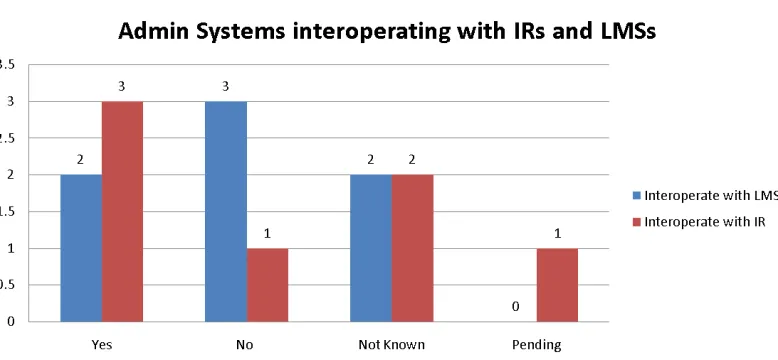
When asked, "Do your systems use Open Standards?"
• 2 respondents answered Yes
• 1 answered No
• The remaining 4 answered Unknown.
When asked, "Do you interoperate with the LMS?"
• 3 respondents answered No
• 2 answered Yes
• 2 said Not Known.
In response to the question, "Do you interoperate with the IR?"
• 3 answered Yes
• 1 No
• 2 Not Known
• 1 pending.
[image:19.612.91.513.269.344.2]Figure 5 - Answers given to OCRIS' questions about interoperability of admin and library systems.
Of those whose systems interoperate with the IR: 1 works within Research Assessment; 1 within Information Systems and Services; 1 within Internal Audit; and 1 (the respondent who answered "pending") within Research Support.4
Of those whose systems do interoperate with the LMS, 1 works within Information Systems and Services, the other with Internal Audit.
The greater number of systems interoperating with IRs may suggest that administrative departments find the information held in IRs to be more relevant or beneficial to the work carried out in
conjunction with their own systems, than they do the information contained in LMSs. However, far more data would need to be gathered in order to determine if this observation is accurate.
No respondents said that they found improving interoperability to be an issue of no importance; but there was some uncertainty. 4 respondents answered "Yes" when asked "Is improving interoperability important?" and 3 selected "Not Known".
One respondent stated: "We are currently reviewing our research information management systems. We are looking at both buying an off-the-shelf product that would allow interoperability between all of our systems, and at the feasibility of updating our current system to allow interoperability. Our aim is to have a complete, fully integrated research information system by the end of next year."
Another wrote: "We currently have an in-house Research Expertise system used for research admin/assessment which links to our IR and other corporate systems as indicated. We are about to (i.e. have chosen supplier and aim to implement by end of the year) replace this with a proprietary system using CERIF as the core data model and CERIF-XML as the exchange format between systems [www.eurocris.org]. We harvest data from 3rd party sources such as ISI and PubMed for journals and similar output; but we manually input metadata on books; so what would be useful would be authoritative source(s) of metadata for non journal items that could be harvested in CERIF-XML; similarly it would be useful to have access to authoritative lists of journals and publishers in this way."
Enthusiasm and knowledge about interoperability is clearly being demonstrated; this highlights the need for future work to be done allowing these issues to be investigated in more depth, perhaps without specific reference being made to library systems and perhaps focussed on Current Research Information Systems (CRISs) or Research Management Systems (RMSs).
4
5.2.2. LMSs and IRs
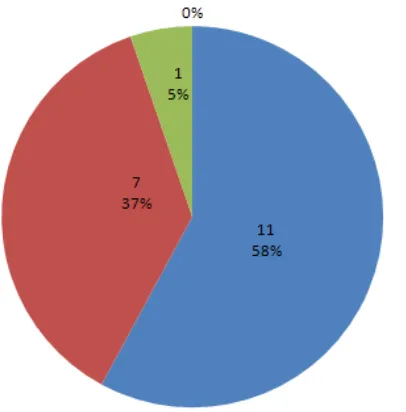
One of the most significant questions for the OCRIS project was "Do your Library Management Systems and Institutional Repositories interoperate?" Answers were as follows:
Interoperability between LMSs and IRs
[image:21.612.165.368.151.357.2]Figure 6 - Responses to the question, "Does the LMS interoperate with the IR?"
Interoperability between IRs and LMSs
[image:21.612.157.391.434.633.2]The totals shown in the above pie charts appear neatly illustrative. However, calculating percentages and numbers for the entire group of respondents (i.e. combining both the LMS and IR questionnaire answers) was complicated by both multiple entries for the same institution and contradictory answers between the two groups, relating to the same systems.
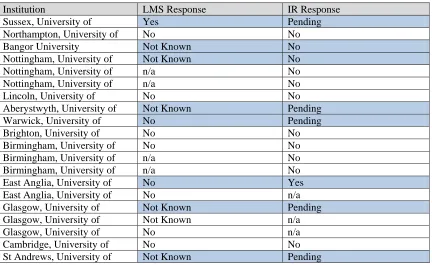
This is illustrated in the table below, which shows answers given to the questions "Does the LMS interoperate with the Institutional Repository?" (Column 2) and "Does the IR interoperate with the LMS/OPAC?" (Column 3). The data which had to be cleaned up or otherwise resolved is shaded.
Institution LMS Response IR Response
Sussex, University of Yes Pending
Northampton, University of No No
Bangor University Not Known No
Nottingham, University of Not Known No
Nottingham, University of n/a No
Nottingham, University of n/a No
Lincoln, University of No No
Aberystwyth, University of Not Known Pending
Warwick, University of No Pending
Brighton, University of No No
Birmingham, University of No No
Birmingham, University of n/a No
Birmingham, University of n/a No
East Anglia, University of No Yes
East Anglia, University of No n/a
Glasgow, University of Not Known Pending
Glasgow, University of Not Known n/a
Glasgow, University of No n/a
Cambridge, University of No No
[image:22.612.96.528.167.432.2]St Andrews, University of Not Known Pending
Table 5 - Conflicting questionnaire responses.
Devising a "resolving" methodology based on fair supposition, it was decided that the 9 instances5 of contradiction would form a new category called "Contradictory answers". To achieve this, firmer answers were privileged over vague ones (i.e. No over Not Known; Yes over Pending) with the vague answer being re-assigned to "Contradictory answers". Where both Yes and No were indicated, both were re-assigned. Pending was selected over No as it seems to indicate greater knowledge. 2 No, 2 Yes and 5 Not Known answers were reassigned in this way. Admittedly there is margin for error.
The introduction of this new category illustrates the difficulties faced when trying to interpret some of the questionnaire responses with precision (which may be an inevitable consequence of asking more than one individual to answer the same question in expectation of the same answer).
5
The table below summarises the two ways of looking at the data described above:
Answer Interoperability across whole group (totals for each with no correction) No 42
Not Known 7
Yes 3 Pending 6 TOTAL 58
Answer Interoperability across whole group (new category added)
No 40
Not Known 2
Yes 1 Pending 6 Contradictory 9
[image:23.612.91.518.91.257.2]TOTAL 58
Table 6 - Interoperability of LMSs and IRs across the group of HEIs - both before and after the introduction of a new category to resolve conflicting data.
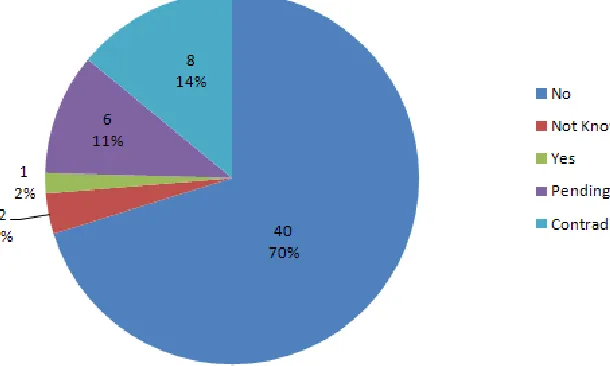
[image:23.612.131.436.379.562.2]The corrected total (with the introduction of our new category) gives the following pie chart:
Figure 8 - Interoperability between IRs and LMSs.
Even disregarding the 14 percent of responses which reveal the conflicting perceptions of staff on this issue and even with some margin for error, it is clear that the vast majority of systems do NOT interoperate with one another. Only two percent of respondents answered in the affirmative. The responses of those who answered that interoperability was "pending" might be added, giving the still low figure of 8 percent.
Figure 9 - Various institutional systems with which IRs interoperate.
Although 31 institutions responded to the IR questionnaire, only 20 of those (64.5 percent, each representing 1 IR) interoperate with other systems; the rest indicated that they currently interoperate with none. Of those 20, 7 interoperate with only 1 other system, 6 with 2, 6 with 3 and 1 with 4.
Figure 10 - Various institutional systems with which LMSs interoperate.
Similarly, 13 of those responding to the LMS questionnaire out of 19 (68.4 percent) stated that they currently interoperate with other institutional systems. Of those 13, 6 interoperate with 4 other systems, 3 with 3, 1 with 2 and 3 with 1.
5.3.Services currently supported
[image:24.612.100.512.386.590.2]key stakeholders, including "end users (researchers across all disciplines, teachers and learners); research administrators, employers and funders, intermediaries working on behalf of any of these groups, and institutions or other bodies with repositories" (page 17).
This perspective fits extremely well with that of the OCRIS project. While the ontology proposed in Linking UK Repositories extends beyond the boundaries of HE, looks at candidate services in greater depth than does OCRIS, and proposes a layered service model, it nevertheless gave the services section of the questionnaires strong theoretical grounding; not least as resource limitations meant the OCRIS team were unable to consult directly with the range of end users listed above.
5.3.1. Institutional Repositories
The services currently supported by IRs are as follows:
Service Number of IRs
supporting service
Providing advice on Open Access 33
Manual metadata creation and enhancement 30
Providing advice on IPR 27
Usage statistics 27
Providing technical help 21
Reporting for use by IR Manager and associated staff 17
Access and authentication 17
Verification of metadata 15
Verification of the digital object itself 14
Verification of content (e.g. document format) 13
Preservation 12 Collaborative or cross-Institutional Repositories at national level 10
Citation 10 Other statistics services (e.g. subject coverage; number of authors) 10
Automated metadata creation and enhancement 9
Seeking submissions from staff/students not currently included in scope
9
Digitisation 8 Collaborative or cross-Institutional Repositories at international
level
7
Reporting for specific administrative department (e.g. R&I) 7
Research and quality assessment (other than REF) 6
Repository construction or hosting 5
Bridging and mapping 5
Research Excellence Framework (REF) 5
Publishing 4 Meta-analysis 3
Subject specific repositories gathering primary content 2
Technology transfer/business advice 2
Other 1
Format specific repositories gathering primary content 1
Interim repositories for authors with no institutional repository 1
[image:25.612.96.515.220.660.2]Media-specific repositories gathering primary content 1
Date: August 2009
[image:26.612.52.737.117.495.2]Date: August 2009
5.3.2. Library Management Systems The services currently supported by LMSs are as follows:
Service Number of LMSs
supporting service
Usage statistics 14
Manual metadata creation and enhancement 12
Verification of metadata 8
Access and authentication 8
Citation 5
Other statistics services (e.g. subject coverage) 5
Automated metadata creation and enhancement 4
Verification of content (e.g. document format) 4
Verification of the digital object itself 2
Digitisation 2 Reporting for specific administrative department (e.g. R&I) 2
Reporting for use by Manager and associated staff 2
Other 1
Bridging and mapping 1
Collaborative or cross-Institutional Repositories at international level 0 Collaborative or cross-Institutional Repositories at national level 0
Format specific repositories gathering primary content 0
Interim repositories for authors with no institutional repository 0
Media-specific repositories gathering primary content 0
Subject specific repositories gathering primary content 0
Providing advice on IPR 0
Providing advice on Open Access 0
Providing technical help 0
Repository construction or hosting 0
Meta-analysis 0 Preservation 0 Publishing 0
Research and quality assessment (other than REF) 0
Research Excellence Framework (REF) 0
Seeking submissions from staff/students not currently included in scope
0
[image:28.612.87.506.107.544.2]Technology transfer/business advice 0
5.3.3. Key findings regarding services offered by LMSs and IRs
It is particularly noteworthy that for both LMSs and IRs, manual metadata creation and enhancement services (63 and 85 percent, respectively) are the second most frequent type of service currently supported after the generation of usage statistics (73 and 77 percent). Reporting services for specific administrative departments is uncommon but twice as frequent in IRs as LMSs (10 percent, 20 percent). Providing advice on IPR (77 per cent) and Open Access is, as might be expected, extremely common (94 per cent) within IRs.
Stripping out IR-centric services clearly not appropriate to LMSs, it becomes clear that only a small number of LMSs are beginning to incorporate services which go beyond what might be considered their "traditional" role - such as citation analysis, digitisation and the verification of digital objects.
Basic services, such as arranging for the provision of adequate, high-quality metadata and monitoring performance, clearly remain more significant parts of the workflow within both IRs and LMSs than do other added-value services.
Although we cannot ascertain from the data exactly how "pending" other services are (i.e. will they be available within the repository soon or are they merely "ideals"?) it is immediately visible how major an influence planning for the REF currently is within UK HE. 17 out of 26 institutions (65 percent) plan to offer services in support of the REF. 3 of the 9 remaining from this 26 already fulfil this function; thus 77 percent of UK HEI repositories responding to the OCRIS questionnaire support or plan to support activities relating to the REF.
There is also some desire to establish "reporting services" for IR managers (46 percent) and other departments (34.6 percent), to generate usage statistics (31 percent) other statistics (31 percent) and to automate metadata enhancement (31 percent).
5.4.Integration services and tools
OCRIS used the term "integration service" as shorthand for some of the services becoming popular - or already - popular within the library systems community, such as metasearch link resolvers and software as a service (SOAS).
Integration services in place or pending in IRs
Integration Service Number of respondents using or planning to use integration service Metasearch/Linking 7
Software as a Service
1
Vertical Searching 4
Web Service/API 10
[image:30.612.94.522.445.646.2]Other 4
Table 9 - Integration services in place or pending in IRs.
Integration services in place or pending in LMSs
Integration Service Number of respondents using or planning to use integration service Metasearch/Linking 13
Software as a Service 3
Vertical Searching 4
Web Service/API 7
Other 2
Figure 14 - Use or planned use of what OCRIS terms "integration services" within LMSs and IRs.
LMSs make greater use of metasearch and link resolvers than do IRs; as discussed further below, some IR developers are starting to realise the potential of using existing library link resolver knowledge databases within their own systems.
Vertical search is something currently being marketed heavily at the LMS community by vendors, and is much discussed; it is a positive sign that this technology is also being considered by those working with IRs but perhaps surprising that not many respondents overall are using or planning to use vertical search (only 17 percent of the total institutions responding) at present.
5.5.Scope Overlap
[image:32.612.119.443.156.504.2]The Venn diagram below illustrates the substantial amount of "overlap" (81 percent) between items which respondents listed as being in scope for their OPACs and IRs. The inner circle shows the set of items common to both groups, the outer one those only in scope for IRs.
Figure 15 - Venn diagram showing scope overlap between IRs and LMSs in HEIs.
The significant finding here is that one set is completely contained within the other; there is not merely overlap – every item type in scope for the OPACs of UK HEIs are now also in scope for IRs. There are only 4 item types unique to IRs.
It is worth qualifying this with an understanding that scope overlap may only be partial - in many instances, an IR will hold a full-text item while the OPAC will hold only metadata about that item, for example, in the case of patents or theses. However, the scoping distinctions and boundaries for IRs and OPACs are becoming increasingly blurred, with many IRs containing bibliographic data and OPACs linking to full text. Thus instances of both partial and full scope overlap are significant.
Some respondents found using the Scholarly Works Application Profile (SWAP) (UKOLN and JISC CETIS, 2008) classification of item types problematic (although guidance was provided on the OCRIS website) as SWAP is not currently supported widely by either LMSs or IRs thus the language it uses is not familiar. The fact that "Conference items" are unique to IRs while "Conference papers" and "Conference posters" are not, may suggest that this data is unreliable.
4 respondents state that they plan to extend the scope of their OPACs; the items currently found to be only in scope for IRs are, perhaps, likely to be recorded in some LMSs soon. 16 respondents to the IR questionnaire state that there are plans to extend scope for their systems.
5.6.Authority Control
[image:33.612.104.497.191.381.2]The following charts illustrate the classification, subject and name authority schemes being used by the LMSs and IRs of those responding to the OCRIS questionnaire:
Figure 16 - Classification and subject schemes being used within IRs and LMSs.
Figure 17 - Name authority schemes being used within IRs and LMSs.
[image:33.612.99.373.443.648.2]popular compared to others. Top-level LCC comes bundled with most versions of EPrints, explaining its comparative frequency within IRs.
Regardless that mappings between many LCC numbers and corresponding LCSH terms are available (despite no intrinsic relationship), it must be stated that there appears to have been some confusion amongst our respondents about LCC and LCSH; some of those responding stated that they use LCSH for subject control, yet (in a few instances) when visiting their repositories, no evidence of this was found – rather, LCC was the standard being used and implemented in "browse by subject" menus.
6.
Summary of analysis of in-depth studies
66.1.Introduction
IRs and OPACs from 9 HEIs and 1 library serving 3 research organisations were selected for in depth investigation in relation to scope overlap, the application and presentation of standards and
duplication at both record and item level.
• Cambridge and Glasgow acted as the OCRIS case study institutions within Workpackage 3 thus they were selected for inclusion.
• Hull is unusual in using Fedora as the basis for its IR, combined with a Muradora interface.
• Southampton is notable for having many Institutional Repositories (10 in total), many of which pertain to specific subjects or disciplines.
• The National Marine Biological Library was selected as an interesting example of an inter-disciplinary but subject-specific organisation with an IR and catalogue relevant to HEI research. This allowed OCRIS to explore the project's aims and objectives beyond the boundaries of a single University.
• Strathclyde was an early advocate of Open Access repositories and is the "home" library of the OCRIS team. Being able to talk directly to staff involved in the development of its IR was beneficial.
• The University College of the Creative Arts administer the Visual Arts Data Service (VADS), an interesting example of a format and discipline specific repository, using custom software.
• The metadata provided for bilingual interfaces was considered in relation to the 3 HEIs which contribute to the Welsh Repositories Network (WRN): the Universities of Aberystwyth, Cardiff and Glamorgan.
All 10 are discussed more fully in Appendix 4, where a range of illustrative screenshots, and the URLs for the relevant IRs and OPACs, are provided. Here, findings have been condensed to highlight the most typical, or unusual, examples.
6.2.Main findings
The in-depth investigations unearthed significant scope overlap across the group for both theses and journal articles. To qualify: that links to full-text journal articles are often available via the LMS (through a combination of subscription databases and link resolvers) effectively constitutes item level duplication, when copies of those same articles are held in the IR; while the full-text of theses may be available only in the IR, when the bibliographic data is also available in the OPAC, overlap occurs at record level.
As well as an apparent lack of "joined up thinking" in cataloguing workflows, there are
inconsistencies and a lack of precision with statements made on IR and OPAC webpages about the types of item in scope.
The inconsistent application of authority control (or indeed, a complete lack of authority control) in IRs is prevalent, leading to difficulties when trying to find all publications by a specific author or outputs from a particular department or research group by searching across OPACs and IRs. The same
6
is true when trying to find IR items according to subject. Inadequate or incompatible metadata is generally the root cause of this fragmentation.
Resource Discovery Platforms (RDPs) - or, "vertical search" applications - at times reveal inadequate metadata and present search results in ways perhaps not best suited to the scholarly needs of end users. Although the data harvesters built into these products are useful for searching across systems (and accordingly, "linking" their items and records), they are, at present, only a partial solution to the problems posed by limited interoperability.
6.3.Descriptions of scope
Item types (variously termed "Format", "Medium" or "Material Type") are usually only viewable via "Advanced Search" menus and are generally derived from fields inbuilt into the system software (e.g. MARC or Dublin Core encoding). In LMSs these fields are often modified to include administrative information relating to circulation control or item location. This means there is little commonality in how items are described across HEI OPACs and scope is difficult to accurately discern, especially as scope may extend beyond the items currently catalogued thus will not be revealed by indices of fields already within. Further, the item types listed may not correspond to how they are described elsewhere on the website and levels of granularity vary.
Usually there are no readily accessible statements of scope (either general or detailed) provided on OPAC or IR webpages and sometimes none at all. Users have to rely on making use of the search and browse options, setting advanced search delimiters to ascertain what item types are available to them.
Similarly, repositories may use default fields (such as "Dublin Core Metadata Initiative Type
Vocabulary" terms or derivates thereof) to list what is in scope. In fact, the repository may not seek to restrict the type of format/content in scope - unless it is clearly instantiated along format or subject lines (for example, chemical datasets; visual arts images) where explanations of scope tend to be clearer. Item types listed may simply be those supplied with the repository software thus do not convey an accurate picture of what items are present, prevalent or actively sought by the repository.
While the use of these fields in the construction of menus is intended to help end users limit their searches, the lack of shared vocabularies or standards means that there is little correspondence between item/material/format types listed in OPACs and IRs, thus when searching both systems independently it can be confusing trying to discern what the commonalities and differences are.
To take a typical example: at Cambridge UniversityLibrary (CUL), items searchable in the OPAC are given as:
• Book
• Serial
• Electronic journal
• Electronic resource
• Disc (CD/DVD)
• Music Score
• Map
• Non-musical Recording
• Musical Recording
• Archive/Manuscript
• Kit
• Mixed Material/Collection
• Mixed Material
• Visual Material