Development of a variance prioritized multiresponse
robust design framework for quality improvement
Jami Kovach
Department of Information and Logistics Technology, University of Houston, Houston, Texas 77204, USA
Byung Rae Cho
Advanced Quality Engineering Laboratory, Department of Industrial Engineering, Clemson University, Clemson, South Carolina 29634, USA
Jiju Antony
Strathclyde Institute of Operations Management, Design Manufacturing and Engineering Management, University of Strathclyde, Glasgow, G1 1XY, UK
Submitted to:
International Journal of Quality and Reliability Management
February 2008
Development of a variance prioritized multiresponse
robust design framework for quality improvement
Jami Kovach
Department of Information and Logistics Technology, University of Houston, Houston, Texas 77204, USA
Byung Rae Cho
Advanced Quality Engineering Laboratory, Department of Industrial Engineering, Clemson University, Clemson, South Carolina 29634, USA
Jiju Antony
Strathclyde Institute of Operations Management, Design Manufacturing and Engineering Management, University of Strathclyde, Glasgow, G1 1XY, UK
Abstract
Purpose – Robust design is a well-known quality improvement method that focuses on building quality into the design of products and services. Yet, most well established robust design models only consider a single performance measure and their prioritization schemes do not always address the inherent goal of robust design. In this paper, we propose a new robust design method for multiple quality characteristics where the goal is to first reduce the variability of the system under investigation and then attempt to locate the mean at the desired target value.
Design/methodology/approach – In this paper, we investigate the use of a response surface approach and a sequential optimization strategy to create a flexible and structured method for modeling multiresponse problems in the context of robust design. Nonlinear programming is used as an optimization tool.
Findings – Our proposed methodology is demonstrated through a numerical example and the results are compared to that of the traditional robust design method. The proposed methodology provides enhanced optimal robust design solutions consistently.
Originality/value – This paper is perhaps the first study on the prioritized response robust design with the consideration of multiple quality characteristics. The findings and key observations of this paper will be of significant values to the quality and reliability engineering/management community.
Keywords Quality, robust design, multiresponse problems
Introduction
In today’s industrial production environment, it is essential that companies create and retain a
competitive advantage over their competitors with respect to quality in order to be successful.
The robust design (RD) methodology, first developed by Taguchi (1986, 1987), is important to
industrial quality improvement initiatives. This approach focuses on building quality into the
design of products and services though the determination of the optimum operating conditions in
order to minimize performance variability and deviation from the target value of interest (i.e.
process bias). Since it was first introduced, this approach has come under serious criticism due to
the statistical analysis methods and optimization approaches utilized. In his method of RD,
Taguchi advocates minimizing signal-to-noise ratios to determine the best overall combination of
design parameter settings and identifying adjustment factors, which are used to adjust the mean
to the desired target value. Yet, Nair and Shoemaker (1990) argue that by simply collapsing
experimental data into signal-to-noise ratios much of the information concerning the system’s
behavior is lost. Additionally, Taguchi gives no real justification for the use of these ratios, and
the details surrounding the use of adjustment factors to achieve the target value of interest are
sketchy at best. To address these issues, there have been several attempts in the literature to
improve the analysis and optimization phases of the RD methodology.
Several RD optimization models that are relevant to the work presented here are based on
the dual response approach, which was first considered by Myers and Carter (1973). Here, the
process mean and variance of a single quality characteristic are modeled separately using
response surfaces. These functions are then optimized simultaneously to determine the system’s
optimum operating parameters. The first attempt to combine this type of optimization model
dual response approach to RD, Lin and Tu (1995) proposed the mean-squared error (MSE)
model. This approach relaxed the zero-bias assumption of the previous model to provide
solutions that are better (or at least equal), in terms of the variance achieved, through a more
flexible optimization model. Lin and Tu (1995) further suggested assigning different weights to
process bias and variability as a way of prioritizing the optimization procedure. Along these
lines, Park and Cho (2003), Shin and Cho (2005), and Cho and Park (2005) considered more
complex RD systems from the viewpoints of non-normal data, process oriented modeling, and
unbalanced design space, respectively, Finally, Kovach and Cho (2006) and Lee et al. (2007)
developed RD models for unbalanced data structures and irregular experimental situations,
respectively.
The RD optimization models discussed thus far may be considered multiresponse
approaches because they simultaneously optimize the response models for both the process mean
and variance. These approaches, however, only consider the response models for the process
mean and variance for a single performance measure. Yet, customer judge products on multiple
scales simultaneously. Further, the prioritization scheme of these optimization models do not
always address the inherent goal of RD. Taguchi (1986, 1987) believed it was vital to quality
improvement efforts to not simply focus on adjusting the process mean to the desired target
value. He felt strongly that it was also critical to reduce the variability of the process around the
mean. Therefore, when optimizing a system, RD should consider multiple quality characteristics
simultaneously and place top priority on minimizing process variability. In this paper, we
propose a new approach to the multiresponse RD problem to address these issues, called
variance-prioritized multiresponse robust design (VPMRD). In this approach, the optimization
scheme is specified using a preemptive optimization procedure. Through a numerical example,
we demonstrate the use of this methodology to determine the optimum operating conditions for
the system under investigation based on experimentation and system modeling.
In the next section, we describe our proposed methodology in detail. Then, an example is
used to demonstrate the practical implementation of our proposed approach. Next, a comparison
study is conducted to validate the proposed model. Finally, we discuss conclusions concerning
the practical implications of the proposed approach.
The proposed methodology
While there are several optimization models that can be employed within the RD methodology,
few consider the inherent goal of RD. Recall that Taguchi’s quality philosophy suggests that
quality improvement efforts should not simply focus on the mean; it also involves the variability
around the mean. Yet, well-established optimization approaches, including the dual response
(Vining and Myers, 1990) and MSE models (Lin and Tu, 1995), may have failed to place top
priority on minimizing the variance. Therefore, we propose a new method of RD that creates a
structured, yet flexible modeling approach for multiresponse RD problems where the goal is to
first reduce the variability of the system under investigation and then attempt to reduce the
process bias. In this new approach, we utilize nonlinear goal programming techniques [3] to
determine the system’s optimum operating conditions based on response surface models of the
system derived though experimentation and analysis.
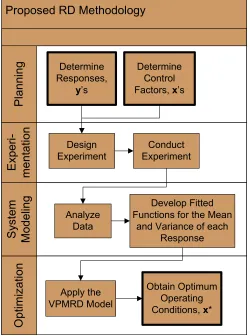
The methodology proposed in this paper is shown in Figure 1, which consists of first
determining the problem to be considered and choosing the responses of interest, as well as the
appropriate experimental design, and the experiment is carried out according to plan. Next, data
collected from the experiment are analyzed using the least squares method of regression analysis.
Based on these results, response surface models for the mean and variance of each response are
created. Finally, the proposed VPMRD model is used to simultaneously optimize the responses
to obtain the settings for the design parameters that make the system under investigation perform
optimally relative to minimizing the process’ variance and bias.
[Figure 1 Approximately Here]
Planning
In an RD study, the determination of the quality characteristics of interest is strongly related to
the nature of the problem being investigated. Similarly, the choice of experimental parameters is
often derived from the responses under investigation using prior engineering knowledge
concerning the system being studied. In many situations, however, practitioners may not have
sufficient experience to effectively choose the appropriate experimental parameters. Therefore,
the alternative is to collect data relative to potential experimental factors and then use
multivariate studies, correlation analysis, and/or screening experiments to determine the specific
factors to consider in an RD investigation.
Experimentation
In designing an experiment, there are many standard approaches from which to choose. These
include, but are not limited to, factorial designs, Taguchi designs, and response surface designs.
The key, therefore, is to choose the design that best addresses the experimental question and
supports the desired data analysis given the available resources (i.e. time and experimental
number of levels of each factor to be tested, and the number of replications planned. The results
obtained form the experiment provides the information necessary to create response surface
models that describe the behavior of the system under investigation.
System modeling
To create response surface models for the mean and variance of each quality characteristic under
investigation, we utilize the least squares method of regression analysis. Using this approach,
consider that each of the n treatment combinations in an experiment consists of r replicates. For each response of interest, let yuj represent the jth response at the uth treatment where
1 2
j= , , , r and u=1 2, , , n. Then, for each quality characteristic, the mean and variance for
the uth treatment can be estimated using the following equations:
(
)
21 2 1
and
1
r r
uj uj u
j j
u u
y y y
y s
r r
= = −
= =
−
∑
∑
(1)
for u=1 2, , , n. Assuming the underlying distribution of the experimental data is normal with
constant variance, the estimators given in Equation (1) are then used to create the response
surface functions of the mean and variance based on the method of least squares regression
analysis as follows. The model for the mean, therefore, is written as
( )
µ
∧ ∧
=
x Xβ, (2)
where
(
T)
1 T∧ −
=
X is the design matrix, β∧ is the estimate of the vector of unknown model parameters, and y is
the vector of estimated means for each treatment combination in an experiment. In addition, the
response surface function for the variance is given as
( )
∧∧
=Xγ
x
2
σ , (4)
where
(
T)
1 T 2∧ −
=
γ X X X s , (5)
∧
γ is the estimate of the vector of unknown model parameters, and 2
s is the vector of estimated
variances for each treatment in an experiment. However, if the underlying distribution of the
experimental data is skewed (i.e. is significantly non-normal) or the assumption of constant
error-variance is violated significantly, the data will have to be transformed in order to proceed
with this type of analysis. Commonly used transformations include, but are not limited to, a log
transformation or square root transformation; the transformation to be used depends on the
specific situation and the degree to which the necessary assumptions are violated. Assuming the
necessary assumptions can be verified, the fitted response functions for each quality
characteristic under investigation are then optimized simultaneously to determining the system’s
optimum operating parameters.
Optimization
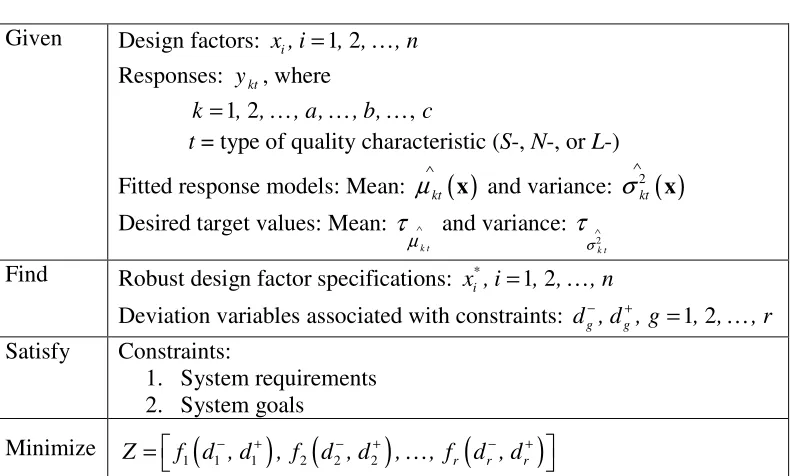
The framework for the proposed optimization model is shown in Table 1 and is structured
in such a way that given the system parameters and the models of their behavior, the goal is to
find the design factor settings based on satisfying the system requirements and goals by
These designations are necessary to accommodate the different types of quality characteristics
that may be considered in an RD investigation. According to Taguchi, responses are usually
categorized as one of the following three types.
1. Smaller-the-better (S-type): Minimize the quality characteristic of interest (i.e. the target value equals zero).
2. Nominal-the-better (N-type): The quality characteristic of interest has a specific target value.
3. Larger-the-better (L-type): Maximize the quality characteristic of interest (i.e. the target value approaches infinity).
Further, µkt
( )
∧
x and σ2kt
( )
∧
x are the response surface functions for the process mean and
variance of response ykt, respectively, which are assumed to be independent of each other, and
k t
µ
τ ∧ and
2
k t
σ
τ ∧ are the desired target values for the mean and variance of response ykt,
respectively.
[Table 1 Approximately Here]
In the proposed model, the constraints consist of the system’s technical requirements and
its desired goals. The system requirements are characterized by the upper and/or lower limits on
the system variables under consideration, which must be satisfied in order for the solution to be
feasible. Further, the constraints representing the system goals model the deviation from the
desired target values for both the mean and variance of each response. Overall, the system goal is
to minimize the deviation from the desired target values. Additionally, we can specify the
priority of individual goals in the objective function given this framework.
The objective function for the proposed model is formulated as a nonlinear goal
programming problem (Hillier and Liberman, 2001). This type of approach makes the general
as a single function using deviation variables. In mathematical programming terms, deviation
variables are also known as auxiliary variables. In the objective function for our proposed model,
these variables are used to denote the under- and over-achievement of a constraint (i.e. a desired
range or target value), which are given as dg and dg
− +
, respectively; hence, the deviation
variables are also used in formulating the constraints for the proposed model. For example,
consider the constraint associated with the process mean of a particular response of interest.
Using deviation variables, this constraint can be written in general terms as
( )
k t
g kt d
µ
µ τ ∧
∧
= x − , for g=1 2, , , r (6)
where
g g g
d d+ d−
= − (7)
and
{
if 00 otherwise
if 0
0 otherwise g g g g g g d d d d d d + − ≥ = ≤ = (8)
Given these definitions, the constraint in Equation (6) can then be rewritten as
( )
(
)
k t
kt dg dg
µ
µ τ ∧
∧
+ −
− − =
x . (9)
Further, the method described here for modeling constraints using deviation variables for the
mean of a quality characteristic can also be used for modeling the variance. Given this type of
approach, the deviation variables associated with the constraints for the mean and variance of
each response are then combined to form a single objective function as follows:
min Z f d , d1
(
1 1)
, f2(
d , d2 2)
, , fr(
d , dr r)
− + − + − +
= (10)
1. S-type quality characteristic: µkS
( )
USLkS∧
≤
x for k=1 2, , , a
2. N-type quality characteristic: LSLkN µkN
( )
USLkN∧
≤ x ≤ for k=a+1, a+2, , b
3. L-type quality characteristic: µkL
( )
LSLkL∧
≥
x for k= +b 1, b+2, , c
Constraints due to system goals: 1. Process mean:
( )
k t
kt dg dg
µ
µ τ ∧
∧
− +
+ − =
x for t = type of quality characteristic (S-, N-, or L-) 2. Process variance:
( )
2
2
k t
kt dg dg
σ
σ τ ∧
∧
− +
+ − =
x for t = type of quality characteristic (S-, N-, or L-) Bounds:
1. Design factors: ximin ≤xi ≤ximaxfor i=1 2, , , n
2. Deviation variables: −, +≥0
g g d
d and −⋅ + =0
g g d
d for g=1 2, , , r
In the proposed model, the constraints are delineated according to the type of quality
characteristic considered where USL and LSL are the upper and lower specification limits,
respectively, for the system’s requirements. To establish a prioritization scheme for the
optimization procedure, our proposed model utilizes a preemptive approach involving sequential
optimization. Here, weights of different magnitudes are assigned to the deviation variables
associated with the process mean and variance. In this model, we propose setting priorities in
such a way that the goal is to first minimize the variance and then attempt to achieve the mean
equal to the desired target value. The proposed approach is illustrated through the numerical
example in the following section.
Implementation of the proposed model
Consider the problem of optimizing a chemical filtration process for measuring dosages with
respect to filtration time, volume, and purity. Here, we consider temperature (x1) and pressure
(y3L) as our responses of interest. Hence, this becomes a multiresponse RD study, given that
there are multiple quality characteristics of interest in determining the optimum operating
conditions for the system under investigation. In this example, filtration time is considered an S -type quality characteristic since it is desirable to minimize processing time. Additionally, the
system configuration has a maximum processing time of 7 seconds that cannot be exceeded. The
desired target for the volume of the filtered chemical dose is 10 mL, where the allowable
tolerance is ±0.5 mL; therefore, filtration volume is considered an N-type response. Further,
filtration purity is required to be as high as possible, therefore this response is considered an L -type quality characteristic with a natural bound at 100%. In this particular example, it is critical
that we reduce the variability of each response simultaneously in order to stabilize the processing
cost in terms of filtration time and improve product quality by minimizing the occurrence of
under- and over-filled vials and stabilizing filtration purity.
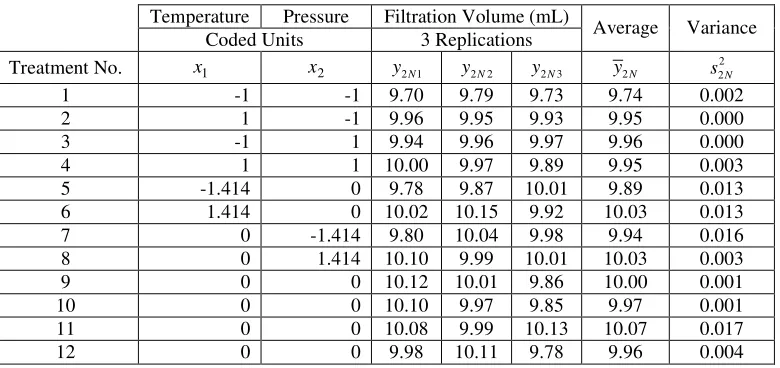
To estimate quadratic models of the responses, a central composite design with four
center points is chosen for this experiment. Additionally, the experiment is replicated three times
and data are collected concerning the responses of interest. The experimental design schemes and
the data for each response are displayed in Tables 2-4, respectively.
[Table 2 – Approximately Here]
[Table 3 – Approximately Here]
[Table 4 – Approximately Here]
Analysis of the data, using the method shown in Section 2.3, results in response surface
models for the mean and variance of each response as follows:
( )
2 21S 2 1725 0 1913. - . x - .1 0 1470x2 0 0613. x - .1 0 1163x - .2 0 2375x x1 2
( )
2 2 2
1S 0 03300 0 0004. - . x - .1 0 0008x - .2 0 0154x - .1 0 0151x2 0 0013. x x1 2
σ
∧
= +
x (12)
( )
2 22N 10 0000 0 0497. . x1 0 0434. x - .2 0 0381x - .1 0 0256x - .2 0 055x x1 2
µ∧ x = + + (13)
( )
2 2 2
2N 0 0058 0 0001. . x - .1 0 0022x2 0 0011. x - .1 0 0006x2 0 0013. x x1 2
σ
∧
= + + +
x (14)
( )
2 23L 94 9775 0 4832. . x1 0 7465. x - .2 0 3725x - .1 0 3175x2 0 1550. x x1 2
µ∧ x = + + + (15)
( )
2 2 2
3L 0 1898 0 0011. - . x - .1 0 0039x - .2 0 0942x - .1 0 0902x2 0 0013. x x1 2
σ
∧
= +
x (16)
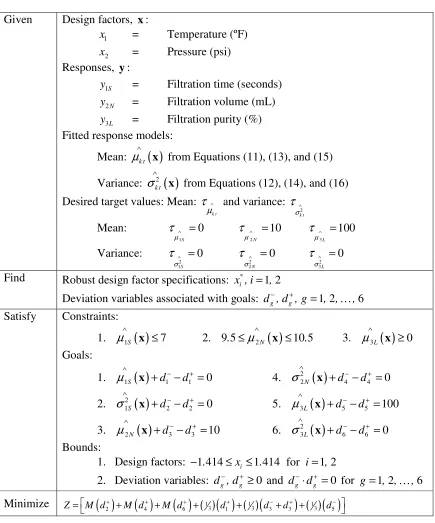
Using Equations (11) through (16), the proposed VPMRD optimization model is then
applied to obtain the optimum operating conditions for the filtration process, as shown in Table
5. In this particular example, the constraints are comprised of the bounds on the responses that
must be strictly adhered to. These bounds are denoted by the technical requirements of the
system stated as the USL and/or LSL. Specifically, filtration time must be less than 7 seconds,
filtration volume must be within the range of 9.5-10.5 mL, and filtration purity must be greater
than zero. Further, the goals are determined based on the desire to minimize the process bias and
variance. For this example, the target values of interest are theoretically zero seconds for
filtration time, 10 mL for filtration volume, and 100% for filtration purity. Additionally, we
specify that the target for the variance is equal to zero because the goal of an RD study is always
to minimize the variance. Given these constraints and their associated deviation variables, the
deviation function to be minimized considers the over-achievement for the S- and N-type quality characteristics and the under-achievement for the N- and L-type quality characteristics of interests for the mean and the over-achievement of each quality characteristic for the variance.
Here, the streamlined procedure for preemptive goal programming is used to first minimize the
responses of interest are weighted equally. The big M method [3] is utilized to establish a
prioritization scheme within the optimization process. Here, the deviation variables associated
with the variance are given substantially larger weights, designated by M, over that of the
deviation variables associated with the process bias.
[Table 5 – Approximately Here]
The results of the proposed method, which are shown in Table 6, indicate the goal of zero
variance for filtration purity was achieved; yet, the variance of both filtration time and volume
slightly exceed zero. In addition, the mean of each response is achieved with minimal amounts of
bias allowed; however, none of the mean values achieved the exact target value desired.
[Table 7 – Approximately Here]
Comparison study
In this section, we validate the proposed methodology by comparing its results to those obtained
using traditional RD optimization models, including both the dual response approach (Vining
and Myers, 1990) and the MSE model (Lin and Tu, 1995). The dual response approach
minimizes the variance with the constraint that the process mean equals the desired target value,
which can be written as
min σ2
( )
∧
x (17)
s.t. µ
( )
τ∧
= x ∈ x
where is the region of interest. This optimization model is typically used for problems in
value. Given this approach, we obtain optimum operating conditions that result in the mean
located on target with some amount of variation around the mean.
To improve upon the dual response approach, Lin and Tu (1995) relaxed its zero-bias
assumption (i.e. the constraint requiring that the process mean must equal the desired target
value) and proposed a model that simultaneously minimizes the squared difference of the mean
from the target value and the variance as follows:
min
( )
( )
2 2
+
µ τ σ
∧ ∧
−
x x (18)
s.t. x∈
When minimizing the variability of the response of interest is of equal or greater importance than
achieving the desired target value, this optimization strategy is often utilized. Based on such an
approach, it is observed that by allowing some difference between the mean and the desired
target value, the resulting process variance is less than or at most equal to the variance of the
dual response approach.
For the purpose of comparison, we utilize an approach similar to that demonstrated by
Tang and Xu (1995) in which we approximate the traditional RD models using the VPMRD
framework developed in this paper. Here, we reformulate the original RD models as goal
programming problems and apply them to the example used previously to illustrate our proposed
methodology. The formulations of and the results obtained from these equivalent models are
presented in the following sections. The results obtained using these models are then compared
to the results obtained from our proposed methodology.
Using the dual response approach, the first priority of the optimization procedure is to achieve
the desired target value and then the model attempts to minimize the variance. To approximate
the optimization procedure of the dual response approach for a multiresponse problem, we use a
preemptive goal programming approach, which is similar to that used in the proposed model. As
discussed previously, all quality characteristics are equally weighted; yet in this case,
substantially larger weighted priorities are placed on the deviation variables associated with
minimizing the process bias over that of the deviation variables associated with minimizing the
variance. Given the same response surface models and constraints used to demonstrate the
proposed model, the big M method can be used in the optimization procedure to establish a
prioritization scheme that reflects the dual response approach for multiple quality characteristics
as follows:
( )
1( )
( )
1( )
( )
1( )
( )
(
)
( )
3 2 3 4 3 6 1 3 3 5
Z = d+ + d+ + d− +M d+ +M d−+d+ +M d− (19)
Based on Equation (19), we can interpret the objective of this model as an attempt to locate the
mean at the desired target first and then an attempt is made to minimize the variance. Therefore,
this equivalent model replicates the goals of the original dual response approach and allows us to
optimize multiple quality characteristics simultaneously. The results obtained using this model
are shown in Table 7.
[Table 7 Approximately Here]
Expansion of the MSE model for multiresponse problems
In terms of the MSE model, minimizing the squared difference of the mean from the desired
target value and minimizing the variance are of equal priority in the optimization procedure and
approximated for multiresponse problems using a nonpreemptive goal programming approach
(Hillier and Liberman, 2001). To create this equivalent model, equal weights are given to the
variables in the deviation function for the mean and variance. Again, based on the response
surface models and constraints used to illustrate the proposed model, we establish a prioritization
scheme that reflects the MSE model for multiresponse problems, which can be written as
min Z=
( ) ( ) ( ) ( ) (
d2+ + d4+ + d6− + d1+ + d3−+d3+) ( )
+ d5− (20)From Equation (20), we can observe that minimizing the bias and minimizing the variance are of
equal importance. This prioritization scheme effectively replicates the original intention of the
MSE model, and this formulation also allows us to optimize multiple quality characteristics
simultaneously. The results obtained using this model are shown in Table 8.
[Table 8 Approximately Here]
Discussion of comparison study results
The results of this study comparing the proposed approach to that of the prioritization
schemes associated with traditional RD optimization models are best considered based on the
evaluation of the mean and variance at their optimal settings. In terms of the variance, Table 9
shows the optimum operating conditions for each approach, which also represents the deviation
from the target, given that the desired target value is zero. The only result that indicates the goal
of zero variance was achieved is for the response of filtration purity using the proposed VPMRD
approach; all other results slightly exceed zero. Yet, it is important to note that the proposed
method also resulted in the lowest variance for the response of filtration time in comparison to
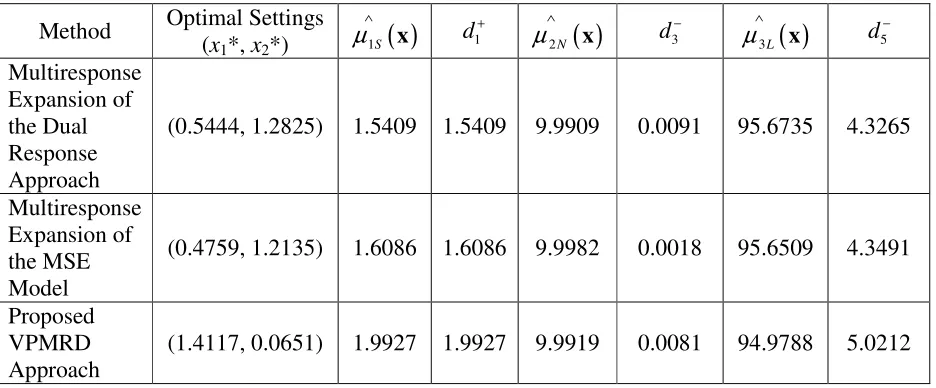
the other approaches. In terms of the mean, Table 10 shows the evaluation of the mean at the
optimization method considered here. For filtration time, all optimization methods over-achieve
the target, with the multiresponse expansion of the dual response concept producing the
minimum deviation. In terms of filtration volume and purity, all approaches under-achieve the
target. Here, the multiresponse expansion of the MSE and the dual response concepts produce
the minimum deviation for the filtration volume and purity, respectively.
[Table 9 – Approximately Here]
[Table 10 – Approximately Here]
As has been shown with other RD models in the past, we see here that a trade-off exists
between minimizing the variance and minimizing the process bias. Based on the results of this
comparison study, it can be concluded that the proposed model achieves its primary goal of first
minimizing the variance and then attempting to achieve the mean equal to the desired target
value. This logic explains why this method tended to produce the minimum variance, but not the
minimum process bias. Yet, this approach provides a flexible and structured method for
modeling multiresponse RD problems in the presence of responses with differing objectives.
Therefore, this method is useful in situations where minimizing the variance is more critical than
achieving a specific target value for problems involving multiple objectives.
Conclusion
In this work, a new RD optimization approach and framework was proposed, called VPMRD, to
handle situations in which we wish to determine the optimum operating conditions for a system
when the problem entails multiple responses and in cases where it is critically important that the
variance of the responses being considered is minimized. Here, the proposed method utilized
using deviation variables. The objective of the proposed model addressed the inherent goal of
RD where the first priority was to minimize the variance. The proposed optimization approach
was described in detail and illustrated though the use of a numerical example. The results
obtained from this approach were then compared to that of expanded approaches of the
traditional RD optimization models in order to address multiple quality characteristics.
The result of this work provides a method for using RD in real-world situations where
optimal solutions are desired in the face of multiple responses. The approach discussed here
illustrates that there are trade-offs in design between minimizing the variance and achieving the
desired target value. Yet, the specific model proposed here addresses these trade-offs by
References
Cho BR, Park C. Robust design modeling and optimization with unbalanced data. Computers and Industrial Engineering 2005;48(2): 173-80.
Hillier FS, Lieberman GJ. Introduction to operations research. New York: McGraw-Hill, 2001. Kim YJ, Cho BR. Development of priority-based robust design. Quality Engineering 2002;14(3):
355-63.
Kovach J, Cho BR. A D-optimal design approach to robust design under constraints: a new design for six sigma tool. International Journal of Six Sigma and Competitive Advantage 2006;2(4): 389-403.
Lee SB, Park C, Cho BR. Development of a highly efficient and resistant robust design. International Journal of Production Research 2007;45(1): 157-67.
Lin DKJ, Tu W. Dual response surface optimization. Journal of Quality Technology 1995;27(1): 34-9.
Myers RH, Carter WH. Response surface techniques for dual response systems. Technometrics 1973;15(2): 301-17.
Nair VN, Shoemaker AC, The role of experimentation in quality engineering: a review of Taguchi’s contributions. In: Ghosh, S (Ed.). Statistical design and analysis of industrial experiments. New York: Marcel Dekker, 1990. p. 247–77.
Park C, Cho BR. Development of robust design under contaminated and non-normal data. Quality Engineering 2003;15(3): 463-69.
Shin S, Cho BR. Bias-specified robust design optimization and its analytical solutions. Computers and Industrial Engineering 2005;48(1): 129-40.
Taguchi G. Introduction to quality engineering: designing quality into products and processes. New York: Krauss International Publications, 1986.
Taguchi G. System of experimental design: engineering methods to optimize quality and minimize costs. Dearborn, MI: American Supplier Institute, 1987.
Tang LC, Xu K. A unified approach for dual response surface optimization. Journal of Quality Technology 2002;34(4): 437-47.
Figures and Tables
! !
"
# $ %
$ &
# $ &
[image:21.595.173.423.166.502.2]#
Table 1 General Model of the Proposed VPRMD Framework
Given Design factors: x , ii =1 2, ,…, n
Responses: ykt, where
1 2 ,
k= , , , a, , b, c
t = type of quality characteristic (S-, N-, or L-) Fitted response models: Mean: µkt
( )
∧
x and variance: 2
( )
ktσ
∧
x
Desired target values: Mean:
k t
µ
τ ∧ and variance:
2
k t
σ
τ ∧
Find Robust design factor specifications: * 1 2 i
x , i= , ,…, n
Deviation variables associated with constraints: d , d , gg g 1 2, , , r
− +
=
Satisfy Constraints:
1. System requirements 2. System goals
[image:22.595.102.497.439.634.2]Minimize Z=f d , d1
(
1− 1+)
, f2(
d , d2− 2+)
, , fr(
d , dr− r+)
Table 2 Experimental Design and Observations of Filtration Time for the Multiresponse Chemical Filtration Study
Temperature Pressure Filtration Time (seconds) Coded Units 3 Replications
Average Variance
Treatment No. x1 x2 y1 1S y1 2S y1 3S y1S
2
1S
s
1 -1 -1 3.86 4.03 3.92 3.94 0.007
2 1 -1 3.12 3.07 3.02 3.07 0.003
3 -1 1 2.82 2.79 2.87 2.83 0.002
4 1 1 1.07 0.97 0.99 1.01 0.003
5 -1.414 0 1.30 1.26 1.32 1.29 0.001 6 1.414 0 2.07 2.14 2.11 2.11 0.001 7 0 -1.414 0.60 0.63 0.68 0.64 0.002 8 0 1.414 2.03 2.08 2.04 2.05 0.001
9 0 0 2.12 1.79 2.16 2.02 0.041
10 0 0 2.80 2.52 2.42 2.58 0.039
11 0 0 2.19 2.02 2.14 2.12 0.008
Table 3 Experimental Design and Observations of Filtration Volume for the Multiresponse Chemical Filtration Study
Temperature Pressure Filtration Volume (mL)
Coded Units 3 Replications Average Variance Treatment No. x1 x2 y2 1N y2N2 y2N3 y2N
2
2N
s
1 -1 -1 9.70 9.79 9.73 9.74 0.002
2 1 -1 9.96 9.95 9.93 9.95 0.000
3 -1 1 9.94 9.96 9.97 9.96 0.000
4 1 1 10.00 9.97 9.89 9.95 0.003
5 -1.414 0 9.78 9.87 10.01 9.89 0.013 6 1.414 0 10.02 10.15 9.92 10.03 0.013 7 0 -1.414 9.80 10.04 9.98 9.94 0.016 8 0 1.414 10.10 9.99 10.01 10.03 0.003 9 0 0 10.12 10.01 9.86 10.00 0.001
10 0 0 10.10 9.97 9.85 9.97 0.001
11 0 0 10.08 9.99 10.13 10.07 0.017
[image:23.595.102.498.144.328.2]12 0 0 9.98 10.11 9.78 9.96 0.004
Table 4 Experimental Design and Observations of Filtration Purity for the Multiresponse Chemical Filtration Study
Temperature Pressure Filtration Purity (%)
Coded Units 3 Replications Average Variance Treatment No. x1 x2 y3 1L y3 2L y3 3L y3L
2
3L
s
Table 5 Proposed VPMRD Optimization Model for the Multiresponse Chemical Filtration Study
Given Design factors, x:
1
x = Temperature (ºF)
2
x = Pressure (psi)
Responses, y:
1S
y = Filtration time (seconds)
2N
y = Filtration volume (mL)
3L
y = Filtration purity (%) Fitted response models:
Mean: µk t
( )
∧
x from Equations (11), (13), and (15)
Variance: σk t2
( )
∧
x from Equations (12), (14), and (16) Desired target values: Mean:
k t
µ
τ ∧ and variance:
2 k t σ τ ∧ Mean: 1 0 S µ
τ ∧ =
2 10
N
µ
τ ∧ =
3 100
L
µ
τ ∧ =
Variance: 2 1 0 S σ
τ ∧ =
2 2
0
N
σ
τ ∧ =
2 3
0
L
σ
τ ∧ =
Find Robust design factor specifications: * 1 2 i
x , i= ,
Deviation variables associated with goals: d , d , gg− g+ =1 2, , ,6 Satisfy Constraints:
1. µ1S
( )
7∧
≤
x 2. 9 5. µ2N
( )
10 5.∧
≤ x ≤ 3. µ3L
( )
0∧
≥ x
Goals:
1. µ1S
( )
d1 d1 0∧
− +
+ − =
x 4. σ22N
( )
d4 d4 0∧
− +
+ − =
x
2. σ21S
( )
d2 d2 0∧
− +
+ − =
x 5. µ3L
( )
d5 d5 100∧
− +
+ − =
x
3. µ2N
( )
d3 d3 10∧
− +
+ − =
x 6. 2
( )
3L d6 d6 0
σ ∧ − + + − = x Bounds:
1. Design factors: 1 414− . ≤xi ≤1 414 for . i=1 2,
2. Deviation variables: d , dg g 0
− +
≥ and dg dg 0
− +
⋅ = for g=1 2, , ,6
Minimize
( )
( )
( )
( )
1( )
( )
1(
)
( )
1( )
3 3 3
2 4 6 1 3 3 5
Z M d+ M d+ M d+ d+ d− d+ d−
Table 6 Results of the Proposed VPMRD Approach for the Multiresponse Chemical Filtration Study
Optimal Settings x* = (1.4117, 0.0651)
Mean
( )
1S
µ
∧
x = 1.9927
( )
2Nµ
∧
x = 9.9919
( )
3L
µ
∧
x = 94.9788
Variance
( )
2 1S σ ∧x = 0.0017
( )
2 2N
σ
∧
x = 0.0081
( )
2 3L
σ
∧
[image:25.595.171.427.439.606.2]x = 0
Table 7 Results of the Multiresponse Expansion of the Dual Response Approach for the Multiresponse Chemical Filtration Study
Optimal Settings x* = (0.5444, 1.2825)
Mean
( )
1S
µ
∧
x = 1.5409
( )
2N
µ
∧
x = 9.9909
( )
3L
µ
∧
x = 95.6735
Variance
( )
2 1S σ ∧x = 0.0033
( )
2 2N
σ
∧
x = 0.0033
( )
2 3L
σ
∧
Table 8 Results of the Multiresponse Expansion of the MSE Model for the Multiresponse Chemical Filtration Study
Optimal Settings x* = (0.4759, 1.2135)
Mean
( )
1S
µ
∧
x = 1.6086
( )
2Nµ
∧
x = 9.9982
( )
3L
µ
∧
x = 95.6509
Variance
( )
2 1S σ ∧x = 0.0069
( )
2 2N
σ
∧
x = 0.0033
( )
2 3L
σ
∧
x = 0.0311
Table 9 Comparison of Optimization Methods in Determining the Optimal Design Factor Settings and the Evaluation of the Variance
for the Multiresponse Chemical Filtration Study
Method Optimal Settings
(x1*, x2*)
( )
2 1S
σ
∧
x 2
( )
2Nσ
∧
x 2
( )
3Lσ
∧
x
Multiresponse Expansion of the Dual Response Approach
(0.5444, 1.2825) 0.0033 0.0033 0.0088
Multiresponse Expansion of the MSE Model
(0.4759, 1.2135) 0.0069 0.0033 0.0311
Proposed VPMRD
[image:26.595.171.427.144.319.2]Table 10 Comparison of Optimization Methods in Determining the Optimal Design Factor Settings and the Evaluation of the Mean
for the Multiresponse Chemical Filtration Study
Method Optimal Settings
(x1*, x2*) µ1S
( )
∧
x d1
+
( )
2N
µ
∧
x d3
−
( )
3L
µ
∧
x d5
−
Multiresponse Expansion of the Dual Response Approach
(0.5444, 1.2825) 1.5409 1.5409 9.9909 0.0091 95.6735 4.3265
Multiresponse Expansion of the MSE Model
(0.4759, 1.2135) 1.6086 1.6086 9.9982 0.0018 95.6509 4.3491
Proposed VPMRD Approach
(1.4117, 0.0651) 1.9927 1.9927 9.9919 0.0081 94.9788 5.0212