City, University of London Institutional Repository
Citation
:
Ravasi, D. and Marchisio, G. (2003). Going Public and the Enrichment of a Supportive Network. Small Business Economics, 21(4), pp. 381-395. doi:10.1023/A:1026119221991
This is the accepted version of the paper.
This version of the publication may differ from the final published
version.
Permanent repository link:
http://openaccess.city.ac.uk/4601/Link to published version
:
http://dx.doi.org/10.1023/A:1026119221991Copyright and reuse:
City Research Online aims to make research
outputs of City, University of London available to a wider audience.
Copyright and Moral Rights remain with the author(s) and/or copyright
holders. URLs from City Research Online may be freely distributed and
linked to.
Going Public and the Enrichment of a Supportive Network: Some Evidence from Italian Initial Public Offerings
Davide Ravasi
Strategic and Entrepreneurial Management Department
SDA Bocconi - Bocconi University School of Management
Via Bocconi 8, Milano
20136 Italy
Tel. +39-02-5836.2540 Fax +39-02-5836.2530 [email protected]
Gaia Marchisio
Strategic and Entrepreneurial Management Department
SDA Bocconi - Bocconi University School of Management Via Bocconi 8, Milano
20136 Italy Tel. +39-02-5836.6224
Fax +39-02-5836.6892
Going Public and the Enrichment of a Supportive Network: Some
Evidence from Italian Initial Public Offerings[1]
Abstract
Introduction
Going public is an important step in the acquisition of resources needed to sustain an entrepreneurial venture. Past research on initial public offerings (IPOs), however, has largely focused on the financial aspects of the process: more or less implicitly, raising investment capital has been considered the fundamental reason to go public, and accordingly the success of an IPO has usually been measured in financial terms by the amount of capital raised (e.g. Deeds, Decarolis and Coombs, 1997), the market capitalization after the issue (e.g. Stuart, Hoang and Hybels), the long term performance (e.g. Welbourne and Cyr, 1999) or the underpricing of the stocks (e.g. Beatty and Ritter, 1986). Raising investment capital is undoubtedly important, and we are not denying the intrinsically financial nature of an initial public offering. We believe, however, that the focus on the financial side of the phenomenon has led scholars to underestimate other potential benefits of going public and to therefore neglect other potentially important implications. Entrepreneurial activity, in fact, requires far more than just money. An established perspective in entrepreneurial studies observes how success requires the acquisition of a variety of resources that include money, equipment, information, political influence, support and advice, through a network of partners (Birley, 1982; Aldrich and Zimmer, 1986; Dubini and Aldrich, 1991; Larson 1991; Steier and Greenwood, 2000).
In this paper we combine evidence from a series of preliminary case studies with the results of a survey of 57 Italian IPOs, and investigate a wider range of potentially important implications of going public, many of which are usually neglected or presented as side benefits and glossed over. Evidence from our research indicates that going public can be a way to improve the reputational and social capital of a company, with beneficial effects on its capacity to access external resources and opportunities to sustain entrepreneurial activity. Our study reveals that, in addition to the usual financial motives, the decision to go public is increasingly stimulated by a search for a higher visibility and prestige and that it is seen as an important step in the expansion and reinforcement of the network of relationships that sustains entrepreneurial activity.
In the following sections, we present a brief review of past literature on IPOs, describe the research methodology, and discuss findings from our study. In the final section, we provide some concluding remarks and discuss the implications of our findings for future research and practice.
A review of past studies
The majority of literature, however, converges on the fundamental idea that the most important reason to go public is to infuse a significant amount of investment capital into the firm (Ibbotson and Ritter, 1995). As a result, studies in the financial tradition focused on the initial underpricing of new stocks on the market as an appropriate measure of the success of the operation (Ibbotson, 1975; Ritter, 1984; Leleux and Muzyka, 1995). If stocks are underpriced, in fact, entrepreneurs “leave money on the table” – and therefore bear an opportunity cost in term of lost equity financing. Even if the typical behavior of IPOs is a price “run up”, some issues show price declination once the trading starts (Keasey, McGuinness and Short, 1992), resulting in an intrinsic element of uncertainty for entrepreneurs and investors. For these reasons, the issue of IPOs underpricing has been widely investigated in the past. Several theoretical and empirical works have proposed alternative explanations to the phenomenon (see Tiniç, 1988 for a review). Two of the more credited explanations to date hypothesize an information asymmetry between issuers and investment bankers on the state of the capital markets (Baron, 1982), or between different groups of potential investors: informed investors, who know when and where to invest, and uninformed buyers who subscribe to every IPO without discriminating (Rock, 1986).
As reducing the asymmetry of information and the inherent uncertainty is required to maximize the capital inflow, it is important that, in bringing the firm to the equity market for the first time, the entrepreneur conveys information to potential investors as to the value of the firm. That is why much theoretical and empirical work has explored how entrepreneurs might signal the value of their firm to potential investors (e.g. Leland and Pyle, 1977, Titman and Trueman, 1986). For example, past studies suggest that in the presence of information asymmetry entrepreneurs may signal the true value of the firm via their own observable actions. Empirical evidence has shown that these signals are mainly related to the equity entrepreneurs retain and the amount of capital expenditure they plan to undertake (e.g. Keasey, McGuinness and Short, 1992). Other studies indicate that entrepreneurs can rely on the reputation of underwriters as an indirect signal to potential subscribers of the value of the firm. A prestigious underwriter, in fact, seems to positively affect the success of the offering, as the quality of the underwriter certifies the quality of the issue (Carter and Manastar 1990).
resource management plays in the small, entrepreneurial venture, while at the same time raising questions on the adequacy of the human resource staff of medium-sized firms to face challenges that do not affect small firms (lawsuits, increasing rigidity, bureaucratization, etc.).
In summary, most studies on the performance of initial public offerings seem to share two common features: the adoption of a short-term perspective and a focus on the financial side of the phenomenon. Even when these studies investigated how variables of organizational or institutional nature affect the success of an IPO, they invariably adopted financial measures of success such as the post-IPO market capitalization (Stuart, Hoang and Hyble, 1999), the amount of capital raised (Deeds, Decarolis and Coomb, 1997) or the short-term increase of the stock price (Welbourne and Cyr, 1999). Although these financial measures provide a reliable way to assess the performance of some dimensions of an IPO, however, they tend to reinforce the assumption that IPOs are essentially a financial matter. The fundamental goals that a firm pursues in going public, then, come to be taken for granted and is therefore synthesized in the notion of simply raising additional capital to finance growth. Conversely, our research attempts to remove this preconceived notion and questions this general assumption, thereby approaching the goals of going public objectively, rather than an unquestioned starting point. A closer and more comprehensive look at the decision process leading to an IPO revealed that the decision to go public may be in fact be influenced by a more complex set of motives and may be supported by a much broader range of benefits.
Research method
Our research followed a two-step approach that combined the richness and depth of qualitative methods for data collection and analysis and the methodological rigor of quantitative research tools (Creswell, 1994). An initial qualitative phase based on seven case studies provided rich and insightful data that allowed us to derive some empirically grounded propositions about the benefits that come from going public. A second quantitative phase, based on a survey of 57 IPOs, was used to test the external validity and the robustness of our claims across the whole population.
The research setting
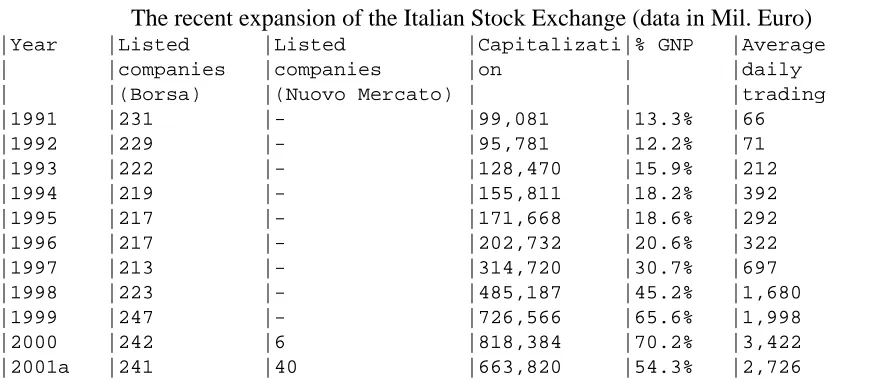
In recent years, Italian entrepreneurs have started to change their attitude towards the stock markets. The gradual increase in the number of private firms that every year turn to the Stock Exchange was initiated in 1995 by a law that introduced substantial tax breaks for new listings – the so called Tremonti Law. It was sustained later by a large wave of privatization that considerably expanded the size and the efficiency of the market. While in the past non-financial listed companies were mainly state-owned firms or large family groups, new sections of the Stock Exchange especially dedicated to small, fast growing companies – like the Nuovo Mercato – have facilitated the access of a high number of young entrepreneurial ventures. The positive experience of some ‘pioneers’ has helped to overcome the widespread mistrust of entrepreneurs and small-business owners and triggered an imitation effect that has brought an increasing number of companies to open their capital to the financial markets (see table I).
---The comparative case study
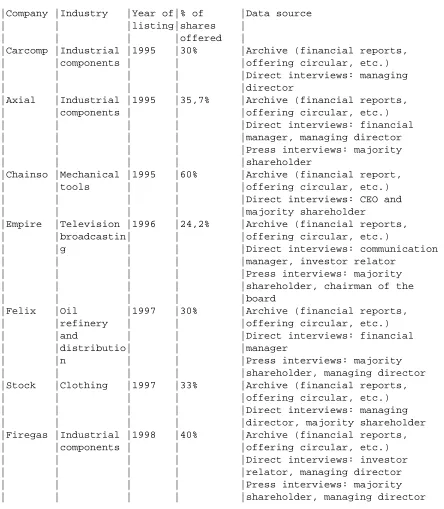
The first step of the research was based on seven case studies of companies who went public between 1995 and 1998 (see table II, company names have been disguised for confidentiality). We initially restricted the selection to those companies listed between two and four years before the study, so that our informants would have had time to fully appreciate the consequences of the event, while at the same time their recollection of the process would still be vivid in their memory. Within this population, we selected companies that represented a variety of sizes, ages, industries and ownership structures (fragmented vs. concentrated, open to merchant banks or industrial partners vs. closed, etc.). We followed Andrew Pettigrew’s principle of “planned opportunism”, choosing firms that represented extreme situations, combining highly-visible and much debated cases with less scrutinized, more “ordinary” cases (Pettigrew, 1990). Following Pettigrew’s recommendations, we purposefully selected firms that, to our knowledge, seemed to disprove patterns from previous studies. In this theory-building phase, we considered heterogeneity as a path to the widest possible variation in data, in order to grasp the complexity of the phenomenon better and, as a consequence, to develop a richer and more refined conceptual framework. The selection was somewhat sequential as some cases were included in the study after the collection and analysis of data had already started. Following common prescriptions for multiple case studies (Eisenhardt, 1989), we replicated the study until we had evidence that we had reached what Glaser and Strauss (1967) refer to as “theoretical saturation”. In other words we stopped when the incremental learning coming from each additional case had become minimal, because what we observed did not seem to improve our emerging framework further.
---Table II here
---Data collection combined multiple sources of data that included both archival research and other secondary sources complemented by in-depth interviews with people who had participated in the listing process (see table II). The interviews were aimed at obtaining a broad representation of the phenomenon by investigating the driving forces leading to the decision to go public, the benefits that the company achieved, and the changes that going public brought about in the organizational structure, culture, systems and processes. All the interviews followed a common protocol. We adopted an open-ended format in order to collect both factual data and personal impressions. During the interviews, we encouraged our informants to specifically refer to facts and events that left a trace in their memory. All the interviews were taped and transcribed. If information collected at a later stage required further probing or the clarification of minor discrepancies, some informants were interviewed more than once. Our tentative reconstruction of each case was later submitted to our main contact persons, either personally or by telephone, in order to ensure reliability and to integrate and refine the emerging framework.
researchers; later comparison of independent analysis showed a substantial agreement. This coding procedure helped us to identify, for each case, a number of key themes. Following indications from Eisenhardt (1989), we referred to the existing literature to develop and to enrich these inductively derived insights. In this phase, we often relied on data collected from our archival research to go beyond our informant’s accounts, and to extend and refine the emerging framework. Provisional interpretations and tentative propositions were refined in several iterations between theory and data until we were able, for each case, to provide a plausible explanation of the observed patterns.
In a second stage, in order to refine emerging constructs and verify how strongly each contributed to explain the observed phenomenon, we conducted a cross-case comparison. Cross-case comparison helped us to verify the robustness of our provisional interpretations across cases. In some cases, the comparison required a further homogenization of concepts, as some themes were grouped into a more general concept. In other cases, propositions were refined, to include the effect of intervening variables. Again, the process followed an iterative path, until the emerging conceptual framework fit the observed patterns across cases. At the end of this operation we were able to identify a number of core issues related to the decision to go public. As it often happens in inductive research, these findings in part confirm and in part extend past literature, and they will be discussed in the next section.
The survey study
In a second phase, we looked for support for the external validity of our claims, checking to what extent the core constructs emerging from the cases were not peculiar to the few observed cases, but contributed to the explanation of the phenomenon over the general population. In order to verify whether the emerging explanatory framework could be extended beyond the observed cases, we turned to a questionnaire to collect quantitative data across a larger population. The questionnaire contained a broad range of items developed on the basis of evidence from the case studies. In this paper, however, we will discuss only results from the first section, investigating the extent to which issues like prestige, visibility and network building affected the decision to go public (see Appendix 1). Translating the observed reasons that affected the decision to go public into items of a questionnaire gave us the possibility to collect quantitative data that could be factor analyzed looking for underlying patterns and latent constructs. The fact that the results of this factor analysis were essentially in line with what we observed in the qualitative study reinforced the internal validity of our claim.
companies, each receiving a questionnaire. Whenever possible, questionnaires were addressed to the managing director; alternatively they were re-directed to the financial director or the investor-relations manager. We required, however, that the respondent had participated in the decision-making process that led to the IPO. After three months and follow-up telephone calls to encourage a reply, we received 57 answers, for a redemption rate of 62,6%. Curiously enough, only two out of the seven companies that were analyzed in depth responded to our questionnaire, slightly increasing the scope of our study.
Data analysis, as anticipated, was aimed at checking the robustness of the framework emerging from the qualitative study across a broader sample of companies. We ran an exploratory factor analysis in order to check for latent constructs. The results supported the argument that issues of visibility, prestige and network building form an interrelated set of reasons that affects the decision to go public in a substantial way. Results of the quantitative analysis will be discussed in more detail in the fifth section.
Building social capital to sustain entrepreneurial action
The preliminary case studies offered us a representation of the phenomenon that conformed only partially to expectations based on past literature. As could be expected, financial issues were mentioned by most of our informants. However, as hypothesized the interviews revealed a broader range of motives and benefits, where raising capital, although important, was just one among many (see table III). Although, all the companies formally stated in their offering circulars that the fundamental goal of the offering was to raise funds to finance development projects, only a few were more specific about what. Indeed, some of our informants explicitly stated that financial capital could have been found elsewhere, and that going public was meant to stimulate an upgrade in the profile of the firm, and a redefinition of internal and external relationships. These changes were often considered as important as the capital infusion to reinforce the capacity of the company to sustain long-term growth.
---Table III here
(i.e. bonds, preferred stocks, etc.), but also to a higher number of spontaneous contacts from banks and other financial companies, offering financial products. This seems to be explained partly by the increased trustworthiness that we have already discussed, and partly by the fact that going public improves the visibility of the company, also thanks to the advertising campaign that supports the operation and to the increased attention of the press, and brings it almost automatically under the attention of potential financial partners. In summary, from the financial point of view, evidence from the cases suggest that, apart from bringing the company an predetermined amount of capital, going public changes the standing of the company, increasing its perceived trustworthiness and visibility in the financial community.
Issues of visibility also seem to influence the reasons that bring second- or third-generation family-owned companies to separate the destiny and the economy of the company from those of the family. Past literature has observed how in a publicly-traded company the liquidity of the title would make it easier for family members to exit the capital without tensions, and how the discipline of the market would make sure that managerial positions are assigned based on competence rather than dynasty (De Visscher, Aronoff and Ward, 1995). Some of our informants, however, suggested that the status of listed company itself made a managing position in the company more attractive, as it offered professional managers a higher visibility within the industrial and financial community thanks to the higher press coverage and the increased occasions for contacts with other companies and institutions. Also, as one of our informants observed, in Italy – where until a few years ago very few, mostly large companies were listed – the perception of the quality of a company tends to improve as it goes public, as if going public were a sign of excellence. It seems that the status and prestige of the managers of a newly publicly traded company tend to increase as well. It is not clear, however, if this effect would last as more and more companies – some of arguable quality – join the stock exchange.
The beneficial effects of increased visibility, standing and perceived trustworthiness seemed to go well beyond financial or managerial matters. In some cases, going public marked a substantial discontinuity in the competitive positioning of the companies. For example, in the case of Empire, a large Italian private television broadcaster, going public was essential for the establishment of alliances with other competitors in the international arena in order to capitalize on the opportunities within the digital and satellite broadcasting industry.. Only by going public could the company could support the establishment of these alliances with an exchange of shares, as industrial partners were reluctant to enter with private capital. Besides giving the new partners the possibility to sell their shares on the market in case the alliance had not been successful, going public made Empire a more reliable and trustworthy strategic partner. Going public, as we have already observed, subjected the firm to a closer scrutiny by regulatory agencies and financial analysts, and forced the company to introduce more transparent accounting principles and governance structures (indeed, the new partners also asked and obtained important modifications to the company by-laws).
multinationals, to the increased standing of the company. Going public also increased the company’s visibility, so that a number of companies operating in contiguous industries contacted the management in the following months, proposing so many joint development initiatives, that, as the managing director told us, they had problems in “keeping track of all of them”. At the moment of our study, most of these projects were still in an embryonic stage, but were nevertheless regarded as important opportunities for diversification. Evidence from the cases, then, seems to indicate that going public may increase the capacity of a company to build and reinforce a network of relationships through which it can access a variety of resources: not only finance, but also managerial skills, complementary technologies and investment opportunities.
Entrepreneurship is about discovering and exploiting opportunities for new valuable combinations of resources (Schumpeter, 1934). The possibility to access and make use of resources that are not currently controlled is a critical component of the entrepreneurial process (Jarillo and Stevenson, 1990). In this respect, entrepreneurship studies seem to challenge one of the fundamental tenets of a resource-based perspective, that posits that competitive advantage rests on the endowment of resources of a firm (Penrose, 1959; Wernerfelt, 1995). Indeed, entrepreneurial success seems to rest more on the capacity of the entrepreneur to recognize unexploited opportunity for a valuable recombination of scarce resources and to overcome the limits posed by the available resources (Stevenson and Gumpert, 1985). This is the reason why, early studies adopting a resource-based approach concluded that this perspective had “little to say” about small, entrepreneurial companies (Foss, Knudsen and Montgomery, 1995; Wernerfelt, 1995). As recent work shifted attention from the endowment of resources to the cognitive capacity to identify valuable destination for existing resources and to continuously recombine them in innovative ways (Galunic and Rodan, 1998), however, a tighter connection with the Schumpeterian view of entrepreneurial innovation was drawn, focusing on resource use, rather than resource availability (Salvato, 1999).
Because entrepreneurs rarely control all the resources they need and use (money, market information, professional skills, managerial talent, technological capabilities, etc.), successful entrepreneurial firms often leverage internal resources, knowledge and capabilities, by connecting them with resources and capabilities possessed by external partners (Larson, 1991, Lorenzoni and Lipparini, 1999). Furthermore, as Ronald Burt observed, the very capacity to identify and exploit opportunities of innovation in a timely and effective way depends on what Burt called the social
capital of the firm – i.e. the sum of all the relationships that a firm possesses and all the resources
of relationships, therefore, is not to be seen just as a way to obtain valuable information before competitors, but also as a way to extend the number of collaborations and alliances through which entrepreneurial pursuit of competitive advantage is carried out.
Evidence from the cases seems to indicate that listed firms enjoy an enrichment of their social capital, thanks to an improvement in what we could refer to as their reputational capital – i.e. the sum of all the intangible assets that rely on the external collective representation of and judgment on the company (Fombrun, 1996; Fombrun and Van Riel, 1998). On the one hand, this can be explained by the increased visibility of the company, in part as a consequence of the press coverage, in part because going public introduces the company in a restricted industrial elite, with privileged relationships with the financial community. Ronald Burt (1993) observes how the supportive network of an entrepreneur if formed by “everyone you know, everyone you have ever known, and everyone who knows you even though you don’t know them [italics added].” In this respect, by increasing the visibility of a company, going public expands a firm’s network and improves its chances to access valuable resources (capital, information, collaboration, etc.) distributed in the environment. This effect seems to be more important for small companies or producers of industrial goods.
Going public, however, seems to have also a beneficial effect on the reputation of companies of all kinds, and, therefore, on their relationships with a number of actors, like financial institutions, large customers, professional managers and potential industrial partners. Evidence from the cases suggests that the mere fact of going public positively affect the collective judgement of the various stakeholders and counterparts, in part because of the higher prestige that being listed confers to the company, and in part, as we have observed earlier, because the tighter set of norms that a public company is subject to, positively affects the perceived trustworthiness of the company. Past studies on trust indicate that the trustworthiness of actors increases when they are subject to formal mechanisms that certifies the accountability or the competence of the actor (Zucker, 1986) or that impose a social cost on opportunistic behavior (Barney and Hansen, 1994). By going public, a company enters a completely new institutional field (DiMaggio, 1988), where legitimation and access to critical resources require to meet the expectations of financial analysts and institutional investors and to comply with the rules set by the regulating agencies – Consob, in Italy – to safeguard the interests of the general public. This wider set of institutional controls promotes transparency and accountability, making of listed companies more reliable and trustworthy partners for a broader set of counterparts.
Proposition 1: All other things being equal, going public increases the perceived trustworthiness, the prestige and the visibility of a company.
Proposition 2: Improved perceived trustworthiness, prestige and visibility, in turn, increase the number of contacts in the social network of a company and the attractiveness of the company as a partner.
Proposition 3. The enrichment of the social network and the increased attractiveness, in turn, positively affect the capacity of the company to access financial and managerial resources and investment opportunities.
As anticipated in the method section, in order to assess the external validity and the robustness of this emerging framework, we developed a questionnaire aimed at investigating reasons and benefits of going public on a larger scale. In the next section we will discuss its results and show how they seem to offer substantial support to our line of argument.
Social capital, reputational capital and the decision to go public
In the previous section, building on evidence from seven case studies, we have argued that going public increases the perceived trustworthiness, the prestige and the visibility of a company. We have observed how the upgrade of its reputational capital seems to lead to an enrichment of the social capital of the company and to its capacity to access external resources. Although past literature has often mentioned the beneficial effects of going public on a company’s visibility and reputation, the issue has never been thoroughly investigated and these benefits have been usually presented as marginal. Our results, instead, show a different picture. A descriptive analysis of our data indicates that issues related to visibility, image, status and reputation might be just as important as financial matters (see table IV). Companies in our sample, in fact, ranked items related to relational and reputational issues as high as financial items. While financing internal growth holds the first position with a mean score of 5.75, it is followed closely by the will to facilitate external growth, to improve a company’s image and to increasing its visibility, that rank number two (mean score 5.59), three (5.46) and four (5.25). Supporting the establishment of strategic alliances ranks number six (4.65), little below the diversification of sources of capital (4.77).
---Table IV here
---Table V here
---Altogether these four factors seem to reflect four complementary aspects of the decision to go public. The third and the fourth factors correspond to the dominant perspectives in the financial and in the family-business literature on IPOs. The third factor (Cronbach’s ?=0.70), explaining 15.1% of the variance, collects items that relate the issue of common stocks essentially with financial matters. The fourth factor (Cronbach’s ?=0.60), explaining 12.2% of the variance, collects two items associated with the transformation that going public brings about in privately-owned companies, facilitating the succession passage in family businesses and the rise of a professional management. In this respect our findings confirm that the need to raise capital to finance growth or to rebalance debt/equity level, on the one hand, and the need to support the succession process, on the other hand, are important components of the decision to go public. Yet they are not the only ones.
According to our findings, in fact, the decision to go public would be influenced also by two other components. The second factor, explaining 15.1% of the variance, seems to reflect what we could call an “opportunistic” approach to the decision, whereby an important driving force of going public would be the will to enjoy favorable external conditions – like the presence of tax breaks or a favorable trend of the stock-exchange – regardless of what was officially declared in the offering circular. A relatively low value of Cronbach’s alpha (?=0,55), however, raises questions about the reliability of using all the three items as a measure for this variable.
What is more important in light of our initial evidence, however, is that the first factor (Cronbach’s ?=0,81), which explains 25.3% of the variance, collects all the items that are somehow related to the construction of a network of relationships and to an upgrade of the relative position of the company. The first component, in fact, comprises items that indicate how going public is perceived both as a way to improve the relative position of the company within its network of relationships – increasing its visibility and standing – and as a way to support the expansion and reinforcement of this network. The high correlation between these items seems to indicate that they represent different but tightly coupled aspects of the same fundamental variable. Also, the high proportion of the total variance accounted for by the first factor seems to indicate the impact of the issue on patterns of decisions across the population.
In aggregate, then, these results seem to support the argument that besides the immediate financial benefits – i.e. the infusion of capital – going public opens up opportunities for future growth, both facilitating external growth, which can be paid in equity, and improving the visibility and the reputation of the company in the business and financial community.
Conclusions and implications for theory and practice
entrepreneurial activity, as it may expand and reinforce the network of relationships that offer access to external resources, complementary skills and investment opportunities. More specifically, our findings suggest that the combined effect of higher visibility, prestige and perceived trustworthiness improve the capacity of the company to attract valuable resources, to lower their cost or to extract a higher value from them. More important, the enhanced visibility and trustworthiness increase the number of opportunities for collaboration in new development initiatives. Evidence from the cases, then, suggests that going public may be aimed at expanding and reinforcing the social network through which the company collects and deploys resources and capabilities, thus sustaining its entrepreneurial activity (see figure 1).
---Figure 1 here
---Furthermore, going public may increase the number of strategic opportunities that the company can select from, as it opens up a broader range of possibilities for establishing and reinforcing partnerships and alliances. Evidence from our study suggests, in fact, that an increasing number of companies are turning to the stock markets, attracted by the possibility to broaden their range of strategic options and to support entrepreneurial growth, along with the more traditional search for capital or management of succession.
We believe that the implications of our findings touch both theory and practice. First, from a theoretical point of view, building on our findings we have argued that going public positively affects the reputation of a company. Past studies have shown that the prominence and the reputation of organizations that are associated with the focal company – merchant banks, industrial partners, etc. – have a positive influence on the success of the offering, as they contribute to legitimate the company in the eye of the investors (e.g. Beatty and Ritter, 1986; Carter and Manastar, 1990; Stuart, Hoang and Hybels, 1999). Our findings suggest that the relationship can also be the opposite: to some extent, going public contributes to legitimating a company in the eye of its current and potential partners. We are aware that these findings could be country- and time-specific. Future research, however, should be aimed at testing the propositions that we have advanced in this article on the basis of our exploratory research.
rely on experimental research, an unusual method that allows, nevertheless, to set up a comparison between alternative options, isolating the focal variable – i.e. the status of listed company – and controlling other potential moderating variables.
From a methodological point of view, also, our findings suggest that past studies on IPOs may have overlooked an important aspect of the phenomenon. By focusing on the underpricing or the total amount of capital raised, in fact, past studies have concentrated only on one aspect of a decision that, as our findings indicate, seem to have more than one facet. By using the underpricing or the total amount raised as the only measure of success, in fact, past studies imply that the success of an IPO is a purely short-term, financial matter. Our findings, however, indicate that besides the important financial motives, there may be other reasons that push companies to go public. Concentrating on financial measures of success, therefore, may oversimplify a complex, multi-dimensional decision process and may neglect important benefits that unfold over time and can be observed only indirectly. We hope that future studies will acknowledge the complexity of motives that are behind an IPO, and try to measure the success of initial public offerings using a broader and more comprehensive set of variables.
APPENDIX 1: THE QUESTIONNAIRE SENT FOR THE SURVEY
References
TABLE I
The recent expansion of the Italian Stock Exchange (data in Mil. Euro)
|Year |Listed |Listed |Capitalizati|% GNP |Average | | |companies |companies |on | |daily | | |(Borsa) |(Nuovo Mercato) | | |trading | |1991 |231 |- |99,081 |13.3% |66 | |1992 |229 |- |95,781 |12.2% |71 | |1993 |222 |- |128,470 |15.9% |212 | |1994 |219 |- |155,811 |18.2% |392 | |1995 |217 |- |171,668 |18.6% |292 | |1996 |217 |- |202,732 |20.6% |322 | |1997 |213 |- |314,720 |30.7% |697 | |1998 |223 |- |485,187 |45.2% |1,680 | |1999 |247 |- |726,566 |65.6% |1,998 | |2000 |242 |6 |818,384 |70.2% |3,422 | |2001a |241 |40 |663,820 |54.3% |2,726 |
a July 31st 2001
TABLE II The case studies
Table III
Reasons for and benefits of going public: evidence from the preliminary cases
|Reasons for and benefits of going public |Number of | | |cases |
|Finance development projects |5 |
|Rebalance debt/equity ratio |4 |
|Broaden potential sources of financing |3 |
|Renew and improve corporate image |3 |
|Improve relationships with the customers |2 |
|Enable and support strategic alliances |2 |
|Separate the company from the holding family |2 |
Table VI
Reasons for going public: descriptive statistics (Likert scale 1-7)
Table V
Rotated component matrix
| |Components | | |1 |2 |3 |4 | |To increase the visibility of the company |0.87 |0.18 |0.14 |-0.06 | |To improve the image and prestige of the |0.83 |0.20 |0.00 |0.15 | |company | | | | | |To support the establishment of strategic |0.72 |0.17 |0.17 |0.04 | |alliances | | | | | |To facilitate external growth |0.67 |-0.26 |0.05 |0.02 | |To benefit from a favorable trend of the Stock|0.23 |0.71 |0,00 |-0.10 | |Exchange | | | | | |To let shareholders sell part of their stocks |0.00 |0.66 |0.00 |0.17 | |To benefit from tax breaks |0.11 |0.66 |0,26 |0.27 | |To rebalance the debt/equity level |-0.06 |0.06 |0.87 |0.14 | |To broaden sources of finance |0.29 |0.00 |0.81 |-0.15 | |To finance internal growth |0.39 |-0.56 |0.50 |0.01 | |To facilitate change at the top |-0.08 |0.23 |0.03 |0.87 | |To support the managerialization of the |0.54 |-0.01 |-0.05 |0.72 | |company | | | | |
FIGURE 1 An emerging framework
---[1] The authors would like to thank Paola Dubini, Luca Gnan, Joseph Pistrui, Lorraine Uhlaner and two anonymous reviewers for their helpful comments on earlier versions of this paper. The authors gratefully acknowledge the support of Bocconi University research fund 600788 – “Le discontinuità negli assetti istituzionali d’impresa”. Although both authors jointly conducted the research project, Gaia Marchisio wrote sections 2 and 5, while Davide Ravasi wrote section 1, 3, 4, and 6.
---Trustworthiness
Availability of resources
collaborate
Willingness to
activities
entrepreneurial
Effectiveness of
Prestige
Flotation
opportunities
contacts
Number of