Copyright © 1971 AmericanSocietyforMicrobiology Printed inU.S.A.
Isolation
of
Temperature-Sensitive Conditional Lethal
Mutants
of
"Fixed" Rabies Virus
H FRED CLARK AND HILARYKOPROWSKI
The Wistar Instituteof Anatomy andBiology, Philadelphia, Pennsylvania 19104
Received for publication 13 November 1970
In an attempt to induce temperature-sensitive (is) conditional lethal mutants
ofrabies virus, stocks ofaplaque-purified substrain of strain CVS fixed rabies virus were subjected tomutagenesis by HNO2, 5-fluorouracil, or 5-azacytidine. It was
necessary to prepare virus stocks from clones of mutagenized virus selected at
randomandtotestsubsequently each stock for possibletscharacteristics by
measur-ing its relative capacity for growthatpermissive (33 C) and nonpermissive (40.5 C)
temperatures. Five tsmutants were detected intestsof 161 clones of mutagenized virus. Each of themutants exhibited aremarkably low incidence of reversion and
little demonstrable "leakiness." One of the five ts mutants (ts2), which formed formedvery smallplaques, andanother (tsl), which formed plaques of only slightly reducedsize, werefurthercharacterized. Virus tslwasmorethermostableat40.5 C than the parental virus, but the ts2 mutantwasunchanged in this respect.The tsl
virus exhibited normal pathogenicity for mice, butts2virus causedaveryirregular death pattern. Both deaths and survivors immune to rabies virus challenge were
noted inallgroupsofmiceinoculated with ts2virus, regardless of the virus dose.
Although the viraletiologyofrabies has been
recognized for nearly a century (13), application
ofmodernvirologicaltechniques to the
study
ofrabies virus has been possible only since its
adaptation to growth in cell culture in 1958 by
Kissling
(6).
Rabies virus does notconsistently
produce acytopathic effect or plaques in
mono-layer cell culture. The
practical
study
ofgeneti-callyhomogeneousclones of rabies virus became
possibleonlyafter the
development
ofanagarose-suspended cell
plaquing
technique (15).
Unfor-tunately, thisplaquing system tolerates onlyvery
narrowranges of temperature and thusis not
ap-plicableto direct assayfor
temperature-sensitive
(ts) conditional lethal mutants of rabies virus.
Furthermore,
plaque
sizes vary for artifactualreasonsinthis system,soit hasnotbeenpossible
to selectplaque-sizevariants from "wild" rabies
populations.
TIhe CVS "fixed" strain of rabies virus
repli-catesinBHK
monolayer
cellculturesat tempera-turesranging
from 25 C to over 40 C.Plaque
assay is performed at 35 C. Maximum yield of released virus isobtainedat33C,buta tempera-tureof35 C is usedforclone outgrowth, asthat is the lowest temperature supporting cell multi-plication. In an attempt to isolate tsmutants of rabies virus, we have selected atrandom clones of virus populations treatedwith chemical
muta-gens and determined their relative capacity for growth at 33 C (permissive temperature) and 40.5 C (nonpermissive temperature). The isola-tion by thesetechniques offive tsmutants and the
preliminary characterization oftwo mutants are
described in this report.
MATERLALS AND METHODS
Cel cultures. BHK subclone 21 (BHK-21) cells
werepropagated inEagle's basal mediumwith double concentrations of vitamins and amino acids (BME)
with0.225% HCO3-and 10%fetalcalfserum (FCS)
added (BME FCS 10). BHKsubclone13S(BHK-13S) cells were propagated in BHK growth medium (10) with0.17%HCO3-and 10% FCS.
Virus. CVS strain virus that had been passed 112
timesin primary hamsterkidneycell culture (7) was
kindly suppliedto usby P. E. Halonen.Thevirus was passed twice in BHK-21 cells, clone-purified three times in BHK-13Scells, and passed two or three more times on BHK-21 cellspriortouse.Virus stocks were
routinelyprepared in BHK-21 cell cultures infected at acellmultiplicityof 0.1 to 10.0 andincubatedfor 72 to 96 hr at 33 C in a medium consisting of BME plus 0.1% bovine serumalbumin (BNME.1BA).Cell super-natantfluidsclarified by centrifugation at 800 X g for 30minat4 Ccomprisedthevirus stock.
Virus cloning methods. All virus assays were per-formed by the agarose-suspended BHK-13S cell plaque technique (15). For virus cloning experiments, selected plaqueswereaspirated with a Pasteur pipette 295
on November 11, 2019 by guest
http://jvi.asm.org/
CLARK AND KOPROWSKI
and suspended in 1.0 ml of BME.1BA. To prepare
clonedvirus stocks, 0.5 ml ofplaquesuspension was added to 1.5 X 10⁶ BHK-21 cellssuspendedin 0.3 ml
of growthmedium.Themixturewasincubatedin
30-ml plastic tissueculture flasks (Falcon Plastics Co.)
standingonendfor30min at 33 C.After this
adsorp-tionperiod, 5.0 ml ofgrowth medium was added to each flask, and the flasks wereplaced flat and incu-bated at 35 C for 4 to 6 days, after which the super-natantfluidswere harvested.ClonedCVSvirus stocks prepared in this manner contained 107-5 to 108.7
plaque-forming units (PFU)/ml.
Chemical mutagenesis: nitrous acid. The method of
Granoff (4) wasemployed for chemical mutagenesis. Two partsofvirus suspension (undiluted virusstock) weremixed withone partof4.0 M NaNO2 in water and onepartofacetatebuffer, varyinginpHfrom4.0to 4.8, at roomtemperature. Atvarious intervals, samples ofthereaction mixturewereremovedand thereaction
was stopped byimmediate 10- to 25-fold dilution in BME.ABA. Eachsamplewastitrated immediatelyto
yield plaquesfor selection aspotentialmutants. 5-AzaC and5-FU.In experiments employing these
mutagens, 5-azacytidine (5-AzaC; Calbiochem, B
grade; reference 5) or 5-fluorouracil (5-FU; Calbio-chem) was incorporated in themaintenance medium
of BHK-21 cells infected with rabies as described
above.
Assayofclonesfor ts mutants. BHK-21 cellcultures
were inoculated with virus of each clone tested, at
multiplicities of infection (MOI) of 10 to 100, and
incubatedat40.5C.Viralyieldsafter 24 or 48 hr were measured. Virus clones giving yields at 40.5 C that
were10-fold(or more) lessthannormalcontrolclones
weresubsequentlyretestedbycomparingtheirgrowth
atboth40.5and33C.
Mouse infectivity titrations. Groups of six 4- to
5-week-old femaleICR micewereinoculatedintothe
left cerebral hemisphere with 0.03 ml each of serial 10-fold dilutions of virus in BME.1BA. Inoculated animalswereobserved foratleast 28daysafter
inocu-lation forthe onsetofparalysisor death.
RESULTS
Inactivation of rabies virus by HNO2. Rabies
virus was
rapidly
inactivatedby
HNO2
at ratesthat are
markedly
pH-dependent.
Forexample,
infectious virus titers were consistently reduced
from 100-fold to
1,000-fold
after incubation for1 min in 1.0 M nitrous acid under conditions
varying from
pH
4.4to4.9. AtpH
5.8 and6.1,
less than 10-fold reductions in virus titers were
observed after incubation
periods
aslong
as 10min. In control reaction mixtures of
pH
4.4 inwhich
NaNO2
wasreplaced
withNaCl,
noreduc-tionin virus titerwas
detected,
thusestablishing
the
specific
role ofthe nitrous acid in the virusinactivation.The
high
degree
ofstability
of rabiesvirus under acidic conditions of
pH
54.5 has beenpreviously
reported
by
Turner andKaplan
(18)
andby
Kuwertand Liebenow(8).
Effect of 5-FU and 5-AzaConthe
replication
ofrabies virus. Incorporationof5-FU incell main-tenancemedium at aconcentrationof 2mm led
to a depression in rabies virus yield (after 48 hr
incubation at 33 C) of from 65 to 85%. Under
similar conditions, 5-AzaC at a concentration of
25
yg/ml
led to a 97 to>99%
reduction in rabiesvirus yield.
Selection of rabies virus mutants. Initially, an
attempt was made to select a heat-resistant CVS
virus variant for production of a standard pool
for chemical mutagenesis,toobviate the problem
of the lability of rabiesvirus at highnonpermissive
temperatures. Virus suspended in BME.1BA was
heatedat 60 C, and samples removed at various
time intervals were titrated for residual
infectiv-ity. Several plaques were harvested from the
titration of the last sample yielding surviving virus
(5, 10, or20 min) andused to prepare new virus
stocks whichwereagain heated at 60 C. After five
such cycles of heating and regrowth of clones of
surviving virus, no thermoresistantvariants were
obtained. The
half-life
at 60 C of the originalCVS stock (suspended in BME.1BA) and of
all
the tested progeny clones (suspended in BME
FCS 10) wasapproximately 36 sec. A clone
des-ignated CVS-HPP (CVS-heated and
plaque-purified) was selected from thesixth heating
ex-periment foruse as abasic stock formutagenesis
because, although it was notdemonstrably more
heat-stable than the parental virus, it was
as-sumedto begeneticallyhomogeneous as a result
of
sixconsecutive
clonings.Five tsmutant clones weredetected in studies
of 161 clonesof
mutagen-treated
CVS-HPPvirus.The
incidence
of
mutant clones was 1 (tsl) of 44treated
withHNO2,
2(ts2
and3) of
91 grown inthepresence of 5-AzaC, and2 (ts4 and 5) of26 grownin thepresenceof5-FU.
The relativecapacity of each mutantvirus (in
the 2ndor3rd BHK-21 passageafter clone
selec-tion)
forgrowth
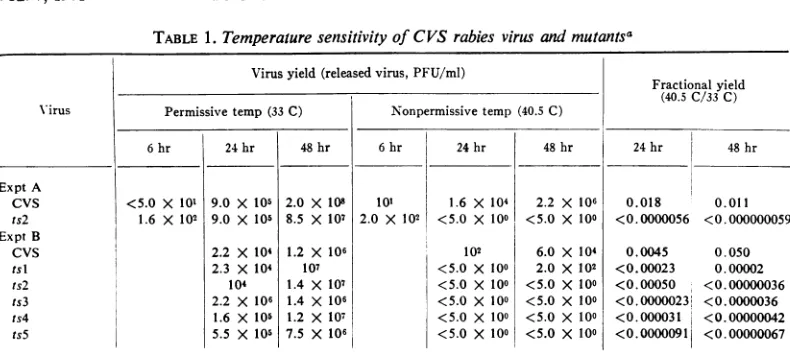
at 40.5 and 33 C is shown inTable 1. Although CVS stock virus gave yields
at
40.5
Cequalto 0.5 to 5.0% of thoseobtainedatthe
permissive
temperature,themutantviruses,
withasingleexception, revealednodemonstrable
replicationatthe
nonpermissive
temperature. Thesmall amount of tsl progeny virus detected at
40.5 C wasdeterminedtoberevertantnon-tsvirus.
The results suggest that there is no measurable
"leakiness" ofthesemutants at40.5 C. Anexact
determination ofreversionrateswas not
possible
becauseofourtechnical
inability
toplaque
rabiesvirusatthe
nonpermissive
temperature.However,
the total absence of detectable virus in 40.5-C
cultures infected with four of the five mutants
indicatesthattheincidence ofrevertantsin those
mutant stocks was less thanone in
108
particles,
296 J. VIROL.
on November 11, 2019 by guest
http://jvi.asm.org/
TS MUTANTS OF "FIXED" RABIES VIRUS
TABLE 1. Temperature sensitivityof CVS rabies virus and mutantsa
Virus yield (releasedvirus, PFU/ml) Permissivetemp(33 C)
24hr
9.0X 10⁵ 9.0 X10⁵
2.2 X 10⁴ 2.3 X 10⁴
104
2.2 X10⁶
1.6 X10⁵ 5.5 X10⁵
48hr
2.0 X 10⁸
8.5 X 10⁷
1.2 X 10⁶ 107 1.4 X 10⁷
1.4 X 10⁶
1.2 X 10⁷ 7.5 X 10⁶
Nonpermissivetemp (40.5 C)
6hr
101 2.0 X 10²
24hr
1.6 X 10⁴
<5.0 X 10'
102
<5.0 X 10'
<5.0 X 10' <5.0 X 10' <5.0 X10'
<5.0 X 10'
48hr
Fractional yield (40.5C/33 C)
24hr 48hr
2.2X 10⁶ 0.018 0.011
<
<5.0 X10' <0.0000056 <0.000000059 6.0 X 10⁴
2.0 X 10²
<5.0 X 10' <5.0 X 10'
<5.0 X 10'
<5.0X 10'
0.0045 <0. 00023 <0.00050 <0.0000023 <0.000031 <0.0000091 0.050 0.00002 <0.00000036 <0.0000036 <0.00000042 <0.00000067
aBHK-21monolayersin 30-miplasticflaskswereinfected atamultiplicityofapproximately10.Afteradsorptionfor 30minat
33 C,monolayerswerewashed twicewithphosphate-buffered saline,treated with 1.0 ml ofpolyvalentrabiesantiserum 1:1,000 for10minat33C,andagainwashedtwice withphosphate-bufferedsaline priortoaddition of cellmaintenancemedium.Times arecalculated fromthe initiation ofadsorption.
the minimum amount of virus in the inocula
tested.
Of the ts mutant clones, one, ts2, produced
unusually small plaques, whereas the size of plaques producedby the other fourwasnormalor near-normal (Fig. 1). The small-plaque mutant
ts2 and the near-normal plaque-forming ts
mutant, tsl, wereselected for further study. Preliminarycharacterization ofmutants tsland
ts2. Theeffect ofthe cell MOI ontheexpression of the ts state ofmutants tsl and ts2 was tested
in several experiments in which postinfection
treatmentofcells with antiserumwasomitted, so that minuteamountsofrevertantvirusmightnot
be neutralized by antibody. Insuch experiments the ts state of mutant stocks was slightly
ob-scuredat6 and24hrpostinfection because of the
release of unadsorbed inoculum virus observed
both at permissive and nonpermissive
tempera-tures. However,data obtained at 48 hr postinfec-tionclearly revealed thatno newinfectious virus
wasproducedat40.5C in culture inoculatedwith tsl orts2 virusstocks atMOIranging from0.13
to 8.0, whereas virus replication was readily demonstrated in cultures inoculated with wild-type virus at similar MOI.
As a furthertestofthestability of thetsstate
of these mutants, serial undiluted passages of
second BHK-21 passage mutantstocks were per-formedin BHK-21 cellsatthepermissive tempera-ture until the 10th passage level was attained.
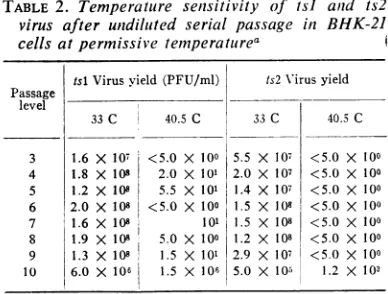
The results oftemperature-sensitivity determina-tions of virus tested at each passage level are givenin Table 2. Both tsl and ts2retained their
ts mutant characteristics unaltered through nine successivepassagesat33 Candthen exhibited
re-version atthe 10th passagelevel. The conditions
leading to thisabrupt conversion are not under-stood, but it is evident that both mutants are
normally very stable when propagated at the permissivetemperature.
The possibility that clones tsl and ts2 may
represent thermolabile mutants was tested by thermoinactivation studies at 40.5 C (Fig. 2). The results indicate that clone ts2 virus is
inacti-vatedatarateverysimilartothat of the parental virus (half-life, ca. 4.1 hr). Clone tsl virus is
ac-tually more thermoresistant than the parental stock (half-life, 7.5 hr).
Pathogenicity for mice. Theresponse of
wean-ling mice to intracerebral inoculation with serial dilutions of parental type CVS and ts mutant
viruses is depicted in Fig. 3. Typicaldose-response effects were observed with CVS, CVS-HPP, and
mutant tsl viruses. The plaque-purified CVS virus appeared to be slightly less virulent for mice than theoriginal CVS stock, causinggreater
than50% mortality onlyatdosesabove 10 PFU, whereas the wild CVS stockwashighlylethaleven
in doses of less than 1 PFU. Mutant tsl virus appeared slightlymorepathogenicthan the CVS-HPP stock from which it was derived, giving a
dose-response curve similar to that of the CVS stock.
Mutant ts2 virus exhibited an extremely
aber-rant dose-response relationship. Both rabies-specific deaths and survivors were observed in groupsof micereceiving virus doses varying from
ca. 1 togreaterthan 10' PFU.
The incubation period was prolonged in mice
infected withtsmutants. Deaths ofmice infected
with tsl mutant virus occurred about2 days later
than inmiceinfected with comparable doses (in
PFU) of CVSorCVS-HPP virus. Deaths of mice
VOL.7, 1971
297
6hr
<5.0 X 10'
1.6 X 10²
Virus ExptA CVs ts2 ExptB Cvs tsl ts2 ts3 ts4 ts5
on November 11, 2019 by guest
http://jvi.asm.org/
CLARK AND KOPROWSKI
I
CVS"..i...,.
HP (VSFIG. 1. Plaque morphology ofmutanit tsl and ts2 rabies viruses, oftheparental CVS-HPP rabies
substraini,
[image:4.491.106.395.69.366.2]midof wild CVSvirus.
TABLE 2. Temperature sentsitivity of tsi and ts2 virus after unidiluted serial passage in BHK-21 cells atpermissive temperature5
tsl Virusyield(PFU/ml) 1s2 Virusyield
Passage level
33C 40.5C 33C 40.5C
3 1.6 X 10⁷ <5.0 X10t 5.5 X 10⁷ <5.0 X 10° 4 1.8 X 10⁸ 2.0 X10' 2.0 X 10⁷ <5.0 X 100 5 1.2 X 10⁸ 5.5 X 101 1.4 X 10⁷ <5.0 X 100
6 2.0X 10⁸ <5.0 X 100 1.5 X 10⁸ <5.0 X100
7 1.6 X 10⁸ 10' 1.5 X 10⁸ .<5.0 X 10°
8 1.9 X 10' 5.0X 10° 1.2 X 10⁸ <5.0 X 10°
9 1.3 X10⁸ 1.5 X101 2.9X10 <5.0 X 100 10 6.0 X10⁶ 1.5 X 10⁶ 5.0 X 10⁵ 1.2 X 10³
aTechniques for theperformanceoftemperaturesensitivity
determinationsaredescribed in Table 1. In the above
experi-ments,only48-hr virusyieldswereconsidered.
infected with ts2 viruswere delayedfrom4 to 10
days. When mice surviving ts2 infection were
challenged with CVS virus (110
LD5o
inoculatedintracerebrally,28daysafter thets2inoculation),
all animals receiving doses of ts2 virus of 160 PFU orgreater wereprotected.The 50% protec-tive doseofts2viruswas23 PFU.
To determine whether mouse deaths were the
48 TIME IN HOURS
FIG.2.
Tlhermal
inactivatiomi
ofCVSrabiesvirusamid
ofts mutantstsland ts2at40.5C.Allvirusessuspended in BME. IBA. Datafrom several experiments arein-cluded.
result ofmutant or ofrevertant virus, virus was
recovered from thebrains ofrepresentative mice
dying after infection with tsl or ts2 virus.
(Be-cause of very low virus titers in mouse brains, brainisolate stocks hadtobepreparedinBHK-21
298 J. VIROL.
on November 11, 2019 by guest
http://jvi.asm.org/
[image:4.491.56.250.401.548.2] [image:4.491.261.454.401.561.2]VOL.7,1971TSMUTANT'S OF "FIXED" RABIES VIRUS29
.:-HPc .-Vs
80j
2
40-2.0 -10 0 0 10 2.0 3.0 40 5.0 6 0 VIRUSTITER/ LOGI0 (PFU /0.03ML)
FIG. 3. Pathogenicity ofCVS rabies virus and ts mutantsforweanlingmice.Groupsof6to12 micewere
inoculated intracerebrally with 10-fold dilutions of
virusandobservedfor28daysafterinoculation.
cellsbythesamemethods usedforpreparationof
stocks from plaques, prior to performance of temperature sensitivity determinations.) Virus from three ofthe sixmice that died of tsl virus infection retained the ts mutant characteristic,
whereasvirus from three others was ofrevertant nature. Virus from three of the four mice that died ofts2 virus infectionwas revertant with
re-gardto both temperaturesensitivity and
plaque-sizecharacteristics; virus from the fourth mouse
retained both the ts and small-plaque charac-teristicsoftheinoculum.
DISCUSSION
We have described the selection of five ts mutantsfromatotal of 161 clones ofpopulations
of CVS strainrabies subjectedtomutagenesis by
nitrousacid, 5-FU,or5AzaC. Theimportanceof chemical mutagenesis for induction of the ts statewasnotdetermined.
Each of the five rabiestsmutantsdetected has exhibited no measurable "leakiness" atthe
non-permissive temperature. The incidence of
re-versiontothenon-tsstatehasbeenlow,andlarge
stocks ofts mutant virus were prepared without difficulties. This experience with the rabies
mutants differs from the general experiencewith
ts mutants of other viruses (1) but parallels ob-servations of ts mutants of the morphologically
similar vesicular stomatitis virus described by
Flamand (2, 3) andby Pringle (InThebiology of
large RNA viruses, Academic Press Inc., in
press).
In addition to temperature sensitivity, mutant
tsl exhibited increasedthermostability at 40.5 C, whereas mutant ts2 induced abnormally small
plaques in BHK-13S cells and asharplyreduced incidence of lethal infections in mice. Mutants with known multiple markers should provide
valuable
flew
tools forbiological
studies of therabies virus. The
only
invitro markerpreviously
reported
forafixed rabiesstrain is the RCT 40-character found in a rabies strainadapted
togrowth
at 26 to 28 Cby
Selimov and Nikitina(16).
Whether themultiple
markers of thetsl andts2 mutants
represent
multiple
mutations ormultiple
manifestations ofsingle-point
mutationsremainsto bedetermined.
The behavior of
small-plaque
ts mutantts2
in mice is of
particular
interest.Although
virusvirulence invivo has not
usually
been aprimary
concern of those
studying
tsmutants,
reducedvirulence has been described for
chemically
in-ducedts mutantsofSemliki Forest disease virus
(1)
and influenza virus(9, 12).
Reducedpatho-genicity
in vivo has also been described in the case ofsmall-plaque
mutants offoot-and-mouthdisease virus induced
by hydroxylamine
(11),
small-plaque
mutants of Newcastle disease virusinduced
by
nitrous acid(4),
and asmall-plaque
mutant of vesicular stomatitis virus
(VSV)
in-duced
by
ultravioletirradiation
(17). However,
toour
knowledge,
apattern
ofpathogenicity
suchasthat caused
by
tsvirus,
in whichvirus-specific
deaths and survivors both occur in animals
inoculated with doses
varying
from 1 to 106PFU,
has not
previously
been described. Theexplana-tionfor this unusual death
pattern
is notclear;
itis
tempting
topostulate
asituation in whichdeath occursonly
if revertant virus appears in lethalamounts before
multiplication
of mutant virusinduces
protective immunity. Preliminary
studieshaverevealed that the brains of three of thefour
mice
dying
afterts2 infection containedrevertantvirus,
whereas a fourth contained ts virus. Thethree mice
yielding
non-trs
virus died afteranear-normal incubation
period
of10daiys;
the mouseyielding
tsvirusdiedonly
after averyprolonged
incubation
period
of28days.
Thepossibility
thatts virusmaybemutantinacharacter criticalfor
rabies
pathogenesis
will
befurtherexplored
in thehope
thatinformation may beobtainedconcern-ing
the unresolvedquestion
of how rabies viruscausesdeath.
Asnoted
above,
rabies virusis thesecond virusoftherhabdovirus groupfrom which tsmutants
havebeen described.tsMutantsofVSV havebeen
obtained in
large
numbers from virus stockssub-jected
to chemicalmutagenesis
and an incidenceof 0.9to
5.0%
ts mutants in wild VSV prepara-tions has been estimated(3,
4, 14).
Comple-mentation between
appropriate
ts mutants ofVSV has been demonstrated to be
unusually
ef-ficient,
and recombination has beendemon-strated. It hasbeen
possible
toplace
themajority
of VSV tsmutants withinoneofeitherfour
(14)
orfive
(3) complementation
groups.Anadequate
299
VoL.
7,
1971on November 11, 2019 by guest
http://jvi.asm.org/
[image:5.491.46.242.61.214.2]CLARK AND KOPROWSKI
comparison of the genetic properties of rabies virus with those of VSV will require: (i) deter-mination that the known rabies mutants
repre-sent single-point mutations, (ii) performance of
tests for complementation and recombination, and (iii) the isolation of many more ts rabies
mutants,anaccomplishment which will
undoubt-edly require the development of new and more
efficient means for screening rabies virus clones
for thepresenceofthe tscondition.
ACKNOWLEDG MENTS
We gratefully acknowledge the excellent technical assistance
ofMaria-Elvira Soriano.
This investigation was supported by Public Health Service Research Grants ROI-AI 02954 and R22-AI 07988 from the National Institute of Allergy and Infectious Diseases and by funds from the World Health Organization.
LITERATURE CITED
1. Fenner, F.1969. Conditional lethalmutantsof animalviruses,
p.1-28. In Current topics in mnicrobiology and iimmunology,
vol.48. Splinger-Verlag,NewYork.
2. Flamand, A. 1969. Etude des mutants thenriosensibles du virus dela stomatite vesiculaire. Miseaupoint d'untestde complementation. Compt. Rend. Acad. Sci. Patis 268: 2305-2308.
3. Flamand, A. 1970. Etude genetique du virus de la stonmatite vesiculaire: classemiient demutantsthemiosensibles spon-tanesen groupes decomplementation. J. Gen. Virol. 8:
187-195.
4. Granoff, A. 1961. Induction ofNewcastledisease virus miiu-tantswith nitrous acid.Virology 13:402-408.
5.Halle, S. 1968. 5-Azacytidine asamutageniforarboviruses. J. Virol. 2:1228-1229.
6. Kissling, R. E. 1958. Growthofrabiesvirus innon-nervous tissue culture. Proc. Soc. Exp. Biol. Med. 98:223-225. 7. Kissling, R. E., andD. R.Reese. 1963. Anti-rabiesvaccine
of tissue cultureorigin. J. Immunol. 91:362-368. 8. Kuwert, E., and W.Liebenow. 1959. Die Stabilitat des
Toll-wutvirus bei verschiedenen H-Ionenkonzentrationen, ver-schiedenen Temperaturen and Formaldehydeinwirkung. Arch. Exp. Vet. Med. 13:335-344.
9. Mackenzie, J. S. 1969. Virulence of temperature-sensitive
mutantsof influenzavirus. Brit. Med. J. 3:757-758. 10. Macpherson, I., and M. Stoker. 1962. Polyoma
transforma-tion of hamster cell clones-an investigatransforma-tion of genetic factorsaffecting cellcompetence.Virology 16:147-151. 11. Maes, R. 1970. Attenuation of foot-and-mouth disease virus
by chemical means. Arch. Gesamte Virusforsch. 29:63-76.
12. Mills,J., J. Van Kirk, D. A. Hill, and R. M. Chanock. 1969. Evaluation of influenza virusmutantsforpossible usein live virus vaccine. Bull.W. H.0.41:599-606.
13. Pasteur, L., M. M.Chamberland, Roux and Thuillier. 1881. Sur larage.Compt. Rend. Acad. Sci. 92:1259-1260. 14. Pringle, C. R. 1970. Genetic characteristics of conditional
lethal mutants of vesicular stomatitis virus induced by 5-fluorouracil, 5-azacytidine,andethylmethane sulfonate. J.Virol. 5:559-567.
15. Sedwick,W. D., and T.J. Wiktor. 1967. Reproducible plaquing
systemforrabies, lymphocyticchoriomeningitis,and other
ribonucleic acidviruses inBHK-21,13Sagarosesuspensions. J. Virol. 1:1224-1226.
16. Selimov, M. A., and L. F. Nikitina. 1970. On the rct
40-marker of fixedrabes virus.Vop.Virusol.15:161-165.
17.Shechmeister, I. L., J. Streckfuss, and R. St. John. 1967.
Comparative pathogenicity of vesicular stomatitis virus
and itsplaque type mutants. Arch. GesamteVirusforsch. 21:127-132.
18.Turner, G. S., and C. Kaplan. 1967. Some properties of
fixed rabies virus.J. Gen.Virol. 1:537-551.