algorithms for multi-objective min-max optimization. In: Bio-inspired
Optimization Methods and their Applications, BIOMA 14, 2014-09-13 -
2014-09-13. ,
This version is available at
https://strathprints.strath.ac.uk/52251/
Strathprints is designed to allow users to access the research output of the University of Strathclyde. Unless otherwise explicitly stated on the manuscript, Copyright © and Moral Rights for the papers on this site are retained by the individual authors and/or other copyright owners. Please check the manuscript for details of any other licences that may have been applied. You may not engage in further distribution of the material for any profitmaking activities or any commercial gain. You may freely distribute both the url (https://strathprints.strath.ac.uk/) and the content of this paper for research or private study, educational, or not-for-profit purposes without prior permission or charge.
Any correspondence concerning this service should be sent to the Strathprints administrator:
The Strathprints institutional repository (https://strathprints.strath.ac.uk) is a digital archive of University of Strathclyde research outputs. It has been developed to disseminate open access research outputs, expose data about those outputs, and enable the
MULTI-OBJECTIVE MIN-MAX OPTIMIZATION
Simone Alicino
Mechanical and Aerospace Engineering University of Strathclyde, Glasgow, UK
Massimiliano Vasile
Mechanical and Aerospace Engineering University of Strathclyde, Glasgow, UK
Abstract This paper presents two memetic algorithms to solve multi-objective min-max problems, such as the ones that arise in evidence-based robust optimization. Indeed, the solutions that minimize the design budgets are robust under epistemic uncertainty if they maximize the Belief in the realization of the value of the design budgets. Thus robust solu-tions are found by minimizing with respect to the design variables the global maximum with respect to the uncertain variables. A number of problems, composed of functions whose uncertain space is modelled by means of Evidence Theory, and presenting multiple local maxima as well as concave, convex, and disconnected fronts, are used to test the performance of the proposed algorithms.
Keywords: Multi-objective optimization, worst-case scenario design, evidence-based robust optimization.
1.
Introduction
Worst-case scenario problems arise whenever a performance index, or cost function, has to be optimal with respect to a design vectord, and at the same time robust against an uncertain vectoru. This class of prob-lems is common in several fields, such as game theory, decision making, robust control, risk analysis, and robust design. For instance, the lower expectation in the realization of the value of a particular performance index for a model of a system can be defined as the degree of belief that
Algorithm 1Min-max optimization via restoration 1: Initialize archive Au ={u1}, and set i= 1 2: while the stopping condition is not met do
3: Compute di = arg min
d∈D
max
u∈Au
f(d,u)
4: Compute ui+1= arg max
u∈Uf(di,u)
5: Add ui+1 to the archiveAu
6: i←i+ 1 7: end while
8: Return {di,ui+1}.
MACSminmax. MACSminmax, employs MACS2 and IDEA at steps 3 and 4, respectively. Another algorithm, MACSν, is presented in this
paper and compared to MACSminmax. MACSν is a variant of MACS2
containing heuristics to deal with min-max problems. The paper starts with a brief introduction to Evidence Theory and its use in the context of robust design optimization in Section 2. Section 3 introduces the two memetic algorithms, MACSminmax and MACSν. Section 4 finally presents the results on some test cases.
2.
Evidence-Based Robust Design Optimization
Evidence Theory [10] allows to adequately model both epistemic and aleatory uncertainty when no information on the probability distribu-tions is available. For instance, during the preliminary design of an engineering system, experts can provide informed opinions by express-ing their belief in an uncertain parameterubeing within a certain set of intervals. The level of confidence an expert has inubelonging to one of the intervals is quantified by using a mass function generally known as Basic Probability Assignment (bpa). All the intervals form the so-called frame of discernment Θ, which is a set of mutually exclusive elementary propositions. The power set of Θ is calledU = 2Θ, or the set of all the subsets of Θ (the uncertain space in the following). An element θ of U
that has a non-zero bpa is called focal element. When more than one parameter is uncertain, the focal elements are the result of the Cartesian product of all the elements of each power set associated to each uncertain parameter. Thebpa of a given focal element is then the product of the
bpa of all the elements in the power set associated to each parameter. All the pieces of evidence completely in support of a given proposition form the cumulative belief functionBel, defined as follows:
Bel(A) = X
∀θi⊆A
m(θi) (1)
where A is the proposition about which the Belief is evaluated. For example, the proposition can be expressed as:
A={u∈U |f(u)≤ν} (2)
wheref is the outcome of the system model and the thresholdν is the desired value of a design budget. It is important to note that the setA
can be disconnected or present holes, likewise the focal elements can be disconnected or partially overlapping. This introduces discontinuities in the search space, making the problem more difficult to solve.
An engineering system to be optimized can be modelled as a function
system budgets (e.g. power budget, mass budget, etc.), and depends on some uncertain parametersu∈U and design parameters d∈D, where
D is the available design space and U the uncertain space. What is interesting for the designers is the value of the functionf for whichBel= 1, i.e. it is maximum. This value of the design budget is the threshold
νmaxabove which the design is certainly feasible, given the current body of evidence. If q objective functions exist, then the following problem can be solved without considering all the focal elements:
νmax= min
d∈DF= mind∈D[maxu∈U¯
f1(d,u), . . . ,max u∈U¯
fq(d,u)]T (3)
Problem in 3 is a multi-objective min-max over the design spaceDand the uncertain space ¯U, where ¯U is a unit hypercube collecting all the focal elements in a compact set with no overlapping or holes. The trans-formation betweenU and ¯U is given by:
xU = b
u
U,i−blU,i
buU ,i¯ −b
l
¯
U ,i
xU ,i¯ +blU,i−
buU,i−blU,i
buU ,i¯ −b
l
¯
U ,i
b
l
¯
U ,i (4)
wherebuU,iandblU,i (resp. buU ,i¯ andblU ,i¯ ) are the upper and lower bound-aries of thei−th hypercube to which xU,i (resp. xU ,i¯ ) belongs.
3.
Multi-Objective Min-Max Memetic
Optimization
Problem (3) searches for the minimum of the maxima of all the func-tions over ¯U and represents an example of worst-case scenario design op-timization. The maximum of every function is independent of the other functions and corresponds to a different uncertain vector. Therefore, all the maxima can be computed in parallel with q single-objective maxi-mizations. The maximization of each function is performed by running a global optimization over ¯U using Inflationary Differential Evolution
(IDEA). The minimization over D is performed by means of MACS2.
actions aiming at following particular descent directions in the criteria space. Social agents implement a Differential Evolution operator and assess the new candidate solutions using Tchebycheff scalarization. Cur-rent non-dominated solutions are then stored in an archive. Both social and individualistic actions make use of a combination of the population and the archive.
In a classical minimization problem two solutionsd1andd2are ranked according to which one gives the lower value of the function. In the minimization loop of a min-max problem, the same can be done only if the maximization loop has returned the actual global maxima ˜u1 and ˜
u2. However, this is usually not true. Therefore a mechanism of cross-check such that also (d1,u2) and (d2,u1) are evaluated is needed in order to increase the probability that each maximization identifies the global maximum, and correctly rank two solutions.
3.1 MACSν
MACSν (Algorithm 2) is the min-max variant of MACS2. It endows MACS2 with special heuristics to increase the probability of finding the global maxima in ¯U. More in detail, a Cross-check (lines 7, 18, and 28) compares the values of the objective functions for a newly generated design vector in the trial populationsPt(line 7) andPs (line 18) against
the function values of a solution already archived in A (indicated with subscriptarch in Algorithm 2). In addition, the cross-check performs a local search or a simple function evaluation in the inner maximization loop depending on whether the location of the maxima changes or not, respectively, for different design vectors. After the cross-check, a Min-Max Selection (lines 11 and 22) compares the population P with the new candidate populationsPt (line 11) and Ps (line 22) and selects
Algorithm 2MACSν
1: Initialize populationP, archiveA=P,nf eval = 0,ǫ= 0.7,δ= 10−6
2: while nf eval < nf eval,max do
3: Run individualistic moves and generate trial populationPt
4: for all d∈Pt do
5: for all darch∈Ado
6: if d≻darch then
7: Cross-check(Pt, A)
8: end if
9: end for
10: end for
11: Min-Max Selection(P, Pt)
12: UpdateP and A
13: Z ← kFmaxarch−Fminarchk
14: Run social moves and generate candidate population Ps
15: for all d∈Ps do
16: for all darch∈Ado
17: if d≻darch orkF(d)−F(darch)k> ǫZ then
18: Cross-check(Ps, A)
19: end if 20: end for 21: end for
22: Min-Max Selection(P, Ps)
23: UpdateP and A
24: Validation(A) 25: for all d∈P do
26: for all darch∈Ado
27: if d≻darch ord≺darch then
28: Cross-check(P, A)
29: else if kF(d)−F(darch)k< δ then
30: Replaceu∈P with u∈A
31: end if 32: end for
33: end for
34: end while
3.2 MACSminmax
Algorithm 3MACSminmax
1: Initialize archive Au ={u1},nf eval = 0
2: while nf eval < nf eval,max do
3: Run MACS2 to compute dmin = arg min
d∈Dumax∈Au
f(d,u) and asso-ciatedfd
4: Add dmin to the archiveAd
5: for all dmin∈Ad do
6: for alll∈ {1, . . . , q}do
7: Run IDEA to compute ulmax = arg max
u∈U¯
fl(dmin,u) and
associated ful 8: if ful > fdl then
9: Add ulmax to the archiveAu
10: else
11: Evaluate function to findulmax= arg max
u∈Au
fl(dmin,u)
12: end if 13: end for
14: end for 15: end while
16: for all dmin ∈Ad do
17: for alll∈ {1, . . . , q} do
18: Run local search to refineulmax∈Au associated to dmin
19: end for 20: end for
21: Return non-dominated dmin and associated ulmax
uncertain vectors (line 3). The archive Au is composed of the results
of a global maximization or a simple function evaluation, depending on which one of the two gives the higher function value (as explained above, it is not guaranteed that the maximization finds the global maximum), for each design vector contained in another archive Ad of candidate
so-lutions (lines 5 to 14). Thus, each element in the archiveAucorresponds
to an element in the archiveAd. This is so if the global maxima change
for different design vectors. If they do not change, the archive Au is
composed of only one element. At the end of the main loop, a local search is run for each element of the archive Ad in order to refine the
accuracy of the elements in the archiveAu. Finally, because the archive
Ad is filled with batches of solutions given in output by MACS2, the
Interesting is a comparison between MACSminmax and MACSν. In MACSν a maximization is run for every agent of the minimization, whereas in MACSminmax each agent of the minimization is cross-checked with the archive of candidate uncertain vectors through a function evalu-ation. However, it is worth noting that the evaluation, in MACSminmax, of each d against an archive Au of candidate uncertain vectors, as well
as the update of Au for each element of an archive Ad of candidate
de-sign vectors, is equivalent to the cross-checks implemented in MACSν. Furthermore, the local search in MACSminmax after the main loop is similar to the validation procedure in MACSν, where a global search is run starting from the extrema of the Pareto front. Finally, in terms of balance between exploration (social moves) and exploitation
(individ-ualistic moves) of the search space, both MACSν and MACSminmax
employ the same search algorithms, MACS2 and IDEA, therefore they are equivalent so long as the parameters (population, F,CR) are set to
the same values.
4.
Test Cases
MACSν and MACSminmax were tested on the six bi-objective and one tri-objective test cases reported in Table 1, where n is the dimen-sion of the design vectord, as well as the uncertain vectoru– therefore the total dimension of the test cases is 2n – andnf eval,max is the
maxi-mum number of function evaluations, i.e. the termination condition for the algorithms. The test cases are composed of the functions in Table 2. The functions are easily scalable and present very challenging land-scapes, with multiple maxima that can change significantly with the design vector. Function MV10, in particular, is characterized by having the maxima located on top of multiple sharp, steep peaks. Note also that the test cases present several types of Pareto fronts, convex, con-cave, linear, and disconnected. The uncertain vector u is assigned the
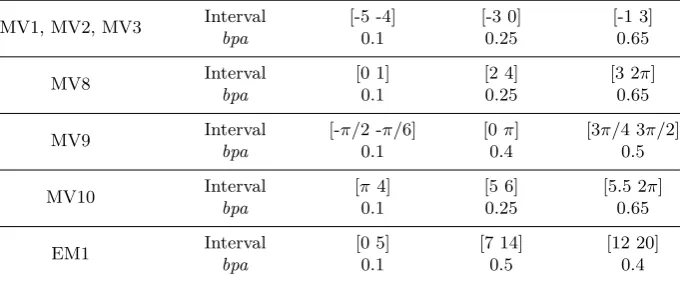
bpa structure reported in Table 3. The uncertain intervals present holes and overlappings, that introduce discontinuities in the uncertain space. The reference solution, i.e. the real front in Figures 1, was computed by merging the results of 200 runs of the same problems solved by means of MACSν with the results of 200 runs of MACSminmax.
From a sensitivity analysis on total number of agents (5, 10, 20) vs. subset of social agents (1/3, 1/2, 1), and F (0.1, 0.5, 1, 2) vs. CR (0.1,
Table 1. Test cases.
Test Case Functions d n nf eval,max
TC1 f1 = MV1,f2 = MV3 [1,5]n 2 2E5
TC2 f1 = MV2,f2 = MV8 [0,3]n 8 1E6
TC3 f1= MV2,f2 = EM1 [1,5]n 8 1E6
TC4 f1 = MV8,f2 = MV9 [1,3]n 2 4E5
TC5 f1= MV8,f2 = EM1 [1,5]n 4 1E6
TC6 f1 = MV10,f2 = MV9 [−4,2π]n 1 1E5
[image:10.595.142.488.331.433.2]TC7 f1 = MV2,f2 = MV8,f3= EM1 [1,5]n 4 1E6
Table 2. Test functions.
ID Function
MV1 f=Pni=1diu 2 i MV2 f=Pni=1(di−ui)
2
MV3 f=Pni=1(5−di) (1 + cosu1) + (di−1) (1 + sinui) MV8 f=Pn
i=1(2π−ui) cos (ui−di) MV9 f=Pni=1(di−ui) cos (−5ui+ 3di) MV10 f=Pn
i=1(di+ui) cos (−ui(5|d|+ 5) + 3di) EM1 f=Pn
i=1(ui−3di) sinui+ (di−2) 2
Table 3. bpa structure of the uncertain variables.
MV1, MV2, MV3 Interval [-5 -4] [-3 0] [-1 3]
bpa 0.1 0.25 0.65
MV8 Interval [0 1] [2 4] [3 2π]
bpa 0.1 0.25 0.65
MV9 Interval [-π/2 -π/6] [0π] [3π/4 3π/2]
bpa 0.1 0.4 0.5
MV10 Interval [π4] [5 6] [5.5 2π]
bpa 0.1 0.25 0.65
EM1 Interval [0 5] [7 14] [12 20]
bpa 0.1 0.5 0.4
analyses were run for test case TC4 with a total of 2E5 function eval-uations, and the results assessed in terms of success rate of finding the global maximum, as well as convergence Mconv and spreading Mspr as
[image:10.595.144.486.482.623.2]Table 4 summarizes the success rates of finding the global maxima, as well as convergence and spreading of MACSminmax in comparison to MACSν. The results are the average performances obtained from the 200 runs needed to achieve a confidence interval of 95% on the success rate being within a ±5% interval containing its estimated value [11]. Columns maxf1, maxf2 and maxf3 contain the maximization success rates computed with an accuracy of 10-4with respect to the actual max-ima, columnsMconvandMsprcontain the mean value ofMconvandMspr
respectively, and columns pconv/tconv and pspr/tspr contain the success
rate of computing a front which convergence and spreading are below the thresholds tconv and tspr also contained in the columns after the ‘/’
symbol. MACSminmax attains performances similar to MACSν, with excellent success rates for almost all the test cases. For TC2, TC3 and TC7, MACSminmax provides a significantly better spreading (2.0, 0.3, and 2.1) than MACSν(16.1, 7.5, and 9.3). Note also that TC2 and TC3 are the test cases with the higher dimension, 16, whereas TC7 has the highest number of objectives, 3. Moreover, for TC5 MACSminmax has a significantly higher success rate for the maximization of the second objective (87.6% against 54.1%): in function EM1 the global maximum has a jump for a certain value of d. This makes the global maximum been tracked more effectively with the global search implemented in MACSminmax than with the local search of MACSν. However, for TC5 average converge and spreading computed by MACSminmax, and their success rates, are worse than for MACSν. MACSν also performs better at finding a front for TC6 which spreading is below a threshold equal to 2. In conclusion, MACSminmax has equal or better capability in the maximization in the uncertain space, and also in terms of convergence and spreading, than MACSν, which in turns performed slightly better in two cases. On one hand, such rather equivalent performances of the two algorithms can be explained by the fact that they have equivalent balance between exploration and exploitation, as explained in subsec-tion 3.2. On the other hand, the better performance of MACSminmax on some of the test cases can be due to more effective archiving, cross-check and validation mechanisms, which are the only aspects that dif-ferentiate MACSν and MACSminmax. The Pareto fronts for the seven test cases are shown in Figure 1. As a comparison, the fronts computed
by means of MACSν and of MACSminmax are displayed. One can see
50 100 150 13.5 14 14.5 15 15.5 16 f1 f2 Real MACSν MACSminmax (a) TC1
200 300 400 500 600 25 30 35 40 45 50 55 f1 f2 Real MACSν MACSminmax (b) TC2
200 300 400 500 600 80 90 100 110 120 130 140 f1 f2 Real MACSν MACSminmax (c) TC3
6 7 8 9 10 11 5 5.5 6 6.5 7 7.5 f1 f2 Real MACSν MACSminmax (d) TC4
6 8 10 12 14 40 50 60 70 80 f 1 f2 Real MACSν MACSminmax (e) TC5
[image:12.595.146.488.149.338.2]2 4 6 8 10 12 14 12 14 16 18 20 22 24 f 1 f2 Real MACSν MACSminmax (f) TC6 100 200 300 400 0 10 20 30 40 50 60 70 f1 f 2 f3 Real MACSν MACSminmax (g) TC7
Figure 1. Pareto fronts of the test cases.
Table 4. Results: comparison between MACSν and MACSminmax.
Test Case Algorithm maxf1 maxf2 maxf3 Mconv Mspr pconv/tconv pspr/tspr
TC1 MACSν 100% 100% - 0.2 1.7 100 / 0.5 79 / 2
MACSminmax 100% 100% - 0.2 1.3 100 / 0.5 100 / 2
TC2 MACSν 100% 65% - 0.5 16.1 100 / 1 0 / 2
MACSminmax 100% 60% - 0.6 2.0 100 / 1 64 / 2
TC3 MACSν 100% 100% - 0.6 7.5 46 / 0.5 3 / 2
MACSminmax 100% 100% - 0.1 0.3 100 / 0.5 100 / 2
TC4 MACSν 100% 91.3% - 0.3 0.9 83 / 0.5 97 / 2
MACSminmax 100% 85.7% - 0.4 1.0 77 / 0.5 91 / 2
TC5 MACSminmaxMACSν 98.6%92.8% 54.1%87.6% -- 1.22.7 5.88.0 24 / 148 / 1 60 / 642 / 6
TC6 MACSν 100% 100% - 0.3 1.2 95 / 0.5 97 / 2
MACSminmax 100% 100% - 0.3 2.0 91 / 0.5 63 / 2
TC7 MACSν 100% 100% 95.3% 5.0 9.3 50 / 5 8 / 5
MACSminmax 100% 100% 98.3% 4.6 2.1 66 / 5 100 / 5
5.
Conclusions
[image:12.595.145.483.401.578.2]imple-ment similar cross-checks. The two algorithms have been tested on seven scalable test cases that present several types of Pareto fronts. Results show that both MACSminmax and MACSν are able to achieve similar very good performances, in terms of finding the global maxima in the uncertain space and the true Pareto front. However, MACSminmax per-formed significanly better in terms of spreading in the two test cases with the highest dimension and the one with three objectives. Multi-objective min-max optimization algorithms find applicability to worst-case sce-nario problems, such as evidence-based robust engineering design.
References
[1] M. Vasile, E. Minisci, and Q. Wijnands. Approximated Computa-tion of Belief Functions for Robust Design Optimization. In 53rd AIAA/ASME/ASCE/AHS/ASC Structures, Structural Dynamics, and Materials Conference, Honolulu, USA, 2012.
[2] A.M. Cramer, S.D. Sudhoff, and E.L. Zivi. Evolutionary Algorithms for Minimax Problems in Robust Design.IEEE Trans. Evol. Comp., 13(2):444–453, 2009. [3] R.I. Lung and D. Dumitrescu. A New Evolutionary Approach to Minimax
Prob-lems. InIEEE Congress on Evolutionary Computation, New Orleans, USA, 2011. [4] A. Zhou and Q. Zhang. A Surrogate-Assisted Evolutionary Algorithm for Mini-max Optimization. InIEEE Congress on Evolutionary Computation, Barcelona, Spain, 2010.
[5] Y.-S. Ong, P.B. Nair, and K.Y. Lum. Max-Min Surrogate-Assisted Evolutionary Algorithm for Robust Design.IEEE Trans. Evol. Comp., 10:392–404, 2006. [6] J. Marzat, E. Walker, and H. Piet-Lahanier. Worst-case Global Optimization of
Black-Box Functions through Kriging and Relaxation.J. Global Optim., 55:707– 727, 2013.
[7] S. Azarm and H. Eschenauer. A Minimax Reduction Method for Multi-Objective Decomposition-Based Design Optimization. Structural Optimization, 6:94–98, 1993.
[8] K. Shimizu and E. Aiyoshi. Necessary Conditions for Min-Max Problems and Algorithms by a Relaxation Procedure.IEEE Trans. Automat. Contr., 25(1):62– 66, 1980.
[9] S. Rivaz and M.A. Yaghoobi. Minimax Regret Solution to Multiobjective Lin-ear Programming Problems with Interval Objective Functions Coefficients.Cent. Eur. J. Oper. Res., 21:625–649, 2013
[10] G. ShaferA Mathematical Theory of Evidence. Princeton University Press, 1976. [11] M. Vasile, E. Minisci, and M. Locatelli. An Inflationary Differential Evolution Algorithm for Space Trajectory Optimization.IEEE Trans. Evol. Comp., 15:267– 281, 2011.
[12] F. Zuiani and M. Vasile. Multi Agent Collaborative Search Based on Tchebycheff Decomposition.Comput. Optim. Appl., 56(1):189–208, 2013.