REPRESENTING GRAPHS VIA PATTERN AVOIDING WORDS
MILES JONES, SERGEY KITAEV, ARTEM PYATKIN, AND JEFFREY REMMEL
Abstract. The notion of a word-representable graph has been
studied in a series of papers in the literature. A graphG= (V, E) is word-representable if there exists a word w over the alphabet
V such that letters xandy alternate inw if and only ifxy is an edge inE. IfV ={1, . . . , n}, this is equivalent to saying thatGis word-representable if for allx, y∈ {1, . . . , n}, xy∈E if and only if the subword w{x,y} ofw consisting of all occurrences of xor y
inwhas no consecutive occurrence of the pattern 11.
In this paper, we introduce the study ofu-representable graphs for any wordu∈ {1,2}∗. A graphGisu-representable if and only if there is a vertex-labeled version ofG,G= ({1, . . . , n}, E), and a wordw∈ {1, . . . , n}∗ such that for all x, y∈ {1, . . . , n},xy∈E
if and only if w{x,y} has no consecutive occurrence of the
pat-ternu. Thus, word-representable graphs are just 11-representable graphs. We show that for anyk ≥3, every finite graph G is 1k
-representable. This contrasts with the fact that not all graphs are 11-representable graphs.
The main focus of the paper is the study of 12-representable graphs. In particular, we classify the 12-representable trees. We show that any 12-representable graph is a comparability graph and the class of 12-representable graphs include the classes of co-interval graphs and permutation graphs. We also state a number of facts on 12-representation of induced subgraphs of a grid graph. Keywords: word-representable graphs, pattern avoidance, com-parability graphs, co-interval graphs, permutation graphs, grid graphs, ladder graphs
Instituto de Matem´atica,Universidad de Talca, Camino Lircay S/N Talca, Chile. Email:[email protected] Supported by FONDECYT (Fondo Nacional de Desarrollo Cient´ıfico y Tecnol´ogico de Chile) postdoctoral grant #3130631.
Department of Computer and Information Sciences, University of Strathclyde, Glasgow G1 1XH, UK. Email: [email protected].
Sobolev Institute of Mathematics; Novosibirsk State University; Novosibirsk, Russia. Email: [email protected].
Department of Mathematics, University of California, San Diego, La Jolla, CA 92093-0112. USA. Email: [email protected].
1. Introduction
The notion of aword-representablegraph was first defined in [11]. A graph G = (V, E) is word-representable if there exists a word w over the alphabet V such that letters x and y alternate in w if and only if xy is an edge in E. For example, the cycle graph on four vertices labeled by 1, 2, 3 and 4 in clockwise direction can be represented by the word 14213243. Word-representable graphs have been studied in a series of papers [1]–[7], [9], [11]–[13], and they will be the main subject of an up-coming book [10].
The first examples of graphs that are not word-representable were given in [11]. In fact, V. Limouzy [private communication, 2014] no-ticed that it is NP-hard to determine whether a given graph is word-representable, see [10] for the details. In [14] it was proved that any comparability graphG is not just word-representable, but it is
permu-tationally word-representable. That is, for the graph G, there exists a
wordw with the necessary letter alternation properties such that w is obtained by concatenating a number of permutations of the alphabet. The key observation that motivated this paper was the fact that the study of word-representable graphs is naturally connected with the study of patterns in words. That is, let P = {1,2, . . .} be the set of positive integers andP∗ be the set of all words overP. Ifn ∈P, then we let [n] ={1, . . . , n} and [n]∗ denote the set of all words over [n]. Given a word w=w1. . . wn inP∗, we let A(w) be the set of letters occurring
in w. For example, if w = 4513113458, then A(w) = {1,3,4,5,8}. If
B ⊆A(w), then we letwB be the word that results fromwby removing
all the letters in A(w) \B. For example, if w = 4513113458, then
w{1,3,5} = 5131135. Ifu∈P∗, we let red(u) be the word that is obtained from u by replacing each occurrence of the i-th smallest letter that occurs in u byi. For example, if u= 347439, then red(u) = 123214.
Given a word u = u1. . . uj ∈ P∗ such that red(u) = u, we say
that a word w = w1. . . wn ∈ P∗ has a u-match starting at position i if red(wiwi+1. . . wi+j−1) = u. Then we can rephrase the defini-tion of word-representable graphs by saying that a graph G is word-representable if and only if there is a labelingG= ([n], E), and a word
w∈[n]∗ such that for allx, y ∈[n],xy∈E if and only if w{x,y} has no
11-matches.
This led us to the following defintion. Given a word u ∈ [2]∗ such that red(u) =u, we say that a graph Gisu-representableif and only if there is a labeling G= ([n], E), and a word w ∈[n]∗ such that for all
x, y ∈[n], xy ∈ E if and only if w{x,y} has no u-matches. In this case
This definition leads to a number of natural questions. For example, how much of the theory of 11-representable graphs carries over to u -representable graphs? Can we classify the u-representable graphs for small words u such as u = 111, u = 1111, u = 12, or u = 121? If a graph G= ([n], E) is u-representable, can we always find a word w
which is a concatenation of a finite set of permutations representing some labeled version of G?
Given how involved the theory of word-representable graphs is, our first surprise was the fact that every graph is 111-representable. Indeed, we will show that for every k ≥ 3, every graph is 1k-representable.
Thus, we decided to explore the next simplest case, which is the class of 12-representable graphs.
It turns out that there is a rich theory behind the class of 12-representable graphs. For example, we will show that not every graph is 12-representable. In particular, the cycles Cn for n ≥ 5 are not
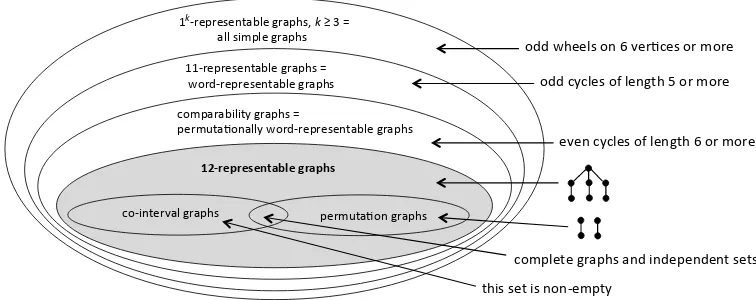
12-representable. We will also show that there are non-12-representable trees, which contrasts with the fact that every tree is 11-representable. In fact, we will give a complete classification of the 12-representable trees. We say that a tree T = (V, E) is adouble caterpillar if and only if all vertices are within distance 2 of a central path. We will prove that a treeT is 12-representable if and only ifT is a double caterpillar. Further, we will show that the class of 12-representable graphs is properly included in the class of comparability graphs, and it properly includes the classes of co-interval graphs and permutation graphs as shown in Figure 1. It turns out that the notion of 12-representable graphs is a natural generalization of the notion of permutation graphs. Figure 1 also gives examples of graphs inside/outside the involved graph classes. For instance, even cycles of length at least 6, being comparability graphs, are not 12-representable (see Theorem 8 in Sec-tion 3); also, odd wheels on six or more vertices are not 11-representable [11].
A fundamental difference between word-representable graphs andu -representable graphs is the following. For word--representable graphs, it is not so important whether we deal with labeled or unlabeled graphs: two isomorphic graphs are both either word-representable or not. On the other hand, for certain u, a given graph Gmay have two different labeled versions G1 = ([n], E1) and G2 = ([n], E2) such that there is a word w which u-represents G1 but there is no word w′ which u -represents G2. In fact, we will see the phenomenon in the case where
u = 12. This is why we say an unlabelled graph is u-representable if it admits labeling G = ([n], E) such that there is word w which
!!"#$%#$&$'()*+$,-#)%.&,/, ,01#2"#$%#$&$'()*+$,-#)%.&, !!"#$%#$&$'()*+$,-#)%.&3,!,4,5,/, ,,,,,,,,,,,,,)++,&67%+$,-#)%.&,,
817%)#)*6+6(9,-#)%.&,/,
%$#7:();1')++9,01#2"#$%#$&$'()*+$,-#)%.&,,
!"#$%&$%'%()*+,%-.$*&/'--81"6'($#<)+,-#)%.&, %$#7:();1',-#)%.&,
122,0.$$+&,1',=,<$#;8$&,1#,71#$, 122,898+$&,1>,+$'-(.,?,1#,71#$,
$<$',898+$&,1>,+$'-(.,=,1#,71#$,
[image:4.612.128.506.124.274.2]817%+$($,-#)%.&,)'2,6'2$%$'2$'(,&$(&, (.6&,&$(,6&,'1'"$7%(9,
Figure 1. The place of 12-representable graphs in a hierarchy of graph classes.
This paper is organized as follows. In Section 2, we give all necessary definitions and show that any graph is 1k-representable ifk ≥3. Some
basic properties of 12-representable graphs are established in Section 3. In Section 4, we shall prove that a treeT is 12-representable if and only if T is a double caterpillar. In Section 5, we compare the class of 12-representable graphs to other graph classes thus explaining Figure 1. In Section 6, we provide a discussion of 12-representability of induced subgraphs of a grid graph. Finally, in Section 7, we introduce a num-ber of new ways to define representability of simple graphs, directed graphs, and hypergraphs via words subject to certain pattern avoid-ance conditions. We also define several analogues of Wilf-equivalencies
in Section 7, which are yet to be studied.
2. Preliminaries
A simple graph G = (V, E) consists of a set of vertices V and a set of edges E of the form xy where x, y ∈ V and x ̸= y. All graphs considered in this paper are simple and finite. Sometimes V will be a finite subset ofP. In this case we say that the graph is labeled. For an unlabeled graph we define its labeling as an assignment to its vertices some elements of P (labels).
IfG= (V, E) is a labeled graph (i. e. V ⊂P) and |V|=n, then the
reduction of G, denoted red(G), is a relabeling G′ = ({1, . . . , n}, E′)
V′ =V ∪ {v′}and E′ =E∪E∗, where v′a∈E∗ if and only if va ∈E
and E∗ does not contain edges not involving v′.
Given a word w = w1. . . wk ∈ P∗ and x, y ∈ A(w), we say that x
and y alternate in w if w{x,y} is either of the form xyxyxy . . . of even
or odd length or yxyx . . . of even or odd length. Let G= (V, E) be a labeled graph. Then we say thatGisword-representable if there exists a word w ∈ V∗ such that for all x, y ∈ V, xy is an edge in E if and only if x and y alternate in w. In such a situation, we say that w
word-representsG and w is called a word-representant of G.
We say that H = (V′, E′) is an induced subgraph of G = (V, E) if
V′ ⊆ V and for all x, y ∈ V′, xy ∈ E′ if and only if xy ∈ E. Then we have the following observation establishing the hereditary nature of the notion of graph word-representability.
Observation 1. If G= (V, E)is word-representable andH = (V′, E′)
is an induced subgraph of G, then H is word-representable.
Indeed, it is easy to see that if w represents G = (V, E), then wV′
represents H = (V′, E′).
In this paper, we introduce two generalizations of the notion of a word-representable graph — see Definitions 1 and 5. In Section 7, we will discuss several other natural notions of representing simple graphs, directed graphs, and hypergraphs by words subject to certain pattern avoidance conditions. The key to our main generalization is to re-frame the notion of word-representable graphs in the language of patterns in words. Note thatxandyalternate in a wordw∈P∗ if and only ifw{x,y}
has no 11-match. Thus, a graph G = ([n], E) is word-representable if and only if there is a wordw∈[n]∗ such that for all x, y ∈[n],xyis an edge in E if and only if w{x,y} has no 11-match. This leads us to our
main definition.
Definition 1. Letu=u1. . . uj be a word in{1,2}∗ such that red(u) = u. Then we say that a labeled graph G = ([n], E) is u-representable
if there is a word w ∈ P∗ such that for all x, y ∈ [n], xy ∈ E if and only if w{x,y} has no u-match. We say that an unlabeled graph H is u-representable if there exits a labeling of H, H′ = ([n], E′), such that
H′ is u-representable. In such a situation, we say that H′ realizes the
u-representability of H.
Thus, by Definition 1, G is word-representable if and only if G is 11-representable.
Observation 2. Replacing “word-representable graphs” by “u-representable graphs” in Observation 1, we would obtain a true statement establishing
The theory of word-representable graphs is rather involved, and thus the following theorem, where 1k denotesk1s, came as a surprise to us.
Theorem 1. For everyk ≥3, every finite graphGis1k-representable.
Proof. Fix any k ≥ 3. Clearly, if G is the complete graph Kn on
vertex set [n], then G is 1k-representable by any permutation of [n], in particular, w= 12. . . n 1k-represents K
n.
We proceed by induction on the number of edges in a graph with the base case being the complete graph. Our goal is to show that if G is 1k-representable, then the graph G′ obtained from Gby removing any
edge ij is also 1k-representable.
Suppose that w 1k-represents G = ([n], E) and let p(w) denote the
initial permutation of w. That is, p(w) is obtained from w by
re-moving all but the leftmost occurrence of each letter. For example,
p(31443266275887) = 31426758. Further, let π be any permutation of [n]\{i, j}. Then we claim that the word
w′ =ik−1πip(w)w
1k-represents G′. Indeed, the vertices i and j are not connected any
more because w{′i,j} contains ik. Also, no new edge can be created
because of the presence ofwas a subword. Thus, we only need to show that each edge msrepresented by w is still represented by w′ if s ̸=j
orm ̸=i.
Ifs ̸=j and m=i, then either
(1) w{s,i} = stid. . . where 1 ≤ d, t ≤ k−1 in which case w′{s,i} = ik−1sisistid. . ., or
(2) w{s,i} = idst. . . where 1 ≤ d, t ≤ k−1 in which case w′{s,i} = ik−1siisidst. . ..
In each case, it is easy to see that w{s,i} has no 1k-match so that w′
1k-represents the edge is.
Ifm ̸=i and s =j, then either
(1) w{m,j} =mtjd. . .where 1≤d, t≤k−1 in which case w{′m,j} = mmjmtjd. . ., or
(2) w{m,j} =jdmt. . .where 1≤d, t≤k−1 in which case w{′m,j} = mjmjdmt. . ..
In each case, it is easy to see that w{m,j} has no 1k-match so that w′
1k-represents the edge mj.
Finally supposem, s̸∈ {i, j}andmoccurs beforesinπ. Then either (1) w{m,s} =mtsd. . .where 1≤d, t≤k−1 in which case w{′m,j} =
(2) w{m,j} =sdmt. . .where 1≤d, t≤k−1 in which case w{′m,j} = mssmsdmt. . ..
In each case, it is easy to see that w{m,s} has no 1k-match so that w′
1krepresents the edge ms. □
We note that there are some natural symmetries amongu-representable graphs. That is, suppose that u =u1. . . uj ∈ P∗ and red(u) = u. Let
the reverse of u be the word ur = ujuj−1. . . u1. Then for any word
w ∈P∗, it is easy to see that w has a u-match if and only ifwr has a
ur-match. This justifies the following observation.
Observation 3. Let G = (V, E) be a graph and u ∈ P∗ be such
that red(u) = u. Then G is u-representable if and only if G is ur
-representable.
For any word w = w1. . . wk ∈ P∗ whose largest letter is n, we let wc= (n+ 1−w
1). . .(n+ 1−wk). It is easy to see thatwhas au-match
if and only if wc has a uc-match. Given a graph G = ([n], E), we let
the supplementofGbe defined byG= ([n], E) where for allx, y ∈[n],
xy∈ E if and only if n+ 1−x and n+ 1−y are adjacent in G. One can think of the supplement of the graph G = (V, E) as a relabeling where one replaces each label x by the label n+ 1−x.
It is easy to see that ifwwitnesses thatG= ([n], E) isu-representable, then wc witnesses that Gis uc-representable. This justifies the
follow-ing observation.
Observation 4. Let G= ([n], E) be a graph, and u be a word in [n]∗
such that red(u) = u. Then G is u-representable if and only if G is
uc-representable.
We can combine Observations 2 and 3 to prove the following fact about 12-representable graphs. Suppose thatw12-represents G. Then
wr 21-represents G and, hence, (wr)c 12-represents G. It follows that
if a vertex v has label 1 (resp., n) in some labeling realizing the 12-representability of an unlabeled graphG, then there is another labeling realizing the 12-representability of G such that the vertex v has label
n (resp., 1).
3. 12-representable graphs
n, ij is in E if and only if j occurs before i inσ. However, this means that σ 12-represents G. Thus we have the following simple fact.
Proposition 1. A graph G can be 12-represented by a permutation if
and only if G is a permutation graph.
It follows that all graphs on at most four vertices are 12-representable (since C5 is the minimum graph that is not a permutation graph). We will study the place of 12-representable graphs among the other graph classes in Section 5.
Next we show that any 12-representable graph can be 12-represented by a word having at most two copies of each letter.
Theorem 2. Let G = (V, E) be a labeled representable graph. Then
there exists a word-representant w in which each letter occurs at most
twice.
Proof. Letw′ representGand suppose that a letterj occurs inw′ more
than twice. Then letw′ =AjBjC, where Aand C do not contain any copies of j. Note that ij ∈ E if and only if (i < j and all copies of
i are in C) or (i > j and all copies of i are in A). So, any copies of the letter j in B do not affect on the neighborhood of the vertex j in
G and therefore they can be omitted. Doing the same with all other letters occurring in w′ more than twice, one obtain a required word w
representing G. □
Note that replacing “at most” by “exactly” in the statement of The-orem 2, we obtain a true statement. This is based on the fact that replacing a letter x in a word 12-representing a graph by any number of copies of x, we obtain a word 12-representing the same graph.
Lemma 3. Let G = (V, E) be a 12-representable graph and v ∈ V.
Then the graph H obtained by adding to G a copy of v is also 12
-representable.
Proof. Let i be the label of v. First, increase by 1 all labels j > i,
keeping all other labels the same. Add a copy of v and label it i+ 1 to obtain a labeling ofH. Now, in a word w12-representingGreplace each letterj > ibyj+ 1 and substitute each occurrence ofibyi(i+ 1) to obtain a word w′. Clearly, ia is an edge inH if and only if (i+ 1)a
is an edge in H, and i and i+ 1 are not adjacent in H. All edges not involving v and its copy are the same in G and H. Thus, w′
12-represents H. □
I3 =
1r 2r r3
J4 =
1 3
4 2r
r
r r
Q4 =
1 4
3 2r
r
r r
Figure 2. The graphs I3, J4, andQ4.
Lemma 4. Let G = (V, E) be a labeled graph. Then if G has an
induced subgraph H such that red(H) is equal to one of I3, J4, or Q4,
then G is not 12-representable.
Proof. First, suppose that G has a subgraph H such that red(H) =
I3. Thus H must be of the form H = ({i, j, k},{ij, jk}) where i <
j < k. Now, for a contradiction, suppose that w = w1. . . wn
12-represents G. Let wm be the left-most occurrence of j in w. Then
since ij ∈ E, no i occurs in w1. . . wm−1, and since jk ∈ E, no k occurs in wm+1. . . wn. But then, clearly,w{i,k} has no 12-match, which
contradict the condition that ik̸∈E.
Next, suppose that G has a subgraph H such that red(H) = J4 or red(H) = Q4. Thus, H must be of the form H = ({i, j, k, ℓ},{ik, jℓ}) where max{i, j}<min{k, ℓ}. Again, for a contradiction, suppose that
w=w1. . . wn 12-represents G. Let wt be the right-most occurrence of kinw. Then sinceik ∈E, noioccurs inw1. . . wt−1, and sincejk ̸∈E, it must be the case thatj occurs inw1. . . wt−1. Letws be the left-most
occurrence of j in w. Then s < t. But since jℓ ∈ E, no ℓ occurs in
ws+1. . . wn. Next, letwr be the right-most occurrence of ℓ inw. Then r < s. But this would imply that iℓ∈E which is a contradiction. □ An immediate corollary to Lemma 4 is that in any path x0x1· · ·xs
in a 12-representable labeled graph, we have x0 < x1 > x2 < x3 >· · · orx0 > x1 < x2 > x3 <· · ·.
Let us say that a labeled graph G= (V, E), where V ⊂P, has a bad path if G has an induced path P whose endpoints are labeled by two smallest elements in P.
Lemma 5. Let G = ([n], E) be a labeled graph. Then if G has a bad
path P of length at least 3, then G is not 12-representable.
Proof. LetP =x0x1. . . xs and max{x0, xs}<min{x1, x2, . . . , xs−1}. If
s≥ 4 then the reduction of the subgraph induced by {x0, x1, xs−1, xs}
is J4 or Q4. If s = 3 then without loss of generality x1 < x2, and the reduction of the subgraph induced by {x0, x1, x2} is I3. In both cases
G is not 12-representable by Lemma 4. □
12-representable since they are caterpillars, and all caterpillars are per-mutation graphs [16].
Lemma 6. Let G = (VG, EG) and H = (VH, EH) be 12-representable
graphs. Assume that there are labelings of G and H such that x ∈VG
and y ∈ VH receive the smallest or the highest labels in G and H,
respectively. Then the graphG∪H∪{xy}obtained from disjoint copies
of G and H by adding the edge xy, is 12-representable.
Proof. Suppose, without loss of generality, that in our labelings VG =
{1,2, . . . , k} andVH ={k+ 1, k+ 2, . . . , ℓ}. Moreover, by Lemma 4 we
can assume that x is labeled by k and y is labeled by k+ 1. Denote by wG and wH the words 12-representing G and H, respectively. Let w′G be the word obtained from wG by replacing each occurrence of k
by k + 1, and w′H be the word obtained from wH by replacing each
occurrence of k+ 1 by k. It is easy to see that the word w = w′Gw′H
represents the graph G∪H∪ {xy}. □ Given two subsets of positive integers A and B, we write A < B if every element ofAis less than every element ofB, i. e. x < y whenever
x∈A andy ∈B. A subset U ⊂V is a cutset ifG\U is disconnected.
Lemma 7. Suppose that G = ([n], E) is a labeled graph. Let U be a
cutset of G. Denote by G1 = (V1, E1) and G2 = (V2, E2) two
compo-nents of G\U. If G is 12-representable, |V1| ≥ 2, |V2| ≥ 2, and the
smallest element of V1∪V2 lies in V1, then V1 < V2.
Proof. Let H = red(G1 ∪G2). Then 1 ∈ V1. Denote by k > 1 the
smallest element in V2. Assume that the property V1 < V2 does not hold. Then V1 contains labels that are greater than k. Denote by
C1 (resp., C2) the set of all vertices in V1 whose labels are less (resp., greater) than k. Since G1 is connected, there is an edge ab such that
a ∈ C1 and b ∈ C2. Denote by ℓ a neighbor of k in G2. Then the reduction of the subgraph induced by {a, b, k, ℓ} is either J4 or Q4, and so G is not representable by Lemma 4, a contradiction. Hence,
V1 < V2. □
The following theorem provides examples of non-12-representable graphs. Note that we have shown, in the paragraph following Proposi-tion 1, that C3 and C4 are 12-representable. It turns out that they are the only 12-representable cycles.
Theorem 8. Cn is not 12-representable for any n ≥5.
Proof. Suppose for a contradiction that Cn is 12-representable where
the cycle in a clockwise order. Then since no subgraph ofCncan reduce
to I3 by Lemma 4, the sequence 1, x1, x2, . . . , xn−1,1 must be an up-down sequence, i. e. 1 < x1 > x2 < x3 > x4 < · · ·xn−2 < xn−1 > 1. This is clearly impossible if n is odd. Now assume thatn is even. But then consider the position of 2 in the sequence 1, x1, x2, . . . , xn−1,1. Clearly 2 cannot be equal to x1 or xn−1. But this means that one of the two paths that connect 1 to 2 around the cycle would be a bad path of length at least 3 which is impossible by Lemma 5. □
4. Characterization of 12-representable trees
A caterpillar is a tree in which all the vertices are within distance
1 of a central path. In this paper, we need the notion of a double caterpillar defined as follows.
Definition 2. Adouble caterpillarT is a tree in which all the vertices are within distance 2 of a central path. Such a path is called a double caterpillar’s spine if it is obtained by first removing all leaves from T
and then removing all leaves from the obtained tree.
Astarorstar treeis thecomplete bipartite graphK1,n. Here we allow
n ≥0, where n = 0 corresponds to the graph K1 (an isolated vertex).
The centrum of a star is the all-adjacent vertex in it. Suppose that a
vertex v in a tree T is adjacent to vertices v1, v2, . . . , vk. Removing v
we obtain a forest T\v whose ith component Ti is determined by the
tree havingvi as a vertex. We say that theith component of the forest
is good if it is a star with centrum at the vertexvi.
Lemma 9. If a tree T is 12-representable then for any vertex v, at
most two components Ti of the forest T\v are not good.
Proof. Note that all trivial (one-vertex) components of T\v are good
by the definition. LetT1, T2, . . . , Tk be non-trivial components ofT\v.
By Lemma 7 we can assume that the labels of these components satisfy the property T1 < T2 <· · ·< Tk.
Now, suppose that there are three components of the forest T\v
which are not good. Without loss of generality, we can assume that these components are T1, T2 andT3. Further, assume that the vertices
v, v1, v2 and v3 receive labels r, m1 < m2 < m3, respectively, in some labeling T′ realizing representability of T. Since T2 is not good, it contains two vertices y1, y2 such that y1m2, y1y2 ∈ E and y2m1 ̸∈ E. Note that a similar statement is true for T1 and T3. The structure of these components is schematically shown in Figure 3.
T1 T2 T3
m1 m2 m3
r
x x2
1 y
y
z z
1 1
[image:12.612.239.375.114.225.2]2 2
Figure 3. The structure of components in T\v which are not good.
We can now assume that r < m1, since for the case r > m3 we can take the supplement of T′ and apply the observation about 12-representable graphs given at the end of Section 2. Since T1 < T2 <
T3 we have r < min{y1, y2} < max{y1, y2} < m3, and therefore the subgraph induced by the vertices {r, y1, y2, m3} reduces to a copy of
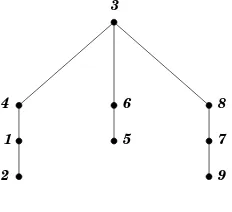
Q4, which is impossible by Lemma 4. □ Note that a tree T\v can have two components which are not good (see, for example, Figure 4), and thus Lemma 9 cannot be enhanced.
1 2 4
3
6 5
8
w= 2416583597 7 9
Figure 4. Removal of 3 produces a forest with two com-ponents which are not good.
The main result of this section is the following characterization of 12-representable trees.
Theorem 10. A tree T is12-representable if and only if it is a double caterpillar.
Proof. Necessity. Suppose that a tree T is not a double caterpillar.
Further, suppose that P =v1v2. . . vk is a longest path in T. Since all
trees of diameter 5 are double caterpillars,P has at least six edges, and thus k ≥ 7. By our assumption, T has a vertex v at distance 3 from
[image:12.612.249.365.402.508.2]is of maximum length, we have i ∈ {4,5, . . . , k −3}. But then in the forestT\vi at least three components which are not good, namely those
containingv, v1 and vk. Thus by Lemma 9, T is not 12-representable.
...
...
...
...
v
1 v2 v2n
}
}
}
[image:13.612.223.390.166.245.2]k leaves k leaves k leaves
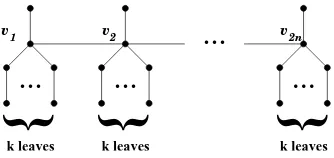
Figure 5. A uniform double caterpillar with even spine.
Sufficiency. By Lemma 3, we can assume that no leaf has a sibling. To show that any such double caterpillar is 12-representable, we will use induction on the length of double caterpillar’s spine, and prove the statement for uniform double caterpillars DC(P2n) with even spines P2n =v1v2. . . v2n presented schematically in Figure 5; then any other
double caterpillar will be 12-representable due to Lemma 3 and Obser-vation 2.
...
...
4
3
6
5 1 2
2k+1
2k+2 2k+3
2k+4 2k+6 2k+5
4k+2 4k+1 4k+3 4k+4
Figure 6. The labeling of DC(P2).
We will prove even a stronger statement, namely that there is a labeling ofDC(P2n) in which the label of v1 is 1 and that ofv2n is the
maximum label 2n(k+1). The base of the induction is given by labeling
DC(P2) presented in Figure 6, and the following 12-representant: 24365. . .(2k+ 2)(2k+ 1)(2k+ 4)(2k+ 6). . .(4k+ 2)(4k+ 4)135. . .
(2k+ 1)(2k+ 4)(2k+ 3)(2k+ 6)(2k+ 5). . .(4k+ 2)(4k+ 1)(4k+ 3) stated on two lines. It is straightforward to check that this word has the right alternating properties.
Now, suppose that we are given a double caterpillarDC(P2n). Choose
any 1≤r≤n−1 and remove the edgev2rv2r+1onDC(P2n)’s spine. We
[image:13.612.196.413.389.447.2]v2r+1 has the smallest label s+ 1 and v2n has the largest label s+t.
Now apply Lemma 6 to connect these graphs by the edgev2rv2r+1 thus obtaining a labeling realizing 12-representability of DC(P2n) in such
a way that v1 has the smallest label 1 and v2n has the largest label s +t = 2n(k + 1) (recall that in the proof of Lemma 6 no vertices except for the endpoints of the inserted edge changed their labels). □
1
4 7
5 6
9
8
10 11
12
13 14
15
2 3
16
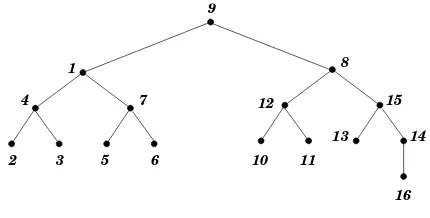
[image:14.612.203.418.219.328.2]w= 4 2 3 7 2 3 5 6 9 1 2 3 5 6 12 10 11 15 8 10 11 13 16 14
Figure 7. A 12-representation of the full binary tree of height 3 plus one vertex.
Note that the labeling presented in the proof of Theorem 10 is not the only possible labeling for double caterpillars. For example, the tree presented in Figure 7 has the spine 1,9,8,15, while the maximum label is 16.
5. 12-representable graphs and known classes of graphs
The goal of this section is to justify Figure 1.
Let us recall the definitions and known properties of some graph classes. A comparability graph is an undirected graph that connects pairs of elements that are comparable to each other in a partial order (a poset). Comparability graphs are also known as transitively orientable
graphsorpartially orderable graphs. Atransitive orientationof a graph
is an acyclic orientation that has a property that ifa→bandb →care arcs then we must have the arc a→c. A graphGis aco-comparability
graph if its complement Gc is a comparability graph. It is known [4]
that a graph G is a permutation graph if and only if both G and its complement Gc are comparability graphs. An interval graph is the intersection graph of a family of intervals on the real line. It has one vertex for each interval in the family, and an edge between every pair of vertices corresponding to intervals that intersect. A graph G is
if it has no induced cycle on at least 4 vertices. It is a well known fact [5] that a graph is an interval graph if and only if it is chordal and a co-comparability graph.
As it is mentioned in the introduction, any comparability graph is word-representable [14], and any odd cycle of length 5 or more, being a non-comparability graph, is word-representable [10]. Moreover, odd wheels on six or more vertices are non-word-representable [11], and the set of 1k-representable graphs, for any k ≥ 3, coincides with the
set of all graphs by Theorem 1. Our next result shows that any 12-representable graph is necessarily a comparability graph.
Theorem 11. If G is a 12-representable graph, then G is a compara-bility graph.
Proof. By Lemma 4, any induced path P of length 3 is such that
red(P) ̸= I3. We now direct edges in G so that if ab is an edge and
a < b then the arc a → b goes from a to b. This orientation is ob-viously acyclic. We claim that this orientation is, in fact, transitive, which completes the proof of our theorem. Indeed, if the directed copy of G contains a directed path P⃗ of length 3, say a → b → c, then we must have the arc a→cin the graph or otherwise red(P⃗) = I3. □
1
6
3
5 4
2 7
6
3 1
7 5 4 2
C =
[image:15.612.146.465.418.505.2]CC
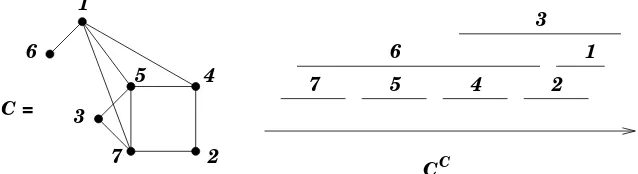
Figure 8. A co-interval graphC and an interval repre-sentation of its complement Cc.
Theorem 12. If G is a co-interval graph, then G is 12-representable.
Proof. Suppose that G is a co-interval graph on n vertices. It is a
Next, form a word w corresponding to labeled intervals by going through all interval endpoints (both left and right endpoints) from left to right and recording their labels in the order we meet them. For example, for the labeled interval representation in Figure 8, the word
w is 76755434261213. Optionally, all occurrences of ii, like 55 in the last word, can be replaced by a single i. We claim that the word w
12-represents G. Indeed, let i < j. If ith and jth intervals overlap, then w{i,j} = jiji or w{i,j} = jiij; anyway, i and j are not adjacent.
Otherwise, by the choice of the labeling, theith interval lies directly to the right from thejth one, and thusw{i,j} =jjii, i.e. ij is an edge. □
To conclude our description of Figure 1, we would like to justify that the Venn diagram presented by us is proper, namely that there are strict inclusions of sets and also that the class of co-interval graphs is not a subset of the class of permutation graphs, and vice versa, and these classes do overlap. Note that it remains to explain the set inclusions only inside the class of 12-representable graphs since the rest of the diagram has been already explained above.
a" b"
c" e" f" d"
g"
a" c" b" d"
a" c" d" b"
A
="
A
c="
a" b"
c" e" f"
d"
g"
[image:16.612.152.459.380.430.2]B
="
B
c="
Figure 9. Graphs A and B and their complements Ac and Bc.
Clearly, complete graphs are both co-interval graphs (for the set of non-intersecting intervals) and permutation graphs (for the reverse of the identity permutation). In Figure 9, there are two graphs, A and
B, and their complements Ac and Bc. The graph A is a permutation
graph (for 2143) but not a co-interval graph, because its complement is not chordal. The graphB is 12-representable by Theorem 10, while it is neither a permutation graph nor a co-interval graph since Bc is
neither a comparability graph [16] (note thatB =T2 in their notation) nor a chordal graph (adbc in an induced C4).
Finally, for the sake of completeness, let us provide an example of a co-interval graph that is not a permutation graph. Consider the graph
Gn whose vertices are defined by all intervals of non-zero length with
left endpoints in the set {0,1, . . . , n} and right endpoints in the set
{1−ϵ,2−ϵ, . . . , n−ϵ}, where ϵ ∈ (0,1). Further, two vertices are connected in Gn by an edge if and only if the intervals corresponding
therefore a comparability graph corresponding to the following poset
P on V(Gn): I < J if and only if the interval I lies entirely to the left
of the intervalJ. We claim thatGn is not a permutation graph if n is
large enough. This follows from two known facts. First [2], a graph G is a permutation graph if and only if it is the comparability graph of a poset that has dimension at most 2. On the other hand, the Example 8.1.4 in [15] shows that the dimension of the poset P grows arbitrary large while increasing n. Therefore, for large enough n, the graph Gn
becomes a non-permutation graph.
6. Grid graphs
In this section, we consider certain induced subgraphs of agrid graph
or polyominoes. Examples of a grid graph and some of its possible
induced subgraphs are given in Figure 10, where the notions of “corner
graphs” and “skew ladder graphs” were invented by us.
[image:17.612.137.470.345.402.2]!"##$%&'%"()& *+%,$%&'%"()& -.$/&!"##$%&'%"()& '%0#&'%"()& 121&'%0#&'%"()& '%0#&'%"()&/03)&"&)+!$&
Figure 10. Induced subgraphs of a grid graph.
Clearly, grid graphs with holes or grid graphs containing a 3 ×3 grid subgraph are not 12-representable because of large induced cycles (cycles of length at least 8) contained in them, which are not possible in 12-representable graphs by Theorem 8.
!" #" $" %" &" '" (" )" *" !!"
+"
+
"
&,!-!./!" &,!-!." &!/!"
&!" &!/#" &!/$" &,!/!./#" &,!/!./$"
&!-$"
&!-!"
&,!/!./!" &,!/!."
&,!-!.-$"
&,!/$./!"
&,"!-!.-!"&,"!-!.-$" &,"!.-!" &,"!.-$"
&,"!." &,"!-!." &,"!-!./!" &,"!-$."
!" #" $" %" &" '" (" )" *" !!" !#" !0"
!*" !)" $!" $0" $&" $$" $#" !'" !$" !%" !&" !("
[image:17.612.175.439.513.675.2]The situation with ladder graphs, corner graphs and skew ladder graphs is different. These graphs turn out to be 12-representable. Note that such a representability for ladder graphs follows from repre-sentability of either of the other two classes of graphs.
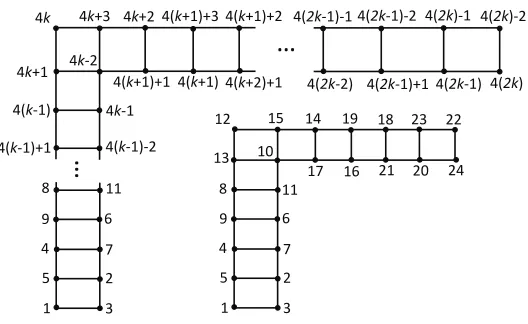
To show that corner graphs are 12-representable, one can consider labelling as shown in Figure 11 in general case, and in case of k = 3 to help the reader to follow the labelling. Words, 12-representing the general and particular cases, respectively, are as follows
3.51.72.94.(11)6.· · ·.(4k+ 1)(4(k−1)).(4k+ 3)(4k).(4(k+ 1) + 1)(4k−2).4k.
(4(k+1)+3)(4k+2).(4(k+2)+1)(4(k+1)).· · ·.(4(2k)−1)(4(k+1)+2).(4(2k))(4(2k−1)).(4(2k)−2)
and
3.51.72.94.(11)6.(13)8.(15)(12).(17)(10).(12).(19)(14).(21)(16)(23)(18).(24)(20).(22),
where the dots just help seeing the patterns in our construction, and the first word is on two lines. Note the corner element in bold that is repeated in our construction. We do not provide a careful justification of why these words work, which can be seen by direct inspection.
!"
#!$%"
#!$&" #'!$()$(" #'!$()" #'!$&)"
#!"
#'!$()$%" #'!$&)$%"
#'"!*()$(" #'"!*()" #'"!)$(" #'"!)"
#'"!)*(" #'"!*()*&"
("
%"
#"
+" ((" ,"
(-" (#" (," (+" (." (%" (&" (/"
&" -"
/" 0"
!"
#'!$&)$("
#'!$()$&" #'"!)*&" #'"!)$&"
#!$(" #!*&" #!*(" #'!*()" #'!*()$("
#'!*()*&" #'!*()*&" #'!*&)" (" -" #" 0"
[image:18.612.134.513.378.494.2]%" &" /" +"
Figure 12. Labeling skew ladder graphs to show their 12-representability.
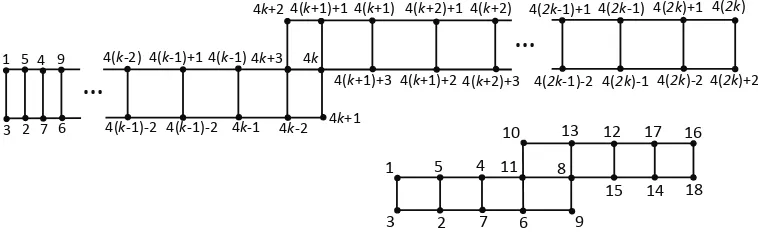
To show that skew ladder graphs are 12-representable, one can con-sider labelling as shown in Figure 12 in general case, and in case ofk = 2 to help the reader to follow the labelling. Words, 12-representing the general and particular cases, respectively, are as follows
3.51.72.94.(11)6.· · ·.(4(k−1) + 1)(4(k−2)).(4k−1)(4(k−1)−2).(4k+1).(4k+ 3)(4(k−1)).
(4k+ 1)(4k−2).(4(k+ 1) + 1)(4k+ 2).(4(k+ 1) + 3)(4k).(4k+2).(4(k+ 2) + 1)(4(k+ 1)).
(4(k+ 2) + 3)(4(k+ 1) + 2).· · ·.(4(2k) + 1)(4(2k−1)).(4(2k) + 2)(4(2k−1) + 2).(4(2k))
and
3.51.72.9.(11)4.96.(13)(10).(15)8.10.(17)(12).(18)(14).(16),
It would be interesting to know whether or not induced subgraphs of a grid graph have a nice 12-representation classification, which we leave as an open problem along with the larger problem of finding a classification of 12-representable graphs.
7. Other notions of word-representable graphs
As it is mentioned in Section 2, apart from our main generalization, given in Definition 1, of the notion of a word-representable graph, we have another generalization given in Definition 5 below. In this section, we also state some other ways to define the notion of a (directed) graph representable by words. Our definitions can be generalized to the case of hypergraphs by simply allowing words defining edges/non-edges be over alphabets containing more than two letters. However, the focus of this paper was studying 12-representable graphs, so we leave all the notions introduced below for a later day to study.
Given a word u = u1. . . uj ∈ P∗ such that red(u) = u, and a word w=w1. . . wn ∈P∗, we say that the patternuoccurs inwif there exist
1≤i1 <· · ·< ij ≤n such that red(wi1. . . wij) =u, and that wavoids
u if u does not occur inw.
Given a word v =v1. . . vj ∈ P∗ and a word w =w1. . . wn ∈ P∗, we
say thatv exactly occurs inw if there exist 1 ≤i1 <· · ·< ij ≤n such
that wi1. . . wij = v and that w exactly avoids v if v does not exactly
occur in w. We say thatw has an exact v-match starting at position i
if wiwi+1. . . wi+j−1 =v.
Similar definitions can be made for set of words. That is, let Γ be a set of words in P∗ such that red(u) = u for all u ∈ Γ. Then we say that Γ occurs in w = w1. . . wn ∈ P∗ if there exist 1 ≤ i1 < · · · <
ij ≤ n such that red(wi1. . . wij) ∈ Γ, and that w avoids Γ if Γ does
not occur in w. We say that w has a Γ-match starting at position i
if red(wiwi+1. . . wi+j−1) ∈ Γ. Similarly, if ∆ is any set of words in
P∗, we say that ∆ exactly occurs in w = w
1. . . wn ∈ P∗ if there exist
1 ≤ i1 < · · · < ij ≤ n such that wi1. . . wij ∈ ∆, and that w exactly
avoids∆ if ∆ does not exactly occur inw. We say thatw has anexact
∆-match starting at position i if wiwi+1. . . wi+j−1 ∈∆.
The study of pattern avoidance and pattern containment in words and permutations is a fast growing area (see [8] for a comprehensive introduction to the field).
We defined the notion of a u-representable graph in Definition 1. More generally, we can make the same definition for sets of words.
Definition 3. Let Γ be a set of words in {1,2}∗ such that red(u) =u
Γ-representable if there exists a wordw∈P∗ such that A(w) =V and for all x, y ∈V, xy̸∈E if and only if w{x,y} has a Γ-match.
Definition 4. Let Γ be a set of words in {1,2}∗ such that red(u) =u
for all u ∈ Γ. Then we say that a graph G = (V, E), where V ⊂ P,
is Γ-occurrence representable if there exists a word w ∈ P∗ such that
A(w) =V and for allx, y ∈V,xy̸∈E if and only if Γ occurs inw{x,y}.
In the case where Γ = {u} consists of a single word, we simply say that a graph G is u-occurrence representable if G is Γ-occurrence representable. For example, the 11-occurrence representable graphs are very simple. That is, if a wordw=w1. . . wn11-occurrence represents a
graphG= (V, E), then any vertexxsuch thatwhas two or more occur-rences of x, cannot be connected to any other vertexysince 11 will al-ways occur in w{x,y}. Let I ={x∈V :xoccurs more than once in w}
and J = {y ∈ V :y occurs exactly once in w}. Then it is easy to see that the elements of J must form a clique inG, while the elements of
I form an independent set. Thus, if G is 11-occurrence representable, then G consists of a clique together with a set of isolated vertices. Clearly, all such graphs are 11-occurrence representable, which gives a characterisation of 11-occurrence representable graphs.
Another simple observation is that the sets of 12-representable graphs and 12-occurrences representable graphs coincide, since a word contains a 12-match if and only if it contains a 12-occurrence.
Similarly, we have the following analogues of our definition for exact matchings and exact occurrences.
Definition 5. Let ∆ be a set of words inP∗. Then we say that a graph
G = (V, E), where V ⊂ P, is exact-∆-representable if there is a word
w∈P∗ such thatA(w) = V and for all x, y ∈V,xy ̸∈E if and only if
w{x,y} has an exact ∆-match.
Definition 6. Let ∆ be a set of words inP∗. Then we say that a graph
G= (V, E), where V ⊂ P, is exact-∆-occurrence representable if there is a word w ∈ P∗ such that A(w) = V and for all x, y ∈V, xy ̸∈E if and only if ∆ exactly occurs inw{x,y}.
Note that to avoid trivialities, while dealing with exact matchings or occurrences, the sets of words defining (non-)edges should be large and hopefully contain at least one word for each pair of vertices in
V. Clearly, the properties of (exact) Γ-representability and (exact) ∆-occurrence representability are hereditary.
Recall the definitions of the reverse ur and the complement uc in Section 2. If Γ is a set of words in P∗, then we let Γr = {ur : u ∈Γ}.
then we let ∆c ={uc:u∈∆}. Then we have the following observation generalizing and extending Observation 3.
Observation 5. Let G= (V, E) be a graph, Γ be a set of words in P∗
such that red(u) =u for all u∈Γ. Then
(1) G is Γ-representable if and only if G is Γr-representable.
(2) GisΓ-occurrence representable if and only ifGisΓr-occurrence
representable.
Recall the definition of the supplement G of a graph G given in Section 2. The following observation generalizes and extends Observa-tion 4.
Observation 6. Let G = (V, E) be a graph, and ∆ be a set of words in {1, . . . , n}∗ such that A(u) = {1, . . . , n} for all u∈∆. Then
(1) G is ∆-representable if and only if G is ∆c-representable.
(2) Gis∆-occurrence representable if and only ifGis∆c-occurrence
representable.
Given two words u, v ∈ P∗, we say that u and v are
matching-representation Wilf-equivalent (resp., occurrence-representation
Wilf-equivalent) if for any graph G, a labeling of G that is u-matching
(resp. u-occurrence) representable exists if and only if a labeling of
G that is v-matching (resp., v-occurrence) representable exists. Note, that Observations 5 and 6 show that the matching-representation and occurrence-representation Wilf-equivalence classes are closed under re-versal and complement.
Our notion of using patterns to represent graphs can also be extended to give us a notion of representing directed graphs via words. That is, suppose that we are given a directed graph G = (V, E), where
E ⊂ V ×V and we are given two sets of words Γ,∆ in P∗ such that red(u) = u for all u∈Γ and red(v) =v for all v ∈∆.
Definition 7. We say that a directed graphG= (V, E), whereV ⊂P,
is Γ,∆-representableif there is a wordw∈P∗ such thatA(w) = V and
for all pairs x < y in V, (x, y)̸∈E if and only if w{x,y} has a Γ-match
and (y, x)̸∈E if and only if w{x,y} has a ∆-match.
Definition 8. We say that a graph G= (V, E), where V ⊂P, is Γ,∆
-occurrence representable if there is a word w∈P∗ such that A(w) = V
and for all pairs x < y inV, (x, y)̸∈E if and only if Γ occurs in w{x,y}
and (y, x)̸∈E if and only if ∆ occurs in w{x,y}.
Definition 9. We say that a directed graphG= (V, E), whereV ⊂P,
isexactΓ,∆-representableif there is a wordw∈P∗such thatA(w) = V
and for all pairsx < yinV, (x, y)̸∈E if and only ifw{x,y} has an exact
Γ-match and (y, x)̸∈E if and only if w{x,y} has an exact ∆-match.
Definition 10. We say that a graph G = (V, E), where V ⊂ P, is
exact-Γ,∆-occurrence representable if there is a wordw∈P∗ such that
A(w) = V and for all pairs x < y in V, (x, y) ̸∈ E if and only if Γ exactly occurs in w{x,y} and (y, x)̸∈ E if and only if ∆ exactly occurs
inw{x,y}.
We can obtain other notions of word-representability by mixing Γ-matches, exact Γ-Γ-matches, Γ-occurrences, and exact Γ-occurrences with ∆-matches, exact ∆-matches, ∆-occurrences, and exact ∆-occurrences in the definitions above.
References
[1] P. Akrobotu, S. Kitaev and Z. Mas´arov´a: On word-representability of poly-omino triangulations,Siberian Advances in Mathematics25(2015) 1, 1–10. [2] K. A. Baker, P. Fishburn and F. S. Roberts: Partial orders of dimension 2,
Networks2(1971) 1, 11–28.
[3] A. Collins, S. Kitaev and V. Lozin: New results on word-representable graphs,
Discrete Applied Mathematics, to appear.
[4] B. Dushnik and E. W. Miller: Partially ordered sets, American Journal of Mathematics63(1941) 3 600–610.
[5] P. C. Gilmore and A. J. Hoffman: A characterization of comparability graphs and of interval graphs,Canadian Journal of Mathematics 16(1964) 539–548. [6] M. Halld´orsson, S. Kitaev and A. Pyatkin: Graphs capturing alternations in words, Lecture Notes in Computer Science 6224 (2010) 436–437. Proc. 14th Conf. on Developments in Language Theory, DLT 2010, London, Ontario, Canada, August 17–20, 2010.
[7] M. Halld´orsson, S. Kitaev and A. Pyatkin: Alternation graphs,Lecture Notes in Computer Science 6986 (2011) 191–202. Proceedings of the 37th Interna-tional Workshop on Graph-Theoretic Concepts in Computer Science,WG2011, Tepl´a Monastery, Czech Republic, June 21–24, 2011.
[8] S. Kitaev, Patterns in permutations and words, Springer-Verlag, 2011. [9] S. Kitaev: On graphs with representation number 3, Journal of Automata,
Languages and Combinatorics, to appear.
[10] S. Kitaev and V. Lozin: Words and graphs, Springer-Verlag, to appear. [11] S. Kitaev and A. Pyatkin: On representable graphs, Journal of Automata,
Languages and Combinatorics13(2008) 1, 45–54.
[12] S. Kitaev, P. Salimov, C. Severs and H. ´Ulfarsson: On the representability of line graphs, Lecture Notes in Computer Science 6795 (2011) 478–479. Proc. 15th Conf. on Developments in Language Theory, DLT 2011, University of Milano-Bicocca, Milan, Italy, July 19–22, 2011.
[14] S. Kitaev and S. Seif: Word problem of the Perkins semigroup via directed acyclic graphs,Order25(2008) 3, 177–194.