City, University of London Institutional Repository
Citation
:
McKay, J.M. (2010). Attachment and Psychotherapy. (Unpublished Doctoral thesis, City University London)This is the accepted version of the paper.
This version of the publication may differ from the final published
version.
Permanent repository link:
http://openaccess.city.ac.uk/8727/Link to published version
:
Copyright and reuse:
City Research Online aims to make research
outputs of City, University of London available to a wider audience.
Copyright and Moral Rights remain with the author(s) and/or copyright
holders. URLs from City Research Online may be freely distributed and
linked to.
City Research Online: http://openaccess.city.ac.uk/ [email protected]
ATTACHMENT AND
PSYCHOTHERAPY
Josephine Mary McKay
“Portfolio submitted in partial fulfilment of the DPsych in Counselling Psychology, Department of Psychology, City University, London.
Contents
List of Tables 5
List of Figures 7
List of Appendices 8
Acknowledgements 9
Declaration of powers of discretion 10
Section A Introduction to the portfolio
1. Overview 12
2. The research component 14
3. The client study component 16
4. The critical literature review 17
Section B Research
Abstract 21
Chapter 1 Attachment Theory and Its Origins 22
1.1 Maternal Deprivation 23
1.1.2 Origins of Attachment Theory 23 1.1.3 Attachment and Loss 24
1.1.4 Internal Working Models 26
1.1.5 Mary Ainsworth 30
1.2 Developmental Perspectives 31 1.2.1 Mary Main: Adult Attachment Interview 33
1.2.2 Reflective Function 36
1.3 Social Psychology Perspectives 39 1.3.1 Measurement of Adult Attachment: Self-report Measures 39
1.4 Summary 45
Chapter 2 Attachment Theory and Psychotherapy 46
2.1 Patients‟ Attachment Style and Psychotherapy 48 2.2 Therapists‟ Attachment Style and Psychotherapy 52 2.3 Interactional Effects of Patient and Therapist Attachment Styles 55 2.4 Attachment Style, Psychotherapy and Outcome 58 2.4.1 Changes in Attachment Style 63 2.4.2 Attachment to the Therapist 65
Chapter 3 The Working Alliance 70
3.1 Origins of the Concept 71
3.2 Measurement of the Alliance 76 3.3 Association Alliance and Outcome 78 3.4 Timing of Alliance Measurement 81
3.5 Summary 82
Chapter 4 Attachment Style and Working Alliance 84
4.1 The Establishment of the Working Alliance 85 4.2 Therapists‟ Experience and the Working Alliance 88 4.3 Development of the Working Alliance 90 4.4 Difficulties within the Working Alliance 91 4.5 Countertransference Management and the Working Alliance 96 4.6 Interactional Effects of Attachment Styles 98
4.7 Summary 102
Chapter 5 Method 104
5.1 Research Questions and Hypotheses 104
5.2 Design 107
5.3 Operationalisation of Concepts 108
5.4 Participants 110
5.5 Instrumentation 111
5.6 Procedure 118
5.6.1 Access 118
5.6.2 Administration 119
5.7 Data Analysis 121
5.8 Methodological Limitations 122
Chapter 6 Results 123
6.1 Descriptive Statistics 123
6.1.1 Therapist Participants 124
6.1.2 Patient Participants 127
6.1.3 Therapist and Patient Attachment Style 130
6.2 Preliminary Analyses 132
6.2.1 Series of Correlational Analyses 132 6.2.2. Analyses of Patients and Their Siblings 134 6.2.3 Analysis of Patients, Gender and Brothers Only 134 6.2.4 Analysis of Patients, Siblings and Lack of Support Network 134 6.3 Outcome as Measured by CORE-OM 135 6.3.1 Changes in Clinical Significance 137 6.3.2 Reliable Change by Attachment Style 141 6.4 Therapeutic Alliance Ratings 145 6.4.1 Attachment Style and Ratings of the Therapeutic Alliance 148
6.5 Linear Regression 150
Chapter 7 Discussion 154 7. New ways of looking at the impact of attachment within therapy 155
7.1 Participants 155
7.1.1 Recruitment of Therapists 155 7.1.2 Orientation of Therapists 156
7.1.3 Personal Therapy 157
7.1.4 CECA-Q Responses 159
7.2 Attachment Style of Participants 160 7.2.1 Attachment Style of Therapists 160 7.2.2 Attachment Style of Patients 162 7.3 Patients and Siblings 163 7.3.1 Patients and Support Networks 163
7.4 Measures of Outcome 164
7.4.1 Therapist Security and Outcome 165 7.4.2 Security of Patient and Outcome 168 7.4.3 Association of Outcome with Therapist Experience 174
7.4.4 Initial CORE-OM 175
7.4.5 Association of Outcome with Length of Therapy 176
7.5 Measures of alliance 179
7.5.1 Concordance of Alliance Ratings 179 7.5.2 Changes in Alliance Ratings Across Levels 181 7.5.3 Therapist Ratings of Alliance 182 7.5.4 Patient Ratings of Alliance 184
7.5.5 Confidence Subscale 186
7.5.6 Openness Subscale 189
7.5.7 Timing of Alliance Measurements 191
7.6 Mediation Model 192
7.6 Comments and Limitations 192
7.7.1 Design 192
7.7.2 Completion of ARM 193
7.7.3 Management 194 7.8 Implications for Counselling Psychology 195
References 199
Appendices 214
Section C Client Study 232
List of Tables
Table 1 Empirical Studies of Patient Attachment Style 49 and Psychotherapy
Table 2 Empirical Studies of Therapist Attachment Style 54 and Psychotherapy
Table 3 Empirical Studies of Interactional Effects of Patient 57 and Therapist Attachment Style
Table 4 Attachment Style and Outcome 59 Table 5 Empirical Studies of Changes in Attachment Style 64 Table 6 Empirical Studies Attachment, Development and 86 Maintenance Working Alliance
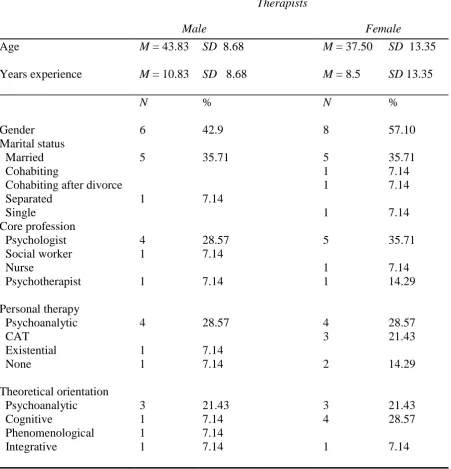
Table 7 Difficulties Within Working Alliance 94 Table 8 Empirical Studies of Interactional Effects 100 Table 9 Professional and Social Characteristics of Therapists 124 Table 10 CECA-Q, Means and Standard Deviations 127 Table 11 Demographic Information on Patient Participants 129 Table 12 Patients‟ and Therapists‟ Attachment Styles 130 Table 13 Correlations of Therapists‟ Characteristics 133 and Attachment Dimension
Table 14 Correlations Therapist “Childhood Experiences of Care 133 and Abuse” and Attachment Dimensions
Table 15 Mean CORE-OM scores, Pre and Post Therapy by Patient 135 Attachment Style
Table 16 Mean CORE-OM Scores, Pre and Post Therapy by 136 Their Therapists‟ Attachment Style
Table 17 Mean CORE-OM Scores, Pre and Post Therapy by 138 Clinical Cut-off
Table 19 Change in Clinical Significance by Their Therapists‟ 140 Attachment Style
Table 20 Reliable Change Criterion for Attachment Groups 141 Table 21 Reliable Change by Patient Attachment Style 142 Table 22 Reliable Change by Therapist Attachment Style 144 Table 23 Means and Standard Deviations for Global Alliance Scores 146 Table 24 Means and Standard Deviations Patient and Therapist 147 Ratings of Alliance
List of Figures
Figure 1 Bartholomew‟s (1990) Four-category Diagram 43 Figure 2 Development of the Concept of the Alliance 72 Figure 3 Schematic Representation of Theory 106 Figure 4 Models of Therapy Used 126 Figure 5 Change in Clinical Significance 139 Figure 6 Reliable Change as Shown by CORE-OM 142 Figure 7 Reliable Change in Relation to Pre-therapy CORE-OM 143
Scores
List of Appendices
Appendix 1 Ethics Committee Approval 212 Appendix 2 Participants‟ Information Sheet (Therapist) 213 Appendix 3 Participants‟ Consent Form (Therapist) 214 Appendix 4 Participants‟ Information Sheet (Patient) 215 Appendix 5 Participants‟ Consent Form (Patient) 216 Appendix 6 Demographic Questionnaire (therapist version) 217 Appendix 7 Childhood Experiences of Care and Abuse (CECA-Q) 219 Appendix 8 Experiences in Close Relationships (ECR) 223 Appendix 9 Relationship Questionnaire (RQ) 224 Appendix 10 Demographic Questionnaire (patient version) 225
Appendix 11 CORE-OM 226
Acknowledgements
I would like to thank my supervisor, Dr Jacqui Farrants, for her help and support throughout this period of study.
Declaration
“I grant powers of discretion to the University Librarian to allow this thesis to be copied in whole or in part without further reference to me. This permission covers only single copies made for study purposes, subject to normal conditions of
SECTION A
INTRODUCTION TO THE
Overview
The values underpinning counselling psychology can at times seem to be threatened by the dominant market forces which permeate the areas in which we work. The centrality of the therapeutic relationship to our work can seem undermined by the increasing emphasis on “one size fits all” therapies where the person of the therapist is seemingly absent. How do we reconcile our belief in “being with” rather than “doing to” a patient when the emphasis would seem to be on delivering evidence-based interventions, for specific medically diagnosed conditions, monitoring outcome in terms of symptom reduction, and all within a short time span with scant regard for individual need. There is emphasis on what works best for which patient ignoring the individuality of either the therapist or the patient.
The three components of this portfolio are related theoretically in that each considers the therapeutic relationship and the therapist‟s contribution to its
development and maintenance. Attachment theory was used as a lens through which to view the process and to frame understanding.
Each component represents aspects of my personal development as a counselling psychologist. The client study, written as a trainee, is especially
question the role of attachment in psychotherapy and this developed into the research component for this degree.
The critical literature review grew out of my experience as a trial therapist in a randomised controlled trial of CBT for the prevention of relapse in psychosis. I had for some time been interested in the work of Frieda Fromm-Reichman and Sullivan together with Bion and Winnicott and found myself frustrated by the predominance of CBT for psychosis. In the therapies I was involved in, I thought that attachment related difficulties recurred frequently and yet the model did not appear to address them. With other therapists involved in the trial, we considered the difficulties in engaging psychosis patients in therapy, and yet we never talked about the experience of being with someone who was terrified of intimacy or the impact such patients had on ourselves. I experienced again the conflicting thoughts and feelings: evidence-based practice said one thing, and yet the subjective experience of therapies seemed to say another.
And finally, the research component focused on therapist and patient
(Turpin, 2009). Whilst it may be implicit, there often seems to be more concern that evaluation measures are completed and that waiting lists are managed, than a client is met in a mutual relationship. Norcross reminds us that the therapist is frequently absent from evidence-based psychotherapy (Norcross, 2002) and yet there is a need to be aware of our own histories and the ways in which these impact on our
relationships, including those with clients.
1. The research component
The impact of attachment style of either therapist or patient on the
establishment of the therapeutic relationship, resolution of alliance ruptures and on the interventions the therapist uses, is well-researched. Both therapist and patient bring with them their past experiences, either good or bad, of relating and being close to another. Some of these patterns of relating will be unconscious and as such
unavailable for evaluation. Others will be accessible through the use of attachment measure questionnaires. Moreover, individuals‟ experience of relatedness within a therapy session can be explored through validated questionnaires about the
therapeutic alliance.
There is conflicting empirical evidence for an interactional effect between therapist and patient attachment patterns. Whilst three studies appear to demonstrate an interactional effect (Dozier, Cue,& Barnett,1994; Rubino, Barker, Roth, & Fearon, 2000; Tyrrell, Dozier, Teague, & Fallot, 1999) shown by the in-session behaviour of therapists, Sauer et al (2003) found no interactional effects. Neither the Dozier et al
(2000), studied trainee psychologists and utilised a video-vignette format with actors playing the roles of patient. Personal therapy and therapeutic training might again be mediating factors.
Whilst it might be assumed that more secure patients will have better
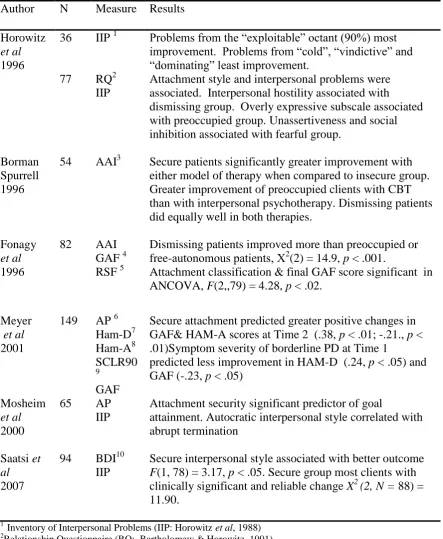
outcomes, most patients are likely to have insecure patterns of attachment. There is some evidence (Fonagy et al 1996), that different patterns of insecurity are
associated with varying outcomes. It is possible that patients with different attachment patterns might benefit from different models of therapy.
Current Study
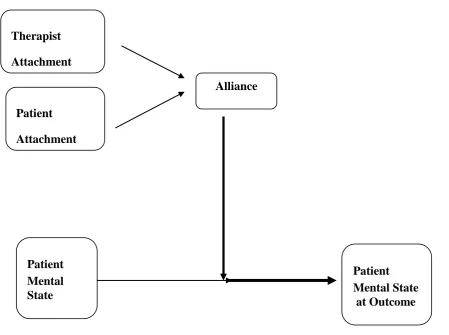
This study explores the interactional effects of attachment patterns of therapists and patients on outcome and questioning whether this is mediated by the therapeutic alliance. A quantitative methodology is being used in which various reliable and well-validated self-report measures are used to measure the participants‟ attachment style and their perceptions of the therapeutic alliance. Outcome is
measured by completion of the CORE-OM, a well-validated outcome measure used increasingly frequently in NHS psychotherapy services. Although quantitative methodologies can be criticised for their emphasis on measurement, there is a case for exploring attachment relationships in this way. Whilst not denying the richness and complexity of human relationships, it is seen that ways of being in relationship are repeated over an individual‟s lifetime and can be captured by self-report
be foregone, a quantitative approach utilizing self-report measures will be more cost-effective, more time-effective and less intrusive.
2. The client study component
This client study has been included with the aim of showing the development of self as a reflective practitioner through supervision and personal reflection – a movement from reflection-on-action towards reflection-in-action (Schon, 1983). Supervision provided me with a space to reflect on the work I was engaged in with this patient, to facilitate the integration of theory and practice and to develop self-awareness. My supervisor encouraged me to practice cognitive therapy techniques myself, a method which permits the trainee “to look in depth at the implications for themselves, for their clients, and for cognitive theory” (Bennett-Levy, 2003, p. 210). I was already keeping a reflective journal and this has been likened by Bolton (2003) to the development of Casement‟s internal supervisor (1990; cited Bolton, 2003).
This study presents a short-term cognitive behavioural therapy for PTSD, demonstrating evidence-based practice. Questioning the medical model and the utility of psychiatric diagnoses, counselling psychology has always emphasised the subjective experience of the client. Whilst this therapy focused on the symptoms of PTSD and was successful in terms of symptom reduction, I felt that the real work of therapy was in the establishment of a sound therapeutic relationship, which in
3. The critical literature review
The aim of this review was to examine psychodynamic psychotherapies for psychosis at a time when CBT models predominated. To achieve this it was necessary to question the modernist research paradigm with its emphasis on
randomised controlled trials resulting in a predominance of CBT evidence. Written whilst I was working as a trial therapist for a Randomised Controlled Trial (RCT), the need to adhere to a manualized therapy made me concentrate on therapeutic technique whilst feeling that something was being lost within the therapy. Evidence based practice has informed the compilation of the NICE guidelines for
psychiatrically diagnosed disorders. As the evidence is strongest for CBT, CBT has been designated the therapy of choice for psychosis and yet, as this review shows, there is some excellent and successful work being done within other models. Practice based evidence also generates knowledge and these case studies and naturalistic studies from within a psychoanalytic framework provoke thought and invite comment.
Evidence supporting CBT-type interventions for schizophrenia is
insufficiently strong to justify limiting psychological interventions to these models (Shapiro & Paley, 2002), yet practitioners seem reluctant to research the efficacy and effectiveness of psychodynamic approaches (Martindale et al, 2002; Shapiro & Paley, 2002; Tarrier et al, 2002).
ensure clinical accountability by establishing empirical evidence for psychological treatments for particular patients in specific circumstances (Shapiro, 1995). Seen as the “gold standard” for investigating treatment efficacy, RCTs are not without their critics or methodological limitations and yet are still held in awe by research and service funders (Shapiro, 1995). Processes of change may occur out of sight of researchers and therapists and outcome studies may not necessarily measure the specific changes that distinguish between treatments. Non-specific factors associated with outcome remain unidentified (Shapiro &Paley, 2002). It has been claimed (Roth & Parry, 1997) that whilst psychological therapies have been shown to be
efficacious, there is little evidence for the efficacy of specific models used in specific conditions.
References
Bennett-Levy, J. (2003). The value of self-practice of cognitive therapy techniques and self-reflection in the training of cognitive therapists. Behavioural and Cognitive Psychotherapy, 29, 203-220.
Bolton, G. (2003). Lift the box lid: reflective writing for professional development.
Clinical Psychology, 27, 32-39.
Dozier, M., Cue, K. L., & Barnett, L. (1994). Clinicians as caregivers: Role of attachment organization in treatment. Journal of Consulting and Clinical Psychology, 62, 4, 793-800.
Fonagy, P., Leigh, T., Steele, M., Steele, H., Kennedy, R., Mattoon, G., et al.
(1996). The relation of attachment status, psychiatric classification, and response to psychotherapy. Journal of Consulting and Clinical Psychology 64, 1, 22-31.
Hague, J., and Cohen, A. (2005). The neglected majority: Developing intermediate mental health care in primary care. London: The Sainsbury Centre for Mental Health.
Layard, R., Clark, D., Knapp, M., and Mayraz, G. (2007). Cost-benefit analysis of psychological therapy. National Institute Economic Review, 202, 90-98. Martindale, B., Bateman, A., Crowe, M., & Margison, F. (2002). Psychosis:
Roth, A., & Parry, G. (1997). The implications of psychotherapy research for clinical practice and service development. Lessons and limitations. Journal of Mental Health, 6, 4, 367-380.
Rubino, G., Barker, C., Roth, T., & Fearon, P. (2000). Therapist empathy and depth of interpretation in response to potential alliance rupture: The role of
therapist and patient attachment style. Psychotherapy Research, 10, 4, 408-420.
Schön, D. (1983). The reflective practitioner. New York: Basic Books Shapiro, D. (1995). Finding out how psychotherapies help people change.
Psychotherapy Research, 5, 1-21.
Shapiro, D., & Paley, G. (2002). The continuing potential relevance of equivalence and allegiance to research on psychological treatment of psychosis: Reply.
Psychology and Psychotherapy: Theory, Research and Practice, 75, 4, 375-379.
Strawbridge, S., and Woolfe, R. (1996). Counselling Psychology: A sociological perspective. In R.Woolfe and W.Dryden (Eds.). Handbook of counselling psychology (pp.605-629). London: Sage Publications.
Tarrier, N., Haddock., G, Barrowclough, C., & Wykes, T. (2002). Are all psychological treatments for psychosis equal? The need for CBT in the treatment of psychosis and not for psychodynamic psychotherapy: Comment on Paley and Shapiro. Psychology and Psychotherapy: Theory, Research and Practice, 75, 4, 365-374.
Turpin, G. (2009). The future world of psychological therapies: Implications for counselling and clinical psychologists. Counselling Psychology Review, 24,
1, 23-33.
Turpin, G., Hope, R., Duffy, R., Fossey, M., and Seward, J. (2006). Improving access to psychological therapies: Implications for the mental health workforce. Journal of Mental Health Workforce Development, 1, 12-21. Tyrrell, C. L., Dozier, M., Teague, G., & Fallot, R. (1999). Effective treatment
relationships for persons with serious psychiatric disorders: The importance of attachment states of mind. Journal of Consulting and Clinical
SECTION B
RESEARCH THESIS
Abstract
The aim of this study was to explore the relationship between therapy
outcome, the therapeutic alliance and both patient and therapist attachment styles. 14 therapists and 27 patients participated. 78.57% (n = 11) therapists and 29.63% (n =
8) patients were classified as securely attached by self-report measures.
It was predicted that more patients of secure therapists would show clinically significant improvement as determined by CORE-OM scores. However, 21.05% of patients with a secure attachment style therapist compared to 40% of patients with a dismissing attachment style therapist showed clinically significant improvement. Short-term therapies of once-weekly intensity enabled dismissing style patients to restore their defences, reduce distress and show clinically significant change in terms of reduction of symptomatology.
There did not appear to be an association between attachment style of either therapist or patient and overall ratings of the alliance in this study. However,
changes in both therapist and client ratings of the ARM subscales for Confidence and Openness between Time 1 and Time 2 suggested that therapist and client were beginning to perceive the alliance more similarly as therapy progressed. Mediation of the relationship between attachment style and therapeutic outcome by the
therapeutic alliance was not found to be significant.
Chapter 1
Attachment Theory and Its Origins
“From the cradle to the grave”
Bowlby, 1977
Attachment theory is not just a theory of infant development but a theory that encompasses lifetime development. Bowlby defined attachment behaviour as:
Any form of behaviour that results in a person attaining or maintaining proximity to some other clearly identified individual who is conceived as better able to cope with the world. It is most obvious whenever the person is frightened, fatigued, or sick and is assuaged by comforting and caregiving.
Bowlby, 1988, pp 29.
Bowlby also emphasized the importance of an attachment figure for
providing a secure base for the infant and later the adult, from which they can safely explore their world and to which they can return. Attachment theory, whilst initially highlighting the normative function of an attachment behavioural system, also enables the conceptualisation of individual differences.
1.1 Maternal Deprivation
Attachment theory grew out of Bowlby‟s work with children who had been separated from their families. The work of Anna Freud on evacuees and Rene Spitz on orphans influenced Bowlby‟s ideas on the importance of family relationships for both normal and pathological development. Bowlby‟s work on maladapted and delinquent children culminated in Maternal Care and Mental Health, the 1951 report for the World Health Organisation on the mental health of homeless children in post-war Europe (Bowlby, 1951).
At this time, Bowlby collaborated with James Robertson who was making the documentary film, “A Two-Year Old Goes to Hospital” – a film which highlighted the suffering endured by children when separated from their caregivers and later became instrumental in changing hospital practice (Robertson, 1953). The film, when presented in 1953, was not well-received by the British Psychoanalytical Society who argued that a child of this age could not mourn but their distress was due to unconscious fantasies regarding the mother‟s pregnancy.
1.1.2 Origins of Attachment Theory
Three classic papers were presented by Bowlby, predating his seminal trilogy, “Attachment and Loss”. In The nature of the child‟s tie to his mother (Bowlby, 1958), Bowlby argued that an infant‟s instinctual responses function to bind infant to
behaviours in the absence of the attachment figure. This paper continued
Robertson‟s 1953 observations, built on the work done by Heinicke (1956, 1965) on parent-child separations and that of Harlow‟s preliminary work on primates (1958). Bowlby also challenged the accepted psychoanalytical belief that maternal over gratification was dangerous to the developing infant, arguing that pseudo affection and over protectiveness might mask unconscious maternal hostility. He went on to postulate that pseudo independence is a defence against separation anxiety. In Grief and mourning in infancy and childhood (1960) Bowlby challenged Anna Freud‟s belief that incomplete ego development in infants precludes mourning by claiming that grieving and mourning processes in children occur with the continued absence of an attachment figure. This work stimulated the interest of Colin Parkes in his work on adult grief and subsequently, Kubler-Ross‟s work on death and dying and the phases of dying.
1.1.3 “Attachment and Loss”
Bowlby‟s theory of attachment was enriched by the work of Mary Ainsworth on the Ganda project (1963, 1967; cited Bowlby, 1969). Ainsworth brought
experimental research methodologies together with observational, naturalistic studies and a child development orientation to Bowlby‟s study of attachment behaviour. Her methodology, considered unusual at that time, involved looking at patterns of
The first volume of Bowlby‟s seminal trilogy, Attachment and Loss was published in 1969. Bowlby wanted to develop a new theory of motivation and behavioural control and this led to preliminary work in Attachment. His theoretical claims were backed with the then current scientific research, citing the influence of work by ethnologists such as Lorenz, Tinbergen and Hinde (cited Bowlby, 1969). Arguing that proximity to an attachment figure has evolutionary functions of protecting an infant from danger, he emphasised how this is not derived from motivational systems related to mating or feeding.
Bowlby thought that the development of the attachment system would continue throughout the preschool years as the child gains greater insight into parental motives and plans. The child now considers the response required from the parent and plans how to achieve this, gradually developing the capacity to take another‟s perspective and adjust her own actions within this “goal-corrected partnership” .
In Separation: Anxiety and Anger (1973), Bowlby revised Freud‟s 1926
In Loss: Sadness and Depression (1980) Bowlby discussed the problems of grief and mourning and the defensive processes which arise. He also developed his theory on Internal Working Models which derived from psychoanalytic theories, particularly those of the British Object Relations theorists.
Bowlby‟s work on attachment theory was taken forward by Mary Ainsworth and her graduate students. Attachment behaviour was seen to be a normal
developmental process in children both in the work by Erickson, Sroufe and Egeland (1985) and by Main, Kaplan and Cassidy (1985).
1.1.4 Internal Working Models
Turning to the inner world of Freudian theory, Bowlby developed the concept of an internal working model of self and attachment figure which he thought was achieved through interpersonal interaction patterns. For Bowlby
“the concept of working models … is no more than a way of describing, in terms compatible with systems theory, ideas traditionally described in such terms as „introjection of an object‟ (good or bad) and „self image‟” (Bowlby, 1973, p. 204).
Internal working models (IWMs) are central to attachment theory. Bowlby drew on ethnology, evolutionary biology and the emerging cognitive information processing sciences to develop his ideas of an internal representation of relationships. Writing from an evolutionary stance, Craik (1943) claimed that organisms which were capable of forming internal representations of their environment increased their potential for survival. He stated that not all aspects of reality needed to be
represented but that the relation-structure would enable evaluation of possible alternative behaviours:
If the organism carries a “small-scale model” of external reality and of its own possible actions within its head, it is able to try out various alternatives,
conclude which is the best of them, react to future situations before they arise, utilize the knowledge of past events in dealing with the present and future, and in every way to react in a much fuller, safer and more competent manner to the emergencies which face it. (Craik, 1943, pp.61).
In choosing to use Craik‟s metaphor of “internal working model” Bowlby wanted to describe a model which was adaptive and could be updated, rejecting other
metaphors which appeared to imply a static state. Models which are not updated appear arrested at a developmental point with levels of self-awareness and interpersonal awareness similarly arrested.
Bowlby‟s model most closely resembles Sullivan‟s (1953) and Fairbairn‟s (1952) theories of object relations. Further work by ego psychologist, Edith
valences, depending on gratification or frustration. Using the term “representation” she described a model incorporating inner and external worlds which were subject to distortion and modification. Fonagy (1999) argues that in some ways her model is more sophisticated than that of Bowlby.
Bowlby drew on information-processing theories to clarify the seeming stability of the internal working model and the defensive distortions. As patterns of relating become habitual, they become less accessible to awareness. Due to
expectancy of reciprocity, dyadic relational patterns are more resistant to alteration (Bowlby, 1980). Defensive exclusion leads to a split in internal working models with subsequent lack of accommodation of the model to external reality (Bowlby, 1980). However, the affective quality of internal working models may change as, for example, when environmental stressors diminish and a parent becomes more able to respond sensitively (Bretherton and Munholland, 1999), although defensive features of IWMs might make this updating more difficult.
Drawing on the work of Tulving (1972) on episodic and semantic memory, Bowlby furthered our understanding of repressive and dissociative phenomena and pathological grief. Bowlby postulated that there was an executive structure which accounted for regulation of competing behavioural systems. This type of defensive exclusion might occur, for example, when a child knows something that the parent wishes they did not know but continues to deny. In this situation, the child will continue to maintain two sets of models which remain unconnected and
events is at odds with the child‟s nonverbal experience thus causing concordance or disconcordance within the IWM.
Attachment patterns can be considered defence mechanisms enabling the child to cope with the particular parent she interacts with (Fonagy et al,1996). Internal representations represent both sides of the relationship, for example, a child who has internal representation of caregiver as rejecting and critical will form a complementary IWM of self as unacceptable and unworthy (Sroufe and Fleeson, 1986). Supportive parents allow autonomy and will talk about their own models of self, of child and others and show the child that working models are open to being questioned and revised.
The conceptualisation of internal working models was further developed by Stern (1994) in his work on the “emerging moment” and the experience of
intersubjectivity. This takes IWMs a little bit closer to the mental model postulated by Johnson-Laird (1983). A cognitive psychologist, Johnson-Laird (1983) argued that mental models were constructed on the basis of perception, knowledge and understanding resulting in a conclusion which can be reality tested by the seeking of alternative disconfirmatory models. He considered the concept of internal working models within an evolutionary framework suggesting that it allows individual insight and permits behavioural planning. Such a mental model offers structural
correspondence between reality and what is represented and is essential for a model which aims to guide behaviour.
theory as they are a “configurational and dynamic approach” to the process of memory. Representational processes are determined by event schemata or scripts in which repeated examples of life events are summarised but the concept of scripts is arguably imprecise and thus unable to explain the relationship to autobiographical memory, the creation of new scripts and the place of affect in event representation (Bretherton et al, 1990). Revision by Schank (1982) is more useful as it permits accessing information from both episodic and autobiographical memories along with associated affect and allows reprocessing, cross-indexing and summarising. There is however a blurring of the episodic/semantic memory distinction proposed by Tulving (1972, 1983). According to this model, new event schemata are processed in light of existing schemata although defensive information processing will impact on selective information processing, and development will be altered into non-optimal channels.
Internal working models have, however, been criticised for “undue
vagueness” which makes it difficult to empirically test them (Hinde 1988; Rutter 1995). However, more recent psychoneurobiological evidence is beginning to show how the development of the right hemisphere of the brain is directly affected by attachment relationships (Schore, 1994). It is beyond the scope of this study to explore the extensive emerging literature on psychoneurobiological research but Schore goes on to argue that the internal working model, with encoded strategies of affect regulation, is stored within the right brain (Schore, 1994).
1.1.5 Mary Ainsworth
Whilst The Strange Situation research has been criticised over the years for the falseness of the situation creating the infant distress, the Ainsworth data compared favourably to extensive home observations. This work highlighted the importance of maternal sensitive responsiveness. Ainsworth‟s classification system enabled
empirical study of Bowlby‟s theory (Slade, 1999) which thus moved along a different path away from being basically a clinical development theory. The
assumption that attachment quality can be classified is central to attachment research.
1.2 Developmental Perspectives
Whilst initially attachment patterns in infancy are associated with a specific attachment relationship, they gradually become the property of the individual rather than a specific relational dyad (Bowlby, 1973). Internal working models lead an individual to have expectations of reciprocity and guide the manner in which the individual engages with another. An insecure pattern of attachment associated with expectations of hurt and rejection will often cause the individual to be closed and avoidant of intimacy thus eliciting rebuff and non-understanding.
It has been said that attachment theory is not only a theory of
Developmental psychopathology is complex, with multiple pathways to and from disorders and attachment insecurity is unlikely to be the sole cause (Greenberg, 1999). Neither should it be used to account for the entire child-parent relationship (Solomon and George, 1999). Both the continuity of attachment status and the empirical evidence suggesting that intervening life events can change an expected outcome of infant attachment, are consistent with Bowlby‟s model where attachment processes show plasticity as an individual‟s life “turns at each and every stage of the journey on an interaction between the organism as it has developed up to that
moment and the environment in which it then finds itself.” (Bowlby, 1973, pp. 412).
Whilst early experiences colour later experiences, those earlier experiences will be transformed by later events. Adverse early attachment experiences can be overcome by later good experiences resulting in “earned-security” of attachment. Individuals with earned-security have been shown to be just as resilient in parenting under stressful situations as continuously securely attached individuals, thus breaking the cycle of intergenerational transmission of inadequate parenting (Phelps, Belsky and Crnic, 1998). The beginnings of formal operational thought enable children to reflect on and re-evaluate previous experiences which they are then able to integrate (Main, Kaplan and Cassidy, 1985). Many early experiences exist in a preverbal period of life and are inaccessible to verbal recall, and thus not easily modified by later experiences (Sroufe et al, 1999).
symptoms, aggression and violence (Fonagy et al, 1997; Lyons Ruth and Jacobvitz, 1999). Fonagy et al (1997) showed that early attachment insecurity is associated with adolescent delinquency and adult criminality. The authors postulate that internal working models of specific attachment figures are generalised during adolescence allowing different attachment relationships. Mentalising ability, made possible by the early experiences of attachment security, creates awareness of others‟ mental states and facilitates appropriate social behaviour. Failure to develop
mentalising capacity creates difficulties in appreciating the needs and feelings of others and there is a concomitant lack of social bonding towards institutions such as schools and peers. Children with avoidant attachment style appeared most likely to follow this developmental path (Fonagy et al, 1997). The ability to cope with anger, anxiety and sadness requires the capacity to use “secure-base figures” and more mature defences (Greenberg, 1999) whilst disorganised attachment behaviours have been seen to reflect inadequate strategies for coping with stress with the noted presence of increased salivary cortisol levels (Lyons Ruth and Jacobvitz, 1999).
Attachment disorganisation appears to occur within specific relationships rather than as a function of an individual‟s traits (Lyons Ruth and Jacobvitz, 1999). Infants who had been classified as disorganised in relationship with one parent were not always so with the other in a study by Main and Solomon (1990).
1.2.1 Mary Main: Adult Attachment Interview
these relationships and events had affected his or her adult personality; by probing for both specific corroborative and contradictory memories of parents and the relationship with parents” (Main et al, 1985, p. 98).
The Adult Attachment Interview was originally developed and used within the Berkeley Longitudinal Study (George et al, 1985; Main et al, 1985). Whilst Ainsworth et al (1978) focused on the differences in infants‟ behaviour, Main et al
(1985), postulated that mental processes were equally different in adults and their work focused on the level of representation. Main and her colleagues explored relationships between parent‟s early attachment experiences and the attachment pattern of their infants (George, Kaplan and Main, 1985), finding that the attachment patterns of these were analogous to their infants‟ behaviour patterns in Ainsworth‟s Strange Situation (1978). The Adult Attachment Interview (AAI) has been described as being able to surprise the unconscious (George et al, 1985), eliciting adults‟
thoughts about attachment relationships and providing a window onto their internal working models or states of mind (Main, 1995). Discourse analysis of the interviews allows both conscious and unconscious aspects of attachment representations to be brought to light. The AAI does not assess secure-base behaviour in adults (Crowell, Fraley and Shaver, 1999) nor an adult‟s security of attachment to a second person (Hesse, 1999) but rather assesses an individual‟s state of mind in relation to attachment. The AAI has excellent predictive power for the behaviour of the infants of these individuals‟ on the Strange Situation task (Steele, Steele and Fonagy, 1996) and also has wide cultural validity (van Ijzendoorn, 1995).
dismissing and preoccupied. They also found further patterns of attachment – unresolved for trauma and later, an unclassifiable style in which individuals showed considerable dismissing or preoccupied speech or were otherwise incoherent (Hesse, 1996).
Individuals classified as secure/autonomous are seen to be characterised by internal consistency of narrative, displaying apparently truthful descriptions of relationships with parents in both childhood and in the present; their narratives appear coherent and organized and they appear able to collaboratively discuss both the positive and the negative aspects of relationships together with congruent emotional expression. Individuals classified as dismissing appear to either devalue the importance of attachment relationships or to talk about them in an idealised way. Frequently these individuals claim they remember little from childhood. By contrast, individuals classified as having preoccupied states of mind for attachment
relationships, talk openly and expressively, although their narrative is confused, incoherent and chaotic.
Slade (1999) argued that Main‟s work on the classification of adult attachment patterns and the importance of representation altered the course of attachment research. Main found that attachment patterns were related, not to the actual events individuals had experienced, but rather the ways in which these events were mentally represented and talked about. The ability to coherently and
each sibling (van Ijzendoorn et al, 2000). When there has been trauma and adversity within the mother‟s history, there is a stronger association between maternal
reflective function and child security (Fonagy et al, 1995) with intergenerational transmission reduced with increased maternal capacity to reflect on her own history. Mothers who demonstrate high reflective functioning on the AAI, have been shown to have high reflective functioning on the Parent Development Interview in which maternal representations of the child are explored (Slade, 2001). More recent work by Steele, Steele, Jacobvitz and Sroufe (2008) has again drawn attention to the ways in which clinicians can access valuable information by using the AAI. The authors suggest that the AAI introduces the individual to the idea that therapeutic experience means “being with someone who is able to hear, believe, and understand a great range of difficult stories about family experience” (Steele et al, 2008, p.12) which can be a profound experience. Steele et al also argued that use of the AAI enables observation of a patient‟s reflective function and their potential to engage in psychotherapy.
1.2.2 Reflective Function
Work on metacognitive monitoring (Main, 1991) and reflective functioning (Fonagy et al, 1995) has been important for the understanding of intergenerational transmission of security or insecurity of attachment. The original concept of
reflective functioning developed from Main‟s theory of metacognitive monitoring of interpersonal experiences (Main, 1991) and has been defined as “the plausible
this work with the concept of mentalisation encompassing the philosophical theory of mind tradition.
In looking at the Bateman and Fonagy (2004) definition of mentalising, Holmes (2005) unpacks aspects of the concept which are inter-related. There is an equivalence between responses which are self-referential and hostile-intrusive (Holmes, 2005; Lyons-Ruth and Jacobvitz, 1999). Bion‟s schematized theory of thinking (1962, 1983) demonstrates the ways in which an infant needs thoughts to be contained by a mother with the ability to think these thoughts, accepting projections and later returning them in such a way that the infant can tolerate thinking. Fonagy and Target (1997) claimed a distinction between pretend and equivalence modes of thinking which compares with Bion‟s barrier between conscious and unconscious thought (Holmes 2005). Mentalising is a marker for secure attachment.
It is through therapy that a patient can be enabled to move from an “equivalence” position to one where “as if” is possible, from “unmentalised
transference” to “mentalisation” (Holmes, 2005). Transference can be thought of as arising from internal working models which are in effect “experientially based templates that are carried forward in development” (Cortina & Marrone, 2003, p.30)
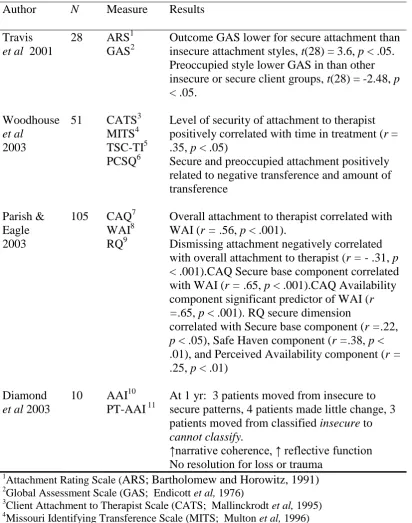
Diamond et al, (2003) have studied the therapeutic relationship using the AAI. Analysis of the reflective function in these transcripts suggests that reflective function improves during the course of therapy, good outcomes appear associated with therapists whose scores are not too far ahead of or behind their patients and that the therapist‟s degree of reflective function varies with each patient (Diamond et al,
2003). Patient-therapist dyads appear to create a specific attachment environment with a particular capacity for mentalisation.
Consideration of the interactive processes between care-giver and child, therapist and patient, lead to speculation about patient capacity to complete
questionnaires regarding the working alliance in empirical studies of psychotherapy (see Chapters 3 & 4). If, as argued by Bateman and Fonagy (2004), mentalising capacity involves attribution of meaning to one‟s own and others‟ actions and thoughts, the completion of measures such as the Agnew Relationship Measure or the Working Alliance Inventory, eliciting patients‟ thoughts about their therapists and therapy sessions, will reflect this capacity.
easier for the patient. Conversely some distress at leaving a therapeutic session might impact on a patient‟s capacity to mentalise as this is frequently compromised in attachment related situations.
1.3 Social Psychology Perspectives
Another line of research developed within social psychology where romantic relationships and attachment patterns were explored.
1.3.1 Measurement of Adult Attachment: Self-report Measures
Whilst the Adult Attachment Interview probes for individual‟s states of mind for childhood attachment experiences, self-report measures elicit thoughts and feelings about adult relationships.
Hazan and Shaver (1987) argued that the three attachment categories of Ainsworth et al‟s (1978) Strange Situation continued throughout adolescence and
were involved in the establishment of romantic relationships. A single-item measure was developed in which the three categories – secure, avoidant and
understanding in romantic relationships whilst insecure participants reported higher levels of loneliness.
Other measures developed at this time included Collins and Read (1990) 18-item questionnaire, the Revised Adult Attachment Scales (AAS) which measured three underlying dimensions of attachment: comfort with closeness (Close), ability to depend on other (Depend) and fear of abandonment (Anxiety). The authors argued that this obtained greater sensitivity of measurement and greater precision of attachment style definition than did Hazan and Shaver. Also Simpson (1990) and Simpson, Rholes and Nelligan (1992) developed a 13-item questionnaire, the Adult Attachment Scale (AAS) which measured two independent dimensions – Avoidance and Anxiety.
Bartholomew (1990) and Bartholomew and Horowitz (1991) noted an inconsistency between the conceptualisation of avoidance by Main et al (1985) and that of Hazan and Shaver (1987). Hazan and Shaver‟s avoidant attachment
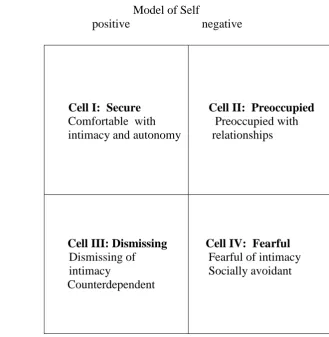
When two levels of self-image are combined with two levels of other-image, four categories logically emerge. The model derived has four “cells” representing a “theoretical ideal” and individuals can be approximately categorized to some degree (see Figure 1, p.43). The dimensions of the model can be seen in terms of avoidance of intimacy and dependency. Differences in interpersonal problems are associated with each attachment style, and there was a consistency for both self and friend reports (Bartholomew and Horowitz, 1991). The authors concluded that these studies confirmed both the distinct dimensions of self and other models and that these dimensions independently vary.
The Relationship Questionnaire (RQ) is a self-report instrument assessing adult attachment within the four-category model developed by Bartholomew (1990, 1991). Based on the work of John Bowlby (1973), Bartholomew proposed that there were two types of internal working model – an internal model of the self and an internal model of others. By conceptualising each model as having positive or negative dichotomies, four possible styles of attachment were theoretically possible. Secure and Fearful-Avoidant attachment patterns correspond to Bartholomew‟s Style A and Style B respectively. Styles C and D correspond to preoccupied and
dismissing-avoidant attachment patterns respectively.
This model includes the dismissing-avoidant category from the Adult Attachment Interview (Ainsworth et al, 1978) which the Hazan and Shaver 1987 model did not include. Bartholomew located the four categories into a two
adult close peer relationships. The measure has most frequently been used with young adult friendships or romantic relationships.
Test re-test stability over an 8 month period was moderate (Scharfe and Bartholomew, 1994). The Relationship Questionnaire has been shown to be the only self-report measure of attachment free from self-deceptive biases (Leak and Parsons, 2001). In a study comparing The Relationship Questionnaire with the Revised Adult Attachment Scale (RAAS; Collins and Read, 1990), Adult Attachment Scale (AAS; Simpson, 1990), Relationship Scales Questionnaire (RSQ; Griffin and
Bartholomew, 1994) and The Attachment Style Questionnaire (ASQ; Feeney and Noller, 1990), the Relationship Questionnaire was found to be twice as likely to classify participants as fearful (Stein et al, 2002). The authors suggest that this might be due to what they term a “hedge word” – sometimes – which occurs in the
description „I sometimes worry that others don‟t value me as much as I value them‟.
The importance of Bartholomew‟s distinction between fearful and dismissing types of avoidant attachment has considerable empirical support (e.g. Brennan, Clark and Shaver, 1998; Bartholomew and Horowitz, 1991; Horowitz, Rosenberg and Bartholomew, 1993).
Model of Self
[image:44.595.199.529.69.407.2]positive negative
Figure 1. Bartholomew‟s (1990) four-category diagram.
Relationships (ECR) is a 36 item self-report attachment measure where the items derive from factor analysis of most of the pre-existing self-report measures of adult romantic attachment. It measures adult attachment within romantic relationships.
Brennan et al (1998) expressed a retrospective opinion that more attention should have been paid by Hazan and Shaver to Ainsworth et al‟s (1978) summary of
results. Brennan et al argue that Ainsworth indicated that attachment types could be seen as two-dimensional spatial regions. These dimensions were Avoidance and Anxiety. It was this conceptualisation of an underlying two-dimensional structure
positive
Model of Other
Cell I: Secure
Comfortable with intimacy and autonomy
Cell II: Preoccupied
Preoccupied with relationships
negative
Cell III: Dismissing
Dismissing of intimacy
Counterdependent
Cell IV: Fearful
that inspired Bartholomew‟s realisation that four rather than three conceptual patterns were possible.
The factor analysis of 60 named attachment constructs (Brennan et al, 1998) enabled the identification of two factors which corresponded to the Anxiety and Avoidance dimensions. Clustering, on the basis of scores on these two dimensions, revealed four groups conceptually corresponding to Bartholomew‟s four types. Hierarchical cluster analysis provided a cluster centre then non-hierarchical analyses were done to optimise cluster fitting. These distinct groups resembled secure, fearful, preoccupied and dismissing categories as described by Bartholomew.
There has been much academic argument as to whether adult attachment patterns should be conceptualised as types or dimensions (Fonagy, 1999; Fraley and Waller, 1998; Griffin and Bartholomew, 1994; Hazan and Shaver, 1994; Rutter, 1995) with Fraley and Waller suggesting that researchers use dimensional
measurement rather than categorical. Empirical research demonstrates low correspondence between assessment of attachment styles by self-report
questionnaires and the assessment of internal working models by interview (Crowell, Fraley, Shaver, 1999; Bartholomew and Shaver, 1998). Bartholomew and Shaver (1998) suggested that there is a continuum which ranges from the Adult Attachment Interview (a categorically coded measure focusing on parenting issues) through the parental attachment and peer/romantic interviews and questionnaires of
Bartholomew to Hazan and Shaver‟s self-report measure. Measures lying near to one another on this continuum appear to be more highly empirically related
1.4 Summary
In this chapter, the beginnings of attachment theory were examined. Bowlby emphasised the importance of an attachment figure for the provision of a secure base for first the infant and later the adult, from which they can safely explore their world and which offers a place of safety to which they can return. The development of Bowlby‟s concept of Internal Working Models was explored showing how internal representation of self and caregiver enables the infant to interpret and predict caregivers‟ behaviour and thus plan their own response. Whilst it was argued that IWMs are unconscious structures, it was seen that some elements were conscious and more easily accessible than others. From this arises the question as to whetherIWMs can be measured by instruments such as the Relationship Questionnaire
Chapter 2
Attachment Theory and Psychotherapy
“less under the spell of forgotten miseries and better
able to recognize companions in the present for what they are.”
(Bowlby, 1988, pp. 155)
Bowlby (1988) saw the emotional availability of the therapist as a core factor in psychotherapeutic outcome. The therapist‟s own history of attachment will impact on their emotional availability. Many therapists have experienced considerable early loss, which they have faced and overcome and patients will use therapists‟
“attachment dramas” in diverse ways (Slade, 1999). Differing responses to patients‟ various attachment styles may reflect therapists‟ earliest emotional experiences. Arietta Slade points out that the caring experience may be reminiscent of earlier experiences for therapists and that within therapy caring suggests that there is an emotional connection from therapist to patient which will, depending on the security of attachment of the therapist, form a sense of safety and connection (Slade, 1999). With an insecure therapist, this caring capacity can be distorted.
It is argued that such internal resources enabling sensitive and appropriate responses are a result of security of attachment in a therapist.
Affect is linked to the concept of internal working models of attachment theory (Pines and Marrone 2003) and sensitive responsiveness includes tact as well as empathy (Stern 1985). Highlighting the importance of the therapist‟s own history of sensitive responsiveness from their primary carers and later their own therapists, Pines and Marrone suggest that the ability to respond empathically to patients will be unconsciously influenced by this prior experience. Adverse attachment histories which have not been adequately worked through will adversely impact on the therapist‟s ability to care for their patient. Defining empathy as “the capacity to perceive the other‟s feeling states as if one were in the other‟s position” (Pines and Marrone, 2003, p. 44), they argue that empathy alone is not sensitive responsiveness which involves mother making responses to facilitate her infant‟s emotional
regulation. As seen in the previous chapter, various measures of attachment style have been developed and have been used in research studies looking into the impact attachment style has on seeking for and acceptance of help.
2.1 Patients’ Attachment Style and Psychotherapy
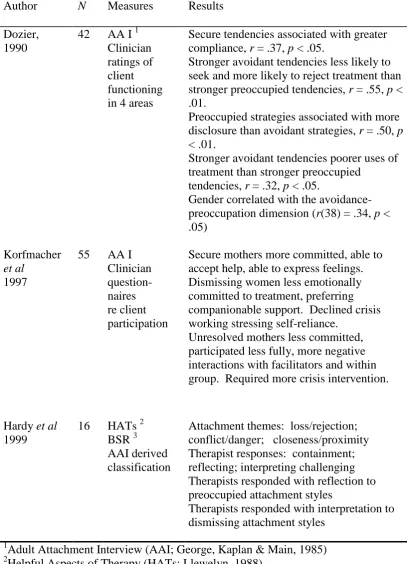
Research has demonstrated the links between insecurity of attachment and psychopathology. Dozier (1990) investigated the association of psychopathology and attachment style using patient self-report and clinician rated use of treatment. The Adult Attachment Interview was given to 42 participants with
psychopathological disorders and clinicians rated treatment use by responding to researchers‟ questions (see Table 1, p. 49). Four areas of functioning were explored by means of two stated questions per area - compliance with prescribed treatment regimen (the frequency of attending appointments and compliance with medication), the extent to which clients sought out or rejected treatment (whether clients
demanded more than provided by the treatment or asked for or rejected additional appointments), the extent of clients‟ self-disclosure (whether clients talked about significant problems and the extent to which they acknowledged feelings of anger and distress) and lastly, the general use of treatment (engagement and degree of benefit). All responses were rated on continuous rating scales with definite end anchors.
Higher security was associated with affective disorders in contrast to thought disorders, gender correlated with the avoidance-preoccupation dimension and men demonstrated greater avoidant tendencies in comparison to women although this did not reach significance. The attachment dimensions of security/anxiety and
Table 1
Empirical Studies of Patient Attachment Style and Psychotherapy
1
Adult Attachment Interview (AAI; George, Kaplan & Main, 1985)
2
Helpful Aspects of Therapy (HATs; Llewelyn, 1988)
3
Brief Structured Recall (BSR; Elliott & Shapiro, 1988) Author N Measures Results
Dozier, 1990
42 AA I 1 Clinician ratings of client functioning in 4 areas
Secure tendencies associated with greater compliance, r = .37, p < .05.
Stronger avoidant tendencies less likely to seek and more likely to reject treatment than stronger preoccupied tendencies, r = .55, p < .01.
Preoccupied strategies associated with more disclosure than avoidant strategies, r = .50, p
< .01.
Stronger avoidant tendencies poorer uses of treatment than stronger preoccupied
tendencies, r = .32, p < .05.
Gender correlated with the avoidance-preoccupation dimension (r(38) = .34, p < .05)
Korfmacher
et al 1997
55 AA I Clinician question-naires re client participation
Secure mothers more committed, able to accept help, able to express feelings. Dismissing women less emotionally committed to treatment, preferring companionable support. Declined crisis working stressing self-reliance.
Unresolved mothers less committed, participated less fully, more negative interactions with facilitators and within group. Required more crisis intervention.
Hardy et al
1999
16 HATs 2 BSR 3
AAI derived classification
Attachment themes: loss/rejection; conflict/danger; closeness/proximity Therapist responses: containment; reflecting; interpreting challenging Therapists responded with reflection to preoccupied attachment styles
Secure tendencies were associated with more compliance with the treatment programme. Clients with stronger avoidant tendencies were less likely to seek out and more likely to reject treatment and less able to be self-disclosing, making poorer use of treatment than those with stronger preoccupied tendencies. Greater
preoccupied strategies were associated with more disclosure. Greater attachment anxiety is related to greater ease with self-disclosure within therapy whilst more avoidant attached patients show greater self-concealment (Dozier, 1990).
The clients in this study were in a residential facility and the treatment use was rated by clinicians with whom they had daily contact. The ratings for treatment use would necessarily be subjective and arguably present only a limited view of any client‟s behaviour.
Treatment non-compliance was also found to be associated with patients with greater avoidant tendencies by Korfmacher, Adam, Ogawa, and Egeland (1997). In a preventative intervention programme involving 55 “at risk” mothers, secure mothers were more committed to the treatment programme and were able to accept more help (see Table 1, p.49). Whilst dismissing women appeared less emotionally committed to the treatment programme and preferred a more companionable support, women with an unresolved attachment style were more likely to require crisis intervention and were less emotionally committed than secure women. The AAI was used to determine clients‟ attachment status.
evoking strong countertransference responses as therapists struggle with feeling pushed out, rejected and helpless (Slade, 1999). Countertransference reactions might include sadistically forcing the patient to acknowledge painful feelings prematurely or avoiding confronting transference concerns (Slade, 1999).
The impact of patients‟ interpersonal style on the therapeutic process was analysed by Hardy et al (1999) who hypothesised that therapist response to
attachment issues would be mediated by patient attachment style (see Table 1, p.49). In order to study change processes in detail, selections of “therapy dialogue” (Hardy
interpretation to dismissing styles (Hardy et al, 1999). Support is taken from the findings of Hardy, Stiles, Barkham, and Startup (1998; reviewed Chapter 4) that over-involved patients attempted to elicit more psychodynamic or interpersonal interventions in contrast to dismissing patients who tried to elicit more CBT
interventions. There was no report of therapist characteristics which, as can be seen from other studies, might have contributed to their findings.
2.2 Therapist Attachment Style and Psychotherapy
Therapists‟ clinical effectiveness in challenging clients‟ internal working models is mediated by their own attachment style (Dozier, Cue and Barnett, 1994) and their perception of their client‟s attachment status and needs (Dolan, Arnkoff and Glass, 1993). The effect of therapists‟ attachment styles on treatment outcome is now emerging (Dozier and Tyrell, 1998; Leiper and Casares, 2000; Tyrell, Dozier, Teague and Fallot, 1999).
First of all research demonstrates the impact of therapist attachment patterns on engagement of patient (Black, Hardy,Turpin, and Parry, 2005; Dunkle and Friedlander; 1996; Leiper and Casares, 2000; Sauer, Lopez, and Gormley, 2003).
Leiper and Casares (2000) studied attachment organization of a random sample of clinical psychologists (n = 196) and found that therapists were
significantly higher on compulsive care giving compared to angry withdrawal (see Table 2,p.54) The amount of early loss experienced by therapists was significantly associated with attachment styles, with loss higher for the insecure group.
difficulty in therapeutic practice as measured by a Clinical Practice Questionnaire based on the Common Core Questionnaire (Orlinsky et al, 1999), with insecure therapists more likely to locate difficulty within themselves. Whilst no significant difference was found between approach used by secure or insecure groups, there was a significant difference on level of early loss experience with “loss” highest for those using an analytic approach. More secure therapists than insecure therapists had been in therapy, mostly analytic. Loss scores were significantly higher for those who reported previous experience of therapy. Secure therapists with previous therapy experience reported significantly more early loss than those who were secure but had not had therapy. In attachment theory, this could be considered “earned security”.
The findings of Leiper and Casares can be considered in relation to those of Sauer et al (2003) who argued that therapist attachment insecurity might be
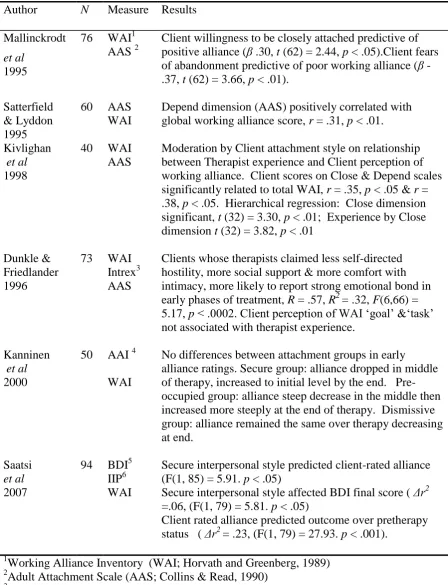
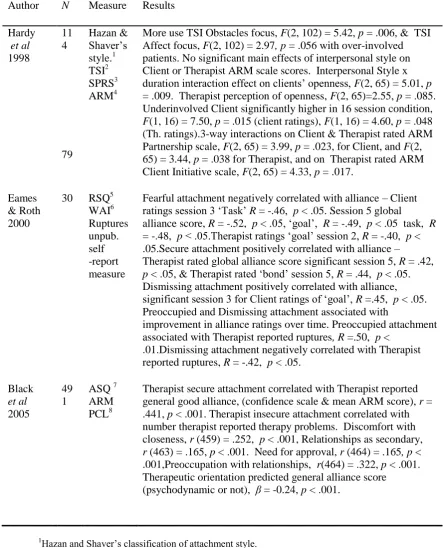
associated with problematic clinical intervention and/or difficulties building the working alliance (see Section 2.3, p.55 & Table 3, p.57). An unexpected finding in their 2003 study was the highly significant positive association between therapist attachment anxiety and patients‟ ratings of the first session alliance. They suggested that anxious therapists with negative models of self and positive models of others might be better at seeing variation in others and responding accordingly as they are “highly invested in establishing connections” (Sauer et al, 2003). Black et al (2005) also found therapeutic orientation was significant (see Ch. 4.4, p. 82).
Table 2
Empirical Studies of Therapist Attachment Style and Psychotherapy
1
Adult Attachment Interview (AAI; George, Kaplan & Main, 1985)
2
Common Core Questionnaire2 (CCQ; Orlinsky et al 1999)
3
Adult Attachment Categorization (AAC; Hazan and Shaver, 1987)
4
Adult Reciprocal Attachment Questionnaire4 (ARAQ; West et al, 1994)
5
Taxonomy of Early Loss (TEL; Burton, 1994)
6
Relationship Scales Questionnaire (RSQ; Griffin & Bartholomew, 1994)
7
Response Empathy (Goodman, 1972)
8
Depth of Interpretation Scale (DIS; Harway et al, 1953) Author N Measure Results
Dozier
et al
1994
27 AAI 1 Depth of interventio n
(manual)
Insecure CMs responded in greater depth to more preoccupied clients, r(14) = -.64, p < .05.
Secure CMs responded in greater depth to less preoccupied clients, r(13) = -.32 (ns trend).
Insecure CMs saw that preoccupied clients had greater dependency needs than dismissing clients, r(14) = .80, p < .01.
Leiper
et al
2000
196 Common Core Question-naire2 AAC3 ARAQ4 TEL 5
Insecure therapists experienced more difficulty in therapeutic practice X2 (2) = 11.21, p < .01.
Avoidant more than ambivalent group (U = 185.0, p < .05). Between groups difference for degree to which difficulty located in therapist X2 (2) = 6.98, p < .05) with Insecure group more likely to locate difficulty in themselves (U = 201.5, p < .05).
Analytic therapists more early loss X2 (5) = 15.6, p < .01) & unempathic parental responses (X2 (5) = 32.4, p < .0001)
Rubino
et al 2000
73 RSQ 6 Response Empathy 7 DIS8
Empathy and depth of interpretation intercorrelated (r = .69).