City, University of London Institutional Repository
Citation:
Kerr, J., Hilari, K. and Litosseliti, L. (2010). Information needs after stroke: What to include and how to structure it on a website. A qualitative study using focus groups and card sorting. Aphasiology, 24(10), pp. 1170-1196. doi: 10.1080/02687030903383738This is the unspecified version of the paper.
This version of the publication may differ from the final published
version.
Permanent repository link:
http://openaccess.city.ac.uk/1094/Link to published version:
http://dx.doi.org/10.1080/02687030903383738Copyright and reuse: City Research Online aims to make research
outputs of City, University of London available to a wider audience.
Copyright and Moral Rights remain with the author(s) and/or copyright
holders. URLs from City Research Online may be freely distributed and
linked to.
Information needs after stroke: what to include and how to
structure it on a website. A qualitative study using focus
groups and card-sorting
Ms Joanna Kerr
(Portsmouth City Teaching Primary Care Trust, Directorate of Public Health and
Well-being, St James Hospital, Locksway Road, Portsmouth, PO4 8LD)
Dr Katerina Hilari
(Department of Language and Communication Science, City University London,
Northampton Square, London, EC1V 0HB)
Dr Lia Litosseliti
(Department of Language and Communication Science, City University London,
Northampton Square, London, EC1V 0HB)
Short title: Web information for people with stroke
Corresponding author: Dr Katerina Hilari, Department of Language and
Communication Science, City University London, Northampton Square, London, EC1V 0HB.
Abstract
Background: Use of the Internet to obtain health and other information is increasing. Previous studies have identified the specific information needs of people with stroke
but not in relation to the Internet. People with aphasia (PwA) may face barriers in
accessing the Internet: Navigating websites requires an ability to categorise information
and this ability is often impaired in PwA. The website categorisation preferences of people with stroke and with aphasia have not yet been reported.
Aims: This study aimed to: a) determine what information people who have had a stroke would like to se on a website about living with stroke; b) determine the most
effective means of structuring information on the website so that it is accessible to people with stroke; and c) identify any differences between people with and without
aphasia in terms of preferences for structuring information on the website.
Methods and Procedures: Participants were recruited from a hospital’s Stroke Database. Focus groups were used to elicit what information participants wanted on a website about living with stroke. The themes raised were depicted on 133 cards. To
determine the most effective way of structuring information on the website and whether
there were any differences in preferences between PwA and PwoA, participants used a
modified closed card-sorting technique to sort the cards under website categories.
Outcomes and Results: Forty eight people were invited and 12 (25%) agreed to take part. We ran three focus groups – one with PwA (n=5) and two with people without
aphasia (PwoA) (n=3, n=4). Participants wanted more information about stroke causes
and effects (particularly emotional issues), roles of local agencies, and returning to previous activities (driving, going out). All participants completed the card-sorting
exercise. Few cards (6%) were categorised identically by everyone. Cards relating to
local agencies and groups were not consistently categorised together. Cards relating
to emotions were segregated. The categorisation preferences for PwA were more fragmented than those for PwoA: 60% of PwA agreed on the categorisation of 51% of
the cards whereas 60% of PwoA agreed on the categorisation of 76% of the cards.
Conclusions: Information needs covered all stages of the stroke journey. The card-sorting was accessible to everyone and provided evidence of structuring preferences and of some of the categorisation difficulties faced by PwA. More research is needed
Acknowledgements
The authors gratefully thank the participants who volunteered to take part in this study;
those giving support and advice from the Speech and Language Therapy Department,
Portsmouth City Teaching Primary Care Trust; the pompeystrokes website team; and
the Community Stroke Rehabilitation Team, Portsmouth Hospitals NHS Trust. The
INTRODUCTION
A recent Cochrane Review concluded that information after stroke can improve patient
and carer knowledge of stroke and aspects of their satisfaction (Smith, Forster, House,
Knapp, Wright and Young, 2008). In the UK, the National Clinical Guidelines for Stroke call for the provision of appropriate, accurate and timely information and advice after
stroke and consider this a key component of service provision (Royal College of
Physicians, 2008). Yet stroke survivors living in the community have expressed
dissatisfaction with the information and advice received about stroke, stroke services and benefits available (O’Mahoney, Rodgers, Thomson, Dobson and James, 1997; the
Stroke Association, 2006).
There is no conclusive evidence on the best way to provide information post-stroke - although providing information in a way that more actively involves the people with
stroke and their carers (e.g. by giving them repeated opportunities to ask questions)
tends to have a positive effect on patient mood (Smith et al., 2008). Information providers need to respond to information needs changing over time: for example, the
most frequent request early post-stroke is information about the causes of stroke, six
months later people ask about the risk of re-occurrence and two years later, the effects
of stroke on memory/concentration (Hanger, Walker, Paterson, McBridee and
Sainsbury, 1998). One way of providing information where people are actively involved – they seek the information themselves and can access different information at
different times – is via an Internet website.
The UK’s Disability Discrimination Act (1995) requires those services which provide
web-based information to facilitate access to it by people with disabilities. The
pompeystrokes website (www.pompeystrokes.co.uk) was specifically developed for people with stroke and their families in a specific community. It contains information
about stroke, stroke services, local resources (such as leisure facilities, health and social care resources) for and by people who have had a stroke, as well as discussion
fora and an events calendar. The original website topics were suggested by the
website steering group, which included stroke survivors, and by a small informal questionnaire survey of stroke survivors and stroke groups. Our study contributed to
the development of this website, by consulting with people with stroke on what
information structured in order to be easily accessible to them. We also explored
whether there were any differences between people with aphasia (PWA) and people without aphasia (PwoA) on their website structure preferences. We will briefly discuss
the literature on people with stroke information needs and on web accessibility, before
presenting our study in detail.
Information needs of people with stroke
One of the earlier studies looking at the information needs of people with stroke (n=35)
found that they needed more information on how to reduce the chance of a new stroke
and how to cope with stress (van Veenendaal, Grinspun and Adriaanse, 1996). Hanger et al (1998) looked at the information needs of 111 people with stroke in New
Zealand, at two weeks, six months and two years post-stroke. Questions about what
stroke is, its causes and prevention, were more frequently asked at the acute stage
compared to two years afterwards - although people still wanted this information two years later. At two weeks the most frequently asked questions were about general
causes (50% of people) compared with 15% at six months and 14% at two years
post-stroke. At six months people most frequently asked about risk of reoccurrence (19%).
At two years people most frequently asked about the effects of stroke in terms of poor memory/concentration (32%), reoccurrence (19%) and balance (19%). Questions
about returning to previous activities (such as driving) were asked more often at two
weeks (7%) and six months (4%). Employment questions were asked at six months
(2%) and two years (1%) but not at all at two weeks. A range of information about help available and financial support was needed at six months and two years post-stroke.
Hare, Rogers, Lester, McManus and Mant (2006) conducted four focus groups in the
UK to identify what people with stroke and carers wanted from community services. The need for information about services available and how to access them was a main
discussion theme. Specific information needs included adaptations to property,
benefits advice, exercise, contact points, surviving a stroke and preventing future
strokes. A need for long-term support for psychological and emotional problems was also expressed. There was confusion about the roles of agencies and services and a
lack of knowledge about voluntary support groups. Another study using focus groups
about information needs after stroke found that lack of individual information about
The aphasiahelp website (www.aphasiahelp.org) is a website specifically targeted to PWA and was set up with the full involvement of PWA. By inference, it reveals the information needs they have generated and chosen to share via the Internet. These are
stroke (causes, potential recovery and medication), living with stroke (the effects of
stroke on the body and emotions), aphasia (effects and strategies) and sharing their life
stories. Users can also use email to contact other PWA.
Very little is known about what information people with stroke would seek from the
Internet in relation to their stroke. A recent pilot study (n=7) assessing the quality of the StrokEngine-Family website found that participants felt the website was lacking specific information regarding emotional support and local community referrals to this
type of support (Rochette, Korner-Bitensky, Tremblay and Kloda, 2008).
Web accessibility
Use of the Internet to obtain health and other information is increasing across all age
groups. In the UK in 2008, 34% of adults had accessed the Internet for health-related
information. There are some barriers to access in terms of low income, lower levels of
education (National Statistics, 2008) and disability (Dutton and Helsper, 2007). Still, the Internet has the potential to be a useful information resource for people with stroke
and it could play an important part in maintaining ‘participation’ (World Health
Organisation, 2002; p 10).
Accessibility, in terms of the Internet, means that:
“[…] people with disabilities can use the Web. More specifically, Web accessibility means that people with disabilities can perceive, understand,
navigate, and interact with the Web, and that they can contribute to the Web.”
(W3C webpage: http://www.w3.org/WAI/intro/accessibility.php )
Studies have been conducted on aspects of accessibility, e.g. readability, in order to
understand information. They suggest that medical information intended for patient
education (50 websites in one study; 100 online consumer health information articles in the other) was written at a reading level higher than that easily understood by much of
the patient population (Gruber, Roller and Kaeble, 1999; Walsh and Volsko, 2008).
The readability levels of stroke education websites (n=50) have also been found to be
Our study considers one aspect of the WC3 definition of accessibility – navigation –
that may present difficulties for an individual with stroke and aphasia. Good website navigation has been described as helping the user answer three questions: “Where am
I? Where have I been? Where can I go?” (Nielsen, 2000 cited in Savitch, 2006; p. 29).
It requires clear organisation and categorisation of information in logical groupings.
Categorisation is often impaired in PWA. Semantic representations involve networks of information about words, objects and ideas that include super-ordinate, coordinate,
associated and sub-ordinate relationships (Chapey, 2001). The information processing
tasks in finding information on a website Homepage comprise the ability to consider the information required, isolate and identify it (e.g. label the information) or if the exact
label itself does not appear on the website, generate a synonym of the label. If neither
the label nor its synonym is shown, the user must generate a super-ordinate category
for the information and then select the category or a category synonym from the options available on the Homepage. The process is dependent upon memory and
attention – which themselves may be compromised after a stroke.
Moreover, using the Internet requires considerable syntactic and semantic knowledge about retrieving and inferring information (Singh, Domonkos Gedeon and Rho, 1998).
Syntactic and semantic difficulties in PWA are evident in word-finding difficulties with
an overall reduced vocabulary, relatively more frequent access to open-class lexical
items compared to closed-class items, with concrete terms or words with higher frequency being accessed more readily, and syntactic or semantic cues assisting to
some extent depending on the type of aphasia (Singh et al, 1998).
Website designers commonly use the technique of card-sorting to organise information on a webpage and inform the hierarchical structure of a website. The aim of
card-sorting is to generate an overall structure for information, as well as suggestions for
navigation, menus, and possible taxonomies (Maurer and Warfel, 2004). Cards
containing information/keywords are given to potential users of the website to sort into meaningful groups. These user categorisations then inform website architecture. The
resulting website should be easier to use because it has taken into account users’
preferences for organising information. There are two types of card-sorting – closed
and open.
cards within these pre-established groups. Closed card-sorting is widely used (e.g. the
Eurostar study, Maurer, 2007) but has not been reported with health care users.
In open card-sorting, participants have free choice about how the keyword cards
should be categorised. Andersen, Ruland, Roslien, Slaughter, Andersen and Jacobsen
(2005) found that oncology patients sorted cancer-related symptoms and problems into
significantly fewer groups than nurses. Savitch and Zaphiris (2006) asked 10 people with dementia and eight Alzheimer’s Disease Society information workers to sort 23
cards containing pieces of information from the Society’s website into categories. One
third of the people with dementia did not group the website information at all. The other participants with dementia tended to have more card groups containing only one piece
of information than the control group. There were areas of similarity (e.g. both groups
categorised cards about drug treatments and about different causes of dementia
together). Some topics were highlighted by the people with dementia as being
important and not to be grouped with other topics (e.g. the ‘Telling other people’ topic).
These findings suggest that various patient groups, as potential website users, may
view information in a different way to health professionals and information
professionals.
In summary, although much is known about the information needs of people with
stroke, very little is known about what information people with stroke and aphasia
would like to see on stroke websites aimed at giving them information. Moreover, we need to explore how they would like this information structured in order to be
accessible to them and whether there are any differences in such preferences between
those with and those without aphasia. This study directly addressed these questions during the development of the pompeystrokes website:
1) What information people who have had a stroke would like to see on the website?
2) What is the most effective means of structuring such information on the Homepage
so that it is accessible to people with stroke?
3) Are there are any differences between people with aphasia and those without in
terms of their preferences for structuring information on the Homepage?
The study was approved by the School of Allied Health Sciences Ethics Committee of
City University London and by the relevant NHS Local Research Ethics Committee.
Design
We used focus groups to address research question 1 and card-sorting for research
questions 2 and 3. Each piece of information generated through the focus groups was
presented on a keyword (KW) card and the cards were then given to each participant to categorise, in an individual interview.
Participants
The study population was people living with stroke in the local community. People met
the inclusion criteria if they lived in a set geographical area, were aged 16 years or
older, were at least six months post-stroke and had sufficient visual/ perceptual abilities
to participate in the card sorting exercise, as documented in medical notes. People unable to give informed consent or with dementia, (as documented in medical notes)
were excluded.
Participants were recruited through the hospital’s Stroke Database. We aimed to run
one focus group of people with stroke but without aphasia (PwoA) and one of people
with aphasia (PWA), of about five to seven participants each. We expected a higher response rate from PWA, due to their contact with the Speech and Language Therapy
Department and therefore aimed to invite 20 PwoA and 10 PWA. The hospital’s Stroke
Database contained 77 eligible people who had been admitted with a suspected stroke, within a set timeframe (November 2006 – March 2007). Working backwards from
March 2007, we invited the first 22 PwoA and the first 10 PWA (according to their
medical notes).
From the people with aphasia, five agreed to take part (50% response rate). Four PwoA responded to the invitation to attend the second focus group (18% response
rate) but only three attended as one person from a Nursing Home experienced
transport problems on the day. To address the low response rate, a third focus group for PwoA was arranged. Recruitment for the third focus group was drawn from people
from the original cohort who had subsequently been seen by the Community Stroke
Rehabilitation Team (CSRT). More recent contact with the Stroke Team was predicted
to increase the participation rate. Sixteen potential participants were invited and four
Assessments
Socio-demographic (gender, age) and clinical data (date of stroke) were collected
through access to relevant items of the patient record. Data on years of formal
education and pre-morbid use of computers and the Internet were obtained during the
individual interview. For descriptive purposes, participants’ language [Frenchay
Aphasia Screening Test (FAST) (Enderby, Wood and Wade, 1987)]. and cognitive skills [Raven’s Coloured Progressive Matrices (RCPM) (Raven, Court and Raven,
1995)] were obtained during the individual interview. One participant came to his
card-sorting session without his reading aids and was unable to see sufficiently to complete the FAST and the RCPM. However, he was able to sort the KW cards due to the larger
font size on the cards. Consequently, scores for the assessments are given for 11
participants.
The FAST screens for aphasia in terms of auditory comprehension, reading
comprehension, and verbal and written expression. Scores range from 0 to 30 for the
total score and 0 to 5 or 0 to 10 for subscales, with higher scores indicative of better
language levels.
Participants’ cognition was assessed with the RCPM - a non-verbal test comprising
three sets of 12 problems to assess cognitive processes “up to the stage when a
person is sufficiently able to reason by analogy to adopt this way of thinking as a
consistent measure of inference” (Raven et al, 1995; Section 2, p. 4). As there are no norms for the RCPM scores for adult populations, we converted them to Standard
Progressive Matrices (SPM) scores and grades (Raven et al, 1995). The SPM grades
range from I-V and they represent percentile ranks.
Procedure
Focus groups
The focus group format was an appropriate means of obtaining differing perspectives and views of the same topic in that the participants had direct experience of the same
event (a stroke) but, as individuals, had experienced this in different ways (Litosseliti,
2003). In addition, focus groups are particularly useful for encouraging in-depth
exploration of sensitive or potentially difficult issues (ibid.). Each potential participant received a letter of invitation to the focus group, an information sheet and consent form.
PWA received the information in an aphasia-friendly format. Transport was arranged
The discussion followed a semi-structured format starting with open questions and then asking about information needs at different stages of the stroke journey (Topic Guide at
Appendix 1). Prompts were given if required to promote discussion of each journey
stage. The prompted topics broadly followed the headings and sub-headings on the
pompeystrokes Homepage at that time: ‘Information about strokes’, ‘Services available’, ‘Money/benefits’, ‘Living at home’, ‘Equipment’, ‘Going out’ and ‘Getting in touch with other people who have had a stroke’. The topic guide was piloted with a
patient who had a stroke who was nearing the end of his inpatient rehabilitation.
Photographs or pictures were used to illustrate the stage of the stroke journey and any topics being discussed. At the end of the session, issues raised were summarised and
confirmed with the group. Each group was audio tape-recorded and written notes
taken to provide a supplementary record. The groups lasted between one and
one-and-a-half hours.
Card-sorting
In open card-sorting, participants are given the cards and asked to categorise them.
The sequence of executive processing in open card-sorting comprises several elements – generating a category for each card, recalling those categories already
generated, deciding whether or not to reject those categories, possibly generating a
new category and possibly moving cards which have already been categorised into the
new category. This may be a too demanding executive processing and language task for people with stroke and/or aphasia. PWA may also find it difficult to generate and
express the category headings required in open card-sorting.
In closed card-sorting, participants are given the cards and also the categories under which to group them. In terms of executive processing it is, therefore, much less
demanding than open card-sorting. Disadvantages are that people may feel restricted
as to categories or that the category headings may be too ‘leading’, too precise or not
precise enough.
For the purposes of this study, the closed card-sorting model was modified:
Participants were shown five headings (icons and words) from the pompeystrokes
Homepage: ‘Equipment’, ‘Keeping Well’, ‘Home and Money’, ‘Out and About’ and ‘Friends and Family’. However, they had the option of creating new categories for any
The five headings cards were A4-sized and set out in the same order for all
participants. The keyword (KW) cards, which comprised the themes generated through the focus groups were A6-sized. The precise wording and the format for the cards was
agreed iteratively between the authors. Providing written and pictorial information on
the cards reduced the language processing load for PWA. Each KW card was
numbered and a randomised list drawn up (Research Randomizer, 2008) so that the
cards were given, one at a time, in the same order to everyone. At the end of each session, the position of each card was recorded (example at Appendix 2).
Focus group participants were asked to return for one-to-one sessions for the
assessments above and card-sorting. They were asked to sort the KW cards under the
heading cards as each felt was most appropriate. If they were unable to choose
between headings, they were asked to make a first choice - which was the choice
recorded for analysis. Participants were told that they could create new groups if they felt this was more appropriate – blank heading cards were displayed as a visual prompt
that this was an option. They were also told that there was no right or wrong answer,
and that the groups could be made up of any number of cards. As is usual during
card-sorting tasks, participants could talk or not talk as they preferred (i.e. this was not a silent sorting task). At the end of the sorting exercise, participants were asked to look
at any new groups they had created and, if possible, give each group a name.
Data analysis
Research question 1 was addressed by content analysis of the focus group
discussions. The audio-tapes and the contemporaneous notes of each focus group
were transcribed. The first author reviewed the transcripts and allocated the data
segments, by colour coding the text, to categories using the topic guide headings as categories. New issues not prompted by the topic guide were identified. The second
and third authors reviewed the text and assigned categories: Consensus was reached
iteratively that all data segments had been catalogued into topic guide or new
categories. The first author then identified key themes within the text and wrote a name for the theme in the margin of the transcripts. The second and third authors reviewed
the themes and by consensus agreed iteratively that all themes had been identified and
named. Some themes could be allocated to more than one category and this was also
USort and EZSort software (Dong and Waldo, 2001) and Excel (Microsoft Corporation,
2003) were used to analyse the card-sorts and answer research questions 2 and 3. The sorts of each participant were entered into USort and then uploaded to EZSort to
aggregate the sorts of multiple participants. EZSort calculates average relationships
between cards. Cards with the greatest distance between each other (i.e. never placed
together by any participant) were given the value 1.00 and those with the least distance
the value 0 (i.e. always placed together). Threshold values of 0.30, to indicate a strong relationship, and 0.70, to indicate a weak relationship, were used (Savitch and Zaphiris,
2006).
RESULTS
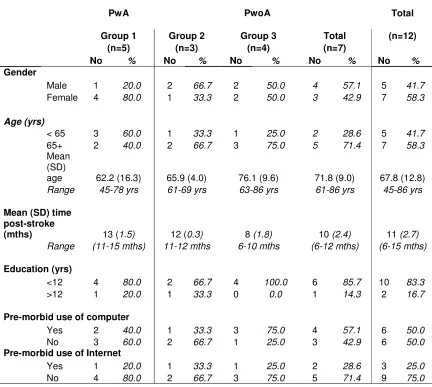
Participant characteristics are detailed in table one. Twelve people with stroke
participated in the study: five PWA (group 1) and seven PwoA (groups 2, 3). The PWA
were younger (mean=62.2 yrs, SD= 16.3) than the PwoA (mean=71.8 yrs, SD=9.0) and had had their stroke slightly earlier (mean time 13 months post-stroke compared with
10 months’ post-stroke). Of the PwoA, 4/7 had used a computer compared to 2/5
PWA. Most participants (5/7 of PwoA and 4/5 of PWA) had not used the Internet
before.
[table 1 about here]
The FAST mean score for PWA was 18.8 compared with 27.7 for PwoA. There was more variation in scores on all language dimensions for PWA (Table 2). In terms of
their cognition, 3/5 of PWA and 4/6 of PwoA scored below average (Table 3).
[table 2 about here]
[table 3 about here]
Focus groups
Common themes with sample comments
• Information about strokes (particularly that younger as well as older people
can be affected)
• Emotional reactions to having a stroke – particularly in relation to lack of
confidence:
“I do want to stop at home but I feel scared still.” (Group 1 member who was not confident about being alone at home)
• The criteria for entitlement to a disabled car badge
• Help with completing claims forms
• Who you need to tell that you have had a stroke
• The need to raise awareness of strokes amongst the general public.
The following themes were identified in two of the three groups (any two):
• Information about the causes of stroke
• Aphasia / communication problems after stroke
“You’ve got to make people aware of what can be affected by stroke.
Because, us here, our speech isn’t affected but we know it can be” (Group
3)
• The impact of stroke on going out – not only physical access but also about
not going out as much and lack of confidence, particularly about going out for
the first time:
“We haven’t been out much at all since I had the stroke. Got to get back
into things”
“Well I forced myself to go out anyway” (Group 3)
• Depression
“And then I used to get up and I used to walk because I was crying and
still didn’t know what was the matter. I couldn’t speak properly. I couldn’t
• Going home from hospital
• Particular services, agencies or groups (CSRT, GPs, stroke services in local
hospitals, Social Services, the Driver and Vehicle Licensing Agency, Age
Concern).
On voluntary groups: “I went out there and seen the strokes number of
strokes out is oh you know they’re kind they’re really kind yeah” (Group 1)
“And I’ll tell you another thing that’s so good I’d go there every day but I’ve
found a Stroke Club. It is once a week” (Group 3)
• Specific questions about driving assessments and not being allowed to drive
“So I thought at the end of six weeks, ‘Should I drive, should I go and ask
somebody or other, or why didn’t I start driving at five and half weeks?’ …
Who’s going to know anyway?” (Group 2)
• Bus passes or tokens
• Shopping and help with shopping
• Work after a stroke
“Work keeps me busy, active, company. Fearful of stopping work” (Group
2)
“Well I’ve been off sick and they’ve been very good and said I’ve got to
be100% better before I can go back obviously because of the job and I
just can’t wait to get back” (Group 3)
“They told [partner’s name] and said ‘keep this’ or he wouldn’t have done
it either. He wouldn‘t have no money or nothing like that, they never told you nothing”
• Where to get equipment from. Shower stools were the only item of equipment
mentioned by two of three groups
Issues raised which were not in the Topic Guide were the need to publicise or raise
awareness of stroke, how stroke survivors could help people in hospital who have had
a stroke, being a parent after a stroke, loss of independence, confidence and friends, and meeting informally.
Differences between groups
The group of PWA was the only group to suggest that people who have had a stroke
could visit other people with stroke in hospital:
“That I’m going to be better and talk better and I would like to do … if people are in (reads word ‘stroke’) s s stroke, I want to help them. I
want to go and say erm I want to tell you how are you.”
“[…] yes and I would say I would do the same nine ten. And say the
same” (Group 1)
PWA also wanted to be able to meet informally and suggested groups to suit different
ages and interests.
“Shouldn’t people like this man (indicates another participant) and us lot
(indicates everyone)”
“Together”
“Why couldn’t we go… somewhere together? To go back” “Well yeah …”
“One afternoon or somewhere”
“We could go somewhere and that lady, we could …go out somewhere
…” (Group 1)
With a younger profile than the other groups, they also had concerns about being a
[good to go] … “down the seafront –especially with a load of kids.” (Group 1)
Their physical and communication difficulties may have affected their own perceptions
of their participation after a stroke. In common with the other two groups, this group
raised the question of the criteria for obtaining a disabled car badge but they did not talk about returning to driving themselves. They raised the issue of losing
independence and having to go out with somebody else:
“When she visits me, then I go out” (Group 1)
“He drives the car everywhere” (Group 1)
Moreover, although of working age, PWA did not raise the issue of returning to work
whereas it was raised by the people of working age in the other groups.
The PWA also reported losing friends:
“Like me I had friends I used to take my child to school what have you
plenty she comes to me and we go cup of tea things like that. Not now.”
“Where are they now?” (Group 1)
The people attending the second group were more physically able than people
attending the first or third group. Compared to other groups, they had limited personal
experience of using equipment and claiming assistance such as disabled car badges.
This group agreed that they would not know where to go for assistance if money was a problem. They were adamant that they would not want to meet other people who had
had a stroke.
Views on computers and the Internet
In principle, both groups of PwoA saw the potential of the website for families of people with stroke – particularly in the acute stage. Two groups raised the question of lack of
access to computers which indicates another barrier to participation. Two groups
wanted information in leaflets as well as on the website.
After identifying key themes in the focus groups that could be used on the website, 133
keyword (KW) cards were created. All 12 participants came to the card-sorting
sessions. Everyone appeared to understand the task and, despite the large number of
cards, worked steadily through the pack.
Thirty-four cards (26% of all cards) had 100% agreement on categorisation by either
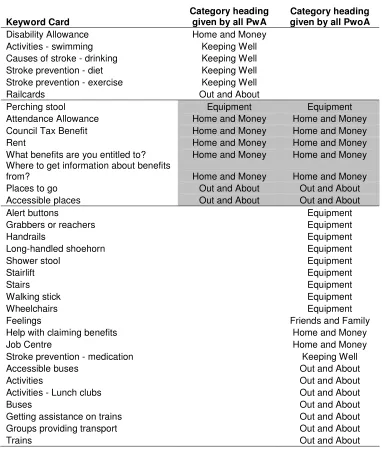
PWA or PwoA. Everyone agreed on the categorisation of only eight cards (6%) – shown in the shaded area of Table 4. PwoA agreed on the categorisation of twice as
many cards as PWA [28 cards (21%) compared with 14 cards (11%)]. There was
100% agreement for topics such as ‘Accessible places’ and ‘Places to go’ to be placed within ‘Out and About’. However, PwoA consistently included topics such as ‘Buses’,
’Trains’ in this category whereas PWA did not (Table 4).
[table 4 about here]
Neither group agreed consistently on categorising health services together– for
example, ‘Speech and Language Therapy’, ‘District Nurses’, ‘Physiotherapy’, ‘GPs’,
‘Psychology’ were not strongly associated by either group. The way users perceive or understand these services may differ from that of health professionals. Similarly,
neither group had a consistent approach to categorising voluntary groups - although
some cards were more strongly associated [e.g. ‘Stroke Association’ and ‘Age Concern
Resource Centre’ (EZSort level 0.2) for PWA and ‘Stroke Association’ and ‘Different Strokes’ (0.3) for PwoA]. One card was labelled ‘Voluntary groups’ but people did not
consistently link this to cards containing the names of individual voluntary groups.
PwoA broadly linked (at level 0.7 or below) voluntary groups to cards depicting causes,
effects and stroke services. PWA broadly linked voluntary groups to cards depicting activities.
Eighty-six cards (65%) were allocated to new categories by at least one person. Still,
of 1,597 sorts, only 213 (13%) were sorts into new categories, which suggests that the category headings of the website were broadly appropriate. The cards most likely to
be allocated to new categories were ‘Neurosurgery’ and ‘Psychology’ (by six people)
and cards related to statutory or voluntary services. This again may reflect differences
in the way patients view services compared to professionals.
People in both PwoA groups selected topics which related to the impact of stroke on
them category names such as “For people that’s sad” or “Feeling”. One person with
aphasia grouped this type of card separately but was not able to give a name to the category.
Differences in the categorisation preferences of PWA and PwoA
EZSort showed that the sorts by PWA were more fragmented than those for PwoA with
fewer blocks of cards associated at 0.3 or below. (Appendices 3 and 4). The ‘Help the Aged’ card was the least strongly associated card by both groups (0.75 for PWA, 0.76
for PWoA). However, there were cards which PWA did not strongly associate with at
least one other card whilst PWoA did, and vice versa. For example, ‘Age of people with stroke’ was weakly associated by PWA (0.7 – its nearest cards were ‘Help with filling in
forms’ and ‘Nomad’) but strongly associated by PWoA (0.13) with cards about causes
and effects of stroke. ‘Help with shopping’ was strongly associated by PWA (3.0) with
‘Emotional lability’ and ‘How to get help in the house’ but had a weaker relationship (0.65) with ‘Lack of confidence – not wanting to go out alone’ and ‘Shopping’ by PWoA.
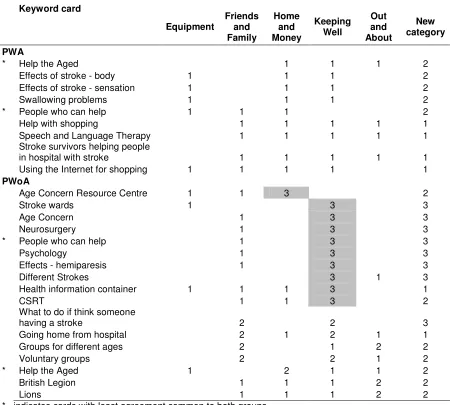
Sixty percent of PWA agreed on the categorisation of 68 cards (51% of cards) whereas
60% of PwoA agreed on the categorisation of 101 cards (76% of cards). PWA did not agree at all on the categorisation of nine cards whilst at least two PWoA agreed on the
categorisation of all cards. Eight of the cards allocated to five or more categories by
PWoA related to voluntary groups and four to health services. (Table 5)
[table 5 about here]
PwoA suggested 12 new categories and named all of them. PWA suggested 15 new
categories: six were given names, seven contained only one card and two were not named. PWA used more categories [mean 8.2 categories, range 5-15] compared to
PwoA [mean 6.7 categories, range 5-10]. However, they placed fewer cards into new
categories (59 cards compared to 75 cards by PwoA). It was unlikely that everyone
would agree on the categorisation of 133 cards. However, 87 cards (65%) were agreed by six or more participants.
Some cards lent themselves to natural groupings in that wording was duplicated on
associated cards. The terms ‘Activities’, ‘Causes of Stroke’, ‘Effects of Stroke’ and ‘Stroke Prevention’ were repeated on associated cards (e.g. ‘Stroke prevention – diet’,
2/4 categories). Similarly, 13 KW cards of individual items of equipment (concrete
terms, illustrated with photographs or line drawings of the item) might reasonably have been predicted to be categorised into the ‘Equipment’ category. PwoA sorted these
items into the ‘Equipment’ category more frequently than PWA (96% compared to
52%).
DISCUSSION
What information do people with stroke want to see on the website?
Focus groups provided insights into what information people with stroke wanted to see on the pompeystrokes website. They wanted to give advice to other people or families
in the same situation and made specific requests for information, such as causes of
stroke, depression and emotional reactions to stroke, going home from hospital, going
out, aphasia, local services, driving, work after stroke and raising public awareness of
stroke. These are similar issues to those identified in other studies (e.g. Hare et al, 2006; Hangar et al, 1998; Wiles, Pain, Buckland and McLellan, 1998; Avent, Glista,
Wallace, Jackson, Nishioka and Yip, 2005). At the rehabilitation stage, Avent et al’s
focus groups expressed the need to meet a person with aphasia. The focus group of PWA in this study offered to be the people rendering assistance. This study comprised
people who were at least six months’ post-stroke. Different information needs may
have been disclosed if they were one or more years post-stroke (Hangar et al, 1998;
Rodgers, Bond and Curless, 2001; Avent et al, 2005). Overall, the needs our focus
groups disclosed were consistent with the literature.
The focus groups’ findings enabled the pompeystrokes website team to identify gaps in local information provision. In particular, the need for information about emotional consequences and impact of stroke was raised by all our groups and has also been
raised in other studies (O’ Mahoney, Rodgers, Thomson, Dobson and James, 1997;
Wiles et al, 1998, Avent et al, 2005; Hare et al, 2006). The website did not include
information about these topics and they have now been included. Discussion also included the effects of stroke upon participation in life situations. The second group
(PwoA) spoke of returning to old activities or trying new activities and not being limited
by stroke, probably because they were less affected physically than the other groups
Running separate focus groups for PWA and PwoA revealed different information
needs. For example, aphasia severely affects people’s social and emotional well-being (Hilari and Byng, 2009). The focus group of PWA suggested meeting informally as a
solution to social isolation. One group of PwoA did not want to meet other people who
had had a stroke. The PWA were less interested in employment options. Other
studies have not explicitly compared the information needs of people with and without
aphasia, and more research is needed in this area.
Placing information on the website will enable people with stroke and their families to
access information about particular topics as their needs change over time and at a time, place and pace to suit them. People with stroke would like information to be
presented in different ways such as leaflets (Hangar et al, 1998). The website could
provide information in different media e.g. text, videos.
This study found that people would like local information to be available on the web and
they did not necessarily see a lack of a computer or their own computer illiteracy as
barriers because they appreciated the potential of the website for their families. As use
of the Internet is predicted to rise, pre-morbid computer literacy will rise and
consequently making information available and accessible on the Internet for people
post-stroke may assume greater importance.
How do people with stroke want the website information to be structured?
Card-sorting was used to explore preferences for structuring information on the web.
The card-sorting activity was accessible by all participants with stroke, whereas in
Savitch and Zaphiris’s (2006) study, one third of people with dementia were not able to participate at all. The pompeystrokes website headings themselves were more (‘Out and About’) or less abstract (‘Equipment’). Overall, for each heading, there was a
group of cards which had a semantic relationship with the heading, suggesting that
even the more abstract headings were understood.
Presenting both pictures and words on the cards exploited visual recognition and
reading which should have increased semantic knowledge of the idea. Overall, more
concrete items were more frequently associated both with each other and within
headings (e.g. individual items of equipment with ‘Equipment’, or buses and trains with ‘Out and About’). However, this was not true of all objects, e.g. the ‘Health information
categories. More abstract ideas (such as nuances of the theme of not going out) were
harder to portray on the KW cards. Three of the cards depicting not going out were amongst the least strongly associated with any one category, which may be due to lack
of understanding or lack of association or both. The ‘Effects of stroke’ cards were not
strongly associated with any one heading. This may be because the effects are varied,
e.g. the effects on the body and brain were almost equally divided between ‘Keeping
Well’ and new categories. Each impact could be associated with different headings on the website. Using hypertext on the website could allow links to be made across
several headings.
The range of issues raised by the focus groups covered the stroke ‘journey’ from initial
admission to post-discharge. Information needs change over time (Rodgers et al,
2001) but no-one suggested redefining the website headings using metaphors such as
‘journey’. No-one suggested categorising by geographical area. Two people
suggested categorising by age. Only 13% of sorts were sorts into new categories. All
this suggested that the website category headings were broadly appropriate.
All groups found it hard to agree on categorisation of health and social care services and voluntary groups. PwoA linked voluntary groups to cards depicting causes, effects
and stroke services. PWA linked voluntary groups to cards depicting activities. People
may be more likely to categorise the voluntary group with the activity they most
associate with that particular group – possibly through personal experience. The ‘Keeping Well’ section was intended to cover information about stroke and services
available but this was not readily apparent to participants. The website was redesigned
with separate sections about stroke and about services to make it easier for users to
find this sort of information.
All focus groups raised the issue of emotions, for example emotional reactions to
stroke, lack of confidence, depression. PWA and PwoA both identified that cards about
feelings required separate categorisation. The issue of emotions may be so important that it has to be an option on the Homepage and not on subsequent webpages.
The card-sorting provided sufficient information to enable the website team to start to
re-structure the information on the website taking into account participant preferences.
There were differences in the categorisation preferences of PWA and PwoA. The
categorisation sorts of PWA were more fragmented with fewer groups of associated cards compared to PwoA. The PWA in this study, similarly to the people with dementia
in Savitch and Zaphiris’s (2006) study, sorted cards into more categories because they
created more categories containing only one card. Anderson et al (2005) suggested
that their oncology patients created fewer categories than health professionals because
patients did not fully understand the topic. In this study, the topics were generated by the participants themselves and they were therefore more likely to understand the
issues. The reasons for the differences we found may relate to individual differences
but also to difficulties with categorisation.
Language impairments impact negatively upon categorisation skills. Baldo, Dronkers,
Wilkins, Ludy, Raskin and Kim (2005) found significant relationships between percent
correct on the Wisconsin Card Sorting Test (WCST) and aphasia in terms of overall ability, naming and comprehension. They concluded that “the ability to internalise
language in the form of inner speech allows us to manipulate concepts and solve
problems covertly” (p 249). Difficulties with internalised language cause difficulties in
manipulating concepts – such as those represented on the KW cards in this study.
There may be a combined negative impact upon categorisation skills in people with
both cognitive impairment and aphasia. In this study, three out of five PWA (60%) and
four out of six PwoA (67%) scored below average on the RCPM. However, we cannot draw sound conclusions from our study on the effects of performance on the RCPM
and aphasia on card-sorting due to the small sample size and the limited aphasia
assessment. Gianotti, D’Erme, Villa and Caltagirone (1986) examined the relationship
between poor performance on the RCPM and disturbance of the semantic-lexical level. They found no significant difference between right and left hemisphere damaged
patients on the RCPM. However, PWA performed worse than non-aphasic left
hemisphere damaged participants. The performance of PWA was not related to overall
severity of aphasia. It was influenced by the clinical form of aphasia and even more by the presence of receptive semantic-lexical disturbance. Villardita (1985) found that
achievement on sub-tests of the RCPM varied with right or left hemisphere damage
and whether people had aphasia or not. The importance of internal verbalisation was
again reflected in the significantly poorer performance on symmetry sub-tests by PWA.
Despite running three groups, participant numbers were comparatively small. Still, our
response rate was reasonable for focus groups; and our number of participants per group (n=3-5) was appropriate for focus groups with people with stroke and PWA.
Moreover, we can be reasonably confident about our findings as the identified
information needs are consistent with the literature (e.g. Hare et al, 2005; Wiles et al,
1998). Selection bias may have occurred - for example, the exclusion criteria were
based on people being able to carry out the card-sorting exercise. This may have excluded people with pertinent views on information needs. Also, technology such as
screen-readers means that visually impaired people are not excluded from using
computers and the Internet but they were excluded from this particular study.
Responders were younger (mean age of 67.8 years) than the sample frame (mean age
of 75.0 years). However, the wide age range of responders (45 years to 86 years)
elicited a broad range of perspectives and issues from people of working age with families to retired people with grandchildren. All the groups emphasised that the wider
public should know that strokes can affect people of all ages.
Although no knowledge of the Internet was required, even the use of the word “Internet” in the study invitation may have dissuaded some people from responding.
Interest in using the Internet for health information is associated with, amongst other
things, positive information-seeking behaviour, motivation and a positive attitude
towards obtaining information from non-clinician sources (Mead, Varnam, Rogers and Roland, 2003). Conducting focus groups with the sole remit of determining information
needs after a stroke (i.e. not relating it to media) may be another way of obtaining
information to place on the website.
Directions for future research
As is common with new research, replications of this study would increase confidence
that the information needs and structuring preferences identified here are generalisable
to people with stroke and to PWA.
The website team needed to consider whether to restructure the website reflecting the
categorisations of PWA. Would wholesale adoption of their categorisations make the
website accessible to PWA? The greater individual variation amongst PWA compared to PwoA in this study indicates that we should view their results with caution. More
Summary and conclusion
In this study, focus groups including PWA were used to inform the content of the
pompeystrokes website. Generated topics covered all stages of the stroke journey and identified gaps in local information provision. A card-sorting activity provided evidence
of structuring preferences. It was accessible to everyone and raised some of the
categorisation difficulties faced by PWA.
This study has shown that people with stroke and those with aphasia can successfully
participate in the creation and design of websites. It extended the participation of users from membership of the pompeystrokes website steering group to direct input into website content and structure. Smith et al’s Cochrane Review (2008) found that
pro-actively involving patients and carers in the provision of information improved patient
and carer knowledge of stroke, aspects of patient satisfaction, and reduced patient
REFERENCES
Andersen R, Ruland C, Roslien J, Slaughter L, Andersen T, Jacobsen W. (2005).
Clustering techniques for organising cancer-related concepts into meaningful groups for patients. American Medical Informatics Association Annual Symposium
Proceedings 882 [online]. Available:
http://www.pubmedcentral.nih.gov/articlerender.fcgi?tool=pubmed&pubmedid=1677916
9 (22 May 2009)
Aphasiahelp website. (2002). [online] Available: (www.aphasiahelp.org) (22 May 2009)
Avent J, Glista S, Wallace S, Jackson J, Nishioka J, Yip W. (2005). Family information needs about aphasia. Aphasiology, 19 (3/4/5), pp365-375
Baldo JV, Dronkers NF, Wilkins D, Ludy C, Raskin P, Kim J. (2005). Is problem solving
dependent on language? Brain and Language 92 pp 240-250
Chapey R. (2001). Language intervention strategies in aphasia and related neurogenic communication disorders. PA, USA: Lippincott, Williams and Wilkins
Dong J and Waldo P. (2001). EZSort (USort and EZCalc) [online]. Available:
http://web.archive.org/web/20040205000418/http://www-3.ibm.com/ibm/easy/eou_ext.nsf/Publish/410 (22 May 2009)
Dutton W and Helsper EJ. (2007). The Internet in Britain, 2007. Oxford Internet Institute. Oxford, UK: University of Oxford
Enderby P, Wood, V, Wade D. (1987). Frenchay Aphasia Screening Test. Windsor: NFER-Nelson
Excel. (2003). Microsoft Corporation
Griffin E, McKenna K, Worrall L (2004). Stroke education materials on the world wide web: an evaluation of their quality and suitability. Topics in Stroke Rehabilitation. Summer;11(3), pp29-40
Gruber MA, Roller CM, Kaeble B. (1999). Readability levels of patient education
material on the world wide web. The Journal of Family Practice, 48(1); pp58-61
Hanger HC, Walker G, Paterson LA, McBridee S, Sainsbury R (1998). What do
patients and their carers want to know about stroke? A two-year follow-up study.
Clinical Rehabilitation 12; pp 45-52
Hare R, Rogers H, Lester H, McManus RJ, Mant J (2006). What do stroke patients and
their carers want from community services? Family Practice, 23; pp131-136
Hilari K. & Byng S. (2009) Health-related quality of life in people with severe aphasia.
International Journal of Language and Communication Disorders, 44(2), 193-205
Litosseliti L. (2003). Using focus groups in research. London: Continuum
Maurer D. (2007). Eurostar card sorting case study [online]. Available:
http://www.rosenfeldmedia.com/books/cardsorting/blog/eurostar_card_sorting_case_st
u/ (22 May 2009)
Maurer D and Warfel T. (2004). Card-sorting: The definitive guide [online]. Available: http://www.boxesandarrows.com/view/card_sorting_a_definitive_guide (22 May 2009)
Mead N, Varnam R, Rogers A, Roland M. (2003). What predicts patients’ interest in the Internet as a health resource in primary care in England? Journal of Health Services Research Policy, 8(1): pp33-39
Morris R, Payne O, Lambert A. (2007). Patient, carer and staff experience of a hospital-based stroke service. International Journal for Quality in Health Care; 19(2), pp105-112
O’Mahoney P, Rodgers H, Thomson RG, Dobson R, James O (1997). Satisfaction with information and advice received by stroke patients. Clinical Rehabilitation; 11: pp68-72
Pompeystrokes website. (2006). [online] Available: (www.pompeystrokes.co.uk) (22 May 2009)
Research Randomiser (not dated) [online] Available: http://www.randomizer.org (22 May 2009)
Raven JC, Court JH, Raven J. (1995). Coloured Progressive Matrices. Oxford, UK: Oxford Psychologists Press
Rochette A, Korner-Bitensky N, Tremblay V, Kloda L (2008). Stroke rehabilitation information for clients and families: assessing the quality of the StrokEngine-Family website. Disability and Rehabilitation, 30(19): pp1506-12
Rodgers H, Bond S, Curless R (2001). Inadequacies in the provision of information to
stroke patients and their families. Age and Ageing; 30: pp129-133
Royal College of Physicians. (2008). Intercollegiate Stroke Working Party ‘National
clinical guideline for stroke’, 3rd edition. London
Savitch N. (2006). How to make the world wide web dementia-friendly. Journal of Dementia Care, September/October, pp29-31
Savitch N and Zaphiris P (2006). Accessible websites for people with dementia: a preliminary investigation into information architecture. International Conference on Computers Helping People with Special Needs; pp144-151 [online]. Available:
http://www.innovationsindementia.org.uk/publications/ICCHP_NSavitch.pdf (22 May
2009)
Singh S, Domonkos Gedeon T, Rho Y. (1998). Enhancing comprehension of web
information for users with special linguistic needs. Journal of Communication, Spring
pp86-108
Available:
http://www.mrw.interscience.wiley.com/cochrane/clsysrev/articles/CD001919/frame.ht ml (22 May 2009)
The Stationery Office (1995) Disability Discrimination Act, 1995. [online]. Available: www.opsi.gov.uk/acts/acts1995/ukpga_19950050_en_4 (26 May 2009)
The Stroke Association (2006) Getting back to work after a stroke. Report by The Stroke Association and Different Strokes
van Veenendaal, Grinspun, Adriaanse. (1996). Educational needs of stroke survivors and their family members, as perceived by themselves and by health professionals.
Patient Education and Counselling, Aug; 28(3), pp265-76
Villardita C. (1985). Raven’s Coloured Progressive Matrices and intellectual impairment in patients with focal brain damage. Cortex, 21, pp627-634
W3C. (2005). Introduction to Web accessibility [online]. Available: http://www.w3.org/WAI/intro/accessibility.php (22 May 2009)
Walsh TM and Volsko TA (2008). Readability assessment of Internet-based consumer health information. Respiratory Care, October, Vol 53, no. 10
Wiles R, Pain H, Buckland S, McLellan L (1998). Providing appropriate information to patients and carers following a stroke. Journal of Advanced Nursing, 28(4), pp794-801
World Health Organisation. (2002). Towards a common language for functioning, disability and health [online]. Available:
Table 1: Participant characteristics
PwA PwoA Total
Group 1 Group 2 Group 3 Total (n=12) (n=5) (n=3) (n=4) (n=7)
No % No % No % No % No %
Gender
Male 1 20.0 2 66.7 2 50.0 4 57.1 5 41.7
Female 4 80.0 1 33.3 2 50.0 3 42.9 7 58.3
Age (yrs)
< 65 3 60.0 1 33.3 1 25.0 2 28.6 5 41.7
65+ 2 40.0 2 66.7 3 75.0 5 71.4 7 58.3
Mean (SD)
age 62.2 (16.3) 65.9 (4.0) 76.1 (9.6) 71.8 (9.0) 67.8 (12.8)
Range 45-78 yrs 61-69 yrs 63-86 yrs 61-86 yrs 45-86 yrs
Mean (SD) time post-stroke
(mths) 13 (1.5) 12 (0.3) 8 (1.8) 10 (2.4) 11 (2.7)
Range (11-15 mths) 11-12 mths 6-10 mths (6-12 mths) (6-15 mths)
Education (yrs)
<12 4 80.0 2 66.7 4 100.0 6 85.7 10 83.3
>12 1 20.0 1 33.3 0 0.0 1 14.3 2 16.7
Pre-morbid use of computer
Yes 2 40.0 1 33.3 3 75.0 4 57.1 6 50.0
No 3 60.0 2 66.7 1 25.0 3 42.9 6 50.0
Pre-morbid use of Internet
Yes 1 20.0 1 33.3 1 25.0 2 28.6 3 25.0
Table 2: Participant scores on the Frenchay Aphasia Screening Test (FAST)
FAST dimension
Comprehension Expression Reading Writing Overall score
Maximum score 10 10 5 5 30
People with aphasia (n=5)
Mean 6.6 5.2 4.0 3.0 18.8
SD 1.8 2.9 1.0 1.4 6.5
Range 5-9 1-9 3-5 2-5 12-28
People without aphasia (n=6)
Mean 9.3 8.8 5.0 4.5 27.7
SD 0.8 1.2 0.0 0.5 1.6
Table 3: Participant scores on the Raven Coloured Progressive Matrices (RCPM)
RCPM score
SPM scores (converted
RCPM)
Percentile Grade Interpretation People with aphasia (n=5)
1 35 52 50 III+ Average
2 35 52 50 III+ Average
3 31 39 25 IV Below average
4 23 24 5-10 IV- Below average
5 22 22 <5 V Intellectually impaired
People without aphasia (n=6)
1 36 57 90 II+ Above average
2 33 44 25-50 III- Average
3 28 32 25 IV Below average
4 24 26 10 IV- Below average
5 25 27 5-10 IV- Below average
Table 4: Keyword cards with 100% agreement on categorisation under website heading
Keyword Card
Category heading given by all PwA
Category heading given by all PwoA
Disability Allowance Home and Money
Activities - swimming Keeping Well
Causes of stroke - drinking Keeping Well
Stroke prevention - diet Keeping Well
Stroke prevention - exercise Keeping Well
Railcards Out and About
Perching stool Equipment Equipment
Attendance Allowance Home and Money Home and Money
Council Tax Benefit Home and Money Home and Money
Rent Home and Money Home and Money
What benefits are you entitled to? Home and Money Home and Money
Where to get information about benefits
from? Home and Money Home and Money
Places to go Out and About Out and About
Accessible places Out and About Out and About
Alert buttons Equipment
Grabbers or reachers Equipment
Handrails Equipment
Long-handled shoehorn Equipment
Shower stool Equipment
Stairlift Equipment
Stairs Equipment
Walking stick Equipment
Wheelchairs Equipment
Feelings Friends and Family
Help with claiming benefits Home and Money
Job Centre Home and Money
Stroke prevention - medication Keeping Well
Accessible buses Out and About
Activities Out and About
Activities - Lunch clubs Out and About
Buses Out and About
Getting assistance on trains Out and About
Groups providing transport Out and About
Table 5: Keyword cards with least agreement – allocated to five or more categories (incl new categories)
No of participants allocating KW card to each category Keyword card Equipment Friends and Family Home and Money Keeping Well Out and About New category PWA
* Help the Aged 1 1 1 2
Effects of stroke - body 1 1 1 2
Effects of stroke - sensation 1 1 1 2
Swallowing problems 1 1 1 2
* People who can help 1 1 1 2
Help with shopping 1 1 1 1 1
Speech and Language Therapy 1 1 1 1 1
Stroke survivors helping people
in hospital with stroke 1 1 1 1 1
Using the Internet for shopping 1 1 1 1 1
PWoA
Age Concern Resource Centre 1 1 3 2
Stroke wards 1 3 3
Age Concern 1 3 3
Neurosurgery 1 3 3
* People who can help 1 3 3
Psychology 1 3 3
Effects - hemiparesis 1 3 3
Different Strokes 3 1 3
Health information container 1 1 1 3 1
CSRT 1 1 3 2
What to do if think someone
having a stroke 2 2 3
Going home from hospital 2 1 2 1 1
Groups for different ages 2 1 2 2
Voluntary groups 2 2 1 2
* Help the Aged 1 2 1 1 2
British Legion 1 1 1 2 2
Lions 1 1 1 2 2
Appendix 1
Focus Groups Topic Guide
Aim: to find out what information people who have had a stroke want to see on a website
1 10 mins Introduction
Introduce self, other SLT and note taker and explain roles
Ask whether they have used the worldwide web before. [Note who has used it and later on ask what used it for.]
Emphasise that it doesn’t matter if you haven’t used websites or know anything about them.
Explain background to project
• Mayor of Portsmouth funded project to set up a website
http://www.pompeystrokes.co.uk/
• Define website – people look at websites on computers. A website is a place
where information about a topic can be stored and looked at by anyone else using a computer. People can also use computers to write to other people who have had strokes
• Show Stroke Association leaflets and their website.
http://www.stroke.org.uk/
• Explain that all the information in the leaflets is on their website. The information
is in one place. If new information comes out, it can be put on the website very quickly.
Purpose of group: - to find out what information people who have had a stroke would like to see on a website about living with stroke in Portsmouth
Group ‘rules’
• Please talk one at a time
• There are no right/wrong answers • Not expected to all agree
• Discussion is confidential – no names will be used • What to do if get off-the-point?
2 30 mins Questions
Open questions:
Would you use a website about stroke in Portsmouth? What would you use it for?
What information would you like to see on the website? Show photo of acute hospital
Think back to when you first had your stroke. What information did you want to know?
• Information about strokes o Causes
o Prevention o Medication
o Feelings eg sadness o Aphasia
o mobility
• People who can help – OTs, Physios, SLTs, Drs, Nurses • Services available
o Social services o Voluntary groups o NHS
o Day centres o Home helps
• Going out “Where do you go?”
o types of transport (cars, ferry, buses) o driving
o shopping
o eating out / pubs o taking children out o swimming
• Money/benefits o Working
o Sickness benefits o Council tax o Housing benefit • Equipment
o Shower aids o Wheelchairs o stairlifts • Living at home
o Meals
o Adaptations eg rails o Equipment
o Sheltered housing
o Nursing / residential homes
• Getting in touch with other people who have had a stroke o groups
Prompts: WORD ASSOCIATION OF ABOVE
We’ve been talking about first admission. Now think about when you were having rehabilitation…
Show picture of someone having PT/OT session in hospital
Think back to when you were having rehabilitation. What information did you want to know?
Prompts as above
Show picture of Different Strokes group at pub.
Prompts as above
What was the most useful piece of information you have found out about living with stroke?
Re-show photo of acute hospital
If you could pass on one key piece of information to someone who has just had a stroke, what would it be?
Would you like to see this information on the website?
PROBES:
• Are there any other points of view? • Can you think of any other examples? • What do others think?
• You don’t seem to agree with this
SENTENCE COMPLETION TASKS:
• The most important piece of information is …
WORD ASSOCIATION OF ABOVE CHANGING TOPICS:
• That’s helpful. Now lets think about …
3 10 mins Summary
Summarise discussion by showing cards/key words on flipchart with key words on them
Thank everyone for attending Repeat anonymity
Appendix 2
Results of card-sorting by one participant
EZSort results for people with aphasia