City, University of London Institutional Repository
Citation
:
Balabanis, G. & Diamantopoulos, A. (2008). Brand origin identification by consumers: A classification perspective. Journal of international marketing, 16(1), pp. 39-71. doi: 10.1509/jimk.16.1.39This is the published version of the paper.
This version of the publication may differ from the final published
version.
Permanent repository link:
http://openaccess.city.ac.uk/17981/Link to published version
:
http://dx.doi.org/10.1509/jimk.16.1.39Copyright and reuse:
City Research Online aims to make research
outputs of City, University of London available to a wider audience.
Copyright and Moral Rights remain with the author(s) and/or copyright
holders. URLs from City Research Online may be freely distributed and
linked to.
City Research Online: http://openaccess.city.ac.uk/ [email protected]
Brand Origin Identification by
Consumers: A Classification Perspective
ABSTRACT
Keywords: country of origin, classifi-cation theory, brand associations, consumer behavior
George Balabanis
and Adamantios
Diamantopoulos
Journal of International Marketing © 2008, American Marketing Association
Vol. 16, No. 1, 2008, pp. 39–71 ISSN 1069-031X (print) 1547-7215 (electronic) The authors apply a classification perspective to (1) examine
the extent to which consumers can identify the correct country of origin (COO) of different brands of consumer durables, (2) investigate the factors facilitating/hindering correct COO iden-tification, and (3) trace the implications of correct/incorrect COO identification on brand evaluation. The results from a U.K. sample indicate that consumers’ ability to classify brands correctly according to their origin is limited and also reveal sub-stantial differences in the classification of different brands to their COO. Moreover, the key antecedent of correct COO identi-fication is consumer ethnocentrism, with sociodemographics (e.g., age, gender) also playing a role. Finally, the authors find that though there are differences in brand evaluations depend-ing on whether the correct COO was identified, such differences are not observed for all brands investigated.
Over the past 40 years, a large number of studies have found that consumers’ product evaluations and buying intentions are related to the origins of the products (Papadopoulos and Heslop 2002, 2003). In general, this research, widely known as country-of-origin (COO) studies, supports the view that a product’s origin indeed affects the way it will be perceived by consumers and the extent to which it will be preferred when it comes to making a buying decision (for relevant literature reviews, see Al-Sulaiti and Baker 1998; Baughn and Yaprak 1993; Bilkey and Nes 1982; Javalgi, Cutler, and Winans 2001; Liefeld 1993; Ozsomer and Cavusgil 1991; Papadopoulos and Heslop 2003; Peterson and Jolibert 1995; Pharr 2005; Srini-vasan and Jain 2003; Verlegh and Steenkamp 1999).
often “use brand names that suggest language origins differ-ent from the brands’ true [COOs]” (Samiee, Shimp, and Sharma 2005, p. 391). For example, Alba, a British manufac-turer of electronic equipment, has introduced the Hinari brand, a name that does not convey the real origins of the product; other well-known examples of potentially mislead-ing brand names are Matsui (United Kmislead-ingdom) and Sharp (Japan). Similarly, Jeep vehicles sold in Austria carry a visi-ble “Made in Austria” sign, signifying the local manufacture of these vehicles in Graz (thereby dissociating the Jeep brand name from its U.S. origin).
Given that different countries have different images in the minds of consumers (Heslop and Papadopoulos 1993; Jaffe and Nebenzahl 2006; Obermiller and Spannenberg 1989), if consumers associate a brand with the wrong COO, their brand evaluations (and subsequent buying decisions) could differ from what they would have been if the correct COO had been identified. For example, if consumer ethnocentrics identify a foreign brand incorrectly as being a domestic brand, the brand might be highly preferred (Sharma, Shimp, and Shin 1995; Shimp and Sharma 1987). Moreover, even if the brand in question is identified as being a foreign brand
but its specificCOO is wrongly attributed, it could be subject
to the negative effects of consumer animosity (Klein 2002; Klein, Ettenson, and Morris 1998) or to bias in favor of (against) developed (developing) countries (Heslop and Papadopoulos 1993). More generally, as several attempts to “monetize” the COO effect show (Johansson and Nebenzahl 1986; Nebenzahl and Jaffe 1993; Seaton and Laskey 1999), consumers are not willing to pay the same price for the same branded product, regardless of its origin. Therefore, associat-ing a brand with the incorrect COO could affect consumers’ perceptions of value directly and, thus, their willingness to purchase the brand at the stated price.
Against this background, we attempt to answer the following questions regarding consumers’ brand origin identification capabilities:
1. Are consumers able to identify the (correct) COO of brands in a product category? Is there a pattern if they get it wrong (i.e., Are the COOs of some brands more likely to be correctly [incorrectly] perceived than others)?
2. What factors affect consumers’ ability to identify the COOs of different brands correctly?
Our study differs from previous related research (e.g., Paswan and Sharma 2004; Samiee, Shimp, and Sharma 2005) in several important respects. First, we focus on a spe-cific product category and also adjust brand origin
identifica-tion rates for guessing.1Second, as is further elaborated in a
subsequent section, we apply a classification perspective based on category learning theory; we not only focus on cor-rect identification but also analyze consumers’ specific incorrect origin allocations as well as their potential inability to assign any COO to a particular brand. Third, we consider several factors that potentially affect consumers’ ability to identify a brand’s origin correctly, such as perceived COO salience, country familiarity, and consumer involvement. Finally, we explore the consequences of correct/incorrect brand origin identification in terms of differences in brand evaluations.
In the sections that follow, we first provide some theoretical background on the concept of brand origin identification and then derive several hypotheses involving its incidence, antecedents, and consequences. Subsequently, we present the study’s methodology and follow this with a presentation of the empirical findings. We conclude by considering both the study’s limitations and its implications for further research.
The literature defines COO identification as the extent to which a consumer can correctly identify the country in which the headquarters of the brand’s parent firm are located, regardless of where the brand is manufactured (e.g., Nike is a U.S. brand, though none of its products are actually produced in the United States). Thus, the COO of the brand must be distinguished from the country of production or manufacture, because different products with the same brand name could be produced in the same or different coun-tries (Liefeld 2004; Nebenzahl 1998; Samiee 1994). There-fore, the term “brand origin” in this article refers to the actual geographical origin of a brand and not the origin as “per-ceived by its target consumers,” as Thakor and Kohli (1996, p. 27) define it. The latter conceptualization of brand origin is much broader than the one we use here because it “refers to signifiers of origin beyond those that merely indicate a country” (Thakor and Kohli 1996, p. 32). Consistent with Johansson, Douglas, and Nonaka’s (1985, p. 389) definition, we define COO here as the country in which “corporate headquarters of the company marketing the … brand is located,” regardless of the place in which the brand in ques-tion is produced.
Few studies examine whether consumers can identify the COO of different brands. Paswan and Sharma (2004) investi-gate Indian consumers’ ability to identify the COO of four
L
ITERATURE ANDwell-known global brands (KFC, McDonald’s, Pepsi, and Coke) and find correct identification rates between 84% (Coke) and 57% (KFC). In contrast, Samiee, Shimp, and Sharma (2005; see also Shimp, Samiee, and Sharma 2001) report average correct identification rates of only 22% for 44 foreign brands from seven countries and 49% for 40 domestic (U.S.) brands. However, the 84 brands in the study represent a wide range of product categories rather than competing brands within a specific product category. In the current study, we focus on a single product category to minimize con-founding effects in the consumer classification process ema-nating from differences in marketing practices, involvement, and other extraneous factors. For example, “in the automobile category … brands (automobile models) are effectively ‘stamped’ with their country affiliation. In many other prod-uct categories, perhaps especially those involving inexpen-sive consumer packaged goods, [COO] information is less conspicuous and thus variable in its recognition by con-sumers” (Samiee, Shimp, and Sharma 2005, p. 382). In addi-tion, as we noted previously, consumers must make appropri-ate adjustments for “guessing” the correct COO; none of the previously mentioned studies make an effort to adjust the raw identification rates for possible guessing effects (Price 1964). Therefore, prior research could overestimate consumers’ true ability to classify correctly the COOs of different brands.
products in most situations; therefore, implicit learning is more prevalent (Ashby and Ell 2002). Categorization litera-ture also supports this view. Specifically, Markman and Ross’s (2003, p. 592) review of the classification literature concludes that “often, category information is learned as a by-product of interactions with the category and is not the central goal of the interaction.”
The use of categories for classification purposes is an impor-tant learning task, and COO is an imporimpor-tant category for con-sumers (Gregan-Paxton and John 1997). Classification refers to the task in which the COO of a brand (i.e., the category label) is predicted from the brand and its attributes. An example would be to predict whether a brand is Chinese from the brand’s price, reliability, and feature innovative-ness. In marketing, several studies recognize the value of classification in consumer decisions (see, e.g., Cohen and Basu 1987; Loken and Ward 1990; Sujan and Bettman 1989); however, this approach has not been applied in the COO context. Instead, practically all relevant studies (e.g., Agar-wal and Sikri 1996; Lee and Ganesh 1999; Maheswaran 1994) citing categorization theory focus on inference (inter-nal transfer of knowledge) from the COO to the brand. Under this perspective, when an unfamiliar or new product is clas-sified as a member of an existing category (e.g., a known COO), information from that category (i.e., the COO) is trans-ferred to the unfamiliar product (Gregan-Paxton and John 1997). Therefore, if a consumer knows the COO of an unfa-miliar brand, he or she tends to infer some of the brand’s unknown attributes (e.g., quality, style) from the COO. In inference tasks, people make predictions about a brand’s unknown attributes (e.g., price, workmanship) from the knowledge of the COO (i.e., the category label); for example, consumers might infer the quality of a DVD player when they know it comes from China.
discriminate the COO of different brands of DVD players (diagnostic attributes), whereas other attributes (e.g., ease of use) might not; in this scenario, consumers would use design and price to classify DVD brands to different COOs.
In contrast to previous COO research that focuses on inference and transfer of knowledge, the current study focuses on classi-fication tasks, involving the allocation of different brands (within a product category) to COOs. We take a single product category approach because the product category–level knowl-edge structure is the one most often activated by the COO cue (Hong and Wyer 1990). Indeed, COO images can be viewed as a representation of the perceived attributes of pro-totype brands from each COO, whereby a set of attributes about a specific product category in a country is derived from a summary of known brands in this product category and country (Agarwal and Sikri 1996; Shimp, Samiee, and Madden 1993).
We also focus on not only the incidence of consumers’ cor-rect brand origin classifications but also the incidence (and specific composition) of incorrect assignments. Previous research (Paswan and Sharma 2004; Samiee, Shimp, and Sharma 2005) in this context has focused almost exclusively on the correct identification of a brand’s COO. However, it is important to distinguish further between consumers who attribute the wrong origin to a brand and those who are unable to associate the brand with any country (i.e., the “don’t knows”). For the latter group, it indeed could be argued that “brand-origin-related information plays no role in their choice behavior” (Samiee, Shimp, and Sharma 2005, p. 381).
Although the bulk of COO research supports the view that a brand’s COO influences consumers’ evaluations of the brand and subsequent buying decisions, a hidden assumption in most relevant studies is that a brand’s COO is known to the consumer. Although experimental studies make this COO information available to respondents as part of the experi-mental stimulus, researchers argue that “the [COO] effect is inflated when participants receive verbal descriptions of a brand’s COO compared to the more ecologically valid situa-tion where shoppers search for such informasitua-tion at the point of sale or retrieve it spontaneously from memory” (Shimp, Samiee, and Sharma 2001, p. 325).
Hutchinson and Alba (1991) find that consumers who inten-tionally try to learn about a product are more likely to clas-sify the product correctly; in contrast, when learning about the product is incidental, classification performance is lower. According to Hutchinson and Alba, consumers do not (intentionally) try to learn about products in most situations;
S
TUDYH
YPOTHESESthus, implicit (incidental) learning is more prevalent. Fur-thermore, consumers rarely intentionally try to test hypothe-ses about the accuracy of beliefs of the attributes of products they use (Hoch and Deighton 1989). Indeed, after reviewing the literature on consumer learning, Hutchison and Alba (1991, p. 326) conclude that “taken together, these studies suggest that learning from multiattribute information is diffi-cult for consumers and that the resultant knowledge is often imperfect or biased.”
In light of the preceding discussion and consistent with pre-vious findings (Samiee, Shimp, and Sharma 2005), we expect the following:
H1: Consumers are more likely to misclassify than
cor-rectly classify a brand to its true COO.
It seems plausible that the frequency with which a consumer experiences a brand as an example of a COO will increase the likelihood of classification of that brand to the correspon-ding COO. Frequency (repetition) has a powerful effect in learning, and cognitive psychology studies confirm that familiar exemplars are judged as being more typical mem-bers of a category than unfamiliar ones (Malt and Smith 1982). Barsalou (1985) provides evidence for the idea that it is not overall familiarity but rather frequency of instantiation that determines an item’s categorization. Frequency of instantiation is defined as “someone’s subjective estimate of how often they have experienced an entity as a member of a particular category” (Barsalou 1985, p. 631), whereas mere familiarity is a category-independent measure and is defined as “someone’s subjective estimate of how often they have experienced an entity across all contexts” (Barsalou 1985, p. 631). However, the two constructs are found to be highly cor-related (r = .57), and this relationship is supported by Loken and Ward (1990, p. 114), who suggest that “people should tend to perceive more frequently encountered stimuli as more typical because … more frequently encountered prod-ucts … tend to have attributes more widely shared by imita-tive competitors than do less popular products.”
The idea that familiarity increases consumers’ ability to dif-ferentiate one item from another is common in learning. As we noted previously, familiarity is related to the likelihood of occurrence: Typically, brands that are more likely to occur will be more familiar. It seems plausible to assume that, on average, consumers are more familiar with domestic brands than foreign brands. Ceteris paribus, the (subjective) fre-quency of instantiation of a local brand as a member of the home COO will be higher than that of foreign brands, and therefore, local brands will have a higher probability of being correctly classified. Thus, consistent with Samiee, Shimp,
Brand Characteristics and
COO Classification
and Sharma (2005), who also find significantly higher cor-rect COO identification rates for home brands, we hypothe-size the following:
H2: Consumers’ COO classification performance is
bet-ter for local (i.e., domestic) brands than for foreign brands.
Smith, Fazio, and Cejka (1996) demonstrate that objects belonging to dominant, or reference, categories (i.e., cate-gories that serve as comparison standards) are more readily produced in classification tasks and lead to better classifica-tion rates. Members of a dominant, or reference, category all share a common, salient category membership; accordingly, they should be perceived as more similar to one another than objects that belong to other categories. Indeed, Corneille and colleagues (2006) show that classification of members of a reference category is more accurate than that for items from nonreference categories.
Applying this rationale to the COO classification context, we expect that brands that come from COOs that are regarded as dominant categories will have better classification accuracy. A dominant COO is an origin that is frequently and readily evoked in a product category; for example, Germany is a dominant COO in the passenger cars sector because it is the most common COO that comes to mind when people think of cars (Dubois and Paternault 1997). Thus, we hypothesize the following:
H3: Consumers’ COO classification performance is
bet-ter for brands from dominant COOs than for brands from other COOs.
Experiments in cognitive psychology show that labeling things influences the classification process. Specifically, Jaswal and Markman (2002) find that people tended to assign moderately dissimilar novel objects labeled with the same name in the same category; however, they did not observe this under the nonlabeling conditions. Horne and Lowe’s (1996) study also finds that common naming of arbitrary stimuli (i.e., not distinguished by common features) is suffi-cient to establish new categories. Therefore, labeling over-rides classification-based perceptual similarities of objects as dissimilar objects when similar labels are placed in the same category.
pro-nouncing a brand name in a foreign language” (Leclerc, Schmitt, and Dube 1994, p. 263). In this context, it appears that the spelling and pronunciation of a brand name are use-ful cues for consumers to identify its origin. Therefore, the COO of an unfamiliar brand might be judged from the simi-larity of the brand name spelling or pronunciation to that of a familiar brand name with a familiar COO. We conclude that spelling or pronouncing the name in a manner that is not linked to the real COO is more likely to lead to misclassifica-tion of the brand’s COO. Thus, we expect the following:
H4: Consumers’ COO classification performance is lower
for brands with names that are incongruent with the
brands’ true origins.
Research on cognitive psychology (Johnson 2001) shows that consumers familiar with a category have extensive knowl-edge of the attributes that group together similar items and classify them in the appropriate category. When a new stimu-lus is presented for categorization, the respondent is assumed to retrieve the attribute list of the relevant cate-gories and then test whether the stimulus features match one of these attribute lists. Familiarity with the categories should make retrieving the required attributes and the discrimina-tion task easier. In our case, consumer familiarity with a par-ticular country will lead to greater knowledge of the country and its brands and thus will make it easier for consumers to classify correctly the COO of a brand from that country. Thus, we hypothesize the following:
H5: Consumers’ COO classification performance is
posi-tively related to their familiarity with the country in question.
Maddox (2002, p. 567) empirically shows that classification performance is determined by experience with the objects and the “reinforcing consequences of the decisions that they make.” Therefore, it appears that if the consequences of assigning a brand to the wrong COO are significant in terms of costs, classification performance (accuracy) will be greater. Similarly, if the rewards of assigning a brand to the right COO are high, classification performance will be greater. Because it is difficult to estimate directly the conse-quences of such misclassification, we use the perceived salience of the COO in purchase decisions as a proxy instead. Specifically, if the perceived salience of COO is high, con-sumers have a lot of confidence in the diagnostic power of COO (Feldman and Lynch 1988; Liefeld 2004) and will be more wary (in a self-attributional manner) of any misclassifi-cations. In contrast, if the perceived salience of COO is low, consumers will view the information conveyed by the COO as being nondiagnostic and thus be relatively indifferent to
Antecedents of COO
errors of classification. As Samiee, Shimp, and Sharma (2005, p. 382) point out, “in as much as [COO] information is not diagnostic, it serves little useful function for consumers to posses accurate memorial representations of country iden-tities for most brands in the marketplace.” Thus, we expect the following:
H6: Consumers’ COO classification performance is
posi-tively related to the perceived salience of COO in purchase decision making.
Motivation to collect information about a brand is largely determined by the consumer’s level of involvement with the product category (Moorthy and Ratchford 1997). Most consumer behavior theories suggest that low-involvement conditions result in minimal search for information, whereas high-involvement conditions lead to higher information search (see, e.g., Beatty and Smith 1987). Therefore, high involvement with a product category is likely to enhance consumers’ COO knowledge of brands belonging to this cate-gory and thus positively affect their ability to allocate brands to different COOs. As Hutchinson and Alba (1991, p. 327) point out, “learning how to classify brands correctly depends in large measure on the consumer’s goals and level of involvement.… [Thus,] cursory uninvolved product judg-ments may result in less analytic classification” (see also Celsi and Olsen 1988; Hoch and Deighton 1989). Thus, we expect the following:
H7: Consumers’ COO classification performance is
posi-tively related to the degree of involvement with the product category involved.
consumers might generate an exaggerated prototype (i.e., belief of summary attributes) for domestic brands, which could lead them to assign some superior nondomestic brand similar to their fictional prototype to the home COO. There-fore, consumer ethnocentrism reduces classification per-formance because it directs learning to only one COO (the home country) and accentuates the differences of the latter to the other COOs. Thus, we hypothesize the following:
H8: Consumers’ COO classification performance is
nega-tively related to the degree of consumer ethnocentrism.
Our final hypothesis is exploratory, and with it, we attempt to assess the impact of COO classification performance on brand evaluations. The extent to which an incorrect assess-ment of a brand’s COO is likely to result in gains or losses in brand evaluations depends on whether the selected origin is perceived more or less favorably than the true origin of the brand (Johanson and Nebenzahl 1986; Nebenzahl and Jaffe 1993). Given that different consumers are likely to (1) have different country images and (2) differ in terms of which spe-cific country they (incorrectly) might associate a brand with, it is not possible to predict a priori the overall net gain (loss) in brand evaluation as a result of incorrect COO identifica-tion. Nevertheless, it is reasonable to speculate that, on aver-age, brand evaluations for a given brand may differ between consumers who know the correct origin and those who choose a wrong origin. Moreover, such evaluations might dif-fer further from the brand evaluations of those consumers who are unable to assign any specific COO to the brand involved (and, therefore, for whom COO information could be assumed to be less salient than for the other two groups). Thus, we hypothesize the following:
H9: Brand evaluations for a given brand vary depending
on whether (a) the correct COO of the brand has been identified, (b) a wrong COO has been assigned, or (c) no specific COO can be associated with the brand.
In investigating consumers’ COO classification capability, researchers must control for differences among the brands’ market presence and resulting levels of consumers’ aware-ness. For example, major brands with high distribution intensity, heavy advertising expenditures, and strong pres-ence in the media are more likely to be familiar to consumers than brands that do not possess those characteristics. Although it is difficult to control directly for the effects of these individual variables (because of data access problems), brands’ market share (available from secondary sources) can be used as an overall indicator of the brands’ strength of
pres-COO Classification and Brand
Evaluations
ence in the market. Thus, in testing H2–H4, which are related to brand characteristics, we use brand market share as a
covariate in the analysis.2
Moreover, in testing H5–H8, which are related to the
antecedents of COO classification performance, we control for the effects of sociodemographic variables (i.e., gender, age, education, and income) because they could confound the links between the proposed antecedents and brand COO identification. For example, education has been previously shown to be negatively related to consumer ethnocentrism (see Good and Huddleston 1995; Klein and Ettenson 1999; Sharma, Shimp, and Shin 1995).
We used a pretested, self-administered questionnaire with the “drop and collect” method (Brown 1987) to collect data from a random number of households in a major British city; this approach has been employed successfully in several other COO studies (e.g., Ahmed and d’Astous 2003; Balabanis and Diamantopoulos 2004; Papadopoulos, Heslop, and IKON Research Group 2000). We collected 193 fully completed questionnaires representing approximately 70% of the house-holds initially contacted. The respondents were 39.6% male, and the average age was 39.03 years (SD = 13.71).
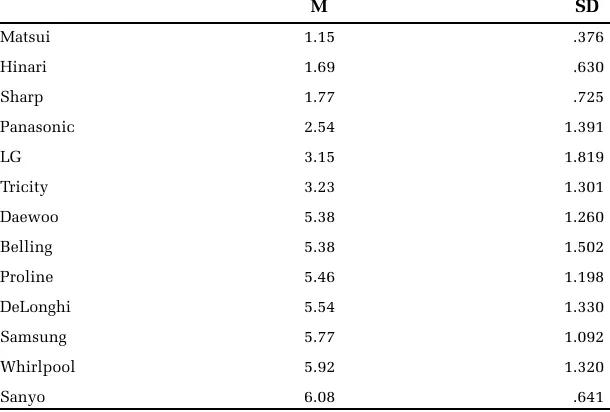
Respondents were asked to indicate the COO of 13 brands of microwave ovens (see Table 1). These brands represent a cen-sus of all brands in this product category available for sale in the United Kingdom. Respondents could either tick one of the nine countries shown in Table 2 or specify a country of their own choice. Moreover, the survey included a “don’t know” alternative for the respondents who could not associ-ate a brand with any country. In this context, methodological research indicates that, on average, 22% of respondents take a guess if an explicit “don’t know” alternative is not included in the response format (Schuman and Presser 1996); therefore, although inclusion of a “don’t know” option does not completely eliminate guessing behavior, it
does nevertheless reduce its incidence.3
We specifically chose microwave ovens as a product cate-gory because they are reasonably sophisticated products and the technical capabilities of a country (and, thus, the country image) are likely to be important in consumer evaluations (Jaffe and Nebenzahl 2006); indeed, “a brand’s [COO] may be highly diagnostic information for choosing an automobile or other technological or crafted product because the [COO] conveys additional information about product quality and other purchase-relevant ascriptions, but [COO] information may be entirely nondiagnostic for inexpensive packaged goods where it is less likely that country superiority is attached to a product category” (Samiee, Shimp, and Sharma
R
ESEARCHM
ETHODOLOGY2005, p. 382; see also Nebenzahl 1998). Another reason is that several COOs are associated with microwave oven brands offered for sale in the United Kingdom. Moreover, the high penetration of microwave ovens in Britain (estimated at 82.7% by Mintel International Group [2006]) made hypothe-ses testing feasible. This also is reflected in the high owner-ship of microwave ovens observed in our sample (88.1%). Finally, the names of some of the brands involved seem to have linguistically incongruent COO associations (e.g., Hinari and Matsui, both of which are British brands) as a result of foreign-branding strategies.
We measured COO classification performance by the number of correct COO allocations consumers made for the 13 brands in the study. Disregarding the effects of guessing, we identi-fied perfect classification performance as the individual con-sumer correctly identifying the COOs of all 13 brands (repre-senting a 100% correct identification rate). On a per-brand basis, we captured classification performance by the propor-tion of respondents assigning the correct COO to the brand involved.
We established COO dominance by an open question that asked consumers to mention spontaneously the country that first came to mind when thinking of microwave ovens. A strong majority of consumers (62%) mentioned Japan, a clear distance from second-placed Germany (25%) and
third-placed United Kingdom (13%).4 Subsequently, we created a
dichotomous variable (1 = Japanese, 0 = other) to indicate whether each brand in Table 1 was associated with the domi-nant COO.
We established brand name incongruence by a procedure similar to that used by Samiee, Shimp, and Sharma (2005) to
Measures
M SD
Matsui 1.15 .376
Hinari 1.69 .630
Sharp 1.77 .725
Panasonic 2.54 1.391
LG 3.15 1.819
Tricity 3.23 1.301
Daewoo 5.38 1.260
Belling 5.38 1.502
Proline 5.46 1.198
DeLonghi 5.54 1.330
Samsung 5.77 1.092
Whirlpool 5.92 1.320
[image:14.612.72.377.56.262.2]Sanyo 6.08 .641
Table 1.
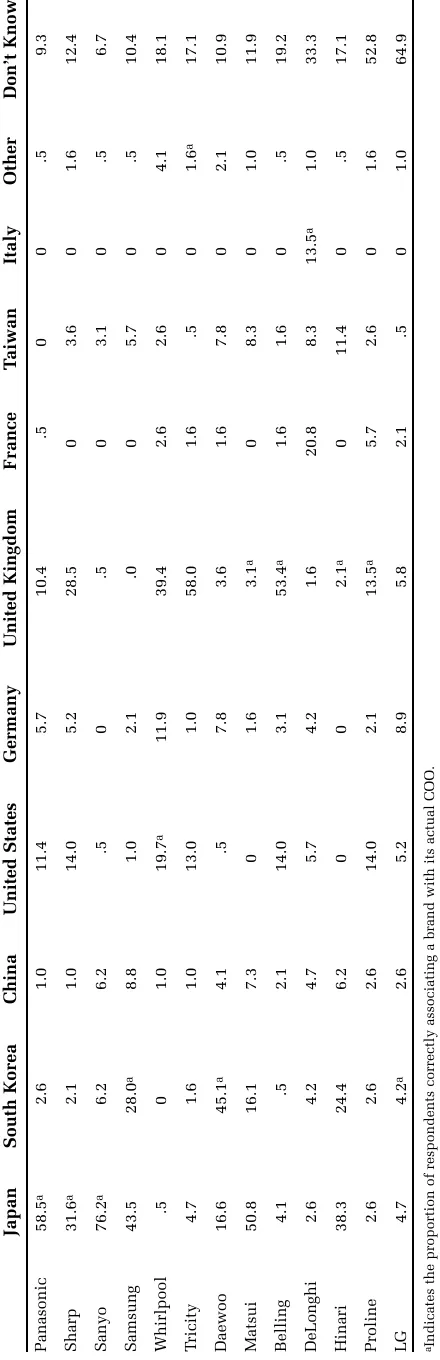
Japan South Korea China United States Germany United Kingdom France T aiwan Italy Other Don’t Know Panasonic 58.5 a 2.6 1.0 11.4 5.7 10.4 .5 0 0 .5 9.3 Sharp 31.6 a 2.1 1.0 14.0 5.2 28.5 0 3.6 0 1.6 12.4 Sanyo 76.2 a 6.2 6.2 .5 0 .5 0 3.1 0 .5 6.7 Samsung 43.5 28.0 a 8.8 1.0 2.1 .0 0 5.7 0 .5 1 0.4 Whirlpool .5 0 1.0 19.7 a 11.9 39.4 2.6 2.6 0 4.1 18.1 T ricity 4.7 1.6 1.0 13.0 1.0 58.0 1.6 .5 0 1.6 a 17.1 Daewoo 16.6 45.1 a 4.1 .5 7.8 3.6 1.6 7.8 0 2.1 10.9 Matsui 50.8 16.1 7.3 0 1.6 3.1 a 0 8.3 0 1.0 11.9 Belling 4.1 .5 2.1 14.0 3.1 53.4 a 1.6 1.6 0 .5 1 9.2 DeLonghi 2.6 4.2 4.7 5.7 4.2 1.6 20.8 8.3 13.5 a 1.0 33.3 Hinari 38.3 24.4 6.2 0 0 2.1 a 0 1 1.4 0 .5 1 7.1 Proline 2.6 2.6 2.6 14.0 2.1 13.5 a 5.7 2.6 0 1.6 52.8 LG 4.7 4.2 a 2.6 5.2 8.9 5.8 2.1 .5 0 1.0 64.9
[image:15.612.237.457.52.732.2]aIndicates the proportion of respondents correctly associating a brand with its actual COO.
determine consumers’ sensitivity to surface-level language characteristics. Specifically, we used a panel of 13 judges, and following the advice of Saito and colleagues (2006), we asked the judges to assess all brands on a seven-point Likert scale on the following statement: “Linguistically speaking, brand X (e.g., Panasonic) as a word (not a brand) sounds [lan-guage of the X’s real COO] (e.g., Japanese).” To assess the reli-ability of mean ratings, we estimated the two-way random-effects interclass correlation coefficient (McGraw and Wong 1996; Uebersax 2006) and found it to be significantly high (ICC = .968). We selected the two-way random-effects model because we viewed judges to be a random sample of all potential and future judges, and all brands were rated by judges. To check for rater bias (Uebersax 2006), we used analysis of variance (ANOVA) to assess the differences in the mean rating levels (i.e., across all rated brands). The results showed no statistically significant difference in average
rat-ing levels of the 13 judges (F(12, 1) = 1.060, p = .398), thus
supporting the absence of rater bias in the analysis.
These findings provided substantial confidence for us to use the resulting average ratings for each brand as a measure of brand name incongruence. As Table 1 shows, Matsui, Hinari, Sharp, Panasonic, LG, and Tricity (in that order) were judged as linguistically incongruent with their COO, having average scores below the neutral point (4) on the scale. In contrast, Sanyo, Whirlpool, Samsung, DeLonghi, Proline, Belling, and Daewoo (in that order) were judged to have linguistically congruent brand names. Paired t-test analysis further con-firmed statistically the differences between congruent and
incongruent brands (at p< .05 or better).
Using the findings in Table 1, we created a dichotomous variable (1 = incongruent name, 0 = otherwise) to indicate whether brand name incongruence characterized each of the brands in the study.
We measured consumer involvement with the product category on a three-item, seven-point bipolar rating scale (1 = “not at all,” 7 = “very much so”) proposed by Mittal (1989). All items loaded on a single factor, and scale reliability came to .79.
We measured consumer ethnocentrism on the ten-item version of the CETSCALE (Shimp and Sharma 1987), which has been used extensively and validated in other studies (e.g., Nete-meyer, Durrasula, and Liechtenstein 1991; Sharma, Shimp, and Shin 1995). All items loaded on a single factor, and the
internal consistency of the scale was excellent (α= .91).
money,” “reliability,” “performance,” and “quality.” A series of factor analysis runs confirmed the unidimensionality of the items; scale reliability was also significantly satisfactory
for all 13 brands (Cronbach’s αranging from .82 to .91).
Finally, we measured country familiarity and COO salience with single-item, seven-point semantic differential scales (1 = “low,” 7 = “high”). Although we readily acknowledge the limitations of using single items (e.g., Churchill 1979; Spector 1992), the study pretest revealed that the use of multi-item batteries to measure familiarity for nine countries plus a multi-item scale for COO salience would have reduced the response rate drastically because of respondent fatigue; therefore, we (reluctantly) decided to “trim” the questionnaire by reducing the measures for country
familiar-ity and COO salience to single items.5In this context, the use
of single-item measures is justified when “the researchers are only interested in a general measure of the construct, and hence ask the respondents to provide an overall feeling, judgment, or impression. In this case, a single item is ade-quate for the purpose” (Poon, Leung, and Lee 2002, p. 276; see also Bergkvist and Rossiter 2007).
None of the respondents were able to identify the correct COOs of all 13 brands, and only four respondents (2.1%) were able to identify the origins of 9 or more brands. More-over, six respondents (3.1%) were unable to assign a specific COO to any of the brands considered (i.e., they responded with a “don’t know” in all cases). On average, the (raw) over-all correct identification rate per respondent came to 27% (SD = 24.6% with 95% confidence interval [CI] ranging from 24% to 30%), the average incorrect identification rate to 51.2% (SD = 22.4% with 95% CI ranging from 48% to 54%), and the “don’t know” rate to 21.8% (SD = 23.5% with 95% CI ranging from 19% to 25%). Corrected for guessing, we reduced the average correct identification rate to 22.2% (SD = 16.1% with 95% CI ranging from 20% to 24%), which shows that though there is considerable variation among respondents in terms of COO classification ability, the
over-all level is rather low.6 The reported CI for the overall COO
identification scores provides strong statistical support for
H1, which states that consumers are more likely to
misclas-sify than to clasmisclas-sify correctly brands to their COOs.
Table 2 shows a more detailed picture of respondents’ COO classification performance broken down by brand and coun-try. On a per-brand basis, the correct identification rates range from a low of 1.6% (for the Swedish Tricity brand) to a high of 76.2% (for the Japanese Sanyo brand). Of further interest are the findings related to the “don’t know” category (last column in Table 2), which shows the proportion of respondents unable to allocate any specific COO to the
vari-R
ESULTSous brands. These range from a low of 6.7% for Sanyo (which was also the brand with the highest correct identification rate) to a high of 64.9% for the South Korean brand LG.
Close inspection of Table 2 reveals that there is no consistent inverse relationship between correct identification rates and “don’t know” rates. For some brands (e.g., Matsui), the “don’t know” rate is relatively low (11.9%), but the correct identification rate is even lower (3.1%), suggesting that most respondents think that they know the correct COO. For other brands (e.g., Proline), the “don’t know” rate is very high (52.8%) and considerably more so than the correct identifi-cation rate (13.5%); this suggests that most respondents believe that they are unable to link this brand to a particular COO. For still other brands (e.g., Whirlpool), the correct identification and “don’t know” rates are similar (19.7% and 18.1%, respectively). Note also that the response patterns in Table 2 are not consistent with a random pattern; if this were the case, a more or less uniform distribution of responses across the various COOs should have been observed for each brand. However, a one-sample chi-square test with expected frequencies based on the uniform distribution returned a
sig-nificant result (p< .01) in all cases.7This indicates that
con-sumers’ ability to identify a brand’s COO is not random but depends on the characteristics of the particular brand in
question (see also testing of H2–H4in the next section).
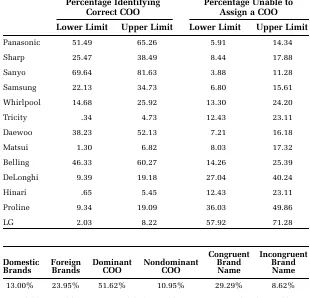
We used the extended Wald method that Agresti and Coull (1998) propose to calculate a 95% CI for the proportion of consumers who correctly identified each brand’s COO as well as the corresponding intervals for those unable to assign any COO to the brand (see Table 3).
We should stress that the intervals shown in Table 3 should not be used to make projections to the U.K. consumer population; to do this, a nationally representative sample would be required, something the current sample is clearly not. Rather, the identification rates should be considered merely indicative of consumers’ COO classification capabilities across different brands. Thus, the highest correct identification rates are associ-ated with Belling, Panasonic, and Sanyo, whereas respondents had the greatest difficulty assigning a COO to Proline and LG. Viewed in conjunction with Table 2, the results in Table 3 are
consistent overall with H1, which postulates that consumers
have a limited COO classification capability.
Focusing on the characteristics of brands that might facilitate
or hinder correct COO classification (see H2–H4), Table 4
shows the mean correct identification rates for domestic ver-sus foreign brands, brands from a dominant verver-sus nondom-inant COO, and brands with linguistically incongruent ver-sus congruent brand names.
Brand Characteristics and
COO Classification
The univariate t-test results support H3(better classification
performance for brands from dominant COOs) and H4(lower
classification performance for brands with incongruent brand names) but indicate the opposite than that predicted
by H2 (i.e., lower classification rates for domestic brands).
However, these results obscure the fact that some domestic brands (e.g., Matsui) have incongruent brand names, that some foreign brands also are associated with a dominant COO (e.g., Sanyo), and that some brands with incongruent brands names also come from a dominant COO (e.g., Sharp).
To take these complications into account, H2–H4 should be
simultaneously tested. Consequently, we employed a facto-rial analysis of covariance design with the correct identifica-tion rate of the brand as the dependent variable and the three brand characteristics (i.e., domestic versus foreign, dominant versus nondominant COO, and congruent versus incongru-ent brand name) as factors, which also allowed for two-way interactions among them; moreover, we included brand mar-ket share as a covariate to control for brand presence/aware-ness effects (see the section titled “Control Variables”). How-ever, the results from the analysis of covariance revealed a
nonsignificant effect for the covariate (p> .10) and
nonsignif-icant effects for all interaction terms (p> .10). Consequently,
Percentage Identifying Percentage Unable to Correct COO Assign a COO Lower Limit Upper Limit Lower Limit Upper Limit
Panasonic 51.49 65.26 5.91 14.34 Sharp 25.47 38.49 8.44 17.88 Sanyo 69.64 81.63 3.88 11.28 Samsung 22.13 34.73 6.80 15.61 Whirlpool 14.68 25.92 13.30 24.20 Tricity .34 4.73 12.43 23.11 Daewoo 38.23 52.13 7.21 16.18
Matsui 1.30 6.82 8.03 17.32
Belling 46.33 60.27 14.26 25.39 DeLonghi 9.39 19.18 27.04 40.24
Hinari .65 5.45 12.43 23.11
Proline 9.34 19.09 36.03 49.86
[image:19.612.231.541.57.355.2]LG 2.03 8.22 57.92 71.28
Table 3.
95% CI Using the Extended
Wald Method
Congruent Incongruent Domestic Foreign Dominant Nondominant Brand Brand
Brands Brands COO COO Name Name
13.00% 23.95% 51.62% 10.95% 29.29% 8.62% ta= –6.897, p< .001 t = 18.356, p< .001 t = 12.546, p< .001
aPaired-samples t-test.
Notes: The results are adjusted for guessing.
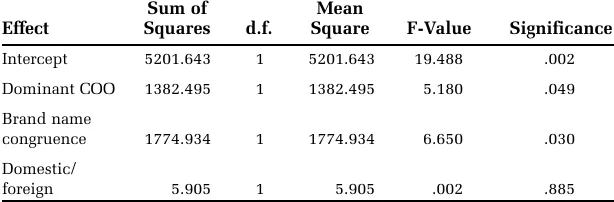
we respecified the model as a simple ANOVA with main effects only; the relevant results appear in Table 5.
The model (R2= .504) explains about half of the variance in
the dependent variable (correct COO identification), indicat-ing that, taken together, the brand characteristics considered substantially affect consumers’ classification performance. However, as the results in Table 5 also show, only COO domi-nance and brand name congruence have significant
inde-pendent effects (p< .05); whether a brand is domestic or
for-eign does not (p > .10). On the basis of these findings, we
conclude that H3and H4are supported but that H2is not.8
We used multiple regression analysis to investigate the potential antecedents of respondents’ overall COO classifica-tion performance and to test the hypotheses related to
coun-try familiarity (H5), COO salience (H6), consumer
involve-ment (H7), and consumer ethnocentrism (H8); we also
included sociodemographic characteristics in the analysis as control variables (see Table 6). The dependent variable in this analysis was the average number of correct COO
identi-fications (adjusted for guessing).9
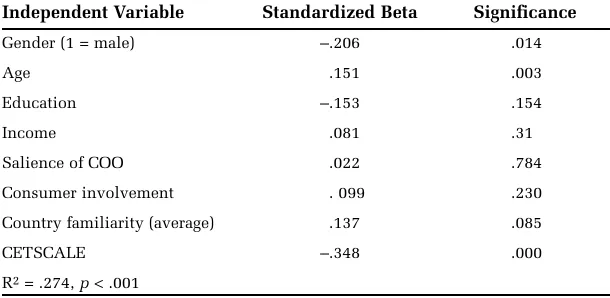
Taken together, the proposed antecedents and sociodemo-graphic variables account for more than a quarter of explained variance in the (attenuated for guessing) correct
COO identification rate (R2= .274). Although consumer
eth-nocentrism and—albeit marginally so—country familiarity returned significant coefficients in the expected direction (i.e., negative and positive, respectively), the other hypothe-sized antecedents (i.e., perceived COO salience and con-sumer involvement level) were nonsignificant predictors. With regard to sociodemographic variables, female and older consumers appear to be associated with higher levels of cor-rect COO identification. On the basis of these findings, we
find support for H5and H8but not for H6and H7.
Our final hypothesis (H9) explores whether brand
evalua-tions vary depending on consumers’ brand COO knowledge. For any particular brand (e.g., Sharp), we could identify three distinct consumer groups: First, there are those con-sumers who know the brand’s correct COO (i.e., that Sharp is
Sum of Mean
Effect Squares d.f. Square F-Value Significance
Intercept 5201.643 1 5201.643 19.488 .002 Dominant COO 1382.495 1 1382.495 5.180 .049 Brand name
congruence 1774.934 1 1774.934 6.650 .030 Domestic/
[image:20.612.71.378.55.156.2]foreign 5.905 1 5.905 .002 .885
Table 5.
ANOVA Results: Brand
Characteristics
Antecedents of COO
Classification Performance
a Japanese brand) and for whom, therefore, brand evalua-tions may be partly shaped by the country image of the
brand’s actual origin (i.e., the country image of Japan may
influence a consumer’s evaluations of Sharp). Second, there are those consumers who associate the brand involved with an incorrect COO (e.g., that Sharp is a U.K. brand) and for
whom the brand’s perceived(but incorrect) origin is relevant
(i.e., the country image of the United Kingdom might influ-ence a consumer’s evaluations of the Sharp brand). This sec-ond group is heterogeneous because consumers tend to assign many different (incorrect) origins (e.g., Sharp is asso-ciated with no fewer than seven different origins; see Table 2). The third group consists of those consumers who cannot assign any COO to the brand involved. For this group, brand evaluations, by definition, cannot be influenced by country image perceptions. (In other words, COO effects are irrele-vant in shaping brand evaluations.)
Bearing this in mind, for any one brand, differences in brand evaluations between the first two groups of consumers and the third group can be interpreted as reflecting an enhance-ment (or otherwise) due to COO influence. In contrast, any difference between the first two groups reveals the (average) impact on brand evaluations of associating the brand with the correct versus incorrect COO.
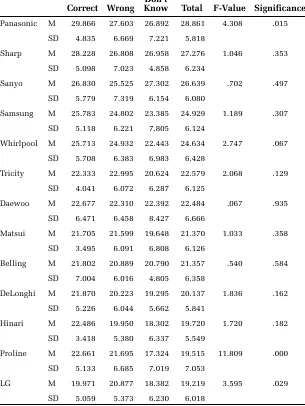
The results shown in Table 7 reveal significant differences for four brands (Panasonic, Whirlpool, Proline, and LG). In all four instances, the average brand evaluations under the “don’t know” category are lower than those under “correct” and “incorrect” COO identification. This indicates that con-sumers who are able to associate a brand with a COO (cor-rectly or incor(cor-rectly) tend to have a more positive view of the brand than consumers who are unable to assign a COO to the brand involved. With regard to the differences between the consumers who know the correct COO of the brand and those who do not, pairwise comparison tests revealed a
sig-Independent Variable Standardized Beta Significance
Gender (1 = male) –.206 .014
Age .151 .003
Education –.153 .154
Income .081 .31
Salience of COO .022 .784
Consumer involvement . 099 .230 Country familiarity (average) .137 .085
CETSCALE –.348 .000
R2= .274, p< .001
[image:21.612.233.538.53.202.2]Notes: Natural logarithm of the number of correct COO identifications, adjusted for guessing.
nificant effect only in the case of Panasonic (with a more favorable evaluation among consumers knowing the brand’s true COO; i.e., Japan).
For the remaining nine brands, we detected no significant differences among the three groups of consumers. Therefore, we conclude that for the majority of brands studied, brand COO identification, on average, does not affect brand evalua-tions; consumers’ brand ratings are similar regardless of whether they can identify the correct COO, whether they assign a wrong COO, or whether they are unable to associate the brand involved with any COO. The data in Table 7 indi-cate that consumers’ brand COO identification can affect brand evaluations, but it will not always.
The purpose of this study is to investigate consumers’ ability to classify different brands within a specific product cate-gory correctly according to their COO. Applying a
classifica-Don’t
Correct Wrong Know Total F-Value Significance
Panasonic M 29.866 27.603 26.892 28.861 4.308 .015 SD 4.835 6.669 7.221 5.818
Sharp M 28.228 26.808 26.958 27.276 1.046 .353 SD 5.098 7.023 4.858 6.234
Sanyo M 26.830 25.525 27.302 26.639 .702 .497 SD 5.779 7.319 6.154 6.080
Samsung M 25.783 24.802 23.385 24.929 1.189 .307 SD 5.118 6.221 7.805 6.124
Whirlpool M 25.713 24.932 22.443 24.634 2.747 .067 SD 5.708 6.383 6.983 6.428
Tricity M 22.333 22.995 20.624 22.579 2.068 .129 SD 4.041 6.072 6.287 6.125
Daewoo M 22.677 22.310 22.392 22.484 .067 .935 SD 6.471 6.458 8.427 6.666
Matsui M 21.705 21.599 19.648 21.370 1.033 .358 SD 3.495 6.091 6.808 6.126
Belling M 21.802 20.889 20.790 21.357 .540 .584 SD 7.004 6.016 4.805 6.358
DeLonghi M 21.870 20.223 19.295 20.137 1.836 .162 SD 5.226 6.044 5.662 5.841
Hinari M 22.486 19.950 18.302 19.720 1.720 .182 SD 3.418 5.380 6.337 5.549
Proline M 22.661 21.695 17.324 19.515 11.809 .000 SD 5.133 6.685 7.019 7.053
[image:22.612.72.377.60.466.2]LG M 19.971 20.877 18.382 19.219 3.595 .029 SD 5.059 5.373 6.230 6.018
Table 7.
Differences in the Brand
Evaluations (ANOVA)
D
ISCUSSION ANDtion perspective based on category learning theory and mak-ing appropriate adjustments for guessmak-ing, we tested several hypotheses, which provided insights into the extent of cor-rect brand COO identification, the antecedent consumer characteristics influencing identification, and the impact on brand evaluations.
Consistent with prior research, we found that consumers’ overall ability to identify a brand’s COO was limited, in sup-port of the view that “consumers are typically uninformed about the CO of products” (Samiee 1994, p. 586). Indeed, with overall correct identification rates of 18% for domestic brands and 29% for foreign brands, our findings reveal an even more disappointing level of brand COO identification (22%) than
Samiee, Shimp, and Sharma’s (2005) study (49%).10The
sur-prisingly low correct identification rates for domestic brands can be traced to the use of incongruent brand names by some U.K. manufacturers. Indeed, if we exclude the Asian-sounding U.K. brand names Hinari and Matsui, that raises the average correct identification rates for home brands to 33.5%, which, though still low, is similar to that of foreign brands (28.8%). Among the foreign brands, Japanese brands are most likely to be identified correctly (55.4%); this is consistent both with the role of Japan as the dominant COO in this product category and with the findings of Samiee, Shimp, and Sharma (2005), who also find a much higher level of brand COO knowledge for Japanese brands (across product categories). Overall, although the correct COO identification rates vary widely across brands, with few exceptions, the majority of consumers either assign the wrong COO to the brands involved or are simply unable to assign any COO.
Regarding the antecedents of brand COO identification, we found that female and older consumers and consumers scor-ing low on consumer ethnocentrism were more likely to identify correctly the COOs of different brands. The findings on ethnocentrism mirror those of Samiee, Shimp, and Sharma (2005), who, albeit in a cross-sectional context (involving a variety of product categories), also found a negative impact of
ethnocentrism tendencies on brand COO knowledge.11 We
also observed the positive link between country familiarity and brand COO identification revealed in previous research (Paswan and Sharma 2004); in contrast, the perceived salience of COO information on consumer purchase decision making failed to register a significant impact.
Taken together, this study’s findings cannot but cast serious doubt on the importance of COO information in consumer decision making. Despite major differences in methodology, this study strongly supports Samiee, Shimp, and Sharma’s (2005, p. 392) conclusion that “consumers either have lim-ited recognition of brand origins or find such information relatively unimportant and thus unworthy of retention in memory.” Our findings are also consistent with those of Liefeld (2004, p. 87), who, albeit focusing on the COO of pro-duction (COOP) rather than on the brand COO, states that “if consumers do not acquire or know the COOP of the choice alternatives, then COOP cannot be part of or play a role in their choice processes.” For a large proportion of consumers in our study, this also appears to be the case with regard to brand origins.
Given that practically all COO studies make the COO cue available to consumers either as part of the experimental stimulus or as part of the survey questionnaire, the issue of brand COO identification is sidestepped in extant COO research: Respondents are told the correct COO of the brands (or products) under investigation, so there is no question as to (1) whether some of them are more informed than others regarding the COOs of the brands under study or (2) whether such differences affect outcome variables (e.g., brand evalua-tions, purchase intentions). Our findings question the extent to which consumers would have voluntarily used the COO cue when undertaking brand evaluations or formulating brand preferences (i.e., whether consumers themselves would invoke COO information when making purchasing decisions). In this context, recent related research on con-sumers’ use of the COOP as an informational cue (Liefeld 2004) shows that only 2.2% of respondents actually indicate that the COOP might have played some role in product choice; the vast majority of respondents indicated that “the COOP is not a relevant attribute for making choices between alternatives” (Liefeld 2004, p. 91; see also Hester and Yuen
1987; Hugstad and Durr 1986).12 Regardless of the view
taken, it is difficult not to conclude that the true importance of COO information could be significantly overestimated in extant COO research.
respondents (whether correct or incorrect) rather than the researchers. The same applies to predictor variables such as country images. For example, if a respondent identifies a Japanese brand as originating in Germany, the image of Ger-many rather than Japan should be used as a predictor of brand attitudes or buying intentions for the brand involved. Although the country image would be incorrect, for the spe-cific consumer involved, this is the relevant image that could affect his or her purchasing decisions (Thakor and Kohli 1996). Therefore, in studying the potential “transfer” of country image associations on brand evaluations and behav-ioral outcomes, researchers should recognize that not all respondents may associate the brand with the correct COO; a researcher would be ill-advised to tell respondents the cor-rect COOs of the brands under investigation because this would knowingly introduce a degree of artificiality into the research design (and inevitably compromise the validity of the empirical results).
From a managerial viewpoint, our findings indicate that emphasizing the COO of a brand as part of international mar-keting strategy could be less effective than expected, because consumers’ knowledge of brand origins is limited. Recall that in this context, if at all, we found that brand evaluations differed only between consumers who could associate a brand with a COO (whether correct or incorrect) and those who could not; moreover, for most brands in the product category under investigation, not even this sort of difference could be established. Therefore, a strategy of attempting to (favorably) influence brand evaluations by emphasizing the COO of the brand seems to be of rather limited effectiveness (at least in the product category investigated). International marketers should try to differentiate their brands on dimen-sions other than COO, because the latter’s role in consumer decision making could be much less significant than origi-nally believed.
One of this study’s main strengths—controlling for the prod-uct category—also could be perceived as a potential limita-tion, in that the results cannot be generalized automatically to other purchases. For example, whether a similar pattern of brand COO knowledge would be observed if, instead of microwave ovens, we had studied brands of DVD players, laptop computers, or sports clothing is open to question and can be answered only by replicating the research in other product categories.
A second limitation of the study involves the use of single-item measures for country familiarity and the salience of COO information in consumer purchase decision making. Although such single-item measures have been used in pre-vious COO research (e.g., Laroche et al. 2005) and though
L
IMITATIONS ANDF
URTHERrecent methodological research shows that single-item meas-ures are not always inherently problematic (e.g., Bergkvist and Rossiter 2007; Drolet and Morisson 2001), it would be desirable nevertheless to employ some well-developed, multi-item scales when studying the effects of these variables (at the expense of a more limited study scope so as not to make the research instrument unrealistically long).
With respect to further research, in addition to replicating the study in other product categories, we identify three interrelated areas. First, a qualitative investigation into whether and how consumers use COO information when comparing competing brands and making brand choices would provide much-needed information as to the reasons underlying the use or nonuse of COO cues. Unprompted questioning of respondents immediately following an actual purchase (see Liefeld 2004) or asking consumers to state the brand origins of products they actually own would be possi-ble ways to uncover the actual role of a brand’s COO in con-sumer decision making.
Second, assuming that consumers are found to seek brand COO information actively when making brand choices, the specific sources of information used by consumers for this purpose are in need of investigation. For example, are con-sumers who rely on memory or simply guess a brand’s COO (e.g., by relying on the brand name) different in their brand evaluations than consumers who use external sources (e.g., the Internet or point-of-purchase material) to identify the ori-gin of the brand?
1. Given n brands and m countries, of which one represents the correct COO for each brand and (m – 1) are incorrect COOs, a respondent has a 1/m chance of getting the brand’s COO right (assuming equal preferences for each alternative). Unless an adjustment is made for guessing, the correct identification rates over all n brands will reflect not only the respondents’ actual knowledge of the brands’ COO but also the effects of guessing.
2. Data on market shares for the brands in the study were purchased from Mintel International Group, a major sup-plier of market research and consumer intelligence reports (www.mintel.com).
3. Needless to say, an adjustment for guessing still must be applied but only to the respondents who do not fall under the “don’t know” category.
4. Japan’s observed position as a dominant COO in this product category is consistent with other evidence rank-ing Japan as the top country for consumer electronics (see
Time1997, cited in Jaffe and Nebenzahl 2006, p. 130).
5. The alternative would have been to drop them from the
study altogether, in which case the testing of H5and H6
would have suffered.
6. The correction for guessing involved the application of Abbott’s formula, defined as follows (see Nunnally and Bernstein 1994, p. 341): Rc = R – [W/(K – 1)], where Rc = corrected score, R = observed number of correct responses, W = number of wrong responses, and K = number of alternatives.
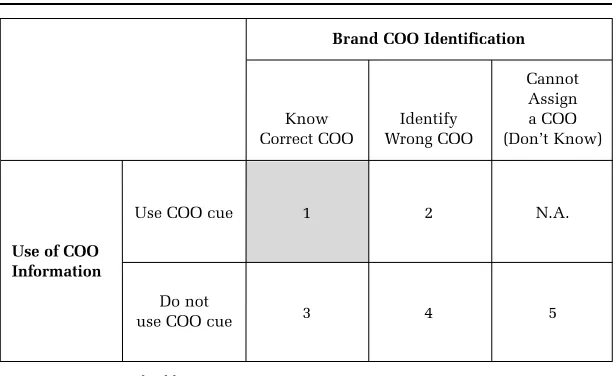
Brand COO Identification
Cannot Assign Know Identify a COO Correct COO Wrong COO (Don’t Know)
Use COO cue 1 2 N.A.
3 4 5
Notes: N.A. = not applicable.
Do not use COO cue
[image:27.612.234.542.49.237.2]Use of COO Information
Figure 1.
Brand COO Identification and
Use of COO Cues
7. In a uniform distribution, all values are associated with the same frequencies (i.e., they are equally likely to occur).
8. We also repeated the analysis using the scale scores (see Table 1) as a continuous measure of brand name incon-gruence; the results were practically identical to those in
Table 5, in support of H3and H4but not H2.
9. We undertook a logarithmic transformation to bring the variable’s distribution closer to a normal distribution.
10. These are raw (i.e., unadjusted) identification rates to make them comparable to Samiee, Shimp, and Sharma’s (2005) study; the adjusted (i.e., attenuated for guessing) rates for domestic versus foreign brands appear in Table 4.
11. Although Samiee, Shimp, and Sharma (2005) also exam-ine the impact of age and gender on brand COO knowl-edge, their findings are mixed and not directly compara-ble to our results because they conducted separate analyses for domestic and foreign brands.
12. Note, however, that consumers might be unwilling to admit that they use the COO cue in their decision mak-ing. As Heslop and Papadopoulos (1993, p. 68) observe, “there is enough evidence to confirm that origin does matter—but, for reasons we have yet to understand fully, people do not like to admit it does.” This also could be (partly) a reason for the nonsignificance of COO salience
as an antecedent of brand COO identification (see H6).
Agarwal, S. and S. Sikri (1996), “Country Image: Consumer Evalua-tion of Product Category Extensions,” International Marketing Review, 13 (4), 23–39.
Agresti, A. and B.A. Coull (1998), “Approximate Is Better Than ‘Exact’ for Interval Estimation of Binomial Proportions,” The American Statistician, 52, 119–26.
Ahmed, S.A. and A. d’Astous (2003), “Product-Country Images in the Context of NAFTA: A Canada–Mexico Study,” Journal of Global Marketing, 17 (1), 23–43.
Al-Sulaiti, K.I. and M.J. Baker (1998), “Country of Origin Effects: A Literature Review,” Marketing Intelligence and Planning, 16 (3), 150–99.
Ashby, G.F. and S.W. Ell (2002), “Single versus Multiple Systems of Learning and Memory,” in Stevens Handbook of Experimental Psychology: Methodology in Experimental Psychology, Vol. 4, J. Wixted and H. Pashler, eds. New York: John Wiley & Sons, 655–92.
Balabanis, G. and A. Diamantopoulos (2004), “Domestic Country Bias, Country-of-Origin Effects, and Consumer Ethnocentrism: A
Multidimensional Unfolding Approach,” Journal of the Acad-emy of Marketing Science, 32 (1), 80–95.
Barsalou, L.W. (1985), “Ideals, Central Tendency, and Frequency of Instantiation as Determinants of Graded Structure in Categories,”
Journal of Experimental Psychology: Learning, Memory, and Cog-nition, 11 (4), 629–54.
Batra, R., V. Ramaswamy, D.L. Alden, J.-B.E.M. Steenkamp, and S. Ramachander (2000), “Effects of Brand Local and Nonlocal Ori-gin on Consumer Attitudes in Developing Countries,” Journal of Consumer Psychology, 9 (2), 83–95.
Baughn, C.C. and A. Yaprak (1993), “Mapping Country of Origin Research: Recent Developments and Emerging Avenues,” in
Product-Country Images: Impact and Role in International Mar-keting, N.G. Papadopoulos and L.A. Heslop, eds. New York: International Business Press, 89–115.
Beatty, S.B. and S.M. Smith (1987), “Involvement, Search and Sat-isfaction: A Path Analytic Model,” in Proceedings of the AMA Winter Educators’ Conference, W. Darden and Kent Monroe, eds. Chicago: American Marketing Association, 44–48.
Bergkvist, L. and J.R. Rossiter (2007), “The Predictive Validity of Multiple-Item Versus Single-Item Measures of the Same Con-structs,” Journal of Marketing Research, 44 (May), 175–84. Bilkey, W.J. and E. Nes (1982), “Country of Origin Effects on
Prod-uct Evaluations,” Journal of International Business Studies, 8 (1), 89–99.
Brown, S. (1987), “Drop and Collect Surveys: A Neglected Tech-nique?” Marketing Intelligence and Planning, 5 (1), 19–23. Celsi, R.L. and J.C. Olson (1988), “The Role of Involvement in
Attention and Comprehension Processes,” Journal of Consumer Research, 15 (2), 210–25.
Churchill, G.A., Jr. (1979), “A Paradigm for Developing Better Mea-sures of Marketing Constructs,” Journal of Marketing Research, 16 (February), 64–74.
Cohen, J.B. and K. Basu (1987), “Alternative Models of Categoriza-tion: Toward a Contingent Processing Framework,” Journal of Consumer Research, 13 (March), 455–72.
Corneille, O., R.L. Goldstone, S. Queller, and T. Potter (2006), “Asymmetries in Categorization, Perceptual Discrimination, and Visual Search for Reference and Nonreference Exemplars,” Mem-ory & Cognition, 34 (3), 556–67.
Drolet, D.A. and D.G. Morrison (2001), “Do We Really Need Multiple-Item Measures in Service Research?” Journal of Service Research, 3 (3), 196–205.
Dubois, B. and C. Paternault (1997), “Does Luxury Have a Home Country? An Investigation of Country Images in Europe,” Mar-keting and Research Today, (May), 79–85.
Feldman, J.M. and J.G. Lynch Jr. (1988), “Self-Generated Validity and Other Effects of Measurement on Belief, Attitude, Intention and Behavior,” Journal of Applied Psychology, 73 (3), 421–35. Good, L.K. and P. Huddleston (1995), “Ethnocentrism of Polish and
Russian Consumers: Are Feelings and Intentions Related?” Inter-national Marketing Review, 12 (5), 35–49.
T
HEA
UTHORSGeorge Balabanisis Professor of
Marketing, Case Business School, City University, United Kingdom (e-mail: [email protected]).
Adamantios Diamantopoulosis
Professor and Chair of International Marketing, University of Vienna, Austria
(e-mail: adamantios. [email protected]).
A
CKNOWLEDGMENTSGregan-Paxton, J. and D. Roeder John (1997), “Consumer Learning by Analogy: A Model of Internal Knowledge Transfer,” Journal of Consumer Research, 24 (December), 266–84.
Han, C.M. and V. Terpstra (1988),. “Country-of-Origin Effects for Uni-National and Bi-National Products,” Journal of International Business Studies, 20 (Summer), 235–54.
Haubl, G. (1996), “A Cross-National Investigation of the Effects of Country of Origin and Brand Name on the Evaluation of a New Car,” International Marketing Review, 13 (5), 76–98.
Heslop, L.A. and N. Papadopoulos (1993), “But Who Knows Where or When: Reflections on the Images of Countries and Their Prod-ucts,” in Product and Country. Images, N. Papadopoulos and L.A. Heslop, eds. Binghamton, NY: International Business Press, 39–76. Hester, S.B. and M. Yuen (1987), “The Influence of Country of Ori-gin on Consumer Attitude and Buying Behavior in the United States and Canada,” in Advances in Consumer Research, Vol. 14, M. Wallendorf and P. Anderson, eds. Provo, UT: Association for Consumer Research, 538–42.
Hoch, S.J. and J. Deighton (1989), “Managing What Consumers Learn from Experience,” Journal of Marketing, 53 (April), 1–20. Hong, S.-T. and R.S. Wyer Jr. (1990), “Determinants of Product
Evaluation: Effects of the Time Interval Between Knowledge of a Product’s Country of Origin and Information About Its Specific Attributes,” Journal of Consumer Research, 17 (3), 277–88. Horne, P.J. and F.C. Lowe (1996), “On the Origins of Naming and
Other Symbolic Behavior,” Journal of the Experimental Analysis of Behavior, 65 (1), 185–241.
Hugstad, P.S. and M. Durr (1986), “A Study of Country of Manufac-turer Impact on Consumer Perceptions,” in Developments in Marketing Science, N. Malhotra and J. Hawes, eds. Coral Gables, FL: Academy of Marketing Science, 115–19.
Hutchinson, J.W. and J.W. Alba (1991), “Ignoring Irrelevant Infor-mation: Situational Determinants of Consumer Learning,” Jour-nal of Consumer Research, 18 (December), 325–46.
Jaffe, E.D. and I.D. Nebenzahl (2006), National Image and Competi-tive Advantage: The Theory and Practice of Place Branding. Copenhagen: Copenhagen Business School Press.
Jaswal, V.K. and E.M. Markman (2002), “Children’s Acceptance and Use of Unexpected Category Labels to Draw Non-Obvious Inferences,” in Proceedings of the Twenty-Fourth Annual Confer-ence of the Cognitive SciConfer-ence Society, W. Gray and C. Schunn, eds. Mahwah, NJ: Lawrence Erlbaum and Associates, 500–505. Javalgi, R.G., B.D. Cutler, and W.A. Winans (2001), “At Your
Ser-vice! Does Country of Origin Research Apply to Services?” Jour-nal of Services Marketing, 15 (7), 565–83.
Johansson, J.K., S.P. Douglas, and I. Nonaka (1985), “Assessing the Impact of Country of Origin on Product Evaluations: A New Methodological Perspective,” Journal of Marketing Research, 22 (November), 388–96.