The accuracy of mid-Pliocene δ18O-based ice volume and sea level reconstructions
Maureen E. Raymo, Reinhard Kozdon, David Evans, Lorraine Lisiecki, Heather L. Ford
PII: S0012-8252(17)30593-7
DOI: doi:10.1016/j.earscirev.2017.11.022
Reference: EARTH 2535
To appear in: Earth-Science Reviews
Received date: 22 November 2017
Accepted date: 23 November 2017
Please cite this article as: Maureen E. Raymo, Reinhard Kozdon, David Evans, Lorraine Lisiecki, Heather L. Ford , The accuracy of mid-Pliocene δ18O-based ice volume and sea level reconstructions. The address for the corresponding author was captured as affiliation for all authors. Please check if appropriate. Earth(2017), doi:10.1016/ j.earscirev.2017.11.022
ACCEPTED MANUSCRIPT
The accuracy of mid-Pliocene
18O-based ice volume and sea level
reconstructions
Maureen E. Raymo1*, Reinhard Kozdon1, David Evans2, Lorraine Lisiecki3, and Heather L.
Ford4
1. Lamont-Doherty Earth Observatory of Columbia University, Palisades, NY 10964
2. School of Earth and Environmental Sciences, University of St Andrews, St Andrews, KY16 9AL, UK
3. Department of Earth Science, University of California, Santa Barbara, CA 93106
4. Department of Earth Sciences, University of Cambridge, Cambridge, CB2 3EQ, United Kingdom
*corresponding author: [email protected]
Abstract
Understanding the sensitivity of the polar ice caps to a modest global warming (2-3°C above preindustrial) is of paramount importance if we are to accurately predict future sea level change, knowledge that will inform both social and economic policy in the coming years. However, decades of study of the Pliocene (2.6-5.3 Ma), an epoch in recent Earth history characterized by atmospheric CO2 levels similar to today, have so far failed to
provide definitive sea level and ice volume estimates for that time. Here we review the sources of uncertainty in the paired Mg/Ca-18O methodology used to estimate past sea
level, ice volume, and ocean temperature, as well as discuss common assumptions that may bias our interpretation of ocean geochemical records including the LR04 benthic-18O
stack, a global compilation of 57 oxygen isotope records that forms the standard template of climate change history for the last 5.3 million years.
Keywords: sea level, ice volume, paleoceanography, paleoclimate, geochemistry
1. Introduction
The degree of polar ice sheet decay that occurs during periods slightly warmer than today has been the subject of much scrutiny within the paleoclimate and sea level research community in recent years [Kopp et al., 2009; Naish et al., 2009; Blanchon et al., 2009;
Raymo & Mitrovica, 2012; Cook et al., 2013; Rohling et al., 2014; Dutton et al., 2015; and Kemp et al. 2015, among others]. In particular, many researchers have focused their
ACCEPTED MANUSCRIPT
[e.g., Dowsett, 2007; Dowsett et al., 2010; Haywood et al., 2013] as well as estimated atmospheric CO2 concentrations of ~350-450 ppm [Raymo et al., 1996; Pagani et al., 2010;
Seki et al., 2010; Bartoli et al., 2011; Badger et al., 2013; Martínez-Botí et al., 2015]. For
obvious reasons, the MPWP is of great interest to the climate modeling community concerned with predicting future climate changes, in particular the long-term response of polar ice sheets to rising greenhouse gases in the atmosphere (present atmospheric CO2
levels hover just above 400 ppm and are climbing steadily; http://scrippsco2.ucsd.edu/). If we can have confidence in the interpretation of our paleo-data, then we can better
evaluate the performance and predictions of climate and ice sheet models forced by a similar increase in CO2.
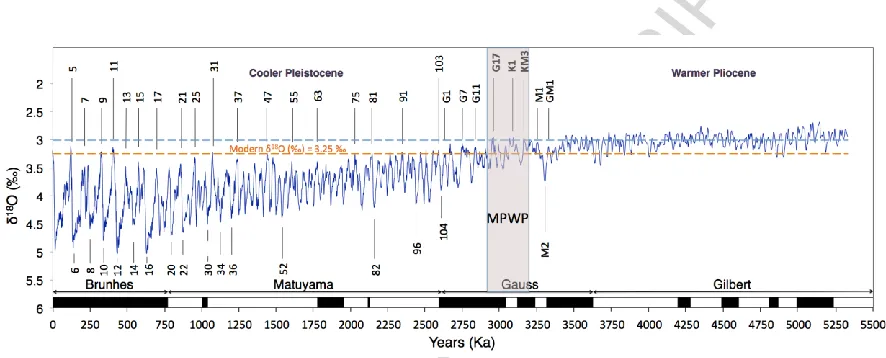
Figure 1. The LR04 Stack with magnetic chrons and subchrons indicated by black bars along x-axis; MPWP=mid-Pliocene
warm period; blue dashed line represents mean 18O value between 3.32 and 5.32 Myr; orange dashed line is mean 18O value of last 5 kyr of Holocene; the data includes a +0.64‰ Cibicidoides vital effect correction and selected marine isotope stages (MIS) are indicated [Lisiecki & Raymo, 2005].
For example, understanding how the East Antarctic Ice Sheet (EAIS) responded to the few degree warming in global mean temperatures that occurred during the MPWP is highly pertinent. Did the ice grounded in large submarine basins such as Wilkes Land destabilize and break up, a possibility suggested for the coming centuries [e.g., Mengel & Leverman, 2014]? Or did enhanced snow and ice accumulation over the EAIS offset ice losses in West Antarctica, the Antarctic Peninsula, and possibly the coastal regions of the EAIS? These two scenarios carry with them different implications for the magnitude of possible sea level change by the end of this century and beyond. These important questions are further complicated by controversy over whether the EAIS has been gaining or losing mass over the last few decades [e.g., Shepherd et al., 2012; Hanna et al., 2013; Zwally et al., 2015].
[image:3.612.72.515.224.403.2]ACCEPTED MANUSCRIPT
principles of geomorphology and morphostratigraphic succession combined with relative and absolute geochronological dating of paleo-shoreline features and intertidal to subtidal facies [Dowsett & Cronin, 1990; Krantz, 1991; Wardlow & Quinn, 1991; James et al., 2006;
Naish & Wilson, 2009; Miller et al., 2005; 2012; Rovere et al., 2014; Dutton et al., 2015; Kemp et al., 2015; Rovere et al., 2016].
The early field studies of the MPWP were sometimes corrected for local tectonic effects (typically by reference to well-dated late Pleistocene shorelines) and sometimes for subsidence caused by sedimentary loading [Krantz, 1991]. However, we now recognize that Pliocene paleo-sea level horizons also need to be evaluated within the context of on-going glacial isostatic adjustments (GIA; Raymo et al. [2011]), as well as mantle-driven dynamic topography (DT) effects which become significant on time scales longer than a million years [Moucha et al., 2009; Rowley et al., 2013; Rovere et al., 2014, 2015;
Austermann et al., 2015]. Gravitational changes in the geoid also likely occur over millions
of years and need to be quantified, although these corrections are probably significantly less than those due to GIA and DT across low to mid-latitudes. Given that the
post-depositional changes to shoreline elevations (or shallow subtidal facies) due to these global effects have been shown to be on the order of tens of meters, and are very poorly
constrained (see above references), published estimates of maximum eustatic sea level for the Pliocene based solely on field observations therefore carry the same degree of
uncertainty. Certainly these studies cannot distinguish whether sea level was 10 m or 25 m higher in the Pliocene (in other words, whether or not there was a significant contribution to sea level rise from the melting of the EAIS).
The second widely applied approach to estimating MPWP sea level is by using the ocean geochemical record, in particular oxygen isotope ratios recorded by calcium carbonate-secreting organisms recovered from deep-sea sediment cores. Temporal variation in the oxygen isotope composition of seawater recorded by foraminifera shells has served as the primary climate proxy used by marine geologists and
paleoceanographers for over half a century. Early pioneering studies by Epstein et al. [1953], Emiliani [1955], Shackleton [1967] and others demonstrated how the isotopic ratio of O-18 to O-16 in seawater (18O
sw) and in calcite precipitated from seawater (18Ocarb)
reflects changing global ice volume as well as ocean temperature and salinity changes through time (and many excellent reviews of the use and calibration of oxygen isotopes in marine settings have been written in the years since, including Mix & Ruddiman, 1984;
Bemis et al., 1998; Adkins et al., 2002; Waelbroeck et al., 2002; Schmidt & Mulitza, 2002;
and Marchitto et al., 2014).
Shackleton [1967] recognized that if one measured 18O
carb in bottom-dwelling
benthic foraminifera, rather than in planktic surface dwellers, the 18O
carb variability
ACCEPTED MANUSCRIPT
Mg/Ca ratio of foraminiferal calcite, which is primarily controlled by seawater temperature at the time of precipitation [Nürnberg et al., 1996; Rosenthal et al., 1997; Lear et al., 2000, 2002; Anand et al., 2003; Elderfield et al., 2006]. In this paper, we review recent efforts to constrain the maximum sea level rise and polar ice volume during the warm extremes of the MPWP using this paired 18O-Mg/Ca technique. While we focus on the LR04 stack
[Lisiecki & Raymo, 2005] and query some of the standard interpretations of the stack’s features, particularly with respect to inferred sea level, our results are relevant to any Pliocene 18O record.
Three recently published papers provide additional, and valuable supplements, to this review, and we discuss them briefly below—Winnick & Caves [2015] challenge common assumptions about polar ice sheet 18O values in the Pliocene and explore the
influence of these assumptions on geochemical estimates of MPWP sea level. Marchitto et
al. [2014] compile an extensive calibration data set for benthic foraminiferal 18O and
provide a more accurate equation relating bottom water temperature to benthic 18O.
And Lawrence & Woodard [2017] explore uncertainties in various methods used to estimate sea surface temperature, some of which are also used to examine bottom water temperatures. Here, we will focus primarily on carbonate diagenesis as well as the chemical evolution of seawater and explore how uncertainties in these processes might also influence sea level/ice volume interpretations. Lastly, we should add that the combination sill depth-18O sea level reconstruction method of Rohling et al. [2014]
combines both the methodologies described above and hence would carry all the uncertainties of both methods.
2. The benthic 18O record and Pliocene sea level
Due to the rapid mixing time of the ocean and the temporal resolution of deep-sea sediments (~1000 years) relative to the time it takes to grow and melt polar ice sheets (thousands to tens of thousands of years), changes in 18O
sw are nearly synchronous
everywhere in the deep ocean. Thus, despite potential differences of several kyr [Skinner
& Shackleton, 2005; Waelbroeck et al., 2011; Lisiecki & Raymo, 2009; Stern & Lisiecki,
2014], 18O remains the premier correlation tool for intervals beyond the limits of
radiocarbon dating, used to match sediment core records separated by thousands of kilometers and across different oceans and hemispheres [e.g., Pisias et al., 1984; Imbrie et
al., 1984; Prell et al., 1986; Imbrie et al., 1992; Lisiecki & Raymo, 2005; Channell et al.,
2009]. However, individual downcore 18O
carb records can also reflect unique variability
due to local influences of bioturbation, sedimentation rate, and/or regional temperature and salinity changes. To minimize these local hydrographic effects and isolate the global signal recorded by 18O
carb, Imbrie et al. [1984] pioneered the strategy of creating
graphically correlated and averaged 18O
carb “stacks”, composed of numerous individual
records and considered to be the idealized representation of a mean global 18O
carb signal
ACCEPTED MANUSCRIPT
From 1984 to 2004, stacks improved in length and in the quantity and quality of the
18O
carb data, culminating in the Lisiecki & Raymo [2005] LR04 stack and timescale (Figure
1). This stack includes 57 benthic records, many derived from cores recovered by the Ocean Drilling Program. Development of this stack also used newly developed graphical correlation software to process the data [Lisiecki & Lisiecki, 2002], and included only data from the benthic foraminiferal genera Cibicidoides and Uvigerina. Because this stack was constructed by graphic correlation, its stratigraphic features were essentially independent of any timescale and the LR04 stack can be easily adapted for use with other timescales.
More than a decade later, the now canonical view of how Earth’s climate has changed over the last five million years can be read in the ups and downs and wiggles of the LR04 stack. The traditional interpretation of the sea level and ice volume history of the Plio-Pleistocene begins with the two million year interval between ~5.32 and 3.32 Myr. This interval, spanning the Gilbert Chron, is characterized by dozens of low-amplitude 18O
cycles with a mean value of 3.00‰ (Figure 1, dashed blue line), which is ~0.25‰ more negative than the Holocene value (mean of last 5 kyr, dashed red line). These low amplitude cycles exhibit “interglacial” or warm values ~0.35‰ more negative than the Holocene on average with minimum 18O
carb values as low as 2.65‰, or 0.6‰ more
negative than at present. The maximum (colder, more ice) 18O
carb values are rarely more
positive than the Holocene value and, taken at face value, imply that high-latitude climate was almost always warmer and/or had less continental ice than the late Holocene.
Between 3.2 to 2.9 Myr—the MPWP—the negative 18O
carb excursions represented by
marine isotope stages (MIS) G17, K1, and KM3 reflect the last warm intervals of the pre-glacial Pliocene, after which a long-term trend of increasing mean 18O
carb values reflects
the cooling temperatures and expanding polar cryosphere that culminated in widespread glaciation of the Northern Hemisphere by 2.5 Ma [Shackleton & Hall, 1984; Raymo et al., 1989].
Based on empirical studies and observations from the last glacial cycle it has been estimated that a 10 m eustatic change in sea level due to a change in ice volume would alter the mean ocean 18O by 0.08-0.11‰ [Fairbanks and Matthews, 1978; Fairbanks,
1989; Schrag et al., 1996, Adkins et al., 2002; Elderfield et al., 2012; Rohling et al., 2014]. Here we use the commonly cited value of 0.11‰/10 m SL change. It was also empirically determined that a 1°C decrease in water temperature would increase the 18O
carb of
precipitated calcite by +0.2 to 0.25‰ [Epstein et al., 1951, 1953; Urey et al., 1951; O’Neal
et al., 1969; Kim & O’Neal, 1997; Bemis et al., 1998; Marchitto et al., 2014]. Note that
these conversions were derived using observations from the laboratory and the recent past, but have been applied to the interpretation of 18O
carb records throughout the
Plio-Pleistocene (and indeed over the entire Cenozoic). Three notable exceptions are the studies of Bailey et al. [2010], Winnick & Caves [2015], and Gasson et al. [2016] who questioned whether the mean 18O of polar ice remains constant over millions of years.
Since only about 7 m of sea level equivalent (SLE) of ice is sequestered on
Greenland at present [Shepherd & Wingham, 2007], less than 0.1‰ of the more negative
18O
ACCEPTED MANUSCRIPT
the Northern Hemisphere (given the current volume and isotopic composition of ice on Greenland). Therefore, the main contributors to the more depleted 18O
carb values are
typically assumed to be some combination of deep-ocean warming and/or an ice volume decrease in Antarctica. However, despite decades of study, the maximum sea level rise (minimum ice volume) during this interval still remains highly uncertain [e.g., Raymo, 1994;
Mudelsee & Raymo, 2005; Sosdian & Rosenthal, 2009; Raymo et al., 2011; Miller et al.,
2012; Woodard et al., 2014].
Consider—if the entire amplitude of the negative 18O excursion in the MPWP
relative to the mean Holocene value of the LR04 stack, 3.25 – 2.92 = 0.33‰, was attributed to an ice volume decrease relative to present, then the traditional rule of thumb given above would imply that an equivalent of ~23 m SLE of ice was lost from Antarctica during the warm extremes of the MPWP (0.33‰/0.11‰ x 10m = 30 m – 7m = 23 m after
removing 7 m for Greenland Ice Sheet (GIS) which we assume melts completely). This would require mass loss of >30% of the present-day East Antarctic Ice Sheet, which is estimated to have a total volume of ~56 m SLE (Shepherd & Wingham [2007]) after
accounting for ~5 m SLE came from the ice currently frozen in the West Antarctic Ice Sheet. On the other hand, if the minimum 18O values in the benthic isotope records are
attributed solely to warming of the deep ocean (and thus, presumably, also the polar surface regions where bottom water forms), then it would imply a bottom water warming of only >1.6°C ((0.33‰/0.2‰) x 1°C).
The problem with these scenarios is that it is hard to imagine, in the first case, how one could lose such a significant fraction of the Antarctic ice sheet without any concurrent warming of bottom-waters, especially as much of these waters originate in the surface regions surrounding Antarctica. Equally perplexing, in the second case, it seems unlikely that a 1.6°C warming of surface and bottom waters in polar regions could occur with no concomitant loss of ice. State-of-the-art climate model results reinforce these intuitions (for instance, Pollard et al., 2015), leaving most investigators to assume the truth lies in some combination of these two effects [e.g., Kennett & Hodell, 1993; Miller et al., 2012]. But herein lies a conundrum. If the climate of the Pliocene was significantly warmer (as the data suggests, e.g. Dowsett et al. [2010]), how does one “fit” both a polar latitude warming as well as a decrease in the size of the cryosphere into the meager ~0.3‰ 18O
carb decrease
that characterizes the warm extremes of the MPWP? And is the widely cited view that ~2/3rds of the 18O
carb signal is due to ice (~22 m SLE including loss of GIS) and 1/3 to BWT
change (~1°C), as observed for the last glacial cycle, a robust assumption (e.g., Miller et al. [2012] and Winnick & Caves [2015])?
3. Geochemical proxy derivation of Pliocene sea level
With only the 18O
carb value of foraminifera, neither the 18Osw nor the seawater
temperature can be reliably determined without independent quantification of one or the other. While Miller et al. [2012] assume the ratio of ice effect to temperature effect in the MPWP 18O
ACCEPTED MANUSCRIPT
years ago (67%/33%, respectively, Schrag et al. [1996]), other investigators have used Mg/Ca ratios to independently isolate the temperature component of the 18O signal [e.g.,
Sosdian & Rosenthal, 2009; Elderfield et al., 2012; Woodard et al., 2014; or Dwyer & Chandler, 2009 working with benthic ostracods]. To do this, researchers pair benthic
18O
carb with bottom water temperatures (BWT) estimated from Mg/Ca ratios measured in
foraminiferal (or ostracod) shells from the same sample depth. This approach allows for a continuous, independent assessment of 18O
sw and thus inferred continental ice volume
and sea level, all else being equal to modern. However, using paired benthic 18O
carb and Mg/Ca ratios to reconstruct past
changes in sea level is complicated by uncertainties in fossil species- and proxy-specific calibrations [e.g., Lear et al., 2004]. Factors other than temperature might alter the Mg/Ca ratios of foraminifera. These include dissolution [Regenberg et al., 2014; Rosenthal et al., 2000], diagenetic recrystallization/overgrowths [Brown & Elderfield, 1996; Sexton et al., 2006; Kozdon et al., 2013; Regenberg et al., 2007], or changes in salinity [Dissard et al., 2010; Ferguson et al., 2008] and/or carbonate ion saturation [Elderfield et al., 2006;
Rosenthal et al., 2006]. Similar uncertainties may exist for the preservation of the Mg/Ca
signal in ostracods [Elmore et al., 2012; Farmer et al., 2012]. Furthermore, the evolution of seawater Mg/Ca is not known in detail but evidence from fluid inclusions, carbonate veins found in mid-ocean ridges, dolomite abundance with time, and echinoderm spines suggest that Mg/Ca ratios may have been increasing from the middle Cenozoic to the present [Wilkenson & Algeo, 1989; Dickson , 2001; Horita et al., 2002; Lowenstein et al., 2001;
Coggon et al., 2010]. While several studies have focused on understanding whether
changing seawater Mg/Ca exerts a linear or nonlinear control on shell chemistry [Delaney
et al., 1985]; Evans & Müller, 2012; Evans et al., 2016], important when accounting for
these secular changes in seawater Mg/Ca, others chose to leave foraminiferal Mg/Ca ratios uncorrected [Lear et al., 2004, 2015].Finally, 18O
carb and Mg/Ca measurements would
ideally also be derived from the same shell, but analytical approaches facilitating 18O and
Mg/Ca measurements within the same microfossil have not been available until recently and still have relatively large errors [Kozdon et al., 2011; Kozdon et al., 2013]. And even as the errors are being brought down, the domains analyzed are so small that they might not be representative of the entire shell. Thus, in addition to the aforementioned
uncertainties, an additional source of error may be introduced by analyzing 18O and
Mg/Ca in different shells or pooled populations of homogenized shells that are assumed to be age-equivalent.
Using benthic foraminifera at DSDP Site 607, and correcting for the carbonate ion effect and Mg/Ca temperature calibration errors, Sosdian & Rosenthal [2009] were the first to estimate BWT for the MPWP using the paired 18O
carb-Mg/Ca technique. After applying
a three-point running mean to their data, they calculated that maximum eustatic sea level exceeded 35 m above present. However, they also emphasized that Mg/Ca BWT and
18O
carb uncertainties contribute an error of ±21 m for the mean trend of sea level and a
ACCEPTED MANUSCRIPT
Pliocene sea level studies discussed above, including the possible influence of carbonate diagenesis on long-term trends, as well as changes in the Mg/Ca ratio of the ocean. We evaluate the potential influence of these factors on the interpretation of Plio-Pleistocene ice volume history (and the LR04 stack) as well as estimates of Pliocene sea level.
4. What do we know about post-burial diagenesis?
Could any long-term bias exist in benthic 18O records, including the LR04 stack,
caused by post-depositional diagenetic processes? There is a growing recognition that calcite precipitation in pore waters has the potential to chemically alter foraminiferal tests as they are buried within the sediment column [McKenzie et al., 1978; Pearson et al., 2001;
Sexton et al., 2006; Pearson et al., 2007; Curry & Marchitto, 2008; Kozdon et al., 2013]. For
surface-dwelling warm-water planktic foraminifers in particular, which settle post-mortem into the cold abyss, any diagenetic overgrowths deposited at or below the seafloor would be isotopically heavy and therefore have the potential to significantly alter the test’s mean
18O value, especially over tens of millions of years (e.g., this mechanism has been invoked
to explain the “cool tropics paradox”; Wilson & Opdyke, 1996; D’Hondt & Arthur, 1996;
Norris & Wilson, 1998; Wilson & Norris, 2001; Pearson et al., 2001; Wilson et al., 2002;but
see also Zeebe, 2001). But what of much younger, benthic foraminifera that have only been buried for a few million years in an environment somewhat similar to that in which they lived? Could diagenetic alteration be significant enough to impact the interpretations of sea level studies such as those discussed above (where a 0.1‰ change in 18O is
equivalent to a 10 m error in estimated sea level)?
For decades it has been assumed that foraminifera tests showing no visible signs of dissolution or diagenetic overprinting under the optical microscope were well preserved and that their original stable isotope and elemental composition had not changed over time. However, this approach to assessing preservation has been questioned on the grounds that foraminiferal tests can have the superficial appearance of being unaltered even as diagenetic calcite has replaced delicate test structures with little or no visible change [e.g., Sexton et al., 2006; Evans et al., 2015b]. Indeed, over the last 15 years, the diagenetic alteration of planktic foraminiferal tests has received considerable attention [e.g., Pearson et al., 2001; Pearson et al., 2007; Pena et al., 2005; Curry & Marchitto, 2008;
Kozdon et al., 2013] and it is now demonstrated that recrystallization or the
post-depositional addition of secondary calcite can significantly alter the mean 18O of planktic
foraminiferal tests [Pearson et al., 2001; Sexton et al., 2006; Kozdon et al., 2011; 2013]. Fewer studies have assessed the preservational state of benthic foraminifera tests with notable exceptions being Collen & Burgess [1979], Corliss & Honjo [1981], Showers et
al. [1987], Widmark & Malmgren [1988], Carmen & Keigwin [2004], Sexton & Wilson
[2009], and Edgar et al. [2013]. In an examination of Pliocene benthic foraminifera, Collen
& Burgess [1979] found well-developed overgrowths and evidence for recrystallization,
ACCEPTED MANUSCRIPT
that a large change in bottom water temperature or 18O
sw (such as that which occurred
from the mid Pliocene to the late Pleistocene for instance, Figure 1) could result in large isotopic offsets between original shell 18O and the diagenetic material later added to fossil
benthic shells in the upper sediment column.
While additional investigations of (a) the progression of diagenesis over time and (b) the average contribution of diagenetic calcite to the mass of a benthic foraminifera test are needed, it is clear that assuming negligible diagenetic bias in benthic tests may be incorrect. While alteration and recrystallization likely begins immediately upon death (in pore waters close in temperature and isotopic composition to the waters in which the tests were originally secreted [e.g., Walker & Goldstein, 1999; Fontanier et al., 2005]), this would not be the case if large changes in climate were altering bottom water characteristics on the same temporal scale. Indeed, with respect to the timing of foraminiferal diagenesis, numerical models (as well as the aforementioned studies) all suggest that carbonate recrystallization in deep-sea sediments begins at deposition [Adkins & Schrag, 2001;
Rudnicki et al., 2001]. Therefore, the degree of exchange between sediments and pore
fluids during the early post-burial phase surely holds the key to determining the isotopic and elemental composition of the diagenetic calcite [Delaney, 1989; Schrag et al., 1995;
Schrag, 1999; Rudnicki et al., 2001; Fantle & DePaolo, 2006; Fantle et al., 2010; Higgins & Schrag, 2012]. In the next section we explore the possibility that Plio-Pleistocene benthic
18O records could be influenced by diagenesis to the degree that it might impact
paleoclimate interpretations, for instance, maximum sea level in the Pliocene.
4.1. A secular bias in the LR04 stack caused by diagenesis?
The LR04 stack is a compilation of 18O data from the benthic foraminiferal genera
Uvigerina and Cibicidoides with standard corrections made for the species-specific vital
effects in 18O (after Shackleton & Hall [1984]). The correction factor for Cibicidoides
wuellerstorfi is +0.64‰, which is the largest correction factor for 18O among the benthic
foraminifera commonly used for paleo-reconstructions. In other words, Cibicidoides
wuellerstorfi is believed to precipitate its test with 18O values that are, on average, 0.64‰
lower (more negative) than those expected from calcite precipitated in equilibrium with temperature and ambient seawater 18O [Shackleton & Hall, 1984]. Consequently, any
early diagenetic calcite deposited by abiotic precipitation on Cibicidoides tests could have a significantly higher/more positive 18O than the original, biologically-precipitated calcite –
this would immediately elevate the mean 18O of the tests.
For instance, if a benthic specimen living at 3 Ma originally had a 18O
carb value of
2.3‰ (prior to the vital effect correction), and subsequent dissolution and reprecipitation from pore waters added, for example, 15 wt.% diagenetic calcite, then the whole test
18O
carb value would shift by +0.1‰, just due to the difference in biological and abiotic
isotope fractionation (e.g., 0.85*(2.3‰) + 0.15*(2.94‰)) = 2.4‰ where 2.94‰ is the value for abiotic calcite precipitated in equilibrium with temperature and ambient water 18O. If
ACCEPTED MANUSCRIPT
equivalent to an overestimation of the amount of polar ice at that time by 10 m SLE; in other words, a larger inferred ice loss/sea level rise could possibly be masked by a seemingly subtle addition of diagenetic calcite).
Is there evidence for significant diagenetic calcite in benthic foraminifera of
Pliocene age? First, we note that a study of diagenesis in Paleogene planktonic
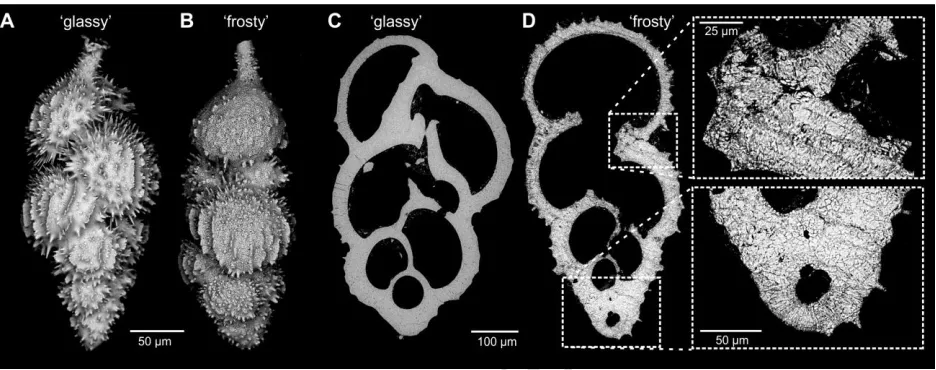
foraminifera estimates that diagenetic calcite can contribute 15-50 wt.% to the mass of the shell [Kozdon et al., 2011], a value consistent with the ~30 wt.% recrystallization estimates of Schrag et al. [1995], Schrag [1999], and Tripati et al. [2003]. Furthermore, our SEM examination of late Pliocene and early Pleistocene benthic foraminifera show clear
evidence of the presence of both glassy microgranular (well-preserved) specimens as well as frosty “coarse crystalline” (significantly altered) specimens (Figure 2), and the early Pleistocene benthic specimen shown in Figure 2D suggests that 15-30% diagenetic recrystallization could be a conservative estimate. With respect to the above calculation, we also note that the widely-used correction factor of +0.64‰ for Cibicidoides has been questioned by calibration studies suggesting calcification is actually occurring closer to equilibrium with temperature and ambient 18O
sw [Bemis et al., 1998; Marchitto et al.,
2014]. Furthermore, these authors suggest that it may be Uvigerina that is characterized by a positive vital effect. Whichever is the case, diagenetic mass balance arguments, such as that given above, would need to be applied to any benthic foraminifera featuring a vital effect. Indeed, it seems almost certain that at least one of these two commonly used benthic foraminiferal is forming its tests offset from ‘equilibrium’ calcite and, as shown above, this uncertainty would likely propagate through to paleoclimate interpretations of past sea level.
Figure 2. A) SEM image of a Uvigerina shell from ODP Site 1208A, ~950 ka, translucent (glassy) under optical microscope. The
[image:11.612.74.542.142.327.2]ACCEPTED MANUSCRIPT
In addition to the fixed offset from bottom water 18O due to biologic vital effects,
one must also consider the implications of the transition to cooler temperatures and greater global ice volume that began immediately after the MPWP, a trend that culminated
in widespread glaciation of the Northern Hemisphere 2.5 Ma ago (Figure 1). A benthic foraminifer that existed at 3 Ma would, over its first ~15 meters of burial (lasting ~500 kyr using a typical deep sea sedimentation rate of 3 cm/kyr), be exposed to pore waters that were exchanging with bottom waters that were increasing in 18O (due to ice growth
between 2.9 and 2.4 Ma), as well as becoming progressively colder (due to climate cooling over that same interval; Figure 3). Assuming that a benthic test formed its calcite in equilibrium with seawater (forgetting for a moment the diagenetic vital-effect issue described in the previous paragraph), the 18O value of any diagenetic calcite added to a
benthic test over the first 15 m of burial would be higher/more positive than that of the original test. If the benthic foraminifera also had a negative (lower than equilibrium 18O)
biologic vital effect, then the downcore “climate trend” diagenetic offset described above would be additive to the vital-effect effect. Keep in mind that the rate and depth to which
Figure 3: Model calculation for the effect of diagenesis on 18O of Cibicidoides and Uvigerina shells. We assume
[image:12.612.74.449.138.456.2]ACCEPTED MANUSCRIPT
diagenesis proceeds, and possibly tapers off [e.g., Pearson & Burgess, 2008; Sexton &
Wilson, 2009; Edgar et al., 2013], downcore, remains a major uncertainty with one
comprehensive study suggesting carbonate recrystallization is virtually over by ~10 Ma post-burial [Rudnicki et al., 2001].
To illustrate the potential for even subtle changes in shell diagenesis to impact interpretations of past temperatures, sea level and ice volume, Figure 3 shows the
cumulative impact of 15% diagenetic calcite added to Uvigerina and Cibicidoides specimens from the MPWP. Here we assume that diagenesis continues at a constant rate throughout the subsequent 3 Myr of burial (over a depth range of 100 m instead of only during the first 15 meters or so of burial considered above, although note that one would also have to consider the competing effects of the geothermal gradient increasing with depth as well as the impact of sediment compaction on pore water circulation). In this example, the
additive impact of changing bottom water characteristics and the vital effect-offset on
Cibicidoides is 0.25‰, a change that would lead to the MPWP 18O values of that species
being shifted to more positive values by ~0.25‰. As this would be equivalent to the addition of >20 m SLE of additional ice at the poles, the potential for significant systematic errors in ice volume estimates becomes apparent—both in individual 18O records and in
the LR04 stack which is dominated by Cibicidoides measurements during the MPWP. In addition, if the accepted vital effects attributed to various species were to be changed [e.g., Marchitto et al., 2014], then one would also have to alter estimates of the potential biases inherent in individual species.
In summary, if the mean 18O of a hypothetical MPWP Cibicidoides test is shifted by
even +0.1‰ by the precipitation of diagenetic calcite under conditions where pore waters are both cooling and increasing in 18O
sw, the additional amount of inferred polar ice
during the MPWP could easily exceed 20m SLE (>10m from this effect + 10 m due to vital-effect offset, assuming the canonical value for the Cibicidoides vital vital-effect). We suggest that interpreting the Pliocene benthic foraminiferal 18O record at face value, relative to
today, to derive Pliocene ice volume/sea level, might lead one to seriously underestimate the magnitude of deglaciation or warming at that time, to a degree that exceeds the stated errors in recent compilations [e.g., Miller et al., 2012; Rohling et al., 2014]. On the other hand, such a bias could solve the conundrum of how one “fits” both a polar
surface/bottom water warming as well as a decrease in the size of the cryosphere into the <0.4‰ 18O
carb decrease that characterizes the warm extremes of the MPWP (Figure 1).
How plausible is our hypothesis that the measured 18Oof Plio-Pleistocene benthic
foraminiferal shells is biased by diagenesis? One indicator of a diagenetic process would be temporal changes in the 18O
carb offsets between benthic foraminifera with differing
vital effects (e.g., Figure 3). For decades, it was assumed that the species-specific vital effects in benthic foraminiferal 18Owere constant in time and space [e.g., Mix et al.,
1995]. It was not until recently that Hoogakker et al. [2010] reported downcore variations in 18Ooffsets between contemporaneous benthic foraminiferal species that were not
ACCEPTED MANUSCRIPT
dissolution, metabolic activity, a change in carbonate ion concentration ([CO32-]), and
productivity, and concluded that the mechanisms for these differences remained elusive. It may be that diagenetic cementation or recrystallization leads to downcore variations in
18O offsets between benthic species such as Uvigerina and Cibicidoides, a process that
could be particularly pronounced on glacial-interglacial transitions that are associated with rapid changes in BWT and 18O
sw.
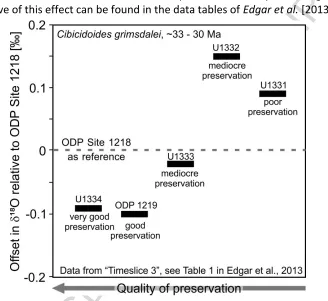
Our model would also predict that more diagenetically altered samples would be more positive in 18Orelative to less altered specimens of an equivalent age. Data
suggestive of this effect can be found in the data tables of Edgar et al. [2013]. In this study,
age-equivalent intervals (33-30 Ma) of mean 18O
carb values from Cibicidoides were
compared to a reference site across six total core locations in the equatorial Pacific. In addition, average shell preservation was assessed at each site, by the authors, using both optical microscopic and SEM methods. When we plot the mean site-to-site 18O
carb offset
against preservation state (Fig. 4), we observe a strong correlation with the 18O
carb of the
Cibicidoides shells generally increasing with degrading preservation. The total offset
between sites featuring the best- and poorest preserved shells is ~0.20‰, consistent with
Figure 4. Relation between foraminifera preservation and 18O in early Oligocene Cibicidoides shells from five ODP and IODP Sites from the eastern equatorial Pacific, shown as the offset in 18O relative to the ‘reference’ Site ODP 1218 for the time interval ~33 – 30 Ma. The selected sites have been correlated to each other by the original authors, allowing for a direct comparison of the 18O of groups of age-equivalent foraminifera shells (see Edgar et
[image:14.612.114.442.216.517.2]ACCEPTED MANUSCRIPT
predictions in Figure 3 of how an increasing diagenetic effect would bias shell 18O. It is
notable that much of the Pacific Ocean today is bathed in a homogenous deep-water mass [Palike et al., 2006] and it seems unlikely that differences in water mass properties, within the much smaller region of the eastern equatorial Pacific, can account for the offsets observed in the Oligocene sediments.
Additional research is needed to establish whether a significant volumetric percentage of diagenetic calcite may have been added to mid Pliocene benthic foraminifera, and whether this diagenetic calcite differs isotopically from the original biogenic record. Preliminary investigation using in situ analytical approaches such as secondary ion mass spectrometry (SIMS) and electron probe microanalyzers (EPMA) suggest this is a possibility for Pleistocene planktic foraminifera [Wycech et al., 2016] but more such studies are needed to shed light on the potential magnitude of diagenesis in late Cenozoic benthic foraminifera. Following this line of argument, we cannot exclude the possibility that some of the climate interpretations from the LR04 stack, or indeed any long benthic 18O record, may be systematically biased by diagenetic processes that unfold after
burial within the sediment column, processes which start the moment a foraminifera dies.
4.2 Could diagenesis influence Mg/Ca ratios of calcite?
Much less is known about the impact of calcite diagenesis on trace metal ratios, in particular Mg/Ca in foraminifera tests. A number of studies have shown that dissolution of planktic foraminifera settling through the water column and/or deposited on the sea floor can alter shell Mg/Ca ratios through the preferential removal of Mg-rich calcite [Hastings
et al., 1998; Rosenthal & Boyle, 1993; Rosenthal et al., 2000; Lea et al., 2000; Brown & Elderfield, 1996; Regenberg et al., 2007, 2014; Hertzberg & Schmidt, 2013]. Dekens et al.
[2002] developed core top calibrations for different planktic foraminifera that would account for this effect by taking the depth (or CO32- concentration) for the core site into
consideration; however, Hönisch et al. [2013] demonstrated that such a correction
systematically biased SST data from cores shallower than 4.4 km implying that dissolution may be minimal in core top samples from well above the lysocline, which was
subsequently confirmed by the global analysis of Regenberg et al. [2014].
But what of calcite dissolution and reprecipitation that occurs in contact with pore waters after burial? Precipitation experiments [Mucci, 1987] demonstrate that the Mg/Ca ratios of inorganically precipitated calcite are about an order of magnitude higher than those reported from foraminiferal tests, suggesting that biological processes play a
significant role in controlling the low Mg-content of tests formed during calcification [e.g.,
Barker et al., 2005; Erez, 2003; Lea, 2003]. Indeed, Mg/Ca ratios measured by EPMA in
ACCEPTED MANUSCRIPT
from older low-Mg biogenic carbonates. Although Mg-loss during dissolution and Mg-gain during diagenesis/reprecipitation could be counterbalancing each other, a recent study of planktic foraminifera suggests that diagenetic calcite can significantly alter both the Mg/Ca and radiocarbon ages of Pleistocene planktic foraminifera [Wycech et al., 2016].
But what of benthic foraminifera? If Mg/Ca ratios in benthic foraminifera were overprinted diagenetically, the presence of even a small volume of diagenetic calcite with a higher Mg/Ca ratio could raise mean foraminiferal test Mg/Ca ratios and lead one to
overestimate the amount of 18O change due to warming and, therefore, underestimate
the amount polar of ice volume change (and equally, the amount of sea level rise). This systematic error would be in the same direction as, and additive to, errors caused by addition of diagenetic 18O as discussed in the previous section. However, Mg/Ca records
from Uvigerina, O. umbonatus, and Cibicidoides spanning 1.5 to 0.5 Myr at DSDP Site 607 show no obvious indication of any inter-species trends or offsets that could be attributed to diagenesis [Ford et al., 2016], although even a 0.1 mmol/mol bias, challenging to identify by any analytical technique, could impact sea level reconstructions by ~10 m (see below).
Ultimately, trace element measurements of diagenetic precipitates or recrystallized domains are sparse and existing data indicate that the processes that control the Mg/Ca of diagenetic calcite formed in the sediment column are still not well understood. Critical issues that await robust inquiry include: (1) SEM imaging combined with
cathodoluminescence (CL) and electron backscatter diffraction (EBSD) characterization of Plio-Pleistocene benthic foraminiferal tests from multiple sites and multiple ages (whole shells, open chambers, and polished cross-sections) to evaluate their preservational state in more detail; (2) minor/trace element mapping by laser-ablation, EPMA and NanoSIMS to understand compositional heterogeneity and identify diagenetic phases; and (3) intrashell
18O measurements by SIMS to evaluate the intrashell 18O-range and correlate measured
18O with domains that are classified as well-preserved or altered based on SEM, EBSD, and
CL images. Lastly, all of these data need to be calibrated by comparison to modern shells cultured under controlled conditions [e.g., Hintz et al., 2006; Barras et al., 2010; Hönisch et
al., 2013; Evans et al., 2016].
5. Could changing Mg/Ca seawater ratios affect Pliocene sea level estimates?
A vibrant debate surrounds Pliocene SST reconstructions from the tropical Pacific derived from different proxies [e.g., Zhang et al., 2014; O’Brien et al., 2014; Ravelo et al., 2014; Ford et al., 2015]. These proxies include those based on biomarkers (e.g., TEX86
[Zhang et al., 2014] and alkenone UK’
37 [Dekens et al., 2008; Herbert et al., 2010]) and those
derived from foraminiferal carbonate (Mg/Ca ratios; e.g., Wara et al. [2005]). In particular, this debate has focused attention on the possibility that the Mg/Ca temperature proxy could be biased by long-term secular changes in the Mg/Ca composition of seawater [Medina-Elizalde et al., 2008]. Indeed, O’Brien et al. [2014] argued that the observed difference between Mg/Ca and TEX86 temperature reconstructions for ODP Site 1143 (in
ACCEPTED MANUSCRIPT
over the last few million years, although opposing viewpoints are given by Ford et al. [2015] and Brierley et al. [2015].
Both culturing experiments and fossil data suggest that the Mg/Cacarb is nonlinearly
dependent on the Mg/Ca ratio of seawater [Evans & Müller, 2012; Evans et al., 2015a] and thus a calibration based on modern core top studies would not be applicable if the
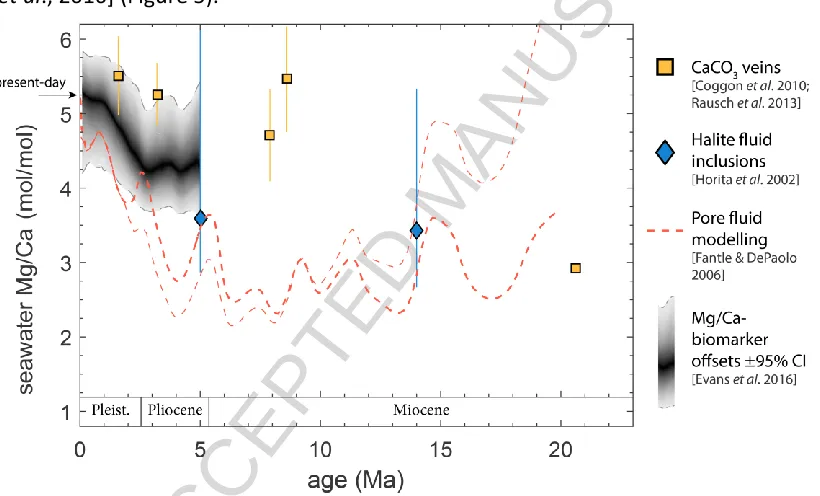
seawater Mg/Ca ratio changed over millions of years. Given the residence times of Ca and Mg are ~1 Myr and ~13 Myr respectively [Li, 1982], it is possible that the seawater Mg/Ca ratio (Mg/Casw) has changed over the 3 Myr since the mid-Pliocene. The most extreme
view suggests that Mg/Casw could have increased by as much as 25% just since the early
Pliocene (halite fluid inclusion data of Horita et al. [2002] in Fig. 5). Pore fluid modeling by
Fantle & DePaolo [2006] and comparison of biomarker and foraminifera Mg/Ca data in
light of laboratory calibrations on the effect of changing Mg/Casw [Evans et al., 2016]
suggest a roughly similar magnitude of change while data from ridge flank carbonate veins suggests only a minor, if any, change since the early Pliocene [Rausch et al., 2013; Coggon
et al., 2010] (Figure 5).
Figure 5. Proxy reconstructions of the molar ratio of Mg to Ca in seawater over the Neogene, broadly indicating an
increase since the Pliocene. The pore fluid-derived reconstruction is sensitive to the assumptions made regarding potential changes in the calcium isotopic composition of seawater over time. The bold orange dashed line assumes no change whereas the thin orange line is a potential scenario wherein the Ca isotopic composition of seawater has changed.
Studies using the Mg/Ca proxy to determine SST or BWT in the past usually assume that Mg/Casw has remained constant [e.g. Wara et al., 2005; Sosdian & Rosenthal, 2009;
Miller et al., 2012; Friedrich et al., 2013; Rohling et al., 2014], with notable exceptions
[image:17.612.73.483.293.541.2]3-ACCEPTED MANUSCRIPT
5 Ma to 5.2 mol/mol at present. The implication of these results is that benthic
foraminiferal Mg/Ca data, if uncorrected for this change, would underestimate Pliocene BWT by ~0.9-1.4°C [Evans et al., 2016]. Using the paired Mg/Ca-18O
carb method to get at
ice volume, this would lead one to overestimate the change in Pliocene polar ice
volume/sea level by 18-28 meters. This is opposite to, and comparable in magnitude to, the direction of the diagenetic effects discussed in the previous sections.
While several (though not all) lines of proxy Mg/Casw evidence for the last 5 Ma are
in agreement with regards to the direction of change since the Pliocene, precise knowledge of the magnitude of this shift is one more prerequisite for deriving an accurate ice volume reconstruction from biogenic calcite. For example, an uncertainty in MPWP Mg/Casw of
±0.5 mol/mol (Figure 5) would translate to a sea level error of ±14 m for a measured Mg/Ca ratio in benthic foraminifera of 1.5 mmol/mol. In addition, while progress has been made in calibrating the response of shell chemistry to Mg/Casw in planktonic and shallow
benthic foraminifera [Segev & Erez, 2006; Evans et al., 2016], the shape of this relationship has only been indirectly calculated for benthic foraminifera [Evans & Müller, 2012; Evans et
al., 2016]. Due to the difficulty of maintaining the commonly used benthic species in
culture, these calculations assume that the relationship between calcite and seawater Mg/Ca is best described by a power function, as has been shown to be the case for most other marine calcifiers [Hasiuk & Lohmann, 2010]. Tighter constraints are needed on the sensitivity of Mg incorporation in benthic foraminifera to Mg/Casw.
6. Additional influences on paired Mg/Ca - 18O estimates of MPWP sea level
Other secondary factors that may impact Mg/Ca ratios in foraminifera and thus bias Plio-Pleistocene sea level estimates are salinity, and the carbonate ion concentration of ambient seawater. Similar to the effects discussed above, these variables could also lead to systematic errors in past sea level/ice volume reconstructions, rather than randomly distributed uncertainty. Here, we briefly discuss and quantify the potential bias of these secondary factors on benthic foraminiferal Mg/Ca ratios but recognize that these particular variables are topics of more widespread discussion and ongoing research.
As an example, a decrease in ice volume equivalent to +10 m SLE would decrease the salinity of the ocean by about a tenth of a salinity unit [Adkins et al., 2002]. In both planktic and benthic foraminiferal culturing studies, a 4-8% increase in Mg/Ca per salinity unit is observed [Nürnberg et al., 1996; Kısakürek et al., 2008; Dissard et al., 2010; Hönisch
et al., 2013]. Thus, with a Mg/Ca-temperature sensitivity of about 0.12 mmol/mol per °C
reported for Cibicidoides [Marchitto et al., 2007], the effect of ice volume-induced salinity changes in benthic Mg/Ca temperatures is likely negligible.
Likewise, long-term secular changes in the pH and carbonate ion content of the ocean are being evaluated with respect to their influence on the Mg/Ca proxy [e.g., Lea et
al., 1999; Zeebe, 2001; Hönisch & Hemming, 2005; Yu & Elderfield, 2008; Bartoli et al.,
ACCEPTED MANUSCRIPT
consider if there is any evidence for long-term secular changes in the depth of the
sedimentary lysocline and calcite compensation depth (CCD) over the last 3 Myr. Elderfield
et al. [2006] suggest that carbonate ion effects can become significant in cold bottom
waters near the CCD. In the deep Atlantic at least, the lysocline may have shoaled after the MPWP (Ruddiman et al. [1987], although see also Lang et al. [2014] who suggest that dilution of pelagic sediment by terrigenous material may be responsible for the carbonate trends observed). If the lysocline shoaled in the Atlantic this would likely lead to a secular decrease in the carbonate ion concentration at a location near the lysocline; this in turn might have caused a decline in the Mg/Ca ratio of calcite from the MPWP to today (by ~1% per µmol kg-1 and perhaps influencing some species more than others; see for instance,
Elderfield et al. [2006], Yu & Elderfield [2008] and Elderfield et al. [2010]). Thus, in places
where the bottom water carbonate ion concentration was higher during the MPWP, the correspondingly higher Mg/Ca ratio would lead one to overestimate the actual BWT change and therefore ascribe too little of the 18O
carb change to a decrease in global ice
volume during the MPWP warm extremes.
What is the potential magnitude of this effect? Sosdian & Rosenthal [2009] estimate that a decline in [CO32-] ion of 10 μmol kg-1 (with a temperature sensitivity of
~0.15 mmol mol-1/°C after Yu & Elderfield [2008]) implies a BWT error of 0.6°C; this would
equate to 0.12‰ in 18O
carb that should actually be attributed to a decrease in MPWP ice
volume relative to today, a decrease equivalent to ~10 m SLE. On the other hand, the Ford
et al. [2016] inter-comparison of Pleistocene Mg/Ca records from three benthic species at
DSDP Site 607 concludes that the lack of coherence between observed Mg/Ca variability and the variability observed in proxies of deep water carbon chemistry, between 1.5 and 0.5 Ma, suggests that temperature is the main influence of Mg/Ca values—they conclude no strong evidence for a carbonate ion effect is observed.
Lastly, as mentioned earlier, Bailey et al. [2010] and later Winnick & Caves [2015] considered how changing one’s assumptions of the average 18O of polar ice during the
warm Pliocene could bias sea level estimates. Using Pliocene Antarctic surface
temperature reconstructions and observed 18O-temperature relationships in polar ice
Winnick & Caves [2015] argue that 18O
ice was 1‰ to 4‰ more positive than at present.
Conserving 18O/16O in the ocean-ice system would imply less sea level change for a given
18O
carb change in the Pliocene. They go on to conclude that ice mass loss during the
MPWP has likely been overestimated and that the 0.3‰ benthic 18O
carb change in the
LR04 stack is consistent with a Pliocene sea level of only 9-13.5 m above modern
ACCEPTED MANUSCRIPT
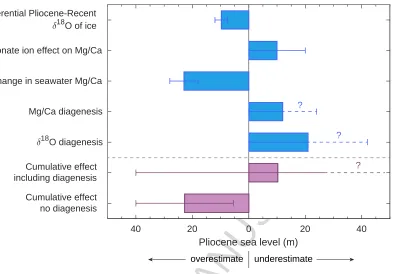
Figure 6. Summary of likely bias (in meters) to an estimate of MPWP sea level, derived from paired Mg/Ca - 18Ocarb measurements, caused by various effects discussed in text. The Mg/Ca diagenesis bar shows the resulting bias from an arbitrary 0.1 mmol/mol increase in shell Mg/Ca. No uncertainty is shown for the cumulative effect including diagenesis as this is sensitive to the magnitude of site-specific diagenetic bias on both Mg/Ca and 18Ocarb.
7. Conclusions
In the sections above we considered factors that pose a challenge to the canonical interpretation of benthic 18O records and derived sea level histories for the past three
million years. In particular, we discuss sources of error in paired 18O-Mg/Ca sea level
estimates, especially diagenesis and long-term changes in seawater chemistry, effects that are poorly constrained and potentially large. These and other variables are often ignored or assumed to remain at modern values, strategies that can no longer be justified,
especially as the likely response of polar regions to a modest increase in global
temperature carries great relevance to our future climate [e.g., Hansen et al., 2008; 2015]. Rather than allude to a consensus on Pliocene sea level that doesn’t exist, or cite mean values with error ranges that do not reflect the full spectrum of uncertainty (Fig. 6), we need to dig deeper into these issues. Diagenesis has the potential to impart a
systematic bias in our data that would lead one to underestimate the ice volume decrease of the Pliocene. A long-term change in the Mg/Ca of seawater could potentially offset this systematic error and, thus, is also an important area of investigation given the range of Mg/Casw suggested by existing studies (e.g. Figure 5). We need to carry out targeted
investigations, using new analytical tools and approaches, aimed at increasing our understanding of two of the most important paleoclimate proxies we have, 18O and
40 20 0 20 40
Pliocene sea level (m) 18O diagenesis
Mg/Ca diagenesis Change in seawater Mg/Ca Carbonate ion effect on Mg/Ca
?
?
?
Cumulative effect no diagenesis Cumulative effect including diagenesis Differential Pliocene-Recent
18
O of ice
[image:20.612.106.499.87.361.2]ACCEPTED MANUSCRIPT
Mg/Ca (Lawrence & Woodard [2017] arrived at a similar conclusion about SST proxies). Many researchers are doing this now but our rate of progress is slow, especially in the face of the inexorable rise in greenhouse gases and the profound threat to coastal communities posed by ongoing and accelerating sea level rise.
Ultimately, robust estimates of sea level during past warm climates, such as the mid-Pliocene warm period, can provide a direct measure of the Earth system sensitivity to modest increases in atmospheric CO2 [e.g., Hansen et al., 2008, Foster & Rohling, 2013;
Palaeosens Project Members, 2013; DeConto & Pollard, 2016]. For the Pliocene,
geochemical sea level proxies currently carry uncertainties too large to allow any meaningful estimate of equilibrium polar ice volume in a world with >350 ppm CO2.
Likewise, uncertainty in the pattern and temporal history of surface elevation changes driven by dynamic topography preclude robust Pliocene sea level estimates being derived from coastal geomorphic and sedimentary features, silled basins such as the Red Sea, atolls, or passive margins (see recent reviews by Dutton et al., 2015 and Kemp et al., 2015). Improvements in sea level estimates derived from field evidence must await advances in our understanding of mantle viscosity and structure as well as the mantle convection models dependent on these parameters.
For the geochemical proxies, increasing awareness of potential diagenetic
alteration is already leading to more careful selection of sample material for geochemical analysis. In addition, recent methodological improvements in in situ analytical techniques such as EPMA, laser ablation ICPMS, and SIMS now permit investigation of microscopic domains within shells which, when combined with advances in foraminiferal culturing, are leading to a richer understanding of the mechanisms by which foraminifera record – and archive – information about their environment. In particular, the assumption that diagenesis takes millions to tens of millions of years to alter foraminiferal calcite is no longer viable—we need to consider the possibility that Plio-Pleistocene carbonate
geochemical records such as 18O or Mg/Ca, even those from benthic foraminifera, may be
biased by post-depositional dissolution and recrystallization. Ultimately, these studies will lead to a deeper understanding of ice sheet stability in a warmer world, knowledge that could guide social, economic, and political actions aimed at minimizing human-caused disruption of the global climate system.
Acknowledgements
The authors would like to thank Ian Bailey, Y. Rosenthal, and the editor Paul Wilson for reviews that greatly improved the paper and focused our thinking. We also thank A. Liang for taking the SEM photographs shown in Figure 2. M.E.R. would like to acknowledge funding support from the World Surf League, the Vetlesen Foundation as well as NSF awards OCE-1202632 “PLIOMAX” and OCE-1436014.
ACCEPTED MANUSCRIPT
Adkins, J.F., and D. P. Schrag, 2001, Pore fluid constrains on deep ocean temperature and salinity during the last glacial maximum. Geophys. Res. Lett., 28, 771-774.
Adkins, J. F., K. McIntyre, and D. P. Schrag, 2002, The Salinity, Temperature, and δ18O of the
Glacial Deep Ocean. Science, 298, 1769-1773.
Anand P., Elderfield H. and Conte M. H., 2003, Calibration of Mg/Ca thermometry in planktonic foraminifera from a sediment trap time series. Paleoceanography, 18, 15. Austermann, J., D. Pollard, J. X. Mitrovica, R. Moucha, A. M. Forte, R. M. DeConto, D. B.
Rowley, and M.E. Raymo, 2015, The impact of dynamic topography change on Antarctic Ice Sheet stability during the Mid-Pliocene Warm Period. Geology, 43; 927–930,
doi:10.1130/G36988.1.
Badger, M., D. Schmidt, A. Mackensen, and R. Pancost, 2013, High-resolution alkenone palaeobarometry indicates relatively stable pCO2 during the Pliocene (3.3–2.8 Ma). Phil
Trans. Roy. Soc. A, 371, DOI: 10.1098/rsta.2013.0094
Bailey, I., C. Bolton, R. DeConto, D. Pollard, R. Scheibel, and P. Wilson, 2010, A low threshold for North Atlantic ice rafting from “low-slung slippery” late Pliocene ice sheets. Paleoceanography, 25, 10.1029/2009PA001736.
Barker, S., I. Cacho, H. Benway, and K. Tachikawa, 2005, Planktonic foraminiferal Mg/Ca as a proxy for past oceanic temperatures: a methodological overview and data
compilation for the Last Glacial Maximum. Quaternary Science Reviews, 24, 821-834. Barras, C., J.C. Duplessy, E. Geslin, E. Michel, and F. J. Jorissen, 2010, Calibration of 18O of
cultured benthic foraminiferal calcite as a function of temperature. Daedalus, 7, 1349-1356.
Bartoli, G., B. Hönisch, and R. Zeebe, 2011, Atmospheric CO2 decline during the Pliocene
intensification of Northern Hemisphere glaciations. Paleoceanography, 26, A4213, doi:10.1029/2010PA002055.
Bemis, B.E., H. Spero, J. Bijma, and D. Lea, 1998, Reevaluation of the oxygen isotopic composition of planktonic foraminifera: Experimental results and revised
paleotemperature equations. Paleoceanography, 13, 150-160.
Blanchon, P., A. Eisenhauer, J. Fietzke, and V. Liebetrau, 2009, Rapid sea-level rise and reef back-stepping at the close of the last interglacial highstand. Nature, 458, 881-884. Brierley, C., N. Burls, C. Ravelo, and A. Fedorov, 2015, Pliocene warmth and gradients.
Nature Geoscience, 8(6), 419–420.
ACCEPTED MANUSCRIPT
foraminifera caused by postdepositional dissolution: Evidence of shallow Mg-dependent dissolution. Paleoceanography, 11, 543.
Carman, M. and L. Keigwin, 2004, Preservation and color differences in Nuttalides
umbonifera. Jour. Foram. Res., 34, 102-108.
Channell, J.E.T., C. Xuan, and D. Hodell, 2009, Stacking paleointensity and oxygen isotope data for the last 1.5 Myrs (PISO-1500). Earth Planet. Sci. Lett., 283, 14-23.
Coggon, R. M., D. Teagle, C. E. Smith‐Duque, J. C. Alt, and M. J. Cooper, 2010,
Reconstructing past seawater Mg/Ca and Sr/Ca from mid‐ocean ridge flank calcium carbonate veins. Science, 327 (5969), 1114–1117, doi:10.1126/science.1182252. Collen, J.D., and C. J. Burgess, 1979, Calcite dissolution, overgrowth and recrystallization in
the benthic foraminiferal genus Notorotalia. J. Paleontol., 53, 1343-1353.
Cook, C., et al., 2013, Dynamic behavior of the East Antarctic ice sheet during Pliocene warmth. Nature Geoscience, 6, 765-769.
Corliss, B.H. and S. Honjo, 1981, Dissolution of deep-sea benthonic foraminifera.
Micropaleontology, 27(4), 356-378.
Curry, W.B., and T. M. Marchitto, 2008, A secondary ionization mass spectrometry calibration of Cibicidoides pachyderma Mg/Ca with temperature. Geochem. Geophys.
Geosyst., 9, Q04009.
DeConto, R. and D. Pollard, 2016, Contribution of Antarctica to past and future sea level rise. Nature, 531, 591-597.
Dekens, P., D. Lea, D. Pak, and H. Spero, 2002, Core top calibration of Mg/Ca in tropical foraminifera: Refining paleotemperature estimation. Geochem. Geophys. Geosys., 3, 1-29.
Dekens, P.S., A. C. Ravelo, M. D. McCarthy, and C. A. Edwards, 2008, A 5 million year comparison of Mg/Ca and alkenone paleo-thermometers. Geochem. Geophys. Geosyst. doi:10.1029/2007GC001931.
Delaney, M.L., A. Be, and E. Boyle, 1985, Li, Sr, Mg, and Na in foraminiferal calcite shells from laboratory culture, sediment traps, and sediment cores. Geochim. Cosmochim.
Acta, 49, 1327-1341.
Delaney, M.L., 1989, Temporal changes in interstitial water chemistry and calcite recrystallization in marine sediments. Earth Planet. Sci. Lett., 95, 23-37.
D'Hondt, S., and M.A. Arthur, 1996, Late Cretaceous oceans and the cool tropic paradox.
ACCEPTED MANUSCRIPT
Dickson, J.A., 2002, Fossil echinoderms as monitor of the Mg/Ca ratio of the Phanerozoic oceans. Science, 298, 1222-1224.
Dissard, D., G. Nehrke, G. Reichart, and J. Bijma, 2010, The impact of salinity on the Mg/Ca and Sr/Ca ratio in the benthic foraminifera Ammonia tepida: Results from culture experiments. Geochim. Cosmochim. Acta, 74, 928-940.
Dowsett, H.J., 2007, The PRISM palaeoclimate reconstruction and Pliocene sea-surface temperature, in Williams, M., Haywood, A.M., Gregory, J., and Schmidt, D.N., eds., Deep-time perspectives on climate change: marrying the signal from computer models and biological proxies: London, UK, Micropalaeontological Society (Special Publication), Geological Society of London, 459-480.
Dowsett, H. J. and T. M. Cronin, 1990, High eustatic sea level during the middle Pliocene: Evidence from the southeastern US Atlantic Coastal Plain. Geology, 18, 435-438. Dowsett, H.J., M. Robinson, A. Haywood, U. Salzmann, D. Hill, L. Sohl, M. Chandler, M.
Williams, K. Foley, and D. Stoll, 2010, The PRISM3D paleoenvironmental reconstruction.
Stratigraphy, 7(2-3), 123-139.
Dutton, A., A. E. Carlson, A. J. Long, G. A. Milne, P.U. Clark, R. DeConto, B. Horton, S. Rahmstorf, and M.E. Raymo, 2015, Magnitude, rates and sources of sea-level rise associated with polar ice-sheet retreat during past warm periods. Science, 349, aaa4019, DOI: 10.1126/science.aaa4019.
Dwyer, G.S., and M.A. Chandler, 2009, Mid-Pliocene sea level and continental ice volume based on coupled benthic Mg/Ca palaeotemperatures and oxygen isotopes.
Philosophical Transactions of the Royal Society A: Mathematical, Physical and Engineering Sciences, 367, 157-168.
Edgar, K.M., H. Pälike, and P.A. Wilson, 2013, Testing the impact of diagenesis on the δ18O
and δ13C of benthic foraminiferal calcite from a sediment burial depth transect in the
equatorial Pacific. Paleoceanography, 28, 468-480.
Elderfield, H., J. Yu, P. Anand, T. Kiefer, and B. Nyland, 2006, Calibrations for benthic foraminiferal Mg/Ca paleothermometry and the carbonate ion hypothesis. Earth
Planet. Sci. Lett., 250, 633-649.
Elderfield, H., P. Ferretti, M. Greaves, S. Crowhurst, N. McCave, D. Hodell, and A. Piotrowski, 2012, Evolution of ocean temperature and ice volume through the Mid-Pleistocene climate transition. Science, 10, 704-709.
Elmore, A.C., S. Sosdian, Y. Rosenthal, and J.D. Wright, 2012, A global evaluation of temperature and carbonate ion control on Mg/Ca ratios of ostracoda genus Krithe.
ACCEPTED MANUSCRIPT
Emiliani, C., 1955, Pleistocene temperatures. The Journal of Geology, 63, 538-578.
Epstein, S., R. Buchsbaum, H.A. Lowenstam, and H.C. Urey, 1951, Carbonate-water isotopic temperature scale. Geological Society of America Bulletin, 62, 417-426.
Epstein, S., R. Buchsbaum, H.A. Lowenstam, and H.C. Urey, 1953, Revised carbonate-water isotopic temperature scale. Geological Society of America Bulletin, 64, 1315-1326. Erez, J., 2003, The source of ions for biomineralization in foraminifera and their
implications for paleoceanographic proxies. Rev. Mineral. Geochem., 54, 115-149. Evans, D., and W. Müller, 2012, Deep time foraminifera Mg/Ca paleothermometry:
Nonlinear correction for secular change in seawater Mg/Ca. Paleoceanography 27, PA4205.
Evans, D., J. Erez, S. Oron, and W. Müller, 2015a, Mg/Ca-temperature and seawater-test chemistry relationships in the shallow-dwelling large benthic foraminifera Operculina ammonoides. Geochimica et Cosmochimica Acta, 148, 325-333.
Evans, D., R. Bhatia, B. Stoll, and W. Müller, 2015b, LA-ICPMS Ba/Ca analyses of planktic foraminifera from the Bay of Bengal: Implications for late Pleistocene orbital control on monsoon freshwater flux. G-cubed, 16, 2598-2618.
Evans, D., C. Brierley, M.E. Raymo, J. Erez, and W. Müller, 2016, Planktic foraminifera shell chemistry response to seawater chemistry: Pliocene-Pleistocene seawater Mg/Ca, temperature and sea-level change. Earth and Planetary Science Letters, 438, 139-148. Fairbanks, R. G., 1989, A 17,000-year glacio-eustatic sea level record: influence of glacial
melting rates on the Younger Dryas event and deep-ocean circulation. Nature, 342, 637-642.
Fairbanks, R.G., and R. K. Matthews, 1978, The marine oxygen isotope record in Pleistocene coral, Barbados, West Indies. Quatern. Res., 10, 181-196.
Fantle, M.S. and D. J. DePaolo, 2006, Sr isotopes and pore fluid chemistry in carbonate sediment of the Ontong Java Plateau: Calcite recrystallization rates and evidence for a rapid rise in seawater Mg over the last 10 million years. Geochem. Cosmochem. Acta, 70, 3883-3904, doi:10.1016/j.gca.2006.06.009.
Fantle, M.S., K. M. Maher, and D. J. DePaolo, 2010, Isotopic approaches for quantifying the rates of marine burial diagenesis. Rev. Geophys., 48, RG3002.
Farmer, J.R., T. M. Cronin, and G. S. Dwyer, 2012, Ostracode Mg/Ca paleothermometry in the North Atlantic and Arctic oceans: Evaluation of a carbonate ion effect.