Extreme M-quantiles as risk measures: From
L
1
to
L
p
optimization
Supplementary Material
Abdelaati Daouia
p1q, St´
ephane Girard
p2q& Gilles Stupfler
p3qp1q Toulouse School of Economics, University of Toulouse Capitole, France p2qTeam Mistis, Inria Grenoble Rhˆone-Alpes & LJK, Inovall´ee, 655, av. de l’Europe,
Montbonnot, 38334 Saint-Ismier cedex, France
p3qSchool of Mathematical Sciences, University of Nottingham, University Park,
Nottingham NG7 2RD, United Kingdom
Supplement A contains the proofs of all theoretical results in the main paper. Supplement B provides additional
technical results and lemmas. Further simulation results are discussed in Supplement C. An application to medical
insurance data is given in Supplement D.
A
Main results and proofs
Proof of Proposition 1. The starting point is thatqτppqis a solution of the equation
p1τqEppqXqp11ItX quq τEppXqqp11ItX¡quq, (A.1)
which is equivalent to:
I1pq;pq p1τqI2pq;pq (A.2)
with I1pq;pq E
X q 1
p1 1ItX¡qu
and I2pq;pq E
Xq 1
p1
.
We now claim that τ ÞÑqτppq is an increasing function on p0,1q, tending to 8 as τ Ò 1. If indeed τ ÞÑ qτppq
were not an increasing function, one could find 0 τ1 τ2 1 with qτ1ppq ¥qτ2ppq. But then, since the maps
q ÞÑ EppqXqp11ItX quqand q ÞÑ EppXqqp11ItX¡quq are respectively nondecreasing and nonincreasing, one
would get thanks to (A.1) that:
p1τ2qEppqτ2ppq Xq
p11I
tX qτ2ppquq p1τ1qEppqτ1ppq Xq
p11I
tX qτ1ppquq τ1EppXqτ1ppqq
p11I
tX¡qτ1ppquq τ2EppXqτ2ppqq
p11I
tX¡qτ2ppquq.
This is certainly a contradiction because of (A.1) again. Now, ifqτppqdid not tend to 8as τÒ1, then it would
converge to some finiteq due to the functionτ ÞÑqτppqbeing increasing. The functionsqÞÑEppqXqp11ItX quq
τ Ò1 in (A.1) withqqτppqthatEppXqqp11ItX¡quq 0. Consequently X ¤q with probability 1, which is
a contradiction sinceX has a heavy right-tail and thus an infinite right endpoint.
The idea is then to compute asymptotic equivalents of both the expectationsI1pq;pqandI2pq;pqasqÑ 8 and then solve equation (A.2) by replacing these terms by the aforementioned equivalents with qτppq substituted in
place ofq.
We start by computing an asymptotic equivalent ofI1pq;pq. Write
I1pq;pq E
H
X q
Hp1q
1ItX¡qu
withHpxq px1qp11I
tx¥1u, and apply Lemma 1(i) withb1 to get
I1pq;pq Fpqq
» 8
1
pp1qpx1qp2x1{γdxp1 op1qq.
An integration by parts and the change of variablesy 1{xentail
I1pq;pq
Fpqq γ
» 8
1
px1qp1x1{γ1dxp1 op1qq
Fpqq
γ
»1
0
p1yqp1y1{γpdyp1 op1qq
Fpqq
γ Bpp, γ
1p 1qp1 op1qq (A.3)
asqÑ 8.
We now examineI2pq;pq. Write
I2pq;pq I1pq;pq E
Xq 1
p11ItX qu
E
Xq 1
p11It|X|¤qu
. (A.4)
By (A.3), the first term on the right-hand side above converges to 0 asqÑ 8. The second one is controlled by writing
E
Xq 1
p1
1ItX qu
¤
2
q
p1
E
Xp11ItX qu opqpp1qq op1q (A.5)
as q Ñ 8, while the asymptotic behavior of the third term is obtained by noting that the integrand converges almost surely to 1 and is bounded by 2p1 which, by the dominated convergence theorem, entails:
E
Xq 1
p1
1It|X|¤qu
Ñ1 as qÑ 8. (A.6)
Combining (A.3), (A.4), (A.5) and (A.6), we arrive at
I2pq;pq Ñ1 as qÑ 8. (A.7)
Using (A.3) and (A.7), equation (A.2) thus yields
1τFpqτppqq
Bpp, γ1p 1q
γ p1 op1qq
Proof of Proposition 2. As in the proof of Proposition 1, the starting point is the fact thatqτppqis the unique
solution of equation (A.2). Let us provide an asymptotic expansion of both sides of this equation asτÒ1.
The left-hand side of (A.2) is the easiest part: we use Lemma 1(ii) withHpxq px1qp11I
tx¥1uandb1 to get, asqÑ 8,
I1pq;pq
Fpqq
Bpp, γ1
r p 1q
γr
A
1
Fpqq
» 8
1
pp1qpx1qp2x1{γrx
ρ{γr1
γrρ
dxp1 op1qq. (A.8)
Whenρ 0, an integration by parts and the change of variables y1{xentail
I1pq;pq
Fpqq
Bpp, γr1p 1q
γr
A
1
Fpqq
1
γrρ
1ρ γr
Bpp,p1ρqγr1p 1q 1
γr
Bpp, γr1p 1q
p1 op1qq (A.9)
asqÑ 8.
Let us now turn to the right-hand side of (A.2), which we break down as:
E
Xq 1
p1
I1pq;pq E
1X
q
p1 1ItX¤qu
. (A.10)
An equivalent ofI1pq;pqis already known by (A.3):
I1pq;pq
Bpp, γr1p 1q
γr
Fpqqp1 op1qq
asqÑ 8. The second term in (A.10) can be decomposed itself as follows:
E
1X
q
p1 1ItX¤qu
E
#
1X
q
p1
1
+
1ItX¤qu
Fpqq
J1pq;pq J2pq;pq 1Fpqq (A.11)
with J1pq;pq E
#
1X
q
p1
1
+
1It0 X¤qu
and J2pq;pq E
#
1X
q
p1
1
+
1ItX 0u
.
We start by examining the asymptotic behavior ofJ1pq;pq. LetHpxq pp1q1p1xqp11It0¤x¤1u and apply Lemma 1(iii), (iv) and (v) to obtain:
J1pq;pq pp1qE
H X q
Hp0q
1ItX¡0u
pp1q
$ ' ' ' ' ' ' ' ' ' & ' ' ' ' ' ' ' ' ' %
EpX1ItX¡0uq
q p1 op1qq
if γr 1
or γr1 andEpX q 8,
EpX1It0 X quq
q p1 op1qq if γr1 andEpX q 8,
FpqqBpp1,1γ1
r qp1 op1qq if γr¡1,
(A.12)
asqÑ 8. To controlJ2pq;pq, notice first that
J2pq;pq E
#
1X
q
p1
1
+
1ItX 0u
E
#
1 X
q
p1
1
+
1ItX¡0u
and apply Lemma 1(iii), (iv) and (v) withHpxq pp1q1p1 xqp1to get
J2pq;pq pp1qE
H X q
Hp0q
1ItX¡0u
pp1q
$ ' ' ' ' ' ' ' ' ' ' ' ' & ' ' ' ' ' ' ' ' ' ' ' ' %
EpX1ItX 0uq
q p1 op1qq
if γ` 1
or γ`1 andEpXq 8
or F is light-tailed,
EpX1Itq X 0uq
q p1 op1qq if γ`1 andEpXq 8,
FpqqBpγ`1p 1,1γ`1qp1 op1qq if γ`¡1.
(A.13)
This is obtained by noticing that, in the case γ` 1, we have EpX1It0 X quq EpX1Itq X 0uq, and in the caseγ`¡1, the change of variablesux{p1 xq, or equivalentlyxu{p1uq, yields
» 8
0
p1 xqp2x1{γ`dx »1
0
p1uq1{γ`pu1{γ`duBpγ1
` p 1,1γ
1
` q.
Finally, notice that the regular variation property of A (see Theorem 2.3.3 in de Haan and Ferreira, 2006) and
Proposition 1 entail
A
1
Fpqτppqq
Bpp, γr1p 1q
γr
ρ
A
1 1τ
p1 op1qq. (A.14)
Combining (A.2), (A.9)–(A.14) and replacingqbyqτppqshows that
Fpqτppqq
Bpp, γ1
r p 1q
γr
A
1 1τ
Kpp, γr, ρqp1 op1qq
p1τq 1Fpqτppqq pp1qrRrpqτppq, p, γrq R`pqτppq, p, γ`qs
. (A.15)
Using Corollary 1 and the regular variation of the functionsF andF (when it is heavy-tailed), we get
Rrpqτppq, p, γrq
$ ' ' ' ' ' ' ' ' ' & ' ' ' ' ' ' ' ' ' %
EpX1ItX¡0uq
qτppq
p1 op1qq if γr 1
or γr1 andEpX q 8,
EpX1It0 X qτppquq
qτppq
p1 op1qq if γr1 andEpX q 8,
FpqτppqqBpp1,1γr1qp1 op1qq if γr¡1
$ ' ' ' ' ' ' ' ' ' ' & ' ' ' ' ' ' ' ' ' ' % γr
Bpp, γr1p 1q
γr
EpX1ItX¡0uq
qτp1q p
1 op1qq if γr 1
or γr1 andEpX q 8,
γr
Bpp, γr1p 1q
γr
EpX1It0 X qτp1quq
qτp1q
p1 op1qq if γr1 andEpX q 8,
γr
Bpp, γr1p 1q
Fpqτp1qqBpp1,1γr1qp1 op1qq if γr¡1
γr
Bpp, γr1p 1q
minpγr,1q
and
R`pqτppq, p, γ`q
$ ' ' ' ' ' ' ' ' ' ' ' ' & ' ' ' ' ' ' ' ' ' ' ' ' %
EpX1ItX 0uq
qτppq p
1 op1qq
if γ` 1
or γ`1 andEpXq 8
or F is light-tailed,
EpX1Itqτppq X 0uq
qτppq p
1 op1qq if γ`1 andEpXq 8,
FpqτppqqBpγ`1p 1,1γ
1
` qp1 op1qq if γ`¡1
$ ' ' ' ' ' ' ' ' ' ' ' ' ' ' ' ' ' & ' ' ' ' ' ' ' ' ' ' ' ' ' ' ' ' ' % γr
Bpp, γr1p 1q
γr
EpX1ItX 0uq
qτp1q p
1 op1qq
if γ` 1
or γ`1 andEpXq 8
or F is light-tailed,
γr
Bpp, γr1p 1q
γr
EpX1Itqτp1q X 0uq
qτp1q p
1 op1qq if γ`1 andEpXq 8,
γr
Bpp, γr1p 1q
γr{γ`
Fpqτp1qqBpγ`1p 1,1γ
1
` qp1 op1qq if γ`¡1
γr
Bpp, γr1p 1q
γr{maxpγ`,1q
R`pqτp1q, p, γ`q.
Consequently, by Proposition 1,
Fpqτppqq pp1qrRrpqτppq, p, γrq R`pqτppq, p, γ`qs
γr
Bpp, γr1p 1q
p1τqp1 op1qq
pp1q
γr
Bpp, γr1p 1q
minpγr,1q
Rrpqτp1q, p, γrq
γr
Bpp, γr1p 1q
γr{maxpγ`,1q
R`pqτp1q, p, γ`q
.
Rearranging equation (A.15) yields
Fpqτppqq
1τ
γr
Bpp, γr1p 1q
1 A
1 1τ
γr
Bpp, γr1p 1q
Kpp, γr, ρqp1 op1qq
1
1 γr
Bpp, γr1p 1q
p1τqp1 op1qq
pp1q
γr
Bpp, γr1p 1q
minpγr,1q
Rrpqτp1q, p, γrq
γr
Bpp, γr1p 1q
γr{maxpγ`,1q
R`pqτp1q, p, γ`q
.
Using a straightforward Taylor expansion of the functionxÞÑ p1 xq1in a neighborhood of 0 completes the proof.
Proof of Proposition 3. By Proposition 2 and a Taylor expansion, 1τ
Fpqτppqq
Bpp, γr1p 1q
γr
p1Rpτ, pqp1 op1qqq.
Proof of Theorem 1. Notice thatyÞÑητpy;pq{pis continuously differentiable with derivative
ϕτpy;pq |τ1Ity¤0u||y|p1signpyq.
Use Lemma 3 to write, for anyu,
ψnpu;pq uT1,n T2,npuq T3,npuq (A.16)
with T1,n :
1
a
np1τnq n
¸
i1 1
rqτnppqsp1
ϕτnpXiqτnppq;pq,
T2,npuq :
1
rqτnppqsp n
¸
i1
»uqτnppq{ ?
np1τnq
0
rEpϕτnpXiqτnppq t;pqq EpϕτnpXiqτnppq;pqqsdt
and T3,npuq :
1
rqτnppqsp n
¸
i1
»uqτnppq{?np1τnq
0
rSn,ipqτnppq tq Sn,ipqτnppqqsdt
whereSn,ipvq:ϕτnpXiv;pq EpϕτnpXv;pqq.
By Lemmas 8, 9 and 10, we get
ψnpu;pq d
ÝÑ uZaVpγ;pq u
2
2γ as nÑ 8
(withZ being standard Gaussian) in the sense of finite-dimensional convergence. As a function of u, this limit is
almost surely finite and defines a convex function which has a unique minimum at
uγaVpγ;pqZd N 0, γ2Vpγ;pq.
Applying the convexity lemma of Geyer (1996) completes the proof.
Proof of Theorem 2. Write
log
p
qW τn1ppq
qτn1ppq
ppγnγqlog
1τn
1τn1
log
p
qτnppq
qτnppq
log
1τn1
1τn
γ
qτn1ppq
qτnppq
.
The convergence logrp1τnq{p1τn1qs Ñ 8 yields
a
np1τnq
logrp1τnq{p1τn1qs
log
p
qτnppq
qτnppq
OP 1{logrp1τnq{p1τn1qs
oPp1q, (A.17)
and
a
np1τnq
logrp1τnq{p1τn1qs
log
1τn1
1τn
γ
qτn1ppq
qτnppq
a
np1τnq
logrp1τnq{p1τn1qs
log
qτ1nppq
qτn1p1q
log
qτnppq
qτnp1q
log
1τn1
1τn
γ
qτ1np1q
qτnp1q
O
a
np1τnq
logrp1τnq{p1τn1qs
rRpτn, pq |App1τnq1q| Rpτn1, pq |App1τn1q
1q|s
O
a
np1τnq
logrp1τnq{p1τn1qs
rRpτn, pq |App1τnq1q|s
op1q. (A.18)
Convergence (A.17) is a consequence of our Theorem 1. Convergence (A.18) follows from a combination of
Proposition 3 and of Theorem 2.3.9 in de Haan and Ferreira (2006) and, in what concerns the relationship
Rpτn1, pq OpRpτn, pqq, from the regular variation of F, F, s ÞÑ Upsq q1s1p1q and |A|. Combining these
Proof of Theorem 3. We start by writing
log
r
qW τn1ppq
qτn1ppq
log
p
qW τn1p1q
qτn1p1q
log
Cppγn;pq
Cpγr;pq
log
qτn1ppq
Cpγr;pqqτn1p1q
. (A.19)
To work on the first term on the right-hand side, note that
log
p
qWτ1
np1q
qτ1np1q
ppγnγqlog
1τn
1τn1
log
p
qτnp1q
qτnp1q
log
1τn1
1τn
γ
qτn1p1q
qτnp1q
.
Sinceqpτnp1q Xntnp1τnqu,n, the convergence logrp1τnq{p1τ
1
nqs Ñ 8and a use of Theorem 2.3.9 of de Haan
and Ferreira (2006) yield:
a
np1τnq
logrp1τnq{p1τn1qs
log
p
qτnp1q
qτnp1q
OP 1{logrp1τnq{p1τn1qs
oPp1q,
and
a
np1τnq
logrp1τnq{p1τn1qs
log
1τn1
1τn
γ q τn1p1q
qτnp1q
O
a
np1τnq
logrp1τnq{p1τn1qs
|App1τnq1q|
op1q.
As a consequence: a
np1τnq
logrp1τnq{p1τn1qs
log
p
qW τ1
np1q
qτn1p1q
d
ÝÑζ. (A.20)
To conclude the proof, it is then enough to examine the behavior of the second and third term on the right-hand
side of Equation (A.19). First,
a
np1τnq
logrp1τnq{p1τn1qs
log
Cppγn;pq
Cpγr;pq
OP 1{logrp1τnq{p1τn1qs
oPp1q, (A.21)
because of the anp1τnqconvergence of pγn and of the differentiability of the mapping xÞÑ logCpx;pq at γr.
Second,
a
np1τnq
logrp1τnq{p1τn1qs
log
qτn1ppq
Cpγr;pqqτn1p1q
OP
a
np1τnq
logrp1τnq{p1τn1qs
rRpτn1, pq |App1τn1q1q|s
OP
a
np1τnq
logrp1τnq{p1τn1qs
rRpτn, pq |App1τnq1q|s
oPp1q, (A.22)
which follows from a combination of Proposition 3 and of Theorem 2.3.9 in de Haan and Ferreira (2006) and, in
what concerns the relationship Rpτn1, pq OpRpτn, pqq, from the regular variation ofF,F,sÞÑUpsq q1s1p1q
and|A|. Combining these elements and using the Delta-method leads to the desired conclusion.
Proof of Theorem 4. We write
1 pτn1pp, αn; 1q
1τn1pp, αn; 1q
1 γr
p γn B p, 1 p γn p 1 B p, 1 γr p 1
p1αnq
1 γr B p, 1 γr p 1
1τn1pp, αn; 1q
1. (A.23)
Now
a
np1τnq
γr p γn 1 p1 γn a
np1τnqpγr pγnq d
ÝÑ ζ
γr
by Slutsky’s lemma. Moreover, using the relationship
BB
Bypx, yq
B By
ΓpxqΓpyq
Γpx yq
Bpx, yq pΨpyq Ψpx yqq
where Ψpxq Γ1pxq{Γpxqis the digamma function, we obtain
d dx B p,1
xp 1
1
x2B
p,1
xp 1 Ψ
1
xp 1
Ψ 1 x 1 .
The delta-method then yields
a
np1τnq
B p, 1 p γn p 1 B p, 1 γr p 1 1 1 B p, 1 γr p 1 a
np1τnq
B p, 1 p γn p 1 B p, 1 γr p 1 d
ÝÑ ζ
γ2 r Ψ 1 γr p 1 Ψ 1 γr 1 . (A.25)
To complete the proof, we note that
p1αnq
1 γr B p, 1 γr p 1
1τn1pp, αn; 1q
p1αnq
1 γr B p, 1 γr p 1 E
qαXnp1q1
p1
1ItX¡qαnp1qu E
qαXnp1q
1
p1
.
Recall now (A.8) in the proof of Proposition 2 which here translates into
p1αnq
1 γr B p, 1 γr p 1 E
qαXnp1q1
p1
1ItX¡qαnp1qu
1
Fpqαnp1qq
1 γr B p, 1 γr p 1 E
qαXnp1q1
p1
1ItX¡qαnp1qu
1
OrAp1{Fpqαnp1qqqs
OrApp1αnq1qs.
Similarly, by (A.10)–(A.13) in the proof of Proposition 2, we get
E
qαXnp1q
1
p1
1 OrmaxtFpqαnp1qq, Rrpqαnp1q, p, γrq, R`pqαnp1q, p, γ`qus
Ormaxt1αn, Rrpqαnp1q, p, γrq, R`pqαnp1q, p, γ`qus.
Combine these two asymptotic bounds to obtain
p1αnq
1 γr B p, 1 γr p 1
1τn1pp, αn; 1q
1Ormaxt1αn, App1αnq1q, Rrpqαnp1q, p, γrq, R`pqαnp1q, p, γ`qus. (A.26)
Combining (A.23), (A.24), (A.25) and (A.26) leads to
a
np1τnq
1 pτn1pp, αn; 1q
1τn1pp, αn; 1q
1 " 1 1 γr Ψ 1 γr p 1 Ψ 1 γr 1 * ζ γr
proving the first statement. In the case when
a
np1τnqmaxt1αn, App1αnq1q, Rrpqαnp1q, p, γrq, R`pqαnp1q, p, γ`qu Ñ0
the above equality becomes
a
np1τnq
1 pτn1pp, αn; 1q
1τn1pp, αn; 1q
1 " 1 1 γr Ψ 1 γr p 1 Ψ 1 γr 1 * ζ γr
op1q
which implies the second statement and concludes the proof.
Proof of Theorem 5. The key point is to write
p
qτ1Wpnpp,αn;1qppq
1 pτn1pp, αn; 1q
1τn
pγn p
qτnppq
1 pτn1pp, αn; 1q
1τn1pp, αn; 1q
pγn
#
1τn1pp, αn; 1q
1τn
pγn p
qτnppq
+
. (A.27)
Now, by Theorem 4,
1 pτn1pp, αn; 1q
1τn1pp, αn; 1q
1 OP
1
a
np1τnq
and therefore
1 pτn1pp, αn; 1q
1τn1pp, αn; 1q
pγn
exp
pγnlog
1 pτn1pp, αn; 1q
1τn1pp, αn; 1q
exp
γ OP
1
a
np1τnq
OP
1
a
np1τnq
1 OP
1
a
np1τnq
(A.28)
by a Taylor expansion. Furthermore, we have
1τn1pp, αn; 1q
1τn
pγn p
qτnppq pqWτn1pp,αn;1qppq
by definition of the extrapolated class of estimatorsqpWppq. Using the asymptotic equivalent
1τn1pp, αn; 1q p1αnq
1 γr B p, 1 γr p 1 (A.29)
we conclude that the conditions of Theorem 2 are satisfied if the parameterτn1 there is set equal toτn1pp, αn; 1q. By
Theorem 2: a
np1τnq
logrp1τnq{p1τn1pp, αn; 1qqs
p
qW τ1
npp,αn;1qppq
qτ1npp,αn;1qppq 1 d ÝÑζ. Now log
1τn
1τn1pp, αn; 1q
log
1τn
1αn
log
1αn
1τn1pp, αn; 1q
and in the right-hand side of this identity, the first term tends to infinity, while the second term converges to a
finite constant in view of (A.29). As a conclusion
log
1τn
1τn1pp, αn; 1q
log
1τn
1αn
.
Together with the equalityqτn1pp,αn;1qppq qαnp1qwhich is true by definition ofτn1pp, αn; 1q, this entails
a
np1τnq
logrp1τnq{p1αnqs
p
qW
τ1npp,αn;1qppq
qαnp1q
1
d
ÝÑζ. (A.30)
Proof of Theorem 6. The proof of this result is similar to that of Theorem 5: just apply Theorem 3 instead of
Theorem 2 in order to prove the required analogue of (A.30).
Proof of Theorem 7. The proof of this result is the same as that of Theorem 3, with pqτW1
np1qbeing replaced by p
qWτ1
nppq[thus applying Theorem 2 to obtain an analogue of (A.20)] and the mappingxÞÑlogCpx;pqbeing replaced
byxÞÑlogrCpx; 2qC1px;pqs. The details of the proof are therefore omitted.
Proof of Theorem 8. The proof of this result is entirely similar to that of Theorem 5 and is therefore omitted.
Proof of Theorem 9. The proof of this result is entirely similar to that of Theorem 6 and is therefore omitted.
B
Auxiliary results and proofs
Lemma 1. Let X be a random variable whose survival function F satisfies condition C1pγq, and let H be an absolutely continuous function whose derivativehis nonnegative and is such that
Da¥0, Dδ¡0, @b¡a,
» 8
b
hpxqx1{γδdx 8.
(i) For any b¡a, we have, asqÑ 8:
E
H
X q
Hpbq
1ltX¡bqu
Fpqq
» 8
b
hpxqx1{γdxp1 op1qq.
(ii) If moreoverF satisfies conditionC2pγ, ρ, Aq, then for any b¡a, we have, asqÑ 8:
E
H
X q
Hpbq
1ltX¡bqu
Fpqq
» 8
b
hpxqx1{γdx A
1
Fpqq
» 8
b
hpxqx1{γx
ρ{γ1
γρ dxp1 op1qq
.
Assume further that a 0 and that h is right-continuous at 0 with hp0q 1. Let X maxpX,0q denote the positive part ofX.
(iii) Ifγ 1, orγ1andEpX q 8, then, as qÑ 8:
E
H
X q
Hp0q
1ltX¡0u
EpX q
q p1 op1qq.
This result also holds true if the functionF is actually light-tailed.
(iv) If γ1andEpX q 8, then the function qÞÑEpX1lt0 X quqis slowly varying and, as qÑ 8:
E
H
X q
Hp0q
1ltX¡0u
EpX1lt0 X quq
q p1 op1qq.
(v) Ifγ¡1, then, as qÑ 8:
E
H
X q
Hp0q
1ltX¡0u
Fpqq
» 8
0
Proof of Lemma 1. The basic idea of the proof is to note that an integration by parts entails, forb¥a:
Ipb;qq:E
H
X q
Hpbq
1ltX¡bqu
» 8
b
hpxqFpqxqdx.
To show (i), write
Ipb;qq Fpqq
» 8
b
hpxqx1{γdx
» 8
b
hpxq
Fpqxq Fpqq x
1{γ
dx
(B.1)
and use a uniform bound such as Theorem B.2.18 in de Haan and Ferreira (2006) to get
Ipb;qq Fpqq
» 8
b
hpxqx1{γdxp1 op1qq
asqÑ 8, which is (i).
Assertion (ii) is obtained in a similar way by using (B.1), the second-order condition C2pγ, ρ, Aqand a uniform inequality such as Theorem B.3.10 in de Haan and Ferreira (2006) applied to the functionF.
The first step in order to show (iii), (iv) and (v) is to splitIp0;qqas
Ip0;qq
»ε
0
hpxqFpqxqdx
» 8
ε
hpxqFpqxqdx
1
q
»qε
0
h
x q
Fpxqdx
» 8
ε
hpxqFpqxqdx (B.2)
where εis an arbitrary positive real number. To prove (iii), note that if X ¤0 almost surely there is nothing to prove; otherwise, because
EpX1lt0 X qεuq
»qε
0
Fpxqdx,
we obtain:
Ip0;qq EpX1lt0 X qεuq
q
1
q
»qε
0
h
x q
1
Fpxqdx
» 8
ε
hpxqFpqxqdx.
SinceEpX q 8the functionF is nonincreasing and integrable in a neighborhood of infinity. This entails
xFpxq ¤2
»x
x{2
FptqdtÑ0 as xÑ 8
and therefore thatFpqq op1{qqasqÑ 8; this is of course also true ifF is light-tailed. We thus obtain, by part (i) whenF is regularly varying:
@ε¡0, Ip0;qq EpX1lt0 X qεuq
q
1
q
»qε
0
h
x q
1
Fpxqdx o
1
q
.
By the dominated convergence theorem,EpX1ltX¥qεuq Ó0 asqÑ 8and then:
@ε¡0, Ip0;qq EpX q
q
1
q
»qε
0
h
x q
1
Fpxqdx o
1
q
.
For anyα¡0, choose nowεsuch that|hpxq 1| ¤α{p1 EpX qqfor allxP r0, εs; this yields
Ip0;qq EpX q q
¤ 1 EαpX q
"
EpX1lt0 X qεuq
q
*
α
1 EpX q
1
q ¤ α
q
To show (iv), use (B.2) to get for anyε¡0:
Ip0;qq 1 q »1 0 h x q
Fpxqdx
»ε
1{q
hpxqFpqxqdx
» 8
ε
hpxqFpqxqdx
forqlarge enough. By the right-continuity ofhat 0 and part (i) of the present Lemma, we get
Ip0;qq
»ε
1{q
hpxqFpqxqdx O
max
1
q, Fpqq
.
For an arbitraryαP p0,1q, choose nowεso small thathpxq P r1α{4,1 α{4swhenxP r0, εs. We get
1α 4
»ε
1{q
Fpqxqdx¤
»ε
1{q
hpxqFpqxqdx¤
1 α 4
»ε
1{q
Fpqxqdx
ô 1α 4
1
q
»qε
1
Fpxqdx¤
»ε
1{q
hpxqFpqxqdx¤
1 α 4 1 q »qε 1
Fpxqdx.
By Proposition 1.5.9a in Bingham et al. (1987), the functionzÞѳz1Fpxqdx³z1txFpxqudx{xis slowly varying in a neighborhood of 8(i.e. regularly varying with index 0) so that forqlarge enough,
1α 2
1
q
»q
1
Fpxqdx¤
»ε
1{q
hpxqFpqxqdx¤
1 α 2 1 q »q 1
Fpxqdx.
Finally, we have³q1FpxqdxÒEpX1ltX¥1uq 8 asqÑ 8and, by Proposition 1.5.9a in Binghamet al. (1987):
1
Fpqq
"
1
q
»q
1
Fpxqdx
* 1
qFpqq
»q
1
txFpxqudx x Ñ 8
asqÑ 8. In other words, forqlarge enough,
p1αq1 q
»q
1
Fpxqdx¤Ip0;qq ¤ p1 αq1 q
»q
1
Fpxqdx.
Sinceαis arbitrary, this entails
Ip0;qq 1 q
»q
1
Fpxqdxp1 op1qq 1
q
»q
0
Fpxqdxp1 op1qq EpX1lt0 X quq
q p1 op1qq
asqÑ 8: the proof of (iv) is then complete.
To show (v), letβ P p0,1qbe such that 1{γ 1β and use once again (B.2) to get:
Ip0;qq 1 q
»qβ
0 h x q
Fpxqdx
» 8
qp1βq
hpxqFpqxqdx.
By the right-continuity ofhat 0 and the asymptotic relationshipqp1βqopFpqqqas qÑ 8,
Ip0;qq 1 q
»qβ
0
Fpxqdxp1 op1qq
» 8
qp1βq
hpxqFpqxqdx
» 8
qp1βq
hpxqFpqxqdx opFpqqq.
In the spirit of the proof of (i), write now
Ip0;qq Fpqq
» 8
qp1βq
hpxqx1{γdx
» 8
qp1βq
hpxq
Fpqxq Fpqq x
1{γ
dx
opFpqqq.
Since in the second integral we haveqx¥qβ Ñ 8, we may use again a uniform bound such as Theorem B.2.18
in de Haan and Ferreira (2006) to get
Ip0;qq Fpqq
» 8
qp1βq
Finally, since1{γ¡ 1, the functionxÞÑx1{γ is integrable in a neighborhood of 0, and thus
Ip0;qq Fpqq
» 8
0
hpxqx1{γdxp1 op1qq
asqÑ 8, which completes the proof of (v).
Lemma 2. Assume thatv,V are such that vpτq Ò 8andVpτq Ó0, asτÒ1, and there existsB¡0 such that
Vpτq
FpvpτqqBp1 epτqq
whereepτq Ñ0 asτÒ1. If conditionC2pγ, ρ, Aqholds, withγ¡0 andF strictly increasing, then
vpτq
Up1{Vpτqq B
γ
1 γepτqp1 op1qq Ap1{Vpτqq
Bρ1
ρ op1q
as τ Ò1.
Proof. Apply the functionU to get
vpτq
Up1{VpτqqB
γ UpBr1 epτqs{Vpτqq
Up1{Vpτqq B
γ.
By Theorem 2.3.9 in de Haan and Ferreira (2006), we may find a functionA0, equivalent toAat infinity, such that
for anyε¡0, there ist0pεq ¡1 such that for t,tx¥t0pεq,
A01ptqUUpptxtqqxγ
xγx
ρ1
ρ
¤ rp2Bqγ ρ pB{2qγ ερsrp2Bqε pB{2qεsx
γ ρmaxpxε, xεq.
Thus, forτ sufficiently close to 1, using this inequality witht1{VpτqandxBr1 epτqsgives that
A0p1{1VpτqqUpBrU1p1{eVpτpqs{τqqVpτqqBγp1 epτqqγ
Bγp1 epτqqγB
ρp1 epτqqρ1
ρ
¤ε
and therefore
1
A0p1{Vpτqq
UpBr1 epτqs{Vpτqq Up1{Vpτqq B
γp1 epτqqγ
ÑBγB
ρ1
ρ as τ Ò1.
The desired result follows by a simple first-order Taylor expansion.
In the next result we use the fact thatyÞÑητpy;pq{pis continuously differentiable with derivative
ϕτpy;pq |τ1lty¤0u||y|p1signpyq.
Lemma 3. For allx,yPR andτP p0,1q,
1
ppητpxy;pq ητpx;pqq yϕτpx;pq
»y
0
pϕτpxt;pq ϕτpx;pqqdt.
Proof of Lemma 3. The result follows from the identity
1
ppητpxy;pq ητpx;pqq
»xy
x
ϕτps;pqds
»y
0
ϕτpxt;pqdt
obtained by the change of variablessxt.
The next lemma gives asymptotic equivalents for a number of moments that will be used in our examination of the
Lemma 4. Assume that the survival function F satisfies condition C1pγq. Pick a ¥ 1 and assume that γ
1{rapp1qsandEpXapp1qq 8. Then:
(i) We have
Ep|ϕτpXqτppq;pq|a1ltX¡qτppquq app1qrqτppqs
app1qp1τqγBpapp1q, γ
1app1qq
Bpp, γ1p 1q p1 op1qq as τ Ò1.
(ii) We have
Ep|ϕτpXqτppq;pq|a1ltX¤qτppquq p1τq
arq
τppqsapp1qp1 op1qq as τÒ1.
(iii) When a¡1, we have
Ep|ϕτpXqτppq;pq|aq app1qrqτppqsapp1qp1τq
γBpapp1q, γ1app1qq
Bpp, γ1p 1q p1 op1qq as τ Ò1.
Proof of Lemma 4. Defineθapp1q. To show (i), note that
Ep|ϕτpXqτppq;pq|a1ltX¡qτppquq τ
a
EprXqτppqsθ1ltX¡qτppquq
and apply Lemma 1(i) withHpxq px1qθ1l
tx¥1u andb1 to get
EprXqτppqsθ1ltX¡qτppquq θrqτppqs
θFpq τppqq
»8
1
pv1qθ1v1{γdvp1 op1qq as τÒ1.
Combining this equality with Proposition 1 and the change of variablesu1v1, we obtain
EprXqτppqsθ1ltX¡qτppquq θrqτppqs
θp1τq γBpθ, γ
1θq
Bpp, γ1p 1qp1 op1qq as τÒ1 which is (i). To show (ii), write
Ep|ϕτpXqτppq;pq|a1ltX¤qτppquq p1τq
arq τppqsθE
1 X
qτppq
θ
1ltX¤qτppqu
.
The conditions γ θ1 and
EpXθq 8ensure that E|X|θ 8. Recall thatqτppq Ò 8 as τ Ò 1 and use the
dominated convergence theorem to get
Ep|ϕτpXqτppq;pq|a1ltX¤qτppquq p1τq
arq
τppqsθp1 op1qq
as required. Finally, combining (i) and (ii) gives (iii) and concludes the proof.
Lemma 5. Let pxnqbe a positive sequence tending to infinity and pht,nq,tPTn be a class of functions such that
sup
tPTn
sup
x¥xn
|ht,npxq| Ñ0 as nÑ 8.
(i) Assume that the survival function F satisfies conditionH1pγq. Then:
sup
tPTn
sup
x¥xn
|ht,npxq|1
Fpxp1 ht,npxqqq
Fpxq
1ht,npxq
γ
Ñ0 as nÑ 8.
(ii) Assume that the survival functionF satisfies conditionC2pγ, ρ, Aq. Then:
sup
tPTn
sup
x¥xn
maxp|ht,npxq|,|Ap1{Fpxqq|q
1
Fpxp1 ht,npxqqq
Fpxq
1ht,npxq
γ
Proof of Lemma 5. We first prove (i). Write for anyph, xq:
Fpxp1 hqq
Fpxq p1 hq
1{γcpxp1 hqq
cpxq exp
»xp1 hq
x
∆puq u du
. (B.3)
By the mean value theorem, we have fornlarge enough
|cpxp1 ht,npxqqq cpxq| ¤ |xht,npxq| max yPrx,xp1 ht,npxqqs
|c1pyq| ¤2|ht,npxq| max yPrxn{2,8q
|yc1pyq|
for alltPTn andx¥xn, which entails
sup
tPTn
sup
x¥xn
1
|ht,npxq|
|cpxp1 ht,npxqqq cpxq| Ñ0 as nÑ 8. (B.4)
Furthermore
1
|ht,npxq|
»xp1 ht,npxqq
x
∆puq u du
¤
logp1 ht,npxqq
ht,npxq
max
yPrx,xp1 ht,npxqqs
|∆pyq| Ñ0
asnÑ 8 for alltPTn andx¥xn, so that the inequality|ez1| ¤ |z|e|z| yields
sup
tPTn
sup
x¥xn
1
|ht,npxq|
exp
»xp1 ht,npxqq
x
∆puq u du
1
Ñ0 as nÑ 8. (B.5)
Combine (B.3), (B.4) and (B.5) with the Taylor expansionp1 hq1{γ 1h{γ ophqashÑ0 to complete the proof of (i).
We now turn to the proof of (ii). Using a uniform inequality such as Theorem B.3.10 in de Haan and Ferreira (2006)
applied to the functionF, we get that for any ε¡0 small enough there is x0 ¡1 such that for all x¥2x0 and
sP r1{2,2s:
1
Ap1{Fpxqq
Fpsxq Fpxq s
1{γ ¤ε.
Applying this tos1 ht,npxq,x¥xn and lettingεÑ0 we obtain:
sup
tPTn
sup
x¥xn
Ap1{1FpxqqFpxp1 ht,npxqqq
Fpxq p1 ht,npxqq
1{γ op1q.
Using again the Taylor expansionp1 hq1{γ1h{γ ophqas hÑ0 completes the proof.
The next result gives a Lipschitz property for the derivativeϕτ.
Lemma 6. For allx,hPRandτ P p0,1q, we have
ϕτpxh;pq ϕτpx;pq |τ1ltx¤0u| |xh|p1signpxhq |x|p1signpxq
p12τqp1ltx¤hu1ltx¤0uq|xh|p1signpxhq.
Especially,
|ϕτpxh;pq ϕτpx;pq| ¤ |h|p11lt|x|¤|h|u p1τ 1ltx¡0uq
$ ' ' ' & ' ' ' %
2|h|p1 if 1 p 2
Proof of Lemma 6. The equality result is a straightforward consequence of the fact that
|τ1ltx¤hu| |τ1ltx¤0u| p1τqp1ltx¤hu1ltx¤0uq τp1ltx¡hu1ltx¡0uq p12τqp1ltx¤hu1ltx¤0uq.
To show the bound on the oscillation ofϕτ, note first that
1ltx¤hu1ltx¤0u
$ ' & ' %
1lt0 x¤hu ifh¡0
1lth x¤0u ifh 0
and consequently
|p12τqp1ltx¤hu1ltx¤0uq|xh|p1signpxhq| ¤
$ ' & ' %
|xh|p11l
t0 x¤hu ifh¡0
|xh|p11l
th x¤0u ifh 0
¤ |h|p11lt|x|¤|h|u. (B.6)
Next, when 1 p 2, becausevÞÑvp2 is decreasing onp0,8qit is clear that
||xh|p1signpxhq |x|p1signpxq|
»xh
x
pp1q|v|p2dv
¤ pp1q
»|h|
|h|
|v|p2dv
2|h|p1. (B.7)
Whenp¥2, write
||xh|p1signpxhq |x|p1signpxq|
»xh
x
pp1q|v|p2dv
¤ pp1q|h| max
vPrx,xhs|
v|p2
¤ pp1q|h|r|xh|p2 |x|p2s
by the monotonicity ofvÞÑvp2 onr0,8q, and therefore
||xh|p1signpxhq |x|p1signpxq| ¤ pp1q|h|rp|x| |h|qp2 |x|p2s
¤ pp1qp2p2 1q|h|rmaxp|x|,|h|qsp2
¤ pp1qp2p2 1qp|h|p1 |x|p2|h|q. (B.8)
Combining (B.6), (B.7) and (B.8) completes the proof.
The lemma below is a useful convergence result for the variance of row-wise partial sums of a triangular array of
strictly stationary, dependent and square-integrable random variables.
Lemma 7. Let pVi,jqbe a triangular array of square-integrable random variables such that:
• for any positive integer nand any k¤n, the random variableVn,k isσpXkqmeasurable;
Then, if the sequencepXnqisρmixing with
°8
n1ρpnq 8, we have
lim
nÑ8
1
nVarpVn,1q Var
n ¸
k1
Vn,k
exists and is finite.
Proof of Lemma 7. Use the strict stationarity of the sequence to obtain
Var
n ¸
k1
Vn,k
nVarpVn,1q 2
n
¸
k2
pnk 1qCovpVn,1, Vn,kq
nVarpVn,1q
1 2
n
¸
k2
nk 1
n corrpVn,1, Vn,kq
.
It is therefore enough to show that the sequencepsnqdefined by
sn: n
¸
k2
nk 1
n corrpVn,1, Vn,kq
converges, or equivalently, that it is a Cauchy sequence. For this, we use the definition of the mixing coefficients
ρpnqto obtain, for any positive integers pandq,
|spsp q| ¤ p
¸
k2
pkp 1
p qk 1
p q
ρpk1q
p q¸
kp 1
p qk 1
p q ρpk1q
q
p q
p
¸
k2
k1
p ρpk1q
p q¸
kp 1
p qk 1
p q ρpk1q
¤ 1
p
p¸1
k1
kρpkq
p q¸1
kp
ρpkq.
Kronecker’s lemma gives that the first sum above is arbitrarily small forplarge enough due to the convergence of
the series°8n1ρpnq; besides, the second term is less than a remainder of this convergent series starting at thepth term, and is therefore arbitrarily small as well forplarge enough. Consequently|spsp q|is arbitrarily small ifp
is chosen large enough, which entails the convergence ofpsnqand concludes the proof.
The last three results are the essential steps to the proof of Theorem 1.
Lemma 8. Work under the conditions of Theorem 1. Let
T1,n
1
a
np1τnq n
¸
i1 1
rqτnppqsp1
ϕτnpXiqτnppq;pq.
Then there isσ2P r0,8q such that
T1,n d
ÝÑN 0, Vpγ;pqp1 σ2q as nÑ 8.
If moreoverpXnq is an independent sequence, thenσ20.
Proof of Lemma 8. Note that the random variablesϕτnpXiqτnppq;pq, 1¤i¤nare clearly centered because
qτnppq arg min uPR
by differentiating under the expectation sign. Write then
T1,n T1,1,n T1,2,n (B.9)
withT1,1,n
1
a
np1τnq n
¸
i1 1
rqτnppqsp1
ϕτnpXiqτnppq;pq1ltXi¤qτnppquE ϕτnpXqτnppq;pq1ltX¤qτnppqu
andT1,2,n
1
a
np1τnq n
¸
i1 1
rqτnppqsp1
ϕτnpXiqτnppq;pq1ltXi¡qτnppquE ϕτnpXqτnppq;pq1ltX¡qτnppqu
.
Here T1,1,n and T1,2,n are again sums of centered variables, which we analyse separately. The first term T1,1,n is
controlled by noting that sinceρpnq ¤2aφpnq(see Lemma 1.1 in Ibragimov, 1962), the series°8n1ρpnqconverges and we may use Lemma 7 to get
VarpT1,1,nq O
Var ϕτnpXqτnppq;pq1ltX¤qτnppquE ϕτnpXqτnppq;pq1ltX¤qτnppqu
p1τnqrqτnppqs2pp1q
.
Using Lemma 4(ii), we conclude that VarpT1,1,nq op1τnq, proving that
T1,1,nÝÑP 0. (B.10)
We now work onT1,2,n. The essential step is to show that
T1,2,n
a
VarpT1,2,nq d
ÝÑNp0,1q. (B.11)
For this, we use the Lindeberg-type central limit theorem of Utev (1990): taking, with the notation therein,jn 1
andknn, and setting
T1,2,n n
¸
i1
Vn,i
withVn,i :
1
a
np1τnq
1
rqτnppqsp1
ϕτnpXiqτnppq;pq1ltXi¡qτnppquE ϕτnpXqτnppq;pq1ltX¡qτnppqu
,
it is enough to show that
@ε¡0, 1
VarpT1,2,nq n
¸
i1
E
Vn,i2 1lt|V
n,i|¥ε ?
VarpT1,2,nqu Ñ0 as nÑ 8.
Because the Vn,i, 1 ¤ i ¤ n are identically distributed, by writing Vn,i2 V
2 δ n,i V
δ
n,i it is easy to see that this
convergence will be shown provided we prove that for some suitably smallδ¡0, the following Lyapunov condition holds:
nE|Vn,1|2 δ
rVarpT1,2,nqs1 δ{2
Ñ0 as nÑ 8. (B.12)
To prove convergence (B.12), we first obtain an equivalent of the denominator. Apply Lemma 7 to get
DcP r0,8q, lim
nÑ8
VarpT1,2,nq
nVarpVn,1q
c.
Note then that by strict stationarity,
VarpT1,2,nq
nVarpVn,1q
1 2
n
¸
k2
nk 1
It follows thatc1 in the case of independent observations; otherwise, the functionxÞÑϕτnpxqτnppq;pq1ltx¡qτnppqu
is increasing, so that the positive quadrant dependence ofpX1, Xkqimplies that corrpVn,1, Vn,kqis nonnegative for
anykand n, see Lehmann (1966). Consequently
VarpT1,2,nq
nVarpVn,1q
1 2
n
¸
k2
nk 1
n corrpVn,1, Vn,kq ¥1.
LettingnÑ 8shows thatc¥1 and thereforec1 σ2 for someσ2¥0, as required. Besides, using Lemma 4(i) entails
nVarpVn,1q Ñ2γpp1q
Bp2p2, γ12p 2q
Bpp, γ1p 1q as nÑ 8. The formulasBpx, yq ΓpxqΓpyq{Γpx yqand Γpx 1q xΓpxqnow yield
2γpp1qBp2p2, γ
12p 2q
Bpp, γ1p 1q Vpγ;pq so that
lim
nÑ8VarpT1,2,nq p1 σ
2q lim
nÑ8nVarpVn,1q Vpγ;pqp1 σ
2q. (B.13)
Using this convergence, it follows that (B.12) and therefore convergence (B.11) will be shown if for some δ ¡0,
nE|Vn,1|2 δÑ0. Choose nowδ¡0 so small thatγ 1{rp2 δqpp1qsandEpXp2 δqpp1qq 8: the convergence nE|Vn,1|2 δ Ñ 0 is then a straightforward consequence of the H¨older inequality and Lemma 4(i). Hence (B.11), which recalling (B.13) is exactly
T1,2,n d
ÝÑN 0, Vpγ;pqp1 σ2q. (B.14)
Combine (B.9), (B.10) and (B.14) to conclude the proof.
Lemma 9. Work under the conditions of Theorem 1. Let
T2,npuq
n
rqτnppqsp
»uqτnppq{ ?
np1τnq
0
rEpϕτnpXqτnppq t;pqq EpϕτnpXqτnppq;pqqsdt.
Then
T2,npuq Ñ
u2
2γ as nÑ 8.
Proof of Lemma 9. By Lemma 6, we obtain
EpϕτnpXqτnppq t;pqq EpϕτnpXqτnppq;pqq
p12τnqEp|Xqτnppq t|p1signpXqτnppq tqp1ltX¤qτnppq tu1ltX¤qτnppquqq
E |τn1ltX¤qτnppqu| |Xqτnppq t|p1signpXqτnppq tq |Xqτnppq|p1signpXqτnppqq
,
that is:
EpϕτnpXqτnppq t;pqq EpϕτnpXqτnppq;pqq
p12τnqEp|Xqτnppq t|p1signpXqτnppq tqp1ltX¡qτnppqu1ltX¡qτnppq tuqq
τnE |Xqτnppq t|p1signpXqτnppq tq |Xqτnppq|p1signpXqτnppqq
1ltX¡qτnppqu
p1τnqE |Xqτnppq t|
p1signpXq
τnppq tq |Xqτnppq|p1signpXqτnppqq
1ltX¤qτnppqu
The idea is now to control the three terms appearing in the above representation. In all these terms, |t| varies in the intervalInpuq r0,|u|qτnppq{
a
np1τnqswhich is such that
sup
|t|PInpuq |t| qτnppq
Ñ0 as nÑ 8. (B.15)
In this proof, all opqand Opqterms are to be understood as uniform in|t| PInpuq. We also letGpxq |x|p1signpxq,
whose (Lebesgue) derivative isgpxq pp1q|x|p2on
R.
First term T2,1,nptq: Writing
1ltX¡qτnppqu1ltX¡qτnppq tu
$ ' & ' %
1ltqτnppq X¤qτnppq tu ift¡0 1ltqτnppq t X¤qτnppqu ift 0
it follows that:
T2,1,nptq
$ ' & ' %
EpGpXqτnppq tq1ltqτnppq X¤qτnppq tuq ift¡0
EpGpXqτnppq tq1ltqτnppq t X¤qτnppquq ift 0
$ ' & ' %
EprGptq ³Xqτnppqgpvqτnppq tqdvs1ltqτnppq X¤qτnppq tuq ift¡0 Ep
³X
qτnppq tgpvqτnppq tqdv1ltqτnppq t X¤qτnppquq ift 0
$ ' & ' %
GptqPpqτnppq X ¤qτnppq tq
³qτnppq t
qτnppq gpvqτnppq tqPpv X ¤qτnppq tqdv ift¡0 ³qτnppq
qτnppq tgpvqτnppq tqPpv X¤qτnppqqdv ift 0
If conditionH1pγqholds, then by (B.15) and Lemma 5(i) we get whent¡0:
»qτnppq t
qτnppq
gpvqτnppq tqPpv X ¤qτnppq tqdv
pp1q
»qτnppq t
qτnppq
pqτnppq tvqp2Fpvq
qτnppq tv
γv p1 op1qqdv
pp1qFpqτnppqq
γqτnppq
»qτnppq t
qτnppq
pqτnppq tvqp1p1 op1qqdv
p1
p t
pFpqτnppqq
γqτnppq p
1 op1qq.
If now we work under conditionC2pγ, ρ, Aq, we can use Lemma 5(ii) instead to obtain
»qτnppq t
qτnppq
gpvqτnppq tqPpv X¤qτnppq tqdv
pp1q
»qτnppq t
qτnppq
pqτnppq tvqp2Fpvq
qτnppq tv
γv p1 op1qq o
A
1
Fpvq
dv
p1
p t
pFpqτnppqq
γqτnppq
p1 op1qq o
FpqτnppqqA
1
Fpqτnppqq
»qτnppq t
qτnppq
pqτnppq tvqp2dv
p1
p t
pFpqτnppqq
γqτnppq
p1 op1qq o
FpqτnppqqA
1
Fpqτnppqq
tp1
.
Likewise, whent 0 we have under conditionH1pγqthat:
»qτnppq
qτnppq t
gpvqτnppq tqPpv X ¤qτnppqqdv
1
pptq
pFpqτnppqq
γqτnppq p
and under conditionC2pγ, ρ, Aqthat
»qτnppq
qτnppq t
gpvqτnppq tqPpv X¤qτnppqqdv
1
pptq
pFpqτnppqq
γqτnppq
p1 op1qq
o
FpqτnppqqA
1
Fpqτnppqq
ptqp1
.
Using Lemma 5(i) again and Proposition 1 we get, under conditionH1pγq:
p12τnqT2,1,nptq
1
p|t|
pFpqτnppqq
γqτnppq p
1 op1qq o |t|rqτnppqsp2Fpqτnppqq
o |t|rqτnppqsp2p1τnq
. (B.16)
Similarly, under conditionC2pγ, ρ, Aq, we have by Lemma 5(ii) that
p12τnqT2,1,nptq
1
p|t|
pFpqτnppqq
γqτnppq p
1 op1qq o
FpqτnppqqA
1
Fpqτnppqq
|t|p1
o |t|rqτnppqsp2p1τnq
o
rqτnppqsp1n1{2
?
1τn . (B.17)
Second term T2,2,nptq: In the same spirit, write
T2,2,nptq
E
»Xqτnppqt
Xqτnppq
gpvq1ltX¡qτnppqudv
$ ' & ' %
E
³
Rgpvq1ltXqτnppq v Xqτnppqt, X¡qτnppqudv
ift 0
E ³Rgpvq1ltXqτnppqt v Xqτnppq, X¡qτnppqudv
ift¡0
$ ' & ' %
³8
0 gpvqPpqτnppq maxp0, v tq X qτnppq vqdv ift 0
³8tgpvqPpqτnppq maxp0, vq X qτnppq v tqdv ift¡0
$ ' & ' %
³t
0 gpvqPpqτnppq X qτnppq vqdv
³8
tgpvqPpqτnppq v t X qτnppq vqdv ift 0
³0
tgpvqPpqτnppq X qτnppq v tqdv
³8
0 gpvqPpqτnppq v X qτnppq v tqdv ift¡0. Whent 0, we get by (B.15) and Lemma 5(i):
»t
0
gpvqPpqτnppq X qτnppq vqdv
»t
0
gpvqFpqτnppqq
v γqτnppqp
1 op1qqdv
Fpqτnppqq
γqτnppq p
p1q
»t
0
vp1p1 op1qqdv
ptqp
p pp1q
Fpqτnppqq
γqτnppq
p1 op1qq
whenH1pγqholds. Working underC2pγ, ρ, Aqinstead and using Lemma 5(ii) entails
»t
0
gpvqPpqτnppq X qτnppq vqdv
»t
0
gpvqFpqτnppqq
v γqτnppq
p1 op1qq o
A
1
Fpqτnppqq
dv
ptqp
p pp1q
Fpqτnppqq
γqτnppq p
1 op1qq o
FpqτnppqqA
1
Fpqτnppqq
ptqp1
Furthermore, applying Lemma 5 again yields:
»8
t
gpvqPpqτnppq v t X qτnppq vqdv
»8
t
gpvqFpqτnppq v tq
t γpqτnppq v tq
p1 op1qqdv
underH1pγq, and
»8
t
gpvqPpqτnppq v t X qτnppq vqdv
»8
t
gpvqFpqτnppq v tq
t
γpqτnppq v tqp
1 op1qq o
A
1
Fpqτnppq v tq
dv
under C2pγ, ρ, Aq. Let ε¡0 be such that 2 γ1pε¡0. By a uniform convergence theorem for regularly varying functions (see Theorem 1.5.2 in Binghamet al., 1987) we obtain
sup
x¥1
pqxqqεε1{1γ{γFFpqpqxq qx
ε
Ñ0 as qÑ 8.
As a consequence
»8
t
gpvqFpqτnppq v tq
t γpqτnppq v tq
p1 op1qqdv
t
γ pp1qrqτnppqs
1{γFpq τnppqq
»8
t
vp2pqτnppq v tq11{γdv
o
trqτnppqs1{γεFpqτnppqq
»8
t
vp2pqτnppq v tq11{γ εdv
.
Now, fornlarge enough and allw¥0,
0¤wp2
1 w t
qτnppq
11{γ
¤wp2
1 2 w
11{γ
where the right-hand side defines an integrable function onp0,8q. By the dominated convergence theorem, we get
»8
t
vp2pqτnppq v tq11{γdv rqτnppqsp21{γ
»8
t{qτnppq
wp2
1 w t
qτnppq
11{γ
dw
rqτnppqsp21{γ
»8
0
wp2p1 wq11{γdwp1 op1qq.
The change of variablesz p1 wq1 yields
»8
0
wp2p1 wq11{γdw
»1
0
p1zqp2z1 1{γpdzBpp1,2 γ1pq.
Similarly
»8
t
vp2pqτnppq v tq
11{γ εdv rq τnppqs
p21{γ εBpp1,2 γ1pεqp1 op1qq
so that underH1pγq:
»8
t
gpvqPpqτnppq v t X qτnppq vqdv
t
γ pp1qrqτnppqs
p2Fpq
τnppqqBpp1,2 γ1pqp1 op1qq.
WhenC2pγ, ρ, Aqholds, because the functionFA p1{Fqis regularly varying with indexpρ1q{γ¤ 1{γand therefore
p2 ρ1
γ ¤p2
1
we can argue along the same lines to obtain
»8
t
gpvqFpqτnppq v tqA
1
Fpqτnppq v tq
dv
pp1qrqτnppqsp1ρq{γFpqτnppqqA
1
Fpqτnppqq
»8
t
vp2pqτnppq v tqpρ1q{γdvp1 op1qq
O
rqτnppqsp1FpqτnppqqA
1
Fpqτnppqq
.
Thus
»8
t
gpvqPpqτnppq v t X qτnppq vqdv t
γ pp1qrqτnppqs
p2Fpq
τnppqqBpp1,2 γ1pqp1 op1qq
o
rqτnppqsp1FpqτnppqqA
1
Fpqτnppqq
.
Whent¡0 andH1pγqholds, we get in a similar fashion
»0
t
gpvqPpqτnppq X qτnppq v tqdv
tp
p
Fpqτnppqq
γqτnppq p
1 op1qq
and
»8
0
gpvqPpqτnppq v X qτnppq v tqdv
t
γpp1qrqτnppqs
p2Fpq
τnppqqBpp1,2 γ1pqp1 op1qq.
IfC2pγ, ρ, Aqholds, we have
»0
t
gpvqPpqτnppq X qτnppq v tqdv
tp
p
Fpqτnppqq
γqτnppq p
1 op1qq o
FpqτnppqqA
1
Fpqτnppqq
tp1
and
»8
0
gpvqPpqτnppq v X qτnppq v tqdv
t
γpp1qrqτnppqs
p2Fpq
τnppqqBpp1,2 γ1pqp1 op1qq
o
rqτnppqsp1FpqτnppqqA
1
Fpqτnppqq
.
All in all, underH1pγq, using (B.15) entails:
T2,2,nptq
$ ' ' ' & ' ' ' %
t
γpp1qrqτnppqs
p2Fpq
τnppqqBpp1,2 γ1pqp1 op1qq p
tqp
p pp1q
Fpqτnppqq
γqτnppq p
1 op1qq ift 0
t
γpp1qrqτnppqs
p2Fpq
τnppqqBpp1,2 γ1pqp1 op1qq
tp
p
Fpqτnppqq
γqτnppq p
1 op1qq ift¡0
t
γpp1qrqτnppqs
p2Fpq
τnppqqBpp1,2 γ1pqp1 op1qq.
Working underC2pγ, ρ, Aqgives instead:
T2,2,nptq
t
γpp1qrqτnppqs
p2Fpq
τnppqqBpp1,2 γ1pqp1 op1qq o
rqτnppqsp1FpqτnppqqA
1
Fpqτnppqq
because of (B.15) again. By Proposition 1 and the identity
@x, y¡0, Bpx, y 1q Bpx 1, yq
Γpxq
Γpx 1q
Γpy 1q Γpyq
this reads
τnT2,2,nptq tpγ1 pp1qqrqτnppqsp2p1τnqp1 op1qq (B.18)
underH1pγq, and
τnT2,2,nptq tpγ1 pp1qqrqτnppqsp2p1τnqp1 op1qq o
rqτnppqs
p1n1{2?1τ
n (B.19)
underC2pγ, ρ, Aq.
Third termT2,3,nptq: Write
T2,3,nptq E
»Xqτnppqt
Xqτnppq
gpvq1ltX¤qτnppqudv
.
Split then the above integral as
E
»Xqτnppqt
Xqτnppq
gpvq1ltX¤qτnppqudv
E
»Xqτnppqt
Xqτnppq
gpvq1ltX¤qτnppq{2udv
E
»Xqτnppqt
Xqτnppq
gpvq1ltqτnppq{2 X¤qτnppqudv
.
The first term in the rhs above is
pp1qE
|Xqτnppq|p2rXqτnppqs
»1t{pXqτnppqq
1
|w|p2dw1ltXqτnppq¤qτnppq{2u
.
Because sup|t|PInpuq|t|{qτnppq Ñ0 and|Xqτnppq| ¥qτnppq{2 in the integrand, this term is equivalent to
tpp1qE |Xqτnppq|p21ltXqτnppq¤qτnppq{2u
tpp1qrqτnppqsp2E
qτnpXpq1
p2
1ltX¤qτnppq{2u
tpp1qrqτnppqsp2p1 op1qq
by the dominated convergence theorem. The second term, meanwhile, is equal to
E
»Xqτnppqt
Xqτnppq
gpvq1ltqτnppq{2 X¤qτnppqudv
$ ' & ' %
E
³
Rgpvq1ltXqτnppq v Xqτnppqt, qτnppq{2 X¤qτnppqudv
ift 0
E ³Rgpvq1ltXqτnppqt v Xqτnppq, qτnppq{2 X¤qτnppqudv
ift¡0
$ ' & ' % ³
RgpvqPpqτnppq maxpqτnppq{2, v tq X qτnppq minp0, vqqdv ift 0
WhenH1pγqholds, we then have by Lemma 5(i):
E
»Xqτnppqt
Xqτnppq
gpvq1ltqτnppq{2 X¤qτnppqudv
$ ' & ' %
³t
qτnppq{2gpvqPpqτnppq maxpqτnppq{2, v tq X qτnppq minp0, vqqdv ift 0 ³0
tqτnppq{2gpvqPpqτnppq maxpqτnppq{2, vq X qτnppq minp0, v tqqdv ift¡0
¤ $ ' & ' %
³t
qτnppq{2gpvqPpqτnppq v t X qτnppq vqdv ift 0 ³0
tqτnppq{2gpvqPpqτnppq v X qτnppq v tqdv ift¡0
$ ' ' ' & ' ' ' %
³t
qτnppq{2gpvqFpqτnppq v tq
t γpqτnppq v tq
dvp1 op1qq ift 0
³0
tqτnppq{2gpvqFpqτnppq vq
t γpqτnppq vq
dvp1 op1qq ift¡0
¤ Fppqτnppq{2q |t|q |
t|
γppqτnppq{2q |t|q
$ ' & ' %
³t
qτnppq{2gpvqdvp1 op1qq ift 0
³0
tqτnppq{2gpvqdvp1 op1qq ift¡0
Fpqτnppq{2q|
t| γ
qτnppq
2
p2
p1 op1qq o |t|rqτnppqsp2
.
Similarly, whenC2pγ, ρ, Aqholds, we have by Lemma 5(ii):
E
»Xqτnppqt
Xqτnppq
gpvq1ltqτnppq{2 X¤qτnppqudv
¤ $ ' ' ' & ' ' ' %
³t
qτnppq{2gpvqFpqτnppq v tq
t γpqτnppq v tq
p1 op1qq o
A
1
Fpqτnppq v tq
dv ift 0
³0
tqτnppq{2gpvqFpqτnppq vq
t γpqτnppq vqp
1 op1qq o
A
1
Fpqτnppq vq
dv ift¡0
O |t|Fpqτnppqqrqτnppqsp2
o
Fpqτnppqqrqτnppqs
p1A
1
Fpqτnppqq
o |t|rqτnppqsp2
o
rqτnppqsp1n1{2
?
1τn .
As a conclusion, ifH1pγqholds:
p1τnqT2,3,nptq tpp1qrqτnppqsp2p1τnqp1 op1qq (B.20)
and ifC2pγ, ρ, Aqholds then:
p1τnqT2,3,nptq p1τnq
tpp1qrqτnppqsp2p1 op1qq o
rqτnppqsp1n1{2
?
1τn . (B.21)
Combining (B.16), (B.18) and (B.20), we get
p12τnqT2,1,nptq τnT2,2,nptq p1τnqT2,3,nptq
t
γrqτnppqs
p2p1τ
and thus
T2,npuq
n
rqτnppqs
p
»uqτnppq{ ?
np1τnq
0
rEpϕτnpXqτnppq t;pqq EpϕτnpXqτnppq;pqqsdt
np1τnq
γrqτnppqs2
»uqτnppq{?np1τnq
0
t dtp1 op1qq
u2
2γp1 op1qq
ifH1pγqis assumed. If we work underC2pγ, ρ, Aq, we have by combining (B.17), (B.19) and (B.21) that:
p12τnqT2,1,nptq τnT2,2,nptq p1τnqT2,3,nptq
t
γrqτnppqs
p2p1τ
nqp1 op1qq
o
rqτnppqsp1n1{2
?
1τn
and therefore
T2,npuq
n
rqτnppqs
p
»uqτnppq{?np1τnq
0
rEpϕτnpXqτnppq t;pqq EpϕτnpXqτnppq;pqqsdt
r n
qτnppqsp
1
γrqτnppqs
p2p1τ
nq
»uqτnppq{ ?
np1τnq
0
t dtp1 op1qq o
rqτnppqsp
n
u2
2γp1 op1qq.
The proof is complete.
Lemma 10. Work under the conditions of Theorem 1. LetSn,ipvq:ϕτnpXiv;pq EpϕτnpXv;pqqand
T3,npuq
1
rqτnppqsp n
¸
i1
»uqτnppq{?np1τnq
0
rSn,ipqτnppq tq Sn,ipqτnppqqsdt.
Then
T3,npuqÝÑP 0 as nÑ 8.
Proof of Lemma 10. As in the proof of Lemma 9, letInpuq r0,|u|qτnppq{
a
np1τnqs. In the present proof, all
opqand Opqterms are to be understood as uniform in|t| PInpuq.
LetSnpvq:ϕτnpXv;pq EpϕτnpXv;pqq. By Lemma 7,
VarpT3,npuqq O
n
rqτnppqs2p
Var
»uqτnppq{?np1τnq
0
rSnpqτnppq tq Snpqτnppqqsdt
.
Because for any t, Snpqτnppq tq is centered and rϕτnpXqτnppq t;pqs2 is integrable w.r.t. t on the interval
r0, uqτnppq{
a
np1τnqs, we get
VarpT3,npuqq
O
n
rqτnppqs2p
»
r0, uqτnppq{ ?
np1τnqs2
EprSnpqτnppq sq SnpqτnppqqsrSnpqτnppq tq Snpqτnppqqsqds dt
.
The Cauchy-Schwarz inequality now yields
VarpT3,npuqq ¤
n
rqτnppqs
2p
»uqτnppq{ ?
np1τnq
0
a
Ep|Snpqτnppq tq Snpqτnppqq|
2qdt
2
Applying Lemma 6, we get for anyt
|Snpqτnppq tq Snpqτnppqq|
¤ |ϕτnpXqτnppq t;pq ϕτnpXqτnppq;pq| E|ϕτnpXqτnppq t;pq ϕτnpXqτnppq;pq| ¤ |t|p1 1lt|Xqτnppq|¤|t|u Pp|Xqτnppq| ¤ |t|q
p1τn 1ltX¡qτnppquq $ ' ' ' & ' ' ' %
2|t|p1 if 1 p 2
pp1qp2p2 1qp|t|p1 |Xq
τnppq|p2|t|q ifp¥2
p1τnq
$ ' ' ' & ' ' ' %
2|t|p1 if 1 p 2
pp1qp2p2 1qp|t|p1 |t|
E|Xqτnppq|p2q ifp¥2
$ ' ' ' & ' ' ' %
2|t|p1
PpX ¡qτnppqq if 1 p 2
pp1qp2p2 1qp|t|p1PpX ¡qτnppqq |t|Ep|Xqτnppq|p21ltX¡qτnppquqq ifp¥2.
By Lemma 1 withHpxq px1qp21l
tx¥1u and Proposition 1, we have when p¥2 that
Ep|Xqτnppq|p21ltX¡qτnppquq rqτnppqs
p2
E
X qτnppq
1
p2
1ltX¡qτnppqu
O p1τnqrqτnppqsp2
and it is moreover a consequence of the dominated convergence theorem that
Ep|Xqτnppq|p2q rqτnppqsp2E
qτnpXpq1
p2
rqτnppqsp2p1 op1qq.
Recalling convergence (B.15),i.e. |t|{qτnppq Ñ0 uniformly in|t| PInpuq, and using Proposition 1 again, we get
|Snpqτnppq tq Snpqτnppqq|
¤ |t|p1 1lt|Xqτnppq|¤|t|u Pp|Xqτnppq| ¤ |t|q
p1τn 1ltX¡qτnppquq
$ ' ' ' & ' ' ' %
2|t|p1 if 1 p 2
pp1qp2p2 1qp|t|p1 |Xqτnppq|p2|t|q ifp¥2
$ ' ' ' & ' ' ' %
Opp1τnq|t|p1q if 1 p 2
O p1τnqrqτnppqsp2|t|
ifp¥2.
Squaring, integrating and using convergence (B.15) once again, we obtain that there is a constantC with
E|Snpqτnppq tq Snpqτnppqq|2 ¤ C|t|2pp1qPp|Xqτnppq| ¤ |t|q
$ ' ' ' & ' ' ' %
Opp1τnq|t|2pp1qq if 1 p 2
O p1τnqrqτnppqs2pp2q|t|2
WhenH1pγqholds, then by Lemma 5(i) and Proposition 1 again,
Pp|Xqτnppq| ¤ |t|q Fpqτnppqq
2|t| γqτnppqp
1 op1qq op1τnq.
If we work underC2pγ, ρ, Aq, then by Lemma 5(ii) and Proposition 1,
Pp|Xqτnppq| ¤ |t|q Fpqτnppqq
2|t| γqτnppqp
1 op1qq o
A
1
Fpqτnppqq
op1τnq.
In any case,
E|Snpqτnppq tq Snpqτnppqq|
2 ¤
$ ' ' ' & ' ' ' %
Opp1τnq|t|2pp1qq if 1 p 2
O p1τnqrqτnppqs2pp2q|t|2
O p1τnq|t|2pp1q
ifp¥2
$ ' ' ' & ' ' ' %
Opp1τnq|t|2pp1qq if 1 p 2
O p1τnqrqτnppqs2pp2q|t|2
ifp¥2
by using (B.15). Because
n
rqτnppqs2p
»uqτnppq{?np1τnq
0
b
p1τnq|t|2pp1qdt
2
np1τnq
rqτnppqs2p
»uqτnppq{?np1τnq
0
|t|p1dt
2
Oprnp1τnqs1pq op1q
and
n
rqτnppqs2p
»uqτnppq{?np1τnq
0
b
p1τnqrqτnppqs2pp2q|t|2dt
2
np1τnq
rqτnppqs4
»uqτnppq{?np1τnq
0
|t|dt
2
Oprnp1τnqs1q op1q
we getT3,npuqÝÑP 0 and the proof is complete.
C
Additional simulations
C.1
Extreme expectile estimation
We concentrate here on extreme L2quantiles, or equivalently, expectiles. A comparison of the three estimators
p
qW
αnp2qin (11), rq
W
αnp2q in (12) andqq
p
αnp2qin (13) (see the main paper) of the extreme expectile qαnp2qis shown in
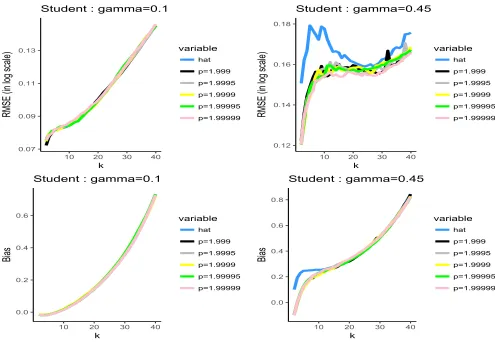
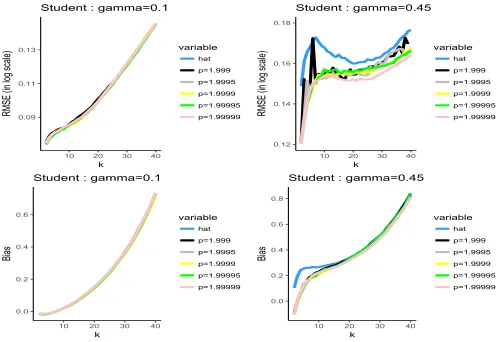
Figures 1 and 2, where we present the evolution of their relative MSE (in log scale) in terms of the valuek. We used
the same considerations as in Section 6 for the choice ofpγn and the intermediate and extreme expectile levelsτnand
τn1 αn. The experiments employ the Fr´echet, Pareto and Student distributions with tail-indices γ P t0.1,0.45u
and various values ofpP p1,2qin the formulation (13) ofqqp αnp2q.
In the case of Fr´echet and Pareto distributions, we already know thatrqαWnp2qbehaves better thanqpWαnp2qin terms of relative MSE. In this case, it turns out that the accuracy of the estimatorqqpαnp2qis also superior toqp
W
αnp2qand