Source Code: Automatic C Library Wrapping
Ctypes from the Trenches
Guy K. Kloss Computer Science
Institute of Information & Mathematical Sciences Massey University at Albany, Auckland, New Zealand
Email: [email protected]
At some point of time many Python developers at least in computational science will face the situation that they want to interface some natively compiled library from Python. For binding native code to Python by now a larger variety of tools and technologies are available. This paper focuses on wrapping shared C libraries, using Python's default Ctypes, with the help of the matching source code generator from CtypesLib.
Keywords: Python, Ctypes, wrapping, automation, code generation.
1 Overview
One of the grand fundamentals in software engineering is to use the tools that are best suited for a job, and not to decide on an implementation prematurely. That is often easier said than done, in the light of some complimentary requirements (e. g. rapid/easy implementation vs. the need for speed of execution or vs. low level access to hardware). The traditional way of binding native code to Python through extending or embedding is quite tedious and requires lots of manual coding in C. This paper presents an approach using Ctypes [1], which is by default part of Python since version 2.5.
As an example the creation of a wrapper for the LittleCMS colour management library [2] is outlined. The library oers excellent features, and ships with ocial Python bindings (us-ing SWIG [3]), but unfortunately with several shortcom(us-ings (incompleteness, un-Pythonic API, complex to use, etc.). So out of need and frustration the initial steps towards alternative Python bindings were undertaken.
In this case the C library is facilitated from Python through code generation. The generated code is rened in an API module to meet the desired functionality of the wrapper. As the library is anything but Pythonic, an object oriented wrapper API for the library that features qualities we love is built on top.
A more complete description of the wrapping process can be found in the corresponding article in The Python Papers [4].
2 Requirements
The work presented in this paper is based on wrapping the LittleCMS colour management library in version 1.16. It has also been used together with version 1.17, which required only the most minor tweaks, mainly on unit tests.
GCCXML is available. This version requires either the ctypeslib-gccxml-0.9 branch of CtypesLib or a recent snapshot of the development branch.
Finally, for the execution of the wrapper libraries the Ctypes as well as the NumPy1 modules are required. Implementing the wrappers dierently, one can avoid using NumPy at the expense of a largely sacriced convenience when operating on (larger) array structures. The Python Imaging Library (PIL)2may be a suitable companion for experimenting with images in using the presented bindings.
3 The Code
This code is free software: you can redistribute and/or modify it under the terms of the GNU Lesser General Public License as published by the Free Software Foundation, either version 3 of the License, or (at your option) any later version.
3.1 Code Generator
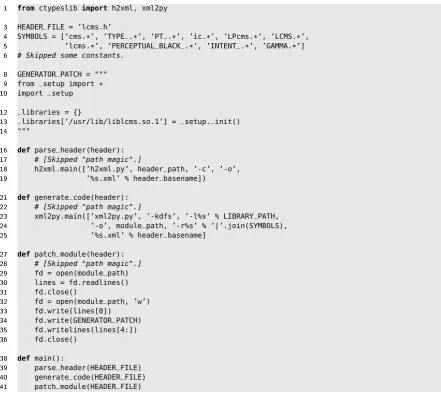
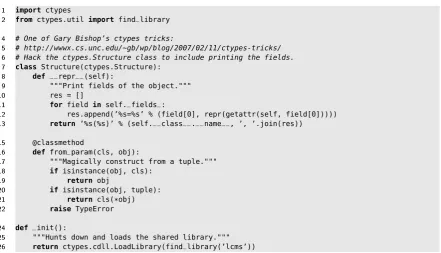
The author of Ctypes is developing CtypesLib. It contains a code generator in the modules ctypeslib.h2xml and ctypeslib.xml2py. These can be called manually, or from a generator script (Fig. 1) with the proper parameters for the task to automate the process. The header is parsed (lines 1619), and a Python binding module is generated into a module _lcms (lines 2125). For some deeper modications code needs to be evaluated before the bindings are dened. For this purpose the generator patches (lines 2736) the generated module_lcmsby injecting the code from _setup.py(Fig. 2).
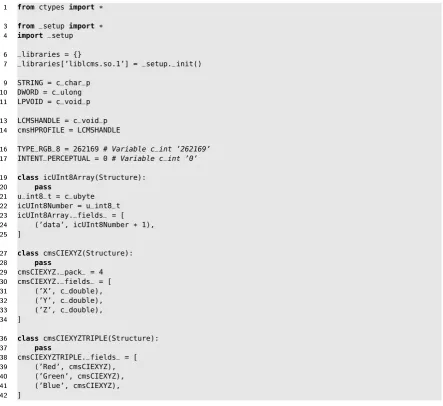
Some excerpts of the quite extensive generated code from _lcms.py is shown in Fig. 3. Lines 37 have been patched into it by the code generator in place of three original lines. Some general (lines 911) as well as some library specic simple data types are dened (lines 1314). Constants (explicit and computed from C pre-processor macros) are as well dened (lines 1617). In the following of Fig. 3 are several more complex type denitions from C structures. These are mostly dierent data containers that can be used as buer types (icUInt8Array or cmsCIEXYZ) for thecmsDoTransform()function after casting toLPVOID(see lines 1316 in Fig. 9). cmsCIEXYZTRIPLE in contrast shows a nested data type as it would be used e. g. to describe the absolute colourimetric values of a device's primary colours (as a camera).
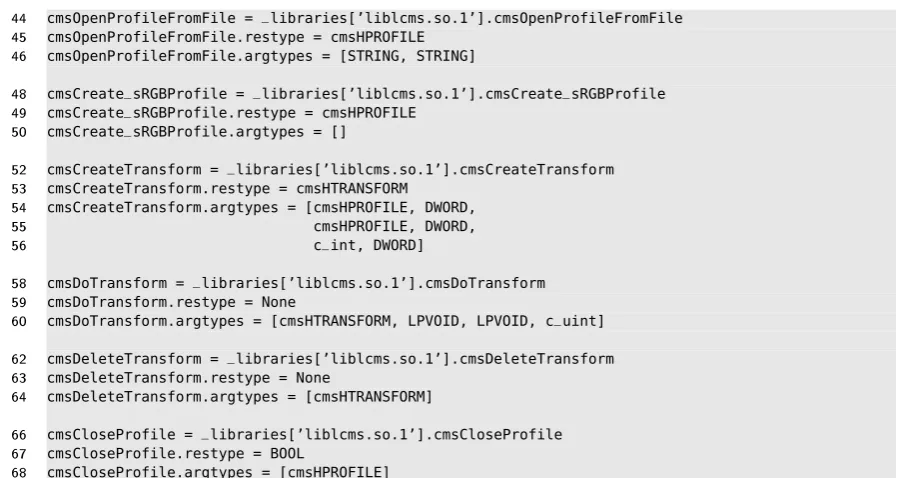
Fig. 4 shows the generated signature denitions for calling wrapped C functions. All C functions used in the sample application in Fig. 9 are shown. Basically a callable Python object is bound to an exposed stub in the library. The attributeargtypesdescribes a list of the calling parameter types, whereasrestypedescribes the type of the returned value.
3.2 The API
3.2.1 c_lcms.py
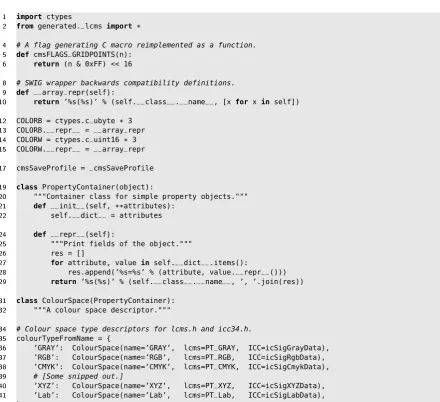
Some features of the original SWIG API have not been mapped identically through the code generation. These issues and some helpers are taken care of in the end user C binding APIc_lcms as shown in excerpts in Fig. 5. The rst lines import the whole generated name space _lcms. A pre-processor macro's functionality is mapped through a function (lines 46), some missing data types are created (lines 1215) and equipped with a nice output representation (lines 810). Also some SWIG naming tweak is emulated (line 17).
Colour space type descriptors are used in a human readable verbatim form (as a string), an integer constant fromlcms.has well as one from the required icc34.h. These corresponding con-stants are stored in an easy to handle Python dictionary containing ColourSpace objects, which
1http://numpy.scipy.org/
1 from ctypeslib import h2xml, xml2py
3 HEADER_FILE = ’lcms.h’
4 SYMBOLS = [’cms.*’, ’TYPE_.*’, ’PT_.*’, ’ic.*’, ’LPcms.*’, ’LCMS.*’, 5 ’lcms.*’, ’PERCEPTUAL_BLACK_.*’, ’INTENT_.*’, ’GAMMA.*’] 6 # Skipped some constants.
8 GENERATOR_PATCH = """ 9 from _setup import * 10 import _setup
12 _libraries = {}
13 _libraries[’/usr/lib/liblcms.so.1’] = _setup._init() 14 """
16 def parse_header(header): 17 # [Skipped "path magic".]
18 h2xml.main([’h2xml.py’, header_path, ’-c’, ’-o’,
19 ’%s.xml’ % header_basename])
21 def generate_code(header): 22 # [Skipped "path magic".]
23 xml2py.main([’xml2py.py’, ’-kdfs’, ’-l%s’ % LIBRARY_PATH, 24 ’-o’, module_path, ’-r%s’ % ’|’.join(SYMBOLS),
25 ’%s.xml’ % header_basename]
27 def patch_module(header): 28 # [Skipped "path magic".] 29 fd = open(module_path) 30 lines = fd.readlines() 31 fd.close()
32 fd = open(module_path, ’w’) 33 fd.write(lines[0])
34 fd.write(GENERATOR_PATCH) 35 fd.writelines(lines[4:]) 36 fd.close()
38 def main():
[image:3.595.83.525.111.504.2]39 parse_header(HEADER_FILE) 40 generate_code(HEADER_FILE) 41 patch_module(HEADER_FILE)
Figure 1: Essential parts of the code generator.
in turn contain the dierent representations(lines 3542). ColourSpace gets its functionality from PropertyContainer(lines 1929).
3.2.2 littlecms.py
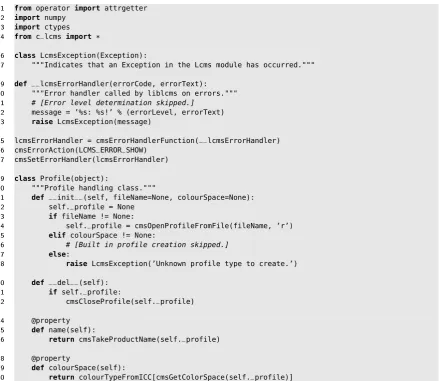
littlecms.py(see Fig. 6) nally contains the object oriented and Pythonic parts of the end user API. First of all a handler that is called by the native library on all errors is dened and assigned (lines 613). The error handler also raises anLcmsException.
TheProfileclass loads proles from the le system, or creates embedded ones from the built-in library built-in the constructor (lbuilt-ines 2128), which it also removes whenever the Profile object is discarded (lines 3032). Furthermore, it reveals the prole name as well as colourSpace attribute information (lines 3440) through object introspection and use of theColourSpacehelper structures dened inc_lcms.
1 import ctypes
2 from ctypes.util import find_library
4 # One of Gary Bishop’s ctypes tricks:
5 # http://wwwx.cs.unc.edu/~gb/wp/blog/2007/02/11/ctypes-tricks/ 6 # Hack the ctypes.Structure class to include printing the fields. 7 class Structure(ctypes.Structure):
8 def __repr__(self):
9 """Print fields of the object."""
10 res = []
11 for field in self._fields_:
12 res.append(’%s=%s’ % (field[0], repr(getattr(self, field[0])))) 13 return ’%s(%s)’ % (self.__class__.__name__, ’, ’.join(res))
15 @classmethod
16 def from_param(cls, obj):
17 """Magically construct from a tuple.""" 18 if isinstance(obj, cls):
19 return obj
20 if isinstance(obj, tuple): 21 return cls(*obj)
22 raise TypeError
24 def _init():
[image:4.595.85.527.109.362.2]25 """Hunts down and loads the shared library.""" 26 return ctypes.cdll.LoadLibrary(find_library(’lcms’))
Figure 2: Essential parts of the_setupmodule used for patching the generated code in_lcms.py.
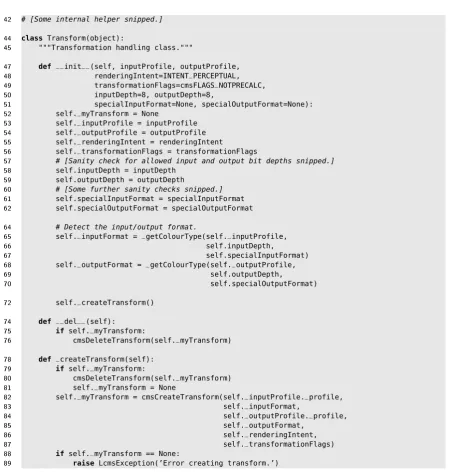
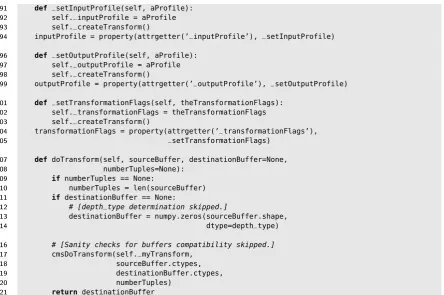
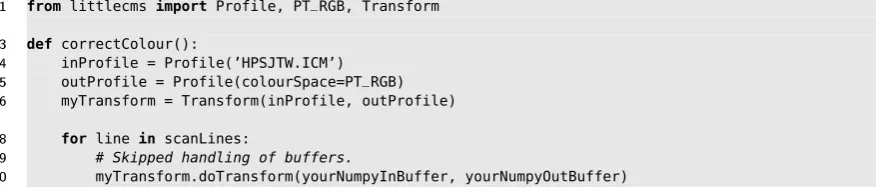
the library. Besides several sanity checks for robustness it implements an automatic detection of the involved colour spaces through the before mentioned prole introspection (lines 6470). The cre-ation of the actual (internal) transformcre-ation structure is located in the function_createTransform() (lines 7889). The reason is, that on every update of an attribute of aTransforminstance this trans-form structure needs to be disposed and replaced by a new one. Management of this functionality is hidden through use of thepropertydecorator together with theoperator.attrgetterfunction (Fig. 8, lines 91105). This way operations are exposed to the end user as if they were simple attributes of an object that can be assigned or retrieved without the need of any helper methods. Finally, for thedoTransform()method (lines 107121) in absence of a setdestinationBuffera buer of a suitable type, size and shape will be created. This way thedoTransform() method can be used in the way of an assignment operation, returning a suitablenumpy array. Alternatively, it can be called with input and output buers, or even with an output buer which is identical with the input buer. In the latter case an in-place transformation will be performed, overwriting the input data with the transformed colour representation.
3.3 Examples
1 from ctypes import *
3 from _setup import * 4 import _setup
6 _libraries = {}
7 _libraries[’liblcms.so.1’] = _setup._init()
9 STRING = c_char_p 10 DWORD = c_ulong 11 LPVOID = c_void_p
13 LCMSHANDLE = c_void_p 14 cmsHPROFILE = LCMSHANDLE
16 TYPE_RGB_8 = 262169 # Variable c_int ’262169’ 17 INTENT_PERCEPTUAL = 0 # Variable c_int ’0’
19 class icUInt8Array(Structure):
20 pass
21 u_int8_t = c_ubyte 22 icUInt8Number = u_int8_t 23 icUInt8Array._fields_ = [ 24 (’data’, icUInt8Number * 1), 25 ]
27 class cmsCIEXYZ(Structure):
28 pass
29 cmsCIEXYZ._pack_ = 4 30 cmsCIEXYZ._fields_ = [ 31 (’X’, c_double), 32 (’Y’, c_double), 33 (’Z’, c_double), 34 ]
36 class cmsCIEXYZTRIPLE(Structure):
37 pass
[image:5.595.83.527.112.518.2]38 cmsCIEXYZTRIPLE._fields_ = [ 39 (’Red’, cmsCIEXYZ), 40 (’Green’, cmsCIEXYZ), 41 (’Blue’, cmsCIEXYZ), 42 ]
Figure 3: Edited excerpts from_lcms.py.
44 cmsOpenProfileFromFile = _libraries[’liblcms.so.1’].cmsOpenProfileFromFile 45 cmsOpenProfileFromFile.restype = cmsHPROFILE
46 cmsOpenProfileFromFile.argtypes = [STRING, STRING]
48 cmsCreate_sRGBProfile = _libraries[’liblcms.so.1’].cmsCreate_sRGBProfile 49 cmsCreate_sRGBProfile.restype = cmsHPROFILE
50 cmsCreate_sRGBProfile.argtypes = []
52 cmsCreateTransform = _libraries[’liblcms.so.1’].cmsCreateTransform 53 cmsCreateTransform.restype = cmsHTRANSFORM
54 cmsCreateTransform.argtypes = [cmsHPROFILE, DWORD,
55 cmsHPROFILE, DWORD,
56 c_int, DWORD]
58 cmsDoTransform = _libraries[’liblcms.so.1’].cmsDoTransform 59 cmsDoTransform.restype = None
60 cmsDoTransform.argtypes = [cmsHTRANSFORM, LPVOID, LPVOID, c_uint]
62 cmsDeleteTransform = _libraries[’liblcms.so.1’].cmsDeleteTransform 63 cmsDeleteTransform.restype = None
64 cmsDeleteTransform.argtypes = [cmsHTRANSFORM]
66 cmsCloseProfile = _libraries[’liblcms.so.1’].cmsCloseProfile 67 cmsCloseProfile.restype = BOOL
[image:6.595.77.527.110.349.2]68 cmsCloseProfile.argtypes = [cmsHPROFILE]
Figure 4: _lcms.pycontinued: Edited excerpts of function denitions.
References
[1] T. Heller, Python Ctypes Project, http://starship.python.net/crew/theller/ctypes/, last ac-cessed December 2008.
[2] M. Maria, LittleCMS project, http://littlecms.com/, last accessed January 2009.
[3] D. M. Beazley and W. S. Fulton, SWIG Project, http://www.swig.org/, last accessed De-cember 2008.
1 import ctypes
2 from generated._lcms import *
4 # A flag generating C macro reimplemented as a function. 5 def cmsFLAGS_GRIDPOINTS(n):
6 return (n & 0xFF) << 16
8 # SWIG wrapper backwards compatibility definitions. 9 def __array_repr(self):
10 return ’%s(%s)’ % (self.__class__.__name__, [x for x in self])
12 COLORB = ctypes.c_ubyte * 3 13 COLORB.__repr__ = __array_repr 14 COLORW = ctypes.c_uint16 * 3 15 COLORW.__repr__ = __array_repr
17 cmsSaveProfile = _cmsSaveProfile
19 class PropertyContainer(object):
20 """Container class for simple property objects.""" 21 def __init__(self, **attributes):
22 self.__dict__ = attributes
24 def __repr__(self):
25 """Print fields of the object."""
26 res = []
27 for attribute, value in self.__dict__.items():
28 res.append(’%s=%s’ % (attribute, value.__repr__())) 29 return ’%s(%s)’ % (self.__class__.__name__, ’, ’.join(res))
31 class ColourSpace(PropertyContainer): 32 """A colour space descriptor."""
34 # Colour space type descriptors for lcms.h and icc34.h. 35 colourTypeFromName = {
36 ’GRAY’: ColourSpace(name=’GRAY’, lcms=PT_GRAY, ICC=icSigGrayData), 37 ’RGB’: ColourSpace(name=’RGB’, lcms=PT_RGB, ICC=icSigRgbData), 38 ’CMYK’: ColourSpace(name=’CMYK’, lcms=PT_CMYK, ICC=icSigCmykData),
39 # [Some snipped out.]
[image:7.595.84.525.199.601.2]40 ’XYZ’: ColourSpace(name=’XYZ’, lcms=PT_XYZ, ICC=icSigXYZData), 41 ’Lab’: ColourSpace(name=’Lab’, lcms=PT_Lab, ICC=icSigLabData), 42 }
1 from operator import attrgetter 2 import numpy
3 import ctypes 4 from c_lcms import *
6 class LcmsException(Exception):
7 """Indicates that an Exception in the Lcms module has occurred."""
9 def __lcmsErrorHandler(errorCode, errorText):
10 """Error handler called by liblcms on errors.""" 11 # [Error level determination skipped.]
12 message = ’%s: %s!’ % (errorLevel, errorText) 13 raise LcmsException(message)
15 lcmsErrorHandler = cmsErrorHandlerFunction(__lcmsErrorHandler) 16 cmsErrorAction(LCMS_ERROR_SHOW)
17 cmsSetErrorHandler(lcmsErrorHandler)
19 class Profile(object):
20 """Profile handling class."""
21 def __init__(self, fileName=None, colourSpace=None):
22 self._profile = None 23 if fileName != None:
24 self._profile = cmsOpenProfileFromFile(fileName, ’r’) 25 elif colourSpace != None:
26 # [Built in profile creation skipped.]
27 else:
28 raise LcmsException(’Unknown profile type to create.’)
30 def __del__(self):
31 if self._profile:
32 cmsCloseProfile(self._profile)
34 @property 35 def name(self):
36 return cmsTakeProductName(self._profile)
38 @property
39 def colourSpace(self):
[image:8.595.86.527.217.598.2]40 return colourTypeFromICC[cmsGetColorSpace(self._profile)]
42 # [Some internal helper snipped.]
44 class Transform(object):
45 """Transformation handling class."""
47 def __init__(self, inputProfile, outputProfile,
48 renderingIntent=INTENT_PERCEPTUAL,
49 transformationFlags=cmsFLAGS_NOTPRECALC,
50 inputDepth=8, outputDepth=8,
51 specialInputFormat=None, specialOutputFormat=None): 52 self._myTransform = None
53 self._inputProfile = inputProfile 54 self._outputProfile = outputProfile 55 self._renderingIntent = renderingIntent
56 self._transformationFlags = transformationFlags
57 # [Sanity check for allowed input and output bit depths snipped.] 58 self.inputDepth = inputDepth
59 self.outputDepth = outputDepth
60 # [Some further sanity checks snipped.]
61 self.specialInputFormat = specialInputFormat 62 self.specialOutputFormat = specialOutputFormat
64 # Detect the input/output format.
65 self._inputFormat = _getColourType(self._inputProfile,
66 self.inputDepth,
67 self.specialInputFormat)
68 self._outputFormat = _getColourType(self._outputProfile,
69 self.outputDepth,
70 self.specialOutputFormat)
72 self._createTransform()
74 def __del__(self):
75 if self._myTransform:
76 cmsDeleteTransform(self._myTransform)
78 def _createTransform(self):
79 if self._myTransform:
80 cmsDeleteTransform(self._myTransform)
81 self._myTransform = None
82 self._myTransform = cmsCreateTransform(self._inputProfile._profile,
83 self._inputFormat,
84 self._outputProfile._profile,
85 self._outputFormat,
86 self._renderingIntent,
87 self._transformationFlags)
88 if self._myTransform == None:
[image:9.595.79.529.162.635.2]89 raise LcmsException(’Error creating transform.’)
91 def _setInputProfile(self, aProfile):
92 self._inputProfile = aProfile 93 self._createTransform()
94 inputProfile = property(attrgetter(’_inputProfile’), _setInputProfile)
96 def _setOutputProfile(self, aProfile):
97 self._outputProfile = aProfile 98 self._createTransform()
99 outputProfile = property(attrgetter(’_outputProfile’), _setOutputProfile)
101 def _setTransformationFlags(self, theTransformationFlags):
102 self._transformationFlags = theTransformationFlags 103 self._createTransform()
104 transformationFlags = property(attrgetter(’_transformationFlags’),
105 _setTransformationFlags)
107 def doTransform(self, sourceBuffer, destinationBuffer=None,
108 numberTuples=None):
109 if numberTuples == None:
110 numberTuples = len(sourceBuffer) 111 if destinationBuffer == None:
112 # [depth_type determination skipped.]
113 destinationBuffer = numpy.zeros(sourceBuffer.shape,
114 dtype=depth_type)
116 # [Sanity checks for buffers compatibility skipped.] 117 cmsDoTransform(self._myTransform,
118 sourceBuffer.ctypes,
119 destinationBuffer.ctypes,
120 numberTuples)
[image:10.595.83.528.125.420.2]121 return destinationBuffer
Figure 8: littlecms.pycontinued: Edited extract fromlittlecms.py. Alterations ofTransformobject anddoTransform()method.
1 from c_lcms import *
3 def correctColour():
4 inProfile = cmsOpenProfileFromFile(’HPSJTW.ICM’, ’r’) 5 outProfile = cmsCreate_sRGBProfile()
7 myTransform = cmsCreateTransform(inProfile, TYPE_RGB_8,
8 outProfile, TYPE_RGB_8,
9 INTENT_PERCEPTUAL, 0)
11 for line in scanLines:
12 # Skipped handling of buffers.
13 cmsDoTransform(myTransform,
14 ctypes.byref(yourInBuffer),
15 ctypes.byref(yourOutBuffer),
16 numberOfPixelsPerScanLine)
18 cmsDeleteTransform(myTransform) 19 cmsCloseProfile(inProfile) 20 cmsCloseProfile(outProfile)
[image:10.595.84.522.501.693.2]1 from littlecms import Profile, PT_RGB, Transform
3 def correctColour():
4 inProfile = Profile(’HPSJTW.ICM’) 5 outProfile = Profile(colourSpace=PT_RGB) 6 myTransform = Transform(inProfile, outProfile)
8 for line in scanLines:
9 # Skipped handling of buffers.
[image:11.595.87.527.364.461.2]10 myTransform.doTransform(yourNumpyInBuffer, yourNumpyOutBuffer)